An African Tribal version of the Litter Drummer boy, from Alex Boye, with a modern visual story.
Month: December 2025

Okay, so maybe I’m a bit nuts
After my fall this morning, I really didn’t think I’d be up to doing much of anything for the rest of the day. I still think I’m really going to be feeling it tomorrow…
… and yet…
I ended up falling asleep for something like four hours. Checking my knees, my right knee has some swelling, though not at bad as I thought. I’m sure the anti-inflammatories have made a difference! I can take these up to three times a day, and I now have a 3 months supply. I’ve been taking them only once a day, if at all, so I can take more without any concerns of running out.
Much to my surprise, while my left knee is also starting to let me know that it got hurt, too, I am not in pain, in a general sense. It only hurts when something touches my knee, even if it’s just a cat tail brushing against my knee as I walk by. I’m definitely developing quite the bruise on my right knee.
The left side of my body is also letting me know it’s not happy. This is the side that I hurt the most when I had my fall in the summer. My left shoulder in particular has never really recovered from that. After landing on my right knee, it was my left side that hit the floor – after I bounced off that bucket – so it’s no surprise that my left side is feeling it more.
Still, after my nap, I felt really good. I am not limping, but I already hobble because of the OA and bone spurs in my feet, knees and hips, so I’m just penguin walking a bit more. Walking doesn’t hurt, but WOW am I thankful for all those arm bars that were installed for my late father. I need those at the best of time, and now is not the best of times! I’ve also got the cane with feet that stands on its own at my bedside. I don’t need to use the cane for walking, but I can use it to help me get up and down from my bed.
My daughters took care of changing all the litter boxes today, but a path to the litter pellet compost pile had to be cleared. When my daughter headed out to start on that, I headed out, too. I actually felt good enough to shovel more!
While getting the shovel down from where we hang it in the sun room, I realized that I didn’t actually trip on the cat carrier after all. Even with my fogged up glasses, I knew where it way. What I couldn’t see was the open door, and that’s what my foot caught on.
The carrier has been repositioned! We keep the carriers in various places in the sun room so the cats associate them with safety and comfort, so I didn’t want to move it out entirely.
One of the areas I worked on was the cat paths. Part of this was done this morning, before my fall.
I cleaned up the path to to the catio, then made a new path around all the shelters. This gives access to the little solar panels for the motion sensor lights inside the water bowl and kibble shelters, so we can clear them of snow as needed. I also cleared a second path to the catio shelter.
In the last picture of the above slide show, you can see the path the cats have made in the snow, to where they can get under the storage house. I’ve started to clear a path that way, but not very far, yet. Over time, we will clear a path to the corner of the storage house, and also redo the path to the fire pit and wood piles, so we can use it.
My daughter, meanwhile, was going the much bigger job of clearing turn around space, after making the path to the litter compost pile.
While she struggled with little Spewie, I was able to go behind her and use the snow shovel to break up the packed snow that had formed at the top. Some areas were drifted higher than Spewie is tall, so breaking that up made it easier for the little snow blower to get at it. In between passes, I cleared out a corner at the sidewalk area. This way, once pulled up to the house, we’ll have more room to open the doors and walk around it, while carrying things.
We didn’t finish the job completely, as it was starting to get pretty dark. My daughter has issues with working in the cold, as breathing cold air triggers coughing fits and hurts her lungs. She was wearing a home sewn cloth mask, but it’s snug against her face. Which means it quickly got very wet, resulting in her breathing in her own condensation. My new coat, when zipped all the way up, has a collar that reached up to my nose. That creates a warm bubble of air that prevents coughing fits. My daughter’s coat doesn’t have that. We need to find something she can wear while outside that will created the warm air bubble, but doesn’t touch her face.
Right now, we have enough space for the truck to turn around, though I still want to round out a corner, at the very least. After that, we have some turn around areas in front of the garage I want to widen a bit. I had a chance to walk around the outer yard before heading inside. My brother cleared enough in the outer yard to drive up to the barn, as well as their trailer and camper. He even cleared a path to the electric meter for me, so I can access it to do a reading.
While working on the inner yard, I could see where deer were digging around the the flower and haskap bed between the sidewalk and the vehicle gate. While walking around where my brother had cleared the snow, I found evidence showing the deer were using the cleared paths to get around, too! Much easier than fighting through the deep snow. 😁
Once everything was put away, we came inside to hot tea my older daughter made for us – turmeric and ginger tea, for me! The Instant Pot stew that was started before we headed outside had just finished and was depressurizing, so we had hot food waiting for us as well.
So far, I’m still feeling good, though I can feel I’m stiffening up. I did take more anti-inflammatories and painkillers with my supper, so that should help.
Hard to believe it’s just a couple more days before we start our Christmas activities on Christmas Eve and Christmas day. I’m still focused on digging things out, and have left all the decorating and such to my daughters. Not that we do much of that anymore, and what we do is limited to the cat free zone, AKA, the living room. It’s going to be a quiet Christmas this year.
We’re all good with that, anyhow!
The Re-Farmer
Share this:
Fallen
Well, crud.
I managed to do a bit of shoveling after my morning rounds. I was going to head in and grab breakfast before going back out to use our little snow blower to widen some areas my brother cleared yesterday and clear more paths in the snow.
My glasses fogged up while I was putting away the snow shovel in the sun room. I thought I was good to step around a cat carrier on the floor.
I was wrong.
My foot caught on the open door and tripped me up. I fell hard on the concrete floor. My right knee getting the worst of it.
I’m not injured, thankfully, but I know I need to stay off it. I’ve taken my anti inflammatories (I was able to skip them last night) and pain killers with my breakfast. My daughters are going to have to take over the outside stuff for me.
Meanwhile, my daughter has treated the most affected joints with Voltaren, and made sure I have a cane handy, if necessary.
I did remember to contact the garage about the truck. While doing my morning rounds, I took the charger off (the battery was fully charged) but didn’t have my key, so I didn’t test anything. The garage recommended a trickle charger rather than a battery warmer. Depending on the brand, that costs about $150-200. I’m looking to book an appointment after New Year’s to get a diagnostic and, if the battery checks out okay, see about getting a trickle charger installed.
For now, it’s time to lie down. I’m going to have to find that balance between resting my joints, and moving them around to keep them from stiffening up. I didn’t land on my hands, but more my elbows. I also hit a small bucket on the way down – how I managed that is a feat, considering where it was tucked aside – shattering the plastic, made brittle by the cold.
What a way to start the day.
The Re-Farmer
Share this:
Gloria!
Yesterday was not just the Fourth Sunday of Advent, but also the winter solstice. Last night was the longest night of the year. From how on, our days will finally start getting a little bit longer!
I’m really going to enjoy that.
I also hope you’ll enjoy this very enthusiastic version of Angels We Have Heard on High. When I was a kid, I used to love belting out the Gloria. I certainly didn’t match how Vasc does it, though!
Share this:
Love
Today is the Fourth Sunday of Advent, the day of Love. The fourth candle on the Advent wreath is also known as the angel candle.
Thanks to RabbelRousserRuminations Weblog for sharing this amazing rendition of Gabriel’s Message.
Share this:
First stock up shop: this is what $588 total looks like (plus an update)
Almost.
Today, my daughter and I headed into the city to do our combination last shop before Christmas and first stock up shop for January. After this, we don’t plan to do our Costco stock up shop until after New Year’s.
Our original plans changed a bit, though.
We waited until a bit later to start heading out, since it was still -30C/-22F at the time we normally would have headed out. As we were part way to my mother’s town, the check engine light turned on.
*sigh*
When we reached town, we pulled over in a gas station parking lot, so I could hook up the OBDII scanner. The scan is done with the key in that half way position, when things are on, but the engine is not running.
Which is when my onboard computer suddenly popped up a message, saying the batter was low and to turn on the engine!
Which I did.
The scan, however, came up with a code for an air-fuel ratio imbalance. Checking the details, this turns out to be a common code for our vehicle. The top reported fix is to replace the O2 sensor.
Did that mean we could still head into the city??
I knew my brother was on his way to the farm and would have his hands free set up, so I ended up calling him. I told him what we were finding. For the sensor, he suggested it could even just be that snow got in, but we should be fine with driving it. As for the battery, the gauge showed it was charging, so we should be okay with driving to the city.
Our first stop was Canadian Tire anyway, and their garage would be open (being Sunday, no local garages would be open), so I could see if they could check it/work on it, depending on how busy they were.
Of course, that made me absolutely paranoid for the rest of the driving!
Once there, I headed in ahead of my daughter, who was a sweetheart and paused to get some ice off from around the wiper blades. It kept rattling during the drive, which made me even more paranoid, because where the sound was coming from made us think it was the engine until we spotted the moving ice.
After explaining to the guy at the counter what was going on, and showing him screen caps of my scan reading, he assured me the truck was safe to drive. They didn’t have a tech in that could work on it. Since I already scanned it and had the code, there was no need for them to scan it again, which would have cost me $125. But he could check the battery for me, if I could pull the truck up to the main bay door.
So I did that and he hooked up to the battery to test it. We did have to pause to I could move the truck out of the way of someone needing to get a vehicle into a bay, but it was still very quick. The battery was low, even after driving for about an hour, so he recommended I put it on a charger when I got home and to leave it overnight. Our charger has an auto shut off once the battery is fully charged, so that was a viable option. He assured me that the truck was okay to drive. As for the sensor, he told me he knew of people driving around for a year before replacing it, so we would be fine.
When he was done, I confirmed how I was to exit the bay area, then said I would go around to park, then come in to pay.
He don’t me, no charge!
That was so awesome of him! Granted, it was less than 5 minutes to check my battery, but he still could have charged me for it and I would have been okay with it!
My daughter, meanwhile, was in the store and had found the coat section. One of my goals for today was to get a replacement parka, now that my 30+ year old down filled parka is finally unwearable.
For a while there, I didn’t think I’d find one.
Their inventory only goes up to XXL, for starters. Even with men’s coats, I like extra room, so I would have preferred a larger size. Sizes, however are not standard, so that is another issue. Also, I’m a tank. A refrigerator. A block. Plus, I’m fat.
The first XXL parka she found, I couldn’t even finish getting my arms in, the shoulders were so tight. We went through the entire section and there were hardly any XXL at all, and none fit.
We were starting to head out, thinking I would try at the Walmart (I doubt I would have found anything there), when we spotted another coat section.
We had even less luck there.
Then we found a couple of display racks at the far end of the store.
I found all of one XL in there. The rest were smaller.
Then my daughter spotted coats in the hunting section.
Amazingly, we found several XXL!
The first one I tried did fit, though it was tight on the arms. Especially the biceps. I may be rotund, but I’ve also got guns, and this parka, warm as it was, barely fit over them.
So we kept looking. My daughter found one that was basically two jackets together, and you could separate them if you wanted a lighter jacket. That one was the worst designed coat I’ve ever tried! I had to get my daughter to help me take off one of the arms because the outside was trying to come off, while the inside layer was wanting to stick to my arm.
Finally, after much digging, we found one that fit. I bit more snug under the arms than I would have preferred, but that was just a matter of cut, not size.
Everything was mixed up, and there was no price on the tag, so I didn’t know if it was in budget. My daughter found someone that could scan the bar code, and it was only $100!
I was so happy!
We then headed to the checkout, where we also paid for the litter pellets we were there for. Those are stored in the vestibule on the way out, so my daughter went to start loading the cart, while I put on my new parka.
We got 4 bags of litter pellets, so the total was $145.55, but I only got a picture of my new parka, so this is what my $99.99 hunting jacket looks like.
My daughter was making all sorts of “where’s Mom? She’s hidden!” jokes.
Also, she requested I stick my arms out like a penguin for the picture. 😄
I had some concerns about how thin the coat was but, WOW, did that thing get warm, fast! I really appreciated how warm the hood was, even though it was really quite loose.
We did find it funny, though not really surprising, that the only coat I could find that fit was a hunting jacket.
Our original plan after Canadian Tire was to go to Walmart for kibble, then to a Superstore for the groceries, but with the truck concerns, I wanted to do as little starting and stopping at possible.
So, we did just the Walmart, instead.
We were originally going to go into the mall the Canadian Tire is part of for lunch, but completely forgot, so we did McRaunchies at Walmart for sustenance, instead.
That was $36 (with a donation to round it up to the nearest dollar). McRaunchies isn’t particularly cheap anymore! We didn’t get any sorts of extras, either. Just burgers, fries and drinks. *sigh*
Then, we finally got to shopping. Which was not fun at all. Granted, it wasn’t as crowed as I was afraid it would be, but it was busy enough and annoying enough that I completely forgot I was supposed to see if they had office/desk chairs in stock to replace my husband’s broken one. At least most people seemed pretty cheerful, and there were a lot of smiles to be shared.
My daughter had her own list and did her own shopping, so that’s not included. She finished and headed for the truck before I even got into line, where I found myself having a lovely chat with the elderly gentleman I let in front of me. He had just a few things in a hand basket, so I sure wasn’t going to make him get behind me in line!
This is what $442.24 looks like.
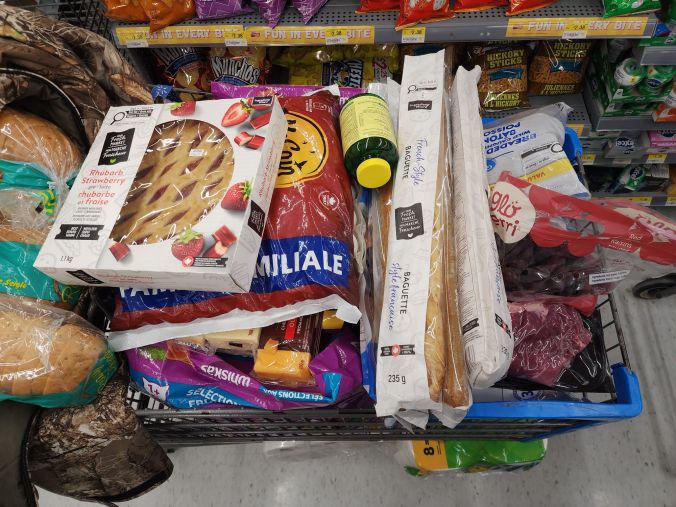
Most of that cart space is taken up with bags of kibble.
For our Christmas plans, we had decided on doing a lot of appetizers and finger foods, rather than our usual huge Christmas Eve wigilia (vigil) meal. I might still do a turkey for Christmas day, though, but we always do our main activities starting after sunset on Christmas Eve.
My daughter picked up some things for this on her budget, but this is what I got, along with regular stock up stuff.
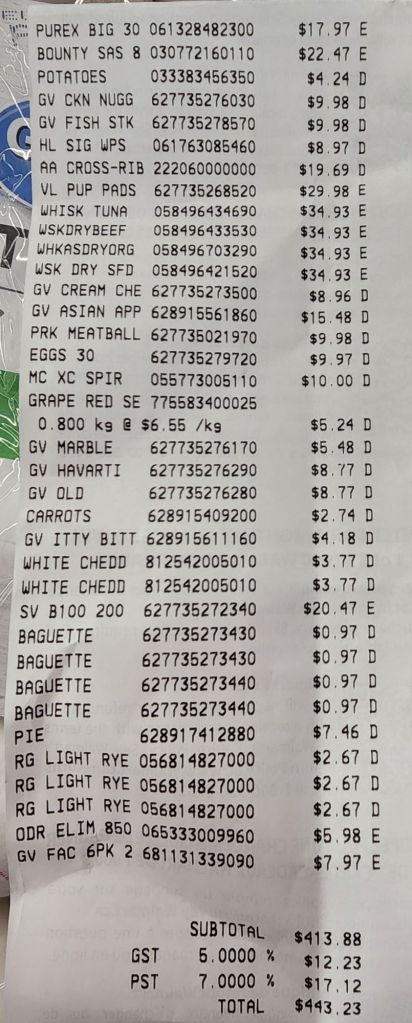
Of course, there were the basics. They had toilet paper on sale, so I picked some up. We still have plenty, but since we’re not going to Costco until later than usual, better to have extra on hand! I also got a large package of paper towels and a package of facial tissues.
For the cat supplies, I got XXL puppy pads (I was out of that size), odor eliminating pet stain powder for carpets (for when the cats manage to get past the puppy pads!) and four 9.1kg bags of kibble. We have enough wet cat food to last until Costco, so I skipped that on this trip.
That made up the bulk or things.
For food, I got a bag of potatoes, some carrots, grapes and that was it for produce. For dairy, I got marble, Havarti and Old Cheddar cheeses. The “white cheddar” on the receipt is popcorn seasoning.
I picked up three loaves of rye bread for regular eating, and four baguettes for New Year’s Eve – those are now in the freezer.
For heat and eats and finger foods, most of which are for Christmas Eve, I got chicken nuggets, fish sticks, cream cheese wontons, a variety pack of Asian appetizers, and meatballs.
There’s also a jar of “Itty Bitty” pickles and a strawberry rhubarb pie. I even remembered to get my B100 vitamins that I was out of. There’s a pack of frozen, extra crispy, curly fries, mostly for my husband, and they had cross rib roasts on sale, so I actually got some beef! I also got a package of frozen salmon filets for my daughters. I’d forgotten about those and it took me the longest time to figure out what HL SIG WPS was. 😄 High Liner Signature Cuts Wild Pacific Salmon.
As we’re still pretty much in the middle of the month, we are still pretty well stocked from last month’s shopping, so a lot of things are “missing” from our usual first stock up trip. The kibble needs to last either until our Costco trip, or until I can get to a feed store. I got four 40 pound bags of kibble last month, and we were almost completely out, after this morning’s yard cat feeding! Three of the bags I got today should last for the outside cats until I can properly stock up, and one bag is more than enough for us to last with the inside cats, as we still have a fair bit.
So, there was have it. A grand total of $588.78. $624.78, if you count lunch.
After that, it was time to head home. Once out of the city, we stopped at a gas station to fill the tank, pick up some drinks and snacks for the ride home. As we were returning to the truck, my daughter ran back in to use the washroom for the long drive home, so I moved the truck away from the pumps to a parking spot to wait for her.
Which is when I noticed.
The check engine light was gone.
Yay!!! Maybe it was just snow in the sensor, after all!
Even the gauge for the battery was where it normally is.
Everything stayed as normal for the drive home, which was a relief for both of us.
After we got home, we pulled up to the house to unload (my brother got a LOT of snow blowing done, including enough in the inner yard that we could drive up to the house). Then I fed the outside cats before moving the truck into the garage. While my brother cleared a path to the door, he didn’t clear enough to turn around, so I’ll work on that tomorrow. Backing up through down path was a test of my reverse driving skills, that’s for sure!
Once in the garage, I got out the battery charger and hooked it up, plugging it into the shop power bar that I use to plug the truck’s block heater into. The charger showed full charge so, while I fussed with the power bar so I could plug in the block heater, I wasn’t surprised when the charger shut off. I was in the process of putting it away when I realized that, while moving the power bar around, with all the cords so stiff in the cold, it accidentally got unplugged. So I plugged it back in, then got the charger set up again.
In that very short length of time, the battery already lost charge.
The battery is only 2 years old, but we don’t have a battery warmer. The cold may have damaged it.
I now have the charger set up for the night. It’ll shut itself off when the battery is charged, but will turn itself back on again, if the charge drops.
Tomorrow is Monday, so our local garage will be open. I plan to give them a call to talk about bringing the truck in for a diagnostic. I’m not too worried about that code that triggered the check engine light to turn on, but I am concerned about the battery.
At this point, the only driving I plan to do between now and after New Year’s, is to visit my mother at the hospital on Christmas day. My sister will be visiting on Christmas Eve, and my brother saw her today, on his way home from our place. I just found out that he broke a sheer pin on the snow blower. Thankfully, he was able to scavenge one from their other snow blower that isn’t running. When he was done, he tried to find a replacement in town. There was none to be had, but it did give him a chance to see my mother.
Once I was settled in, I called the hospital to see how my mother was doing. She was responding to the IV Lasix to reduce the swelling so well, they are no longer going to continue that for a week. She will be back to taking it in pill form.
I spoke to the guy for a while and remembered to tell them about my mother’s macular degeneration, and that it was getting worse, but we couldn’t transport her to the clinic in the city for treatment anymore. He thought we had an appointment and said they could arrange transportation, but I told him, the last appointment she had, we had to cancel it, so we haven’t made another appointment since then. It was good to know that they could have transporter her, though.
As we were talking, and he was telling me how great my mother was doing, I brought up her pain and mobility issues, saying that after this, she couldn’t go home anymore. He said, “yes”. Like, it was a given that she couldn’t live independently anymore.
This is the first time anyone actually said that.
He brought up having her paneled for long term care, and I told him, she’s been paneled. Twice. Once, just a couple of months ago. He sounded shocked to hear that. I told him, we aren’t understanding why she hasn’t been accepted.
I didn’t mention it, due to how much time it’s been, but it’s not due to lack of beds. During her last panel interview, the home care coordinator said there were beds available. It’s just that she wasn’t “needing” that much home care. That was part of why we added meal assists, bathing and dress assists, to her care plan. My mom did actually need them, but had been refusing them. Just like she has refused things like having a hospital bed, which she really needed.
He told me that, now that she’s in the hospital, she will stay there until they can find a space for her. The people in charge of those decisions will be in, tomorrow, so that would be the time to call and ask about it.
Hearing that was such a relief!
After talking to him, I asked to be transferred to my mother’s room so I could talk to her.
I tried to tell her about what the nurse told me, but she made that very, very hard! I would say a bit, and she would cut me off with a tangential rant. I’d manage a bit more, and she would cut me off again and go off in another directions. I kept saying, let me finish, and she just ignored me. I had to actually raise my voice and talk over her, several times, saying “let me finish” before she finally stopped.
I finally was able to tell her that she will be in the hospital until they can find a place for her in a nursing home.
Her immediate reaction?
Where?
Over the next while, I had to deal with her doing what she always does: be her own worst enemy. She even started to say how, with home care taking such good care of her, with her medications and her meals, and my doing her grocery shopping for her, she can manage just fine. Her vision loss isn’t a problem, because it doesn’t hurt.
She doesn’t want to be a bother…
…
I had to stop her and tell her – again -that she needs to stop making light of things. She can NOT go home after this. It’s just not safe for her.
I’m just so frustrated. She’s the one who started the push to be placed into a nursing home. This is what she wants, and what she needs. We’ve been fighting for this for two years and, and now that she is SO close to actually getting into long term care, suddenly she’s talking about how she’s fine in her own apartment.
I told her (again), that this is the time to say MORE about her physical issues, not less, or make light of them, or not tell the hospital staff about them at all.
I don’t know that I got through to her. She finally stopped cutting me off, but when she goes silent like that, it often means she completely disagrees and is planning to do the opposite of what she should be doing.
Hopefully, she won’t this time but, gosh, she makes it hard for us to help her at times!
Anyhow.
Tomorrow, I’ll be giving my new winter coat a real test. I plan to expand some of the areas my brother has cleared out with his snow blower, and clear out more paths in the yard. Little Spewie is going to get another work out! Some of the areas will need to be shoveled, though, so I’ll be getting a workout, too! We are expecting more snow tomorrow, but now they’re saying it won’t start until 6pm, and it’s full dark before 5pm these days, so that’s not going to be an issue.
While catching up with my brother and SIL after visiting my mother yesterday, my brother gave me strict instructions to NOT have a heart attack, with all the shoveling I’m doing! 😄 I’ll be sure to follow his instructions.
The main thing is, we can get in and out easily, and we are stocked up. Anything beyond that is gravy!
The Re-Farmer
Share this:

More digging out, and a visit to the hospital
The blowing snow we had yesterday wasn’t as much as the blizzard that preceded it, but this time the winds drifted over the driveway.
Last night was bad enough that my brother and SIL had friends staying the night, because it was too dangerous to drive home. All morning, we were keeping watch on the road conditions to see if we could actually meet up and visit my mother in the hospital today or not. When doing my morning rounds, I checked the driveway. The blown in snow was light enough that I could drive through it, right up to the gate. As frustrating as it was that all my clearing of the driveway as almost completely filled in, it would have been a lot worse if it hadn’t been done first.
The first problem I had, though, started before I even went outside in the first place. The old down filled coat I’ve been wearing and patching together is finally done and unwearable. I ended up layering, the borrowing my daughter’s coat, so I could clear the end of the driveway.
By the time that was done, my brother and SIL had also dug themselves out – the winds blasted right into the front of their townhouse, and encased their car in snow. We worked out some details, and I was going to go to my mother’s place, first, to get her some fresh clothes, etc. Then I was going to meet them at the hospital.
The first picture was taken after I cleared the end of the driveway. The road was not plowed again, but it was passable.
Before heading out, I called my mother to let her know we’d be visiting her and about when we’d arrive. I told her I was going to her place first, and she added some instructions.
She also still wanted one of her bubble packs. Which they can’t use. Turns out, she believes they are just giving her random pills. I pointed out (again) they have her med list; they just have a different source for their medications. They might look different, but they are the same medications. They know what she’s supposed to be taking.
To which she responded, “do you really think they’re that smart?”
…
*sigh*
How do you answer something like that? Other than, “yes!”
Anyhow.
As I was about to leave, I realized I had no room to back out of the garage. The wind had created such a smooth drift, I couldn’t really notice how far it extended past where I’d cleared, yesterday. I went back and got the shovel, clearing just enough that I could back out of the garage. Thankfully, it was still light and fluffy snow, and didn’t’ take long.
What you can’t tell in the second photo is that there’s at least another 6 feet of drifted snow over what had been cleared, yesterday.
While messaging with my brother, we worked that that, while my daughter and I are headed to the city tomorrow for our first January stock up shop, and the last shop before Christmas, he will be coming out here and getting one of his snow blowers going. It will be MUCH easier to clear the show with a gas powered snow blower than my little Spewie which, technically, is called an electric shovel, not a snow blower.
When heading out to my mother’s, I layered up with a couple of hooded jackets, so my daughter had her own winter coat to wear. She was planning on breaking Spewie out and getting the driveway done while I was gone. In the end, she wasn’t able to get very much cleared before she had to go back inside. Thankfully, with my brother coming out tomorrow, he should be able to get the rest cleared out.
The drive to my mother’s was touch and go. Visibility was good, for the most past (unlike other highways in the area), but there was a lot of packed snow and ice, making for some slow driving at times. I got to my mother’s place, checked on things, packed a bag for her, and was soon on my way again. I normally would have cut across from her town to a different highway to get to the hospital she’s at, but all the reports I was seeing what that route was far worse.
I still got there faster than my brother and SIL!
My mother was in bed when I got there, but sat up while we talked about what I brought. She was in need of a Voltaren rub on her back, which took some doing to accomplish. She then moved to a chair. The whole time, she was clearly in a lot of pain from her hip and back.
By the time my brother and SIL arrived, though, she had perked up quite a bit and was clearly happy for the company. After a while, I went to the nursing station to see what we could find out about how things were going, and the nurse caring for my mother that shift came to her room to update us.
They are restarting her on the IV Lasik to get the swelling down. That will be continued for another week. She talked about draining the fluids away from my mother’s heart. When I asked, she said the edema was due to congestive heart failure.
There’s a problem with that.
My mother doesn’t have congestive heart failure. It turns out they just assumed she did. Confirming it would require transporting her to the same hospital she recently had her MRI done, for a CT scan. We told the nurse, my mother’s heart has been checked out quite a few times (because she kept thinking she was having hear attacks that turned out to be acid reflux and heartburn), and her heart is incredibly healthy. Healthier than most people a quarter her age.
Meanwhile, all her vitals are right where they should be.
I had mentioned to the nurse yesterday that my mother can be her own worst enemy. She complains about the minor stuff, while making like of the major stuff. Even the minor stuff, she makes things worse for herself. She – once again – brought up the dry mouth issue. When the spray was suggested, she immediately said, oh, I just drink some water and it’s fine. So… why is she complaining? When the dry mouth spray was suggested, she tried turning it down. She’s on so many medications, you know. Once we figure what she was thinking, we told her, it’s not a medication. It’s just for her mouth to fee less dry. Once the nurse realized what the mix up was, she did offer to bring her a bottle of the dry mouth spray. Which is what she has at home, brought back from the last time she was in the hospital but refuses to use. She keeps bringing up the dry mouth, wants the doctor to somehow stop it from happening, but won’t actually do the things that will make it better.
Meanwhile, she tried to make light of the reason she was in the hospital. Like it was not an actual problem, compared to her dry mouth.
With days as short as they are, and the road conditions an issue, we didn’t stay too long. After saying our goodbyes to my mother, I was able to go to the pharmacy and drop off that signed paper they needed from my husband, then meet my brother and SIL at a nearby restaurant to catch up. We’re all quite concerned that when they reassess my mother a week from now, they’ll try discharging her to her home. That is simply not acceptable. She cannot live independently anymore. She could barely get out of bed and walk 4 steps today! According to my mother, she hasn’t even been seen by a doctor yet. Just an assistant.
It’s all so frustrating.
Still, we had a good time together and soon parted ways. I did make a point of stopping to pick up some take out for the whole family, then filling the gas tank, before heading home. By then, it was past sunset and the light was failing fast. I’d messaged ahead that I was on the way home, and my daughter met me to close the gate and help me bring things in – including a care package from my brother and SIL. They are so sweet!
So that’s where we stand now. Still up in the air about my mother.
With the road conditions as they are, I’ve been keeping an eye on the forecasts. I thought that maybe we could delay the city trip until Monday.
We’re getting more snow on Monday.
*sigh*
So, tomorrow it is.
I’m dreading going, but my daughter is coming along, and she is quite the sanity saver for me! I hate shopping at the best of times. Shopping this close to Christmas, in the city, is something I really try to avoid. We’ll be stocking up as much as we can, so that we can delay our second January stock up shop until after New Year’s, if possible!
If all goes well, I’ll find a new winter coat, too.
Oh, and we’ll be looking at bariatric office chairs. My husband’s chair suddenly – and loudly – reclined backwards and couldn’t straighten up again. After moving it around, we spotted the snapped bolt on the floor. It’s an old chair and was getting in pretty bad shape. We’d even replaced all the wheels on it – which will be salvaged, as they are really good wheels! Hopefully, there are some sales we can take advantage of. We shall see.
It’s going to be a busy day tomorrow.
The Re-Farmer
Share this:
Hark!
I remember this…
Here is a Polish Christmas carol I remember my mother singing.
It actually feels weird to hear the Three Tenors singing it. When my mother sang it, it was much faster and very lively.
Edit: Here are the lyrics, first in Polish, then the English translation.
Lulajże Jezuniu
[(refren:)]
Lulajże Jezuniu, moja Perełko,
Lulaj ulubione me Pieścidełko.
Lulajże Jezuniu, lulaj, że lulaj
A ty go matulu w płaczu utulaj
Zamknijże znużone płaczem powieczki,
Utulże zemdlone łkaniem usteczki.
[(refren)]
Lulajże, piękniuchny nasz Aniołeczku.
Lulajże wdzięczniuchny świata Kwiateczku.
[(refren)]
Lulajże, Różyczko najozdobniejsza,
Lulajże, Lilijko najprzyjemniejsza.
[(refren)]
Dam ja Jezusowi słodkich jagódek
pójdę z nim w Matuli serca ogródek.
[(refren)]
Dam ja Jezusowi z chlebem masełeka,
włożę ja kukiełkę w jego jasełka.
[(refren)]
Dam ja Ci słodkiego, Jezu, cukierka
rodzynków, migdałów z mego pudełka.
[(refren)]
Cyt, cyt, cyt niech zaśnie małe Dzieciątko
oto już zasnęlo niby kurczątko.
[(refren)]
Cyt, cyt, cyt wszyscy się spać zabierajcie,
mojego Dzieciątka nie przebudzajcie.
https://lyricstranslate.com/en/lulajze-jezuniu-hush-little-jesus.html
Hush little Jesus
[(Refrain:)]
Hush little Jesus, my little pearl,
Hush my favourite little delight.
Hush little Jesus, hush, hush
But you lovely mother, solace him in tears
Close your little eyelids, tired of weeping,
Solace the little lips, fainted from sobbing.
[(Refrain)]
Hush, our beautiful Angel.
Hush, you graceful little flower of the world.
[(Refrain)]
Hush, you most decorative little rose,
Hush, you most comfortable little lily.
[(Refrain)]
I’ll give Jesus sweet little berries
I’ll go with him into his Mother’s heart’s orchard.
[(Refrain)]
I’ll give Jesus a little butter with bread,
I’ll put a doll into his crib.
[(Refrain)]
I’ll give you, Jesus, a sweet goody
raisins, almonds from my little box.
[(Refrain)]
Hush! Hush! Hush! Let the sweet little child fall asleep
Here it has already fallen asleep like a little chicken.
[(Refrain)]
Hush! Hush! Hush! You all go to sleep now,
don’t wake up my sweet little child.
[(Refrain) ]
https://lyricstranslate.com/en/lulajze-jezuniu-hush-little-jesus.html
Share this:
We can get out now… for now
Knowing we had a pharmacy delivery coming – and more snow – as soon as I finished giving the outside cats their food and water, I headed to the garage to break out little Spewie.
I then spent the next 2 hours clearing enough space in front of the garage to be able to back the truck out and turn. Then I had to go in to warm up and have breakfast. My down filled coat was completely wet, so I ended up borrowing my daughter’s leather coat. It has no lining, but it cuts the wind completely, so the layers I had underneath were more than enough to keep me warm.
The first picture in the slide show above is what I got done in the morning. For a lot of it, I had to first break up the crust of snow at the top with a shovel before I could get through with little Spewie. With the wind, I was working only in one direction, so the wind could blow the snow away from me. I still got covered in snow, but at least it wasn’t as bad.
When I came about out to work on the driveway to the gate, I broke out a second 100′ extension cord. That was just enough to reach the gate. Thankfully, beyond the gate was blown clear. There was just the plow ridge at the end that needed dealing with.
Which I never got to. As I write this, my younger daughter is actually out there, working on it.
It took another 2-2 1/2 hours to get the driveway cleared to the gate. Dragging that much cord around sure didn’t make things easier! By the time I was done, the snow was starting to come down pretty hard. The wind was worse than the snow, though. I’d gone back to the gate with the shovel to work on the plow ridge but once at the gate, there are no longer any trees to block the wind, and it was just too brutal to keep going.
I discovered something while working on this. I have a step counter app on my phone. When I got in after the first 2 hours of walking back and worth, the app had me at a ridiculously low step count. I had my phone in my chest pocket, so there was no chance of snow getting in and getting it wet. It was so snug in there, it wasn’t counting most of my steps. When I headed out later, I had them in a pants pocket, but I had so many layers, it was still missing most of my steps. We’re talking off by thousands, not just a few steps here and there!
Once inside, I found someone had hung up on our answering machine. Caller ID told me it was the pharmacy, so I gave them a call. It was about the timing of our delivery. Even with the weather getting worse, the driver was already out! So I basically just stayed in my boots and my layers until I got the call from the driver that he was just a few minutes a day (something we have requested the driver does, since we keep the gate closed). I made sure to tell him I hadn’t been able to clear the plow ridge, so he might not be able to pull into our driveway. Then I bundled back up again to meet him at the gate. The plow ridge wasn’t too bad, but a bit much for a sedan, so he just pulled over on the road. As I asked him about road conditions, I noticed something extra on my husband’s bag of prescriptions.
Something that needed to be signed. With his meds including controlled substances, he has a form he (or I, on his behalf) needs to sign for them, once a year.
Neither of us had a pen.
So I brought it in and my husband signed it, then called the pharmacy about it. We hoped he could just take a picture and email that in, but they need the physical paper. He’s getting his bubble packs delivered next week, so we can give it then, or I can bring it over the next time I’m in town.
Which might be tomorrow.
My sister had called the hospital this morning and sent an update. My mother was finally no longer in ER, but in a room, where she has a TV and a phone. She was much happier! She’s going to be on IV for another day, and then… ???
Once I had the chance in the afternoon, I called the hospital again. The nurse I talked to had just checked on my mother, and she was napping.
I had a chance to talk to her about our concerns that she might be discharged to home, and that we felt she could not live independently anymore. We were hoping that, with her in the hospital, perhaps the doctor could make the decision, since home care wasn’t.
Now, when I say “home care” for this stuff, it’s not the local office that takes care of her visits, but a higher up office. Anything we do with the local office when it comes to paneling my mother for long term care gets sent to this higher department. That department is where everything has been stalled. My mother got paneled a second time, less than 2 months ago, and the local home care coordinator had heard nothing since she gave them the updated paperwork.
That department has a liaison in the hospital.
If the doctor thinks my mother needs to go into long term care, but the liaison disagrees, guess who has the final say?
Not the doctor.
The nurse completely understood when I expressed my frustration.
I did have a chance to tell her that my mother can be her own worst enemy. She will complain loudly about minor things, like her “dry mouth”, but it took us (including the home care workers) about a week or more to get her to finally use the Lifeline and get to a hospital.
Guess what my mother has been complaining about to the nurses?
Yup. Her dry mouth.
She can’t accept that she’s simply sleeping with her mouth open. She won’t use the spray. She won’t keep herself hydrated.
The problem with her complaining about the dry mouth is, she’s not talking about why she’s sleeping with her mouth open in the first place. She’s having trouble breathing when she lies down. This isn’t even a sleep apnea thing, because she struggled to breathe when the paramedics had her lying on her back for a few seconds before raising her up to a more seated position.
The nurse assured me that the doctor was aware of the situation. I knew I was forgetting something, and now that I’ve written this, I remember. I never mentioned her macular degeneration is getting worse, and we can’t even transport her to the specialty eye clinic in the city for treatment. She’s losing her vision. More reason for her to not be going home, but to go into long term care from the hospital.
Even the nurse was commenting that, when someone is approaching 100 years of age, like my mother is, they really should be able to just go into long term care if they want!
So I got that update from the nurse and passed info along to my family. My brother and I had already made plans to visit my mother tomorrow but, now that she’s in the hospital, we’re looking at going to her place to pick up some more clothes and whatnot for her, then going to visit her in the hospital.
Assuming the roads are open and cleared.
Then I got a surprise.
A phone call from my mother!
We had a chance to talk for quite a while. She actually sounded better than she has in quite a while. I told her that – then told her to try sounding sick! 😄
My mother being my mother, she had all her usual complaints. She used to work in a hospital 70-75 years ago, so she knows how they are supposed to be run, and always brings up the same thing. There’s always noise, day and night (I told her, she was in the ER. There’s no difference between day and night in the ER! But it should be better, now that she’s in a room). She can here the staff – and instead of using the word “laughing”, she starts to “laugh” in a very mocking and nasty way. She makes this complaint so often, it seems that hearing other people laugh is the thing about being in the hospital she hates the most. She doesn’t like the sound of other people being happy. As for being in a room now, she complained that she could hear another patient, calling for help.
She didn’t care that a patient needed help. She only cared that it was noise she didn’t want to hear.
Then she complained that she can’t tell the difference between a nurse and a janitor, because they all dress the same (she thinks they should be in those old style starched white uniforms, still).
Of course, she was also complaining about how they are giving her her medications. They look different (different pharmacy, different supplier), so she doesn’t think they are the right medications. There was one that she takes at bed time that they didn’t give her until the morning, so that’s another thing that made her believe they are giving her the wrong medications, different medications, they don’t know what they are doing…
If there’s any sign that my mother is feeling better, it’s that she’s hating on everyone around her again.
When I mentioned to her that we were planning to go to her place to get her some clothes, she wanted me to bring her medications. She doesn’t trust them. I told her, I could bring them, but they would have to lock them away (they had to do that with her T3’s that she brought with her) and would not be allowed to use them. They have to use their own supply, not hers. What was obvious was that, if she had access to her own bubble packs, she would be taking her own medications on top of what they were giving her.
She really is her own worse enemy at times!
She also told me the doctor said that she would be there for another week, and that a nurse told her that she had water around her heart. I knew she didn’t have any in her lungs, but the only thing mentioned to us is that they were trying to get the swelling down on her legs. No one has said anything about her heart, and no one has said anything about how long she will be there. When she was in the hospital before, she had told me the doctor said she would be there for another three weeks, but when we brought it up with the doctor, he had no clue what we were talking about.
So that whole situation is just a mess. It will be good when we can go to the hospital in person and talk to the doctor directly!
Whether or not we can get out tomorrow, we shall see. The snow is supposed to continue, off and on, for another 5 hours or so. It’s not a lot of snow, but the blowing snow advisory is on until 7 or 8am. Checking my weather and highway conditions groups, highways are being closed again all over the place.
I expect our roads to be plowed. It’s our own driveway that will be the issue. All the clearing I did will help, but my daughter told me that drift I’d cleared from under our gate was already back, and there was no sign that I’d cleared it earlier.
Also, she is so happy with her Tough Duck overalls. They cut wind like nobody’s business! They aren’t lined, but she didn’t feel the cold at all.
I need to get me a pair, too!
So that’s where we are at. It’s all one day at a time right now.
The Re-Farmer
 The Re-Farmer