We’ve got a bit of a break in between things, so I thought I’d drop in and wish everyone a Happy New Year!
Image created by WP AI image generator
My daughter and I headed out this afternoon to go to the bank in my mother’s town, where she could get a replacement debit card, after discovering someone had stolen her number and tried to use it in the US somewhere. Since it was so close to the grocery store, I dropped her off and went in to pick up some drinks for tonight, and more sandwich meats – because I know, no one is going to want to cook for the next while!
Then I spotted some excellent sale prices and got a few more things. Of course. 😄
When my daughter joined me, she picked up a couple of things just to confirm her replacement debit card was properly activated.
Before heading out, we stopped to fill the gas tank. Our province’s gas tax break ends tonight, and the prices are expected to jump by about 12¢/L tomorrow. Unfortunately, the prices went up since yesterday. I’d put some gas in yesterday at $1.309 and today it was at $1.369 *sigh*
And we’ve got so much driving to do in the next couple of weeks!
From there, we made a quick stop at the post office to pick up a parcel for my husband that came in today. While I was there, I got a cheap (on sale) bottle of wine for tonight. Then I saw the most adorable display of tiny mason jars of “Moonshine” (that’s the brand name) in different flavours. I ended up getting one of each for us to taste test. For the price of those, I spent more on them than the bottle of wine, but I’ll never be buying them again, so I figured it was a nice treat. The full size jars – these drinks all come in mason jars – are a pretty standard inventory item, but I’ve never seen the minis before. Our tiny little general store’s booze corner doesn’t have a lot of space, and these are seasonal items, so I don’t expect to see them again. Mind you, for such a tiny space, they manage an amazing selection.
From there it was home. As my daughter and I were gathering stuff to take to the house, I noticed something strange on the shelf against the wall.
The garage door handle.
My daughter had gone ahead to start the truck as we were leaving and, when she opened the door, the handle hit the sagging door frame and broke loose. When she closed the door as we were leaving the garage, I could see the screws in the door, holding bits of the handle still!
I don’t see the point of replacing the handle until we can do something about that sagging frame.
While my daughter took care of putting things away, I made sure to give the outside cats their evening feeding.
He is a strange one when it comes to trying to pet him! He wants pets, but he also wants to bite my hand. Or lick it. Or attack it with his paws. Or push his head against it, asking for more pets, then biting at my hand again.
Silly boy!
For now, we have a bit of time on our hands before we need to start preparing things for tonight. There isn’t a lot that can be done in advance. We plan to have a whole bunch of different appetizers that need to go into the oven, a vegetable tray with dip, a charcuterie board and baked brie with a variety of crackers, mini Naan and cubed French bread.
Oh, I just remembered something that needs to be made ahead! Asparagus pinwheels. They’re a simple appetizer. Flour tortilla spread with cream cheese all over, then rolled with pickled asparagus spears in the middle. This time, we will be including prosciutto with the asparagus spears. After they are rolled up, they get sliced into rounds about half an inch thick. They’re awesome, but we only make them for days like today. We just don’t normally have pickled asparagus spears around.
As we enjoy our spread this evening, we plan to continue our Lord of the Rings marathon until midnight.
Since I have to go to my mother’s so early in the morning for her MRI, I might take a couple of hours nap (I made a point of napping earlier today), but may end up just staying up all night, then sleeping when I get home.
I get the feeling sleep is going to be in short supply for the next while. 😄
Meanwhile, I hope you all have a grand time celebrating this New Year’s Eve and welcoming in 2025!
December 30 is a sort of “all saints” day on the liturgical calendar. Many saints are associated with this day. I have chosen to commemorate Saint Anysia of Salonika, or Thessalonika.
There was one heck of a crowd in the isolation shelter when I came back from doing my morning rounds! As I came closer to the shelter, some of the more feral cats ran away, leaving “only” eleven left in the upper level of the shelter. I think there might have been as many as fifteen cats, crammed into that upper level, as I was walking up to the shelter!
Once I was back inside and having my breakfast, my daughter suddenly came in with her phone. She’d been wanting to book a follow up visit with her doctor today, which was on my morning to-do list, as I wanted to book a meet and greet for myself, too. The doctor I’m seeing now is still the interim doctor. It may be convenient having the same doctor as my mother, but we’re working to get my mother into assisted living, and it would be more convenient to have the same doctor as my daughter. That and the clinic is right next to a grocery store, which is extra handy. 😄
Well, the clinic called her cell phone (I’m shocked they got through!), and she was wondering what date worked for me to drive in. So I talked to the receptionist and booked a double appointment for us. After the call, my daughter asked, who goes first? I told her, I would, and then I could go to the grocery store if we needed anything, while she had her appointment. It’s been a long time since I’ve had my bloodwork done, though, so I won’t be surprised if I get a requisition for that to be done. There is a lab in the pharmacy right at the clinic, too.
After the call and while finishing breakfast, I was wrestling with myself. There were a few things I wasn’t able to get at the grocery store yesterday. If I left early enough, I might be able to find them before they sold out. Mostly, I was looking to get a party tray of fresh vegetables, and maybe another of fruit, to go with our finger food New Year’s celebration. Plus a flat of eggs. With tomorrow being New Year’s Eve, I knew things would be busy and things would sell out fast, but none of it was necessary, and I really didn’t want to go.
Then my mother phoned.
She was worried about her MRI appointment on the first. It’s a big holiday, and everybody has the day off, so there must be some sort of mistake. I told her, hospitals don’t have the day off. Oh, for emergencies, sure, she tells me. I finally asked, are you wanting me to cancel the appointment? Oh… no… but are you sure there’s no mistake?
I assured her that, when I got the call, I did ask because the appointment was on New Year’s day. They confirmed.
Then she started talking about how, when she looks into her fridge, it’s looking pretty empty.
Did she want me to come over?
Oh, no, she tells me. Then starts listing off all the stuff she still has (even after telling me she was out of various things). Plus, it’s cold, and she also needs to go to the bank, and she doesn’t want to go out in the cold. Plus, today is Bingo day.
I told her, it’s going to start getting colder again after New Year’s. Looking at my calendar, I added, it’s either today or Thursday, and it’s supposed to be colder on Thursday.
She hemmed and hawed some more.
Finally I told her to just start her list, because I can come over today. She was getting her Meals on Wheels today, so I told her I would be there for about 1pm, after she had a chance to eat.
I ended up leaving early enough to do my own shopping first. This little grocery store doesn’t do party trays, so I ended up getting some fresh vegetables to make our own party tray, some grapes to go with our charcuterie board, plus a few other things. Then, because the price was right, I picked up a 2 pack of frying chickens for less than a single chicken normally is. The Instant Pot I got for my daughters is big enough to fit a whole chicken in it, so that would work out well.
(As I write this, I can hear the pot venting away; they’ve started a pot roast for the first meal with it!)
From there, I put some gas in the tank (we’re going through a lot more gas than usual, with all the extra driving around!), got my own lunch to eat in the truck (the truck seats are more comfortable) and still ended up at my mother’s about half an hour early.
When I got there, she was in the lobby, looking for something.
She was wondering why bingo wasn’t set up yet.
I asked how she was doing, and she was silent, making motions and acting like there was some reason not to speak out loud. Finally, she said, it’s better not to say.
So…. I guess that meant she wasn’t feeling well?
She did manage to tell me that she wasn’t up to going out and would just give me her list. Then she was going on about where bingo was one or not, then knocking on a neighbour’s door right by the common room to ask him if he knew if it was still on. He didn’t, and seemed confused that she was asking him. She told him she could just phone, instead. I told her, it’s barely past 12:30. It’s probably still too early, thinking it started at 1, but nope: turns out it starts at 1:30. Way too early to be setting up!
I managed to get her back to her place and, as soon as she sat down, she started digging around for a phone number. I eventually figured out she meant to call the senior’s center (they run the social events in her building) to find out if bingo was still on. I told her, why bother calling? Just go over at 1:30 and see. It’s either on or it isn’t, but there’s no need to call. She agreed that she could do that.
Then we went over her list, she gave me funds for her shopping, and I was soon off. The shopping is a lot faster when it’s just me using her list. When I got back and made my way through the common room, I saw that they were starting to set up for bingo! 😄
I made sure to tell her that, when I got to her place. After putting away her groceries, there was time for a bit of a visit before bingo started. As we were talking, she told me how her breathing issues seem to be connected to how much commotion is going on. After asking some questions, it seems like a stress response. The problem is, my mother is creating a lot of her own stress, like worrying about there being a mistake with her MRI appointment (this isn’t the first time she’s done that with appointments, so it’s not just about it being on New Year’s day), or that bingo was cancelled because nothing was set up an hour in advance.
Then she started talking about her vision. Oh, her vision. It’s getting worse.
Now this set off all sorts of alarm bells with me. With her wet macular degeneration, we were advised to monitor it closely and, if it starts getting worse, to get her back to the eye clinic in the city right away. So of course, I started asking more specific questions.
As she started talking about how her vision is getting worse, she casually mentioned that the “black spot” is gone…
Wait… what???? !!!!
Then she mentioned the wavy lines are gone.
????????????????????!!!!!!!!!!!!!!!!!!!!!!!!!!
The wavy lines were from dry macular degeneration in her left eye. She’s taking special vitamins to keep that from getting worse. For those to be gone is amazing, but not as amazing as for her to say the “black spot” in her right eye is gone!
I got her to cover her left eye, then held my hand about two feet from her face, raising two fingers. I asked her, can you see the two fingers?
Yes, she tells me.
I raise a third finger without saying anything.
Three fingers, she tells me.
I’m totally shocked that she could see any fingers at all!
I moved my had back another couple of feet and tried again.
She couldn’t tell me how many fingers, but she could see that “something” was there.
I am totally blown away. While at the clinic with her, less than a month ago, a tech did the same test with her, and she couldn’t see his fingers. When he had her try and look at a single letter on the eye chart, she saw nothing at all.
The eye doctor had told her she shouldn’t need more injections, but also that her eye would not get better. There is scar tissue that will not go away. The injections were to keep it from getting worse, but that we shouldn’t expect it to get better. Her next appointment is in February, and we are to monitor her and bring her back if it gets worse.
Now, it seems her vision around that scarred area in her eye has healed enough that she can see more.
But, she told me, her vision is getting worse. It’s getting “dimmer”. I tried to ask questions to get a better idea of what she meant, but she started getting really frustrated. She simply doesn’t have the vocabulary to tell me what she means. So we dropped that part.
She’s been wearing her old glasses, though, since she decided the eye doctor she got her prescription from gave her a bad prescription and cheated her (they treated her like gold). I suggested that tomorrow, she try wearing her new glasses, as those would have the most up to date prescription. She agreed that it was worth a try.
Hopefully, she will remember to do it in the morning.
Then there was a knock at the door. One of her neighbours had come over to let her know, bingo would be starting soon!
So we said our goodbyes, and I headed home.
By then, it was pretty much time to do my evening rounds, so I headed out and topped up the kibble and warm water for the outside cats.
The one in the freshly emptied food bowl is Magda. She is pretty friendly and lets us pick her some and sometimes even carry her.
The one above her, with the black splotches on its nose and mouth, has been named Ink by the girls. It also has black splotches on its front paws. The girls think it looks like he’s been playing with a pot of ink, so that’s what they’ve named him.
Or her.
He’s pretty feral and won’t let us anywhere near him to find out, one way or the other!
Oh, there was one other unexpected thing today.
Not long ago, my daughter tried to log into her bank account and found it locked. I got a message from her while I was on my way home. She’d gotten through to the bank on the phone and discovered that someone tried to use her debit card number (she has no credit card) at a restaurant in the US. !!! It was stopped and her accounted locked as potential fraud, so nothing was taken from her bank account, thank God!
She would, however, need to go to a branch and get a replacement card.
As soon as I could, I called the branch in my mother’s town to confirm their hours. They are open tomorrow.
Which means that, tomorrow, I will be driving my daughter to our bank branch in my mother’s town (we won’t be able to do that much longer; I hear this branch will be closing!).
Then, the day after tomorrow – New Year’s Day – I will be taking my mother to her MRI appointment.
Then, on the 2nd, my husband and I will be going to trade his phone in before they ding him with the end-of-contract bill of almost $700. It has to be done before the 4th, and that’s the only day I’ve got left.
The next day, Friday, I’m taking the truck in to get the MAF sensor and block heater cord replaced.
Then, on the following Monday, I’m taking my mother to her regular doctor for a follow up appointment.
Then, on the Wednesday, I’m going back to the same town, but a different clinic, for the joint appointment for me and my daughter.
I’m doing as much driving in the next couple of weeks as I would normally do in a month in the summer. In the winter, I try to do as little driving as possible, but that’s just not working out!
Thank God winter has been mild and conditions pretty good, so far. Based on the 10 day forecast, though, that joint appointment is going to be on a day where the high is expected to be -24C/-13F, while the lows are supposed to be -29C/-20F.
At least we’ll be able to plug in the block heater by then! That’s being replaced on Friday, and Thursday night is when overnight lows are starting to dip below -20C/-4F again.
Weirdly, the long term forecast now says we’ll have about 10 days of that, then 10 days or so of temperatures rising to just below freezing again. This is a La Nińa winter, though, and the system should start affecting our area more over the next couple of months. For our region, that usually means colder temperatures, but it looks like we’re going to be getting temperature whiplash, instead!
Once we get past that last appointment, I hope to not have to do anything more than short trips into town – and hardly any of those! – until it’s time to go more stock up shopping at the end of January!
I counted 11 while I was taking the photo. It’s hard to tell, with all the reflections. Altogether, I think I counted 32 cats this morning. They were running around so much, it was hard to keep track of which ones I’d already counted.
Last night, my husband glanced out the bathroom window and saw the heat lamp was out. I went to check and found the cats have managed to knock the plug loose out of the power bar.
While there, I realized there was a cat using the heated water bowl as a butt warmer.
Even though I’d given them an early feeding so I could park the truck, they were out of both food and water! Even the broken heated water bowl we replaced, which had been full of ice and slowly melting, was down to just dregs. So I gave them another feeding, then rinsed out and filled the water bowls.
This morning, the water bowls were all empty again! Well. Except we have two outside that aren’t heated, so they were just solid ice. Both are in shade, so they never melted with the warmer temperatures. The cats were more interested in the water than the food!
I just got back from doing the evening rounds. We’re still at our predicted high of -3C/27F, but it’s so lovely and sunny out there, any ice and snow still on the sidewalk blocks are melting. The cats are just loving it. I think I counted 29. They needed their water bowls topped up again, too, though at least they weren’t completely out, this time.
With the warmer weather, I’ve actually seen a couple of visitors in the sun room on the critter cam. Once, a skunk, and another time, a single massive racoon. Hopefully, they won’t be visiting more often, and will stay in their hiding places when the temperatures drop again!
Overall, though, it’s been a home day for me, and I’m quite happy to not have to go anywhere. I might make a quick trip into town tomorrow, though, to get the last couple of things I wasn’t able to get on the stock up trip, and check the mail. The strikers might be back at work, but we’re still missing mail. At least my husband got his bloodwork requisition, even though we can’t do anything about it until after the holidays.
In other things, I got to see the first files from the new solar powered trail cam. I am quite happy with it. I won’t need to move the stand it’s one, for starters. I will probably need to reduce the resolution and motion sensitivity, though. I have it set to take a photo, then a short video, just like the camera it replaced. I was amazed by how well it picked up audio! With the other camera, it would have a recording of me right next to it, talking to a cat or something, and barely pick up sound. This thing’s microphone is so sensitive, I could hear the sounds made by the chain and sliding bar when unlocking and opening the gate, some 30 feet away!
We shall see how it holds up when the temperatures drop, though. That’s always the litmus test for the cameras!
Now that we have the truck back and it’s no longer screaming at me, I was able to get quite a bit done today!
I’m happy to say that the problem with the sensor did not show up again, which was always on my mind as I drove. The oil pressure gauge stayed where it was supposed to the whole time, which was quite a relief!
Today was going to be another warm one – the predicted high was 0C/32F, but we at least hit 1C/34F again – so when I finished doing my morning rounds, which included setting up the new solar powered trail cam at the gate, I took the time to chip away the ice on the sidewalk and patio blocks around the house. They and the driveway were insanely slipper this morning, with a new layer of ice on top of the snow. Then I brought the truck into the yard and my daughter helped me load up the garbage for the dump. With everything going on lately, we haven’t been to the dump for a while, so there was lots. We left the recycling for another day!
The dump is far enough away that, if that sensor was going to be a problem again, it would start before I got there. Happily, it did not.
The only real good thing about not going to the dump for so long is, the area in front of the pit is packed with snow deep enough to cover any sharp things on the ground. I’m still paranoid about getting another flat tire. Even so, I had to stop backing up so I could get out and clear the area before I could get closer to the pit to unload. It’s like people don’t even try to toss further than the edge. 🫤
That done, I went home and got a few little things done before heading out again. I was hoping to connect with the Cat Lady en route, but the timing of things didn’t line up. She says she has more canned cat food her cats won’t eat to pass on to us. We are quite fortunate that her cats are so fussy! 😄
After a quick stop in town to get more gas, it was off to the nearer city, with me eyeballing that oil pressure gauge the whole time. I was happy to see the roads were nice and clear, if wet, though some parts of my route were shaded by trees, so they were still icy.
I had just one stop I needed to make, and that was the Walmart. I didn’t have much of a list, since we got so much during are trips earlier in the month. I don’t expect we’ll do another Costco trip until the end of January or the beginning of February.
I ended up getting most of the things on my list, plus some extras, taking advantage of sales. Thankfully, the store wasn’t any more insane than usual, too.
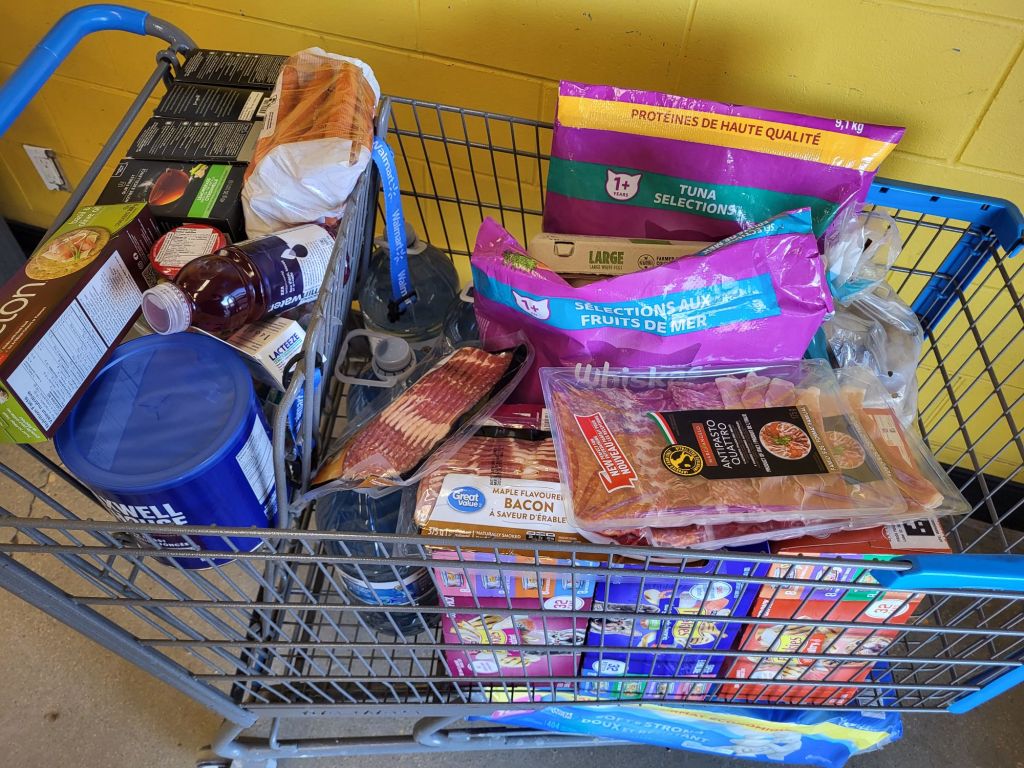
This is what $307.24, after taxes, looks like.
Even with the sale prices, that cart isn’t very full for $300
The 32 packs of canned cat food was on sale. They never go on sale! So I got three different variety packs. (Yes, we are actually out of the donated canned cat food!) I also got two 9kg bags of kibble. With so many cats, we can never have too much kibble!
Since I don’t expect to do Costco again today, I picked up a large package of toilet paper. It was on sale.
Probably the most important thing on my list was the distilled water for my husband’s CPAP humidifier. I hadn’t realized he was almost out! Four gallons should last him a while.
The 10 pound bags of Russet potatoes were on sale, costing the same as a 5 pound bag of red potatoes. The bacon was also on sale, so I got two packs of maple flavoured bacon. I also grabbed two variety packs of sliced meats for our New Year’s Eve munchies. I wanted to get more finger food type things for New Year’s, but the only things I saw that interested me, we already had. The pecan pieces are for a baked brie we plan to make, as well.
I got an 18 pack of eggs, because we can never have too many eggs, plus another can of dark roast coffee for the girls. The bag of carrots were the only fresh vegetables that looked appealing to me, that the family will eat.
There was a selection of teas for only 97¢ each, so I got four different flavours. I would have gotten a fifth, but they were completely out of vanilla rooibos. 😢
I got a small jar of artichoke hearts for our New Year’s spread as well – and Lacteeze for my dairy loving but lactose intolerant family! The package of crackers is also for New Year’s. I also got four tubs of sour gummies for my husband. They are a comfort snack for bad pain days. That and he’s been having low blood sugars lately, and these are cheaper than the glucose tablets.
Last of all, I got a drink for the drive home.
I had meant to get more rye bread as well, but decided it wasn’t worth the risk of the loaves getting squished on the way home. I meant to get bar soap, but got distracted while going back for it and completely forgot until I packed everything up. That’s something that can wait, though.
So that’s what I got at the Walmart. Since I was in town, I decided to pop across to the Canadian Tire to look for something. I found it but didn’t buy it, as I couldn’t justify spending the money for it, but I did get something else. The girls and I were talking, just last night, about getting a back up electric kettle. We like the glass ones that have a light when it’s turned on. The one we have now has lasted longer than expected already, to be honest, but our hard water is very rough on things like that. It’s starting to not automatically shut itself off at times.
While cutting through some displays on the way to somewhere else, I spotted a stack of boxes with glass kettles – for $29.99. This particular kettle is normally considerably more. So I snagged it. Plus, I used my Canadian Tire credit card, which has bonus Canadian Tire Money promos right now, basically tripling the amount such a modest purchase normally would have gotten. These little bits add up. I’ve got a goal set to save enough to get a septic pump for free, though it doesn’t look like Canadian Tire actually carries that type of pump. Once I reach my goal, I’ll get a staff member to see if they can find the type of pump I need. If not, I can use it to get things like a back up sump pump or a new table saw. Now that we’ve got credit cards again, I’ve been judicious about where I put our budget amounts specifically for goals like this.
So, between getting gas, having breakfast… er… lunch, the stock up shopping and the kettle, it was a bigger shop than I intended for today, but none of it was extraneous. Were it not the holiday season, I normally would be doing my big stock up shopping around now, anyhow, but with the extra stocking up I was able to do earlier in the month, that isn’t necessary.
Meanwhile, while I was gone, my daughter took advantage of the lovely day and opened up windows all over the house while she did the mopping and cleaning up. It was still just wonderful out there, while we were unloading the truck. We’ve got a few more mild days before the temperatures start dropping in January – just in time for when I need to start driving my mother to medical appointments, and get the truck back into the garage for a couple more fixes.
I will be much happier when we have the block heater cord replaced and can plug it in! We are expecting January temperatures with highs colder than -20C/-4F and lows dipping below -30C/-22F. After the mild temperatures we’ve been having this winter so far, that’s going to feel brutal!
But who knows. If there’s one thing about weather forecasts you can be sure of, it is that they are constantly changing, and almost never match reality!
Still, I’m happy that we are well stocked. If it weren’t for appointments and helping my mother out, we could probably just stay home for most of January and be fine!
Which is why I take advantage of days like today, and get a little extra, when we can.
Not that we’re getting much for our money, even with sales on, these days. 😢
She tried to get away from me but the rose bush slowed her down enough that I could stealth pet her. She liked it enough to stop and let me keep petting her and give her ear skritches.
She even started purring!
We’re not at the stage were we can get her into a carrier, but we’re getting there!
Today has turned out to be a lovely, warm day! The forecast ranged from 1C/34F to 3C/37F, depending on what app I looked at. It seems the temperature we actually hit was in between, at 2C/36F.
Even when I headed out to do my morning rounds, we were at a balmy -1C/30F. The outside cats were quite enjoying it, and were running around all over the place!
I even had several following me up the driveway when I went to check on the gate!
It’s been a while since I’ve had that many cats following me around.
With the temperatures expected to go above freezing, I made sure to break out the ice chipper to scrape the sidewalk, and the concrete in front of the sun room, clear of ice and snow, so that it would melt clear faster. Tomorrow we’re supposed to reach a high of 0C/32F, so hopefully that will be enough for the sidewalks to dry clear, rather than just ice over!
The truck was booked at the garage for this afternoon, but I headed out earlier, so I could stop at the post office before it closed for a few hours around lunch time, since I wasn’t sure how long I’d be gone. I even remembered to grab the empty water jugs for refilling, too. While opening the garage door to put them in the truck, though… well…
The middle of the garage door frame is slowly sagging. There is a metal piece attached to the top that is there to sort of guide the handle inwards, but as it slowly sags lower, I try to remember to push the door in a bit so the handle will clear the frame.
I forgot to do that this morning, and slammed the handle right into the frame. This is a replacement handle, too. I can now see how the old one got so broken!
So, we’re going to have to pick up another handle. No hurry on that. We don’t close the door all the way, anyhow, as one of the latches on the sides doesn’t retract far enough when the handle is turned. When the door gets closed all the way down, it can only be opened again from the inside, by manually pulling the cable to that latch. When we get a new handle, we should be able to just tighten the cable on that side to fix it, though I don’t know why it became a problem in the first place. The cable is as tight as the day I installed it, still.
Anyhow…
I’m more concerned about figuring out how to straighten out the frame, then support it to keep it from sagging again. Given the larger size of the opening, it would likely have to be supported from above
We’ll figure it out.
I made sure to give the truck’s engine time to run before I headed out. Everything was fine during the short drive to the post office, just like last time. I had a couple of packages to pick up, including some kibble the Cat Lady was able to get with coupons from Amazon for us.
From there to town, I kept an eye on the oil pressure gauge. It actually last longer than I expected, and I almost got to the garage before the needle dropped and the alarm started sounding – just as I had to stop behind several cars to wait for a tiny train to go by! It was basically about a block of driving with the alarm and warning lights going.
I was quite early to drop off the keys, but I also made a point of booking the truck for next week. That’s when the MAF sensor and block heater cable will be replaced. He has to order the parts in, first.
After that, I popped into the motel next door and had lunch at the Chinese restaurant there, before running a couple of errands. My appointment was at 1pm, and I got back about 20 after. He was on his own, though, and hadn’t had a chance to look at it yet, but I just wanted to grab the keys so I could put away my shopping bag.
Before I headed out, I mentioned doing errands, and he suggested I check out a nearby store. A customer had told him the entire store was 50% off today. I pretty much never go there – I can’t afford their prices, normally. About the only things they have that would interest me is clothing, and it would be a rare thing for them to have my size. Still, I figured it was worth taking a look.
Ha!
I got in the door, and that was pretty much it. There was a line at least 20 people deep, cutting through the area I would have wanted to look in. This is not a large store, so it doesn’t take much for it to get overcrowded! The other side of the store was mostly empty, but that was where the shoe and jewelry sections were – nothing I would be looking at.
So I left. I was happy to see how busy they were, though. For a lot of retail companies, these last few weeks of the year are what puts them in the black for the year, and it’s even harder for a small town like this.
After putting my bag in the truck and giving the keys back, I had a bit of time to kill, so I swung by the hardware store across from the store that was having the big sale. A hardware store is much more my style! I ended up getting a couple of small items, but mostly wanted to look at some of their equipment. They actually had some utility pumps in stock – and on sale! Not the sort of pump we need to replace our septic pump, though. One of the staff came over to help me and I showed him a picture of the pump we have, and he agreed that the one I was looking at was not what I needed. He admitted, he wasn’t the one who knew septic pumps (not a surprise, since the system we have isn’t really done anymore), but that was okay. For now, I was just looking at prices. I think I should probably consult with my brother about getting a new one. My SIL was sure they actually have a spare, somewhere among the things now stored in our barn, but I think I would prefer a new one, if I can swing it.
I was just leaving the store when I checked my phone and discovered a message from the garage had just come in. The truck was ready.
When I got there, we talked about the problem for a bit. All he did was take the sensor apart and clean it out, so he just charged me for labour.
It is going to happen again. Even if he replaced the sensor again, it wouldn’t make a difference.
The problem is, with the temperature fluctuations this time of year, moisture gets into the system, but doesn’t get a chance to evaporate completely. He suggested doing things like letting the truck run for about 15 minutes before going anywhere and, if I’m just running inside a store briefly, to leave the engine running. This would give it a chance to heat up enough for the moisture to evaporate. Meanwhile, keep checking the oil levels. As long as they’re good, we know that it’s the sensor again, not an actual problem with the oil pressure.
As he was telling me this, I could tell he was really frustrated. He’s mentioned to me before, that this is very much a GM thing. He doesn’t see this problem in other brands. Some sort of design flaw, is his thought on that. When I mention having it go off like this, it leaves you not knowing if it’s just moisture in the sensor again, or an actual problem, and he completely agreed.
Then there’s just the problem of driving around with an alarm dinging, warning lights and the onboard computer telling me to SHUT OFF ENGINE. It is really quite stressful.
Hopefully, cleaning out the sensor will do the trick for at least a while. I have to take my mother for a scan on the 1st, then a medical appointment on the 6th, and I sure as heck don’t want that alarm going off while driving with my mother!
As an aside, I spoke with my mother last night, and she asked about the truck. She is still talking about buying “herself” a brand new car. She doesn’t drive, of course, and anything she gets would have to be half in my name, as that’s the only way I’d be able to get it insured. I don’t expect her to be paying for the insurance (nor any other vehicle expenses), and it would be parked here at the farm, anyhow. I did try to warn her that a brand new car would be very expensive, but she’s okay with that. In fact, she’s almost excited about the idea. I really, really hope my brother has a chance to talk to her about that. She doesn’t have *that* much money squirreled away! As great as it would be to have access to a back up vehicle again – and a new one, too! – we would have to do something with her current car, just to have someplace to park it (which means it would have to be quite a small car!). Having to pay the expenses for two vehicles again, while having payments on the truck at the same time, would be very painful on our budget. *sigh*
Anyhow…
After reclaiming the truck (he’d even left it running, since I responded to his text so quickly), I popped across to the grocery store, picked up a few things and refilled a couple of water jugs. From there, it was a quick stop at the gas station, then home.
I’m happy to say, the needle on the oil pressure gauge stayed right were it was supposed to. It did seem to start dropping when I was driving slower on the icy gravel road, but still inside the acceptable range on the gauge.
Once everything was unloaded and put away, I got to do an unboxing.
Our new solar charged trail cameras were in!
The cats really, really wanted to see what was going on, too!
I was specifically looking for a camera where the solar panel directly powered the camera, with regular batteries as a back up. I settled on this brand, which came in a 2 pack. We only need one right now, so the other is still in its box.
I had to retake the photo of the outside of the boxes. When I laid them out on my bed, Layendecker leaned over and used one of them as a pillow!
Silly boy.
The camera comes with a tree strap for mounting, plus a USB cable for the first charging of the solar panel’s internal rechargeable batteries.
The USB cable is mostly hidden under a curious Mitsy in the photo.
After opening it up, it took me a while to find where the battery cover was. The clip is partially hidden by the cover, as it’s right near the bottom cover hinge.
One substantial difference between this camera and any others we’ve had is that it uses only four AA batteries. Most take eight. We did have one camera (that got stolen) that held eight batteries, but could operate on only four, if necessary. This one has room only for four batteries. They will only be used if the solar panel doesn’t have enough charge to power the camera.
The solar panel adjusts slightly, and it does not come off. The one we have now, the solar charger is a separate unit that can be removed, so the camera can be used on batteries only. I like having that option, if necessary, but the camera we have now is no longer available. The current camera’s solar panel angle cannot be adjusted, so there are trade offs both ways.
While the camera does have a tree strap, it also has the screw in port for a plate mount, which is what our current camera is on, now. This camera did not come with a mounting plate, while the old one did.
I find it really bizarre, however, that the screw in port is in the battery cover. I would have to either remove it from the mounting plate (which I have to do now, for a different design reason) or, in theory, open the mounting plate and swing the camera down. I wouldn’t want to do that, though, as it would put too much stress on the hinge of the battery cover.
I plan to use both the mounting plate already on the stand, and the tree strap to hold it in place. With the current camera, the top heavy weight of the solar panel is a bit too much for the mount, so I’ve got a small bungee cord supporting it. Over time, though, the bungee is starting to stretch out and not support as well. The solar panel on the new camera is not as heavy, though, so it might not be an issue. We shall see.
One thing about this camera is that it does NOT have a wide angle lens. The solar camera we have now is wide angle, which I really like. Without a wide angle lens, we will probably have to move the stand it’s mounted to. The base, with its weight to keep it from blowing over in the wind, is buried in snow right now, so that likely won’t happen until spring!
The USB cable is for pre-charging the solar panel’s internal batteries, which is recommended to do before first use. After going through the menu and setting up the date, time, etc. and putting in a memory card, I hooked that up, so it will be fully charged and ready for tomorrow. When I do my morning rounds, I’ll switch cameras instead of memory chards!
The other solar camera has been working again, which is good, but when it fell open into the snow, one of the cover clips broke. So there is just one clip holding it closed. That would make it slightly less waterproof, as condensation could get past the seal by the broken clip.
The non-solar sign cam is still working, but it’s quite a bit older and sometimes glitches out. Depending on how this new camera is, I might use the spare to switch out the other one. It’s under a tree, but it does get enough sunlight to support a small solar panel. Especially at sunrise.
Either way, we’ll still have a couple of back up cameras, if we ever have troubles again.
I look forward to seeing the first files on the new camera, and what the quality is like.
Which is rather fun and all, but it sucks that we need to have to set up trail cams as security cameras in the first place.