I just watched this video from Maritime Gardening and wanted to share.
The next seeds I plan to start will be quite large, and I plan to let them soak overnight first. The next time we’ll be starting smaller seeds, I might experiment with this method. Not that we have had much problem with germination rates, but that waiting until they show, and wondering if any will germinate at all, is the thing. Right now, in the tray with early peppers, two varieties have start to emerge, but one still has not, and we still have just one Butterfly Flower seedling.
The thing will be to remember to start the seeds like this, about a few days, or even a week, in advance!
This first video from Gardening in Canada is a bit more generic – a look at what gardening supplies are worth getting at Dollarama.
For those of you in the US, I’ve been told that your Dollarama stores have a LOT more than ours do, but I’m sure there are at least some overlap.
Personally, among the things I’ve found there that I’m really happy with are their ground staples, the wire twist tie spools with built in wire cutter, and their metal stakes. Especially the metal stakes! We’ve also tried their “instant raised garden” which, while somewhat small and quite shallow, turned out to be remarkably durable. Same with some grow bags we got from there. They also have a type of spray bottle suitable for misting plants that are really good quality, but I find they tend not to be in stock as often as the cheap versions. We can’t seem to have enough of those, both for use as misters for plants, and on the stream setting to deter cats from things!
This next video is from MI Gardener. It’s not relevant to most of us in Canada right now, but we’ll be there in a few weeks!
I hope.
Talk about intense planting! The concept of making sure there is no exposed soil is similar to how square foot gardening is planned out. He’s just doing rows instead of squares.
I do find it amusing to see him out there planting, while it’s snowing! Of what he’s planting here, the only things we will be doing are carrots and spinach. I think we’ll be skipping the beets and radishes until we get further ahead in improving our soil, as the last few years have not been good for either of them. We also will probably not do lettuces, though we should have some self sown greens show up. We found they got bitter very quickly for some reason, even though they weren’t bolting.
With some of our raised beds, they are sheltered enough and get enough warm sun hitting them that we might be able to plant cool weather crops nice and early. Especially if I can find some of the plastic drop cloth GIC mentioned, to help warm the soil up faster.
Looking at our 10 day forecast, we’re supposed to get a bit of snow tonight, and the high over the next few days are supposed to hover just above freezing, but a week from now we’re supposed to go into the double digits. Not only that, but next weekend, our overnight lows are supposed to stay above freezing! Just for a couple of nights, though. After that, the overnight lows are expected to stay below freezing until May. Most things can’t be planted until the overnights lows consistently stay 6C/43F or warmer. Of course, it would be better to plant based on soil temperature, but we don’t have a soil thermometer.
I’ve still got gardening on my mind, and just had to share this video, from MI Gardener.
I’m glad I found it, since I was looking to start drum gourds and Crespo squash fairly soon. These are much bigger seeds and need bigger pots than the ones he shows in the video. Based on this video, it looks like they would do better in the smaller peat pots I still have from last year, not the bigger ones.
I didn’t mass sow my peppers as he did with his, and I did use larger celled trays and Red Solo cups for them and the San Marzano tomatoes, but I think the main thing would be not to thin them too early. I did thin the earliest peppers and the eggplant I started already, but they were quite a bit larger than his examples, too.
That reminds me. I forgot to turn the fan on in the living room today. Those seedlings need a breeze over them, to help develop strong stems.
On a completely different note, I just spoke to my brother on the phone about what’s going on with the septic pump. He knows the system better than anyone, having fought with it so often over the years. The switch the septic guy mentioned is actually part of the float, and it got replaced not long before we moved in here. It’s possible it’s malfunctioning, but those things tend to last for many, many years. In fact, the old one got replaced as part of troubleshooting while trying to find the cause of the problem at the time, and probably was working just fine. My brother even hired a plumber to excavate the tank and under the pipes leading to and from it. They never did find the problem, which was a lack of vacuum, and the plumber ended up leaving without a solution. They assumed there was a leak somewhere, but they couldn’t find one. My brother stayed late and kept working on the system in the basement and finally tried one last thing. Our BIL had installed a filter, with the same idea as the one we have now. My brother took that off and put in a new section of pipe – and suddenly it was working fine. The filter hadn’t been installed properly, and air was getting in. The current filter my brother later installed is a much higher end one, and he made super sure it was well sealed! When we switch out the filter basket, we make sure to prime the reservoir before closing it up again. It’s been working just fine since then.
So… it shouldn’t be the switch, since it’s so new. The septic guy knew I thought the problem might be the float was stuck, and I know if he’d seen anything wrong or unusual, he would have knocked on the door to tell someone. Still, I will be swinging by his place tomorrow to pay him, and hope he will be home to talk to.
Until then, we have a workaround until we can get a plumber in to check it out and determine why the pump won’t shut itself off like it should. Getting the tank emptied will help a lot, too.
We’ll get it figured out.
Until then, I’m going to think gardening thoughts. 😄😄
This time of year, the McKenzie Seed displays are everywhere, including the grocery store I do my mother’s shopping at. Today, she just gave me her list and stayed home, so I took the time to take a quick look at the display.
I should have known better! 😄😂
I ended up getting these.
What caught my eye were the Royal Burgundy bush beans. I grabbed their last package. We grew these back in 2021, and of the three types of bush beans we grew that year, they did the best. In fact, everything we grew that was purple seems to do really well. We’d ordered them from Veseys, but they don’t carry them anymore. Last year, I ordered a different purple variety, but those were sold out and not replaced, so we got the Red Swan beans as a substitute. We still have lots of those. What we really wanted, though, was more of those Red Burgundies! So I snagged them.
I didn’t want to be buying just one packet of seeds and nothing else, though, so I looked for some edible pod peas. We have plenty of the Dalvay peas, but no edible pod varieties. We had tried growing edible pod peas before, but they didn’t do well. We aren’t growing vegetables in that area anymore, so I expect them to do better planted somewhere else.
Just not at the chain link fence again. The deer ate everything that grew through to the outside of the fence! The next time we plant climbers at the fence, we’ll have to make sure there is protection on the outside of the fence, as well as the inside!
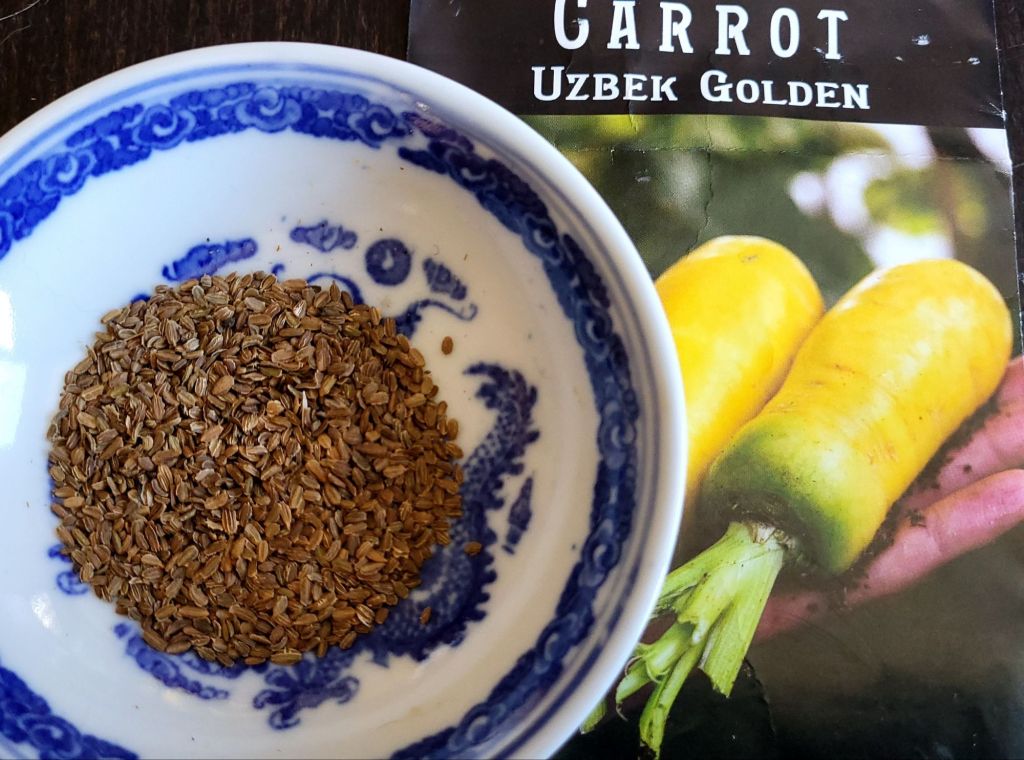
So I went through my seed bin again – main bin, not just the smaller bins organized by “direct sow” or “start indoors” – and found my package of Uzbek Golden Carrots from last year. I really liked these carrots, so I want to plant more this year. I also found my leftover Napoli carrots. Those are pelleted seeds, so no need to do anything with those, but after how well it worked out with our Naval carrots last year, I wanted to make seed tape with the Uzbek Golden Carrots. I also found some other things, but more on that later.
The package still had quite a lot of seeds in it. We planted only one row, about 14′-15′ long, last year, so we didn’t use much.
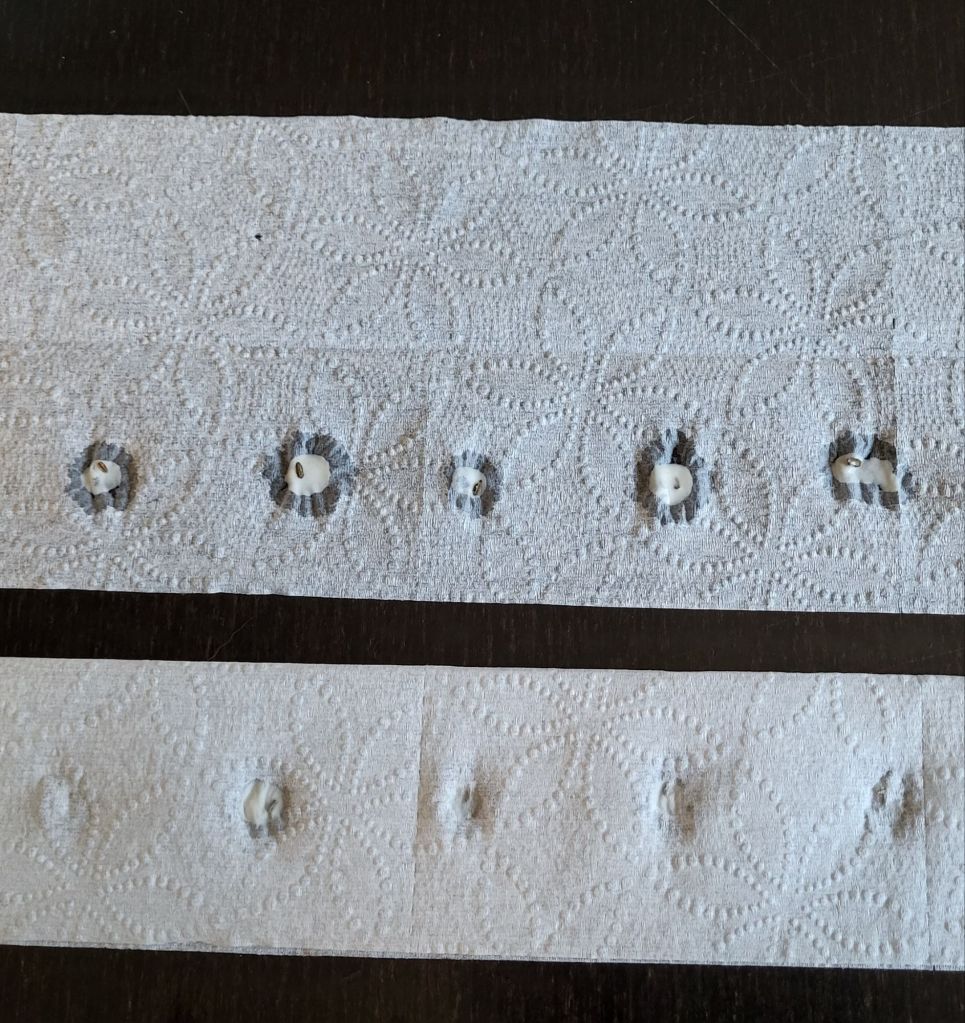
Like last year, I used strips of toilet paper the length of the end of our dining table, split into single ply. I pre folded the toilet paper, lengthwise, to make it easier later on. A flour and water paste was used as the “glue”, and I used a bamboo chopstick to apply the paste with the thick end, and to pick up the seeds with the narrow end. Once the seeds were in place, the toilet paper strip was folded over, pressed into the flour paste, then set aside to start drying while the next batch was done.
After a while, the stack of drying strips was getting rather thick. There were still plenty of seeds when I stopped, so I took another look at the package.
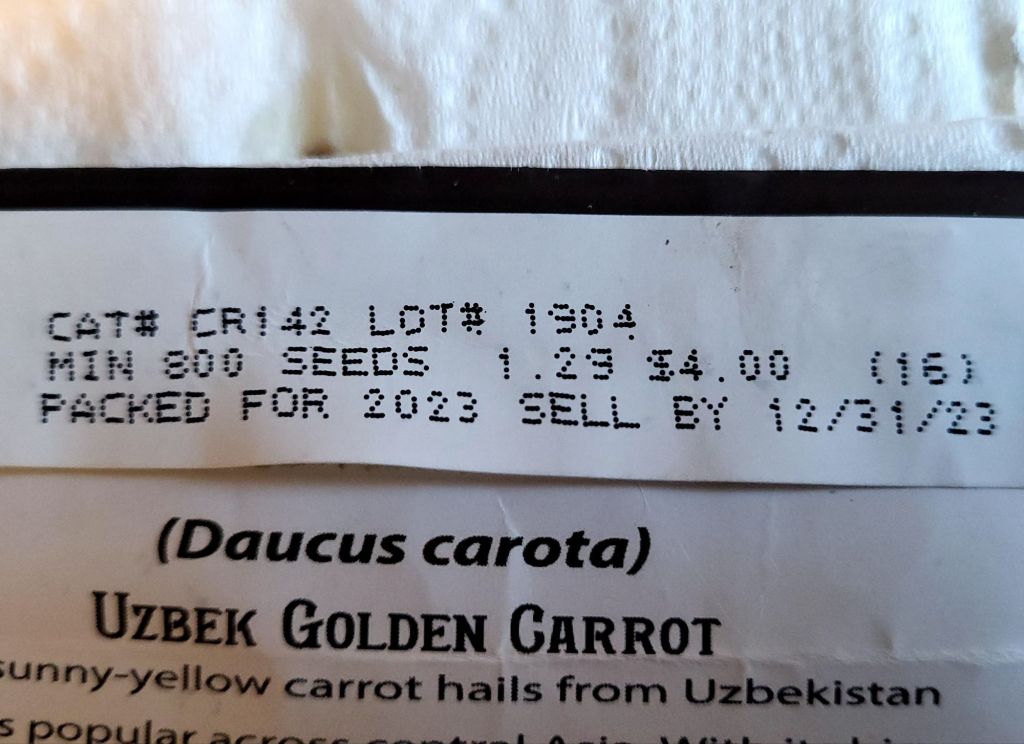
A minimum of 800 seeds! Wow!
Each strip has 20 seeds in it (a few got pairs of seeds stuck together, but I’m counting those as one). I counted the strips, and had another 20.
I think 400 seeds will be enough! I’d estimate there’s still close to 300 seeds left in the package.
The seed tape is now draped around the cat free zone in the living room to finish drying, before they get rolled up and stored until it’s time to plant.
As for the other stuff I found…
I confirmed that I do have a few Crespo squash seeds left. I really want to grow those, as they are supposed to be quite delicious. I got the seeds from Baker Creek, but they don’t seem to carry them anymore, so I want to be able to save my own seeds. I also am thinking of trying the African Drum gourds again. Last year, I had issues with the gourd seedlings and replanted a few times, to the point I started getting the pots mixed up. By the time the survivors were transplanted and started producing fruit, we discovered none of them were drum gourds! Hopefully, I’ll have better luck this year.
I also was surprised to find I still had luffa seeds! Last year, they also had issues and got replanted a couple of times, but it’s also the first year we actually had a luffa develop. So I think I will try those again, this year. Being in the old kitchen garden was so much better for it compared to our previous attempts, so I will take that into consideration when it comes time to transplant them. It’ll be the same thing with the Drum gourds and Crespo squash. I’ll need to really think about where they need to be planted, as much to protect them from the deer as anything else. The first year we grew Crespo squash, they did fantastic, until then got eaten by deer and groundhogs three times before we could get them sufficiently protected! They recovered very well and started developing fruit like crazy, but there just wasn’t enough growing season left for them. Last year, we had one develop to about the size of a smallish pumpkin, but I think their location got too much sun, and the plants got baked.
Anyhow.
I will try starting the three of them within the next couple of weeks. I still have some larger peat pots left from last year, so they’ll go straight into there. Hopefully, that will mean there will be no potting up needed. The pots didn’t break down after transplanting the Crespo squash, like they were supposed to, but they can be broken up without disturbing the roots at transplant time. The main thing will be to keep the pots moist until then. Otherwise, they dry out and suck the moisture out of the seed starting mix!
I’m still waffling about whether or not I will try growing corn again this year. We have some short season varieties, but I don’t know that we’ll have enough space prepared for them. They are not a priority, compared to some of the other things we want to grow this year. A lot will hinge on being able to get those new beds built in time for planting. We’ll be growing potatoes where we grew winter squash last year, so we’ll be needing space for the squash we want to grow this year, and I hope to grow quite a bit of both winter and summer squash. We’ve got a melon mix this year, too.
Well, we’ll see how it works out when the time comes. For all the plans we’ve made, I’ve found it’s awfully easy for things to side swipe them!
Still, I’m happy to at least have the seed tape done and ready for planting, once the ground is thawed out enough. Carrots, at least, can be planted before last frost, and I can hardly wait!
Shuffling the trays around has certainly helped! Check this out.
When I turned the lights on yesterday morning, there was nothing in the tray. When I turned them off in the evening, all the cells on the far right of the photo had seedlings breaking ground. By morning, they were opening their seed leaves, and I could even see one starting to break the surface in the middle row, though it’s not visible in the photo.
That row of seedlings on the right are the Black Cherry, which are new seeds for this year. The middle row are the Chocolate cherry, which are seeds from previous years. The ones on the left, which we got this year as a freebie with our order, are a completely different type of tomato, so I expect those to take longer to germinate, compared to the cherries.
I will wait until there’s more sprouts before I raise the tray off the heat mat. I’ll just put one of the dome lids under it, which will raise the tray about 5 or 6 inches off the mat and closer to the light. I don’t want to unplug the mat until the peppers start germinating, which will take longer.
The tray with the San Marzano seeds has been a bit of a surprise. There weren’t many seeds in the packet, but it turns out that there were more than I thought. There are seedlings in all the cells in the tray, but in the row where I had enough to plant only one seed per cell, there’s extra, and in some of the cells where two seeds had been planted, there are three seedlings! These would have been seeds that had stuck together in the package. Some are so close together, I’ll just cut away one, rather than thin by transplanting, as removing one would damage the other.
What a strange day we are having out there! I just got back from a quick trip into town, but I’ll get to that later.
First, the seedling shuffle!
The San Marzano tomato tray got moved to the other half of the big aquarium greenhouse. You can see there are quite a few more seedlings in there now, too! This side is elevated quite a bit compared to the side with the heat mat, so the seedlings are now quite a bit closer to the lights.
These guys, on the other hand, are quite a bit lower now! I considered putting things under the heat mat to raise them higher, but for now, there is no need. They need the warmth more than the light. Once there is germination, the heat mat will be unplugged, anyhow. At that point, I can either put stuff under the trays to raise them closer to the lights, or put them on the mini greenhouse frame in front of the window. They have better light in the tank, but better air circulation in the window.
I look forward to when we can build up a dedicated seed starting area in a cat free zone! Which can’t be the living room, because there’s just not a lot of space. We might have to find a way to use the new part basement. As long as we can keep it warm enough and bright enough. Since bringing Peanut Butter Cup indoors, we closed up the new basement (the old basement isn’t safe for the cats, so it’s always closed to the cats), because we didn’t want to crawling around under stuff down there, right after being spayed. Since then, we just haven’t bothered letting them down there again, and that doesn’t seem to be a problem for them. We might actually be able to reclaim the space as a workshop again. There’s space at one end where we could set up tables or shelfs and hang the shop lights from the ceiling, but once things start melting, the floor there starts getting damp. The weeping tile at that end isn’t doing it’s job anymore, ever since someone left a rain barrel to overflow outside that corner, during a couple of months of heavy rain. When my brother found it, that whole corner was molding, and it took him a long time to get it cleaned. My daughters had been working hard to keep that end cleaned and bleached but, for some reason, cats would ignore the four litter boxes and crap on the floor against that wall. Which cats, we never saw. If we can turn that basement into a cat free zone, that would make a big difference in where we can do things! Come summertime, though, we’d have to start opening the door, as the basements help keep the house cool. We’ve got a hardware cloth door for the old basement door – which is currently being stored by using it as a cat platform in the sun room. We’d have to pick up some lumber and made another one for the new basement door.
Ooooh… If we can keep it a cat free zone, then we can remove the hardware cloth “door” we made for the opening between the two basements. I can’t really call it a doorway, since it’s just an opening that was broken through the old basement wall that’s now an odd shape and size. We’d put in the barricade in such a way that, if we wanted to go from one basemen to the other, we could just unhook the bungee cord holding it in place and slide it to one side.
We didn’t consider just how determined the cats would be, in trying to get through. Not only did we have to barricade it with whatever we could find from the old basement side, to keep them from simply pushing through, we had to use more hardware cloth above opening, to cover a gap between the floor joists and heat ducts above.
The end result is, we basically can’t get from one basement to the other right now, without having to dismantle the whole thing. The old basement is where we have the water taps from when the laundry used to be there. Now, when we need water to mop the floors or whatever, we have to get it from the bathroom in the old part of the house and haul it through pretty much the entire ground floor to get it to the new part basement.
There is a lot of space down that that isn’t being used right now. The only down side it, my knees and stairs do not get along, but I’d learn to live with it!
Things to think about, and set up for next year, perhaps.
In other things…
As I write this, we’ve warmed up to -10C/14F, with a “feels like” of -9C/16F. However, it is also bright and sunny. Which means that anything dark out there is warming up more, and things are starting to melt around them. Things are both freezing and melting, at the same time!
It also means the snow is starting to soften.
When I got back from town, I drove the truck into the yard to unload, since I was not about to carry those water jugs across the icy path. The snow drift the truck had no problem climbing over yesterday was still manageable, but the truck did have a harder time of it, since the tires started sinking this time. Then, while backing up in the yard so I could turn to the gate and leave, I felt the back end of the truck suddenly sink, and I almost got stuck. It looks like the frozen “lake” of water behind the garage extends quite a bit further under the snow than I thought. The tires broke through the snow covered ice. The “lake” is deep enough that our recent cold hasn’t been enough to freeze it solid, so there is still liquid water under there that the truck is heavy enough to break through to.
Which means I may not be able to drive the truck up to the house again for a while! At least not without digging out a couple of spots, first. We’re supposed to stay in this general temperature range for at least a few days.
No matter. As long as I can get to the house when it’s time to unload our stock up shopping, and that’s more than a week from now.
On a completely different note…
Do you have any idea how hard it is to type while a cat insists in laying across your wrists and rolling?
When I saw all those long range forecasts saying we’d be getting consistent highs above freezing, I knew things would likely be different, but… really?
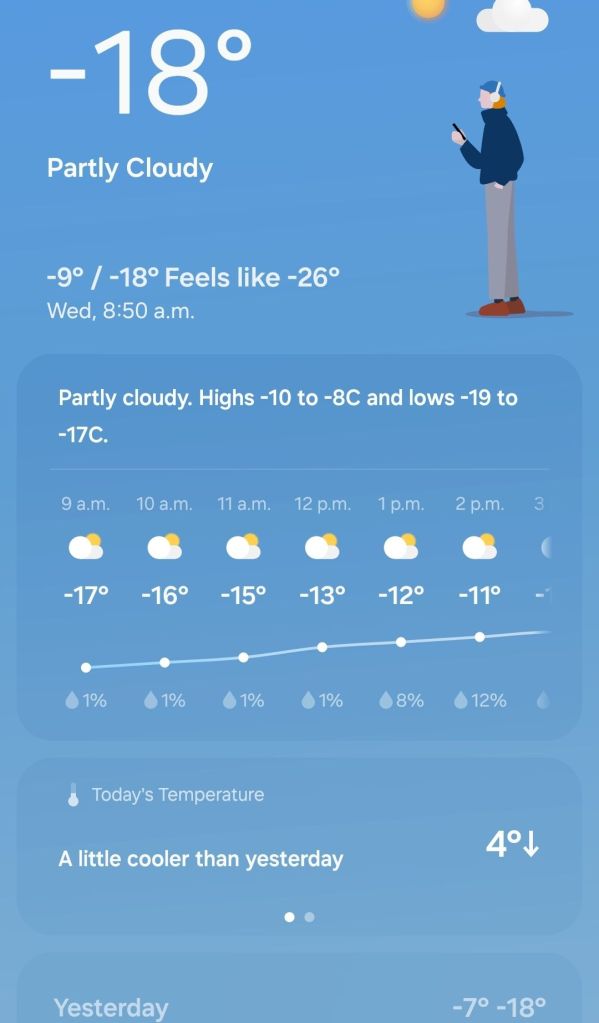
This is what it was like when I did my morning rounds; -18C/~0F, with a wind chill of -26C/-15F! That’s January temperatures!
This time of year, we all tend to be tired of the cold and snow – even after as mild a winter as we had this year – but to have such warm weather melting everything all through February, and a forecast saying it would continue, to the complete opposite is downright depressing!
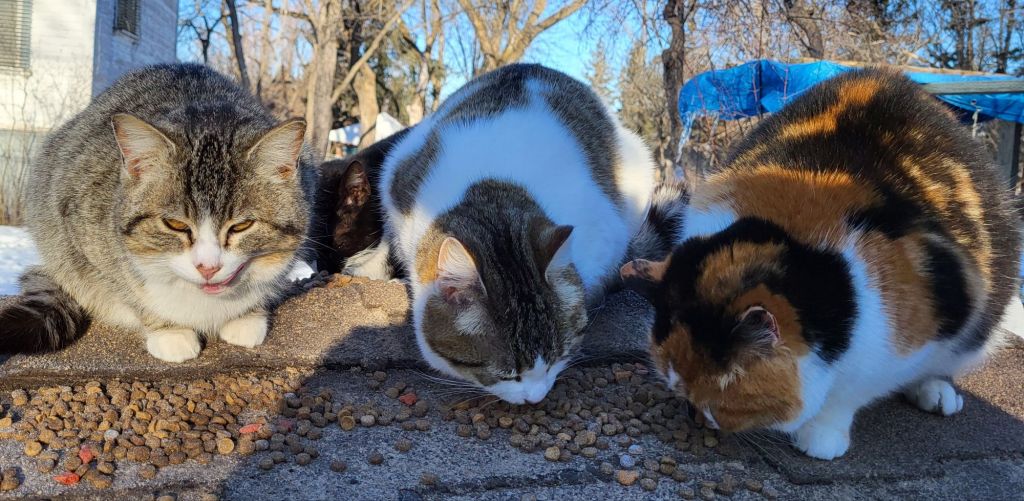
The yard cats don’t seem to mind it, though!
I actually got to pet Broccoli this morning! I snuck a pet as she walked in front of me, after taking this picture, and she actually stopped eating to enjoy shoulder scritches for a little while. So far, that’s still as much as she will allow. Junk Pile, who’s licking her chops enthusiastically here, had been eating with her back to me, and I was able to rest my hand on her back. Just for about half a second, before she realized what was happening and got all startled, then moved to where she is in the photo. Altogether, I think I counted maybe 23 cats, but they were running around so much, I’m just not sure!
Yesterday, I made a quick garden tour video for the first day of spring. While I was recording inside the big aquarium greenhouse, I didn’t see that we had new tomato sprouts until I uploaded the video to my desktop. This morning there are more, and the ones that the video picked up are already much larger. So far, it’s just the middle row, plus one in another row, that are germinating.
The other seed trays, however, show no activity. These are the ones in the new seed starting trays with their grow lights, and are set above the heat vent. I think it might still be too cold for them, though. I think what I’ll do, is shift the San Marzano tomatoes off the heat mat, to the other side of the tank. The new trays, with the peppers and other tomatoes, can go on the heat mat, along with the Butterfly Flower tray. I’ll remove the domes on the new trays, since they won’t be needed in the aquarium greenhouse. That will free up the LED grow lights to put over the bin with bell peppers and thyme, to give them a bit of a boost.
Okay, so I’m really a week early for this, but I decided to start more seeds, anyhow!
It was also an excuse to finally get my video making software up and running on the new computer. That was far more complicated than it should have been, but once it was all set up, everything went well.
Plus, PBC makes a cameo appearance.
This time, I started the three varieties of short season bell peppers left over from last year; Early Sunsation, Dragonfly and Early Summer. When it comes time to transplanting them outdoors, we need to try a completely different location. Definitely well away from those trees along the north side of the low raised garden beds! Hopefully, by starting them indoors this early, as well as planting them in a better location, we will actually get ripe peppers to try. With the peppers we started last month, this will make for 6 varieties, only one of which was able to ripen outdoors last year. None of the seeds are new.
I ended up starting 4 varieties of tomatoes. We were intending to only plant a couple varieties, originally; one paste tomato variety and one cherry tomato variety for fresh eating. Then we got some free seeds I wanted to try, too. When going through the tomato seeds we had, I decided to grow the Chocolate Cherry tomatoes again. I used the new seed starting trays for the tomatoes, which have only 12 cells, so I’m going for more variety over quantity of plants. I know the cherry tomatoes should be prolific (if they do well this year), but the free Forme de Coeur we got are also supposed to be quite prolific. I planted only 2 seeds per cell. If we end up with only a few plants of each variety, all together should be adequate to our needs. If we do end up with a high germination rate, I’ll might thin by transplanting, but we’ll see when the time comes.
The San Marzano tomatoes went into my remaining new style of tray I got this year, with the larger, deeper cells. There weren’t a lot of seeds in the package, though, and I used them all up. I filled the cells only half way for now, and will top them up as the seedlings get bigger. With this, if we do have a high enough germination rate that they’ll need thinning, I will definitely thin by transplanting. As it is, I only had enough seeds to plant a pair of seeds in two rows, and the last row got only one seed each. It’s entirely possible that thinning won’t even be an issue.
Last of all, I started some Butterfly Flower, which is an orange variety of milkweed. That one had plenty of seeds, so I might also try direct sowing in the spring, too. I had a small tray with Jiffy Pellets left over from last year, so I used that. The seeds are pretty big, compared to all the others I started today, and each pellet got only one seed each. That’s still a dozen seeds, so not bad. Since these are perennials, we will need to be selective on where we transplant these.
Starting these seeds meant a bit of rearranging needed to happen. The seeds starting in the Red Solo cups were still in the big aquarium greenhouse, and that was going to be needed for the large tray of tomatoes.
Zero oregano seeds germinated, so I took those cups out completely. With the Purple Beauty bell peppers, one cup had all 4 seeds germinate, while the other had none, so I transplanted two of them into the empty cup. The German Winter Thyme doesn’t seem to be growing much bigger. I’m not sure what to make of that. The bin with these went into the mini greenhouse in front of the window. The two trays with the LED grow lights on them went into the mini greenhouse as well, and are now plugged into their USB cables. For now, I can still use the remaining three lights to supplement the tray with the eggplants and hot peppers.
The trays with the tomatoes and peppers are set up above the heat vent. Hopefully, that will be enough, because we’ve only got one heat mat, and that’s now being used with the San Marzano tomatoes. The milkweed is in the big aquarium greenhouse, too, but off on the side. These shouldn’t need the extra heat, anyhow, but the warmth from the lights themselves should be adequate for them.
Now I’m really going to be getting antsy. We are at 11 weeks before last frost and with these seeds started, the seeds I have left don’t need to be started until 2-4 weeks before our last frost date. Unless I decide to start some gourds, but even they all are recommended for starting at 2-4 weeks. That means having to wait until the start of May, at the earliest!
Well, before then, I’m sure some things will need to be potted up or something, so I should still be able to get my gardening fix! 😂😂





 The Re-Farmer