The grand total was actually higher, but I don’t have photos of everything. 😄
Today, my younger daughter and I headed into the city to do the more tiring of our stock up shops.
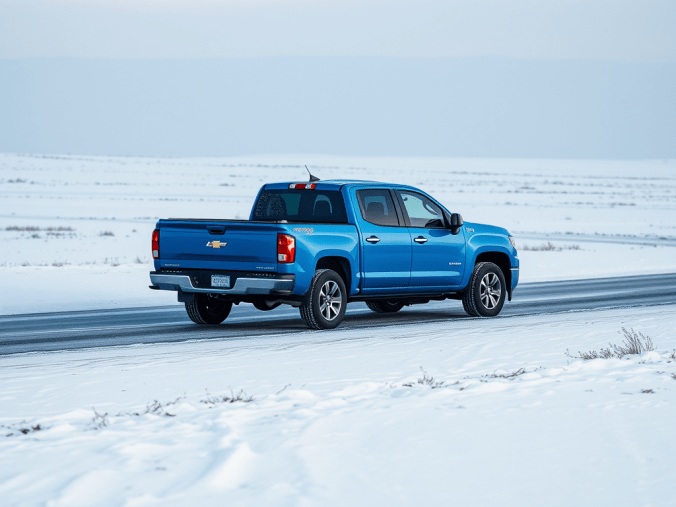
I’m happy to say that Damocles ran well, with no issues, though road conditions certainly didn’t help matters much! I still expect the truck to break down at any moment. 🫤
At least the roads were better than yesterday. Today turned out to be a relatively warm (hovering on either side of 0C/32F, depending on where we were at the time) and very sunny. Which meant that the last of the ice built up in the wheel wells finally came off! With a little help from my daughter bashing at some of it with her cane. 😄
Our first stop for shopping was Canadian Tire. It’s attached to a mall and my daughter treated us to breakfast (well… more like lunch, by then) in the food court, first. So nothing there came out of my own budget.
At the Canadian Tire, we got three bags of the litter pellets we needed, plus a bag of seed starting mix, a two pack of nail brushes for the bathroom and the kitchen, plus a couple of packs of marigold seeds. I was specifically looking for the French variety, which is the one that is good for repelling damaging insects. It took some digging, but my daughter finally found some French Double Dwarf marigold seeds. I’ll start some of those when we do our next round of seeds in a couple of weeks, possibly more in May, and I still plan to direct sow some, so we should have them blooming through most of the summer.
Total damage at Canadian Tire was $48.41
As we were leaving, we stopped by a gas station and put in $40 in gas – I’ll fill the tank when I do the Costco run and reset our trip mileage counter. When we drove though the town my mother is in (again), gas was $1.729/L. In the city, it was $1.529/L!!! What a difference! Usually, it’s just a few pennies cheaper in the city, if at all.
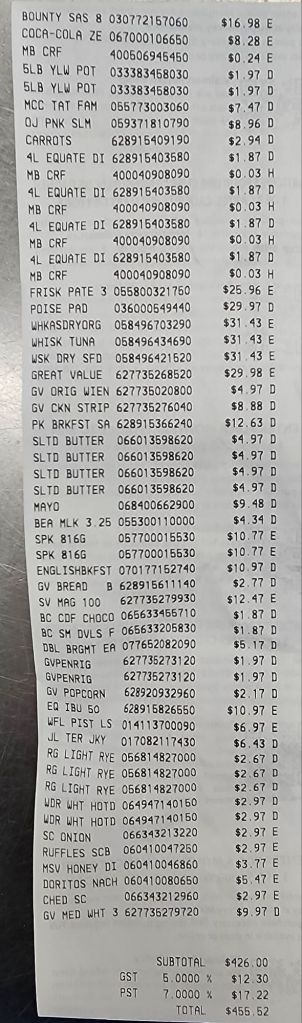
Our next stop was Walmart. This is what $301.84 looks like.
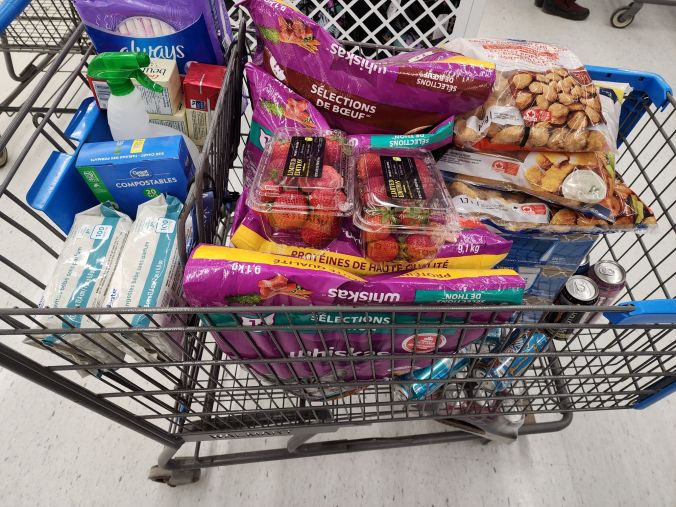
*sigh*
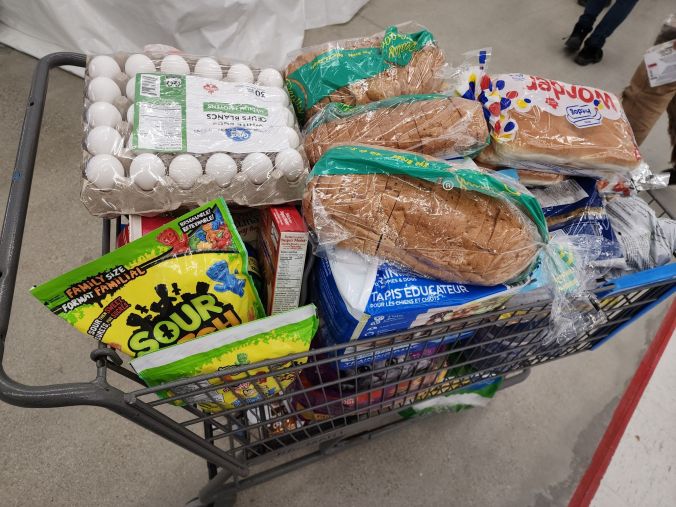
This is what we got for our money.
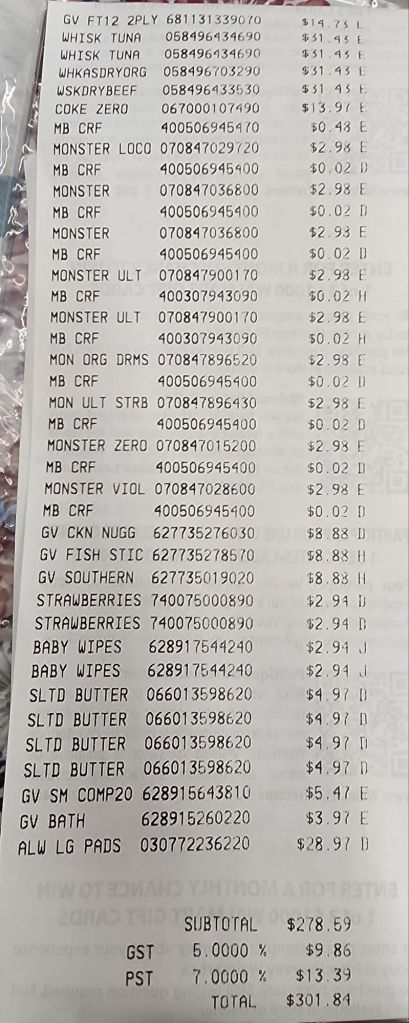
There is a case of facial tissues, four bags of dry kibble, a flat of 24 Coke Zero, a couple of packs of wet wipes, spray cleaner, compostable compost bags, incontinence pads, and a total of 9 energy drinks for my daughters and I.
For actual food, strawberries were an excellent price, so we got two packs. We also got three packs of frozen heat and eats; chicken nuggets, popcorn chicken and fish sticks, for those days when we’re all too broken to cook. I also got four more pounds of butter, as they were still at a better than Costco price.
And that’s it. That’s all I got.
My daughter picked up something for herself, but also paid for an item I’d picked up as an unplanned extra. We found ergonomic snow shovels on clearance and grabbed one. It was marked down to only $17. It wouldn’t fit in the cart, so my daughter carried it around the whole time we did the shopping, then snuck off with it to pay for it herself as a gift for me. 😄😂
Most of this was the kibble, but still… ouch. And I didn’t even pick up more XXL puppy pads or wet cat food for the beasts this time, either! We got a total of 29 items on this purchase, and that includes the 9 individual cans of Monster.
*sigh*
By this time, we were already both exhausted and hurting, but we still had one more stop to make. The international grocery store. We haven’t been there in ages, and I was thinking ahead to our Easter baskets, for ourselves and for my mother.
This is what $279.11 looks like – and that was after discounts totaling $114.56!
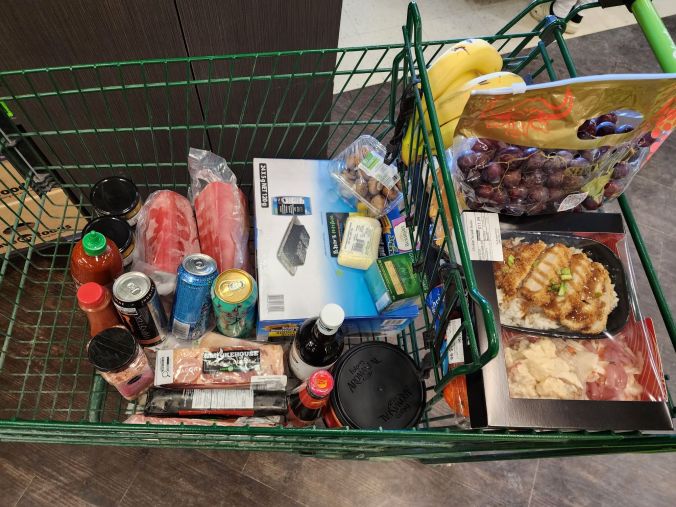
Yeah, that looks pretty empty, doesn’t it?
This is what we got.
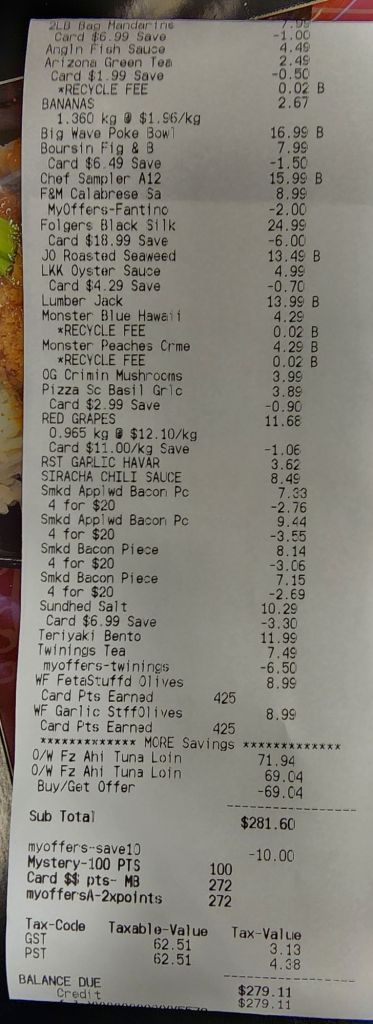
For fruit, we got a bag of Mandarin oranges, red grapes and bananas that weren’t solid green, like the ones at Walmart were. We also got a package of small cremini mushrooms.
The biggest purchase – and the biggest savings – was the ahi tuna loin. It was a “buy one, get one free” deal. This is something we get for the girls only when there are huge sales like this, and this is the only place I know of that has these.
We also got some locally made, unsliced bacon, two regular smoked and two applewood smoked, on an “Any 4 for $20” sale. There is a calabrese sausage that I got specifically for my husband, for snacking on.
We got a couple of cheeses for the Easter baskets; a little Boursin Fig and Balsamic Vinegar for ours, and a roasted garlic Havarti for my mother’s. We also got stuffed olives – one with feta, the other with garlic – for the baskets, though I don’t think my mother likes olives, so maybe just for ours.
My daughter found some sauces she remembered they were out of (I don’t use these in my own cooking). A particular fish sauce, a Siracha, and some oyster sauce. The seaweed is mostly for them, too, though I sometimes like to grab a package to snack on, all by itself.
I spotted a few other things not normally on our list that I grabbed, as they are things we typically get only when they are on sale, or they are not often in stock, so we grab when we can. One of those was some dark coffee for the girls; it’s almost never under $20 anymore, so I grabbed one, even though the girls still had a “spare” at home. Squeeze bottle pizza sauce was on sale, so I grabbed one, to make mini pizzas on the naan bread I recently picked up. I got some Twinings tea because my loyalty card offers had $6.50 off of a $7.49 package, and extra tea is always good. I also grabbed some Himalayan Pink Salt that wasn’t in a grinder. We have a grinder, so we just need a refill, but finding just the coarse rock salt on its own has been surprisingly difficult. I was about ready to order in on Amazon, so I was very happy to see it in stock.
Last of all, we got food for everyone for supper. For my husband, we got a huge Lumberjack sandwich, which will feed him for a couple of days. 😄 I got their last Bento box; chicken teriyaki. My daughter chose a Poke bowl and a Chef Sampler from the sushi bar for herself and her sister. Then, for the road home, I got an energy drink for myself and my daughter got an Arizona Green Tea – plus I grabbed an extra Peaches and Cream Monster for my daughter for later, because it’s her favourite and we hardly ever see that flavour.
One of the loyalty card offers I had available was a “spend $10, get $10 off” deal. That was after the $114.56 in discounts I got with sales, for 28 items in total. I could have used loyalty points to get other discounts, but I want to save them up again. I can usually get at least a free turkey at the end of the year with them. Not too bad, considering we don’t make it into the city to shop there all that often.
Okay, I just got a phone call from my brother and had to share this.
He just left from visiting our mother. She had told him our vandal and his wife had visited today – with his wife pushing him in, in a wheelchair. They were there for the money he thought she would give him to pay for his funeral. She told him, no. He’s rich, he has land, etc. He should pay for his own funeral. Why is he coming to her?
When it became clear he wasn’t getting any money, he got up out of the wheelchair and walked away, with his wife and my mother both calling after him to come back.
My mother said she wanted to talk to his wife, but she just left, too. I assume she took the wheelchair with her.
As far as I know, they don’t have a wheelchair. His house isn’t wheelchair accessible, anyhow. Most likely, they borrowed one of the “public” wheelchairs available in the hospital the TCU is located in.
[I got a confirmation while I was going over this post, looking for typos. Yes, it was a hospital wheelchair.]
When my brother told me our vandal got up and walked away, I could only laugh. What a scammer!!
Good on my mother for actually standing up to him. I’d been trying to tell her, how he acts when he’s around her isn’t at all like how my brother and I have been seeing him, and that he’s probably putting on an act. Yes, he’s sick, but anytime we see him, he looks quite robust for someone who constantly says he’s dying. Now, he just proved me right. He fakes it when around my mother.
And his wife is part of the role play.
*sigh*
Okay, back to the topic at hand!
Adding all our stops together, including gas, this was a $669.36 day. Slightly over budget for this stock up trip (the gas comes out of a different line in the budget), but with how late we did our last stock up trip, plus what I got locally just a little while ago, hopefully we won’t need to use as much of our Costco budget.
We’ll just have to see what the prices are when we get there, next week.
The Re-Farmer




 The Re-Farmer