I’m glad I was able to get work done on the cat isolation shelter today! I’m hoping to get more done tomorrow, too, but we shall see.
Next week, I won’t be able to get much of anything done.
On Monday, I’ll be taking my mother to a hospital in the city. Thankfully, she found the letter they’d sent her about the appointment. We now know that this test was something her previous doctor had written her up for, before he moved to another clinic. I believe that makes it more than a year, waiting.
I will have to go to her place quite a bit earlier, so I can go over the letter and figure out where we need to go. She’s supposed to arrive half an hour early, for time to register. This hospital is where the heart clinic is, but that part of the hospital can’t be accessed from the inside of the building. My husband and I had to go through the emergency entrance. Where my mother’s test is going to be will be in the main part of the hospital, but it can be so confusing to find places, they sometimes have volunteers available to act as guides and take you straight to the right place. Other times, we follow colour coded lines painted on the walls.
On top of that, this place is right in the middle of the city, across the river from downtown. I’m going to have to drop my mother off at the main entrance, find somewhere to park, then come back for her. With my husband, I often found myself parking blocks away, as the parkades were all full, as well all the nearest streets. I’ll need to factor in the time that will take, too.
It’s going to be an all day thing.
Then, a couple of days later, I’m taking my mother to an eye clinic, then the day after that, we’re bringing a male cat – whichever one we can catch – to the vet clinic to get snipped.
All that driving around isn’t going to leave much time to get things done at home, including working on the cat shelters.
It had been my intention to see if I could reinforce the mesh that is popping loose on the catio with the steel strapping I have, but I couldn’t find it. So no progress on the catio.
I got quite a lot of progress on the isolation shelter, though!
Here is a slideshow of things at the end of the day.
In between other things, I opened up the roll of 3/4 inch welder wire and cut off a piece to cover the back of the bottom level. At this stage, the mesh is held in place with a few staples. I’ll be covering the edges with wood lath to secure them, later.
I started cutting pieces for the lower level door/ramp to size, and prepared to cover the back of the upper level. I’ve decided I will cover the back first with some rigid insulation. It will probably get scratched up by cats, but that won’t matter too much. The sheet I was using today already has cat damage on it. I cut a section of insulation to size, and will then cover the whole thing with 4′ pieces of wood lath to secure it.
Once I measured and cut and prepared what I needed, I started painting, which you can see in the second photo. The first thing was to cover the edges of floor pieces that weren’t pre-painted, as they were not supposed to be exposed before I had to make changes to the floor plan. The scratching post/ramp to the second level got its ends painted.
In the next photo, you can see the pieces of wood lathe that got painted. Only one side of those need to be painted.
The pieces for the door/ramp need to be painted on both sides. I didn’t have room on the saw horse for all the pieces, though, so I found things on my work table that could support the door/ramp pieces as they dried.
The other thing I did was build the insulated cat “nest”. This is the box that is made to fit under the shelf on the second level. Once it was assembled, and the insulation secured, I framed the entrances for both the insulated and uninsulated boxes with pieces of wood lath. This is not just to them look more finished and pretty. We will probably be adding some sort of cover over the openings that will keep the weather out, and give a potentially frightened cat someplace cave-like for them to hide in. My husband has some leather that he will cut to size to cover the front. Part will be kept solid to be attached to the top of the opening, while the rest will be cut into strips that a cat can push through to get in and out.
I hadn’t intended to paint the cat boxes, but since I was painting things anyhow, I painted them, too.
Tomorrow, I will flip the things that need to be painted on all sides, including the boxes, and finish painting them, then continue working on the back of the shelter. I should be able to start adding wire mesh to the sides and front of the shelter, but not until after I’ve secured the scratching post/ramp in place, and then added anything else I can think of. Once the wire mesh is in place, Nothing more can be build into the bottom half, so I need to make sure I’ve done everything I want, first.
I still haven’t decided how to make the access panels into the top half, nor how to finish enclosing it. I really hoped to be find some clear plastic panels for parts of it, at least. Not just so we can see inside, but so any cats inside can sit in the sun and look out if they want. Plus, depending on how we position the shelter, it can add passive solar heat.
That is something else I want to make sure we can do – heat the upper half of this! I’d like to be able to hang a heat lamp off the frame somewhere, or even the centre support for the roof, and run the cord out the top somewhere. If we are going to have mostly feral cats isolated in there for a couple of weeks in the winter, we most definitely want to have a heat source of some kind in there.
That’s one thing about the clear plastic roof we plan to put on there. It will be thin, so it will have almost no insulation of any kind – but it can also be a source of passive solar heat on sunny winter days.
This whole thing is a complete experiment, and a learning experience, that’s for sure!
I’ve actually been working on fixing up the donated catio today. I’ll cover that in another post, but at one point I had to wait for a board I had to scrub clean to dry. That gave me time to work on a scratching post/ramp for inside the lower level of the cat isolation shelter.
In the first photo of the slideshow above, you can see the piece of scrap lumber I cut to fit into the space. It had started out as a 2×4 but had been cut in half at some point.
Once I determined it was long enough, I used the vertical supports it would be set against to determine what angles to cut off, so it would be flush. You can see the bottom cut in the second photo. I cut that one first then, once it was set in place, could mark off the angle for the top cut.
In the next photo, you can see the materials I used. I had picked up some hemp cord from the craft section of a dollar store. Usually, sisal cord is used for scratching posts but 1) I wasn’t finding any that was a good thickness for a scratching post without buying online and 2), the hemp cords price for the amount in the hank was right.
One of my frustrations with scratching posts is that, once the cats tear through a strand, the whole thing comes undone. With that in mind, I dug out a can of spray glue I’ve hung on to for years. This actually came out with us when we moved here, almost 7 years ago. This is the first time I’ve used it, since.
Sometimes, being a pack rat, has advantages!
I sprayed the board in sections of about 6 or 8 sections. The first few inches of the cord was secured under the initial wraps, and making sure to press the cord against the spray glued surface, I’d wrap until I was a couple of inches from the end of the sprayed section, spray the next section, then keep on wrapping. The final few inches of the cord was secured with a couple of large headed roofing nails. That end will be the bottom of the scratching post.
In the last photo, you can see how it will be set up in the isolation shelter. As a ramp, it’s really more for any kittens we might had to keep in there. Larger cat would be able to jump straight up the large opening, or use the shelf “step” in the front to get to the small opening.
There will still be room for a litter pan under there, and even an insulated shelter box as well.
By the time this was done, I could start working on the catio again. After my daughter came out and we took care of supporting the tomatoes together, she mentioned that she was going to be making herself a breakfast. That made me realize I was feeling hungry. I was a bit surprised. I’d had a large breakfast. Why was I hungry already?
Then I realized, more than 5 hours had passed!
Uhm… yeah… time for food! I’d say lunch, but it’s past 3pm, sooo…. lupper? 😄
Once that’s done, I’ll head back to continue on the catio. I want to get as much done as I can, since it’ll be a day or two before I can work on it again.
Which means I should probably stop writing blog posts, and finish eating!
In the first photo of the slideshow, you can see how the corners were done. The shelter is upside down in that photo. I added the angled brackets to the inside of each corner. I found I had the flat L shaped plates left over from when my daughter and I reinforced the raised bed covers, and they were perfect for further reinforcement of the corners at the base.
I want to add angled brackets to the inside of the top corners, too, but I’m too broken to go inside the catio to reach. I’ll have to get a daughter to do that for me.
While moving it around, I found that there was some damage from when it fell out of the truck while they brought it to us. In the second photo, you can see where a part of the frame had cracked. Ideally, I would have reinforced it with a metal plate, but I couldn’t find anything I could use, so I went through my scrap wood. I eventually found a piece that would work, and attached it with a combination of wood glue and 1 1/2 inch screws. Part of the piece of wood sticks out beyond the frame piece, but I can saw that off later.
The mesh on the back of the shelter had two holes in it, which were the openings that allowed cats to get into it from a basement window. There were also the remains of a couple of long screws that were used to attach it to the house. The heads were deep in the wood, so it was easier to just break off the pointed ends. Then I used wire cutters on the mesh, just a bit beyond the largest hole.
The mesh is held in place with staples, and I used pliers to pull those out. Quite a few of them were so rusted, they broke off, instead. The wire mesh was pretty rested out in some places, too.
Once the section of mesh was removed, I measured how much new mesh I would need. There was a corner of the mesh rusted out as well, so I want the new wire to wrap around the frame far enough to cover the hole. In total, 6′ of mesh would do.
The rolls I got are only 5′ long.
I don’t want to be cobbling together lengths of mesh from the two rolls. Not only would that leave me with almost nothing to use on the isolation shelter, but any sort of overlap creates a potential escape point, or a weak spot the racoons could get through. The rolls of hardware cloth that I got are wide enough that there will be a decent amount of overlap, horizontally. I don’t want to also have overlap, vertically.
Which means, I need to find longer rolls of hardware cloth, and that starts to get expensive.
*sigh*
So for now, the repairs need to wait.
Meanwhile, back to the load that came this morning!
It took them about an hour to get here, and the hired guy arrived first.
There were two tractors on his trailer. One was a small tractor with a front end loader. The other was a McCormick that looked very, very familiar.
Yes, it was the one I remembered from my childhood! When I asked about it, I was told that something had broken down on it and my dad told my brother, if he could fix it, he could keep it.
He fixed it, and it’s been working ever since.
The McCormick was very carefully loaded directly over those triple axles!
My brother and his wife had their trailer loaded, too, but the first order of business was to unload the tractors. The front end loader, which had its bucket resting on the gooseneck of the trailer, had to be pushed forward first, then the McCormick pushed towards the front of the trailer, until the fold out ramps were clear. Once that was done, it was a relatively easy thing for my brother to drive it off. The tractor with the front end loaded took a bit more work, though. Partly because it turns out there’s a trick to getting it started and staying running. It also needed to be driven off in reverse, which got tricky over those ramps!
Once that was done and the tractors parked by a shed near the barn, my brother’s trailer needed to be unloaded. One of the things they unloaded was a snow blower attachment for the tractor they brought over last time.
Do you hear that sound?
That’s the sound of my heart going pitter patter.
We might not have to try and keep the driveway clear with little Spewie this winter!
For those new to this blog, Spewie is a 20′ electric snow blower. Actually, I believe it’s marketed as an electric snow shovel. Either way, it’s very small, and we’ve really put it through a lot over the last few winters!
Not that any of us would be setting up and using my brother’s tractors and snow blowers. At some point, he might be able to take the time to show us how, but none of this stuff is straightforward when it comes to using them!
My brother did have something for us in the back of this truck, though.
He brought us a hose that we can use as a diverter for when the septic expeller is being worked on, so we can still use the plumbing in the house. The septic guy was supposed to swing by this evening, and I was going to talk to him about that – they might be able to hook up the pipe in the basement and get it through the foam filled opening in the wall. Once that’s through, it can be set up to this, and drain into the maples.
It’ll stink, but that’s a trade off we’re quite okay with!
Meanwhile…
There was other equipment that needed to be unloaded then, as soon as they were done, they rushed off again. The guy they hired was hoping to do three loads today!
They didn’t manage three loads.
The second load on the triple axle trailer included a square baler, larger than the one that was brought over before, and a hay cutter. Those two things filled the entire trailer!
A tractor was needed to pull the baler off, and they ended up strapping the hay cutter to the bucket on the front end loader, to lift it off the side.
Once that trailer was unloaded, the hired guy and his assistant left. On this trip, my SIL wasn’t able to come along, so it was just my brother and I to unload their trailer.
This trailer was why it was the last trip of the day. It took a lot to get the stuff on – and it was just three things! The hired guy had to use a Bobcat to load it.
We don’t have a Bobcat here. Our vandal still has that and has no intention of returning it, even though there are still parts and attachments, here.
One thing on the trailer was pretty easy to unload. My brother and I could lift it off together. The others needed to be dragged off with a tractor. One of them had to be pulled off sideways, and sections of it got caught on parts of the trailer, requiring another tractor to be used to pull it back again. The front end loader was once again pressed into action, to try and lift it off the end of the trailer, since there was no way it was going to slide down the ramps.
When it finally came off, the same parts that were getting caught on the trailer slammed into a corner of the tractor, punching straight into the radiator.
It’s going to have to be replaced entirely.
Considering how old this tractor is, that’s going to be a challenge. My brother is very good at hunting down parts that aren’t made anymore, though, so I hope it won’t be too difficult to find.
There was still one more piece of equipment on the trailer that had to be taken off. It was a bit easier, but this was a very old piece of equipment, with old and partially rotted wood, with parts attached, that broke off completely in the process. Still, my brother was able to get it off and parked. All of this equipment is being tucked away where there is space. Once the biggest of the items is here, which won’t be until next month, my brother will move things around in an organized way.
It’s a shame so many things were broken or damaged in the process, though.
Meanwhile, we can expect another load on the triple axle trailer next weekend, too!
My poor brother, though. I helped as much as I could, but some things, I just physically can’t. Plus, at one point, he tripped and, while he didn’t fall, I think he did hurt himself. He never complains, though.
All this took so long that, once it was finally done, he had to rush off home again.
I did manage to finally get a hug in, though!
I think he really needed one by then, too!
I don’t know how much more they will be bringing out here. I had thought they might sell off some of the equipment, but I’m starting to think they’re keeping it all, and just bringing it here!
This will actually be of great help to us, in the long term. A lot of this is the sort of equipment my parents had here before, that disappeared. Maybe not so many tractors, though. At least, not that I know of.
The outer yard is going to get very crowded!
More reason to get the scrap company out here to take out the junk vehicles and the old threshing machine.
I have got to remember to call them back tomorrow. It’s not too much of a rush. There are some things I know can go now, but with others, I need to go looking at them with my brother, first, so he can confirm with me, what can go and what stays.
I’m really not sure why. I got sleep. It could very well be just the accumulation of things. The end of the month always involves a lot of running around, but this month we had a few extra stressed thrown in – both positive and negative stresses, but stresses, nonetheless.
Still, that’s just a guess on my part.
The morning was pretty typical. I wasn’t in any rush to get to the city, and did my morning rounds as usual. Then I grabbed the bag of ice packs and headed out. I didn’t even need to stop for a bit of gas along the way, as I’d put a bit in while in town yesterday, before meeting up with the Cat Lady and bringing home the donated cat shelter. It did mean I was below half a tank when I got to the Costco gas station, and filling up was the first thing I did. Regular gas at Costco was $128.9/L Everywhere else was either $1.379 or $139.9 It still cost me $80.94 to fill the tank!
Before I went to Costco, though, I did make a stop for breakfast (it was well past 10 by the time I reached the city). I decided to stop at a mall and try the food court, since the last time I tried to have food at Costco, I couldn’t eat it. My complete intolerance for spice heat in food means I can’t even have the Costco chicken strips meal. I figured, the food court would have more choices.
I can’t remember how long it’s been since I’d gone into this mall, but it was long enough that the food court was completely different, with mostly different vendors. I ended up going for Chinese food. A 3 item meal was quite a bit more expensive than where I got Chinese food last time, in the international grocery store, a few days ago! I was, however, able to get a taro bubble tea with it. I don’t think I’ve had bubble tea since before we moved out here! If I have, it’s only been once, and years ago, but I don’t remember having even seen somewhere to get bubble tea since we’ve moved.
The total bill for my breakfast was $24.62. It was good, but I don’t know that is was worth the price, to be honest.
Since I was in the mall and the food court was right next to a Dollarama, I checked that out before leaving. I ended up getting two more table protector sheets – the ones I got earlier are meant to protect the eggplant bed, but these will be to actually use on our dining table. I got some hemp rope that will be used to make scratching posts inside the cat shelters, and a small paint roller that will be used to paint the donated cat shelter’s wire mesh. Last of all, I found a cat toy that I wanted to see if the cats would actually like. It’s got the captured jingle ball, but it’s quite small and on a rocker base that, for the most part, can right itself, plus some feathers on a string out the top. The question of whether they like it is mostly due to its small size.
They like it. If I find more like it, I definitely will pick up more.
The total bill at Dollarama was $19.32
Then, it was off to get gas and do the shopping.
Since I already got some kibble at the feed store, and will be getting more later, the only cat food I needed to get today was for the inside cats. So it was just a couple of bags of kibble, plus wet cat food and puppy pads. The rest was for us humans!
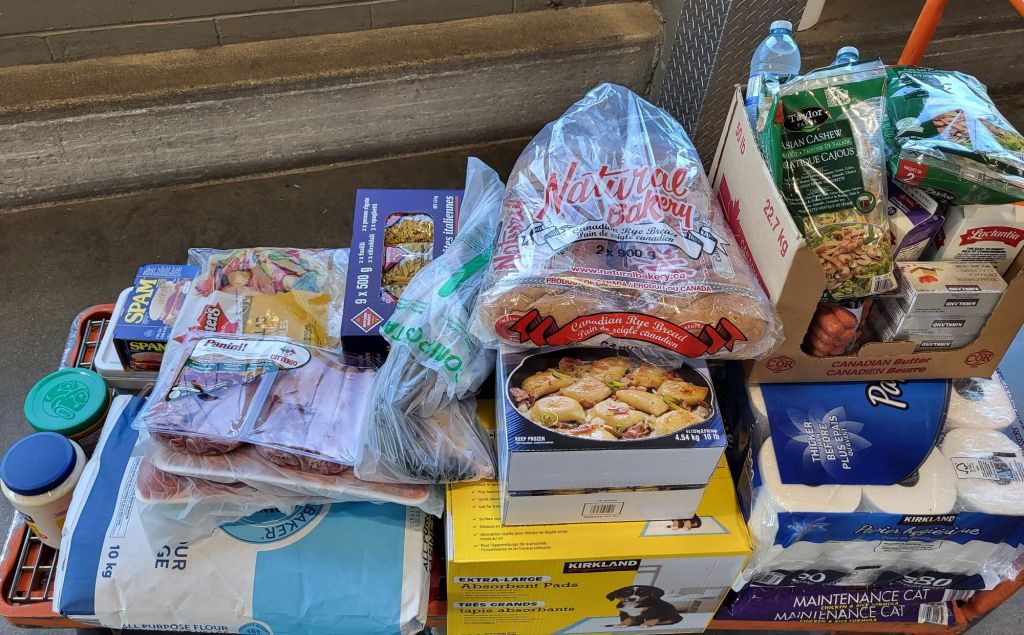
I did get the pet supplies on a separate bill. This is what both bills together, $735.23, looks like.
Well, kinda. Quite a few things are hidden in the image.
The pet supplies receipt is on the bottom. Two cases of wet cat food, two 9kg bags of kibble and one box of puppy pads. Grand total: $182.51
The stuff for ourselves totaled $552.72, but this did include some more expensive purchases that are not at all usual. One of those is something that’s hidden in the photo above. I got a shop light, which cost $39.99 Now that both basements are cat free zones, we’ll be setting the workshop up again, including the giant self healing cutting mat that is currently covering the dining table. My husband will be bringing some of his leatherworking supplies down there. The light will be hung above the work table.
We got a flat of Coke Zero, but the other unusual thing we picked up was a flat of Monster energy drinks, in three flavours. Both my daughters and I drink them, so I figured it would be worth trying a case. That was $44.99.
The other “bottom of the basket” stuff includes a bag of flour – we weren’t out, but at $9.99, I grabbed one, as flour is rarely such a good price, even at Costco. I got a bucket of ghee, as we were getting low – it’s not the same as what we got before but, for the amount, the price is still insanely better than elsewhere. There’s a 9 pack of pasta, two flats of eggs (60 eggs), frozen perogies and toilet paper.
Along with those, there are packages of pork chops, fresh sausages, a panini variety pack and – a treat for the girls – a package of fresh pink salmon! Salmon is usually extremely expensive, but there were three or four salmon in there, for only $24.09. Usually, we’d pay that much for a single frozen fillet, and not a very big one!
I got another 3 pack of Spam for the pantry, and a 3 pack of all beef wieners. There is a big jar of mayonnaise and another of peanut butter. I got a 2 pack of rye bread, and two 2 packs of tortilla wraps. I also got their last 2 pack of hot dog buns. Not enough for the amount of wieners I got, but the shelf was empty. The only reason I got the one package was because someone left it in with another type of bread.
There are also blocks of mozzarella and Old cheddar cheese, plus two 4 packs of cream cheese. My daughter wants to do some baking! There are 5 pounds of butter, a 1L of whipping cream and a 2L of lactose free milk. There are a couple of 2 packs of salad mixes, and finally there are containers of ibuprofen, acetaminophen and house brand lactase.
Both Costco bills together came to $735.23
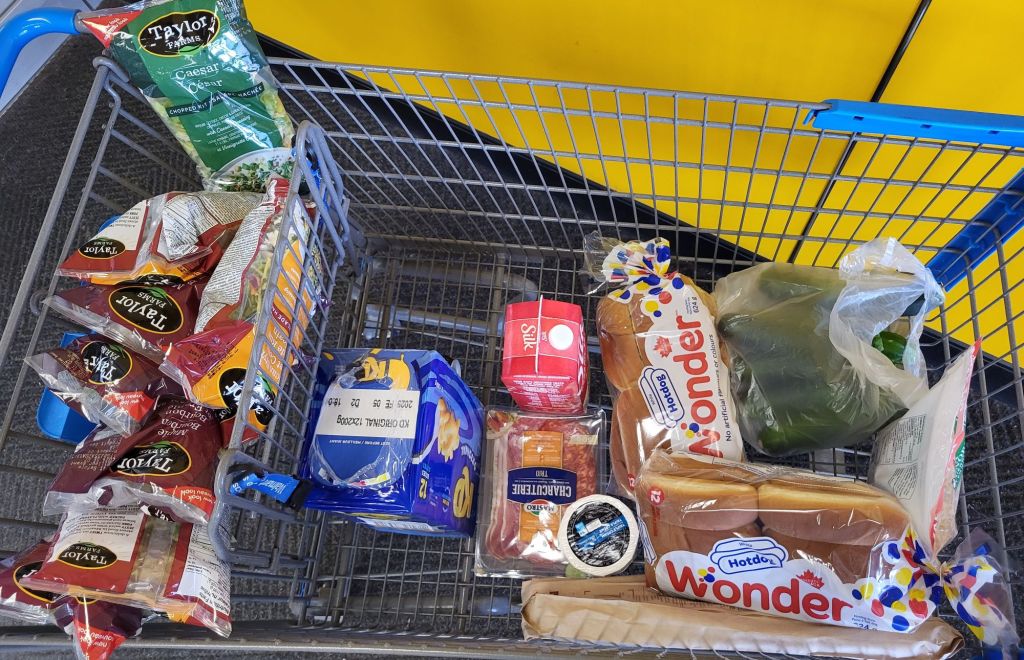
There were a couple of things on my list that I couldn’t find, though, so I decided to hit a nearby Walmart before leaving the city. I chose to go to the Walmart only because it was physically easier to get to and from than my other options.
I ended up getting more!
Click on the images to see them full size.
One of the things I was looking for was zucchini, for my daughter’s baking. We don’t have enough summer squash in the garden for the amount she needs. The other thing was soy milk. I got the lactose free milk, but my daughters had requested soy milk, and I couldn’t find any at Costco.
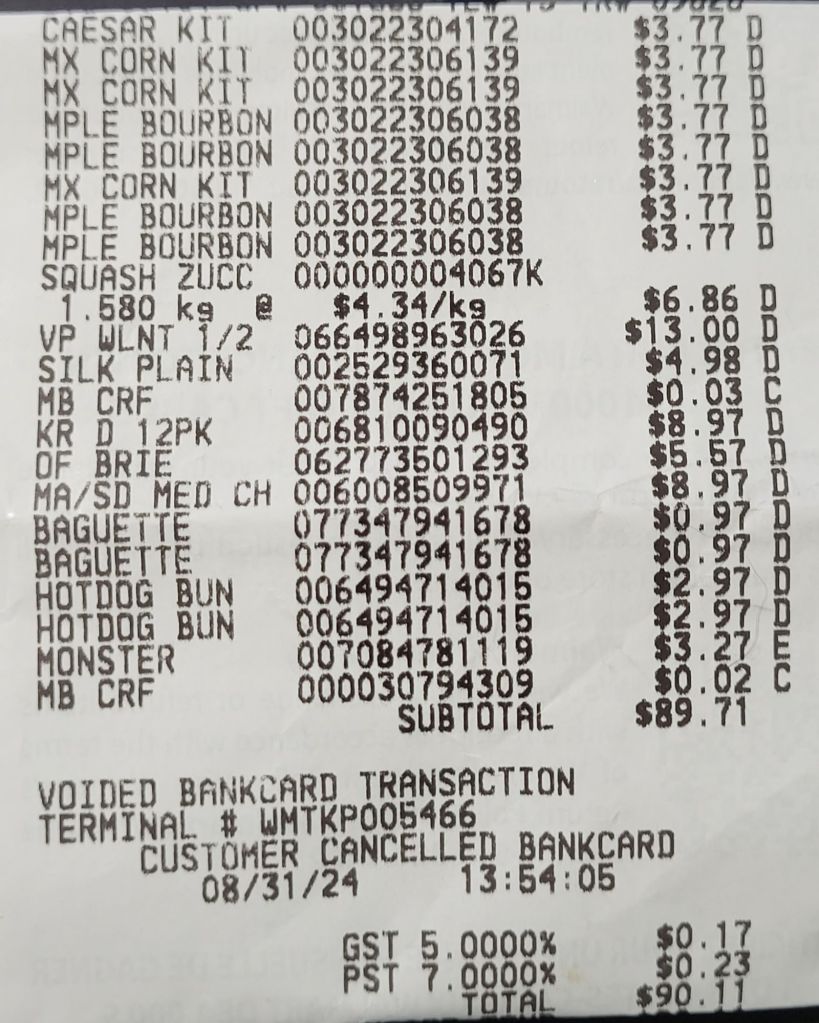
The big winner were the bags of salad mix. They were only $3.77 each – normally, they’d be closer to $6, even at Walmart, and closer to $7 locally. I try to get one bagged salad for each of us – it’s just easier that way – but they only had three bags left of the Mexican Corn mix. My husband likes Caesar salads, so I got one of those for him. I also got four bags of Maple Bourbon mix.
I grabbed another 12 pack of mac and cheese, as it was only $8.97. Those usually cost closer to $13, or even $15. There’s a small wheel of brie, a couple of baguettes, and a small charcuterie mix of meats. I’d like to have another charcuterie and Columbo night, this time with both girls, now that my older daughter has hit her commissions deadlines. I got more hot dog buns, so we now have more than enough for the amount of wieners I got at Costco. Last of all, I got myself a cold energy drink for the drive home.
By the time I was ready to go through the checkout lane, I was pretty exhausted. I found a lane with just one cart ahead of me, being unloaded. It was two women, shopping together. One was talking to the cashier while the other was finishing emptying the cart.
As I started unloading my own cart, both women were starting to talk to the cashier, who was no longer scanning their items.
The cashier was trying to hard sell them a Walmart credit card.
And I do mean HARD selling!
Every time one of the women would say no, the cashier would be, Oh, but there’s this benefit, or this feature, or no fees… The women kept saying no, but also listening politely to the cashier, who just kept pushing them to get this credit card, waving around this printout she had with the details…
… and not scanning their purchases.
This went on for quite a while before I finally asked, “should I be going to another lane?” The woman looked at me, and I added, “I’m tired. If this is going to take a while, should I just go to another lane?”
The cashier tired to push the card in them again, the women said no again, and finally the cashier put away the sheet and started scanning their stuff again.
It took maybe a minute for them to finish after that.
When the cashier started scanning my stuff, I got no greeting at all. She basically ignored me until she was done…
… then tried to sell me on their credit card.
Funny. When I said no, she didn’t try to hard sell me on it.
Then, for some reason, when I tried to pay for my purchase by inserting my card into the machine, I got a message saying, customer canceled transaction. I hadn’t touched anything but the bottom of the machine as I pushed the card in. At least I don’t think I did. Given how tired I was, it’s entirely possible my hand slipped and I hit a button, but I don’t think so. She resent the total to the machine and I scanned the chip, instead, and it worked fine after that.
Grand total was $90.11
I was more than happy to be out of there.
So the grand total for stock up shopping, both Costco and Walmart, was $825.43
Add in the gas and the Dollarama purchase, and it totaled $925.60 Plus my breakfast, $950.22
Ouch.
I was very happy to be leaving the city after that. Thank God I won’t have to do this again until next month!
Unfortunately, that nice cold energy drink I got did not accomplish much.
It’s an hour’s drive to the city, plus the driving time inside the city itself. After about half an hour, my exhaustion was starting to catch up on me.
By about 45 minutes, I was looking all over for a place I could safely pull over. I was feeling so tired, I started to be afraid to blink, because my eyes did not want to stay open!
In the end, I wasn’t able to pull over until I reached the intersection outside of the town nearest us, with a gas station. I went in to use the washroom, bought a couple of small things to pay for the toilet paper I used 😉, then messaged my family to let them know where I was, and that I was going to close my eyes for a bit. I was only about 25 minutes from home, but I was just not safe to drive.
Once back in the truck, I cracked the windows open a bit, leaned my seat back and closed my eyes. I had the radio going which, with the engine off, turns itself off after 10 minutes. I turned it back on again once. I also had to close the windows on one side of the truck, as it started to rain and the wind was coming in from that side, blowing rain into the cab.
I didn’t think I’d slept much, but then my phone started to ring. It was my husband, giving me a wake up call.
An hour had gone by!
Before I got off the phone, I asked if someone could open the gate for me so I could drive straight in, and then set off for home.
When I got home, both girls were waiting for me by the house. Once I was backed up to the house, they ordered me to go inside and lie down, then started to unload the truck.
I went to the bathroom before going to lie down, which is when I first heard it.
Thunder.
By the time I got back to the entry, it was pouring rain. My younger daughter was outside, unloading the truck to my older daughter at the door. My older daughter asked if I could take over while she ran upstairs to close the window by their computer!
So I took over door duty, grabbing the remaining stuff my younger daughter was bringing over. She was laughing gleefully, while getting completely soaked!
Then, as quickly as it hit us, the rain was gone!
The girls took care of everything else while I tried to lie down, but sleep would not come.
Mostly because I had a very persistent Potato Beetle, demanding attention.
He does this by reaching out and grabbing and arm or hand or face, with a single, sharp claw!
One of my daughters rescued me but, by then, I needed to eat something, anyhow.
The rest of my evening has been one of recovery, while the girls take over things. As I write this, they just finished feeding the outside cats and tending to eye baby.
It’s almost 8pm right now, and I think as soon as I finish this, I’m going to try going to bed for real this time!
Okay, so after confirming that we didn’t have any flat tires this morning, then getting diverted with a trip to town before doing to the city, the trip to Costco has been dropped entirely for today.
When the Cat Lady and her husband caught up with me, I could see why they had to much trouble with the catio! With her husband’s short box truck, it was leaning against the tail gate. It is really quite light. No wonder it got blown off! They did get a strap for it, though, and ended up giving me the strap after it was transferred to our truck. She also gave me four bags of kitten food that fussy little Button won’t eat!
They’ve had to put a bell on him. He’s so tiny, he kept going missing!
I still used one of my new straps, along with the tarp and some bungee cords to secure it. The catio just barely fit into the box of our truck, between the fenders on the sides, and the rolled up cover by the cab and the tail gate. I did have to slightly bend the remaining roof panel to squeeze it forward, so we could close the tailgate.
The second photo shows it unloaded behind our garage.
The Cat Lady hoped we could at least use the parts and pieces. They’ve had this catio for a while. As we unloaded it, I did see that one corner on the bottom will need to be reinforced. The wind tore off part of one of the fabric cat beds, but my younger daughter is pretty sure she has some heavy duty fabric she can replace it with.
The mesh has a hole in the back that had been the entry through their basement window in their old house. That will need to be patched. It’s the same half inch hardware cloth that I just picked up for the isolation shelter I’m building, and we’ll have enough to patch that up.
I’m surprised that the wire is just held in place with staples! Definitely something heavier duty than what we’ve got. Any time I’ve tried to staple something like this down, the staples tend to pop out again, easily. I was a bit surprised to see that those shelves are just “floating”. They are attached to the wire only, not the frame!
You can see that there is some rust on the wire, too. Once we reinforce the corners and do any other fixes or modifications, we’ll give the whole thing a paint job. If the wire needs to be painted, though, I think I’ll go for black, so it’ll be easier to see through the wire.
We might add a second latch on the door, near the bottom, as it’s bowing out in that corner – reinforcing the frame should fix that. Racoons can figure out how to open those latches, though, so we’ll probably look for something different.
By this time, it was past noon, so instead of going to Costco, I went to my mother’s town and the feed store to pick up 40 pound bags of cat food for the outside cats. While there, I asked about lysine. The guy I spoke to before was there, and he said he found some in 1 pound buckets, so he got two of them for me. They will arrive on Tuesday (after the long weekend).
I was going to get 4 bags of cat food, but they had only 3 in stock. I paid for those, but when the guy went to get the bags to load into the truck, there were only two left on the shelf. More will be coming on Tuesday. I was going to come back for the lysine and another bag of cat food, anyhow, so I’ll get the bag that’s already paid for at the same time. The two bags I got are equivalent to four of the Kirkland brand I get at Costco, so we’ll be good for a while.
That done, I decided to swing by the hardware store. They also carry roofing supplies and materials, so I asked about clear roof panels. They don’t carry them in stock, but they do special order them. After looking at my options, I went ahead and ordered two 3’x8′ panels. They will be cut in half cross wise, and will be enough for both cat shelters, so I won’t be using the salvaged metal roof pieces that I was expecting to use. They couldn’t say exactly when the panels will come in, but will call me. At best, they might even be in by Tuesday, too.
Once home, unloaded and settled, I phoned the septic company that charges by the hour, to arrange to get the septic expeller area fixed. They won’t be able to come out for a couple of weeks, unfortunately, but the owner is going to be in the area on Monday. He will be swinging by to look at the area on Monday evening.
The good thing is, the renter’s cows are no longer here, so we can move the electric fence and chain away from the vehicle opening in the fence by the barn. It’s wide enough for heavy equipment. I should probably head out there in advance, with the extended pole pruning saw, and cut away the willow branches overhanging the expeller.
I was going to do it with the loppers, but I’m not tall enough.
So today turned out to be not at all as I expected it to be, but I don’t mind. We now have the ratchet straps and tie downs we meant to get for the truck kit anyhow. The tarp did get damaged by wind during the drive home, but it’s repairable.
More importantly, we have a cat shelter that can be used until the isolation shelter I’m building is finished. I plan to use some of the wood lath I have to reinforce the wire mesh, because I don’t trust staples, along with any other repairs it needs. Then we can move it closer to the house. Probably on the patio blocks under the kitchen window, so we can see it, though we’ll need to find somewhere else for a wood bench and the swing bench, if we put it there.. The clear plastic roof panels can be added, and any painting can be done, after it’s been moved. Once it’s in place, we can leave the door open and allow the cats and kittens to enjoy it. That way, when we have a cat that’s been spayed and needs to stay in there for two weeks, it will already be used to the shelter.
I might even be able to get some stuff out there done, while there’s still light out, since I’m not exhausted by a Costco shop.
I should probably eat something first, though! I keep forgetting to do that.
I’m happy to say, no flat tires this morning, so I was going to do the Costco shop this morning.
I slept in longer than intended, and didn’t leave as early as I’d planned. Which is why I was still home when I started getting messages from the Cat Lady.
They had a change in plans, too, and needed to go to the town nearest us. Could I meet them? They had cat food for us, but instead of the cat tower, they had their old catio shelter.
Of course, I said yes. I was heading that direction to detour road work, anyhow.
I ended up going into town early, got a bit of gas, and was going to wait.
I got a message saying they were leaving late, so I went for breakfast.
They have a short box truck, and apparently the cat shelter was really tall in it. They were going to drive slow.
Then I got a message.
It fell off, onto the highway!
Nothing broke, though.
Some time later, I got another message.
Two roof panels just blew off!
After making sure everyone was okay, I went to the hardware store for ratchet straps, a tarp and tie downs.
I messaged them about it, and she told me they stopped to get straps, too. The ones they kept in their truck had been borrowed by her FIL.
Oops!
So now I await them in our meet up spot. I’ve already rolled back the box cover. Once we have the shelter, I’m going home to drop it off.
I’m seriously considering doing Costco tomorrow! But a Saturday Cos5co trip would be worse than a Friday one. 😆
Plus $80 in gas. As I headed out, I stopped in town to get $50 in gas, at $139.9/L, along with a sandwich (made by our one restaurant in our little hamlet) and a drink for breakfast while driving, but the food was out of a different budget, so I’m not counting that. I then got another $30 of gas at $137.9/L as I was leaving the city. I also got lunch later on but, again, different budget, so I’m not counting that, either.
I didn’t get pictures of everything. I ended up going to five different places – and still skipped Superstore.
My first stop was Home Depot, as it was basically across the street from the Canadian Tire I was going to. Mostly, I was wanting to see things I was looking up online, like the clear, transparent plastic I thought might be good for windows on the cat isolation shelter.
Good grief they are expensive!
Other stuff I wanted to see, they didn’t have in stock, but they were things I am thinking of for the permanent garden trellises, so that can wait.
What I did find was half inch hardware cloth. They were rolls only 5 feet long, so I got two. I also remembered we were pretty much out of CLR, so I got a bottle of that, too.
Grand total for the three items: $47.10
That done, I popped across to the Canadian Tire and got 4 bags of hardwood pellets for the litter boxes. On the way to the tills, I grabbed a couple of 6pc bungee kits that were on clearance, and a bottle brush. The cats kept stealing our bottle brushes and they had to be thrown away, so it was nice to see some on sale.
Hopefully, the cats won’t find these ones as delicious.
Grand total: $52.43
I was going to the Walmart next, but I forgot I’d already passed it, so I went to the international grocery store, instead. It shares a parking lot with a Dollarama, so I dashed in there to see if there was anything I wanted to pick up.
There were a few things.
I found a metal hanger that might be better for hanging my daughter’s bike than what I got last time. I also grabbed a pizza rocker knife. We don’t actually need it for pizza, but we do make quesadillas fairly regularly, and other flat things that will be much easier to cut with this type of knife. I’d seen it at Dollarama before, months ago, and didn’t get it, but when I wanted to buy one, they weren’t in stock, so I snagged it when I saw it today.
I also found clear, transparent shower curtain liners, and clear transparent table cloth protectors. I got two of each. They will be for the box frame on the bed with the eggplants and hot peppers, to create a sort of greenhouse protection around them. The nights are starting to get chilly, for heat lovers like eggplant. The plastic we tried before got absolutely shredded by the wind, so I am hoping these will be less likely to tear apart. I don’t know which will work best, but the ones that don’t get used will certainly not go to waste.
Grand total: $23.52
Then I finally made it to the international grocery store. By then, it was coming up on noon, and I was going to have lunch, first. I was originally going to have Dim Sum again, but the Chinese buffet lured me in. I was in line behind a pair of older women sharing a shopping cart. One just finished getting her 3 item meal (the largest size on their menu), and her companion started to order her 3 item meal.
Then another.
Then another.
A line started forming behind me, including a young man that was immediately after me. I noticed he was wearing the store uniform, so I asked him if he was on lunch break. He said yes, so I offered for him to go in front of me. He started to say no, he could wait – until the first of the two women in front of me said that her companion was “only” ordering 5 meals.
She was still choosing items for her third one.
At that point, the guy agreed to go in front of me!
The woman ordered two more dinners, and was just starting to order a 6th, when her friend pointed out to her that she already had her five. It was just that one of them hadn’t been placed on top of the buffet cover with the others, yet, so it looked like only four. So she stopped the guy behind the counter before he put anything in the new container.
The employee in front of me started ordering, while the two ladies were talking, and it turned out that no, the second woman really had needed six meals, not five! So they asked if she could order her last one ahead of me.
I said yes, but good grief! 😄 At least one more didn’t take very long. By then, a second employee was able to help me, so it wasn’t just one guy behind the counter anymore.
It was an excellent lunch, and worth the wait.
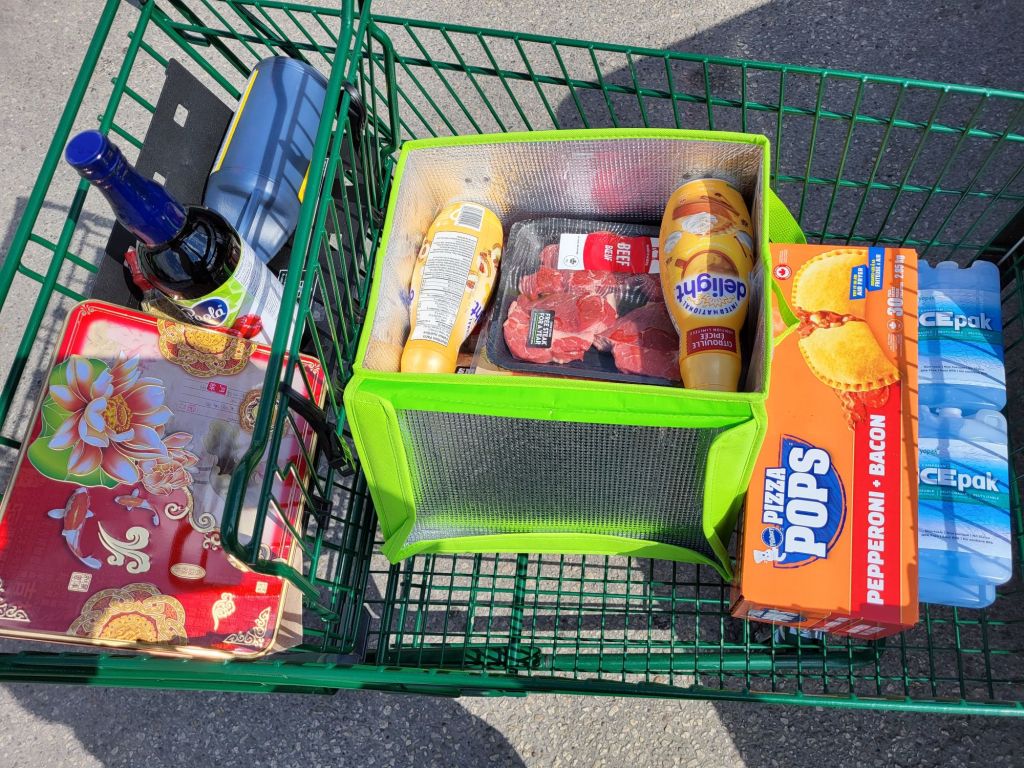
When I do my shopping, I prefer to put everything back into the cart, then bag things myself in the truck. Especially when there are things that I want to pack with ice packs. Today, though, I noticed they had hard sided insulated bags in stock, so I got one of those, too. It was also on sale, which was a nice bonus.
This is what $222.55 looks like – plus the hardwood pellets.
Most of what I got fit into that one insulated bag!
I got the Coke Zero for my husband and I, and the root beer for my daughters. Those were both on sale.
Hidden in the insulated bag are three $5 each packages of shaved sandwich meats – chicken breast, black forest ham and old fashioned ham. I actually got a package of top sirloin steaks – a treat! – that was on sale. For the girls, I got some frozen Coho salmon and frozen Basa fillets. From their cheese bar, I got some Austrian gruyere, forest mushroom gouda and beer gouda. I got a charcuterie trio to go with the chesses. A few more ingredients, and the girls and I will have another charcuterie and Columbo marathon. 😁
There’s also some thick sliced applewood bacon and unsliced smoked bacon, both locally made. The sliced was on sale, as was the package of pork tenderloins I grabbed. Last of all for the insulated bag was a couple of bottles of creamer for the girls’ coffee, which was on sale.
Among the other items, there’s a jar of dried rosemary – something I’ve been looking for for a while, but was been out of stock, all over! There’s a bottle of Polish raspberry syrup that the girls like to add to drinks, and the Philippine soy sauce my husband likes.
I also grabbed another box of pizza pops, even though I just grabbed one yesterday. This was on an even better sale – regular price $24.79, sale price $17.49. Having an extra for the freezer is a good thing!
As a treat, I bought a box of double yolk mooncakes. They were on sale. I don’t think I’ve had moon cakes since before we moved out here! I admit; as much as I like moon cakes, part of the reason I got them was for the tin. They are very handy, and very pretty. They had two different designs, and I had to resist getting one of each!
Last of all, I ended up grabbing four 4″x6″ ice packs to add to our collection. 😄 They were on clearance and only 90¢ each, instead of $2.99.
The down side of getting those pizza pops at such a great price is, the box is long and doesn’t fit in any of our insulated bags. I stuffed it into a soft sided bag with some ice packs, but couldn’t zip it closed.
My next stop would have been Superstore, but with things thawing out in the truck, even with ice packs around them, I went straight to the Walmart.
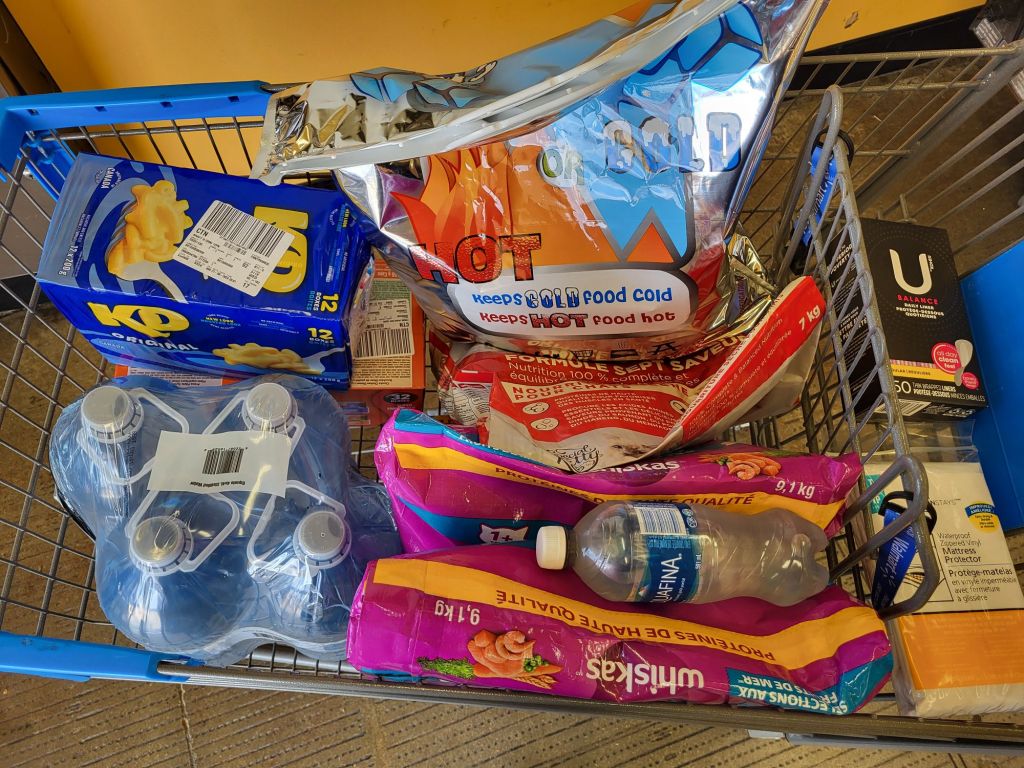
The main thing I needed there was enough kibble to tide us over, if we can’t get to Costco or the local feed store until after the long weekend. I ended up getting two 9kg bags of Whiskas and one 7kg of their house brand. I also got a 32 pack of wet cat food.
The KD was on an excellent sale, so I grabbed a box. I also grabbed more distilled water for my husband’s CPAP humidifier. It wasn’t on sale, but their regular price is almost half what it costs, elsewhere, so I grabbed a pack of four bottles.
The other thing I was looking for was a mattress bag. We may not have a spare bedroom for my brother, but we can set up a bed for him in his van, as a surprise. Since it will be in a van, though, I want to make sure the spare mattress is in a bag, to help keep it protected. I had a couple of choices, and selected the one that was heavier duty.
Then there were some hygiene products for my daughters and a bottle of cold water for the drive home. It took a while, and asking several people, before I found a larger insulated bag that I hoped would be large enough for the pizza pop box, then picked up a couple of bags of ice to put in it. Last of all, I added a donation for a school lunch program.
Grand total: $182.24
The new insulated bag wasn’t quite large enough. The squareness of the box’s end made it tight to snap the bag closed, and as soon as it was moved, it started popping open again. Still, it was better than before. It had ice packs with it, and the bags of ice went into the soft sided insulated bag we keep the ice packs in – which had been set inside an insulated hard sided bag, to make extra sure they were still frozen when I needed them! – with the remaining ice packs. I just made sure the new insulated bag had its top folded over and push against another insulated bag, while the bag of ice went on top.
At that point, though, I needed to get stuff home. Just a quick stop at the gas station for a bit of a top up (I’ll fill when I get to Costco), and it was straight home to get things into the freezer!
While unloading, there were cats just everywhere, so I paused to put kibble out and get them away from the truck. They were quite hungry!
Also, eye baby’s eye is looking both absolutely horrible, and so much better, at the same time! She’s running around with the other kittens so much that it actually takes me a moment to identify her now. Gotta see that messed up eye, and her adorable ears with the turned back tips.
After the litter pellets were loaded into the house, I still had to deal with kittens, exploring under the truck. That was a good time to get the hose and rinse the dust off the truck, so I could move it under the trees in the yard.
Until I’m finished using the garage as a workshop, the truck is still parked in the shade of the yard. The major downside of this is, cats like to lie under it, and kittens like to explore the undercarriage! Every time I go to use the truck, I make sure to walk around it once or twice – three times, if I’m unsure – banging on the hood, the sides, and the box cover, to make sure no cats are under it – and especially not under the hood!
So there we have it.
Five places, and more than $500 later.
Between yesterday’s unexpected stock up trip, and today, there’s no hurry to do a Costco trip. My husband’s private insurance disability payment – the one that pays almost all the bills – comes in on Friday.
It’s Labour Day weekend coming up; the last long weekend before school starts.
Costco is going to be insane.
I have zero problems waiting until Tuesday to do a Costco trip!
Tomorrow is my usual first trip to the city for stock up shopping, but we were completely out of a few things. I had a very short shopping list, but my daughter sent me some funds, so that allowed me to be on the lookout for some good deals.
Well, it turns out the local grocery store was having some Dollar Days sales, and I took advantage of it!
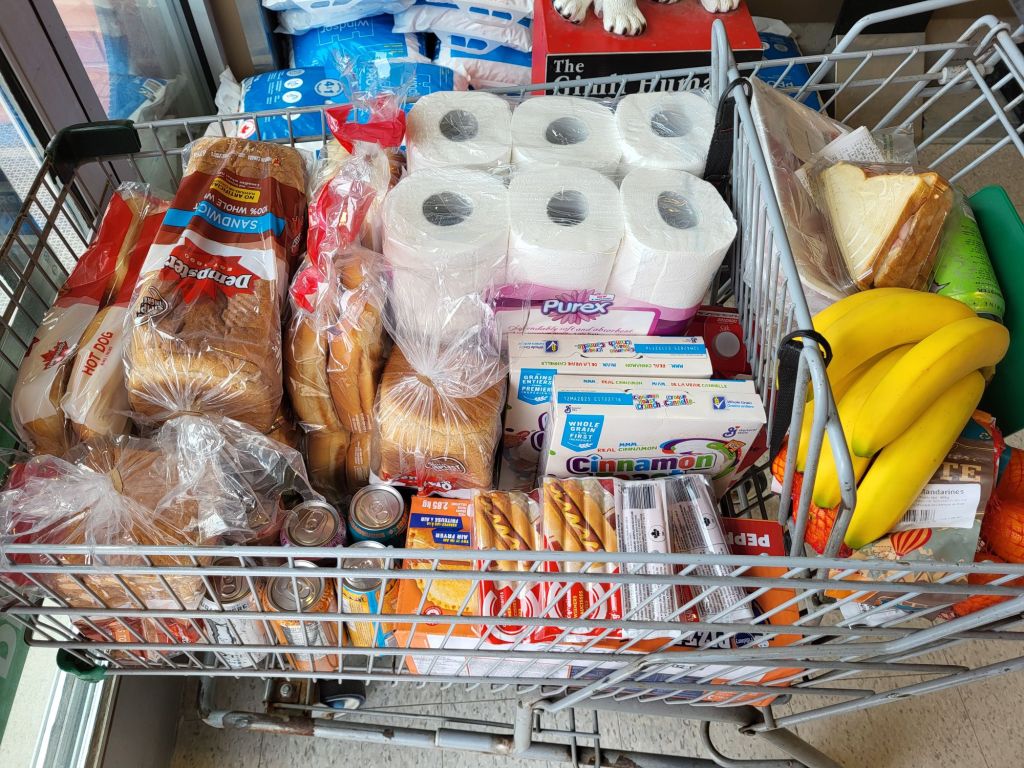
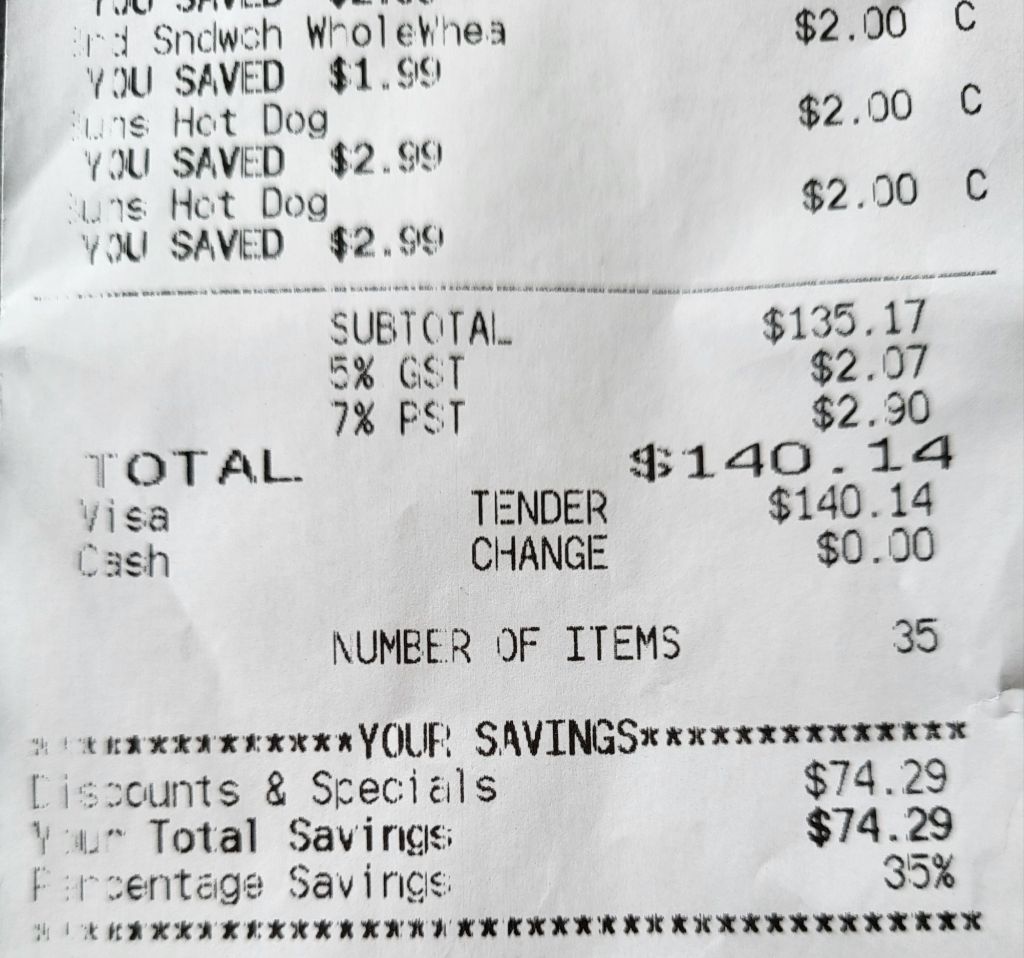
This is what $140.14 looks like.
Without the deals, this would have cost $214.43
The only things on my list were bread, eggs, butter and toilet paper. The TP deal was with using a Scene points card, giving $4 off per package, so I got two. The eggs were not on sale, nor was the butter, but the butter was the house brand and the price was not much higher than the price for butter at Costco.
We don’t normally buy boxed cereal, but these were $4 each, which was $1.99 off per box. Along with the Cinnamon Toast Crunch visible in the photo, I got Oatmeal Crisp Maple, which is buried under the bread.
I also got 6 different flavours of energy drinks. That was a 2 for $7 deal, and the savings was only 49¢ per can, but it also got me 100 points for every 2 cans. I could have gotten cases, instead, but the cases came in only 2 flavours, and we like variety.
I got a couple of packets of lemonade and strawberry powdered drink mixes. They were not on sale, but they were only 65¢ each, and sometimes we just want something not-water. It’s something to try and see if we like.
The whole milk (1L) and soy milk (2L) were not on sale, but if I was getting cereal, we were going to need more milk.
The box of pizza pops is an occasional treat that I usually get at Walmart, as they tend to have the best price, but these were $5 off, making them a better price than Walmart.
The bag of Mandarin oranges was $3 instead of $6.99, and the bananas were 59¢/pound ($1.29/kg), instead of the usual 79¢/pound.
The pork was an excellent deal. One package cost $4.76, with a savings of $6.16, and the other was $3.91 with a savings of $5.03
The hot dog wieners were $2 a package ($3.29 off), so I got three, to go with the three packages of hot dog buns that were also $2 each ($2.99 off). The whole wheat Texas Toast and sandwich bread was also $2 each ($1.99 off), so I got two of each.
So I got 35% off in savings, plus 300 points extra. I had enough point to get $10 off my bill, too, but chose to save it for another trip.
Most of the bread and 2 packages of wieners went straight into the freezer.
Meanwhile, CPP Disability comes in tomorrow, and I should be doing our non-Costco shopping trip in the city, which will mean going to at least three different stores. Four, if I have the energy to do Superstore, too. The international store that we got to has some good sales on right now, and tomorrow is the last day for them, so I don’t want to skip that. Plus, I’m looking forward to some Dim Sum for brunch!
For those who have followed this blog for a while, you might be a bit surprised to hear this, but …
… so was my mother, today. Hopefully, that won’t change.
Let me step back a bit! Things went so different than expected today, it actually feels like it’s been two days!
After I finished my rounds this morning, I grabbed the inner pipe for our septic expeller and headed out towards the barn. Once I got to the outer pipe, I could see that nothing had overflowed the pipe while the venturi pipe was out. I made sure to have my rubber boots on this time and walked around. The saturated area is quite large. Which, I suppose, makes sense if it’s been leaking for at least 6 weeks.
When I put the venturi pipe in, though, I did hear splashing, so there was at least some fluid making it into the pipe.
I had really hoped that somehow, it would be something as simple as seating the venturi valve at the bottom properly, but no. We will definitely need to get it excavated and repaired. Which is something I’ve been really dreading. The last time my brother had to get something excavated here because of a septic problem, it cost him over $5000.
Once I was done and cleaned up, I made myself some breakfast, then sat at my computer so I could start looking up companies while I ate.
Which is when the phone rang.
It was my mother.
Before I even picked up the phone, I knew what she was going to say. Even from the tone of her voice when we said our hellos, I could tell.
She did, however, ask me how I was doing, first. So I was honest with her.
I was doing terrible.
I then – very briefly – told her about what was happening with the septic, that we would need to have it excavated, but we had no way to pay for it. The stress of the whole thing was worse than I realized, because by the time I finished telling her that, I was almost crying – and it takes a LOT for me to cry!
Then, much to my shock, my mother said that she would help.
I never, ever, would have asked my mother for money for this. I know she has it, but when it comes to money, my mother’s behavior is particularly… unfortunate.
I’ll just leave it at that.
I told her that I was going to call for estimates, but couldn’t even guess how much it might cost. She just said, make sure it’s professionals doing it, and she would help.
Which just blows me away.
Unfortunately, my mother does have a history of offering help, and then trying to back out of it. She did it when she said she would pay for the movers, which was part of the deal for us to move here in the first place (in the end, she did pay most of it, but we still needed help from my brother to cover the rest). She tried to do it again after she agreed to pay for the new roof on this “perfect” house she asked us to move into. She’s done it to my brother, many times, over the years.
Still, just that she offered to help at all was greatly appreciated and a wonderful surprise.
After we talked about it a bit more, including my telling her I’ve been talking to my brother about all this, and that he also said, get an excavator, she told me why she was calling in the first place.
It was exactly what I expected.
She thought she was going to die last night, again.
Now, when she’s having these issues, she says she’s struggling to breathe, can’t breath, feels like she’s dying…
She said she tried taking “medicine” for it (most likely Tylenol), but it didn’t help. Then she took the “pink stuff” I’d bought for her.
The no-name Pepto.
I know she’d taken it before and found it helped, but I didn’t realize she’d stopped. She’s already on a prescription medication for acid reflux, so she shouldn’t need it.
She took some last night, and it worked. She felt much better!
She was, however, now out of it.
So we worked out that, after I had my breakfast, then made some phone calls, I would go pick up some more for her, and bring it to her.
My mother hadn’t slept during the night, so she was going to try sleeping in her comfortable chair while waiting for me to arrive.
I then started looking up some local companies that service septic systems, then made some calls. One of them was to the guy my brother usually called for work done here, but I was pretty sure he didn’t do plumbing anymore. He does do excavating, though, so maybe? The last few times I called him and left messages, he never called back, so it was a surprise when he actually answered the phone. I explained the situation, but I was right. He bought a memorial business a few years ago, and that has become his focus. Most of his excavating now is digging graves. He was apologetic, but I was expecting this.
I left messages with two other companies, but got a real human with a third.
I explained the situation and said that I was looking for estimates to pass on to my brother, as I don’t own the property. I know my brother would trust me with whomever I chose, but I would run it by him, anyhow – and it buys me the time to get multiple estimates.
When I described our ejection system with the expeller rather than a septic field, I was told that these are not supposed to be repaired anymore! If they break down, they are supposed to be replaced with a septic field.
I don’t think we can even do that. There are just too many trees and roots to mess with a field. That’s why we have the ejection pump system to begin with.
He was clearly familiar with systems like ours, though. He asked a few questions about what was happening and started looking things up, rattling off the parts and pieces we’d need, factoring transportation from the town they’re in (about 40 minutes drive away), then gave me a number.
$2032, before taxes.
Which was way less than I expected! In fact, it makes me wonder if he somehow didn’t include excavation in the estimate.
And estimate is an estimate, though, so I left it at that, and thanked him for it.
That done, I then got ready to head out to my mother’s, making a quick stop at the post office before they closed over the lunch hours. Not that I was expecting a package, but I’ve been surprised before. 😁
Then it was off to the pharmacy in my mother’s town, I got her “pink stuff”, then headed to her place.
When I got there, I found she had all sorts of food set out, including a hot lunch for me! She had just finished eating herself. I had to say no, as I’d just had breakfast and was still full. I did stay for a while, though, and we had a chance to talk. Long enough that I ate a muffin. 😄
I was very curious as to how she was feeling, before and after she’d taken the Pepto during the night. Particularly when it came to her breathing. She’s confused about it, too, but mentioned she was also dealing with anxiety and panic attacks. Which makes sense, if she literally felt like she was dying, and would also add to the problem.
If the Pepto helps, then it helps. Even if it’s psychosomatic, who cares? She feels better!
It did remind me to tell her the OT that visited her a while back had called me recently, and we talked about their visit. One of the recommendations she’d made to my mother was moving to a larger apartment, where she would have the space to use her walker inside (my mother parks her walker just outside her door, and uses a cane, or hangs onto the walls, counters, etc., inside).
I said that I told her, we want to get my mother into supportive living in the town where my brother lives, and that the OT said she would contact the guy in homecare. He will call one of us to arrange an appointment to go over the panel questions and application process with my mother. The last time he was there, it was a panel for a nursing home, which my mother feels she needs to be in, but she doesn’t qualify. She didn’t even qualify for assisted living.
Given how long it’s been, I said that I should probably call him myself and see if I can get an appointment made. My mother said to tell them, it has to be soon, because she might not be around much longer!
She’s turning 93 within a couple of weeks. She’s not wrong. But then, that could be true of any of us, at any time, as we painfully learned when the youngest of my brothers died at only 45.
We also talked about the septic issue a bit, but not too much, as it was making her feel anxious. I apologized, and told her that for me, right now, it’s hard to think of anything else!
While I was still with my mother, I got a message from my SIL. I just quickly skimmed over the preview, and saw that she was confirming they’d received my earlier updates about the septic system, but that my brother would get back to me about it, later.
I was able to stay a bit longer, but I could see my mother was starting to want me to leave. She was very tired. Her attempt at napping earlier had failed, and she wanted to try again. So I left soon after.
It wasn’t until I got home and on my computer again, that I finally read the rest of my SILs message.
It turns out that my brother is taking vacation days on Mondays now, they’d loaded up the trailer, and were coming out here today!
They must have been on the road already by the time I saw this and responded. I had some stuff to do inside, and planned to be back out before they got here, when I got a message saying they were here!
It’s a good thing my brother has a key for the gate!
By the time I threw on my outside shoes and headed out, they were pulled into the outer yard with their truck, trailer …
… and a bread van?
A large, formerly commercial bead van. Images of bread loaves on the side had been painted over, but the shapes were still very visible.
I had no idea they had one. Was it even theirs?
Then I saw the cement mixer.
*melt*
They had to get the tractor and rotary mower out of the barn first, then back the trailer up for unloading. I helped unload almost everything around the cement mixer. That was on skids. My SIL was on the trailer, moving things, and was able to drag it closer to the end. Once she and my brother got it off the trailer, I helped him move it into a space he prepared in the barn.
Not where he originally intended. He was going to put it in the lean-to side, but I told him, it rains in there! When the metal roof was put on the barn, the lean-to roof was not included.
It should have been.
To get the cement mixer to the space he prepared, we had to skid it over a massive board he’d brought last time, which now had three huge posts – posts he uses as a tripod to lift engines – on one side. Now, the posts would make it easier to move the skid over to the prepared space in an old cow stall, as they would roll, but as we were turning it, my brother stepped on one of the posts and it rolled out from under him. My heart almost stopped as I watched him fall!
Okay, it was a controlled fall. His old Tae Kwon Do lessons didn’t get forgotten. What really got me was how close his head came to the corner of a board on the other side of the barn’s centre aisle! I don’t think he realized just how close he came to a severe head injury!
My brother is my brother, though. He just got up and kept going, like nothing happened!
Gosh, he’s amazing.
Once that was done and the trailer moved away – the stuff remaining on it needed to go somewhere else – my SIL got on the tractor and went to do a bit more mowing. She was going to go where the storage warehouse is, but the truck and trailer were in the way! It was near the burn pile, though, so they moved it closer so we could unload some scrap wood to burn.
As she started digging the pieces out and passing them to me, I found myself setting pieces aside, as they were in good enough condition that I could use them with the small projects we build.
When it became clear that most of what they had was useable, I went and got my utility wagon. We loaded that up with almost all the wood they’d brought for the burn pile, then took it over to the garage. I cleared the top of an old shelf, and we stacked it on top.
I think I have what I need to make a door/ramp for the cat isolation shelter, now!!
Then my brother borrowed my driver, a short board, and some screws. The door to the hay loft on the barn was getting blown loose. It was tied closed on the inside, but that was giving out. So he basically just boarded it up. It’s not like we’re going to go up there. It’s too dangerous. If we need to access through those doors, we can just take the board off.
Over the next while, they traded off doing more mowing. My SIL started expanding the area around the storage warehouse while my brother and I moved some things out of the way. I had a chance to talk to him about having the scrap guys coming out, and what he was okay with them taking.
In short, there’s 5 cars, something we think is part of a truck (it’s almost completely hidden by grasses and burdock) and a threshing machine. With having the aluminum and batteries only, they would come out if they were already in the area. With a threshing machine and several vehicles as well, this should warrant a special trip.
All of this belongs to my brother, so any funds from selling the scrap metal will go towards taking care of the place.
That would include things like repairing the expeller on the septic system!
I don’t know how much we’d get for it all, but this company weighs things on site, and pays the going rate. I assume things like transportation and clean up will be taken off. I can’t even guess what we’d get for it. Probably not enough to cover the entire cost of the septic repair, but who knows? Prices might be good, whenever they get here.
I will just be happy for this stuff to be gone, and look forward to being able to clear out the vehicles in the old hay yard, too! All but one truck can go. I’m pretty sure my brother thinks he can get that truck going again. He’s the one who gave it to our father to use around the property. I don’t think it’s ever going to be roadworthy.
Gosh, it looks so much better! Plus, I should be able to collect some of the “hay” for mulch. Not anything close to the warehouse; there are too many burrs in there! There is lots that should be clean and not gone to seed yet, though.
My brother had already done part of this area, the last time they were here and brought the tractor. My brother took over the mowing after a while, as he had specific areas he wanted to get particularly clear, and went over them with the mower set lower.
He also cleared in front of the storage warehouse up to the three cars that are there, that the scrap dealer can now access. Eventually, they will most a lane to the secondary driveway.
Over the next few days, I’ll have to make a point of putting markers where the surviving Korean Pines are, as well as the ash tree my mother gave us, so they won’t mow over them by mistake!
With all this mowed, we can now access areas where we need to cut saplings away from buildings, before they start causing damage, too! It’s amazing how quickly areas I cleared out have become overgrown again.
Once the space he wanted was mowed to his satisfaction, my brother moved the bread van over and parked it. It turns out they’ve had it for years; I just never saw it before! Since they will be bringing more equipment to store out here over the next while, my brother plans to use this as his “house”. A place where he can change, or even sleep, whether or not we are around. Not that there isn’t someone home at all times, but since my husband has to have his hospital bed in the bedroom closest to the bathroom, we don’t have a spare bedroom to offer. They want to avoid disrupting us as much as possible.
The good thing about my brother doing all this in preparation for his retiring, and no longer haying on their property, is that we’re going to be seeing a lot of them over the next while!
Once all this was done, they had to head home right away. That’s going to be pretty much the pattern, over the next while. Whenever they can manage to come out here, they’ll bring another load of stuff, then will have to leave as soon as it’s unloaded stored.
We’re just happy to be able to see them so often!
I think this would be a good time for us to start going through the storage warehouse. My mother is adamant that we keep her stuff, though I do have permission to sell some of it (she keeps saying I should have a garage sale, which I will not do!), but there are bags and bags of old clothing and similar items, much of it belonging to my late father. My mother even left behind a whole lot of clothing, including a lot of underwear.
Packing those into bags was not the most comfortable of things! 😄
These bags of clothes can’t even be donated. They need to be taken to the dump. Once those bags are out, we’ve got boxes that are starting to collapse on themselves that need to be rearranged. They were labelled as detailed as we could when we packed them, and there is probably stuff we can still use. We just can’t get at things, the way it is now!
What I’d really like to do is get that building cleared out, so it can become a workshop again, and not a storage building!
But that is something we will have to deal with in time.
I almost missed it! It had fallen into the “living fence” my mother had planted, which was holding it up.
Getting it down was a bit risky, though. I had to get right under a hawthorn to be able to pull it out. After I managed to get it far enough I could move further away, I took a look and realized just how close I came to getting my back impaled by many very sharp thorns! Those things are deadly!
You can see more clearly, in the second photo of the slideshow above, just how large the branch turned out to be. I dragged it out closer to the fire pit, where there’s more room to break it down, but left it for now. I don’t know what the humidex put us at, but we were at 30C/86F at the time. As I write this, we’ve cooled down to 28C/82F, and with the humidex putting us at 32C/90F. That little bit of exertion was enough to leave me almost as soaked with sweat as I was when I got caught in the storm!
Before I checked the yard, though, I went to check on the septic expeller. Normally, I’d go through the barn to do this, but my brother’s tractor is in the way! I tried to go around, but there’s just too much junk in the old cow stalls on either side. So I had to make my way through the tall grass – I swear, some of it is as tall as I am! – to the vehicle gate. It has both a chain across it, and the renter’s electric fence wire, to keep the cows out. The cows have been rotated out, though, so the electric fence is off right now.
In the first two photos, you can see black part way up the pipe, where it then ends abruptly. Which means that the greywater has been going up into the outer pipe, but only so far. It’s not overflowing.
I brought the pipe to the yard and hosed it off, then ran water through both ends of the pipe.
There is no clog in the pipe at all.
So… what does this tell me?
It could be that the venturi was simply not seated properly at the bottom of the pipe. Rather than going through the venturi and being expelled out the top, the greywater was going into the outer pipe, but then draining into the soil around it fast enough that it never overflowed at the top.
Or there is something wrong at the bottom of the pipe that prevents a proper seal once the venture is set in the bottom.
I’ve sent the images to my brother, in hopes he has a better idea. He would remember the actual installation of all this, and probably helped do it. I was just too young. All I remember is the trench dug from the well towards the barn. I don’t even remember the pipes being laid down in the trench.
My hope is that it’s just the pipe wasn’t seated properly when I cleaned up around there, back in early July. I’d taken the pipe out to check it, but I was sure I’d set it back in properly. You can actually feel when it pushes into place.
I’m leaving it out for now and will take it back tomorrow, and see what I can see inside the outer pipe. With the inner pipe removed, the outer pipe should fill up faster when the pump runs, and actually overflow. If it does, I should see signs of that.
It would be really awesome if all it is, is the pipe not set properly! If that’s at, and water is flowing through the expeller properly again, that means we don’t need to call anyone and possibly need to get it excavated!
I’m just glad we are finding this problem now, and not in the winter!






 The Re-Farmer