So my progress on rendering lard has seen a few delays. Thankfully, using the slow cooker means I can leave it on warm for quite a while, if I need to. I did add several more hours on low, too.
The first delay was while I was preparing the soft cat food before my daughter came to help medicate Tissue. While I was doing that, I heard a strange sound coming from my bed.
Tissue was digging around my pajamas, near my pillow.
Yup. She’s just peed on my pajamas!
I guess that confirms it really was her that did it last time.
So I had to strip the bed and start another load of laundry, use paper towels to soak up as much pee as I could (thankfully, it was much smaller than last time! Or maybe it just didn’t have time to spread, yet.), and set up a fan, then help my daughter with the meds.
Tissue is very good about taking her meds, at least. When the syringe comes close, she opens her mouth and lunges at it! She does try to bite it a bit, but mostly, she just happily takes her medication.
Today is supposed to be her last dose, but it looks like there’s one dose left. Based on her behaviour, I am thinking we’ll keep her isolated a bit longer and give her that last dose tomorrow. It’s a pain killer, and while she is clearly doing very well, all things considered, she does still seem to have some pain issues at times. She’s also still not eating as much as I would like, so her tongue and jaw may still need a bit more time to heal up.
That done, my daughter stayed to cuddle Tissue while I headed outside.
While doing my rounds this morning, I was very happy to see a furry face that’s been missing for at least a month, now!
Rosencrantz is back! Rolando Moon was around, too, though she’s been disappearing for only a few days at a time, lately.
Seeing Rosencrantz gave me some hope that Potato Beetle would show up.
I was wrong.
After doing my rounds, I headed out to finally get that Purolator package. I was just backing out of the garage when I started getting messages from the Cat Lady. The local vet was trying to reach us, but they were trying to use my cell phone number, so I wasn’t getting anything. Instead of trying the land line, they contacted the Cat Lady, whose information is on file as the emergency back up number. From what little information she could give me, it sounded like the needed another update on Potato Beetle, the last cat they neutered for us through the rescue. I mentioned my daughter was near a phone, so the land line would be the most reliable option, then continued on my way.
I was able to confirm the new Purolator drop off depot, got the package and had an excellent chat with the guy that runs the place. After a quick stop at the grocery store, and then the post office, I got home and was able to finally start prepping space to sanitize jars for the lard.
I didn’t get very far, when the phone rang.
It was the local vet.
They were, indeed, calling about Potato Beetle.
Someone had found him and they matched his tattoo on file!
They gave me the name and phone number of the person who had Potato Beetle, so I called him up right away. After getting directions to his place (gotta love country directions: “go down the road that says “no through road” until you see a driveway….”) I grabbed a cat carrier and headed over.
My goodness, they are so nice and far from the road! We may be in the boonies, but the house is right near a surprisingly busy intersection. It does mean less driveway to clear, but I’d rather have less traffic!
Just look at me, complaining about traffic, after living downtown in a major city for so many years! 😂
After finding the house and managing to turn the van around, the guy came out and we started chatting. They’d seen this new cat for quite a while, but couldn’t get near him at first. When they finally did, he was incredibly friendly, and they could finally check for a tattoo.
Turns out, he’s been inside with them for some time, and would actually sleep with the guy! They already have nine cats, though.
The cat had gone outside again, though, so we went around to look for him. They built a cat shelter against the back of the house, and sure enough, up popped a familiar face! It was, indeed, Potato Beetle. Once he recognized me, he came right over for cuddles!
We spoke for a while, while one of his cats kept jumping in and out of the cat carrier, which was open from the top. Aside from their own cats, they get others that show up from the neighbours. Potato was a new one to them, though. While relatively close for driving, it’s quite far for a cat to wander beyond their own territory.
When he mentioned growing up in the area, I had to ask his last name. It was a very familiar one. It turns out I went to high school with his aunt! We were very good friends!
Small world!
Potato Beetle is now back again, though not at all the way I expected.
He’s inside the house now.
We figure if we let him out, he’d just disappear again, and since he did so well indoors at out neighbour’s place, we’re trying him indoors.
Yeah. We’re sucks.
We left him in the carrier for a while, as other cats sniffed at him, then let him out to explore.
So far, so good.
Maybe now, I can finally get back to finishing with that first batch of lard!
After I make lunch… It would be a very good idea to actually eat something today!
I started working on the pork fat well before it was thawed out, as it’s much easier to cut it while it’s partially frozen. I have two large slow cookers, and I was planning to use both of them to render the fat out. It should be done over low heat for a long time, and I wasn’t about to monitor a pot on the stove all night.
Thinking back, my mother never rendered lard on low heat. She didn’t have the time for that. I remember it being quite hot by the time she scooped the crispy cracklings out. I’m pretty sure I’m remembering burned bits, too! 😄
Having a large slow cooker or two would have made the job much easier for her!
Part way through cutting the fat up, I changed my mind.
I wasn’t going to do two slow cooker’s worth!
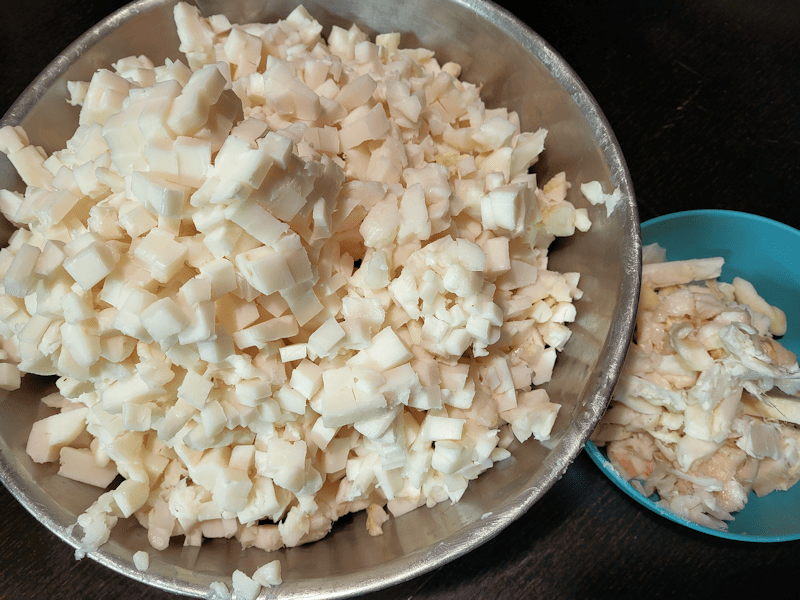
To fill this bowl, I finished off all the smaller pieces I could find. All three of them. 😄 I started cutting into the larger pieces, but they were still too frozen. Plus, I didn’t want to push my hands too far. They’ve been relatively pain free of late, and I would rather they stayed that way!
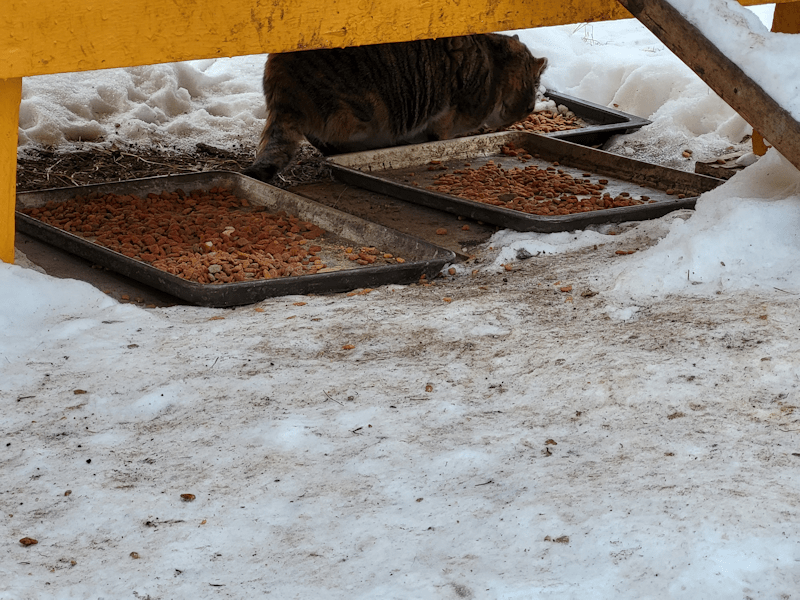
The small bowl on the side is the janky bits, with blood vessels or meat and the sliver skin. That was saved as a treat for the outside cats, which they were very happy to get!
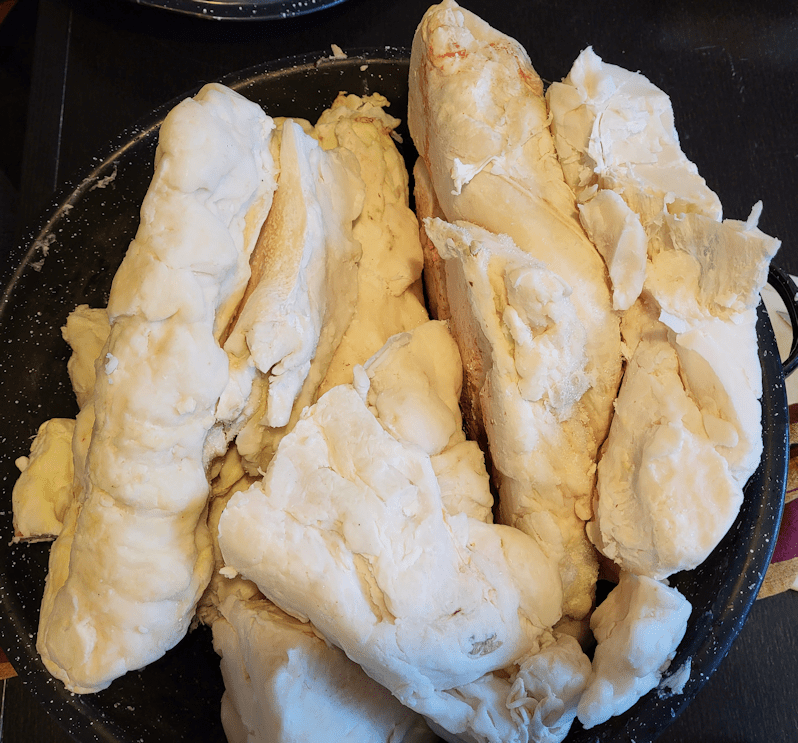
There was enough pork fat left in the giant bowl that the lid still didn’t quite fit all the way closed, and I had to use the foil to cover it completely again. It’s now sitting on top of the freezer in the old kitchen. It’s going to be a very slow thaw in there! Which is okay. While I was cutting, the outside of the fat would be getting too soft to cut easily, while the inside of the bigger pieces were still too hard. A slow thaw won’t have the two extremes, and it should be easier to continue cutting up tomorrow.
They kinda look like cheese curds in there! 😄🧀
For a moment, while filling the slow cooker, I thought I’d have to dig out the second one, after all! I squished it just flat enough to make sure nothing would touch the underside of the lid. As it renders, it’ll get lower.
The slow cooker is now set on low for 8 hours, and then it’ll automatically switch to warm. It might need more time, so I’ll be checking it off an on throughout the night. I did add a small amount of water to get it going, and make sure it the bits don’t start burning before the fat starts rendering out.
Once it’s getting close to done, we’ll sterilize some jars – probably in 500ml sizes (pints) – to store the lard in. If we do decide to go with a larger size, I’d go with the 750ml jars, rather than the 1L/quart jars. I don’t see us using it fast enough to warrant that large of a jar.
Based on how much is left that needs to be cut up, we might actually be doing two more batches! It’s a shame the meat grinder I found while cleaning out the old kitchen has parts missing. A grinder would make the job much easier, and more fat would render out of the smaller pieces, too.
No matter! The job is getting done, and we’ll have a good supply of shelf stable, high smoke point, flavour neutral fat for our pantry.
I just got back from picking up a whole bunch of meat for the freezer, from one of our homesteading neighbours!
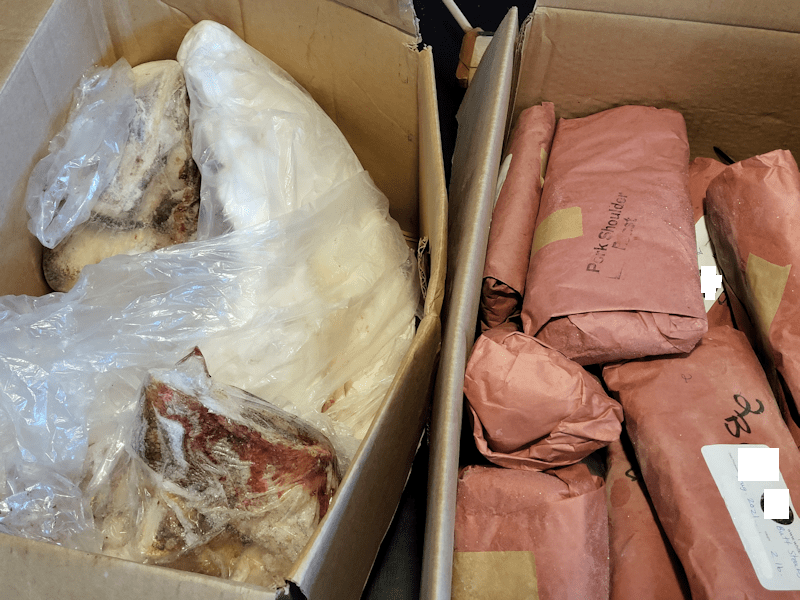
The box on the right is almost all pork, with four HUGE chickens buried under them, for $200. The box on the left is leaf lard, plus some soup bones, that they added in for free.
The fat has been set aside in a giant bowl to thaw out. I had to cut some of it up to fit it in so I could cover it and protect it from the cats. Thankfully, even when frozen, fat is pretty easy to cut through. Once it’s thawed a bit more, I’ll cut it into small pieces, and we’ll render it into lard, leaving behind what my mother used to call “skvarki“. I’ve spelled that phonetically, because I have no idea how it was spelled in Polish, and when I try looking up “cracklings”, I get a different word! The cracklings, with a bit of salt, make a great protein snack. Lard is a shelf stable fat. Properly rendered and stored, it can stay at room temperature for months, or as much as a year in the fridge. Even longer, if it’s frozen.
We also will be getting a shed in the spring, that could be used as a chicken coop!
Sadly, our neighbour won’t be our neighbour for much longer. They’ll be putting the property up for sale and escaping Canada, going to where there is no snow, and they can grow food all year long! As we were chatting, I mentioned the shed roof that collapse under the weight of snow almost a year ago, that I was planning to dismantle it to use the wood, and hopefully build a chicken coop.
He pointed to a nearby shed and asked if I wanted it! He needs to get rid of it and, in the spring, he can load it onto a trailer and deliver it to us.
Of course, I said yes!
It will need some work done on it. It has a flat roof, so it started leaking. We’ll need to make an angled roof for it. The leaking rotted away the floor boards, but the joists are still good, so we could easily put a new floor down. It’s roughly 8′ x 10′ in size, so we’ll need to prepare a base for it that’s larger than that. It’s got some pretty large windows on the sides, and there is a screened window by the door.
The question is, where do we want to set it up? We could use it as a chicken coop, but I do still want to have a mobile coop. Or we can set it up nearer the house and use it as a much needed garden shed.
We’ve got a few months to decide on that.
Meanwhile, we now have a greater variety of meats stocked up in the freezer that should last us a good long time!
For quite a while now, I’ve been noticing something odd when I check my WordPress notifications.
You know how the display is a different colour for the notifications you haven’t looked at yet? Then, once you’ve clicked on and read them, they turn white? The “unread” notification colour is such a pale blue, I actually have a hard time seeing it, whether it’s on my desktop on my phone.
The weird thing that’s happening is this…
When I check my notifications, I’m finding the reactions, follows, etc are in “unread” blue – but when someone leaves an actual comment, it’s in “read” white! If I go to the “unread” tab, they’re not there, of course.
Today is the first morning with actual sunshine instead of fog for quite some time!
It’s been sunny all day, but while the high of the day is supposed to be warmer than yesterday, it doesn’t seem to be happening. According to the hourly forecast, we’re supposed to be -7C/19F right now, but in reality, we’re -14C/7F, with a wind chill of -26C/-15F Quite the difference!!
A while back, my husband told me he’d ordered a new heater. I had just picked one up to replace one of the heaters the girls use upstairs that stopped heating. The fan still works, just no heat. So we talked a bit about letting the girls decide which they wanted to use. He mentioned setting a heater up in the sun room, but personal heaters aren’t supposed to be left unattended, so that didn’t seem likely.
Well, it came in, and it turned out to be something entirely different. Why he didn’t correct my assumption, I have no idea, but he’d picked up one of those radiant “chicken coop” heaters we’ve been seeing on Amazon. I’d already looked at them and decided against getting one, but… well… now we have one.
I wasn’t up to setting it up at the time, having had a bunch of things to deal with already, so he ended up setting it up himself. Except he didn’t notice the open plug in the old kitchen wall, so when he ran the cord through the window, he use a power bar he’d taken from the kitchen, which we have to keep the breaker from tripping if we have two things being used at the same time. He unplugged the extension cord to the cat house so he could plug the power bar into the power bar on the wall, then plugged both the extension cord and the heater into the power bar he took from the kitchen.
Heaters aren’t supposed to be plugged into power bars at all. That was even in the instructions.
Then he set it up in the sun room, turned it on and left.
Without securing it.
I found out about this when he told me to go into the bathroom, leaving the light off, so I could see into the sun room. The heater was lying on it back, and there were three or four cats trying to crowd onto it.
Nothing is supposed to be on the surface, which the sheet that came with it warned could get as hot as 75C/167F
!!!!!
Needless to say, I went out and changed things around.
*sigh*
There’s a reason I’d decided not to get this, and now there are more reasons.
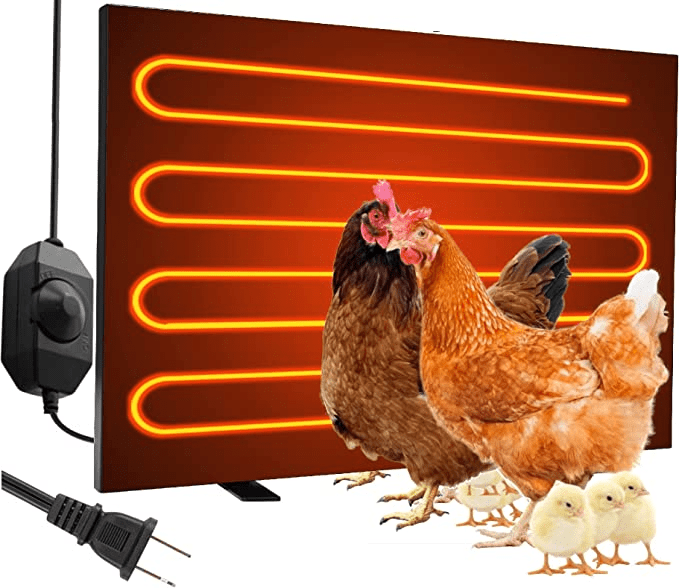
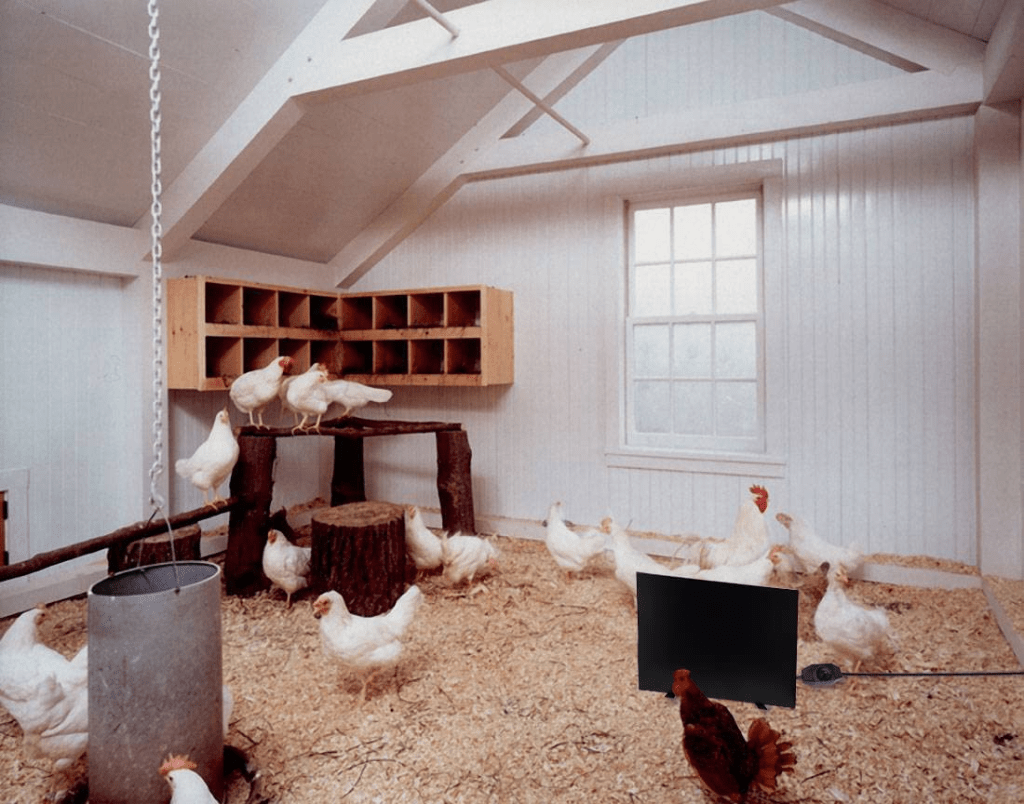
For starters, it’s really small. The images all have chickens photoshopped beside it, with no perspective, making it seem larger than it really is.
But that would not be a problem if it actually worked.
I’ve got that thing set as high as it goes, but when I touch the surface, I feel only low warmth in one patch off to the side.
The instruction sheet, meanwhile, is in pretty bad Google Translate. Especially the “Profile” part at the time. As for the operational instructions…
Turn the switch clockwise to turn on the heating panel
Keep turning the switch clockwise to raise up the power and it will heat up faster
The heat-sensitive sticher will turn red when the panel heated up
Turn the switch anti-clockwise to reduce the power or turn off the heating panel.
Oh, and in the other warnings and instructions, it says to “Keep out of the water or wet area” and “Keep out of children.”
It’s number three that has me perplexed the most. First, I don’t know what a “sticher” is supposed to be. I figured I would see something turn red and that would tell me, but there is nothing that turns red. Anywhere.
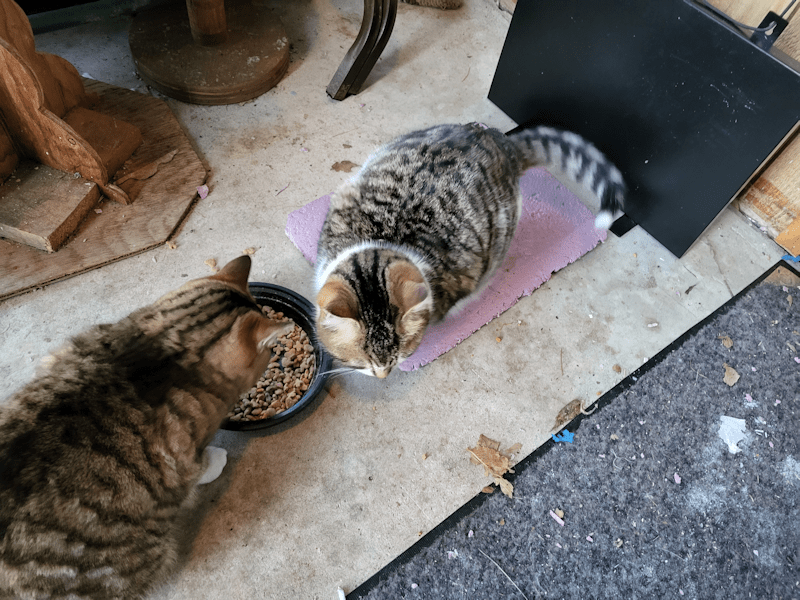
There is so little warmth coming off that thing, the cats only go in front of it because I’ve moved a food bowl over.
So that was a waste of money. Yeah, we could probably try to return it or something, but considering the janky email included, I wouldn’t expect anything to come of that. Mind you, it wasn’t exactly cheap.
Ha! I just looked up the order. Check out this picture!
So… the panel itself is supposed to start glowing? Bahahaha!
And look at how big they try to make it look, behind those chickens. Some of the other pictures are even worse! Like this one!
Bahahahahaha!!!!
According to the listing, 50% of reviewers gave it a 5 star rating, with a total rating of 3.8 stars. It’s also supposed to be suitable for chicken coops, dog houses, or under your desk.
Oh, too funny. I’m looking at the reviews. There are quite a few from Canada, saying “no heat” and “would never buy again” – but those reviews have 5 stars on them!
Several say they had terrible customer service and weren’t able to get refunds.
Why did my husband buy this again? 😄
Anyhow…
Today I headed out to help my mother with shopping. Normally, I buy lunch first, but she told me not to, so I made sure to eat first, but still headed over early. I needed to run some errands, and also wanted to get a visit in, since I had to drive to another town to pick up a package at a Purolator depot. More on that, later! I wanted to get a visit in with her before we did the shopping, since I would need to leave once we were done.
I got there just after she finished calling me to come over sooner, because she was hungry. She was waiting for me, before having her own lunch! I reminded her she’d told me not to bring anything, and she was all, no, I made lunch! I told her that, because she said no to lunch, I ate before coming over. I’d just have a cup of tea.
She made me eat.
There’s a reason I prefer to bring take-out.
*sigh*
At least we had our visit. My mother wasn’t feeling up to the trip, though, so she had a list ready for me. I headed out and got everything on her list, which makes for a much faster shopping trip!, and was soon back. After helping put things away, I started to head out, only to get the usual lecture about how we’re always in a hurry, and if we come to see her, we need to not be in a hurry and be prepared to stay. I reminder her that I’d told her from the start that I needed to go somewhere else. That’s why I came early; to get a visit in, first.
She was not mollified. She simply cannot accept that we aren’t retired like she is, and have things that need to be done. She also can’t appreciate that we *do* take time for her – the fact that we’re there at all (my brother gets this lecture a lot, too) demonstrates that. In her mind, I guess we’re supposed to stay with her all afternoon. Of course, she is completely unwilling to reciprocate. She also expects us to call her frequently, but if we happen to call while Joel Osteen is on or something, she cuts the call off completely. Meanwhile, she does the guilt tripping thing, with how we won’t have her around forever, and when she’s gone, we’ll remember what she said! I’m glad we’re out here, so I can be the one dealing with her the most, rather than my other siblings! That doesn’t work on me. It does make my brother absolutely miserable. She has no idea how badly she hurts him with the things she says.
Overall, though, it was a good visit. She just saved the psychological manipulation for the very end, when she didn’t want me to leave. 😄
But I wasn’t sure where I was going, or the hours of operation. My daughter had placed an order from somewhere that had mailed her stuff out before, so they accepted our box number. However, it went to Purolator this time. They don’t accept box numbers. When my daughter got the notification, she tried to input our physical address, but it wouldn’t accept it. Which, of course it wouldn’t. Our physical address doesn’t exist on maps. According to them, we’re on an “unnamed road”. She tried the live chat and explained the situation to a real human being – who told her, they don’t accept box numbers. My daughter explained that she new that, but they don’t accept our physical address, either. Apparently, the person couldn’t understand that, and we’re out of their delivery are so…
In the end, my daughter said to send it to a depot the next town over.
The problem is, the place that used to also be the depot suddenly closed. Last I’d heard, the Purolator deliveries were switch to a garage, right next door. My daughter had sent me a screen cap of the delivery notification, which had an address, but no location name. Most of the places on that stretch don’t have addresses visible from the road. It was on the same highway, though, so maybe it was still there?
So I went there and…
It was closed. Not open on Saturdays at all.
There was no sign in a window or anywhere to show that this was also a Purolator drop off depot.
Also, I couldn’t find an address anywhere on the building. I ended up just putting it into my map app to look it up and…
It was clear across town. In fact, it was well out of town.
So I drove over there anyhow. The place turns out to be some sort of … marine garage? There were fishing boats parked on one side, and RVs parked on the other.
It was also closed.
They had been open today, but closed about an hour before I got there!
Again, there was no sign anywhere to show that this was a Purolator drop off depot.
I went home.
Purolator was supposed to phone after the package was delivered to the depot, but they never did, so we couldn’t even ask them directly. It’s not like there’s a number we can call to find out. All we have is a delivery notice.
I’ll have to try again on Monday.
Which leaves my daughter in a conundrum. She has to order things for her business. If it goes by post, it’s fine. It’ll get to us. But a lot of places are like this order: they accept a box number when you place your order, but then it goes to a delivery company instead of the mail, and they don’t do post offices. However, they also don’t deliver to our physical address, because we’re often out of their delivery zones (though not with all companies).
In the end, she’s going to try what my husband sometimes does. Give the physical address for the general store the post office is in, and have our box number as the “unit” number. Which explains my confusion, because I know I’ve picked up Purolator deliveries at the store, when I was expecting a mail delivery. Purolator, it turns out, does deliver to our little hamlet. Just not to us, because we are “out of town”.
What a pain in the butt!
Hopefully, I’ll actually be able to pick up that parcel on Monday.
At least I’ll have something better to pick up tomorrow.
I was wanting to make a trip to Costco to pick up some quality proteins, so we have more variety in our freezer. Well, I don’t have to do that anymore. At least not for meat. I had been buying pork from a homesteader that lives not for from us, who had been selling at one of the local summer markets. He wasn’t doing that at all last year, and we sorta lost touch. The last I spoke to him, we were talking about getting a half pig in the fall, but never got back about it. Then I saw him posting on a group we’re both on, about having whole chicken available.
Long story short, I’m going to be picking up a variety pack of pork and chicken, tomorrow.
We’re going to have to rearrange the chest freezer to make space! I don’t actually know what we’ll be getting. I just told him how much my budget was and asked him to surprise me with a mix of things to meet that amount. Since I’m picking it up tomorrow, I will finally have a chance to see their homestead! I’m quite looking forward to it. They’re doing a lot of things we’re still slowly building up to.
Meanwhile…
Still no word about the vehicle financing. I’ll have to send an email to see if I can get an answer, one way or the other, so we can just get on with things and start using the van again.
Tissue is still doing all right. She’s still not eating as much as I’d like to see, but she is eating and drinking. Giving her her medication this morning was amazing. She was sitting on my office chair, so I was just going to brace her while my daughter used the syringe to squirt the medication into her mouth. She got most of it in, with no fight at all, and when she moved to squirt the last little bit in, Tissue actually opened her mouth to take the syringe!!
We’ve tried to see her tongue wound. All I could make out was redness. She spends most of her time sleeping, and is currently burrowed under the covers on my bed. She still hisses at Marlee, Nosencrantz and Butterscotch. Much to my surprise, Nosencrantz mostly ignores her. She’s usually the Anxiety Bear, but right now, Marlee is the Anxiety Bear when it comes to Tissue. Butterscotch just sort of puts up with her to a certain point, then leaves. Tissue will even hiss at Cheddar and Leyendecker, when they come in, and they seem quite confused by her behaviour! I think mostly, she just wants out of the room!
Just a couple more days, and we can let her out, I think.
We shall see! She’s still clearly a bit rough around the edges, but it doesn’t seem to be bothering her much. Monitoring will continue!
This morning, we had a combination of light snow and more fog.
Only now, in the late afternoon, do we finally have sunshine.
We still haven’t received a call about financing the replacement vehicle. By now, I figure there just isn’t a lender that will accept our application. I’m sure our credit score is pretty low. After my husband went on disability and we lost 40% of our income, we had to go under a consumer proposal to finish paying things off. That was ended a few years ago, but we have no credit cards, no mortgage and no other loans. Basically, no debt. Which means, nothing to improve our credit score. Rather ironic, isn’t it? We have no debt, therefore we have a bad credit score.
With waiting on the financing, I’ve been delaying our stock up shopping trip. We’re still good for most things, but I didn’t want it wait too much longer, or we’d start running out of things. Mostly cat food, since that’s the one thing we haven’t been able to stock up on. Since the van is still prepped for trade in, including the summer tires in the back, that meant using my mother’s car. Which can’t hold as much, even with the back seats folded down, but it’ll do.
Once on the road, the further south I went, the thicker the fog and blowing snow. I was intending to go to Costco, but by the time I reached the town my mother lives in, I changed my mind. The highways were fine – and the surrounding fields and trees were stunningly beautiful! However, I knew the city would be a mess. So I decided to go to the nearer city and hit a Walmart. It meant a smaller shop, but I could at least get the most necessary items.
I almost didn’t!
This is $261.11, after taxes.
Lately, I’ve been buying 10kg bags of kibble (about 22 pounds). The shelves with large bags of kibble were almost empty, and I had to get the 7kg (about 15 pounds) of economy kibble, instead. Four of those for the outside cats, and more wet cat food for the inside cats, and we were already at about $110.
I got a container of black peppercorns, but they didn’t have the ground thyme and sage I was looking for, in stock. I had intended to buy more protein items, but ended up with just three different cheeses (of the 2 for $10 varieties), some pork chops, and some seafood for the girls. They also requested hot dog fixings, so I got a bulk package of wieners and some hot dog buns, as well as wraps. I got a box of granola bars and Kraft Dinner for them, too. That meant more milk for making the KD. The olives are more of a snack food for my husband, though I like to nibble on a bowl of olives, too. One of my favourite treats used to be a certain brand of sundried black olives, packed in salt, but I haven’t seen them since we moved, so… green olives it is. 😄 There’s paper towels and facial tissues, coffee creamer for the girls (my husband and I don’t drink coffee), and two boxes of Earl Grey Double Bergamot tea. It’s often out of stock, so I was happy to see it. Especially since the tea shelves were pretty empty, too!
Aside from getting this as Walmart, I was also able to swing by a Staples and get some ink for my printer. For some reason, I’m out of cyan again – why that one colour keeps running out, I have no idea. We don’t use our printer much. If the printer is out one colour, it won’t let me print anymore. Not even black and white. Frustrating! While there, I picked up some tax preparation software. NOT TurboTax this year. Hopefully, something that isn’t so frikkin’ counter intuitive. So that was another $55 and change in total gone.
The price of printer ink went up since I last bought some. The economy kibble prices also finally went up. I got excellent prices on some other things, though, so that sort of made up for it.
The unfortunate thing is, I’m going to need to do this again, soon. That kibble won’t last until the end of the month, though as things warm up, the outside cats aren’t needing to eat as much. We also need to get more stove pellets for the litter pretty soon, and that’s a Canadian Tire trip. If I’m getting both, I’d be taking the tires out of the back of the van and using that, rather than my mother’s car.
Another ironic thing, considering our major gardening plans. What I’d wanted to do, and will have to do when I finally make it to Costco, is stock up on quality proteins. We still have lots of our quarter beef in the freezer, but I don’t want to go through that too quickly.
I’ve mentioned more than a few times, that all four of us have various health issues. After much research and assessing of things, my husband and I want to try going carnivore. We’re not going to go cold turkey on it, but the more I look into it, the more convinced I am that our entire family would see significant improvement in all our different issues, by cutting out virtually all carbs. For my daughters, I especially think they need to cut out almost all vegetables. All plants have pesticides in them. It’s their natural defence, since they can’t up and run away from the animals and insects that want to eat them. Some people are sensitive to them than others. Ruminants are the best meat for a low carb diet, as they have digestive systems that ferment plant material, thereby removing those toxins and converting material indigestible to humans into high quality meat. Personally I don’t think I am sensitive to these plant toxins, and could probably do well on keto, but it seems the rest of my family is. My daughters, unfortunately, have been cutting meat out of their diet more and more – probably because of the cost, though one of them says certain meats make her feel sick. That this includes some cuts but not others, of the same kind of meat, leaves me thinking there is something else going on. Anyhow, what my husband in particular really should be doing is going completely carnivore, then slowly adding things back, as a sort of elimination diet. It won’t heal his back (which includes birth defects that were not discovered until after his back injury), but it should at least get him off a lot of medications. I’m hoping that, once they see positive results in us, my daughters will be more willing to go it, too.
Yet another reason why I want to include animals as part of our self sufficiency goals, and part of that includes growing their feed, because the cost of feed is getting pretty steep. If that means growing a garden full of animal food, then eating the animals, I’m good with that. But we have lots of preparation before we can start doing that. First, a chicken coop. Possibly some meat rabbits next. Then set up for a couple of pigs. For pigs, we would get piglets in the spring to be butchered in the fall, so we won’t be overwintering pigs, like we would with chickens. Pigs are social animals, so we’d get at least two. We might get milk goats at some point, but will likely keep buying our beef from the same ranch we’re getting it from now. I just don’t see us reaching a point where we will have our own cows – though we might get alpacas at some point. My daughter wants fibre animals.
Okay, so I’m getting off track here. 😄
Back to other updates.
I’ve been messaging with the Cat Lady. Her surgery was cancelled at the last minute. The new specialist wants to put her on medications, first. It’s so frustrating, but he’s convinced that if they do the surgery now, she’ll end up back within the year. She’s planning on going to the US for a second opinion and possible surgery in the spring. So frustrating! Months of tests and preparation, actually in the hospital and ready to go under the knife, only to have the whole thing turned upside down by someone she’d only seen for 15 minutes. The other specialist thought surgery was the best option. The health care system in this province really sucks. It’s not even the worst province in Canada for that, either, which is downright scary.
All that going on, and she’s worried about how Tissue is doing, too! I assured her that Tissue is doing fine. As I write this, she is burrowed under my sheets, sleeping. A few more days on soft food and medication, and we should be able to let her out of the isolation room again. 😄
On top of all that, I got a call from my mother. Her timing was perfect, as I’d just gotten home. The girls were still putting away the groceries!
I’m heading out again, to help her do her own grocery shopping trip. Then I have to head to another town to pick up a Purolator package. I thought they now had a depot in the general store our post office is in – I’ve picked up a Purolator package there not long ago! But apparently, no. Weird.
I’d love to finally get a call back from the finance lady. Even if it’s just to tell me that no, we can’t get financing. That’s better than hanging in limbo like this! But she’s working really hard to get us that vehicle! 😁 I do appreciate her efforts. But gosh, it’s taking a really long time!
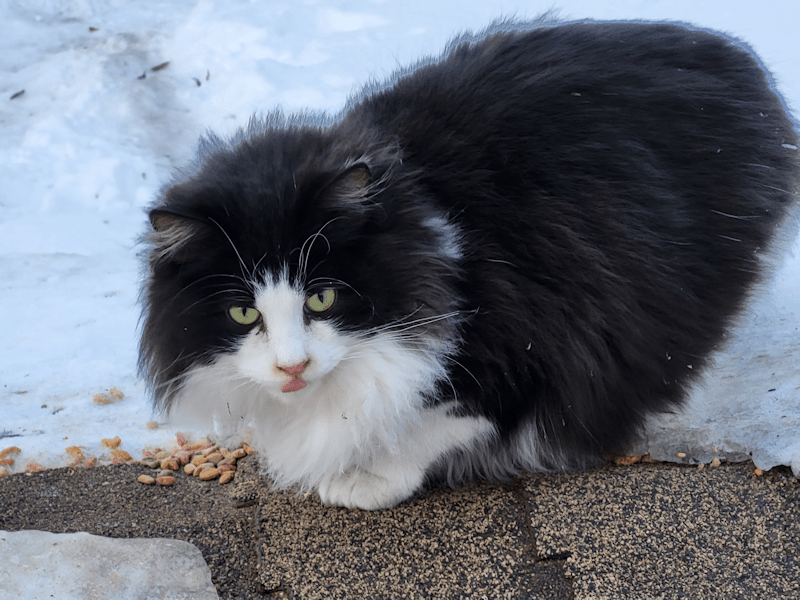
But first, let us enjoy this handsome blepping boy!
While I’ve managed to touch him briefly in the past, for the most part he won’t let us near him.
Sadness!
No such sadness when it comes to Tissue!
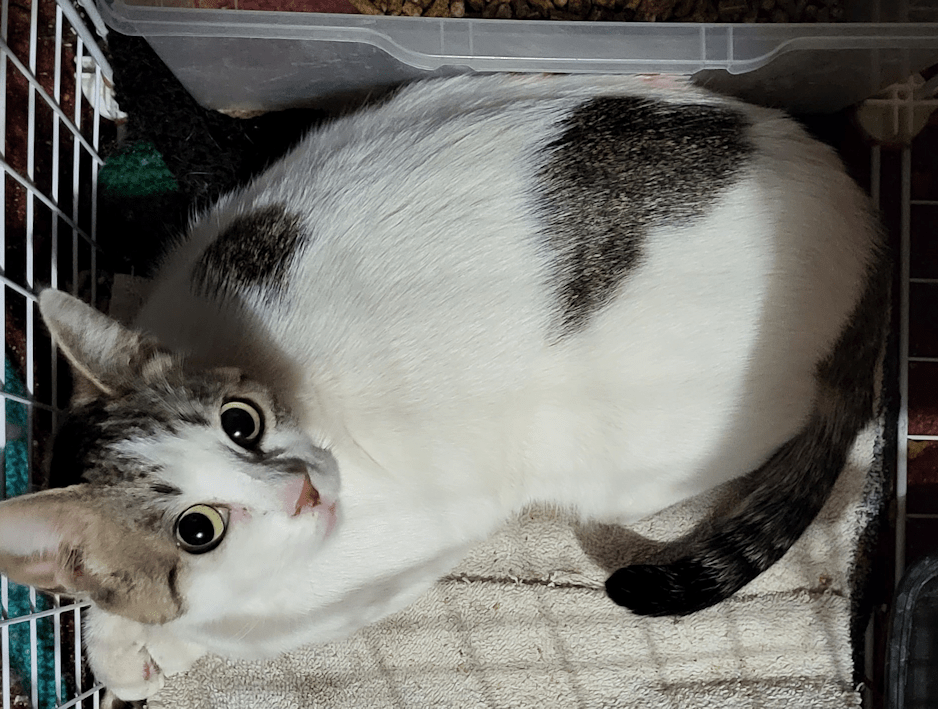
She had a quiet night in baby jail, which was actually closed up, just to be on the safe side. I had it open for a while in the evening. Tissue really, really wants out of the room. She even managed to escape briefly, when my daughter came in, not knowing she was out. Interestingly, any cat that is in the room with her, or is allowed in, she will growl at – but when she ran out of the room and was surrounded by cats, she didn’t growl at any of them.
She definitely has a hoarse “voice” right now.
She has been eating, but not very much. I imagine her tongue and jaw must be quite uncomfortable. Which means she’s not using the litter much, either. But she has her favourite spot in baby jail that she hangs out in, though just as I started writing this paragraph, she started trying to open the door. I will let her out later, when I’m able to supervise her more closely.
She got her medication this morning, which should help with the pain and, hopefully, she’ll eat more. She’s on the pain meds for a total of 5 days. I don’t know how long she’ll need to be on soft food. It all depends on how well she heals. Overall, she is calm (except towards the other cats in the room) and allows us to pet her and hold her.
Well, that’s interesting. I decided to open the door to baby jail in between writing the above. She went out, popped into a cat cave, then went right back onto her favorite bed in baby jail! 😄 She just didn’t like having the door closed.
Fair enough!
In other news…
I got a call from the financing lady about the replacement vehicle. She had good news and bad news. The good news was that we were approved for financing. The bad news was, they wanted a deposit of $3,500, first.
That’s about 40% of the cost of the vehicle!
Obviously, we don’t have that.
As we were stalking, though, she mentioned a Nissan.
Nissan?
We were looking to buy a Ford Escape.
…
Well, it turns out she was sent information about 2 vehicles, and the wrong one was applied to our application! So she input the correct information, with a much lower price, but a higher mileage, and resubmitted them to the lenders. One, she could tell me as she was doing it that it would be rejected, simply because of the mileage, and it was. It was automatic. The other one she sent it to, they had no such restrictions.
That one was tentatively accepted, pending confirmation of banking information.
Considering it was past office hours by then, that was as far as things got.
So I am expecting a call with an answer, some time this morning. She’s been trying really hard to get this vehicle for us, and it’s really appreciated! Ours has been a very unusual application.
Until then, we continue to wait. At some point, I need to go pick up some parcels at the post office. I’ll leave that for the afternoon, when the post office reopens.
I hope to get the call before then! This hanging in limbo thing really sucks!
Yesterday, the right side of her mouth and cheek were all red. They’d cleaned her up, so that was from being so swollen. Her front paws, as well.
While she has a hairline fracture in her jaw, the cut on her tongue is actually the worst injury. We’ll have to monitor it, in case it starts getting infected. If it does, we’ll probably smell it before we see it. We’ve got medication for her for the next five days, to be given with food, and she’s on soft food only for a while. We currently have her in baby jail, with the door closed, and Butterscotch has taken it over from Marlee. This way, we can also monitor her food.
She was completely calm during the ride home. We had to use my mother’s car again (still no word on the financing for the replacement vehicle, so the van is still prepped for trade in), and my daughter road in the back with her. She was able to open the door and hold her paws, while Tissue used her hand as a pillow.
*melt*
Currently, she’s behind me, growling at any cat she sees. Even Cheddar! It’ll take her some time to calm down.
Her bloodwork came back perfect. We will also keep an ear out for her lungs, because she was so frozen.
Speaking of which…
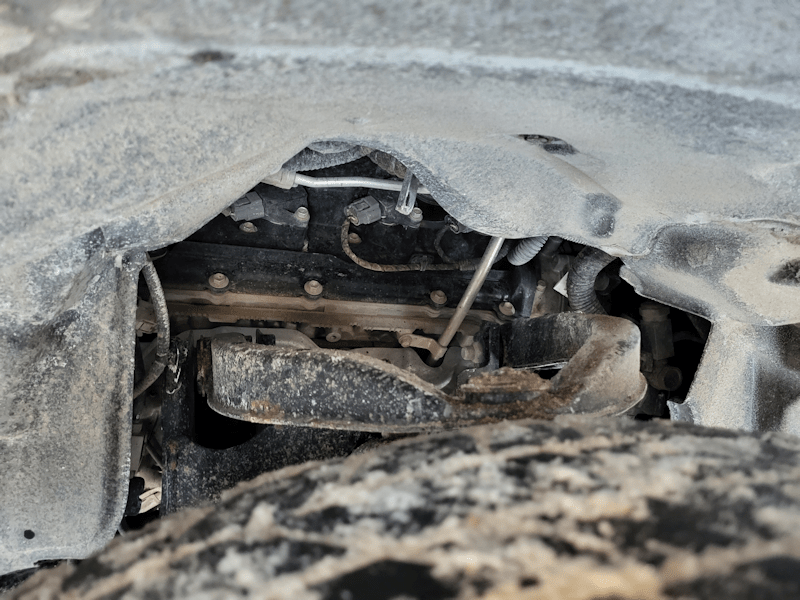
… this is where she got up into the engine compartment. The car was put together (car! ha! It’s a Nissan Armada. A perfect vehicle for our winters!!) enough that the Cat Lady was able to drive it, but she still didn’t have any heat. That will be fixed later. Somehow, Tissue squeezed her way up, basically into the fan belt, and got stuck. They could only see her tail. If they had tried to start the vehicle, the fan belt would have killed her. If they had tried to put it in neutral and push it into the garage, she would have been crushed. The only way to get her out was to dismantle the engine. By the time they got to her, she was unconscious from the cold. At the vet, they had to put stuff on her eyes to protect them, because they wouldn’t close or move.
The mechanics were amazed by the damage. When they first called the dealership garage, they thought the Cat Lady was talking about a squirrel stuck in there, because the space is so small. So was the space she first got into, by the muffler. That spot, where she would have been when they drove around, could not be seen. She would have been quite cozy in there, though it would have been a tight fit, and kept warm by the muffler while they were driving, but once the vehicle was off, that metal would have sucked the heat right out her. They asked about having the space blocked off, so no other animal could get in, but it’s there for a reason, and can’t be sealed off.
She was able to get out of that, at least. The space into the engine compartment was smaller, then once she got stuck, she just panicked and started destroying anything she could reach. As for the damage to the hoses, the mechanic said that was the sort of damage a racoon might make. That it was done by a cat was astonishing.
She did $3000 in damage to their vehicle.
When the cat lady paid the bill, I hear the receptionist saying it was something over $1,300.
I feel so bad. All this over what was supposed to be a cheap spay!
Meanwhile, as far as she knows, the Cat Lady is still scheduled for major surgery tomorrow. Whether is gets cancelled at the last minute, it’s still hard to say.
While at the veterinary hospital and talking to the staff about Tissue as they called up the billing information, they started talking about how much they were going to miss her. It seems she was very affectionate, and all over the staff. My daughter described her habit of spinning around while being pet, and they just started nodding; she was doing the same thing for them!
She’s acting like she’s got no injuries at all. The Cat Lady made sure to stay out of her sight as best she could, in case Tissue associates her with trauma now. She was calm in our carrier, the whole time. Not that she’d be able to break out of this one. It has clips to lift the top off, but since it has a door at the top, we never use them, so we added the screws to hold it together. Even if the clips get opened, that thing won’t come apart without a screwdriver.
Everyone is just amazed by her recovery. Especially the staff at the vet’s.
Now that Tissue is home, she’s here to stay! Adopting her out is now out of the question, as is taking her to be spayed.
No, she’s not out of the woods yet, but it’s mostly just observing her, and giving her tongue and jaw time to heal.
Under the circumstances, we couldn’t have gotten a better prognosis.
I just spoke to the Cat Lady on the phone. She just finished talking to the vet.
Tissue is coming home today.
Not only did she survive the night, but she looks like she has only minor injuries. She might have a hairline fracture in her jaw, which only needs time (and soft food only) to heal.
The broken tooth is basically just a chip the vet says won’t bother her.
She has a cut on her tongue but again, that just needs time.
No broken bones.
No spinal injury.
Her back legs weren’t moving much mostly because she was so cold.
She did start to have crystals in her blood, but there is no damage visible.
The doctor is going to write up a report for other vets, about how they thawed her out.
She clearly isn’t happy there, and the vet wants her to come home to us, rather then go to the rescue for her recovery. He says we shouldn’t even try to have her spayed for at least 6 months. To which I say, forget it. We’re not getting her spayed at all.
We will get full instructions and any medications when we pick her up, late this afternoon, and bring her home. She will be on soft food, and in isolation in my office during her recovery. We’ll need to monitor her, of course, but she should make a full recovery.
This, just 12 hours from being at death’s door.
The best possible prognosis we could have expected. The vet is absolutely stunned.
We had another foggy night last night. While it’s clear and sunny now, areas to the south of us were getting fog warnings of sudden zero visibility!
The trees never lost their frost from when the first fog hit, so we now have frost on top of frost on top of frost!
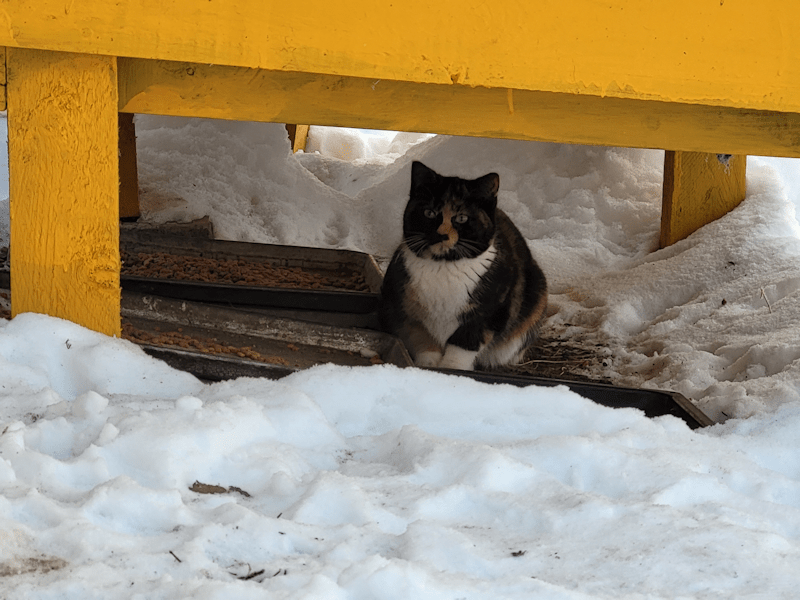
I didn’t even try for a head count this morning, but I did manage to zoom in to get a picture of this elusive tortie! The girls call this one Phantom, because she has a sort of Phantom of the Opera mask. She is from Broccoli’s first litter, along with two calicos, which makes her big sister to the two tiny bitties we were finally able to catch and pass on to the Cat Lady.
I got messages from her while I was doing my rounds.
Tissue made it through the night. She is awake and alert.
That’s all we have right now.
Which means they will be fully assessing the extent of her injuries right now. It’s still possible her injuries are so severe, it would be just too much and trying to treat them would do her more harm then good.
Or, the injuries might not be as severe as we fear, and she’ll make a full recovery, minus a tooth.
There’s just no way to know right now. We just have to wait until we get work from the vet.
Tissue is such a strong cat and a real fighter. The Cat Lady and her husband have the wounds, and a torn apart car, to prove it!













 The Re-Farmer