The plow went by, increasing the snow ridge at the end of the driveway. It really wasn’t that bad and we could have driven through. The problem is, between the plow ridges and the driving, the end of the driveway was getting narrower and narrower. I needed to get that opened up, before the next polar vortex hits.
I love that ice scraper. It does a bang up job of cutting through hard packed plow ridge snow!
Technically, today was warmer, and there was less wind, but even a slight breeze brought was was -20C/-4F to a “real feel” of -31C/-24F. I was well bundled but, by the end of it, my toes and finger tips were starting to feel it!
While I was out there, my mother called from the hospital. I didn’t see my daughter’s message until I was putting things away, almost an hour later. My mother apparently sounded frustrated.
So when I called back, I made sure to talk to the nurse, first. I found out that she has been refusing her afternoon pain meds. Because she’s been in so much pain with her back, and the Voltaren wasn’t enough anymore, they now have she scheduled to take painkillers 3 times a day, instead of “as needed”. She’s apparently been having better days and saying no to the pills.
When talking to her about it later, she told me, she’s taking so many pills! Which makes it sound like it isn’t that she’s in less pain, but that she just doesn’t want to take another pill.
*sigh*
I asked the nurse about my mother getting Xrays, but she could find nothing on the file about it. She made notes to talk to the doctor about it. I also brought up that we need to have a meeting with the doctor, so she made notes for someone that can check his schedule, and to call my brother to book a time. My schedule is flexible, so I can work around his.
Then I got transferred to my mother’s room.
*sigh*
She was shouting right from her “hello”. It actually hurt my ears. When I asked her why she was shouting, it was “so you can hear me.”
Yeah, Mom. I can hear you. So can everyone outside your door and down the hall!
No, I didn’t say that out loud.
She then starting complaining. No one is calling. No one is visiting. No one cares (she includes the hospital staff on that). Why doesn’t my brother call or visit?
So I told her about his going to her place to replace the window from the AC set up, then about the woman who fell. She actually knows the woman, as she often does the Gospel readings in church. When I told her about the fall and my brother taking her to the hospital, she only wanted to know, which hospital. I told her, and she started saying, she has children, why did my brother drive her. Her (adult) children weren’t there (I think they live in the city!). Even when I told her, my brother probably saved her life, because if he hadn’t seen her, there was a good chance she would have frozen to death before anyone got to her.
She didn’t care.
She also didn’t have any appreciation for my brother going out to her apartment in the severe cold, getting the window done, helping a neighbour, and still driving her to the farm to drop off the AC, in the dark.
Instead, she kept complaining about how no one calls or visits her. I finally told her that, right then, she was making me regret calling her back, and called her out on how nasty she was being.
She – sarcastically – thanked me for being open with her.
*sigh*
After that, the call was better. She did complain that money was probably taken from her bank account for her apartment. I told her that she IS still renting it. All her things are still there. Of course she has to pay for it. That got us to talking about her things and what she wants done with them.
Don’t throw anything away, she keeps saying.
We’ve got an entire building filled with personal belongings we packed from this house – a building we could really use as the workshop it used to be – that she insists we don’t throw away. Now, we’ll have more, and we’ve already run out of storage space.
Then she demanded I tell her what I planned to do with a particular mirror she’s had stuck in her storage closet for the past 10 years. Something she gets obsessed about, every now and then. I finally had to tell her, don’t worry about it. We’ll take care of it.
Then she started going on about how, really, my sister should be taking care of her more, she and her husband are both on pension, she doesn’t need to be working, she should be taking care of Mom.
I’m sure my sister has been nagged about that a few times, already!
I was eventually able to get a word in – right after she told me, she wants to get out of there! – and told her, I think her problem is, she’s bored. She’s there by herself, with nothing to do, and she’s bored. We talked about it a bit, and she agreed. She is bored and lonely! Which, I told her, is completely understandable!
Well, this post got interrupted by a call from my brother.
We have a meeting booked with the doctor. They got us in as quickly as they could, and it’s an evening meeting, so that works for my brother. It was noted that, since we are dealing with cognitive issues with my mother, she won’t be there, and won’t even be told about it. Our concern was that, if she knew in advance, she’d end up telling our vandal about it, and he could cause problems.
It sucks having to even consider these things.
As for me, I am done for the day. I’m glad I got the end of the driveway cleared, but I’m really going to be paying for it, tonight, even with my meds!
I have to admit, though, I did quite enjoy the shoveling!
This is what it was, this morning, shortly before I headed out to tend that yard cats. I did not do the rest of my morning rounds. -21C/-6F with a wind chill of -35C/-31? Yeah, I was feeling that.
As I write this, the temperature is the same, but the wind chill is now -42C/-44F
All night and all this morning, I was seeing posts about blizzard conditions, white outs, and the general advice of “stay home, if you can!” The bulk of the storm hit the south end of our province, though, so we’re mostly getting that wind, but very little new snow. A small blessing, but I’ll take it!
The weather warnings starting coming in fast on the weather group I’m on, yesterday. While my brother was still at my mother’s apartment. When he set up my mother’s portable AC, he got permission from the public housing department to remove a window. He set up a board with the exhaust port installed in it. In the winter, the AC’s hose was removed and 3″ Styrofoam insulation was set over the window. While we still don’t have anything official saying my mother isn’t going back to her apartment, we’re preparing it for that, anyhow, and he wanted to get the window and trim back in
In that cold.
He took extreme care to ensure nothing chipped, cracked or broke in the severe temperatures, and you’d never know it was ever taken out in the first place.
As he was packing the AC into his car to bring here (which I didn’t even know he was planning to do!), a woman came out of the church across the street.
Then slipped, fell and hit the back of her head on a concrete bench.
!!!
My brother went over to help, and was soon joined by a woman in my mother’s building who saw what happened through her window. The woman who fell was consious, but not moving. They helped her up and to her home, which was right next to the church. My brother checked under her hood, and found blood.
I’m convinced her winter gear saved her life.
As did my brother. She couldn’t get up on her own and, in this cold, even if she survived an unpadded blow to the back of her skull, the cold would have done her in within minutes.
My brother ended up driving her to the nearer city’s ER (the local hospital’s ER, just blocks away, is almost never open). Driving her was faster than waiting for an ambulance. My brother left her in good hands, then drove back to my mother’s apartment to finish loading his car, before coming here.
When he first told me he was planning to come here, he wasn’t sure if our roads were clear, so I went out to check the driveway. Our road was not plowed, but it didn’t need it. The winds swept it clear. Which probably meant the main road was drifted over. Our own driveway had some drifting, but I knew his car could make it all right. Being so much smaller than our truck, he would have plenty of room to pull up to the house and turn around without hitting the areas that were starting to drift over. So I left the gate open for him, then called him back. I did recommend he take a different route. Normally, he take a road that allows him to avoid driving past our vandal’s place, but that road doesn’t get as much traffic, and is not maintained as thoroughly. He agreed. Apparently, the last time they came out here and took their usual route, it was in very poor condition. The main road may not have been plowed, but it gets a lot more traffic, which would make it easier for him to get through.
After calling him back, I bundled up in layers and headed back out with the ice scraper and shovel. There was a fair bit of ice built up under a layer of snow on our front steps and sidewalk, and I didn’t want anyone to slip and hit their heads on a concrete step!
By then, it was getting dark, but it was also warmer than it had been earlier in the day. After clearing in front of the house as best I could, I went and started clearing the drift in front of our garage door, by the light of the yard light. I was just finishing that up when my brother arrived. He stayed long enough to drop off the AC and accessories, then headed home. He had about an hour to drive, and road conditions were getting worse. Happily, he got home safe and sound.
We now have my mother’s AC unit, that my brother bought for her. The first of many things that will end up coming here, over the next while.
I’d hoped to go to my mother’s today, as it was supposed to be warmer. Apparently, we did reach the predicted high of -17C/1F, but it was at around 4-6am! Not going to happen, today. (As I watch the giant maple branches out my window sway in the wind, amazed they haven’t broken off yet.)
The next few days, we’re supposed to reach highs warmer than -20C/-4F. More importantly, the wind is supposed to die down. I’m not sure on the timing of things, since I will also be taking three cats in for spay/neuter on Wednesday.
The last time my mother was in the hospital, it was at the end of January, beginning of February (less than a year ago!). We had to deal with weather issues then, too!
The older I get, the more I am starting to really dislike winter.
I was messaging with my brother this morning. In the wee hours of the morning, someone got stuck on the road in front of their place, and it took two tow trucks to get them out. Then the tow trucks came back into the parking lot, for someone else!
The plows were out, though, so the roads should be clear again. The highways, at least.
I was questioning whether my brother was going to come out to my mother’s place today. They were already recommending I stay home, but my brother is going to make the trip! This must be the only day he has available for it.
I headed out to do that cats stuff and, at first, things looked pretty good. The bright sunny morning, and being sheltered from the wind, was deceptive. The sun room’s thermometer was reading 0C/32F, which was encouraging.
A few minutes outside, though, and I was starting to really feel the cold, even as bundled up as I was!
In the end, the choice was made for me. There isn’t a lot of drifting, but enough that I’d want to dig through them, before trying to drive anywhere – and there was no way I would be outside shoveling today!
After today, things will warm up a little bit, and then we’re supposed to drop down to highs of -30C/-22F, as another Polar Vortex sweeps through. Wednesday coming up looks to be the warmest day over the next little while, which is good, because that’s when we’re supposed to bring 3 yard cats in to the vet for spay/neuter.
Today, however, is a day to stay indoors as much as possible!
I had a strangely rough night last night. I wasn’t able to sleep, so when I heard my older daughter taking a break from work at about 3am, and we grabbed something to eat. Just as I settled down, I started to sneeze.
And sneeze.
And sneeze.
For the next hour, at least, I was either sneezing or fighting off sneezes. I have no idea what I was reacting to! Yes, I took antihistamines, but they made no difference.
I did finally get an hour of two of sleep, waking up as it started to get light out. I messaged with my brother and SIL a bit about tomorrow – though that may change – and meeting up at my mother’s apartment, then headed outside to do the morning routine.
The wind was brutal. We’d had a bit of snow during the night, which was actually appreciated, as the paths I wasn’t able to spread ashes over, plus the driveway were not as slippery. On the down side, the paths were also starting to fill in and drifts starting to form. Nothing to complain about, really. As the storm moved across the prairies, highways were being closed all over the place. The local highways group had people posting about poor visibility and road conditions, but they were still passable.
Once I was done, though, I had enough energy to grab some instant oatmeal for breakfast and then crashed for several hours, completely embedded by cats. I think they were cold!
We had a couple of packages we ordered that had reached the city, and my husband got a notification that one of them had arrived at our local post office. I decided to wait until the post office closed then reopened at 2pm, though, and sure enough the second package arrived from the city, too. So I headed out after the post office reopened.
Straight into a brutal wind. Conditions had definitely worsened. A drift was starting to form in front of the garage door that I had to shovel out before I could leave. The wonderful plow job on our gravel roads was being drifted over, and visibility was poor.
Thankfully, I only had to go a few miles.
One of the packages was a new office chair for my husband, to replace his broken one. He’s been using a small armchair for the past while, and it’s brutal on his back injury. Picking up the chair was not something that was going to wait!
As I write this, we are still at -15C/5F. When I got home, the wind chill was -35C/31F, but it has since dropped to -37C/-35F.
Tomorrow is supposed to be colder, and almost as windy.
Hopefully, my brother’s schedule will allow him to postpone going to my mother’s for a day!
As soon as we got the box inside, my daughter immediately started to assemble the chair for her father. While she worked on that, my husband got to check out the new “toy” he picked up, as something to keep in the truck.
Or for me to keep handy while working outside after the snow is gone.
Yeah. It’s a hammer, axe, multi-tool, with holster.
The second picture shows it opened up.
We were pleasantly surprised by the quality, to be honest. That axe is sharp! The knife is really good, too, and the screwdriver/file/bottle opener is also solid. The pliers don’t seem to be as strong, but it’s not going to be seeing heavy duty work. The hammer has surprising heft to it, and is actually useable.
I didn’t spot where they opened as I quickly looked at it, but there are several screwdriver tips in the handle that fit into the top of the axe/hammer head. There’s also a magnesium rod tucked in there somewhere, with a built in whistle.
I’m going to have to grab it from my husband and look it over again!
The “snowflake” that came with it is also surprisingly strong. Each tip is a different screwdriver tip or hex key and each space is a different size wrench, plus a bottle opener. One of the tips doubles as a box cutter. There’s a hole for the key ring, but the ring is flimsy. My husband will probably add a cord to it, instead. That’s something he will probably keep handy and find more useful.
The whole thing is absolutely hilarious, adorable – and may actually be useful! A lot of these multi-tool gadgets look great, but once you try to use them, their designs are not practical at all. I look forward to trying this thing out.
Meanwhile, it looks like the worst of the weather system has passed by. Wind will still be an issue, and any new snow expected isn’t supposed to show up until night time.
We’ll see how things are for my brother. His schedule is far less flexible, so I will adjust to what works for him.
Almost. They moved before I could get my phone out to take a picture. When I first came in, Grommet’s chest was plastered against the window screen, with Stinky plastered over top of him. Enjoying the warm air coming from the bathroom! We keep the bathroom door closes, so none of the inside cats come in, so it doesn’t affect our thermostat. The window gets opened when someone is in the shower, to let moisture out, since the ceiling fan stopped working. Again.
They want in. 😄
My first order of business today was to go to my mother’s apartment and check on things. As I was doing the morning routine, though, it was still so incredibly slippery. I knew the roads wouldn’t be as bad, but just walking around the yard was insanely dangerous. I ended up grabbing a bucket and a spade and collecting ashes from the fire pit. There wasn’t enough to do all the paths, but I was able to scatter ashes on the main ones, including to the garage door. What a difference that made!
Happily, the roads were well plowed and nowhere near as icy, and the highway was mostly clear. What wasn’t was wet, rather than icy. We exceeded our predicted high and reached 3C/37F, though the town my mother’s apartment is in was a bit warmer, and the town the hospital is in reached 5C/41F, according to one of the announcement signs I passed while on my way home!
I hadn’t had breakfast before I left and by the time I got to my mother’s town, it was lunch time, so I paused to pick up some fried chicken and wedges at our favourite gas station, and took it to my mother’s to eat.
When I got there, I found a message from my daughter. She had been in the shower when my mother phoned, and she could actually hear her shouting to the answering machine. She was asking where I was, sounding very angry and out of breath.
So I immediately called the hospital to talk to someone at the nursing station. I told her I was at my mother’s apartment, but my mother had called our home, yelling at the answering machine and sounding out of breath. Before I had a chance to say I was going to be there later, she said she would check on my mother right away and ended the call. I was good with that!
I started to eat my breakfast when I got another message from my daughter. My mother had called again. My daughter wasn’t near a phone so it went to machine again, and she could hear my mother demanding to know where I was, and that it was an emergency.
!!!
After that call, my daughter told me she was going to keep a handset close by, so she could answer before it went to the answering machine. Thankfully, it turned out to be unnecessary.
I called the hospital back.
When I got the nurse again, it seems she heard my mother making that call, and saying it was an emergency.
There was no emergency.
My mother tried to say, oh, it was just to my daughter. The nurse told me she explained to her that when you say “emergency” it can mean very different things.
What she wanted was for me to visit.
*sigh*
I’ve since listened to both messages. They were both very short, and wow, did she sound furious!
I told her that I was checking on my mother’s apartment in another town at the time, but that I would be visiting her in the afternoon, with a few errands in between, and she promised she would let my mother know this.
After that, I could finally finish eating!
I then packed up a few things, mostly canned goods, and shifted things from her freezer to the fridge before setting it as low as it could go. I’ll come back soon to clean out the jars of frozen stuff (I can’t quite tell what some of them are). After that, the fridge can be shut off entirely and cleaned.
I took care of a few more little things before heading out. My next stop was the hardware store, looking for some Roof Melt, but they didn’t have any. Then I drove to the next town to visit my mother in the hospital.
When I got to her room, I was surprised to see her door wide open. There was quite a bit of bustle going on, with my mother in a wheelchair and some of her things packed up. They were in the process of moving her to another room!
My arrival paused things. They had been about to have my mother set up in the hallway while they cleared her room, but with me there, did I want to take her to the cafeteria, instead?
Which is when another nurse walked in and said, no.
??
My mother wasn’t going to be moved. They would move someone else.
The shuffling has to do with the size of the rooms. People like my mother, who are there for longer periods, get the “corner” rooms, as they are larger, and single beds. They were going to move my mother so that someone from a smaller room could be moved into hers, but decided to instead move the other patient to the room they were going to move my mother to. So my mother could stay where she was!
This hospital only has 8 extended care beds, and 4 “special care” beds. I think my mother is in an extended care bed.
So, that commotion done, I helped my mother transfer from the wheelchair to her favourite chair in the corner. She was clearly in a lot of pain.
Once everything was settled, I jokingly said, “so, I hear you’ve been difficult!”
I then told her that, when she had tried to call me, I was at her apartment, checking on things. I could see she was torn between happy that I was doing that, and angry that I wasn’t there when I called!
She chose angry.
For the next while, she ranted about how they are not taking care of her, they don’t care. She hasn’t seen a doctor. They don’t care. They see all these other patients, but not her. They don’t care. They say she’s been seen by doctors, but she has eyes and she hasn’t seen any doctors, the entire time she’s been there. They don’t care. They walk around in the hallways talking, instead of taking care of her. They don’t care.
She wants to leave.
She even said, she could go back to her apartment.
*sigh*
I totally understand that she wants to leave! She’s been there for about a month now. It took a while of explaining (you’re on their side! you always make excuses for them!) things like she can’t leave without a doctor discharging her. She can’t go back to her apartment, because she would have the same problem of not having help available when she needs it. No one knows where she is going next and yes, we are frustrated about that, too!
Thankfully, between that and a nurse coming in a couple of times to refresh her water, etc., my mother finally calmed down and we could talk normally.
One of the things she brings up is her pain. Apparently, she ran out of Voltaren, so she went into the hall with the empty tube, asking for more, but they aren’t using it on her (she’s now scheduled to have it applied twice a day). Someone finally took the empty tube and said they would get a new one, but they were running around tending to other patients, but not her.
…
I had to explain again, that she is actually doing really good. Her treatment right now is all the pills she’s taking (thirteen! Yes; they’ve added in her painkillers…), checking her vitals, etc. She asked, why are they weighing her all the time, so I explained that it’s to keep track of any changes. A sudden change in weight is a warning sign.
She was somewhat mollified.
As for her pain, I told her I would talk to the nursing station and see if they can get some Xrays done and see what’s going on. It’s probably arthritis, and there isn’t much they can do about that, but at least they would have a better idea of what’s going on. She was very happy at that suggestion.
Then I found out my sister had come by yesterday, which is her mid week day off. My sister never complains, I was told. And she’s never in a hurry, I was told.
*sigh*
My mother is so determined to drive wedges between us.
Then she told me our vandal visited yesterday.
Twice.
!!!!
It seems he was being treated yesterday, and he visited her before and after treatment. During one of them, he brought someone along. My mother wasn’t sure what they were, but it sounds like they were a therapist or counselor or something like that. He was, of course, on his best behaviour, and even asked her to sing some songs for him.
…
Red flags, all over the place.
Also, the doctors have apparently told him there is nothing more they can do for him. Which means his condition is terminal.
More red flags.
Based on past history with my late father, we’re going to have to be on the lookout that he doesn’t show up with a lawyer or something, and try to get Power of Attorney away from my brother. My mother would be very easily manipulated at this point.
Someone from the hospital, meanwhile, had called my brother last night and requested a copy of his PoA documents. I have copies of them, so I was able to bring them today. That, at least, has been taken care of.
Meanwhile, my mother talked about how our visits were “like medicine” and she felt so much better.
I’m not sure what she expects. She had visitors yesterday, but today she was calling us in a fury, demanding my presence? The only reason she told me about her visits yesterday was because I mentioned I had originally intended to visit yesterday, but the conditions were too slippery. I told her, now that she’s in town, I will be able to visit more often, but I don’t know when that would be exactly, from week to week. She told me, she would at least be happy with a phone call.
Then she started complaining that my calls weren’t getting through to her, and the nurse had to pass on messages. I explained to her that when I call, it’s to the nursing station, and they transfer me only when I ask them to. Since I was at her apartment, I had instead asked them to pass on the message, that I would be visiting.
I had to repeat it a few times, but I think she got it.
I’m happy to say that, when I left, it was on a good note. Very different from when I first arrived!
As promised, I stopped at the nursing station to pick up the documents, then talk about the possibility of getting X-rays for my mother. I mentioned that my mother still insists a doctor has never seen her. The nurse I was speaking to told me that she was with the main doctor when he saw her – this would be the one black doctor in the entire hospital that my mother doesn’t remember seeing. She did admit that it’s been a while since he’d seen her.
When I mentioned her pain, I was asked if my mother had been in any accidents, and I told them about her car accident, years ago, that is why one of her knees is currently bent sideways. As for her back and hip pain, it’s probably osteoarthritis. We talked about her current pain medication, which clearly isn’t cutting it anymore, and even the Voltaren doesn’t seem to be working as well anymore, either. The nurse promised to talk to the doctor about arranging X-rays, so they can have more information and determine any changes in her painkillers, at least. That’s about as much as they can do right now!
That done, I did the rest of my own errands before heading home. With how warm things got today, I knew the roads were going to get quite icy again.
If all goes well, I expect to be back at my mother’s apartment this weekend. Possibly with my brother, if he can squeeze out the time.
We’re going to need to get moving boxes or bins and packing material soon. We still don’t know where my mother is going but, with my brother’s availability, it would be good to get things mostly packed up before the end of the month.
We really need to get some idea of what’s happening next with my mother! All we know is “she’s not going home” – but until that’s official, there still is the possibility that they’ll discharge her to go back to her apartment.
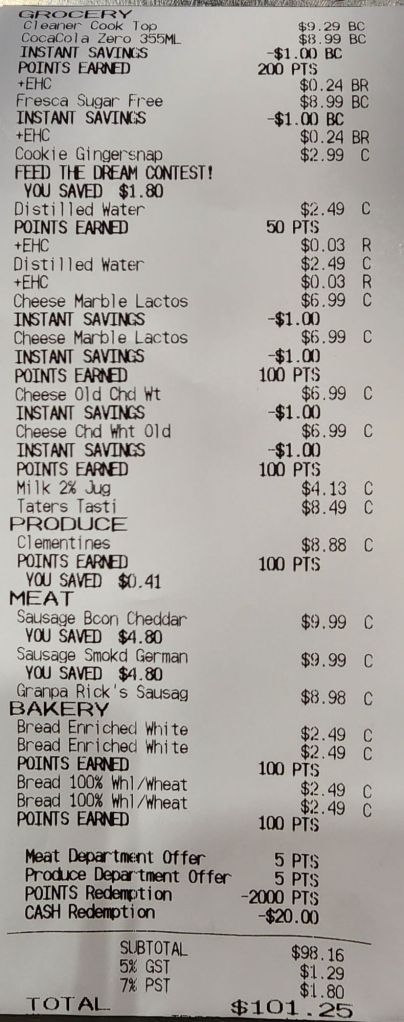
Did quite a bit of running around today, which I’ll cover in another post. Since I was in town anyhow, I did a small grocery shopping trip that turned out to be bigger than originally planned. I was only there for bread, milk and cheese! 😄
This is what $121.25 looks like, but I got $20 off from my loyalty points.
Yeah, most of it fit into the one hard sided bag I brought.
One of my daughters mentioned we were running low on glass top stove cleaner, so I picked up a bottle of that. I also got a 12 pack each of Coke Zero and Fresca for the four of us, which were on sale.
There was actually ginger snap cookies in stock, so I got a box for my husband, along with two jugs of distilled water for his CPAP humidifier. I also got him some frozen tater tots as an each snack that he can prepare himself.
Then I got two packs of marble, two packs of white Old Cheddar, lactose free cheese, which were on sale. They didn’t have any 2L 3% milk in stock, so I got 2%.
I spotted hoagie sausages on sale, so I got two packages. The sale price is what used to be their regular price. The girls really like those. I also picked up a ring of garlic sausage, made by a local company.
Then, finally, I got the bread I was there for. Four loaves of regular white and whole wheat bread. The rye bread I normally get was on sale, and completely out of stock, so this was the substitute.
And that’s it. All that, with sale prices and discounts, came out to over $100.
*sigh*
On another note, our pantry just got a boost for canned soups and a few more cans of beans. With my mother still in the hospital and not going back to her apartment, I’m going to start clearing some things out, little by little. My brother and SIL had picked up a lot of canned soup and such for her, as it was a lot easier for her and something the home care staff could prepare for her. After talking to them about it, they told me to take them, since we have “more mouths to feed”. 😄 I certainly won’t say no to things to add to our pantry!
While shopping today, I saw the canned beans we used to get regularly were on sale as 2/$3 A sale price of $1.50 per can, that used to cost 97¢ a can, regular price, not that long ago.
What isn’t pictured is my stop at the pharmacy. I got ibuprofen for the girls. Two smaller bottles that were on sale, making them cheaper than getting one larger bottle. I got acetaminophen for myself, which is safe to take with my anti-inflammatories. I still have some prescription painkillers left, but I don’t want to be using those if I don’t have to. I also got a tube of Voltaren for myself, that was on sale, and lactaid for my husband, which was not on sale. That all came out to something like $98.
I did stop at the hardware store before going to visit my mother, trying to find some Roof Melt. Turns out, they don’t even carry it, though the website made it look like they did. The city stores carry it, not the small towns. The first staff I asked about it didn’t even know what it was. I ended up talking to a manager? I think? who has helped me before. They tried really hard to find something for me. One of the other staff came by and heard what I was asking for, and got all excited, because it’s a product she would be getting, too! In the end, the manager said he was going to try and order something in, but he wasn’t sure if it would work.
He did mention that you can get beet juice granules. Somewhere. He didn’t know. This would be sprinkled on the roof and in the eavestroughs in the fall, where they would keep things clear all winter, and are completely safe for the grass and water table the melt water would drain to.
Today, I finally got around to starting our onion seeds.
Usually, I start onions by densely sowing them in trays. Onion roots can handle quite a bit of abuse. When it’s time to transplant, I just pull them apart as I go. The problem with that, is, the roots do get pretty tangled together, and there have been times when I’ve even had to use water to wash away the growing medium in order to get individual seedlings out.
This time, I wanted to try something different.
I’ve been seeing the “seed snail” method that got me curious. Basically, seed starting mix it laid out on a strip of something – plastic, cardboard, paper towel, etc. – and rolled up. Seeds are planted at depth at the top, covered with more seed starting mix, and it’s done. When it’s time to transplant, the roll is undone and there is less root disturbance when accessing the plants. If the plants need to be “potted up”, it can be unrolled, more starting mix added, then rolled back up again.
In looking it up more, I see people using this method for pretty much everything, including things with very large seeds that grow pretty big. I’m not so sure the method lives up to the hype for larger things in particular, but something like onions? It seems perfect.
The thing that I was most curious about was, the material used to make the roll. One article I read, which was not positive towards the method, used paper towel. I can’t imagine using something that practically dissolves in water, over time! Others described using heavy paper or cardboard. I don’t really have anything like that, in the size and shape needed. I’ve also found that using paper products tends to wick moisture out of the growing medium, away from the plants, and need more watering. Even with the biodegradable pots, I’ve found the pots themselves need to be kept wet, or they start drawing moisture away from the plants.
One thing mentioned as working well was the thin foam sheets used to wrap breakables for packing.
Did I still have some?
I quick look in a storage bin in the root cellar, and I found I had plenty!
So that’s what I used.
Before I started on that, though, I prepped the last of my seed starting mix from last year. It had quite a lot of pieces of wood and such, which would be more of a problem with a seed snail. I wanted to sift it, but didn’t have a sifter. In the end, I used a metal colander with finer holes all over, and sifted it into a giant mixing bowl.
I got quite a bit of larger material out. I also had some concern that I might not have enough sifted started mix for the project.
I had four seed options. There were our own saved seed, which is a mix of red and yellow bulb onions. Then there were the seeds I got from MI Gardener. Red Long of Tropea, which are very much like the Tropeana Longa onions we’ve successfully grown before. Red Wethersfield, which we tried but did NOT successfully grow before, and Red Beard Bunching onion.
I was at first thinking to do the bunching onions later, but they are 110 days to maturity, while the other two are 100 days to maturity, so I prepped four strips. I taped shorter pieced together for the length, then folded and cut them in half lengthwise. That resulted in two strips of about 31 inches, and two of about 29 inches long, and about 6″ wide.
That sifted seed starting mix was absolutely beautiful to work with! So soft and fluffy!
Each strip got a layer of starting mix about a quarter inch thick, laid out right to the edge of one end and the bottom. The top had about an inch empty, and the other end had about 8″ empty. I had my work surface covered with a repurposed clear garbage bag, which actually made it easier to roll them up. I could lift the plastic up against the base of the snail, to keep starter mix from falling out.
I prepped masking tape ahead of time. Four were labelled. After rolling up the snails, I used a black piece of tape to hold it together near the bottom, before tucking it into a bin. After they were all rolled, I sowed the seeds and added the labelled strips of tape to hold it together near the tops.
In the first picture here, the seeds are sown, more seed starting mix was set on top and every so gently tamped down to get rid of any air gaps. In the next picture, they’ve been topped with vermiculate.
Once topped with vermiculate, they got a very thorough watering with a spray bottle, then more water was added to the bottom of the bin they’re in, so they can be watered through capillary action, too. Last of all, the bin’s lid was laid on top to act as a moisture dome.
This was all done in our basement dungeon. I don’t have any of the grow lights, the heat mat, trays, etc. ready. I won’t need them for quite some time yet. So these went upstairs to the cat free zone (aka: the living room). It’s not particularly warm there, but warm enough. Plus, the window gets full sun only for a few hours in the morning, so we have supplementary light above.
It should be interesting to see how this method works out.
In the past, when densely sowing seeds in trays, I would usually finish off the package. This time, there are seeds left in all three packets – plus there is lots of our saved seed. So there is the possibility of trying again, if this doesn’t work, as long as they get started early enough.
Anyhow. The main thing for now is, the onion seeds are started!
While doing the morning rounds, I could not believe just how slippery everything was! I don’t think we’ve had anything like this, since we moved out here. Today was even more dangerous than after it was actually raining.
The camera on my phone seems to compensate a bit for the brightness. I couldn’t actually look at where I was taking the pictures, the sun’s glare on the ice was so blinding. I had to be super careful walking the paths to set out food and water for the yard cats. I was really appreciating the handles I’d put on the isolation shelter, as they gave me something to grip as I went from one sliding window to the other. I’d cleared the patio blocks below, but they are now covered with a thick layer of sheer ice.
Tomorrow, we’re supposed to get above freezing, so things should soften up and, in some areas, melt clear. Hopefully, that means the highway will be dry by the afternoon, as I plan to go to my mother’s apartment to check on things, then hit the hardware store to get some Roof Melt to get rid of the ice dam that has formed on the sun room roof.
Speaking of my mother…
I called the hospital last night. I timed it badly, as they were doing shift change, and I was asked to call back later. That meant I was talking to a new shift nurse, who had just barely been debriefed.
My mother, it turns out, had a rather “bad” day… and by “bad”, it was about her behaviour.
She had called me early in the morning, before they came to do her vitals, and over an hour before they were scheduled to do her morning meds. After I called the nurses’ desk back to explain the call to my mother, they checked on her, then I got a call back with an update.
Some time after that, it turns out my mother went into the hall and started yelling and swearing at the staff, calling them stupid. The nurse I was talking to had been updated during their shift change meeting, but hadn’t completely finished reading the written report yet, but she was able to tell me that the previous nurse managed to get her back into her room. The nurse then addressed her behaviour, in private.
I was both surprised and not surprised at the same time. I think it was the swearing that actually surprised me the most, because I didn’t think she knew any swear words in English. I’m probably wrong on that. If she had been swearing in Polish, it’s unlikely they wouldn’t have known if something was a swear, other than by tone.
I apologized for my mother’s behaviour, of course, but the nurse just laughed it off. She told me, the get this quite a bit, and never take it personally.
At the end of the call, I made sure to pass on my gratitude for how well they are taking care of my mother. She does not make it easy.
Some changes in her schedule were made, though. My mother complained that they weren’t doing anything for her, regarding her pain in particular. The only things they do for that is give her her Tylenol and rub affected areas with Voltaren, both of which help her a lot. These, however, were “as needed”, and if she didn’t specifically ask for them, she wouldn’t get them. It seems she wasn’t asking for them as often as she should have been. So now, both are scheduled. She will get both, twice a day, without her having to ask for them first.
There really isn’t anything else they can do for her. Most of her maladies are not things that can be fixed. At 94 years old, her body is simply giving out in places – and she really is doing remarkably well for her age! She doesn’t think so, of course.
Hopefully, they will find a care place for her soon, whether its assisted living, or a nursing home, like she wants. These places tend to have activities to help with cognitive decline, or simply for socializing. There is nothing like that available in the hospital, so she’s basically stuck alone for much of the day, stewing in her own mind, without the distractions she had become used to.
At the end of my call with the nurse, who was about to do the evening meds, she promised to call me back, if there was anything of concern. She did not call, so no news is good news.
After checking my mother’s apartment tomorrow, depending on the road conditions, I will drive to the hospital and visit her, too.
For a while, there, my mother had been doing so well. She really was happier than I’d seen her in years. Now, she seems to be reverting to her usual self again. Which makes the idea of visiting her or calling her on the phone a lot more stressful than it should be.
The hospital staff are saints. My mother is not the only difficult patient they have to deal with! At least, with her, she is an “easy” patient, in that she doesn’t need a lot of physical care, for someone that is hospitalized.
While we haven’t had anything official yet, we at least have been told she is not going to be discharged back to her apartment. They just don’t know when or where she will be discharged to, yet.
Which puts the rest of us in limbo.
I suppose we should start packing her apartment, though. I just don’t know where to start!
One of the things we found when we were cleaning the house out, before the movers brought our stuff, was an old rotary dial phone.
That phone is now set up beside my bedside, as it will continue working, even during power failures, unlike the modern cordless phones. There is one down side, though.
The ring is LOUD!
That’s what I woke up to.
That wasn’t the most jarring thing, though.
I actually got out of bed to grab the cordless phone, so I could check the call display, first. It was from the hospital. Sort of.
It was my mother, calling from her own phone in the hospital.
The first thing she started asking me was if I knew where the pendant for her Lifeline was. I told her, it was with the base in her apartment now. She wanted me to use it. I told her, I would have to drive to her town to do that (a half hour drive, if road conditions are good. They are not good.). But I have their number, right? Yes…
She wanted me to call her Lifeline to get advice on what to do.
…
She’s in the hospital, and she wants me to call the Lifeline for… health advice?
As you can imagine, this was very confusing even when not bleary from being half asleep!
From what I can figure out, if she had still had the pendant with her, she would have tired to use it, expecting to get a response from Lifeline, even though 1) the base is in her apartment and 2) her account is currently suspended until we know where she is going next.
She also thought the number I had was to whoever would have been monitoring her Lifeline, had it been active. The number I have is for their customer service. I didn’t even think about that at first, because I had no clue what she was getting at.
I told her, she’s in the hospital. If she needs help, use the call button.
What followed as a whole lot of jumbled stuff that I struggled to make sense of. Partly because she was talking in Polish, and didn’t have her teeth in. At the end of it, I did ask why she had switched to Polish and got only a vague answer that I think was her saying she didn’t want anyone to overhear what she was saying.
Somehow, in what was probably not that long of a call at all (though it felt much longer), she managed to…
Tell me the hospital isn’t doing anything for her. They just want her to sit quietly in the corner and die.
She’s been there for a long time (she even figured back to the date she went to the ER), and has still never been seen by a doctor.
They give her lots of pills. Eleven of them this morning (she hadn’t had her morning pills yet, I later confirmed, so… this would be the same morning she’s been talking to me about for over a week).
She is in pain, they come in to rub on the Voltaren, and that’s it, they don’t do anything else.
She wanted me to take her to a different hospital. Maybe they will help her.
Oh, and she squeezed in another complaint about paying for the Lifeline service, but they don’t help her. I reminded her, the service is suspended right now, but she was complaining about that before, anyhow.
When I tried to explain that you can’t just go hospital hopping, while trying to figure out just WHAT she wanted treatment for, I was told I was “on their side” and just wanted her to die.
Then she told me to talk to my brother, because he’s smart, he’ll know what to do.
…
She was clearly having a bit of a freak out, but I could not pin down what was going on. She talked about pain and they just rub on the Voltaren. Does it help? Yes. So what else does she expect them to do? She brought up her dry mouth again. They have given her a spray for that, and she doesn’t even keep it in reach. She wants them to “cure” it somehow, but it’s because she’s sleeping with her mouth open. She didn’t even bring up the pain in her chest that she used the Pepto for, but I couldn’t get the straight of whether there was anything else happening. When she started accusing me of being “on their side”, I told her, I’m trying to understand, but I need words! I need information!
I never got it.
She also went on about how they have five doctors, and no doctor has seen her. I told her, they don’t have five doctors at the same time. They have one. That’s it.
Oh, you’re on their side…
In the end, I promised her that I would pass things on to my brother, because he was wanting to book an appointment with the doctor to talk about next steps, anyhow. I told her, he was probably already at work, so I would message him. She actually ended the call so I could do that, which is unusual.
The first thing I did, though, was call the hospital to talk to whoever was at the nurses’ desk. I explained that I just got a call from my mother and the things she was saying to me. The receptionist didn’t know who my mother’s nurse was on that shift but, after being filled in, she told me she would pass all this on to her nurse, but would also check on my mother herself. She then offered to call back and update me, which I gladly accepted.
Then I got on my computer and started updating my brother. Part way through, I got the call back.
When she checked on my mother, the nurse was there, taking her vitals, and my mother was saying to her some of the things she’d already said to me on the phone.
My mother is apparently just fine. Her vitals are always really great. Her swelling is not an issue anymore. Her pain is being dealt with in various ways, as needed.
So what is it she is wanting to be treated for, to the point of wanting to go to a different hospital?
We don’t know.
My mother’s file was checked, and the last note from the doctor, about the Pepto my mother wanted, was written on the 5th. Today is the 13th. So he has been seeing her, even though he hasn’t needed to add notes each time.
So what is going on?
The doctor is seeing her, but she either doesn’t remember, or she doesn’t believe he’s a doctor. She had complained about how the nurses and doctors should be in uniforms, because she can’t tell them apart from a janitor. This doctor, however, is very distinctive. He’s probably the only black person in the hospital right now, probably the tallest person in the hospital, too, and he’s the same doctor that tended to her when she was hospitalized before. So it could be that she doesn’t think he’s a “real” doctor, because he’s black, and not doing whatever it is she wants done to her. This is a pattern with her, and not just based on colour. For as long as I can remember, she would go to doctors, therapists, psychiatrists, even priests, and any time they started saying things she didn’t want to hear, she would stop seeing them and claim they were somehow uneducated, unqualified, or otherwise not “real” in their title. If they did say something she liked to hear, she will drag that out, over and over, even if it is completely at odds with everything else.
We had a good talk about it. At one point, I read out a response from my brother, saying that my mother doesn’t understand that she’s in a holding pattern right now, while they try to figure out getting her into care, wherever that is. I explained that my mother WANTS to be in a particular nursing home, and that we’ve been trying to help her do that for two years now, with no success.
I think part of the problem (and the person I was talking to agreed) is that my mother is likely lonely and bored. With her eyes failing, she can’t read or write like she used to. She has her radio, but it’s set to a talk radio station in the city, because we couldn’t get the Polish radio station she usually listened to, so she’s probably not bothering. That talk radio station used to be a good one, and I remember we had it on a lot when I was growing up. It has changed significantly, over the years, and would probably not interest her anymore. She has the TV, but there’s only two channels, and she doesn’t approve of either of them. It’s just sports and stuff, and the same thing over and over, she says – and the news is just bad stuff, never good stuff, and the government should take them over and tell them to show only good stuff. Being in a hospital, there aren’t any activities that she can take part in, like there were in her apartment building, either.
So… yeah. She’s probably bored out of her tree, with only her own thoughts to mull on.
Which, considering the things she come up with, must be unpleasant. As my brother has said, it must be really scary to be in my mother’s brain right now. I mentioned that to the person I was talking to, and she agreed. We’re looking at increasing dementia, and she must be getting very frustrated and confused. This would be part of why she would get so upset with me when I can’t figure out what she is trying to tell me, or what she wants me to do. She doesn’t have the words. Even if there was some new thing wrong with her, she doesn’t have the words to tell us.
I updated my brother the rest of the way, but there really isn’t anything much he can do, either. We need to have that meeting with the doctor to get things straight and make decisions – and we’re already in the middle of January! My mother went into the hospital before Christmas.
She’s in the best place she could be right now, until some sort of long term care, assisted living or supportive living accommodations can be found for her, and we do know that she is being paneled for that while she’s there.
But she wants to be treated for something. Anything. All her many complaints, most of which can’t be fixed. Something. But aside from the swelling that got her into the hospital in the first place – which was blamed on a heart condition she doesn’t have – she is not sick. She is feeble, has already had a fall while there, and can no longer live independently. If it weren’t for our making a big deal about that, she probably would have been discharged home weeks ago, and she’s be in even worse shape. She would have been in real trouble if she’d had that fall in her apartment!
So… that was how my day started.
By the time all that was done, it was time for me to head outside for my morning routine, so that got taken care of.
I counted NINE cats and kittens in the isolation shelter, while doing the food and water in there!
The thermometer against the back wall is reading 5C/41F. Of course, it would be much warmer under the heat lamp, where Bug is hanging out.
After getting the morning stuff done, I was falling asleep on my feet, so I set a timer and went down for a short nap. It helped.
I was considering heading out to town today. My SIL had mentioned a product to me to help with the roof dams. I hadn’t even mentioned that we had one to them! They know how much of a problem that one spot it. Anyhow, these are pucks of calcium chloride and, depending on the brand, other chemicals. You just toss them up onto the roof, they melt their way down and then continue to melt away snow and ice for a long time. I called up the local hardware store to see if they had any in stock, but they did not. My mother’s town, so the south of us, has a hardware that apparently has the same brand of product in stock, but I wasn’t going to do highway driving, if I could avoid it.
We did actually reach our high of 3C/37F today, but it was at 4am. By the time I was outside doing my morning routine, it was getting cold, and we were having high winds. Anything that melted while it was warmer overnight was already frozen. As I write this, we are at -16C/3F, with a wind chill of -35C/-31F.
Tomorrow, we’re supposed to reach 1C/34F in the afternoon, through to the early evening, with continued high winds. It’s going to be our last warm day for a while. After that, we’re going to start getting highs below -20C/-4F. So if I’m going to run any errands, tomorrow is the day to do it.
It’s supposed to warm up slightly in the middle of next week, though, which is a good thing. I now have three appointments with the vet for spays or neuters. We’ll just be grabbing whoever we can that is for sure big enough to be done. Priority on the females, of course, but males if we can’t catch any. We’ll have to catch them the night before and keep them in the isolation shelter for the overnight fast. What we like to do is try to bring them in early enough to treat them with wet cat food, then take the food bowls out once their fast is supposed to start.
I’m still hoping we can get Frank in. She has allowed me to pet her a couple of times, but is extremely nervous about it. Adam has been around, but I haven’t been able to get close to her, and Slick may as well be as feral as Sprout, the way she’s been behaving lately. Then there’s that white and grey that has apparently moved into the cat house for the winter. Can’t get anywhere near her at all.
When doing the evening cat feeding, I was actually able to pick up and snuggle Blot, but she is probable too small. There are a couple of large kittens that I know are female – the calico, Sprig (daughter of Sprout), of course, but also the still unnamed fluffy black and white. There are fluffy tabbies that we just can’t tell, one way or the other. Too much fur, and we can’t get close to any of them.
We’ll bring in three, and that’s all we can be sure of!
So that’s good news.
Meanwhile, I am thinking I should probably call the hospital again and see how my mother is doing.
Honestly, I really don’t want to. You never know, though. She might have completely flipped between this morning and now, and be a different person again. There’s just no way to know, unless I call.
You know those nights where to get into bed and suddenly, you’re just awake? Absolutely zero chance of falling asleep?
Well, I had one of those last night. Finally, at around 4am, I got up to find a food. I sat at my computer table to eat and, since I was there and the computer was off, I decided to clean out the crevices on my mouse. It wasn’t as bad as I expected, so I decided to do the same to my keyboard.
I cannot believe how much cat hair I pulled out from between the keys! How does it even get in there??? Today, however, it feels like I’m typing on a brand new keyboard. 😄
I finally tried going back to sleep at about 5am and managed to get a bit of highly interrupted (by cats) sleep before it was time to get up and do the morning routine and feed the outside cats. Then I tried to go back to bed, but found I wasn’t feeling well for some reason. I finally did doze off, only for the phone to ring and wake me up.
I gave up after that.
I still wasn’t feeling well in general. Part of it had me wondering what I might have eaten to trigger problems (nothing out of the ordinary), and part of it was my joints wanting to give out on me. That whole “shoulder wants to dislocate while reaching to flush the toilet” thing is decidedly inconvenient!
I ended up getting one of my daughters to do the evening outside cat feeding.
I was feeling particularly useless today, so I started looking up recipes. At some point, Pinterest started showing me some Pins for liquid dough flat bread, which caught my attention. We aren’t baking bread anywhere near as much as we should be. Our bread machine stopped working properly a while ago, though we could still have it mix up a batch of dough in the evening, ready to bake in the oven in the morning, but we weren’t always in a position to do baking in the morning. Plus, a single loaf doesn’t go very far with four adults in the household.
Meanwhile, with all of us breaking down, one way or another, we were focusing more on no-knead bread recipes, anyhow. Most of these still require rising time, but sometimes I want something faster. Baking powder pan bread works okay, but variety is always nice.
Today, I found a couple of “liquid dough” recipes that looked good and decided to try one of them out. The dough’s texture is thinner than a batter bread, but thicker than a pancake batter, though there seems to be quite a bit of variability between recipes.
This is the basic recipe I settled on to try today.
Liquid Dough Flatbread
Ingredients: 2 cups flour (AP or whole wheat) 2 cups water 1 egg (beaten) 1/4 tsp salt 1/4 tsp sugar 2-3 tsp dried parsley (or slightly less, if using chopped fresh parsley) Oil or butter (melted) for cooking
Instructions: 1. Add all ingredients together in a medium bowl and whisk together until smooth. 2. Heat non-stick skillet over medium high heat. Brush lightly with oil or butter. 3. Pour 1/2 cup of batter into the hot skillet and spread evenly. 4. Cook until the bottom starts to change colour and is solid enough to flip. 5. Flip, then apply a light coating of oil or butter. 6. Press the edges with a spatula (they tend to curl up). Cook for 2-3 minutes, then flip again. 7. Apply another light layer of oil or butter. Continue to cook for another 2-3 minutes, or until both sides are golden brown. Note: a bubble of steam may form in the middle.
For this, I used olive oil in a handy little dispenser and a pastry brush to spread it, which made things easier. I also used a half cup measuring cup as my ladle, with a rubber spatula to scrape the outside to keep it from dripping all over and making a mess. With the half cup measuring cup, I was able to do 7 flatbreads that were about 8″ across this way, then for the last one, I just poured in what was left, which made for a flatbread about 10″ across.
The original recipe said to put all the ingredients (the egg did not need to be beaten first), except the parsley, into a blender, blend it smooth, then transfer to a medium bowl and stir in the parsley. We don’t have a blender, but why would I want to dirty extra things when a wire whisk and one bowl will do the job? I didn’t even bother to beat the egg in a separate bowl, but just made sure to beat it before incorporating everything else in the bowl.
The finished flatbreads had a lightly crispy edge, and a softer, chewier middle.
We taste tested them plain.
My conclusion:
Very easy and quick to mix up, and not too bad when it came to how long they took to cook, for something that could be cooked only one at a time.
Adding the extra oil when flipping them did result in them being slightly oiler than I prefer – and I didn’t oil them as much as the original recipe called for!
For flavour, I think it would have been better if I’d used butter, ghee or even a flavoured olive oil, rather than a plain olive oil. I think butter would be best, as they rather needed the extra salt. Something to experiment with, if I make this recipe again, as it was a bit on the bland side.
I think I would also like to experiment with trying different additions instead of the parsley. Finely chopped garlic, for example, or a dry grated cheese, like Parmesan, or even some powdered, dehydrated tomato or spinach, for savoury options. I think it would also work well with a bit more sugar – maybe substituting brown sugar instead – and the addition of things like ground cinnamon or cloves, for a sweeter option.
While we were taste testing these plain as a snack, I think they would be a nice addition to go along with a hearty soup or stew, though for that, I really prefer our fluffy dumplings. More likely, we would use this as a wrap, like we use tortillas, with some sort of savoury filling. My daughter thought they would be nice dipped in some hummus or sour cream. Interestingly, she found the flavour quite “eggy”, which I didn’t get at all. Her taste buds can pick up a lot more than mine can, though.
I do think this is something that might work well for campfire or firepit cooking, too. Our well seasoned Dutch oven lid has legs and can double as a griddle that would be perfect for something like this.
In the end, I think this is something that would do well to quickly work up when feeling peckish but, as I mentioned before, it’s a bit on the bland side. I can see myself making a half recipe of this as a snack during the night.
A night like last night, were sleep just didn’t want to happen!!



 The Re-Farmer