It was a hot and windy day today, and my younger daughter and I ended up making a quick run into town, but we did get some decent progress in the garden.
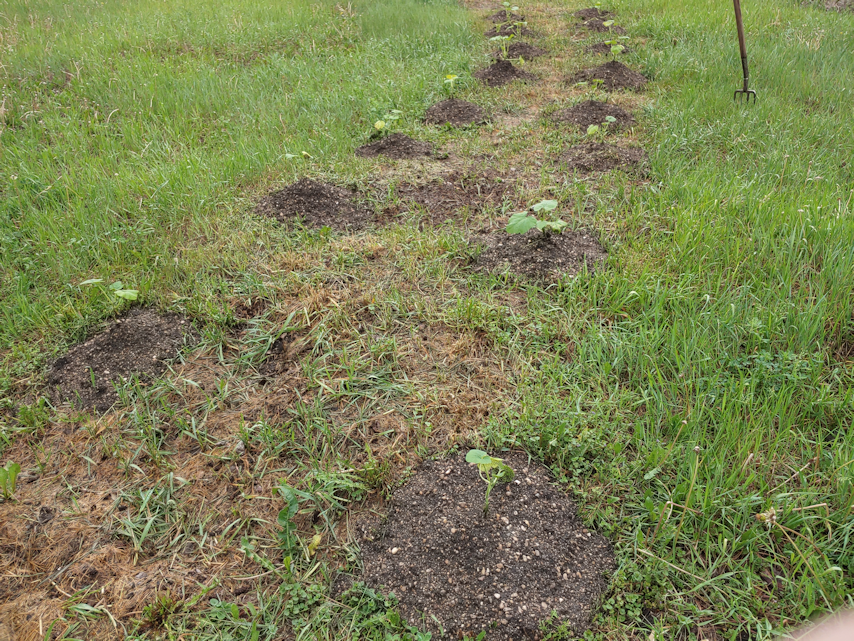
My older daughter braved the hottest part of the day and added more soil to the 15 summer squash mounds.
I waited until it was cooler.
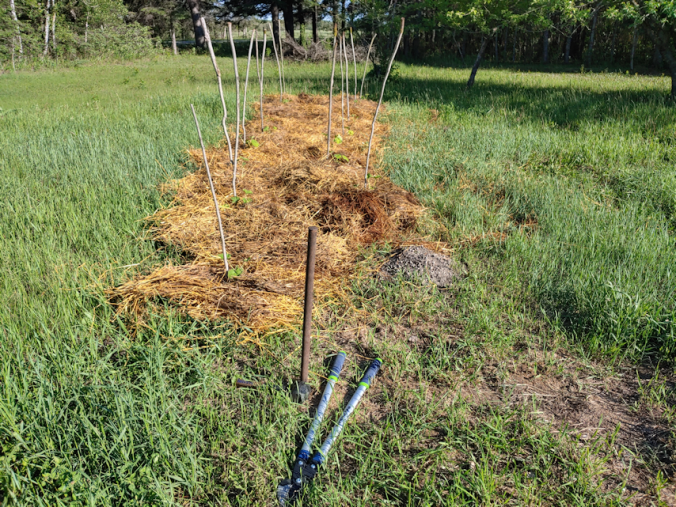
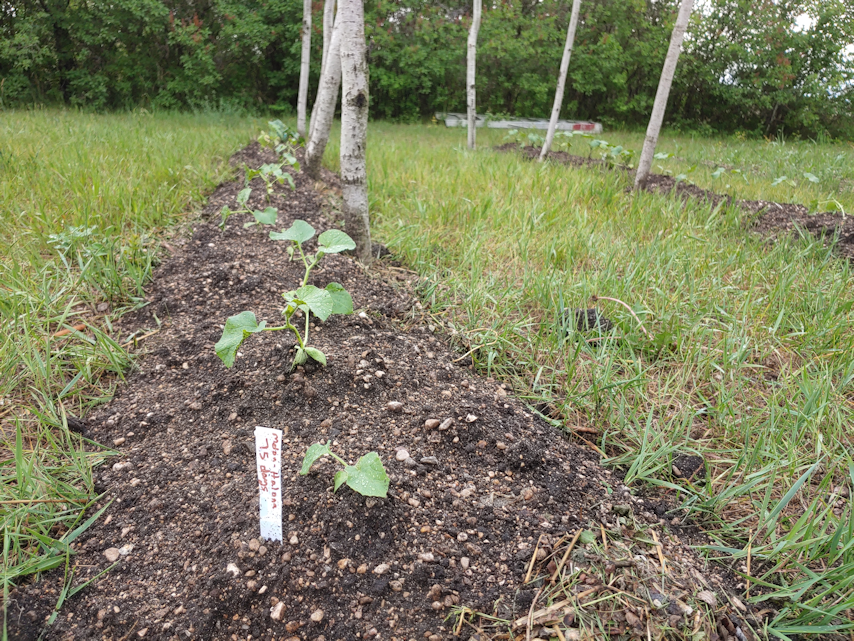
I added a stake near each plant. The stakes are some of the smaller poplars we cleared our of the spruce grove, trimmed to about 3-4 feet in length. In the foreground of the photo, there is a metal bar stuck in the ground. It has a point at one end. I can’t remember at the moment, where we found it, but it was a happy find! I used it, and a mallet, to make holes in the ground. Then the stakes, skinny end down, were pushed in as far as I could, beyond what I managed with the steel bar, then the soil carefully stomped down to secure it. As close to the plants as they were, that meant mostly just on one side. Once those were in, the area was mulched with straw. The idea is to secure the stems of the squash to the stakes, as they grow, and pruning the bottom leaves, little by little. We shall see how that works!
Also, I really need to get this area mowed, before the next rains come!
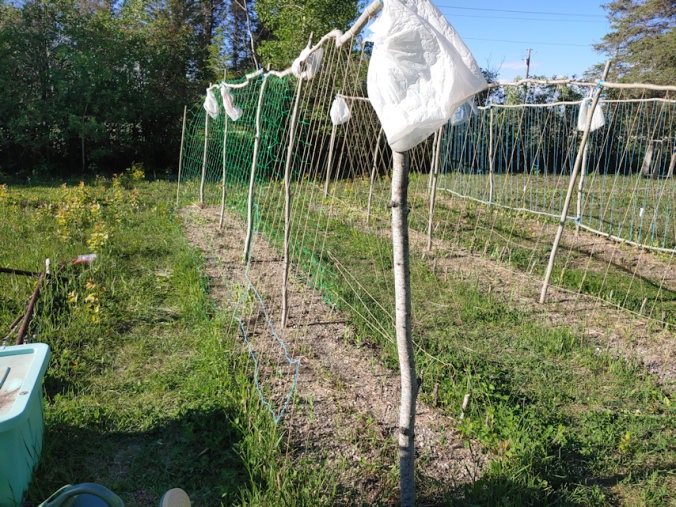
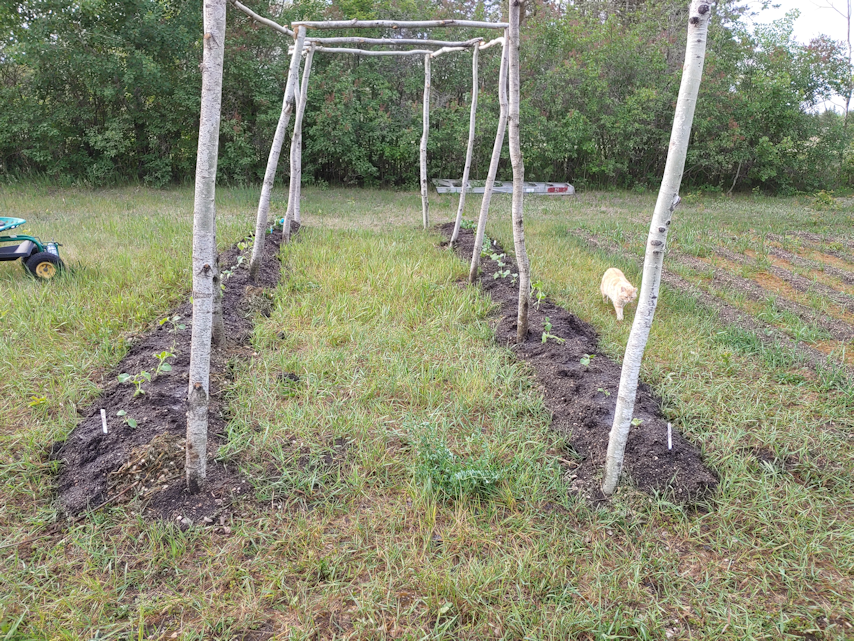
I had found some trellis netting, so my daughter finished the last sections of pea trellis with that, along with adding soil to the summer squash. The peas are getting tall enough to start climbing! The peas I planted later, to fill the gaps left by those that did not germinate, are sprouting, too. I’m really looking forward to having fresh peas! I can’t remember the last time I had fresh-from-the-garden peas.
If you look to the left of the photo, you can see what is a problem in this area: all those tree seedlings! They are spreading through root systems, like quack grass. Usually, I would have mowed over them by now, but we’re going to have to cut them back by hand this year.
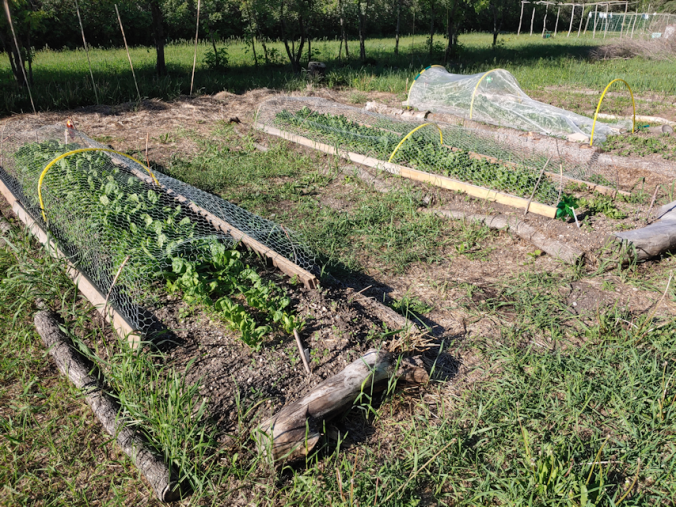
My younger daughter, meanwhile, went all out and thinned all three spinach beds.
Yes, this was taken after the beds were thinned!
The furthest one, under the netting, is the one that got the most deer damage, but parts of it are doing well. You can see at the end of the closer beds, the smaller spinach at the ends the deer got at.
With the spinach she gathered, I currently have two trays drying in the oven, and made myself a huge spinach salad for supper. The reason we went into town was to get ingredients to make spinach dips. Both cold and baked versions. :-) I’m really looking forward to that!
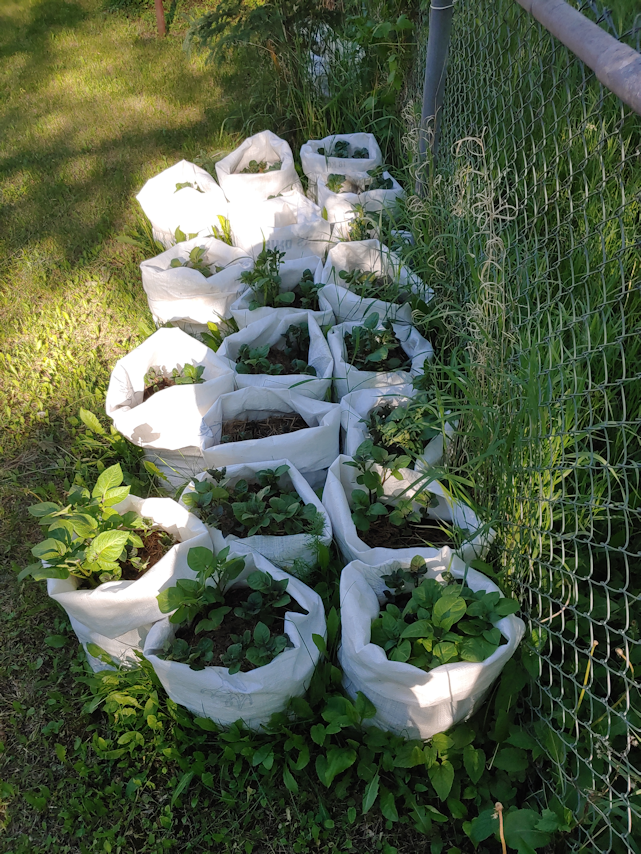
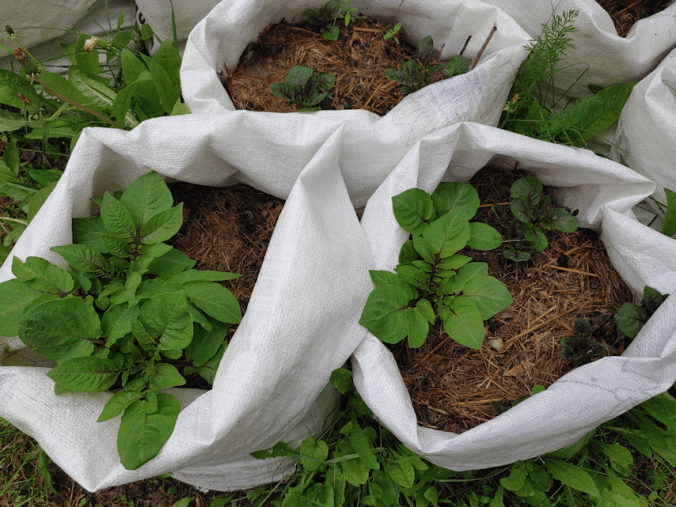
This last one is just to show how well the potatoes have been doing! At this rate, some of them are going to need topping up, soon! I’m very excited to see how productive these will be at the end of their season.
With today’s progress, my goal for tomorrow is to get working on that squash tunnel. The luffa needs something to climb! :-D
Today, I built what should be the last garden bed for the year. This one is for the climbers.
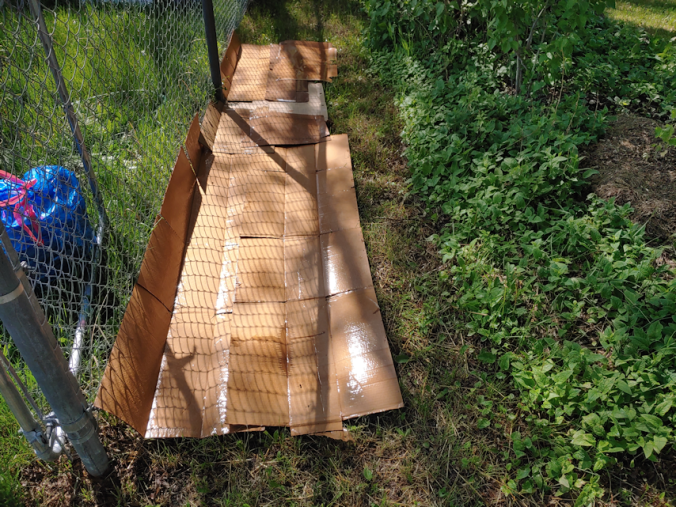
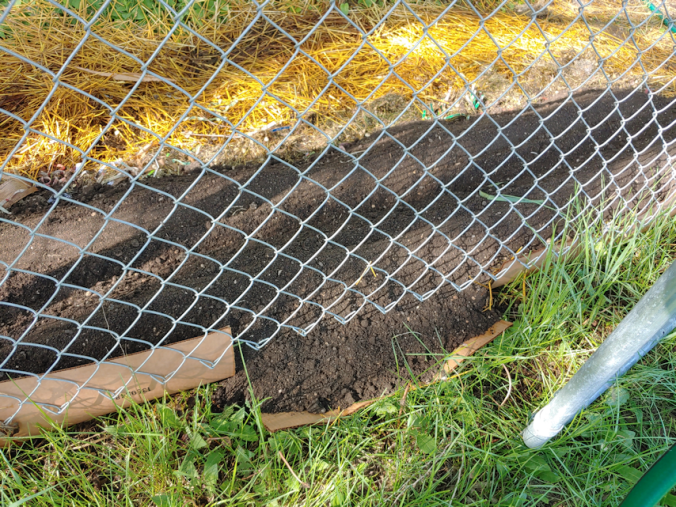
Here is what the space looked like when I started.
The original plan was to use the remaining chimney blocks, like the one in the photo, as planters along the chain link fence, but they remain in the basement until we can figure some thing out, and it is not a priority.
We’ve been saving up our cardboard, and had just enough to create a barrier layer, which got a thorough soaking.
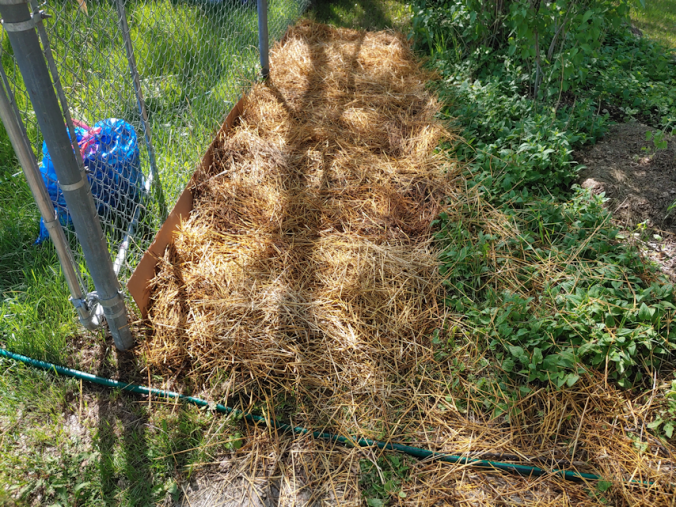
The next layer was the straw, which is also the mulch to cover the path between the new bed and the flower bed beside it. I was able to get some of the straw at the bottom of the bale that has had time to start breaking down, too, which was great! This layer, like all the layers, got a thorough soaking – after I beat it flat with the back of a fan rake.
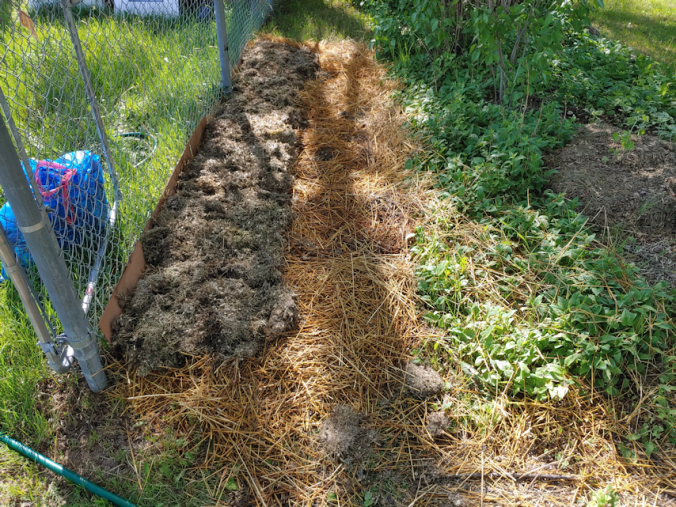
Then, because we had some, I emptied our kitchen compost along the fence line, which got tromped on before a soak.
There wasn’t much. We don’t get a chance to accumulate much for the compost pile. It tends to get used right away!
We still have grass clippings, so a thick layer of it got laid down.
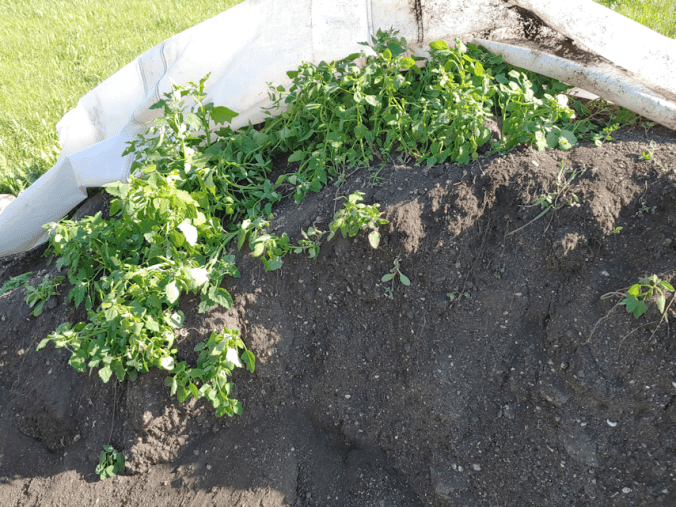
We’ve been keeping our compost-safe paper for shredding, and I had a bag full to add for another layer. After giving it a soaking, my daughter tromped it down for me, while I went to get a load of soil. This was from the nearby tarp covered pile in the outer yard. When I pulled back the tarp, I just had to call the girls over to take a look!
The white tarp allowed enough light through for the weeds to start growing, and grow they did!! They were huge!
These are mostly lambsquarter, which are supposed to be edible and very healthy. Better than spinach!!! At least that’s what the breathless Pinterest images that have started to show up in my feed are all exclaiming. Maybe some day we’ll try them, but for now, they are growing in places we want other things to be growing (or, in the case of our soil pile, nothing to be growing!), so we’re pulling them. Still, it was something else to see how big they got under that tarp! It actually is encouraging, since we plan to build polytunnels and high raised beds in the outer yard, eventually.
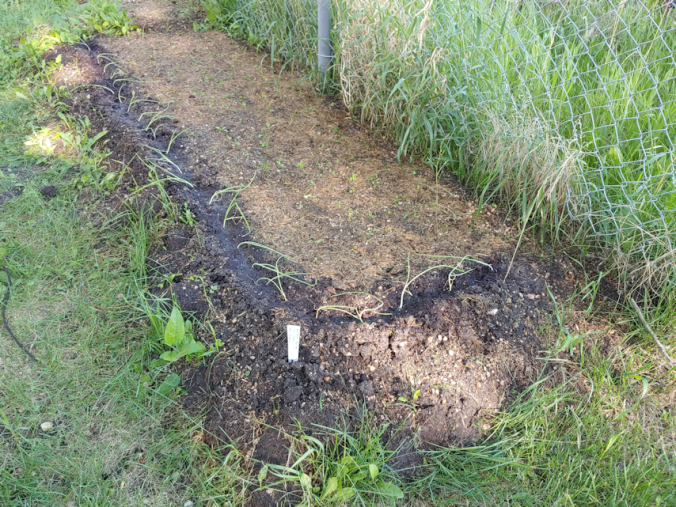
Finally, a thick layer of garden soil was added to the new bed, with a trench down the middle to hold water. My daughter did catch me before I made the new bed too wide. With the one we made for the tomatoes, we’re finding it a bit hard to reach, even though we ended up narrowing it down when we added more soil for the transplants. We’ve noticed the same issue with the beds of spinach, carrots and onions. They’re only about 3-4′ wide, but they are low beds right now, and we’re short. It’s hard to reach the middle while bending down so far; our balance goes off kilter. Especially for my daughters who, unlike me, have not had their generous proportions surgically reduced. That really affects center of balance! It would not be an issue with the tall raised beds we plan to build, but we need to remember that, for low beds, they need to be narrower. Especially if we can reach from only one side, like these along the fence.
One thing that was an unexpected issue is that the chain link fence on this side is higher above the ground at the bottom than on the other side of the gate.
Which means that the damp cardboard flaps against the fence couldn’t quite hold the soil in some places! Which is fine. We’ll work around it.
After filling the trench in the soil with water to soak it, I brought over the cucamelons that have sprouted (most did not, but that’s okay; we planted way more than needed!), as well as the gourds. The bucket and plant pot have the cucamelon tubers in peat that I dug up from last year, to see if they would grow this year. Time to dump them out and find out if they survived!
They did not.
Aside from a few wispy root clumps and what may have been the dried outer skin of a tuber, I found nothing. They had completely decomposed.
Well, that just left me with some peat I could make use of.
So I widened the trench I’d made before, added some peat to it, and watered it again.
Then it was time to do the transplanting.
The cucamelons were all in their own Jiffy pellets, so they were easy to space out. I planted even the tiny ones. If they make it, great. If not, at least they had a fighting chance! Our cucamelons from last year were quite prolific, even in less than ideal conditions. This location gets much more light, so I expect them to do even better, here. If all grows well, this fence will be completely covered with climbing vines!
Of the gourds, the pot that had 2 Ozark Nest Egg seedlings had sprouted a third! I’d forgotten I’d planted 3 seeds in the cups. The pot that first sprouted still had only one, plus there is the one Thai Edible Bottle gourd. These are in Jiffy pots, so the ones with just one seedling in them got planted whole. The one that had three in them, I gently broke it open along one side and sort of unrolled the contents to separate the seedlings. One of them just sprouted today, so it’s unlikely to survive, but who knows? It might do even better than the others. :-) I believe in you, little sproot!
That done, I had some more transplanting to do. I’d put the last of our Norstar onion seeds into a Solo cup, and they not only sprouted, but are starting to form bulbs!
The girls and I had talked about where to put them, and the border of the asparagus bed seemed the best place.
The onions are shallow growers, and there’s plenty of space between them and where the asparagus are, so this should be fine. At this stage, I doubt they will reach full maturity, but they will help deter critters and insects. There were more seedlings than would fit here, so I added the last of them in front of the Mosaic Mix tomatoes. There had been some bunching onions transplanted there before, but they were the tiniest, wimpiest ones that we probably shouldn’t have bothered with, and only 3 were still alive. Which is fine. There are more bunching onions in front of the Spoon tomatoes. We’ll see how these ones do!
That’s pretty much it for the transplanting. We should probably plant the one Hopi Black Dye sunflower that finally sprouted. Since there’s just the one, I’m thinking of planting it somewhere else, like in the old kitchen garden. The pink celery will go into a pot that we can move in and out of the sun room, as needed, but they are way too tiny to do anything with, yet.
Which means that tomorrow, it’s back to the other garden beds. The pea trellises need to be finished, the squash tunnel needs to be worked on, and the summer squash needs a garden soil top up, before getting mulched with straw. Somewhere in there, I need to actually mow around the main garden beds. It’s getting pretty out of control around there! For the old garden area, I’m seriously considering using the weed trimmer, instead. It’ll take longer, but I won’t have to worry about hitting rocks or lumps of soil with the lawnmower. Also, of course, weeding. Especially in the corn and sunflower blocks. All the stuff that barely grew there before have had the most moisture and inadvertent tending since… ever, and they’re really liking it! :-D
The main thing is that, aside from the pink celery and that one sunflower, we’re done the transplanting! Anything else that didn’t germinate by now, isn’t going to. We won’t be tending those pots anymore.
Aaaannnndd….
It was getting late, so I paused and took the pink celery seedlings indoors, then went ahead and transplanted the one Hopi Black Dye sunflower in the old kitchen garden, in the bed we planted the poppies in. So that’s done now, too!
One of the things we’ve done to deter deer from nibbling things in the old kitchen garden was drape mosquito netting over one end, using existing T-posts at the retaining wall, ropes, and pegs. Basically, it’s a tent.
We’ve had two problems with this set up. The first is… well… it’s mosquito netting. As expected, bugs can’t get through it. They get caught at the peak of the “tent”. We would find all sorts of flies, but also moths, bumblebees and clearwing moths, and the only way to let them out would be to flip one side of the netting over the top, to the other side, then later flip it back.
The other problem was also expected. Wind! Today, it got windy enough that, even though parts of the netting is attached to trees, it came loose from the posts and even started coming loose from the trees.
Today, we worked on fixing that a bit. I think this will work out better.
The netting had been affixed to the rope with clothespins. Those, of course, would come loose, but then they’d disappear. I expect we will be finding bits and pieces of them in the lawn and garden beds! We’re still using the clothespins in some areas, but now the netting is mostly on the outside, and weighed down with bricks wrapped in the excess fabric. If we need to access the things planted in the retaining wall blocks, we can just unwrap the nearest bricks and reach under the netting, then put the bricks back again. It works rather well, as I did it to get at the newly opened chive blossoms to add to our vinegar (which is now at the sit-for-2-weeks stage).
The rest of the netting is allowed to flap loosely. The movement is one more thing to startle deer away, plus it gives the insects a better chance of getting out on their own, except for at each end, where it’s fastened more tightly. We will still need to check it often, to remove any critters that might get caught. Otherwise, this should work out just fine.
Those bricks we’re finding all over the place are really handy. We need more of them! :-D
While I was working on a new bed, which I will write about in a separate post, my daughter went to check on the asparagus and strawberry spinach beds, and do a bit of weeding. She made a very exciting find!
The days have rain have made a huge impact! The purple asparagus has sprouted! They were not there when I checked the beds this morning. At least not in any size I could see. All 6 asparagus crowns now have asparagus sprouted; the ones in the photos above are the largest.
We are so totally stoked! I had no idea what to expect in their first year. That one spear is SO purple, too! :-D
Two more years, and we’ll be eating asparagus from this bed. :-)
Gosh, it was so lovely to do my rounds this morning! It has finally cooled down (for all the rain we had yesterday, it was still hot and very muggy!), and as I write this, it’s a lovely 17C/63F outside. There is the possibility of more rain, then things are expected to get hot and sunny again. I don’t know of we’ve had enough rain for the burn bans to relax a bit; it would be nice to be able to light our burn barrel, or use the fire pit.
We do still have a few plant babies in the sun room that will eventually get transplanted. This morning, I found a new gourd seedling.
A third Ozark Nest Egg gourd has appeared! We only planted 2 per pot, so we have plenty of seeds to try again next year – starting much earlier, and with a warmer set up!
With the Thai Bottle gourd, if this one seedling survives, we might at least be able to try them, as they are edible at 4-6 inches. There is no wait for them to reach full maturity. The other gourds, however, were planted for crafting purposes, and with them sprouting so late, they just won’t have the growing season for it.
Another reason I’d like to set up polytunnels and/or greenhouses. Extending our growing season would open up a lot of options for us.
I’m happy to see the grapes are leafing out nicely! They had a slow start (which I am beginning to think is normal for them), but once they do, they grow really fast! There are new vines this morning that were not there, yesterday.
The Peruvian Purple Fingerling potatoes are filling their grow bags faster than any of the other varieties. Gosh, they look so pretty! I love that hit of purple at the stems.
One of the nice things about the clean up I was able to do in the spruce grove this spring, is that I can now cut through it to get to the main garden, while doing my rounds. This morning, I found this lovely explosion.
The wild roses are blooming! The rains have been a huge boost for them. :-)
As we continue to clean up the spruce grove, everything in here will be cut back and cleaned up. Unlike the spirea, which we are trying to pull out by the roots as much as possible, the roses will just be trimmed to ground level. Once it’s all cleaned out, they should grow back better than ever. This area, however, will probably not get worked on this year. We’re focusing more on the south and west sides for now.
Checking the various garden beds, everything it looking really good and strong. We do have a couple of mysteries, though. One is in the yellow bush beans.
A while back, I noticed a few of the seedlings appeared to have had their heads chopped off. Remarkably, the stumps still seem to be growing!
I’m not sure what did this. Normally, I would have thought it was a deer, but if it was, I would have expected a whole swath of seedlings with their tops gone, like at the ends of the spinach beds. Not 2 here, 1 there, and 2 more in the other row.
Well, whatever it is, it seems to have stopped coming over, as there is no new damage, and nothing is showing up on the trail cam.
There is another mystery, though.
All the radish sprouts have disappeared.
There had been so many sprouts, before the corn started coming up, and now, nothing. Not a trace. Not a stem or leaf to show it was bit by a critter, or cut by an insect. There were only 2 rows with the daikon type radish, but the watermelon radish was interplanted in every row of the other two corn blocks. The corn is coming up nicely, but the radishes have simply disappeared.
It is so very strange!
I should also take back the “no new damage” statement, though this damage is no mystery. Nutmeg has taken to following me along when I do my rounds, wanting attention. While looking at the sunflower transplants, supported by their twine, he decided to rub against the twine, then drop to the ground and start rolling.
Right on a sunflower, breaking the stem.
*sigh*
It wasn’t completely broken off, and it’s been put back between the twine for support, but I doubt it will survive.
Destructive little boy!
As I continued checking the beds, I would stop to do a bit of weeding, and he’d be right in there, pushing at my hands for attention, walking, sitting and rolling on top of the plants! I kept having to move him off the beds, only for him to jump right back, as long as I kept trying to weed.
When the girls and I were just starting to head home from the city yesterday, my husband messaged us to let us know that a low flying airplane had just gone over the house. This morning, it happened again, though it wasn’t an airplane.
Instead, we had a low flying helicopter! Seeing helicopters flying around is not that odd (there is a small airport not that far away), but seeing one flying this low certainly is. I don’t usually see ones coloured like this, either. Usually, they’re black.
When I was done my rounds, I uncovered one of the spinach beds to do some weeding and thinning.
Yes, these are just the thinnings, and just from one side of one bed! They’re packed down a bit in that colander, too. The spinach is doing just fantastic, now that they’re not being eaten by deer. ;-) I was able to uncover the bed on my own, but with are makeshift covers we have right now, it takes 2 people to put the covers back again.
I supposed we’ll eventually get to the point when we’ll have more spinach that needs harvesting than we can eat right away, so I’ve been thinking of what to do with any excess. I know they can be frozen, but why ruin good spinach? ;-) I’ve decided to try dehydrating them, then making spinach powder. This would keep for a long time in a jar on the shelf, and be a handy ingredient to toss into soups, or pasta dough or something like that.
I’ll have to get some photos later, but our chives have started to bloom, and I’ve started using them to make chive blossom vinegar. I picked up a bottle of white wine vinegar, and we’re just adding the cleaned blossoms straight into the bottle, after removing a small amount of vinegar to make space. It will get strained after 2 weeks in a cool, dark place, though we might keep adding more blossoms over the next few days, as the chives finish their blooming. We’ll count it as 2 weeks from when the last of them are in the bottle. :-)
*sigh* This post has been taking MUCH longer to finish that it should have. Our internet is crappy at the best of times, but whenever we get rains or winds (not even over us, but anywhere to the south of us), we start having troubles connecting. Getting images to load is the worst. It’s taken me half an hour to get the above image to load, and as I’m writing this, it STILL won’t load! Once I get the bloody thing to work, and hopefully get this post published, it’s time to get off the computer before I go completely bonkers!!
I gotta say, I am so glad we got those transplants in, yesterday! I’m also glad we’re just getting rain today, and not the severe storms that other parts of our province is getting. Not that far south, either. The motion sensor on the garage security camera gets triggered by lightning. While checking the files, I could track the storm, over the span of a couple of hours, as it swept past us. None of the late night lightning was quite as dramatic is this one.
It was at about 6am when I woke to hear the rain coming down, hard. Of course I was concerned about our new transplants, and checked on them as soon as I could do my morning rounds.
Happily, none of the summer squash appeared damaged. In fact, a couple that were still looking droopy yesterday evening were looking tall and strong. Without a mulch to protect them, though, we’re going to have to add more soil to the mounds before adding the straw.
Even the littlest melon transplants at the squash tunnel were looking quite strong.
In checking these, I realized I made a goof in posting about them, yesterday. I’d said the two types of gourds were planted opposite each other at the far end of the tunnel. I completely forgot that, at the last moment, I changed my mind. Both types of gourds are on one side, with both types of winter squash, opposite them.
It was the corn I was most concerned about, and not just because of the downpour. I’m happy to say that none of them are looking at all drooping or stressed from root disruption. Some did look a bit tipsy from the pounding rain, though! We’ll see how they look, after a few days.
I’m thinking of leaving the little flags for a while. They flutter quite a bit, and might help dissuade deer from approaching.
These Crespo squash were planted a little while ago, and I’m just including them because I’m so happy at how strong looking they are. Even the little one has gotten noticeably bigger and stronger. A lot of things are. The bush beans are looking so fantastic, so quickly! The peas are getting tall enough that we’ll have to start training them up their trellises soon. The carrot sprouts are getting big enough that we can be more vigorous in weeding around them, and not be as concerned about accidentally pulling them up. The two spinach beds we were able to cover over first are looking downright succulent. The third one looks like it had been nibbled on more than I thought, but even so, it’s doing pretty darn good, too.
We don’t seem to have any purple kale coming up; they were pretty much the first things we planted outdoors, and should have come up long ago. The purple kohlrabi planted between the onions and shallots also doesn’t seem to be coming up, either. The onions are doing all right, though I have no idea how big they should be by now. The garlic, meanwhile, is growing like gangbusters.
We’d seen strawberry spinach seedlings earlier, but it seems only a few are still growing, though with those, just a couple of plants would be sufficient. It’s hard to tell them from the weed seedlings, though. The poppies are in a similar situation. I see a few seedlings that might be poppies, but it’s hard to tell with the weeds. That’s one down side of buying garden soil by the dump truck load. It may be a premium mix, but it’s also from a giant pile outdoors, so of course, it came with weeds. At least most of it is a local weed I well recognize, having pulled many of them from my mother’s garden when I was a child! :-D
The lettuces are a mixed bag. Some seem to finally be doing all right, while others seem to have just died off. We need to do a successive sowing of those, anyhow. The seed packets, which were in a Ziploc bag, ended up upside down and some of them spilled, so future sowing is going to be a mix of seeds! Which I don’t mind at all. :-) The beets meanwhile, are doing quite well, in all the beds. Even with the cats walking across them, and sometimes lying on them! The tomatoes are also looking really good, including the itty bitty transplants. Even the potatoes are coming up in all of the grow bags, now, and looking very healthy.
After doing my morning rounds, the girls and I made our trip to the city. We even used my mother’s car, partly to give it a good run on the highway, but also because it has air conditioning that works. ;-) I was very happy for those new tires when we found ourselves driving through some very solid rain. It was definitely coming down harder, the further south we went.
For now, we have a break from the rain, but we will likely get more again, before the system finally passes. I think everyone around here is breathing a sigh of relief. We needed this rain so much! And our
Yes!!!!! We managed to finish transplanting tonight!
I thought we might have to move beyond the squash tunnel, but since these will be trained to climb, we were able to plant them closer together than we normally would, and they all fit. Also, I was sure we had the little pumpkins to transplant. I was wrong. None of them germinated. We didn’t plant many to begin with, but I’d hoped to have at least one!
At the far end of the squash tunnel, we have 4 luffa vines on one side, and 3 dancing gourd on the other. Next to them are the two varieties of winter squash, and the two varieties of melon.
There are a lot more melons than anything else (I REALLY love melon!), and that’s even with several cups that never germinated. There are some cups with summer squash in them that never germinated, either, which is why we have only 15 transplants. We all really love summer squash, so we would have enjoyed more, but it’s still a bit more than we had last year.
Now that the squash tunnel’s transplants are in, they, and the summer squash, will be getting a mulch of straw as soon as we are able to get back to it. Then I’ve got to get those bottom cross pieces in, so we can attach the mesh for them to climb.
That done, it was time to finish the new corn block. I’d put a fairly deep layer of grass clippings down, first, so I wanted to put a fairly deep layer of soil. Plus, the garden soil tested high in nitrogen, which corn uses a lot of, so I wanted to make sure it had at least that for the transplants to start in.
After the soil was in place, I made a trench in each row to plant into, then thoroughly watered the trench with water from the rain barrel.
Doing the actual transplanting was rather cringe worthy. I keep hearing from others that corn doesn’t handle being transplanted well, their roots don’t like to be disturbed, and so on. At the same time, I have heard from zone 3 gardeners that only start corn from transplants and never had an issue. Still, I really would have loved for the toilet paper tube plan to have worked. I don’t know of anyone who has tried to grow Montana Morado in Canada, never mind in our province, nor can I find anything online about it, so this is all completely experimental.
The biggest, healthiest looking corn plants tended to be the ones were all 4 seeds in the cups germinated. Except for when they were taken outside to be hardened off, the cups with their drainage holes were all in a bin that had water on the bottom, so they could take up water from below. Which means that there were strong roots at the bottom of the cups, and with anything more than 2 plants in a cup, that meant having to tear the roots apart to separate them.
I am really, really hoping they survived this.
They are, however, all in! I even managed to get some in the little half row I wasn’t sure if I’d be using. I went ahead and planted the little ones, too. Considering they tended to be a single plant per cup, they might actually end up doing better!
Also, the flash makes it look darker than it actually was. I did still have enough light to see what I was doing.
After they were transplanted, I gave them a gentle watering with the hose. It was amusing to see a flashlight coming through the increasing darkness. My daughters hadn’t realized I’d stayed out to finish transplanting the corn, and one of them came out to check on me. :-D Which was handy, because that meant I had help putting things away. The washing of the cups and trays, however, will wait until tomorrow!
The only thing left to do with the corn is put a mulch in the paths between the rows. More to keep the new soil in place while watering than anything else.
Now that this is done, the girls and I can head into the city tomorrow, and I won’t be angsting over getting the transplants in the whole time we’re out! :-D
I’m tired and in a world of hurt – and really, really appreciating having my husband’s bath chair to use in the shower! – but I am very happy. :-)
We’re taking a break from our push to get the squash and corn transplanted today. Lots has been done, with lots more to do, but we just had to stop for a while.
My daughters didn’t take any photos of what they were doing, so I just have “after” pictures to show.
This is the summer squash. We have only 15 transplants; quite a few did not germinate, but we do have some of all 4 varieties. There’s an extra hill. Later on, straw will be added around the hills for mulch, and I will be adding stakes near the transplants, to train them to grow vertically. This is supposed to help prevent fungal infections or rot from touching the soil, increase air circulation, make it easier for pollinators to get to the flowers, increase yield and make it easier to harvest. The bottom leaves are supposed to be pruned away, and it will also be easier to water them at the roots.
At least, that’s how it’s supposed to work. We shall see!
Next, they started building the beds at the squash tunnel. Priority for planting here are the luffa and dancing gourds and the winter squash. Oh, and the little pumpkins. We have quite a lot of melons to transplant, too, but if there is no room here, there is a lot more space where the sunflowers were planted last year.
What they were working on those, I worked on the new corn block.
I had turned about 2/3rds of it last night, so I didn’t expect it to take too long to finish.
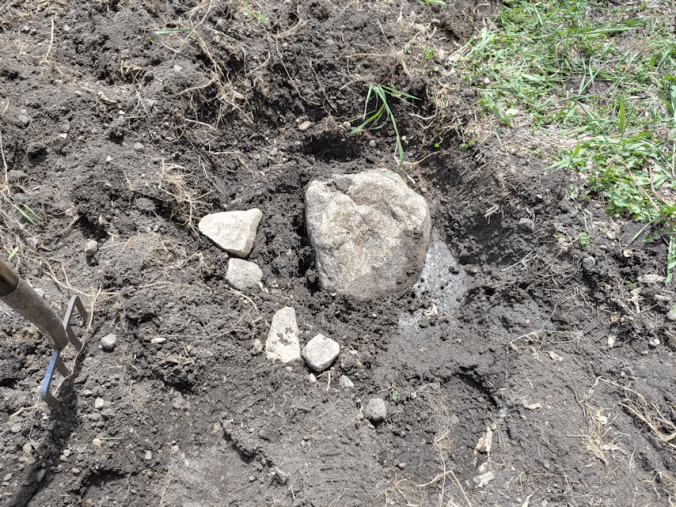
Then I hit something, right near the end. Of course, I was hitting rocks the whole time, but usually I could just move the fork a few inches and keep going. Not this time!
I ended up using a space to dig around the rock. I dug up a few other rocks, but part of it seems to continue below where the soil is still undisturbed.
I used water pressure to clear the stone and try and see how much further it went, but that wasn’t much. My younger daughter decided to give it a try, and ended up bending the fork, trying to move the rock!
So… it will stay. :-D
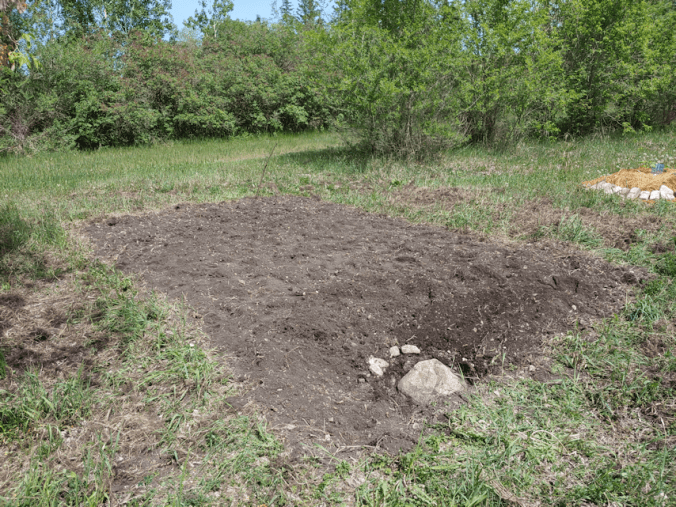
The next step was to take out as many roots, rocks and start leveling things off.
That stick coming out of the ground in the background is a tree root. I have to grab something to cut it with!
For this part, I had a garden claw with a long handle we found in the basement when we were cleaning it out. What a back saver! You can see, all around in the grass, where the roots, crab grass and weeds were tossed. Rocks got tossed under trees, so they wouldn’t be “found” with the lawn mower. Of course, it’s not possible to get all the roots out, but I got most of them.
Finally, I could go over it with the thatching rake, which picked up a few more roots that I missed, as well as some rocks, and leveled it off a bit. I chose not to bury the big rock again, as it was so close to the surface. I’d rather see it and know it’s there, than forget about it and plant something on top by mistake.
One thing about this area; it has the deepest top soil of any part of the old garden, yet! I didn’t reach gravel until I started digging deeper to try and get around the big rock, and while I found other chunks of rock, I just barely reached the gravel layer. This is the soil my mother is talking about, when she talks about how great the soil used to be. Except for the rocks. She didn’t remember the rocks! :-D
The next step was to mark out for planting. I counted the corn plants this morning, and there are 65, plus a couple of bitty ones that probably shouldn’t be transplanted, but I likely will, anyways. I wasn’t sure if I’d have enough space, but with rows 2 feet apart, and the transplants 1 foot apart in each row, I will have enough space.
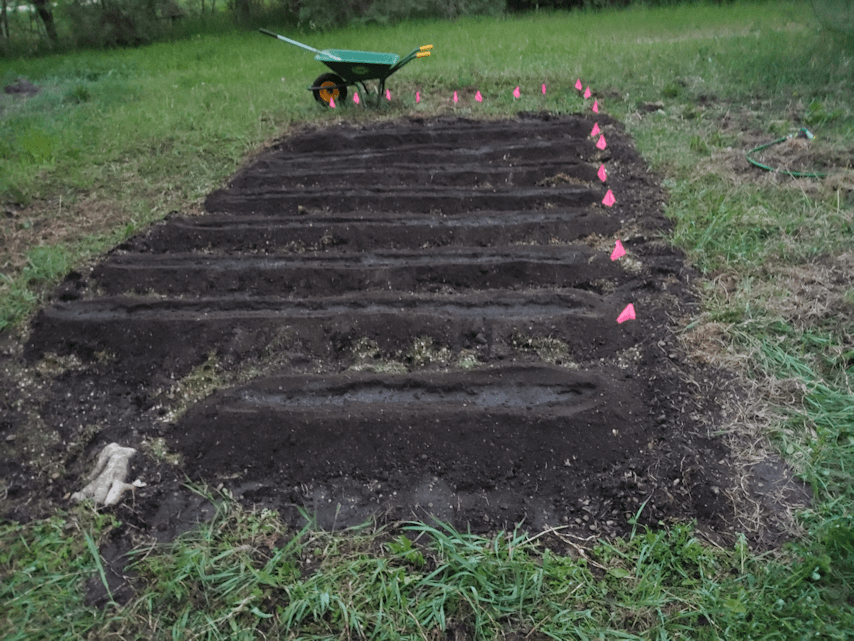
While the soil may appear good, all the soil tests I did showed a lack of nutrients, so it will still be amended. I used the flags to lay down grass clippings. I lay them out in rows, but I don’t mind them spilling over into the paths in between, to help keep the weeds down.
After this photo was taken, I used a watering can and rainwater to wet down the grass clippings, since the hose and sprinkler were needed at the other end of the garden.
Then we headed inside. We reached 30C/86F while we were out there! So we will take a few hours indoors and let things start to cool down before we continue.
We have predictions for rain tonight, and possible severe thunderstorms by tomorrow afternoon. They might even hit us. :-/ If it does look like we will get a severe storm, we have things we can use to cover the squash to protect them, though the corn would be on its own. It is, however, in a more sheltered area of the old garden. We shall see.
We might still hit our goal to get all the transplants done here by this evening! After that, we have transplants for the south yards, but they are not as urgent and can wait a bit longer.
As for me, I’m seriously thinking of joining all the cats on my bed for a short nap. I’m so tired, I have been falling asleep while writing this!
I’m going to be hurting so much by the time all this done, but it’ll be worth it!
So… today didn’t go quite as planned, originally. What else is new? :-D
But first, I want to share this picture.
This bed is the yellow bush beans. The green and purple ones look much the same. Even more beans have been sprouting, and it looks like we’ve got an almost 100% germination rate already! Even in the spaces where there are no beans sprouted yet, I’m seeing bumps and cracks in the soil, showing that something is trying to push it’s way through. Some were so close to the surface, they got uncovered when I watered them!
My original plan had been to finish the new corn block, so the Montana Morado corn could be transplanted, after I got back from helping my mother with her grocery shopping. Instead, I decided the lawn needed to be mowed, first. Not just because we haven’t mowed it yet this year (even with the rains we did get, it wasn’t all that overgrown), but because I wanted the grass clippings. Which meant using the push mower, with its collection bag.
I started off dumping the grass clippings into the wagon, with the intention of hauling the clippings to the garden beds where they will be used as mulch, but I realized the constant stopping and starting and hauling would take too long; particularly since the wagon can only hold 3 bag fulls. Which is more than the wheelbarrows, but still…
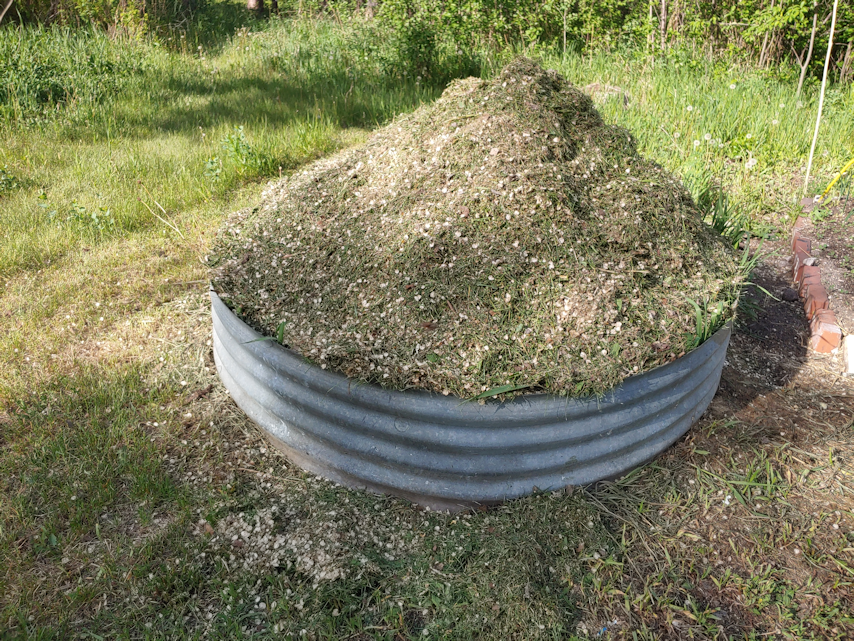
So I started dumping the clippings into the compost ring.
This is the clippings from just the south yards, minus two bag fulls. The compost ring was almost empty when I started.
My only concern with this is all the Chinese Elm seeds in there. Piles of grass clippings get shocking hot, though, so I’m hoping that will kill off at least some of the seeds. :-/
When I started on the East yard, I had to find some place else for the clippings, so they got added to the old compost pile. The one we haven’t been able to use, because when we started to dig into it, we kept finding garbage and branches. I think we got all the garbage out, except for maybe a few stray bits. Then when the East and North yards were done, and I started on the West yard, I had to start a third pile.
I didn’t get all the mowing done; a couple of areas just don’t have enough grass to mow, and I didn’t try to go into the trees at all, yet. I want to mow the areas around the old garden, and the new garden beds, more to keep down the poplars that keep trying to spread, and we need to do the parts of the old garden we haven’t put beds into, as well. That part is the most difficult, because it’s so rough. Last year, even at the highest setting, I still kept catching rocks and clumps of soil. In some areas, it’ll be easier to use the weed trimmer, which we can actually do, now that we have enough extension cords to reach all of it.
After the mowing was done for today, I took the plants back inside before going into the house, and noticed some of the squash are starting to show flower buds! They need to get into the ground right away, so they’ll have the nutrients, space – and pollinators! – they need. The girls and I were going to make a trip into the city tomorrow for some shopping they need to do, but that will be pushed back. Instead, I will be focusing on finishing that corn block and transplanting the Montana Morado corn, while the girls will be focusing on building the squash beds. The summer squash will have beds build where the sunflowers were planted last year, where the ground had been mulched. The winter squash will need to have beds built at the squash tunnel, too. The bottom supports and mesh will have to be done after they are transplanted. They will be planted on the outside, so can work from the inside to avoid the plants, if we have to. If we end up having more transplants than there is space at the squash tunnel, the extras will also be planted where the sunflowers were last year, in the section that runs close to where the squash tunnel is. The only thing we need to make sure of is to leave a gap where we can walk through while dragging the hose to reach the rain barrel.
I figure, by the time we’re done, we’ll be out of grass clippings again. :-D
Just a quick post about what I found during my morning rounds, before I have to head out. It’s a bit of a mix!
Before I go into this morning, though, here is the progress I got last night in the new corn block.
I got about 2/3rds gone turning the sod before stopping for the night. It was past 10pm by then – the temperatures were lovely, but it was starting to get too dark! LOL I am hoping to get it done today. The corn really needs to be transplanted soon.
This is what greeted me this morning, when I came into the dining room.
Cheddar and Keith, enjoying the morning breeze while watching the birds outside. :-D The cats just LOVE this set up.
The door is secured with cord, just in case. Although it is locked, sometimes it simply pops open on its own. Which is not a problem when the inner door is closed, but would be kitty disaster otherwise!
After feeding the outside critters, I started taking the plants out of the sun room. One of our disappointments was that one tray with 3 different gourds in it had not germinated. Still, I kept them watered, and have started to take the tray outside, too. This is what I found this morning.
A single Ozark Nest Egg gourd has sprouted!
It’s way too late in the season, but when the time comes, it’ll be transplanted out and we’ll see how it does. Who knows. We might have a long summer this year.
Also, do you see all those seeds scattered about? They are EVERYWHERE!!! And this is why I’ve developed a hate-on for the Chinese Elm trees. We’re going to be fighting these in just about every single garden bed. :-(
While checking out the furthest garden beds, I had a bit of a disappointment.
Four Mongolian Giant sunflowers in one row had their heads chopped off. The one that had been eaten and pulled up before was in the other row, which originally had 13 transplants in it. This one had 11. So of the 24 we started with, we’re down to 19. At least the direct seeded ones are coming up, so we do have more. As long as they don’t get eaten, too!
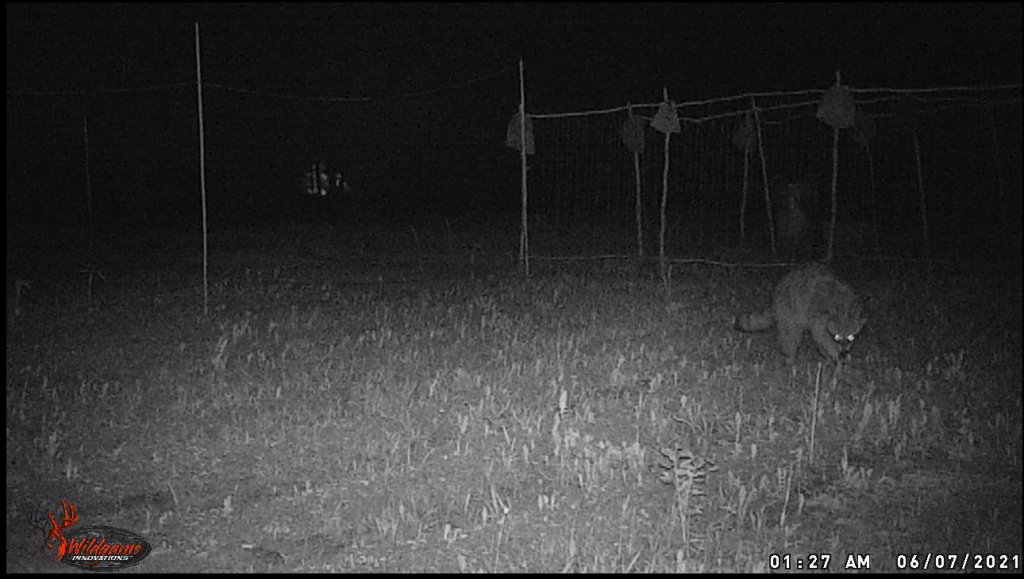
My daughter and I had moved the trail cam over to this corner, but it’s not the wide angle camera, and I wasn’t sure if it caught this area at all. In fact, I was pretty sure it didn’t. So I shifted it and it now faces down the corn and sunflower blocks only.
When I checked the files, I found I was right. This row as off frame. I never saw what ate the leaves, but I did find this!
We had a raccoon pass through! Until now, the only evidence we had of raccoons here was the tip of a tail going past the camera when it was facing the tulips. It just wandered through, sniffing at some weeds.
The raccoon would not have been responsible for the sunflowers, though. I’m sure that was a deer. There was one other night time video, but whatever triggered the motion sensor was no longer in frame by the time it started recording. If a deer had jumped the fence nearby, it could have walked right past the camera and out of frame before it started recording. That’s the down side of setting it to video. It takes more time to start recording than just taking a still shot. I’m not using still because the shortest time delay between triggers is 15 seconds, regardless of whether it’s set to still or video. That’s a long gap, and much would get missed. At least with video, there’s that 15 seconds (or up to 1 minute, if I wanted to) of video to catch what’s going on.
Finding the damaged sunflowers was a disappointment, but I wanted to end this on a more positive note.
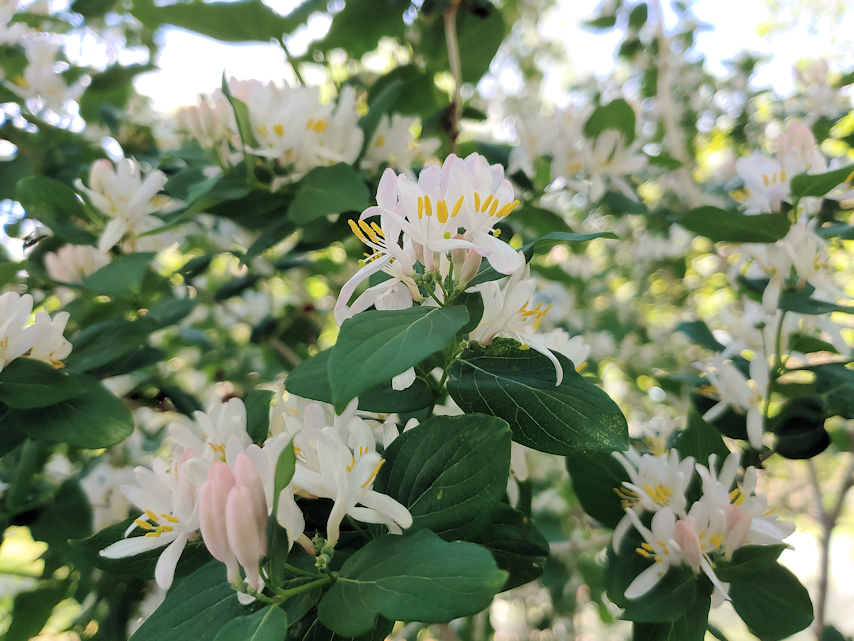
The honeysuckle bush in the old kitchen garden is looking amazing! It’s in full bloom, and absolutely dense in foliage and flowers. When we dug up along the house and laid down blocks and bricks to make a path, much of the soil that was dug up ended up around the bases of the honeysuckle and two rose bushes nearby. Between that and the extra watering they’ve been getting this year, they’re all looking better than ever. I’m very happy with how great they are doing this year! Even the little pink rose bush that got broken by something over the winter (likely a deer) is doing very well, after having the tree branch that was shading it pruned away, and a garden bed built up around it. There was just one stick of it left, but it’s now full of the biggest, healthiest leaves it’s had since we moved here!
So overall, we’ve had more increases than losses, so far! :-)
We managed to get outside for a bit more progress on the garden. One of the things I did was go through where we planted sunflowers last year, and dig out any remaining stumps. I am really impressed with how much softer the soil is. Well. When I managed to not hit any rocks, at least. ;-) I think using this area for the summer squash will work out. We just have to fight back the grass and weeds. :-/
Not yet, though. The new corn block will be the priority for transplanting.
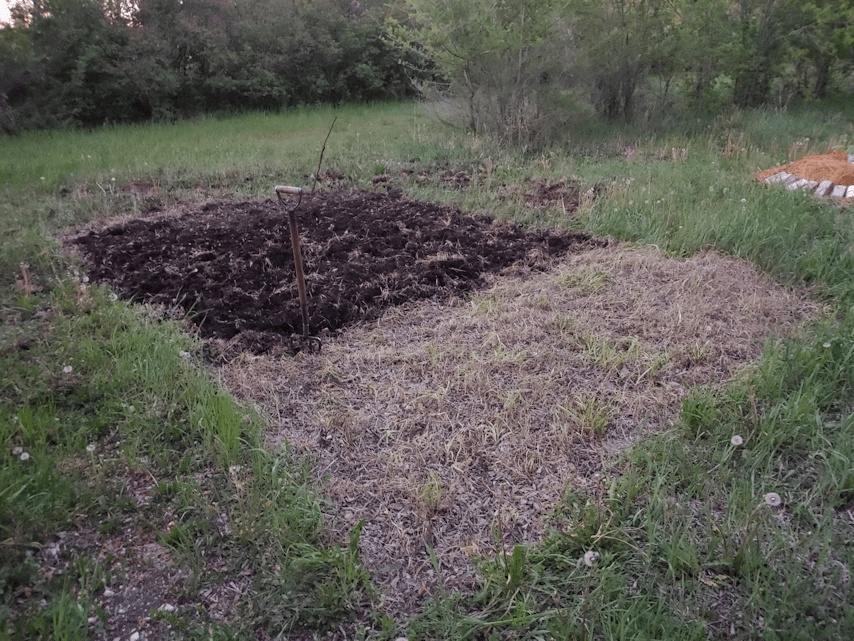
This area has been covered with black tarp for at least 2 months. Almost, but not quite, enough to kill off the grass and weeds.
This area is remarkably rough, though. I had the hardest time mowing on this side, without hitting rocks or lumps of dirt. Partly because of this, I will be going things differently. I will actually be turning the soil here. Nothing extreme. Mostly just loosening it with a garden fork, while pulling out the larger roots and rocks. Once it’s loosened up, I plan to go over it with a thatching rake (we only have 1 thatching rate, and a bunch of fan rakes, so that’s the tool I’ll use! :-D ). That should pull up more roots, but mostly I want to level it off enough that I’m not tripping over dirt clumps every time I walk through!
I had gotten a start on loosening the soil at one end, when one of my daughters was able to join me. Together, we got to work on the squash tunnel.
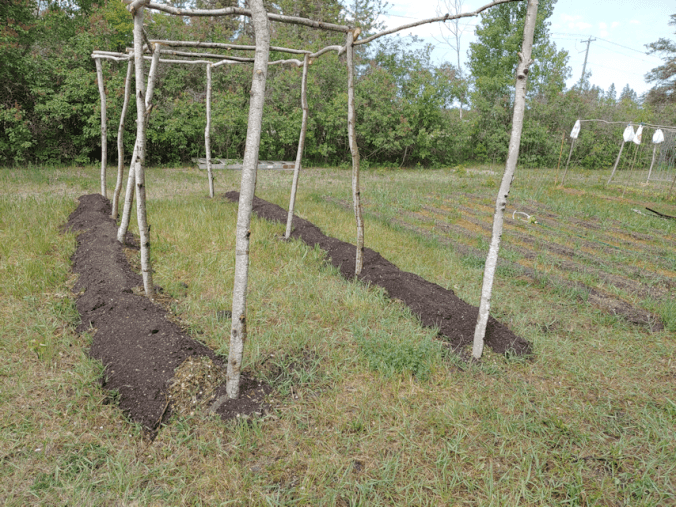
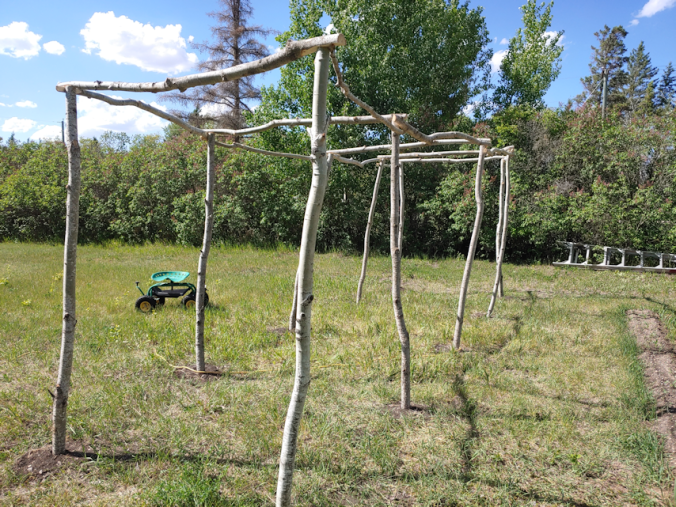
We were able to get all the side cross pieces in place at the tops. A job that was much more difficult than it looks!
I may have mentioned this before, but… we’re a bit on the short side.
Oy, did that make a difference!
My daughter held the cross pieces in place while I climbed the ladder to drill the pilot holes, then put in the screws. It was very awkward and painful for her – especially with her gimpy shoulder! – to try and hold the pieces steady until I had the screws in far enough that she could relax. Some of the uprights had shifted, too, so not only was she holding a cross piece in place, above her head, but sometimes holding an upright in place as well. The fact that everything was different sizes and shapes didn’t help, either. Doing this in 27C/81F heat, and winds high enough to blow over the step ladder, certainly didn’t make things any easier.
Also, we really need a power screwdriver. Driving in 3 inch screws manually, while someone else was struggling to hold the pieces together, was another thing that made the job more difficult than expected!
But we got it done!
It is still incredibly wonky, of course. Good thing it’s not intended to be permanent! We also didn’t use as many screws as I intended. For some joins, it was because the pieces were not of a size or shape to add more than one screw. With others, we just needed to get it in place and move on to the next, due to how painful or awkward it was for my daughter to support the cross pieces.
I now need to cut cross pieces for the bottoms. When I put those in, I will take the time to add extra screws were they are needed at the top. If necessary, I’ll add extra support pieces at the corners, but I think once we add the wire mesh for the vines to climb, that will help stabilize it a bit more, too. I’m actually not sure how we will get the mesh over the top.
Did I mention we’re short? LOL
At least it’ll be easier to put in the bottom cross pieces.
When we did as much as we could, I was ordered by my daughter to head indoors and out of the sun. Apparently, I was looking rather overheated!
So I am taking a bit of a break in the cool of the house. By the time I get outside again, more of the corn block I want to work on will be in shade, so that will help. I’m hoping to be able to get the corn transplants out by the end of tomorrow. We’ll see how it goes. I’ll be helping my mother with her grocery shopping earlier than usual, so that should work out.
























 The Re-Farmer