Babcia’s Bread experiment, part 2; the beginning

Photo heavy post ahead. :-)

Okay, here it is! My very first attempt at slowly recreating my grandmother’s bread, with her use of “old dough” yeast that she kept stored in flour in between baking day. (Part 1: the story)

The first goal is to create the bread dough yeast starter, and for that, I need to make a yeast bread.

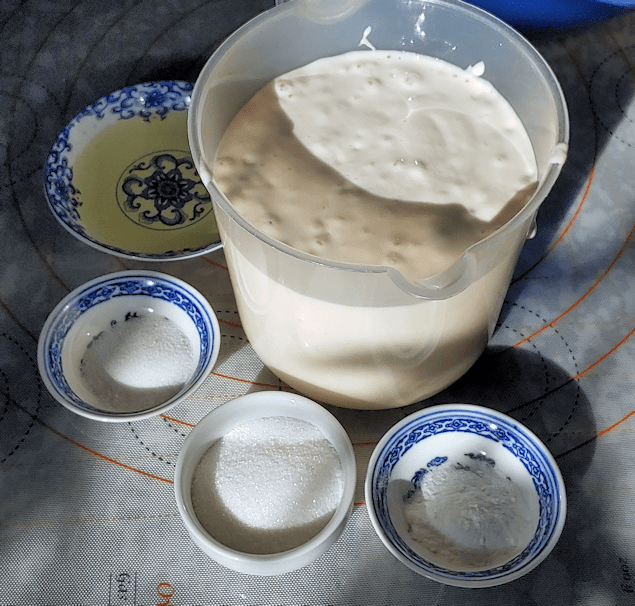
Here are the ingredients.

Water, yeast, salt and flour.

That’s it!

I used Kosher salt, as I figured that was more like what my grandmother had available to her.

For a 2 loaf recipe, I used 2 cups water, 2 tsp salt, about 2 tsp yeast, and between 5 and 6 cups of flour.

The yeast is my “cheat”. Back in the spring, when everyone started panic buying, yeast was among those things that became hard to find. One of our local grocery stores now not only stocks lots of the usual big name brand or two, but a wide variety of brands and types of yeast. When I spotted a “sourdough” yeast, I grabbed a packet, just to try it.

Since some of the dough from this batch will become the “mother” of future batched, I thought it was appropriate to use it.

The ingredients list is interesting. Both wheat and rye is used.

If you’re wondering about the sorbitan monpstearate, this is what I found:

“Sorbitan monostearate (abbreviation SMS), or Span 60, is an emulsifier esterified from sorbitol and stearic acid with the European food additive number E491. This ingredient is mostly used in baking yeast by improving the activity of instant dry yeast when the yeast is rehydrated before use. “

Speaking of rehydrating…

For the 2 cups of water, I boiled it first, because I have doubts about our well water. We really need to get the water tested, but a full test is really expensive, so… boiling it is.
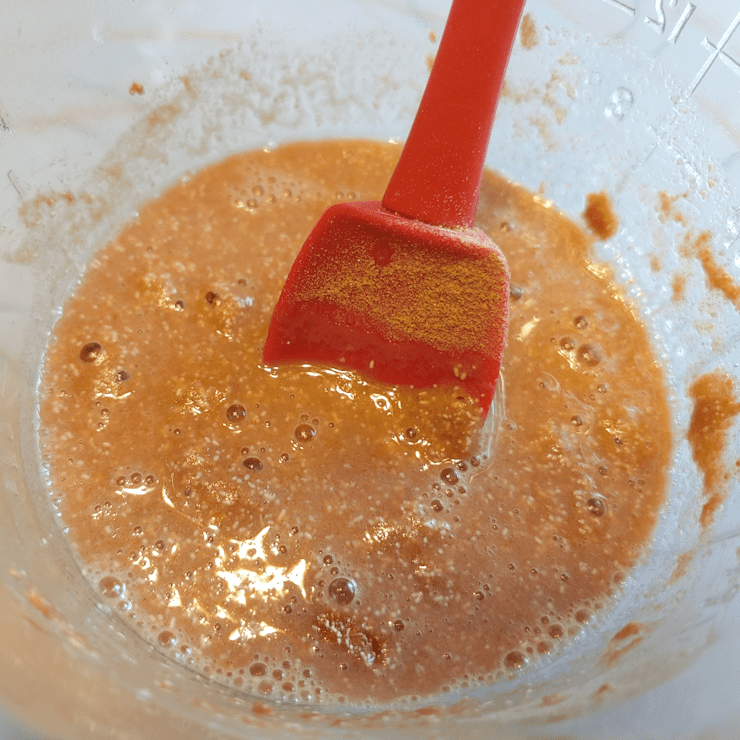
I measured out half a cup of water into another measuring cup to rehydrate the yeast. I could have done it in the full 2 cups, but the half cup cooled down to a safer temperature for the yeast faster.

The inclusion of rye in this really changes the colour!
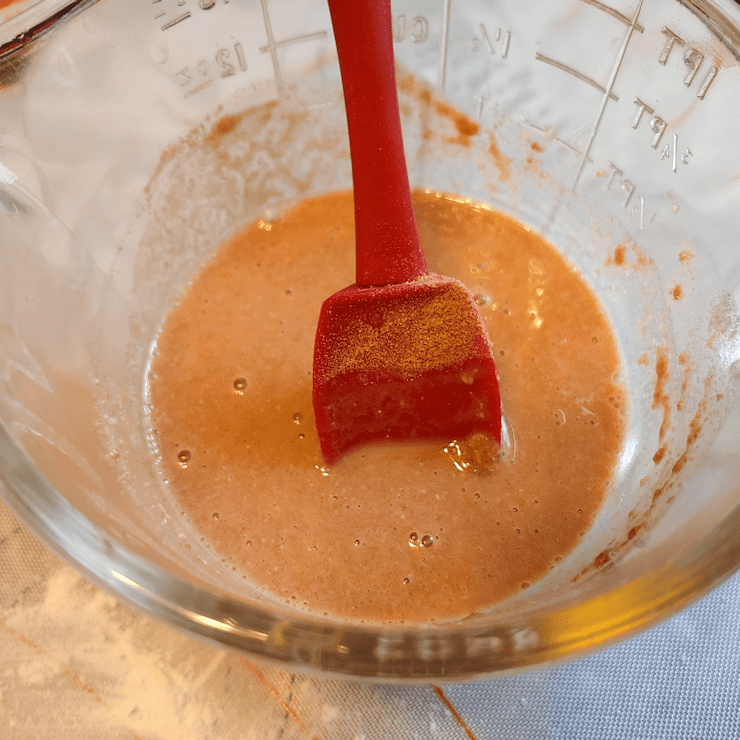
I let it proof for 5 minutes. I don’t know if I should have proofed it longer – I have recipes that call for anything from 5 to 15 minutes. It’s bubbled up, though, so I decided to go ahead.

While it was proofing, I mixed the salt into about 2-3 cups of flour. Without a wood bread bowl, I decided not to use a plastic one, and tried “dump your liquids into a well in the flour” method.

That looks…

Unpleasant.

The next while was spent with very messy, sticky hands, incorporating the rest of the flour and water in.

Thankfully, my daughter came down to give me a hand, adding the flour and water as I kneaded it in.

Once it was all mixed in, I kneaded the dough for about 15 minutes.

I may have used too much flour. I’ll have to keep that in mind for next time.

I did notice a difference in texture from my usual bread. Although I kneaded the dough until it felt smooth and satiny, it never looked smooth.
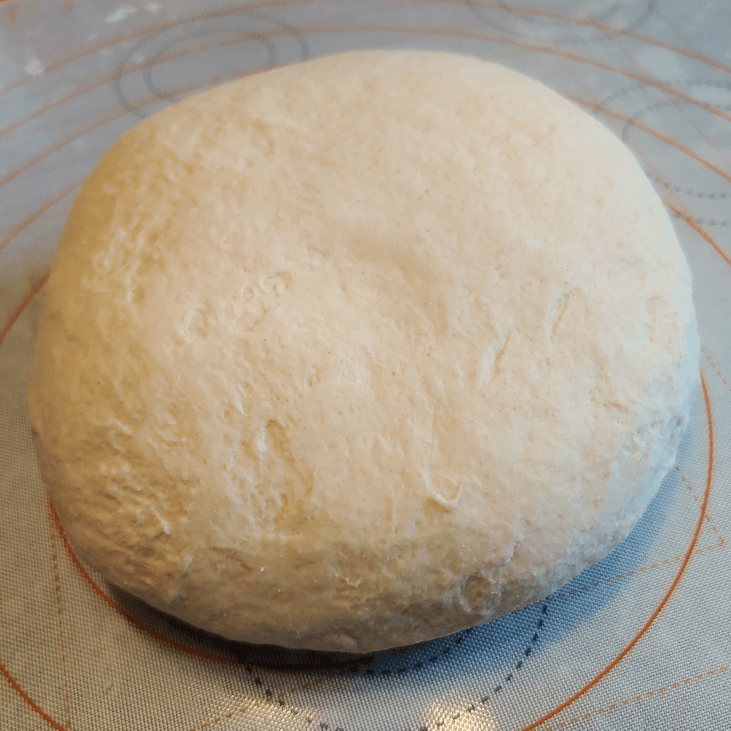
In fact, the longer I kneaded, the rougher it began to appear!

So I went by feel rather than appearances when it came time to set it aside for a first rising.

It went into an oiled plastic bowl, turning to coat all sides with oil. After covering the bowl with a tea towel, it went into a warm oven to rise.

Earlier in the day, I had prepped a baking stone and was curing it with oil in the oven. The oven was off but still warm; prefect for proofing the dough.

Once it was in the oven and rising, I set a timer to check it in an hour while my daughter started a batch of French bread. Checking it at an hour, I decided it needed more time, by my daughter’s bread was rising by the, too. So I took the bowl out and put my daughter’s dough in the warm warm oven, and set my timer for another hour.

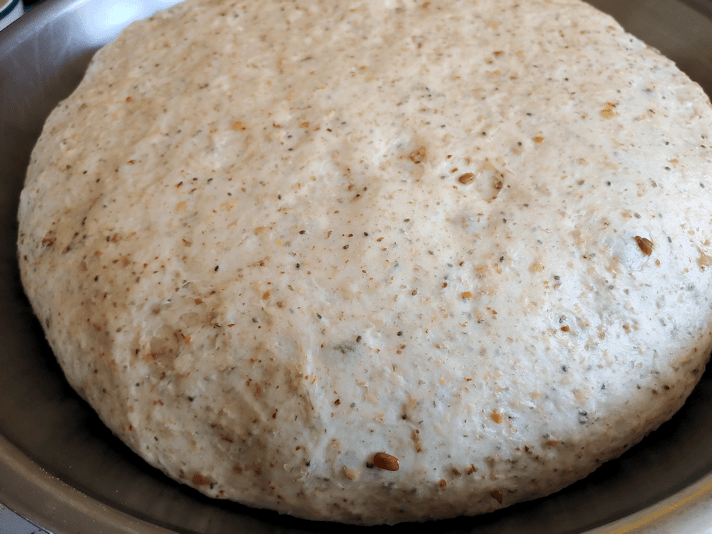
This is the dough, after 2 hours.

After turning the dough out to prepare the loaves, I had to make sure to do that most important part.

Collect a dough egg! :-D

This humble little lump of dough is what it’s all about.

Into our flour canister it went!

I almost forget to get a picture before burying it!
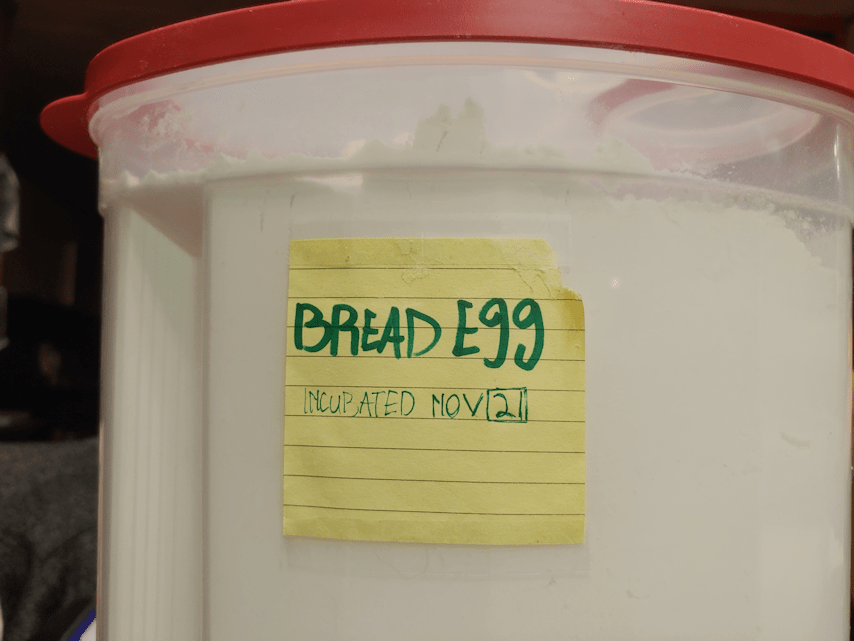
My other daughter labeled the container for me.

She is a hoot! :-D

The ball of dough will now dry out until the next time we bake this bread.

After dividing the dough, I decided to form it into round loaves.

By this time, my daughter’s loaves were in the oven.

Where she forgot to take out my curing baking stone.

So they got to have their second rise on a normal baking pa, instead.

In kneading and shaping the dough, once again, the dough got rougher rather than smoother! You can really tell in the one of the left.

I then left them to rise, checking them after about half an hour.

My daughter’s French bread was done well before my second rising was done!

The ended up needing another hour of rising time.

The baking stone had cooled down quite a bit by then, but was warm enough that I transferred the loaves over, and I think that residual warmth helped them rise even more. The above photo was taken just before they went into a 400F oven.

All done!

I am not sure how long they took to back. I set my timer for half and hour, then kept peaking and resetting the time for another 5 minutes, over and over. I think it took about an hour to bake.

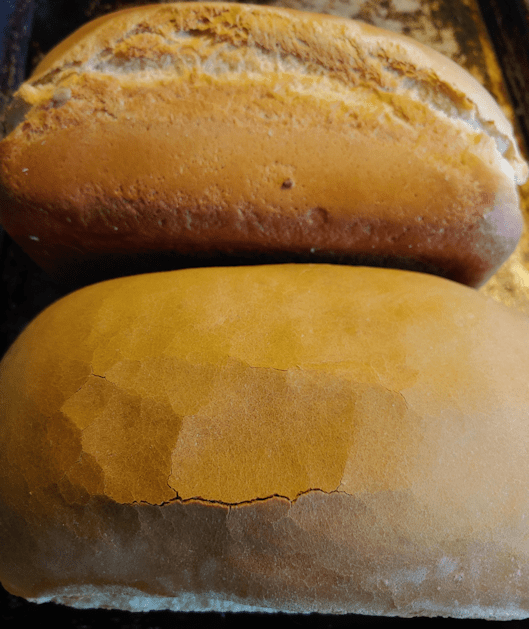
I was quite impressed with how much the loaves rose in the process!

The next part was the hardest.

Waiting for the loaves to cool down!
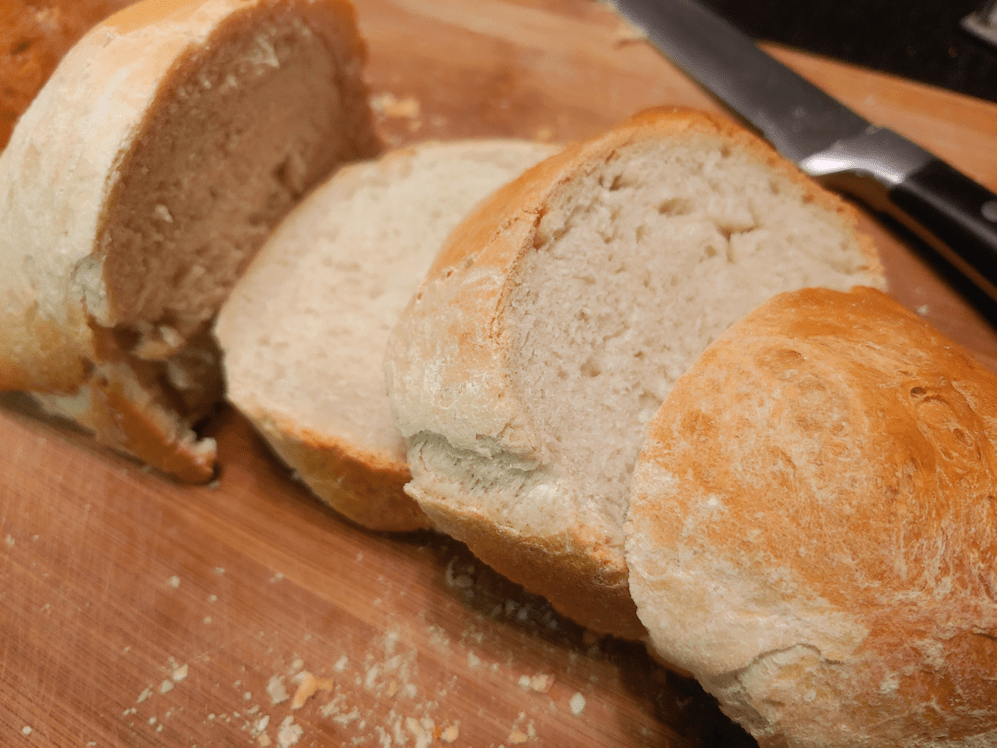
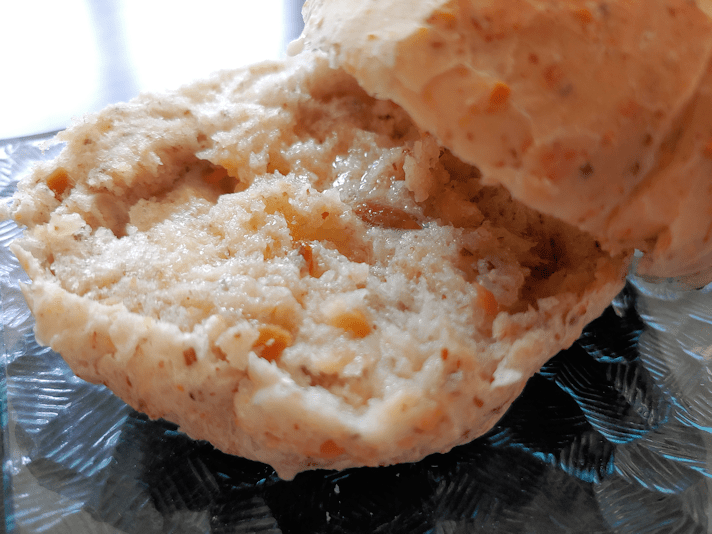
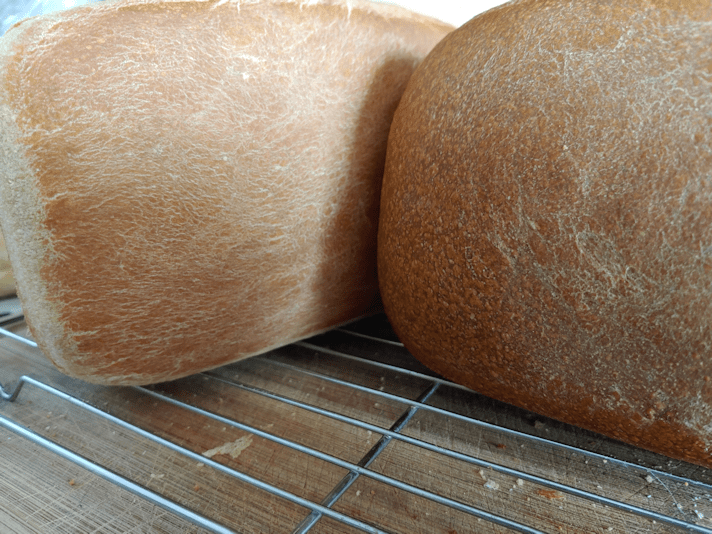
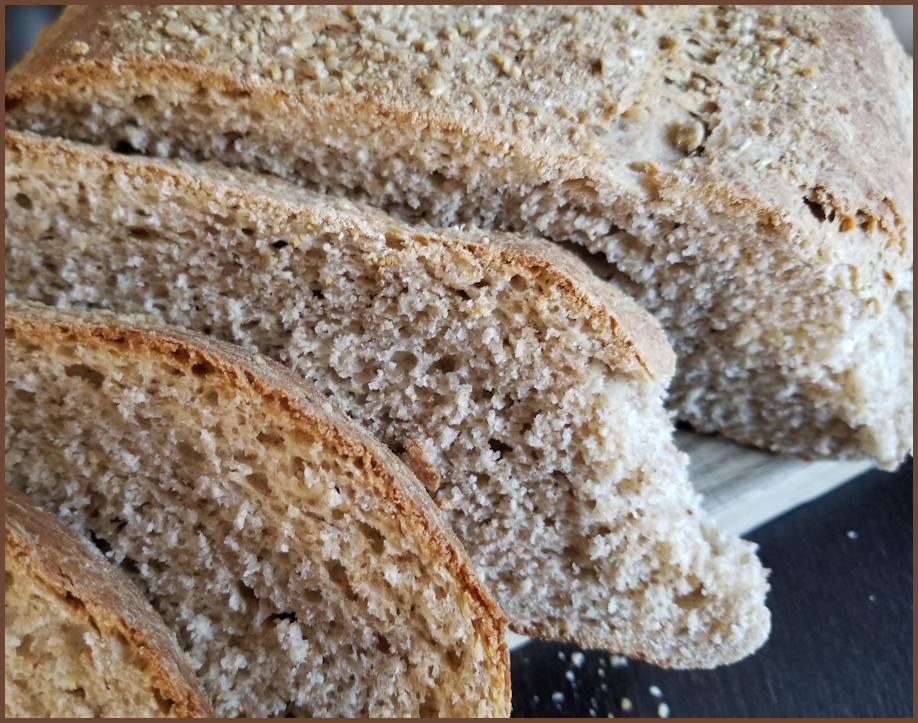
For all that the loaves rose so much in the oven, they still felt surprisingly dense. I was also a bit surprised by how fine a crumb there was.

I taste tested one piece plain, one with ordinary butter, and one with a garlic herb butter.

I’m having a hard time describing the flavour. It was certainly tastey, but I think I was picking up the rye flavour in the “sourdough” yeast. It did have a “sourdough” tang, but one that is quite different from any sourdough we’ve made ourselves.

The sponge was soft, yet toothsome. The crust was crusty enough to be a good chew, but not so crusty as to cut up the mouth (something I have issues with, when it comes to most “crusty” breads).

The plain slice was tasty, but the buttered slices definitely were better. With no fat in the bread itself, the butter really brought out the flavours that were more muted in the unbuttered slice.

All in all, this very plain, very basic bread was a success.

It is, however, just the first step in the process. It’s purpose was to provide us with some dough to reserve for the next batch. Every batch of bread we make using the bread egg now sitting in the flour canister will be another step closer to recreating my Babcia’s bread.

While my grandmother did her bread baking once a week, we will probably make our first batch using the bread egg in 3 or 4 days.

I am really curious to see how it will look when we fish it out of the flour, and how the overnight soak will turn out! For a first time use, I don’t expect the flavour will be much different, but who knows? I’ve never done this before! :-D

The Re-Farmer

Babcia’s Bread Experiment, part 1: the story

I may have mentioned in past posts, about my mother’s memories of bread baking in pre-WWII Poland. I was fascinated by what she could tell me. With no commercial yeast available, I had thought my Babcia (grandmother) had used a sort of sourdough. I know my father remembers this; a portion of the bread dough would be set aside to continue to ferment, and be used in the next batch of bread.

My grandmother did something different. She allowed her old dough to dry.

We lost our own sourdough starter, the Sourceror this past summer. It almost made it to 2 years, but we had a real problem with fruit flies this year. Somehow, they managed to get into the container and contaminated it.

Having a big bubbling bowl on the counter has been a bit of a problem for other reasons, so the more I heard about how my Babcia saved her dough, the more I wanted to try it.

My mother’s memories go back to the late 1930’s, early 1940’s. Then WWII happened and they eventually ended up in Canada, where commercial yeast was available. After questioning her about it, this is what I’ve been able to piece together.

Babcia would bake bread once a week. She would set aside some of the dough, adding in the scrapings from the wooden dough bowl, form it into a ball, then burying the ball in the flour. The night before she would be baking bread again, she would take out the dried ball of dough, break it up into pieces, and soak it in water overnight. In would get all bubbly, and that would be her yeast for her bread baking, with the cycle continuing each time.

My basic bread recipe includes things like oil, sugar, eggs, milk… all things that I just couldn’t see handling sitting in a bag of flour for a week without going off. On questioning my mother, I learned Babcia used none of these things. It simply wasn’t available. Her bread was flour, water, a bit of salt, and the reconstituted old dough. That’s it.

The flour would have been flour they milled themselves (at least they did until the Nazi’s caught them using an illicit hand mill and destroyed it), using grain they grew themselves. My mother says corn flour was also sometimes used, which they also would have grown themselves. The ingredients may have been few, but my mother remembers it as being the best bread; especially when corn flour was added. She remembers it was light and fluffy, too.

My mother was too young at the time to remember a lot of details, though, so I did some research. I know that bread can be as basic as flour and water, but if salt is used, would that be a problem? I know that sugar feeds yeast, while salt retards it. How would having salt in the dough affect the old dough yeast cake? Also, how much dough was set aside? My mother remembers a “ball”, but as young as she was, her sense of how large that was would be distorted.

In my research, I found quite a bit about “old dough” bread baking. This gave me a lot of the information I was looking for. For some types of old dough baking, dough is set aside before the salt was added, while others were taken out after. Both work. As for how much was taken out, I eventually found a general “about the size of an egg” description.

What I didn’t find was anyone who used old dough that was stored in flour. Nor did I find any that stored the dough for weekly baking. Most described setting the old dough aside in the fridge for 2 or 3 days, at most. In some forums I found, people described using it in their daily baking. Not a single person described using their old dough the way my mother remembers her mother did it. They all used wet dough. None used reconstituted dry dough.

I have decided, instead of getting a sourdough going again (for now), I will try and recreate my Babcia’s bread.

Of course, some things I will simply not be able to recreate; at least not now. We’ll be using plain old AP flour. I won’t be adding corn flour right away. I don’t have a big wooden dough bowl like my Babcia would have had (with a wooden dough bowl, yeast would have gotten into the wood itself, adding its own layer of flavours). I also don’t have a wood burning masonry stove (something similar to this, with a sleeping area on top) like my grandmother would have been baking in.

I found some proportions for ingredients for 2 loaves that I will start with, and I will probably experiment with making some a couple of times a week before I start adjusting quantities for larger batches.

One of the main differences in this experimental process is that I don’t have a yeast “mother.” My mother has no memory of where her mother got hers from. It was always just there. She may well have gotten her first old dough from the family members she was living with (my great grandparents having already gone to Canada to start a homestead, only to not be able to send for their children as they had planned, because of WWI). However, as they saw the warning signs leading to WWII, they abandoned their farm in Eastern Poland, taking nothing but the clothes on their backs and a goat they could milk for food, to settle in Western Poland. At that point, my grandmother likely got another old dough ball from one of their new neighbours.

It’s amazing how much history is intertwined in something so ordinary as how my grandmother leavened her bread!

So this is what I will be doing in my experiment that will possibly span years.

Today, I have started a first batch of plain bread; it’s rising as I write this, and I will post about it separately when it’s done.

I will be using a commercial “sourdough” yeast I happened to find, in this first batch.

After the dough is risen and before I shape it into loaves, I will break off some of the dough and store it in a container of flour, then bake the rest of the dough as usual.

In a few days, I’ll reconstitute what should be a mostly dried ball of dough overnight, make another 2 loaf batch, then continue repeating the process.

What should happen: the flavour of the bread should change and develop over time, just as with a sourdough.

What might happen: I’ll have sucky bread that doesn’t rise properly? The dough ball will start molding? The yeast will die off and I’ll have to start over? I have no idea.

For the first few months, at least, I will stick to the same basic mix of flour, water, salt and the old dough for yeast. Eventually, I will try adding corn flour. If I do decide to modify the recipe in other ways, it will be by doing things like kneading in herbs or shredded cheese or whatever, after the dough ball has been removed. I won’t be adding things to the base recipe, like sugar, milk, oil or eggs.

After I’ve done a few batches, and assuming this works, I plan to give some to my mother to taste. Hopefully, she will remember enough to be able to tell me if I’ve succeeded or not! :-D

The Re-Farmer
Let’s talk about yeast

First, you may have noticed a change in the menu at the top. I now have a separate tab for sourdough. If you’re looking for information on making a sourdough starter, or trying some of the recipes we’ve been using, that’s where you’ll find quick links to all the relevant posts.

There’s a reason I’ve done this. :-D

We have long been the sort of family to keep a pantry stocked of basics and do a lot of “from scratch” cooking. Part of it was because that’s what we wanted to do, but there was many a time when finances left us with little choice.

Since we’ve been living on my husband’s long term disability income, which comes in once a month, we’ve also been in the practice of stocking up once a month, long before we found ourselves living out in the boonies.

Which means that many of the things people are being called to do, with the Wuhan virus lockdowns, are things we were already doing. Now, however, there are more people doing it, which means we’re suddenly having a harder time finding things that have never been an issue before.

Like yeast.

Now, to be honest, I did have troubles finding the type of yeast I wanted. It was far easier to find super quick acting or bread machine yeast, than the slower acting yeasts I preferred. But that’s just me being picky. :-D Right now, there just isn’t any type of yeast to be found, even as supplies of flour and sugar have been restocked in many places; at least in the cities.

I have given up Facebook for Lent, which is probably an extra blessing this year, as I’m missing out on all the social media crazy that I’m sure is going around right now. I still use their messenger, as I can use it on my phone without logging into Facebook, so I sometimes get people sending me information that way, but beyond that, I’m pretty much out of the social media loop.

With so many people suddenly stuck at home and having to learn how to cook and bake, plenty have turned to social media to discuss and share. Since I’ve mentioned to a few friends and family members about my inability to find yeast, I had someone message me with something they found.

It was instructions on how to “make your own yeast.”

Now, right off the bat, I knew things were off. That’s not how yeast works. You don’t “make” yeast. Yeast is a living thing, and wild yeast floats in the air around us all the time. Now, it could have meant instructions on how to make something like commercial yeast, but that’s not what was in the photo.

What it really was, was instructions on how to make a sourdough starter.

Which was great. As a recipe, it could have made a very nice sourdough.

The reason I say “could” instead of “would” is because how it turns out depends on the wild yeast that finds a home in the mixture and starts colonizing it. It’s entirely possible for a nasty strain to take hold, and instead of getting a nice, bubbly mixture that smells wonderful, you get something that’s black or red or otherwise nasty, and it needs to be thrown out. That’s why even some sourdough starter recipes include adding a bit of commercial yeast. This is to ensure that a strain of yeast that is known to be safe is established.

There are lots of reasons people so readily adopted commercial yeast.

Even if it was colonized by a lovely strain of yeast, sourdough starter is not something you can substitute 2:1 with commercial yeast. It doesn’t work that way. Starter is a living thing that needs to be tended and fed and stored properly if it’s not going to be used very often. It also behaves differently than commercial yeast, typically taking much longer to rise (unless your recipe calls for something like baking soda which triggers a chemical reaction… do feel free to visit the sourdough tab to learn more). That slow rise is one of the attractions of sourdough baking, as it allows all sorts of lovely flavours to develop.

Oh, and the Pinterest worthy photo of a mason jar full to the top with lovely, bubbly sourdough starter?

Don’t do it. It may not be as aesthetically pleasing, but this is what it should look like.

20180119.sir.sour.alot

A starter needs lots of room to bubble and expand. Put it in a little mason jar, and you’re going to have a mess to clean up before long! Also, if you’re going to be doing any serious level of baking with sourdough, you’re going to need more than a tiny jar will give you. We keep ours in a giant plastic bowl (no metal!). Some of our recipes call for 4 cups of starter, so we keep a fairly large amount of starter bubbling away.

Having yeast is really handy. That’s why, even though we have a sourdough starter we’ve managed to keep alive for a year and a half now, I still like to have commercial yeast.

I recently spoke to my mother about not being able to find yeast. She told me how, in her younger years, no one used yeast. She’s shared memories of her childhood before, so I already knew that part. When bread baking, her mother would set aside a piece of the dough for the next baking day. I knew that part, too, as it was a common technique at the time, and my dad has also shared memories of his family doing the same. Her mother would bury the set aside piece of dough into the flour.

Wait… I didn’t know that part!

In fact, this was a method I’d never heard of before. My grandmother would bury the piece of dough in the flour. A dry crust would form on the outside, and it would need to be soaked before it could be used in the next batch of bread.

I think I might have to try that!

So what’s my point about all this?

Well, for those who are new to baking and wondering what to do about not having commercial yeast, you’ll be fine. You can make a sourdough starter. Just know that this is something that takes time to get established. Or you can make flatbread, with no leavening at all. There are options. The trick will be to sift through the misinformation that’s out there. It’s not as hard as some make it out to be, but it’s not as “easy” as others make it out to be, either.

I supposed it comes down to, if it sounds too good to be true, it probably isn’t!

Even if we’re talking about yeast.

The Re-Farmer

No-Knead Focaccia

My daughters were sweethearts and baked the new recipe they found. It’s the Shockingly Easy No-Knead Focaccia from Bon Apetit.

We did make one change in the recipe. We didn’t have any extra virgin olive oil. We did, however, have avocado oil, so we used that, instead.

It worked very well!

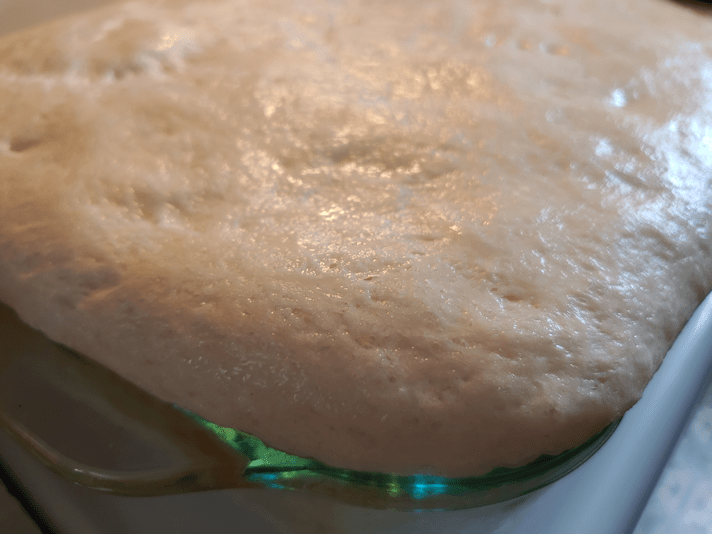
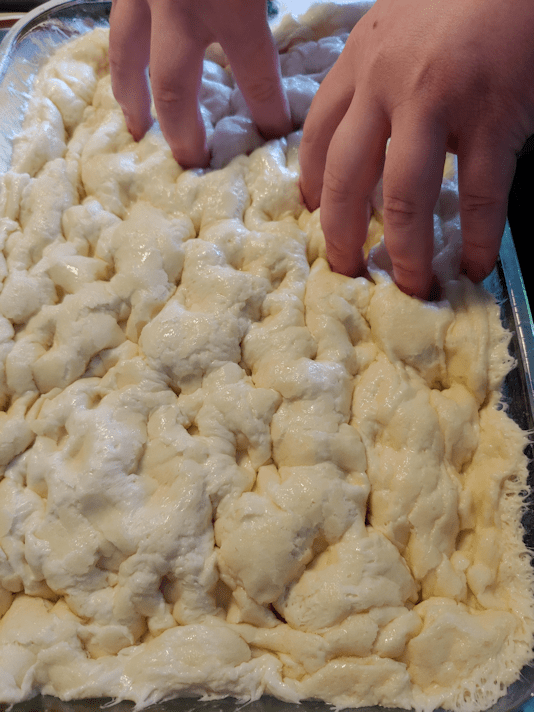
We also didn’t have the type of pan they recommended. We have 9×13 pans. Just not with high sides. So we used a slightly smaller glass pan. The dough has a second rising in the pan, and was very close to overflowing before it was vigorously poked at to deflate it.

For a recipe with no oil in the dough, it uses quite a lot of oil! And butter. The baking pan is buttered, first, then oil added, then the dough put in.

Just before putting it in the oven, more oil is drizzled over the top, and sprinkled with Kosher salt. After it’s baked, butter is melted with garlic, which is drizzled on top.

The end result is both beautiful and delicious. That salty, buttery, garlicky topping is sublime! The texture is moist and chewy, and there were some pretty large bubbles in there! Even the bottom crust has a very nice texture, thanks to the butter and oil combination.

I rather like avocado oil better than olive oil in a lot of things, but it’s frightfully expensive stuff. Costco has it at much better prices, at least.

This recipe is definitely worth trying out! It has rising instructions for both an overnight dough and a same day bread.

Now excuse me, while I go back to enjoying this Focaccia!!

The Re-Farmer
More baking, and my daughter works in a tent now

I went into town today, driving my daughter to work. We got there at our usual 10-15 minutes early, but there were already several cars in the parking lot, and people standing by the doors. I’ve seen this before, but not with so many people. Weird.

Since I was in town anyhow, I made a quick run through the grocery store. My husband was running out of brown rice (he’s the only one who eats it) and the girls were running low on lactose free milk. There was plenty of milk, but almost no rice of any kind at all. Oddly, there were no potatoes, squash or onions. Entire sections of fresh produce were empty. I find myself thinking there are other reasons for the stuff to be gone, besides more panic buying. There was no shortage of bread or meat on the shelves, but they haven’t restocked in things like flour, sugar or yeast yet.

Still no toilet paper, either.

Thankfully, we are not in any need of these items.

Once at home, I did a couple of different breads. One was a sourdough soda bread from Alaska Sourdough, the cookbook that got me into sourdough many years ago, though I acquired my own copy much more recently.

This recipe uses 4 cups of sourdough starter, along with oil, sugar, salt and baking soda. I tried to get a video of the chemical reaction when the baking soda (mixed into a “jigger glass” of warm water) is added, but it just couldn’t capture how the mixture just… foams. It’s really quite fun to watch!

The recipes in this cookbook are hand written, and in this one, the instructions forget to mention when to add the salt! I just add it with everything else, before the soda and flour are added.

The recipe also said to use 8 – 10 cups of flour.

Eight to 10??? What’s with all these recipes that use huge amounts of flour? I barely got 3 in. I’d wonder if my sourdough starter is too thick or something, but it’s the same with non-sourdough bread recipes, too. I know we’re really dry here, this time of year, but it shouldn’t make that much of a difference!

This recipe requires just one rising, so it got shaped into loaves right away and I left them in a warm oven to rise while I made another double batch of my seedy bread. I ended up making it into a bunch of mini-loaves this time, just for fun. By the time that bread had its two risings, and finished baking, the sourdough bread was ready to go into the oven.

They came out so pretty!

While I was working on that, my other daughter came down for a break and let me know her sister is now working in a tent.

A tent?

The cash desk now has a plastic curtain around it, to protect the cashiers from plague customers who won’t keep their distance. It hangs from the ceiling, and is Tuck Taped to the counter, with windows cut into it to reach products for scanning. The pharmacy counter has its own plastic wall, with a slit for the pharmacists to go in and out at one end, and a slit at the pick up counter. Customers, apparently, are still trying to stick their faces right up to the openings.

People suck, sometimes.

After I picked my daughter up at work, she needed to go to the grocery store, so we swung by on the way home. Some of the empty produce displays were no longer empty – there were onions again, though not many. Still no potatoes or squash. So very odd!

As we were going through the till, I couldn’t help but comment to the cashier about how nice it must be, to be able to clean the belt more often. She confirmed that, yes, it is! She was quite enjoying the cleanliness. Customers still try to shove things onto the belt, but at least now the cashiers are allowed to tell them to stop, so the belt can be cleaned. I remember only too well how difficult it was to keep things clean in between costumers, when I worked as a grocery store cashier!

They’re also back to single use plastic bags. This franchise had only recently made such a big deal about no longer having plastic bags and encouraging people to bring, or buy, reusable bags. Now, if people bring their own bags, they have to pack them themselves. It’s long been known that reusable bags are very unsanitary, but it took the Wuhan flu for that to finally be taken seriously. :-(

Well, we’ll be able to go back to staying home for the next few days. No plague people hiding among the deer that visit us. There is plenty to keep us busy! The only thing I’ll need to remember to go out for is to get the mail, since I’m expecting my seed order to come in soon. I look forward to starting some of them indoors.

Oh, I also broke down and ordered a bottle cutter. This is not something we can find locally. I chose a type that can cut square bottles, as well as round. I look forward to using it to help make bottle bricks! Since I already know we plan to make the walls on our cordwood practice building 8 inches think, we can get a head start on making these.

Also, my daughter found a really nice recipe for no-knead Focaccia that I think we’ll be trying out tomorrow.

Should be fun!

The Re-Farmer
Brownies, with recipe

Along with the sourdough batter bread my daughters made today, they also made brownies!

I wasn’t there to take pictures as they made it, but here is their recipe.

I didn’t realize until I uploaded the picture that there’s flour covering some of it. That reads “1 1/4” for the white sugar. :-)

For the chocolate chips, this time they used mini Reese’s Pieces.

These are such decadent brownies!

I think I’m going to go have a piece…

The Re-Farmer

Sourdough “Batter” Bread, with recipe

Today my daughters did the baking, starting with a sourdough “batter” bread.

There’s a reason the word batter is in quotations…

The girls have been finding recipes they like and, after trying them out, adding them to a notebook with any modifications or adjustments they’ve come up with.

Like this…

Continue reading

Bread Baking Day – all done!

Sometimes, I think we really need to do bread baking more often.

Then I remember how much clean up is involved. :-D

No matter! We now have two kinds of freshly baked bread done.

Here’s how the seedy bread turned out.

This is how it looked after only 1 hour of rising time. The bowl it’s in is pretty huge – too big to fit in our kitchen sink (which makes washing it a bit of a challenge! :-D ) – with plenty of room for this 4 loaf recipe.

The timing of things works out really well. I use half the dough to make buns first, leaving them to rise while I shape a couple of loaves. Once those are done, I star to preheat the oven. By the time it’s heated up, the buns have risen enough to go straight in. Once they’re out, the loaves have had enough time for their second rising. When those are done, the overnight sourdough loaves are ready to go into the oven. No wasted time in between, making for more efficient use of a hot oven.

They came out quite beautifully, too! Such a tasty bread, with a really nice texture. I love the bit of crunch the seeds add to it.

The second rising for the sourdough loaves was probably about 4 – 4 1/2 hours. The first rising was probably about 11 or 12 hours.

This is how they looked, just before I put them in the oven. They definitely rose more than the first time I tried this recipe, so the modifications made quite a difference, but still not rising as high as variations that use added yeast.

Is it worth it?

I think so.

The actual working time to make this bread is low. It’s mixed at night, then kneaded for 10 minutes the next day. It really doesn’t need a lot of attention.

The loaves came out so smooth and gorgeous. None of the cracking you can get when using an added yeast bread, since there’s no sudden rise in height in the oven.

The bread itself has a slightly thicker, sturdier crust, while the crumb is incredibly soft, tender and fine in texture.

Reducing the amount of sugar was definitely a good move. The sourdough flavour was more dominant this time, whereas the last time I tried this recipe, the sweetness was more dominant. I think adding that little bit of baking soda helped with the rising, too.

I’d still prefer a more “sour” sourdough flavour, but that has more to do with our starter than with the recipe. We’ll be making more of this one, that’s for sure. I think I’m satisfied with it enough that, next time I bake it, I’ll post with the tweaked recipe.

Tomorrow is going to be another baking day, though this time for my daughters. I look forward to seeing what they’re planning to make. :-)

The Re-Farmer
Bread Baking Day

Yesterday was actually intended to be my bread baking day, but we just didn’t have the energy for it. It was a pretty bad fatigue and pain day for all of us. :-(

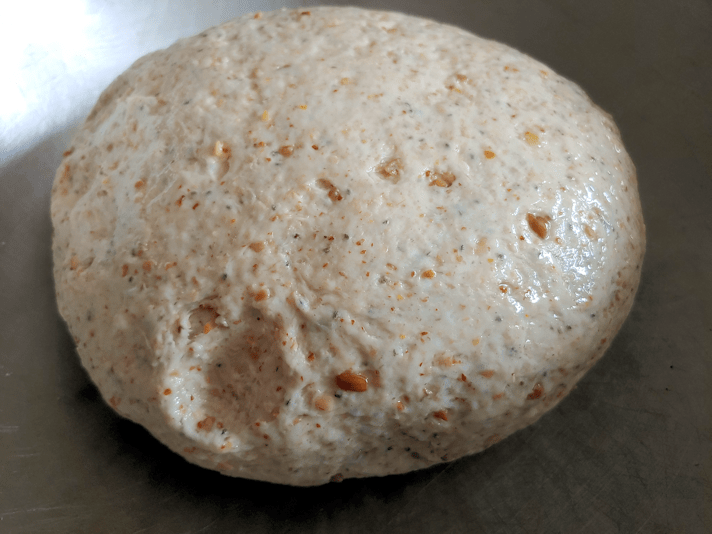
I did start a batch of overnight sourdough before bed, though. The last time we tried this recipe, it didn’t really rise at all by morning, so I tweaked the ingredients this time. I reduced the sugar to something adequate to feed the sourdough yeast, and not make the bread itself a sweeter bread. I also added just a touch of baking soda along with the flour. Last time, I left the dough to rise in a bowl on our dining room table, but the house it just too cold, so this time it went into a warm oven with the light left on to keep it warmer throughout the night.

I checked the dough before I headed out to do my rounds, and was quite pleased by what I saw.

It rose quite nicely! I’m very pleased.

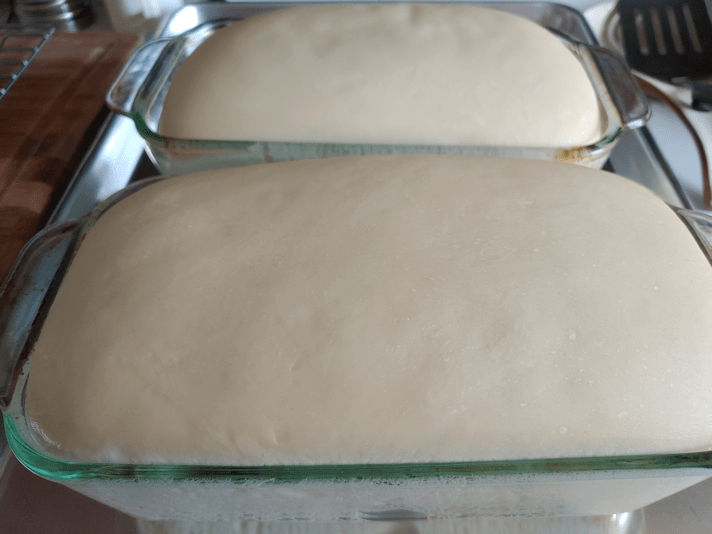
After finishing my rounds, I kneaded the dough for 10 minutes, then set it up in loaf pans for a second rising.

With no yeast other than the sourdough in the recipe, it will still take a long time to rise. So I waited an hour before starting some non-sourdough bread.

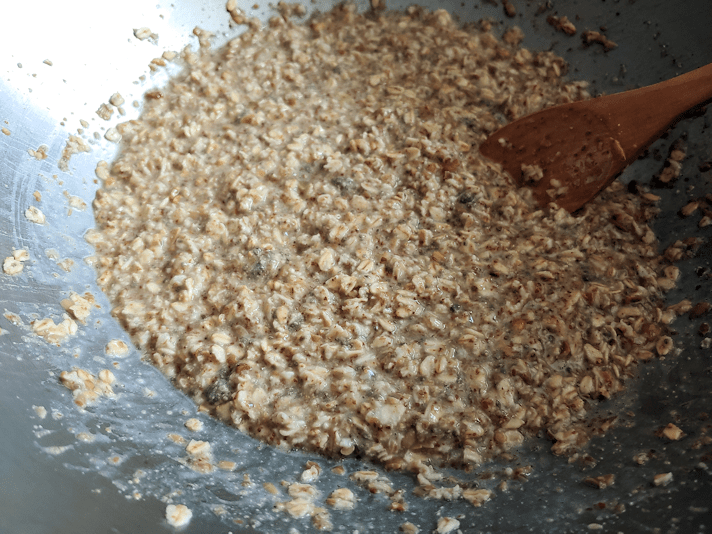
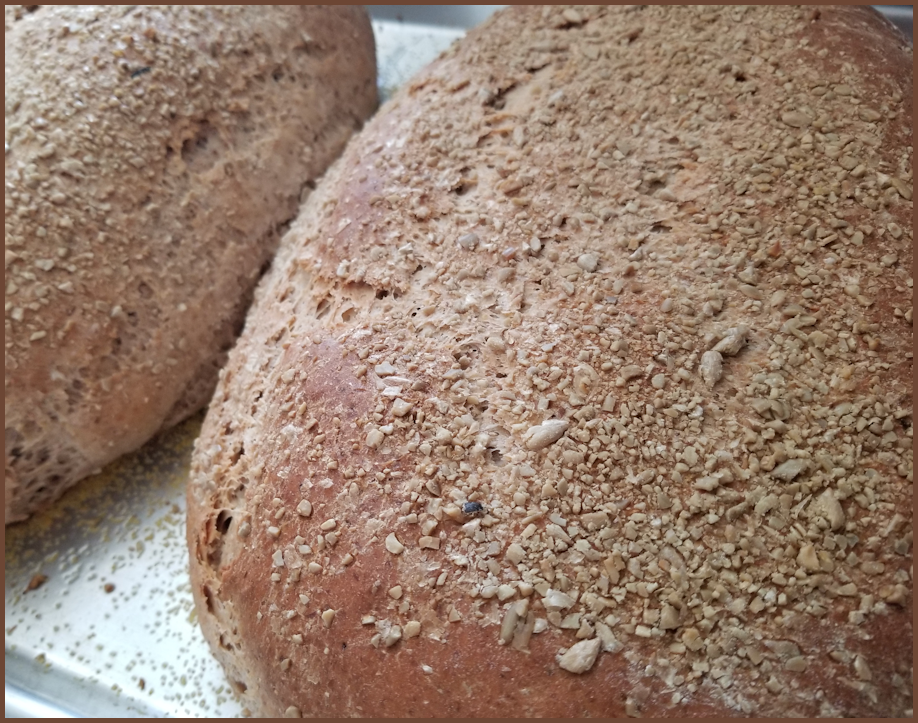
My favourite additives to my basic bread recipe is thick cut oats, chia seeds, ground flax, sunflower seeds and pumpkin seeds. The sunflower and pumpkin seeds are roasted and salted, and this time I took more time to grind them in a mortar and pestle to break them up. The whole seeds and bigger pieces tend to fall out while the dough it being kneaded. I let it all soften in boiling water first, which makes a much nicer texture in the bread. I doubled the basic 2 loaf recipe again, too.

By the time I got this batch set aside to rise, it was about an hour and a half since setting the sourdough loaves to rise. A quick check showed very little change, so I expect to have the second batch baked before the sourdough is ready to put in the oven! :-D

Oh, and my timer has just gone off. Time to get back to it! :-)

The Re-Farmer
Overnight Sourdough Rye Bread

overnight.sourdough.rye.fresh.baked

Fresh out of the oven!

This is a bread that needs a LOT of time!  The finished result, with its tangy sourdough flavour, is well worth it.

Begin by preparing the starter the evening before.  We used our rye starter, The Rye of SourOn, but a regular starter can be used as well.

Overnight Sourdough Rye Bread

Overnight starter:
1 cup sourdough starter
2 cups warm water
2 1/2 cups rye flour

  1. Mix the ingredients in a large bowl.  Cover and let stand overnight in a warm place, such as the oven with the light on.overnight.sourdough.rye.sliced

Ingredients:

Overnight starter
1 cup milk
3 Tbsp butter
3 Tbsp sugar
2 tsp salt
1 Tbsp active dry yeast
1/4 cup warm water
3 cups rye flour, or 2 1/2 cups rye flour, 1/2 cup flax meal
3 – 5 cups all purpose flour
1/8 cup crushed sunflower seeds, to coat top of loaves (optional)
(place roasted, salted sunflower seeds into a slide lock freezer bag and crush with a rolling pin)

The night before: prepare overnight starter

The next morning:

  1. Pour the milk into a saucepan and scald.  Add the butter to melt, then stir in salt and sugar. Set aside to cool for about 10 minutes.
  2. Sprinkle yeast over warm water and let stand for about 5 minutes.
  3. Stir yeast and cooled milk mixture into the overnight starter.  Stir well.
  4. Mix in optional flax meal and rye flour.  Beat thoroughly until batter is smooth.
  5. Cover lightly and set in a warm, draft free place to rise until almost doubled in size; about 30-40 minutes.

    overnight.sourdough.rye.risen.loaves

    Shaped loaves after rising.

  6. Stir down dough.  Add all purpose flour, a little at a time, until a medium stiff dough begins to form.  Turn onto a floured surface and knead in more flour, as needed.  Continue kneading for another 8-10 minutes, or until soft and elastic.
  7. Divide dough in half, cover lightly and let rest for 10 minutes.
  8. Prepare baking sheet or loaf pans.
  9. Shape the dough into loaves.  Place crushed sunflower seeds onto kneading surface and press tops of the loaves into the seeds before placing on the baking sheet/into loaf pans.
  10. Cover lightly and let rise for about 1 hour in a warm, draft free place.
  11. Preheat oven to 375F.  Bake for about 45 minutes.  Note: if the bread is a golden brown at 30 minutes, tend with foil to prevent further browning.
  12. Place baked loaves on cooling racks.

overnight.sourdough.rye.sliced.title