Our 2023 garden: spinach, beets and radishes

I finished preparing the bed we harvested the garlic from, and sowed for a fall harvest.

I chose Cherry Belle radishes and Bresko beets. I wasn’t sure how many seeds I had left, so I brought two different varieties of spinach. I was able to sow the Lakeside variety, which is what we planted in the spring. I was so impressed with how they didn’t go bitter, even when they started to bolt, I definitely wanted to sow those again.

I used the boards I’d brought out to shelter the tomatoes from the wind in the spring and laid them out around the edges, where weeds are such a problem, as well as across the middle to divide the bed into three sections. I ended up adding a couple more boards at the ends, too. Aside from hopefully keeping the crab grass at bay and dividing the bed, they also give me something to step on while tending the middle rows.

The first thing I did was give the entire bed a watering, using the cone setting on my sprayer for more even coverage. Then I used a hoe to trench out three rows in each section. Those got a watering on the jet setting, because I wanted to drive the water deep. Even though I’d already watered the bed, the moisture didn’t get very far, and the trenches were quite dry. The water also leveled out the soil in the trenches, so they weren’t so deep.

Next, I used grass clippings to mulch along the boards and in between the rows. Once the mulch was down, I used a broken piece of bamboo stake to make the rows the seeds would be planted in.

I picked up a seeder at Dollar Tree, and this is the first time I used it. It worked rather well. In the photo are the beet seeds, which were easiest. The rounder radish and spinach seeds did sometimes get a bit out of control, though! 😄

The beets went into the middle sections, the spinach at the end closer to the house, and the radishes at the far end.

Once the seeds were in and lightly covered, I used the flat setting on the hose to water each row and settle the soil further around the seeds. The grass clippings were toasted dry in the sun, so I used the cone and shower settings to soak the mulch. Last of all, I used the jet setting to clean the loose grass clippings off the boards.

What I will probably do later is put some kind of cover over the whole thing. I think we have some mosquito netting long enough for it. I mostly want to keep the insects from eating the greens. Last year, the radishes seemed particularly vulnerable. As they get bigger, they will definitely be tempted for the deer, too!

We were at 26C/79F while I was out there. Another reason to make sure the bed got extra watering! The two northernmost rows of squash were wilting in the heat again, so I’ve got the sprinkler going on those. Squash need a lot of water, anyhow! I had been concerned that the two southern rows would have trouble because they get so much more shade, while the two northern rows basically get zero shade from sunrise to sunset. With this year’s heat, that shade it turning out to be helpful! Last year, with the flooding, it was the other way around. The squash that were in full sun strove mightily to recover from the flooding, while those in shade basically had no chance at all.

For the next week to ten days, we’re going to see increased heat. Depending on which app I look at, we’ll either have no rain at all, have several days or rain, or several days of thunderstorms! It’s awfully hard to plan things with such conflicting information!

The Re-Farmer

Our 2022 garden: beets, lettuce and bunching onions. Also, cats!

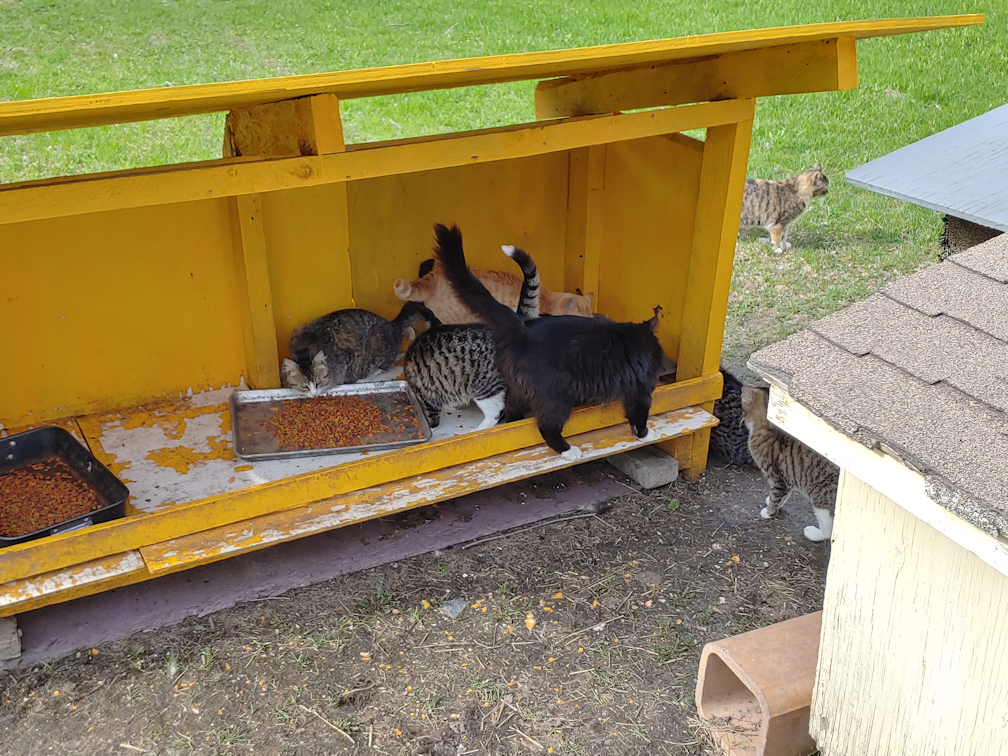
Today has turned out to be a warmer day than predicted, and beautifully sunny. When heading out to do my morning rounds, I had a whole crowd of hungry kitties, waiting by the sun room door for me!

They were running around so much, I didn’t even try to count them. While putting food in the kibble house, TDG not only let me pet him, but let me pull the big ole wood tick in the tip of his ear! In fact, he didn’t even seem to notice I did it.

Which reminds me; while topping up the cat food last night, I got to touch Rosencrantz a bit and finally got a closer look at one of her ears. I thought she might have lost the tip to frost bite over the winter, but the tip is still there! It’s just badly torn. Not a new injury. Not much we can do about it, unfortunately.

The transplants got set outside for hardening off. They were supposed to be out for 5 hours, but we ended up bringing them in a bit early. The winds really picked up, and some of the pots were being blown around.

Wind or no wind, I was determined to get the old kitchen garden finally planted!

This is now our beet bed. We bought two types of beets this year, Cylindra and Bresko, plus we had some Merlin left over from last year. The support posts handily divided the bed into three sections, so that makes it easy to keep track of where one type starts and another one ends.

After the bed was seeded and watered, I broke open the roll of netting. This is the stuff my daughter picked out that I thought could be used for deer fencing. It’s a much finer net than I expected! The black just disappears, too, but in the photo, you can see where the excess is bunched up along the sides. I’m really glad I found that big bag of cheap tent pegs in the garage. We used quite a few of them to pin down the edges of the netting. The short ends are held in place at one end by a stick rolled up in the excess, while at the other end, the excess went under a board I was using to mark the end of the bed.

Next was the L shaped bed. Lettuce went into there. I thought I had 4 types of lettuce left over from last year, but it turned out one of the envelopes was empty. That actually worked out, for the amount of seeds in the remaining packets.

The hard part was covering the odd shaped bed. One of my daughters came out and we sized up a piece of netting for the longer part of the L shape and cut it. The netting is 14′ wide, so we stretched it out on the grass and cut it in half.

The short side of the L, up to the label you can see near the bottom of the photo, is one type of lettuce, which is about as much as the other two together! There were still a few seeds left over, including some that had spilled in the baggie the seed packets were in, so those got scattered in the odd little bit of space next to the rose bush. They didn’t get covered with netting; the space is too small to bother.

The long side of the L shape was pretty easy to cover, but the short side curves around the lilac and gets wider at the end. While I used pieces from the canopy tent frame as supports at one end, there weren’t enough of that length for the whole bed, so I dug out some metal support rods I got last year. They’re not very strong and some had pieces broken off, making them shorter. Those matched the tent frame pieces more easily, but other were full length. I could push most if them deep enough to match heights, but with a couple, I kept hitting rocks that were big enough, I couldn’t seem to get around it. That one stake that has a spider web of cords from it is the highest of them all, and there was no way I could adjust it to avoid the rock I was hitting, and still have it where I needed it. (The bottoms of water bottles are there to keep the netting from falling down the stakes) That extra height in particular made pegging the netting down more of a challenge. In the end, we just had to push some of the stakes inwards to create some slack. We managed it, though.

That left one more bed to plant in.

For this bed, I transplanted the Red Baron bunching onions, in little groups of 3 or 4 seedlings. These are not going to get covered, since nothing eats the onions. Hopefully, the cats will leave the bed alone!

While working on this, I checked out the small bed we planted the poppy seeds saved from last year. I think they are starting to come up, but there are so many things coming up with them, it’s hard to tell! For all the roots I dug out of these beds, we’re still going to have a lot of weeds to fight off.

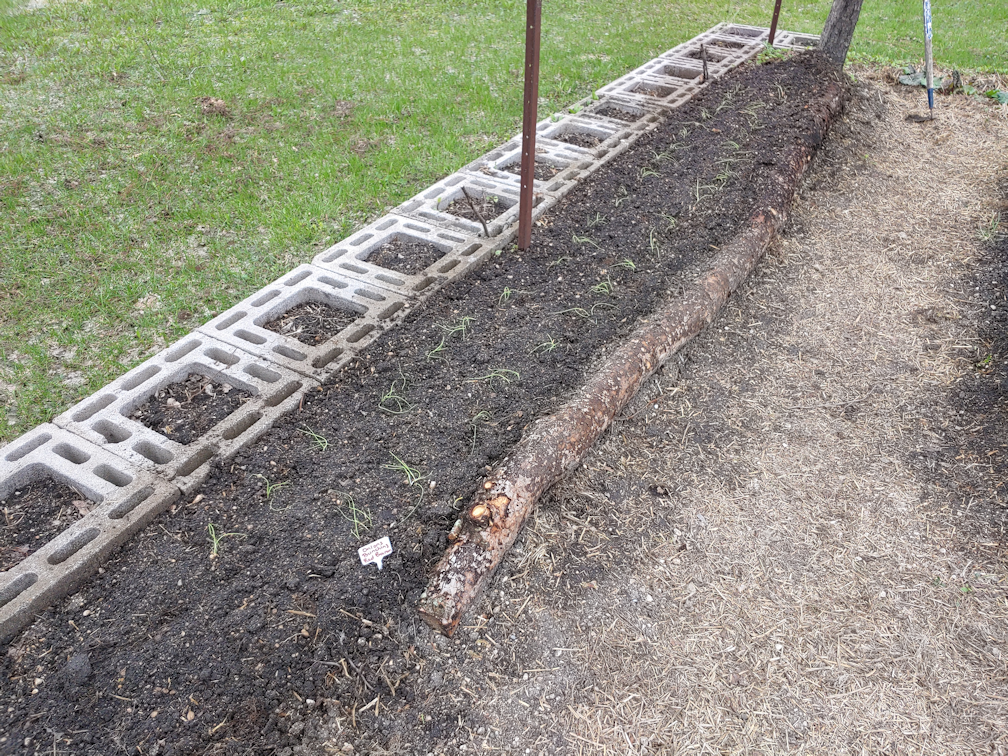
Now, the only thing left in the old kitchen garden are the retaining wall blocks. I’d transplanted mint into alternating blocks, but they’re not showing yet. I don’t know if they’re going to show up later, or if they got killed by the winter cold. It takes a lot to kill mint, but they did just get transplanted. I’ll leave those for now, but still plan to plant things in the remaining blocks. I just haven’t decided what, yet, since we will likely not be covering those. Plus, this area gets shaded by the ornamental apple trees a lot. With the T posts there, we could put up trellis netting and plant climbers, but anything like that would be deer or groundhog buffet, so we would have to find a way to cover them. It was very difficult to cover the retaining wall blocks last year. We’d planted lettuce in it last year, which we were able to protect from the deer, but didn’t count on the groundhogs getting at them.

We’ll figure it out. We can tuck something into the blocks, later one. For now, I’m just glad to finally get this garden basically done!

Oh, before I forget, just a quite update on my mother. I called her up this morning, and she’s still in a lot of pain. She’s quite surprised by it, it seems. She’s also disappointed. She thought that the doctor would be able to fix her. I tried to explain, they can’t fix everything, but she started taking about how, with all the modern technology we have, there must be something. I had to go back to using my husband as an example, since he’s been dealing with debilitating back pain for a very long time now. Even if they technically could do surgery for one thing, the risk was too high for little benefit, and it would have to be done again in 2 years anyhow – and that wasn’t even for the main source of his pain, for which there is nothing that can be done other than painkillers and, for some of it, physio. He hasn’t been able to do physio since we moved here. Some things just can’t be fixed. I don’t think my mother realised just how fortunate she is to have reached 90 and not had to deal with something like this before.

Ah, well. It is what it is. We just deal with the hand we’re dealt with!

The Re-Farmer