We have our first beans of the year! The purple Carminat and the green Seychelle pole beans. The one San Marzano tomato I’ve been keeping an eye on was looking ripe, and when I touched it, it fell off the vine on its own. I was even able to grab a small handful of Dalvay shelling peas.
I honestly didn’t think we’d get beans this year, with how much they’ve struggled.
We are having a much more pleasant day today, temperature wise. In fact, our overnight low last night dipped down to 9C/48F! I actually had to turn my fans off. 😄 Right now, coming up on 6:30pm, we’re still at our high of 21C/70F, which has been sooooo enjoyable!
I did end up watering the garden this afternoon, though. This time with water soluble fertilizer. The NPK on this fertilizer was 18-18-21, rather than the acidifying, high nitrogen fertilizer I used before. With so many things developing their fruit, they need that higher potassium and less nitrogen.
While I was watering in the main garden area, I saw something that made me smile!
We have pole beans developing! So far, just one purple Carminat plant has them, but the others are blooming, so I’m hoping to expect more. The green Seychelle beans that were planted later, to fill the gabs where the Carminat failed to germinated, will likely be a couple of weeks behind.
While watering the San Marzano tomatoes in the retaining wall blocks, I saw our first tomato that’s starting to show a blush of red.
At this time last year, most things were farther along, and we were still harvesting bush beans, and even some summer squash and some decently sized carrots. Still, things are growing well, for all that they’re behind in the growing season. As long as that frost holds off, we should have a pretty decent harvest at the end of the season.
Plus, we should soon have beans, corn and shelling peas to harvest!
Well. As long as something else doesn’t get them first. Like a deer. At least we don’t have problems with groundhogs this year, and with all the yard cats, rodents and hares are not a problem at all!
I didn’t get all the stuff on my list done, but my goal was to get most of it, and I managed that!
I had intended to start earlier in the day, but ended up unable to sleep for some reason, until about 5 or 6, when I got an hour or so of actual sleep. Not very good sleep, though, as I had several cats draped over me, and I really, really needed to pee! 😄😄
By the time I got out, it was coming up on 9am and starting to get warm already. The first job I did was work on the trellis bed, which needed a serious weeding before anything more could be done in it.
We are starting these beds out at two logs high, and they will most definitely be made higher, over time. It didn’t take me long to realize I needed to use the scooter, to make the weeding less painful. This is the first time it’s been used since last year, to all the tires needed to be pumped up.
This bed has the onions transplanted out of the bed that now has winter squash in it, as well as a few I found in the other bed that was shifted over, but has not been planted in yet. These onions are doing very well! As these had over wintered, they should go to seed this year, which would be awesome.
All along one side, where a permanent trellis will be built in, I wanted to fit as many of the Summer of Melons Blend transplants as possible. This bed is a little messed up as, on what will be the trellis side, the bottom log is bowed inwards. This works out to ensure the vertical trellis supports will be even with each other, but it means that we loose several inches of planting area. With that in mind, I used a couple of stakes to mark the ends of where the row of melons would be, then used another stake to mark a line from one to the other, far enough in for the melon roots to have space.
We had some packages delivered yesterday, so I had some packing paper and cardboard that I could lay down between the markers.
The next part was the most difficult. Getting the transplants out of the large celled trays and so I could space them out between the markers.
With other things I grew in the large celled trays, I didn’t have too much trouble getting them out. Their roots held things together enough that, usually, I could loosen them by squeezing the cells a bit, then pull the whole thing out by the plant stem.
Not with these melons!
Their stems and roots are way too fragile. Plus, as I tried to push the soil and root cluster out, the soil (seed starting mix, actually) would start to break apart. With some, I had to use a narrow trowel to scoop it out. When it got to that point, there was no way that the roots could not be disturbed quite a bit!
Interruption! I ended up going into town. My husband needed something, but I also ended up getting Dairy Queen to bring home. I was too tired and sore to cook, my younger daughter is caning it and can’t stand long enough to cook, and my older daughter became ill during the night and still feels unwell! I headed out just in time; the rain hit while I was on my way home. I was just getting in the driveway when the radio started blaring an emergency alert. Parts of our province was under a tornado watch, and the weather office was tracking some. Not anywhere near us, though. We’ve got a bit of a break in the rain as I write this, then start up again at around midnight, and keep raining for about 6 hours!
Now… where was I? Ah, yes…
So getting those melons out of the tray was not a good thing for those roots! I would not be surprised if we loose some of them.
Because we will be training the melons up a trellis, I was able to space them closer to each other, getting 17 transplants laid out. That leaves another 4 transplants in this Summer of Melons Blend that still need to be transplanted.
Once I figured out where they were going, I cut through the packing paper and cardboard and found the line I’d marked out earlier, to dig the planting holes. Once the holes were all watered and the melons transplanted, I made use of the bark I’d taken off the logs for the bed the winter squash is in, to weigh down the paper and cardboard mulch, so it won’t blow away. Then everything got another thorough watering.
That left a section on the other side of the bed to plant in. I decided to put bush beans there, and planted the Royal Burgundy seeds. It’s not a large space, so there were seeds left over that we might plant somewhere else. Grass clippings were added on either side of the row for mulch.
That bed is now done!
The next thing on my list that I decided to do was to work on the bed with the winter squash. I used a stake to mark out a little trench to plant in, on either side of the winter squash and their grass mulches. Since the bed’s frame is not going to be complete for a little while, yet, I needed to make sure they weren’t too close to the edge of the soil mound. On one side, closer to the high raised bed, I planted the Dalvay shelling peas. We have quite a lot of seeds. I spaced them 4-5 inches apart, and had lots left over. After pushing the seeds into the soil, I made sure to cover them in such a way that there is a soil “wall” on the outside, and there is still a bit of a trench for the water to collect in before being absorbed.
I did the same on the other side, with the Carminat purple pole beans. I didn’t have as many of those left, so they were planted more like 6-7 inches apart. When I finished the row and still had a few seeds left, I went looking for spaces that looked a bit wider and added them there. We no longer have any Carminate pole bean seeds left!
The seeds planted and watered, I grabbed a bundle of bamboo poles and set up 5 to each side. After the beans and peas have germinated, we will add netting to the bamboo poles for the peas and beans to climb.
This bed is now done. At least, when it comes to planting!
After that, I took a hydration and sustenance break. While I was doing that, my younger daughter headed outside to try and get some lawn mowed. Even after waiting until noon, that grass was still so wet! That’s not even taking into account the low areas where standing water collects. There were whole sections she had to just go around and leave alone.
It may be making things hard to mow, but the gardens sure love it! All the stuff we planted previously is doing really well.
When I got back outside to continue working in the garden, though, the poor melons were looking pretty limp! Aside from the obvious transplant shock, we were reading our high of the day. I ended up misting them a bit to help relieve them from some of that heat!
I decided the next thing that needed to be done was to get the drum gourds and pumpkins planted. They are the largest transplants, and needed to get into the ground faster.
In the space in line with the high raised bed, we’d made a pile of grass clipping mulch. Most of it was used throughout the garden last year, but there was still some grass clippings and shredded paper mulch left. I raked what was left aside, clearing a rectangle about the same length and the high raised bed. Eventually, the high raised bed will either had a matching bed near it, with a space between them, or we’ll just add a new bed attached to the current high raised bed. I haven’t decided, yet.
With a garden bed planned for the area already, I figured it would be a good place to build squash mounds, which can be incorporated into whatever bed we end up building there.
I just had to sift some more soil from the pile in the outer yard.
I made three mounds of soil. Each of them got a gallon water bottle with its bottom cut and no caps, placed upside down in the middle. They got filled with water to slowly drain.
I had two pots with the pumpkins from the free seeds we got at the grocery store by my mother’s place. They have grown so much!
I also had two pots of drum gourds, but each pot had two very strong and healthy plants in it. What a difference from last year, when I ended up replanting them, several times, and ended up with none!
As expected, when I took them out of the pots, there was no separating them. Their roots were just too entwined. So I kept them together, but after planting them, I gently teased the stems away from each other. As they grow, I want to train them to run in opposite directions.
Once they were all in, the grass clipping mulch that had been raked aside was drawn up and around each mound.
And I was done for the day!
Well. Almost.
My daughter had done as much mowing as she could and gone inside. I sent a message asking for a hand with my next task, only to see her come hobbling along with her cane! She was in a world of hurt. 😢
With the possibility of thunderstorms tonight, I’d set up the support hoops for the row “greenhouse” I’d picked up at a dollar store to try. The set came with a plastic cover, but I wanted rain to get through. I just didn’t want the little transplants to be battered with rain!
So I brought out a roll of mosquito netting to put over the hoops. Unfortunately, the netting wasn’t long enough to cover the entire row of melons. We ended up moving the hoops a bit closer together, and set it up over the end where the transplants seemed to be needing the most protection. Once the netting was over the hoops, we used bricks, boards, branches – anything we could find, to weigh the edges down.
By the time that was done, it was just too hot to keep going. Still on my list was to plant onions or shallots in the high raised bed, around the peppers. There’s also that second shifted bed that needs to be prepped for planting.
We still have 4 Summer of Melons Blend transplants, but we also have another 15 pots with melons we actually know the names of Plus, there is still 7 winter squash to transplant, and a few tomatoes. Anything else would be direct sown.
If all goes well, tomorrow my priority is to get the shifted bed prepped for planting. I have decided to get the last winter squash transplanted. There will be more space between them compared to the other bed, which I plan to take advantage of. I have a variety of sweet corn that is only 55 days to maturity, so I will plan small groups of them in between each winter squash.
Once those are in, the next three beds need to be weeded and shifted over. We’ve got plenty of melons that will need to be transplanted, including a couple of Zucca melon. I will find a way to give them their own hills to grow on, since their fruit can reach 60 pounds in size. The rest of the melons will be need trellises to grow on – and I’m starting to run out of takes!
We also have the last, sad little San Marzano tomatoes to plant, and last of all, all the onions and shallots will get tucked away, in between other things.
Once all the transplants are in, I went to direct sow more summer squash. I also want to plant more carrots – it’s probably late for those, but I’ll try , anyhow. I’ve got yellow and green bush bean seeds, too, if there’s room for them.
I’m actually starting to see a light at the end of the tunnel!
I just have to make sure not to push myself too much, though, so I don’t have to take more days “off” to recover!
Okay, it’s that time! I’ll be working on a serious of posts, going over how our 2022 garden went, what worked, what didn’t, and what didn’t even happen at all. This is help give us an idea of what we want to do in the future, what we don’t want to do in the future, and what changes need to be made.
It was a mixed bag when it came to growing legumes in 2022!
As with so many other areas in the gardens, we did have flooding around the pea and bean trellises, but that area is a bit more elevated, so it wasn’t much of an issue, compared to other garden areas.
The previous year, we’d grown three types of bush beans, and they did very well, in spite of drought conditions and heat waves. We were very happy with them.
For 2022, though, we decided to try growing pole beans, and shelling beans.
The previous year, we had little success with peas. For 2022, we decided to try an edible pod pea, as well as shelling beans. Plus, we had a whole four saved seeds from the King Tut Purple Peas we tried growing the year before.
Let’s start with the peas.
We used the same trellis we’d grown peas at, the year before, amending the soil a bit more. The trellises were all meant to be temporary, but we did get one more year out of them.
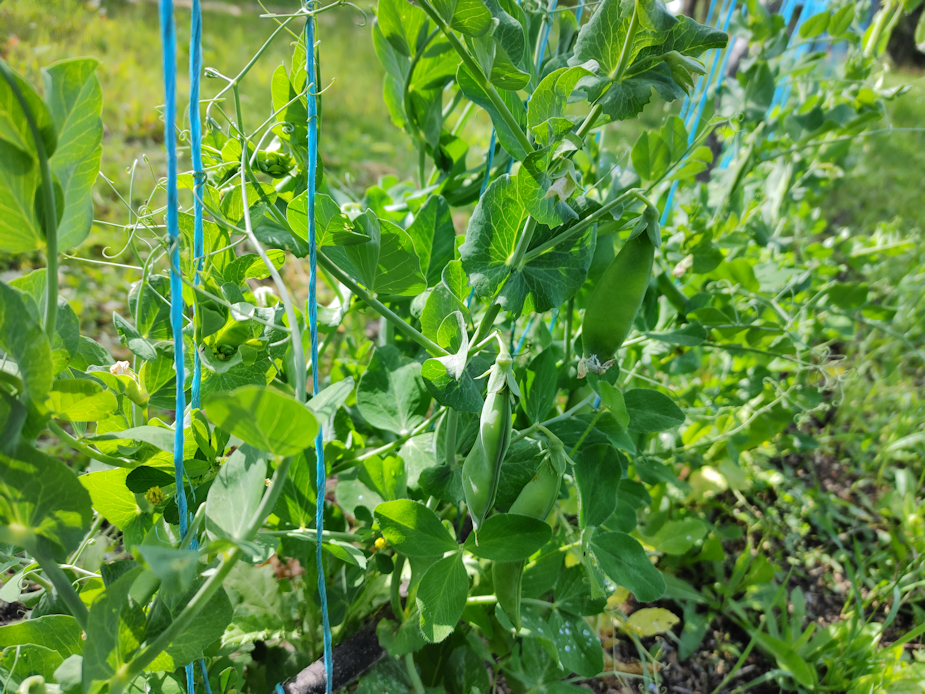
Don’t those peas look nice and healthy?
That was about the best they got.
The Results:
The sugar snap peas germinated, then almost disappeared. I think we got a whole two pea pods out of them. There weren’t a lot of those, however, and were planted in half of one side of the trellis. The shelling peas too up the rest of the trellis, which means some were planted across from the snap peas. Those pea plants also did not do well, which tells me that the soil on that end of the trellis was most likely the problem.
A couple of weeks later, we planted more of the shelling peas at an A frame trellis, shared with gourds and cucumbers. Those plants actually seemed to do better.
In general, though, the peas did not thrive. Even the healthiest, strongest plants only got to about half the size they should have. I did have shelling peas to harvest, but never more than a handful. Usually, it was just a few that I could eat right away.
Then there were the purple peas.
The Results:
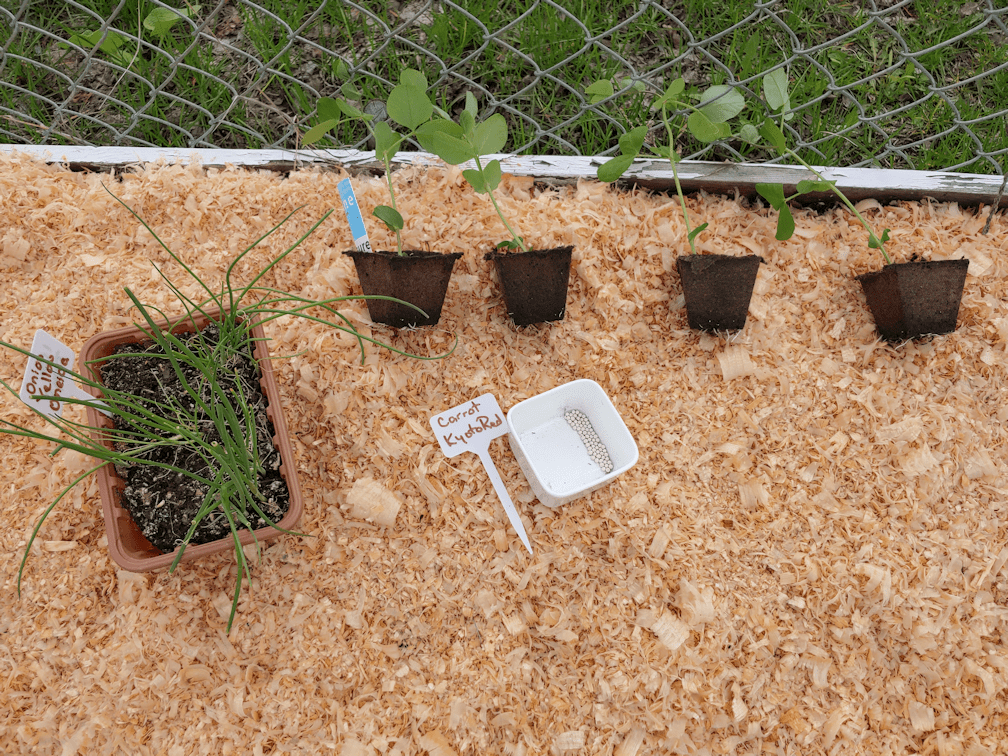
As with the other peas the year before, the King Tut Purple Peas did not do well, but they kept trying to grow and bloom for a surprisingly long time. I decided to try starting the four seeds we’d managed to keep indoors. All four germinated and were looking quite healthy. They were transplanted in a south bed with the chain link fence to climb. Shortly after transplanting, I cut the top and bottom off some gallon water jugs and put them around the peas for extra protection from the wind until they could grow big enough to start vining into the fence.
They… grew. Like the other peas, they did not reach their potential at all. They grew tall and thin, without a lot of foliage. There were a few purple blooms and pea pods developed, but they were green instead of purple, except for one. I never tried harvesting them at all, but just left them to go to seed. There wasn’t a lot to collect at the end of the season, and I’m not even sure I want to try growing them again. They weren’t the tastiest of peas, but that could be because they just didn’t grow well.
The Conclusion:
While the peas did not do well, we will still be growing them again. For 2023, I’ve already ordered the variety of shelling peas we’d tried in 2020. The pea and bean trellises have been dismantled, and they will be grown in a completely different area, as we build up our permanent garden beds. Hopefully, that will make the difference. I really love fresh peas, and would love to have enough to freeze. I would love to have edible pod peas, too, but I’m not sure if we will try them again in 2023. I think it will depend on how far we get with the permanent gardening locations.
Then there were the beans.
While we bought pole beans, we also had green and yellow bush beans left over from the year before.
We planted a green and a purple variety at an A frame trellis. The shelling beans and the red noodle beans were planted at what had been a squash tunnel, the year before. The yellow beans were planted with the kulli corn to act as a nitrogen fixer, as well as to help shade out weeds.
The green beans from the year before were planted with our sweet corn as well, but that bed got flooded out. While most of the corn survived, not a single green bean germinated. We bought another variety of green bush bean and planted those, and they did grow.
The Results:
The purple Carminat and the green Seychelles pole beans did great, considering what a horrible growing year it was.! Both varieties were quite productive. I wasn’t picking beans every day, as I was with the bush beans the previous year, but I was at least picking some every couple of days. The purple beans seemed to do the best – even when a deer went by and nibbled on them all along the row!
The yellow bush beans planted with the kulli corn did quite well, too. The only downside was that we had a net around the bed to protect the corn from deer and racoons, which made harvesting the beans very inconvenient.
The green bush beans we planted with the sweet corn didn’t grow as large as they should have; it was a new bed and it had lots of issues, so I’m not surprised by that. Everything did a lot better when we were finally able to finish mulching it all. The bean plants were so small, however, that it was hard to harvest them with the mulch. They were there more for the corn than for us, so I decided to just leave them and hopefully have seeds, but I think they were planted just too late for the season, and none of the pods dried out.
Then there were the shelling beans and Red Noodle beans at the tunnel trellis.
The shelling beans (Blue Grey Speckled Tepary) were very small plants, just barely getting tall enough to start climbing the trellis, yet they produces so many pods! Still, there wasn’t much of a harvest of these very small beans. That photo is the entire harvest! I saved 100 seeds (we’d planted 50) to grow in 2023, and we ate the rest. It was the first time we’d tasted these beans, and they were barely enough for one meal! Still, we found them tasty, and I look forward to trying them again. I hope a better growing year will improve things.
As for the Red Noodle beans…
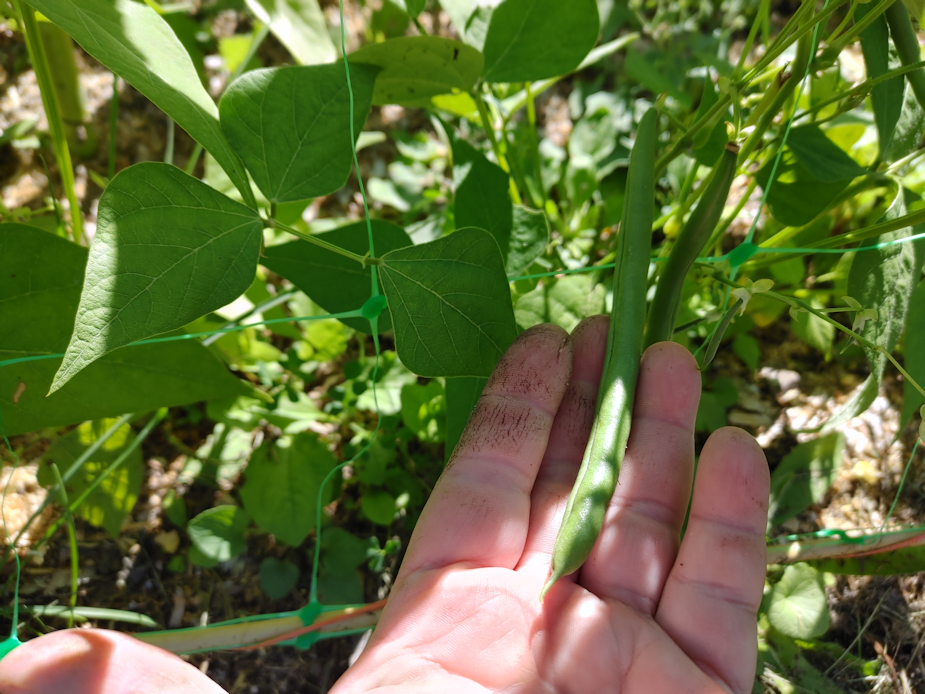
These are supposed to be a vining type bean, but it wasn’t until near the end of the season that they actually got large enough to start climbing the trellis. It took even longer before I finally saw blooms. We were starting to harvest and pull up the garden for the end of the year, when I found a single, solitary, baby red noodle bean pod, which you can see in the above photo.
I had been looking forward to trying these beans, and would like to try growing them again, just to find out if we like them! Not in 2023, though.
Conclusion:
Beans are such a staple crop, and we enjoy having a variety of types, we are definitely growing beans again in 2023. Along with the seeds we saved for shelling beans, my mother gave me a jar of white beans that are descendants of beans she used to grow here. She gave seeds to my sister to grow in her own garden, which she did for quite a few years. She’s not growing shelling beans anymore, though, so she gave her saved seeds to my mother, who passed them on to me. What a circle!
On top of that, we have ordered seeds for green, yellow, purple and red varieties of beans, including one that is supposed to be good as both a fresh bean and a shelling beans.
While we’ve had our failures this year, beans are one of the few crops that have produced really well for us, even in adverse growing conditions, making them a reliable food to grow.
I am so enjoying today’s cooler temperatures! Yesterday, we reached at least 31C/88F, though I’m sure we got hotter than that. I headed out to top up the kitty kibble and was actually feeling nauseous from the heat by the time I got back inside. Of course, the upstairs is much hotter, and it really hit one of my daughters hard, and she was quite ill for a few hours.
Today’s high is supposed to be only 19C/66F or 21C/36F, depending on the source. Quite enjoyable! By the time I got out this morning (having been kept up most of the night by a naughty Nosencrantz constantly making noise and getting into things!), it was only about 18C/64F. Which is about perfect, as far as I’m concerned! 😁
The current conditions are keeping things going in the garden quite nicely. I got a decent harvest of green and purple pole beans. The Red Noodle beans are still not even blooming, but the shelling beans… well, take a look.
They are still so very small and delicate – but they are LOADED with pods, and starting to dry out. I suspect they are smaller than they should be, but I do hope the beans we get will still be tasty.
I was surprised by how many ground cherries I found on the ground this morning, though some greener ones fell off while I was trying to reach to pick them up. They are related to tomatoes, so I’m hoping if we just leave them, they’ll continue to ripen.
I picked our first G-Star patty pan squash! One of the plants seems to have suddenly become limp, though. Odd.
I don’t usually let the sunburst squash get that big before picking them, but they seemed to have quite the overnight growth spurt!
I’m quite happy to have a nice little variety to harvest.
Well, the vet clinic hasn’t called back yet, but I need to get outside and take advantage of today’s lovely temperatures, since we’re supposed to heat up again over the next week. I’ll just have to let the answering machine take it. I’m sure if there were any problems with Leyendecker, we would have heard from them earlier, so no news is good news. 😊
I’ve been training the cucumber up the trellis netting, but somehow missed one big cucumber that was lying right on the ground. I’m glad I spotted it this morning. Not much longer before it would have started to be over mature. Which would be okay if I were wanting to save seeds, but I won’t be for these.
With last night’s rain and an incredibly humid morning, things were still soaking wet outside, and my glasses were fogging up! The squash are loving it, though, and I’m seeing increased growth. Even the one Zucca melon that’s trying to survive had a noticeably growth spurt.
The sweet corn and the popcorn are both sending up tassels! The popcorn is still really small, but has had a growth spurt, too. They only reach about 2 ft high to begin with, so there is hope for a crop, yet!
There are squash blooming all over. Whenever possible, I am hand pollinating. There has not been a lot of opportunity to do that. Still, if we have a long, mild fall like last year, it will help ensure we have fruiting plants that can take advantage of it. We shall see!
I didn’t get a photo of the finished squash patch last night, so I got one this morning.
All the paths are now mulched, too. There’s no carboard under the paths, so I expect things to start growing through, but at least it will be more sparse.
The plants themselves are seeing new growth and lots of flowers. It’s a race against time and the weather to see if we’ll have anything to pick this year.
I love that you can see the giant pumpkin from so far away!
I swear, this thing is visibly bigger, every day.
Of the two other pumpkins spotted, this one is making it and growing fast. The other did not get pollinated, and withered away. I see no other female flowers, so we’re probably just have the two.
In checking the Red Kuri squash and Apple gourds, I found both male and female flowers blooing at the same time, so I went ahead and hand pollinated. The Red Kuri is doing well, but with the Apple gourds, all the female flowers so far have withered. This morning, I found a female flower on one plant, and a male on another, si I made sure to hand pollinate
Thankfully, tomatoes are self pollinating.
The are so many of them changing colour right now! I have to check myself, to make sure I don’t pick some of them too early.
The one big Sophie’s Choice tomato I recently picked was enough for the girls to make a tomato salad out of it. I’m glad they’re enjoying the variety.
I finally picked the one bigger golden zucchini this morning. There were not a lot of yellow beans to pick, but there were more of the pole beans, with many more little ones on the vines. There will be more peas for a while, too. There may not be a lot of quantity from each of them, but altogether, it’s pretty decent.
The only down side this morning are my pain levels. I over did it yesterday, while pruning the trees. I was so distracted by the heat, I missed my other “time to back off” warning signs. Frustrating.
Ah, well. That’s what pain killers are for. Today is going to be a hotter one, with possible thunderstorms, so it’s not going to be a day for significant manual labour, anyhow.
There were very few yellow beans to pick this morning. The bush beans seem to be winding down. There were more of the green pole beans to pick, though – and our first purple beans!
There are still a few peas on the first planting, while the second planting of peas are getting into their prime. I found more cucumbers than expected. Enough to make a decent size cucumber salad.
I finally picked the one Sophie’s Choice tomato that was looking like it could have been picked a while ago. It didn’t seem to be getting any redder, so I went ahead and grabbed it. I also grabbed the reddest Cup of Moldova tomatoes. The one that fell off while I tried to get the clip loose has ripened indoors, so there are two of them for my husband and the girls to taste test later on.
I picked what seemed to be the largest of the turnips to taste test as well. They are not a large variety and golf ball size is supposed to be when they have the best flavour. I also pulled a couple of the largest looking beets, to see how they are, and… they’re not doing well at all.
But we have something. And something is better than nothing!
I had done some recordings to make another garden tour video in the morning, but after going over them, I went back out to re-record most of them in the early evening. The final video will have a mix of both. I have this terrible habit of using the wrong words for things and not even noticing. Like saying “purple corn” when I meant to say “purple peas”. That sort of thing. I might have time to work on editing it this evening, but I’m not sure just yet. It depends on how things go after I get back from my mother’s, this afternoon.
There is some lovely growth happening in the garden right now.
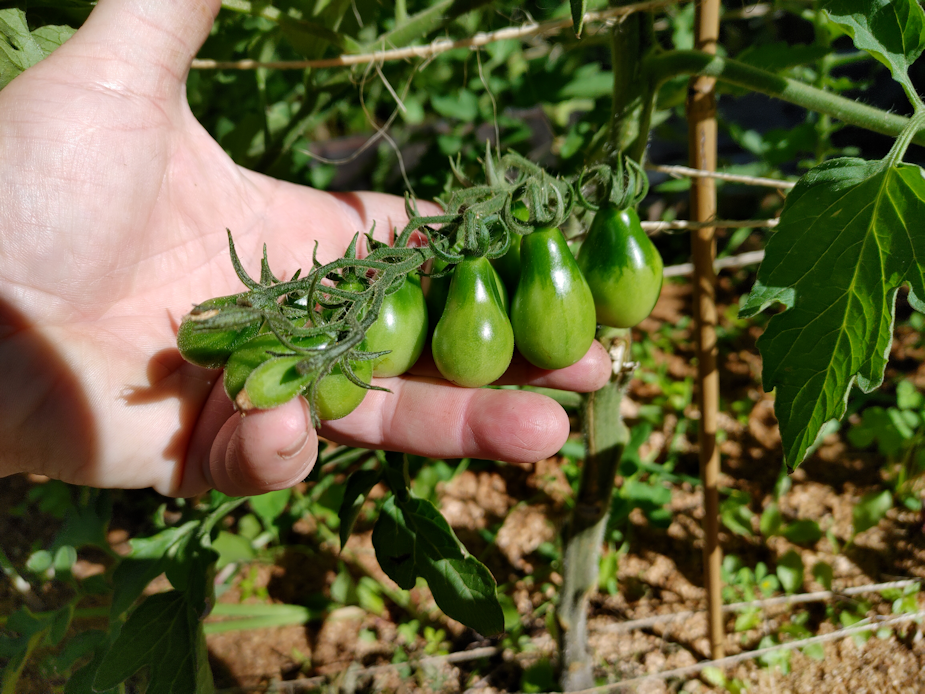
While we have lots of Cup of Moldova and Sophie’s Choice tomatoes ripening on their vines, these Yellow Pear tomatoes are looking to have a good crop, too. They are actually turning out larger than I expected for this variety. It should be interesting when they finally start turning colour!
These Carminat bean pods are getting so very long! I love their gorgeous dark purple.
With the purple pole beans, we can see quite a few pods developing, though the vines are still trying to extend their reach, and blooming all the way. The green pole beans (sheychelles) have wispy little pods forming, too.
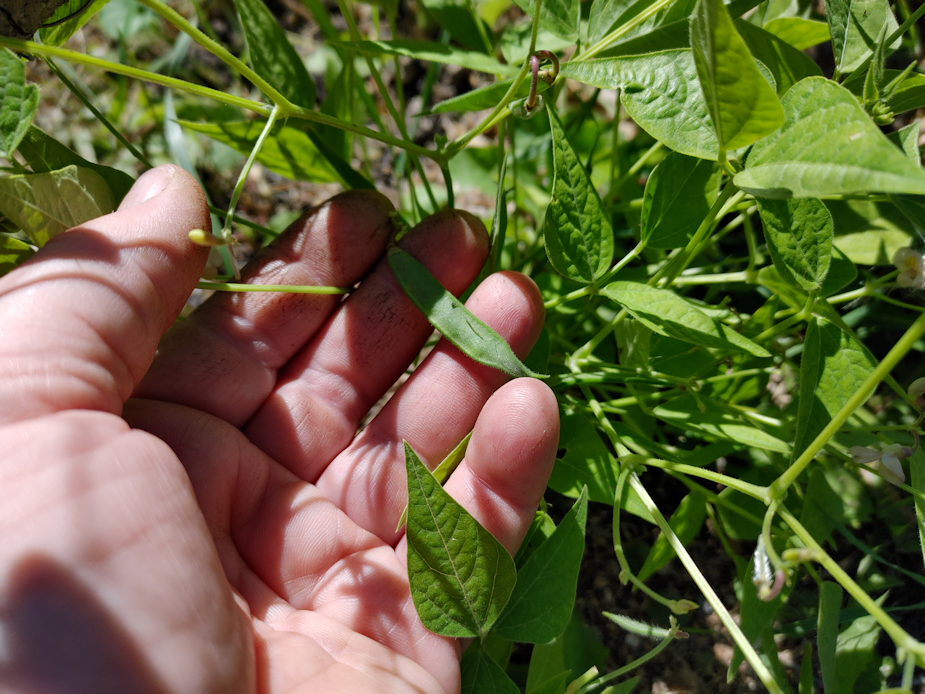
Then I started weeding and discovered a hidden surprise.
There are ripe pods hidden among the greens! It turns out these beans start developing right near the ground, unlike the Carminat, which have no flowers or pods at all near the ground.
Awesome!
After finding these, I made a point of looking more closely at the Blue Grey Speckled Tepary beans – the shelling beans – too. They’ve been blooming for a while, but are still such tiny and delicate plants.
Sure enough, I found time tiny pods starting to form. Since these beans are for shelling only, they’ll just get weeding and watering until the pods are all dried.
We actually have yellow zucchini this year! Last year, I was sure we had at least one germinated, but after transplanting, all we got were green zucchini. So I am happy to get some this year. Especially since we still don’t have any green zucchini developing! We did have female flowers, but there were no male flowers blooming at the same time to pollinate them.
We are finally getting more Sunburst patty pan squash, too. There was also one Magda squash ready to harvest.
All the squash are SO far behind. The squash patch, which is mostly winter squash, and the summer squash bed should be enveloped in plants. It’s unlikely we have enough growing season left for most of them, but we should still get something from the smaller varieties.
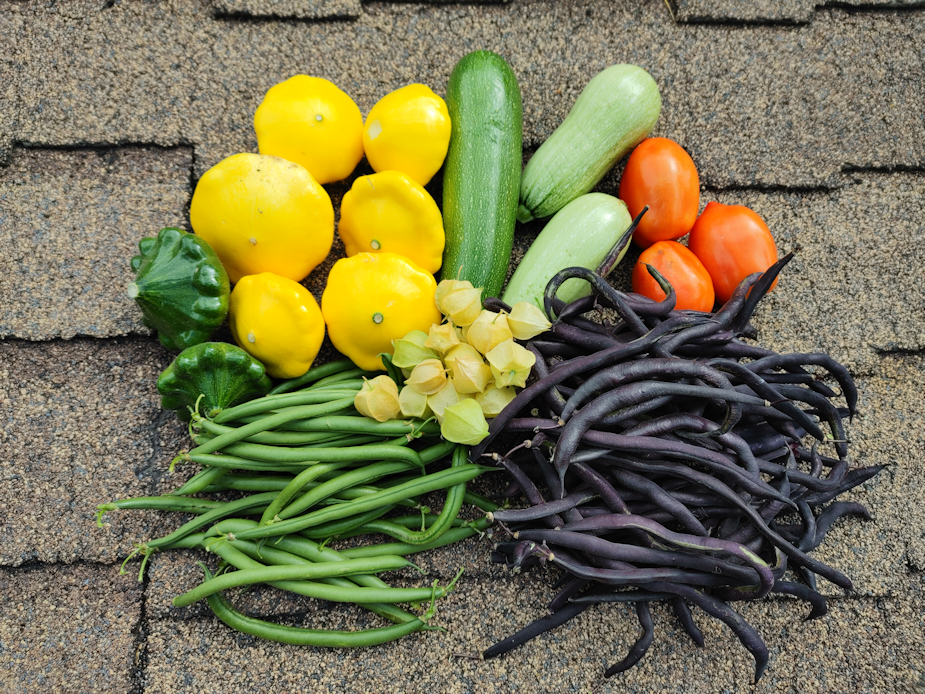
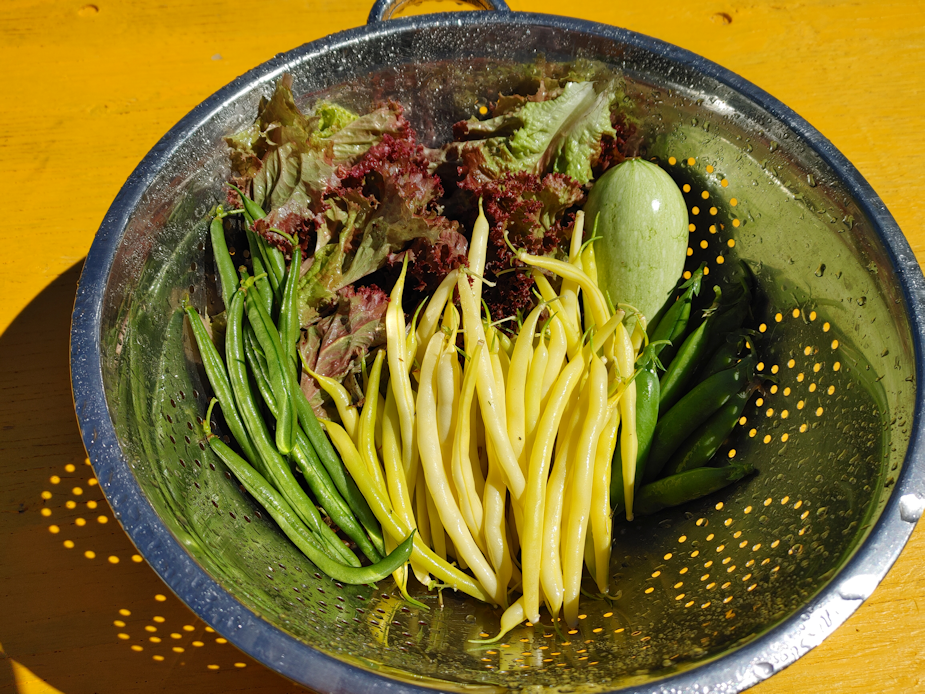
Here is this morning’s harvest!
Yes, the peas are still producing! There was only a handful to harvest from the second planting, but it’s the most I’ve been able to pick in one day, this year. We have both the yellow bush beans, and the green pole beans.
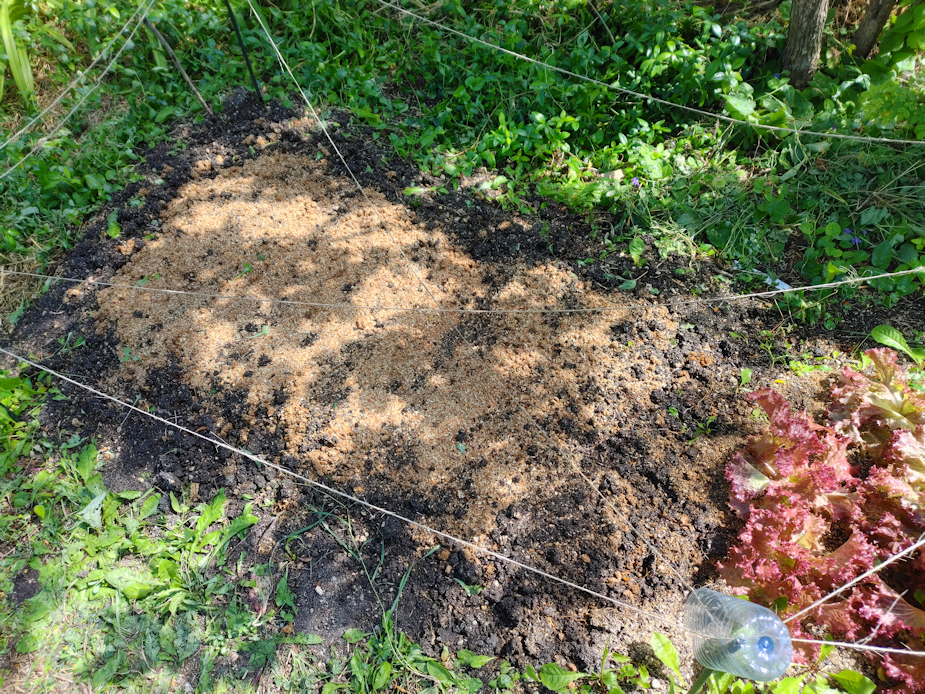
With the lettuce, we normally just go in and grab however many leaves we want. This time, I harvested the plants in one area of the L shaped bed in the old kitchen garden, so that the space can be used again.
I was planning to plant fall spinach elsewhere in the main garden area, but changed my mind.
It’s just a small area for now. As more of the bed gets cleared, I’ll plant more.
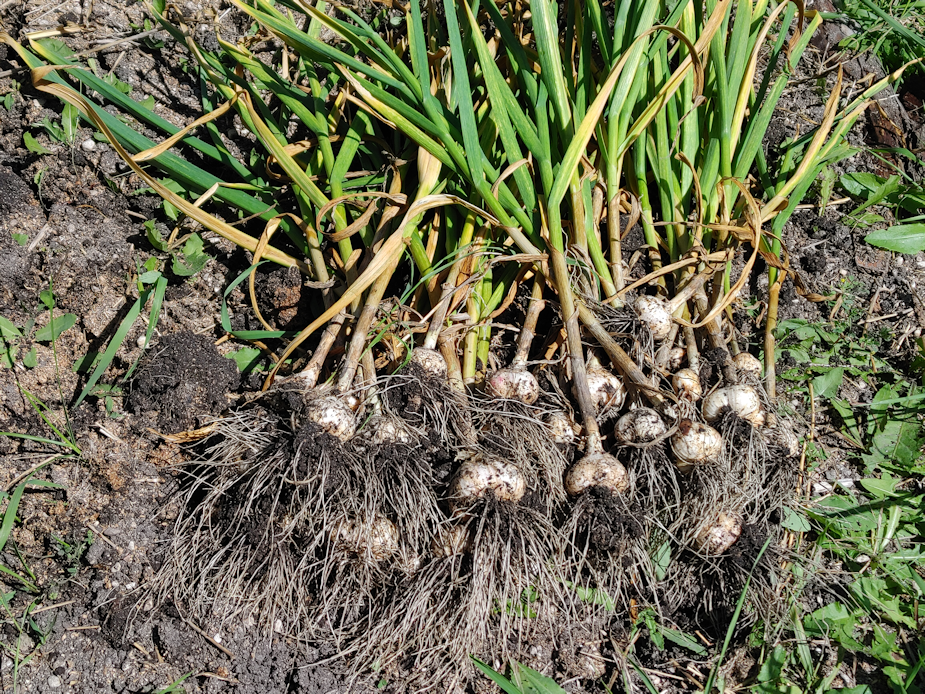
We got another harvest in this morning, too.
This is the garlic from the bed in the main garden. There isn’t a lot, but they are much larger than last year’s drought garlic!
The other garlic is quite behind, so it might be a while before we can harvest those.
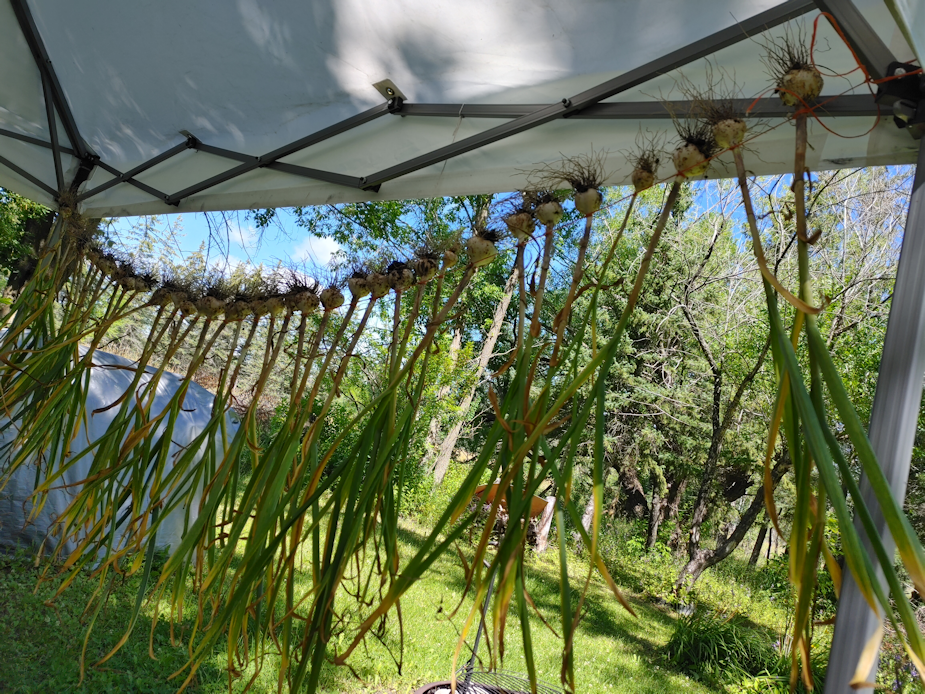
The freshly picked garlic is now strung up under my daughter’s old market tent, where it can get plenty of air circulation as it cures, and we won’t have to worry about it being rained on.












 The Re-Farmer