Making stock

I can’t help it. I feel like I’ve wasted a day. I got a stock going and tended it, off and on, for much of the day. While I didn’t have to be there constantly, I was checking on it often enough that I didn’t want to start anything that took too much of my focus or was too distracting. I ended up actually *gasp* watching TV, binge watching DS9 on Prime. I could use each the status bar on the episodes as my timer to go check the stove. Normally, I’d at least do something like crochet at the same time, but a summer in the garden has left my fingertips so rough, most yarns stick to them like Velrco, and I ended up pulling the loops right off the hook! 😆

Ah, well. I suppose it’s good to have a break every now and then.

One thing I discovered while sitting on the couch watching the show.

Fenrir missed me!
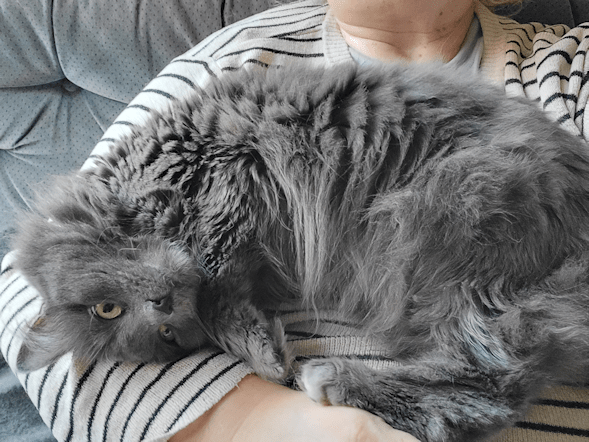
Before Butterscotch and Nosencrantz came indoors, she used to spend as much time as she could like this, while I was at my computer.

Which made it very difficult to type.

Unfortunately, Fenrir is one of the cats that will come in and immediately launch an attack at Nosencrantz if allowed in my room. Butterscotch, too, if she’s in view. I have no idea why she is so aggressive towards them. Especially Butterscotch. Butterscotch and Beep Beep took her in, along with their own kittens, when she showed up at our place as a kitten, our first summer here. Now, she will spend hours just outside my bedroom door, watching it and, if I’m not careful, she’ll teleport herself into my room as soon as the door opens, and attack Nosencrantz. She’s amazingly fast! Given the opportunity, however, she will climb onto me, curl up on my chest, and nap, as she did several times, today. She was not impressed by my frequently getting up to tend the stove. 😁

Our fridge freezer had quite a few bags of carcasses waiting, mostly from chickens, but also some turkey. I roasted them first, and they completely filled my roasting pan. There was enough that I used my giant stock pot, that I’ve also been using for water bath canning, to fit it all.
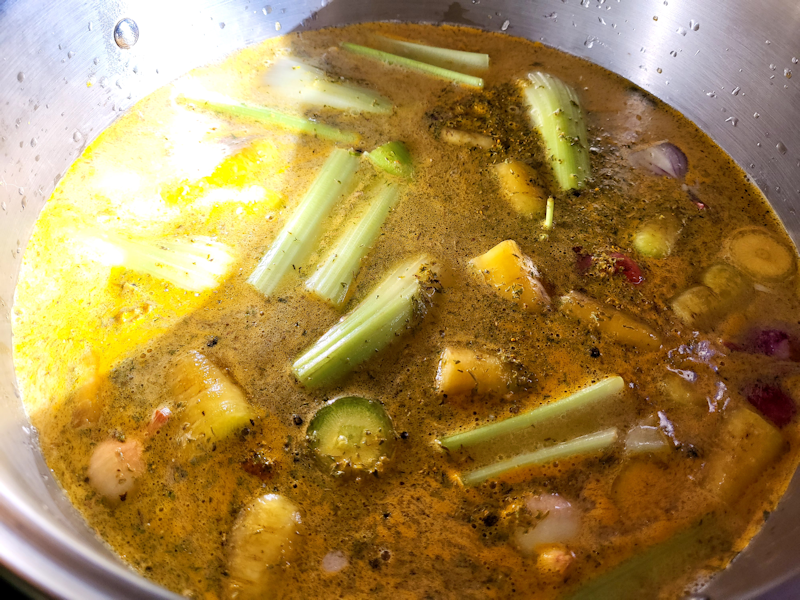
Into the pot went most of our remaining Uzbek Golden carrots.

I admit. I’m a coward.

I could have used at least a couple of Black Nebula carrots, too. That would have changed the colour significantly! But I decided that might not look too appetizing. 😂

Along with the carrots I added crushed garlic cloves, yellow and red onions – the little ones from our garden – plus celery. For seasonings, I added course salt, whole peppercorns, turmeric powder, dried thyme leaves and dried parsley, then covered it all with water. Later on, I added a generous splash of our crab apple cider vinegar, too.

After bringing it to a boil I let it simmer for about 7 hours adding more water to the pot part way through. After that, I used a hot pot soup strainer spoon that I find very handy, to take out as many of the bones and vegetables as I could, then a small sieve to strain out more, before finally ladling it through a fine mesh strainer into my other two stock pots.
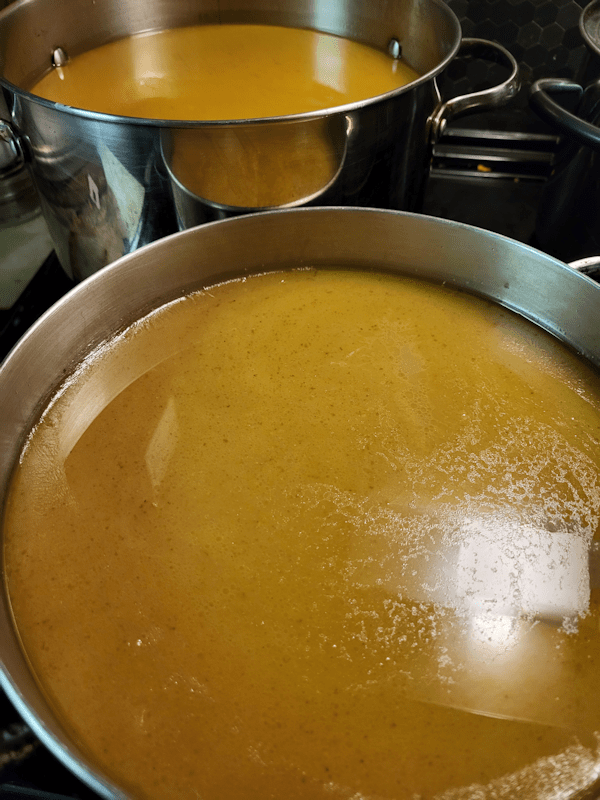
The larger pot, with the measurements on the inside, shows a little under the 6 quart line. In total, I would say there’s about 10, maybe 11, quarts (11 to 12 1/2 litres).

For now, the pots are covered and cooling, as is the bowl of carcasses and vegetables. I’m debating what to do with it next. I could just pour it into freezer bags and freeze them, as is. Or I could cook it down to make a more concentrated stock. I’m kind of leaning towards cooking it down more. I’ll see how it looks in the morning.

The Re-Farmer

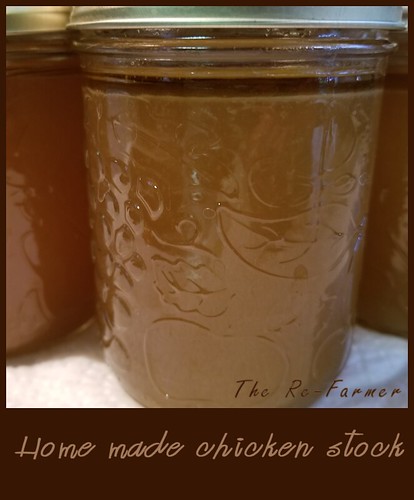
Home Made Chicken Stock

The following is a “use watcha got” recipe to use up the carcasses of your cooked chicken (or turkey).  This stock is cooked down to be more concentrated, and should result in a rather firm, gel-like consistency when cool.

Decide ahead of time how you will store your stock, and prepare in advance as needed.  I used pint sized canning jars and sterilized the canning funnel, jars, lids and rings during the last hour or so of cooking.  You could also pour the stock into ice cube trays for freezing, or use freezer bags.

You will also need a colander and bowl large enough to hold your stock, plus a sieve and cheesecloth for straining.  Having a giant measuring cup is also very handy to stain into, making it easier to pour the stock into jars.

Ingredients:

bones and skin from roasted chickens (or turkey)
pan drippings
onion and/or leeks
garlic cloves
vegetables such as carrots, celery (including leaves), celeriac, parsnips
herbs such as rosemary, thyme, savory, sage, bay leaves, ginger, parsley or dill
peppercorns
salt; optional
cold water
optional additions: lemon or orange zest, a splash of apple cider vinegar or white wine vinegar

homemade.chicken.stockNote: Quantities will depend on how many carcasses you are using.   For 3 carcasses, I used 1 large onion, a whole head of garlic, 4 carrots, and whatever herbs I had handy in my cupboard.

Seasonings will also depend on how the chickens were seasoned when cooked.  When I roasted ours, I first rubbed them with lemon juice and put the lemon pieces, with some bay leaves, into the cavities.  I also rubbed lemon salt, paprika, pepper and oil into the skin.  Because of this, I was able to be light on the salt and pepper when making the stock.  What salt I did use was lemon salt.

  1. Place your chicken bones and skin into a large stock pot.  Scrape pan drippings in (cooled pan drippings may be gelled, which is awesome).
  2. Add onions, cut into large pieces (skin can be left on, if you wish), or leeks cut into 2 inch or so chunks.
  3. Crush garlic cloves with the side of a large knife (skins can be left on, but I like to remove them) and add to the pot.
    Note: If you don’t have fresh onions or garlic, dried can be used.
  4. Vegetables do not need to be peeled.  Just scrub them, and remove the root ends.  Chop them into about 2 inch pieces, then add to the pot.
  5. Add fresh or dried herbs and other seasonings of your choice.
  6. Add peppercorns (or ground pepper, if that’s what you have) and salt.  If you’re not sure about the salt, leave it for later, after tasting.
  7. Add enough cold water to cover everything by about 1 or 2 inches.
  8. Bring to a boil, then reduce to simmer.  Do not stir, as that will make your stock cloudy.
  9. Simmer for about 3-4 hours.
  10. Place a colander over a large bowl.  Carefully pour everything in the stock pot, into the colander.  Gently lift out the colander, allowing to drain, and set aside.  Colander contents can be discarded.
  11. Wash the stock pot out and place back on the stove.  Pour the stock, through a sieve, back into the stock pot.
  12. Taste for seasonings.  Adjust as desired.
  13. Bring the stock to a boil.  Reduce heat and continue to simmer the stock down until reduced by 1/3rd.
  14. Line a sieve with several layers of cheesecloth and place over a bowl or large measuring cup.
  15. Gently ladle the stock into the lined sieve.
  16. Fill prepared containers with strained stock (in batches, if need be) and seal.
  17. Refrigerate or freeze, as desired.


Using the carcasses of 3 chickens, I was able to fill 11 pint sized canning jars (all the ones I had available), plus have 3 cups of stock left over.

The second cooking down of the stock concentrates it a bit; if you wanted to, you could continue to cook it down more, for an even more concentrated stock.  Keep this in mind when you use it, as you may need to water it down a bit.

Enjoy!

The Re-Farmer