Our 2025 Garden: a nice harvest, and breakfast!

This morning I collected our largest harvest yet, for this year!

I had some help, too.

When I prepared to transplant the melons, I set up a trellis for them using Dollarama steel fence posts and welded wire mesh salvaged from the old squash tunnel from years ago. When the Spoon tomatoes were planted in the other half of the bed, I use bamboo stakes to make them their own trellis.

Well, with the melons barely growing at all, they’re not going to need the trellis. So, with my daughter’s help, we pulled the posts, with the wire still on them, and moved them over to the corn and Arikara squash bed. It’s loosely set up for now, but the 4′ square bed will get a wire fence around it – the mesh is just long enough! – to hopefully keep the raccoons from getting into the corn, when the cobs are ready. I’ll probably have to put some sort of cover over it, too, or they’ll just climb up and over.

The corn bed has plastic netting around it. Hopefully, they will be dissuaded from the corn rather than tearing their way through.

After moving the melon trellis away, the Spoon tomatoes can now be reached from both sides, so my daughter helped me pick tomatoes on one side, while I did the other.

There were lots of Spoon tomatoes to pick!

I’m glad I remembered to bring a separate container for the Spoon tomatoes!

There was also a whole two Royal Burgundy beans to pick, from the three surviving plants. I did pick a small handful of yellow bush beans last night, though, so there was enough to actually use. While checking last night, I noticed some ripening Sub Arctic Plenty tomatoes and this morning, one was ready to grab.

After that, I dug up some potatoes, then winter sown carrots from the high raised bed.

In the next image in the slide show above, you can see a very wonky potato!

That was from roots.

These potatoes were picked from about the middle of the bed, so at least twenty feet away from the trees. My garden fork was digging up more roots than potatoes.

Those trees have got to go.

Then I remembered we have herbs and stuff, so I went to the old kitchen garden, where I gathers some lemon thyme, lemon balm and oregano. In the winter sown bed, I grabbed a few Swiss Chard leaves. I even grabbed some bulbils from the walking onions, since we don’t want them to spread any further.

Once inside, the longest time was spent getting all those little green bits of stem off all those Spoon tomatoes! I also set aside some of the ripest looking ones to collect seeds from, later. Their seeds are so tiny, I’ll have to consider how best to do that!

In the last photo – which looked much better and in focus on my phone, I swear! – it what I made with it. There’s still potatoes and Spoon tomatoes left, plus the one Sub Arctic Plenty tomato, but I used up all the carrots, julienned, a handful of bush beans cut small, the onion bulbils and a whole head of garlic. We still have fresh garlic left of the ones that were too far along for curing and winter storage. Then there was the chard and herbs.

When I went into town to get kibble yesterday, I also picked up some chicken legs and thighs that were on sale, which my older daughter prepared last night, so breakfast (brunch?) was the vegetables gathered this morning, plus oven roasted chicken legs.

It was very good!

The Re-Farmer

Our 2025 Garden: first zucchini forming, a harvest for the day, and those trees have got to go!

First up, I spotted our first blooming female zucchini flower today!

There’s another one under it that bloomed and was done before I ever saw that it was a female flower.

There were no male flowers open at the time, so I grabbed a couple of older ones and tore off the petals so I could access the pollen and hand pollinate. The first one had water pour out when the petals were torn off, so I used a second one, too, just in case the first one didn’t have any viable pollen. At this point, it’s too early to tell if the one I missed had a chance to be pollinated before it was done blooming.

This afternoon, I decided to use up a whole bunch of odds and ends vegetables in the fridge, along with some fresh stuff, in the slow cooker. I’ve been leaving the potato bed for the past while but decided to dig some up for today’s use.

I had dug some up before under the potato plants that had died back the most, which was at the north end of the bed, closer to that row of self seeded trees my mother left to grow. The entire potato bed died back early, without ever developing flowers, but the north end of the bed had them dying back the fastest.

Well, I’ve pretty much confirmed why.

The potatoes in that basket are from under four potato plants that were at the end of that bed. That mass beside the basket is capillary roots from the elm trees nearby that came up while I was digging around for the potatoes. I was hitting more, larger roots as well. I’ve de-rooted these beds several times, and they come back so fast!!

Those trees have GOT to go! They’re killing our garden!

I dug up more potatoes closer to the middle of the bed, and was still getting a lot of capillary roots like that, but found more potatoes under two plants, than under the four I’d dug up first.

Since I finally had a container on hand, I harvested Spoon tomatoes. It’s been a while since I picked any, so there were plenty to gather. Thankfully, the mesh on this basket is fine enough to hold the tomatoes! Some of them were so small, they would have fallen through if they weren’t being held in place by the larger ones. I had to be careful to keep the potatoes from rolling over and squishing them.

Then I grabbed a few more carrots to add to what we already had inside, and the only ripe bush beans I could find.

In the last photo of the slide show above, it shows all the vegetables I prepared for the slow cooker, seasoned and tossed with avocado oil. All from our garden!

There are the potatoes, carrots and Spoon tomatoes, of course. Plus I finally used that one big turnip that I’d left to get big and go to seed, but the deer ate most of the greens. There’s kohlrabi in there, and more beans that we had in the fridge. It took three “harvests” of bush beans to have enough to make it worth using them in anything! Oh, and there is Swiss Chard and a whole bulb of fresh garlic in there, too.

We have a large Crockpot, and the vegetables almost filled it completely. They will shrink as they cook down, though. After I left for my mother’s, my daughter browned some ground turkey, along with some of the yellow onions we still have left from last year’s garden (they have lasted a really long time!!!) and mixed that in later on.

The slow cooker was set to high for 3 hours. Since I’ve come back from my mother’s, I’ve checked on it a few times and added more time. All those potatoes need extra time to cook through, as I deliberately left them in big chunks. For I still don’t know how it turned out!

The house is smelling amazing, though, and I’m getting hungry! 😄

The Re-Farmer

Happy New Year!

Wishing you all a blessed and peaceful year in 2024.

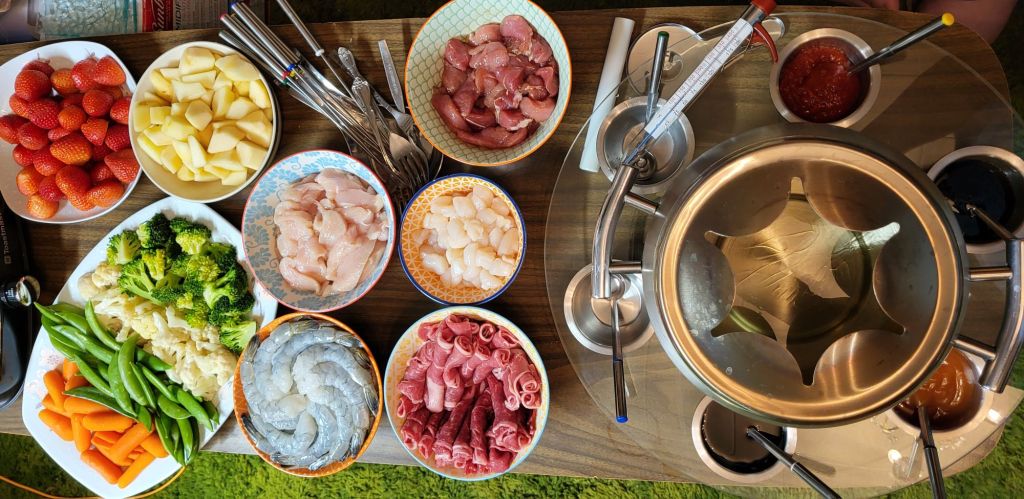
The family and I have successfully managed to get our fondue going!

I am glad I got the extra burner, because we emptied one almost before the oil was hot enough!

The cheese fondue mixed up nicely, but the hot plate was too hot, even on its lowest setting. Still, it was enough to get started while the oil heated.

Not pictured is the tempura batter, which got mixed up at the last minute. We still can’t do more than two items in the oil at once, as the food cools the oil down too much – which makes for a very slow meal. Perfect, as we watch Columbo and wait for midnight.

If we can hold out that long before just going to bed!

😁😁

The Re-Farmer

17th Century onion soup – not a recipe

Recently, I saw this video from Townsends.

We have quite a lot of fresh onions, on top of the ones we dehydrated (half of which I powdered) and froze. Mostly the Red of Florence onions.

Which have started to grow! Not all of them, but enough that we had to do something about it.

So I made a version of this historical onion soup using all red onions, to use up the ones that were sprouting.

I made a few other changes, too, of course.

This is how it turned out.

I sliced all the onions that were starting to sprout, saving the greens to use fresh, some of which I used to garnish my bowl. We’d done a pork roast yesterday, and there was just a bit left, along with the pot juices and rendered fat from the roast. I used the fat from the roast, as well as bacon drippings, to caramelize the onions, instead of butter. Part way through the caramelization process, I added the leftover bits of pork, finely chopped – there is no meat in the version in the video.

For the liquid, I use the juices from the pork roast, which had jelled quite nicely overnight, plus water. They used just water in the video. A vinegar I had on hand I chose to add to the beaten egg yolks was a fancy, barrel aged apple cider vinegar.

My daughters had made a loaf in the bread machine yesterday, and that was used for the bread portion. The video specifically stated to use the outside of a crusty loaf, not the soft insides (which would just turn to mush in the soup!), so I sliced off the crust on the bread machine bread. The bread machine makes a relatively dense bread, particularly around the edges, so I was able to cut quite thick slices off all sides for this, and cut them into fairly even cubes. They stood up well to being cooked in all that liquid!

The only other thing I did a differently was to add a splash of vinegar to the soup stock, even though there was vinegar in the beaten egg yolks. After tasting it, I just felt it needed that extra bit of bite.

The only down side to making this soup was the length of time it took to slice the onions, then caramelize them. By the time the soup was simmering and the cubed bread added, my back was giving out and I had to sit down in between doing the other stuff. Not an issue for people who aren’t broken, like me! 😁

As for the soup, it was quite tasty. Even my husband went for seconds, and he’s not a soup person! I think it would have tasted even better with yellow onions, but that’s just me. If all goes well, we’ll have a lot more of those in our garden next year!

This is definitely a soup I’d make again, with any type of onion.

I might be getting my daughters to do the chopping or caramelizing next time, though! 😄

The Re-Farmer

Tomato sauce is done!

It took a while, and I had to pause part way through to do other things, but it’s finally done!

Here are photos of the process. I didn’t really follow a recipe, but rather used a number of different recipes I found online to use as a guide.

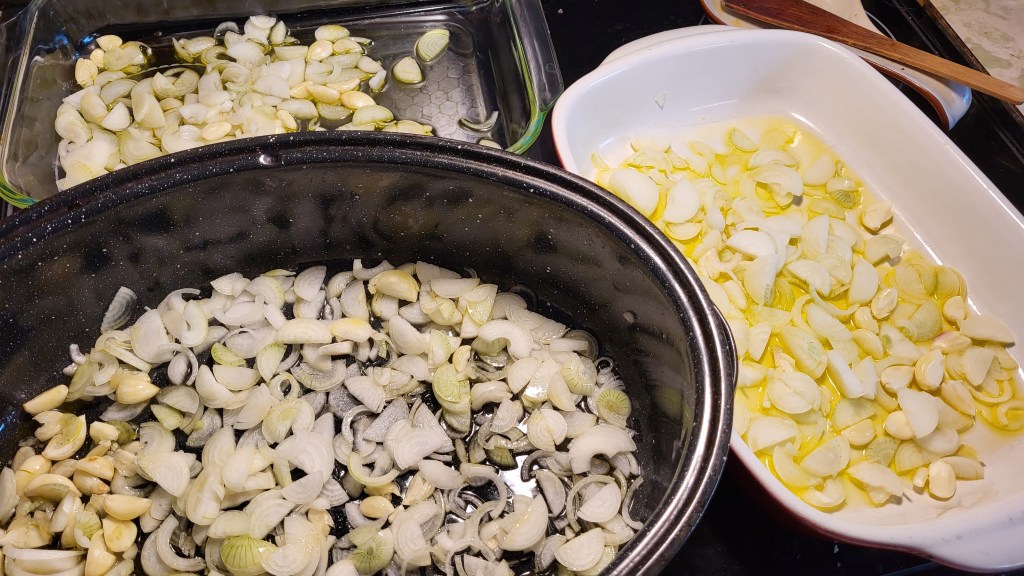
After selecting the ripest Roma VF tomatoes, I gave them a wash and left them in the water while working on the onions and garlic. I wanted those on the bottom of the roasting pans to make sure they would get completely immersed in any liquid released by the tomatoes. I wanted them to cook until they were so soft, they’d disappear into the sauce.

When it came time to process the tomatoes, things went a lot faster than fighting with those little onions and garlic! I was going to leave the skins on, so I only needed to cut the stem ends off (and any damaged bits), then give them a squeeze. With the shape of the Roma, it was easy to do it sort of assembly line style, cutting the ends off and lining them up on the cutting board, cut side down, until the board was mostly full, then squeezing the seeds out into a bucket for the compost.

A handy tip to make things easier: place a cutting board inside a baking pan with low sides. I have a whole bunch of 9×13 baking pans that are perfect for this. They are large enough to fit a cutting board with room to spare to catch liquids or keep items handy, and the sides are low enough to not get in the way of my hand or the knife as I cut.

All the recipes I found had the amount of tomatoes by weight – usually 4 lbs. I had no idea how many pounds of tomatoes I had, so I just winged the quantities for the other ingredients, and split everything between the three pans.

After all the tomatoes were cut and seeded, I added more olive oil and carefully turned the tomatoes to coat them, while trying not to move the onions and garlic on the bottom too much.

The recipes I found had oven temperatures ranging from 300F to 425F, and while some had cooking times, most were “until the skins start to blister”.

I decided to go lower and slower. I put the three roasting pans into a 325F oven. I checked them at about 40 minutes, then added another half an hour.

While they were roasting, I went and got some fresh oregano and thyme. I didn’t get a lot of oregano, because the plant is mostly blooming right now, and the bees were loving the flowers. So I just found a few smaller stems. I picked about the same amount of the thyme sharing a pot with the oregano. We have German Winter Thyme in the old kitchen garden, but the seed pack for these ones didn’t include a variety name.

This gave me a chance to try out the herb chopper I picked up at a Dollarama not long ago. It came with a cutting board with a recess matching the curve of the blades. It did a pretty good job, though with the slightly larger oregano leaves, they sort of got caught between the blades while just rocking it, so it needed to be lifted and shifted with each cut. That was not as much of an issue with the thyme leaves.

I like it.

When the timer went off on the oven, the kitchen needed to be used for other cooking, so I just shut it off and left the pans in the oven. Then, before I started on the final cooking, I made sure to do all my outside stuff and other little things, so they were in the oven for probably 2 or 3 hours. They were still quite warm when I took them out!

When transferring them into my big stock pot, I was very happy to see how softened the onions and garlic were! Exactly what I was after. All three roasting pans really filled that pot!

At this point, I added the chopped herbs and salt. Sea salt, because we happen to have some at the moment. After stirring that in, I turned on the heat, then used the immersion blender on it. Not for long, but that things is very efficient, so there were just a few larger pieces that got missed.

After that, I kept it at a simmer for about another couple of hours, stirring frequently. I tasted it a few times and ended up adding more salt (twice), some pepper, some dried sage, a bay leaf and a splash of lemon juice.

Towards the end, I removed the bay leaf and took the immersion blender to it again. This time I kept it going for longer, so make sure there weren’t any big pieces of tomato skins anywhere.

I like that this pot has a measurement scale inside it. After the first blending, the sauce reached just under the 7L mark. When it was done, it was at the 6L mark. I could have cooked it down further, but I think it’ll be good enough.

For now, the sauce is cooling down. I plan to put it into freezer bags and freeze them, though we will probably use some of it with a meal, first.

I think the next processing I will do is to dehydrate slices of the Black Beauty and Indigo Blue tomatoes. Those can be left in a warm oven, unattended, while I get other work done.

A dehydrator would be a useful gadget, but we really don’t have the space for one. At least not where we also have access to an outlet.

For now, the oven will do just fine, and tomorrow, I hope to get some work done outside at the same time!

The Re-Farmer

Taking a break

Finally, I am home for the day and can start the tomato sauce. We have tomatoes all over the place, and I gathered all the ripest Roma VF, leaving the Black Beauty and Indigo Blue, for now.

It was enough to fill a kitchen sink.

After going over numerous recipes for roasted tomato sauce, I decided on how I would make these.

I have 3 roasting pans and can fit them all in the oven together.

To start, the bottoms got a generous splash of olive oil. I then took advantage of this and used the smaller onions and garlic. I finished off an entire small braid of onions, which gave me the equivalent of maybe 2 large onions. 😁 I also smashed and peeled cloves from about a dozen small garlic bulbs. That gave me the equivalent of about 2 large bulbs.

I wasn’t too concerned about the proportions in each roasting pan. They will all go into one pot, later. That’s when I will be adding fresh herbs and seasonings.

The down side of using the smallest bulbs is that it took a really long time standing at the counter, prepping them.

My back is killing me, and I took painkillers before I started.

So I am taking a break now.

Next step is to trim and deseed the tomatoes. That’s going to be another long time, standing at the counter!

I plan on leaving the skins, though, as I will be using the immersion blender as a final step.

As for the black tomatoes, once the sauce is done in the oven, I think I will slice the ripest ones and dehydrate them. As much as I can fit on baking pans, at least. There are more Romas ripening, so there will likely be more sauce or paste to make, later.

The Re-Farmer

Rendering lard: second batch, first use

I was going to start the third and (hopefully!) last batch tonight, but it’s coming up on 5pm, and I just finished jarring up the second batch a little while ago. It can wait until tomorrow!

At times like this, I really appreciate the uninsulated old kitchen. This time of year, it’s basically a walk in freezer or refrigerator, depending on how cold things are outside. The remaining leaf lard is the thickest chunk we got and was still really frozen when I worked on the rest, yesterday, but as it sits in the old kitchen, it will soften more, yet still be frozen. That makes is a lot easier to chop, but also gives me a bit of flexibility in time for getting it processed. Yesterday evening, I had to get the girls to take over some stuff because my hips suddenly decided to go crunchy on me (they were fine by morning!), while my shoulders have started to really hurt from all the chopping. I’m doing it while sitting at the dining table, since there’s no way I can stand at a counter long enough to do it all, but the height while sitting isn’t very good, resulting in a lot of pain and stiffness right in the muscles where the neck and shoulder join. Which still hurts now, so I’m going to take an evening off from chopping.

I didn’t render the second batch in the slow cooker quite as long as the first batch; I’m curious to see if there is a noticeable difference in the colour of the lard. I might have had a touch less chopped fat in the second batch, but since I only have the depth in the slow cooker to go by, I can’t say for sure. Taking the solids out earlier did mean less liquid fat to jar up, and more volume to turn into cracklings later.

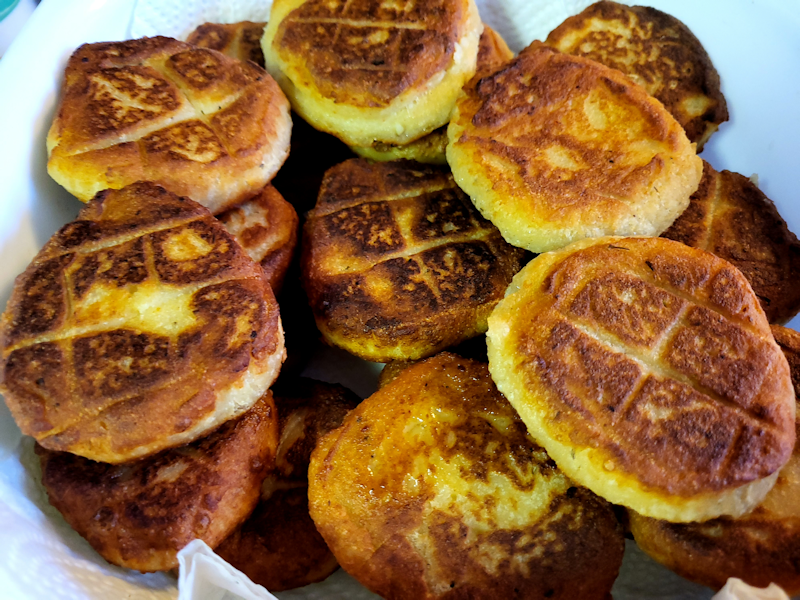
After removing the cracklings, I was able to fill six 500ml jars, with such a small amount left in the slow cooker, I just dumped the rest into the pan with the solids. After taking a break so the girls could use the kitchen, I started rendering the last of the fat out of the cracklings. While that was slowly heating up, I decided to take some leftover mashed potatoes and make them into potato patties. I just kneaded flour to the mashed potatoes until I got an dough somewhat thicker than bread dough, but not as dense as pasta dough. After breaking of sections and making them into rolls, I cut them into rounds, then pan fried them in some of the first batch cracklings lard. Enough to cover the bottom of the pan by about half an inch.

Lard has a high smoke point, so I could do these at almost deep fryer temperature. The higher the temperature, the less fat gets absorbed by the food. After cooking, they got laid out on a paper towel lined dish. They came out nice and crispy on the outside, with a smooth texture on the inside, and not at all greasy.

The lines that you see are because I set the cut rounds on a cooling rack until the pan was ready. If I’d laid them out on a plate, I would have had to flour the outsides to keep them from sticking, and I didn’t want to have burnt flour in the hot oil.

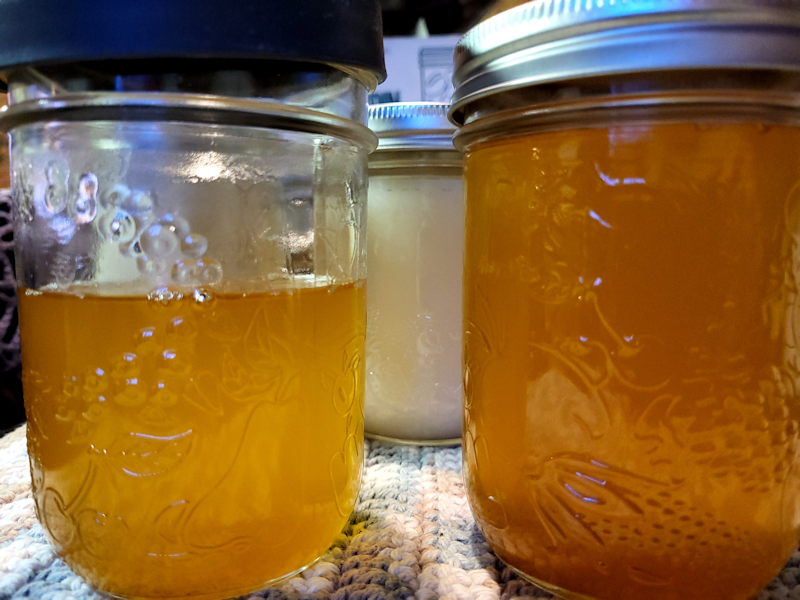
Here is the second batch of lard.

The first 6 jars were almost solid by the time the cracklings lard was done! I got another 1 1/2 pint size (500ml) jars out of the cracklings, making for a total of about 7 1/2 jars. The first batch was just under 8 jars total, so it came out very close.

The cracklings are once again laid out between paper towels, sandwiched between 9×13 baking trays and weighted down, so that cats can’t get at it!

One thing about handling all this fat for the past several days; even with constantly having to wash my hands with lots of soap, they haven’t been this soft in years!

The Re-Farmer

Making stock

I can’t help it. I feel like I’ve wasted a day. I got a stock going and tended it, off and on, for much of the day. While I didn’t have to be there constantly, I was checking on it often enough that I didn’t want to start anything that took too much of my focus or was too distracting. I ended up actually *gasp* watching TV, binge watching DS9 on Prime. I could use each the status bar on the episodes as my timer to go check the stove. Normally, I’d at least do something like crochet at the same time, but a summer in the garden has left my fingertips so rough, most yarns stick to them like Velrco, and I ended up pulling the loops right off the hook! 😆

Ah, well. I suppose it’s good to have a break every now and then.

One thing I discovered while sitting on the couch watching the show.

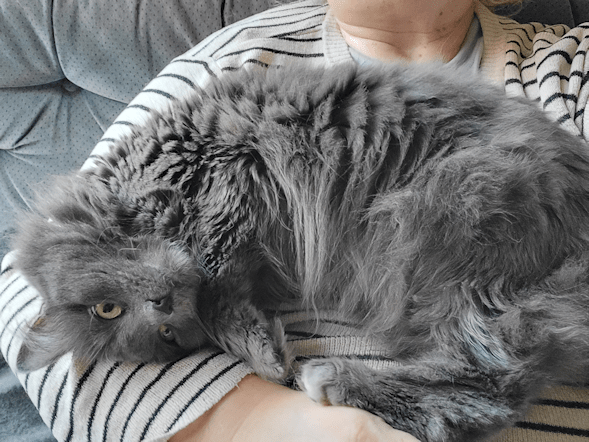
Fenrir missed me!

Before Butterscotch and Nosencrantz came indoors, she used to spend as much time as she could like this, while I was at my computer.

Which made it very difficult to type.

Unfortunately, Fenrir is one of the cats that will come in and immediately launch an attack at Nosencrantz if allowed in my room. Butterscotch, too, if she’s in view. I have no idea why she is so aggressive towards them. Especially Butterscotch. Butterscotch and Beep Beep took her in, along with their own kittens, when she showed up at our place as a kitten, our first summer here. Now, she will spend hours just outside my bedroom door, watching it and, if I’m not careful, she’ll teleport herself into my room as soon as the door opens, and attack Nosencrantz. She’s amazingly fast! Given the opportunity, however, she will climb onto me, curl up on my chest, and nap, as she did several times, today. She was not impressed by my frequently getting up to tend the stove. 😁

Our fridge freezer had quite a few bags of carcasses waiting, mostly from chickens, but also some turkey. I roasted them first, and they completely filled my roasting pan. There was enough that I used my giant stock pot, that I’ve also been using for water bath canning, to fit it all.

Into the pot went most of our remaining Uzbek Golden carrots.

I admit. I’m a coward.

I could have used at least a couple of Black Nebula carrots, too. That would have changed the colour significantly! But I decided that might not look too appetizing. 😂

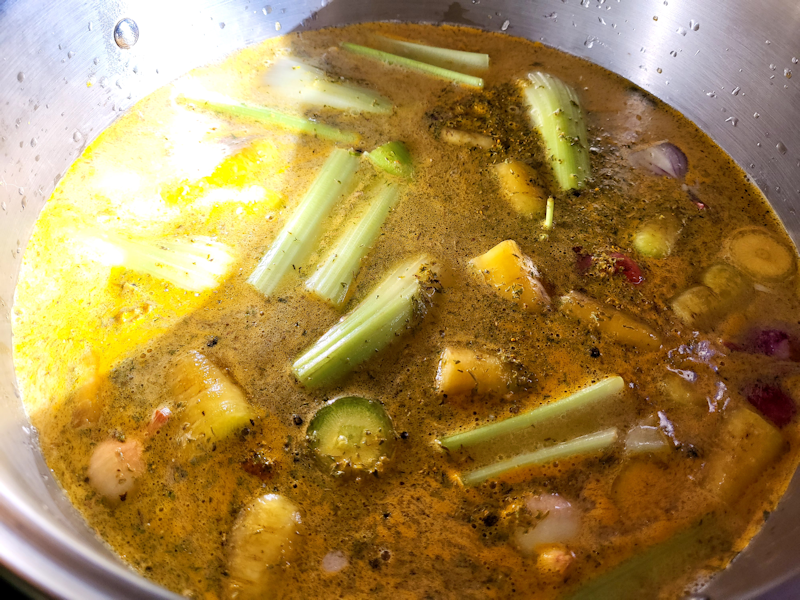
Along with the carrots I added crushed garlic cloves, yellow and red onions – the little ones from our garden – plus celery. For seasonings, I added course salt, whole peppercorns, turmeric powder, dried thyme leaves and dried parsley, then covered it all with water. Later on, I added a generous splash of our crab apple cider vinegar, too.

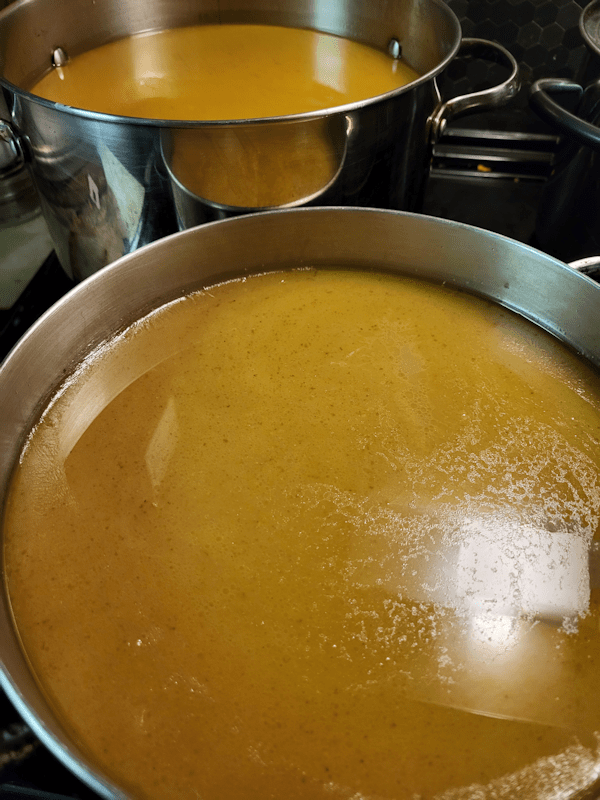
After bringing it to a boil I let it simmer for about 7 hours adding more water to the pot part way through. After that, I used a hot pot soup strainer spoon that I find very handy, to take out as many of the bones and vegetables as I could, then a small sieve to strain out more, before finally ladling it through a fine mesh strainer into my other two stock pots.

The larger pot, with the measurements on the inside, shows a little under the 6 quart line. In total, I would say there’s about 10, maybe 11, quarts (11 to 12 1/2 litres).

For now, the pots are covered and cooling, as is the bowl of carcasses and vegetables. I’m debating what to do with it next. I could just pour it into freezer bags and freeze them, as is. Or I could cook it down to make a more concentrated stock. I’m kind of leaning towards cooking it down more. I’ll see how it looks in the morning.

The Re-Farmer

How they turned out

Last night, after saving some for planting next year, I picked over the blue grey speckled tepary beans we grew, then left them to soak overnight. I ended up using all of the remaining beans.

This is how they looked after shelling.

After soaking overnight, they looked like this.

The got a bit bigger, but not by much, really.

I was going to use them in a soup, and decided to cook them separately, first. This is how they looked after being cooked al dente.

The colour is off because the camera got steamed up. They did lose a lot of their colour, and I noticed they turned the water quite grey, so I’m glad I decided to cook them separately, first. Otherwise, they would have turned my soup grey!

I was going to make a cream of chicken soup, but ended up making an “everything but the kitchen sink” soup. My daughters had roasted several whole chickens, with our own potatoes, a couple of days ago. Today, I deboned what was left of them, and used the remaining roasted potatoes in the soup, too. I also used a couple of yellow onions from the garden, the single shallot I’d picked yesterday, the last bit of slab bacon we had, and all of the Kyoto Red carrots, since there were so few of them. The tiny sweet potato harvest was used up, along with the last of our summer squash – green and yellow zucchini, and yellow patty pan squash. Corn kernels, cut from the cobs, went into the pot, as well as some of the tomato sauce I’d made recently. After everything was cooked, I took the immersion blender to it for a while, adding in some whipping cream at the same time. The very last thing was a handful of shredded cheddar cheese.

I tasted the beans after they were cooked, and they tasted like… beans. 😁 I had not added any seasonings of any kinds, so they were as plain as plain could be. Once in the soup, I honestly couldn’t taste them at all. They did add a nice texture, though, and the ones that got hit with the immersion blender helped thicken things a bit. I like my soups hearty and thick!

I think they worked out rather well, but… well… Aside from what I took out to plant next year, that was an entire year’s harvest, used up in a single pot of soup! 😂 I’ve set aside twice what we planted this spring. Between that and if we get a better growing year, it would be nice to have a much better harvest next year! I also have some beans my mother gave me. I don’t know the name of them, but they are a small (though bigger than the tepary beans) white bean that she grew every year from her own seeds. She’d given some to my sister, who grew them for years. She doesn’t grow beans anymore, so she brought a pasta sauce jar – just shy of a quart – full of seeds to my mother. My mother has no plans to grow them, in her little garden plot, so she gave them to me! They’re a few years old, but there should still be a decent germination rate. Which means that, next year, we should have two different types of shelling beans to grow.

The more, the better!

The Re-Farmer

Making yellow tomato sauce

There are only two people in our household that enjoy eating fresh tomatoes, but even they are getting tomatoed out when it comes to the Yellow Pear tomatoes! They were starting to accumulate, so I decided to make a small batch of tomato sauce.

Along with the Yellow Pear tomatoes, there were about five or six Chocolate Cherry tomatoes, and two Cup of Moldova tomatoes on hand, so they wall went into the pot together!

Being so small, they got mushy very quickly, so it wasn’t long before I was running them through the finer colander we have. Some of the seeds still get through, but no one seems to mind that. If I were making a tomato paste, though, I’d run it through a sieve as well, to get rid of the seeds.

After straining the tomatoes, I fried up some finely chopped onions and garlic in some olive oil until soft, then added the strained tomatoes back to the pot. For seasoning, I added salt and pepper, a bit of sugar, and a bay leaf, then cooked it down until slightly thicker.

It wasn’t quite enough sauce to fill a 750ml jar.

What a colour!

Not too long ago, I found some large mouth screw on jar lids – usually I can just find regular mouth. Since this is going into the fridge, I much prefer to use the screw on lid, rather than the canning lids and rings. I’ll have to pick up more of these when I find them again. Most of the canning jars we have are wide mouth jars.

Not being a fan of tomatoes in general, I didn’t actually taste this to see how it turned out. I’ll have to get my husband or daughter to do a taste test and let me know what they think!

The Re-Farmer