Welcome to my “Recommended” series of posts. These will be weekly – for now – posts about resources and sites I have found over the past while that I found so excellent, I want to share them with you, my dear readers. 🙂 Whether or not I continue to post these, and how often they are posted, will depend on feedback. Please feel free to comment below, and if you have a favorite resource of your own, do share, and I will review them for possible future posts.
I hope you find these recommendations as useful and enjoyable as I have!
This week, I would like to recommend a really excellent and interesting YouTube channel. How to Cook That, with Anne Reardon. Along with the YouTube channel, there is a website, and various other social media, Patreon, etc. sites, linked on the About page.
This channel has been putting up videos for 9 years, and the videos cover a LOT of ground! The primary focus is on dessert how-to’s, like this one from 2012.
Reardon – with the assistance of her incredibly brave husband! – also recreates some historical recipes.
That one is rather terrifying! :-D
They also put out “Clever or Never” videos, where they test out various kitchen gadgets.
We used to have the French Fry cutter they tested out here! Ours worked a lot more easily. I think the one they tested may have started to get pretty dull. :-D
Then there are her mind boggling Teeny Weeny Challenge videos.
I just can’t imagine working in that scale! Talk about going all the way, with that miniature kitchen, too!
The thing that first brought me to this channel, however is on a very serious note. Anne Reardon is a food scientist, and she has put out some very important videos. If you’re on Facebook at all, you’ve probably seen the cooking “hack” videos go by, which show several quick clips of “how to” make or do various things food related. Some of them simply don’t work. Others are actually dangerous.
With so much current pandemic misinformation around, she also did a video on some of that, too.
There is just so much great stuff here, in such a variety of food related topics. I highly recommend subscribing to the channel and spending some quality time checking out the videos!
One of my Recommended posts was for the Historical Italian Cooking YouTube channel. Recently, they put out a new video for a super simple dish made with ingredients we typically have on hand. Today, I was able to give it a try!
Here is the video.
You can also visit this link for the written recipe.
This is an ancient Roman dish; chickpea and leek soup, with a fried flatbread called lagana.
About the only thing we had to go out of our way to get for this recipe was the white wine.
There was one ingredient we couldn’t find, though. Durum wheat flour. Any type of flour is just now becoming easier to find, but there’s no chance of finding any out of the ordinary flours. All Purpose flour, which is what we have, is made with a blend of hard and soft red wheat. Here in North America, durum wheat tends to be used in pastas. It’s the sort of thing we’d have to go to specialty stores to find. I’m sure I could find it in the city, but certainly not locally.
So I substituted AP, since that’s what I had.
First, the soup ingredients.
Another substitute I made was to use canned chickpeas instead of soaking dried chickpeas overnight. The recipe called for 2 leeks, but has almost no other quantities given. I had 2 leeks, but they were pretty massive, so I used 2 cans of chickpeas to balance out the quantities. There’s also the white wine, some olive oil, and caraway seeds ground with a mortar and pestle. I eyeballed most of the quantities based on watching the video. :-)
The soup was started by boiling everything but the leeks in salted water for 10 minutes. Then, the leeks are added and cooking continues for another half hour.
While that’s being done, the flat bread is made.
The flour was the other thing with a quantity given: 300 grams.
Unfortunately, my kitchen scale disappeared. So we had to use a converter. I used a little under 2 1/2 cups of flour. Salt is added, then a dough is formed with some warm water. That’s it, that’s all!
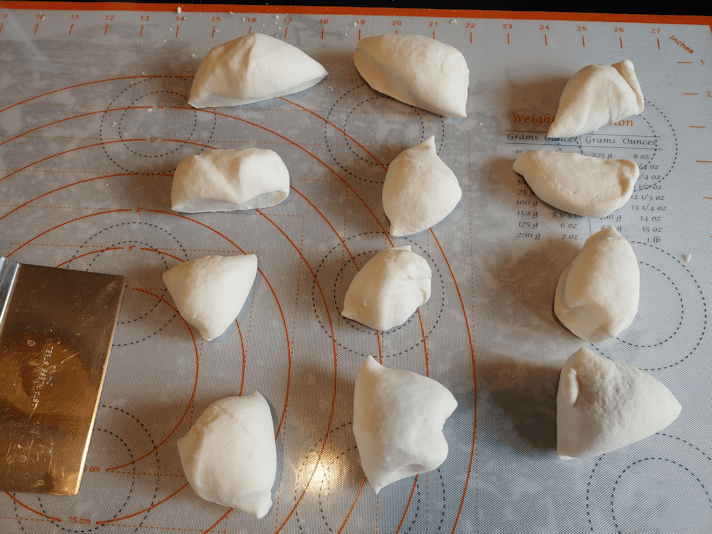
After the dough is kneaded until smooth, the recipe said to divide it into 10 pieces. There are 4 of us in this household, so I divided it into 12 pieces, instead.
The pieces of dough are then rolled out into rough circles.
The recipe calls for olive oil to be used to fry the bread. Olive oil has a low smoke point, so I modified the recipe a bit more. I added a bit of vegetable oil to increase the smoke point a bit. I was just frying in a pot on the stove, so this was more of a safety issue.
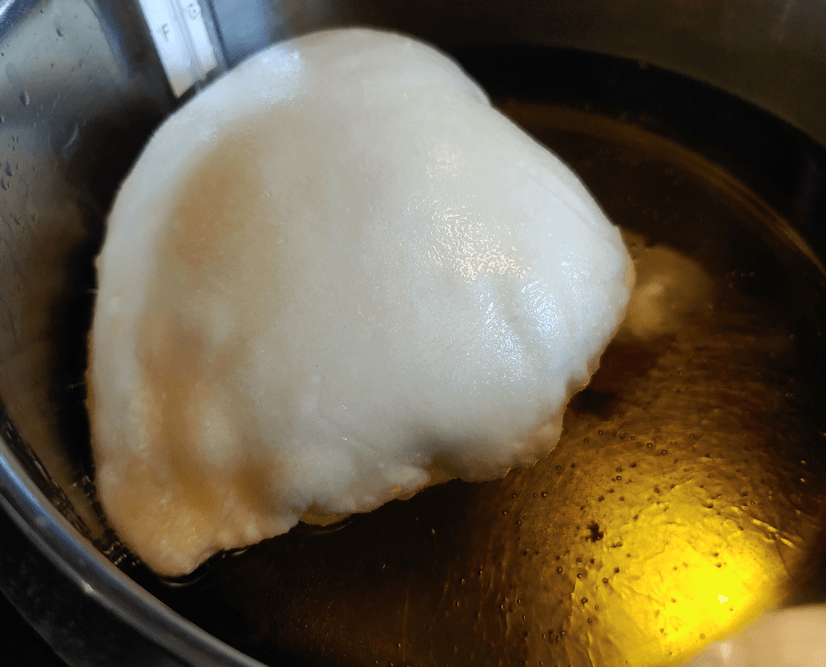
Once the oil was hot, the rolled out dough was fried, one at a time.
The dough bubbled up a bit in the video, but not into big dough pillows like this! :-D This could be because of the different type of flour, or even because of the oil blend.
Not that I’m complaining! :-D
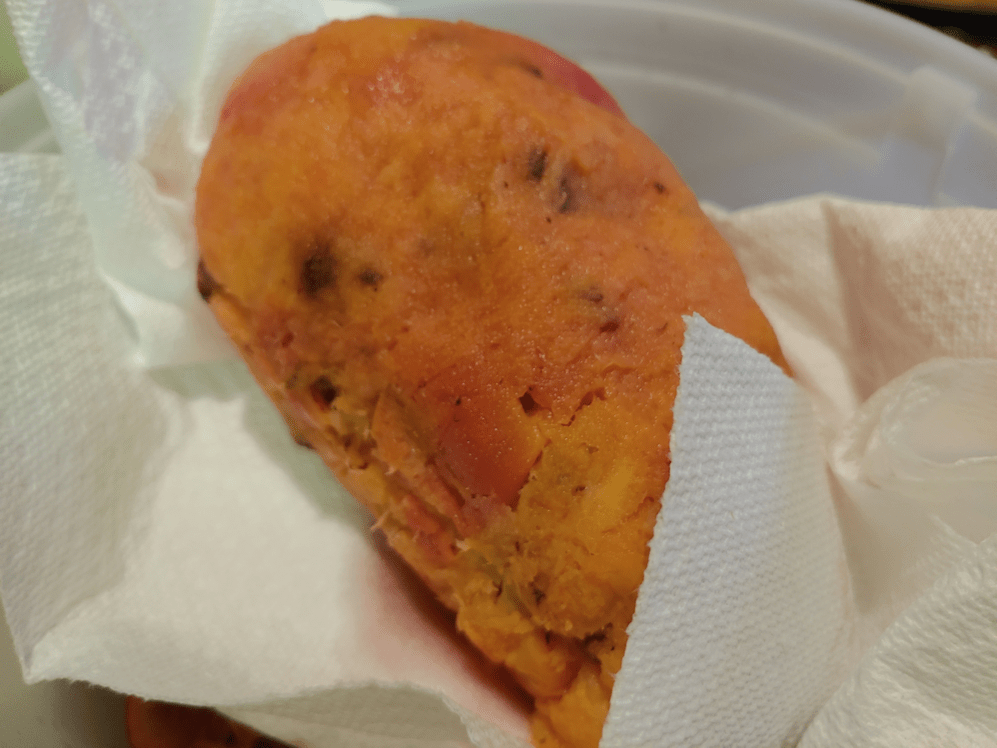
These fried up very quickly. Maybe half a minute on each side, to get them to a golden brown, before placing them on paper towel to drain. The bubbles cracked on a couple of them, allowing oil to get into the pockets. That took a fair bit of draining! The bread was finished well before the soup itself was.
They look absolutely amazing!
Taste test time!
The soup itself was very mild tasting. Possibly because I used more water than in the recipe. I couldn’t distinguish individual flavours of the caraway or the wine, for example. No one ingredient overpowered the other.
The lagana bread had a surprising amount of flavour for something that is just flour, salt and water! The outside was crispy, while the inside was chewy. It went incredibly well in the soup. A real balance of flavours. Making one without the other would not be as good as the two together.
This is a remarkably easy soup to make. The lack of quantities in the recipe made it a bit more interesting to work out, but that just gives room to adjust to one’s one preferences!
We did make one change in the recipe. We didn’t have any extra virgin olive oil. We did, however, have avocado oil, so we used that, instead.
It worked very well!
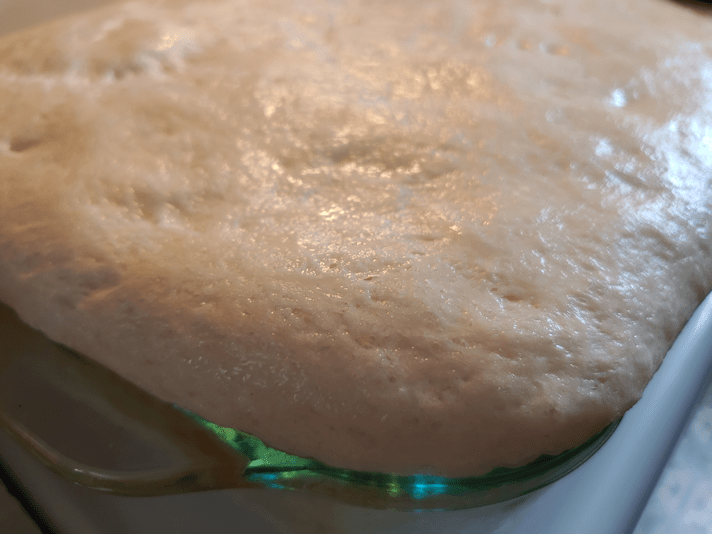
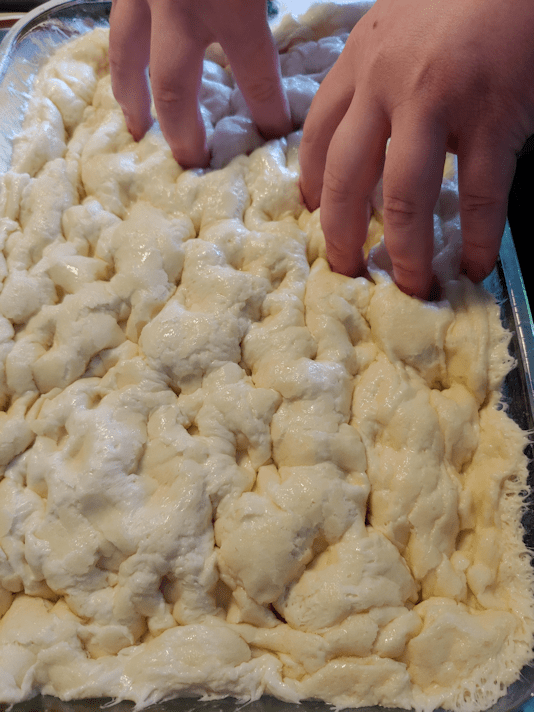
We also didn’t have the type of pan they recommended. We have 9×13 pans. Just not with high sides. So we used a slightly smaller glass pan. The dough has a second rising in the pan, and was very close to overflowing before it was vigorously poked at to deflate it.
For a recipe with no oil in the dough, it uses quite a lot of oil! And butter. The baking pan is buttered, first, then oil added, then the dough put in.
Just before putting it in the oven, more oil is drizzled over the top, and sprinkled with Kosher salt. After it’s baked, butter is melted with garlic, which is drizzled on top.
The end result is both beautiful and delicious. That salty, buttery, garlicky topping is sublime! The texture is moist and chewy, and there were some pretty large bubbles in there! Even the bottom crust has a very nice texture, thanks to the butter and oil combination.
I rather like avocado oil better than olive oil in a lot of things, but it’s frightfully expensive stuff. Costco has it at much better prices, at least.
This recipe is definitely worth trying out! It has rising instructions for both an overnight dough and a same day bread.
Now excuse me, while I go back to enjoying this Focaccia!!
Today my daughters did the baking, starting with a sourdough “batter” bread.
There’s a reason the word batter is in quotations…
The girls have been finding recipes they like and, after trying them out, adding them to a notebook with any modifications or adjustments they’ve come up with.
Sometimes, I think we really need to do bread baking more often.
Then I remember how much clean up is involved. :-D
No matter! We now have two kinds of freshly baked bread done.
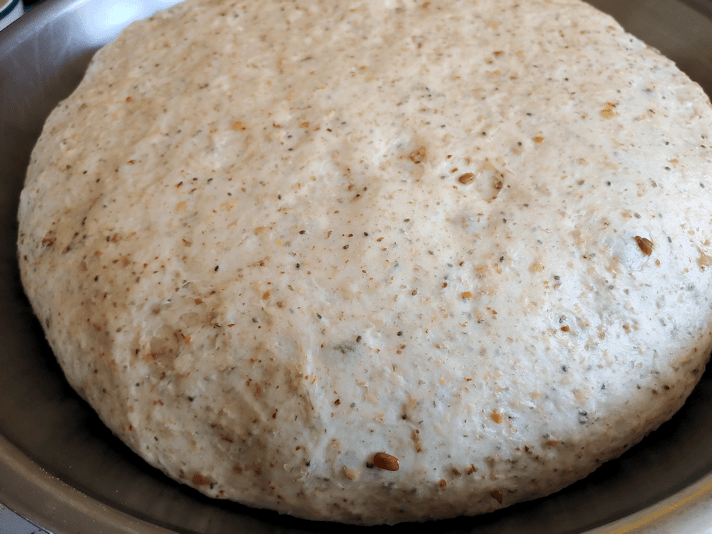
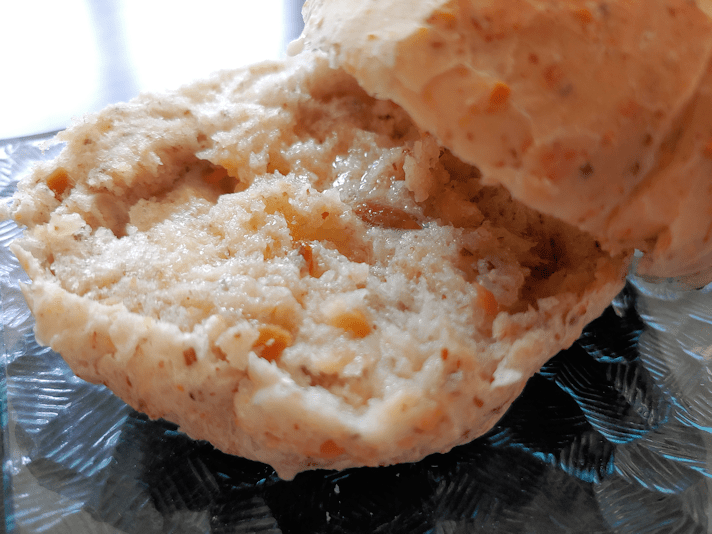
Here’s how the seedy bread turned out.
This is how it looked after only 1 hour of rising time. The bowl it’s in is pretty huge – too big to fit in our kitchen sink (which makes washing it a bit of a challenge! :-D ) – with plenty of room for this 4 loaf recipe.
The timing of things works out really well. I use half the dough to make buns first, leaving them to rise while I shape a couple of loaves. Once those are done, I star to preheat the oven. By the time it’s heated up, the buns have risen enough to go straight in. Once they’re out, the loaves have had enough time for their second rising. When those are done, the overnight sourdough loaves are ready to go into the oven. No wasted time in between, making for more efficient use of a hot oven.
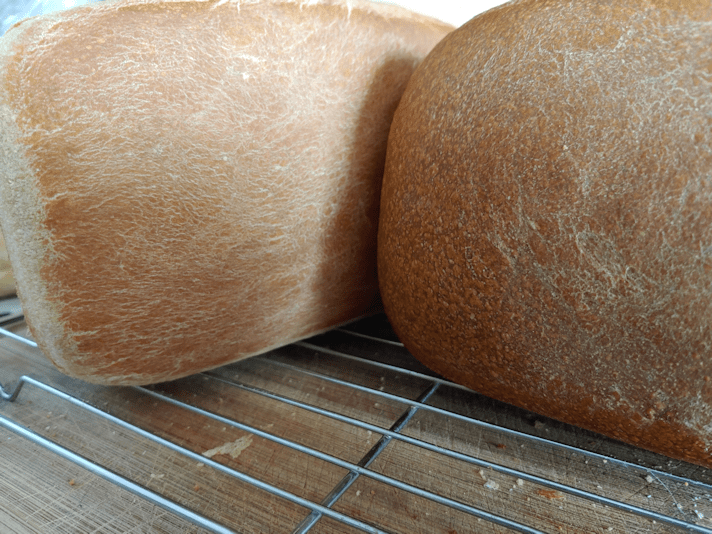
They came out quite beautifully, too! Such a tasty bread, with a really nice texture. I love the bit of crunch the seeds add to it.
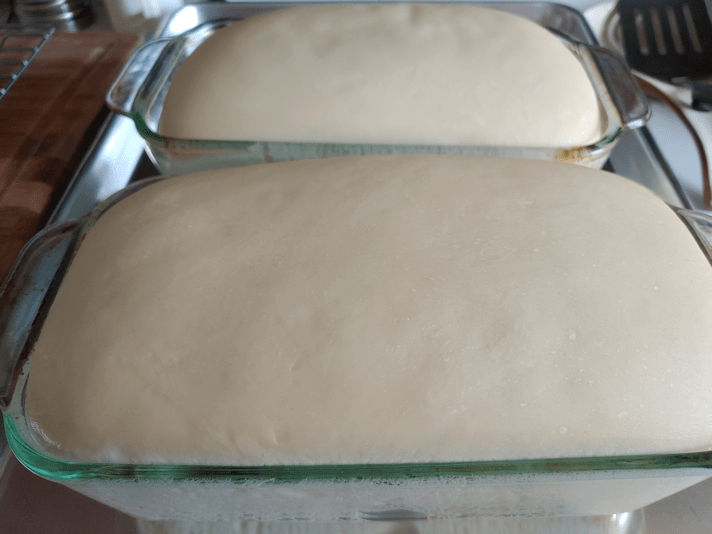
The second rising for the sourdough loaves was probably about 4 – 4 1/2 hours. The first rising was probably about 11 or 12 hours.
This is how they looked, just before I put them in the oven. They definitely rose more than the first time I tried this recipe, so the modifications made quite a difference, but still not rising as high as variations that use added yeast.
Is it worth it?
I think so.
The actual working time to make this bread is low. It’s mixed at night, then kneaded for 10 minutes the next day. It really doesn’t need a lot of attention.
The loaves came out so smooth and gorgeous. None of the cracking you can get when using an added yeast bread, since there’s no sudden rise in height in the oven.
The bread itself has a slightly thicker, sturdier crust, while the crumb is incredibly soft, tender and fine in texture.
Reducing the amount of sugar was definitely a good move. The sourdough flavour was more dominant this time, whereas the last time I tried this recipe, the sweetness was more dominant. I think adding that little bit of baking soda helped with the rising, too.
I’d still prefer a more “sour” sourdough flavour, but that has more to do with our starter than with the recipe. We’ll be making more of this one, that’s for sure. I think I’m satisfied with it enough that, next time I bake it, I’ll post with the tweaked recipe.
Tomorrow is going to be another baking day, though this time for my daughters. I look forward to seeing what they’re planning to make. :-)
One of my long time interests is experimenting with historical cooking.
I say experimenting, because it’s not unusual for these recipes to include ingredients that are no longer available, hard to find, unknown or even extinct. Plus, they often don’t include a lot of information, either because it was assumed the reader already understood what was needed, or it was simply technologically impossible for the time period.
Thankfully, that’s not as much of a difficulty for recipes from more recent time periods.
Not too long ago, I discovered a YouTube channel called Townsends, featuring all things 18th century. I highly recommend it! I was intrigued by this video on how to make Mushroom Ketchup.
Yes, you read that correctly! Mushroom. Ketchup.
It sounded both weird and delicious at the same time! :-D
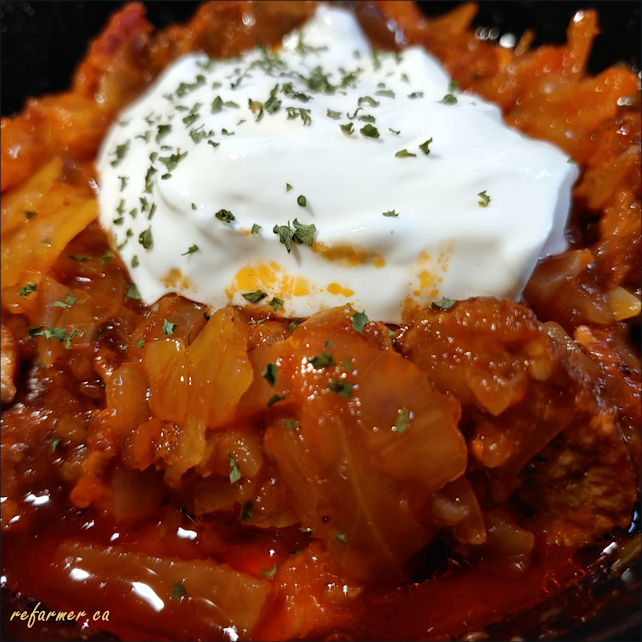
Traditionally, bigos – otherwise known as Hunter’s Stew – is made with game meat and a whole lot of ingredients I don’t typically have on hand. I just used what I had! Maybe I should call it Non-Hunter’s Stew? :-D
This is my version of Poland’s national dish!
I made this yesterday evening, for today’s eating, and I must say, it turned out very well!
cooked sausage, cut into 1 inch pieces, to make about 2 – 3 cups
2 cups cubed pork or fresh meat of choice
1 package bacon
1/2 cup crab apple cider vinegar, mixed with 1/2 cup vegetable broth, or 1 cup de-glazing liquid of choice.
1 can crushed tomatoes
1 can tomato paste
optional: seasonings to taste
Top row, left to right: sauerkraut (rinsed and draining), chopped crimini mushrooms, cubed pork, cooked sausage (honey garlic). Middle left: frying bacon pieces. Middle right: de-glazing the pan Bottom row, left to right: softening cabbage mixture, all ingredients stirred together, stew after 1 hour in oven, stew after 2 hours in oven. Centre:Bigos, after resting overnight, topped with sour cream and parsley
Instructions:
Turn oven on to 350F.
drain sauerkraut, rinsing if desired. Squeeze out excess liquid.
chop onion and garlic coarsely
core and finely cut fresh cabbage. Cabbage, onion and garlic can be combined into one bowl for later.
trim mushroom stems, cut mushrooms in half, then slice. (Alternatively, re-hydrate dried mushrooms in boiling water, then chop coarsely. Reserve liquid to add to the stew.)
cut bacon into 1/2 inch pieces
prepare de-glazing liquid (my vegetable stock was hot water and powdered bouillon)
Place the cooked sausage pieces into a large, oven safe pot with lid.
In a large frying pan, fry the bacon pieces until just browned. Add bacon to the sausage, reserving rendered fat in pan.
Brown pork cubes in the bacon fat. These do not have to be cooked through. When browned on all sides, add to the sausage and bacon mixture, reserving fat in pan.
Add mushroom pieces to the reserved fat and cook until just starting to brown, stirring frequently. (If using reconstituted mushrooms, skip this step and just add the mushrooms to the pot with the meat.)
Add de-glazing liquid to the pan and cook liquid down to about 1/3rd volume.
Add cabbage, onion and garlic to the pan. Cover with lid to steam for a couple of minutes, and for the cabbage to reduce slightly. Continue to cook, turning the mixture often, until vegetables are softened.
Add the sauerkraut and softened cabbage mixture to the pot with the meat and mushrooms.
Add the crushed tomato and tomato paste (plus reserved mushroom stock, if reconstituted mushrooms were used). Mix thoroughly.
By now, the oven should be preheated. Cover the pot and place in oven.
Check after about an hour and stir. If the liquid level seems low, add boiling water, as needed to prevent burning.
Check after 2 hours and stir. Adjust liquid again, if needed.
Cook for another half hour or so.
Can be eaten immediately, or left to cool and rest overnight (recommended).
Serve with rye bread, or a dollop of sour cream. Garnish with parsley if desired.
For this, I used no added seasonings at all. The ingredients themselves add a lot of flavour on their own. However, feel free to add whatever seasonings you like, if you feel the need.
Of course, after this was done cooking last night, I had to have a small bowl to taste it. It was definitely a success! Letting it rest overnight did allow the flavours to mellow and combine very nicely. It was a subtle difference, but enough for me to recommend giving it that extra time.
The more traditional ingredients for this dish includes a greater variety of meats, with game meat being the prime ingredient, and even prunes – though the bigos I’ve tasted in the past did not include prunes. Some versions include things like grated carrot, but my fermented vegetable sauerkraut includes carrots, so there was no need to add more.
The amount of sauerkraut I used is a bit on the low side – a typical jar of commercial sauerkraut is about 900-1000ml (approximately equal to a quart jar) and my jars are 500ml. Even adding the last of my plain sauerkraut gave me just over that amount. However, that is also the equivalent of more than half a head of cabbage. The fresh cabbage I used was more on the large than medium size, so between the two, the total quantities didn’t change much.
This makes quite a large quantity of stew, and it really helps to have a very large, deep frying pan with a lid. Even then, I had to be careful adding the cabbage mixture to the pan! Using the lid to let it braise for a bit made it much easier to stir, as the cabbage released its liquid and reduced in size.
This dish can be made on the stove top instead of the oven, but that would require continuous attention and stirring to make sure it cooks evenly and doesn’t burn on the bottom. Using the oven is just simpler and more efficient.
If you try this recipe, do feel free to let me know how you liked it!
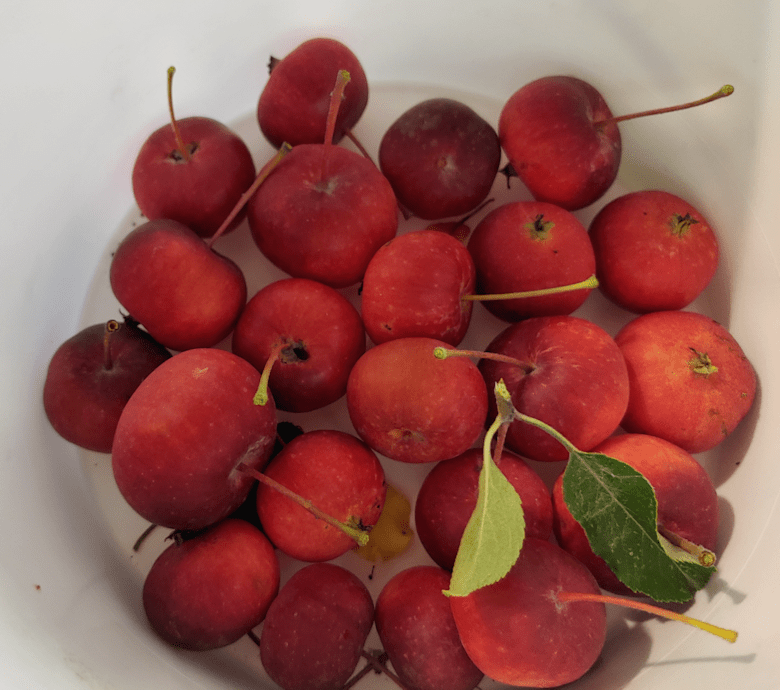
Once we got our crab apple cider vinegar made up and set aside to ferment, it was time to turn to the rest of the crab apples!
The apples had been cleaned and left to soak in cold water with vinegar overnight. The extra time allows for any damage and bruising to the apples to be easier to see.
The next steps were to remove the stems, then cut the apples. These crab apples are small enough that I just cut them in half.
This was the time to cut out any damaged bits – or remove some apples completely.
There were quite a few that looked fine on the outside, only to be bad in the middles. The above photo is what I removed from the apples, including the small batch I used for the apple cider vinegar.
Just a little something for the compost pile. :-)
As I have some of our choke cherries and sour cherries in the freezer, I decided to make several small batches, including spiced jelly. Some of the recipes I saw said to cook and strain the apples first, cook the juices with the other additions, strain them again, then make the jelly.
I had no interest in cooking and straining these twice, and saw no reason to. Instead, I divided the cut up apples into three pots. I had two medium sized pots plus my smaller stock pot, so after I filled the two smaller ones, any left over apples went into the bigger pot. My smaller pots each held about 6 cups of chopped apples, and the bigger pot had about 7 cups of apples.
I then made my additions.
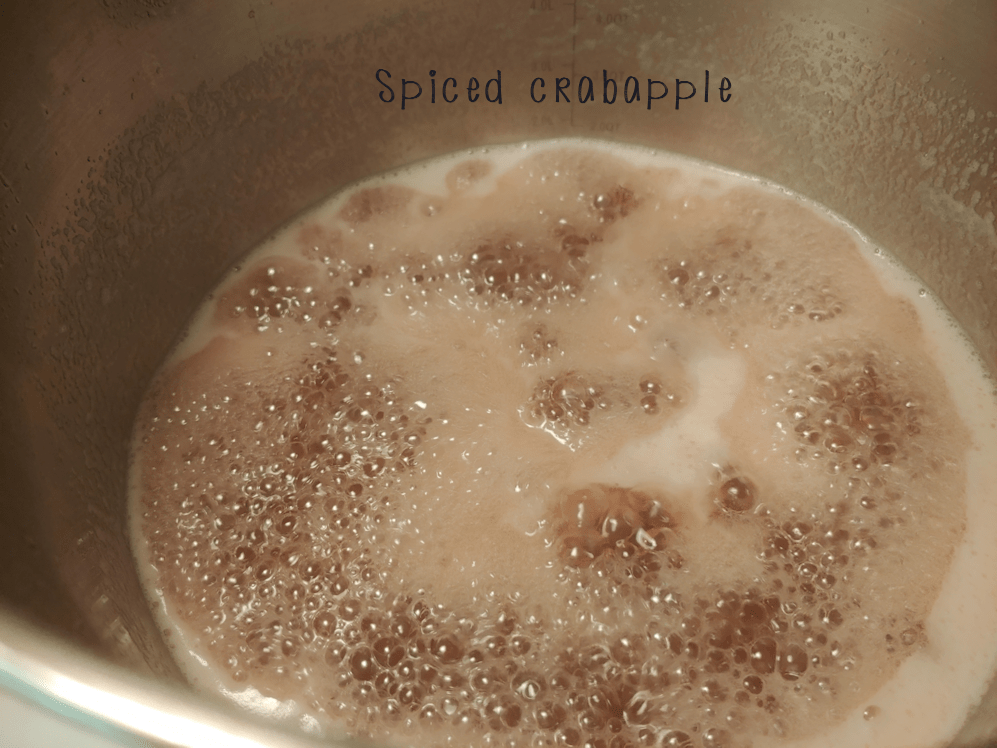
The spiced batch got a couple of cinnamon sticks, 2 pieces of star anise and about a tablespoon of whole cloves. The others got about 1 cup of frozen fruit added.
Next, water was added until the fruit was just covered. They were then brought to a boil, covered and left to simmer until soft.
The pot the choke cherries were in turned out to be just a touch too small, and I had to transfer it to my other stock pot to prevent it from over flowing.
After about 20 minutes or so, I stirred them down to break up the fruit a bit; I had to use a potato masher on the spiced apples, as the pot was too full to stir properly!
I continued to cook them until the fruit was quite soft.
This is the sour cherry batch on the left, choke cherry batch on the right. I forgot to get a picture of the spiced batch before I put it up to strain.
While the apples were cooking, I prepped for straining.
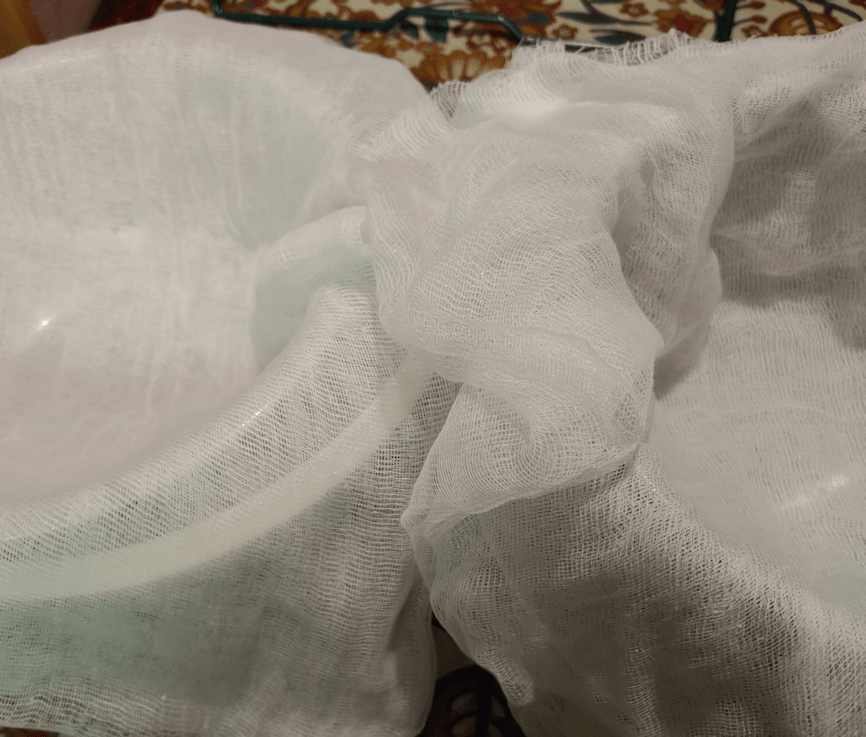
I currently have only one jelly bag, so I lined colanders set over large bowls with cheese cloth.
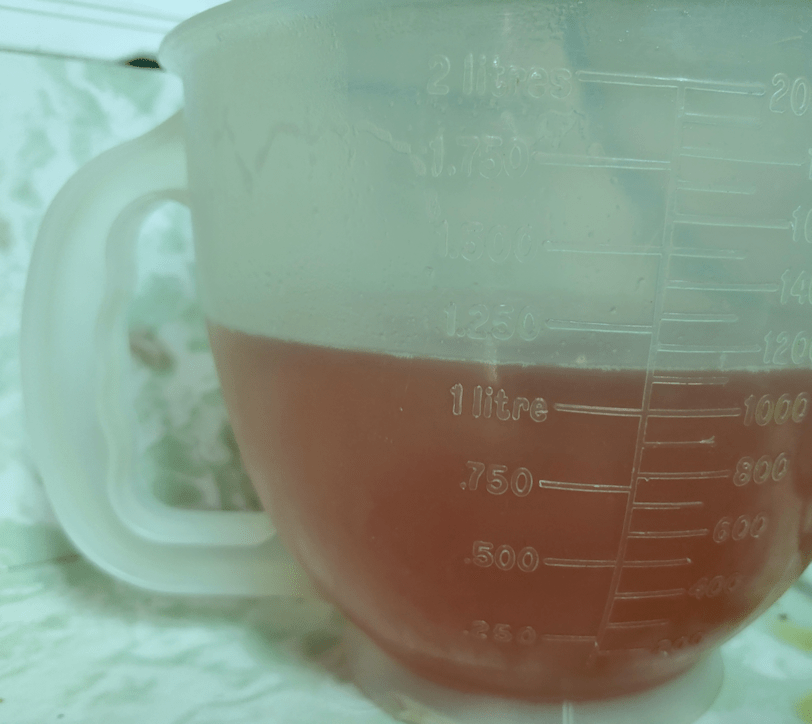
I used the jelly bag for the spiced mixture and hung it up in my usual spot. By then, I already had over a litre of juice strained out!
I had to get creative to hang the other two. I used one of those wire frames made to hold bags open, like for leaf bags. Thoroughly cleaned, of course. I set it up on the dining table and hung the tied off cheese cloth bags of apple pulp on the frame, with their bowls of juice set up under them and the colanders removed. I wasn’t able to get a good photo of the set up, though.
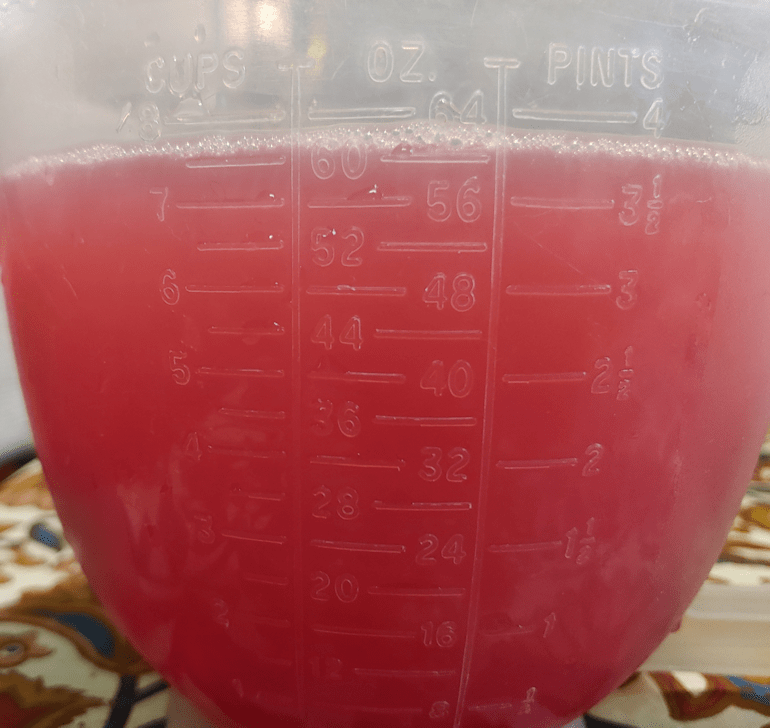
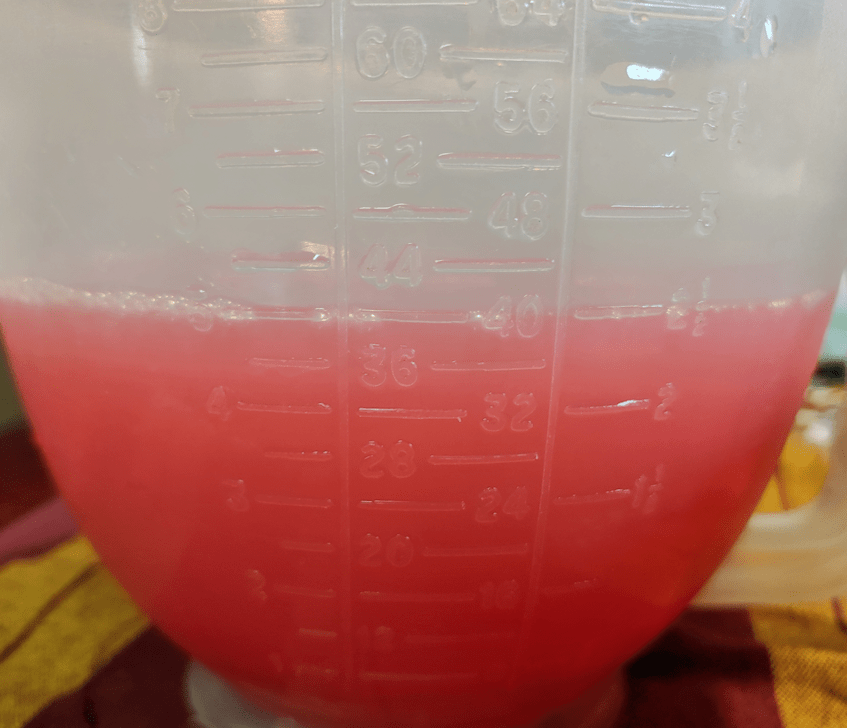
I then left the bags to drain overnight, though we did cover the various bowls with whatever we had on hand. One got a piece of cheese cloth stretched over it, another bowl was the perfect size for our mesh frying pan splash screen, and the big measuring cup got covered by a large mesh sieve. These all allowed the juices to keep dripping in, while keeping out any dust, cat hair, insects or whatever else might be floating about.
Note: they don’t need to be left overnight, but the pulp should be given at least a couple of hours to drain. Some recipes suggest to squeeze the pulp to extract more juice. This will result in a cloudy jelly, so that’s up to you! ;-)
That was all done yesterday. Today, it was time to cook things down!
I did each batch one at a time, rather than all at once, starting with the juice that was already in the measuring cup.
This is the spiced apple pulp from the jelly bag. The pulp all went to the compost pile.
I ended up with almost exactly 5 cups of juice from the spiced apple and the choke cherry batches, and almost exactly 8 cups of the sour cherry batch. For each cup of juice, I added a 3/4 cup of sugar.
Which felt like an insane amount of sugar, but that’s how it works!
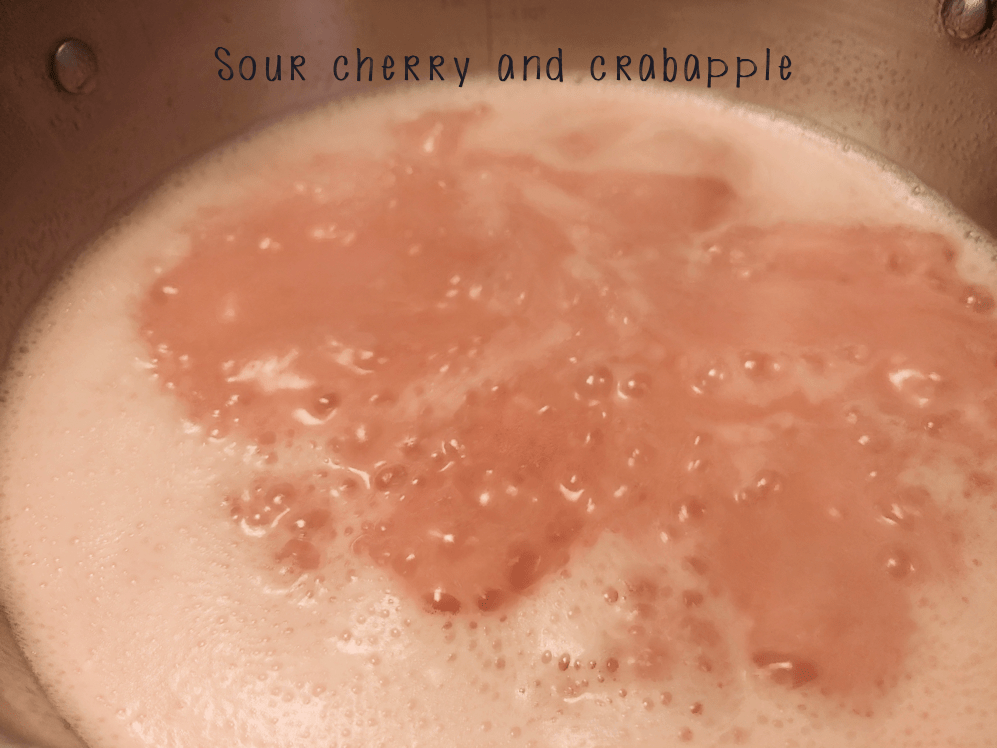
Each batch was boiled to the gel stage.
Before I started cooking any of them, though, I started sanitizing my canning jars. With how much juice I ended up with, I knew my dozen 250ml (1 cup) sized jars would not be enough. I decided to use one 500ml (2 cup) for each batch, then use however many of the smaller jars I needed to empty the pot. The larger jars will be for our own use, and the smaller jars can be given out as gifts, if we want.
I also made a discovery.
We have not been able to replace our damaged hot water tank yet, which means it’s still heating the water to extremely high temperatures. I figured I would take advantage of that and use it to sanitize my jars and implements.
I was able to set up all the jars in a large container on the counter near the stove. I was also going to use my candy thermometer, so I dug that out, washed it, then put it into one of the jars to scald. Shortly after, I pulled the candy thermometer out. The whole set up with the water had been sitting for about 5-7 minutes since I added the hot tap water, so I had to do a double take when I saw the thermometer.
It was at almost 100C.
That’s 212F.
The instructions I was following said to cook the juice and sugar mixture to 210F to reach gel state. My tap water was already hotter than that!!
The juices reached beyond 210F very quickly, so there was no way temperature alone was enough to reach gel stage, so I kept boiling it. After the first testing, I went to wash the thermometer and discovered there was water in it.
???
Looking closer, I discovered that the glass covering the bulb of the thermometer was gone! For all I know, this is damage from our move. I very rarely use the candy thermometer.
So I threw that out.
Which meant I was checking for the gel state using the *spoon test.
Each batch took me at least half an hour of boiling before it reached the gel stage.
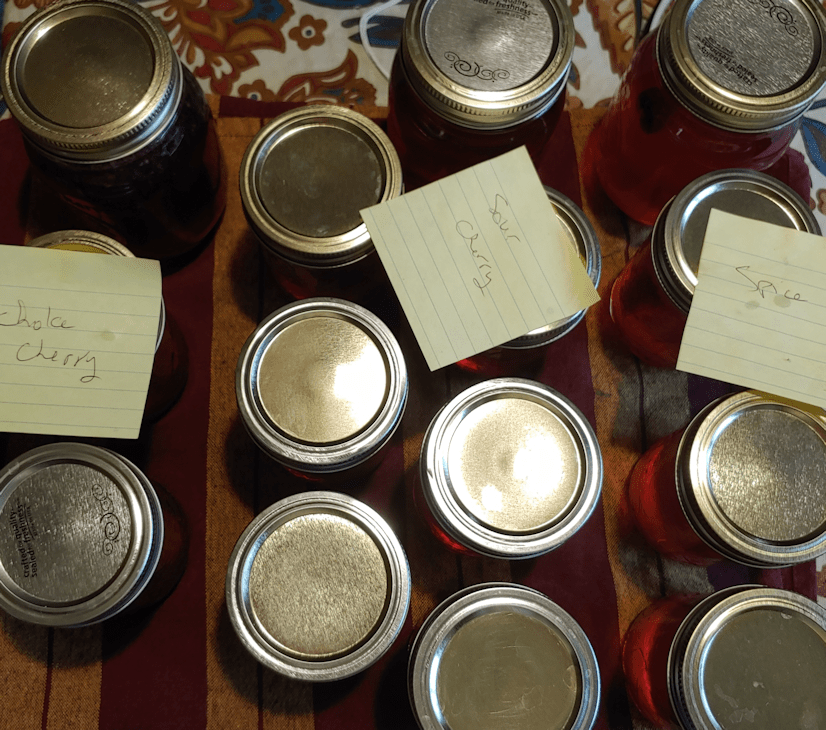
Once each batch was ready, I filled some jars – I added cinnamon sticks to the jars with the spiced jelly – covered them, then set them aside to cool while I washed everything before starting the next batch.
My 8 cups of sour cherry juice mix, and 5 cups of spiced juice mix, each gave me the same number of cups of jelly, but for some reason the 5 cups of chokecherry juice mix resulted in only 4 cups of jelly!
I still don’t have the tools to do a hot water bath, so these are not shelf stable, and will need to be stored in the fridge.
I absolutely love the colours in these!
After they had a chance to cool, my daughters used some when making supper this evening. They made grilled cheese sandwiches with some of the sour cherry jelly spread in with the cheese. It was really good!
The Re-Farmer
Homemade Crab apple jelly, with flavour variations
Items needed:
cheese cloth or jelly bag
bowl to drain juices into
if using cheese cloth, a colander that fits in the bowl
canning jars, jar funnel and lids, sanitized
place to hang pulp bag over the bowl
large saucepan or stock pot with lid
Ingredients:
crab apples, washed, stemmed and chopped. (no need to peel or core)
sugar
Optional flavour additions
about a cup of fruit or berries per 6 cups of chopped crab apples.
any combination of whole, not ground, spices, including cinnamon sticks, whole cloves, allspice, star anise, etc. to taste.
Place cleaned and chopped apple pieces into a large pot.
Add any flavour options desired.
Add enough water to just cover the fruit. Bring to a boil.
Cover and simmer for about 20-25 minutes, or until apples are very soft. Stir the fruit every few minutes.
Mash the mixture with a large spoon or potato masher. Cook for a few more minutes.
While the mixture is cooking, dampen a jelly bag and ready a bowl to catch juices, or line a colander placed in a bowl with cheese cloth (in 4 layers) and prepare a place to hang the pulp over the bowl.
When the fruit is cooked until completely soft, spoon the mixture into the jelly bag over a bowl, or into the prepared cheese cloth. Tie off the bag and hang over the bowl to drain for at least a few hours, or overnight. (After draining, pulp can be composted.)
Prepare canning jars and sterilize implements.
Measure the juice extracted and place into a large saucepan or stock pot. Add 3/4 cup sugar per 1 cup of juice.
Bring to a boil over high heat. Boil, stirring often, until mixture reaches gel stage*. This will take about 20-40 minutes, depending on how much juice there is.
Pour hot jelly into heated canning jars. Skim off foam, seal and set aside to cool.
Process in hot water bath or store in refrigerator.
* Sheet test for gel Dip a cold metal spoon into the boiling soft spread. Lift the spoon and hold it horizontally, edge down, and watch how the mixture drops. When the mixture reaches the gel stage, it will begin to “sheet”, with the jelly breaking off the spoon in a sheet or flake, rather than pouring or dripping.
Things have been a bit crazy lately, weather wise. Some severe storms have blown across our area and, while we have pretty much just caught the edges of them, they still resulted in internet outages and our power flickering in and out.
Perfect weather to stay indoors and to things with our crab apples!
I decided to use the small amount of apples from one tree to make apple cider vinegar.
A recipe I found called for filling a quart jar 3/4’s full, and it seemed I had enough to do that with just these.
I washed all the apples in cold water with a splash of vinegar, leaving them to sit overnight. The recipe I found called for the scraps of apples – skin and cores – adding that if whole apples were used, to chop them coarsely. Since the crab apples are so small to begin with, after removing the stems, I cut them all in quarters. Some also needed to have bruises or damage cut out, and a few turned out to be bad on the inside and could not be used.
In the end, I had just the amount I needed to fill the jar 3/4’s full, perhaps a touch extra.
The next step was to dissolve a couple of tablespoons of sugar into a cup of water and adding that to the jar, then adding enough water to completely cover the apple pieces. Filtered water was suggested. As we have well water, we could have just used that, but our water is very hard and iron rich, so I used bottled water I happened to have.
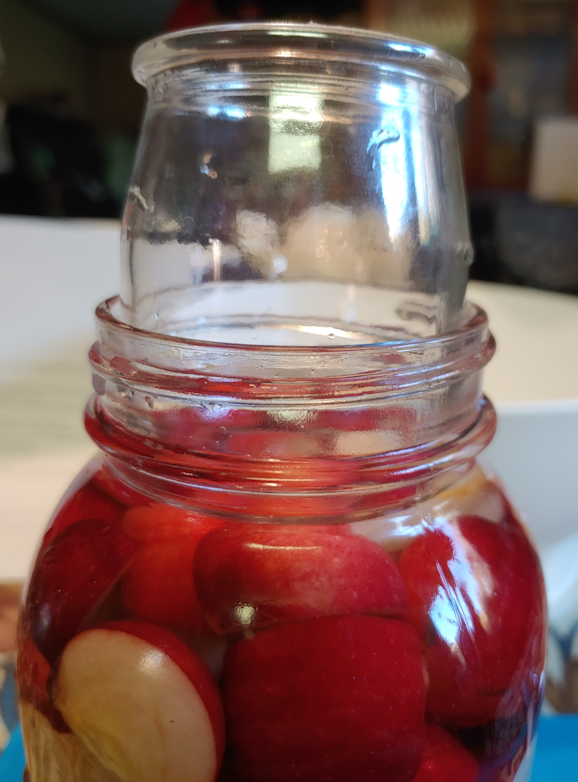
The apples need to be kept submerged, and there are fermentation weights available for this. I have none, and had never seen one before looking it up on the internet. The alternative was to put a small jar in to weigh it down.
I have a collection if tiny jars that I have hung on to, and one of them fit perfectly into the quart jar! This is from a package of yogurt that came in 4 little jars to a package. I admit, I bought it just for the jars because they were so adorable. Handy, too!
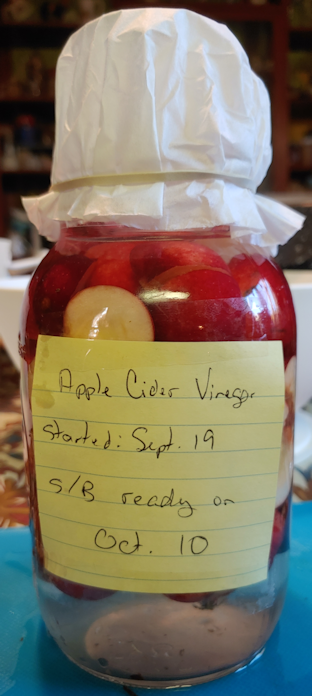
The next step was to cover the jar with something that would keep dust or whatever out, but allow air in. It could be a piece of cheese cloth, some thin cloth or a coffee filter, fastened in place.
I stole one of my daughter’s coffee filters.
Now it needs to just sit in a dark place at room temperature to ferment into vinegar. This should take about 3 weeks. I’ve tucked it into the top of a cupboard we used fairly frequently, so it will be easy to check if there is any mold happening.
After 3 weeks or so, it will be strained, then left at room temperature to continue to ferment for another 3 or 4 weeks.
Once it’s at the desires taste/strength, it just needs to be strained and re-bottled. We’ll see how it turns out!
The Re-Farmer
Apple Cider Vinegar
Items needed:
quart size jar (an air and liquid tight lid will be needed after fermentation is complete)
fermentation weight or another jar small enough to fit into the mouth of the quart jar
cheese cloth, clean cloth or coffee filter to cover the jar
cord or elastic to fasten cover in place
Ingredients:
apple scraps or whole apples, coarsely chopped; enough to fill a quart jar 3/4 full
2 Tbsp sugar
about 2 cups filtered water
Sanitize a quart jar and let air dry.
Fill the jar 3/4 full with apple pieces.
Dissolve sugar in 1 cup water and pour over the apples.
Top up with more water until apples are covered.
Add weight or small jar to keep apples submerged. Exposed apples may start to mold.
Cover the jar with a cheese cloth or coffee filter and use a cord or elastic to hold it in place.
Place in a dark location at room temperature and leave for about 3 weeks. Check regularly to ensure the apples remain submerged and no mold is growing.
After 3 weeks, strain the apple pieces out, return liquid to the jar and cover again with cheese cloth or coffee filter.
Return jar to a dark location at room temperature for another 3 or 4 weeks, stirring every few days.
Taste after 3 weeks to see if it has reached desired tartness. If not, leave to ferment longer until it reaches the desired flavour.
Cover with a lid and use as desired. The vinegar can also be transferred to a different jar or bottle, if preferred.
If you notice a film has formed at the top of your vinegar, congratulations! You have developed a “mother.” It can be used as a starter for future batches of vinegar – or a small amount of a previous batch can be used.






















 The Re-Farmer