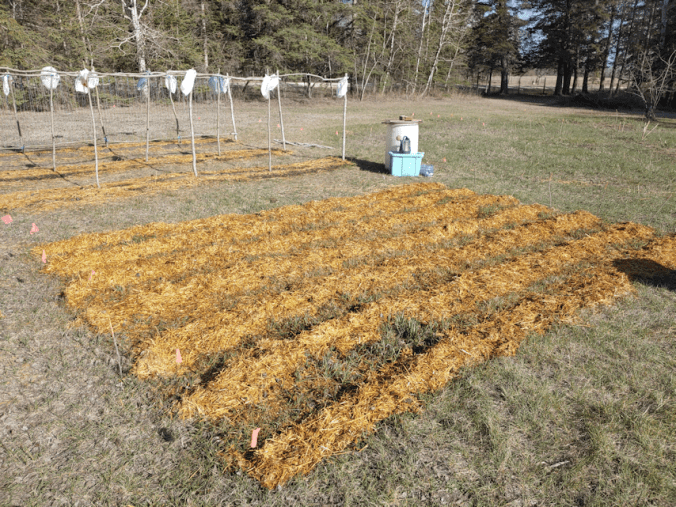
Our 2021 garden: direct sown corn and sunflowers, done!

The crab apple trees near the old garden area are starting to bloom. Not all of them yet, but this one was looking gorgeous, today. :-)

This morning, after all the garden beds were watered, my older daughter and I got to work on the corn and sunflower blocks. She started by making furrows for the seeds and watering them, then I followed behind to plant.

We managed to get 2 corn blocks done, with radishes planted in between, when we stopped for lunch. It started raining, and for a while I thought we wouldn’t have a chance to finish, but it did get done! Mind you, I was getting rained on while planting the last seeds, but not enough for it to be an issue. :-)

These are the three types of corn that got planted today. At the far end in the photo, is the Sweetness, then Early Eh, and finally the Montauk, in the foreground.

Because the soil is hardest packed the further north we go, we planted the April Cross Chinese Radish, a Daikon type radish, in the northernmost corn block. The packet had much fewer seeds than I expected, so we were able to include them in only 3 of the 5 rows. There was enough Red Meat Watermelon Radish to interplant with the remaining two blocks of corn. Hopefully, both varieties will help with breaking up the hard soil and, once harvested, will give the corn’s roots more room to grow into. This is really late for radishes to be planted; they can be planted as soon as the soil can be worked, however with their short growing season, it should still work out.

The blocks of 3 rows were for the sunflowers. The Mongolian Giant got planted in the block to the north; with how big they are supposed to get, I figured that would work out better. There aren’t a lot of seeds in the packets, but at 2 ft apart, I did end up filling two rows. There will still be the transplants to include, about a week from now. The 3 row block that’s to the south got the Hopi Black Dye sunflowers. The flags mark the block with the Hopi Black Dye and, not being a giant variety, they were planted 18 inches apart. That filled 2 rows as well. Not a single one of the packet we started indoors has germinated, so there is nothing to transplant. We will have more Mongolian Giant transplants than will fill in the one row left in that block, so we might end up splitting them between the two blocks. I didn’t think ahead, and planted seeds on the northern rows. Any Mongolian Giant transplants could end up shading the Hopi Black Dye – though with zero germination from the first packet, I wouldn’t be surprised if none of these germinated, either. I am at a loss as to why the ones we started indoors completely failed to germinate.

Now that these beds are done, we have some time before we can start transplanting, which should be enough time to get the squash tunnel built, and create more beds for them and the other transplants that need them.

Two weeks from now, if all goes well, all the planting (not counting successive sowing) should be done!

The Re-Farmer

Our 2021 garden: morning progress, and changes in plans

My morning rounds now includes watering all the garden beds. Though we have had rain in the forecast, so far we’ve only received the lightest of smatterings. Hopefully, over the next few days, we’ll get some real rain.

I had a lovely surprise when I came into the sun room this morning.

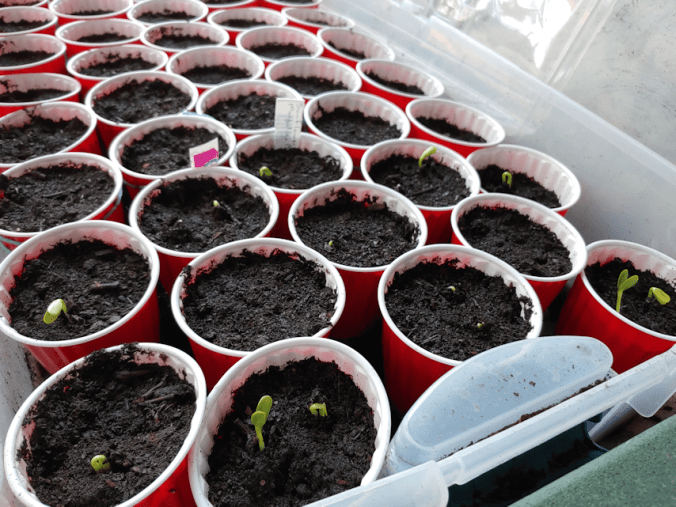
SO many more of the Mongolian Giant sunflowers and Montana Morado corn are germinating! The corn is just little points of green, barely visible in most of the cups.

In the pellet tray, I think I even saw a cucamelon sprout starting to break through.

It’s getting close to time to start hardening off our bigger seedlings for transplanting. :-)

I can now say, with absolute certainty, that all three spinach beds have sprouts. :-) I might even have, just possibly, maybe, seen our first pea sprout this morning, too! :-D

When done checking the trail cam files, I headed back outside until it got too hot for manual labour in the sun. My computer’s weather app says we’re at 16C/61F that feels like 15C/59F, while my phone’s app says we’re at only 9C/48F with a RealFeel of 12C/54F! There is no way we are only 16C out there, never mind 9C. I have no doubt it’s at least 20C/68F out there right now. I’m thinking of picking up another outdoor thermometer to set up at the pea trellises.

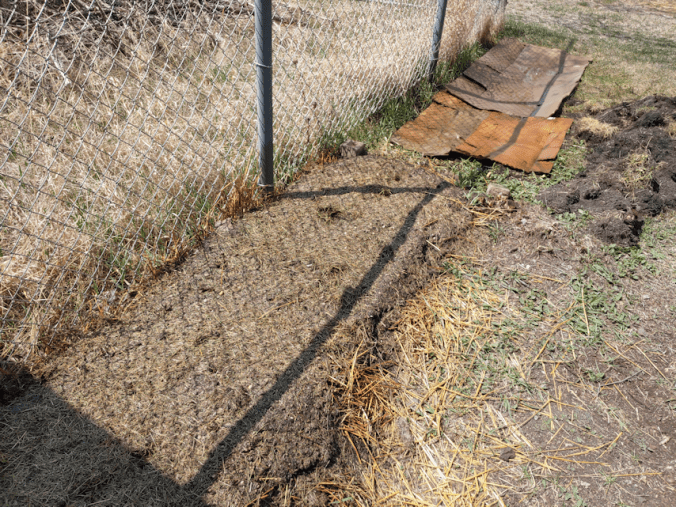
One of the areas we needed to work on is the block for the Dorinney corn. I was loath to just start adding soil on the chopped straw. It would end up in the paths in between and we’d end up walking on it, and I just don’t want to waste that precious dirt! :-D

Then I remembered all that mulch I put around the sunflowers last year. A thick layer of grass clippings I kept adding to throughout the summer. I figured that would work well to put on the paths as a mulch to walk on, while it would also serve to hold the soil in the rows.

Once I started gathering up the grass clippings and laying them down, I realized this partially broken down mulch would work much better under the soil, than the straw.

So this bed will now be reversed. The grass clippings will have the soil added on top, while the chopped straw will serve to hold the soil in place, and keep the grass/weeds down in between, as well as helping keep any moisture. We lost a row in the process, but I wasn’t sure we have enough of these seeds to fill the entire block, anyhow. If we have more, we can just add another row to one side. Before we add soil, though, the area will get another thorough soaking. We can just reach this area with the hose. I should see if I can set up the sprinkler. I don’t think we’ve got enough hose to set that up where it can water the whole block, though.

In the background, you can see the row of sunflower stumps, where I took the mulch from. I didn’t even get as far as where the rows of sunflowers overlapped in the middle, and after finishing laying down mulch in the corn block, I still had enough mulch in the little wheelbarrow to add it elsewhere.

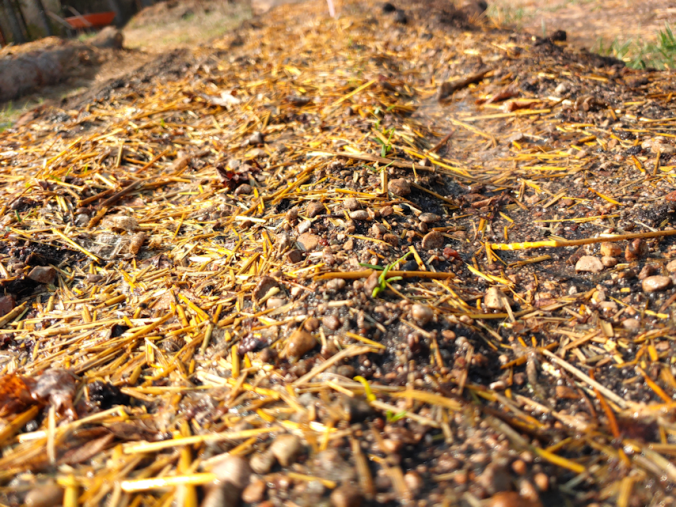
The girls saw carrot sprouts and took off the plastic covering this bed, so I added a light layer to the surface to protect it. Especially if we do end up getting that predicted rain.

I also put a light layer over the Strawberry Spinach bed.

In preparation for planting the asparagus crowns, I soaked the trench, put the cardboard back to discourage any of those roots we didn’t clip or dig out from growing, then soaked it again. Later today, we’ll put the crowns to soak while we start adding soil and preparing it for planting.

We’ve reached that point in the season, where we are switching from going out in the afternoon, when it was finally warm enough to work in the garden, to splitting our days between the cooler mornings and evenings, while avoiding the hottest parts of the afternoon. The problem with that is, the hottest part of the day tends to be around 5pm, so we’re easily losing at least 6 hours of daylight productivity. Long range forecast says we’ll be hitting 30C/86F in four days – and we’re still in May! At least it’s expected to cool down gradually after that, but we’re still going to be in the high to mid 20’s for another week. We’re also supposed to get rain. I’d say “more rain”, but what’s been predicted so far has been missing us, as usual. :-/ We shall see how it goes.

The hard part is going to be waiting until after the last frost date before planting/transplanting. I think direct sowing a bit earlier would be safe, but after losing so many transplants last year, I don’t want to take that chance again, this year!

The Re-Farmer

Our 2021 garden: haskap and corn plot status

The girls were able to come out and give me a hand this afternoon, so things got done a lot faster. Especially for me, when they booted me out of the garden and into the house. Apparently, I was looking pretty sun burned! Not feeling it, though. ;-)

In my focus on watering, I’ve been eyeballing the haskap bushes. The male is doing quite well.

It’s even beginning to show flower buds!

We planted these two summers ago, so this year should have been a year with good production.

That’s not going to happen.

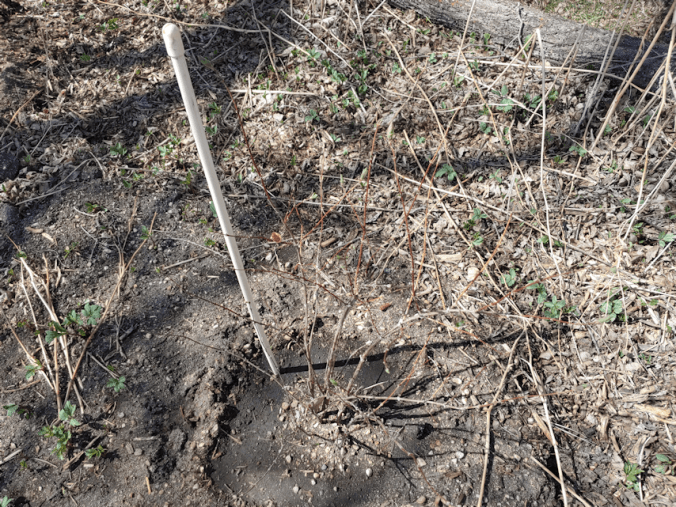
I wish I knew what was going on with this poor female haskap! The only leaf buds are on the very tips of branches, and not even all of them. I’d expected to get more of them by now, but I haven’t seen any yet. We might have to order more online for next year, instead. We shall see.

With all the watering they’re getting, my mother’s yellow flowers in this bed are already starting to come up strongly in places. We’re not watering the entire bed as thoroughly; just the haskaps and the lilac bush. I expect the lilac to do better this year, now that the maple tree that was shading it has been cut down.

Meanwhile…

My daughters and I marked out a block for the corn we will be planting soon. This block is to the West of the peas, so it can actually be reached with the hose. One of my daughters worked on soaking the area while the other helped me with chopping up straw with the lawn mower to lay down in the block.

The rows are two feet apart, and the corn needs to be planted 1 ft apart. We just have one packet of these seeds, so this should be more than large enough. The variety being grown here is called Dorinny. While I found them at Baker Creek, apparently they had largely disappeared for decades, until they were rediscovered and reintroduced by Wood Prairie Farm. They are a Canadian heritage breed, can handle cold soil, and matures in only 75 days. I’m quite looking forward to them! These are a type that I hope to save seeds from.

One of the bonuses of these being planted earlier and maturing so quickly is that the chances of cross pollination with the Montana Morado we’ll be planting at the other end of the garden will be greatly reduced, even with our winds. They will mature at completely different times.

We know this area is low in nutrients, especially nitrogen, which corn needs a lot of, so we’ll have to take extra steps to ensure they have enough. The fresh, nutrient filled garden soil mix will be the first boost. We picked up a water soluble vegetable fertilizer that has higher nitrogen levels, but in cleaning out the old kitchen, we found a water soluble fertilizer that’s even higher in nitrogen. We also found a pump sprayer, still in its box, so we’ll be able to use it to feed the corn, even in the furthest plots, where the hose doesn’t reach. We do plan to pick up more hose but, for now, the rain barrel and watering can are working out just fine.

The chopped straw was also added to the rows of peas as mulch. Being able to run the lawn mower over the straw a couple of times really makes a big difference. I find myself thinking that I wished we’d thought of it earlier, but then I remember that when we were using the straw previously, we were having problems with the push mower that was here. I did use the new push mower to do it last fall, but that’s when it stopped working completely. I’d chopped up just enough to mulch the garlic for the winter.

One thing’s for sure: we’ve made a huge dent in that straw bale! We’ll need to get another one by the end of the season, for sure. :-)

The girls went on to thoroughly water everything for the evening. Tomorrow, we start hauling soil again… after soaking the ground some more, and stomping down the chopped straw. I do wish we had enough cardboard to lay over the grass, but there isn’t enough in our recycling to cover even a single row. I supposed that’s a down side of our bulk-buying, low packaging shopping habits!

Once this block is planted, we can move on to preparing the beds for everything to be planted or transplanted out here, after June 2. After the girls kicked me out of the garden so they could finish, I checked how things were growing in the sun room, and am very happy to see more summer squash and melons have germinated. It doesn’t look like any of the winter squash or pumpkins have started yet. Still nothing on the rest of the gourds, either. :-( I’ll be keeping a close eye on the climbers over the next couple of weeks. How many germinate will tell me how big of a squash arch we will be building.

The day after tomorrow, we should be getting our first batches of items in the mail from Veseys, including the mulberry tree. I am thinking of planting it in a grow bag this summer, though. There are too many dead trees in the area it will be going in permanently that need to come down. I’m hoping they are solid enough that we can use them for building materials.

Next week, the potatoes will be arriving, and we’ll set up the grow bags we made from feed bags for those. We settled on having them along the chain link fence near the storage house, where they’ll be out of the way, yet easy to access and tend to. Plus, full sunlight. Hopefully, using the grow bags will alleviate the slug problem I found we had, last year.

It feels so good to be getting so many things into the ground! Now we just have to wait and see how many will actually grow! ;-)

The Re-Farmer