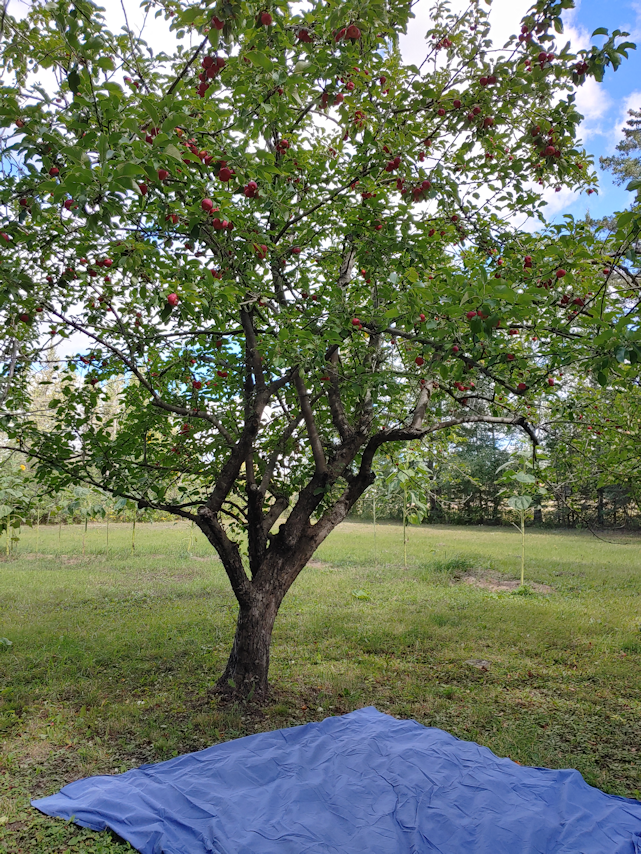
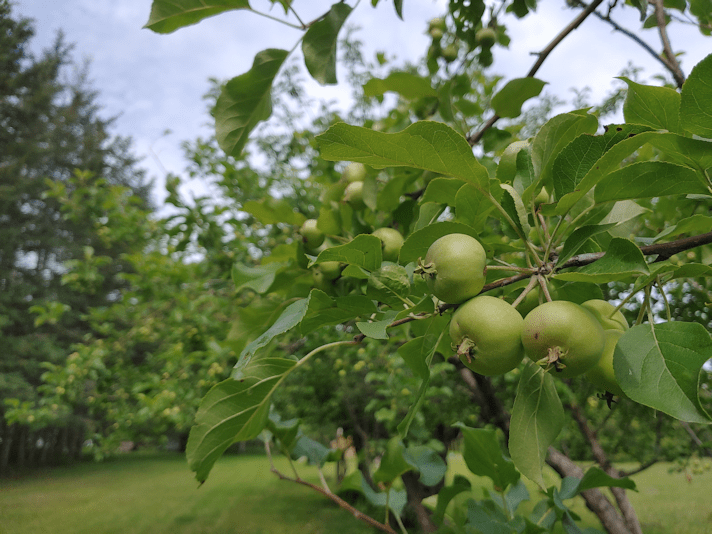
Today, I headed out to pick the apples off of one of our crabapple trees.
This is the one that has such bright red, sweet apples. It also ripens earlier than the other trees.
Last year, most of the apples disappeared before I had a chance to harvest them, so I wanted to get them before the … deer? … get them first.
When we were cleaning things out, I was flummoxed by finding a grabber with spoons attached to it. My mother eventually remembered that my dad used it to pick apples.
I’m happy to say that it works absolutely beautifully!
Since there were so many apples to pick this year, I laid out a sheet on the ground for them to fall on. It also made it much easier to move the apples into a bucket.
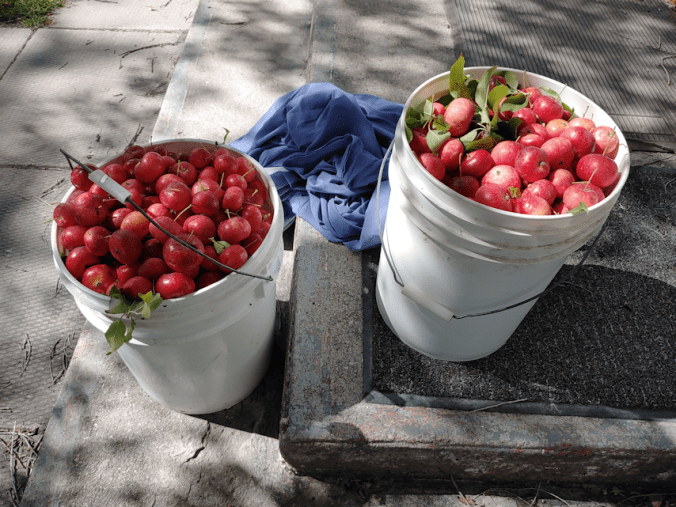
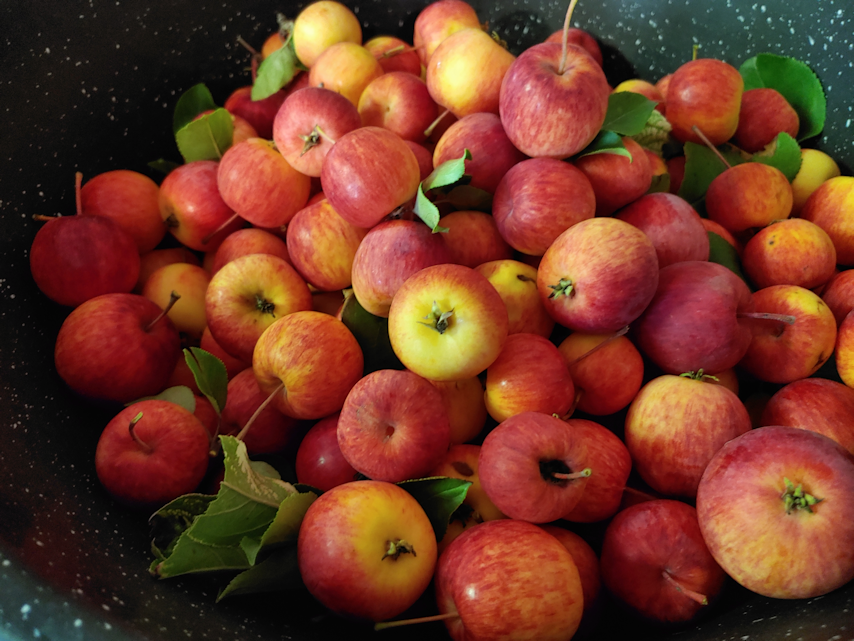
I was able to fill a 5 gallon bucket just with the apples I could reach with my hands, or the grabber. I did try shaking the trees, too, but the branches are a bit too thick to be able to shake much at that height, so I didn’t get a lot that way.
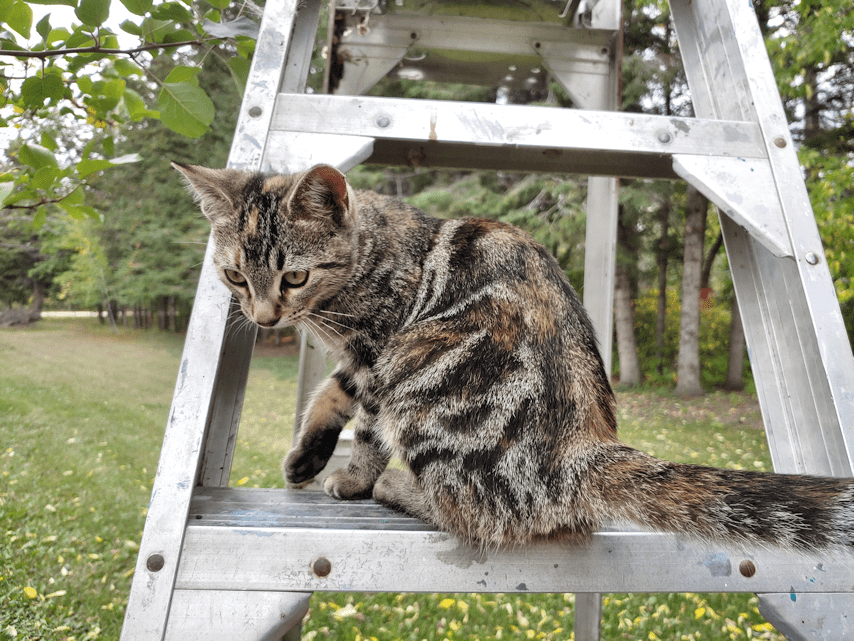
Using the step ladder, I was able to fill another 5 gallon bucket. I could have gotten more, but by then, it was getting too dangerous to try and get the apples, even with the grabber. The remaining apples will be for the birds. :-)
Ten gallons of apples is so awesome! Last year, I used the apples from this tree to make apple cider vinegar. After trimming and chopping, I filled a quart jar 3/4s full.
That’s it. That’s all we had.
This year, I plan to make more apple cider vinegar, then juice at least a gallon, to make hard apple cider. There should still be plenty to give to my family, when they come out this weekend, if they want some.
For the hard apple cider, we have gallon jugs, bungs and airlocks to use. When we made apple cider vinegar in a quart jar last year, it was a success, but there was a problem with fruit flies being attracted to the coffee filter covered jar in the cupboard. So this year, I plan to use an air lock (they’re so cheap, I’ve been buying extras).
I’ll be using a repurposed gallon sized pickle jar for this, which means I need to find a way to get an airlock into the lid.
Which I’ve already gotten started, and will show how in my next post. :-)
One of the things I’ve been checking every morning of late, is how the crabapples are doing.
In the row of trees by the spruce grove, there are really just two trees that we can use. The others have such small apples, they’ll be left for the birds and the deer.
One of these two trees gets such bright red apples!
There are lots of them, too. I have actually thinned them, and with this tree, the easiest way to do that is just grab a branch and shake. They fall off a lot easier than the other trees!
This tree produces remarkably sweet apples. Last year, oddly, by the time we went to pick the apples, most of them had disappeared. I wasn’t even seeing many on the ground. Very strange, considering how full of apples it was, just the day before! Anyhow, I used them to make crabapple cider vinegar. You can read how that went in parts one, two and three of the process. I want to do this again, but this time, we’ll be using an airlock! Using a coffee filter was messy, and attracted fruit flies. We still don’t have fermentation weights, but we’ll figure something out.
The other tree in this row surprised me, last year. I would taste the apples from different trees to check their ripeness, and this one was… well, pretty awful tasting. We gathered what we could from the other trees, but left this one.
Then my mother insisted I bring her apples from the farm. I told here there weren’t many left, and the ones that were left didn’t taste good, but she said she would just be cooking them down and adding sugar, anyhow, so go ahead and bring them to her.
Much to my surprise, the apples actually tasted really good! They simply needed a lot more time to ripen, compared to the others.
This year, we cleaned out the dead part in the middle, and the remaining parts seem to be appreciating this.
Some of the apples are nearly 3x the size of the red ones on the other tree!
With the fungal disease attacking the row of crabapple trees, I would happily get rid of all the others, if it means saving these two trees.
There is one other crabapple tree, next to the old compost pile, that is ripening some pretty big apples. It should be ready to harvest soon, I think.
We should have lots of apples to make things with this year.
Maybe even enough try making some hard crabapple cider! :-)
I think it’s time to visit the brewery supply place in town. I’m starting to think that the 4 airlocks we have now are not going to be enough. Especially since we’ll be making gallon batches of mead, soon!
Yesterday afternoon, we had a constant, light rain.
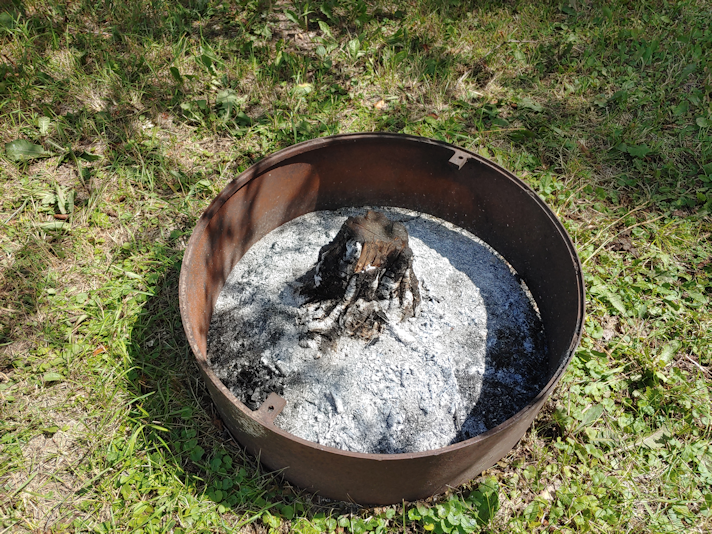
The perfect time to light a sketchy fire!
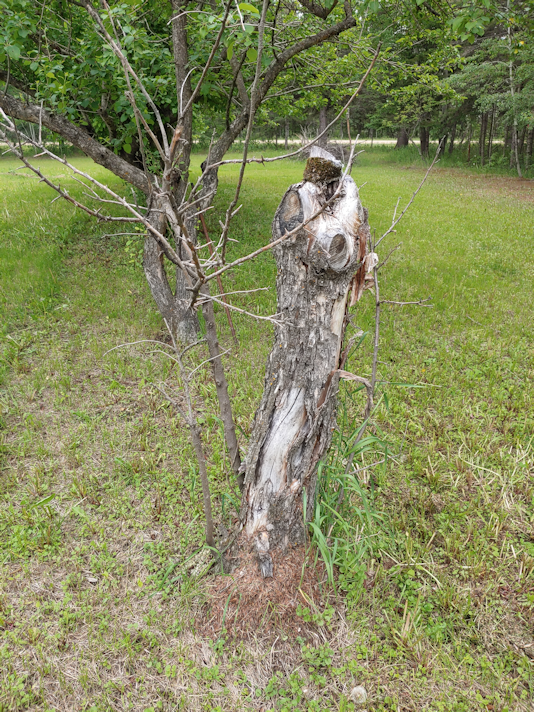
Of the several fungus infected tree stumps we need to burn out, I started with the only one that isn’t cut flush to the ground. I figured I should get the bigger one done first; the rest will get done very quickly, in comparison!
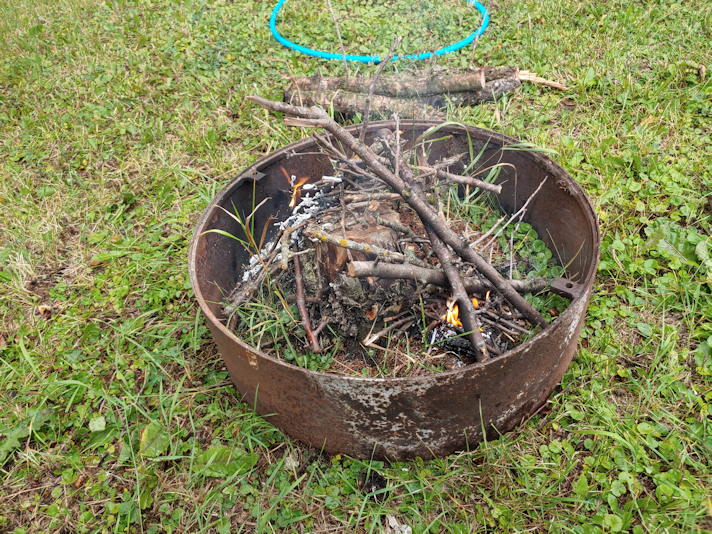
The metal ring I rolled over from where I found it by the storage shed was just the right size.
You can see some of the fungus from last year, dried up on the side of the stump facing me. On the other side is the remains of an ants nest. When we cut what was left of the tree down and left the short length of trunk next to the pile of diseased branches we’d pruned earlier this summer, the ants moved with it!
So no killing of ants involved. :-)
Of course, I made sure to have a hose handy, even with the rain. The wood used as fuel is from the stack of diseased branches, which all need to be burned.
I set myself up with a chair and an umbrella, too. :-D
It took a while to build the fire around all of the stump, partly because I needed to keep the fire small. It wasn’t directly under another apple tree, but close enough to potentially damage some of the branches.
I’m not too worried about that particular tree. Of all the apple trees, that one has the smallest, least edible apples on it.
The birds and deer like them, though, so that’s good.
This tree is one of the ones I want most to protect.
It’s at the far end of the row of trees, and next to one of the stumps cut flat to the ground that we found fungal growth on, too. This tree already has tasty apples! It has the wonderful combination of sweetness and tartness that I love. There is one other tree, at the very end, that also has really good apples, though they take quite a bit longer to ripen. The main grafted part of that tree died, and it’s the suckers from the base that are producing such nice apples. Usually, it’s the other way around.
So I’m rather motivated to keep this fungal infection from spreading! We really should have done this in the spring, but the weather was not at all co-operative. Spores for these emerge in the fall, so we have a bit of time, yet.
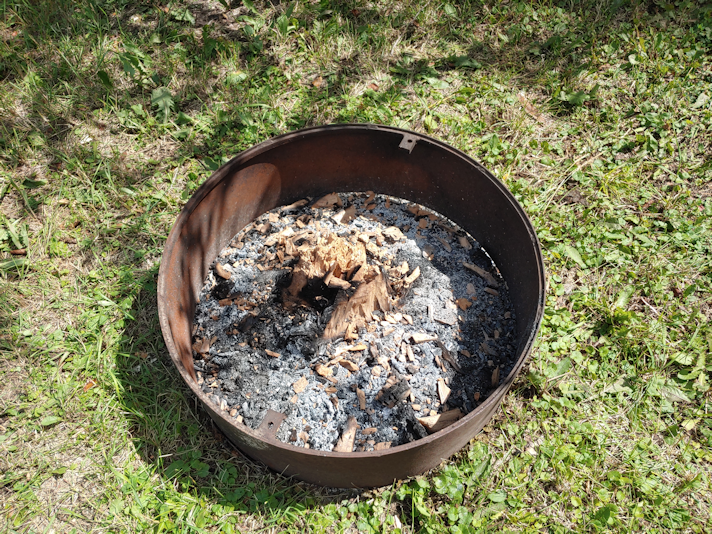
When I stopped for the day, I scrounged for something to cover the stump with. The fire was out, but might still smolder, so I wanted to make sure it couldn’t flare up or spread.
That top of an oil drum is something I fished out of the edge of the nearby spruce grove when I cleared the north side of it. The metal sheet was just one of those things among the garbage we dug up near the old garden shed.
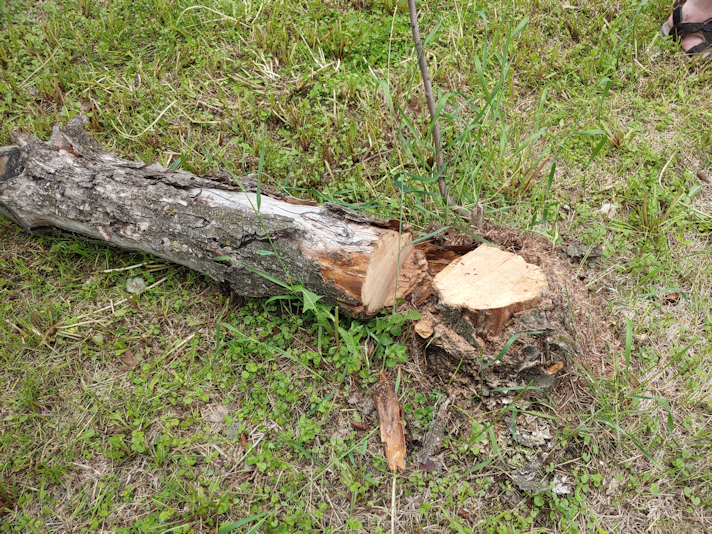
The fire got quite a bit of it cleared. I don’t know how far into the wood the fungal infection gets, but even if the fire killed that off, I still need to get the stump down to ground level.
For now, I’ve taken an ax to it to break it apart a bit. We’ll start another fire on it later and repeat the process as often as necessary.
It’s a hot day today, but it’s going to get even hotter throughout the week, hitting above 30C/86F in a few days. Plus, I’ll be doing a lot of driving throughout the week. I figured if my brother could be out baling hay in this heat today, I can prune some deadwood!
There were two trees in particular I wanted to get at. Here is the first I worked on.
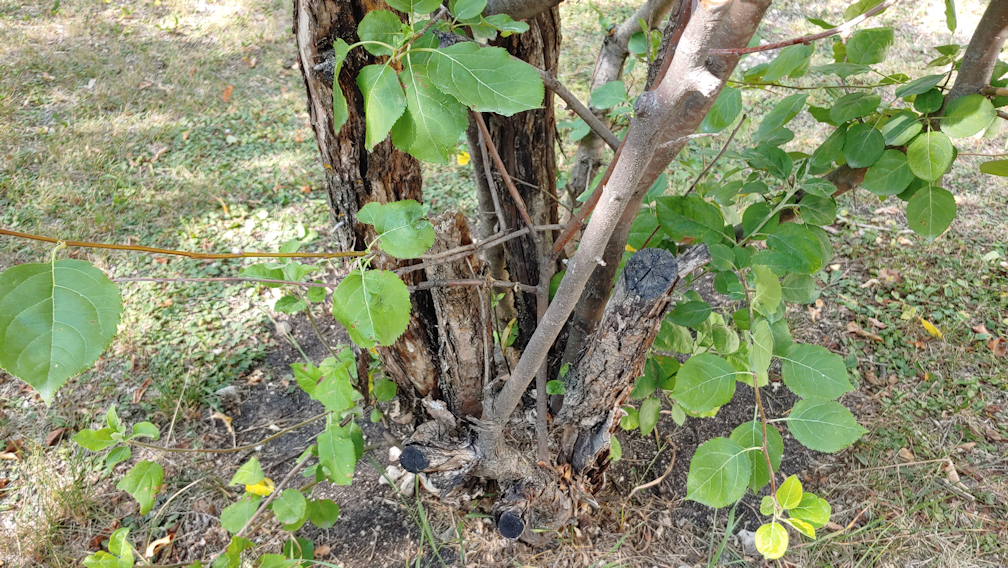
I had already cut the dead parts of the main tree, our first summer here. What was left were the suckers growing out the base. As the main part was grafted, what grew out the base was not the same type of apple as what had already died.
When I first worked on it, the live parts were bending low, so I left tall stumps of the original tree and used them as supports to tie the live ones to. One, growing out the middle, didn’t need the support.
As you can see in the photo, that’s the one that is now dead.
It actually did have leaves and even flowers this spring, but they didn’t last. As I cut it away, I was surprised it managed even that much. It was so dead and dry, I could only cut about half way, and then it was easier to break it off by hand.
One of the live branches was hanging down again, even though part of it was supported, so I got creative.
I found what was probably an old mop handle and zip tied it to one of the old stumps at the bottom, and to another live branch higher up. Then I lifted the bent branch and attached it to the support. Hopefully, this will be enough for it to start growing straight – or at least straighter – on its own. If nothing else, I won’t be getting my hair caught in it when I mow past it, anymore!
The next tree was a bigger job.
I’d actually thought I would be working on an old plum tree, but it was another apple tree that needed help.
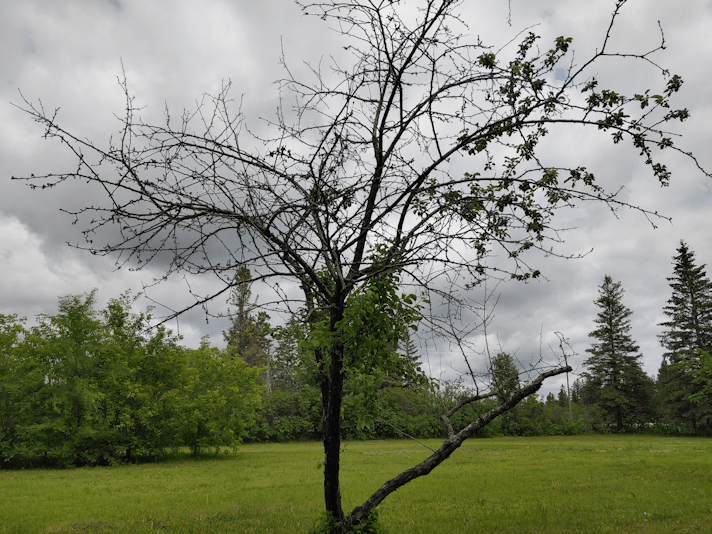
There are two large branches on the apple tree that have died. In the background, you can see the dark coloured plum tree meandering its way up. The branches are so tangled, it was hard to see what belonged were, but it seemed that the plum branch still had live branches and little plums at the top.
I would see better, after the apple was cleared.
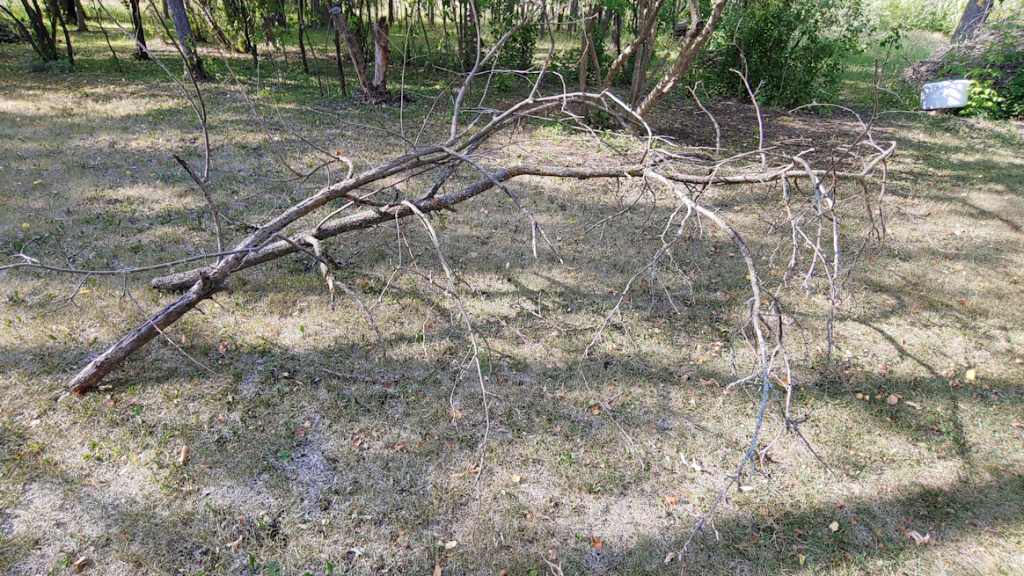
I took the slightly smaller branch off first (on the left of the trunk, in the above photo) using the reciprocating saw, and it came down fairly well. The branches at the ends were tangled with live branches, so it ended up standing upright on its cut end when it fell. Once I cleared that, it was time to get the big one down.
When cutting larger branches like this, you always have to be careful when it gets past a certain point, depending on the angle and weight of the branch. Once it starts breaking under its own weight, things can go in unexpected directions.
This one was a bit different.
It didn’t fall.
You can see the one live branch growing out the side, so I made sure to cut above it.
I cut right through, and it just sat there!
Hmmm… I wonder why that would be…
The live plum and apple branches were holding it up!
There was a lot to get tangled on!
For this tree, I used pruning spray on the cut branches, to protect the main trunk a bit.
There is still one branch alive on this tree, and it’s got quite a few apples on it.
The plum in the background does have a lot of dead branches, but at the top, it’s still alive. I am leaving it for now.
Usually, for stuff like this, I would have broken down the branches a bit, but otherwise just hauled it over to one of the piles of branches we’ve made while cleaning up over the past couple of years. I did things differently this time.
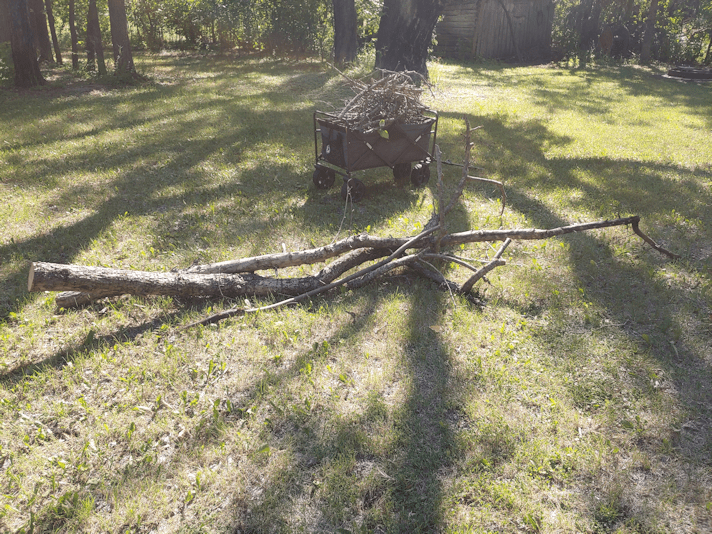
The small branches, I cut short and loaded into the wagon, to be used as kindling in the fire pit.
The large pieces will wait until I can co-ordinate with one of the girls to work on them.
The wood looks surprisingly solid. I’m going to see if anything can be salvaged for carving. If not, they’ll be cut to fire pit size for use during cook outs.
It isn’t much, but I’m happy to have gotten at least this bit done. There is another tree, an elm, near the fire pit area that is mostly dead. I actually thought it was dead our first year here, but after a rainfall, it perked up. Last year’s drought seems to have done it in, though. It’s quite large, though, so we’ll have to be more careful taking down the dead parts.
The down side of using what clear weather we’ve had to keep on top of the mowing is, lots of other things aren’t getting done.
Today, we tackled one of those jobs (though I could easily have spent a couple of hours mowing).
We worked on pruning the dead wood out of the crab apple trees. This first one was losing the most.
Honestly, I think this one is probably a lost cause. It has a fungal disease, and much of it is already dead, but if we can save it, that would be great.
This next one is already completely dead.
Last year, the stems that were growing out of the base were still alive, so we left it. Not a sign of any life at all, this year.
Unless you count the ant hill that appeared at the base, or the fungus growing on it, we discovered last fall.
This last one is not too bad.
The main trunk of this tree – which my brother tells me was grafted on by my late father – has died, but the suckers that grew out of the base produced very well last year. They were decently larger, for a crab apple, and while it took quite a while for them to ripen compared to the other trees, once they did, they were the tastiest of them all.
Mind you, last year was not a good year for apples.
I had help, while doing this, and not just from my daughters…
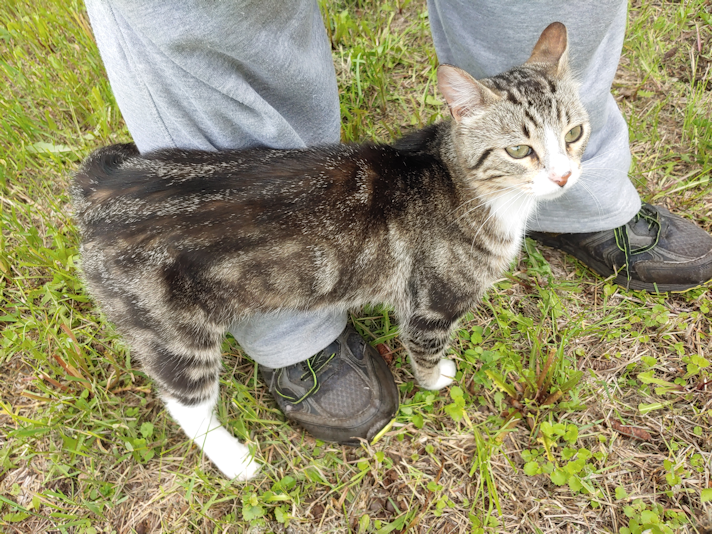
What a silly boy! :-D
Here is how the trees look now.
There is not a lot left on that first one. On the stump we cut short, you can see little dots – those are ants! The last one is looking pretty good.
The pile of branches next to the first tree is what we cut away from these three areas.
After that, we decided to cut away the dead wood from the other trees.
I’d actually done a major pruning of dead wood on all the trees, our first summer here, and kept it up a bit last year, so I wasn’t expecting to remove all that much. Which is why I didn’t thing to take a before picture.
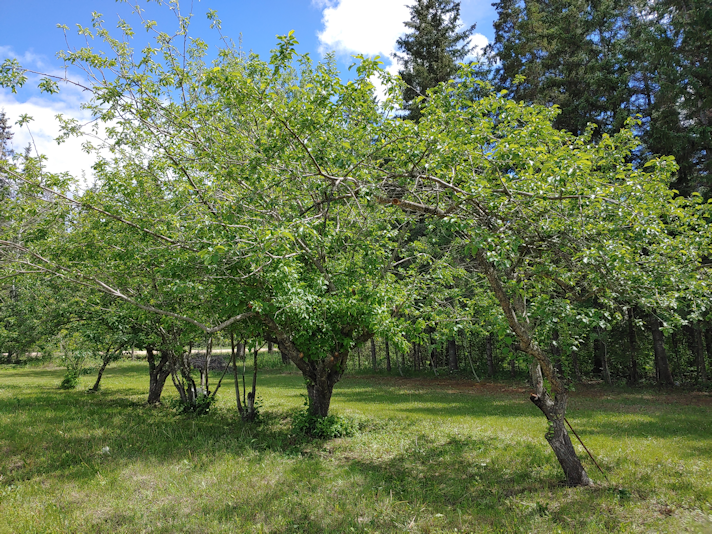
I was really amazed by how much dead wood we got out of these, and how much more open the trees looked! They were hard enough to clear on their own, with how much apple branches twist around each other, but with the trees planted so close together, they were also entangled in neighbouring branches! The biggest tree, in the middle of the photo, had a really surprising number of dead branches. This also makes it more dangerous to take them down. They catch on everything on the way down, and time and again, we’d bring down a branch that turned out to be much bigger than we’d expected it to be. They’d get caught on the other branches, and were quite difficult to remove.
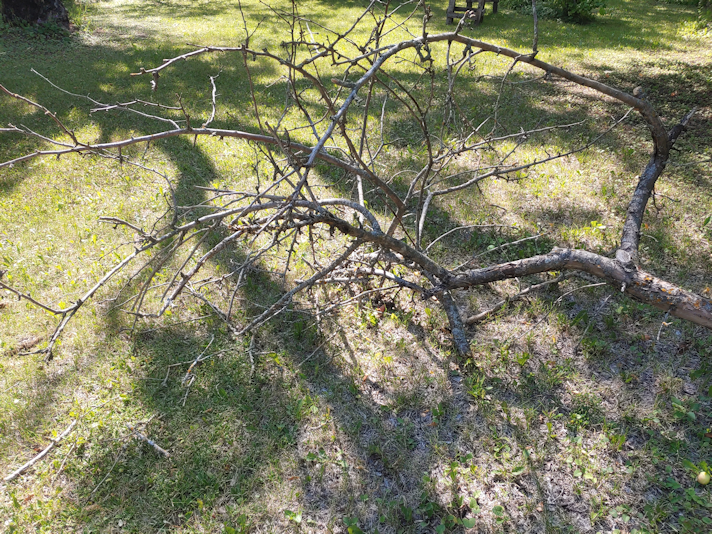
Here is the final pile of branches.
All of this needs to be burned, due to the fungal infection. No salvage to be had, here. What a shame. While we did get a few dying branches with leaves still on them, this was almost all dead stuff. We did not actively try to prune any of the live branches.
Since we also have to burn out infected stumps, we’re leaving these branches here. When the conditions are right, I’ll be bringing a metal ring we’ve got to place over each stump and start a small fire. We need to burn out the stumps, but they are also under live branches, so we have to take care to keep the fire small enough not to affect those. While these will need to be done on separate days, weather willing, this pile will be used partly to feed the small fires, but also broken down and we’re just going to burn it in the garden. We’ll be able to have a slightly bigger fire, but not by much. Thanks to the rain we’ve been having, there would be no complete burn ban right now. So no controlled burning of fields, but yes to fire pits and burn barrels.
It was good to get this done! With how much more open the trees are, this should help increase yield quite a bit – though I think all the lovely rain we’ve had so far will play a much bigger part!
As an aside, we got some unexpected entertainment while working. At one point, we heard a tractor go by on the road. It was our vandal. Some time later, he made his return trip. I could just see him through the lilac hedge and something seemed… odd. It took a while to see him clearly, but the entire time he drove past us, he had one arm out, giving us the finger! :-D
So juvenile!
Which reminds me. Before we started on the trees, my daughter and I planted new sunflower seeds in the spaces that either didn’t sprout, or the sprouts got … eaten? Of the seeds we originally planted, we’ve got about a 50% loss, in total, between the two varieties. I found another variety in the grocery store that is supposed to be a large head, eating/bird seed type. It’s so late in the season, it’s hard to know if they’ll reach full growth, but even if they don’t, I’m hoping they’ll fill the gaps to be part of the wind break/privacy screen we also planted them for.
While we were putting things away, I spotted a pleasant surprise.
We put this up to encourage local pollinators last year, and not a single tube got used, so I was very happy to see some of them have been filled. It’s only in this one area, but hopefully, that means we’ll see more of them, over time.
I’m really glad to have gotten this job done. Now we just have to get rid of those branches, before things get overgrown again! :-D
Well, when it came to the mad dash to get the lawn mowing started, it was mosquitoes 0 : rain 1 :-D The bug spray actually worked this time. :-D Thankfully, I didn’t have to charge the battery on the riding mower, and could get started on that right away. I got rained on a bit, but it wasn’t until I was using the push mower to get the edges that the rain started falling heavily enough I had to put the equipment away.
I’m also happy to say that the lawn mower bag we found in the basement and moved to the barn is for this push mower, rather than one of the many broken ones lying about. It’s a rear bag, and normally I would have closed the cover of the side opening, but that wasn’t an option. Someone built a sort of shield of wood that holds the flat up, while also preventing clippings from spraying towards whomever is pushing it, and the shield is bolted to the body of the mower. I don’t mind it being open, since most of the clippings goes into the bag anyhow. I kept the folding wagon close by to empty the bag into, and was able to fill it before I had to stop due to rain. This will make it so much easier to have grass clippings for mulching and composting! :-)
Later in the evening, before I headed outside to do my rounds, I paused to check the indoor plants. Particularly the aloe that has started to bloom.
It had a surprise for me!
Not only has one of the flower spikes reached the ceiling, it’s pressing against it, and looks like it has more growing to do!
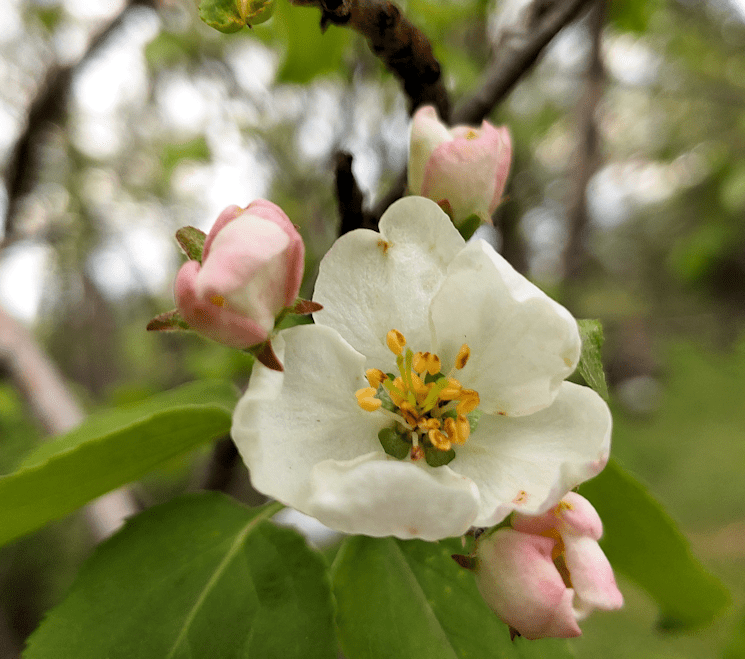
Outside, there were more blossoms emerging. The crab apples are starting to bloom.
This is from one of the trees in the West yard.
You can really tell that these ones get more light than the ones planted North of the spruce grove.
Earlier in the month, I had spotted some fungal growth on one of the apple trees by the spruce grove. Now that the leaves are in, I can see that the entire section of that tree is dead. There are still two sections of it growing, and seem to be healthy, so far, so we’ll see how it fares after I remove the dead section. (update: after taking a closer look, the living sections aren’t going that well, after all. :-( )
Of course, I visited the kittens, and got thorough and viciously attacked by little critters!
Big Rig looks even bigger when she’s next to Saffron, who is the teeniest of the bunch.
Now that they’re bigger, and occasionally stay still long enough for me to check, it looks like we’ve got three females and two males. Big Rig, Turmeric and Saffron seem to all be female; it’s a bit surprising, since orange tabbies are usually male. Leyendecker and Nicco both appear to be male. With Leyendecker being black, it’s even harder to tell with him! :-D
If all goes well, tomorrow, I’ll be able to get either the rest of the mowing done, or the rest of the planting done. Maybe even both, weather willing.
I completely forgot about the pumpkin seeds my mother gave me. It’s quite late for direct sowing pumpkins, but I’ll give them a try. Checking the seed trays, some of the gourds are most definitely emerging! After the trays were knocked over, they’re all mixed up, but none of the gourds had sprouted at all yet, so the new ones can’t really be anything else.
I used more of the soil mix for the sunflowers than I expected, so I think I will pick up more, the next time I’m in town. We still need to get those chimney blocks outside, to use as planters for the cucamelon transplants. The plan had been to take them through the new part basement, and up the stronger stairs, but with the kittens down there now, and always under foot, we’ll have to find a way to get them up the more rickety old basement stairs.
Once again, I am thinking of how great it would be to convert the old chimney for the wood burning furnace into a dumbwaiter! :-D
Once the blocks are in place, I plan to fill the bottoms with grass clippings and straw, then top it with a soil mix. With more squash to transplant, I don’t have enough of the soil mix left for it all.
It’s all coming together rather nicely, I think. I look forward to seeing how everything does.
I spoke to my mother today, and was telling her about what we’ve planted and where. Of course, she had to start telling me what I should be planting, none of which is what I am planting. She is currently fixated on onions. I should be planting onions. Also, I should be using the chives (which are coming up nicely) in salads. Also, I need a tiller. Because digging holes for the sunflower seeds is… and she stopped herself before saying it, though I could still here the word “stupid” hanging in the air. :-D I had told her about my wanting to go with no-till methods, and the use of straw, and she told me that she’d never seen anyone do that before. Straw is only for strawberries, not for anything else. It’s rather funny, how she is so convinced that the way she did things is the ONLY way to do things! Nobody else ever did anything different. :-D As for the old garden area, I reminded her of the conversation we’d had about planting trees there, and how we were intending to plant fruit and nut trees. She started telling me I should get hazelnuts from the bush, for free. The problem with that is, I have no memory of where those hazelnuts are. I was little more than a toddler when I went with her to gather nuts. They may not even be there anymore. So many trees and bushes have died, over the years. So she reminded me of one place we know for sure there is a hazelnut bush. The cemetery my father and brother are buried in!
I’m not sure what she expects me to do about that. :-D But hey; at least we are in agreement on the planting of food trees!
All in all, I think it’s been a decently productive day! :-)
The kittens have been noticeably more active, and I’ve been finding one orange one in particular, at the furthest end of their little nest box, looking out into the rest of the basement.
They are still very quick to bunch up again, though!
Lately, when I got downstairs, I have been leaving the basement door open. Beep Beep goes upstairs to explore, while other cats follow me downstairs. To explore.
Including Keith.
We’ve put the twin size bed frame against the wall for storage, and they quite enjoy climbing up to the top, to check things out from on high! :-D
While doing my rounds outside this morning, I spotted something new on one of the crab apple trees.
It looks like a fungal disease. It seems to be only on the one branch, so I hope that pruning it off will do the trick, but this tree has already had quite a few branches removed due to infection, and trees on either side of it have as well. It might be better to remove the entire tree, to prevent it from infecting the others. I will also be working on the areas we spotted a potentially deadly (to apple trees) fungus, so I might do it all at the same time.
Quite a few of these trees are just not doing well at all. I don’t know that the type of crab apples are particularly prone to fungal disease, or if it’s more a matter of their age making them more susceptible.
The important thing will be to prevent the spread of the fungus, and that means burning the wood. As some of the infections are in stumps already cut level with the ground, I plan to bring one of the metal rings we’ve got lying about to put over where these stumps are, and making a small fire on top of them. We are already under fire ban right now, but it’s not a complete ban, so contained fire pits and burn barrels are still okay.
Something else to add to the to-do list for outside!
Catching up on stuff that I intended to post about yesterday…
I finally got a chance to pick some crab apples.
I had help.
It was starting to get pretty late in the season to pick these. A lot were already on the ground, other had signs of being eaten by birds. There were some I could not safely reach, even with the ladder, but that’s okay. The birds will enjoy them.
The one tree that was giving larger, sweeter apples this year resulted in about 2 1/2 gallon buckets of apples.
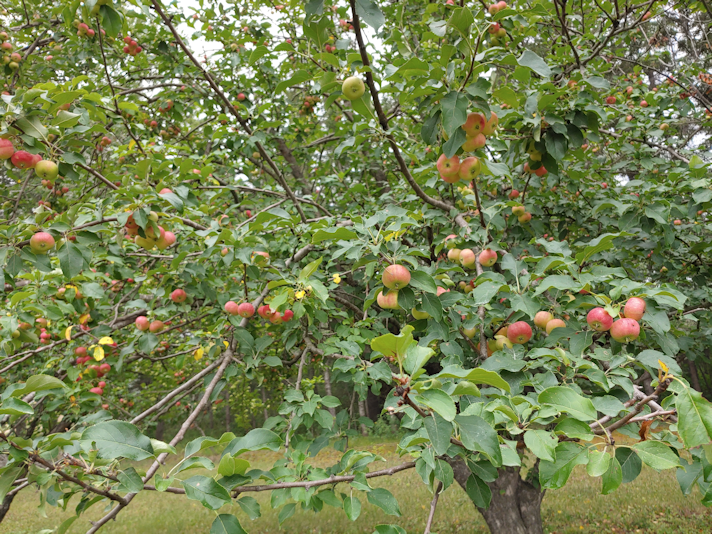
There is one other tree that had larger, sweeter apples last year. Though the apples are much smaller this year, there are lots of them. When I do my rounds, I have been tasting them. As the season progressed, the apples on this tree did start to develop that sweet-tart taste crab apples are known for. There are a couple of other trees with lots of apples on them, but they are pretty… unpleasant.
I decided to pick some from the one tree with good apples. Just a bucket full, I figured. So I dragged the ladder over and went to set it up under the most apple laden branches.
There… weren’t any?
These apples have been getting a very deep red as the season progressed, and there had been lots of them, but suddenly, there were hardly any at all.
Of course, my first thought was to check the ground, to see how many had fallen, but the ground was clear of fallen apples.
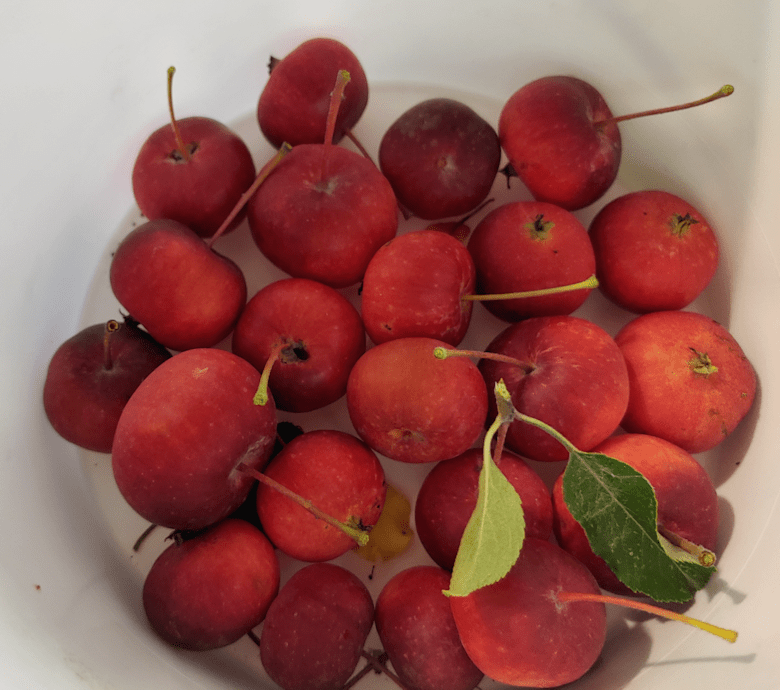
I finally went to pick some. Most were already too far gone and starting to rot at the stems. This is all I got.
Barely enough to cover the bottom of the bucket!
You can see one with a hole at the stem that I accidentally picked. Most of the remaining apples I saw had much larger holes like that.
I am guessing that the apples were eaten by something. I’m good with feeding critters. What I found interesting, though, is that it was just this one tree. There are trees on either side of this one that are full of apples, and I can see apples on the ground beneath them.
I guess whatever has been eating the apples from this tree found it tastier than the others, too!
Anyhow.
For the larger amount of apples, I am planning to make jelly. For the smaller amount, I’m going to try making apple cider vinegar.
Yesterday, I heard some odd meowing noises out my window, so I went to check it out.
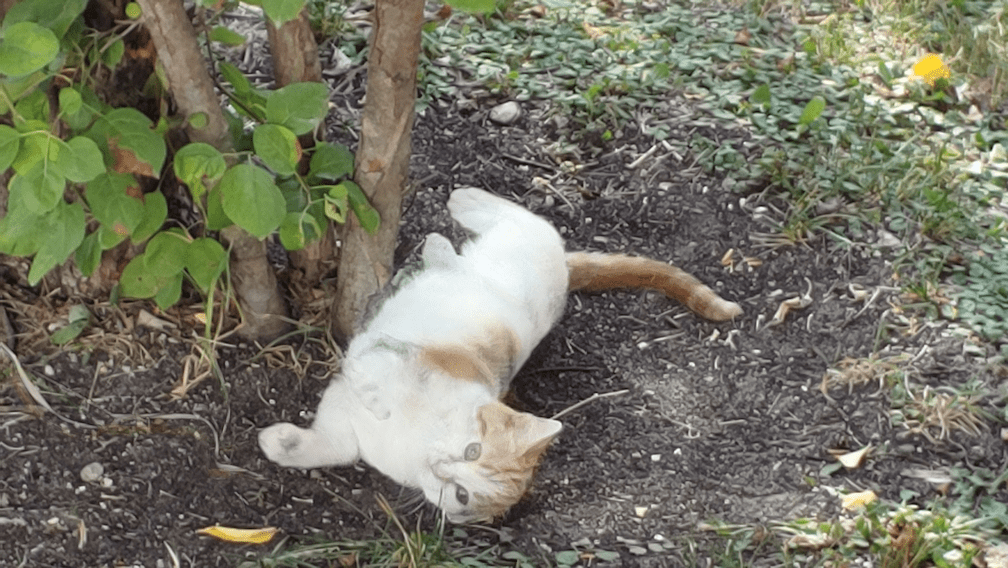
I walked right by one of the apple trees by the old kitchen garden, completely missing it was the source of the meowing!
The base of this tree is one of the cats’ favorite rolling-in-the-dirt places. When I first spotted them, though, he was mostly hidden behind the tree. It was his Aunty Beep Beep that had me laughing. It looked like a pair of eyes was watching me from the ground!
Then she rolled around some more; the epitome of grace. Not. :-D
Since I was there anyhow, I stopped to take a good look at this apple tree.
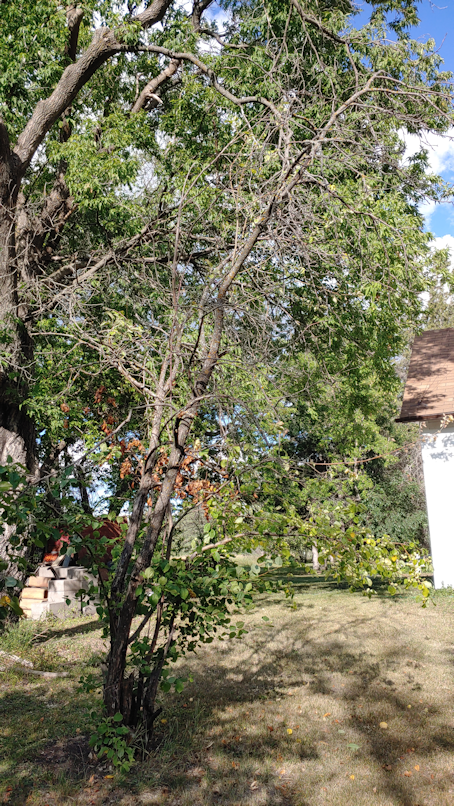
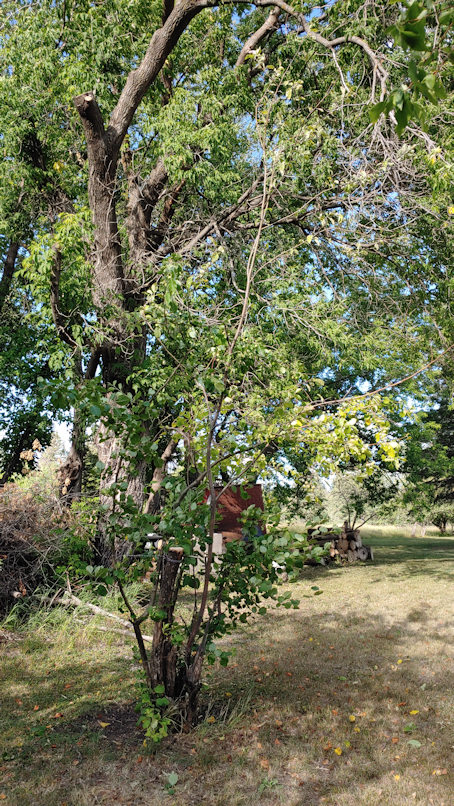
You can see one branch is hanging quite low, weighted down by apples as they get bitter.
Much if it, however, did not survive the winter. It wasn’t doing well last year, and I guess that polar vortex that kept hitting us was too much for parts of it.
As you can see from its base, it has been cut back a few times. I don’t think there’s anything left of the original graft. The two main trunks that you see in the above picture seemed to be dead. With living and dead branches so entwined together, it was really hard to tell where one branch started another began. I couldn’t tell if they were completely dead, or if they still had a live branch or two on them.
Either way, down they came.
Not a living thing on either of them.
I cut them at about 3 feet above ground, with the intention of cutting the remains, further down. Instead, I decided to make use of them.
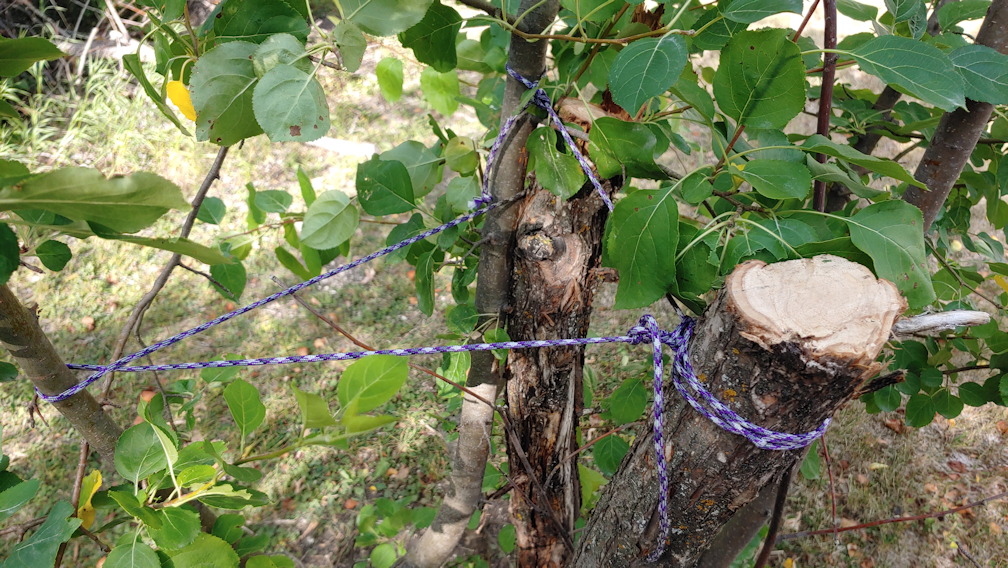
I took the branch that was hanging down the most and braced it against one of the remaining trunks. It had a secondary branch that immediately began leaning over in the other direction, so I used rope and the remaining trunk pieces to support them. If they survive, with this support, they will continue to grow stronger, upwards.
This is not a healthy tree, however, so we shall see.
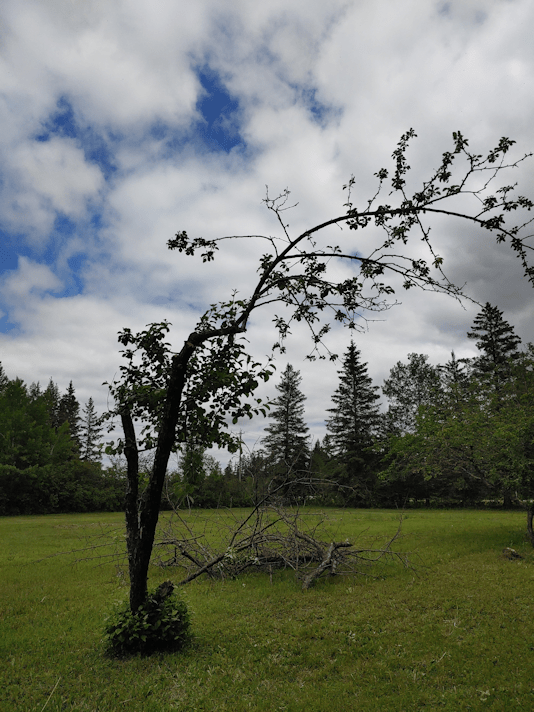
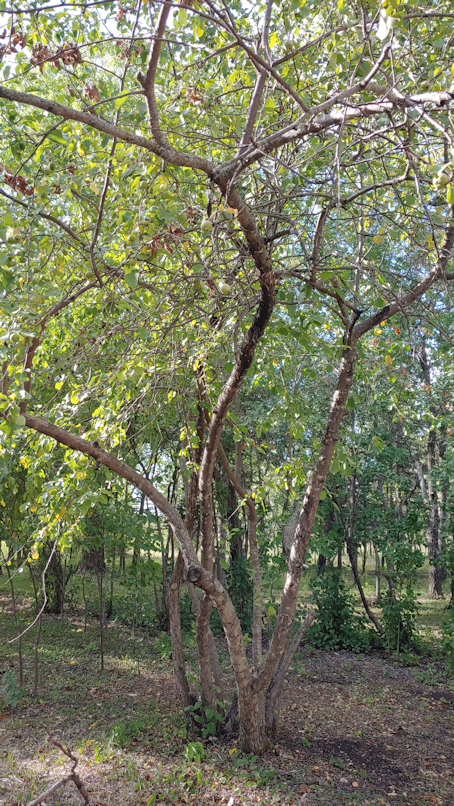
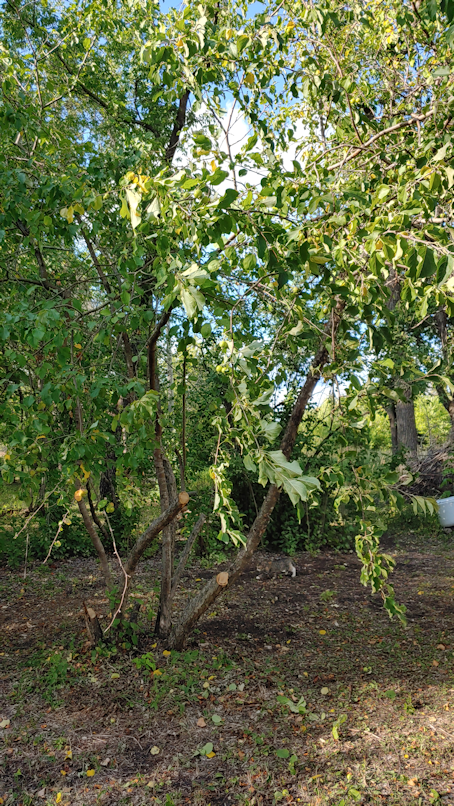
This is how it looks now.
It’s hard to tell, with the maple grove in the background, and with the dead wood gone, there’s surprisingly little left. Basically, they’re just suckers that have survived while the rest of the tree has slowly died.
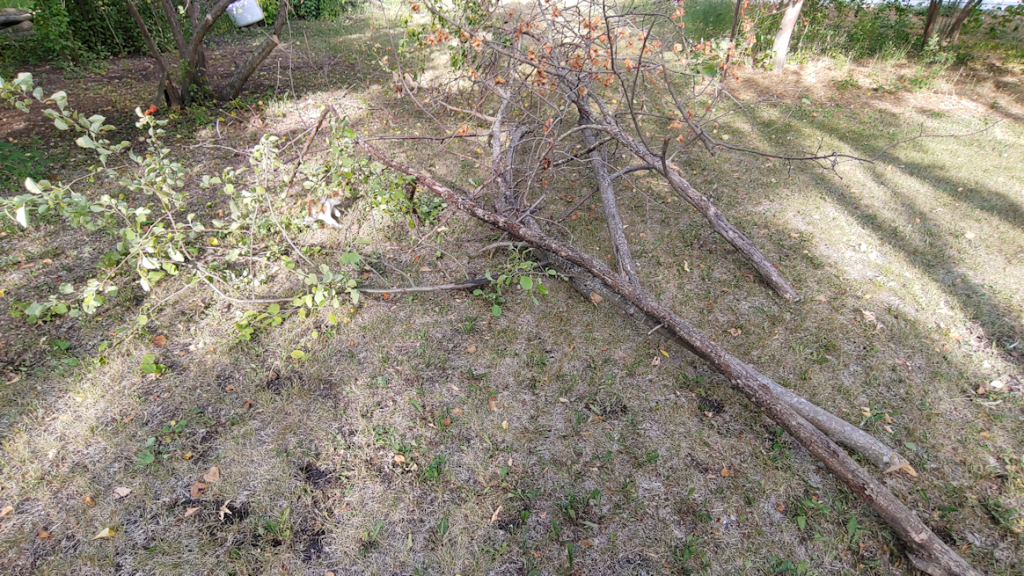
After finishing with this one, I turned to another apple tree next to it.
This tree had quite a bit pruned away, but also had signs of a fungal disease.
The branches that had the most signs of disease seem to have died.
Once again, with how twisted the branches were around each other, it was hard to see how much of any particular main branch was dead.
I ended up taking out three major branches.
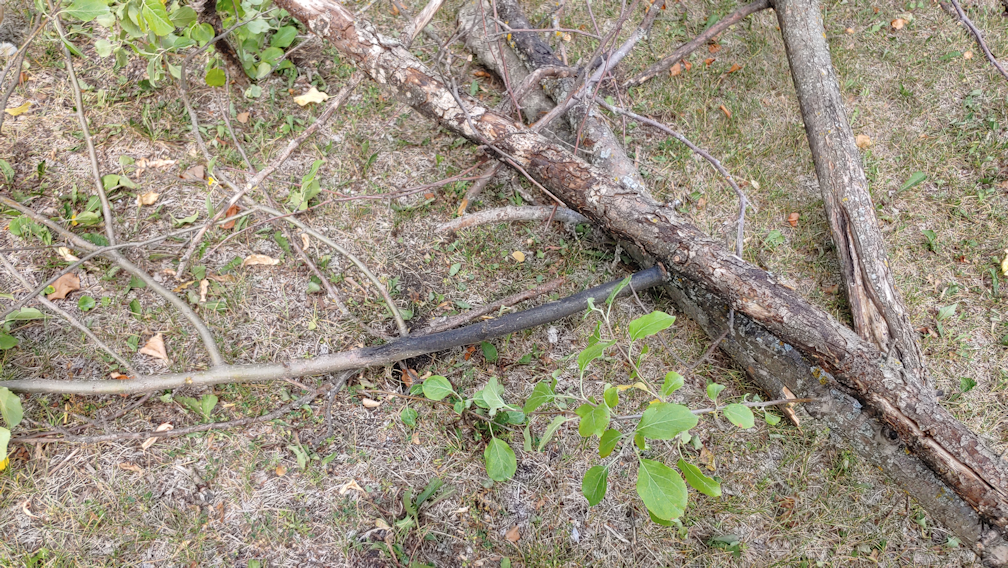
One of them did have a still-living off shoot, but…
The part of it closest to the main branch is blackened. It almost looked burned.
One of the dead branches I cut out was so intertwined with others, it was really hard to pull out of the tree, with several dead branches breaking off and staying stuck among the living.
After cleaning it out, one of the living branches ended up hanging down almost to the ground. It turns out to have been supported by one of the dead sections. I could have mucked about to give it support, but in the end decided it would be better for the tree to take that weight off completely.
There was a third apple tree, growing between the plums, with a dead piece I cut off as well, though I neglected to take photos of that one.
I haven’t done much beyond maintaining what I did in this area last year, trying to focus on the East yard and the spruce grove, instead. Even so, I can see how the trees that seemed the weakest last year are either struggling even more this year, or have died outright. The row of apple trees to the north of the spruce grove is no exception. I don’t think we’ll be getting many apples this year. Not just in quantity, but they bloomed so late, it’s unlikely they’ll have time to ripen before the cold sets in. One that had been pruned back the summer before we arrived had started to recover fairly well, but not enough to survive this past winter. Others in that row have lost quite a few branches. Those, I think I’ll leave pruning back until next spring or so.
Something we will have to keep in mind as we plant more food trees: either they will be varieties hardy enough for our bitter winters, or we will have to ensure they get extra protection wrapped around them in the fall.





















 The Re-Farmer