After looking up and confirming when to start harvesting cucamelons, I went ahead and picked the largest ones.
The fruit doesn’t grow larger than 1 or 2 inches, and we read that if they are left too long, they get really seedy. Which makes sense.
Aren’t they adorable?
There was just enough for 2 each, so the girls and I tried them last night, while I left the last two in the little bowl on the table for my husband to try in the morning.
One of them disappeared.
Either we’re going to step on a cucamelon at some point, or a cat ate it. :-D
So… how did they taste?
Like cucumber, really. :-D The skin to flesh ratio is higher, so you do have more of that slightly bitter flavour of the skin, but just enough to make them distinct. They have a nice crunch, too.
From what we read, picking the fruit makes them more productive, and they will produce for a long time. I look forward to having more of them to gather, soon!
I think these are definitely keepers for future gardening. Apparently, in colder climates with shorter growing seasons like ours, you can even dig up the roots in the fall for spring transplanting, and have earlier production.
As we work on clearing, cleaning and reclaiming the yard and planting our first garden beds, I’ve been keeping a close eye on details to keep in mind for the future. Things that will help us decide what needs to be done next, what to change or what to keep the same.
This morning, I found myself making a lot of comparisons.
The cutest one is the cucamelons.
This is the largest one that is developing, with my fingers giving an idea of just show small these are!
Isn’t that just the cutest thing? :-D This is the first one big enough to start seeing the patterns developing.
The trellis I made for these is just cotton yarn. It is working very well, except for on thing.
The cats.
When I am out there and the boys come over for some attention, they will plow their way through the trellis, pulling tendrils off in the process, then look at me all confused over why I’m flipping out at them. :-D They also try to lean and rub against the strands of yarn, only to flop over onto the plants. !!!
We already know that this location doesn’t have enough sun for cucamelons. If we grow them in the future, they will be planted somewhere with full sun. Our original intention was to plant them against the chain link fence for them to climb, and the cats are showing us exactly why that’s a very good idea! If not there, then we will have to make sure to have trellises that are sturdier, with strands much closer together. Not because the cucamelons themselves need it, but because of the cats!
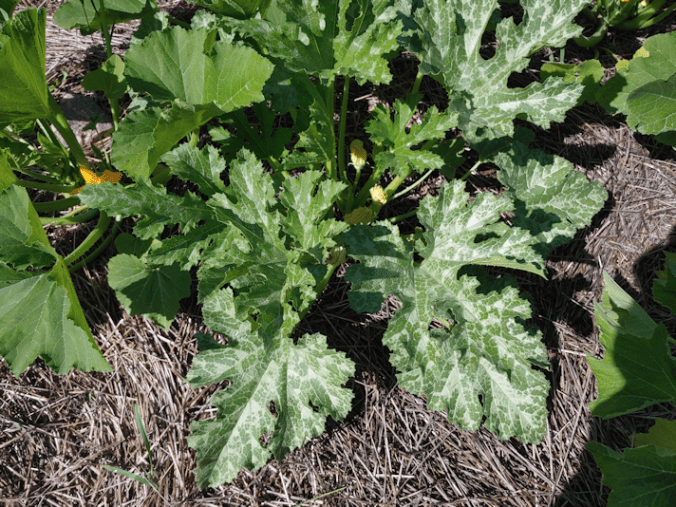
Here is another comparison. These two squash plants, with the mottled leaves.
They look pretty much like the same kind of plant, don’t they?
Now look at the developing squash.
They’re completely different!
I’m looking forward to being able to start harvesting these. My favourite way to eat them is raw, with dip. No need for anything else, when they’re at just the right stage. :-)
It was looking at the chokecherry trees that I am really seeing what a difference even minor changes in conditions makes.
This first one is at the south side of the garden where the squash beds are.
This one gets sun in the mornings, but for most of the day, it is shaded by spruce and maple trees to the South and West of it. It is not crowded by other trees. It has quite a lot of berries that are looking big and juicy (well… as much as chokecherries can be! ;-) ). Even last year, during the drought, it had larger berries. While I do not specifically water this tree, I do sometimes water the little patch of flowers and raspberries on one side of it, and the black current bush (my sister confirmed what it was for me) on the other side, so it does get extra water from that. While is has larger berries, it also ripens later. As you can see, the berries are still very much on the red side of things.
This next one is the chokecherry tree that is engulfed by lilacs.
This one gets full sun for most of the day, though it does get slightly shaded at the end of the day, by the trees my mother left to grow after she moved the raspberries they’d self-sown in between, years ago. This whole area gets quite dry, and we do not make any effort to try and water anything here.
The berries themselves are noticeably smaller than in the previous tree, and there are less of them, but they are also ripening faster.
Then there is this tree, right nearby.
This is the top of a young, small tree that was self-sown and allowed to grow (rather than get mowed over, like all the other saplings) in a grassy band between the old garden area (with the row of trees mentioned previously) and the lilac hedge. It might get some shade towards the end of the day, but otherwise gets full sun. Our first summer here, it did not produce fruit yet, and I wasn’t even completely sure what kind of tree it was. Our second summer, it had a few berries. This year, it has matured enough to produce quite a lot of berries. With full sun most of the day, not at all crowded, and little moisture, the berries are still not as big as the ones closer to the house, but the clusters are dense and ripening quickly.
You can see how this tree is situated in the background of the next photo, below. This next chokecherry is also among the lilacs, but on the edge of the hedge, not in the middle of them.
Here, it gets no shade at all. It has lots of berries that are already ripe. As you can see, though, some of the leaves are turning yellow. Only a few branches are like this, not all of them. It’s not stopping them from heavily fruiting! Like the other two along this side of the old garden, the berries are not as large as the trees nearer the house.
This next one was a surprise find, along with the Saskatoon berries. This area had been full of spirea that I had pulled up. It’s starting to grow back, so I’ll have to do it again, as pulling them up has been a good thing for other trees. The Saskatoons thrived this summer, and we discovered another chokecherry tree among them.
This area is under spruce trees, both living and dead, getting very little sun. In the above photo are the berries on the North side of the tree, where it gets even less sun. As you can see, they are just turning from green to red here.
This next photo is of the same tree, but on the South side.
That little bit more sunlight sure makes a noticeable difference in how fast they ripen!
Again, while I have not really been watering these trees, they are near the horseradish, and with the spirea taken out, wildflowers have come up and I’ve been watering those. So they will have benefited a bit from that, too. Mostly, though, being under the spruces as they are, they don’t get the full heat of the day, so the soil doesn’t dry out after a rainfall as quickly, either.
Then there is this one…
That’s a chokecherry in the middle of the photo. I had cleared a path to the junk pile you can see part of, to try and find useful pieces of wood in it, but that’s as far as I got so far. The tree itself is not crowded by other, large trees, and is shaded only in the morning hours. It’s surrounded by spirea and thistles, so we can’t get at it right now, but it appears to be just loaded with ripe chokecherries.
Finally, there is this one.
This is the top of a chokecherry tree among the cherries. I can get close to it, but not enough to be able to harvest it until I clear away the cherries around it; mostly cherries that had been killed off by last year’s horrible spring, and the bits that are now growing up from the bases. They create a formidable barrier!
This tree also gets shade in the morning hours only. Our last two summers, I don’t recall seeing any flowers or berries at all. Last summer, I’d cleared away the old wood pile, which turned out to be a much, much larger job than I expected. You can read about it in this series of posts (all links should open in new tabs, so you won’t lose your place!); parts one, two, three, four, five, six, seven, eight.
Did I mention it turned out to be a really huge job?
Yeah.
So while there is still lots to clean up to work our way into the spruce grove, what has been done so far made a big difference. I’m thinking that, had the cherries not been so damaged by the previous spring conditions, they would have improved, too. Mind you, the one cherry tree I kept because it managed to actually produce a few berries, and is not at all crowded, did not produce even a blossom this year.
It’s amazing how the same type of tree, while not really all that far apart from each other, are so different based on even minor changes in sun, shade, moisture, etc. When it comes time for us to plant more food trees, the differences among these chokecherry trees is providing us with a lot of information.
Everything we started from seed has finally been transplanted.
At least, everything that sprouted…
These are all the pellets that didn’t sprout. The tray in the background was the squashes tray. I’d say most of those empty pellets are the gourds. The ones in the foreground are mostly fennel, with maybe a cucamelon or two.
It’s entirely possible some might eventually sprout, so I’m just leaving them out.
Today, both my daughters were able to help, at the same time! Things went very fast with three people working at once.
The first thing we did was transplant the cucamelons in the chimney block retaining wall. It had been our intention to bring up the remaining blocks from the basement, to use as planters in another location, but there is no safe way to take them out. At least not while the kittens are downstairs. So we planted them here, instead. With the ornamental apple trees growing nearby, they won’t have the full sun they should be getting. There are 3 metal posts I couldn’t take out, when I removed the fence that used to be here, so we will use them to hold a trellis. Hopefully, that will help them get more sunlight as they grow bigger.
The few fennel that sprouted were planted in the soil beside the blocks. All 6 of them. They are so leggy, I don’t know that they’ll even survive, but we’ll see.
That done, we moved on to the squash garden.
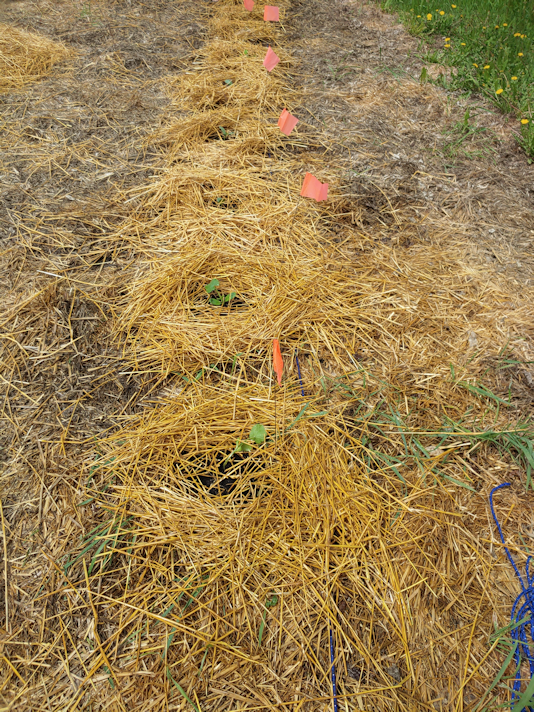
We had exactly 11 transplants, so we marked a spot in the middle of the row, then measured and marked out every 2 feet in each direction.
In this photo, each has been transplanted into its “pot” of soil mix, and we were starting to add the mulch. These would mostly be the zucchini mix and pattypans (it’s all a surprise mix now, after the tray got knocked over!), but some of them are the birdhouse gourds. We’ll figure out which is which, as they grow! :-D
I had intended to build some rather heavy duty trellises for the squashes, but things aren’t quite working out to get that done, so I picked up some bamboo poles. We’ll use them and, if I can find some, some plastic mesh instead of the chicken wire. The wire, I want to reserve for when I finally do make something more heavy duty.
After we finished mulching and watering, I set out the poles.
I’ve mentioned a few times, how rocky this area is. Just pushing in those flags typically involves readjusting a few times, to get around rocks we hit, inches into the soil.
When pushing in the bamboo poles, I made a point of pushing the narrower ends into the ground, as they were more pointed. I had to make several attempts on pretty much every pole.
Including this one.
I still managed to hit a rock hard enough to break the end off the pole!
This is how it looks now.
It’s hard to say how many of the frost damaged squash will survive, but I still put poles in to trellis whatever makes it. We’ve got the mixed squash on the far right and far left, three pumpkin hills in the middle, and now a row of mixed squash and gourds along the back.
And it’s all done! No more planting!
While working in the area, we also took the time to water various things, including the gooseberry bushes.
Which are not gooseberry bushes.
While cleaning in the maple grove, two springs ago, I uncovered several gooseberry bushes. They were not doing well, with the lack of space and sunlight from all the overgrowth and closely planted, some dead or dying, trees.
Last year, they started to recover, but with the drought, there were almost no berries. Of the few there were, I noticed they were much smaller and darker than I expected, but with the drought, that was true of many of the berries we had.
It was when I was going through the Vesey’s catalog that I saw photos of gooseberries, right next to currants, and realized these might not be gooseberries at all. The leaves look much the same, but the berries are slightly different.
When I had the chance, I asked my mom if the gooseberry bushes really were gooseberries.
Nope. They weren’t.
So what are they?
She had no idea.
My sister had brought them and planted them, but my mother did not know what they were. Since she didn’t know what they were, she figured they were poisonous (as if my sister would give her poisonous berries for her garden???), so she’d never tried them. I happened to mentioned I’d eaten some of the very few berries we had last year, and she was all “oh… you’re okay, so I guess they’re safe.”
*facepalm*
So I think we actually have currants, not gooseberries.
This year, we’ve been better able to water them, and they are looking much better. There are lots of flowers, so I hope that means that, this year, we’ll have lots of fruit!
It had taken a lot of work, but we found quite a few fruit and berry bushes as we cleaned up many years of neglect. After a couple of years, now that these foundlings have space and sunlight again, they are all looking stronger and healthier. Hopefully, that will mean higher yields, to go along with our first attempt at gardening, since moving out here!






 The Re-Farmer