Well, I’m back home now, and am really wrestling with myself.
I went to the old church again to see what was left. I saw a few things moved around, and a shelf in the entry that had been in the choir loft. Someone shattered a fluorescent light bulb, so there was new glass all over one area.
Someone managed to remove and entire window. They had simple stained glass panels in them; squares for the most part, with triangles to fit the semi circle tops.
Unfortunately, that leaves a big hole in the wall. It’s unlikely anyone will make any effort to board it up, since the entire building is going to be torn down.
Much to my surprise, the pair of candle sticks with red glass globe shaped tops were still there.
I decided to take them.
I went into the priest’s room and found the closet doors in there open, and vestments still hanging. The doors protected them, and they are not damaged by fire at all.
There’s a solid wooden shelf opposite the closet. I went through more of the drawers this time. They were a bit janky, trying to open them with one hand while using my phone as a flashlight with the other. Still, I hope someone takes the shelf. It’s big, heavy and incredibly solid. There is only smoke residue on it.
The drawers were for things like altar cloths, other cloths, and I even found the curtains that had been used as doors for these two tiny rooms on either side of the altar. At a bottom drawer, I found a cloth that looked very clean and picked it up. I am sure it is actual linen, not the usual cotton.
I decided to take it.
There were a number of glass items that I was very tempted by, but I left those for now. Instead, I grabbed the candles sticks and headed out.
My conundrum.
Should I take a pew? Plus a bench or two?
Five of them have already been taken. There are still eight left, plus a couple of benches. If no one takes these, they will be burned.
They are really solid. Even the ones in front seem to have only smoke damage, not flame damage. The benches in the back have the least damage of all.
They are all pretty long. Possibly longer than our truck box, though that is not a concern. I could just secure them with the tailgate down and put a red flag on the back.
With various projects we have in mind around the property, I can see being able to use these.
The problem is, where to keep them until then?
Ideally, we’d take them into the new part basement, where they could be cleaned over the rest of the winter. With how long they are, though, we couldn’t get them down the stairs. For the new part basement, we simply wouldn’t be able to maneuver them through the doors and down the stairs. Then, once at the bottom of the stairs, they would be too long to turn at the bottom. There’s a hand rail attached to a support pillar in the way.
Theoretically, we could take them straight through the house and to the old part basement doors, but we’d have the same problem at the bottom of the stairs. The space around those stairs is even tighter.
There are a few other things still there that I’m tempted to take but, again, where would I put them until we can use them?
After I was done going through the church, I went to the store the post office is in. Still no regular mail, but my daughters’ Christmas gift that I was expecting was there. The product packaging was wrapped in semi-transparent plastic, though, you could see exactly what was in it!
My daughter had sent me some funds and a request for some Crown Royal for the eggnog. Her sister had already picked up some booze when we were doing errands a couple of days ago, but she picked such good ones, they didn’t want to “waste” it on eggnog. 😄 The general store and post office has a booze section, too. After looking at the options, I chose a Salted Caramel.
As I was paying for our stuff, I asked the owner of the store if she knew when the church was going to be torn down. She didn’t know, but her husband happened to walk in while we were talking, and she sent me his way, as he was more involved with all the meetings and stuff.
It turns out he didn’t know, either, as that decision hasn’t been made yet. He thinks it would be in the spring, too. It just doesn’t make sense to do it in the winter.
We spoke for quite a while. He had been in the church this morning, while I had been there within maybe 15 minutes, and there were already some changes from between our visits. He himself had taken a couple of pews. I brought up the shelf in the priest’s room, with the janky drawers. He just laughed and said, they have always been like that! He agreed, though, that it is really solid, and hoped that someone could take it. It would not be easy to get out of there, but it would be worth it!
So we will have time to decide.
When I got home and brought things in, my older daughter met me at the door to help me come in.
…
Well, since she was going to see it anyhow, I handed her the box and told her, Merry Christmas!
We got them an Instant Pot.
My daughters had been talking about getting a rice cooker, and in my conversation with them, I suggested getting an Instant Pot, since it can do that, as well as being a slow cooker and a pressure cooker, among other things. We’re down to one slow cooker, so a second with be handy, and it would have more control than our little pressure cooker.
I got a positive response to the suggestion, so when we had the chance, I ordered one as a gift for them. We are a family that quite appreciates useful gifts like this!
So they got their gift early. I’m sure they’ll get good use out of it!
Then she helped me carefully take the candlesticks and their glass covers, which I had already taken off, to the cat free zone to join the other mementos. As she was going through the doorway into the living room, though, something fell and hit the floor.
Hard.
It was the insert from one of the candlesticks. The insert it meant to hold a long, straight candle and has a spring on the bottom so that, as the candle burns away at the top, it slowly pushes the rest of the candle up.
It still had most of the length of a candle in it!
After everything was put away, we started talking about what I found at the church and I told them about wanting to take a pew, and maybe a bench or two. They agreed that these were things we could definitely make use of but, again, where do we store them until then?
One possibility mentioned is the storage house, in the inner yard. That would be a good place where they would be protected from the elements, but there is already so much stuff in there, I don’t know that there is room for even a bench, never mind a pew.
Ideally, we could put it in the storage warehouse, which used to be my late brother’s workshop. That, unfortunately, is so full of stuff from my parents, there’s barely space to walk around.
A lot of what’s taking up space in there is bags and bags and bags of old clothing, bed pads and other fabric items. The clothing, at the very least, should be taken to the dump as far as I’m concerned. My mother, however is still very attached to her material goods and still frets over whether the door is locked, because someone might steel her stuff.
*sigh*
That building is the most structurally sound one in the outer yard, and we can’t even use it.
Either way, it would mean we couldn’t start to clean them until spring, at the earliest.
So … can we take a pew and some benches?
I think we could make it work. In fact, if we could find the space, I would take several pews. It would be a massive shame for them to be destroyed. They don’t make them solid like this, anymore!
For at least a decade, there has been an increase in people who have decided to move out of the cities, get themselves an acreage, and live as self-sufficiently as possible.
Which is basically, how I grew up.
Things have really changed, though, and modern homesteaders have a lot more resources, options and choices than was available when I was a kid, 50 years ago, never mind what our pioneers had. I found this very encouraging to see.
A couple of decades ago, while part of an online homeschooling support group – pre-social media, when everything was by email (and dinosaurs roamed the earth) – I often saw people waxing poetic about how we all need to go “back to the land”, and live these organic, subsistence lives, and all our food would be free and we would barter for everything else, and so on. It had a lot more to do with ideology than anything else. Going back to the farm was a dream of mine since I moved away in my late teens, so I could appreciate many of the sentiments they expressed. Unfortunately, this romanticized view was wildly unrealistic, and I found myself trying to remind people that there are reasons people, including farmers, moved away from that life.
Most of them didn’t get it.
Once we moved to the farm, 4 years ago, in a caretaker role, how things were done when I was a kid just wasn’t an option, and I’m quite okay with that. Most of the land is rented out, so we just have our corner to work on. My mother had a massive garden that had been slowly neglected for many years, as my parents retired from farming and age reduced their mobility, no matter how much my siblings tried to help. We can finally work on our dream to be as self-sufficient as possible, but we have to do a lot of things differently than how we did it when I was a kid.
It was in researching this that I found this dynamic and growing homesteading community. These were people who may have gone in starry eyed, but were also realistic and determined, and they were making it work. The aging hippies I couldn’t get through to all those years ago, with their ideological blinders, could never have done what these awesome people were doing. It was very exciting!
Then, the last couple of years happened.
As people saw their jobs disappearing, their livelihoods destroyed, prices skyrocketing, and government restrictions stifling people’s ability to do some of the most basic things, a lot of people are suddenly having real concerns about being able to feed themselves and their families.
During WWII, governments actively encouraged families to grow Victory Gardens, and even gave out information and resources to help people do it. That sort of thing isn’t happening now. Instead, we are having to rely on each other to figure out how to grow what, for too many people, are literally survival gardens.
Whatever your reasons for wanting to start growing as much food for yourself as you can, I heartily encourage you! You won’t get any sermons or lectures from me. I do hope that I can, at the very least, provide some information and inspiration.
Start where you’re at
Your circumstances are going to be unique to you. If you’re already on an acreage, great. If all you’ve got to work with is a hall closet and some makeshift grow lights, great. You can start where you’re at, even if it’s just poking some holes in a bag of potting soil to grow some greens in a sunny window. Little by little, it’ll get done!
What I will be sharing here is going to be geared mostly to people living in colder climates – and by that, I meant Zone 2 or 3 (depending on what Canadian zone maps are being used, we live in either 3a or 2b).
I will add one thing I’ve heard quite a number of very experienced, prolific gardeners say. If they had to depend on their gardens for survival, they’d starve! It takes a lot to grow enough food to actually provide enough for even one person to last from preservation to the next year’s harvest, and it will still need to be supplemented with other things. I’m still somewhat amused and perplexed by my mother trying to lure us out here by saying we could grow a garden and not have to buy groceries anymore. Even as big as her garden was, plus having chickens and cows, sometimes pigs, turkeys and geese, a root cellar and lots of canning and freezing, we still had to buy groceries.
So you’re still going to need to buy stuff. Hopefully, just a lot less!
With that in mind, as you plan what to grow in your own personal survival garden, here are some things to consider when making decisions.
Grow what you will eat.
I’ve looked at so many lists out there, for things like what to grow to feed a family for a year, or what to grow in your climate, and so on, and frankly, a lot of stuff on those lists are foods I just don’t like. Others, I can’t eat. There are four of us in our household, and we have very different tastes. Which means that our focus will be more on growing things all of us enjoy eating, then including smaller amounts of things only one or two of us like to eat. As wonderful and appetizing as I find tomatoes and bell peppers, they both make gag, but two people in our household enjoy eating them, and all of us can eat processed tomatoes. Now, those two people REALLY like their tomatoes, so growing more of those than peppers for fresh eating makes sense, as well as growing a lot of tomatoes that are good for making tomato paste to last us for months. It’s a sort of juggling game.
Try new things
What we find in the grocery stores is there because those varieties can handle large scale growing and transportation. When you’re growing your own, you can have a lot more choices. This is a time to grow new varieties of things you know you like, and if you have the space and resources for it, grow something you’ve always wanted to try, but couldn’t for one reason or another. Which kinda ties in with my next point to consider.
Grow at least one thing for fun
Yes, growing food to ensure your family has something to eat when times are tough is serious business. The whole point of the list I’ll be presenting to you is to be able to get as much bang for your buck as you can. At the same time, growing something just for fun is a great morale booster. As you go through what various seed companies and nurseries have to offer, you’re bound to find something that just puts a smile on your face. If you have the space and resources for it, go for it!
Keep in mind your region, climate and particular circumstances.
While the zone maps are very handy, that doesn’t mean there aren’t exceptions. There are things my mother successfully grew in our Zone 3 that were rated at Zone 5. She didn’t even doing anything different for them, either! This is a good time to find and get involved with a community of people in your region and zone, online or off, to learn from. If you are growing outdoors, look at what is rated for your zone, but also consider whether you can create microclimates. If you have only a balcony or patio, there are lots of places where you can learn about container gardening or vertical gardening. If you are growing indoors, there are resources geared specifically for that.
Storage and preservation
If you’re growing food to feed your family, and trying to grow as much as possible in your space, it’s not going to be much good if you grow more than you can eat, but can’t preserve it! There are many options available; freezing, dehydrating, water bath canning, pressure canning and even freeze drying, if you can afford the machine! You might even be able to create a root cellar in some corner of your home. Refrigerator pickling and fermenting are options, if you don’t have canning equipment.
If you’re going to store and preserve food, you’ll need somewhere to put it. What methods you have available to save your food will help you decide what makes the most sense for you to grow.
Things will go wrong. Do it anyway
One thing that is going to happen is, there will be failures at some point. It’s inevitable. Sometimes, you’ll make a mistake. Sometimes, there will be circumstances completely out of your control. It happens. The beauty is, you can still fail “up”. Honestly, you’ll probably learn more from the failures than the successes! Of course, it’s always a good idea to learn from others as much as you can to avoid failures, but it’s still going to happen. Since being here at the farm for 4 years, and only gardening for 2, we knew we were trying to grow in far from ideal conditions, and had some setbacks, yet we still managed to have food from our own garden that we could enjoy.
When it came to making a list of things that might work well in a survival garden, I looked for things that could be grown in colder climates, had high yields, and could be stored or preserved, while also keeping time in mind. So let’s start with the fastest growing things, first!
There are quite a few things that can go from seed to plate in less than a month. Some in less than 10 days! Micro-greens and sprouts can be grown very quickly, can be grown indoors in trays or jars, continually throughout the year. Many seed companies now has sections for sprouts, and quite a variety of things can be grown for their sprouts. Many sprouts can be grown in jars – alfalfa, mung beans, lentils, radishes, and more. Gelatinous seeds, such as flax, chia, cress, arugula and psyllium, can be sprouted in trays. For microgreens, you can try beets, swiss chard, broccoli, cress, peas, radishes and sunflowers.
If you want to give things a bit more time, leafy greens such as pretty much any type of leaf lettuce, spinach, chard, kale, bok choi and radishes can be grown and harvested very quickly. Many of these don’t like heat much, so they can be planted outdoors early in the spring and sowed successively until the heat of summer, then sowed again for a fall crop.
These quick growing plants are nutritional power houses, but they don’t have a lot of calories. They’re not going to keep anyone going for long, so it’s good to think of these as a supplement, and something that can provide nutrition until other foods can be harvested.
Short term
By “short term”, I am talking about the things we typically think of in our annual vegetable gardens. These are things that can take a few months before you can start harvesting anything, and can potentially keep feeding you and your family throughout the winter, with proper storage and preservation.
Root vegetables: carrots, parsnips, beets, radish bulbs, turnips, rutabagas… there are many to choose from, and many varieties of each! Stored properly, they can last for months on their own, but they can also be pickled, pressure canned, frozen, and dehydrated. With these, they are one seed, one plant (except beets; their seeds are actually clusters of seeds), but they produce so many seeds, most packets will provide more than needed for a typical household.
Bulbs and tubers: potatoes, sunchokes/Jerusalem artichokes, sweet potatoes – yes, there is a cold hardy variety of sweet potatoes out there! – bulb fennel, celeriac and more.
There are many varieties of potatoes, some more prolific than others, and some better for storage than others. A good source of seed potatoes will give that information. Potatoes also come in determinate and indeterminate varieties. Indeterminates are good for potato bags and towers, while determinate are good for hilling or Ruth Stout growing methods. Sunchokes will grow in just about any type of soil, and can be so prolific, they are sometimes considered invasive.
Special mention: the alliums are excellent bulbs to grow, but tend to require a lot more time, unless you are starting onions and shallots from sets, or spring garlic. Hard neck garlic needs to be planted in the fall, while onions and shallots from seed – which gives a lot more choice in varieties – need to be started indoors very early. In my garden groups, I’ve found Zone 3 gardeners that start their onions from seed as early as January! Onions also come in long day and short day varieties. If you are in a northern Zone, look for long day varieties. Of course, some varieties store longer than others but, properly cured and stored, they can last a very long time! Onion greens can be eaten as the bulbs mature, and hard neck garlic produces scapes that need to be removed to produce bigger bulbs, and they are delicious, making them dual crops to grow.
Summer squash and zucchini: There are many varieties of summer squash, and they all tend to be quite prolific. Just a couple of plants can provide plenty of baby squash that mature fairly quickly, and if they are left to grow larger, some varieties can be stuffed and baked. Most summer squash start to get tough as they get larger, and are not a storage vegetable, but they can be pickled, canned, frozen and dehydrated. Zucchini is a bit of an exception, in that it can be used as both a summer squash while small, or a winter squash if allowed to grow to full size.
Winter squash and pumpkins: These are squash that can grow to sometimes colossal sizes, but there are also varieties that are small, fast maturing and very prolific. Once they reach maturity, the fruits are cured and can be stored for the winter months. Some varieties reach their best flavour after weeks or months in storage. They can also be frozen, canned, shredded and dehydrated.
Legumes: there are few vegetables out there that provide more bang for your buck than legumes! Especially beans. Bush beans can be grown for their pods, and when they’re done producing is about when pole beans are ready for harvesting, and of course there are shelling beans, which are grown for their fully mature and dry seeds. Peas, chick peas and lentils can also provide a lot of food from just a few plants. Dried legumes, stored properly, can last for years, making them one of the most efficient foods to grow.
We could fit about a hundred of these tiny Spoon tomatoes into a single Red Solo cup.
Tomatoes: tomatoes are a fruit that deserve their own category. The varieties available is staggering! However, if you are looking to get the most pounds per plant, look at growing a mid sized variety. Aside from fresh eating, they can be frozen, canned or dehydrated on their own, or be used as an ingredient for sauces and salsas, and so much more.
Cucumbers: As with tomatoes, there are a really amazing number of cucumber varieties available, but most fall into one of two categories; slicers, for fresh eating, and picklers, for preserving. They all tend to be fast growing and very prolific, too.
Peppers: I wasn’t sure about including peppers on this list. They are excellent producers, but growing them in our colder climate seems to be touch and go. I’ve heard from people who have had great success with them, while others have tried for many years, but have never had a harvest. Peppers can be canned, preserved in oil, frozen, dehydrated, pickled and made into relishes.
While being able to grow food quickly is important, it is also useful to consider the long haul. If you have the space for it, there are things that may take several years before they begin producing, but once they do, the harvests will be bounteous!
Asparagus: asparagus can be grown from seed or you can buy crowns to transplant into trenches. It can take three years before they can be harvested, and even then, for the first year or two, harvests should be minimal. Once they are established, however, asparagus will keep producing for up to 20 years!
Raspberries, currants, gooseberries and haskaps: Haskaps are the new berries on the block, and are exceptionally cold hardy. They require male and female plants to produce, and can potentially begin producing berries in their first year. Raspberries are available as regular cane (new canes produce berries in their second year, then die back) or primal cane (new canes produce berries in their first year). Choosing varieties that mature at different times can give you fresh berries for months. Currants and gooseberries, once established, can produce fruit for many years. Berry bushes can provide a great deal of fruit per plant. Along with being used fresh, frozen or dehydrated, as well as made into jams and jellies, they can be used to make vinegars, syrups and wines.
Grapes: yes, there are Zone 3 grape varieties. I’ve even seen a Zone 2 variety. Grape vines are very long lived, and have the potential to provide fresh and frozen fruit, jelly, and wines for many years.
Hedge bushes and trees: There are a number of larger berry bushes that can double as shelter belts and natural boarders. Some, like sea buckthorn and bison berry, do well in poor soils, and while they may be considered invasive in warmer climates, they tend not to be, in our Zone 3. The Rugosa rose produces large edible hips, and their flower petals are edible, too. Saskatoons are a more of a tree than a bush, and absolutely delicious. Chokecherries produce many berries, but are better used in syrups, vinegars, etc. than eaten fresh. Many of these will provide enough berries not only for your own use, but for birds as well!
Now we’re really going for the long haul! Here, we are looking at things that can take five or ten years before they start producing food – but once they do, they will continue for decades to come.
Fruit trees: there are a remarkable number of fruit trees that can grow in colder zones. Apples, pears, apricots, cherries and plums can all be grown here. While a single mature tree can provide enough fruit for the entire family, many need to be planted with a pollinator, which can be a different variety.
Nut trees: there are not a lot of nut trees that can grow in Zone 3, but some, like the Korean Pine, are hardy to Zone 2! Hazelberts and beaked hazelnuts are also very hardy. Others, such as the black walnut, can grow in Zone 3, but the nuts may not have enough for a growing season to fully mature.
Okay, so all this is a lot more than just a “survival” garden, but we all start somewhere, right? :-) Little by little, it’ll get done!
I hope you find these useful in working out what are the best things for you to start growing in your own particular situation.
For those who have already been doing this for a while, please feel free to leave a comment, sharing your own experiences. What worked best for you? What didn’t work? Is there anything you would tell someone who is just starting out now? Let us know!
With snow on the ground and temperatures dropping, this is the perfect time to look at how our gardens did this past year, compare it to the year before where we can, re-examine our goals, make some adjustments, and use that information to plan on what we will do next year.
Because we went from a pretty small garden the year before, to a much larger – and spread out – garden this year, I will go through things in more detail in later posts. For now, I just want to do an overview.
When we first moved out here, we worked out a multi-year plan. The first summer would focus on clearing and cleaning up the inner yard. The second year, we’d continue working on cleaning up the spruce grove and start working on the outer yard while maintaining what we cleaned up in the inner yard. The outer yard, we figured would take another 2 or 3 years.
With this plan, we would have been ready to start gardening around year five. Which would have made it next summer. Instead, we started our first small (ish) gardens in 2020. We had a few beds in the old garden area, and planted in the newly uncovered, soft soil found under the old wood pile. We were not very ready for gardening at all, but really – if we only ever did things when we are “ready” to do them, nothing would ever get done! ;-)
This past year, we kept our main goals, and added some new ones. The main goals have stayed the same. Ultimately, we want to be as self-sufficient as possible. That means growing as much of our own food as we can, in quantities sufficient to store or preserve enough food to last us through to the next garden season. So, not just through the winter, but until we can start harvesting fresh food from our garden again. (Animals will be part of the picture, too, but for now I will focus on plants.)
While we certainly didn’t meet that goal this year (nor did we expect to, yet), we did make progress. And I must say, I love being in a position to start working on a meal, realizing we’re out of onions or garlic in the kitchen, and simply popping into the root cellar to grab a bunch.
We didn’t plant anywhere near enough onions for our needs, but that’s part of figuring things out!
When it comes to planting things, whether it is our garden or trees or bushes, we try to meet multiple goals. In our long term goals, we want to have fruit and nut trees. Mid term includes certain types of berry bushes. Growing vegetables are part of our short term goals, simply because they are mostly annuals.
After being here a few years, we have identified gaps in the shelter belt we need to fill, as well as the need to increase privacy screening and dust protection from the surprisingly busy main gravel road that runs past one side of the property. With the aim of meeting multiple goals, any trees or bushes we plant will be chosen not only to meet those needs, but also provide food – and if they can provide enough for ourselves and for birds and wildlife, that’s just bonus. Soil testing has also helped us focus on what we can reasonably expect to grow here at all.
In trying to meet these multiple goals, we did things that would normally be gardening no-nos, like planting as far from the house as we could, and still be in the yard, breaking new ground that will later have things planted permanently. Choosing what to grow was based on things like short growing seasons, high yields and long term storage capabilities.
One thing we have is the luxury of space. That means that we have room to experiment and try new things to see how they do in our zone and growing conditions.
Some things, of course, end up being completely out of our control. Drought conditions being the main issue we had to deal with, this past summer. A plague of grasshoppers certainly didn’t help, either. Then there was the critter damage. That combination of things, plus the far-flung garden beds, made things considerably more difficult than it should have been.
Looking at things from a very broad perspective, though, we had more success than failure. Under the conditions we had, that’s pretty amazing!
I will talk about more specific things later but, in general, here is how we hope to progress next year, which will help us decide where our monthly “seed” budget will go.
The main thing we really need to focus on is trees. These can take years before they will start producing fruits or nuts, so we need to get those going as soon as we can. We’ve identified areas where we can plant things that will need more protection from the elements, and we’re looking at varieties that can handle our climate zone, as well as our nutrient depleted soil. Some of the varieties of nut trees we want to get cannot be planted in the inner yard, though, so we will still have to hold off on those until we can prepare areas in the outer yard. The renter is planning to rebuild the fence around the outer yard, and if he is able to do that next year, that means his cows won’t be able to get through anymore. We won’t have to worry about cows damaging seedlings; just deer! We will also be able to start taking out some of the old fencing around the inner yard, which will make it easier to tend to anything we plant in the outer yard.
We do not have the funds to get everything at once, so we have to focus on getting what will provide the most benefit in the shortest time frame. We will be able to get a few of the slower growing/producing trees, little by little, but will need to focus on faster growing/producing trees and bushes first, even though logically, it’s the trees that need the most time to mature that we should be getting first.
With that in mind, we will be ordering shelter belt berry bushes as soon as we can. Unfortunately, the varieties we had decided on are currently not available, but they might be available for ordering in December or January. Our first layer of “defense” will be to plant Bison Berry (if we can get them) along the East property line, to create a privacy screen. Sea Buckthorn is another one we are looking at, for another area, and we’re also looking at the Rugosa Rose. These will not only provide privacy screens, but will act as dust protection and deer barriers. The berry bushes are also nitrogen fixers. Once mature, they are supposed to be very prolific producers. What we don’t use ourselves will provide food for birds and other wildlife. The Rugosa Rose produces unusually large hips, and the flowers are also edible. (This will be on top of the wild roses we already have growing here.) These are more short to mid term items, as they should be able to start producing in just a few years. It will also take a few years for them to get big enough to form privacy and dust screens, and probably longer before they are dense enough to be a barrier to deer.
For long term, we are looking to order a bunch of Korean Pine Nut trees, if they are available. They require shade for their first few years, and we have the perfect spot to plant a row of them, though they will still need extra shade (and deer!) protection, at first. They are hardy to zone 2, and with 3 yr old saplings, it will still be at least 7 years before they start producing pine nuts. These will be the first nut trees we plan to get.
In the row of crab apple trees that we currently have, we will need to get rid of most of them, due to disease. I’m hoping we can save two of them that produce the best fruit. Crab apples are good for pollinating other apple varieties, so it’ll be important to keep at least a couple of healthy and strong trees.
What we are currently looking at are different cold-hardy apple varieties. I hope to get at least a couple varieties ordered this winter. We are looking for apples that are good for fresh eating, good for storage, and suitable for making cider, as well. Over time, we will be adding pears and plums as well, with the same requirements. These are more mid to long term goal plantings. They will need several years before they start producing, but nowhere near as long as the nut trees we are looking at. Once they do start producing, they are prolific, so we shouldn’t need a lot of trees to meet our needs.
Speaking of prolific, I found a source for a cold hardy variety of ever bearing, white mulberry that we plan to get. A single tree should be enough to provide for our needs, with plenty to spare for the birds as well. I even found a source for zone 3 paw paws! Given the rarity of those, I think we will put a priority of ordering them before they are sold out. Which means that is likely where our upcoming seed budget will be spent.
For short term, we need to start on our raspberries. This past year, the bushes my mother had planted did not produce at all, and the new ones we planted had to struggle with deer damage as well as the drought. We want to get several varieties of raspberries, in different colours and maturity rates. We all love raspberries, so the goal is to eventually have quite a lot of them.
We have found several bushes that appear to be black currants. There are two fairly large bushes, but they are completely shaded and barely productive. I plan to transplant those into sunny areas. I’m also looking to pick up some gooseberry and/or josta berry bushes as well, though probably not for 2022. We shall see.
The main focus with all of these is that they are perennial and, once established, should provide food for many years, so the sooner we can get them growing, the better.
For short term food growing, our original plans have changed a bit. Where the main garden area is, we will be building high raised beds to replace the current low beds, using logs from dead spruces in the spruce grove. Now that I have a chain saw that works, we should be able to clear the dead trees out much more quickly, and have logs cut to size ready and waiting to build high raised beds in the fall. Clearing out those dead trees will open up the spruce grove a lot. While we will be planting more spruces in the spruce grove (there are many little spruces we can transplant from elsewhere), we will also plant food producing trees that can use the extra protection the spruces provide.
The high raised beds we will be building in the main garden area will also serve multiple purposes. A primary one is accessibility, so we can continue to garden even as we get older and more broken. Filling them hugelkultur style should reduce how much water they need, even as high as they will be. This garden area has some shade issues, due to the tall trees my parents planted along the south side, and the beds will be high enough that they should even get more sun.
We will need a LOT more garden space to grow food in the quantities we need, however, and for that, we will be making garden beds in the outer yard, where they will get full sun, too. We won’t have enough dead spruces to use as materials for high raised beds there, as well as the main garden beds, but hopefully by the time we need to build them, we’ll have the funds to buy materials.
Looking at our long term plans, however, we are going to need to expand beyond growing vegetables for ourselves, too. We plan to get a hand mill. Among things I want to grow will be varieties of corn that can be ground into flour, and even different varieties of grains. I am hoping to at least get seeds this year, even if we can’t plant them right away.
As we start to include animals, I want to be able to grow as much of their food, as well as our own, as possible, which means forage crops. I’m even looking at plants that we can use to make our own sugar or syrup (yes, sugar maples are on our list, but there are other possibilities, too).
While some of these things may not be started this year, or even next year, we can still keep the plans in mind as we work on things this coming summer, to prepare. There is a rather massive amount of clean up needed in the outer yard, to have room for all this, as well as for the larger trees we intend to plant. Especially since some of those trees will need to be planted a minimum 30 feet apart, or cannot be planted near food crops because of the chemicals their roots release. Between that and the extra space needed between the raised beds, for accessibility purposes, things will be very spread out.
This past summer was a very difficult growing year. While I will go over specific things later, in general, I consider it a successful year. Remarkably successful, under the circumstances! Even some of our failures where still successes, since we had multiple purposes in mind. Some things we will do again, others will be dropped, if only temporarily, and new things will be tried. We learned a lot in the process, too, making everything a step forward to our ultimate goals.
The orange ones now have names. The bigger one is Turmeric. The tiny one is Saffron. :-D
As I write this, Beep Beep is curled up with them, but things were not so peaceful, a little while ago. I heard some strange squealing and looked over in time to see her jump out of the nest, with Nicco in her mouth, then dash over to a corner under my crafting table. There is shelf under there that’s empty, since it’s unreachable, and she was starting to move him into it. I had to move some storage bins to be able to reach Nicco and bring him out, but she tried again, later. I’m hoping I’ve dissuaded her from moving the kittens into there. Aside from this being a hard, colder, smaller space, they would eventually damage the wood of the shelf, and the carpet in front of it, as they get bigger and start pooping and peeing all over.
I now have storage bins all over my bed. With the area uncovered, it’s less tempting of a potential nest!
Meanwhile…
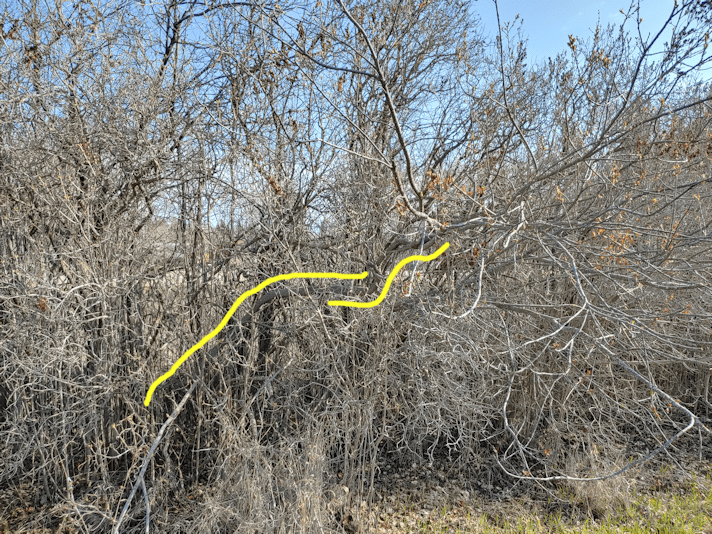
While doing my rounds this morning, I paused to take another look at one of the chokecherry trees among the lilacs, and consider some possibilities. Here is how the tree is growing.
It’s hard to see among the lilacs, so I put in the lines to show how the main trunk is leaning.
Here is a closer look of the base.
While I was not planning to work on the lilac hedge for some time, I am debating with myself on whether I should just go ahead and clear out around this tree. It is pretty choked out by the lilacs, so on the one hand, it would make for a healthier tree and higher yields of berries as quickly as this summer. Now would be a good time to clear it out, before the leaves are in. On the other hand, this tree is leaning so far over, I think the lilacs may be the only thing holding it upright. Whenever I do clear it, I would add a support of some kind, and start training it to grow straight again.
What do you think? Should I do it now, or stick to my original plan of doing it when we work on the lilacs a year or two from now?






 The Re-Farmer