After sitting overnight, tucked away in the oven, it was time to take out the cheese and do the final steps.
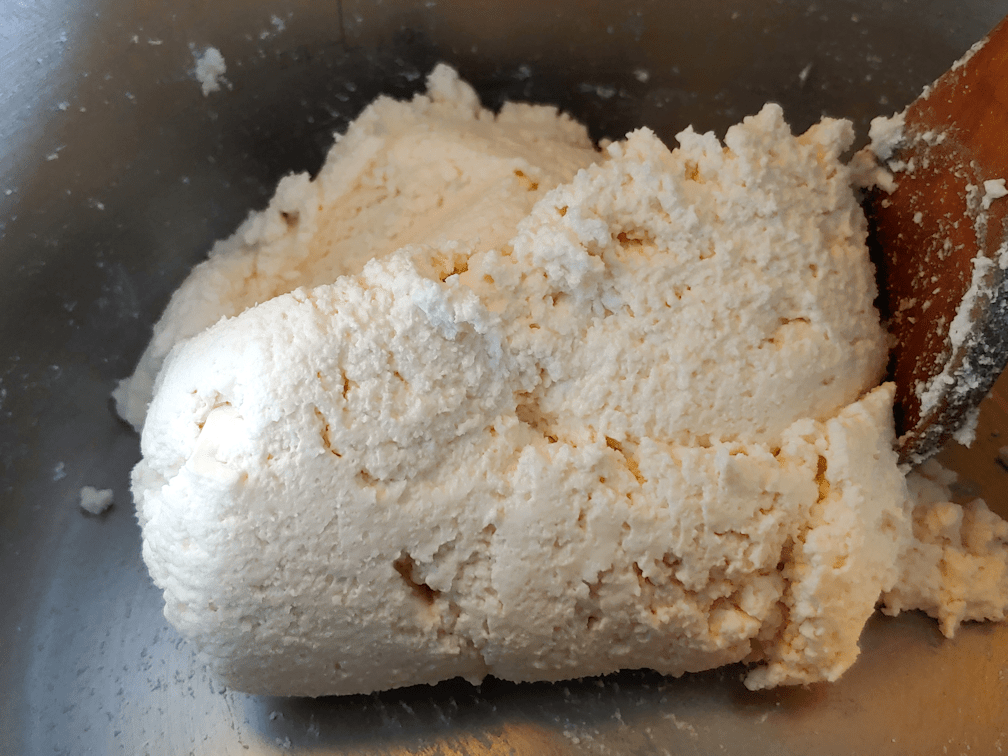
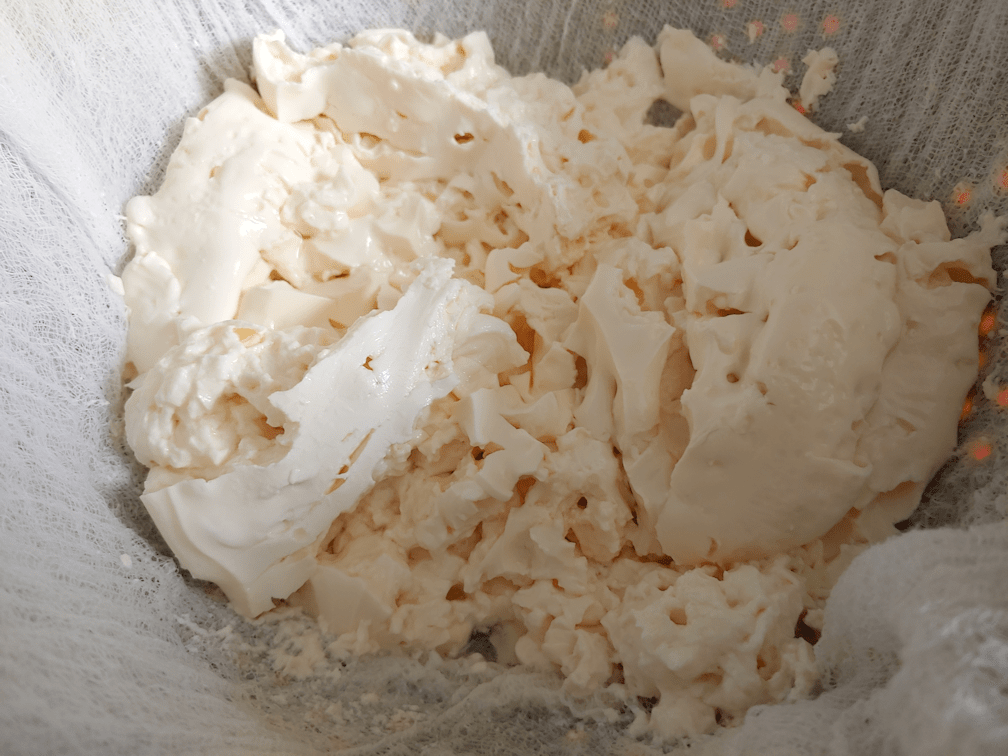
This is what it looks like this morning, after stirring.
It… looks like dry cottage cheese.
The next instructions were:
Add salt to taste, if desired. Add colour if desired. Add herbs/spices, if desired.
For this first attempt, I am only adding salt.
If you look closely, you can see the salt on the curds in front of the spoon. My mother would have just plain table salt, since that’s what she would have had. I stole some of the powdered salt my daughters use in the popcorn pot. It’s just coarse salt that has been run through a coffee grinder, so it can be added to the oil that popcorn is popped in, and actually stick to the popcorn as it pops. That got very thoroughly mixed in while I started the next step.
Put to frying pan on low heat, in batches, and heat. Mix while heating.
The more the curd got mixed, the more dough-like it got in consistency.
Then, it actually started to melt!
I know that’s what my mother said, but I still felt surprised by it!
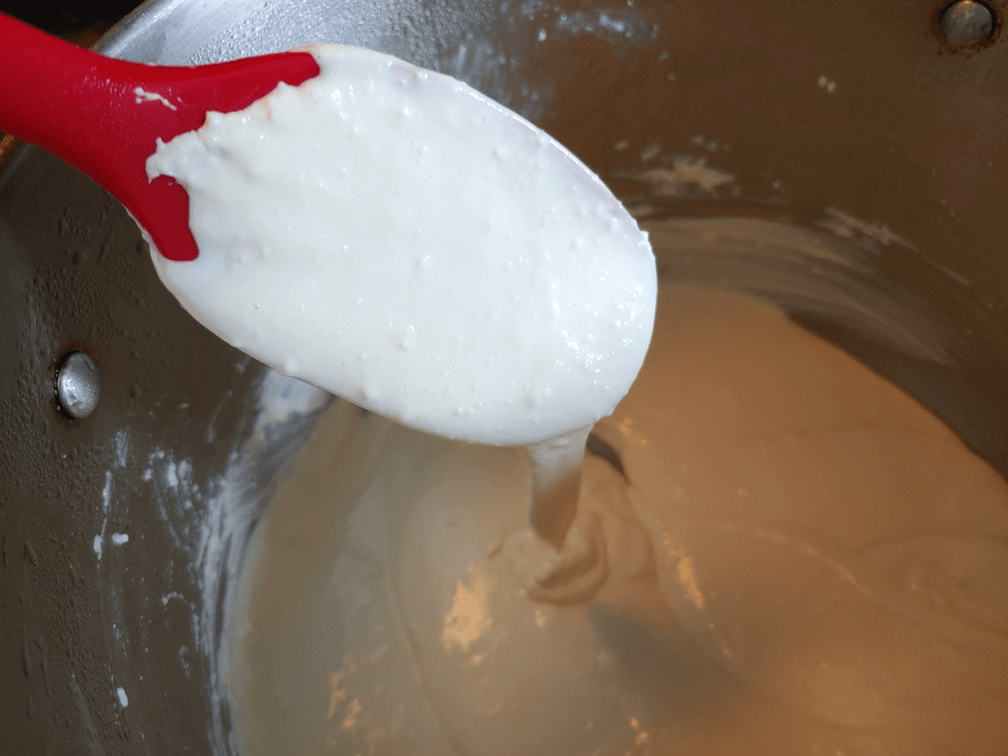
I even had to change spoons. By this stage, the texture was a bit like cake batter.
When melted completely, pour into form.
I didn’t know how long it needed to be stirred, but my mom said to pour it, so I just kept going.
Just look at this! It really did get to a pour-able consistency, unlike any other cheese I’ve ever worked with! At this stage, it was like well stirred sour cream in consistency.
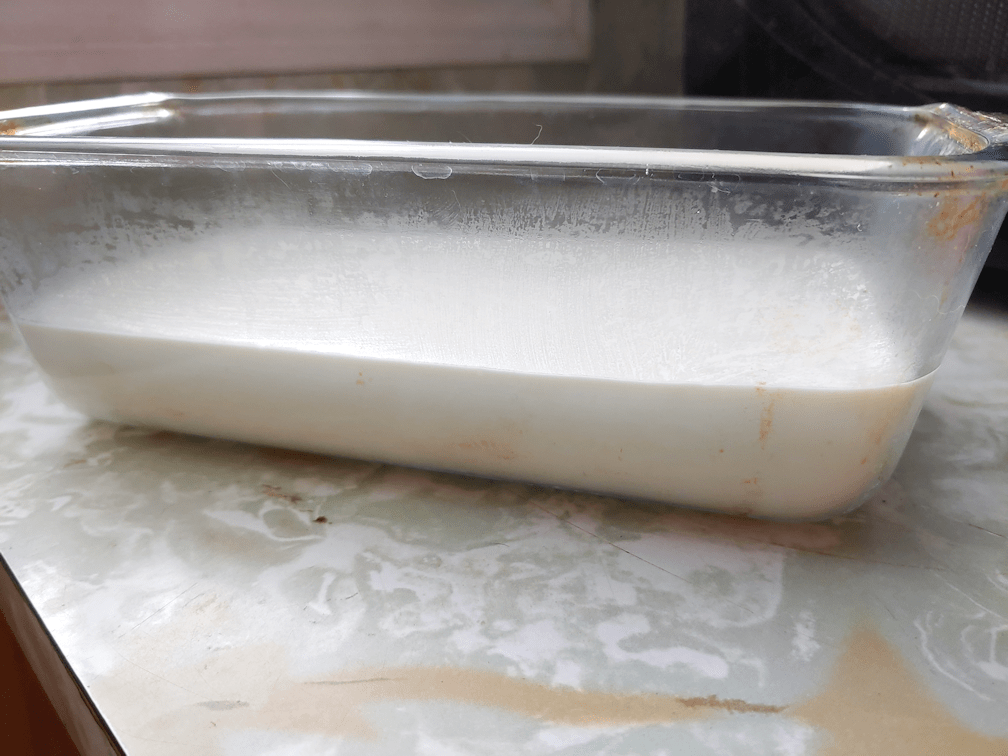
I then poured it into a loaf pan I’d scalded and had ready. This level if what 1 gallon of milk was reduced to.
Leave to rest until cool. When cool, ready to slice.
This is the stage we are at now. I covered the loaf pan with a narrow wooden cutting board I have. I considered covering it with plastic wrap, but I wasn’t sure I wanted the condensation build up, and the board would keep the dust off while also allowing a bit of air.
I’m hoping that, as it cools, it shrinks a bit, so it’ll be easier to remove from the loaf pan.
I did taste it after pouring it into the mold (I admit it. I licked the spoon!). The salt definitely improves the otherwise bland flavour. There is another flavour in there that I just can’t identify or describe. I’m hoping after we do a taste test, later, someone in the household will be able to describe it!
Okay, so the curds have been hanging for about 5 1/2 hours, and I’ve moved on to the next steps in trying to recreate my mom’s cheese.
Now, my Mom had said to just set it aside for a few hours, or overnight, so hanging it may have changed things a bit. I don’t know. But this is what it looks like after hanging for most of the day.
Also, it’s a good thing I covered the whole set up with another cheesecloth, because the cats REALLY wanted to get at this!
The next instructions are:
Put solids into large pot. Add about 1 tsp baking soda and mix thoroughly. Leave overnight. Will rise like bread.
Hmmm.
Looking at how little there is in here, I’m starting to think that my original notes, saying about 5 gallons of milk, was accurate. There is not a lot in here, and when I saw my mother’s cheese, it filled an ice cream bucket, so there’s no way it was only 1 gallon.
Which means I’ve been using the quantities for vinegar and baking soda for 5 gallons, not 1 gallon. Yet, 1 tsp of vinegar to sour 5 gallons seems like way too little. Mind you, she would have been making this in the summer, and the milk probably would have soured quickly, with no vinegar at all. Knowing she was pretty loosey-goosey on the quantities to begin with, it’s really hard to know. Considering how long it took to sour using 1 tsp of vinegar to 1 gallon of milk, I suspect it’s actually the correct amount, and that I would have needed more, if I were using more milk.
This is after very thoroughly mixing in the baking soda. Yes, I used 1 tsp for this amount.
The curds feel like a cross between cream cheese and cottage cheese. I spent quite a bit of time mixing it, because I wanted that baking soda to be worked in as much as possible.
My mom said to leave it overnight, which means she would have just left it on a counter, but I have put the covered pot into a warm oven, because of how chilly that part of the house gets.
She commented that it will “rise like bread.” That makes sense, since we should be seeing a chemical reaction between the acidic milk soured with vinegar, and the alkaline baking soda. It’s something I’m used to when working with sourdough, but with cheese? I did get the sense that the curds were starting to feel “fluffier” by the time I finished stirring in the soda, but that could be just my imagination because I am expecting something like that.
I did taste the curds before and after adding the soda. As I mentioned before, it has very little flavour right now, but I did feel that the baking soda … softened… the flavour, if that makes sense.
After it has sat for the night, salt, colours and herbs and spices can be added. For this first attempt, I will be adding some salt, but that’s it. If we make it again, we’ll experiment with adding herbs and spices or whatever.
I am incredibly curious to see what it looks like by morning!
Growing up here, as a subsistence farm, we had cows for milking and for beef. Even with 7 of us, we were milking enough cows to have excess milk. I remember my mother making cottage cheese (which I did NOT like), but that was the only type of cheese I saw her make until some years after I’d moved off the farm. I’d come out to visit, and saw some semi-hard cheese in an old ice cream bucket for a form. It was slightly harder than a cheddar, sort of tannish yellow in colour, with caraway seeds in it. It was quite tasty. I asked my mother about it, and she said she had made it.
A few years ago, I asked my mother about how she made this cheese I remembered. Unfortunately, she thought I was talking about cottage cheese, and the more I described it, the more perplexed she was.
After moving here, I was having a conversation with my mother about making and preserving food, when she mentioned a cheese she’d made. It was the one I remembered! I quickly took advantage of the moment, and got her to describe to me how she made it. I knew it had to be different, because my mother did not have access to rennet or any of the bacterial starters. She didn’t have a food thermometer, either.
Getting any sort of information like this from my mother has always been difficult. I remember the first time I tried to get a recipe for a soup she made. I remembered some of the ingredients, and asked her if she remembered how she made it. Instead of answering me, she started mocking me for not knowing how to cook and not knowing how to make soup. Never mind that I was already married and a child, by then, and had been feeding the family just fine.
I never did find out how she made that soup.
This time, I did manage to get the information down then, after I got off the phone with her, re-wrote it into more cohesive instructions, since the conversation bounced all over the place. When I was finally ready to try it, I was perplexed by some of the quantities, so I called her to clarify. Did she really start with 5 gallons of milk, or did I make a mistake writing it down?
Finding out was like pulling teeth! She kept avoiding answering the question, and kept saying, “you mean you’ve never made cheese before?” in total shock. Then giving me instructions on how to do different parts. I kept going back to the quantity, and asked her if she had used 5 gallons, only to be told how I should just use one gallon, because 5 gallons is such a lot… *facepalm* Then she talked about how she’d never made it using milk from a store, and how I could use lemon juice instead of vinegar, and on and on. It took a while, but I managed to explain that I have made cheese before, I did only want to use 1 gallon, and if the instructions I had was for 5 gallons, I’d have to know that, so I could adjust the other quantities.
What it came down to is, my mother never measured. She used whatever amount of milk she had, and went from there. I did know that. What I needed was some sort of approximation, because there is a heck of a big difference in quantities involved.
Finally, she told me she used about 1 gallon.
*sigh*
Once I had that clarified, I finally got a batch started. Here are the instructions I got from her, highlighted in blue, with my own commentary.
Milk – about a gallon Add 1 tsp vinegar to make sour. May take all night.
This part actually ended up taking almost two days. The milk was supposed to rest at room temperature, but with how cold our house is – especially the kitchen – I put it in a warm oven.
When sour, put in pot/roaster into oven to warm (lowest heat) until forms curds and whey.
We finally reached that stage this morning.
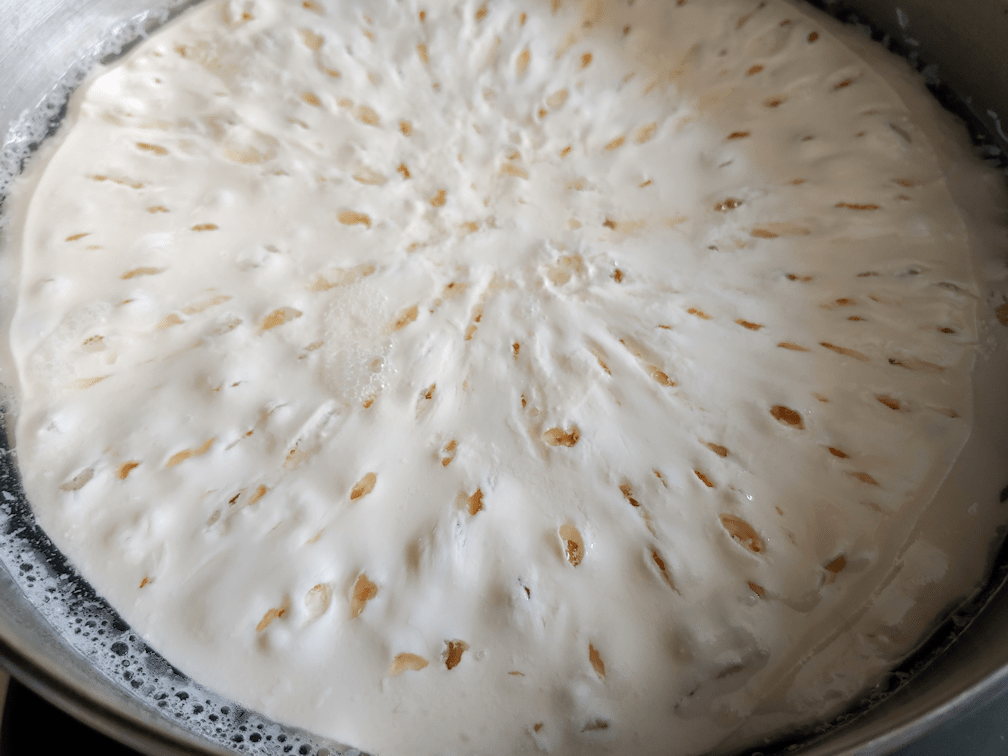
This is how it looked.
I have no idea if this is how it’s supposed to look.
Drain through cheesecloth.
There is nothing about cutting the curds or anything like that, first. Just to drain it.
I did give it a taste at this point. It doesn’t have much flavour to speak of. The texture was a lot denser than I expected it to be, considering how it broke apart.
Set aside for a few hours or, preferable, overnight.
This is the stage we’re at now, though I’m cheating a bit. I dug out the stand I made to hang jelly bags or drain yogurt cheese, tied off the cheesecloth and hung it.
After taking this photo, I covered the whole stand and bowl with another cheesecloth, to keep out the dust and cat fur – and cats!
Since I got to this point so early in the day, I will likely continue after a few hours, rather than leaving it overnight, because…
Put solids into large pot. Add about 1 tsp baking soda and mix thoroughly. Leave overnight. Will rise like bread.
… it will sit overnight again, after this stage.
As for the whey, I think it’s time to do some more bread baking! I love using whey as the liquid. It adds so much flavour!
The next instructions have me wondering.
Add salt to taste, if desired. Add colour if desired. Add herbs/spices, if desired.
This is all stuff that’s supposed to be added after the baking soda gets added, and after it rests overnight. Which seems odd to me, but that’s how she did it, so that’s how I’ll try it!
Put to frying pan on low heat, in batches, and heat. Mix while heating. When melted completely, pour into form.
… melted?
It can melt at this stage?
I am really perplexed by this.
I’m not sure what I’ll use as a form just yet. It will depend on what I see when the time comes
Leave to rest until cool. When cool, ready to slice.
If I hadn’t see my mother’s cheese, I would never guess that these instructions would get that result. As it is, I am still unsure of what I’ll actually get!
So this should be an interesting experiment. I hope it works, because it’s really easy to make, even if it does get spread out over several days.
No, I’m not talking about our furry Ginger Bug! I’m talking about using the actual roots.
In keeping with our stocking up on the assumption we’ll have a month or two where we can’t get out to do any sort of shopping, we’ve been thinking not only of essentials, but those little things that improve on quality of life. One thing that we considered is liquid refreshment. Drinking plain water gets boring, fast – and we buy our drinking water. We really should have tested our well water by now, but to get the full testing done is very expensive and time dependent. We’d have to take a sample and drive it to the lab in the city as quickly as possible. Even just getting a sample bottle requires going to another town. One I haven’t been to since I was a kid and went to a cattle auction with my dad. So that will just have to wait again.
Our usual default drink that isn’t plain water is tea, and my older daughter has already taken care of that department. She went through the sale section of David’s Tea and ordered 13 different types of tea! They should arrive in the mail this week.
The other thing we do enjoy is pop (soda). Usually Coke Zero for my husband and I, while our daughters prefer Ginger Ale. I actually don’t like Ginger Ale on it’s own, but love it mixed with fruit juice. There’s something about that carbonation that really hits the spot.
Which is why I’ve decided to start fermenting our own pop. It’s supposed to be all healthy and everything, but really, I just want to make a thirst quenching fizzy drink.
To start the process, we need to make a ginger bug and get the fermentation process going. I meant to start one a few days ago, but got busy with other things, so I finally got it started last night.
The basics of a ginger bug is fresh ginger root, sugar and water.
I looked at a lot of websites and videos, and there is a lot of conflicting information, of course. Some say to leave the skin on the ginger, because that’s where the yeast it, while others say to peel it, and it’ll ferment just fine. Some say to grate the ginger, others say to use a fine shredder, and still others say to just chop it up. Some were very specific about using a wooden spoon to stir the bug, while in some videos, I saw people using metal spoons to stir. Of course, the quantities and ratios of ginger:sugar:water are all different. With all this, everyone seemed to have very successful ginger bugs, so I figured things were pretty flexible! Then there is the container to put it in. As an open ferment, some cover the jar with cloth or a coffee filter, while others keep it in a sealed jar. Which, to me, seems to really increase the risk of an explosion.
So I just sort of took it all in and did my own version.
I decided to chop the ginger into a small dice, going with the sites that said it made it easier to strain the liquid out later. I don’t like floaties, if I can avoid them! I left the skin on, because peeling ginger is a pain in the butt.
As the ginger bug needs to be fed, I chopped extra and put the excess in the fridge.
I decided to use:
3Tbsp ginger 3Tbsp sugar 2 cups water
I put the whole thing in a 750ml jar to have room to add more ginger and sugar, and for stirring. I also used some of our purchased water, rather than our well water. If I were to use our well water, I would have boiled it and let it cool to room temperature, first.
I could have used an elastic to hold the coffee filter on, but I find a canning ring is much handier.
The jar itself is now stored in a cupboard. Not because it needs to be tucked away, but to keep the cats from knocking it off the counter or something!
It not needs daily tending and feeding until it gets fizzy.
Which means it will get stirred every morning, then fed every evening.
While that is fermenting, we need to think about what to make with it! Of course, we can make basic ginger ale, but as I mentioned, I’m not really a fan of plain ginger ale. Apparently, you can use sweet tea as a base, so that’s always an option, though I am leaning more towards things like cranberry juice or pomegranate juice. I don’t normally buy juices; I find them way too sweet. There are many options, though, and I’m looking forward to experimenting!
Today, I did something I haven’t done in quite a while; check things out beyond the outer yard. Everything beyond the fence surrounding the outer yard, plus the old hay yard, is rented out, and somewhat less than half of that is used for pasture.
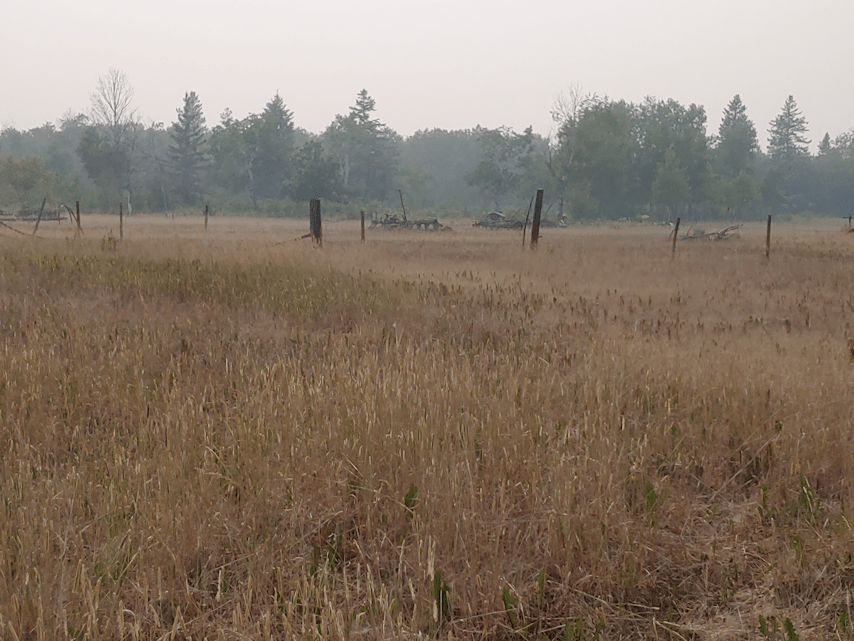
This first photo was actually taken from within the outer yard.
Everything is bone dry and crispy, and you can see the haze of smoke from wildfires that are nowhere near us! Keep in mind that the camera automatically cleans up haze, so the view was actually smokier than this.
This photo was taken at the “gate” by the barn. You can see the renter’s electric fence wire ends here. The only green that shows among the dormant grass is dandelions, and even they are burnt red.
This is facing the areas behind the old barn. By the time the renter rotates his cattle here, this grass is typically 2, almost 3, feet high.
This old pond is typically a source of water for the cattle. I walked to the deepest part, and even there, the ground is bone dry.
Also, we would normally be able to see the neighbour’s tree line in the distance, about a mile away. In the photo, it’s just barely visible as a shadow.
This is the deepest areas of what used to be a gravel pit, but which became another dugout to provide water for the cattle. At the far end is a marshy area that eventually reaches as far as the roadway by the pond.
This is in the deep part of the old gravel pit. Most of the tracks look like they were made by deer, but I think I saw some that looked like there were claw marks. All the tracks are old. There hasn’t even been mud here for some time.
This pit used to be quite a bit deeper. Since it wasn’t being used for gravel anymore, there’s at least a couple of decades of pond sediment, decaying plants and cow manure building up at the bottom. One of these years, I would like to have it, and the pond, excavated again. Since we moved back here, this is the first time I’ve seen the old gravel pit completely dry. Even in last year’s drought conditions, there was still water in the lowest area, making it one of the few sources of water for wildlife in the area.
Here, I’m standing at the “end” of the gravel pit area. Behind me is more marshy area that extends to a “creek” that is part of the municipal drainage system, but tends to have water only with the spring runoff.
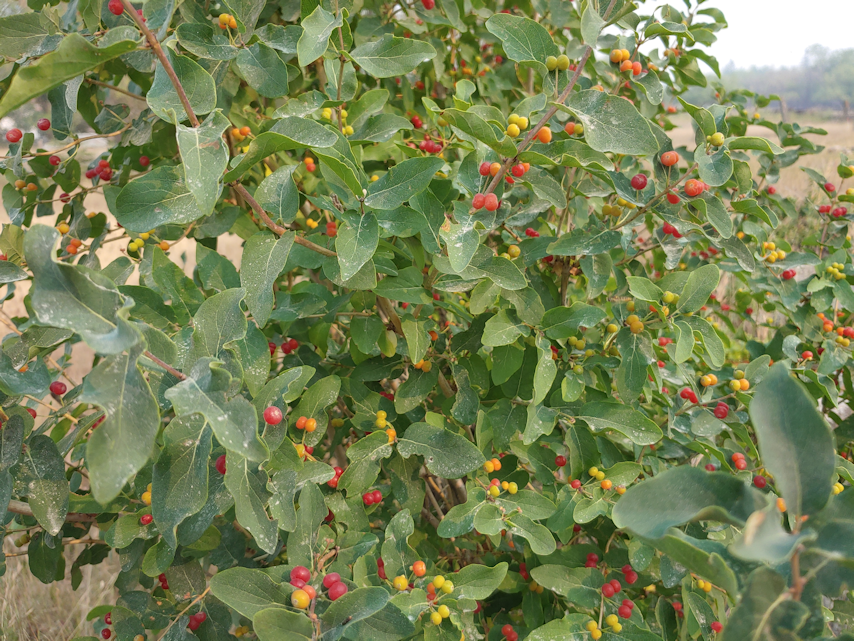
Heading back towards the house, I checked out an area that is mostly rocks and broken concrete that is overgrown with hawthorn and other bushes. This is the only thing there that has berries on it, and they’re not doing very well.
The white that you see on the leaves is dust kicked up on the gravel road, every time something drives by.
There has been a lot of road dust this year.
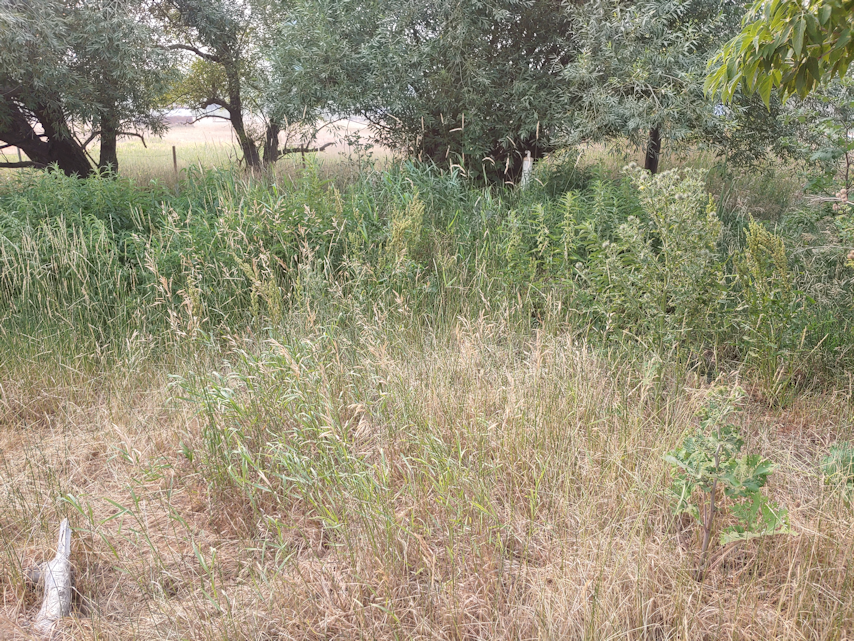
Another view of the pasture area, looking towards the pond.
Walking through all this, not only was everything crispy and crunchy, but ever step I took sent masses of grasshoppers flying. With things this dry, I don’t think even the grasshoppers can eat it!
There is but one area of relatively lush, green growth.
The septic field.
This is out towards the barn. Unlike a gravity field, our system pumps the greywater from the tank by the house, all the way out here. You can see the white pipe that is the outflow. It just sprays out from there. There is an entire low area beyond this that, in a wet year, forms another pond. It had been fenced off to keep the cattle out, since any water there would have septic water in it, too, but those fences have long since fallen down.
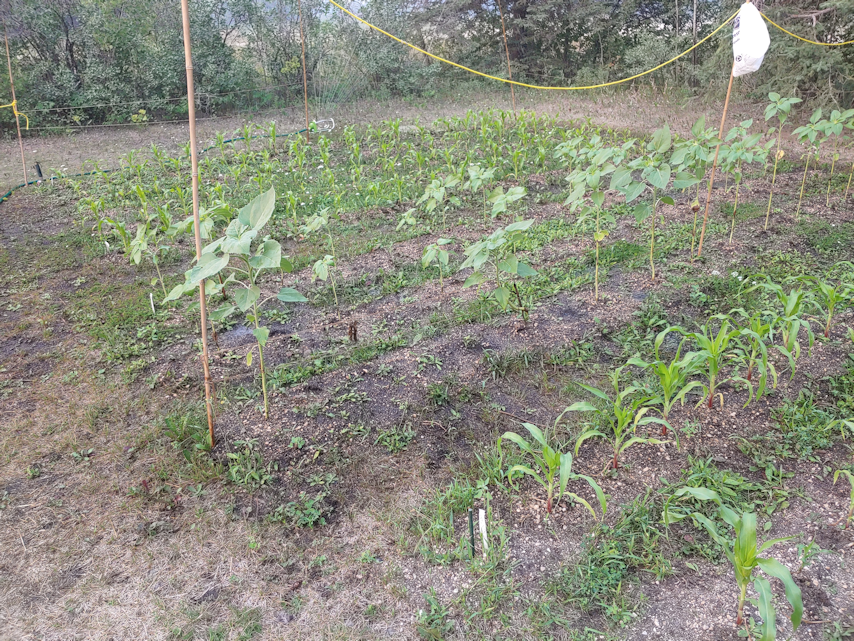
After I finished my walkabout, I set up the soaker hose at the squash tunnel, then decided to try an experiment.
Our green peas in particular are pretty much toast. Or should I say, toasted. They are still blooming and trying to grow pods, but between the heat and whatever is eating them, we aren’t going to get a crop from them.
The Dalvay peas are sold by weight, not seed count. Which means we had a LOT of seeds left over. Part of why I wanted to plant so many peas and beans near the corn, and to do it in this far flung area, was for their nitrogen fixing qualities.
So I decided to take the leftover seeds and plant them with the sweet corn.
Interestingly, not long after I started, I realized I was hearing the sound of a small engine vehicle moving around on the property. It turned out I was not the only one who decided to check conditions today. The renter had come over on his utility vehicle and was checking out all the pasture areas.
If he does rotate his cows here, I suspect he’s going to have to provide both food and water for them. Last year, he only had to provide water.
One of the things I’d like to do in the future, if we ever have the money to do it, is get those two water fountains going again. It would mean replacing our pressure tank with a much bigger one, as there had been in the past, and hiring someone to make sure all the pluming and the tanks themselves are in working condition. We don’t have cows of our own, but they would be good for wildlife, as well as the renter’s cows.
That’s something for the dreams list! :-)
I was almost done planting peas when my daughter came out to set up the sprinkler. Using a sprinkler feels like such a wasteful way to water, but for this area, we simply couldn’t water them as thoroughly as they needed, any other way. The other beds don’t have the same issues. It’s remarkable how different soil can be, even in a short distance. Since we started using the sprinkler, the corn and sunflowers have been doing visibly better.
There were so many peas left in the package, I was able to plant one pea for every corn in the block-and-a-bit visible in the photo. In these, I had planted a couple of seeds of corn a foot apart, then thinned them later. In the last block, I just planted a corn seed every six inches. Most of them germinated, so there wasn’t the space to plant one for every corn plant, so I planted one every 1 – 1 1/2 feet, depending on the spacing.
I still had enough seeds to plant more among the surviving Dorinny corn. Then I still had enough to plant with the Montana Morado corn (which seems to have been replaced at Baker Creek with Mountain Morado corn). And I STILL had seeds left over! Only about a dozen or so, but wow, was Veseys ever generous with their quantities!
Now, these seeds had been left behind in a storage bin we keep by the rain barrel next to the pea trellises. Which means that they’ve been out in this heat all this time. It’s entirely possible they won’t germinate. Or only a few will germinate.
Though planting peas for a fall crop this time of year, to get a fall harvest, is something that can be done in our zone, this year is so hot, we might still have the same problem as with the ones I planted in the spring, even if they do germinate. However, that’s not what I’m planting them for. I’m planting them for their nitrogen fixing qualities. Corn are nitrogen hungry plants, and our soil is nitrogen depleted. Yes, we can use a high nitrogen fertilizer, but having a plant that will do that job is preferable. Plus, if they do germinate, the corn plants will provide shade for them, while also providing a natural trellis for the peas to grow on, as with beans in Three Sisters plantings. We only have bush beans, though, so they won’t climb the corn. People had been talking about the Three Sisters method of planting in some of my gardening groups. Some people found it worked well. Some found that the squash made getting at the corn difficult, or that there was just too much competition for nutrients, and some found peas worked better for them than beans.
So we shall see how this turns out.
As I’ve mentioned in the past, all of these far flung beds are temporary. We’re basically breaking and amending the soil in perpetration for future plans. With what we are learning this year, we are already adjusting some of those plants. We were talking about planting a nut orchard and fruit trees, which we’re going to have to do soon, because those can take years, in some cases a decade, before they start producing.
We’re going to be adding a step.
My daughters and I have been going through the Whiffletree catalog, repeatedly. With the soil conditions we have, we’re now thinking to start by adding hedges. There are several options available for zones 2 and 3 that not only produce edible fruit and do well in poor soil, but also help fix nitrogen in the soil. If they’re still available next year, we’ve decided on three different ones. Silver Buffaloberry, which is a zone 2 bush, Autumn Olives (also called Autumn Silverberry), which is a zone 3 bush that is semi-fertile, and Sea Buckthorn, which is a zone 3 bush that requires 1 male variety for every 5-9 females varieties. On top of producing edible berries, being able to grow in poor soil conditions, and acting as nitrogen fixers, these will also form a barrier that will not only give us a privacy screen from our peeping vandal, they are dense enough to form a barrier that deer can’t get through. Plus, they will be dense enough to act as dust barriers. We’ve worked out the areas we can plant in, leaving a gap over where we thing the buried telephone wires are. We never did hear back from the Call Before You Dig people, but I figured out an easy way to do it. My brother’s property is right across the road, and the lines run though his place, too. He has a gap in his spruce grove, over the phone lines. All we have to do is line up our gap with his! :-D Anyhow, after we start with these nitrogen fixing, berry producing bushes, we will then start adding fruit and nut trees in what is currently a big void in the old garden area. Little by little, year after year, we will be adding more food trees, strategically placing each of them, so serve multiple purposes. At least, that’s the plan right now! :-D
Meanwhile, by the time I was done with all the pea planting, the smoke in the air had gotten to the point that there was a haze in the yard. As I write this, I can see the live feed from the garage security camera, and I can see smoke in our driveway. We’re still getting rain in our forecast, but in millimeters. Some areas did get rain today, which I am happy to hear about, but none of it is reaching us. I would actually be okay with that, if we could at least get rain over those northern fires.
A while back, we tried a recipe for overnight bread, which you can read about here, and find a link to the original recipe we used.
I then tried an “over day” version, using the dough baby from my Babcia’s bread experiment. It was fantastically successful!
We’ve made it again, as a pretty basic no-knead bread and, once again, it turned out awesome!
If you are new to this blog and don’t know the background to this, you can read the story behind my experiment to try and recreate the bread my grandmother made in pre-WWII Poland, as my mother remembers it. Or you can check out all the posts about it at this link. All links will open in new tabs, so you don’t lose your place here!
Here is how we made No-knead bread, using the old dough method.
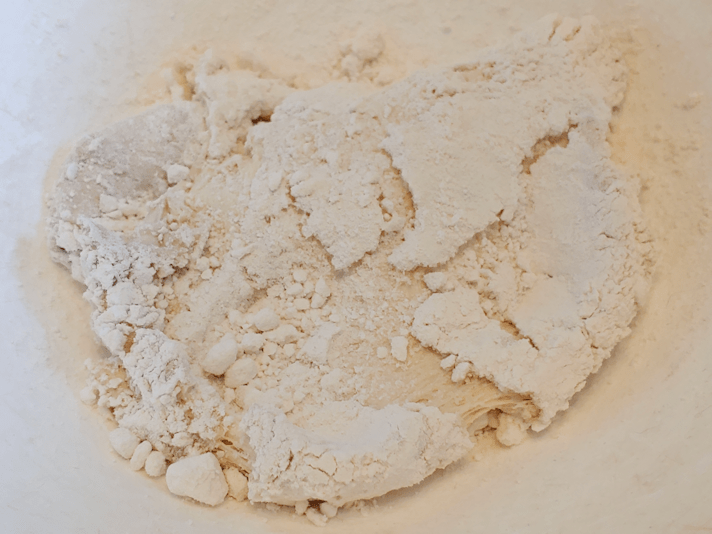
The first step is to dig the dough baby out of the flour it sleeps in.
My Babcia did bread baking once a week, and when the old dough sits that long, it tends to be dry enough to break apart into pieces before reconstituting it. This time, the dough baby had not been sleeping in its bed of flour for that long, and it was still quite… doughy! :-D
So I just pulled it apart a bit and placed it in the bottom of a very large bowl.
I don’t know how much that is. Maybe about 2 cups, including the flour stuck to it? The dough baby rises and collapses while stored in the flour, and I made no effort to measure the quantity.
I also pre-measured 2 Tbsp each of course salt and sugar, and 1 Tbsp of yeast.
The yeast would be optional. The dough would need more time to rise without it, which would give more of a sourdough flavour.
Four cups of very warm water was added to the dough baby. Since it wasn’t dry enough to break into pieces, I spent some time stirring it and breaking it up in the water.
Then, the sugar and yeast was added and mixed in, the bowl loosely covered, and it was left for about 10 minutes.
I like to use traditional active dry yeast, rather than quick or instant dry yeast, but that’s just me. The traditional yeast needs more time to proof in the liquid compared to the quick yeast, and the instant yeast wouldn’t need to be added at all at this point, but would be mixed in with the flour.
If I were not using yeast, I would leave the water, dough baby and sugar mixture in a warm place for much longer, checking regularly to see how active it was.
Here is how it looked after 10 minutes. I stirred it again to break up the dough baby a bit more.
Then it was time to add some flour.
I started by adding 3 cups of flour. It’s easier to mix in that amount compared to starting with just one cup.
I decided to use Durum wheat flour at this point, just because I have it. Use whatever flour, or mix of flours, you like best!
After the first 3 cups was thoroughly beaten in, I added another cup of flour and the salt.
More flour was beaten in, about a cup at a time at first, then a half up at a time.
How much flour to use is something I’ve never been precise about. I know there are bread bakers that weigh and measure precise amounts, but in my experience, that just doesn’t work. The amount of flour needed can depend on things like how fresh the flour itself is, to how much humidity there is in the air.
With 4 cups of water, I would have expected to work in at least 8 cups of flour for this recipe (with my usual kneaded bread, I typically used 5 or 6 cups of flour to 2 1/2 cups liquid).
We are very, very dry right now.
Today, I worked in 7 1/2 cups of flour, and probably could have done with a bit less.
By this point, I was working the flour in with my hand rather than trying to stir it with a spoon. If you have an electric mixer with a dough hook, go ahead and use it!
Before setting it aside to rise, right in the same bowl, I sprinkled some flour over the top and sides, in case it rose high enough to touch the bottom of the bowl’s lid.
Lightly cover the bowl, then set it in a warm place for about an hour. With our chilly our kitchen is in the winter, I heated our oven to its lowest setting (145F on “warm”), then shut it off before I started mixing the flour into the dough. The covered bowl is left in the warm oven, with the light on, to rise. Anywhere that is warm and draft free will do.
Here it is, after an hour. It just barely touched the bottom of the lid! :-D
The dough it then pushed down and worked a bit to incorporate the flour that had been dredged on top.
Next is a very, very important step.
A piece of the dough needs to be removed and set aside for the next batch of bread!
I dumped some flour on a container and plopped about a cup of dough onto it.
Once the new dough baby was set aside, the rest of the dough was dumped onto a 9×13 inch baking sheet that was lined with parchment paper. The last time I made this, I used a parchment paper lined lasagna pan, but I could also have split it into two parchment paper lined loaf pans.
If I didn’t have parchment paper, I would have well oiled the pan, first.
Speaking of oil…
After spreading the dough out to fill the bottom of the pan, I stabbed at the dough with my fingers to create “dimples”, then topped it with oil, course salt and dried parsley flakes.
I happened to still have some fake truffle oil that I used, but an olive or avocado oil would work just was well.
The pan was then set aside for the dough to rise again. Since this batch is so flat and thin, I started preheating the oven for 450F right away. Had I used loaf pans or the lasagna pan again, I would have let it rise longer before preheating the oven. If I had used no yeast at all, it would be left in a warm place until doubled in size.
While the shaped loaf was waiting to go in the oven, there is this to deal with…
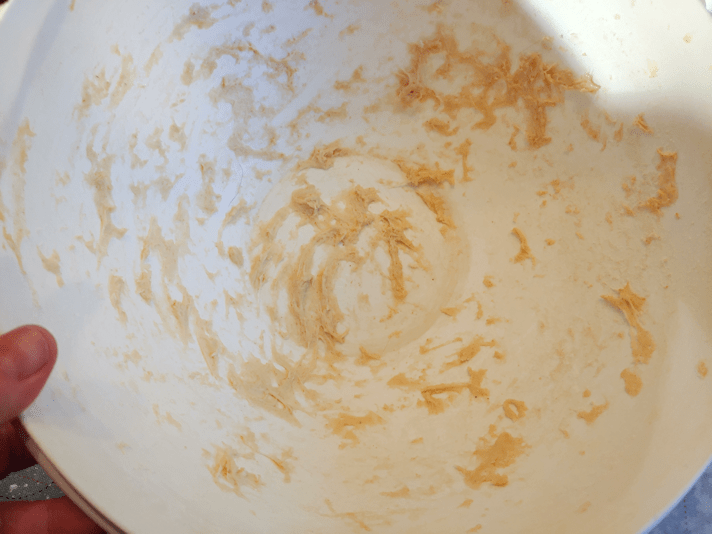
The bottom of the bowl still has quite a bit of dough stuck to it!
We can’t let that go to waste!
Into the bowl went the new dough baby, and the flour it had been resting on.
While working the flour dregs into the dough baby, scrape as much of the dough stuck to the sides and incorporate it into the dough baby.
You probably won’t get all of it off the sides, which is okay.
The dough baby is now ready for a nap. I have a canister of flour that I bury it in, but it can also be buried right in a bag of flour, as long as you’re not planning to use the flour for anything else in between bread baking!
After the dough baby has been buried, it will rise quite a bit before collapsing in on itself, breaking through the surface of the flour. Remember to check on the dough baby later on, to make sure it is still covered in flour.
Once the oven is ready, place the pan of bread into oven and bake. If you wish, place a container with about a cup of water on the rack under the bread pan, to add some steam to the oven as it bakes.
For a very flat loaf like what I made today, it took about 25 minutes. A deeper loaf, or a pair of loaf pans will likely need 30-40 minutes. Bake it until it looks like this.
With the oil added to the surface, it will have a deep, golden colour when it’s ready.
When baked, remove from the oven and left to cool for a few minutes. Once it is safe to do so, remove the bread from the pan and onto a cooling rack (parchment paper makes that job a LOT easier!).
I really like the big, flat slab of bread, but it is a bit hard to cut a slice off! :-D
Here is how it looks on the inside.
The crumb is light and fluffy, yet still wonderfully chewy. The star of the show, however, is that golden, flavorful top crust! It’s just a lovely and delicious combination of textures and flavours.
The only problem with this bread is how difficult it is, not to just scarf it all down right away! :-D
Here is the recipe.
Old Dough No Knead Bread
Ingredients:
old dough set aside from previous bread baking
4 cups warm water
2 Tbsp sugar
1 Tbsp traditional active dry yeast (optional, or use 2 Tbsp if you don’t have old dough)
2 Tbsp course salt
about 7 or 8 cups of flour
small amount of good quality oil (olive oil, avocado oil, etc.)
small amount of dried parsley and course salt
Break up the old dough into a large bowl. Pour water over the old dough and stir. Add the sugar and yeast and leave to proof for about 10 minutes. If you do not have old dough, use the larger amount of yeast and proof it in the sugar water. If using only the old dough and no added yeast, leave the bowl in a warm place until the mixture is bubbly.
After the yeast and old dough has proofed, add 3 cups of flour and mix thoroughly until it forms a very smooth batter. (An electric mixer can be used at this stage.)
Add the salt and 1 cup of flour, mixing thoroughly.
Add more flour a little at a time, mixing thoroughly after each addition, until it reaches a thick but sticky consistency. Use your hands to mix in the last of the flour. (If you have an electric mixer with dough hook attachments, switch to the dough hooks at this point.)
Leaving the dough in the bowl, dust the top of the dough with flour and cover loosely. Place in a warm spot to rise until doubled in size.
Prepare baking pans by lining with parchment paper or oiling thoroughly.
When the dough has risen, punch it down again, folding it into itself to incorporate the flour dusted on top.
Dust some flour on a small plate or bowl. Remove about a cup of dough for the next batch of bread, setting it aside on the floured container until later.
Pour the remaining dough into the prepared baking pan(s). Using your hands, press the dough to fill the pan to the edges and corners, then stab into the surface with your fingers to create dimples in the dough.
Carefully sprinkle oil across the surface of the dough, then use your hand to spread it evenly across the surface.
Sprinkle the oiled surface with course salt and dried parsley.
Set aside in a warm place to rise.
While the bread is rising, return the dough set aside earlier to the mixing bowl, along with any flour in the plate or bowl. Use the flour and the dough ball to scrape off any remaining dough stuck to the surface of the bowl, working the dough ball until smooth. Shape the dough into a ball, then bury it in a container of flour, for use in the next batch of bread.
When the pan of rising bread is almost doubled in size, preheat the oven to 450F.
Place the bread in the centre rack of the preheated oven; if desired, place about a cup of water in an oven proof container on the lower rack to create steam.
Bake until the bread is a deep, golden colour – about 25 minutes when using a 9″x13″ baking sheet, about 30-35 minutes if using loaf pans, or a cake or lasagna pan. The finished loaf should sound hollow when the bottom is tapped.
Set aside to cool in the pan for a few minutes, then transfer the bread to a rack to finish cooling.
I experimented with the no-knead, overnight dough recipe I’d made before, using the old dough bread baby from my Babcia’s bread experiment.
I didn’t take any process photos this time, since I was winging it. The “overnight” dough became an “over day” dough, for starters! :-D
Instead of making a pair of loaves, I made one giant loaf in a parchment paper lined lasagna pan.
As I was spreading the dough out as evenly as I could, I found myself thinking it was looking a bit like a focaccia. Too bad we’re out of olive oil.
Then I remembered… we still have some fake truffle oil (the only kind we can find, or afford!) left.
I ended up drizzling the top with the fake truffle oil, spreading the oil around evenly, then stabbing the dough with my fingers to make lots of little holes, which also helped even the dough out in the pan more, before sprinkling on some coarse salt and dried parsley.
Of course, it wasn’t real a focaccia recipe, and it rose quite a bit. This is how it turned out.
This turned out to be, hands down, the best bread I have ever baked! Definitely a winner!!
I think the next time I try this, I’ll use a baking sheet instead of the lasagna pan, to make a thinner bread. Mostly, because I think it’ll be easier to slice than this was, but it’ll also give a larger surface for the oil and salt crust. The texture and flavour it gave was amazing!
Next time, I will definitely take process shots and share the details here!
Yesterday, I made another batch of bread using the old dough stored in flour as a starter. I did change things up a little bit, though.
One of the things about trying to recreate how my grandmother did this is, I’m relying on my mother’s childhood memories. There would definitely be things my mother never noticed, never saw, or simply doesn’t remember. In reality, my grandmother would have made do with what she had, so while their bread would certainly have been as basic as flour, salt and water, if she had had other ingredients, she would have used them. I know they would have made their own butter and rendered their own lard. They may even have pressed their own seed oil (my mother does remember processing hemp, so they likely had hemp oil, too). They likely had honey or some type of sugar, if only rarely. It’s hard to say, though, since my mother doesn’t remember very much of that, and none of my research so far has turned up more historical detail. There just isn’t a lot out there to describe how people in poor, backwater villages ate because, frankly, most of the people recording such things either didn’t know about them, or were indifferent to how ordinary people lived.
I do think that there is room to experiment a bit and still be pretty true to how Babcia would have done things, even if they were only on special occasions or when she happened to have access to ingredients.
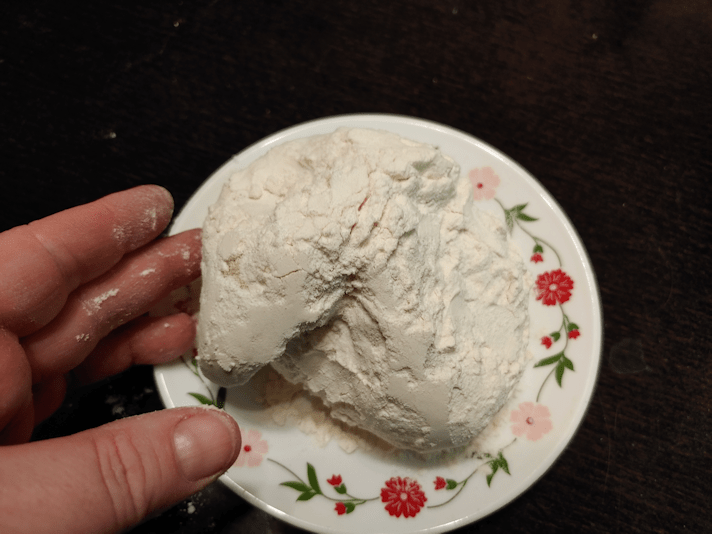
With yesterday’s baking, one of the things I changed up was how long the old dough was left to soak in warm water. My mother says it was left overnight. My grandmother had a large lump of old dough, for her weekly baking of a dozen or so loaves, but I’m not working with such quantities. The amount I’d set aside from the last batch was the largest I’d done yet, and it was getting too big for my canister of flour. In fact, I didn’t get any pictures of it when I took it out, because there was just too much flour all over, it was bigger than the plate I’d brought to hold it, and I just broke it up into my crock right away.
When the old dough was left to sit in a warm oven overnight, it seemed to me that this was too long. It was no longer actively bubbling by morning. So this time, I decided to just let it sit for a few hours. I also added a small amount of sugar (about a tablespoon to 2 cups of water that had been boiled, then allowed to cool down to the right temperature) to feed the yeast. Last time, I supplemented with a bit of commercial yeast, but not this time.
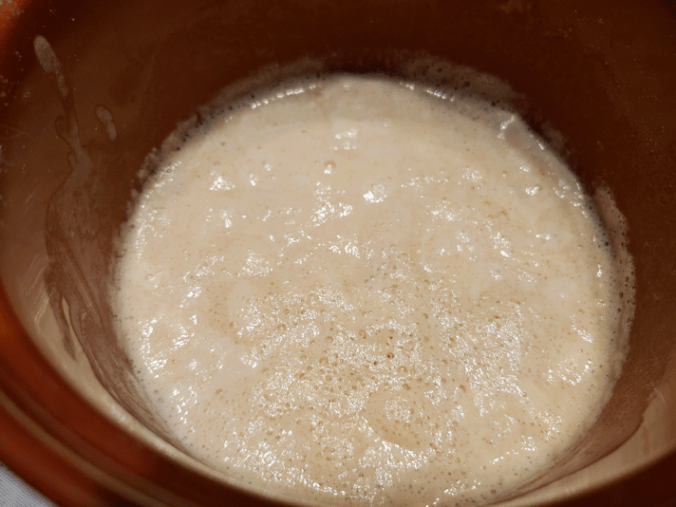
This is how it looked, after about three hours sitting in a warm oven.
Just look at how bubbly that is!
I did add a bit more sugar (another tablespoon or so) to the dough as I mixed it, too. No added yeast. This was a slightly larger batch than before, too. Previous batches used about 3 cups of water in total, to 4 or 5 cups of flour, but this time I used about 7 cups of flour to 4 cups of water. Then, after cutting away a piece of dough for next time, I tried something else.
I kneaded in a cup of thick cut rolled oats. This is something my grandmother would have had, at least sometimes, so I have little doubt that she would have included it, when it was available.
Normally, I would have added the oats at the very beginning, leaving it to soak in boiling water until it was cool enough that the yeast or sourdough started could be added. I wasn’t sure how that would affect the dough set aside for next time, though, so I left it until later.
I knew the flakes would still soften while the dough was rising, and it would add some texture, too. Kneading it in was a challenge, though! I deliberately left the dough stickier than I usually would have, just to make working in the rolled oats easier, and it was still trying to fly all over the place! LOL
Unfortunately, I completely forgot to take pictures after this!
The dough itself just did not want to rise! Yes, it was in a warm oven, but I’m using a plastic bowl (metal can react with sourdough, affecting the flavour, and this is pretty much a kind of sourdough), so I didn’t want to make the oven much warmer. It did rise some, and again as I formed the loaves, but even the smaller loaves didn’t rise as well. I really should be leaving it to rise for far longer, but it’s just to dang cold.
It does rise more while baking, of course, so that helps. The bread was still dense, but it did still have plenty of air bubbles in it. The rolled oats did soften up, as expected, while still adding a bit of nice texture and a subtle flavour.
Speaking of subtle flavours, there is most definitely a light sourdough taste developing.
I made a total of 8 small loaves out of this batch; 4 round loaves (basically just big buns!) baked in a cast iron pan, and 4 long loaves baked on a pizza stone. At 400F, the round loaves needed about 40-45 minutes to bake, while the long ones needed about 30-35 minutes. I have no idea how long my grandmother would have baked hers, since she had a masonry stove, and I don’t know what method she used to determine when the temperature was right.
As for the bread it self, it was quite tasty. I like the addition of the rolled oats. This morning, I cut one of the little long loaves into slices, pan toasted one side in butter, then topped each with a slice of mozzarella, for breakfast. It was very nice! It probably would have been nicer to broil the cheese, but I didn’t feel like fussing with the oven. :-D
Next time, I’ll have to remember to take pictures through the whole process. :-D
For the next while, as I remove part of the dough from one batch to use in the next batch, I will be taking out slightly larger pieces of dough, to make larger batches of bread with it, next time.
Our flour canister is tall and narrow, so I’ve made a point of flattening the dough baby a bit before burying it in the flour. When I opened the canister last night, I found the dough baby had grown enough to emerge from the flour like a mushroom!
I think today’s dough baby will the the last one I can fit into the canister! I’ll have to start burying them directly in the flour bag. They get so big! Which is encouraging, since that shows how lively the yeast is, so it’s a good problem to have. :-D
The dough baby was light, with a slightly crunchy dry shell, and a thick bubbly interior. The larger size made it a bit harder to tear apart to put in the little crock to soak overnight, so the pieces were a bit on the large size. That did not seem to make a difference to how it looked in the morning.
I soaked it in 2 cups of warm water overnight then, because I wanted to increase the amount of dough I was making, I cheated a bit and let maybe a tablespoon of commercial yeast proof in another cup of warm water. Right now, I’m getting enough to make the equivalent of 4 small loaves, and I eventually want to be making the equivalent of 4 large loaves. I don’t plan to get to my Babcia’s level of a dozen loaves at a time! :-D Making enough for 6 or 8 loaves, maybe, but not a dozen!
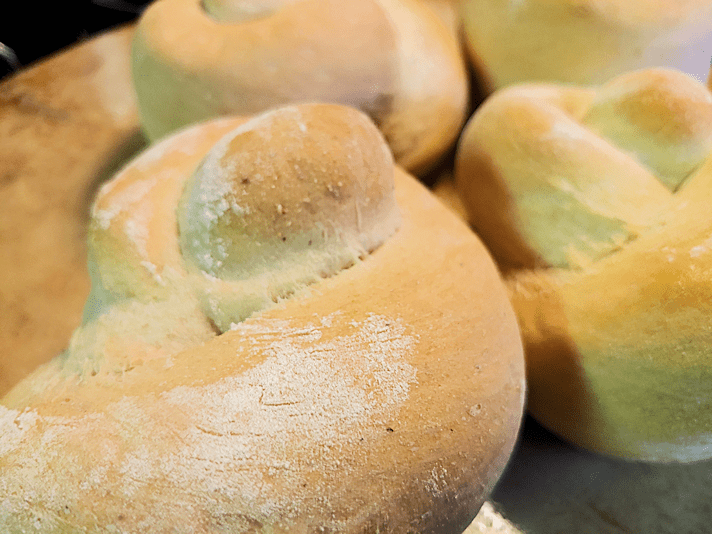
Once again, I used a mix of all purpose and Durum wheat flour, and let it rise only once before shaping. When I am no longer using commercial yeast, I’ll add an extra rising again. I also split it to do one half plain, and one half fancy. For the first half, I made it into 4 knotted buns and used a cast iron pan to bake them in again, which is working out very well.
The second half got divided again, to make a pair of rolled loaves.
Each piece was rolled out, then small pieces of leftover ham were scattered evenly, followed by generous amounts of shredded sharp cheddar, mozzarella and Monterey Jack cheese.
Before rolling them up, I did dampen the edges with water, but I did not try to seal the dough.
Once rolled up, the ends were tucked under, and they were left to rise.
The knotted buns were baked first, and turned out quite adorable.
The ham and cheese rolls, as expected, did leak out the bottom seam!
That’s okay. It just got crispy on the bottom of the pan, for some extra deliciousness. :-)
I would not recommend doing this without using parchment paper. :-D
A huge bubble formed under the top, as the cheese melted and the layers collapsed below. That did make it a bit hard to cut through! :-D
The ends that were tucked under were a lot more substantial. I the slices where the large bubble formed, the top crust was almost like a fancy chip! :-D
We had them for supper with tomato soup. It was a very nice combination! :-D The crispy cheese bits made for a lovely little treat, too.
After yesterday morning’s cat disaster, the girls were kind enough to drop their own projects and take over cleaning up.
While I was doing my rounds outside, the furry little monsters created another mess. One of the jade plant posts I’d managed to shield from their digging got knocked to the floor. *sigh* I was able to repot the plant. Not sure if it will survive. Once again, the girls took over the clean up so I could take care of other things. At least I wasn’t bread baking today!
The one down side of using my grandmother’s method to bake bread is, once I take the dough ball out of the flour and start it soaking overnight, it must be used the next day. There’s no way to postpone it if other things happen!
By the time we were doing cleaning up and putting things away, I started the bread baking much later than planned.
I did, however, cheat a bit. I wanted to mix up more dough, so I could take off more to set aside, for larger batches in the future. As it was, the overnight soak was not looking as active as I would have liked, so I did end up adding some yeast and a touch of sugar, and let that bubble up some more.
Then, since I have it, I used half all purpose flour, half durum wheat flour.
This is after it had about an hour to rise.
I notice a definite difference in the dough, when using the durum wheat flour. The dough feels smoother and more elastic. It was very noticeable when making the pasta, but even at half-and-half, for the bread, it is much nicer to knead.
My grandmother would have used whatever flour they had, so mixing it up like this is probably not all that different from how she did it.
After removing a portion to set aside for the next batch, I split the dough in half. The first half was left plain, though I did have some fun with it, anyhow.
I split the dough into 4 pieces (because there’s 4 of us), and made knots.
The resulting bread was a bit denser and chewier with the durum wheat flour in it. We all like our bread on the toothsome side, so we quite enjoyed it.
For the other half, I was going to do a cheese roll, but my daughter suggested rolling and folding it. With the extra gluten in the durum wheat flour, it could actually handle that, so I have it a try! This time, I made two loaves.
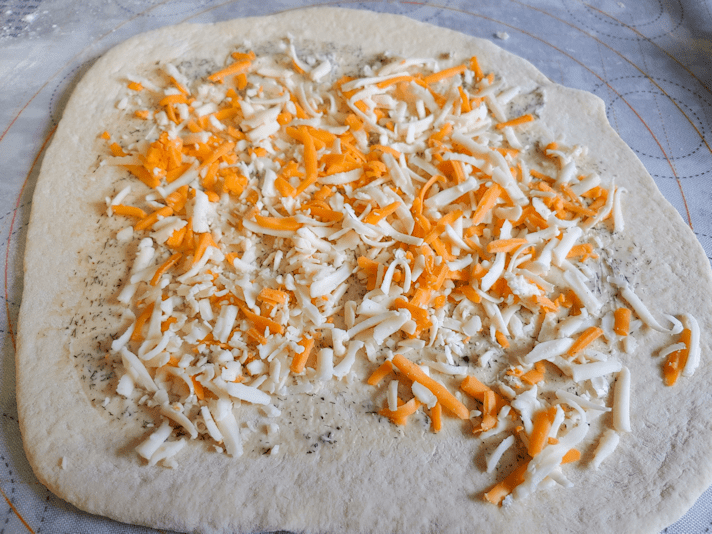
After rolling the dough out flat and as thin as I could, I used some of the herb butter my husband had made. I don’t know what all he included in there, other than a LOT of dill (the container slipped…), some caraway seeds, and a touch of lemon juice.
Then I added some shredded cheese. It’s a mix of sharp cheddar, mozzarella and Havarti.
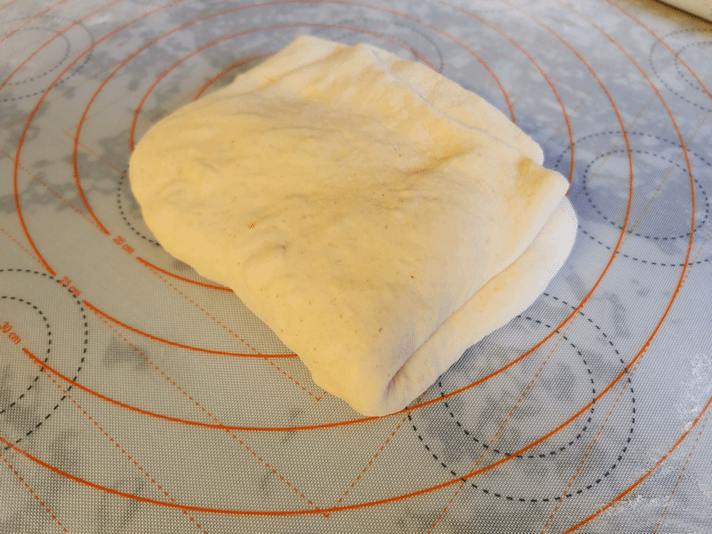
Then I folded it in on itself.
It then got rolled out slightly and folded again, before final shaping. I had to use a touch of water to get the edges to stick closed.
Once in the pan, I flattened them out a bit more with my hands, before leaving them to rise.
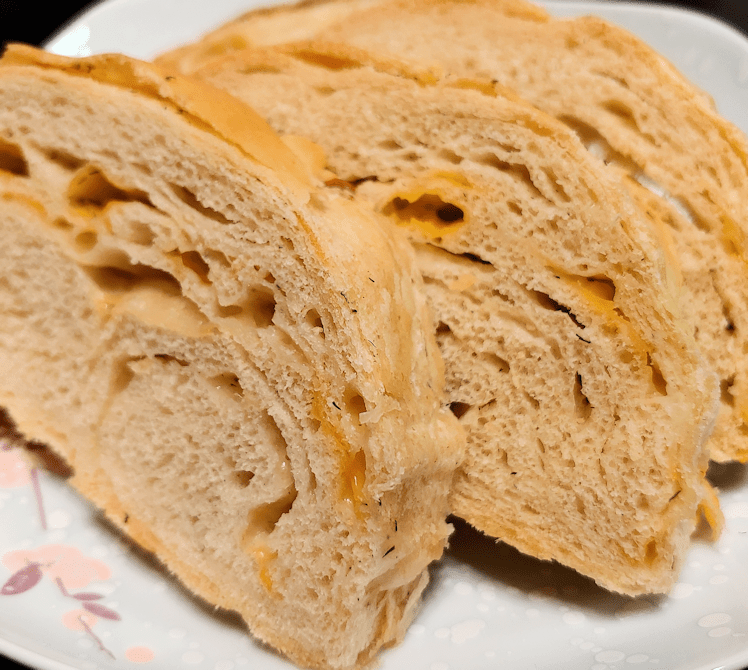
Of course, some of the cheese did make its way through the dough as it baked, but my goodness, it looked and smelled wonderful!
It was quite flaky on the outside. On the inside, the dough absorbed much of the butter, leaving cheesy little pockets all over!
It was quite enjoyable! I don’t know that I would go so far as to do the folding method again (though it would be awesome to do that again with some sliced green onions, to make a version of green onion cakes!), but I definitely do it as a cheese roll in the future.
Until then, I am not going to have some with my lunch!





























 The Re-Farmer