Building a goat catcher!

After the owner of our visiting goat had to leave, we needed to figure out how we could make use of the chicken wire he left behind for us.

I knew there was a pile of wood in the barn, and I thought there might be some 2x4s on the bottom.

As soon as we were able, my younger daughter and I headed for the barn to dig them out.

Once they were cleared of the stuff on top, I discovered they were not 2x4s.

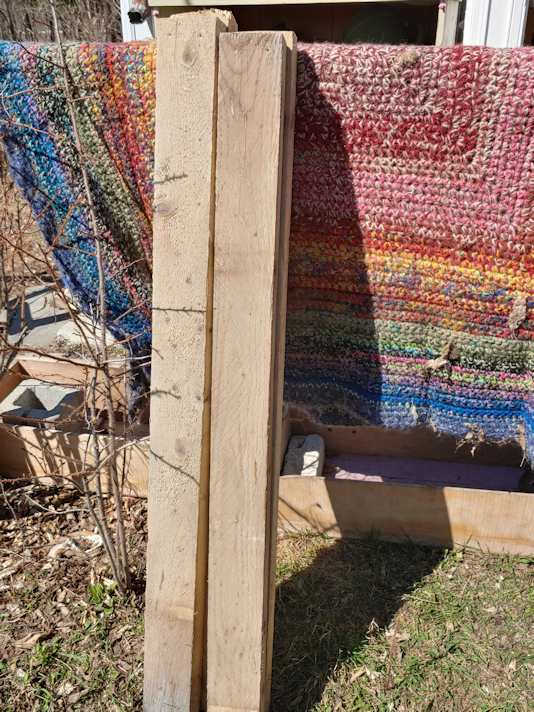
They were 3x4s. In pine – some still had bark on them. They were very roughly cut, some of the ends were wonky, and they were definitely not high end cuts. But they would do the job!

I decided to find a way to make a small corral of sorts, in such a way that we wouldn’t have to cut chicken wire that isn’t ours. I figured I could frame out the sides and ends of a sort of paddock, with uprights the same height, or slightly taller, than the chicken wire, then longer boards across top and bottom. With the wire attached across all of the sections at once, it could then be “folded” to create a fenced in area with a “gate” at one end.

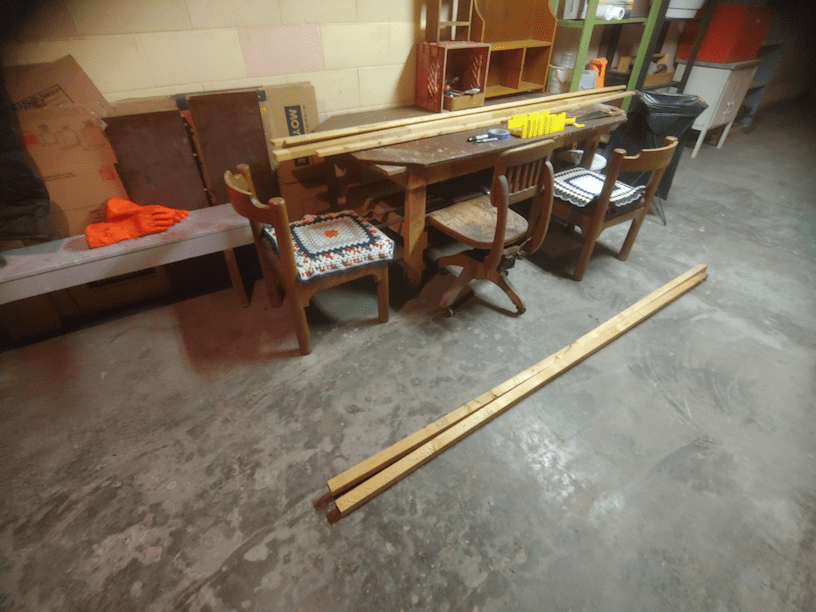
The boards turned out to be 100 inches long.

Well… most of them…

So we cut uprights at 50 inches long. Four boards to make 8 uprights.

Then we unrolled the chicken wire and used the remaining long boards we’d brought to see if we could fit 4 of them, with spaces in between to create gaps that would allow us to “fold” the fence.

The wire was not long enough for 4 full length boards, so we ended up cutting a couple in half. This would give us 2 long sides and 2 short ends.

Once we figured that out, we measured out where we wanted to drill pilot holes for the screws in the uprights.

They were all marked the same distances at the top, then the bottoms were marked at 4 feet from the top, which is the height of the chicken wire. This would leave slightly more “leg” at the bottom, if we lined the wire up with the top.

Of course, it didn’t quite turn out as planned. Thankfully, this is not intended to be a permanent structure!

We only drilled pilot holes in the uprights. With the boards all being slightly wonky in size, there was just no way we could measure out where to drill matching pilot holes in the cross pieces.

Oddly, we also don’t have any longer drill bits, which would have allowed us to drill pilot holes through more than one board, so we couldn’t even try drilling pilot holes after putting the boards in position, first.

Then we discovered that not being able to drill pilot holes through the cross pieces meant we couldn’t even use a power drill with screwdriver attachment to screw the pieces together. The wood is hard enough that even our new drill didn’t have enough power to put a screw through on it’s own!

Still, we managed to put them together, with three of us screwing corners together at the same time. :-) Here is the first frame assembled.

My thought in orienting the boards this way was that the wire would be attached to the uprights, making it easier to grasp the cross pieces while moving everything around.

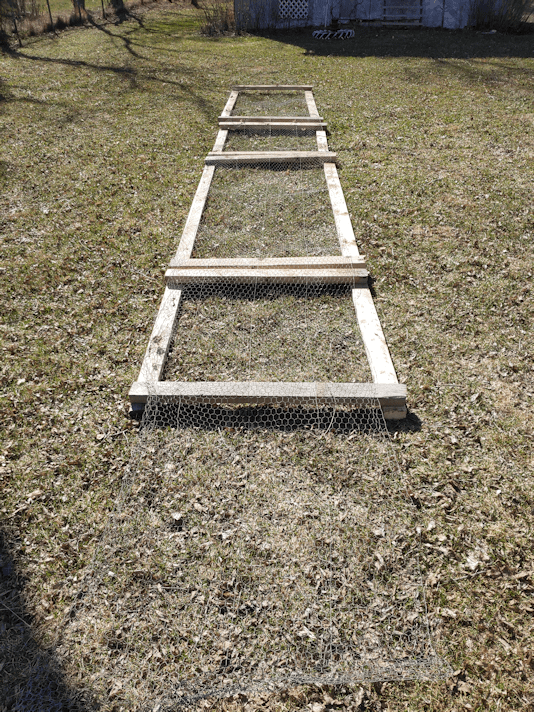
Here is all 4 sections, ready to have the wire attached.

With the shorter sections, the wire is now too long, but we figured we could fold it back around the ends on one side, and on the other side, it could be used to wrap around the corner after closing the “door” section.

Unfortunately, the only thing we had to attached the wire to the frames was a staple gun – and not a larger, heavy duty one. It is enough to attach the wire mesh we used to make the new basement cat safe, but it was a bit more difficult on this. For starters, the wood is hard enough, and the staples small enough, that the staples tended to not want to stay at all, never mind hold wire in place. We hoped using enough staples would do the trick, but once we picked it up, most of them just popped right off!

So, my daughters got creative.

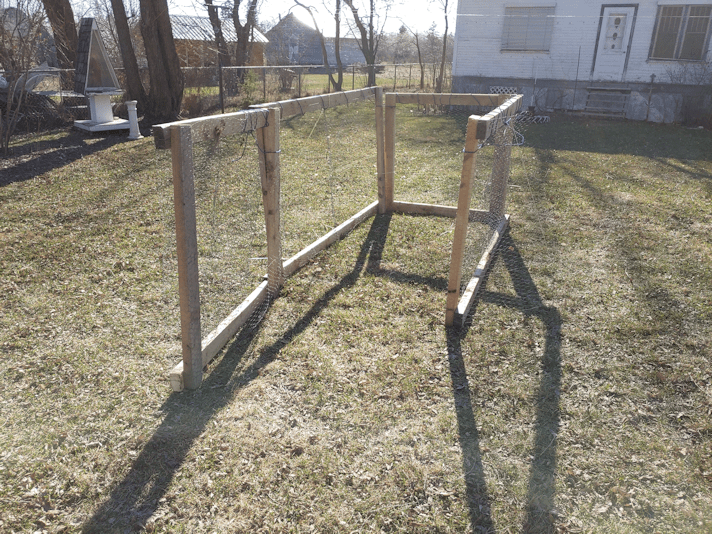
They used rope around the top cross pieces to hold the wire in place, making sure to anchor the corners. Then, because it was still wobbly, rope and tent pegs were used to create support.

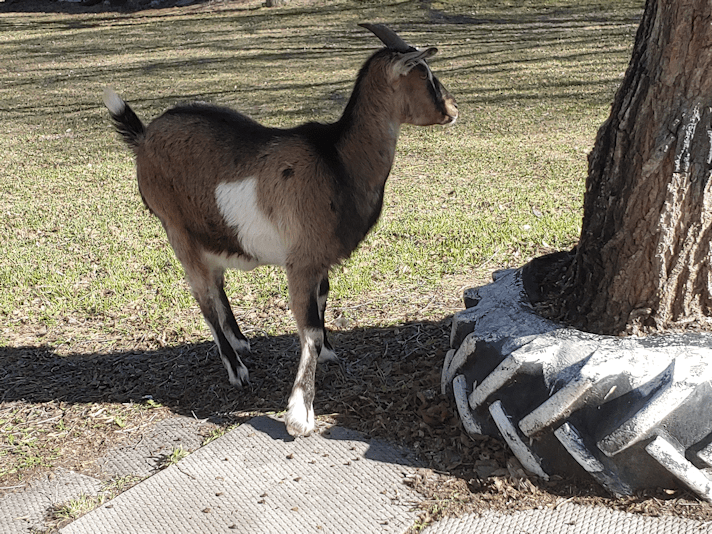
The whole time we worked on this, we were watched with much curiosity!

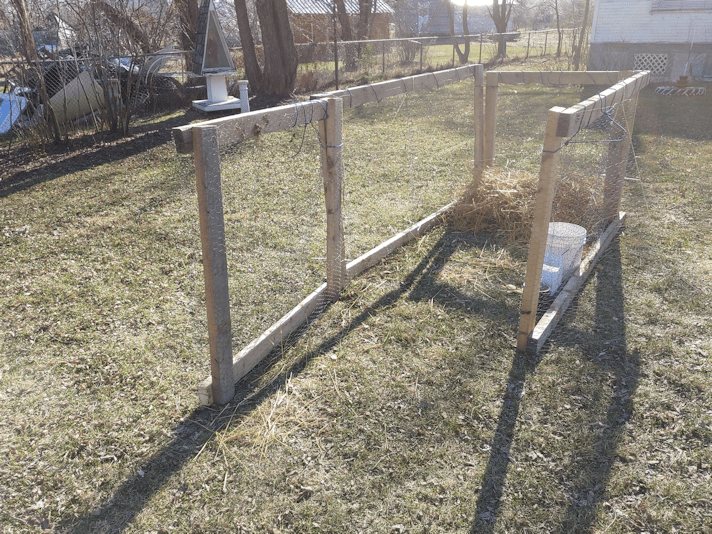
Once it was set up and secure, we tried to make it tempting.

There is straw for bedding, the bucket of water, and a container with food in it.

We will just leave it like this for her to get used to, and not try to close her up in it. I am hoping she will use the bedding tonight instead of sleeping on the hard concrete step.

So far, she has gone to sniff at it, but we haven’t seen her actually go in, yet.

I have just been informed, however, that the goat can get up onto the board sheltering the window into the old basement that used to be used to throw firewood into the basement!

While up there, the goat allowed my younger daughter to touch her nose!

None of us have been able to get close enough to touch her until now.

Progress!!

Little by little, with lots of patience, we hope the goat will finally let us near. Then let her owner near her, too. He really, really wants to trim her overgrown hooves!

I hope our goat catcher works. :-)

The Re-Farmer

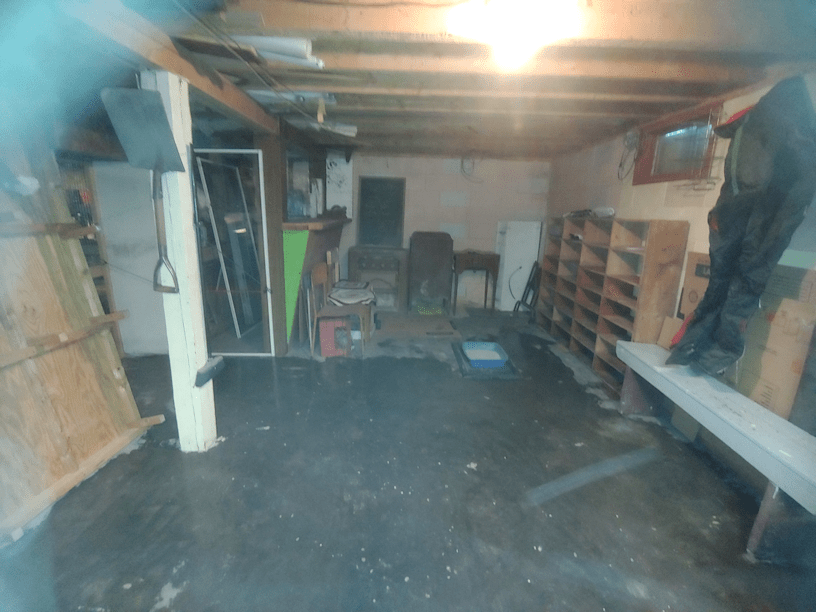
Clean up: basement – Done!!!

Woohoo!!!

It’s done!

The girls and I made a push to finish tonight and, as I write this, we now have two very pregnant cats in the new “maternity ward”.

Before we hauled out all the stuff waiting by the stairs, my daughters and I went rifling through a shed and the barn to see what we could find to use as doors.

First, we went into the shed, where I knew there were some doors that might work. We decided against them, but found some decent wood in a corner. We found a couple more pieces in the barn.

With the trellis wire left over from covering the counter opening to the unfinished bar, we figured we could build a mesh door to size.

I also started to bring some of my tools down. I’m so excited to be able to do that!!!

While in the barn, we found these.

They are actually plastic windows. They were wide enough to fit over the opening into the unfinished bar – there’s space at the top, but the cats won’t be able to get up there.

They almost fit over the opening to the old basement, but that wider part on the bottom couldn’t be covered.

My thought had been to build the wire mesh door for the bar opening, which would have allowed us to make a hinged door (except we didn’t have any hinges handy). With using one of these windows instead, hinges couldn’t be attached, anyhow.

So I found some cup holder hooks and Bungee cords. The idea was to have a pair of Bungee cords holding the window pane in place. That didn’t work out exactly as planned, as we only had one Bungee cord that was the right size.

We made do. You’ll see how in the next photo. :-D

After bringing the stuff to make doors down, the girls and I hauled out what needed to be gotten rid of. We now have an awful mess outside our main door, but cleaning that up will have to wait until the weather improves. Plus, finished the basement was the priority.

The girls started working on building the frame for the wall opening while I started cleaned the window panes, then started cleaning up the area by the stairs.

When it was time to screw the frame together, the girls couldn’t find any usable screws in any of the buckets and miscellaneous containers we kept. There were just nails.

So we ended up using the deck screws I’d taken out from the barn doors, after our vandal had boarded them up.

I’m still giggling about the irony of that.

Once the frame was screwed together, the mesh was stapled into place in two overlapping pieces. There was a possibility of a cat getting through at the overlap, though. My daughter managed to find a couple of shorter screws and we put a cross piece on the mesh side of the frame at the overlap. The overlapping parts of the mesh were then stapled to the cross piece. This closed the potential gap, strengthened the frame, and it can even serve as a “handle” on one side.

Here is how they look now.

The frame ended up working better in the old basement side of the wall. It’s braced on one side by a table, and a Bungee cord attached to one of the cup hooks is keeping the other side in place. To get through, we can unhook the cord, then slide the door to one side.

As for the window-door, until I can find another cord the same length as the red one, we’ve got a longer one diagonally, just to keep the window pane from potentially flipping over. The extra window pane is now stored in the old bar. Who knows. It might come in handy for something else.

The fun part is, we’re already using the basement as a workshop!

I’m so excited! :-D

One of my daughters took over cleaning while I found and brought more tools down, then helped finish the frame. She even mopped the rest of the floor.

I can’t even think of when this floor was ever mopped, other than parts of it at times like when my brother found the water damage shortly before we moved in and had to scrub away mold and bleach the floor and walls in the corner.

Here is how it looks now at that end.

We have set up cat beds under chairs and the old phonograph. A flattened box is there to act as a rug, and we brought in the litter box that was in the sun room, since the outside cats don’t need to use it anymore.

And here’s the rest of it!

We set up food and water bowls at the far end, nearer the stairs.

When I went into the sun room to get the litter box, Beep Beep was in there, curled up on the swing bench. That was encouraging, since we would be getting her soon. Then Big Jim came out.

He had blood all over one side of his head!

It looked like it was coming from an ear, an injury that was most definitely not there this morning. The poor thing! The blood was dry, so whatever happened, it was no longer bleeding, at least, and it didn’t seem to be bothering him. He sure wanted pets, though!

After setting up the litter pan, food and water, one of my daughters and I went outside with some cat treats. I scattered some both inside the sun room, where Beep Beep and Big Jim still were, and in the outside food bowls.

Creamsicle and Potato Beetle were quick to come for treats, and I was very pleased to see Butterscotch waddling her way over, too. We let them eat for a bit, then tried to get the mamas in.

Beep Beep was more cooperative. She jumped out of my arms as soon as I got inside, but I’d managed to open the door to the basement, first, and that’s where she made her escape to – exactly where I wanted her to be.

Butterscotch was much less cooperative.

My daughter was eventually able to pick her up, and I was manning the doors so she could get Butterscotch inside, and into the basement, at almost the same time.

Butterscotch did NOT want to go down the stairs!

It took some persuading and gentle wrangling by my daughter to get her down enough stairs that I could close the door. Then she went back to the top step, essentially trapping my daughter in the basement.

Beep Beep, meanwhile, had already settled herself in front of the chalk board at the other end of the basement.

My daughter spend the next while trying to coax Butterscotch down the stairs. When she did get to the bottom, she immediately hid in a shelf under the stairs. My daughter brought one of the cat beds, placed inside a crate to make a “nest”, and put it beside where Butterscotch was hiding. This way, we hope she’ll find the nice, soft bed and a more enclosed area she will feel safer in.

And hopefully have her kittens in.

We will now have to add going downstairs to our cat care routine. It should be interesting to see how much of a challenge it will be to keep the mamas downstairs, and the other cats upstairs. Eventually, I want to have the litter boxes for all the cats downstairs, which will mean having the door to the new part basement open all the time. That’s not going to happen while the mamas are down there, for a while.

I hope they feel comfortable and safe down there, soon!

The Re-Farmer

Mead Baby 2.0: second fermentation

First, the back ground, for those who are new to this blog. (Welcome!) All links will open in new tabs, so you won’t lose your place. :-)

Mead Baby, redux
Mead Baby 2.0: active fermentation
Mead Baby 2.0: it’s a temperature thing
Mead Baby 2.0: temperature success

We’ve been keeping a close eye on our baby mead, keeping the temperature at the warm end of the temperature range recommended. If it dropped to 16C, I would turn on the electric heating pad to the “warm” setting, and that would bring it back up to 18C.

We could see bubbles inside the airlock, so there was still active fermentation – something we’re pretty sure had stopped completely well before this point in our first batch. The “burp” had dropped to about 23-27 seconds apart and seemed to be staying there for the past few days, so my daughter and I planned to transfer the must to another 1 gallon glass carboy for a second fermentation today.

Continue reading

Mead Baby 2.0, overnight temperature status

Mead Baby 2.0 has had its first night in the new set up.

About an hour or so before heading to bed, I checked the temperatures. The ambient temperature had dropped to about 13C, while the ferment dropped to 17C, so I turned the heating pad on for about an hour.

I checked again, first thing in the morning, and it was at 18C!

After I did all my running around this morning, I checked it again, and this time, I could stay to watch the airlock.

The ambient temperature was back at 14C…

While the ferment had dropped to 17C, so I turned the heat pad back on and starting watching the airlock. When I first started, there were bubbles about 8 seconds apart. I remembered that I have a timer on my phone, so tried using that (which is more of a pain than just counting “one thousand 1, one thousand 2…). When I first started, it was already up to about 7 seconds apart, and by the time I was done, it was up to 6 seconds apart.

So this set up is definitely working! I’m really happy that it was able to maintain its temperature overnight.

The Re-Farmer

Mead Baby 2.0: temperature success!

Yes!!!

It worked!

Mead Baby 2.0 is now tucked away in a corner of the living room. I cleared off one of the shelves that were in the house when we moved here – it used to be a TV, back when they made the boxes out of real wood – that is next to one of the extension cords coming up through the floor we’ve found throughout the house. It was being used being used more as a catchall space, so this was an excuse for me to do some organizing. :-)

Though the shelf is wood, I still put the rigid insulation down first. I used a crocheted book mark to hold the electric heating pad in place around the towel, set the heating pad to “warm”, and left it to shut off on its own in 2 hours.

I came back to it 3 or 4 hours later.

This was the ambient temperature of the room.

At 14C, it is just a touch cooler than the dining room we were set up in before.

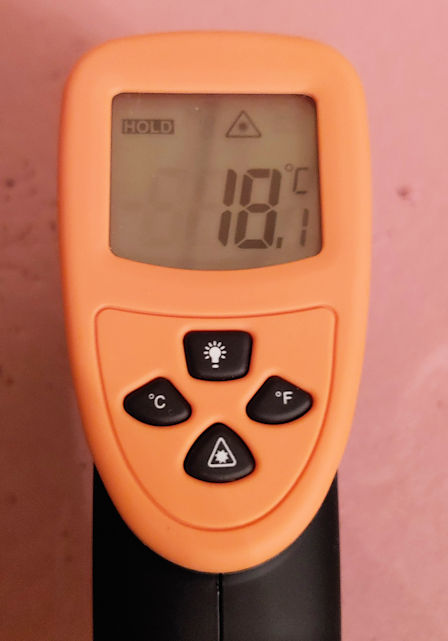
This is the reading I got from the must.

Woo Hoo! At 18C, it’s now at the higher end of the temperature range it should be at.

The yeast also seems to like the new temperature. The CO2 “burps” in the air lock are now happening every 4 – 6 seconds. More 4 than 6. :-)

This evening, I’ll probably turn the heating pad on the warm setting again, for when the house temperature drops during the night. We’ll see what the temperature of the must is again, before we do.

I’m feeling much better about this now!

The Re-Farmer

Mead Baby 2.0: it’s a temperature thing

It’s been pretty cold lately, which means the house is pretty chilly, despite the thermostat setting (and I’m not about to crank it because bits and pieces of the house don’t get heat). The carboy is set up near an interior wall in the dining room, which has one heat vent across the room, under the window. The only other heat vent in this part of the house is in the living room, also under a window.

Not the idea environment for fermenting Mead Baby 2.0

The must should be in a temperature range of 15C – 20C. We don’t have a temperature strip, but thanks to a gift from a thoughtful friend, I am still able to get a reading.

16.7C This is encouraging. It’s at least in the range is should be, if on the low side.

This was the ambient temperature of the room, taken right after I checked the must.

The room is only 14.6C

This means the must is generating some of its own heat, and the towel wrapped around it as a sweater is helping keep that heat in.

The fermentation activity is slowing down faster than I am comfortable with, though. Watching the airlock, the “burp” of CO2 went from about every 6 seconds (which was already slow for this early in the ferment, based on what I’ve been reading) to about 8 1/2 seconds, at the time I took these temperature readings.

I’ve read a number of suggestions on how to keep things warm enough, and I’ve already implemented one of them. I took a scrap piece of rigid insulation (that stuff is coming in so handy!!!) to put under the carboy. This way, it won’t lose warmth into the table top, and we don’t have to try and keep the towel bunched under it, making it more stable.

I’m also thinking of running a towel through the dryer when we’re doing laundry, and then switching towels while it is still warm. We don’t need to do laundry all that often, though. Another recommendation that is practical for us is to use the little electric heating pad I recently picked up for my daughter, since our two old ones are no longer working. There are actually special versions of these, made specifically to wrap around carboys, but we’re not at a point to invest in anything like that right now. What we have will do. It has a low temperature setting, and turns itself off after two hours. We wouldn’t wrap it directly around the carboy, but around the towel, so as not to warm it too much or too quickly. We’ll have to move the carboy to somewhere we can plug it in.

Ooh. I think I just thought of a place, too!

The Re-Farmer

Bonus critters, and a kitty gate

We had some new, furry visitors to our feeding station this morning!

This is a first for us to see raccoons! :-)

They are so fuzzy!!! Like round little bears. :-D

This morning, I also figured out a way to let the mama cats out of the sun room, while keeping the babies in.

I noticed a whiteboard I had in storage, and gave it a try. The whiteboard is too slippery for the kittens to climb, and even if they managed to climb up the jugs I shoved against it to keep it from tipping, the marker ledge should keep them from being able to climb over. The remaining question was whether or not the moms would jump over it, and if they would knock it down when jumping back.

As my daughter and I were heading out to go to town, I heard a noise and saw that Beep Beep had jumped it, without knocking it down. When I came back later, however, it seemed the Butterscotch hadn’t figured it out yet. So I just lifted her over. You can actually see her in the photo, at the old dog house, where she promptly went to eat some grass! She has since returned to the sun room, and the kitten gate is still up, so it seems to be working.

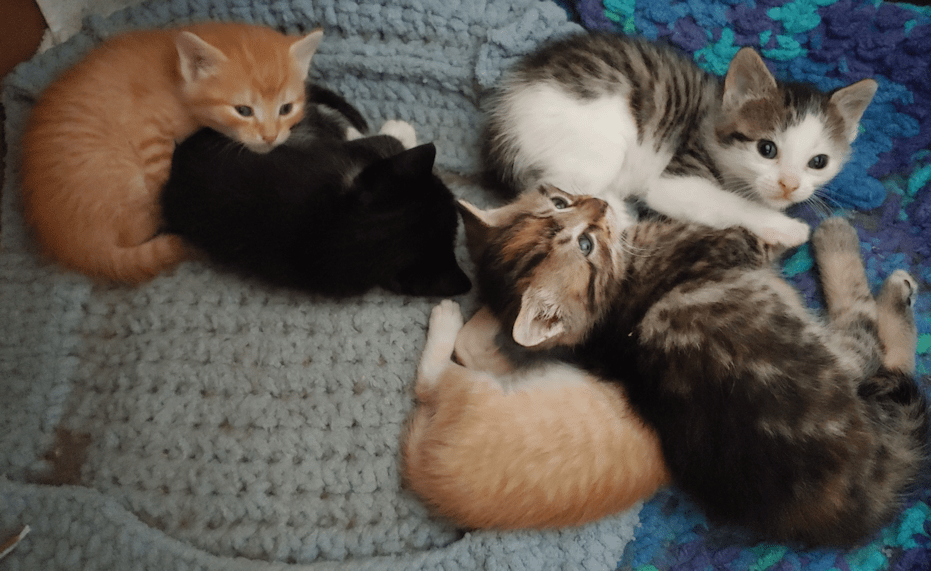
The kittens, meanwhile, were content to ignore the set up.

They had all been sprawled on that blanket until they saw me moving around. A few came to check things out, then stayed to play.

This one, however, just luxuriated…

Cutest.

Thing.

Ever!!!!

In other things, we have not been able to work on painting the gate again, yet. We had a good rain during the night, so it was still wet when we went into town. I’m hoping to get some more done this evening, once it starts to cool down a bit. At least the area that’s already painted is no longer tacky to the touch! Tomorrow, I’ll be driving my mother to a medical appointment, so if I get some painting done today, that’ll give it plenty of time to cure tomorrow. No rain is predicted overnight, so that should help, too. We’ll see how it works out.

For now, we’re just staying out of the heat!

The Re-Farmer

Seasonal things

I’ve been able to spend more time outside in the last few days. Aside from cleaning up the downed branches in the yard and burning them in the fire pit, this has mostly been assessing things and making decisions.

I was checking around the garden area and could clearly see where the deer were coming in at the corner.

20190420.deer.path

Even with the snow gone, the path the deer made through the ditch and over the fence is clearly visible!

I was also noticing some changes. Like this.

Continue reading

A light at the end of the tunnel?

After I wrote about our foggy morning, yesterday, my daughter and I headed to town for her shift.

Locally, we had a light, moody fog. By the time we left, it was pretty much gone.

On the way to town, we drove into a wall of fog, that just kept getting denser as we got closer to the lake!

I took this picture in the grocery store parking lot.

20190407.fog

Keep in mind that my phone’s camera cleans visibility up quite a bit with smoke or fog, so in real life, the visibility was actually much less. Even so, I would normally be able to see several buildings, including the hospital my husband is in, from here!

Continue reading