What a drip!

The old basement is the heart of the plumbing in this house. It’s where all the pumps and tanks are, plus we have a couple of sets of taps; one for the laundry sink, and one for where the washing machined to be, and pipes with shut off valves leading to the taps outside.

Until the plumber added a shut off valve to the hot water tank, those were pretty much the only shut off valves in the system. Otherwise, there is a main shut off valve at the well pump that shuts water off to the entire house.

One of the things my brother did was install a pool filter to the septic pump system. It has a filter basket that catches larger bits before they get into the pump and sent on to the outflow. It has to be cleaned out every now and then, so he got an extra basket, so one can be quickly switched out for the other, and the pump can be back in action right away, rather than having to stay off while the filter basket gets cleaned. Which is a big deal, since it basically turns black and needs time to soak in a detergent solution after the grit and odd bits of straw that fell into the tank while it was being emptied are cleaned out.

Handily, the laundry sink is right there, and that’s where I wash out the filter basket.

It is also where we shock our hot water tank with hydrogen peroxide every now and then, when the water develops a rotten egg smell. This is done using siphon action by attaching a short hose to the tap. After shutting water off to the hot water tank, then allowing it to drain until the vacuum created prevents more water from draining out, we can put the hose end into a container of hydrogen peroxide, turn on the hot water tap, and the peroxide gets sucked into the hot water tank. Unfortunately, the threads on the hot water tap are damaged, so instead of being able to screw on a short length of hose directly to the tap, we’ve had to use Gorilla tape and a length of aquarium hose. It doesn’t seal as well, but it works.

Those are pretty much the only times that sink gets used.

When I’d switched out the filter baskets at the septic pump, I noticed that the hot water tap had developed a drip. I have no idea how long it’s been dripping, but as I used the hot water to do a rough clean on the filter basket, then set it in a container to soak, it started to drop more. Last night, I switched out the soaking water, and the slow drip because a fast drip.

We already needed to replace both the hot and cold water taps, but until now, that wasn’t much of a priority.

Here, you can see the hot water tap, with the tape holding the bit of aquarium hose. The cold water tap has a length of hose screwed on – without the hose, the water sprays all over. The piece of hose across both taps is what I’d tried to screw onto the hot water tap, only to discover the threads were damaged.

This morning, I headed into town to hit the hardware store, just as it opened. After showing the photo to one of the staff, he found the right size replacement taps for me (I plan to take advantage of the situation and replace both taps). Unfortunately, these taps are soldered on. Which means, to change them out, I need to heat them with a torch, remove the taps, clean the pipes, then solder on the replacement taps.

We don’t have the tools to do that. Even if I wanted to cut the old tap off and put a new one on the remaining length of pipe, I’d still need a soldering gun – and I don’t want to shorten the distance of the taps over the sink, anyhow.

Of course, there are no shut off valves between these taps and the pumps. To work on it means, at the very least, shutting off the water to the hot water tank. To work on the cold water tap means shutting off water to the entire house.

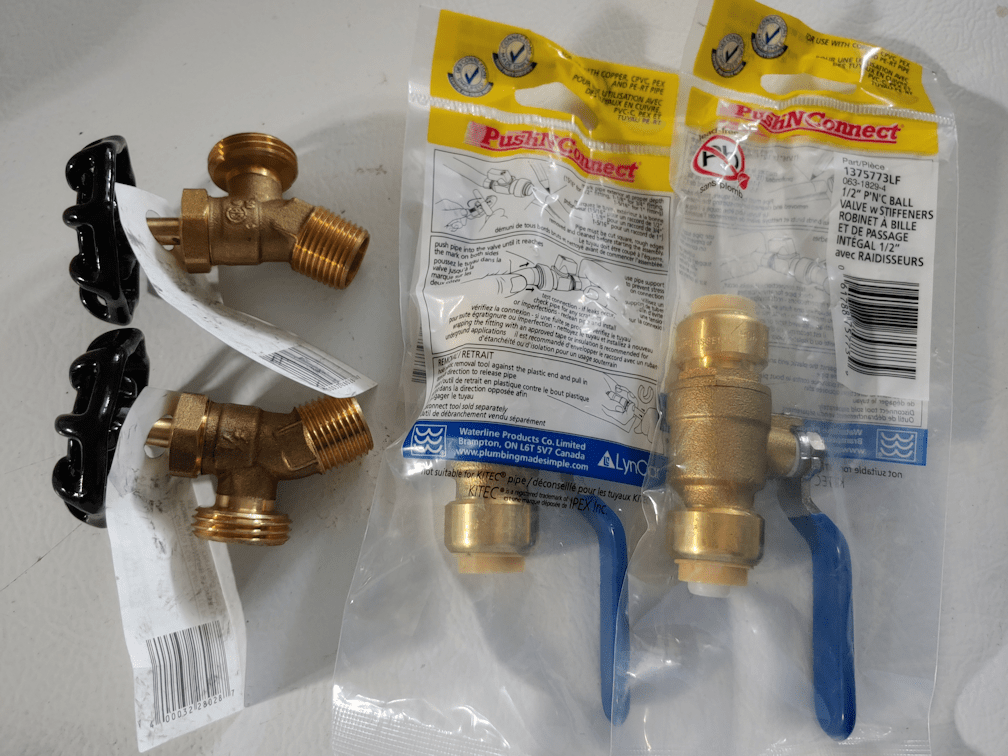
So I picked up a couple of Shark Bite shut off valves.

We have what we need to cut pipe, so we can install the shut off valves ourselves. That will allow us to shut water off to the taps and stop the drip, until we can replace the taps themselves.

I’ve already been able to talk to my brother about this, as he has the tools needed to replace the taps. As for the shut off valves, he had it in his mind to install them in the vertical pipes leading to the taps, but I am thinking of installing them in the horizontal pipes running along the ceiling, so that they will shut off water to the other set of taps as well. Those have never been used since the washing machine was moved upstairs, but considering how old they are, I can see needing to replace them in the future, too.

My daughters are still on “night shift”, though, so I don’t want to start any of this until after they’ve gotten up and had their showers. For now, I just want to install the shut off valve on the hot water pipe, but – as unlikely as it is – if something goes wrong during the install, we wouldn’t be able to turn the hot water back on until it’s fixed, and who knows how long that would be. It’s really a simple job, but I know how easily simple jobs can become major problems, in this place!! Hope for the best, plan for the worst!

One of the considerations for installing the shut off valves; unless we cut out about 3 inches of pipe, they will add to the length of the pipe. That would mean the taps would need to be shifted over by the same distance. Which I wouldn’t have a problem doing, except that parts of the copper pipe have been painted over.

Including the clamps and screws holding the pipes in place. Which is going to make loosening the screws a pain in the butt!

*sigh*

Still, it needs to be done, regardless. We’ve had issues with a loud noise that would start after the well pump kicks in to refill the pressure tank. It is very loud, and I can actually feel the floor vibrating under my feet when I am at my computer. It rather freaked me out because, at first, I thought the noise was coming from the well pump, and we’re already on borrowed time with that thing. Eventually, I was able to trace the noise to the pipes. The pipes run under the exposed floor joists, and have a mishmash of supports attached to the joists, holding them in place. In a couple of spots, there is a pipe that has a 90 degree turn and runs under the pipe it had been parallel to. One of those spots is the hot water pipe that runs from the hot water tank to the laundry sink. What seems to have happened is that, as the house has shifted, those pipes no longer have any sort of gap between them. When the pump starts running, it causes vibrations in the pipes, and with these two pipes now hard against each other, that results in the noise and vibrations I can actually feel in my feet. Right now, the vertical pipes are clamped so tight against the wall – with painted over screws – that there is no give at all. So while we are working on the taps and valves, I want to see if I can adjust the hot water pipe downwards a bit, so that they are no longer touching. Hopefully, I’m right that this is the cause of the noise, and it will stop.

If it doesn’t, and we still get the noise in this location, I’m at a loss as to what else the cause might be!

So we’ve got our work cut out for us this afternoon, just to be able to stop the drip until we can replace the tap itself. Once that’s done, there is no longer any sort of urgency.

The Re-Farmer

First low raised bed: part one. It’s good to be flexible!

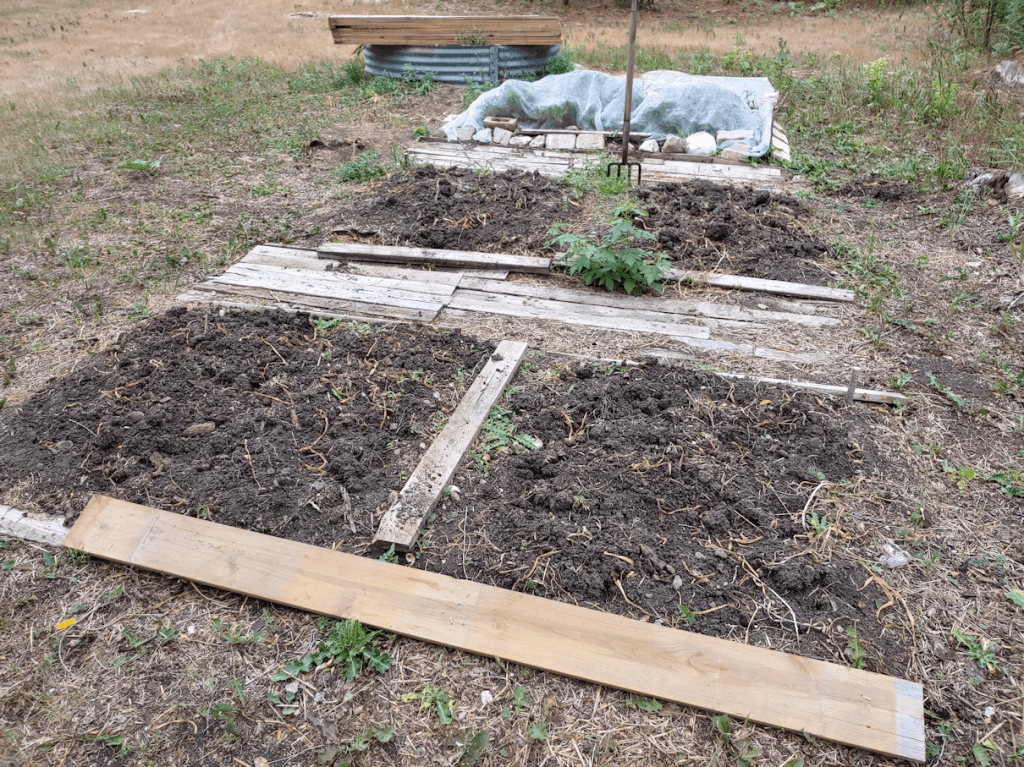
This evening, I finally got around to working on the first of the low raised beds in what had been our garlic beds this year.

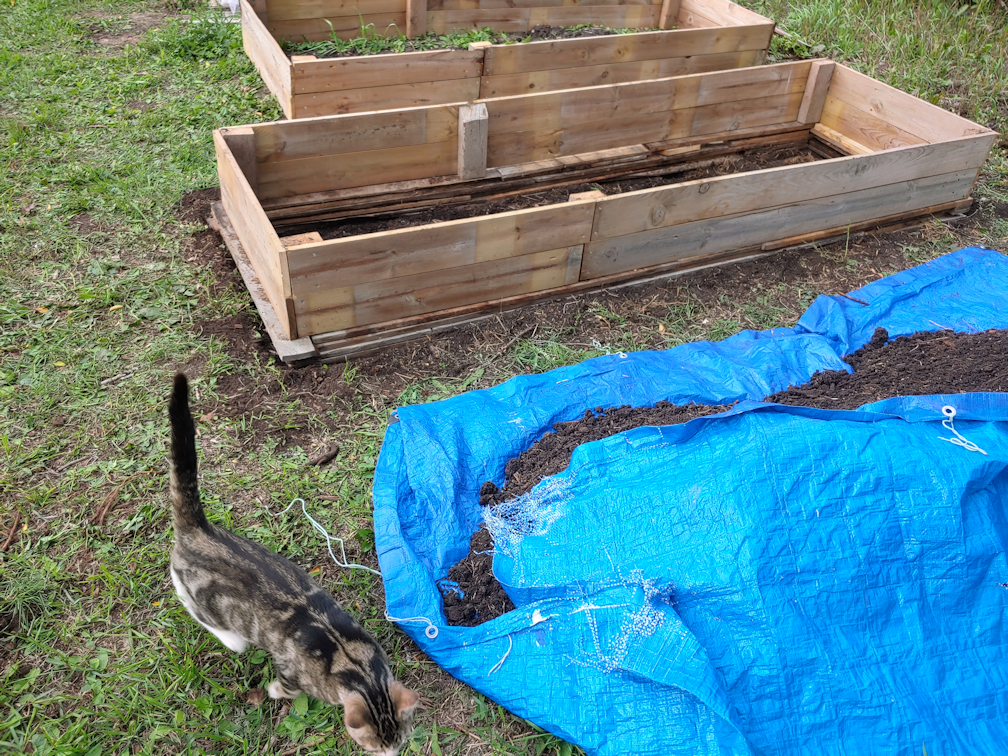
The boxes are ready and waiting, and the beds had been left for any weeds to get larger, so they would be easier to pull.

The plan: dig out all the soil and buried layers of compostable material beneath, set up the box frame, then add the layers back, Hugelkultur style, with wood at the very bottom layer.

The first order of business was to loosen the soil a bit further than the new length the bed will be, and clear out all the weeds by the roots.

The first problem was in adding length. I was originally going to make it longer just at one end, only to find myself hitting large roots and rocks. So I did a bit at one end, then extended the other end, only to have the same problem!

Once the soil was as clear of weeds and roots as I could, it was time to remove the topsoil onto the waiting tarp.

The original plan had been to remove the soil up to the buried straw and compost pile contents into one pile, then remove the straw and other matter onto another. With the extended length, there was already the problem of not being able to dig far because of the roots and rocks I was hitting.

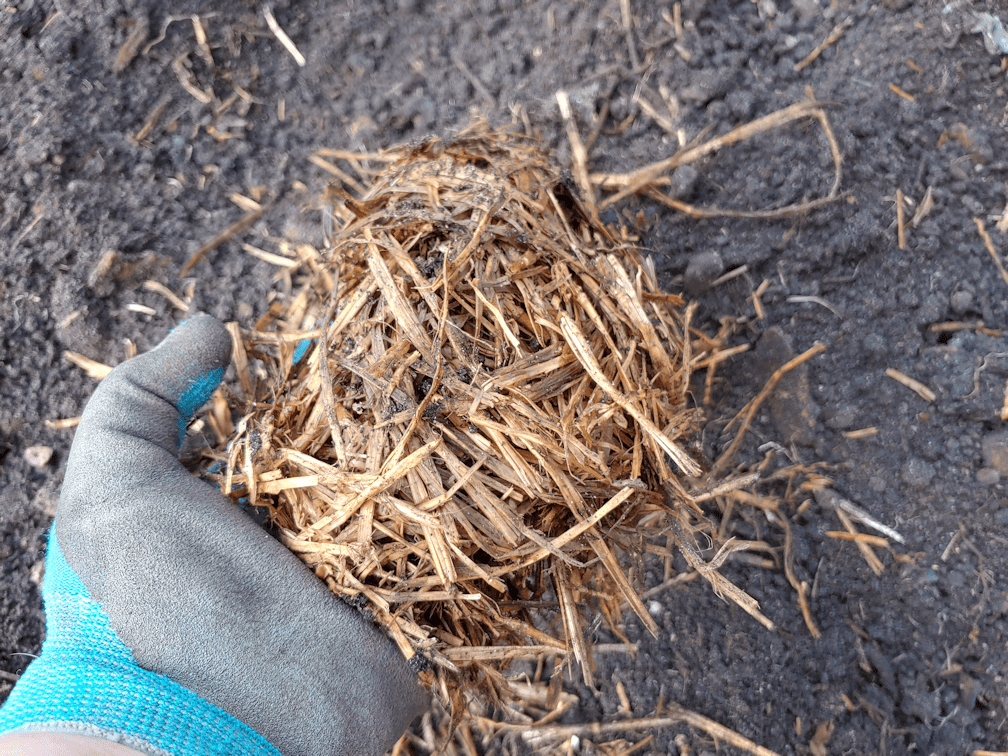
As expected, the straw was barely decomposed. It takes a long time for straw to rot away. That made it harder to dig down further.

I decided to leave it and modify my plans. If it wasn’t practical to dig down further, I would just have to build up higher!

Using a garden hoe, I flattened and somewhat leveled the perimeter, pushing the soil into the middle.

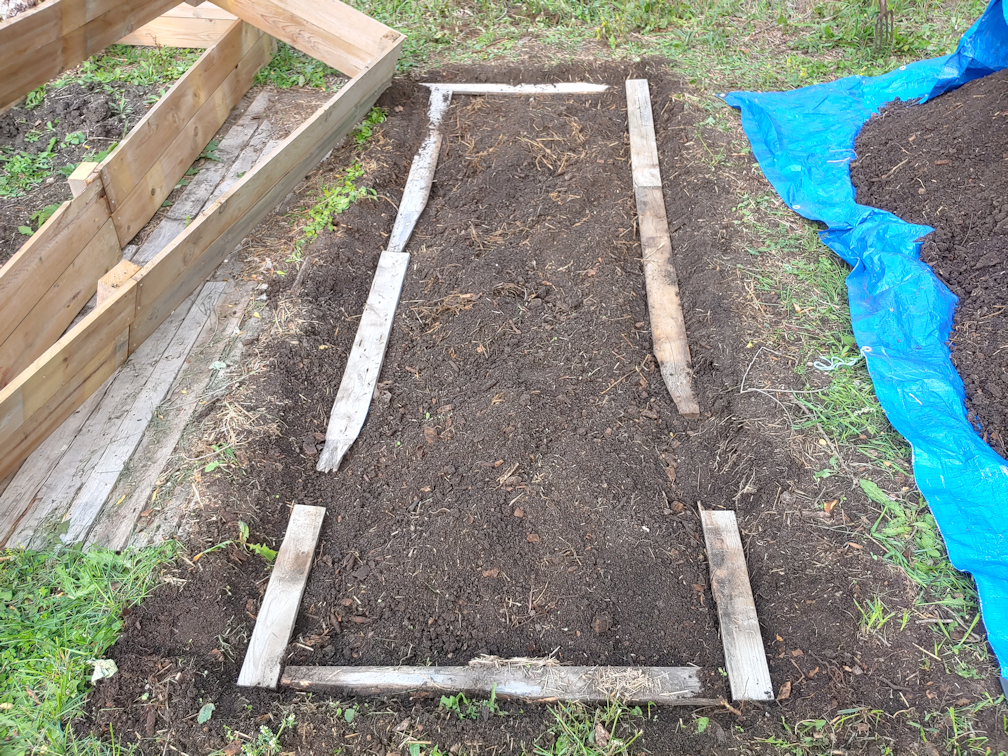
The box was then laid over the bed and stomped on, to create guidelines.

Then, it was time to raid the junk pile of old boards and create a foundation.

A first layer was placed on the guide lines, leveling the soil out more in the process. Then it was just a matter of digging out more boards and adding more layers. The boards are in varying states of condition and length, and a few were cut to size to fill in gaps.

I stopped at 5 layers of boards, which put the foundation at about level with the ground.

Then the box was lined up on top of the foundation.

That was definitely a two person job. :-D

The next step was to use the hoe to move the soil from the middle to the sides, burying the foundation on the inside.

Now it was time to do our use-watcha-got, Hugelkultur layering.

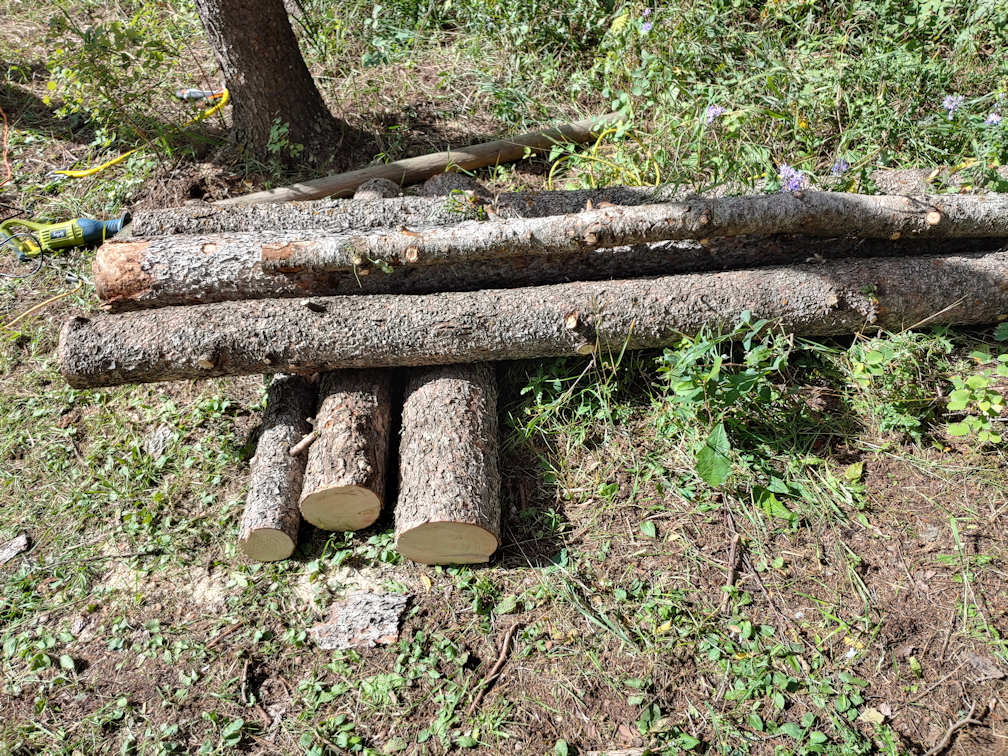
I raided one of our branch piles and brought small branches and twigs to cover the bottom. If we were doing a high raised bed, I would have used larger branches and logs, but these will do for a small bed. The idea with the wood is that, as it decomposes, it acts like a sponge, absorbing moisture that later becomes available to the roots of the plants above, and reducing the need to water.

The next layer was shredded paper. We’ve been saving and shredding our compost safe fliers and other paper, just for this purpose.

Then a layer of grass clippings from our new little “haystack” got added.

Then, the contents of our compost pile was added. Plenty of egg shells, coffee grounds, banana peels – all sorts of things that “garden hack” lists include. :-D

The last step for today was to hose the whole thing down, partly to keep things from blowing away. We have thunderstorms predicted for tonight. If we do get rain, it will help soak down the layers and get a kickstart in decomposition. If we don’t get rain, it will get saturated with the hose before the soil is returned.

Before the soil is added, however, I’ll have to find something I can pound into the ground on the outside of the long sides of the box, to prevent the boards from bowing out.

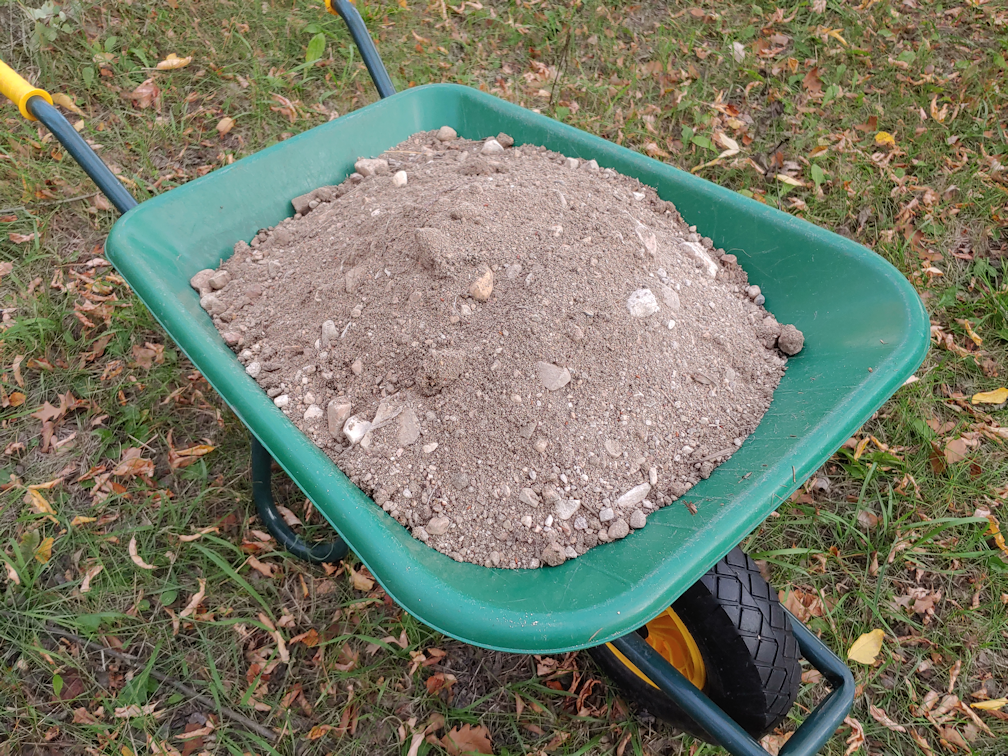
As lovely as the soil here is, it did test low in nitrogen, so before returning the soil to the bed, I will be mixing in some of the new garden soil, as well as more grass clippings, plus some of the pellets we’re using for cat litter now. It’s just compressed sawdust. As they get wet, they expand and break apart. This will add organic matter to the soil to keep it from compacting, plus the sawdust will absorb moisture and act as a sponge. The clipping and pellets will have the fall and winter to break down, and help increase the nitrogen levels.

If we had wood chips, they would have been included in the layers, and would be added as a layer of mulch at the very end. Alas, that will have to wait until we either get a wood chipper, or hire the tree guys to come out with their massive chipper for a few hours, and break down some branch piles for us. :-)

Which, weather willing, I should be able to work on tomorrow. :-) Unless something else comes up. Which happens often! :-D

The Re-Farmer

Our 2022 garden: first raised bed box

With the garlic all harvested, we’ve got two empty beds that need to be readied for next year’s garden.

With these beds, we had dug into the soft soil we found under the wood pile, mounding soil into beds and making paths in between. This worked out quite well, but there were a couple of issues. One was, for such low raised beds, I found them too wide. They were about 4 feet wide, which would be fine for a high raised bed, but awkward to reach the middles on a low bed. That was partly solved by putting a board across the middle, which served to both mark where the different varieties of garlic were, and to give something to step on while trying to reach into the middle.

What can I say. I’m short.

The other issue was that the soil along the edges would end up in the paths, either from watering or from when the birds were digging around the garlic, early in the season.

The solution to both issues was to build a narrower box frame.

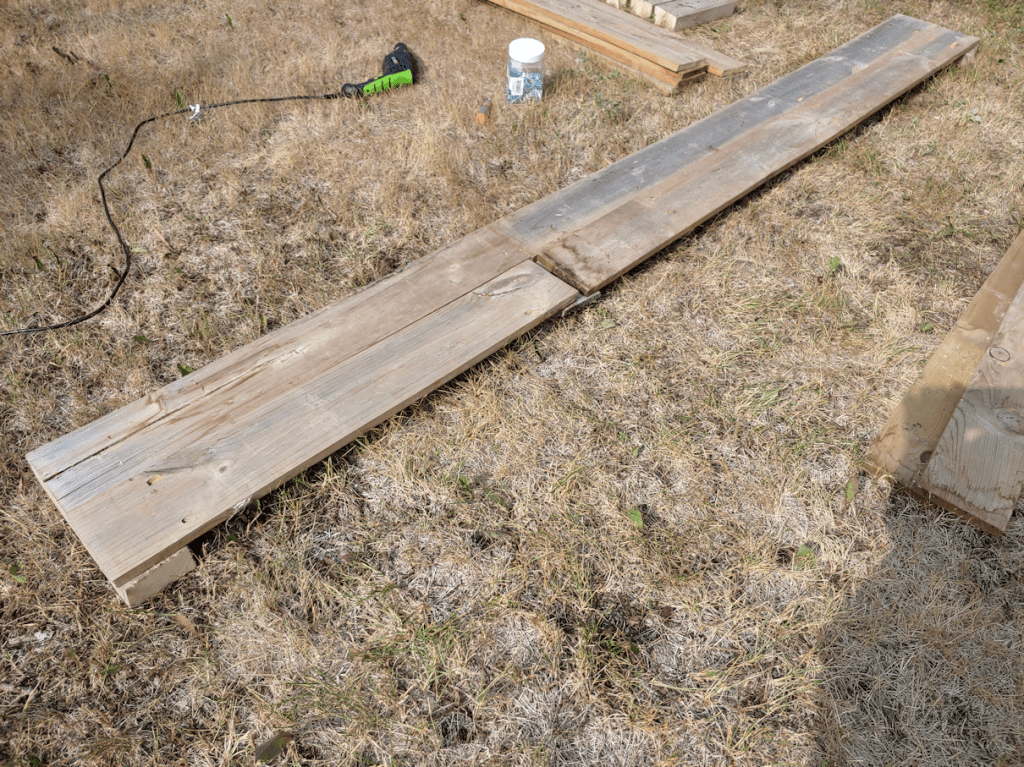
After scavenging in one of the sheds, I found some boards that would serve the purpose.

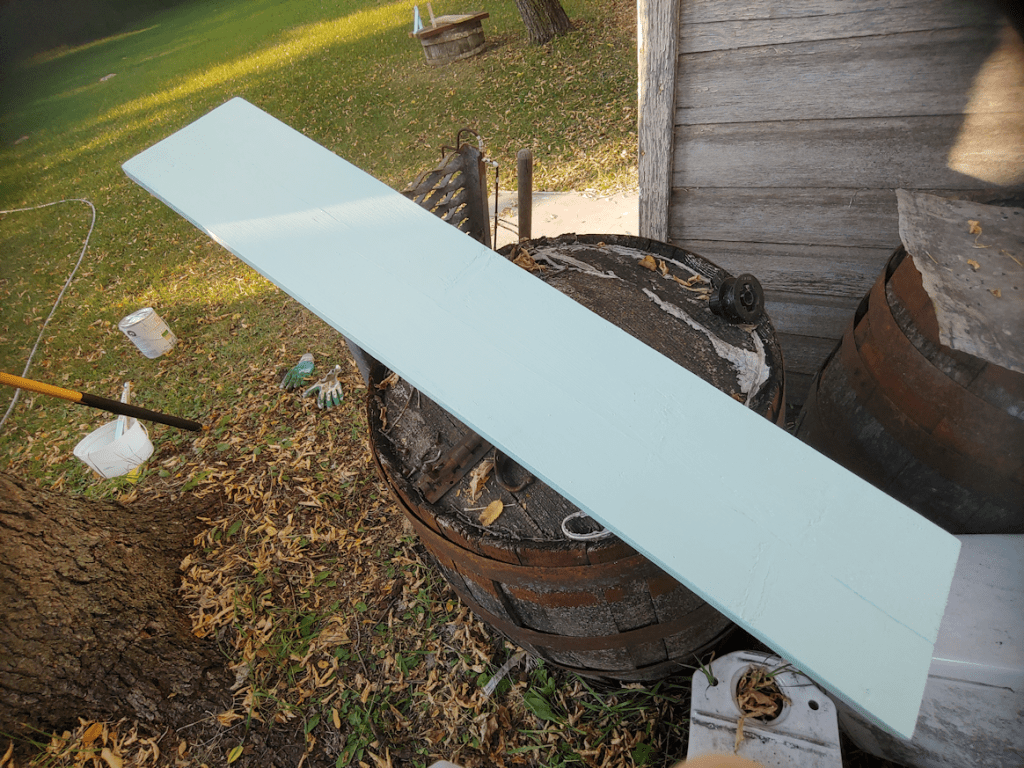
I dragged them all over to the beds. Here you can see one of them laid at the first bed I want to frame.

In total, I had 17 boards like the one in the foreground, plus 4 more that were the same length and thickness, about about an inch wider.

I decided to keep things simple.

I left four boards as is, then cut another four in half. The boards were all 6′ 1/2″ long and 5 1/4″ wide. Some of the half pieces would be used to increase the length, while the rest would be for the ends of the bed. I cut support pieces for the corners and to join the lengths together from some wood leftover from another project. Those were cut to match the width of two boards together.

The long sides were made by screwing the boards to the support pieces. The boards all have damage to them, ranging from old water damage and some rot, to splitting and cracking from being so very dry. Which is fine. They will do the job, and will last a few years, at least.

What wasn’t fine was flipping a board and almost catching my hand on these!!! They look like the screws were broken off on the other side, so there is no way to unscrew them from the wood. I have to think about the best way to get rid of these, using what tools we have, but for now, we’ll just have to watch out for them!

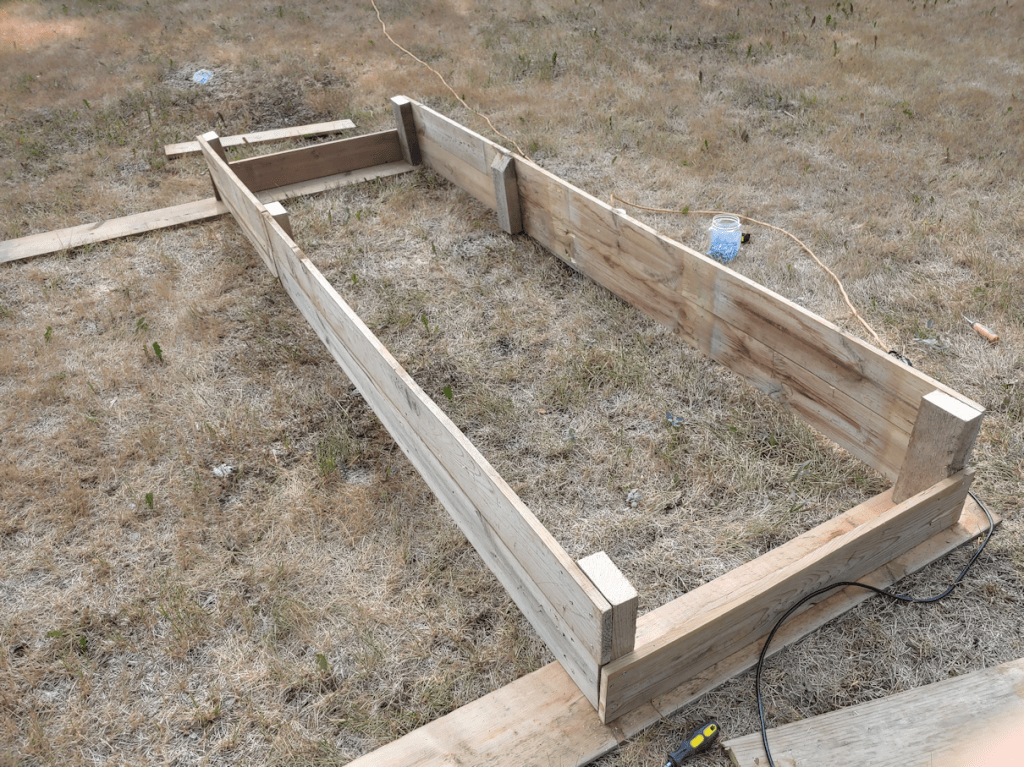
Once the side pieces were screwed together, making sure they matched in length, I brought over a couple of the wider boards to give a flatter, more even, surface to work on while putting on the end pieces.

Then I quickly tacked it together with just a single screw at each corner, to hold everything together while I worked.

Oddly, one piece was almost an inch longer than the others! Which is okay; the excess can be sawed off, later.

Here we have it! The finished box, next to the bed it will be placed at.

Here, you can see the difference in the dimensions quite clearly.

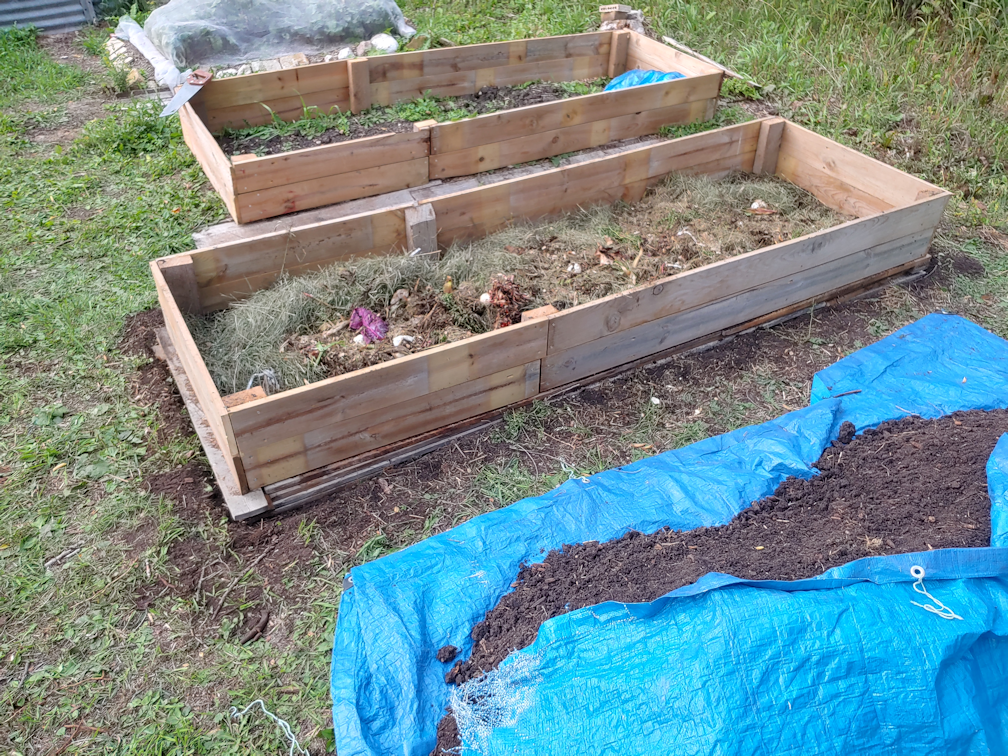
The box is about 9 feet long by 3 feet wide, and about 11 inches high.

In preparing these beds before planting the garlic, we dug out the soil and buried layers of straw and compost material at the bottom. Since the dimensions are being changed so much, I plan to dig out the beds again, then once the box frame is in position, will start filling it, hugelkulture style, by burying some of the branches we’ve been pruning for the past few years at the bottom, then layering the contents of our compost pile on top of that. Straw decomposes slowly, so I expect to find it when digging the bed out. If I do, I’ll be keeping it separate from the soil, so it can be layered back on again. As for the top layer of soil, I’ll take advantage of the situation to get rid of the weeds by their roots, then mix in some of the garden soil we purchased this year, before returning it to the bed. This soil tested healthier than anywhere else we took samples from, but it was still low in nitrogen, so adding the fresh soil will be a benefit. Once we have the materials again, the top will get layers of mulch to protect the soil.

I have enough wood to make a second box frame just like this one. I plan to build the second box before I start digging out soil. With the wider boards, there is enough to make a third frame for the bed that still has the beets in it, though it will be only one board high.

When this area is done, there will be three longer, narrower, framed beds with wider paths in between. This will make them much more accessible, even at their relatively low height.

Hopefully, I will be able to continue working on this tomorrow, but we’ll see how the day goes. I’ve got our rescheduled court date for the restraining order against our vandal in the morning. Hopefully, it’ll actually happen this time – and if the security guards try to tell me to leave and come back later, I will stay close this time.

The Re-Farmer

Row cover adaption

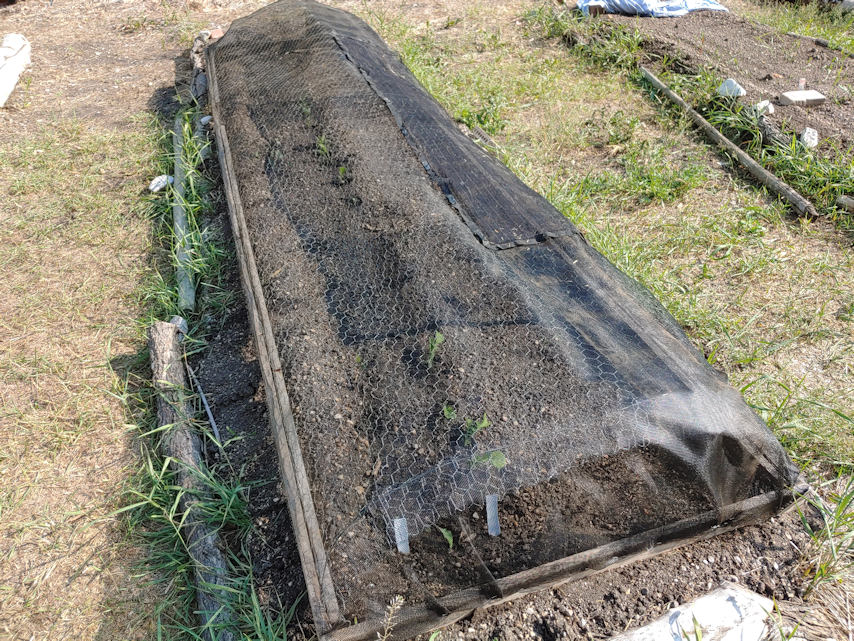
When we planted for a fall harvest, we did as much as we could to make row covers to protect our seedlings. We had enough materials for only two chicken wire covers, then made do with other materials for the third bed.

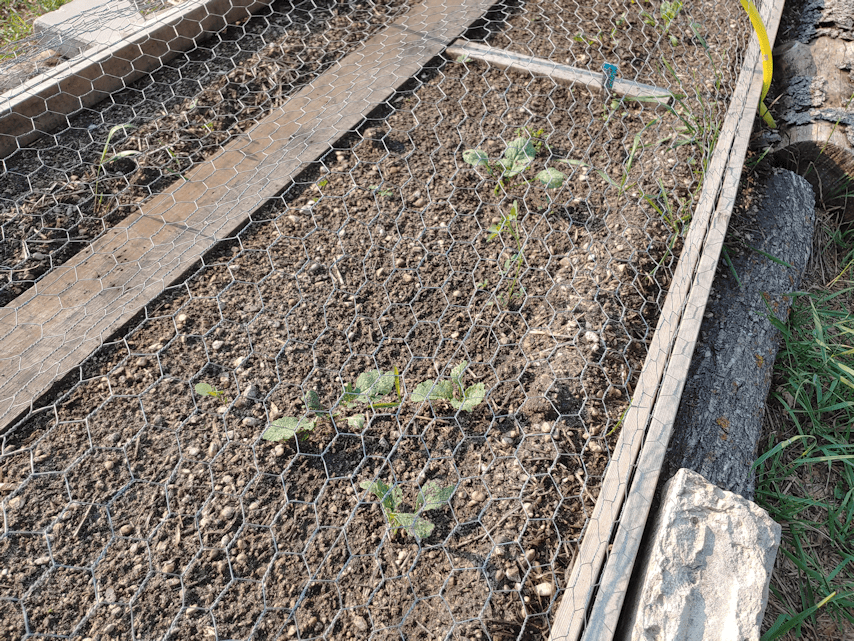
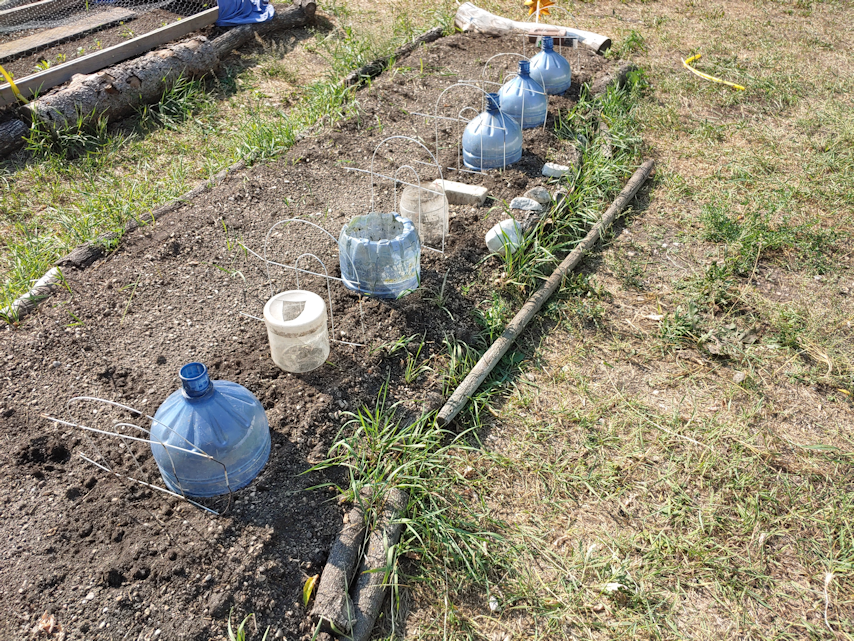
We rigged what we could to protect the last bed, but the grasshoppers really did a number on the seedlings. I ended up using old water bottles with their bottoms cut off to protect the remaining bits of seedlings, hoping they would recover. As you can see by the green in some of the bottles, there has been growth!

They can’t stay under the bottles, though, as they need wind and air to be strong. However, if we just took off the bottles, they’d only get eaten by critters.

The bed nearby was pretty much wiped out by the grasshoppers.

Even though the ends of the covers were open, the critters didn’t seem to want to go under them, but there is no such barrier for the grasshoppers!

The third bed is doing a bit better. The radishes may have lots of damage to them, but they’re the biggest ones we’ve got right now. The only surviving chard is in this bed, too.

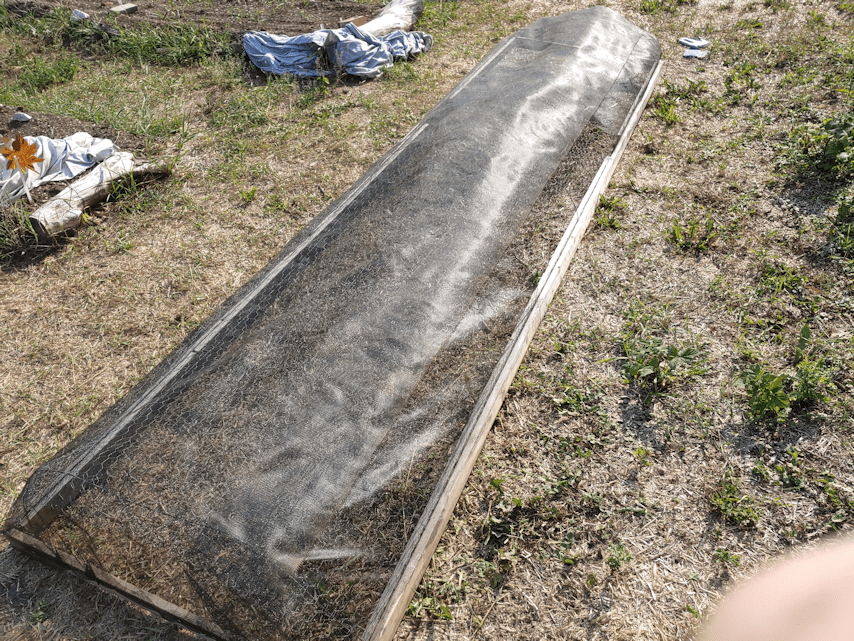
Since the middle bed was the most damaged, I decided to modify the cover and move it to another bed. In cleaning up the new part basement, we found a roll of window screen. I’d used some of it to make covers for the rain barrles, but there was still quite a bit left.

The cover is wider than the mesh. One length of it was enough to cover most of the chicken wire, but after cutting the remaining mesh in half and adding it, I was left with a small gap.

The edges of the screen were stapled to the wood frame, including enough to cover the ends. I tided down the mesh to the chicken wire just enough to keep it from moving.

A dear friend had sent us a couple of those mesh curtains that are meant to go over doors. The idea being, the mesh would keep the bugs out, but still allow wind in. They are tacked to the door frame, and the middle is held closed with magnets. The hope was that we could set them up in the old basement door, to keep the cats from going in there, but they could just push their way through the magnets. :-(

One of the panels was perfect to cover the gap.

The outer edge is stapled to the frame. The fabric is reinforced there, since it’s supposed to be tacked onto a door frame, so there is no damage there. Amazingly, the magnets are holding to the chicken wire enough to keep it one!

Once it was ready, it was time to set up the garden bed.

Even covered by water bottles, there was still grasshopper damage!! Some had never recovered from being eaten, at all. While removing the bottles, the soil wanted to stick to the them, too, and that quite nearly pulled up several of the plants. :-(

After making sure those that had been disturbed had soil pressed in for supper, it was time to add the new cover.

I’m quite happy with this.

It will be worthwhile to get more window screen mesh!

Since the ends are covered with window screen, it made it easier to add the shade cloth.

The surviving seedlings in the now-uncovered bed to things much bigger than little water bottles to protect them. The grasshoppers can still get in, but it’s still better than nothing.

Then all the beds got their shade cloths to protect them from the heat of the day.

When we make our permanent raised beds, they will be shorter. I actually like the length of these – they’re about 15 feet long – but it makes the protective covers awkward to handle, and we just didn’t have the materials to make them the same length. The covers are only about 13 feet long. I’m thinking 10 feet will work better, but we shall see when the time comes.

Until we can get the materials to build them, it’s a moot point, anyhow!

Whatever we end up with, having window screen mesh on a frame to keep the insects out seems to be more practical than the mosquito netting we’re using as floating row covers.

The Re-Farmer

First tree stump bench made!

I had cleaned up the dead spruce tree I’d cut down, a few days go, but only now got to continue working in the area.

Because of how the tree had landed, I used the baby chainsaw to clear away all the non-weight bearing branches first, and was left with this giant insectoid shape! :-D After clearing away the last of the branches, I was going to break the trunk down further with the electric chain saw, but when that turned out to not be working properly, I just left the trunk to the side. We’ll have to take care of it later.

Today, I broke out the reciprocating saw and used it to finish trimming the top of the stump.

Happily, the wood in this stump is nice and solid.

The other trunk, from the tree we took down 3 summers ago? Not only did it have ant damage, but as I was trimming it with the reciprocating saw, it was vibrating at root level!

Well. That changed my plans.

At first, I figured I would just make a seat instead of a bench, but I really wanted a bench.

I used one of the boards that would be a horizontal support to mark off and cut the stump, using the reciprocating saw. At this point, I was still thinking of making a seat, but figured this stump was solid enough to support a bench. I cut the support pieces to a couple of inches shorter than the board that would be the seat, found the middles, then drilled pilot holes.

Despite using a level when positioning the support pieces, they still ended up uneven!

Though at least part of that is because one of the boards was warped.

Ah, well. I wasn’t going to start over! The only thing I did have to do was trim the top of the stump with a hand saw a bit, to make it even with the support pieces.

Then it was time to screw on the board for the seat.

You can see on the far right, that there was a substantial gap! I ended up making a wedge from a scrap piece of wood and jamming it in, then screwing the board in place, though the wedge and into the horizontal support.

As I was doing that, I could feel the bench wobbling a bit and decided the ends needed extra support. I didn’t want to put too much stress on the screws holding it to the stump, even though there are quite a few of them, and they are longer than needed. I had the pieces of wood I’d cut off the horizontal supports, so I trimmed those to size and added them at the ends to make legs. The main support is still the stump. The legs are just enough to give a little extra support, if there is too much weight at an end. The ground under them is soft, so if they were to be weight bearing, I would have wanted to add something solid under them, like a brick or some flat rocks

And there we have it! Our very first tree stump bench. :-D And I must say, it felt SO good to have someplace to sit down when I was done! It was the perfect height for me and my messed up knees, too. In fact, I used my knees to judge what height to trim the stump down to, and with the height added by the thickness of the seat board, it worked out just right.

Now it just needs a good scrubbing and a paint job to protect it from the elements. The board I found for the seat still has some paint on it, so it’s not too urgent.

I am quite pleased with how this turned out. We have so many dead trees in the spruce grove that need to be cut down, with some of them fairly close to each other. My thought was to cut them to leave stumps that could be used to make seats and tables, making sure that some of the seats are a bit higher, for my husband to be able to use comfortably. This bench is the first experiment to see if the idea is viable, and I’m happy to say that it is. Most of the greenery you can see behind the bench are a flower patch that we uncovered when cleaning up in this area, and have been leaving alone, as we mow or trim around it. Which means that, over time, we’ll be able to sit here in the shade, surrounded by lovely yellow flowers. :-)

Over time, we will have many seats like this, scattered all around the the inner yard, as we continue to clean up among the trees, and turn the inner yard into a lovely haven.

I feel a sense of peace, just thinking about it!

The Re-Farmer

Our 2021 garden; made in the shade, and we have melons!

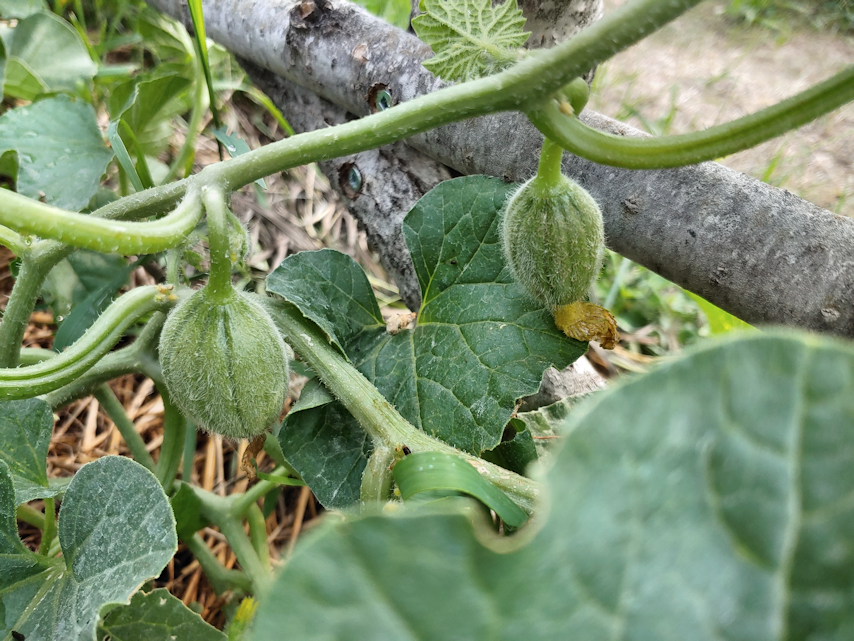
While doing the evening watering, the girls spotted a couple of little melons last night! I just had to go looking for them this morning.

Aren’t they adorable?

The bigger one is about 2 inches long. I wasn’t expecting them to be fuzzy. :-D

These are the Halona melons. Still nothing among the Pixies – at least not that we can see. Lots of flowers, though.

In thinking of how to protect our Crespo squash from being nibbled on, and our new sprouts from the upcoming heat, I scrounged in the old garden shed and dug up some old, bent up, decorative wire border fences.

Most of the sections went around the Crespo squash. Whatever has been eating them has not tried to go past the hoops, so I’m hoping the new border will further dissuade it.

The ground here is so rocky, I wasn’t able to push all the wire “legs” into the soil! Enough are in to keep it from falling over, though, so it should be fine.

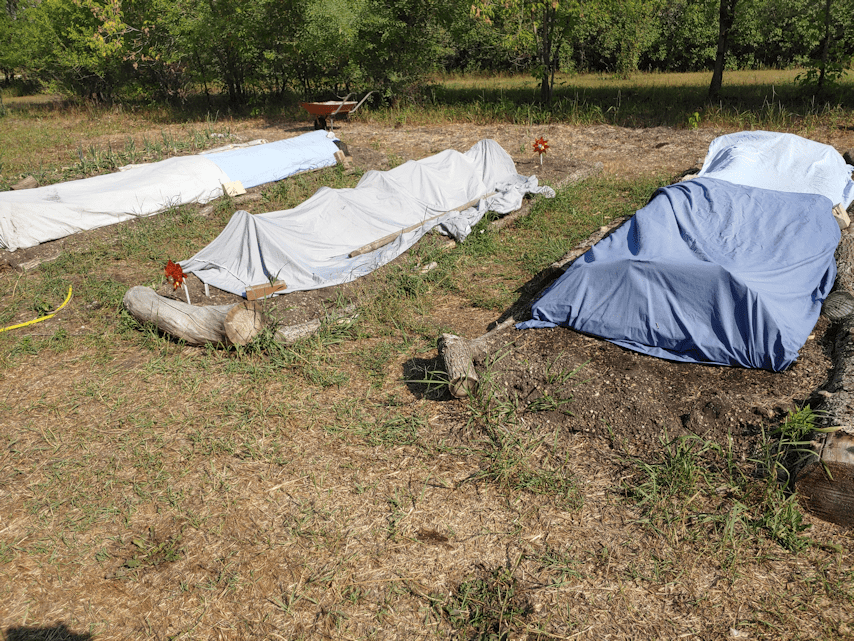
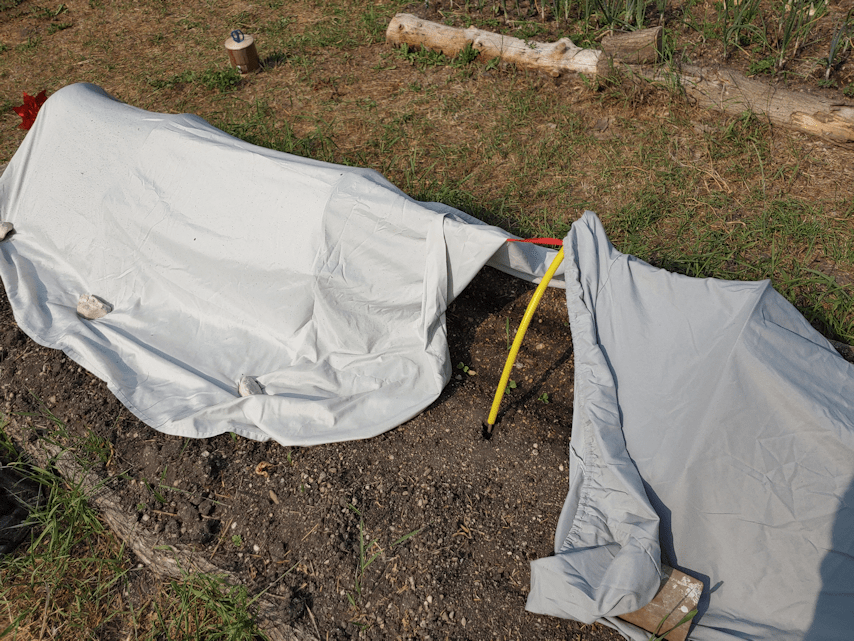
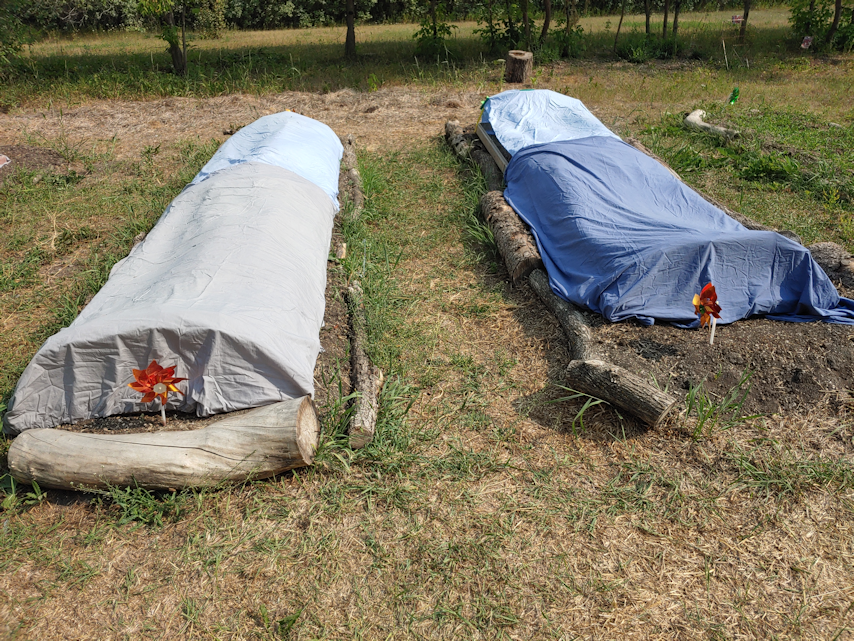
There were a few sections left, and they got used in the garden bed that doesn’t have a row cover on it. Then I used some bed sheets as shade covers. I neglected to take progress photos, though. :-/

There were 6 individual sections that got evenly spaced over the seedlings. The bundle of fencing had been tied with a fairly long ribbon, so I used that to join the tops of as many of the middle ones as I could. As I was laying the sheets down, though, there was nothing in the centre to support the ends. I had a short piece cut from a hula hoop left, so that’s now in the middle, on a couple of sticks in the ground to hold it up. It was too short to bend well, so there’s a kink in the hula hoop piece, but at long as it holds the sheet up, I don’t care! :-D

After that, rocks and bricks were used to pull the fabric taught and weigh it down.

For this bed, I could use some old Twin sheets. For the other two, I had some queen and kind sized sheets to use.

The one top sheet was easy enough, but the fitted sheets needed to have their elastics cut off, and one of them was cut in half and used to cover the ends of the rows. With these, the fabric could be secured by tucking it under the wooden frame. The sheet that was cut in half is barely wide enough on one frame, and a few inches too narrow on the other, but the ends are tucked, and in the middle of the row, the other sheets were laid on top to hold it in place.

So now our shade-loving seedlings have their shade, and protection from the heat of the day. We can uncover them when we start the evening watering, so they get some less direct light during a cooler time of the day. Then I can cover them again when I do my morning rounds.

We’re supposed to start hitting 30C/86F and higher, tomorrow, though the hourly forecast on one of my apps says we’re supposed to hit 32C/90F this afternoon. The record high for today is 33C/91F, set back in 2002. I think we were actually living in this province again in 2002, though I believe we moved back in the fall. The record low for today is 9C/48F, set in 1993.

Anyhow, we’re supposed to stay about 30C/86F for almost a week, and these sheets should help keep the seedlings a bit cooler. I’m considering whether it would be a good idea to moisten the sheets, too, but the extra weight of water might be too much for the frames to hold.

It should be interesting to see how these work out!

The Re-Farmer

Our 2021 garden: netting fix, and we have asparagus!

One of the things we’ve done to deter deer from nibbling things in the old kitchen garden was drape mosquito netting over one end, using existing T-posts at the retaining wall, ropes, and pegs. Basically, it’s a tent.

We’ve had two problems with this set up. The first is… well… it’s mosquito netting. As expected, bugs can’t get through it. They get caught at the peak of the “tent”. We would find all sorts of flies, but also moths, bumblebees and clearwing moths, and the only way to let them out would be to flip one side of the netting over the top, to the other side, then later flip it back.

The other problem was also expected. Wind! Today, it got windy enough that, even though parts of the netting is attached to trees, it came loose from the posts and even started coming loose from the trees.

Today, we worked on fixing that a bit. I think this will work out better.

The netting had been affixed to the rope with clothespins. Those, of course, would come loose, but then they’d disappear. I expect we will be finding bits and pieces of them in the lawn and garden beds! We’re still using the clothespins in some areas, but now the netting is mostly on the outside, and weighed down with bricks wrapped in the excess fabric. If we need to access the things planted in the retaining wall blocks, we can just unwrap the nearest bricks and reach under the netting, then put the bricks back again. It works rather well, as I did it to get at the newly opened chive blossoms to add to our vinegar (which is now at the sit-for-2-weeks stage).

The rest of the netting is allowed to flap loosely. The movement is one more thing to startle deer away, plus it gives the insects a better chance of getting out on their own, except for at each end, where it’s fastened more tightly. We will still need to check it often, to remove any critters that might get caught. Otherwise, this should work out just fine.

Those bricks we’re finding all over the place are really handy. We need more of them! :-D

While I was working on a new bed, which I will write about in a separate post, my daughter went to check on the asparagus and strawberry spinach beds, and do a bit of weeding. She made a very exciting find!

The days have rain have made a huge impact! The purple asparagus has sprouted! They were not there when I checked the beds this morning. At least not in any size I could see. All 6 asparagus crowns now have asparagus sprouted; the ones in the photos above are the largest.

We are so totally stoked! I had no idea what to expect in their first year. That one spear is SO purple, too! :-D

Two more years, and we’ll be eating asparagus from this bed. :-)

The Re-Farmer
Our 2021 garden: squash tunnel, day 3, and progress

We managed to get outside for a bit more progress on the garden. One of the things I did was go through where we planted sunflowers last year, and dig out any remaining stumps. I am really impressed with how much softer the soil is. Well. When I managed to not hit any rocks, at least. ;-) I think using this area for the summer squash will work out. We just have to fight back the grass and weeds. :-/

Not yet, though. The new corn block will be the priority for transplanting.

This area has been covered with black tarp for at least 2 months. Almost, but not quite, enough to kill off the grass and weeds.

This area is remarkably rough, though. I had the hardest time mowing on this side, without hitting rocks or lumps of dirt. Partly because of this, I will be going things differently. I will actually be turning the soil here. Nothing extreme. Mostly just loosening it with a garden fork, while pulling out the larger roots and rocks. Once it’s loosened up, I plan to go over it with a thatching rake (we only have 1 thatching rate, and a bunch of fan rakes, so that’s the tool I’ll use! :-D ). That should pull up more roots, but mostly I want to level it off enough that I’m not tripping over dirt clumps every time I walk through!

I had gotten a start on loosening the soil at one end, when one of my daughters was able to join me. Together, we got to work on the squash tunnel.

We were able to get all the side cross pieces in place at the tops. A job that was much more difficult than it looks!

I may have mentioned this before, but… we’re a bit on the short side.

Oy, did that make a difference!

My daughter held the cross pieces in place while I climbed the ladder to drill the pilot holes, then put in the screws. It was very awkward and painful for her – especially with her gimpy shoulder! – to try and hold the pieces steady until I had the screws in far enough that she could relax. Some of the uprights had shifted, too, so not only was she holding a cross piece in place, above her head, but sometimes holding an upright in place as well. The fact that everything was different sizes and shapes didn’t help, either. Doing this in 27C/81F heat, and winds high enough to blow over the step ladder, certainly didn’t make things any easier.

Also, we really need a power screwdriver. Driving in 3 inch screws manually, while someone else was struggling to hold the pieces together, was another thing that made the job more difficult than expected!

But we got it done!

It is still incredibly wonky, of course. Good thing it’s not intended to be permanent! We also didn’t use as many screws as I intended. For some joins, it was because the pieces were not of a size or shape to add more than one screw. With others, we just needed to get it in place and move on to the next, due to how painful or awkward it was for my daughter to support the cross pieces.

I now need to cut cross pieces for the bottoms. When I put those in, I will take the time to add extra screws were they are needed at the top. If necessary, I’ll add extra support pieces at the corners, but I think once we add the wire mesh for the vines to climb, that will help stabilize it a bit more, too. I’m actually not sure how we will get the mesh over the top.

Did I mention we’re short? LOL

At least it’ll be easier to put in the bottom cross pieces.

When we did as much as we could, I was ordered by my daughter to head indoors and out of the sun. Apparently, I was looking rather overheated!

So I am taking a bit of a break in the cool of the house. By the time I get outside again, more of the corn block I want to work on will be in shade, so that will help. I’m hoping to be able to get the corn transplants out by the end of tomorrow. We’ll see how it goes. I’ll be helping my mother with her grocery shopping earlier than usual, so that should work out.

Little by little, it’ll get done!

The Re-Farmer

Testing, testing!

Well, I’m certainly glad I decided to switch memory cards on the trail cam over the tulips after I finished my last post.

With this camera, if it happens to be recording when I pull out the memory card, I have to manually turn it back on again after putting in the new card. This time, it wouldn’t turn back on again. After much fussing, and even loosening the camera so I could reach things better, I finally got it going again.

When I checked the card, there was nothing on it. Whatever happened that caused it to turn off and stay off, happened while I was positioning the camera in a new location.

So I went back, made a point of triggering the camera so I would have at least one file from it in position, then switched cards again.

I then went back and forth between re-positioning the camera, switching cards and checking the files, several more times.

There were a couple of problems. The first was, no matter how I positioned the camera on various parts of the apple tree, I couldn’t cover all of the tulip area.

The other problem was physically moving the camera. It is held in place by a long strap. One end has a gripping clasp that the other end is woven through. This is great if I have to put it on a large tree and leave it there. It also doesn’t make much difference when it was on a fence post, as I could just loosen the strap and lift it off the top of the post. To move it from place to place on the tree, the strap needed to be pulled through the clasp, every time, then placed around the trunk, reinserted into the clasp and pulled tight again. Meanwhile, the strap runs through slots in the back of the camera that grip nothing, so the weight of the camera itself kept causing it to slide around and swing.

Since it was still on while this was being done, I had a lot of videos that were very hard on the eyes to watch!

In the end, there was simply no place I could put the camera that would cover the area needed. And there were no other trees in suitable spots that I could attach the camera to.

I could see where the camera needed to be set up. What I needed was something there I could attach the camera to.

I found something.

I grabbed one of the old sawhorses. We have three, and this one is the odd sized one, so it doesn’t get used as much. I set it up on its end, and attached the camera to the cross bar. The bonus is, now that the camera is strapped onto it, making adjustments is easy. I just shift the saw horse instead of trying to move the camera. With the camera mounted so low to the ground, I can switch the memory card more easily by tipping the sawhorse onto its side, then popping it back up again, without shifting its position. If I check the files and find that it does need to be shifted, it is much, much easier to do so now, then trying to do it on a post or tree trunk.

I already have a file of Creamsicle Jr. walking past the camera!

This should work out just fine.

And yes, I did move the string of bells and plastic spinner to the sides, so that they wouldn’t trigger the motion sensor in the wind!

On the one hand, I hope to capture the critter that’s abusing our tulips. On the other, I hope the critter never shows up, because there aren’t many tulips with flower buds left. We have not found other materials we can use to protect them (the fence wire I was thinking we could use would not stop a skunk), and won’t be able to buy anything until at least tomorrow. We’ll be making our monthly bulk shopping trip to the city tomorrow, but I’m not sure if we’ll be able to find anything useful. Now that we’ve added Canadian Tire to our list of places to shop at, to get the stove pellets we’re using for cat litter, I’m hoping to at least be able to find some chicken wire or something like that.

We’ll see how things work out!

The Re-Farmer

Our 2021 garden: last beets, and mulching

I’m taking a bit of a break from working outside, to avoid the hottest part of the day. We’ve reached 22C/71F, and our high is supposed to be 23C/74F.

One of the things I’ve been trying to do early in the day is water all the beds that we’ve planted. I’ve been concerned about them, since we are so incredibly dry right now. It’s hard to give the beds even a shallow watering, never mind the deep watering they need. The problem is that the surface dries out so quickly. What we need is a mulch. The only thing we have for mulch right now is straw. Which is fine if I’m mulching around larger plants, like when we transplant our squashes, etc. Not so good for things like greens.

What I do have, however, is a lawn mower.

So after I planted the last of our beet seeds – three types all mixed up – in the L shaped bed in the old kitchen garden, I brought out the mower.

We already had some chopped up straw that had been on top of the garlic beds; we’d removed most of it and it’s been sitting in the kiddie pool, waiting for use. I chopped all that up a couple more times with the mower, then filled the wheelbarrow with more straw and chopped it up several times, too.

The finished mulch, which now included leaf litter that was on top of the lawn, went back into the kiddie pool, which made it very easy to drag around to where it was needed.

The mulch is so light, I could let the wind distribute most of it for me!

The L shaped bed is all beets. I had thought to put some carrots along the edge of the bed, but there was no room! In fact, I ended up broadcasting the last of the seeds in another little spot.

The patch of mulched soil near the plastic and the tree is where the last of the seeds went. Almost all of these beets are last year’s seed, so who knows how many will germinated.

I then scattered mulch onto the poppy bed, too.

After thoroughly watering everything, I moved on to the big garden.

Once again, I could let the wind lightly cover the beds for me. The beds at each end, with the onions, got fully covered. The spinach beds have their first sowing in the middles only, so I just focused on that area. When we sow more in another week, we can add more mulch then.

Everything got another thorough watering. All the beds will be watered again this evening, when it starts to cool down.

Until then, my next job is to mark off and start preparing the block to direct sow the one variety of corn we have that needs to be planted before last frost. That’s going to be out by the peas, and that’s where we’ll be working on for the next while, as we prepare beds for the beans, corn and radishes, sunflowers, squash and gourds. Then, last of all, the block at the opposite end of the garden, where the Montana Morado corn will be transplanted. None of the sunflowers or corn starts have germinated yet, but it hasn’t been very long yet. I’m just impatient! :-D

We will also use the lawnmower to chop up more straw for more light surface mulch. That, at least, I’ll be able to work on in the shade this time! :-)

The Re-Farmer