While taking video of the peppers for the garden tour yesterday, I spotted what I thought was a tiny pepper beginning to form. It turned out to be the remains of a blossom. From what I could see, if it did develop into a pepper, it would be our first one.
Today, I went to take another look. After moving the dried remains of petals off, I did indeed find a teeny, tiny beginnings of a pepper.
An absolutely adorable little tree from, no bigger than the tip of my thumb.
I am so happy we have so many frogs this year. I wish they could make a bigger end on the mosquito population, though! Lots of frogs, but no dragonflies.
Gotta set up some bat houses at some point. Walking around this afternoon, the air was filled with the whining of mosquitoes. It’s absolutely insane, how many there are this year!!
Thankfully, I wasn’t needing to be out there for long. My daughter and I had our back to back medical appointments, after doing my mother’s med assist this morning, followed by a trip to the pharmacy, so we were away most of the day. Plus, it’s been raining off and on all day. Very happy for the rain, too! Not much to do in the garden right now, anyhow. Just see how much more the deer have eat, and stare perplexedly as all the things that just aren’t growing this year.
*sigh*
As my SIL once said about their own garden; if they had to live off of what they grew, they’d starve! They weren’t trying for any sort of self sufficiency. Just to supplement. We, on the other hand, are planning our garden out specifically to have a combination of fresh eating, freezing, canning and winter storage. Last year, we at least were able to freeze a few things. This year, I don’t think we’ll even have anything more than for fresh eating.
We do still have just under 50 days before first frost – a bit longer, if we go by the adjusted average, though I certainly won’t count on it. Who knows what might happen in that time! Maybe, things will actually start suddenly growing and producing and we’ll have a long and mild fall, with plenty to harvest at the end of the season.
In the bottom row, we have Tricolor Mixed bush beans, Rainbow and Fordhook Giant Swiss Chard, an Assorted Mix of beets, White Egg turnip, White Icicle radish and a rainbow blend of carrots.
In the middle is Bi-colour Pear gourds, my “just for fun” item, yellow scallop squash, Gill’s Golden Pippin winter squash, green scallop Bennings squash, Spring Blush peas and White Vienna kohlrabi.
In the top row is Red Beard bunching onions, Borage, American and Giant Noble spinach, Kandy Korn sweet corn, Purple Vienna kohlrabi, and an envelope to collect and store our own seeds in.
From this batch, these are the ones that will be planted this fall, before the ground freezes.
Rainbow and Fordhook Giant Swiss Chard
Assorted Mix beets
White Egg turnip
White Icicle radsih
Rainbow Blend carrots
Spring Blush peas
White and Purple Vienna kohlrabi
American and Giant Noble spinach
I am not sure about the Borage. I’ll have to do some research before deciding if those will be planted in the fall or started indoors in the spring.
Everything else except the corn and bush beans will be started indoors.
Bi-colour Pear gourds
yellow and green patty pan squash
Gill’s Golden Pippin winter squash
Red Beard Bunching onions.
Hopefully, starting the summer squash indoors next year will work. Direct sowing hasn’t been working out for those, for some reason. We didn’t have a slug problem this year, thanks to the many, many frogs, so that wasn’t the issue. We should be able to winter sow summer squash, but when I tried that for this year, none germinated. Most were old seeds, but there were new seeds in there, too. When I planted potatoes in that bed later, I did find a few seeds, but most seemed to have just disappeared. I did have to cover the bed with netting because of the cats, so they might have had something to do with the failure, too.
This, all on its own, is the makings of a decent garden for next year. We have other types of beans, winter and summer squash, melons, peas, corn and our own onion seeds. Of course, we’ll also be getting seed potatoes in the spring, and will probably try the little bell peppers and orange eggplants again. We have herb seeds that I might start indoors, if we have space, or we might cheat and buy transplants again, instead.
So there we have it! The beginnings of next year’s garden, much of which will actually be planted this fall.
Hopefully, we’ll have a better growing year than this one, because something really weird is happening with this year’s garden. It’s been so frustrating. We should be at the peak of growth and harvesting right now, and there’s basically nothing – and not just because of the deer! I’ll be talking about that in my garden tour video, and you’ll be able to see exactly what I mean.
Speaking of which, time to try and record some video. The rain has stopped, but we’re supposed to get thunderstorms later this evening!
In the first image above, you can see the potatoes in the background. They are yellowing and dying back, even though they’ve never flowers, and there are no signs that they ever will. I’ve looked around and have been able to rule out insects or fungal disease, which pretty much leaves heat and lack of water. I’ve been trying to keep up with the watering, but it’s very possible I wasn’t able to keep up, with the heat that we’ve been having. Mind you, the wildfire smoke probably hasn’t helped anything, either.
I’ve avoided watering the garlic bed for a while, so it could dry out before harvesting. A quick loosening of the soil with a garden fork, along both sides, and they all came out quite easily.
We got some of the biggest garlic heads we’ve ever grown in there!
In preparing this bed before planting the garlic, I did trench composting with whatever organic matter was handy. Including kitchen compost and grass clippings. These garlic have the biggest, strongest roots we’ve ever had, and a few of them pulled up partially broken down grass clippings, and even some egg shells, with them. The roots seemed very happy with the trench compost!
Once picked, I brought them over to the canopy tent I’d set up for them, and sorted them on the bench. Some of the garlic was picked too late, and were starting to split. There was one garlic where the scape never made it out, and instead got stuck in the stem. The bulbils formed in there and broke through the stem. We could keep those and plant them, if we wanted.
Or eat them.
The remaining garlic was strung up on two lengths of twine and hung across the canopy tent to cure.
The garlic that got too big and starting to split was cleaned up and trimmed, and are now in the kitchen for immediate use.
That done, I was finally able to give the garden a solid watering. I even had a full rain barrel to use on the old kitchen garden. I didn’t do the new food forest trees, though. I wasn’t feeling that good, yet!
Tomorrow, the dump is open and, now that we have the truck back, we’ll be able to do a dump run. I’m also going to have to do a shopping trip large enough to make it worth driving to Walmart. I’m hoping to get that done early enough in the day that I can continue working on the new wattle weave bed later on. Since I have an abundance of willow switches in particular that are too short for the distance the verticals are set at now, I’m going to take advantage of those chimney blocks and go the completely the opposite direction. Each of the concrete blocks has a series of openings around the sides. The posts are inserted in those openings along one side, with four empty ones in between each post. It was an easy way to evenly space the verticals.
I’m going to try adding verticals, using thinner posts, in each of the openings between the posts that are already there. I’ve got six posts now, which means there are five sections where I can add four more verticals. Since these will be sitting on top of the retaining wall, there will be no need to debark them, which will certainly save time, and be easier on my hands!
What this should do is allow me to use the shorter, thinner and more flexible willow switches we have so much of, adding new lengths along the way, held in place more securely. Right now, with what I’ve got so far, the overlapping ends just sort of sit there, loosely. I could probably tie the overlaps together, but that rather defeats the purpose of weaving them in the first place!
One of the things I am planning to get, to plant in the outer yard, is basket willow. Properly coppiced, these can produce an abundance of really long, flexible willow. It seems weird to buy more willow, since we have so much of it around, but they are a different variety, and surprisingly not-straight, unless they’re really, really young. I was originally thinking to get basket willow so that we could… you know… make baskets. However, if the coppiced willow is allowed to grow long enough before harvesting, they would be ideal for wattle weaving, too.
That’s at least a couple of years in the future, though. For now, we make do with what we have!
They were still nice and crunchy, which is nice. There is still that very mild radish flavour. They were much sweeter than I expected, though. Not a complaint, but I did expect more of a vinegar flavour, considering it used two types of vinegar. It was quite good, tasted on its own, and would be a nice little something on the side of any meal. In my sandwiches, they added a bit of a crunch, but are mild enough in flavour that they really weren’t than noticeable.
This is definitely something I would do again, and try out different brine recipes. I think they would do nicely with a garlic and dill brine.
For now, we’re just doing quick pickles. I am thinking that we might try to grow more for next year, to have enough to make it worth breaking out the water bath canner, to have some shelf stable jars for the pantry.
As someone who doesn’t really like radishes, I’m happy with how these turned out, and I think they may become a regular in our garden – as long as we’re able to sow the seeds in the fall, since they don’t tend to survive spring sowings.
After a morning that turned out to be way more hectic than it should have been, going out to water the garden was a much needed stress reducer!
It actually did start raining a bit while I was watering, and it’s rained a bit more since then, but so little, the watering was still needed.
What I’d really like to see is a whole lot of rain going over all those wildfires. Sadly, that doesn’t seem to be happening in the near future.
When watering the beds in the south east yard, I noticed more missing tops of greenery along one side of the winter sown bed. I’m actually not too worried about that, as the deer aren’t eating the radish pods I want to keep. I do have some lettuces I’m leaving to go to seed, though, so I might have to do something to protect what’s left in this bed. The other two have netting around them, and the little square bed has plastic around it. The deer can reach over, but I don’t think they like winter squash or corn plants. Corn cobs, yes, but not the plants.
It was when I got to the main garden beds that I found more damage.
Most of the damage was in the high raised bed, which is really just the right height for a deer buffet. A whole lot of beet greens disappeared. In the trellis bed (the next image in the slide show above), a single Hopi Black Dye sunflower lots its top. It will probably grow a new one, though.
While doing the watering, I was seeing all sorts of frogs coming out of the mulch. Some of them were huge! Well… huge for our native varieties of frog, that is.
There was one tiny one that emerged that really caught my attention, though. Would you look at that colour!!!
What an incredible green! That is not a common colour for frogs here, at all. It’s almost metallic.
I did the trees in the outer yard, too. To do that, I drag the hose out to the outer yard, where it almost reaches one of the Korean pines. Then I go back to get a couple of watering cans. I keep those next to the rain barrel (which still isn’t even half full) with water in them, so they don’t blow away.
Since they already have water in them, I got straight to the two furthest walnut trees. The one seed that had been almost dug up did survive, and a seedling has finally emerged!
As I was watering it, I notice the watering can seemed to be getting clogged. That happens a lot with this can. It has some algae, I guess it is, stuck to the inside that I haven’t been able to get off. It comes off in bits, which then clogs the holes in the rose. When that happens, I take the rose off and use the water to rinse off the stuff clogging it while still watering the plant.
Except that there wasn’t anything clogging the rose.
Then something landed in my hand before falling to the ground.
First, I grabbed some support posts and traded them out for three of the post I have with pinwheels at their tops. I put a couple in the corners of the high raised bed, where the beets are, and one at the end of the trellis bed where the sunflowers can be reached. The other end doesn’t have anything the deer like near the end, and the side that doesn’t have the trellis netting is lined with onions, which are a bit of a deterrent for deer, so it was really just the one end that needed something.
In the high raised bed, I put overlapping hoops on the sides, and one at the end. I set the hoops under the radish plants, so they’re not hanging almost to the ground anymore. Then I added a hoop to each end of the trellis bed, including the one that didn’t really need it. The asymmetricy without it was bugging me. 😄
I deer can still stick it’s head through, but they don’t have good depth perception, so I’m hoping the extra things in the way will prevent more carnage.
There is one massive turnip in the high raised bed. I’d left it to go to see, but it’s not bolting. What I thought was from the turnip turned out to be from another radish.
I need to look up recipes for pickling radish pods. I’ll have enough to harvest to be able to fill at least a pint sized jar or two, to do a quick pickle. Now that we finally have radish pods, it’s our grand experiment to see if we want to do this again next year – which would mean planting them this fall. I did order icicle radish seeds, but those won’t be grown for their pods (thought I might let one go to seed to actually collect seeds.
Anyhow. We’ll see how the new additions to to keep the deer from chomping more of my veggies!
The first image is of the Spoon tomatoes in the main garden area. I’ve been seeing tiny tomatoes developing for a while now. I had expected them to get much taller before forming tomatoes – when we’ve grown these before, they always got really tall and lanky. This year, they seem to be staying short and bushy. I’m not bothering with pruning side branches away, after seeing some videos about that from Gardening in Canada, so I was expecting them to be bushier. These are still indeterminate tomatoes, though, which are more of a vining type. Which is why I made sure they had a nice, sturdy trellis to climb. We’re just into July, though, so maybe they’ll still get taller. We’ll see.
In the second image, we have our first sugar snap peas developing. There are quite a few more flowers blooming now, too. Most definitely the biggest, strongest and healthiest peas we’ve ever grown, this year. I don’t know if it’s the location, this year’s weather, or what, but I’ll take it!
The final photo is my morning surprise. There are Sub Arctic Plenty tomatoes forming! Yes, these are super short season tomatoes but, like the Spoon tomatoes, the plants haven’t really grown much since being transplanted. The plants are so short, the developing tomatoes are inside the protective collars!
The Chocolate Cherry and Black Beauty tomatoes are getting taller, at least, and getting to the point that I’ll need to start clipping them to their supports, soon. Those, we’ve grown before, and I am expecting them to get quite a bit taller – but then, I was expecting the Spoon tomatoes to get quite a bit taller, too! There were flowers blooming on all the tomato varieties when I transplanted them, but I remember that the Black Beauties took a very long time to ripen. The plants had loads of tomatoes, and I remember they tended to crack and split a lot, long before we had any ripe enough to pick.
It should be interesting to see if there is any difference in how quickly they ripen, this time around.
The strip loin grilling steak was $47.89/kg. One kilogram is 2.2 pounds. For those of you in the US, that’s US$15.99 per pound, as of today’s exchange rate.
The whole strip sirloin in the second picture is actually cheaper at “only” $41.99/kg or US$14/pound.
These weren’t even the highest prices/kg for beef. They are some of the largest cuts of beef, which made for a savings/kg compared to buying them in smaller, more prepared packages.
Even ground beef was off the menu on this trip.
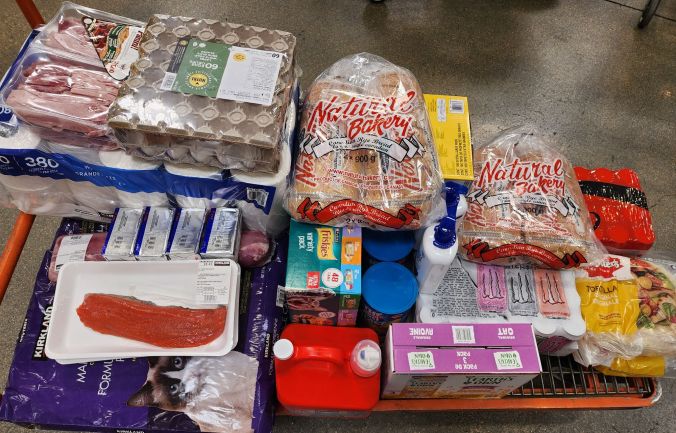
So this is what we got for our $606.14, after taxes. I got a lot of stuff on sale, too.
Yeah. That’s it.
We ended up getting six 9.1kg bags of dry kibble. Normally, I like to get at least a couple of 11kg bags, but the price per kg was better with the Kirkland brand. At $27.99 each, or $167.94 in total, I think these have actually gone down in price. At the very least, they haven’t changed. There are two cases of wet cat food at $37.99 each, which is about the same, too. The puppy pads were $20.99 which I don’t think has changed, either.
The Kirkland brand toilet paper was $23.99, which is high, but unchanged from the last couple of shopping trips – they used to be under $20.
Also on the non-food list, we stocked up on a double pack of large Head and Shoulders at $22.99. This has been working well for my daughter as a anti-fungal wash. My husband has similar issues, particularly in this heat, so he will be using it as a body wash, too. We picked up the Kirkland brand of laundry detergent at $19.99 The cold water detergent was cheaper but my daughter is having to wash all her clothing and bedding with hot water (anti-fungal), so we aren’t doing cold water washes anymore.
The flat of Coke Zero, at $16.99, is the same. The flat of Monster (which my older daughter paid for) is normally $44.99, but were on sale for $9 off. We ended up getting two containers of iced tea mix because they were on sale for only $9.99 each. The regular Costco price was $12.99, which is still a good price. At local grocery stores, I’ve seen them as much as $26. We also got a three pack of 2L oat milk for my daughters, at $11.99
For breads, we finally found the tortilla wraps; the last couple of times, they were out. We picked up two packs of 36 wraps for $9.99 each. We also got two 2 packs of rye bread for $6.99 each.
We still had some butter in the freezer, so we got only four pounds today, at $5.45 each. That was it for dairy.
For protein, we got our double flat of eggs (60 eggs) for $20.39, and a pork loin for $24.15. We got two panini packs this time. Normally, they are $14.99 each, but they were $3.50 off today. The biggest sale price, however, was for wild caught salmon. They were normally about $49.99/kg, but were on sale for $24.99/kg, so I got two fillets for the girls; one at $10.05 and the other at $8.45. Both were on the smaller size of what was available.
Then we stopped, because we’d reached my budget for this trip.
*sigh*
The gas prices, at least, were a huge savings. While everywhere else was at $1.349 or $1.359 per liter for regular gas, Costco was at $1.099/L It still cost me $72.05 to fill the tank.
We did have other purchases today. When we got to the city, the first thing we did was have lunch for breakfast. We went to a nearby mall’s food court and got food and bubble teas from different places, which totaled over $40. I ate only half of my Chinese food meal. The other half was supper.
We also made a quick stop at the Dollarama, where I got a few things for the garden, including supports for that black currant bush. I also found a broom for outside with plastic bristles, so it’ll last longer than the straw broom we have for outside, now, which is ready for the trash. I got more plant clips, and my one splurge was for some solar powered LED string lights. I’m torn between using it in the garden, or replacing the string of lights on the fence by the gate, which are getting old and starting to dim quite a bit. The total was just under $30 for everything.
We also stopped at the Canadian Tire to get a metal replacement winch for the clothes line. The one that came with the kit for the new line was slipping. There were several options available, but we went with the one that turned out to be exactly the same as what’s on the older clothes line. We also got four more line separators; the kind with the wheels on them. Now, each line has three of these.
While there, we found more clothes line kits that got us rather excited. The kit I got, locally, was the only option available, and had a medium duty line. Canadian Tire had kits for heavy duty and super heavy duty lines. The super heavy duty kit was about $90. Looking at the contents of the kit, sold separately, and it’s actually a huge savings. The 150′ of heavy duty line alone cost more than half what the kit cost. So when we’re ready to set up a third line, we’ll definitely be getting one of these sturdier kits. That way we can have an extra strong line for things that are very heavy when wet, like towels or blankets, while light stuff can go on the medium duty lines.
The winch and four line separators cost just over $40.
So, everything together today cost about $788, give or take a few dollars.
About $265 of that, before taxes, was just cat stuff. Closer to $244, if we don’t count the puppy pads.
Actual food and beverages for us humans came out to about $225.
There is something wrong with that picture. Especially considering the prices of cat food hasn’t gone up in quite a while.
Hey, did you know there’s a Ko-fi donation button at the top? All proceeds go directly to the care and feeding of cats!
*sigh*
So our stock up shopping was a bit short on the “stock up” part, but we did get a few really good prices in there. We’re supposed to be buying extra for the pantry, though, so that we have at least an extra month’s supplies for the winter, in case we can’t get out again. We can’t count on having another mild winter, or on not having spring flooding washing out the roads again.
We are actually very fortunate in our situation, too. I’m counting my blessings here. If we were still living in the city, we’d be in far worse shape, that’s for sure!
So I give thanks for what we have, and ma grateful for it.
I woke at my usual time, which is basically when it starts getting light out (about 5-5:30am, these days), but was in massive pain. I did manage to get outside to feed the yard cats, but wasn’t able to do the rest of my morning rounds. Instead, I took some painkillers and headed back to bed.
I didn’t wake up again until about noon!
I did feel a lot better by then, though, which is good, because – as always – the job I needed to do took more than expected!
The bed I need to work on is where I had eggplant and hot peppers growing, last year. These had been mulched first with cardboard, then grass clippings on top of the cardboard. In the fall, I just did a chop and drop, leaving it pretty much as it was for the winter.
What you see in the first photo is what was able to grow through the openings in the cardboard where the peppers and eggplant were growing through, and areas around the edges where rhizomes in particular were able to work their way up the side walls of the bed.
The box frame was secured to hold plastic I’d set around the eggplant and peppers to form a sort of open top greenhouse. The twine wrapped around was there to reduce billowing in the wind. If the wind were not an issue, it would have worked out quite well, but it was a pretty constant battle. Even the cover with the wire that is stored on top of the box frame would get blown off, and it was there to weigh down the tops of the plastic, and didn’t have anything else over it! Which is why it got lashed down with paracord, later on.
Removing the mulch and remaining bits of cardboard did clear a lot of the elm seeds off, but there were so many seeds, the mulch can’t be used again, nor would I want to put it on the compost pile. Instead, I put it around the base of the box on the outside, to hopefully smother any weeds that would come up through the gaps.
Then it was time to fluffify the soil and pull the weeds, including the roots.
Which was absolutely brutal. It was like concrete.
I normally would have gone over it with a garden fork, first, but with the box frame in place, that wasn’t an option. So I was just using my little hand cultivator.
That has got to be my favourite garden tool right now. It really does the job! It was still pretty difficult. In the end, I spent more than an hour, just breaking up that soil. There weren’t a lot of weeds to pull, thanks to that mulch, but getting the roots out was almost impossible. Even after breaking up the soil first, if there were any clumps at all, the roots and rhizomes would just break apart.
I keep water with me while I work but, once the soil was prepped, I had to head inside for a sit down and hydration break. Thank God for cooler temperatures! Unfortunately, I’m out of any amendments that would help reduce this sort of compaction.
For this bed, I wanted to plant the Orchard Baby corn, which has only 65 days to maturity, with some beans. I had some yellow Custard bean seeds left. Which is a bit funny because, a few years back, we grew a different variety of corn in this bed, with beans from this same packet, in between!
Given that the beans are a few years old, I don’t expect a high germination rate, but bean seeds last a lot longer than other things.
Using the end of one of the larger plastic coated plant stakes, I marked off 5 fairly deep lines in the soil – three for corn, two for beans – then filled the resulting little trenches with water. Then I ran the stake over the lines again, and this time used the hose on the jet setting, to drive the water deeper in the planting areas.
In the slide show above, right after the photo of the seeds, the seeds are laid out in the rows. Even the bright pink inoculated bean seeds are hard to see, but they’re there!
The beans were planted pretty far apart; there were enough that I knew there would be plenty left behind. They’re more of a “bonus” crop.
The corn was supposed to be about 50 seeds per packet, and I did hope to get them all in, but there just wasn’t the space, even setting them pretty close together. They will be thinned later, if the germination rate is high.
To actually plant the seeds, I cheated, and used the end of the plant stake I used to make the rows to push the seeds into the soil, which you can see in the next picture. For each one, I’d give the stake a spin to make sure no seeds stuck to the end, before moving to the next one! Then I gently dragged the stake over the rows to cover the seeds before finishing off with a gentle watering, which further ensured the seeds were well covered.
I still had those leftover corn seeds, though. I didn’t want to hang on to such a small amount, but what to do with them?
Well, there was this little bed nearby, with the Arikara squash in it.
So I opened up the mulch, where there seemed to be the most room, including right in the very middle, and planted the leftover seeds there. These beds are close enough that wind pollination between them should work out fine. For now, though, the mosquito netting cover got put back on until the squash is large enough I won’t have to worry about something getting at them.
Then I went to the tomato bed and, using the plant stake to make holes in the soil, planted more beans down the middle of the bed, plus the gap between the Black Beauty and Chocolate Cherry tomatoes. Bonus beans, plus they will act as a living mulch later on.
That done, I brought out the stove pellets for the corn and beans bed. I scattered them all over the bed, then misted them with water. After the pellets had a chance to expand and start breaking up into sawdust, I sprinkled some more pellets on and misted it again.
As there is nothing in this bed with protective collars or anything like that, it was going to need something to keep the cats out. A few years back, my daughter bought us a large roll of netting. I’ve been reusing pieces of it in other areas but, for the amount I needed, I brought the remaining roll out. You can see it in the second last photo of the corn and beans slideshow. The netting on that roll is actually folded in half. I left it as it was, though. Using ground staples to fasten the netting to the wire above the box cover, I unrolled it all the way around, with a decent amount of overlap, before cutting it. Roughly 25 feet, in total. There is still lots on the roll.
About this time, I got a notification on my phone for a voicemail message. Turns out my Wi-Fi calling had shut itself off. Why I was still able to listen to the voicemail message, but not get the call itself, I have no idea.
It was home care, letting me know that there would be no one available for my mother’s bed time med assist.
It was almost 6pm when I got the message, which means she would have just had her suppertime med assist.
I had time to finish setting up the netting. The top was secured with ground staples to the wire cover at several points. This netting catches on everything, so I was able to make use of that and got it “stuck” at each corner. Then, just to be on the safe side, I used more ground staples to secure the netting between the box frame and the walls of the bed. The box frame is tied down tight enough that it was hard to make the space to slide the ground staples through. Those aren’t going anywhere! The netting would rip, first.
Once that was finished and everything cleaned up and put away, I got a daughter to take over and do the watering of the rest of the garden, while I washed up and changed, before going to my mother’s.
It’s been almost a week since I did my mother’s grocery shopping, and I have an appointment in town tomorrow, so I left early enough to hit the grocery store, first. I knew she’d be running out of milk, at the very least – she is always running out of milk, but refuses to buy more than one 2L carton at a time – so I got that, plus a few other things I thought she might be running out of by now. Since I was there anyhow, I spotted some excellent sales and picked up some stuff for ourselves, too.
When I got to my mother’s she was so very happy when she saw I’d brought her more milk! She had told me, she even considered asking me if I could pick some up on the way, but had decided against it.
I was early for her evening pills but, once everything was put away, I opened up the lock box and got them ready for her. Which gave her time to tell me why the cover was missing on the tiny tagine shaped bowl I gave her to put her pills into, so they could be double checked and counted before she took them.
It turns out that, a couple of times now, someone would open the bowl to put in her dose for the time, only to find one of her half pills from the previous med assist, still sitting in the bowl. It had been counted out, but she missed it when she took them – and clearly, the home care aid didn’t double check to make sure my mother had actually taken all the pills!
So it was decided that she would tuck the lid away so that, if a pill got accidentally left behind again, it could actually be seen and she could take it right away.
Good thinking, but really, part of the home care aid’s job is to make sure my mother takes her pills properly. That’s why they’re there, and the pills are in a lock box, after all!
I did get a bit of a visit in before I headed home, much appreciating the longer daylight hours! I’ve made these trips in the winter, when it was dark by the time my mother was supposed to get her suppertime visit, but this time of year, I was driving home in full light. Much easier to watch for deer!
Tomorrow, I’ve got an appointment in town, but my afternoon is free. I’m waffling between working on the bed at the chain link fence, or the bed that will have a permanent trellis built into it.
I’ll see what I feel up to, after I get home!
For now, it’s time to take some pain killers and get to bed. Maybe even before midnight!
I don’t know if starting our seeds in the relative cold of our basement has anything to do with it, or maybe having the portable greenhouse, but this year’s transplants are some of the strongest, healthiest looking plants I’ve grown yet!
The first image is all our tomatoes. There’s one bin of Spoon tomatoes, one of Sub Arctic Plenty, and one with a mix of Black Beauty and Chocolate Cherry. One of those was lost when the wind tried to tear apart the portable greenhouse, so there was space enough for me to tuck in the two sage transplants I picked up yesterday.
In the next image, we have two bins on the left, one with eggplant and one with peppers. In the middle are our melons, and on the right are the winter squash. It was the winter squash that was my priority for today, as they are outgrowing the cells in their tray.
I did the safe first, though, since there was just the two of them, going into an already prepared bed.
I tucked them into the middle, between the other herbs.
I look forward to seeing how this bed looks, once the herbs reach their full sizes. They should fill the whole thing. I’m curious to see if we’ll need to remove the cover later on. For now, the main thing is to protect the transplants from cats.
Speaking of which…
The older kittens have discovered the portable greenhouse – and the pots with luffa in them! The pots have a thick layer of sawdust from the stove pellets added around them as mulch.
Apparently, sawdust makes a great bed.
Grommet was in the pot with the larger luffa and wouldn’t leave. Which was a surprise, since he normally runs away when I come too close. This time, however, he let me pick him up and carry him around for a while enjoying pets!
The luffa now have gallon size water bottle collars around them, to keep the kitties from squishing the luffa!
The next thing I wanted to get done was the Arikara squash.
My goal for the day was to get all the transplants in.
Ha!
No, I didn’t achieve that goal.
I did, however, get a LOT done, until the 34C/93F heat finally did me in. Enough that I’ll be breaking it up into several posts.
The start of the day was the same as it has been for the past while; after my morning rounds, everything got a watering in preparation for the coming heat. I was quite appreciating the new watering can, which holds twice as much as the breaking apart bucket I’ve been using! So that part of the watering went a lot faster.
Before I started watering the new asparagus bed, though, I did some modification. The landscape fabric or whatever it is had just been folded back to uncover the space I planted in, and the rocks I pulled out was just tossed on top. I lifted the folded side to shift all the rocks towards the opposite side, then laid the edge out close to the little wire fence protecting the strawberries. After weighing that down, I pulled the other end to cover a new section of what had been our squash patch in previous years.
There was still some grass clippings on the fabric, and that got used to lightly mulch the asparagus area, and heavily mulch along the wire fence. Once that was done, it all got a thorough watering.
The light mulch should be enough to protect the soil, while still making it easy for the baby asparagus to poke through. The heavy mulch should, hopefully, keep any weeds from coming back by the strawberries.
I’d left a couple of buckets filled with water to keep them from blowing them away. I noticed the cats have been drinking from them, often, so now I keep them full for the kitties. 😊
Next to the new asparagus bed is our garlic bed, then the potatoes.
The garlic is looking so good! We should start getting scapes soon. We are all looking forward to cooking with those!
The potatoes are coming up a lot faster now. When watering that bed, I noticed there are SO many frogs! They get startled when I water the potatoes, and jump into the netting. They seem to be able to get in and out just fine, though – at least when they’re not being scared by something!
Once all the watering was done, it was finally time to start transplanting things.


 The Re-Farmer