Finally done!

I put together a video of the work I did yesterday. No audio, so I wanted to add music to it today.

I spent so much time trying to find public domain music that fit the mood I wanted. Then my daughter came in and helped me pick music that was already in the software I’m using, in a matter of minutes.

She’s now interested in making videos. I have no doubt she would do a better job than me! So at some point, you might start seeing better quality videos getting posted.

For now, this is what I got done yesterday.

We settled on this location for the new Liberty apple tree for several reasons. The main one is, it is a zone 4 tree, which means it will need more protection in the winter. Where I was thinking of planting it originally is far more exposed, and will remain so until the silver buffalo berry reaches maturity.

Here, it will get full sun, but also be sheltered from the north by the lilacs. It also needs another variety of apple tree for pollination. While I took down the one crab apple tree, there are the ornamental crab apples in the old kitchen garden, plus another crab apple tree, though we’ll see how well that one does. It will likely be taken down, eventually.

The little plum trees were also removed; we’ll see how the larger ones do this year. These are not edible plums, though my father did use them for wine making sometimes. They have almost no flesh around their pits.

If all goes well, we’ll start having apples to harvest in a few years. The new apple tree can reach a mature height of 18-20, so if we do plant any other fruit trees here, we will need to keep that in mind. If we do end up taking out the one crab apple, and possibly the remaining inedible plums, I figure we have room for one more fruit tree here.

My parents planted so many things in this little area over the years; I remember there being mountain ash (there are none left at all now), a pear tree, other crab apple trees, plus I thinned out caragana and lilac. Oh, and there’s the big linden tree at one end, now. It’s one of the few things that is doing well! I’m sure there were other things that came and went in the 30 or so years I’ve been away.

Now that I’ve cleared as much as I have, the lilacs will hopefully grow better. When I first cleared the area of dead stuff back in 2018, I found most of the lilacs had stretched to very unusual heights. They had leaves pretty much only at the top, as they struggled to get sunlight. They are recovering, but still a lot lankier than lilacs normally would be.

The main thing, though, is that the new apple tree and the tulips have that barrier around them. It’s small enough that I hope no deer will consider it worth trying to jump it. Over time, we will add things to the wire to blow, flash and make noise in the wind.

One thing I noticed only after watching the time lapse video I took.

I had a LOT of cats running around while I worked!

The Re-Farmer

Our 2023 garden and food forest: order is in!

This morning I headed into town to refill our big water jugs and pick up a few things at the grocery store. By the time I headed back, our post office was open. I’d checked the tracking last night and knew our Veseys order would be in today, but when I got there, she still hadn’t had a chance to finish processing all the parcels that came in. She found them for me, though – among several other boxes from Veseys that I could see! They are a popular company, with good reason.

For the potatoes, we got a total of 4 pounds each of Red Thumb fingerling and Purple Peruvian fingerling. We really liked the Purple Peruvian when we grew them a couple of years ago, and I’m hoping we’ll have enough to save seed potatoes for next year.

There is also a 3 pound back of Irish Cobbler.

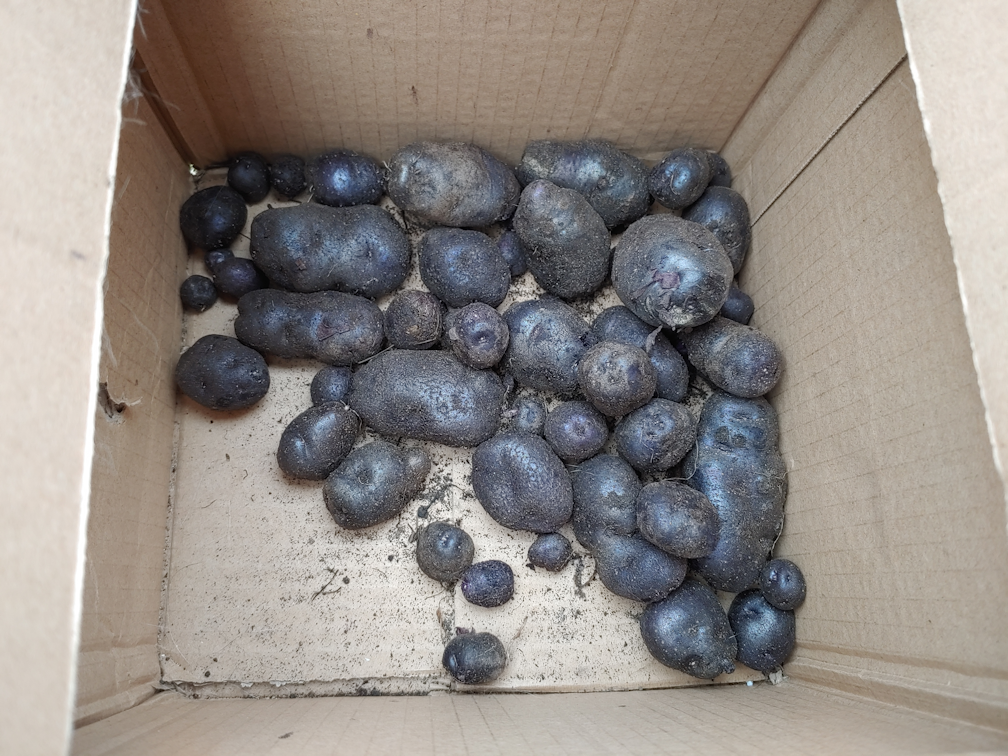
Two of the above images are from the Veseys website. The Purple Peruvian are some of our own harvest.

I can see that the potatoes have already started to sprout. We’ll need to lay those out for air circulation as much as for chitting. I’ll have to go through the old feed bags we have and see how many are left, since we’ve stopped buying deer feed and bird seed. We have too many slugs and not enough garter snakes or toads, to try growing them in the ground again.

Then there was the box with our trees.

Would you look at those mulberry trees!!

I knew they would be small, but I didn’t think they would be THAT small! Normally, there would have been a single, larger, 2 yr old sapling, but they had a shortage of that size. Instead, they sent out two 1 yr old saplings for the same price.

The above pictures are from Veseys. Hopefully, in a few years, we’ll have apples and berries to harvest!

Right now, I’ve got them out of their plastic bags and set up in the living room, safe from the cats. I find myself seriously considering leaving them to grow indoors for a year but… well… I don’t know that their chances for survival would be any better indoors than out! We will have to make sure to put a cloche over them when they are planted, to protect them. The funny thing is going to be transplanting these tiny little things with their fully grown size in mind. They can grow 15-20 ft high. This variety is supposed to be hardy to our zone, but winter protection is still something we’ll want to ensure. At least for the first couple of winters.

The apple tree is quite a bit larger! It started raining as I got home, so it might be a little while before we plant it, so I opened the plastic bag and set it up next to the mulberries. I didn’t take it out, since it’s packed in sawdust.

The planting instructions for the mulberry state:

Unless you have heavy clay soil, there isn’t much to do in terms of soil preparation. You can add amendments such as compost or peat moss to the soil and/or a layer of mulch over the root area after planting will help retain moisture, especially during the first year. While it may be tempting to add fertilizer or manure to your freshly dug hole before planting your new tree, PLEASE resist! Fertilizer or manure in close contact with the root system could chemically burn the roots and potentially kill the tree.

Mulberry trees can grow quite large, up to 15-20 feet tall. Avoid planting near walkways and driveways as the fruit will drop and create stains. Mulberries are self-fertile and require full sunlight. 

https://www.veseys.com/ca/trader-everbearing-mulberry-37817.html

Where we will be planting them, the soil is very rocky and hard packed, and a whole lot of sun, so we’ll be giving them some garden soil to grow in, and plenty of wood chip mulch around them.

It’ll be different for the apple tree. The planting instructions are:

Plant apple trees 5-6 meters (15-18 feet) apart in the spring in a full sun location with good air circulation and drainage. For best results, two varieties should be planted to ensure successful pollination and fruit production.  Dig a hole large enough to accommodate all of the roots without bending (approx. 18 inches). Place the tree in the hole with the graft union about three inches above the soil surface. You should be able to see the soil mark on the trunk where the tree has been taken out of the ground, it should be planted no deeper than this. Mix compost with the soil to fill back in the hole once the tree is set in place, and lightly firm to ensure good soil root contact. Water surrounding the tree to ensure good root establishment. Water every two to three days if your season is dry.

https://www.veseys.com/ca/liberty-apple-tree-37810.html

It will be planted closer to the crab apple trees for cross pollination, but far enough away to hopefully protect it from the fungal disease that is killing them off. This variety is also a zone 4 tree, which means it will need shelter for the winter.

Hhhmm… I’m rethinking where to plant the apple tree. There are some dead and dying trees in the west yard that need to be cleared out. Better shelter, full sun, and close enough to the ornamental apple trees in the old kitchen garden for cross pollination.

We’ll figure it out. That’s now our job for the day!

The Re-Farmer

August garden tour (video)

Oh, my goodness. This took way more time and effort to make than usual! Starting with going back later in the day to record new video because I made too many goofs, the first time around. I mean, how did I accidentally say “corn” when I meant to say “peas”? Repeatedly!! 😂

It also took all day to upload the file. Yes, it’s more than half an hour long, but it still shouldn’t have taken more than 8 hours to upload.

But, here it is. A tour of our garden, including fruit trees this time. It’s been a very rough year for the garden, with some complete losses, but we do still have something to show for it, at least!

I hope you enjoy it, and please feel free to let me know what you think!

Tree seeds and using the toilet tube pots

When finishing the toilet tube seed pots we made yesterday, we had to put the lids on the bins, to keep the cats out, so it took quite a while for them to dry.

They still weren’t totally dry, but I figured it was good enough! After all, we’re just going to be bottom watering these, anyhow, so they’re going to get soaked, soon.

I started with the tubes intended for the paw paw seeds. After filling them 3/4s of the way with pre-moistened seed starting soil, I started carefully finding the paw paw seeds in their baggies, while my daughter continued to fill the tubes intended for the tulip tree seeds.

After placing a seed into a pot, soil from the baggie was used to top up the pots. In the above photo, the two on the left have seeds in them.

None of the paw paw seeds showed signs of roots, though they did look more… filled out, shall we say. More rounded. Which is to be expected, considering they’ve been in damp soil all this time.

Once filled, they tucked into the bin a bit more tightly than while empty, which is what I want. It’ll keep them from falling over, and keep the toilet rolls from unraveling when they get wet.

After putting the filled pots back in the bin, they got watered, and any that showed the soil settling quite a bit, got topped up with more soil. Then water was added to the bottom of the bin.

The tulip tree seeds also did not show any signs of roots. In fact, they still looked almost exactly like they did when we first got them, except a bit darker from being in damp soil.

They got watered from above, topped up with more soil as needed, then water added to the bottom of the bin, as well.

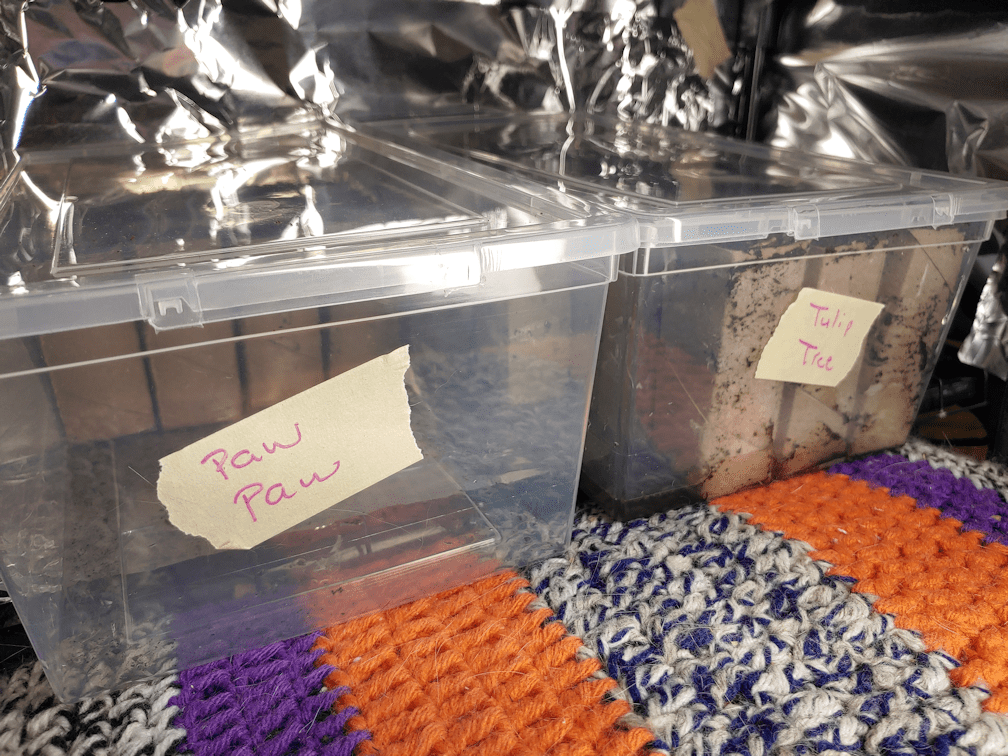
They then got lidded and labelled, ready to go into the mini-greenhouse.

The lids will be left on, loosely, to help keep the moisture levels even.

A bit of re-arranging of the other seedlings and trays, and I was able to put these on the two bottom shelves where, even if the cats manage to get in, they will be safe.

Now there’s another reason to use these bins for seed starting. Cat protection!

The instructions they came with said that these take a very long time to germinate, and that the roots will be growing long before the leaves start to show. So we will just keep these moist and otherwise leave them alone. Not having them in the baggies anymore means we won’t get to see those roots, but I think it will be better for them to be in these little pots instead of the baggies. Less chance of the roots getting damaged, I think. It will also be much easier to move them around in these bins, than in the tray that was holding the baggies. Those black trays may fit the shelves in the mini-greenhouse just right, but they are awfully wimpy things, and hard to move around. A couple of them have already started to crack on their edges, from bending in the middle when picked up.

So this is now done. The tree seeds are in little pots and, perhaps in a month or two, we might see sprouts emerge. I have no idea what to expect from these, and am just hoping for the best!

The Re-Farmer