I made a trip to the post office today and had a lovely surprise.
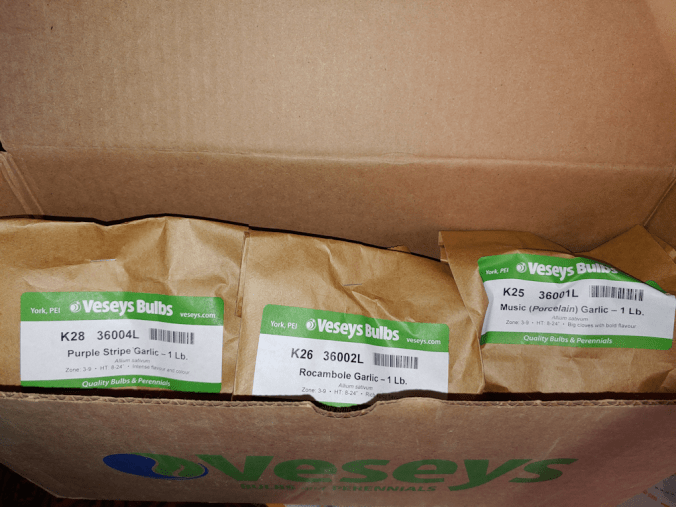
Our garlic is in!
According to the Canada Post tracker, it wasn’t supposed to arrive for another four days.
We have our garlic, but we still don’t have a straw bale to mulch the bed, so I messaged our renter about it. When we bought from them before, they usually had a bale over right away, so I was wondering.
Sadly, my suspicions were correct. They are having to buy all their hay and straw bales themselves this year. They haven’t got their shipment yet, and don’t even know what to charge me until they pay for it themselves. Yet they’re still willing to part with one for me!
We ended up chatting a bit, and it’s been a very rough year from them. Almost everything is a write off this year. The corn they harvested from the field by our place was chopped up and will be made into silage, at least. Even their garden was decimated by the grasshoppers, on top of the drought.
So it may be a while before we get a straw bale. Now that I know this, I will cover the garlic beds with plastic and maybe some grass clippings until the straw comes in.
Since the garlic will be going into the low raised beds we built this year, I’m thinking it might be worth dismantling the long covers we made for the main garden beds and use the materials to make covers for the low raised beds. We shall see. That’s something that can wait until spring. Cleaning up and preparing the beds for planting in the spring is the priority right now.
But first, I will go start breaking apart garlic bulbs to get them ready for planting!
One of the things about living our here is that phone calls are pretty rare things.
We like it that way.
Every now and then, we’ll get a robocall. Sometimes, from political parties, for conference call town hall meetings, or urgent messages telling us that we are about to be arrested by Canada Revenue for some reason or another, if we don’t call them immediately – and give them our personal information, of course. You know. The usual.
I was just preparing to write this post when we got a robocall with a difference. It was for our municipality, but from the RCMP. It was a warning that there was possibly an armed and dangerous suspect in our area! And by “our area”, they meant the two nearest cities, plus our region. Not municipality. Region. Which is huge.
The alert came with a name, but no description of the person. We did get a description and license plate of their truck, as if that means anything.
After the call, I settled back at my compute to continue with this post. I am happy to say I finally got some progress on the high raised bed that’s worth blogging about. Of course, I’m keeping a close eye on the weather. One of the handy things is that I have a little icon from The Weather Network in the corner of my task bar with the temperature on it and, when warranted, it flashes red with a white lightning bolt as a weather warning. We used to get those whenever there was a frost warning, but I have not seen that, even after last night’s heavy frost. It was flashing when I sat down, though, so I figured we were finally getting a frost warning.
Nope.
My weather app was giving a public safety alert, and it took me to the exact same message from the RCMP that I got from the robocall!
There is no other information about this guy, but they sure to want us to know he’s dangerous and might be in the area!
Or hours away from us, considering how large of an area they are including!
None of us are particularly concerned, but the warnings are appreciated.
Anyhow. To the topic at hand!
Progress on the high raised bed has been frustratingly slow. My tools are the baby chain saw, a hatchet (our other axes are too big for the job), a hammer and a chisel. Basically, I use the baby chain saw until both batteries are drained, with the other tools used to remove material in stages.
Today, I also worked on the carrot bed next to the high raised bed, which meant the first battery actually had time to charge, giving me a chance to get more done than usual.
Which means I FINALLY got the second log in place on one side of the bed.
That took ridiculously long to do! But, it’s now in place, and I’ve started on the other side.
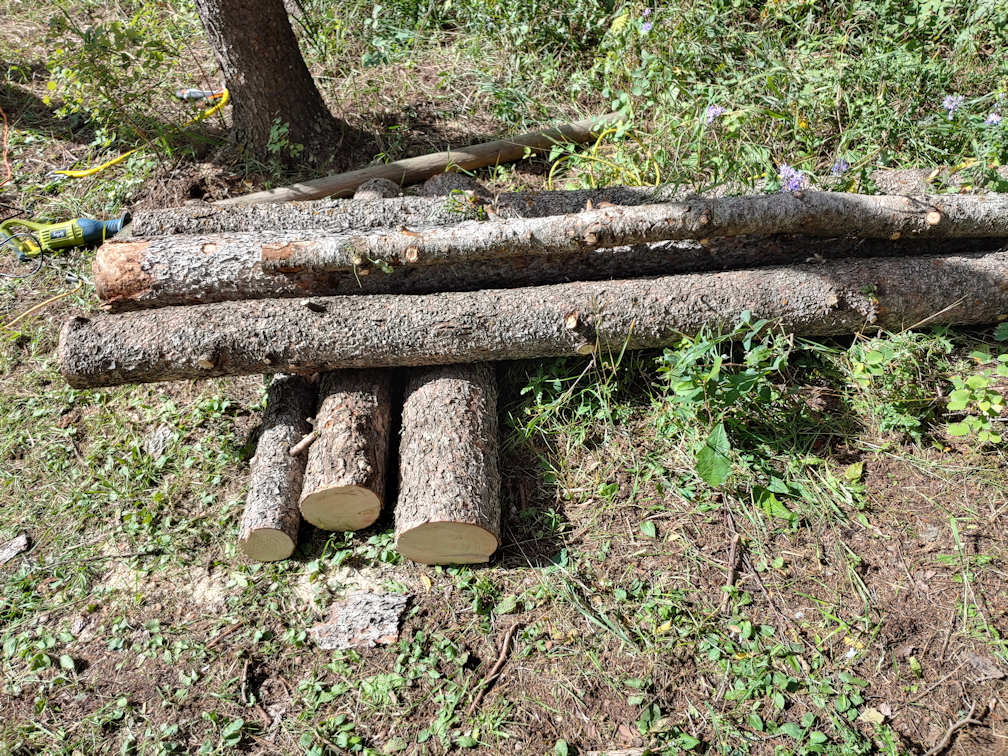
I used the second log to mark where I needed to cut the notches on the side log and end logs. The logs at the end are the thickest, so I started removing material from there, first.
I think part of why I’m so frustrated is, I’ve got three chain saws. The gas powered one broke when I tried to start it, simply because the plastic shell was so old and brittle. The electric one I found was checked out, and they found nothing wrong with it and just sharpened the chain for me, but I discovered it leaked chain oil when I found it in a puddle after the first time I used it, which was for just a single cut before I switched to the baby chainsaw. The next time I used it, I found it would simply stop cutting after just a few seconds. I still have the little, electric, convertible pole chain saw with a 10 inch blade my husband got for me a couple of years ago. It would be enough to do the job, but something went wrong with it the first summer we got it. I checked it out again today, and it basically just screams when I try to make a cut, and the chain stops turning. I’ve got that in the van now, for the next time I go into town and can leave it at the small engine shop to see if they can fix it. I can’t even try using the reciprocating saw. It runs, but no longer shuts off. It needs to be unplugged to turn it off, and it even starts trying to run when it’s plugged back in, making and it quite unsafe to use.
If even one of those chainsaws worked, this thing would be done by now!
*sigh*
Ah, well. It is what it is. Hopefully, I will still be able to complete the high raised bed, and fill it, before the snow flies.
One of the things I found with the baby chainsaw is that, when it first seems to run out of juice, and the red light starts blinking on the battery meter, I can set it aside for a little bit and it will actually “recover” and run again for a while. That usually gives me time to chop or chisel away excess wood. I can usually do this a few times before the battery is finally completely dead. This also gave me time to pull carrots while waiting on the battery life.
I just dug up the Napoli carrots in half the bed. With the Kyoto Red mostly gone to seed, I figured they could wait.
Pulling them all from in between the weeds was certainly a challenge, even using a garden fork to loosen the soil and weeds!
After draining the second battery on the baby chainsaw, I had time to clean up the weeds, pulling out all the roots I could. If some leaves got left behind, I didn’t care, but my goodness, there were some REALLY deep roots I had to dig out!
Half the bed, all done! Hopefully, I’ve pulled out enough roots that it won’t get this bad again, next year! The time it took to do this was enough for a battery to charge, and get more done on the right raised bed.
The temperatures are supposed to stay the same as today for a couple more days, then start to warm up again, which should hopefully give more time to work on the high raised bed and, of course, finish cleaning up all the garden beds and ready them for next year, too.
Yesterday, looking at the weather radar, I had expected that we would catch the edge of a weather system that was being pushed up from the southeast. Which is what usually happens.
Instead, the system ended up going right over us, and we had heavy rain all day and most of the night. We are expected to continue to get rain today and tomorrow, and remain cool until the day after.
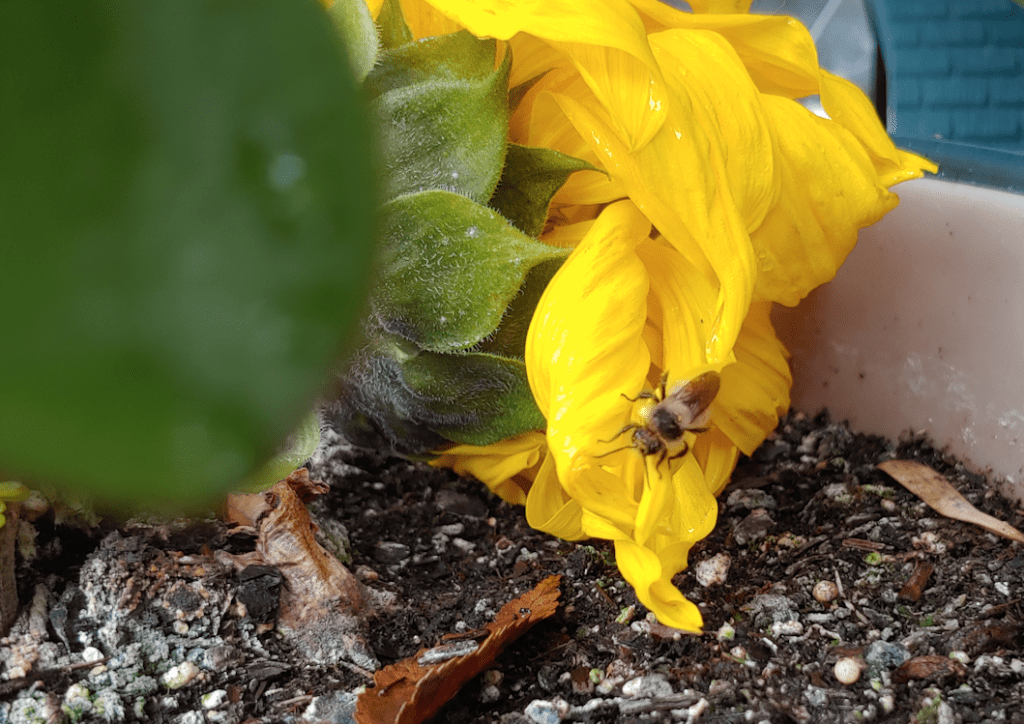
I didn’t think the bee on the sunflower would survive that long.
We have a mini greenhouse in the sun room, so I lay the cover of a seed starter kit upside down on the top shelf, and had a sieve ready to use as a cover, then went to cut the sunflower off and bring the bee over. It had actually moved a bit since I last looked at it, which was encouraging. We had set up a light fixture on the top of the mini greenhouse with a full spectrum, incandescent light bulb in it, to keep our seedlings warm. The sun room wasn’t much warmer than outside, so I turned the light on to add a bit of warmth, making sure the fixture was tilted away, so it was more indirect.
The bee is hidden by the petals on the sunflower, in the above picture.
If the bee were sluggish and staying on the sunflower only because of the temperature, I expected to see it become active fairly soon. If that wasn’t the reason it was still on the sunflower, I expected to find a dead bee.
Since it’s too wet to work on outside projects, I set up in the old kitchen to start an inside project. Since the sign with my late father’s name on it got disappeared from the corner of the property, I decided we needed a new one, as it had been a landmark we could use to give directions to our place. Yesterday, I went rifling through the barn and found a scrap of half inch plywood that was in decent shape, brought it over and gave it a cleaning. Today, it was dry and ready for painting.
We still had some white paint from when we fixed the door into the sun room and repainted the frame as well, and there is enough to do at least two coats.
It’s just a bit bigger than the top of our freezer! :-)
The first coat is done, and tomorrow I will give it a second coat. I will also look for wood that I can attach to the back to make posts that can be driven into the ground. The sign that disappeared had been attached to the corner post of the fence, but all those old fence posts along there are falling and need to be replaced, so I want to mount the sign independently from the fence.
After the paint is dry, but before the lettering is painted on, I plan to give the whole thing a spray with some reflective paint I picked up a while back. This way, the background should highlight the lettering when hit by headlights as people turn the corner towards our driveway.
We’ve been talking about coming up with a name for the farm, just for fun. It has always been really important to my parents that the farm stay in the family name, which is why it went to my older brother, who has sons and now grandsons, to carry on the name. So out of respect for my late father, I have decided to simply use our family name on the sign, however I will also include our driveway marker number, with the municipal road name, which is also our family name, and an arrow towards our driveway. The road sign with our family name on it that disappeared when the stop sign it was mounted on was broken, never got replaced, so having that road name on the sign will be helpful for our neighbours, too. Which means I will have two lines of lettering, plus an arrow, on this sign when it’s done.
I think we might also need to set up another camera on it, just in case. I have no proof that our vandal stole the old sign, but if we put up a new one, with our family name on it, I suspect it will infuriate him, and our restraining order against him is still going through the court system.
After I finished with the first coat of paint, I checked on the bee, and was happy to find it crawling actively around the sunflower. I’m very glad we had it covered!
We tucked the entire sunflower into a plant pot (our houseplants are still outside), where it would be more protected, both from the weather and from curious kitties. Happily, it immediately began crawling around even more. Hopefully, it will be able to make its way back to its hive, wherever that may be. Most local bees are more solitary, and have hives underground, so there is no way to know where it came from. At least now it has a chance, and we need all the pollinators we can get!
As much as I appreciate the rain we are having, I’m looking forward to when it clears so I can get back to work outside. I got a transaction notification from my bank, showing that Veseys has charged us for the garlic we ordered. That means they will be shipped soon. Possibly even today or tomorrow. I’ll get an email notification when they do. They will need to be planted soon after they arrive. That means we are running out of time to prepare a bed for the garlic. If the weather prevents me from finishing the high raised bed we are working on, then I will top up the low raised beds we made where the garlic was planted last year. With the new dimensions, we might even be able to plant all three varieties in one bed. It’s typically advised to rotate alliums into different beds every year, but in building the low raised beds, the soil has been amended a lot, and they will be topped up with fresh soil, so it should be just fine. We shall see what we have time for.
Meanwhile, we’ve got a couple of days to work on indoor projects, instead. Like the bread baking I can hear my daughter working on as I write this! :-)
If you’re on Facebook, you know how they pop things into your news feed that you posted, X number of years ago today?
Yesterday, I saw one of those, with a photo I posted, three years ago.
After a snowfall.
Not only have we blown past our average first frost date of Sept. 10, but we are at a point where it is not at all unusual to have snow on the ground. Nothing that lasts, really, but usually at least one storm.
I am so loving our extended summer. Especially with how it’s giving our garden so much more time to recover from the extreme heat and drought conditions of the summer.
This morning, I found new Ozark Nest Egg flowers, both male and female! I hand pollinated some other ones, but it’s too early to tell if it works. I went ahead and hand pollinated the female flower here, too.
While looking through the Ozark Nest Egg plants, I found a single flower from the Thai Bottle Gourd that has made its way up the fence, mixed in with the Nest Egg gourds! I’ve only seen male flowers on this one, though.
Remember that carrot bed the groundhogs kept decimating, over and over? The one we finally gave up on, other than watering it now and again? Half of it, where the Kyoto Reds are planted, has carrots gone to see, pushing their way up through the weeds. The other variety, Napoli, have fronds visible among the weeds, but none are going to seed.
I watered the gardens this morning and, out of curiosity, pulled up some Napoli carrots. I was really surprised by how big they were! After having their greens eaten away several times, It’s amazing that there are any at all, never mind anything of a decent size! That had me looking around among the Kyoto Reds for carrots that had not gone to seed, and I found a surprisingly large one there, too!
The squash tunnel thermometer is definitely whack. We might be at 30C/86F as I write this, but it was only about 22C/72F at the time I took this photo.
While watering the peas among the corn, I couldn’t help but notice the corn block that is the furthest south.
We actually have corn. This block as lots of cobs developing!
They are very small – the husks make them look like there is more than there really is – and poorly pollinated, but we actually have corn. I went ahead and ate the one I picked, right after taking this photo, and it was tender, sweet and delicious. I will have to go back later today, with a container of some kind, and pick more!
Once back inside, I started up a big chili in the crock pot. It’s got our own onions, garlic, carrots and bush beans in it, as well as both ground beef and the ground pork we got from our neighbour. Oh, and I also tossed in some Spoon tomatoes we’d tucked into the freezer. In the future, I plan to grow beans for drying, so some day we will be making chili with our own dry beans, too, along with the paste tomatoes we plant to grow and can. :-)
With a goal of being as self sufficient as possible when it comes to growing our own food, this year has shown just how touch and go that can be. We had a very warm May that had all sorts of things starting to bloom, only to get a single cold night that killed all the flowers off. Because of that one night, we have no crab apples, no saskatoons, no chokecherries, and it killed off the (expensive!) mulberry bush we’d transplanted. Even the lilacs and roses got damaged by that one night. Then we had the drought conditions that had us watering every day, twice a day, for so long. And now we’ve got an extended summer, and instead of frost and snow, parts of our garden are able to recover and start or continue producing! It’s been a crazy gardening year, but as much as I shake my head over how extreme conditions have been, the reality is, this isn’t actually all that unusual. As every farmer, gardener or homesteader knows, you could have the best year of all, only to have all your hard work wiped out by a single storm, or one unusually cold night. Or you could get a terrible spring and summer, but then get a great fall and winter. Some years, you might not get any real summer at all, and in others, the winter will be as mild as any fall or spring. As fantastic as it can be, to be able to grow your own food and preserve it for use in the off season, I’m just as thankful that we have grocery stores and imported food. I think both are good! As my brother and his wife have both said, if they had to rely on their garden, they’d starve!
One last garden update to post, interrupted by having to make a run to the post office to pick up a package before they closed! :-D
With the kittens mashing down the netting on two of the beds in the old kitchen garden, I finally gave in and removed the mesh completely.
With the beets along the retaining wall, there isn’t much we can do about them anymore. If the deer eat them, it’ll be no more of a loss than it already is. I’ll be cleaning that bed up for the winter soon, and if there are any beets to harvest in there, that’s just bonus. The L shaped beet bed, however, will remain covered. The kittens haven’t been going after that one, and they are doing well enough that we don’t want the deer to eat them.
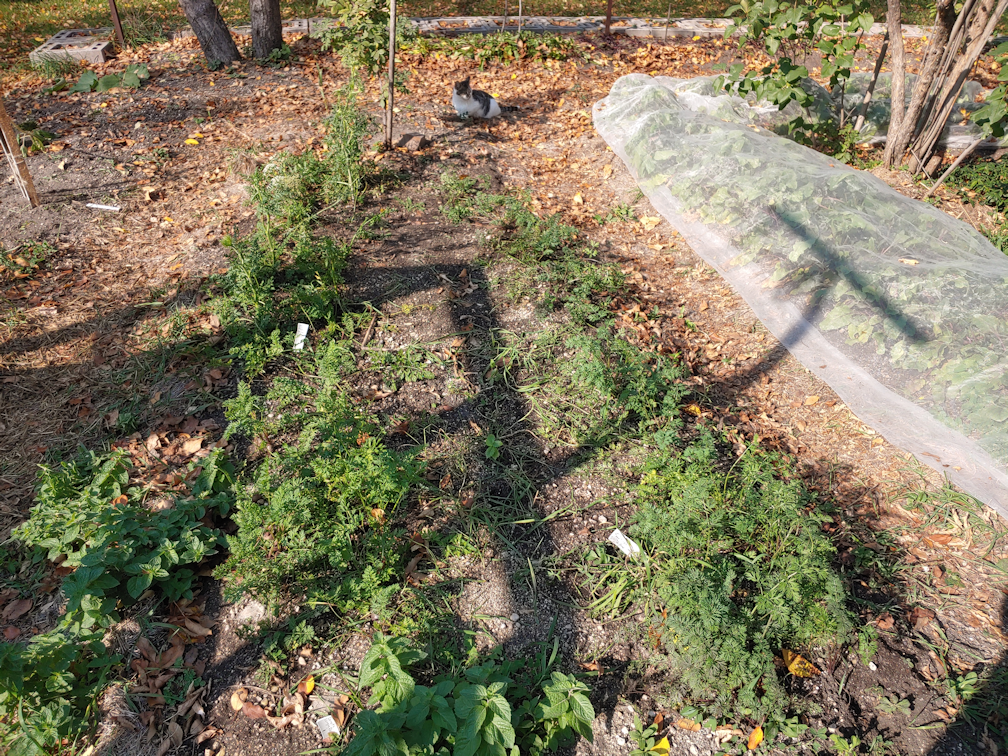
After removing the hoops and netting from the carrot bed, I found my first surprise. I did not plant this bed. My older daughter did. Two types of carrots, with kohlrabi down the middle.
Well, nothing came of the kohlrabi – I finally decided the big leafy plants that did show up were a weed of some kind, as I found them growing in other areas where kohlrabi has never been planted.
What I did notice is that there are three carrot labels, not two. Which I sort of noticed before, when I weeded the bed and added the hoops, but for some reason, never stopped to actually read the label. Along with the Deep Purple and Lounge Rouge Sang, there are Kyoto Red! If you look at the photo, towards the far end of the bed, you can see carrots that have gone to seed. Those are the Kyoto Red. Like the ones planted in the main garden bed, after the groundhogs ate the greens, they got tricked into acting as if they were in their second year and started to develop seed heads. The other two varieties didn’t.
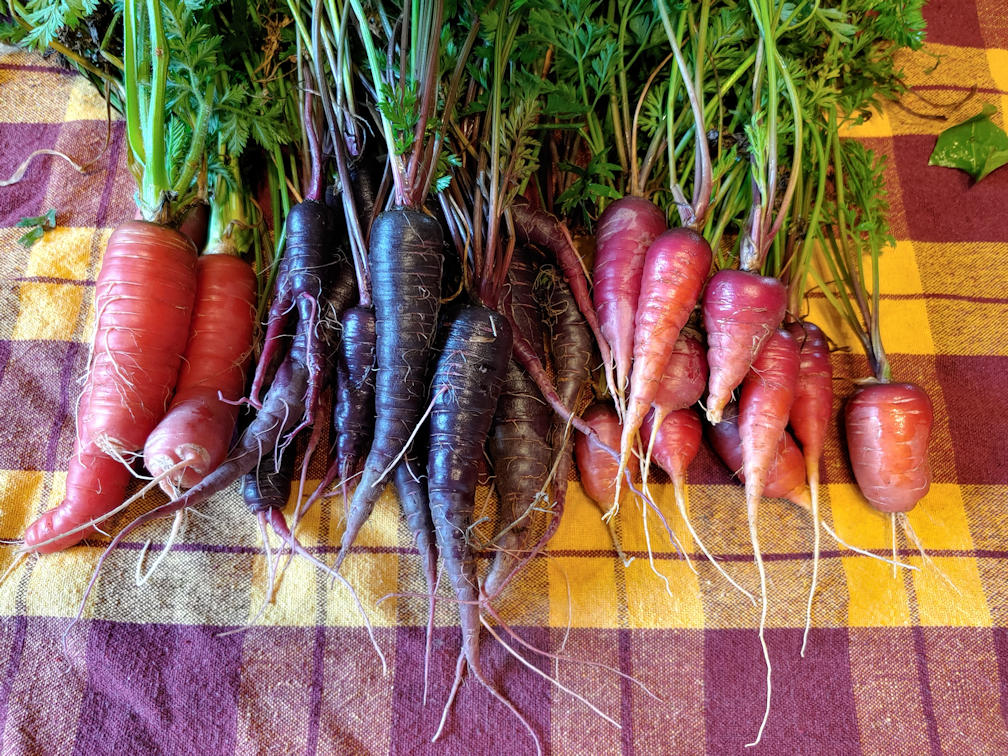
This morning, I decided to pick some, and ended up up quite a few. The ones on the far left are the Kyoto Reds. There were very few that haven’t gone to seed, so I only got a couple of them. The purple ones are obvious the Deep Purple variety, but when I’d picked from that bed before, they were not this dark purple, and I thought they were the Lounge Sang Rouge!! I hadn’t picked any from the other row, as they did not need any thinning.
Which means we got to try two new varieties of carrots today! My daughter decided to use up the summer squash we had in the fridge and make a soup, and she included a few carrots as well. After they were sliced up, we tried each of them. The Kyoto Red, unfortunately, was bitter. They may not have been going to seed, but tasted like they were ready to. The other two tasted fairly similar. We’ve had the Deep Purple before, and they tasted much the same as I remember from last year. The Lounge Sang Rouge seemed to be a bit sweeter.
When cut, the Kyoto Red was that deep reddish-orange colour, all the way through. The Deep Purple carrots were purple with a pale orange, almost yellow, ring inside. The Lounge Sang Rouge was a solid pale orange.
After picking the carrots, I used the rain barrel to water the old kitchen garden, then went on to water the loan beet bed that we made in the spring, next to where the fall garlic beds. This bed was planted with Merlin beets, only. That bed is covered with netting, too, tacked down on the long sides with tent pegs, and the excess netting on the ends rapped around boards to weigh them down. After watering it, I decided to lift the boards at the ends to see how the beets looked.
I ended up picking a couple from each end!
I should have held these differently; there was one quite large beet, but it’s underneath. It’s about the size of the other three, all together!
I’m rather pleased with these – and I know there are larger beets in the middle, from when I last tended it. I’d found a groundhog had managed to squeeze it’s way under the netting, when it was only weighted down with rocks and bricks.
We don’t plan to harvest the beets for a while; possibly not until after first frost. When we do, however, we should have enough to make it worth doing some canning!
Aside from the deer and the groundhogs wanting to eat them, beets have been among our most successful vegetables. We planted a LOT of beets this year, which we may not do next year, but I’m sure we will plant them again. We’ll just have to decide on what varieties we want, and if we want to try some new ones.
And that’s it for our fall garden update! The other parts of the garden were pretty much unchanged, so there’s nothing to really say about them. :-)
I am so incredibly grateful that our growing season has been extended this year, and am glad our drought and critter ravaged garden has had a chance to recover and continue to produce as much as it has!
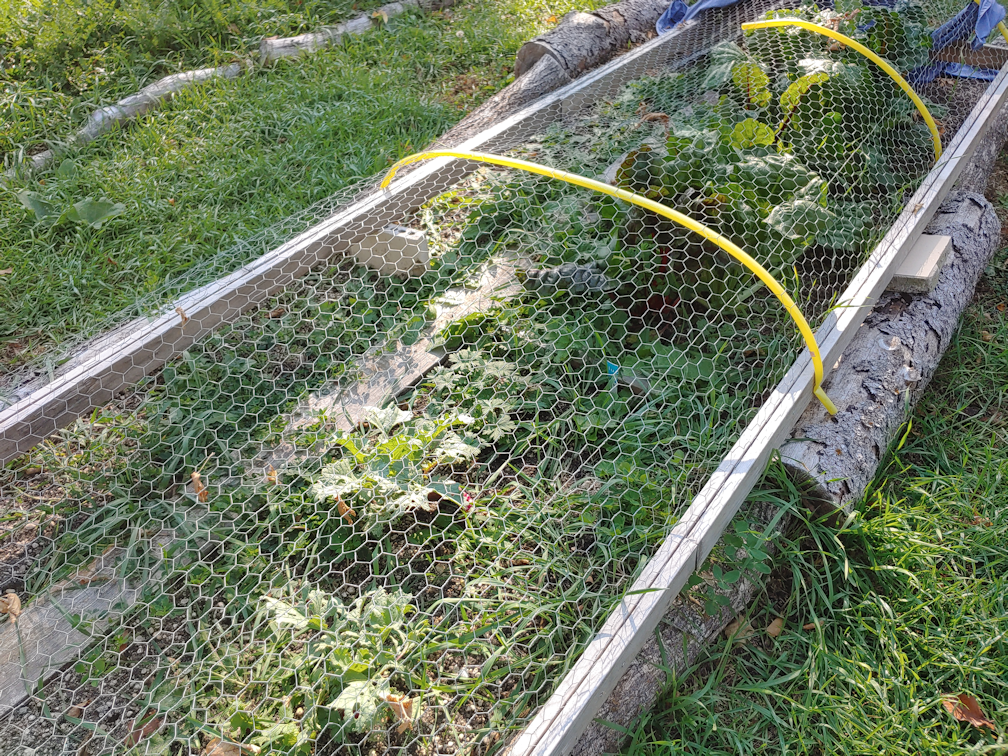
In the main garden area, which will be a permanent garden, we’ve still got the two beds covered with mesh to protect them from the deer. Unfortunately, that leaves them pretty neglected, due to the difficulty in moving such long frames.
Of the radishes we planted, there are two French Breakfast radishes that survived the grasshoppers, and they are actually now looking stronger and healthier than ever! They were so eaten up, I did not expect them to.
And just look at the big mutant radish bulb. :-D
Will they get to the pod stage they were planted for? I have no idea. Normally, I’d say it’s way too late for that, but then I look at the long range forecast and think… maybe they will?
The surviving chard, on the other hand, are just thriving! The problem is, we’re not really using them much. It’s not that we dislike them or anything. It’s just a pain to get at them.
The lettuce is also doing really well – as is that one tomato plant that showed up on its own!!
If I were not sure that deer are still passing through the garden areas, I would take the covers off completely. Then they could be tended and harvested more easily. Which won’t be much use if I come out one morning and find it all gone. Mind you, from what I’ve seen on how big radish plants get when they start to develop pods, we’re going to have to take the cover off at least that bed. And what will we do about this very strong, very healthy tomato plant that started itself so late in the season? I don’t even know what kind of tomato it is. Can tomatoes be transplanted into pots and grown indoors over the winter? I have no idea.
At least the groundhogs are no longer a problem. For them to go into hibernation so early, I would be thinking we’re in for an early and bitterly cold winter, and yet it’s supposed to continue to be warm throughout October, for as far ahead as the long range forecasts go. Plus, The Old Farmer’s Almanac is predicting a milder, wet winter for our region.
Once protected from critters and insects, we can at least say that the chard, lettuce and radishes were – eventually – a success. When we have our permanent, high raised beds, which will be only nine feet long, we will be making sure the covers we make for them will be easy to move aside as needed!
When it comes to the sunflowers, it looks like we’ll have a few Hopi Black Dye seed heads that will fully mature, but I wasn’t expecting much from the Mongolian Giants.
Then I took a closer look at one of the largest heads.
This is only about a third, maybe a quarter, of the size it should be, and yet there are maturing seeds in here!! There are so many developing and opening seed heads still, too. I don’t think there are any other Mongolian Giants like this one, with pollinated and maturing seeds in them, but while looking at them this morning, I did see some bees fluttering around, so who knows what will happen? It’s been such a strange growing year, there’s just no way to know anymore.
Some sad little peas among some sad little corn! This is the sweet corn block that is doing the worst, and yet they are still trying to produce little bitty cobs! We’ve got the most pea plants growing in this block, though, so at least this area should see the most improvement from their nitrogen fixing capabilities.
And we’ll even have a few peas to harvest!
The Montana Morado corn – what’s left of it – is being left to go to seed, and a few of the cobs have uncovered themselves. Which is helpful, since it lets me see how the seeds are maturing and drying on cob. A fair number of peas interplanted with them have been managing to grow, too. Not a lot of pods developing, but I’m seeing flowers around.
When it comes to the corn, I find myself waffling back and forth over whether or not we want to try growing them again next year. I still want to get Maize Morado seeds to try, and maybe we’ll do the Dorinny Canadian hybrid again. It’s hard to guess how much better the sweet corn would have done, had we not had drought conditions. The soil is nitrogen depleted, but we did use a water soluble, high nitrogen fertilizer on all the garden beds, a few times over the summer, plus were able to amend a bit with the purchased garden soil.
Is it worth trying the sweet corn again? I really love corn, but until we are able to improve our nitrogen depleted soil, is it really worth it?
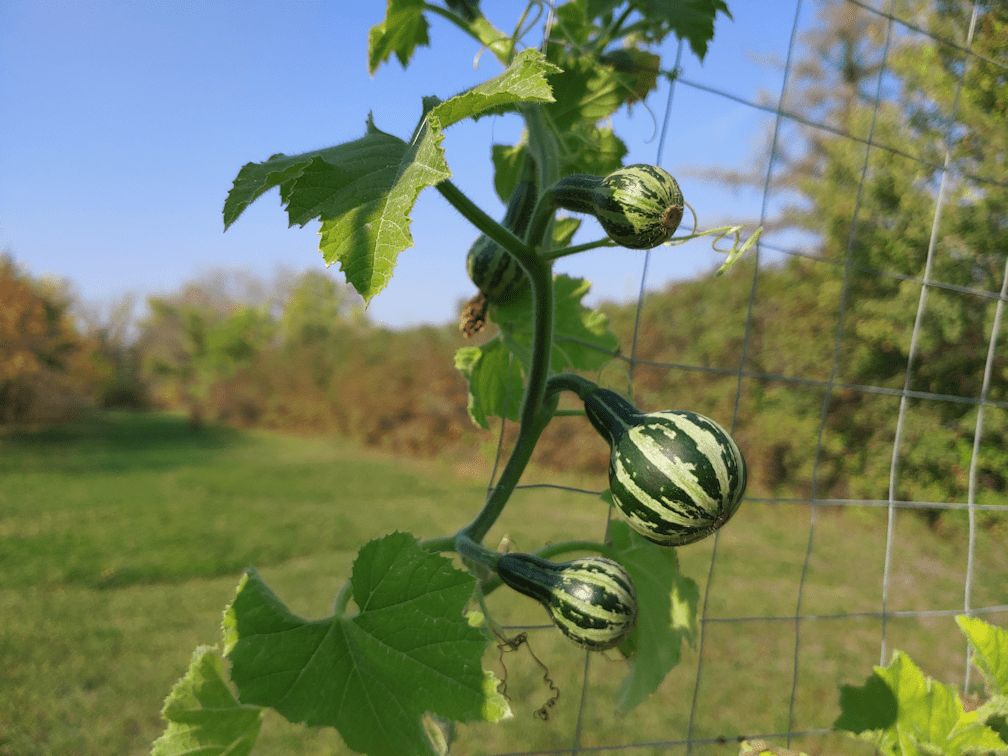
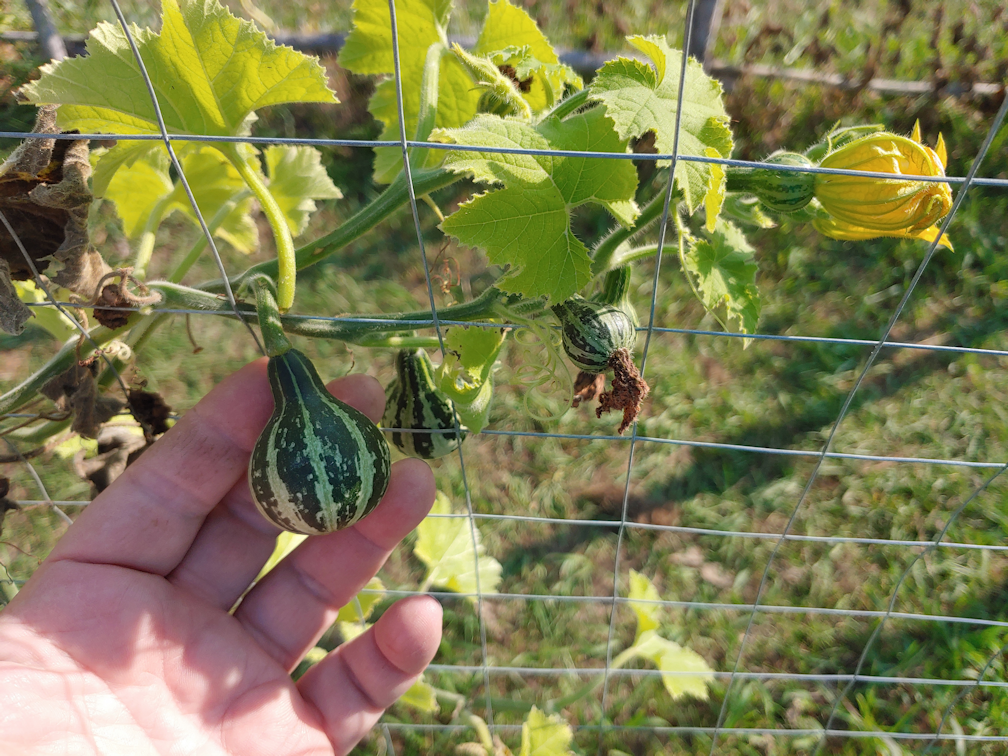
While the squash and melons are died back, or in the process of doing so, I continue to be amazed by the Tennessee Dancing Gourds.
These were one of our “fun” crops. Yes, I hope to use them for crafting purposes, but really, I just thought they were adorable and hoped that maybe, just maybe, they would grow in our Zone 3. From reviews I read when I bought the seeds, I knew they could be prolific, and the certainly have been, even with poor growing conditions.
While I’ve harvested only four mature dancing gourds, that are now drying out on our kitchen counter (protected from the cats!), there are more on the vines that are just as big, but still firmly attached.
More amazingly, the vines are still growing and blooming, with both male and female flowers. They have been doing amazingly well!
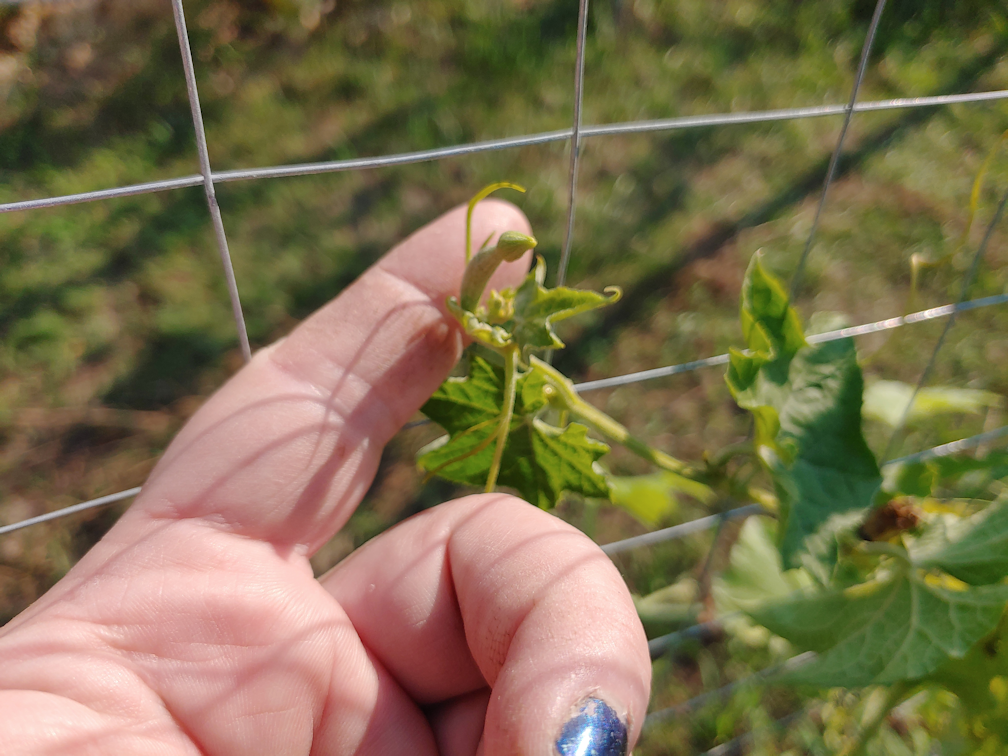
The luffa have decided to surprise me. I thought that, by now, they were basically a lost cause.
The very first luffa gourd that started to form ended up withering away, so when these ones showed up, I tried to hand pollinated them. Which I hope worked, but it’s still too early to tell.
You can just see a minuscule female flower developing, above my finger, too.
There are more male flower buds forming, and even another tiny female flower, with its tiny gourd, developing.
The vine itself is the only one that has grown enough to start making it’s way over the top of the squash tunnel.
I took this picture above my head to show the flowers that are blooming, but I was pretty blinded when I took it. So it was not until I uploaded the photo that I realized, there are gourds forming up there, too! There is no possibility of hand pollinating them, as I can’t reach them, but they might just make it!
None of the gourds we planted are zone 3, so that was a strike against them growing here, right from the start. While they would have loved the heat of our summer, it was difficult to water them adequately during drought conditions, so that was another set back. Though we have not have frost yet, we have had some pretty chilly nights, so I am really amazed they are still green, growing and flowering, while plants more suited to our zone, such as the nearby winter squash, are dying back. Especially the luffa, which didn’t even start blooming until very late, and didn’t start producing female flowers even later. It is unlikely the mild temperatures will continue long enough for the luffa gourds to fully mature, but the Tennessee Dancing gourds are doing just fabulously! I definitely want to try growing both, again. If they did this well in such poor conditions, imagine how well they’d do in better conditions?
While going through the garden beds this morning, I was just blown away by how much is still growing – and still getting a chance to grow, if the forecasts for October stay true!
The last time I had so many photos to share, I put them together into a video, but it only ever got one view. Clearly that’s not something people are interested in. So today, I will instead make a series of short posts, instead, starting with our winter squash and melons.
This is the very first Red Kuri/Little Gem squash that matures. As you can see in the photo, the vine is completely died back – except for the few inches on either side of the stem!
The vine with the next biggest one still has some green leaves on it. There had been another small squash that started to develop, but it withered away and fell off.
The other one, however, is still getting bigger, and just starting to deepen in colour. The vine it’s on has a lot of cold damaged leaves, but is still mostly green and growing, so this one may actually get a chance to fully mature.
The vine the mutant is on is also still growing, with fresh new leaves showing up even as the older ones get killed off by colder overnight temperatures. We still have not had a frost, which is the only reason we still have hope for our garden!
We are back down to the two Teddy squash, one on each plant. The others that had started to form, withered and fell off, likely due to lack of pollination. I don’t know how much bigger this well get, as they are a very small variety to begin with.
If you notice the white on the squash and leaves, no, that is not powdery mildew, or any other sort of fungal disease. That’s road dust. Even with the lilac hedge nearby, dust from the nearby road still gets through and coats things. Even the summer squash, which is furthest away, has road dust on them. Another reason we want to complete the hedge with dense bushes, and also plant taller trees. They will serve as more than wind breaks and privacy screens, in this area!
Here, you can see that the melon vines have all completely died back. All of them. And yet…
… the remaining melons are very firmly attached to their vines! Of course, they can’t grow any bigger, but I’m hoping as long as they stay out here, they will continue to ripen.
Under the conditions we’ve had, I’m really impressed with all of these. The melons managed to be quite prolific. The winter squash were not as prolific as they normally would have been, but we will at least have a few squash to try, and to see if we like them enough to want to grow these varieties again. We certainly would be willing to grow the Halona and Pixie melons again, though I think that we will try new varieties next year, to see what other varieties we enjoy eating.
Today was dry enough that I could work on cutting up the dead tree that had finally fallen, thanks to recent high winds.
This time, I could use power tools! I used my baby chainsaw (aka: cordless pruner), with it’s 4″ blade, to trim off branches, then a reciprocating saw, with a 12″ blade to cut the measured lengths. Unfortunately, my reciprocating saw is giving up the ghost. It cuts, but it doesn’t stop. Sometimes, it’ll slow down when I release the trigger, but other times it would just keep right on going. I had to unplug it to turn it off!
At the last minute, I changed my mind on the longer lengths I would be cutting. These will be used to make high raised beds in the main garden area, and I had been thinking of building them at 10 feet long. As I was measuring, however, I decided to make them 9 feet long. The boxes we built for the beds where the garlic had been planted are 9′ x 3′. I figured if I did these at 9 feet long, any future cover frames we build will fit on both. I kept the short ends at 4 feet, though. With the width of the wood, the inside of the beds will be roughly 3 feet wide, so any covers would still be interchangeable.
So here we have two 4′ and two 9′ lengths. Enough to make one course of logs to frame a high raised bed.
By the time I cut these, the rest of the tree was light enough that I could drag it closer to cut a couple more pieces.
That gave me another 9′ and another 4′ piece. At the top of the long pieces is the remaining top of the tree, which is about 7 or 8 feet. I set that aside for potential future use. When I was trimming the branches off, I found another 6 or 7 feet of the top had broken off and was dangling from a nearby tree. With three 9′ lengths, three 4′ lengths, plus another, say, 7 feet of trunk, and 6 feet for the top that broke off, we’re looking at a tree trunk that was roughly 52 feet. Add in the roughly 3 feet of stump left behind, we’re looking at a dead tree that was about 55 feet tall when I cut it down.
The one that’s still stuck on another tree was a bit taller.
At this point, I had salvaged logs to do 1 1/2 courses to build a raised garden bed. I needed two more pieces.
I didn’t have to cut down another tree, though. I still had the trunk of the dead tree I’d cut down and used the stump to make a bench.
After I finished trimming the branches, the trunk was eventually rolled up against the patch on the right, where there is a currant bush, chokecherry tree, raspberries, some flowers and a crab apple tree that died this spring. So after dragging/carrying the first pieces over to where the garden bed will be built, I cut a couple more lengths from this tree trunk, then set the remaining top piece aside with the top of the other tree, for potential future use.
You can see that the new raised bed will be quite a bit shorter than the low raised beds we had this year. Those are about 13 feet long. We will be losing planting space, but we should also be able to plant more densely, once they are at a more accessible height. For now, I want to make these at least 3 logs high, then see how they work. I expect to finish them off at 4 logs high.
Which would translate to roughly 3 or 4 trees to harvest, per bed. In this area, there are six low raised beds that will be converted to high raised beds, so that means as many as 12 trees to replace all the low raised beds with high raised beds.
Considering that we have more than 20 dead trees that need to be cut down, having enough logs won’t be a problem, even if some of them turn out to be too rotten to use. Some of those trees are thicker and taller than the two I used today, so I’ll probably need even fewer. With the new beds being several feet shorter than the current beds, we could potentially have a double row of beds. That will depend on the space for paths. These are meant to be accessible raised beds, with room for a walker or wheelchair in between, so the paths need to be 4′ wide.
The one thing we do have is the luxury of space. While we are starting with raised beds in this area we are already gardening in, as time goes by we will be adding more beds in this area. Not a lot more, though, as there are too many tall trees on the south side casting shadows. The plan is to build more permanent raised beds in the outer yard, where they will get full sun.
But that is for after we’ve done a lot more logging of dead trees in the spruce grove!
Once the last of the logs were dragged over, I took advantage of having the tools handy and finally took down the dead crab apple tree.
For this job, I was able to use the baby chain saw, and didn’t need anything else. I love that thing!
In the photo, you can somewhat see where the bark as split off the trunk at the bottom. This tree had started to get leaves in the spring, but then just died off, and seeing that damage sure explains why. The tree itself was showing signs of disease, even last year, so all this wood is for burning, not the chipping piles. I noticed that even the raspberry plants near it were also showing signs of disease, so what we will likely have to do is remove any plants growing around the tree and not plant anything at all here for a few years. That should be time enough for whatever disease has gotten into the soil to die off.
Once cutting and clearing away to the base, I could see that this tree was actually the sucker of a larger tree that had died, long ago! The inside of the old stump was so rotted out, I could brush it aside with my hands.
I kept cutting and breaking up bits and pieces for a while, but what I will ultimately do is bring a small metal ring I found and have been using as a portable fire ring, and light a fire on top of the remains of the tree. That will prevent any suckers from trying to start growing and, hopefully, sterilize the soil of whatever disease has gotten into it, at least a bit.
It was good to finally get this cleared up. There are a few other dead and dying crab apple trees that will need to be cleaned up, too. Over time, once enough time has passed, I hope to replace them with other fruit trees that are more disease resistant. This spot, however, will not get anything tall planted in it. There are already too many tall trees shading the area. An awful lot of garden space was lost to shade because my parents planted so many new trees on the south side of the garden, instead of the north! Most frustrating is that they also planted them too close together, so none of them thrived, and quite a few died. I removed a lot of these when I cleaned up the maple grove, our first summer here, but I think I will have to take out an entire row of crab apple trees I discovered in the process. They simply aren’t getting enough light to bloom and produce, even after I cleaned the area up. That’s not a priority right now, though.
But I digress!
I’m happy to have gotten as much done as I did today. Tomorrow, the girls and I have an outing with my mother planned, so we won’t be able to get more done then. I’ll have to use Sunday to take down another tree and hopefully get enough wood to start on the first permanent high raised bed before winter. With several days of rain predicted next week, we shall see how far we will be able to get on that!














 The Re-Farmer