We were supposed to get rain, first, but if we did, it wasn’t much. Not a lot of snow, either, but we’re supposed to get more, later in the week. These are our “April showers” that will hopefully lead to May flowers. :-)
I managed to snag a photo of Ginger this morning!
He has been very active, so it’s been hard to get photos! :-D
As squirmy as he was while I tried to get that photo, it was no comparison to Beep Beep.
I hadn’t even tried to pet her. As soon as she saw me taking pictures of Ginger, she started rolling around like mad, beeping for attention!
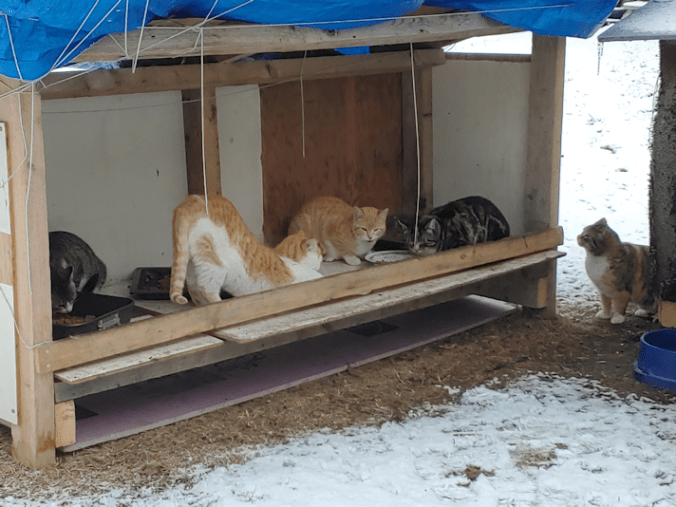
When I came outside, I saw Ginger’s brothers and Junk Pile coming out of the cat’s house, while his mom emerged from the shelf shelter by the sun room door. I’m not sure where Rosencrantz emerged from! :-D
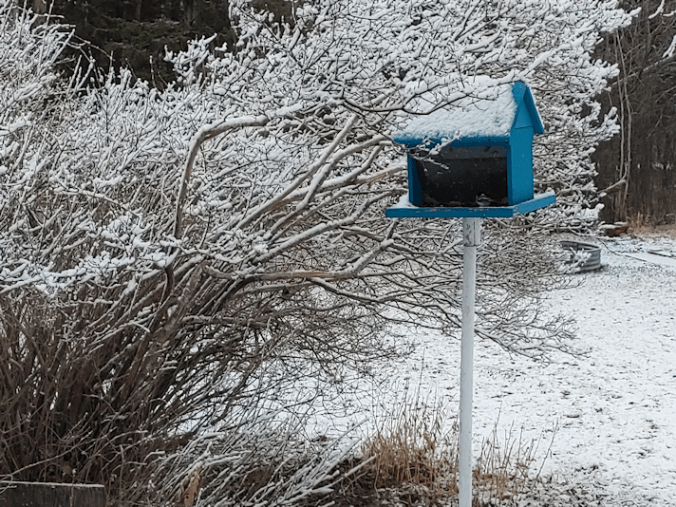
You can see the chickadee on the bird feeder platform, and if you look carefully, you’ll see another one in the lilac bush, just under the thicker branches.
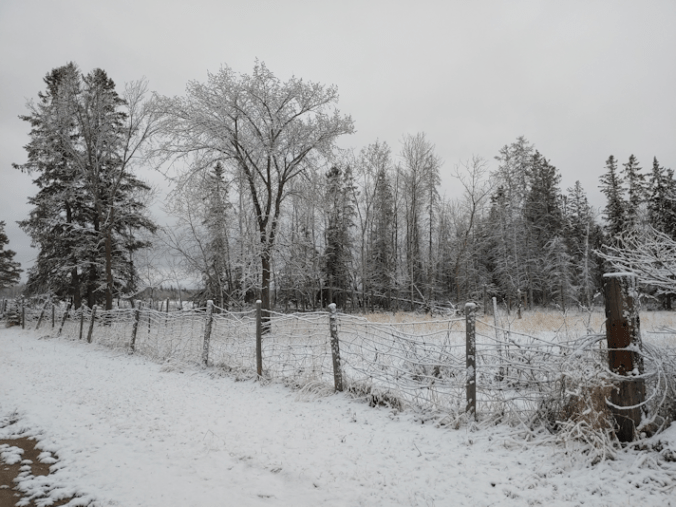
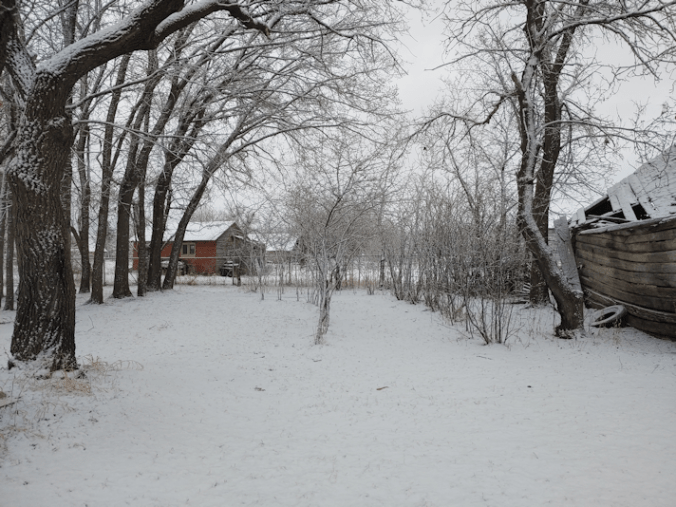
The snow almost made even the ugly fence look pretty!
I so look forward to when we can take that fence out!
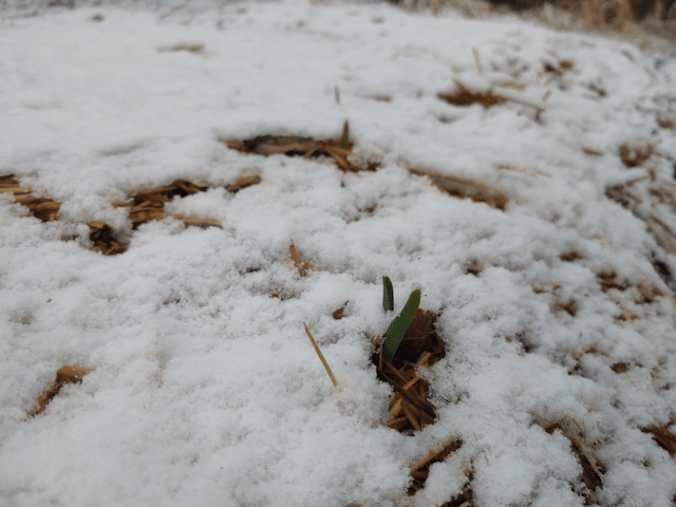
The little garlics peeking through the mulch are visibly bigger than when we first spotted them! Thankfully, they should be able to handle this weather just fine. Likewise, the onion starts in the sun room are doing quite well. The temperatures in there don’t go below freezing (and the trays also have heat from below), but it gets chilly enough that if we had the tomatoes or squash in there, we’d have to bring them into the house for the night. The sun room still manages to stay warmer overnight than the old kitchen!
I spotted the shy calico disappearing under the fence on the far end of my mother’s “living fence” of hawthorn, carigana and oaks.
One of these months, I’ll get to cleaning up around the collapsing log cabin, and that corner of the fence. The chain link just sort of got dropped to the ground after the last fence post, so the junk there, and on the other side of the cabin, act as a sort of fence on their own. Once it’s cleaned out, if the renter’s cows get into the outer yard again, there will be nothing that can stop them from getting into the inner yard. Another reason to fill in any gaps, should the electric fence fail again.
I do love seeing the cows, and the few times they have gotten through, they did a great job of eating the overgrown areas in the outer yard, which in turn reduces the fire hazard in those areas. :-)
By the time I was done my rounds, the cats were making their way back into their shelter. I think it’s even dark enough for the light sensor on the timer to turn on the ceramic heater bulb.
Those things have been so handy, I think we will pick up more!
As I write this, we are at -3C/27F with a wind chill of -11C/12F. It’s the wind that’s more of an issue than the snow or the temperatures. Meanwhile, short range forecasts have us at 1C/34F over the next couple of days, with a sudden leap to 15C/59F on Thursday – only to drop to -3C over night, with more snow into Friday. Which is supposed to reach a high of 2C/35F, so it’s all going to melt away very quickly. Long range forecasts show rain and snow in the first days of May.
Somewhere in there, we have to get our septic tank emptied, and get those loads of garden soil delivered. There are things we need to be able to direct sow two weeks before last frost, and everything we are planting this year depends on having that soil available.
It feels like we’re starting to cut it close. Even with the snow, though, we’ve had enough warm temperatures that they should be able to load the soil into their trucks by now. I need to remember to make some calls tomorrow and find out.
It seems the more we get these little snowfalls, the more antsy I am to get gardening! :-D
I’d crocheted an amigurumi squid, years ago, trying out a new pattern. When I realized we’d closed the other cats out for the night and Ginger had no toys in the room, I decided to see if he would like it.
He did.
Squidly is now Ginger’s favourite toy! The other cats like it, too. :-D
Speaking of other cats…
His sister, Cabbages, and Keith were pretty adorable, cuddling together! :-)
This morning, as I put kibble out for the outside cats, most of them eventually made their way over.
I did not see Butterscotch.
I have my suspicions that she’s tucked away with somewhere, with new babies.
If my suspicions are correct, I hope her nest is nice and cozy, because they’re now predicting another 7 inches (almost 18cm!!) of snow on Sunday! We’ll have more snow in April than we’ve had the entire winter.
The slow melt we’re having now is perfect, except with the overnight temperatures going below zero, the freeze-thaw cycle is destroying the roads! I had to run some errands today, picking up our newly sharpened and tested electric chain saw while dropping off a lawn mower for servicing, then going to another town to drop some stuff off, and the gravel roads in particular are just awful. The paved roads and highways are going to be crumbling even worse than usual in the next while.
I don’t mind the snow while we’ve got these milder temperatures. I think most people on the farms out here will happily put up with rough roads, if it means they will have enough moisture when planting their crops.
I must admit, though, it’s rather disjointing to read other people’s blogs where they talk about all the stuff growing in their gardens, or their latest transplants. :-D
Speaking of which, we did decide to start one of the squashes we’ve got now, rather than later. The Crespo squash is the only one of them that grows large fruit. In trying to find the “days to maturity”, all I can find is “harvest the the skin is very hard”. Which doesn’t tell me much at all! I’ll just assume large fruit means longer time needed to grow them, and will give them a bigger head start. I set the seeds to soak last night, and will plant them later today.
I’m not finding a lot of information about this specific variety at all, so I’m really looking forward to seeing what happens with these.
And now I have to de-cat myself (hello, Susan) and get some work done! :-D
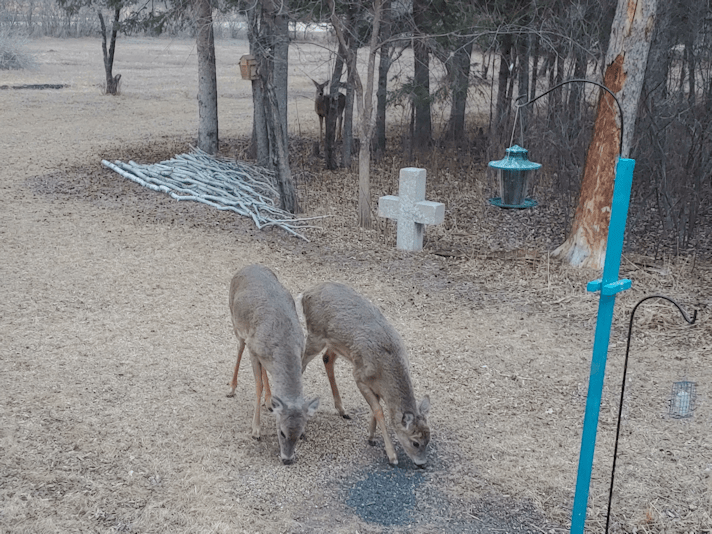
They tend to show up near the end of the day, when the light makes is hard to get good photos! You can still see, at least a little, the growing antler nubbins on the deer on the right.
If all goes well, this will be the last bag of feed for the deer that we buy until the fall. Looking at the long range forecast, we’re expected to dip below freezing again, with snow on Monday (three days from now). They’re predicting 3-6cm. After a couple more days, the temperatures will be back above freezing during the day, though we’ll have below freezing temperatures overnight for a while longer.
I’m hoping we actually get that snow, and that it slowly melts. The deer should have fresh growing things to eat after that. We were supposed to have rain over the past couple of days, but once again I watched on the weather radar, as the system moved right past us. We didn’t even get a sprinkle.
Yesterday was a very lazy day for me. There is something about it being overcast that leaves me feeling like I’m ready to fall asleep, all day. Plus, with the cooler temperatures and hopes of rain, I didn’t want to be working outside with power tools. ;-) I did make a trip into town, though. Our darling daughter treated us to pizza for our anniversary. My husband and I celebrated 33 years together this month. :-) While driving into town to pick it up, there actually was a bit of rain, but it was nothing but a tease!
Today, I finally made the trip to the smaller city to pick up the last few things I wasn’t able to get during my Costco trip. They were actually sold out of cat litter, of all things! While there, I started chatting with another customer, who is also feeding a lot of cats. Mostly outside cats. He estimates he spends about $3000 a year on cat food – and spent another $5000 to get 40 cats fixed. !! That’s through some sort of program, where getting a female done is only about $80-$100, instead of the $350 we’re paying. I’ve had all sorts of organizations recommended to us, but either we can’t get through to them, or they don’t operate as far out as we are. :-(
(Oh, just got a phone call. The people who are adopting Two Face are on their way to pick her up. :-) )
While talking to the other customer, he mentioned using wood pellets instead of litter. I’ve heard of people using them, and talking about how much better it is, so I asked him more about it. It turns out that these are just the wood pellets sold as fuel for pellet stoves. He told me that when the cats use the pellets, they absorb all the moisture and break apart into sawdust. They also absorb the odor, so the only thing you smell is wood. When cleaning the litter pans, you simply dump out all the pellets in the pan and replace it with fresh – and the old pellets can still be burned. !! I don’t know that I’d want to do that. At least not in the fire pit (or a pellet stove, if we had one!), but we do still have a burn barrel. Or compost them, while burn bans are in effect. That would save us from having to haul those heavy bags to the dump. He told me the pellets are a lot cheaper, too, and they come in 40 pound bags, so they last a long time, too.
I think it’ll be worth trying it out. Maybe start with just a few litter pans, first, and see how the cats like it.
The conversation got me thinking about just how much we spend on critters. With the cats, it’s about $350-$400 a month in wet and dry cat food, plus litter. So, about $4,800 a year, on the high end. Plus the deer, which we do only for about 6 months, which works out to about $300 a year. Then there’s the bird seed, which we do all year, and works out to about $1000 a year.
Which we’re doing my husband’s disability payments.
Thank God for private health insurance!!
There are a lot of things we are doing without, to keep the critters fed. We include it all in our grocery budget. If, however, we were just setting that money aside, we’d have been able to save enough to replace the roof in only 2 years.
Now, we’re not going to stop feeding the animals, but we really need to find a way to address that expense. This is not sustainable. The problem goes back to my not simply being able to go out and get a job, since any income I would make would get deducted from my husband’s disability payments. If I ever made enough to bring that replace my husband’s disability payments, he would lose his insurance entirely (since he would no longer “need” it) – and he’d no longer have coverage for his prescriptions. So it’s a lose-lose situation. That’s why we had to be so careful when fund raising for Ginger’s vet care. We can accept gifts. We can’t have additional income.
*sigh*
Reducing the costs will help, which is why I want to try the wood pellets instead of cat litter. Cat food isn’t going to get any cheaper, though. It’s another reason why we want to grow and preserve as much food for ourselves, as well.
Slight interruption in writing this, as the people adopting Two Face arrived. As a thank you for Two Face, we were gifted with a bag full of brand new, still in their wrappers, Tupperware! Looks like the lady is a distributor. :-)
I hope Two Face is happy in her new home. We’re going to miss her!
Well, with the weather getting colder again for the next while, we’ll be slowing things down as well. At least, outside. Not so much, inside. The tray of bulb onions are now in the sun room. It’s warmer in there, but with the cooler temperatures coming, we’ve got them heated from below. By the time things warm up again, we should be ready to move more seedlings from the aquarium greenhouses to the sun room, then use the aquariums to start the summer and winter squash.
If all goes to plan, we should be ready to start direct sowing some things near the end of May, then do the final direct sowing and transplanting after our last frost date of June 2.
A while back, I wrote about two areas we were considering building a permanent, accessible raised bed garden outside the inner yard, and asked for feedback. You can read about that here.
While walking with my daughter this evening, it occurred to me, we could start in a very different location.
I hadn’t considered this area before, because I had something else in might for it.
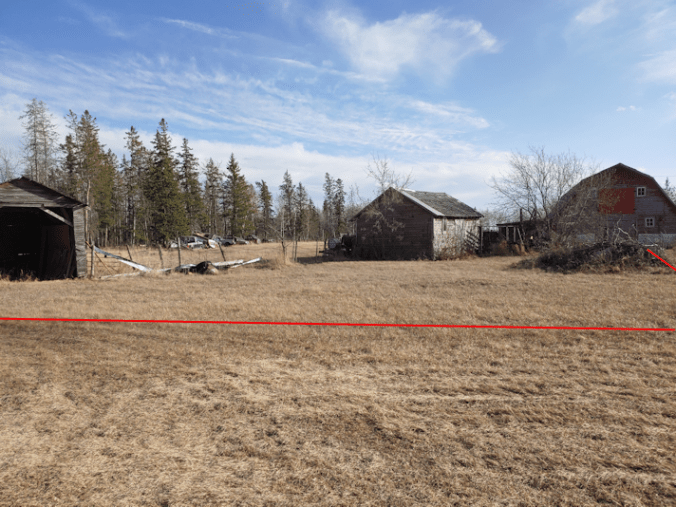
This is the space.
This is the area in front of the garage, where I’ve been able to keep up with the mowing. As you can see by the tire tracks in the foreground, there is traffic here. The red lines mark where we tend to drive, either as part of our turning radius to get in and out of the garage, or in the access lane to the barn, and the “gate” in the fence beside it. The opening has a chain across it, as well as the renter’s electric fence. I found the remains of the barbed wire gate that used to be there, buried in the tall grass. :-/
This is actually where I was thinking we’d want to build a new fire pit/outdoor cooking area. Our current fire pit is too near trees and a collapsing log building. A wide open space like this would be much safer for a fire pit. With the winds we get, we were thinking of building a sheltering wall of around the fire pit, as well as making sure the ground around the pit was fire proofed with bricks, stone, gravel, sand or even just bare soil. I’d also like to build an outdoor clay oven, and a shelter of some kind, and turn the whole arrangement into an outdoor kitchen. The practical purpose is to have somewhere we can cook if power is lost.
These plans, however, won’t come into fruition for some years yet, and can either be moved, or be integrated into any garden layouts we end up doing. I’ll go further into that in a bit.
The most obvious advantage of this location is that it’s flat and dry. There are also no buried pipes we need to work around, no rough soil to level, and now low spots that gather water in wet years. While the one shed, with the wide open front, is not worth salvaging, it can still be sort of used until it finally collapses, or we take it down. The other shed is worth salvaging, and we can use it for storing garden tools and equipment.
There is that pile that needs to be dealt with. While it has branches on top, those branches are on top of what I was told is a pile of insulation. !! I believe my late brother salvaged it from a demolition job or something, and had plans for it that never came to fruition. We need to clear it out. However, there is enough space that we could probably build a few raised beds around it, even taking into account the dimensions needed for accessibility, until we can figure out what to do with it.
Getting water to it will be a bit harder than the area to the west that I was thinking off, but not as difficult as the area even further west that we were considering. Plus, it’s an area we can see from the house.
We will still need to figure out how to deal with deer, of course. In fact, as I started writing this post, I saw some movement on the security camera, flashing through this area. A look out the door, and I could see two deer standing by the pile. The deer cut through the old hay yard at the fence between the two shacks, as well as going through here to reach the “gate” by the barn. That’s one downside to this space. It’s a higher traffic area, both for humans and animals!
We have broader plans for this part of the outer yard, as we work towards getting rid of most of the fencing around the inner yard, making the inner and outer yards are one, large, usable space.
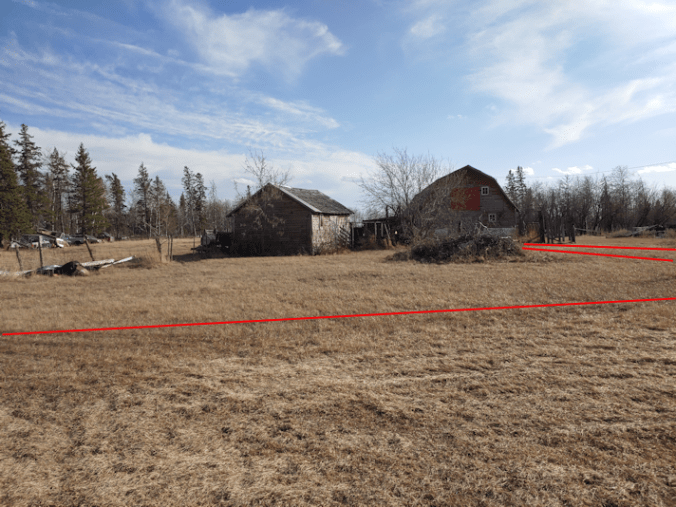
This is the other area we want to work on, in the short term.
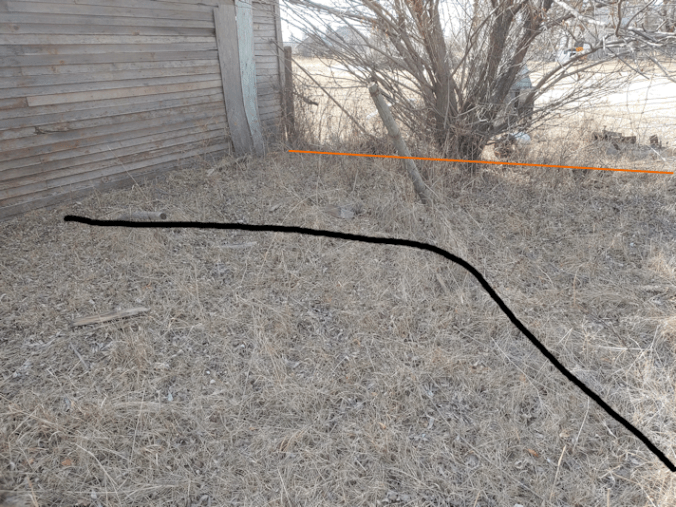
In these photos, I am at the North end of the old hay yard. In fact, we never had hay stacked this far from the barn, and it was used as pasture. When hay wasn’t being store here, this area was used as a corral and/or pasture area. The orange lines in the above photos mark the fence around the area that is functional. The black lines mark a collapsed fence line. I believe this second fence line was added after some trees were planted, to keep the cows away from them. Here and there, I can see the dead remains of trees that look like they were planted in a row, rather than self-sown.
I want to get rid of the fence marked in orange, but that can’t be done until we have something to replace it. In the short term, I want to put temporary fencing where the fallen fence marked in black currently is. It needs to be strong enough to hold back the renter’s cows, but it will eventually be removed, too.
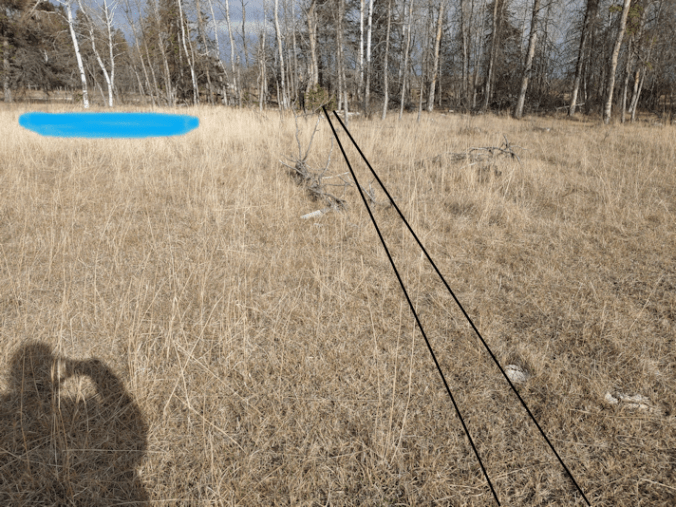
This is an area I want to get worked on.
The blue is a low area that used to be a dugout, and should be filled with water right now. It’s so dry this spring, there isn’t even mud in there. One of these years, I want to hire someone with an excavator to dig it deep enough to be a pond in all but the driest of years. It’ll be a nice water feature, and the intention is to allow bull rushes (aka: cattails) and other aquatic plants to grow, and hopefully have a little haven for other creatures.
Trees would be planted along the property line in the background for privacy from the road, to keep out road dust from vehicles driving by, and as part of a shelter belt from those wicked south and south-easterly winds. The trees that are there now just aren’t enough to shelter from those winds!
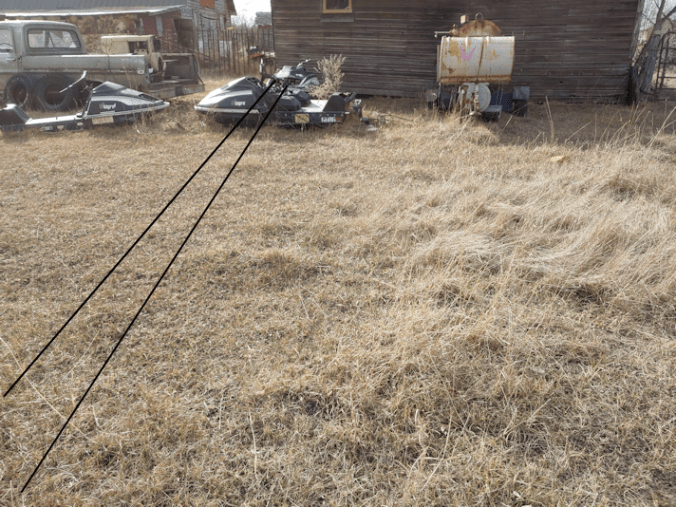
The black lines in these photos mark more or less where a permanent fence would go.
As you can see, some clean up needs to be done behind the shed. What the shed hides is the space in front of the barn, where the fence surrounding the outer yard ends, and where there is a collapsing ramp for loading cattle onto a truck.
Shelter belt trees would also be planted along or near these lines, though not all the way to the barn. There would likely be a gate of some kind, there, too. We may shift the whole line so that it lines up with the corner of the barn, instead of lining up with the shed. That decision can be made when we are in a position to start building the fence, which will be a few years from now.
So if we build the permanent fence here, there will be plenty of room to build the outdoor kitchen/fire pit area, if we wanted it to be closer to the future pond site. Or, as mentioned before, we could integrate it in with the garden beds, which I think it more likely to happen.
So, what do you think? Is this a better idea than what was written about here?
Ooh… I just had an idea. That old shed that’s starting to fall apart will eventually need to be cleared out. It could some day be replaced with a greenhouse! Again, no need to level or raise the ground. It’s already flat and dry.
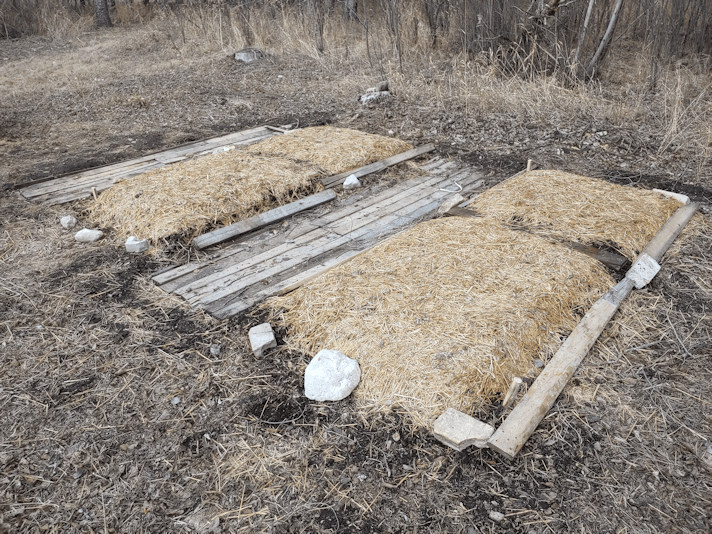
My older daughter and I headed out for a walk, and we decided to go ahead and remove the plastic covering our garlic beds.
When looking up how to plant winter garlic, all the resources said to cover the garlic with a heavy layer of mulch.
What none of them did was mention when to take off the mulch in the spring. I knew the mulch was removed, because all the videos and photos I saw that were taken later in the growing season showed the garlic growing out of bare soil. No mulch in sight. It took some dedicated searching, but I finally found resources that said to remove the mulch after overnight temperatures were consistently above -6C/21F. Looking at our long range forecasts, we seem to be at that point, as overnight temperatures are generally supposed to stay above freezing. We’ve started by just removing the plastic for now, though. We’re supposed to get some much needed rain tomorrow, and have decided to leave the mulch a bit longer. Right now, it’s keeping the beds from drying out, like everything else has done this spring. With so little snow over the winter, and very little precipitation so far this spring, every little bit of moisture is precious.
When I dug these beds out, I moved the soil to one side, put the contents of our compost heap on the bottom, added straw on top, then put the soil back, including the soil that was in what are now paths. I dug those areas down to the gravel, using it to raise the garlic beds higher, then filled the space with scrap wood to create the paths.
I won’t be adding another path on the other side of the third bed, which means I’ll only have what soil I take off the top. I’ll be emptying out our compost heap into the bottom, then add in the mulch from the garlic beds, before putting the soil back. I don’t think it’ll be as high as the other beds, but hopefully we’ll have our loads of garden soil delivered soon, so I’ll be able to top it off with that. The mulch will probably be removed before then, and I’ll just move it onto the paths at first.
We’ve had quite a few warm days. I think I’ll call the company up in the next day or two and see if their soil is thawed out enough to load into their trucks or not.
I might be just a little bit excited about getting that soil! :-D
As we plan this year’s garden, we are also looking towards the permanent, accessible garden beds we plan to make, both near the house, and in the outer yard.
The satellite image I used to plan things out for this year’s gardening was cropped from an image that included the outer yard and beyond. Looking at the image, I figured out the line where the pipes run from the house towards the barn. Back when my parents still had cows, they set up water to the barn, and to a pair of water fountains for the cows. There is also the pipe from the septic tank by the house, to where it drains well away from both house and barn.
I was thinking of putting the permanent raised beds directly south of the house, making sure not to do anything above where the pipes are, in case they some day need to be excavated. Looking at the satellite image, I figured that would require putting everything to the West of the pipes. My sense of perspective is really off when looking at the satellite image, though. This morning, I stood right where the pipes should be, and realized we might not have to do that.
The lines mark approximately where the pipes should be, under my feet and running towards one of the fountains (the little bit of orange you see in the distance). The pipe from the septic tank diverts off to the West (to the right, in the photo). The grey water gets pumped to an outlet hidden by the collapsing log building. The water pipes go to the fountain, to the barn and to a second fountain on the other side of the barn. I have zero memory of how pipe was laid to get to the fountain behind the barn. I only remember the trench from the house towards where the fountain is. I would have to confirm with my brother to get a more exact idea of where the pipes are.
The yellow line going to the left is running through a power pole, holding the electrical lines that power the barn.That is about midway between the barn and the main power pole, so while it looks far away, it’s actually not much past half way to the outer fence, from where I’m standing to take this shot. There is a vehicle gate through the fence, though, so we wouldn’t be going much beyond that post. It still leaves us with a lot of space.
There is a shut off valve at the well pump in the basement, for the water to the barn and fountains. I don’t know how many decades it’s been shut off, but I do know that, at some point, a smaller pressure tank was installed, so even if we did dare turn it on, we don’t have an adequate pressure tank to supply water to the barn and the house at the same time. The fountains are designed to be refill continuously as cows drank the water, so they have no “off” switch, other than the float that keeps them from overflowing. One of the fountains looks to be in pretty good shape and probably still works, but the other – the one in the picture – looks like it’s been bashed around. It used to have a box built around it, but that has been falling apart. I think the renter’s cows have knocked it about.
I have no idea how they are powered, nor how the power to them is turned on and off.
Which is all my roundabout way of saying that, any gardens in this area would be watered from the house, not the barn.
In the distance, you can see the fence for the outer yard. At some point, we want to make sure that is fixed up and cow proof enough to eventually remove many sections of the fences around the inner yard, so it’ll all be one big yard around the house.
One of the reasons why I want to set up in this area is because it’s fairly close to the house, we can see it out our windows, and it would be easy to water it. There’s a tap on the south side of the house, and it’s basically a straight line over the chain link fence to this area.
The area in the above picture is shows quite a bit; I had to set my phone to wide angle to get as much as I did, which is partly why the perspective is so off. It doesn’t show all of this area, though.
Here is the rest of it.
The yellow lines mark roughly where the pipes run.
I think you can see some of the problems with this area. It’s not just overgrown, but rough, with low patches. That patch of brighter coloured tall grass is basically marsh grass growing in one of the lowest spots. The area needs to be leveled, or at least smoothed out. That antique tractor needs to be moved, and the trees trying to grow through it taken out. There’s an old disk rake beside the tractor, and other miscellaneous parts and pieces floating about. Of course, there’s also that collapsing building. That’s a log building that was the second of three log cabins previous owners had built, with the third one being the old part of the house we’re living in now. Sadly, no effort was made to preserve it. It is full of all sorts of stuff that was “stored” there until the roof collapsed on top of it all.
At least the old chicken coop, behind the tractor, is still pretty solid, though the entire roof structure is slowly sinking.
We wouldn’t need to go as far as the stuff that needs cleaning out until we’re starting to build greenhouses or some such.
So this area is where I was thinking we could set up the permanent garden beds, and maybe even a greenhouse or poly-tunnel, some day.
While walking around the area with my daughter, however, I found out she thought I meant somewhere else.
She thought I meant on this side of the pump shack and old chicken coop. That yellow line, marks where there is a buried cable providing power to the storage building. Which, some day, I’d like to empty of my parents’ stuff and turn back into a workshop. My late brother had a marvelous set up in there, but it’s now stuffed full of my parents’ things that we emptied from the house. It’s so full, that when we finally cleaned out the basements and the old kitchen, we had to use the barn and the “extra” house in the inner yard to store things.
So… not someplace we can put garden beds (though if we cleaned it up, we could use the space between the pump shack and the old chicken coop).
My daughter then suggested this area.
In the foreground is where we need to be able to drive, and you can see the start of what is a very rough driveway to the back gate. It’s the area between that driveway and the shed that she is talking about. We’d have to remove the pile of stuff there, which includes a stack of massive steel doors and what I think are pieces of steel door frames. There are also what look like steel balcony rails. They’re quite large and heavy, too.
This area would be easier to clean up. It’s rough, but not as rough as parts of the other area. The shed does create some shade, but most of the area gets full sunlight. The main problems are that this is getting pretty far from the house, we can’t see if from the house, and it’ll be harder to get water to it.
Unless we can get the old well and manual pump in the pump shack going again. Which we want to do, anyhow, so that we have a back up water supply if we ever lose power.
The yellow in this photo marks the “driveway” to the back gate, with a turn off that leads to a gate in the outer fence line. Someone drove through here when it was muddy, leaving deep ruts that are still a problem. We will be cleaning up the dead and dying trees in that shelter belt row there, and will be planting nut trees in the area closer to the fence, and behind where that pile of branches is – one of several piles we need to get chipped.
This photo shows where the drive leads to the gate in the outer fence. It’s hard to see the fence line, but in the corner there is roughly where we would like to someday build a small, barrier free house for my husband and I, and the girls will get the main house to themselves. That is many years in the future, however, and may never happen. Meanwhile, we could start putting garden beds in the foreground area.
Also, that’s a cat path cutting through the grass! :-D
For these permanent garden beds we are planning, they will be designed for accessibility. That means the beds themselves will be about 3-4 ft high (roughly a meter) and no more than 4 feet (1.2m) wide. The lengths are flexible, but the paths in between must be at least 4 ft wide as well. This is enough room for a walker or wheelchair to go through, and be able to turn around. Which means the paths also have to be level and solid for wheels. Handily, that will also make it easier to move around with wheel barrows or wagons, too. The space needed for the paths means that everything will be pretty spread out, compared to your typical raised bed garden layout. Space, we have. Functional space… that’s a completely different issue.
If we can get the old well going again, that solves a lot of problems. The old chicken coop used to be a “summer kitchen” before my parents bought the property from a family member. It had a wood burning cook stove and was used to do the canning and cooking, without over heating the house in the summer. If the old well can be fixed, it would be worthwhile to rebuild the pump shack, and I’d love to turn it into a summer kitchen. Maybe not with a wood burning stove (that would increase the property insurance rates for my brother, significantly), but I like the idea of having a place to cook outside of the house, that’s still sheltered.
A moot point, if we can’t get the well going. We will test it out this spring, once we can move things around in there to access the pump again.
Okay. These are our options.
There’s the area between the house and the barn.
Pluses:
Southern exposure: gets full sun all year.
Easy to get water to by running the hose straight from the house.
Can be seen from the house.
Easy to get to from the house. It’s straight from the main doors.
Minuses:
No wind protection from the south. We’ve found the southern winds to be much more of a problem than any other directions.
Must work around pipes running underground.
The ground is very rough and uneven in parts. Will need to be smoothed and leveled. We’d likely have to hire someone with heavy equipment to get the area to the West of the pipes leveled.
Then there’s the area by the storage shed.
Pluses:
Relatively easier to clean up. Does not need as much leveling.
Does have some shade, but most of the area gets full sun, all year.
More potential space, if we decide to continue adding beds along the “driveway” to the secondary gate.
Minuses:
Further from the house.
Can’t be seen from the house.
Harder to get water to (unless the old well can be fixed).
No protection from winds from both South and North.
With vehicle access needed to the storage shed and gates, there is less flexibility in space.
Personally, I’m leaning towards the space I can see from the house, but my daughter thinks the other area would be better.
What do you think? Can you think of other pluses and minuses for either area? Any suggestions?
Well, it was time to throw in the towel on some of our seed starts.
The bunching onions in the small fish tank never recovered from the cats being able to get at them, there were mold issues, and watering problems. At least with those, we still had seeds left and could start more.
The shallots (in the background, out of focus) are another loss.
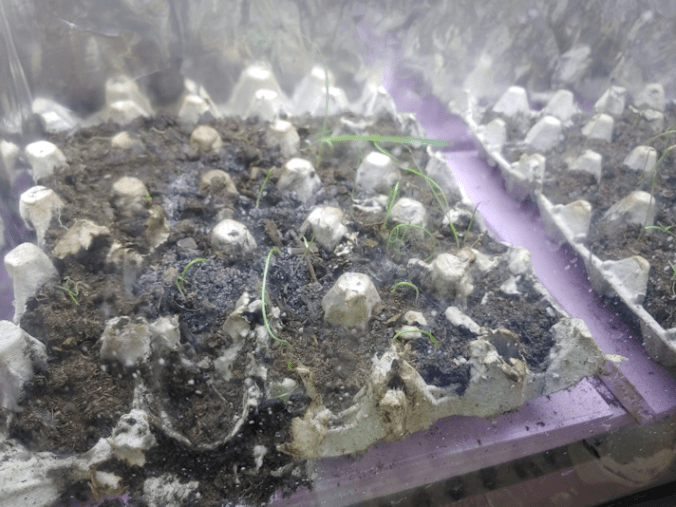
This is one of the potential problems of using whatever was on hand. We started them in the cardboard egg cartons, but had no way to put a tray of any kind under them, where we could water them from below. Even though we did take them out and give them a thorough watering from below, it wasn’t enough. I regularly sprayed them with water, trying to get the cartons themselves wetter, but again, it wasn’t enough. The shallots are a complete loss, and I have no more seeds to try again. So we’ll be down from four types of onions to three. :-( Unless I find and buy sets later on.
In the future, I would not use the cardboard egg cartons to start seeds in again, unless I were able to keep them in a tray of some kind, and keep the cardboard wet all the time. In spite or watering them every evening, when I pulled them out of their makeshift greenhouses this morning, they were pretty much bone dry. So, they went into the compost heap this morning. :-(
The little tank is now empty, and the tomatoes and bunching onions have been shifted around in the big tank. We are seeing more and more seedlings pop up, though there are still a couple of cups that have no seedlings at all. We’re not after a lot of tomato plants, but I am hoping for more of the Red Baron onion seeds to germinate. At least the bulb onions seem to be doing all right. From what I’ve read, I should be trimming them a few inches, about now.
Yesterday, I picked up some Jiffy pots. I’ve been looking things up about growing luffas, which have a very long growing season to reach that sponge stage I’m after. I’ve decided I will start a few seeds of those in the next few days, and set them up in the little tank. With the screen I found in one of the sheds as a “lid”, we’ve solved the cat problem, so I can raise the level closer to the light, too. From what I’ve been reading/watching, luffa doesn’t like to be transplanted (more so than other gourd types), so using pots which can be buried should help reduce transplant stress. With the size the pots are, I should be able to still double cup them with the red solo cups, which would allow me to water them from below.
So that’s a goal for the next few days, and I will also be preparing to start the other seeds that need to be starting in April.
Meanwhile, as I do my morning rounds, I’ve been studying the different areas we intend to garden in this year.
This strip has never had a garden in it. You can see where the ground starts to get rough on the left, where the old garden started. That rough part is from the crappy plow job that was done before we moved here.
This stretch will have alternating blocks of three varieties of Peaches ‘n Cream corn and two varieties of sunflowers.
In years where we had more snow, where I’m standing to take this picture had a large puddle of water from melted snow. This year, there is only that whitish patch you can see on the left foreground. That’s ice from the small amount of water accumulated this spring. This is something to keep in mind when we are planting food trees here, as we don’t want saplings being drowned out in the spring. So part of our goal when growing here is leveling things out a bit more.
The further out we go, however, the drier it gets. By the time we reach the corner, past the low hanging spruce branches I will have to prune away, it’s very dry. Weeds and grass barely grow there. Which means that, when we have corn growing there, we are going to have to find ways to keep them well watered. This entire area is going to be a challenge to water, simply because it’s so far from the house.
This time of the morning is the only time this area is in shade. It gets full sun for most of the day, and also gets incredibly hot. To the left of where the corn and sunflowers will be planted is where we will be having beds of melons and gourds. They’ll get the heat they need (especially if we have summer like last year!). We just have to make sure they get the water they’ll need. The winter squash will also be more on this side, while the summer squash will be planted closer to the house, where they will be closer for continual harvesting over the summer.
We’re also going to have to work on keeping the deer out. There are a number of options we can try. If we make use of several of them together, it should work out.
The fence line the trees on the right are hiding is pretty much toast. New posts had been put in along the spruce grove, which I’m guessing my late brother did, but he never got to finish the job. The remaining stretch of fence has rotting fence posts, some of which are held up by nothing but the barbed wire. My late brother had a soil auger attachment for the Bobcat, and we still have the post pounder he built, but the Bobcat and its accessories are with our vandal now, and the post pounder had been sitting, exposed to the elements and covered in junk, for so many years, there’s lichen growing on the belts. So if we’re going to be putting in new fence posts, we’re going to have to do it the old fashioned way. I’ve found a couple of post hole diggers that we can try out. One of them is a very different design, and I’m curious as to how it would be used.
Meanwhile, that entire strip along the West fence line needs to be cleaned up. I might have to take the remains of the fence out entirely. The North fence line, which runs behind the lilac hedge, is in even worse shape, but at least the lilacs are there to provide some privacy and a bit of security. Once the strip along the West fence line is cleared out, it’ll be pretty open.
It would be nice to not need a fence there at all.
Since these fences mark the property lines at the roads, these are areas where we can consider putting in something very permanent for fencing. Something along the lines of a hedgerow, perhaps, or a “palisade” type of wall that would give both privacy, and keep the deer out! The corner at the far end is one of the places they regularly jump the fence (well… what’s left of the fence…). The road on the North side is very busy (as such things are in this area), and in the summer, a LOT of dust gets kicked up. On a windless day, it just hangs in the air like a fog, slowly drifting across the property, for a surprisingly long time. The lilac hedge helps keep that out of the garden area quite a bit, so that’s another thing to keep in mind as we work on the area. Dust control!
When it comes to gardening in this area, it’s all temporary. If things go well, it’ll just be for one year, and then next year, we’ll be able to start planting food trees here, while permanent garden beds get placed to the south of the house. The area we intend for permanent beds is very rough, though. It might be easiest to clear it as much as we can, then get someone in to plow and smooth it out as much as possible. We’ll be building accessible raised beds there, so it’s the leveling that’s more important to our needs. It would be good if we could get the old farm equipment moved, and the collapsing building dismantled and cleared away, but that might be just too much for this year!
We’ve got a lot of work to get done! Last year, with first the heavy rains, then the excessive heat, we didn’t get anywhere near as much done as I wanted. Hopefully, this summer will be not be as extreme.
So much of what we want to do depends on the weather!
It was a lovely day today, with the temperature at a glorious 3C/37F. With things still on track for our garden plans, I figured this was a good day to start some clean up and gather the materials that will be used to build trellises, etc.
This meant giving our new baby chainsaw (otherwise known as a cordless pruner, but that’s boring) its first workout, as I took down some of the little poplars along the south fence line of the spruce grove.
I’m just really excited to be able to do this work in March! I think the earliest I’ve ever been able to start this sort of work since we’ve moved here, has been in May.
Before starting, I took the time to clear out a number of branches that fell over the winter. In the process, I found this old bird’s nest on the ground. I left it there. :-)
Here are the before and after pictures. I’m afraid I didn’t match up my positioning very well! (click on the pictures to see them better)
The larger tree lying on the ground on the left came down last fall, and there’s another hung up in the brush behind it that has been there since before we moved in. The further into the grove we go, the more downed trees and branches there are. Clearing those, and other fire hazards, out is a major goal.
When we had a trail cam on a tree instead of a post, I used to trudge down that foot path, every morning, to switch out the memory card. This area has already seen a fair bit of clean up since we first moved here. The space to the left of the foot path has self-seeding flowers. I figure it would be good to get this done before they start growing again. Once they’re in full bloom, it’s a gorgeous mix of purple and green, almost all the way down.
In the distance of the after picture, you can see several poplars lying on the ground. I was trimming branches off of them when the battery died. I’ve left them there until I can come back to finish the trimming.
Because I goofed on my positioning, the elm tree in the foreground of the second picture is hiding where I cleared out some things between the two big poplars.
From the time it took me to take the before pictures, to the time it took for the battery to run out (which includes the time taken to clear out dead branches first, was only about 50 minutes. In that short time, I did as much as would have taken me at least twice that amount of time, with hand tools. Even using the reciprocating saw took longer.
These are the trimmed poles that will be used for building supports in our various garden beds. There will be quite a bit more, by the time I’m done clearing this area.
That baby chain saw made the job SO much faster and easier! And it was surprisingly quiet, and downright fun to use! I can certainly see why these things are selling out so quickly. The only down side is that the little bitty battery doesn’t last very long. I’d estimate about half an hour of cutting time in total. So having a second battery is going to be a necessity, and with the work I am expecting to do over the next few months, a third certainly won’t be overkill!
I still have to leave some of the larger stumplings to go back and cut to ground level later, with a larger cutting tool. Not as many as I’d expected to, though.
I’m now eagerly awaiting the battery charge, in hopes that I’ll be able to take it out again this evening! :-D Mind you, I could go out with manual tools, if I really wanted to, but they’re stored in the sun room with Ginger, so I’ll wait for the charger.
A while back, I used a satellite image to plan where we could plant our garden this year.
Getting a gasp of dimensions was difficult on this, though, but at least it could be used as a guide. Things need to be pretty flexible at this point, anyhow.
With the snow clearing away, we have been getting into the areas and realized that there was a lot more room to the West of the existing beds than there appeared to be, in the satellite image.
Here is the areas with the existing beds where we had planted squash last year.
The perspective makes it look a bit strange.
Two years ago, the area where the green marked beds are was mulched with straw, then covered with black … tarps? Possibly landscaping fabric? Whatever it was we salvaged when cleaning up the old wood pile. That log marks one of the corners of the area we mulched. This made a HUGE difference in the workability of the soil when we planted last year, as well as killing off a lot of the grass and weeds. This area was no longer hard as concrete, and could actually be worked, though we did still dig out pockets to fill with a soil mix that we could transplant into, because of all the rocks.
The long bed in the back has bamboo poles marking where I’d stuck the seed potatoes found last fall that, for some reason, didn’t sprout but still looked completely fresh. There is one more potato than I had poles to mark the spots with. :-D When the garden was prepped for winter, that bed was actually widened a bit, so even if the potatoes do miraculously start to grow, there is room for something in front. Which will probably not be use this year, but it’s an option. If we are unable to get rid of that row of self-sown trees, then we will likely create a series of long, narrower, bed with trellises on the North side, for any climbing plants we decide to grow in the future.
Then there are the three beds down the middle, which used to be pumpkin mounds, with longer beds on either side. The three beds down the middle are all the about same size, while the two on either end are almost exactly the same size as each other. With our current plan, the three smaller beds in the middle will have our three varieties of spinach, while the larger beds on either side will have two of our varieties of onions, which in turn will probably be interplanted with other things. Possible kale and kholrabi, as the onions will help protect them from insects. We shall see.
In the back of the photo is a purple block which is where we are planning to plant the Montana Morado corn. That leaves a surprisingly large space (in orange) that didn’t get marked on the satellite image, where we can plant something else. Perhaps one of the three bush bean varieties can go there.
After we dig out the huge rock that’s half buried in there. When this area was plowed last, the person who did it went around the rock, creating a hill in one area, and a low spot in the other. :-/ This is one of the roughest areas of the entire old garden space. Even where the Montana Morado corn will be planted in ridiculously rough.
As you can see, there is a substantial area in shadow, so there is quite a bit of space that can only have shade loving plants. Most of what we have requires full sun, and even the cool weather plants still need more sun than those areas get. An unplanned consequence of my parents crowding more and more trees into what used to be part of the garden.
Still, it is here that we are intending to make permanent, accessible, raised bed gardens. The plots we have now do not have the dimensions needed for that (which must include the paths as well as the raised beds), so even here, everything we do is temporary. One of the reasons this area was chosen for permanent gardening is its nearness to a water source, and to the house itself. Accessible raised beds will also be high enough to address the shadow problem, at least somewhat.
Now to the other side…
In the foreground is one of the old squash beds marked off in the earlier photo. The smaller two beds are where we had potatoes last year, and where we hope to plant the shallots and bunching onions, if the seedlings survive. Those two beds are a bit under 4″x8″ in size (or a little more than 1m x 2m), to give you some perspective.
All the orange area will be for new garden beds. Most of it was part of the old garden that had been plowed before we moved here. Of that space, the only area that has seen and mulching was where we planted the sunflowers. As with the squash, we dug holes and filled them with a soil mix, in which we planted the sunflowers, because of how hard and full of rocks the soil is. As we were able, we added grass clippings around the seedlings for mulch.
The furthest we’d planted the sunflowers are almost to the very end of the row of crab apple trees. Again, for perspective, we could just barely reach those ones with 260′ of garden hose – almost 80 meters.
Way in the back, at the corner, there is a large L shape inside the orange area that has never had any garden in it. We will be working this area for gardening for the first time. I would estimate the orange area, along the edge on the right, near the old potato beds, to be probably 250′, or about 76 meters, long. The far end, along the fence line, is probably 300’/91m.
Funny. It sounds so much bigger when I write that down. When I’m standing in the middle of it, remembering the garden of my childhood, it feels very… small.
The orange area gets full sun, up until you get close to the crab apple trees that are beyond the right edge of the photo. It gets very hot and dry, so we will have our work cut out for us to grow the corn, sunflowers, beans, peas, melons, radishes, summer and winter squash, and gourds we intend to plant there. Getting water that far out from the house is going to be the biggest challenge.
Part of the goal in breaking soil here is for the future planting of nut trees. Many varieties do very well in poor conditions, but not all. Any improvement of the soil will give them a better chance of survival, and when we’re talking about something that may not produce for at least ten years, any losses have much longer term effects.
The orange area closest to the green areas may become part of the permanent garden beds on this side of the house, but that has yet to be determined. Our plans still need to be very flexible at this point.
After taking these photos this morning, I also took photos of the spruce grove areas we need to work on.
Here are out garlic beds. Another bed will be created to the left, near the current compost ring location. There will likely be beets grown there.
The mess of little trees beyond the garlic beds all need to be cleared out. The ones with whitish trunks are poplar trees, and there are many, many, MANY more of them growing towards the garage, and then down towards the road. They also keep trying to come up in the yard. I had not realized how invasive they could be! These will become the materials to build trellises and arbors for our climbing plants.
The darker colours stems that you see are mostly cherry, from a parent plan from Poland. Something we saw happen since we’ve moved here, and probably happens often, is that the cherries start to bloom quite early in the spring, as soon as it warms up. This, however, is Canada, not Poland, and they got hit by a late frost. This killed off the trees that had bloomed. New shoots, however, come up from the base. So what we’ve got is a lot of dead cherry trees, surrounded by immature new growth.
Cherry trees, we’ve learned, also spread by their roots. I had to deal with that while clearing out the area under the old wood pile, so we could plant carrots, beets and parsley here, last year.
So we’ve decided all of that is going to be cleaned out, as far back as we can. It’s a huge area, and the clean up will likely be done in stages over several years. We don’t want to take too long on that, though, because this is where we would like to plant berry bushes and fruit trees.
Then there’s this area…
Every red line marks a dead spruce tree. The two on the left, by the junk pile, are the ones closest to the house that we were already looking to hire someone to take down for us, along with the dead spruce by the garage and outhouse. Counting that one, there’s a dozen dead spruces that need to be taken down, before they fall down, in this area. There are also plenty of fallen trees that need to be cleaned up, along with the junk pile and the spirea (which is hiding at least one, maybe two, fallen trees). There are Saskatoon bushes beyond the junk pile that we want to clean up around, including removing some chokecherries, which will provide them with the air flow and sunshine they need to thrive. So far, none of these has shown signs of disease.
In the middle of the photo, tucked into where there are so many dead trees, is where we planned to plant the mulberry tree that’s set to arrive later in the spring, in time for planting in our zone. We chose this location, because it’s a zone 4 tree and needs the protection the other trees will provide (the ones still alive, anyhow), and still get a lot of sunlight. With so many dead trees to take down first, however, I’m almost thinking we might want to put it in a pot until next year!
In the foreground, behind the compost ring, is where we intend to build the cordwood outdoor bathroom. I had been upset that we were not able to at least get started on leveling a foundation for it last year, due mostly to the excessive heat, but now that I’ve realized how many dead trees there are, I’m glad it didn’t happen. Any one of those trees could come down in a storm or high winds. Can you imagine doing all that work to build a cordwood shed, only to have a tree fall on it?
Oh, and along with these, I was able to make my way through the spruce grove near the fence line and take a closer look. I found five more dead trees. Those ones are not as urgent to take down, though. It’s the ones near the house and garage that have priority. Of course, there are the trees that have already fallen that need to be cleaned out, too. Focus that far out, however, will be on the south end of the spruce grove, along the driveway, where there are almost no spruces left. Lots of little poplars to take out, and probably some larger ones, too, and lots of underbrush, fallen trees and dead branches to clear away. Only then can we figure out if the crab apple trees my mother planted in there can be salvaged. They’re not as overshadowed as the other ones I found near the maple grove, but last spring, I only saw one branch bloom, and no apples produced. I think I would rather take those out and transplant more spruces in that area, and save the fruit trees for better locations. There are a number of little, self-sown spruce trees that I would rather transplant than get rid of. I’ve had to kill enough trees while cleaning up, already, and will have to do more. If transplanting some is an option, I will be happy to take it!
Yes! We managed to resist temptation, and not start the tomatoes too early. :-D
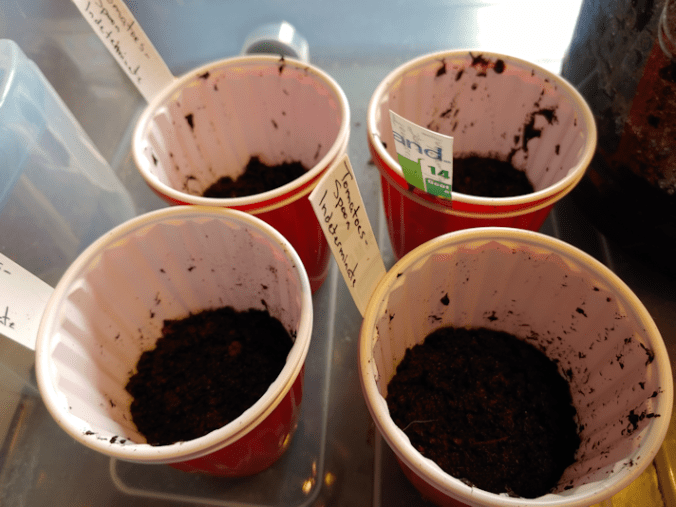
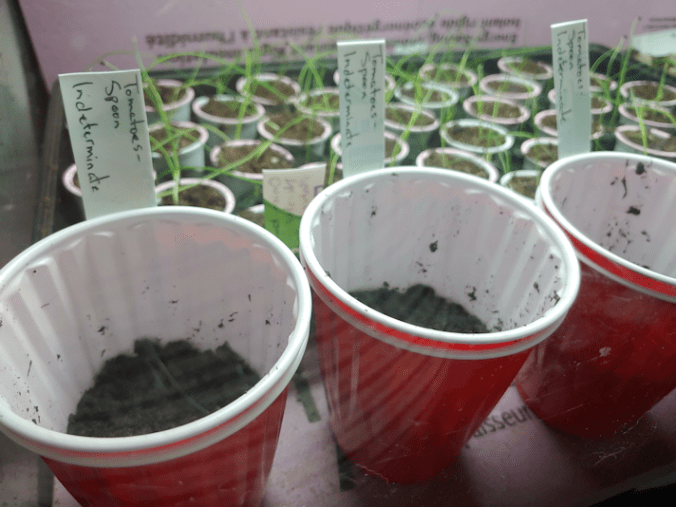
After a fair bit of research, plus an evaluation of our cat-safe spaces, I chose to start our tomatoes using the “double cup” method.
I’d already picked up a large package of the red beer cups, and those were the types recommended. The first thing to do was to make drainage holes in half the cups we’d be using.
These will later be used to start our squash and gourds, so I didn’t mind putting drainage holes in extra cups. I’ve got a bag of 250, so we’ll be putting holes in at least 125! :-D
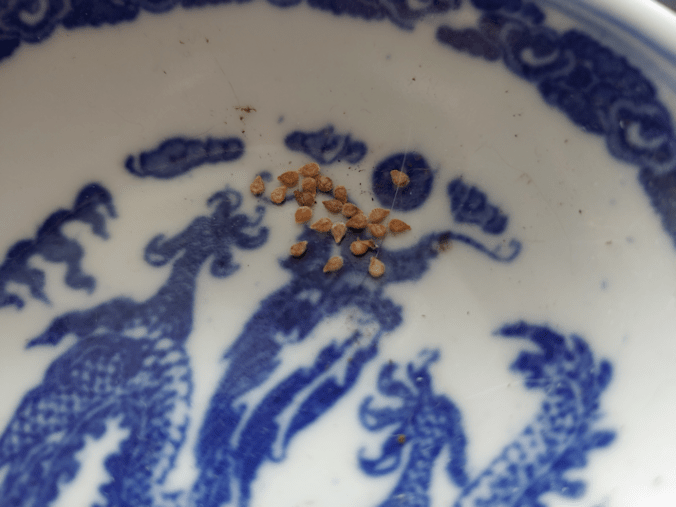
These are the seeds from one packet of Spoon tomatoes from Baker Creek. They are so tiny!!! And we didn’t even end up using them all!
Now, we’ve considered quite a few options for starting our seeds, including peat or similar pots, Jiffy pellets, starting trays of various types, and even looking at the pots of various sizes we found while cleaning out the basements. I settled on these cups for a few reasons. They are the size I want, you can get a LOT of them for a very low price, and I expect to be able to reuse them for many years. In some of the gardening videos I’ve watched, there are people who have been reusing these cups for as long as 10 years.
If I had the budget, I would prefer to use coir pots. I like the idea of those, or peat pots, as they can be put right into the soil with the transplants to break down, resulting in far less root disruption. The problem is, for the sheer volume of these that we would need, they’re just completely out of budget. Peat pots are fairly easy to find, but coir or any other biodegradable pots are things we’d have to seek out, and are far more expensive. :-/
The double cup method has added benefits. I can water them from below, using the outer cup, and not have to have them sitting in trays. That makes them more flexible for our spaces. Particularly since we’re using fish tanks as makeshift greenhouses. Using double cups means we can fit them inside the big tank, along with the trays of bulb unions and shallots.
Another benefit to using these cups for starting tomatoes is that we won’t need to “pot up” the tomatoes.
We filled the cups only half way with peat. The loose peat we’re using takes a long time to moisten, so I made sure to set some up in a container with water to saturate overnight, first.
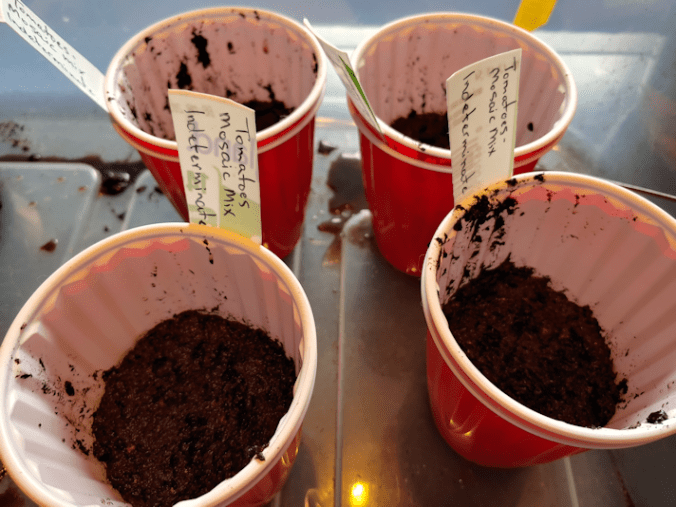
As a bonus, the double cups hold the labels in place very well!
Once the seedlings reach a size large enough that we would be potting them up, we can just add more of the peat around the stems. No disruption of the main root, and the “hairs” on the stems will become new roots, making them hardier for when they finally get transplanted outside.
We planted 4 seeds in each cup. We shall see how many germinate, and how many make it to the transplant stage! The goal is for a total of 8 plants, but if we have extra… well, we’ll figure it out when the time comes. With the Mosaic Medley, it is a mix of cherry and grape tomatoes, so we will hopefully have several different varieties from the seeds that were planted, but I really don’t know how we’ll be able to tell until they start fruiting, really. There are plenty of seeds left in that packet, too.
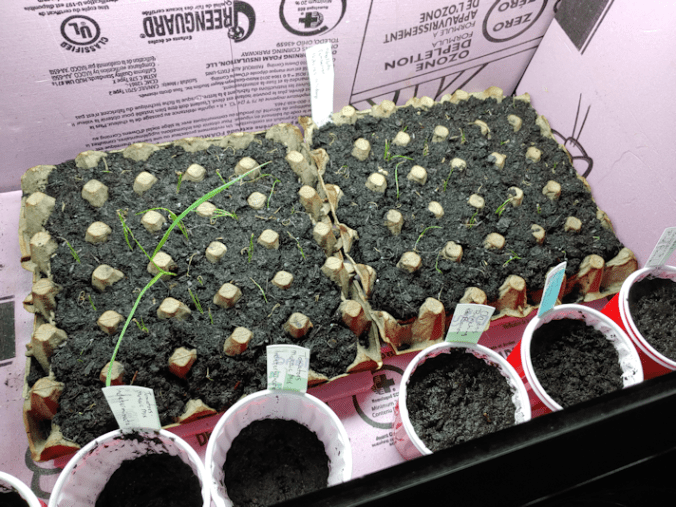
Here they are, all in a row along the front of the big tank. Once they start sprouting, if it seems they aren’t getting enough light, we can place the extra aquarium light over the tank above them.
At which point, I call your attention to the onions, behind them.
The bulb onions (Norstar) in the self-watering tray are doing all right. The K-cups are actually doing better than the ones in the Jiffy pellets, which was a surprise for me. In fact, so many seeded pellets didn’t germinate, I reseeded many of them (plus a few K-cups), and they seem to be doing better now. The K-cups dry out much faster, and don’t water from below as well as the pellets. Unfortunately, watering the taller K-cups without also over watering the pellets has been a challenge. In the future, I would not want to mix the two again.
As for the shallots in the egg trays… Hmm.
I had thought that the wet cardboard of the egg trays might help the plugs stay moister, longer, but they seem to have done the opposite. They seem to be drying them out faster, and with this set up, I don’t have the space to put trays under them, to be able to water them from below. I’ve been using a spray bottle to water them from above, but … well, they really seem to be struggling. And I can’t even plant more, because all of the shallot seeds were used up in these trays.
Then there are the bunching onions, in the small tank.
*sigh*
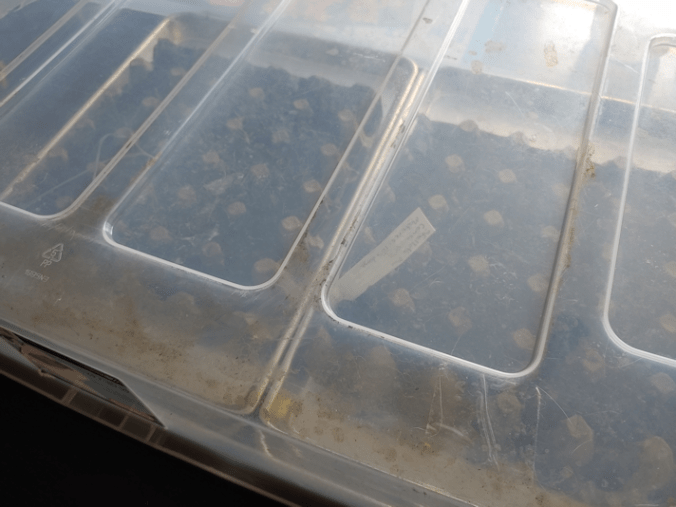
The cat damage didn’t just wreck a lot of plugs, but it looks like the peat was contaminated, too. On one tray, a white mold has started to grow, while on the other tray, there is what looks like a more yellowish mold. Lack of air circulation in the tank certainly wasn’t helping matters.
That will not be as much of a problem now, at least. The window screen I found in the shed to replace the lid seems to be working, even though it is bigger than the tank. The frame along one side juuuuussssttt fits in the narrow gap between the tank and the wall, which means the tank itself helps hold the screen in place. A couple of 5 pound hand weights on the back, and it seems to actually be working. Yes, we did have a cat knock it off by going on the overhang, but since the weights have been added, that seems to have solved it.
On removing the light fixture from the lid, I had a slightly different issue. There is no “back” to the light bars, and while the waterproof tubes the lights are in have a dark strip along where it would have been against the lid, there was still a lot of light in every other direction. For now, I’ve simply placed the fixture on top of the metal mesh of the screen, then placed a somewhat-cut-to-size piece of rigid insulation, wrapped in aluminum foil, on top. All that “wasted” light is now being reflected downwards. It seemed darker in the tank, possibly because of the mesh itself, so I put aluminum foil around the sides of the tank, too. The foil wrapped “backing” for the light seems to be working well, so I plan to attach the light fixture to it, rather than just have it sitting loosely on top. I had intended to mount the light to the underside of the screen, but it actually seems to be working okay, sitting on top. As long as the cats leave it alone. They don’t seem to like the overhang of the screen, though, and only a couple of the kittens have been willing to make the effort to get past it.
We have a very small, light fan that can sit right on the screen and provide air circulation in the tank. For now, we’ve been switching the little fan back and forth between the tanks, until we feel it’s time to start using the oscillating room fan that’s on a stand.
I’m pretty sure those bunching onions are a lost cause, though.
So we had two things to deal with; the too dry shallots, and the dying bunching onions.
The girls took care of the shallots for me, while I made a run to the post office. They had to get creative, because… cats.
They put the seedlings into baking pans with water in them, to water the seedlings from below. That needed time, but they found that the under-bed storage container that we’ve been using to contain our potting mess was large enough to cover and protect both trays.
They successfully foiled the cats!
There was room for three more cups in the big tank, though, and we still had seeds for the bunching onions. So when I got back from my errands, I decided to plant more of them.
The shallots were well dampened by then, so I slid them back onto the pieces of insulation we’re using tho carry them, and put them back in the tank. Then I filled three double cups with peat and put about a dozen seeds, at least, in each cup. The seeds are all about half an inch apart, so I’ll be able to easily thin them, if necessary, or separate them for transplanting, later on.
And I still have seeds for the bunching onions left over!
So that is done. Tomato seeds have been planted, shallots have been, hopefully, rescued, and new bunching onion seeds have been planted.
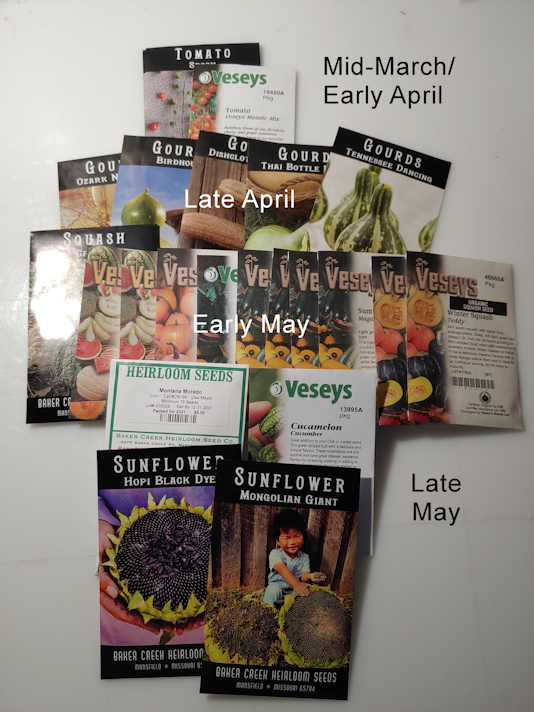
The next batch of seeds that we will need to start are the gourds.
But not for another month or so.
Hopefully, by then, it will be warm enough even overnight, that the onions and tomatoes can be safely transferred to the sun room, so we can use the fish tank aquariums for the next batch of seed starts.

















 The Re-Farmer