Our 2021 garden: winter squash follow up

Yesterday, I posted about a concern I was finding with our Red Kuri/Little Gem winter squash. I also shared photos in some gardening groups I’m on, and of course, did some searches.

I greatly appreciated the feedback that I got from all over. Some had suggested it was a pollination problem, but that seemed to be from people seeing the pictures of the dying fruit, and not seeing my question about the yellowing leaves. Thankfully, we have not had any shortage of pollinators, unlike some other gardeners I’ve been hearing from. Others suggested blossom end rot. That would be due to watering problems, particularly over watering. In this location, and with our soil (or lack of it), over watering would be very difficult to do. Under watering could be an issue, but these plants are watered the same as everything else at the squash tunnel.

Other possibilities included squash borers, which there are no signs of, and the pattern of yellowing would have been reversed from what is happening. Fungal disease was another possibility, as was root rot. Both of which I could rule out pretty confidently. Insect damage in general could also be ruled out.

Nutritional deficiency seems to be the most likely cause. Everything at the squash tunnel has been fertilized a couple of times with high nitrogen fertilizer, and lack of nitrogen is one of the possible nutrient deficiencies, but I ‘also had suggestions that lack of calcium, iron and even magnesium might be contributing factors. None of those are included in the soil tests I did! It could simply be that this type of squash has higher nutritional needs than the melons and squash on either side of it. There are five of this type of squash, and all five are affected, while nothing around them are having the same issues, which suggests to me that it this variety is simply a heavier feeder than the others.

This morning, I pruned away all the dead and dying leaves at the bottom of the plants, as well as trimmed away the stems from leaves that had been nibbled on, previously. There were very few of those; it’s the winter squash next to them that is getting the worst of the nibbles!
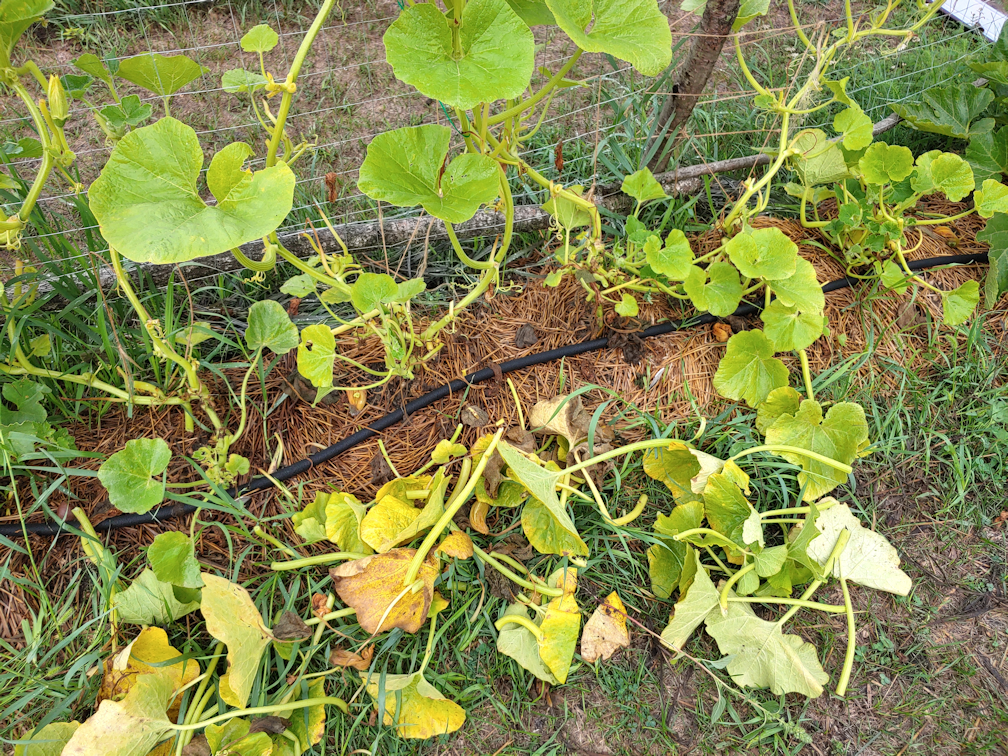
There was quite a bit to trim away! What I found interesting was what was revealed, once these leaves and stems were removed.
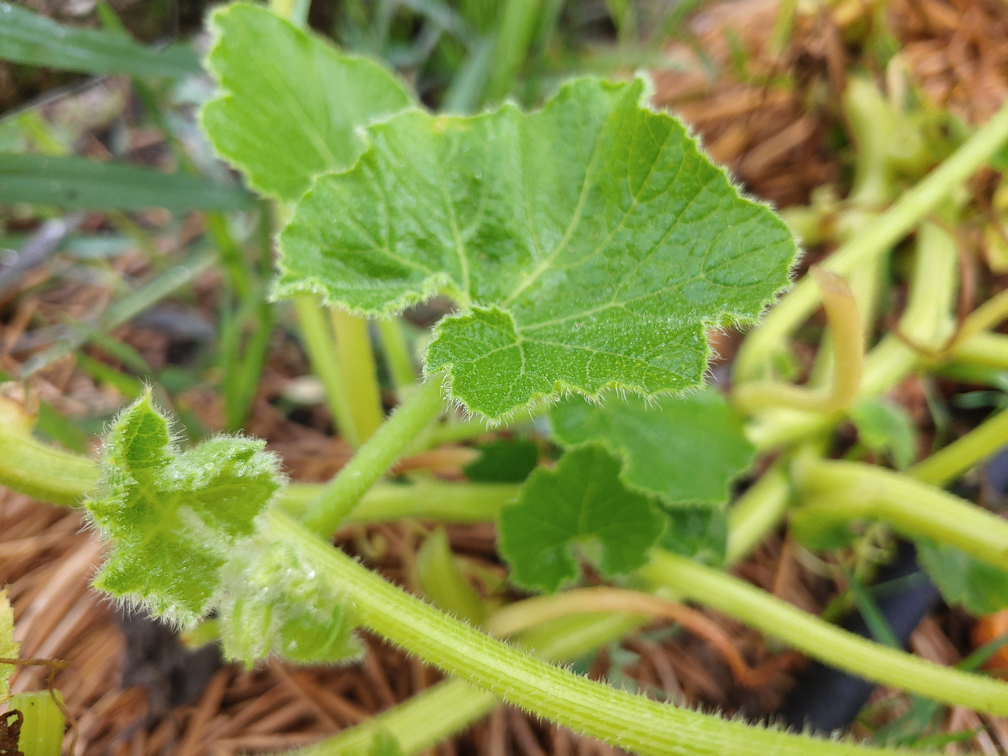
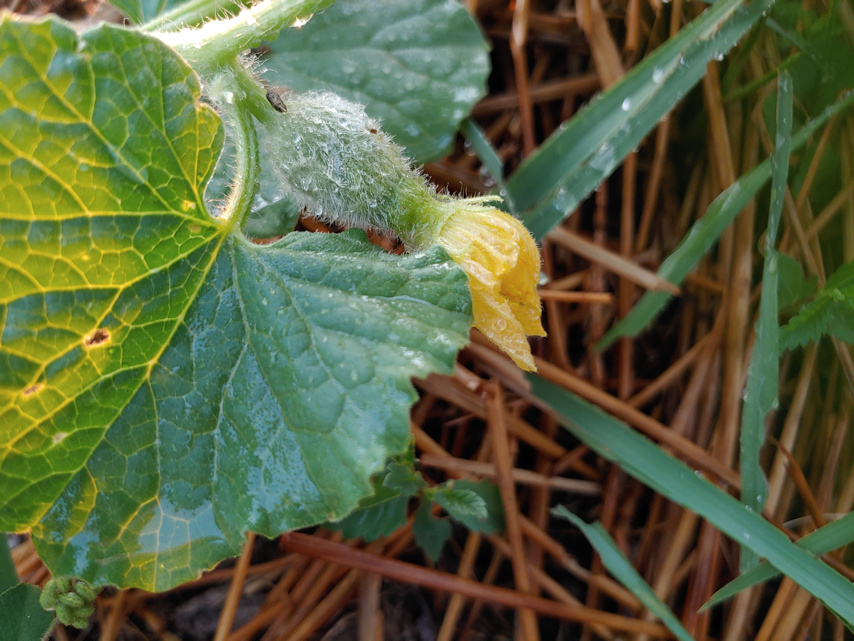
There are fresh new leaves growing! Many are growing out of the stems right next to the dying leaves, as if the plants are trying to replace them as fast as it can.

This also opened things up so I could better check for things like fungal disease, insect damage, etc., just in case I’d missed something before.

In the end, lack of micro nutrients seems to be the most likely cause. That new leaves are coming up at the bottoms (no leaves higher up on the trellis needed to be trimmed), is encouraging.

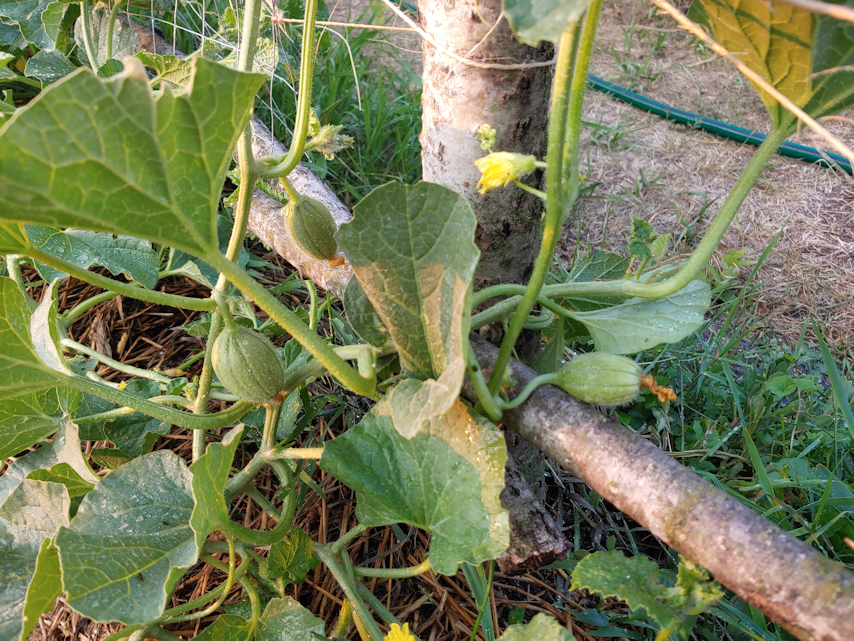
The big, beautiful flowers, and the still healthy developing squash is also very encouraging!

On a completely different garden topic, I was checking out the corn and sunflower blocks, and taking a closer took at some of the developing seed heads.

This Mongolian Giant is typical; one large seed head developing at the top.

Then there was this one, two stalks over.

This one has a whole bunch of little seed heads starting to develop, all down the stem! Pretty much every leaf on this plant is showing a baby seed head growing in their elbows.

I remember we had a sunflower last year do this, too! Sadly, none had a chance to mature before that first frost hit. Hopefully, these have more time to develop, and we’ll have seed heads to harvest as something other than bird feed this year!

The Re-Farmer

Our 2021 garden: first bulb onions

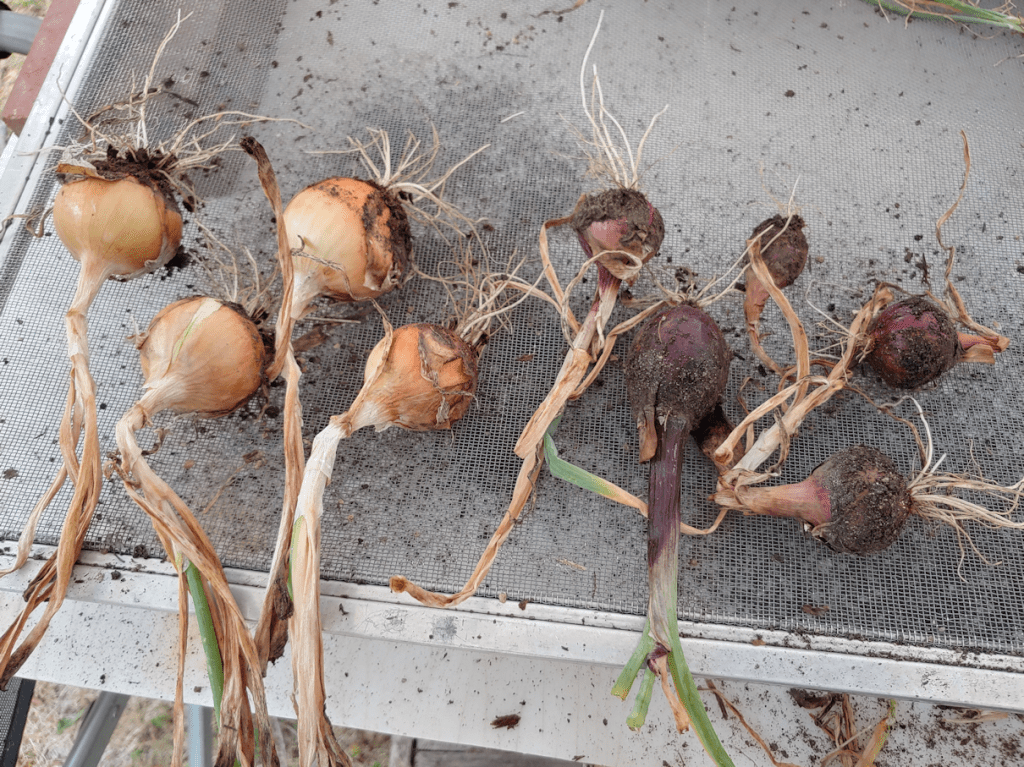
This morning, I decided to go through our onions and harvest the ones I was sure were done for the season. Here are the first ones I picked.

These are the yellow onions we planted from sets that I picked up at Canadian Tire, and planted in the same bed as the shallots. This is about a quarter, maybe a third, of what was in the bed. There were also a few that I pulled and left behind, as they had no roots and were starting to rot.

These ones are mostly pretty small, as they died off too early, I think.

There were enough of them that space on the drying screen was an issue, but they had enough stems left for braiding, so now they are hung up to cure under the canopy.

Then I went back to check the other onion bed.

Very few of these were ready to pick. On the left are the surviving yellow onions we grew from seed, and they are looking the best of all the onions. The ones on the right are the red onion sets we ordered from Veseys.

These have been left outside to dry for a while, but they will be for immediate use in the kitchen! :-)

I’ve been looking up how to tell if onions are ready to pick and finding conflicting information. Some say they are ready after their tops have fallen over, which I think is way too early. Others says after the dry outer skin has developed. Still others say once the youngest leaves – the ones in the very middle of the stalks – are dry, they are ready to pick. That one seems too late!

So the ones I picked were ones that had died off the most, and I could be sure they would not be growing any bigger. I’m also on the lookout for those with roots that have died off, and pull up easily. Those tend to already be going soft, and often have what looks like mold growing in them. From what I’ve read, that’s a sign of fungal infection, so they need to be taken right out.

It should be interesting to see the differences in flavour. I probably won’t be able to tell the difference, and the medications my husband is on has changed his ability to taste things, but the girls should be able to taste differences. I’ll have to trust them to tell me which varieties are worth growing again! :-D

After the issues we had with cats destroying so many of the onions we started indoors, I’m just happy to have any onions at all right now! :-D

The Re-Farmer

Our 2021 garden; fall planting, and shallot surprise

Now that it’s “cooled off” again to 32C/90F (feels like 34C/93F), I headed back to the garden to remove the shade clothes and get those photos I promised.

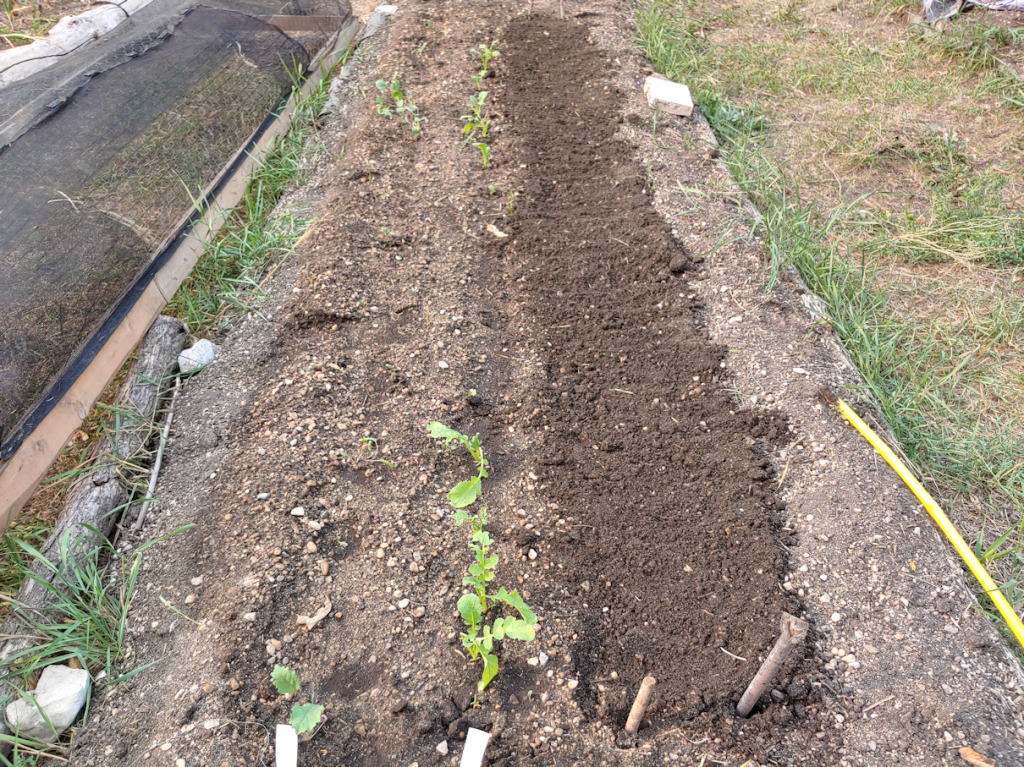
Our surviving (barely) French Breakfast radishes, and rainbow chard.

Now that one of the beds has a window screen mesh covering it, I decided to take a chance.

I planted lettuces.

On the far left are the surviving purple kohlrabi, and in the middle are radishes. I forget which variety at the moment.

I had our four varieties of lettuce together in a slide lock bag, and they spilled a bit, so I planted the mixed up seeds at the bottom of the bag. So we are going to have lettuce surprise when they start to sprout!

Moving the cover on and off is still a two person job. The length of the cover makes it a bit too wobbly. We definitely need to make the permanent beds shorter, just for that!

A nice thing about the window screen mesh is that it slows down and breaks up the water, so it lands more gently. We don’t have the hose nozzle set on anything high pressure, but these surviving seedlings are still spindly and weak from being under those water bottle covers to protect them from insects and critters. With the mesh covering the ends, I have at least some hope that these lettuces will have a chance to survive. At this point, it’s the grasshoppers, more than the critters, that are an issue.

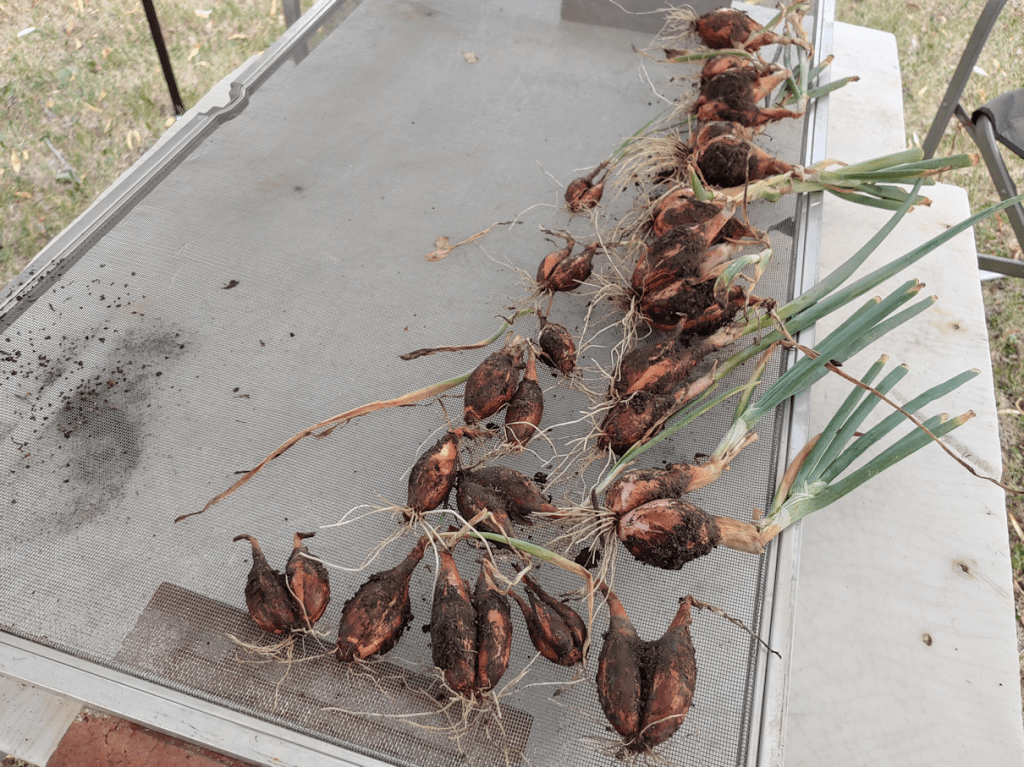
Once this was done, I decided to harvest the shallots. I’d been weeding the bed while watering this morning and accidentally pulled one up. I didn’t think they were doing well; many of the green parts had withered away completely, and I could no longer see where they were, while others just looked like they were struggling. The one I accidentally pulled up looked surprisingly large, so I left it there, to collect with the others this evening.

I was very pleasantly surprised!

As I started digging them up, I found they were much larger than expected. The one way at the far end in the photo is almost as big as an onion!

Then I accidentally dug up a shallot there there was no sign of any growing there anymore, and it was far larger than I expected, too. So I went back over the row and dug into each spot I knew I’d planted a shallot, and found several more! They are the smaller ones with no, or almost no, stems.

For now, they sit on a window screen, raised up on bricks for air circulation, to cure for a while. I’m quite pleased with what we got. Our original shallots, started from seed, were destroyed by the cats, so these ones are from sets I bought at the grocery store. There was only a dozen sets per bag, so I got two bags. A far cry from how many we would have had, if the ones from seed had survived, but way better than nothing at all! This is just awesome!

Tomorrow morning, I think I will start harvesting some of the onions. They are not all ready, but some of them definitely are. We have quite a lot of them, so I don’t mind harvesting and curing them in batches!

Being able to harvest things already, and even plant things for a fall harvest, kinda makes up for all the problems we’ve been having with the drought, critters and insects! We may not have as much as we hoped to in the spring, but we will still have food to harvest, and that’s the important part!

The Re-Farmer

Our 2021 garden, and the things I found this morning

I have to admit, after yesterday’s damage, I was quite trepidatious about checking the garden beds while doing this morning’s rounds!

I was, however, greeted with a happy sight, first thing.

Potato Beetle is still here!

With him being gone for so many months, there’s no reason to assume he’s here to stay, so every day that we see him will be a gift. :-)

The down side is, he’s been mean to the other cats. Though he used to be part of the crowd filling the kibble house since we built it last fall, he chased all the other cats away this morning. Yesterday, he went after Nutmeg for no reason, and even growled at Junk Pile cat while she was hiding under the cat shelter. I’m hoping this will settle down once he’s been back for a while.

I found an Ozark Nest Egg gourd blooming this morning. Between the density of the leaves, the chain link fence and the protective wire around them, there’s no way I can look to see if there are any female flower buds developing. Of the few I could see, they were still only male flowers. The vines are pushing their way through the chain link fence, and we should be able to start training them up the fence soon.

If they don’t get eaten, first!

More and more tomatoes are starting to change colour. Until today, the most Spoon tomatoes we’ve had ripe at the same time was only three. Plus, we have our very first ripe grape tomato, from the Mosaic Medley mix of seeds!

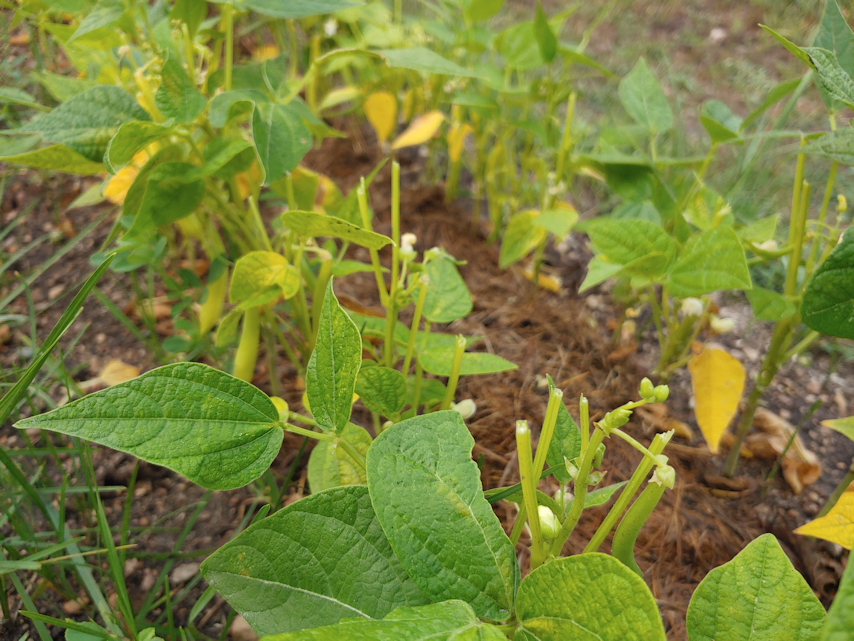
Alas, there was more deer damage this morning, though nothing like what we found yesterday. This time, it was the yellow beans that got nibbled on.

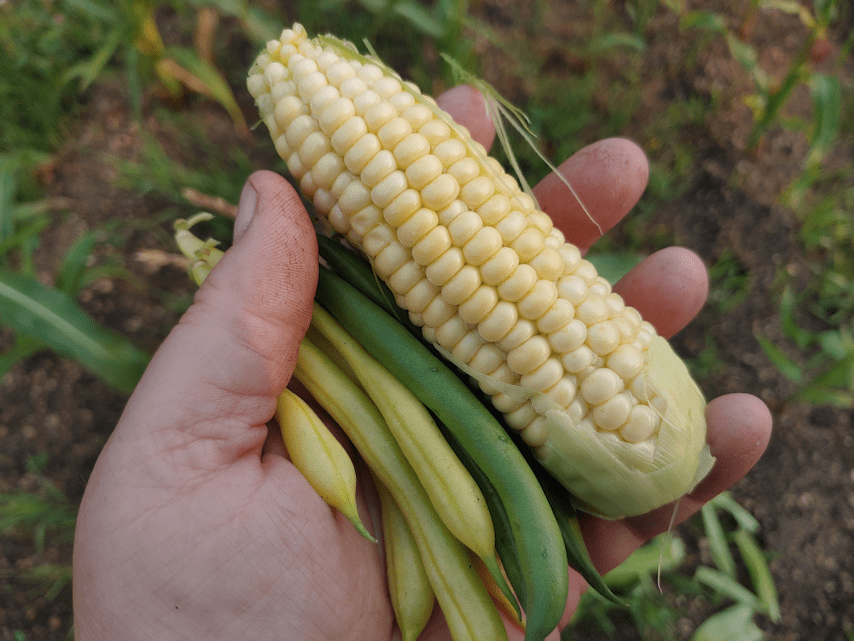
I was able to pick a small handful of both green and yellow beans this morning, but I am not finding anything in the purple beans. While moving aside their leaves to look, I was seeing a lot of stems, and I wonder if they’d been eaten. The purple beans have so much more foliage, it’s harder to tell, compared to the other beans.

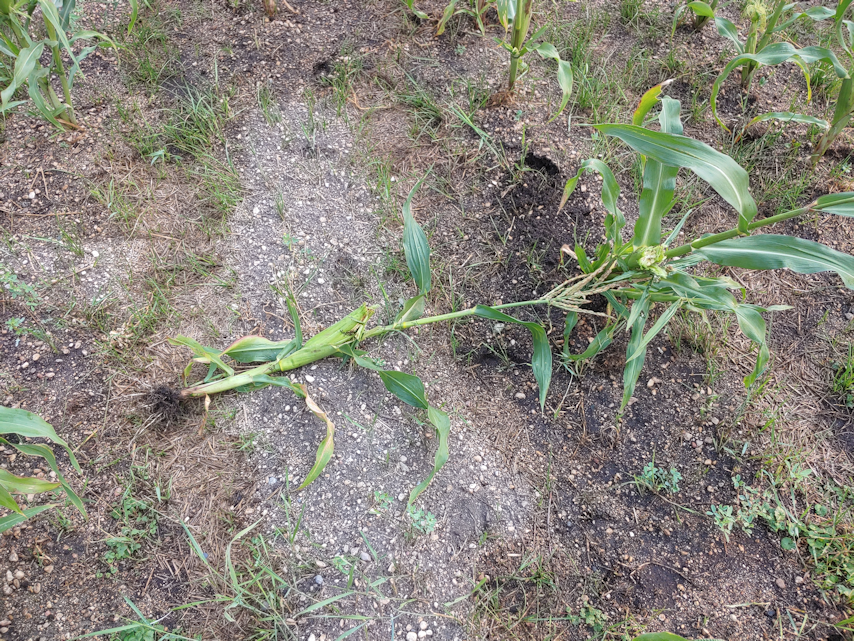
While the sweet corn and sunflowers appeared untouched, I found an entire Dorinny corn pulled out of the ground. The plant next to it has a big chomp taken out of the cob.

The ants were all over that cob!

I also found a cob that had been torn off another plant, with nothing but a nibble off the top. Curious, I went ahead and shucked it.

It was almost completely ripe! It was so well pollinated, too.

Well, I wasn’t about to let it go to waste, so I washed it and ate it raw.

It was delicious!

However things go for the rest of the season, at least I can say I’ve tasted both the Dorinny and the Montana Morado corn this year. :-D

I had one more find that I wanted to share, but I saved the photo for last. If spiders bother you, you might want to quickly scroll on by.

Still here?

I found a garden friend among the purple bean leaves.

I had been pushing aside and turning the leaves, looking for beans underneath, so it was a real surprise to see this spider, not being startled away. Just look at the grip it’s got on that egg sac! It didn’t move at all while I got close to take the photo. Such a good mama!

When I was done, I took the leaf off and put it on the ground in between some bean plants, where it was more sheltered.

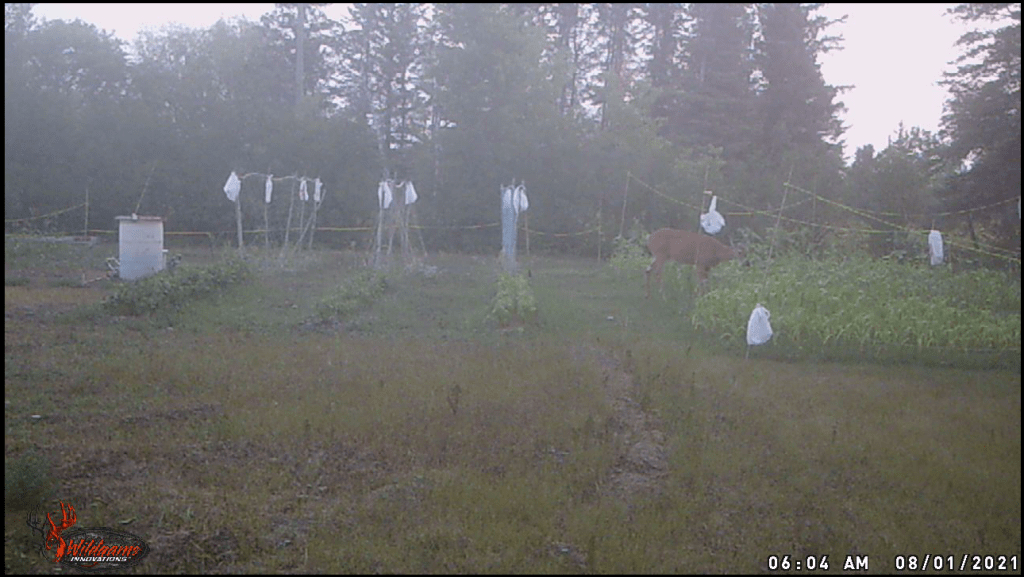
Once I was back inside, I checked the garden cam files and confirmed that yes, it was a deer that had done this morning’s damage. The only other critter that triggered the motion sensor was Potato Beetle, while he was keeping me company in the garden yesterday evening.

I have a few ideas on what to try next to keep the deer out, but I’ll need to go into to town to find the materials for it. Today is a holiday here in Canada, and there is a festival going on in town right now, so I’m going to avoid it completely. :-/

The Re-Farmer

Our 2021 garden; NOOooo!!! *sob*

Today is supposed to be hot again, so I wanted to make sure to get the garden watered early in the day, while it was still cool. I started with the soaker hose at the squash tunnel, then went around checking the melons, squash and gourds.

I was extremely disappointed to find this.

Our one and only Teddy winter squash was gone.

Et.

Munched.

Masticated.

The two Teddy plants are blooming, and there is even a female flower developing, but that one baby squash had grown so much after the rain, I was really looking forward to watching it develop.

This is one of the nearby Little Gem winter squash. There were no developing squash down here to be eaten; those are much higher on the trellis. Still, it means energy will be going to recover from the damage, instead of into developing squash.

Thankfully, that was the only damage here. The melons and gourds had no critter damage. I did find one of the nearby Dorinny corn had been gotten into, the remains of a cob on the ground. The corn may have been a deer, but I figured the squash was a groundhog. The deer don’t go along that side of the garden beds, preferring to walk through the open areas in the middle.

I was wrong.

When I checked the garden cam, I almost missed the shadow moving in the darkness. It was a huge raccoon! So big that, if it hadn’t turned at the end of the bean bed and I could make out its tail, I would have thought it was a bear cub.

I continued checking the beds, and was so disappointed to find this.

A deer got into the Montana Morado corn. In the above photo, several stalks in the outermost row are gone.

I found corn cobs scattered on the ground, each looking like they had only a single bite taken out of them.

Hoof prints left no doubt as to what was responsible for this damage.

The deer had traipsed right through the middle of the corn block, leaving damaged plants and nipped corn cobs in its wake.

These are all the cobs I picked up off the ground.

I think it would bother me less if the deer actually ate the corn, rather than taking a bite here and a bite there. and leaving a trail of damage.

On checking the cobs, you can see that a couple of them were almost completely ripe, if poorly pollinated. When ripe, the kernels should be an even darker purple.

One cob is looking like it was going blue, instead of purple!

Several of the cobs had been beautifully pollinated, full of developing kernels.

I am so incredibly unhappy. Clearly, the flashy spinny things around the corn block are no deterrent.

Not even our purple beans escaped damage. The purple beans are lusher and bushier than the green and yellow beans – except for at this end of the row, where the leaves have been thinned out by nibbling.

And here is the beast that did the damage – nibbling on a sunflower!!!

I. Am. Not. Impressed.

I even added bells to the lines around the corn and sunflower beds, but the deer came from the other side!!

Venison is sounding very good right now.

What a disappointing way to start the day.

Other things went well, though, and I will save those for other posts!

The Re-Farmer

Our 2021 garden: what happened? and more critter damage :-(

One of the things I’ve been trying to baby is our Montana Morado corn. I really, really want these to work out!

As these were started indoors, they are much further along than any other corn we have, and have been developing ears of corn for a while now. I’ve been a bit concerned about pollination, and have even been hand pollinating any cobs that look like they might get missed.

My concern?

Many of the silks have have dried up. This is supposed to be a sign that the cobs are ready to pick, but they shouldn’t be ready to pick until the end of August or so. The packet didn’t have a “days to maturity” on it, as the variety is just too knew, but in looking up maize morado, it says 120 days to maturity, so I figure this should be close.

As my daughter and I were looking the corn over and talking about our concerns over how many silks are dry, even on tiny little cobs, I went ahead and picked a cob from the plant that first developed one. This would be the largest, most mature, of all the cobs. The silks at the top were so dry, they came off as I started to peel off the husks.

So this tells me one thing, at least. Pollination is good. There are lots of developing kernels, and almost no gaps. It is also clearly immature, and just starting to turn to its mature colour.

I have to admit, that looks very… unfortunate… :-D

We did taste it, and while not particularly sweet (I was not expecting it to be), but it did taste… well… like corn.

So why are the silks starting to dry so early? Yes, it’s been dry, but we’ve been diligent about watering these.

Have we not been watering it enough? Has it been too hot, even for this variety that was developed in a warmer zone than us? Will the cobs continue to mature, even if the silk dries up as would normally happen when the cobs are ready to pick?

I don’t know, but I’ve posted the question on one of my local gardening groups. I’ve had some clarifying questions, but so far, no answer.

Crud.

Well, we’ll just keep watering them and hope for the best!

Meanwhile, on checking the Crespo squash nearby…

More, “oh, crud.”

One of the vines have been eaten, and it does not look like deer damage. The barriers we put around it might convince a deer to not bother, but they can’t actually stop anything. I’m guessing this is from one of the woodchucks.

Today was hot enough that everything has dried up again, so I set up the sprinkler on the purple corn for a while. As I was moving the sprinkler to the corn at the opposite end of the garden area, I spotted a woodchuck in the middle of one of the sunflower blocks!! It wasn’t eating anything, and there was no damage when I checked, so it may have been just passing through.

I greatly encouraged that notion, and chased it through the hedge, into the ditch. It can go to the empty house across the road!

Anyhow.

As for the corn, I guess the only thing we can do is keep watering it and hope the cobs will continue to mature.

When we first bought the corn seeds, the produce description was for maize morado. The site even had a video talking about how a cowboy from Peru brought some seeds to where he was living in the US, and was able to grow extra to provide seeds for the company. I thought I was getting a Peruvian corn. Then the story changed, and it turned out to be a purple corn developed in Montana, and now it seems the name has been changed to Mountain Morado.

While trying to look up what the days to maturity might be for this corn, I found a different seed company that is selling the actual maize morado from Peru, Kulli. I think I will try buying those for next year. The packets only have 25 seeds in them, so I’ll probably get two or three. I had hoped to have seeds to save from this year’s corn, which may still happen, but if I don’t, I will also try the Mountain Morado (again?). Between the two, I hope to have something that will grow in our zone.

Until then, we’ll see how things go with what we have now.

The Re-Farmer
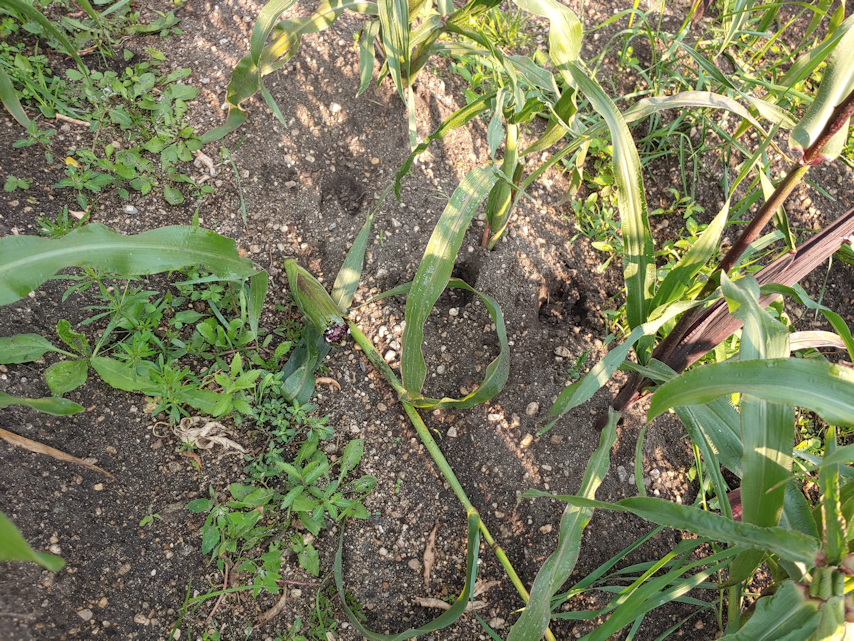
update: well, that was fast! Having tapped into the wealth of knowledge in the local gardening group, I have a likely answer. The drying of the silk may show that they have been successfully pollinated.

It’s either that, or the heat.

Our 2021 garden: corn, melons and new critter damage

We have been very excited by how well the Montana Morado corn has been doing. However, as some of the stalks have gotten taller, they have started to fall over. The soil around the plants seems to be washing away as we water them. So, this evening, I added more garden soil to the bases of each one.

While watering these, my daughter has been focusing on giving a deep watering into the paths in between them, then using a finer spray to water the entire bed, so as to prevent more erosion. A couple of the stalks are also supported by stakes.

We are very curious about what the cobs will look like. Some of the stalks, silks and tassels are very purple, while others are varying shades of green. These are all supposed to give us corn so dark a purple, it looks black. But is that what we will get? We shall find out! It does look like several cobs are filling out nicely. :-) I’ve taken to hand pollinating every now and then, just to be on the safe side.

Meanwhile, while watering the squash tunnel, my daughter found another little melon!

At first, she thought one of the ones she’d found before had fallen to the ground, but then she saw they were both still there, so she lifted the third melon onto the structure. This had me looking around for more, and I was very excited to see two of these.

Tiny little melons, juuuust starting to form!

This is awesome!

I checked the other melons, squash and gourds. The summer squash is getting nice and big, and I might even have a couple of squash to pick tomorrow. The other melons and the winter squash have flowers and/or buds, but no fruit forming. Same with the Crespo squash. The luffa isn’t even showing flower buds, but it is climbing the trellis.

Then we went looking at the tomatoes (so many fruits are forming!), and they are doing great. The tiny little onions we planted under them are still tiny and little. :-D I noticed this morning, however, that a couple of self seeded (likely from the bird feeder) sunflowers seemed to be gone. This evening, I looked again and found their stems, leaves all eaten away. *sigh* More of the flowers in the bed nearby have not only had their heads eaten away, but in one area, even the stems are being eaten. We will not be getting many blooms out of that bed this year!

That reminds me: it looks like a lot of our French Breakfast radishes have been eaten, too. Possibly grasshoppers.

When checking the cucamelons, it looked like some of them had lost a few leaves and vine ends, too! They’re such small, fine plants, though, it’s almost hard to tell.

Then I saw this. :-(

This is the Thai Bottle Gourd. We had the one transplant, and a second seed germinated next to it. Now, the little one has lost most of its leaves, and the big one has lost a couple, plus a couple more leaves are partially eaten.

No damage to the Ozark Nest Egg gourds. Which is good, but we have more of those!

Very frustrating.

This year’s garden has been such a mixed bag of stuff going well, and stuff going badly, due to critter damage!

The Re-Farmer

Critter battle update, a mini harvest, and we’re getting poppies!

First, a bit of a follow up from yesterday. After blocking the woodchuck holes by the house and in the old garden area, I headed out a few times to check on the one by the house. Twice, I found things disturbed!

This picture was taken after the second time I found it dug up. The first time, I had started to remove the plastic around the back of the mock orange, saw that things had been pulled out, and started tying it back again. As I was fussing and making noise, I could actually hear little grunting noises coming from under the stairs! I found some rocks had been dug up a bit on the other side, too, but just a little. After blocking the other side, I tried spraying water into the little gaps remaining, to try and pursuade the woodchuck to leave out the other side. We never saw it, but I came back later and it seemed to be gone, so I blocked the opening again. A couple of hours later, what you see in the photo above it what I came back to! After making as sure as I could there was nothing inside, I blocked it off again. As of today, it has not been disturbed again, so here’s hoping the critter has decided it’s not worth the effort.

Later in the evening, I found this in the old garden area.

Much to my surprise, the first den we found was dug into again! It was just a small hole compared to before – the buried sticks seemed to work in preventing further digging. I blocked it off and, when I checked it this morning, it was still buried. Once again, I’m hoping the woodchuck has decided it’s not worth the effort and have moved on.

After doing the watering this morning, I picked a tiny little harvest.

There was one zucchini big enough to pick, and I gathered the last of the garlic scapes (unless I missed one or two). Plus, we have our first peas. :-D Only two pods from the purple peas. Because the pea plants are so stunted in growth, the weight of the pods were keeping the plants they were on from being able to reach the trellis lines. At least we’ll be able to taste the peas. I’m curious about how the purple peas taste. Reviews on the Baker Creek website were pretty mixed!

Unfortunately, it looks like some of the pea plants are not just stunted in growth, but have been nibbled on, too! Where this is new nibbles or not, I couldn’t really tell. I also noticed new nibbles on the Crespo squash. Any part of the squash that started to grow outside the hoop and twine barrier seems to be getting nibbled. We’ll have to find a way to extend the barrier.

Meanwhile, in the old kitchen garden, I’m happy to see pods developing on the Giant Rattle poppies! These had had such a rough started, I wasn’t sure what we would get, so this is making me very happy. For this year, we might have enough pods to taste them, but not enough for cooking with; mostly I want to save the seeds to grow more next year, and fill the bed. Gosh, this brings back memories! When I was a kid, my mother grew similar poppies in this garden, and I remember my late brother and I picking dried out pods and eating the seeds, straight from the garden. We would later have big bunches of the dried pods (well… big, in my childhood memory!) gathered. The only thing I remember my mother making with them was a special soup she made only for our Wigilia (Christmas Eve) dinner.

I did have another harvest this morning, which will get its own post next. :-)

The Re-Farmer

Our 2021 garden: this morning in the garden

I love how, every day, there seems to be something new or different in the garden!

While doing my rounds, one of the first things I do after putting food and water out for the cats (or like today, just water, as my husband was feeling good enough to go outside and do their food), is check the nearby potatoes.

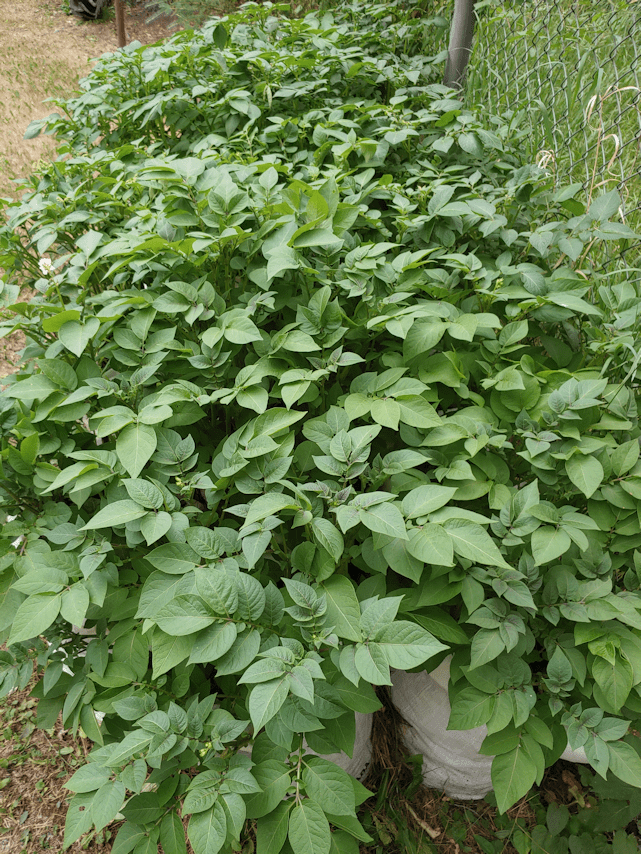
They are so huge and lush, you can barely see the grow bags! Of everything we planted this year, nothing is doing as well as the potatoes.

Hopefully, that means we’ll have lots of potatoes, and not just lots of greenery!

Potato flowers are such pretty little things!

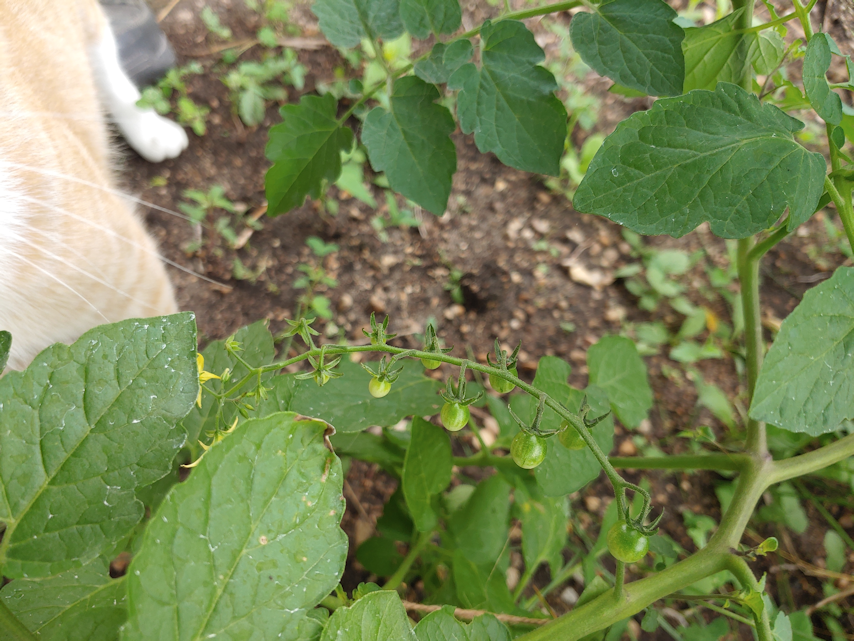
While checking the tomatoes, I tried looking for the baby tomatoes we’ve been seeing and had a hard time finding them. Then I found this “huge” spray of tomatoes I’ve somehow missed seeing all this time!

“Huge” being a relative terms, for the world’s smallest tomatoes! :-D

While heading back down the driveway after switching out the trail cam memory card, I had to pause to get this photo.

There are less of these flowers than last year, and they are blooming later. Like so many other things, they had been damaged by that one cold night in May, and it’s taken this long for them to recover. We don’t water down here at all, and we’ve had no rain, so it’s amazing to see them at all. Such resilient flowers!

I was weeding the big carrot bed this morning, which is rather difficult right now. I sometimes wonder why I bother, considering how much they’ve been eaten. I accidentally caught a remaining carrot frond while pulling up a weed, and pulled a carrot up with it.

I’m… kinda glad I did.

If they have this much root after all they’ve been through, there is still a chance for them! We won’t get any big carrots, and my hopes of having enough to can are certainly dashed, but we might still have something worth harvesting.

As for this little guy, I washed it off with the hose and ate it, and as small as it was, it was tasty.

So that’s encouraging.

I had another surprise waiting for me in the old compost pile nearby.

Amazingly, there are more mystery squash coming up, next to the stems of the chewed up ones!

Of course, nothing will come of them after sprouting this late in the season, but we might at least see them get big enough to determine what they are.

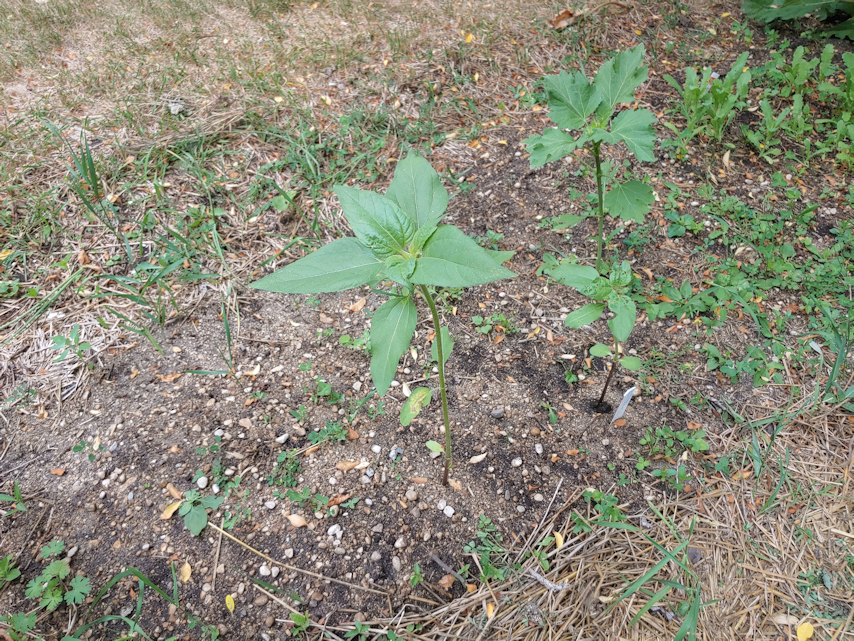
I find these two Hopi Black Dye sunflowers in the old kitchen garden very interesting. The bigger one was the first of the seeds we started indoors to germinate. That was after the ones we’d direct sown outside had already germinated. The smaller one, which has the label next to it, germinated some time later. Right now, both of these are bigger than the ones that germinated first, in the large beds. The difference, of course, is the soil. The other ones are planted in an area that has not been amended or planted in before, while these are in a garden we’d been working on for 3 summers already

As for the tall plant behind the smaller sunflower, we still don’t know what it is. :-D

I was happy to see that many of the poppies have seen quite a growth spurt, and the ones that were under rhubarb leaves are getting stronger.

Then there is this plant, nearby.

When we were preparing the bed next to the retaining wall, there was a compact plant growing in it. Unsure of what it was, other than “some kind of flower”, we dug it up and transplanted it between the rhubarb and the chives. It quickly grew from a compact, bushy plant to the tall, leggy thing you can see in the photo.

I also now recognize it, though I still don’t know the name.

Do you see those sprays at the ends? With the small round things hanging down?

When it starts blooming, this plant has lovely, delicate little flowers.

Which then become some of the most annoying little burs, ever. It isn’t possible to go near one of these without ending up with masses of tiny burs stuck in your clothes, that are harder to get out than burdock! I’ve had some get so thoroughly stuck in my clothes, not only was I not able to get them completely out, but they managed to stay stuck after several washings!

After I took this photo, I pulled it up. Even though it is in the flower bud stage, it still tried to stick to my clothes!

It did not go into the compost, but into the fire pit for eventual burning.

If we ever get to light the fire pit this year. I suspect not.

While things have finally cooled down today – in fact, it actually got chilly last night! – and we are no longer getting heat warnings on our weather apps, we are now getting air quality alerts. There are a number of fires burning in our province right at the moment. I’d actually been smelling wood smoke for a while before we started getting the alerts, and with our heat and dryness, I was very concerned. None of the fires are near us, thankfully, but we’re still getting some of the smoke.

Today will be our coolest day for the next while, with a high of only 18C/64F so I will be taking advantage of it and getting things seeds sown in those empty spinach beds! :-)

The Re-Farmer
Our 2021 – and 2022 – garden: seed assessment

Before heading out to do the watering, I went through our remaining seed packets to do a bit of planning.

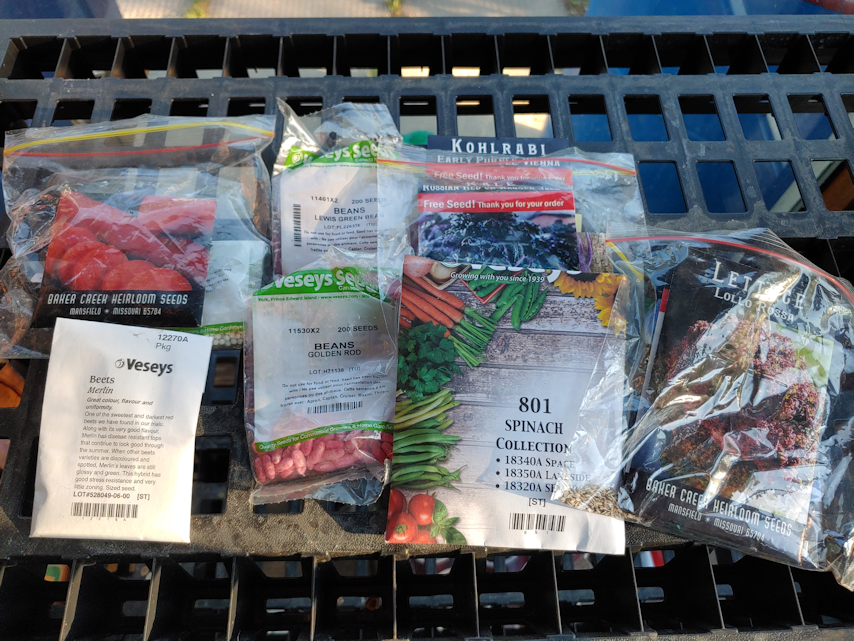
First, there’s what’s left of things we planted in the spring.

To the right, we have the two types of carrots in pelleted seeds. I keep reading that we can still plant carrots this late in the season, and I had debated with myself about replanting the carrots decimated by the woodchuck, but really… what’s the point? It seems to have a special love for carrot greens, and until we get rid of the woodchuck, there will be no new plantings of carrots!

To figure out what we can plant for a fall harvest, I looked up our first frost date, which is Sept. 10, and worked out how much of a growing season we have left. Then I checked out the germination and days to maturity to see what we can plant now, and what will wait until later. We could plant the remaining Merlin beets, but we have so many beets planted, there is no need. The two types of beans could also be planted, but again, there is no need. Not in the photo are the remaining green peas, which apparently can also be planted this late in the season, but we won’t. If we wanted to, we could plant any of the summer squash, too, if we wanted to. All the seeds we will not be using this year got set aside for next year.

We had received the purple kale and purple kohlrabi as free seeds with each of our orders from Baker Creek. We ended up with two packs of kohlrabi seeds, but still have seeds in the one we did open. There are still kale seeds, too. These are both cool weather crops, and the kale can hand frost. While I plan to try kohlrabi again next year by starting them indoors, I’d forgotten we still had seeds. I’ve decided I will go ahead and plant the rest of the open packets of seeds, in hopefully better conditions, and actually get some growing!
The 3 types of spinach adn 4 types of lettuces will be planted, but not until the end of July.

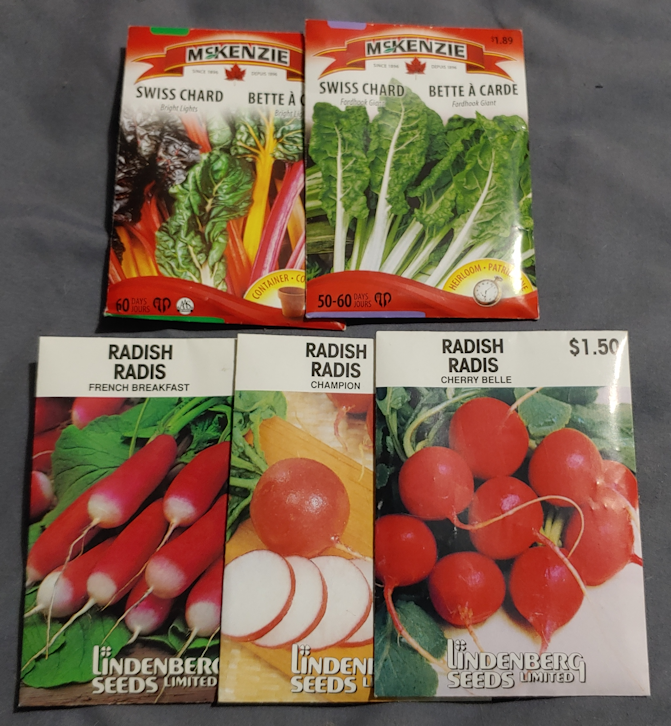
Then there are these.

I’d picked up the radish seeds when I was last helping my mother with her grocery shopping. I intend to plant those as soon as possible; just a few of each. From what I’ve read, I should not expect to get bulbs developing in the heat of summer, and will be growing them for their pods.

The chard was something I picked up a few days ago. While waiting in line at the grocery store, I found myself next to a couple of boxes of seed packets, all jumbled together, instead of in their display cases. I rifled through them and found the two types of chard, which will be planted right away, too. I’ve read that they are tolerant of summer heat.

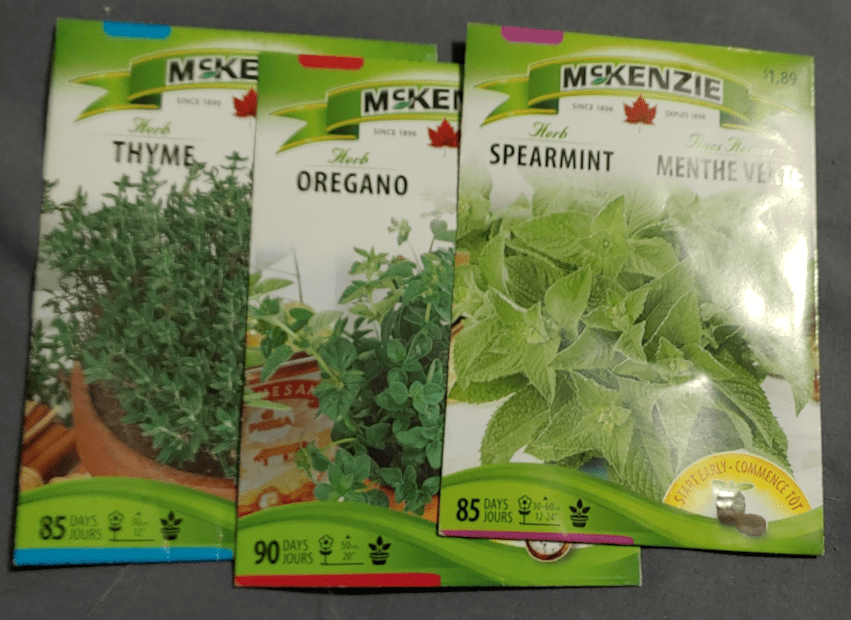
While going through the seed packets, I also picked these up.

Little by little, we intend to have an herb garden, likely in the old kitchen garden, so these are seeds for next year. Unless we want to try growing them in pots indoors, but I don’t imagine they’d survive the cats.

So we now have our first herb seeds, and more seeds to join the Yellow Pear tomatoes I picked up earlier.

The 5 day forecast has us back to around average temperatures for July, which means we should be able to catch up on things we’ve set aside because of the heat. But then, the forecasts have been so off for the past couple of weeks, I wouldn’t be surprised if the forecasts were completely off! Still, those empty beds need to have something planted in them, and it needs to be done soon!

The Re-Farmer