There’s another one under it that bloomed and was done before I ever saw that it was a female flower.
There were no male flowers open at the time, so I grabbed a couple of older ones and tore off the petals so I could access the pollen and hand pollinate. The first one had water pour out when the petals were torn off, so I used a second one, too, just in case the first one didn’t have any viable pollen. At this point, it’s too early to tell if the one I missed had a chance to be pollinated before it was done blooming.
This afternoon, I decided to use up a whole bunch of odds and ends vegetables in the fridge, along with some fresh stuff, in the slow cooker. I’ve been leaving the potato bed for the past while but decided to dig some up for today’s use.
I had dug some up before under the potato plants that had died back the most, which was at the north end of the bed, closer to that row of self seeded trees my mother left to grow. The entire potato bed died back early, without ever developing flowers, but the north end of the bed had them dying back the fastest.
The potatoes in that basket are from under four potato plants that were at the end of that bed. That mass beside the basket is capillary roots from the elm trees nearby that came up while I was digging around for the potatoes. I was hitting more, larger roots as well. I’ve de-rooted these beds several times, and they come back so fast!!
Those trees have GOT to go! They’re killing our garden!
I dug up more potatoes closer to the middle of the bed, and was still getting a lot of capillary roots like that, but found more potatoes under two plants, than under the four I’d dug up first.
Since I finally had a container on hand, I harvested Spoon tomatoes. It’s been a while since I picked any, so there were plenty to gather. Thankfully, the mesh on this basket is fine enough to hold the tomatoes! Some of them were so small, they would have fallen through if they weren’t being held in place by the larger ones. I had to be careful to keep the potatoes from rolling over and squishing them.
Then I grabbed a few more carrots to add to what we already had inside, and the only ripe bush beans I could find.
In the last photo of the slide show above, it shows all the vegetables I prepared for the slow cooker, seasoned and tossed with avocado oil. All from our garden!
There are the potatoes, carrots and Spoon tomatoes, of course. Plus I finally used that one big turnip that I’d left to get big and go to seed, but the deer ate most of the greens. There’s kohlrabi in there, and more beans that we had in the fridge. It took three “harvests” of bush beans to have enough to make it worth using them in anything! Oh, and there is Swiss Chard and a whole bulb of fresh garlic in there, too.
We have a large Crockpot, and the vegetables almost filled it completely. They will shrink as they cook down, though. After I left for my mother’s, my daughter browned some ground turkey, along with some of the yellow onions we still have left from last year’s garden (they have lasted a really long time!!!) and mixed that in later on.
The slow cooker was set to high for 3 hours. Since I’ve come back from my mother’s, I’ve checked on it a few times and added more time. All those potatoes need extra time to cook through, as I deliberately left them in big chunks. For I still don’t know how it turned out!
The house is smelling amazing, though, and I’m getting hungry! 😄
These were damaged quite a bit by that one cold night was had, shortly after they were transplanted. It set them back and, while I saw them blooming, I was beginning to think there would be no eggplants forming at all.
Today, while watering, I finally spotted some! In fact, in the space of a couple of days, there are now more eggplants forming that there are of the peppers, in the same bed. There are still only three peppers forming among the 9 plants. Just one eggplant has more than that forming!
Now, the question is… do we have enough season left for them? Normally, these would have 80 days to maturity from transplant. We have barely 30 days of growing season left before average first frost. I’m still going by Sept 10 as our average first frost date, even though the 30 year adjusted averages that just came out now says our average first frost dates are between Sept. 21 and 24. If I look at the monthly forecasts in my desktop weather app, we might not get frost until the second half of October. Since moving out here, we have had everything from a blizzard in October to first frost in November. So really, there’s no way to be sure. With how badly our transplants and spring sowing have been, in general, I’m really hoping for a long, mild fall. If that does happen again, we might actually have stuff to harvest and preserve for the winter. With the way things are going right now, we have just a few things we can harvest every couple of days, to supplement a meal or two.
While watering this evening, I am actually noticing some growth. I might be imaging things, but even the red noodle beans seem to be looking a bit greener, and a bit bigger. The Giant Fordhook chard I planted as a fall crop, where the Royal Burgundy bush beans failed, are still just barely there, but they are getting bigger! The winter squash are blooming – no female flowers, though – and I even spotted a couple of tiny zucchini forming! I don’t know if they got pollinated before the blossoms closed up. They weren’t open when I did my rounds this morning, or I would have hand pollinated them. The pumpkin vines are doing well. Two of them are quite a bit ahead of the others, and the female flower on one that I hand pollinated is now a growing pumpkin. I’m training that one up the trellis, so we’ll need to make a hammock to support the weight of the pumpkin. When the trellis is finished, it will be built to hold the weight of winter squash of all kinds, but we’re not there yet!
It isn’t a lot, but I’m pretty excited about any progress we get right now!
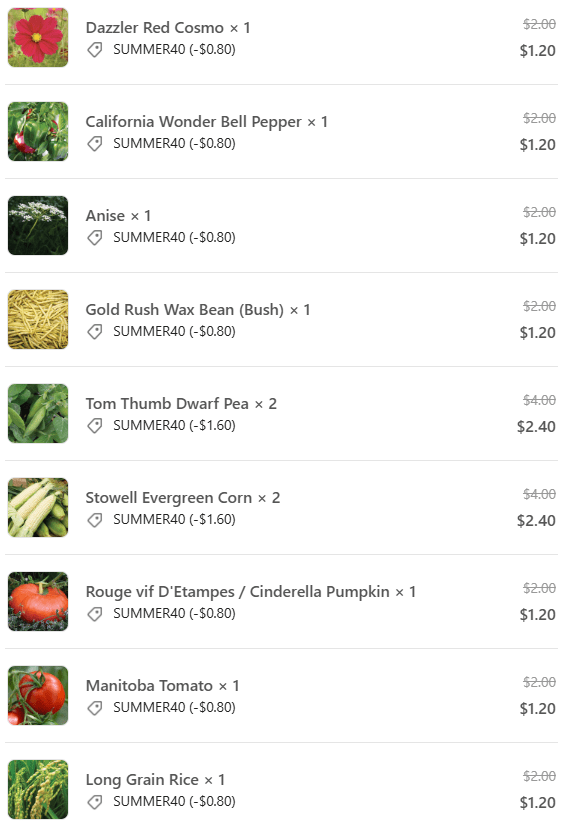
Okay, so I took advantage of MI Gardener having a 40% sale on seeds. Which means I got a lot of things I wouldn’t normally have been able to get and still stayed in budget. Most of these will be for future gardens, as we continue to build more beds and extend further afield.
Here is what I ordered today. Click on the images to see them better. I’ll include links as I list them below, this time in alphabetical order.
Oh, the crazy thing about going back and looking up the links. When I placed the order, I selected “in stock” items only. Going back, I just went through all the seeds, not just categories and not just “in stock”. I found that quite a few things I ordered are now listed as out of stock – but there are things that I see listed as in stock, but weren’t there when I was placing the order from the in stock only list!
Must. Not. Place. Another order!!
Ah, well. Here is what I chose today. All links should open in new tabs.
Anise One for our developing herb garden. I had no idea anise could grow here, but it’s only 75 days to maturity, so we should have no problem.
Bachelor’s Button – blue Bachelor’s Button – pink Years ago, I lived in a city where Bachelor’s Button practically grew wild and always loved them, but I had no idea they were also edible! These are deer resistant, so they will be planted strategically.
Butterneck Squash This one is a Canadian heirloom variety that is apparently almost extinct! So of course we’ll have to grow some to save seed. 90-100 days to maturity.
California Wonder Bell Pepper these are to restock our pepper seed inventory. It’s a thick walled pepper, which caught my attention. Some varieties we’ve tried had surprisingly thin walls. 75 days to maturity.
Canary Yellow Melon I’m as much a sucker for melons as I am for winter squash! 80 days to maturity
Caraway Another one for our future herb garden. 70 days to maturity.
Coffee Seeds (coffea arabica) I always like to have at least one “for fun” thing and one “challenge” thing. This will be a “challenge” thing – and to be grown as a house plant, as this is a zone 11-13 item. 2-4 years to maturity, and yes, this is a real coffee plant that we could potentially harvest beans from to make our own coffee. This one is more for the girls, since they are the coffee drinkers in this household.
Dazzler Red Cosmo I got this because the red is a less common colour for them, and they are great for attracting pollinators. 75-90 days to maturity.
Gold Rush Wax Bean (Bush) I did already get a tri-colour mix of bush beans, but I’ve almost used up the yellow bush bean seeds I had in my current collection, so this is a replenisher. 55 days to maturity.
Golden Boy Celery I’ve never grown celery before. The one time I tried, it was a pink variety and I started them way too late. These ones, however, are 80-90 days to maturity, so I shouldn’t have that problem.
Golden Hubbard Squash Yeah, I’m a sucker for the winter squash! These are a smaller and more prolific variety of Hubbard that grows to “only” 5-15 pounds. 95-110 days to maturity
Hales Best Jumbo Cantaloupe Melon Yup. Another melon! These are described as being more drought tolerant and thrives in hot weather – kinda like we’ve got right now. 85 days to maturity.
Long Grain Rice I looked these up out of curiosity and was shocked. We can actually grow this variety of rice here! Gotta try it! 90-100 days to maturity.
Manitoba Tomato This is an all purpose tomato, and the variety my mother used to grow here, so I know these should work. With only 65 days to maturity, we could direct sow these, instead of starting them indoors.
Meadow wildflower mix One of these days we’ll get a wildflower mix that will take! 90 days to maturity.
Oaxacan green dent corn (x2) There aren’t a lot of seeds per packet, so I got two of these. As a dent corn, we would be growing these to make corn flour. Only 80 days to maturity, too!
Orange flesh honeydew melon Oh, look! Another melon! We have the green flesh honeydew (none of the melons we have this year are going to produce, and I still don’t know what happened), and now orange flesh. 75-110 days to maturity.
Red Long of Tropea onion We’ve grown this variety before, and they did really well. We have our own onion seeds, but none of this variety. 90-110 days to maturity.
Red Wethersfield onion While I think we these are the red onions we have in the mix of our own seeds collected, they were from onions that had died off after transplanting – we thought! – but came up the next year. We’ve never actually successfully grown edible bulbs of these, so I figure it might be worth trying again. 100 days to maturity.
Rouge vif D’Etampes / Cinderella Pumpkin This variety caught my attention partly because it’s listed as being able to last in storage longer. 110 days to maturity.
Russian Tarragon Another one for the future herb garden, and it apparently overwinters well with little protection. Not sure if that applies to our zone 3 winters, but no zone is listed at all for it. 60 days to maturity.
Stowell Evergreen Corn (x2) Another corn, and another addition to our collection of white things! This variety is listed as drought tolerant, which is important for where we are. There aren’t a lot of seeds in the packet for something that needs to be wind pollinated, so I got two. 80-100 days to maturity.
Tom Thumb Dwarf Pea (x2) This variety grows to only 13-18 inches high. No trellis needed. Which would make it much, much easier to protect from deer! Not a lot of seeds per packet, so I got two. 45 days to maturity.
Triticale (x2) Okay, this one is for well into the future! At some point, we do want to grow our own grain to make flour. I’ve already got some heirloom wheat that is particularly noted for making good bread flour though, even with two packets, the amount of seeds I have for those would be grown only to collect more seeds for the first couple of years! The triticale comes in 500 seed count packets, but I still got two. Even so, the first crop would be mostly to get more seed for larger, future plantings. Thinking well ahead on this one! 85 days to maturity.
There we have it! My second order with MI Gardener, in as many days, and third order this summer. 😄
While there are still some things we will get from other sources, these orders will set us up for several years, as we build and expand on our garden beds and growing areas, plus more flower seeds for the pollinators. The additions for the herb garden has brought that goal closer to reality by quite a bit. There are many other herbs I’d love to get, but most of them need a much longer growing season than we’ve got. At least until we get a permanent greenhouse.
I seem to have become addicted to getting seeds like I used to be with getting yarn. Seeds are cheaper, though! Especially with sales like this one. This order totaled US$36, with a savings of US$24. No shipping costs, either. Plus, they have a points program and I now have enough points to get $5 off my next order.
Which is not going to happen for a while. I’ve got lots of seeds now!
Honest!!
At least until their new inventory comes in, after this blow out sale clears space for them.
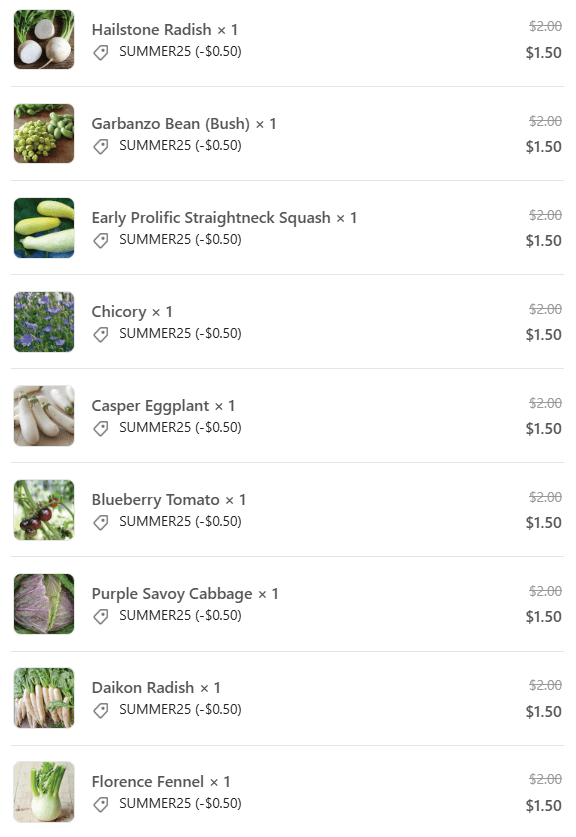
I placed an order with MI Gardener previously, and it arrived a while ago. So why did I order more? Well, MI Gardener prices are some of the best around right now, even when ordering from Canada. I’m on their email list and they announced a 25% off sale that started today. I happened to be up past midnight, so I went ahead and placed an order to take advantage of it. In fact, I might even made another one. I haven’t decided yet.
I took advantage of our winter sowing experiment to clean out my seed inventory of older seeds, so part of my goal was to replace things with fresh seed. With the sale, I’m continuing that, but I am also building my my seed inventory with extra. How much we actually plant will depend on how many beds we have ready this fall for winter sowing as well as for spring sowing and transplanting next year.
So, without further ado, this is what I ordered last night/this morning.
This time, I’m going to link to each item I ordered. All links should open in a new tab. They are list below in the same order as in the images above.
Tigger Melon This was something I had in my wish list. It’s a tiny, personal size, melon. More importantly, it takes 90 days to full maturity, and we average 99 days between first and last frost. In theory, we could direct sow them and get a harvest, though I would start them indoors, just to be safe.
Summer Savory This year, I bought a summer savory transplant. We plan to expand our culinary herb garden, and this will be part of that. Only 65 days to maturity.
Golden Sweet Pea I got another colourful variety last time. We have other peas as well. I just like to have a variety to shake things up. 😊 60 days to maturity.
Black Futsu Squash We have a variety of winter squash seeds, but we’re still experimenting to see what we like. This variety has an edible skin and stores 4-5 months. It needs 110 days to maturity, so definitely one to start indoors.
Orange Currant Tomato This looks very much like an orange version of the Spoon tomatoes we’ve been growing for a few years now – and it the only tomato that has anything we can harvest at the moment. It would be great if these do as well. 65-70 days to maturity.
Yellow Swiss Chard We have Rainbow Chard. We have Fordhook Giant Chard. Why not Yellow Chard, too? As with the other chards, this one is heat tolerant, drought tolerant and can grow in cold weather, so it can be succession sowed as well as winter sown. 28-57 days to maturity.
Sweet Siberian Watermelon One of these days, I’d really like to get watermelon! I only get short season varieties, of course, but so far, none have done well. The one Cream of Saskatchewan melon we got last year about about the size of a baseball, and they’re supposed to be much bigger. This variety is supposed to produce 15-20 pound fruit, yet has only 80 days to maturity. It does come with the warning that it needs lots of room to spread!
Shogoin Turnip a good cool weather variety that needs only 40-60 days to maturity. Plus, it’s really pretty.
Lemon Squash In our first couple of gardening years, we had good summer squash production. Then… nothing seems to be growing! I’m hoping this variety will do better. It’s supposed to be prolific, and only 50-60 days to maturity.
Hailstone Radish with finally being able to grow radishes, and even radish seed pods, through winter sowing, I’m more than happy to experiment with different varieties. This one is only 25 days to maturity!
Garbanzo Bean Okay, this is an odd one. Until fairly recently, I didn’t even know garbanzo beans, aka chickpeas, could grow here. I happen to really like chickpeas. However, they are also drought tolerant, nitrogen fixers. They are 100 days to full maturity, though, so it’s touch and go for this one.
Early Prolific Straightneck Squash So this seems to be another winter squash with an edible skin? The description specifies it is like zucchini, and that the whole thing can be eaten. I’m not sure, but with our luck with any squash these days, I’m willing to try it! Heat tolerant and somewhat drought tolerant. Only 70 days to maturity.
Chicory Okay, I’m not sure how to categorize this one. Perhaps it’s one for the kitchen garden. The leaves can be eaten, and it can be used medicinally, but it’s mostly the roots I’m interested in, as they can be used as a coffee substitute. I remember my parents sometimes buying it at the store, but never tried it. I don’t drink coffee, but my daughters do, and that stuff’s getting really expensive. So… worth a try. Especially with only 80 days to maturity.
Caspar Eggplant I’ve definitely got a “white” theme going on this year! This is described as a rare Japanese variety. Of course, I see “rare” and I’m all for growing it to save seeds. 😄 75 days to maturity.
Blueberry Tomato yes, another tomato to try! A cherry tomato with a lovely appearance. Hopefully, it’ll taste as good as it looks. 75-85 days to maturity.
Purple Savoy Cabbage Growing cabbages is something that’s been our list for when we have more space in the garden. Cold tolerant and good for storage. Only 65-70 days to maturity, too.
Daikon Radish I actually meant to order this last time, but they were sold out. I got the icicle radish instead. My younger daughter really likes Daikon radish. The last time we tried to grow it, something ate them as soon as they sprouted. With winter sowing, we might actually succeed this time! Best of all, only 55 day to maturity. Long for a radish, but well within our growing season.
Florence Fennel This is another one that we tried before, but it did not succeed. We didn’t have the right growing conditions for it. This is one of those vegetables we like, but almost never buy, just as a matter of budget priorities. 70 days to maturity.
And now I’ve gone and removed everything I’ve ordered from my wish list, so I don’t accidentally buy them again! 😄
All of these cost US$27, which is pretty darn good!
Oh, look at me… I’m already going through what they’ve still got in stock to see if there’s something else I want to order.
😂
Anyhow.
We will now have lots of options to choose from when we do our winter sowing in the fall. Last fall, I just scattered mixes of seeds. This time, now that I’ve seen how things worked out, the sowing will be more planned and more attention paid to spacing. Plus, our seed inventory is built up again, so if some things don’t work out, there are other things that can be sown in their stead.
Of course, that means continually adding more garden beds!
When I went out this morning to feed the yard cats, I had an adorable little surprise. Fluffy Colby was with some other cats INSIDE the sun room! I found the other three kittens around the cat shelters and they did run off, but Colby stayed close.
When it was time to bring out the kitten soup bowls, I found him sharing a tray with Havarti. He ran off a bit when I put the kitten soup bowl down, but he was soon back, sharing with with his cousin.
The garage kittens, sadly, still won’t come closer.
Today, my plan was to focus on finally giving the garden, and the food forest additions, a deep watering. Particularly since tomorrow will be hotter again, and I will be doing my Costco shop in the city. Tomorrow is supposed to reach 25C/77F. Today reached a comparatively cool high of 23C/73F. I didn’t need to go anywhere today, so I hoped to get some progress outside.
Well, of course, that changed.
My husband called in refills for his injections, so a trip to the pharmacy was in order. Of course, I combined errands as much as possible, grabbing our big water bottles to refill at the grocery store after getting the meds. Then, since I was there anyhow, I checked out the sales and picked up a few things.
Nectarines always tended to be more expensive, but they still were usually under $2/lb in season.
The next image is of a beef tomahawk steak. This is a cut I almost never see. I know people on carnivore that prize these as having an excellent protein to fat ratio. I just can’t imaging spending $84.95 ($55.09/kg) for about 3 pounds of bone-in meat (1kg=2.2lbs) that would be just one meal. Sure, that might be enough for the entire day on carnivore, but… yikes!
I did pick up a family pack of stew meat, though, which was in the $20 range.
Once back at home, I was soon outside doing the watering. When I got to the high raised bed, though, I also did some harvesting. In this bed, I had left one Purple Prince turnip to go to seed. Which it did.
It’s probably past its best stage for eating, but it wasn’t regrowing a new seed stalk, so I figured it was harvest it, or it would start rotting.
In the next photo, you can find the fuzzy friend I found on one of the leaves. I broke off that section of leaf and set it aside, so as not to disturb the caterpillar. I have no idea what type of caterpillar it is. Hopefully, not something I will regret saving!
In the last image, you can see the turnip with the Uzbek golden carrots I also harvested. I was careful to pull the biggest ones. I’m leaving the smaller ones to give them a change to get bigger, instead of just harvesting the entire bed as I was considering doing. I found a single orange Napoli carrot large enough to harvest. I see hints of orange on some of the other carrots, but for the most part, it’s the Uzbek Golden carrots that have been growing. The Napoli carrot seeds were a couple of years older, and I finished off the last of what was left in the packet. I didn’t expect many of those to germinate.
For all the garden struggles this year, things are still kicking! In both winter sown beds, the radish seed stalks that the deer ate are trying to recover.
They’re blooming again, and sending out more leaves in some of them.
While watering the Spoon tomatoes, I noticed something. When they were being transplanted, I pruned off the bottom leaves before planting them inside the protective collars. One transplant had a larger branch that I pruned off. It was so nice and strong, I decided to just stick it into the ground between two other tomatoes and giving it a chance to grow.
It’s still tiny but, as you can see in the next image above, it’s producing tomatoes!!! The entire plant is maybe 8 inches high, if that. Just one little branch, and it’s producing!
As for those Royal Burgundy beans in front of the Spoon tomatoes – the whole three plants that emerged – one of them has a tiny bean starting to grow! I didn’t get a picture, but one of the yellow Custard beans planted with the tomatoes in the East yard had a whole bunch of tiny bean pods forming. It’s really late in the season, but we might actually have beans to harvest before summer is over!
Even the sugar snap peas are trying to make a come back! Some of them are dying back – they are well past their season – but after the deer munched away at them, some of the plants are pushing out new growth, and blooming! I’ve got one Super Sugar Snap pea plant that I’m leaving (and the deer have left alone) to fully mature so I can save the seeds, but it looks like we might have a few more fresh pods to enjoy, too.
If the deer don’t get to them, first!
It’s encouraging to see some signs of the garden trying to recover and grow. The tiny summer squash are getting a bit bigger, and blooming, though still just male flowers. The winter squash seem to be recovering a bit, too, and some are blooming. The melons are still tiny, but some of them are blooming. The pumpkins are doing quite well, and one of them even has a female flower bud showing!
Whether or not any of this will have time to recover, grow and produce before our season runs out is questionable. With some things, unlikely. Looking at the monthly forecast, it’s possible we’ll have all of September with no frost, though we would probably still need to cover things on colder nights. August, at least, looks like it’ll stay pretty warm. Of course, such long term forecasts are completely unreliable. I’m still going to assume our average Sept. 10 first frost date.
After finished up in the garden and bring the little harvest in, I used some of the carrots, onions from last year – yes, we still have a few! – and an entire head of fresh garlic in a beef and barley dish for my husband and I. The girls hate barley, but my husband and I love it, so they get to make their own supper using some of the fresh fish I picked up for them, yesterday. There will be enough of the beef and barely for my husband to have tomorrow, as well, while I am in the city. My younger daughter is having some PCOS issues right now, so she won’t be able to come with me this time. Which is fine; I don’t actually need the help, but I do like her company. I’ve been doing so much better myself, since I’ve been on the anti-inflammatories, I’ve actually been able to handle these outings better, too. I’m only taking them at the end of the day, instead of twice a day, before with my last meal before bed. I can take them up to 3 times a day, as needed. I just haven’t needed to take that many!
I haven’t taken any pain killers at all since I started on the anti-inflammatories. I do still have pain. Particularly if I lie on my left hip for too long, and I still have issues with my injured left arm. The pain, however is now more specific, and really not all that bad. Nothing worth taking more meds over. I should probably take some painkillers before I leave for the city, though, since I’ll be doing a lot of walking on concrete, and these shopping trips really take a lot out of me.
In the first image, I finally harvested that White Vienna kohlrabi I’ve been eyeballing for a while now! I also grabbed a smaller Purple Vienna kohlrabi.
They were peeled and quartered to go into a roaster with potatoes and carrots, including the Uzbek Golden carrots in the photo. I made sure to taste test them, first. If I had to choose, I’d say the Purple Vienna was tastier, but I think I might have allowed the White Vienna to get too big before I harvested it, so that might account for the taste difference. Once peeled, there’s really no visual difference between them.
In the next photo in the slideshow above, I picked some of the largest beets that had their greens eaten by deer. On one of the albino beets, you can see where the deer actually chomped off part of the beet root, too! These, I’m leaving for my daughters to get creative with.
I went to my mother’s this evening to do her med assist, as home care didn’t have anyone for her two evening med assists. I didn’t bring anything from the garden for my mother at the time, but I will be in her town again tomorrow. I’m meeting a friend as she drops her car off at the garage to be checked out. Originally, she was going to come by and pick me up on the way, but my mother’s almost completely out of her medications, so I want to make sure to get her bubble packs from the pharmacy – and that they get properly locked way in her lock box! Last month, she snuck one of the bubble packs away and hid it, for those days when home care simply doesn’t show up.
Since I’ll be leaving quite early to meet my friend, I’ve already prepared a bag with some fresh potatoes and some garlic bulbs from the ones curing under the canopy tent outside for my mother and left it in the truck. I had already promised her some garlic, and I think she’ll really like the fresh potatoes, too.
Also, I’m happy to say that my not being up to watering the garden this morning was not a problem. We got a lovely little downpour this afternoon!
Tonight is supposed to be a fair bit cooler. Hopefully, that means I’ll finally be able to get some real sleep!
While taking video of the peppers for the garden tour yesterday, I spotted what I thought was a tiny pepper beginning to form. It turned out to be the remains of a blossom. From what I could see, if it did develop into a pepper, it would be our first one.
Today, I went to take another look. After moving the dried remains of petals off, I did indeed find a teeny, tiny beginnings of a pepper.
An absolutely adorable little tree from, no bigger than the tip of my thumb.
I am so happy we have so many frogs this year. I wish they could make a bigger end on the mosquito population, though! Lots of frogs, but no dragonflies.
Gotta set up some bat houses at some point. Walking around this afternoon, the air was filled with the whining of mosquitoes. It’s absolutely insane, how many there are this year!!
Thankfully, I wasn’t needing to be out there for long. My daughter and I had our back to back medical appointments, after doing my mother’s med assist this morning, followed by a trip to the pharmacy, so we were away most of the day. Plus, it’s been raining off and on all day. Very happy for the rain, too! Not much to do in the garden right now, anyhow. Just see how much more the deer have eat, and stare perplexedly as all the things that just aren’t growing this year.
*sigh*
As my SIL once said about their own garden; if they had to live off of what they grew, they’d starve! They weren’t trying for any sort of self sufficiency. Just to supplement. We, on the other hand, are planning our garden out specifically to have a combination of fresh eating, freezing, canning and winter storage. Last year, we at least were able to freeze a few things. This year, I don’t think we’ll even have anything more than for fresh eating.
We do still have just under 50 days before first frost – a bit longer, if we go by the adjusted average, though I certainly won’t count on it. Who knows what might happen in that time! Maybe, things will actually start suddenly growing and producing and we’ll have a long and mild fall, with plenty to harvest at the end of the season.
In the bottom row, we have Tricolor Mixed bush beans, Rainbow and Fordhook Giant Swiss Chard, an Assorted Mix of beets, White Egg turnip, White Icicle radish and a rainbow blend of carrots.
In the middle is Bi-colour Pear gourds, my “just for fun” item, yellow scallop squash, Gill’s Golden Pippin winter squash, green scallop Bennings squash, Spring Blush peas and White Vienna kohlrabi.
In the top row is Red Beard bunching onions, Borage, American and Giant Noble spinach, Kandy Korn sweet corn, Purple Vienna kohlrabi, and an envelope to collect and store our own seeds in.
From this batch, these are the ones that will be planted this fall, before the ground freezes.
Rainbow and Fordhook Giant Swiss Chard
Assorted Mix beets
White Egg turnip
White Icicle radsih
Rainbow Blend carrots
Spring Blush peas
White and Purple Vienna kohlrabi
American and Giant Noble spinach
I am not sure about the Borage. I’ll have to do some research before deciding if those will be planted in the fall or started indoors in the spring.
Everything else except the corn and bush beans will be started indoors.
Bi-colour Pear gourds
yellow and green patty pan squash
Gill’s Golden Pippin winter squash
Red Beard Bunching onions.
Hopefully, starting the summer squash indoors next year will work. Direct sowing hasn’t been working out for those, for some reason. We didn’t have a slug problem this year, thanks to the many, many frogs, so that wasn’t the issue. We should be able to winter sow summer squash, but when I tried that for this year, none germinated. Most were old seeds, but there were new seeds in there, too. When I planted potatoes in that bed later, I did find a few seeds, but most seemed to have just disappeared. I did have to cover the bed with netting because of the cats, so they might have had something to do with the failure, too.
This, all on its own, is the makings of a decent garden for next year. We have other types of beans, winter and summer squash, melons, peas, corn and our own onion seeds. Of course, we’ll also be getting seed potatoes in the spring, and will probably try the little bell peppers and orange eggplants again. We have herb seeds that I might start indoors, if we have space, or we might cheat and buy transplants again, instead.
So there we have it! The beginnings of next year’s garden, much of which will actually be planted this fall.
Hopefully, we’ll have a better growing year than this one, because something really weird is happening with this year’s garden. It’s been so frustrating. We should be at the peak of growth and harvesting right now, and there’s basically nothing – and not just because of the deer! I’ll be talking about that in my garden tour video, and you’ll be able to see exactly what I mean.
Speaking of which, time to try and record some video. The rain has stopped, but we’re supposed to get thunderstorms later this evening!
In the first image above, you can see the potatoes in the background. They are yellowing and dying back, even though they’ve never flowers, and there are no signs that they ever will. I’ve looked around and have been able to rule out insects or fungal disease, which pretty much leaves heat and lack of water. I’ve been trying to keep up with the watering, but it’s very possible I wasn’t able to keep up, with the heat that we’ve been having. Mind you, the wildfire smoke probably hasn’t helped anything, either.
I’ve avoided watering the garlic bed for a while, so it could dry out before harvesting. A quick loosening of the soil with a garden fork, along both sides, and they all came out quite easily.
We got some of the biggest garlic heads we’ve ever grown in there!
In preparing this bed before planting the garlic, I did trench composting with whatever organic matter was handy. Including kitchen compost and grass clippings. These garlic have the biggest, strongest roots we’ve ever had, and a few of them pulled up partially broken down grass clippings, and even some egg shells, with them. The roots seemed very happy with the trench compost!
Once picked, I brought them over to the canopy tent I’d set up for them, and sorted them on the bench. Some of the garlic was picked too late, and were starting to split. There was one garlic where the scape never made it out, and instead got stuck in the stem. The bulbils formed in there and broke through the stem. We could keep those and plant them, if we wanted.
Or eat them.
The remaining garlic was strung up on two lengths of twine and hung across the canopy tent to cure.
The garlic that got too big and starting to split was cleaned up and trimmed, and are now in the kitchen for immediate use.
That done, I was finally able to give the garden a solid watering. I even had a full rain barrel to use on the old kitchen garden. I didn’t do the new food forest trees, though. I wasn’t feeling that good, yet!
Tomorrow, the dump is open and, now that we have the truck back, we’ll be able to do a dump run. I’m also going to have to do a shopping trip large enough to make it worth driving to Walmart. I’m hoping to get that done early enough in the day that I can continue working on the new wattle weave bed later on. Since I have an abundance of willow switches in particular that are too short for the distance the verticals are set at now, I’m going to take advantage of those chimney blocks and go the completely the opposite direction. Each of the concrete blocks has a series of openings around the sides. The posts are inserted in those openings along one side, with four empty ones in between each post. It was an easy way to evenly space the verticals.
I’m going to try adding verticals, using thinner posts, in each of the openings between the posts that are already there. I’ve got six posts now, which means there are five sections where I can add four more verticals. Since these will be sitting on top of the retaining wall, there will be no need to debark them, which will certainly save time, and be easier on my hands!
What this should do is allow me to use the shorter, thinner and more flexible willow switches we have so much of, adding new lengths along the way, held in place more securely. Right now, with what I’ve got so far, the overlapping ends just sort of sit there, loosely. I could probably tie the overlaps together, but that rather defeats the purpose of weaving them in the first place!
One of the things I am planning to get, to plant in the outer yard, is basket willow. Properly coppiced, these can produce an abundance of really long, flexible willow. It seems weird to buy more willow, since we have so much of it around, but they are a different variety, and surprisingly not-straight, unless they’re really, really young. I was originally thinking to get basket willow so that we could… you know… make baskets. However, if the coppiced willow is allowed to grow long enough before harvesting, they would be ideal for wattle weaving, too.
That’s at least a couple of years in the future, though. For now, we make do with what we have!
After a morning that turned out to be way more hectic than it should have been, going out to water the garden was a much needed stress reducer!
It actually did start raining a bit while I was watering, and it’s rained a bit more since then, but so little, the watering was still needed.
What I’d really like to see is a whole lot of rain going over all those wildfires. Sadly, that doesn’t seem to be happening in the near future.
When watering the beds in the south east yard, I noticed more missing tops of greenery along one side of the winter sown bed. I’m actually not too worried about that, as the deer aren’t eating the radish pods I want to keep. I do have some lettuces I’m leaving to go to seed, though, so I might have to do something to protect what’s left in this bed. The other two have netting around them, and the little square bed has plastic around it. The deer can reach over, but I don’t think they like winter squash or corn plants. Corn cobs, yes, but not the plants.
It was when I got to the main garden beds that I found more damage.
Most of the damage was in the high raised bed, which is really just the right height for a deer buffet. A whole lot of beet greens disappeared. In the trellis bed (the next image in the slide show above), a single Hopi Black Dye sunflower lots its top. It will probably grow a new one, though.
While doing the watering, I was seeing all sorts of frogs coming out of the mulch. Some of them were huge! Well… huge for our native varieties of frog, that is.
There was one tiny one that emerged that really caught my attention, though. Would you look at that colour!!!
What an incredible green! That is not a common colour for frogs here, at all. It’s almost metallic.
I did the trees in the outer yard, too. To do that, I drag the hose out to the outer yard, where it almost reaches one of the Korean pines. Then I go back to get a couple of watering cans. I keep those next to the rain barrel (which still isn’t even half full) with water in them, so they don’t blow away.
Since they already have water in them, I got straight to the two furthest walnut trees. The one seed that had been almost dug up did survive, and a seedling has finally emerged!
As I was watering it, I notice the watering can seemed to be getting clogged. That happens a lot with this can. It has some algae, I guess it is, stuck to the inside that I haven’t been able to get off. It comes off in bits, which then clogs the holes in the rose. When that happens, I take the rose off and use the water to rinse off the stuff clogging it while still watering the plant.
Except that there wasn’t anything clogging the rose.
Then something landed in my hand before falling to the ground.
First, I grabbed some support posts and traded them out for three of the post I have with pinwheels at their tops. I put a couple in the corners of the high raised bed, where the beets are, and one at the end of the trellis bed where the sunflowers can be reached. The other end doesn’t have anything the deer like near the end, and the side that doesn’t have the trellis netting is lined with onions, which are a bit of a deterrent for deer, so it was really just the one end that needed something.
In the high raised bed, I put overlapping hoops on the sides, and one at the end. I set the hoops under the radish plants, so they’re not hanging almost to the ground anymore. Then I added a hoop to each end of the trellis bed, including the one that didn’t really need it. The asymmetricy without it was bugging me. 😄
I deer can still stick it’s head through, but they don’t have good depth perception, so I’m hoping the extra things in the way will prevent more carnage.
There is one massive turnip in the high raised bed. I’d left it to go to see, but it’s not bolting. What I thought was from the turnip turned out to be from another radish.
I need to look up recipes for pickling radish pods. I’ll have enough to harvest to be able to fill at least a pint sized jar or two, to do a quick pickle. Now that we finally have radish pods, it’s our grand experiment to see if we want to do this again next year – which would mean planting them this fall. I did order icicle radish seeds, but those won’t be grown for their pods (thought I might let one go to seed to actually collect seeds.
Anyhow. We’ll see how the new additions to to keep the deer from chomping more of my veggies!




 The Re-Farmer