I spotted a hint of green while spritzing the pots in the aquarium greenhouse last night, so I was quite eager to check this morning.
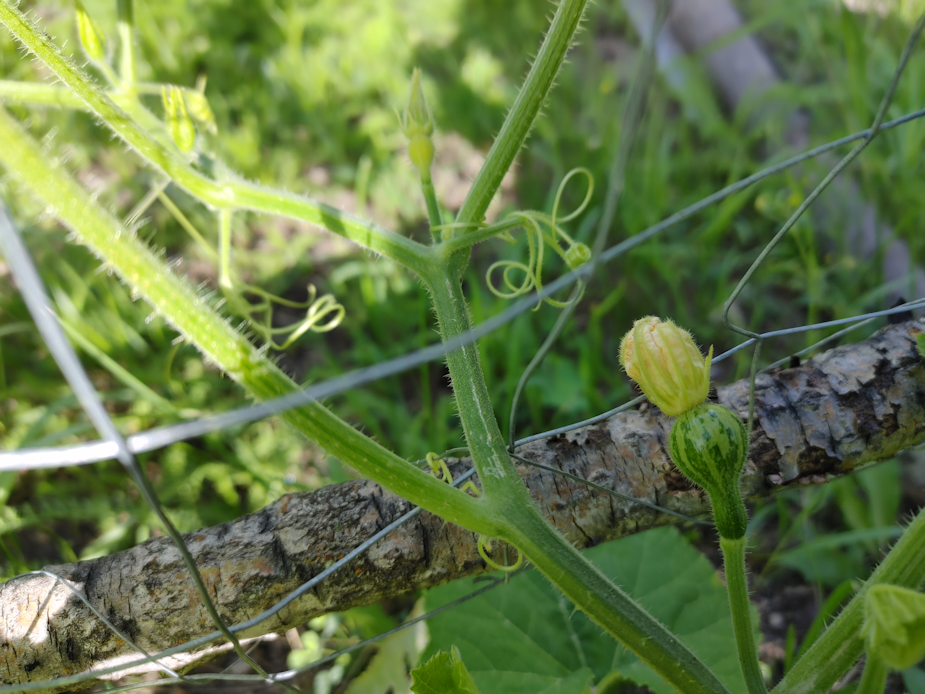
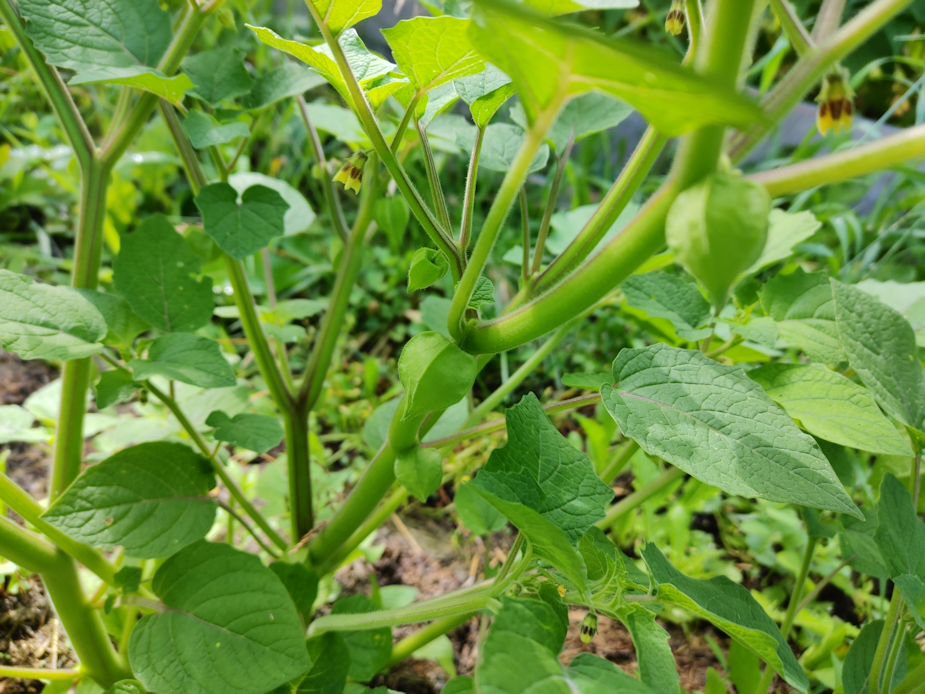
This, my friends, is our very first African Drum gourd seedling!
I’m rather surprised that this sprouted first. The peppers we’ve got planted have yet to germinate, but here we’ve got one of the massive gourds breaking ground!
You can see the big, remarkably fuzzy, seeds on the far right of the above photo.
I’m quite excited by this! It’s going to be a challenge to get these to grow to full maturity, so the gourds can then be set aside to cure and dry for at least a year. The zucca melon are also supposed to get huge, but they are for eating, not crafting.
The inside of the tank is lined with insulation, and the tray is on a heat mat, but I do wonder if it’s still too cold for the peppers. They’re at the end of the tray right in the corner. I’ve considered rotating the tray, but if it’s too cold for peppers, then it would be too cold for the drum gourds and zucca melons. We have time to try again with peppers, if it comes down to that, but not the drum gourds or zucca melons. Maybe I can find a way to rearrange the onions and luffa seedlings, so I can shift the tray on the heat mat closer to the middle.
What a beautiful day it is today! As I write this, we are at -1C/30F, and have yet to reach our predicted high of 0C/32F.
It’s a good thing it’s getting nice and warm. Yesterday evening, I went to set up the one of the new ceramic heat bulbs in the sun room. Before I did, I screwed it into the fixture and plugged it in, in the old kitchen, to test it.
It didn’t work.
So I took the heat bulb and removed one of the bathroom light bulbs to test it there.
It works.
Looks like the old light fixture is toast. This was something my brother had attached to a board so that he could use the heat of a light bulb to keep pipes from freezing in the kitchen, when this place was empty. We might have some other portable light somewhere that I could safely set up in the sun room, but if we do, it would be in one of the sheds or the barn, where we won’t have access until spring.
The sun room is above freezing, however, so the kitties will be fine. This morning, I counted 25!
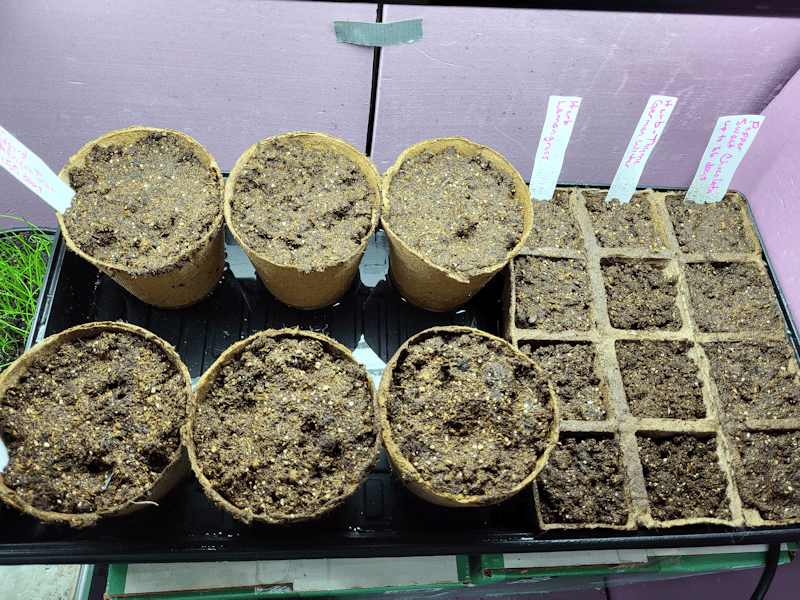
Today I went through the packets of seeds to start indoors and selected these as needing to be started very early.
I was finding contradictory information about the Sweet Chocolate bell peppers. The package says to start the seeds indoors 8-12 weeks before last frost – but the days to maturity I found maxed out at 86 days! We could potentially start though by direct seeding by that, if the soil were warm enough right after our last frost date. I am considering planting more of them, when I do the other peppers, but we have so many varieties to try, I don’t want to take up the space, if we don’t have to.
The lemongrass will eventually end up in a large pot, while the thyme will be going into a raised bed in the old kitchen garden. They, and the peppers, will eventually need to be potted up at least once before going outside, so I decided to put them in the degradable square pots, so that can be done without disturbing the roots.
Because of the size the Zucca melon and drum gourds will get before transplanting, those went straight into the largest degradable pots I have for now.
But first, I needed to make space in the aquarium greenhouses.
I could fit only two trays of the onions in the small aquarium. The problem is, there’s nothing we have that fits in there that can be used as a drain tray for bottom watering.
We have a large jade tree that we had to cage with hardware cloth because the cats wouldn’t stop digging in it. I had to remove the top of it because the jade tree was starting to grow through the openings, so I used that to rig a cover for the tank. Last year, we used salvaged screen windows, but they were larger than the top of the tank and, even with weights, the cats kept knocking it about. I’m hoping this works. On the one hand, the openings are large enough that the cats could reach through and dig at the trays – the first year we used this tank as a greenhouse, the cats destroyed our onion starts by reaching through the filter opening in the tank’s lid. They were incredibly determined to get at those trays! However, the larger size mesh also means it’ll be harder for the cats to walk on it, so maybe they’ll just stay off?
We’ll see!
The luffa seedlings have joined the remaining tow trays of onions. I wanted to keep them in this aquarium greenhouse, since it’s warmer than the little one, thanks to the two lights above. One of the seedlings seems to have stalled and isn’t getting any bigger. The second seed in the pot hasn’t germinated at all, and probably won’t by now. I thinned out the extra seedlings that were in two of the pots. So we are probably down to three luffa. Hopefully, they will survive long enough for transplanting!
We now have four cells each of lemongrass, thyme and Sweet Chocolate peppers – those thyme seeds are so incredibly tiny! While I was sowing the seeds for those, I had six each of scarified zucca and drum gourd seeds soaking in water, and now each round pot has two seeds. The seed starting mix was premoistened and the surface got spritzed with water after the seeds were planted, but I also made sure to add a lot of water to the tray, once it was on the warming mat. I want those pots to absorb water from the tray, not the soil.
It should be interesting to see how these do, with being started this early! We won’t need to start more seeds until probably March, though I’ll have to double check on some of them. I think things like the Crespo squash and Boston Marrow could use an earlier start. We’ll have time to move things around in the living room to make space for trays as they get rotated out of the aquarium greenhouses while need seed trays go in.
Since the fixture used for the heat bulb in the sun room is broken, I won’t need the frame of the mini greenhouse to support it anymore. The mini greenhouse can be brought in and gotten ready, too. Plus, we should be able to use some of the plant hooks in the ceiling to hang the shop lights we’re using for grow lights, and generally have a much better set up than last year.
Which means we’ll have to make building a cat barrier a priority over the next few weeks!
Yesterday, after many delays, I finally sorted through all our seeds, old and new. I was happy to find I still had luffa seeds left, so I got those started, along with our onions.
Since I’m running out of media storage space on my WordPress account (the down side of having such a photo heavy blog!), I took my photos and made them into a video, instead. I hope you enjoy it!
Please feel free to let me know what you think of it, either here or in the comments under the video at YouTube. If you watch the video on YouTube, you can subscribe to my channel there. I’ll be uploading it to my Rumble account, too.
I will probably be doing a lot more of these, since I’m not about to spend over $300 a year to upgrade my account, when all I want is more storage space! It takes a lot more time, and I borrow my daughter’s microphone for the voice overs, but it does allow me to use higher quality images, and more of them, than I would here. I’d call it an experiment, but it’s not like I have much choice!
On another note, I’m quite enjoying the Movavi Video Suite to make these videos. I’m just barely skimming the surface of what the software allows me to do, since my needs are really basic, but if I wanted to, I could create some pretty professional looking videos. The only complaint I have is how it keeps wanting me to buy into subscriptions to get more choices in media and effects, etc. But that’s pretty typical of most media software these days, I think.
We haven’t even done a thorough assessment of our 2022 garden, nor fully decided what we plan to grow next year, but I’ve gone ahead and made our first order for next year’s garden, today.
The main reason is, there are things I wanted to order before they have a chance to be out of stock. Particularly with trees for the food forest we are slowly developing. These will be shipped in the spring, and we won’t be billed until they are shipped. I ordered seeds as well, because I used a sponsor promo code from Maritime Gardening, which gives free shipping if there is at least one package of seeds in the order.
This is what I ordered today. All images belong to Veseys, and links will open in new tabs, so you don’t lose your place. 😊
The new Trader Everbearing Mulberry is the main reason I wanted to place an order right away. We tried a different variety before, that promptly got killed by an unusually cold night shortly after it was planted. Cold enough that even if we had this variety, it likely would not have survived, so soon after being planted.
Here is the description from the site (in case you’re reading this years later, and the link is dead).
Morus alba x rubra. There are so many things to love about ‘Trader’ Everbearing Mulberry! First, the tree itself is absolutely beautiful and can be grown as a single trunk or multi-stemmed shrub. Big, glossy black fruit are present throughout the summer and are an irresistible blend of sweet and tart. Even the leaves are starting to be considered a super-food and can be made into a powerfully healing tea. ‘Trader’ is winter hardy (Zone 3-4), vigorous, long-lived and disease and pest resistant. We ship 8-12″ non-grafted tree.
Please note: Due to a crop shortage, we are not able to supply the Mulberry in a 3.5″ pot. We can supply in a 2.5″ pot. Since these are smaller, we will send 2 of the smaller size for spring 2023.
That last bit about pot sizes is another reason we wanted to order the mulberry right away. They may be smaller, but we’ll be getting two trees for the price of one. Which means chances are better for at least one of them to survive!
The other tree we ordered was Liberty Apple. From the website:
Malus. Superlative variety resistant to a host of diseases. This apple has outstanding flavour and is aromatic and juicy. The conical red fruit is among the very best and as an added bonus is excellent for cider. Crispy, juicy apples right in your back yard. Good Scab resistance, making them much easier to look after. For best results, two varieties should be planted. We are offering 1 yr. whips. approximately 18-24″ in height which have been grafted onto hardy rootstock. They should mature to about 15-18 ft. Hardy to zone 4.
Yes, it says zone 4 and we are zone 3, but we will just have to take extra care in where it’s planted, and to protect it while it’s small. We have crab apple trees, but no regular apples. One apple tree should be enough to provide for our needs, and the crab apples will be the second variety pollinator.
Then there are the seeds.
While we didn’t have much to show for peppers this past summer, that had more to do with our horrible growing year in general. My pepper loving daughter had thought we would be ordering several varieties for this past year, but I’d only ordered the one type. I think we learned enough about growing them to order more varieties, so I ordered a sweet bell pepper combo.
Early Sunsation: Bright yellow and big. Very heavy yielding with thick, juicy walls. This variety stays nice and crisp even when fully yellow. 3 lobed fruit. Resistant to Bacterial Leaf Spot races 1-3. 65 days to green; 80 days to yellow from transplanting.
Early Summer: Elite, early and extra large! Early summer is an early maturing, yellow bell pepper. The fruit are large at 5″ and an elite disease resistance package gives Early Summer a winning combination.
Dragonfly: Sweet and colourful. Dragonfly’s early production was a standout for our trial staff. Fruit emerges green and turns deep purple when mature. Dragonfly continues to produce fruit into the fall even after temperatures have dropped.
The Early Summer is new to Veseys for the 2023 growing season.
There was another new for 2023 item I just had to order.
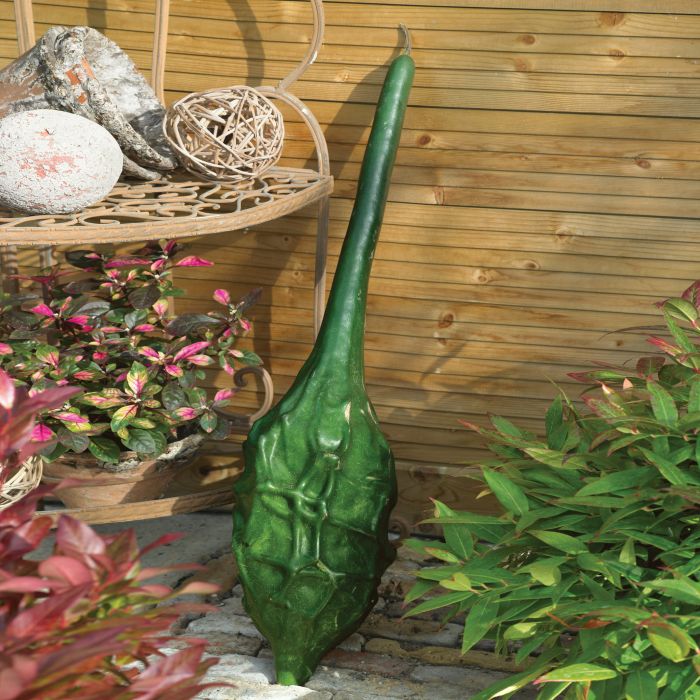
The Caveman’s Club Gourd! This is definitely something for the “just for fun” list. 😁
Truly different! This 12-16″ gourd produces a dark green, ridged, alien-like, bulbous fruit that are not like anything we have seen before! Growing them on a trellis ensures a straight neck. Plant early for best results. Matures in 120 days. Approx. 15 seeds/pkg.
I just couldn’t resist. This will be an ideal thing to try growing on the new trellis tunnels we will be building in the spring.
After we’ve taken the time to assess things from our 2022 garden, then gone through what seeds we still have, we’ll start making final decisions about what else we want to order for the 2023 growing season. One thing we will almost certainly be ordering are different raspberry bushes, that mature at different times. Any raspberries we order won’t start producing until their second year, so what we order to plant in 2023 will be to have raspberries in 2024. As we add to our perennial food producers, while still staying in budget, it’s a balancing act between ordering things that will take years before they start producing, like the apple and mulberry trees, and things that will start producing more quickly, like the raspberries.
For a while now, my mother had been telling me she had a tree for me to take home and transplant. She’d grown it from seed collected from trees in her town, and it was in her little garden plot.
When I was at her place a couple of days ago, she had it dug up and in a bucket, waiting for me to take home.
I asked her about the tree to try and get a sense of how big it would get, or even where she got the seeds from, so I could see for myself. She wasn’t able to tell me much, but did think that, in English, it was called an Ash tree.
So I looked it up and confirmed it was Ash, but couldn’t narrow it down to a specific variety. This is not something that normally grows in our area. Using the ID function on my phone’s camera, it listed European Ash first, but there was no way that was right. Those can’t grow in our climate zone.
From what I could find, Ash trees can grow anywhere from 30 to 100 feet tall – I even saw one listed as growing up to 115 feet! Given that the trees she got the seeds from were planted to line streets somewhere in her town, I figured this one wouldn’t get that tall, but probably more than 30 feet.
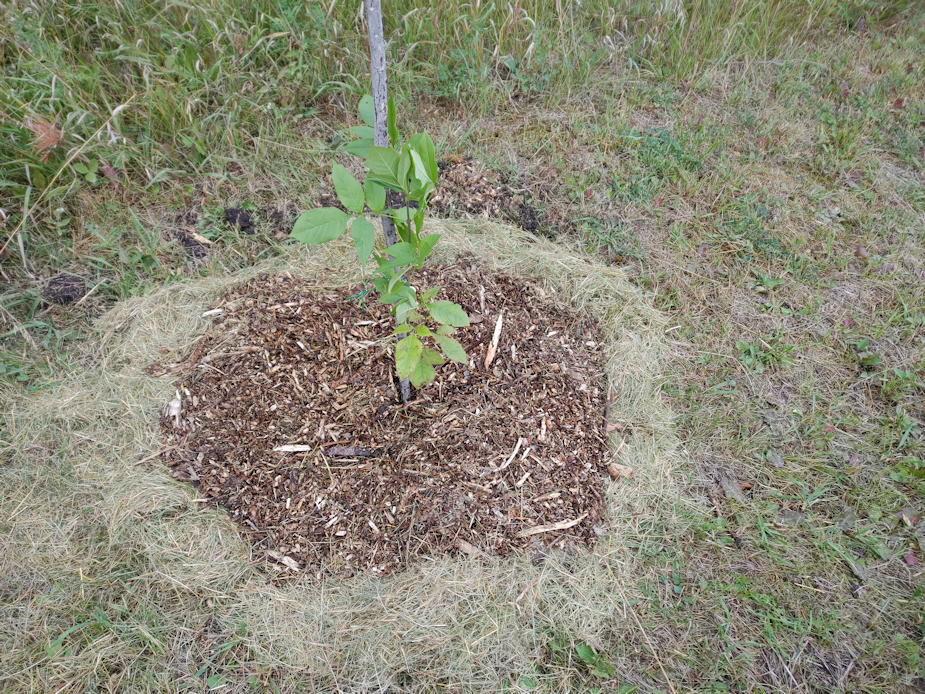
Which that in mind, I decided to plant the tree in the outer yard, replacing one of the Korean pine that died.
Since I have both, it got a double mulch. The grass clippings will break down faster, and both will keep the grass and weeds down, while the roots establish themselves. Wind is a problem, though; even as I was planting it, the wind was pushing it over. The Korean Pine that had been here had a tomato cage to protect it, secure in place with a branch, so I made use of the branch to support the Ash tree. It can stay there through the winter. In the spring, we can see what it would still need for support.
We still have some chicken wire left over. I will cut some to size to put around the tree to protect it from deer, too, making sure to spray it with the high visibility paint, like the ones protecting the surviving Korean pine. I hope it does well.
Earlier on, while checking the garden during my morning rounds, I found a surprise. I don’t know how I missed this!
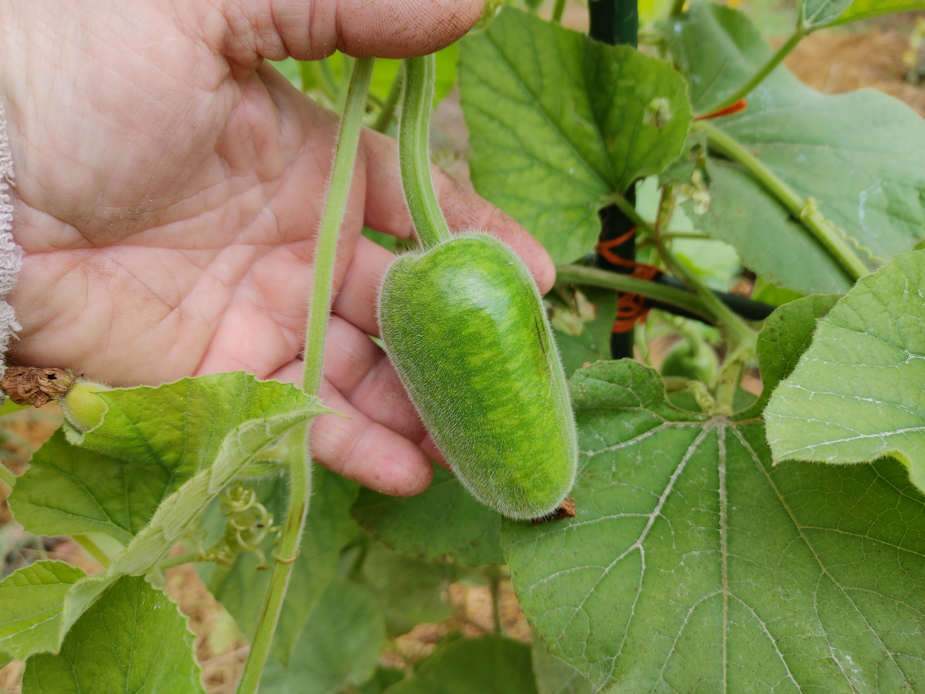
I’ve been admiring all the little gourds forming on the Apple gourd plants, but never saw this big one until this morning! It had been hidden behind some leaves. There is another one that’s about 3/4 the size of this one. The little ones may not have time to fully mature before the growing season ends, but this big one has a chance!
We continue to have forecasts for mild temperatures over the next couple of weeks. Early next week, we may reach as high as 24C/75F.
Or… maybe higher?
My husband found this article a couple of days ago.
Tuesday, September 13th 2022, 9:10 pm – On paper, Typhoon Merbok appears unremarkable. An intensifying typhoon in the Pacific is hardly noteworthy, but its location where it’s intensifying is a little perplexing.
The part that caught my attention was this…
The perturbation continues eastward. As the trough digs across the West, there will be a region of adverse weather, including the prospect of a classic fall low developing across the eastern Prairies. The temperature extremes across the Prairies will be extraordinary, with wet snow across higher terrain in Alberta and southern Manitoba pushing towards 30°C.
Across Ontario and Quebec, there’s increasing confidence in temperatures surpassing 30°C, so some daily temperature records will likely fall next week. It’s a relatively rare feat to record 30°C across the Greater Toronto Area (GTA) after mid-September, with Pearson International Airport reaching it this late in the season more than 15 times since 1938.
Where we are, we’re not likely to get such extremes, but perhaps that 24C/75F day we’re supposed to be getting is a result of this. We’re supposed to have and overnight low of 14C/57F that night, yet just three nights later, we’re supposed to reach lows of 1C/34F, which would likely mean frost. This would be a week from now. The app on my phone, however, says we’re supposed to have a low of 5C/41F that night, so no frost.
I’m just obsessing over the temperatures forecast right now. I want the garden to be able to squeeze in every bit of mild weather. However, if things start dipping too low overnight, I’ll have to at least harvest the winter squash and pumpkins that I can, and might be able to cover a few beds.
I would really, really love it if the frost held off until well into November, like it did last year! That might be too much to hope for, though. We shall see!
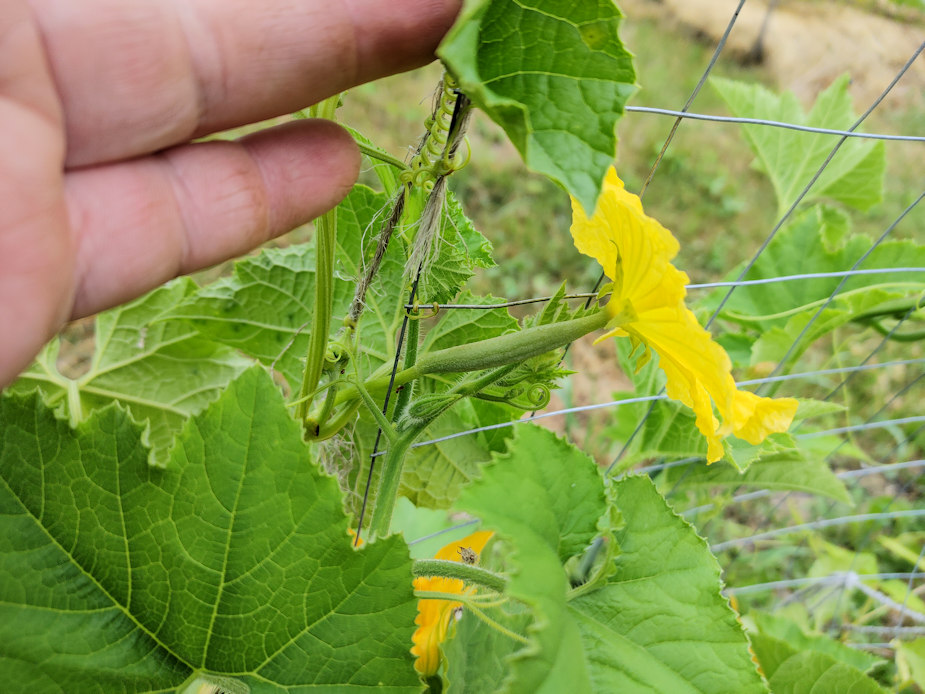
There was a new and different flower among the dancing gourds, and it turned out to be a luffa!
Which means there may actually be two surviving luffa gourds that got transplanted.
Along with this open flower, I found some teeny, tiny female flowers developing as well. Unfortunately, there isn’t a single male flower or bud to be seen, so this luffa likely won’t get pollinated.
It’s way too late in the season for something like luffa. We started them indoors early enough to have given them the time, even after the Great Cat Crush, but everything got set back by the weather so much after transplanting, any advantage we had was lost. Still, it was a nice surprise to find they did survive!
After doing some watering with the hose, I hooked up the soaker hose on the tomatoes, then let it run while I finished mulching the paths in the squash patch.
Our straw bale is now completely used up, and all the paths in the squash patch are now mulched. Yay!
Somehow, I didn’t think to take a picture, though. Too focused on getting the watering done!
The rain barrel at the trellises was half empty, so I set the hose to fill it and use the watering can, taking my time to give the barrel time to actually fill up in between my taking water out. That gave me the chance to train more of the cucumbers up their trellis net, as well as the mystery gourd.
Which is no longer a mystery.
The labels had worn off, but I figured they were either luffa or ozark nest egg gourds – and they didn’t look like luffa.
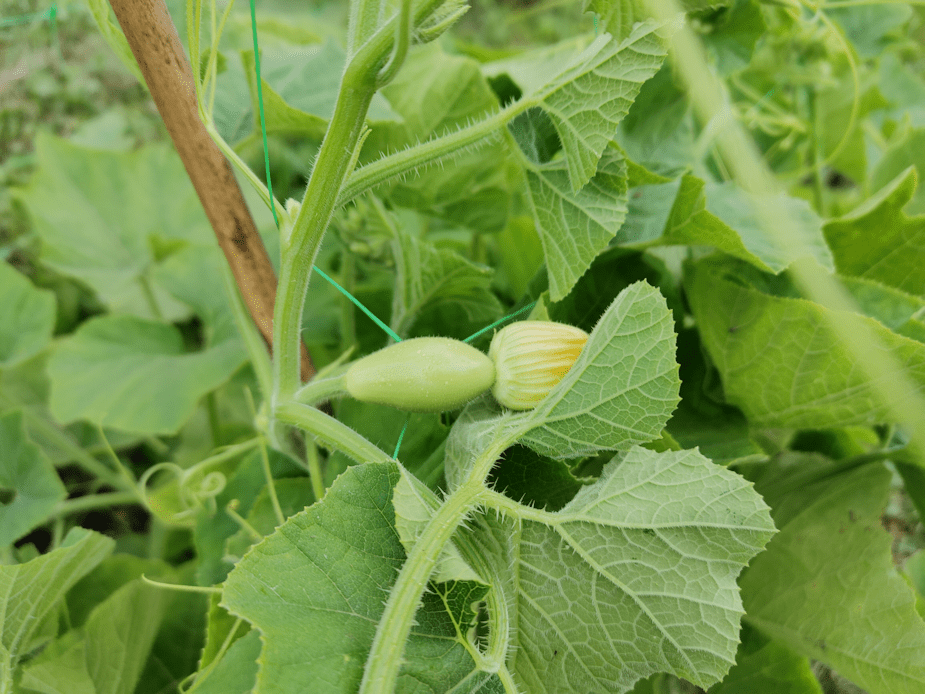
While training some of the vines up their trellis net, I found some baby gourds.
Which officially confirms it. They are Ozark nest egg gourds.
Which mean that none of the luffa transplants survived at all.
Hopefully, this year, we will actually have some mature gourds! Last year, once the heat waves and drought conditions eased off, the Ozark nest egg gourds absolutely exploded with new growth, and many baby gourds. Unfortunately, it was too late in the season by then, even with our unusually long and mild fall, and they were killed off by frost.
Hopefully, these will have more time! The gourds aren’t particularly large at their mature size, so there is a chance for them.
I would love to finally have some gourds to cure and use for crafting!
While checking on the garden (and putting back cardboard mulch that was blown around), I spotted some new growth.
This is an apple gourd! I’m hoping it was pollinated and will continue growing. It looks like 3 of the 4 apple gourd plants are going to be productive, but this one is definitely the largest and strongest. The fourth one remains barely visible!
We have two more Baby Pam pumpkins developing! I hand pollinated these ones myself, just in case, and it seems to have taken. That makes a total of 3 of these pumpkins trying to grow. As these are a small, short season variety, we might actually have ripe pumpkins to harvest this fall.
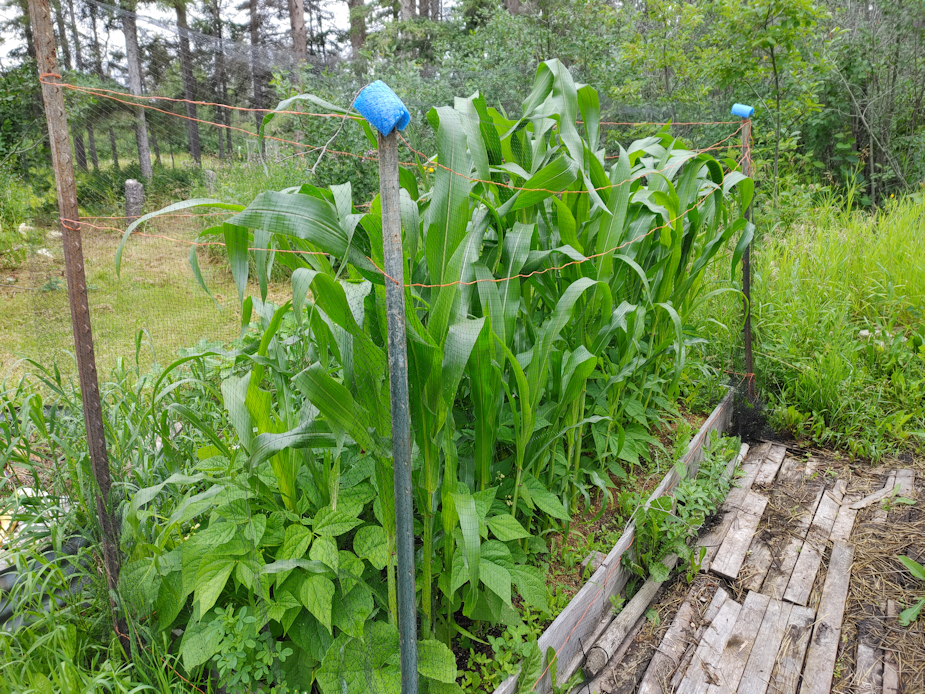
The kulli corn is getting nice and tall! It’s time to take the net off and see if we can wrap it around the side, leaving the top open, for the corn to reach its full height.
Those bean plants are huge! This bed was made with trench composting, and it seems to have made a difference.
Rearranging the net will give a chance for some weeding, too, but it doesn’t look like this bed is having weed problems! 😄
The nearby ground cherries are getting very robust!
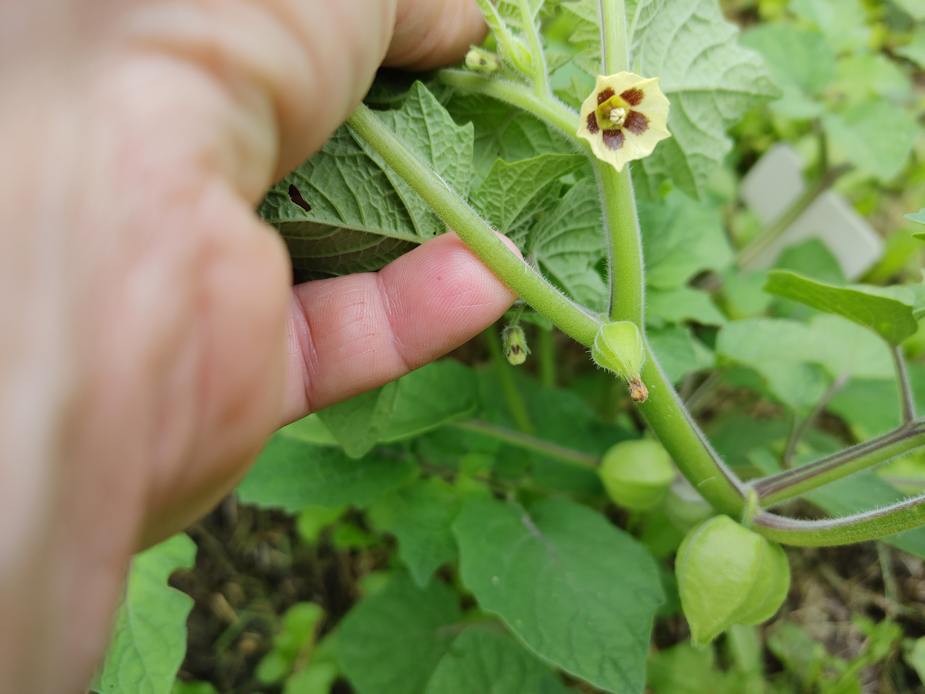
This is what ground cherry flowers look like. :-) I’ve finding quite a few flowers, and developing fruit. I’m looking forward to these!
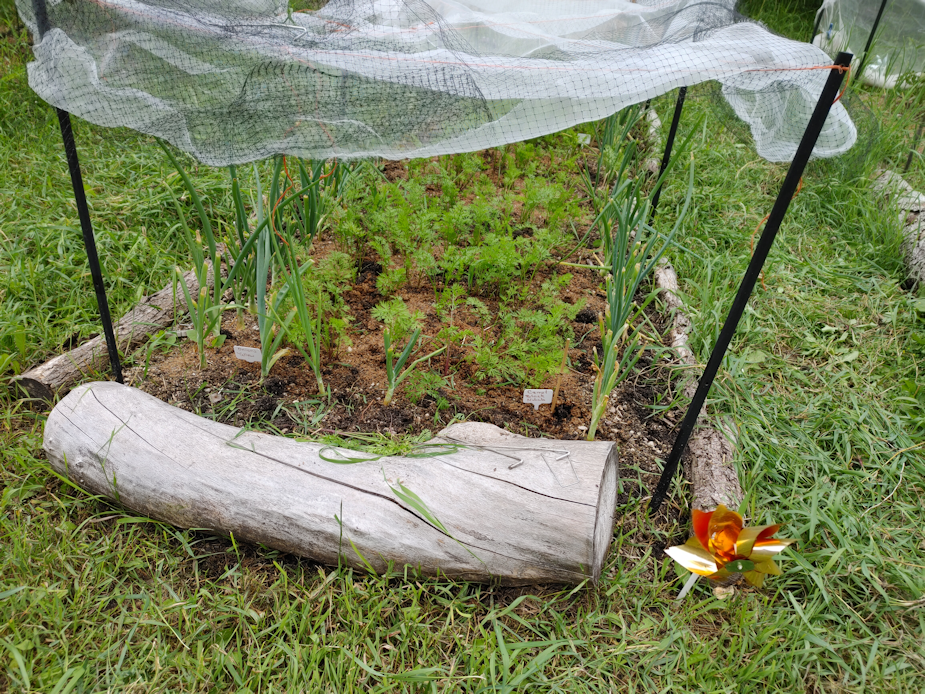
I was finally able to settle in and weed this overground bed. The netting around it may keep the groundhogs away from the carrots, but it prevents casual weeding, too.
Unfortunately, I did end up accidentally pulling a couple of purple carrots in the process. It’s really hard to pull up crab grass next to carrot greens!
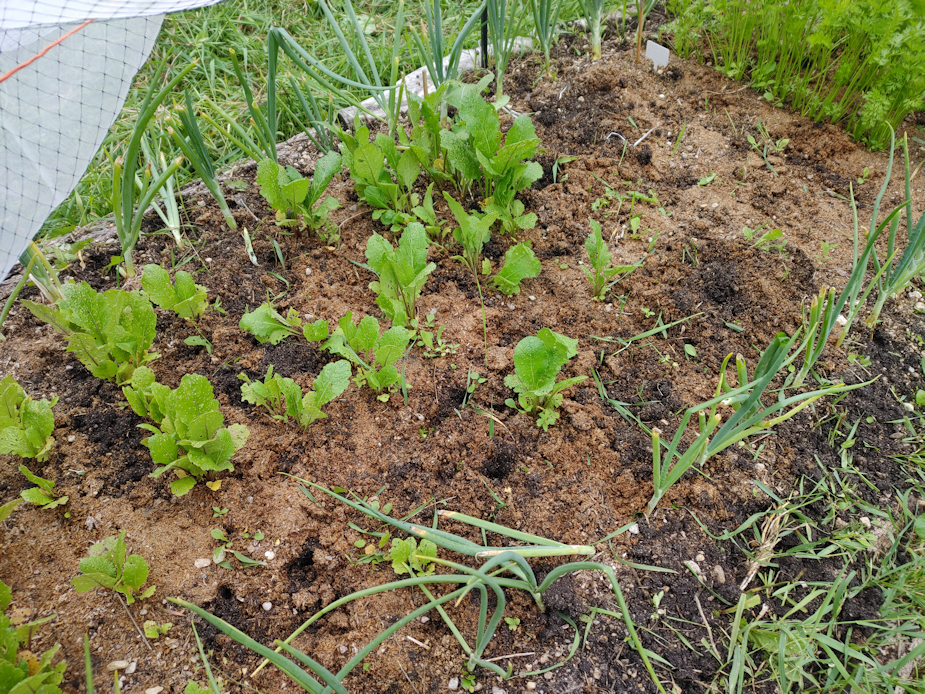
There aren’t a lot of the one type of turnip, but at least there’s something. The Gold Ball turnip are simply gone. They were the first to germinate, and disappeared almost immediately. I’d hoped that, while weeding, I might find some survivors, but there’s nothing. I don’t know what ate them, any more than I know what is leaving so many holes in the other turnips. We planted 3 types of turnips, but only one has survived – so far.
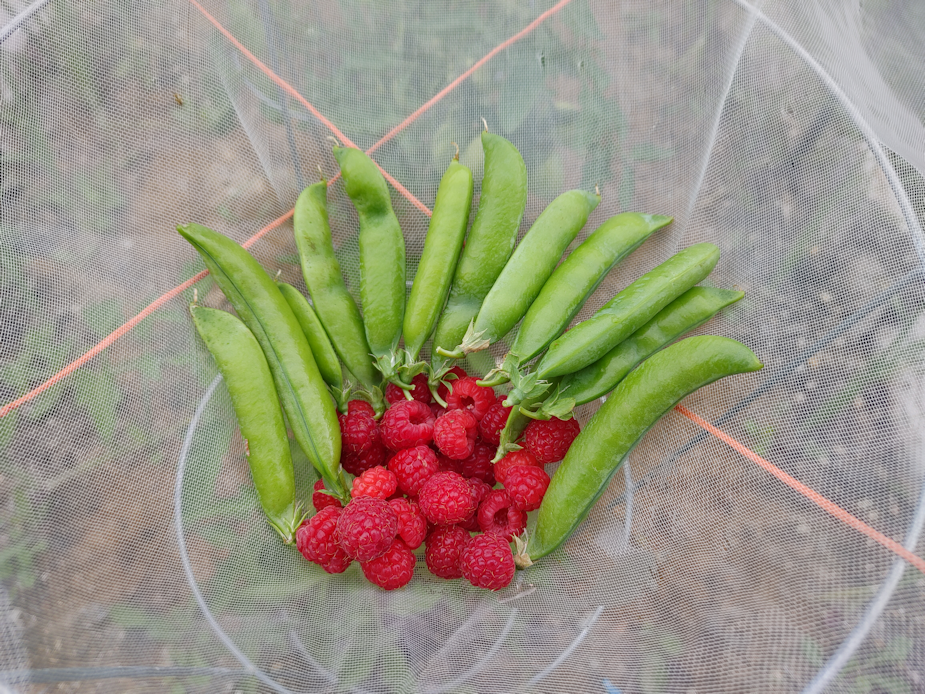
I did manage to have a sad little harvest this morning. A handful of the shelling peas, and a few raspberries.
Which is better than no harvest at all!
While at my mother’s, yesterday, we went looking at the garden plots outside her apartment. She has one little corner with some low maintenance plants in it, but some of her neighbours have better mobility and are growing a remarkable amount of vegetables in those little plots. One person has peas. They are pretty much twice the size of our own peas even though, from the stage of the developing pods, they had to have been planted later than our own. Even so, they were smaller than pea plants should be.
It’s been a hard gardening year for so many people!
My daughters were sweethearts and took care of feeding the cats outside for me, as I’m still feeling pretty unstable, so the cats weren’t out and about by the time I headed outside. I did get to briefly pet a kitten, though! :-D
While checking out the garden, there was some new progress – and a bit of deer damage – to find.
The Carminat beans are reaching the top of the trellis, and you can see their flower buds. At my fingers, however, you can see the stem of a missing leaf! There was a vertical row of missing leaves, a few feet along the trellis. Right about deer height! Time to find more noise makers and flashy things to set up.
On this side of the trellis are the Seychelles beans, which are starting to get pretty tall, too. None of them show deer damage, which is good, since less of them germinated. In the foreground are the self seeded (or should I say, bird-seeded) sunflowers that I left to grow. The beans can climb them, too! With the flooding this spring, we did not plant any of the Hopi black dye or Mongolian Giant sunflower seeds we’d collected from last year, so I don’t mind letting these one grow. These would be the black oil seed that we put out for the birds in the summer. We’re finding them all over the place, thanks to being spread by birds!
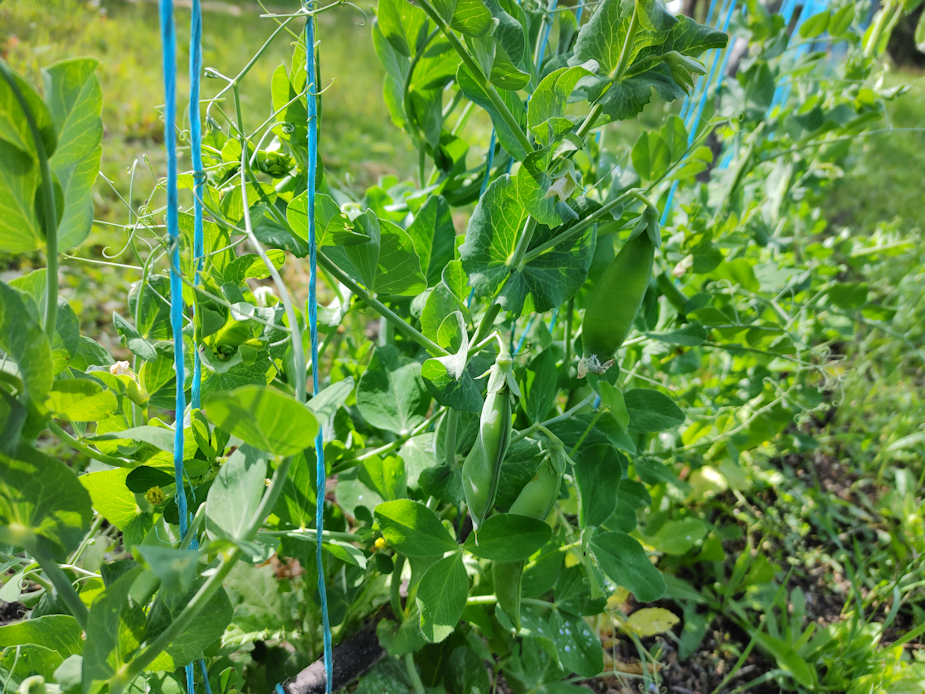
The first sowing of shelling peas may be about half the size they should be, but they are loaded with pods. At least on the north end of the pea trellis. Towards the south end, the sugar snap peas are barely surviving, and the shelling peas on the other side of the trellis are much weaker, too. The entire trellis gets an equal amount of sunlight, so this would be a reflection of soil conditions.
This should be the last year we use this spot for growing vegetables. Next year, they’ll be moved closer to the house, and this area will be made available for planting fruit or nut trees. We haven’t decided what to get next, yet.
The cucumber row is a mixed bag of plants that are growing nice and big, and filled with little cucumbers, and others that are barely bigger than when they were first transplanted!
I had an adorable find at the big trellis.
We have a first Tennessee Dancing gourd developing! It is so cute!
The beans on the same side as the dancing gourds are the red noodle beans. The plants are pretty large, but they are still not at the point of climbing. The shelling beans on the other side, however…
The are much smaller, but have tendrils climbing the trellis, and have even started to bloom!
The most adorable little pollinator showed up just as I was taking the picture.
I startled a bee when checking out this HUGE pumpkin flower.
Yes, it’s on a giant pumpkin plant. 😁
I’d seen some female flowers previously, but now I can’t find them, so there are no pumpkins starting to form, yet. While we are not shooting for super big pumpkins, and won’t be pruning them down to just one pumpkin per plant, it feels like it’s too late in the season for any giant pumpkins to mature. We’re near the end of July already, and none have formed, yet!
In the south yard, we finally have Chocolate cherry tomatoes! Just this one plant, yet. Of the 4 varieties we planted this year, the Chocolate cherry have been the most behind – and they are planted where tomatoes had done so well, last year. The plants themselves are getting nice and tall, and we’ve been adding supports and pruning them as needed, but there are much fewer flowers blooming, and only today do we finally have tomatoes forming. Thankfully, the other varieties are much further along.
I also spotted some ground cherry fruit forming! These plants are doing remarkably well, given how much water they had to deal with this spring. It took a while, but not they are quite robust plants, and I’m happy to see them setting fruit!
Hopefully, it won’t be too much longer before we start getting actual food from the garden. Everything is so, so behind, I am extra happy to see progress like this.
Today is working out to be slightly cooler than yesterday; it’s coming up on 6pm as I start this, and we’ve been at 28C/82F for some hours. We’re not expected to start cooling down for at least another hour. Longer, if today is at all like yesterday.
It was getting pretty late last night before I finally headed outside, fogging myself in mosquito repellant, and started on the squash patch.
I did remember to take a before picture. Every pair of sticks shows where there is a summer or winter squash, a pumpkin or a gourd. The straw mulch we laid down may help keep the soil cool and moist, but it isn’t thick enough to choke out the weeds. It also makes weeding – or even using the weed trimmer – impossible.
One of the apple gourds is relatively robust. The hulless pumpkins, Baby Pam pumpkins and Crespo squash plants are also doing comparatively well. The green zucchini, Teddy, Georgia Candy Roaster and Winter Sweet winter squash, however, are all very tiny. They should all be much, much larger for this time of year.
I am hoping that using the cardboard to smother the crab grass and weeds around the squash plants will help. I did things a bit differently this time. Previously, when preparing an area with cardboard to be covered with a straw mulch, I laid down flattened boxes in overlapping layers, making everything at least 2 layers thick. The overlaps were 4 layers thick or even 6 layers, depending on how they ended up overlapping.
Obviously, I couldn’t do that, here.
Most of the boxes were roughly the same dimensions; there were a lot of banana boxes in the pile! When flattened, they made long rectangles. I cut each in half, so that I could lay each piece down as a single layer, positioning 4 such pieces at right angles around each plant. That meant two boxes for each plant – mostly. I barely had enough cardboard to finish the job, but some of the boxes were large enough that I could cut them down further, and use just one box around a plant. I got them all done, with no cardboard to spare at all.
It was a brutal job.
For all that I used mosquito repellant, I was still being swarmed. Any spot that didn’t get sprayed was attacked. It’s one thing to find myself being bitten in the butt because my shirt shifted as I bent over. It’s quite another when they would fly under the lenses of my glasses and go for my eye lids. Yes, I actually got mosquito bights on my eye lids! On top of that, because of the heat, it wasn’t long before I sweated off the repellant. At which point, I was just a mosquito buffet! By the time I was putting down the last pieces of cardboard, I was spending more time flapping my arms and doing the mosquito dance than anything else!
By the time I was done, it was quite dark, so an after photo had to wait until the morning. We did have a small thunderstorm during the night. As usual, the bulk of the system blew right by us.
None of the cardboard blew away, however! That was my big concern. Interlocking the pieces of cardboard seemed to have done the trick.
As we get more cardboard, I do want to fill in the spaces in between, but the squash and corn patch needs to be done, first. For now, this should help. I’ve picked up a slow release, granular fertilizer that will be applied soon. I just don’t want to be feeding the crab grass as well as the squash!
Hopefully, I’ll be able to get another van load of cardboard, soon. I did manage to get a few boxes today, when I stopped at the post office/general store. Possibly enough to do one row in the squash and corn patch. We shall see.
Another thunderstorm is being predicted for tonight. I do hope it actually happens, and gets swept northward. Not only to help cool things down here, but there are some major fires to the north of us. At least one of the reserves had to be evacuated yesterday. Rain would certainly help get those under control. For all the flooding we had this year, most of it affected the south of our province. The further north you go, the less affected it was, which means those areas will still be prone to fires.
Just out of curiosity, I checked our 30 year temperature records for today. We’re still at 28C/82F as I write this. Our average for today is 26C/79F. The record high was 33C/91F, set in 2011, while our record low was only 6C/43F, set in 2000. So we’re pretty normal for this time of year. If our spring hadn’t been so awful, this would have been a very productive gardening year.
It’s hitting the girls in their upstairs “apartment” the worst. My younger daughter just cut all her hair off, to help keep cooler. Their switching to sleeping during the day and being active during the night hasn’t been working that well this year; the nights are simply not cooling down much. As a surprise for them, I made a trip to a Canadian Tire this morning, and got one of those Arctic Air cooling fans. I’d much rather have picked up a portable AC unit for them, but not only are they ridiculously expensive, there aren’t any in stock in most places right now. The window AC units are much more affordable, but there is only one window it could possibly be installed in, and it won’t fit with the way that window opens. In fact, that’s true of all our windows. Best bet would be to actually have one installed through a wall, not in a window. Since we don’t actually own the house, that’s not something we’re going to start doing!