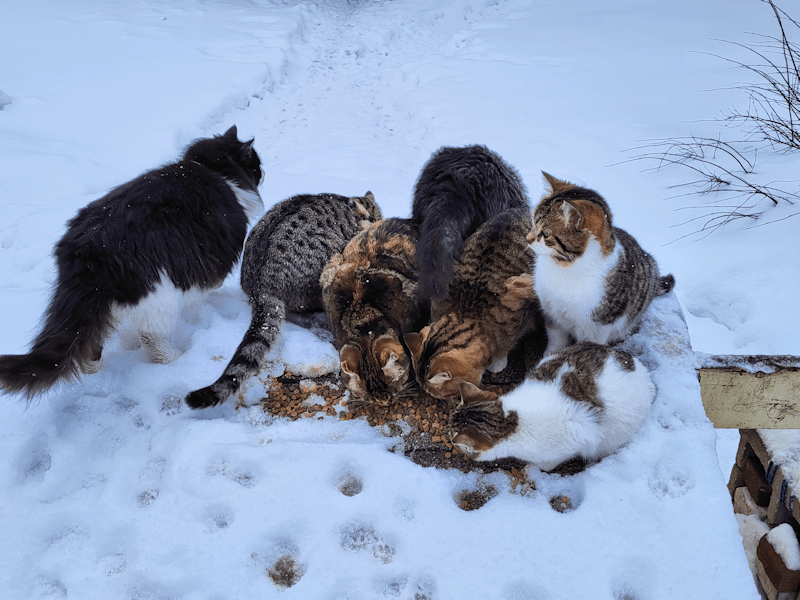
We had a light snowfall last night, making everything all white and fluffy this morning.
The outside cats didn’t mind it at all!
I counted 21 this morning.
Meanwhile, indoors, we have our first signs of spring.
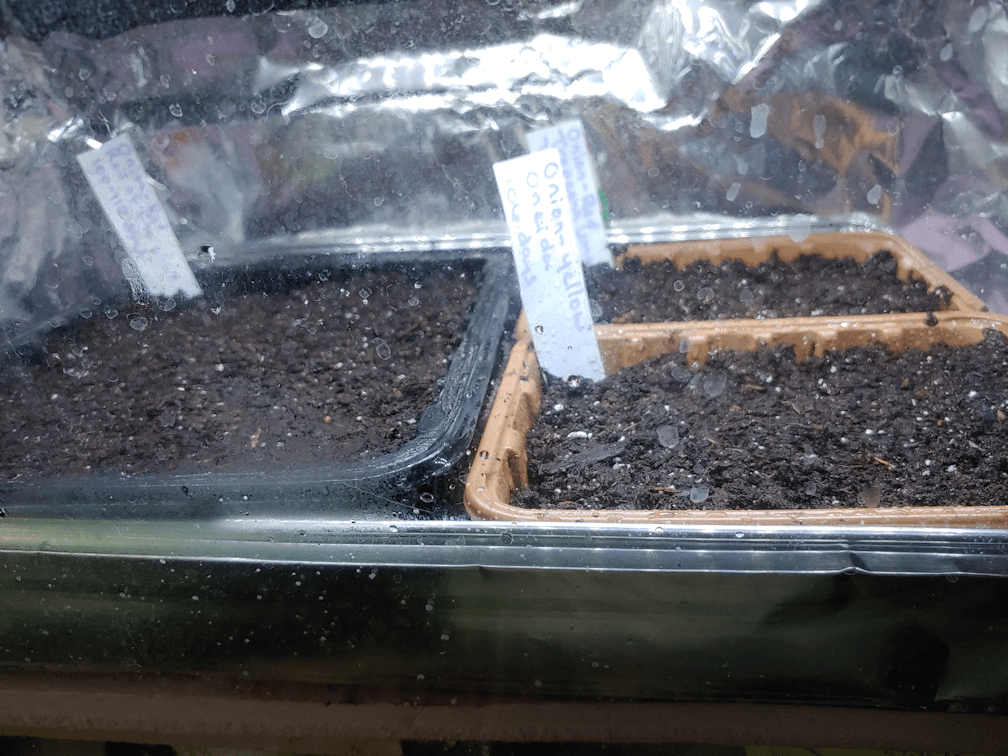
When I checked the trays this morning, three out of four of them had onions sprouting. When I came back about an hour later, there were sprouts in the fourth tray!
I’m absolutely amazed by two things. One is, how quickly they started to germinate.
The other is, how much cat hair there is, all over the soil surface. These trays had lids on them. Where did all that cat hair come from? I mean, Beep Beep practically lives on top of the lights. She naps on them, rolls around on them, and even hugs them, so yeah… I can see some of her fur drifting down… but getting under the lids?
Yesterday, I marked on our communal calendar, two sets of dates. One was the number of weeks counted back from our last average frost date, June 2. This way, we can see at a glance that something that needs to be started 10 weeks before last frost, needs to be started around March 24, while something that needs only 4 weeks can wait until May 5th.
The other dates I marked was number of days counted back from our average first frost date, which is Sept. 10. We have exactly 100 days between our average last spring and first fall frosts. That’s the growing season we can mostly count on for frost sensitive plants.
For things that have really long days to maturity, it’s that “days before first frost” that we need to consider. If, for example, I have a gourd that requires 110 days to maturity, that’s May 23. If it needs 7-10 days to germinate, I would start them at least a week before that.
If I have something than need 90 days to maturity, that falls on June 12 and, by then, I could get away with direct sowing, instead.
One of the really useful tools I’ve found is the Farmer’s Almanac planting calendar. Most planting calendars just give number of weeks before first frost, because they’re meant to be generic. I can get that information from the seed packet. Farmer’s Almanac, however, lets you input your area code (or zip code, if you’re in the US). You can even put in your city (ha!) and province/state. It will find the climate station nearest you, then give you the calendar dates for starting indoors and transplanting, or seeding outdoors. It even gives you the choice of dates based on frost date, or on moon dates. Oh, and I discovered something very handy when I hit the print button on the web page. It allows you to remove things from the list that you aren’t growing, which greatly reduced the number of pages that got printed out!
It’s still a bit generic, of course, but the date range is pretty wide. For example, it tells me bell peppers should be started between March 24 and April 7. We have five varieties of bell peppers, and four of them are early varieties, so we could use the information on the seed packet to figure out which ones need to be started in March, and which can wait until April.
Of course, they can’t cover everything, so we still need to make adjustments. For example, their calendar says to start winter squash outdoors between June 16 and July 14. With some varieties, we could do that, but we’ve got some large varieties of winter squash that need more time to fully mature, so we would be better off starting them indoors. If we use the biodegradable pots that can be buried, that would reduce transplant shock.
We have always started summer squash indoors. I think, this year, we might direct seed them. The calendar says zucchini can be planted anywhere between June 16 and July 14, which is when we can expect the soil to finally be warm enough.
As for the things we’ll need to start the earliest, the herbs (except dill, which is direct sown) will need to be started at the same time as bell peppers; in March. The eggplants and tomatoes can be started in early April, melons can be started in early May, while pumpkins and watermelon can be started in mid May.
The direct sowing dates are pretty interesting for some things. If we decide to try growing radishes again, they can be direct seeded in early April – at the same time we’d be starting eggplant and tomatoes indoors. Carrots can be planted in late April, early May, which would be about the same time we’d be starting melons indoors.
All of which needs to be taken with a grain of salt. For example, the calendar says to start onion seeds outdoors in early May. Sets, sure, but seeds? Nope. There’s a reason people out here start their onion seeds indoors in January! Also, it has dates to start lettuce and chard indoors, but none for direct seeding. Who starts lettuce and chard indoors? I mean, sure, you can grow them indoors, but for transplant?
As it stands now, though, we won’t need to start anything else indoors until March 24, at the earliest.
That gives us February and most of March to get the materials we need and build a removeable door and frame, to keep the cats out of the living room, and out of the seedlings!
We’ll also need to build a barrier to block an opening in the shelf to the left of the door in the image.
Among the things we were talking about ordering that will be delivered in the spring were potatoes and, potentially, raspberries.
It seems we weren’t the only ones that had a bad growing year in 2022, because the potatoes I was looking for were simply not available. However, Veseys has potatoes again, and so I placed another order with them.
Among the items we have ordered before, we are getting the Purple Peruvian Fingerlings again. We were really happy with them, in their grow bags, two years ago. They come in 2 lb packages, so we ordered two of them.
I am also ordering a couple of seed mixes from them that we ordered before (and using the coupon code from Maritime Gardening saved me the shipping costs!). I ordered two each of the Alternative Lawn Mix, and the Western Mix Wildflowers. The areas we had planted them, in the fall of 2021, got flooded in the spring, and nothing came of them. With so many wood piles chipped, we now have areas of bare ground that I would like to seed before they get taken over the invasive weeds again! Two of those areas will get the alternative lawn mix. The third does get accumulated snowmelt nearby in the spring, but should be fine to plant in. That area is next to our budding food forest, and will be good for attracting pollinators.
The seed packs will be sent right away, but the rest will be sent in time for planting in our zone 3.
Here are the new varieties we are going to be getting. All images belong to Veseys.
These are Red Thumb fingerling potatoes. They are noted for their delicious flavour. Unfortunately, there isn’t any information about how well they store over winter. These come in 2 lb packages, so we ordered two of them.
These are Irish Cobbler potatoes, an early variety also noted for their exceptional flavour. They come in a 3 lb pack, and we ordered just one of them.
These last ones are for our food forest. Royalty Raspberries. They come in packages of three, and we ordered just one package to try them. They are a late maturing variety, hardy to zone 2. So far, everything we’ve tried that’s purple has done really well for us, even in poor growing conditions, so I’m hoping the trend continues! These will produce fruit in their second year, so as long as we can keep them alive this year, we should have purple berries to try, next year.
There are still other things we will want to order for spring delivery, such as replacement sea buckthorn. We’ll just have to be careful to set aside the budget for them as we place the spring delivery orders, because we’ll be charged for them all at once, when they’re shipped!
This year, I’m happy to have several items, with different maturing rates, added to our food forest. The raspberries for production next year, apples that should start producing in 4 or 5 years, and the zone 3 mulberry trees that should take a few more years before they begin producing berries, as we will be getting 2 smaller, younger seedlings, instead of the 1 larger, older seedling they normally would have shipped, but are not available.
Little by little, we’re getting to where we want to be!
Yesterday, after many delays, I finally sorted through all our seeds, old and new. I was happy to find I still had luffa seeds left, so I got those started, along with our onions.
Since I’m running out of media storage space on my WordPress account (the down side of having such a photo heavy blog!), I took my photos and made them into a video, instead. I hope you enjoy it!
Please feel free to let me know what you think of it, either here or in the comments under the video at YouTube. If you watch the video on YouTube, you can subscribe to my channel there. I’ll be uploading it to my Rumble account, too.
I will probably be doing a lot more of these, since I’m not about to spend over $300 a year to upgrade my account, when all I want is more storage space! It takes a lot more time, and I borrow my daughter’s microphone for the voice overs, but it does allow me to use higher quality images, and more of them, than I would here. I’d call it an experiment, but it’s not like I have much choice!
On another note, I’m quite enjoying the Movavi Video Suite to make these videos. I’m just barely skimming the surface of what the software allows me to do, since my needs are really basic, but if I wanted to, I could create some pretty professional looking videos. The only complaint I have is how it keeps wanting me to buy into subscriptions to get more choices in media and effects, etc. But that’s pretty typical of most media software these days, I think.
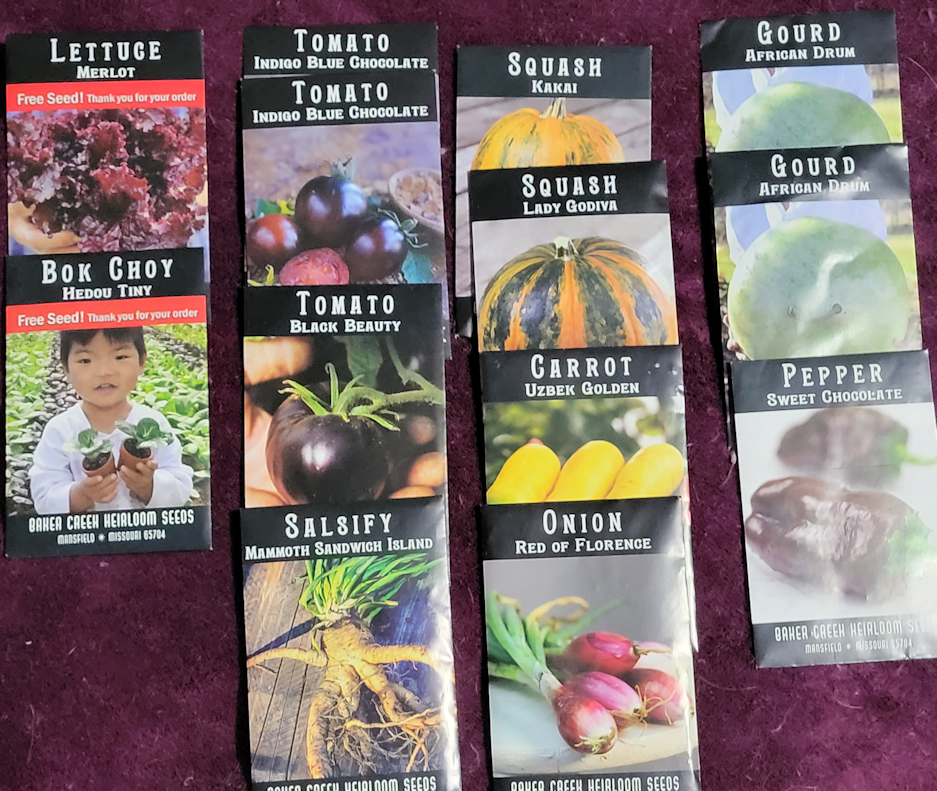
Last I checked the tracking for my Baker Creek order, it was still hung up in Illinois, so it was a wonderful surprise to get it in, along with the Heritage Harvest order I knew had arrived in yesterday’s mail.
The hulless seed pumpkins, carrots and onions are all repeat orders. The free Merlot lettuce seeds are a variety we’ve ordered before. We hadn’t planned to buy lettuce seeds for 2023, but there they are!
The Hedou Tiny Bok Choy is something I’d not heard of before! I don’t know if we’ll plant the lettuce for 2023, but I’d sure like to try this variety of Bok Choy! From the description, they are a cool weather crop, so we should be able to grow them all right, here.
Well, would you look at that! Thanks to the free seeds, we now have two types of lettuce! Jebousek lettuce. “A wonderful heirloom deer tongue lettuce from Czechoslovakia. Ella Jebousek of Brooks, Oregon received this variety from a descendant of the family who brought it from Czechoslovakia. Looseleaf type.”
We’ll see if we try them in 2023 or not.
What I’m looking forward to is going through that seed saving book!
I don’t think we’ll be ordering more seeds after this. We will be ordering other things, though, that will be shipped in the spring. Potatoes, for sure, and likely raspberry bushes or strawberries. That won’t happen until after the holidays, though.
Okay, it’s that time! I’ll be working on a serious of posts, going over how our 2022 garden went, what worked, what didn’t, and what didn’t even happen at all. This is help give us an idea of what we want to do in the future, what we don’t want to do in the future, and what changes need to be made.
Okay, so I’ve gone over how things went for our 2022 gardening year. We expanded our garden so much this year – and it was still less than we intended – I decided I need to do one last post to wrap it all together.
In a nutshell, though, I could probably just say this.
It was a terrible growing year.
In 2021, we got hit with drought and heat waves. For the longest time, we were out there watering the garden twice a day, just to keep it alive. With all that, things produced way better than I excepted, even when much of it did not thrive, or got eaten by groundhogs repeatedly, or got chomped on by deer.
I never thought that this year would be worse!
A lot of the failures can be attributed to things outside of our control. Winter dragged on long, as we got walloped with blizzards and large amounts of snow. I couldn’t complain about the snow, since we needed that moisture badly. Unfortunately, snow melts faster than ground thaws, and when the temperatures rose, the ground just couldn’t absorb it fast enough.
Even growing up here as a kid, I don’t remember ever having standing water in these areas!
The sad thing is, even with all this water, it would not have been enough to replenish the water table after years of drought.
Where, last year, we had things produce far better than expected, this year, it was the other way around. It turns out our garden handles drought and heat waves better than flooding and average temperatures.
Gotta look for that silver lining, though. We’ve had the two extremes, which gave us a lot of information to help us decide on our next steps.
The goal is to grow and produce as much of our own food, and be as self sufficient as possible. When we get animals, we want to grow their food as much as possible, too. How we get to that point can be changed or modified as much as it needs to be!
A lot of what we grew this year will be grown again in 2023, though not necessarily the same varieties.
As we expand our main garden area, we’ll be moving away from the distant garden beds, where we are now starting to build up our food forest. That’s what those beds where there to help prepare the soil for.
Which means that 2023 will have pretty much all the garden beds closer to the house, and we will be building more permanent structures. The temporary trellises have come down and, in the spring, we will be taking down the trellis tunnel, saving the wire to be reused.
We plan to start building permanent trellis tunnels where some of the newest, deep mulched garden beds were started. We will also focus on building more high raised beds – the challenge is to safely harvest the dead spruces to build them with, since we don’t have the funds to hire a company to take them down for us. I don’t begrudge them the cost at all; it would be worth every penny. We just have too many other things pulling at those pennies that are a higher priority, when we can do most of this work ourselves.
The low raised beds were enough to keep some things from getting drowned out, but in other areas, it still wasn’t enough. So while I do want to keep some beds low, the majority of our beds will be high raised beds.
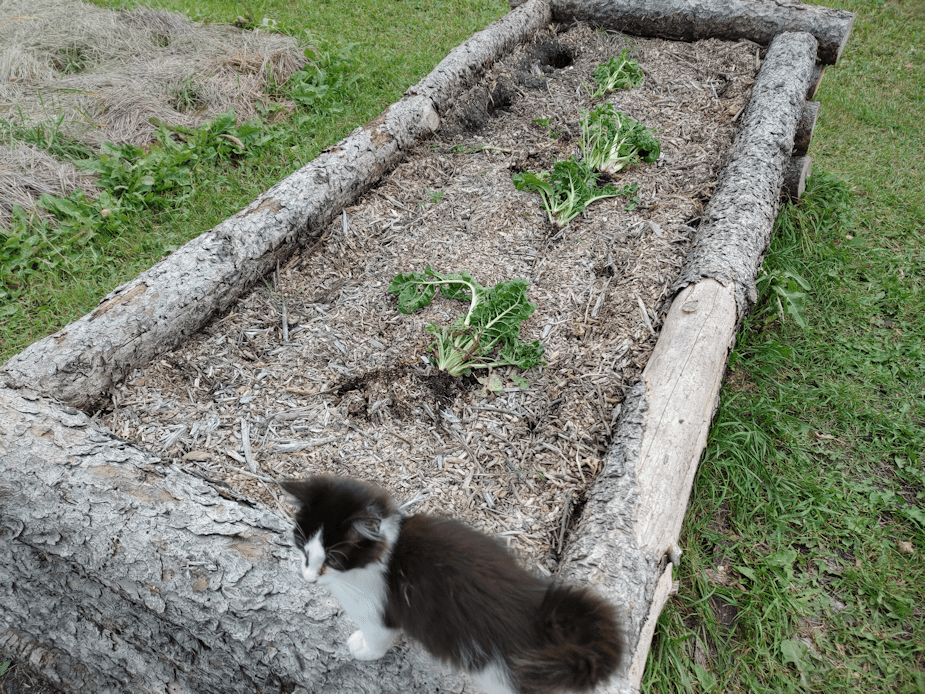
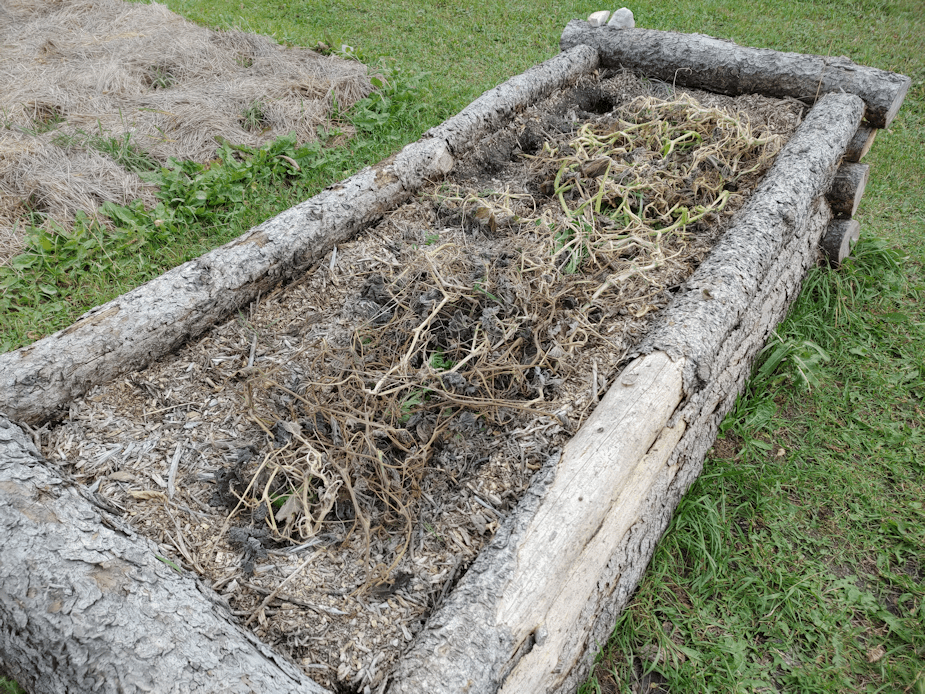
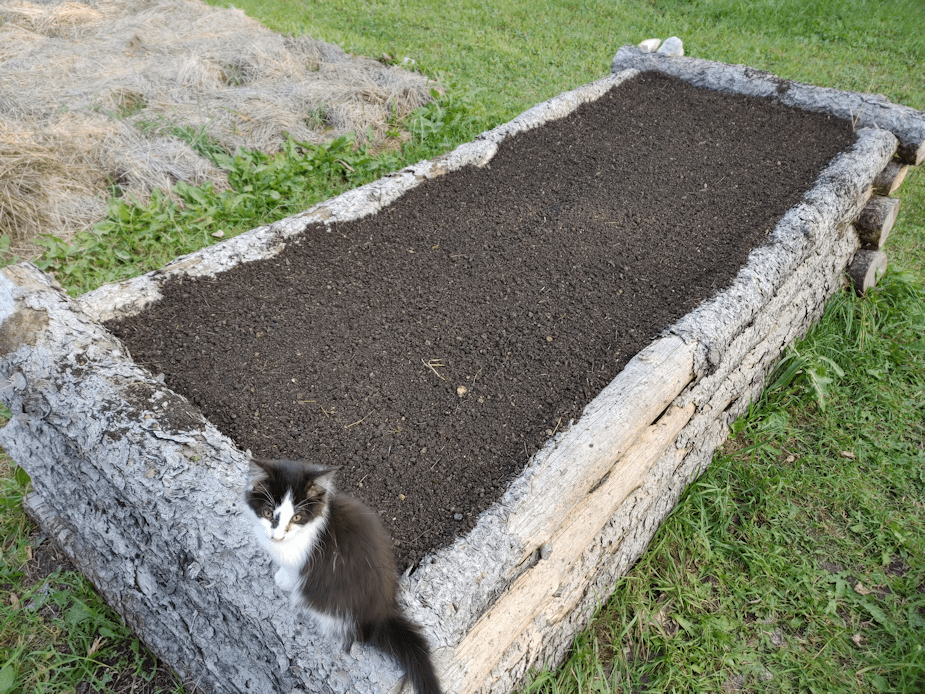
The one high raised bed that is complete, filled hügelkultur style, did very well. By the end of the season, it had settled quite a bit and needed a top up, which was to be expected. At this point, I think the bed’s “topsoil” is deep enough that it could be used to grow longer root vegetables now. This is definitely the way we will continue to build and fill our high raised beds, though we might tweak a few details, such as finding better ways to join the logs in the walls. We have a few more and better tools to help us now, and will continue to acquire more.
Since a major component of building our permanent beds is accessibility and mobility, as we build the permanent structures, we will make sure that the paths will be at minimum 4 ft wide – wide enough for a walker or wheelchair to turn around in. That will include the trellis tunnels we will be building. Now that we are aware of how much water can accumulate where we plan to build them, we intend to build probably middle height beds on the outside of the tunnels. Those beds will be 2 ft wide, since they will be accessible from only one side. I figure we should shoot for building at least three or four of these in the main garden area (not all in one year!), along with the 9′ x 4′ high raised beds we will be making. We will be sticking to 9′ x 4′ as much as possible, regardless of how tall the bed is, so that any covers we build for them can be interchangeable. Obviously, the narrower beds we plan to build at the trellis tunnels will be the exception, but the things planted in there would need different types of protection – if any at all.
Even aside from the trellis tunnels, we will want to built quite a few other trellises that can be moved around to wherever they are needed. Among the things that actually started to grow well (if too late), I noticed that the hulless pumpkins really, really wanted to climb. The melons we want to plant are also climbers, as are some of the gourds we want to grow. These would need support that can hold the weight of their fruit, so they will need the strength of the permanent tunnel trellises. Lighter climbers, like peas and pole beans, would be fine with portable trellises.
While we will be focusing on permanent structures in the main garden area, we are also needing to plan ahead to when we build permanent garden beds in the outer yard, where there is better sunlight. We are also working on plans for an outdoor, off-grid kitchen in that general area. That’s on top of the shed we need to dismantle, so that we can salvage the lumber for other projects, like the mobile chicken coop I want to build.
We’ve got a lot of building and heavy labour ahead of us, and none of us are quite able bodied, so it might take a while to get it done!
As terrible of a growing year it was in 2022, it provided us with much useful data, and will actually help us in planning our next steps.
Okay, it’s that time! I’ll be working on a serious of posts, going over how our 2022 garden went, what worked, what didn’t, and what didn’t even happen at all. This is help give us an idea of what we want to do in the future, what we don’t want to do in the future, and what changes need to be made.
Okay, so now let’s look at the things that never happened – or the things that kinda, sorta happened.
I’ll start with a kinda-sorta happened, and didn’t happen, at the same time!
The bread seed poppies.
Last year, we’d planted some bread seed poppies in the old kitchen garden, which didn’t thrive, but we were still able to harvest dried pods and keep seed for. For 2022, we also bought two other varieties. The plan was to plant them well away from each other, to prevent cross pollination. Poppies self seed very easily, so wherever we planted them, they would be treated as a perennial.
In the spring, we scattered our collected seed over the same bed we’d grown them in before. They really were too densely sown, but at the same time, it was just such a terrible growing year. Lots of them germinated, but there were weeds growing among them that had leaves very similar to the poppy leaves. I had to wait until the got larger before I could tell for sure, what was a weed, and what was a poppy. They still didn’t do all that well, and I didn’t bother trying to collect any of the few dried pods that formed to collect seed. Instead, that bed was completely torn up, and there is now a low raised bed framed with small logs. Whatever we end up planting there should do a lot better.
As for the new varieties, we never found a place we felt was suitable to sow them. The flooding certainly didn’t help. Some of the places I was thinking of ended up under water, so I guess it’s a good thing we never tried planting there.
So bread seed poppies are something we will try again, once we figure out permanent locations to grow them that are in very different parts of the yard.
Then there were the wildflowers.
We got two types of wildflower seed mixes, specific for our region. Both were sown in the fall, when overnight temperatures were consistently below 6C/43F. One was an alternative lawn mix, so we sowed those between two rows of trees behind the storage house, where it’s very difficult to mow or tend. The other was sown outside the fence near the main garden area, where we later put the new sign to identify the property, after the old one disappeared. There is a broad and open strip of grass between the fence and the road, that I would eventually like to fill with wildflowers. To start, our first sowing was done near the corner, where we hoped they would attract pollinators that would also benefit our garden.
We got nothing.
The photo on the right doesn’t show the space between the trees the seeds were broadcast onto, but it was filled with water. The storage house didn’t just have a moat around it, like the garage. The space under it, where the yard cats often go for shelter, was completely full of water.
The photo on the right shows where the Western wildflower seed mix were broadcast and, while there was some standing water in places, it also got covered with sand and gravel from the road, as the ridges left behind by the blows melted away.
Yes, the snow got flung that far from the road!
Not a single wildflower germinated, in either location.
I suppose it’s possible that some seeds were hardy enough to survive the conditions and will germinate next spring. Who knows.
I’d intended to get more seed packets, which would have been sown in the fall, but completely forgot to even look for them. I might still get them and try broadcasting the seeds in the spring. We do still want to turn several areas that are difficult to maintain, over to wildflowers and groundcovers. Once we get them established, they should be virtually maintenance free. It’s getting them established that might take some time!
During our previous two years of gardening, we grew sunflowers. The first year, we grew some giant varieties. For 2021, we grew Mongolian giants and Hope Black Dye. These were to do double duty as privacy screens.
They did not thrive during the drought conditions we had last year, and deer were an issue, but we were able to harvest and cure some mature seed heads and intended to plant them in 2022.
That didn’t happen.
Basically, with the flooding, the spaces we would have planted them in were just not available. Plus, the bags with the seeds heads were moved into the sun room, after spending the winter in the old kitchen, with the intention of planting the seeds, they ended up in there all year. With how hot it can get in there, I don’t think the seeds are viable anymore.
Still, it might be worth trying them!
The reason we wanted to grow the varieties included using them as both privacy screens and wind breaks. We also want to grow them as food for ourselves and birds and, at some point, we’ll be getting an oil press, and will be able to press our own sunflower oil. So sunflowers are still part of our future plans.
We did have sunflowers growing in 2022, none of which we planted ourselves. They were all planted by birds, and were most likely black oil seed; the type of bird seed available at the general store. Only a couple of seed heads were able to mature enough to harvest, and we just gave them to the birds.
I do want to plant sunflowers again, but at this point, I’m not sure we will do them for 2023.
Several other things we got seeds for, some we intended to plant in 2022, but others for future use.
Of those we had intended to plant, one of them was Strawberry Spinach.
These are something we’ve grown before on our balcony, while still living in the city. The leaves can be eaten like a spinach, while also producing berries on their stems. We’d ordered and planted some in a new bed, where we could let them self-seed and treat them as a perennial, in 2020.
They were a complete fail. We don’t know why.
I ordered more seeds and we were thinking of a different location to plant them, but then the flooding hit, and we got busy with transplanting and direct seeding, and basically forgot about them.
I still want to grow them, but we still need to figure out a good, hopefully permanent, location for them.
We also found ourselves with a packet of free dill seeds (, plus we were given dill that we were able to harvest seeds from. Since cleaning up the old kitchen garden area, we did start to get dill growing – dill is notorious for spreading its see and coming back year after year! – but they never got very large. We have bulbs planted where they’ve been coming up, so we’re not exactly encouraging them in that location.
In the end, with the way things went, we never decided on a location to plant them, and with all the other issues we had with the garden this year, it just wasn’t a priority.
For 2023, however, we’re actively starting to order herb seeds and will be building up an herb garden, so hopefully we’ll be able to include dill in those plans, too.
One thing we ordered that we did not intend to plant right away was wheat.
These are a heritage variety of bread wheat, and we only got 100 seeds. Even if we had a good year, I doubt that would give us enough yield for even a loaf or two of bread. We do, however, plan to invest in a grinding mill in the future.
Meanwhile, when we do plant these, it will be for more seeds, not for use. In the longer term, we’d need to have a much larger area to grow enough wheat for our own use.
We’ll be starting slow!
Then there were the forage radishes.
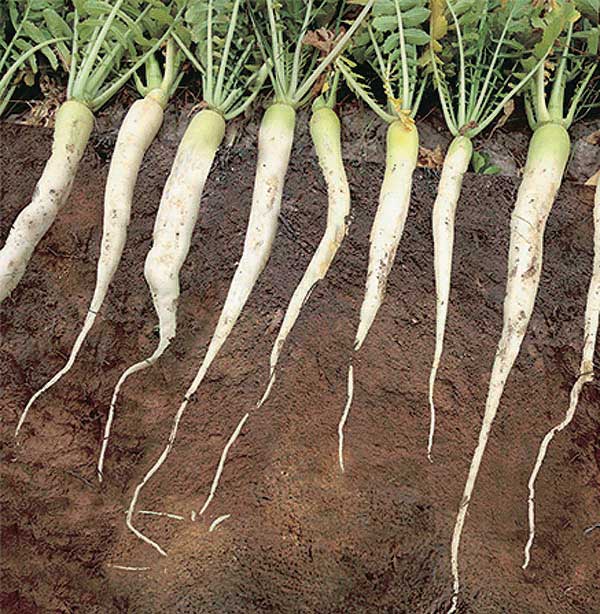
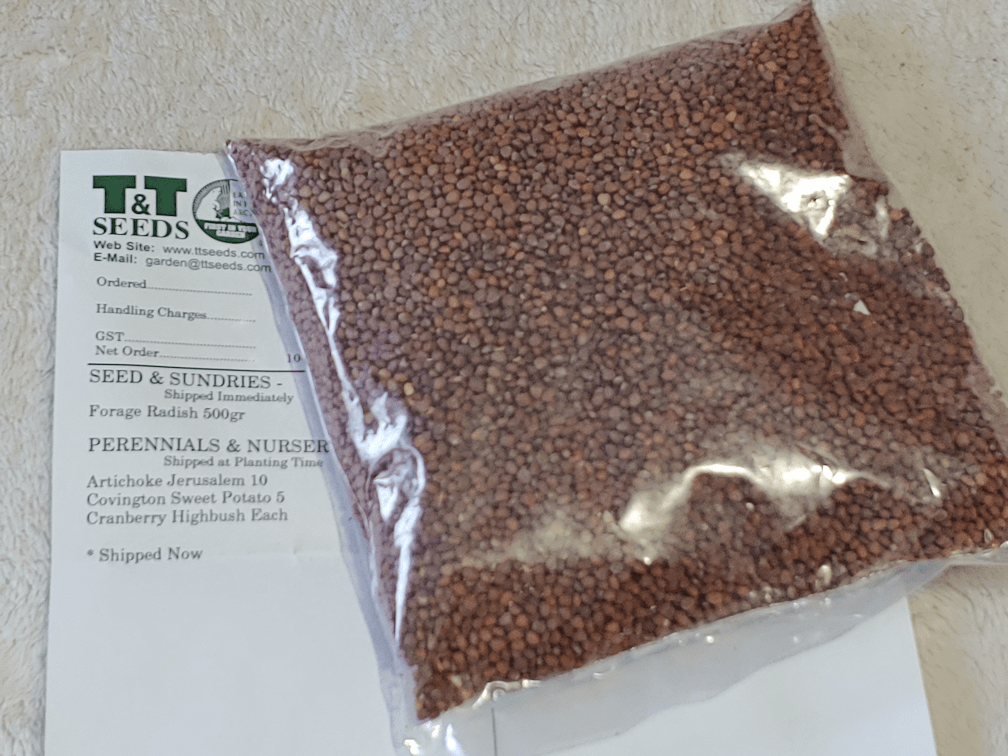
Also called tillage radish. We got these to help amend our soil, and loosen it for future planting. These would be something we would use to break new ground in preparation for future garden plots. There are a whole lot of seeds – and that was the smallest size package! – so we’ll probably have a few years to use these to prepare new beds.
I think that’s it!
I’m sure I’m forgetting something. 😄😄
Next, I’ll post my final thoughts on how everything went. With everything that went on this year, that’s going to need its own post!
The Re-Farmer
Update: I knew I was forgetting something! Two somethings.
The first is our winter sowing experiment. You can read about how that turned out, here. Basically, we got nothing, and I think it was due to our extended, cold winter. I know this is something that has worked for others in our climate zone. It just didn’t work for us this year. In the future, I will probably experiment with it more, but not for the 2023 growing season.
The other is our cucamelons. In 2021, the cucamelon vines grew well in a much more ideal spot, but we had almost no fruit. The previous year, we grew them in a spot that was too shady for them, but still managed to get more fruit. I believe it was a pollination problem.
While we do want to grow them again in the future, we decided not to get more seeds. However, in cleaning up and redoing the spot they were growing in, putting in chimney blocks to plant in and keep the soil from eroding under the chain link fence, we found lots of tubers. In theory, we could over winter the tubers and plant them again in the spring. So we buried them in a pot and set the pot into the sun room, where it doesn’t get as cold. The first year we tried that, there was pretty much no sign of the tubers by spring. I found only the desiccated skin of one. When I brought the pot out for 2022, I didn’t even bother digging for the tubers. I knew they wouldn’t have survived the extended cold, even in the sun room. We should have taken it into the house and maybe into the old basement, where the cats couldn’t get at it, but those stairs are difficult for to navigate, and we go down there as rarely as possible.
So winter sowing and cucamelon tubers were both things that just didn’t work for 2023.
In truth, we might not actually plant these seeds. It will depend on the space and conditions we have. However, I do want to have them in my seed collection, just in case, or for future planting.
Here is what I ordered (all images belong to Heritage Harvest).
This is something we got as free seed last year and planted in our 2022 garden. They germinated quickly, then completely disappeared! It is described as one of the best tasting turnips, and a good storage variety, so I would like to try them again.
This time, making sure to use floating row covers to protect the seedlings from whatever has been eating them!
The early season watermelon variety we tried last year died off almost immediately after transplanting. Whether that was due to transplant shock or the flooding, I’m not completely sure. Very likely, both. I couldn’t find it again, so I would like to try this one. This is not a storage variety, due to the very thin rinds, but it is described as extremely tasty, so storage likely won’t be an issue! With only 80-85 days to maturity, we might even be able to direct sow these, instead of starting them indoors.
Yes, we already have two varieties of corn seeds, including a popcorn. These are a dwarf variety that matures in only 60 days. They are also described as being extremely rare. There’s only 50 seeds per packet, so I ordered two.
This variety matures in only 55 days. While not a dwarf variety, the stalks grow to only about 4 feet in height. This variety was introduced from the University of Alaska, so they should do all right here!
These also come with only 50 seeds per packet, but I decided to just get one.
Which variety or corn, or how many we end up planting, is a decision we will make once we have a better idea of what we have to work with in the spring. After the past couple of years, we know full well that whatever plans we make now can change very quickly. Hopefully, I will plant at least the popcorn, plus one sweet corn variety, but if we can manage more, that would be great.
I actually removed several things from my cart in order to get this book, and stay in budget. How to Save Your Own Seeds.
I do know how to save seeds for quite a few things, but there are some that I’m not as sure about. With availability of seeds, or specific varieties of seeds, fluctuating so much at the best of times – and these are not the best of times! – I figured this would be a valuable resource for our library.
I was so, so tempted to order more! I saw the Tropeana Lunga onions were in stock, but decided against them this time. They did really well, but their super thick necks prevented them from curing properly, so we’ll stick to other varieties that will hopefully not have that issue. I was looking at giant sunflowers and herbs, flowers, and even more tomatoes. It’s hard not to over indulge! Especially when they are things we do want to grow, like herbs that will also attract pollinators, or flowers that can be used as trap crops for insects.
All in good time. We’ve still got a lot of work to do, before we’re ready to grow many things we are planning for!
Okay, it’s that time! I’ll be working on a serious of posts, going over how our 2022 garden went, what worked, what didn’t, and what didn’t even happen at all. This is help give us an idea of what we want to do in the future, what we don’t want to do in the future, and what changes need to be made.
Our 2022 garden had a lot of challenges, and a lot of failures. Some of challenges and failures started well before we planted a single thing outdoors.
With our short growing season, we need to start a lot of things indoors. That, in itself, is expected and not a big deal. Our circumstances, however, have thrown in some major difficulties.
Fourteen of them, in fact.
Well. Sixteen, when we were trying to get them going this year.
Our indoor cats.
The other challenge is a combination of space and light. This house is oriented to the East. Our largest windows face the sunrise – with a grove of 60’+ spruces not far away. Our south facing windows are smaller and inaccessible for the purpose. The exception to that is the sun room, however the sun room is not warm enough to start seeds in when we need to. Plus, during colder weather, we allow the outside cats to use it for shelter.
Which means we need to figure out how to start seeds indoors, provide adequate artificial light, and protect the seedlings from cats that are determined to either roll on them, or eat them!
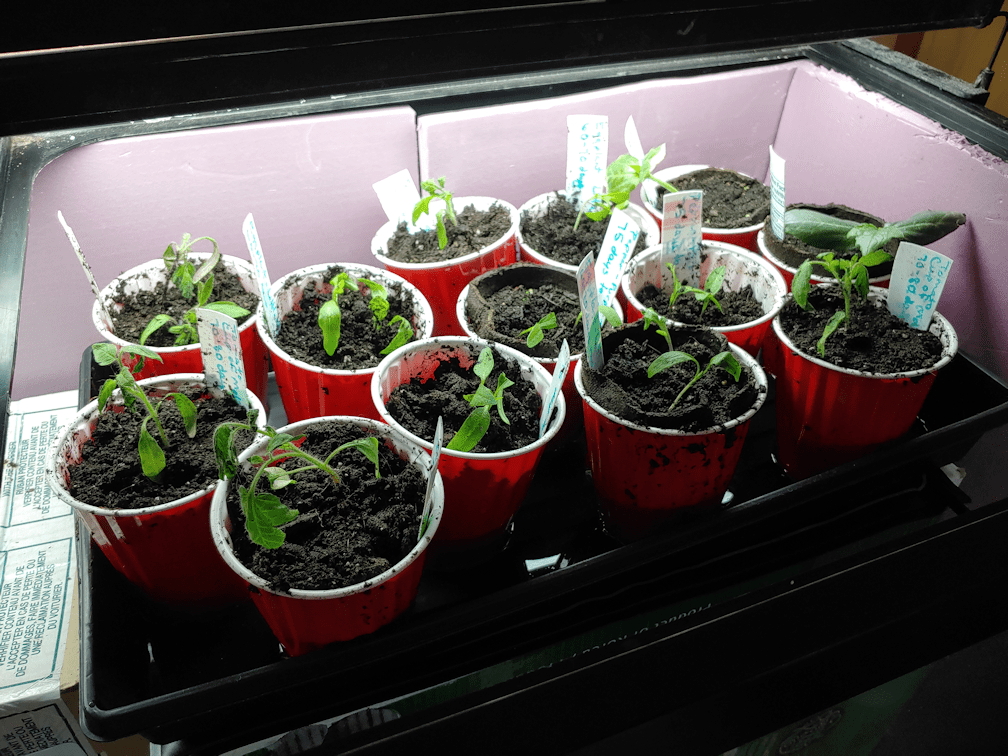
The first solution was one that we started doing last year. We have two aquariums that we have been able to convert into greenhouses, of a sort. When we moved out here, we brought our big tank, with a second light fixture to replace the kit light. Both work just fine, and provide adequate light for starting seeds.
The corner of the living room the tank sits in gets cold, so we added rigid insulation against two walls for extra protection. We were also able to get a warming mat to place under seed trays of things that needed extra heat. Since the lights can’t be raised or lowered, we used cardboard boxes under the seed trays to adjust the height, with new plantings closer to the lights, and larger ones lower down, rotating and adjusting as needed. We built frames with hardware cloth to cover the top of the tank, which both protected the seedlings from the cats, but also allowed more air flow.
This above picture was taken with the hardware cloth covers removed for access. As you can see from the bedraggled seedlings, we didn’t quite manage to protect them from the cats. More on that later.
The other tank is much smaller; just a 20 gallon tank. It, too, tended to get chilly, plus the light it came with was not as bright as having two lights, as with the large tank. It has insulation on three sides to protect from the chill walls, which also got covered in aluminum foil to reflect the light.
When we first started using this tank the previous year, we used the original lid it came with. The cats were incredibly determined to get at the trays below, and were able to reach through the opening for the filter, no matter what we used to block it, completely destroying the trays below. This year, we found some window screens in a shed, and used one of those as a lid, weighted down with hand weights. We removed the light from the bottom of the original lid and attached it to a foil lined piece of rigid insulation, and simply set it on top of the window screen. The cats still sometimes managed to knock the weights around and displace the screen but, over all, it did keep them out.
The problem with both tanks, but especially the little one, was air circulation. For that, we used a tiny fan we found in one of the basements while doing clean up. We could put it right into the big tank, or on top of the hardware cloth covers, aimed downwards. For the small tank, we could just set it on the screen, also aimed downwards. Ultimately, though, we used the small tank as little as possible.
We had an awful lot of seeds to start indoors, however. Way too many to fit in the tanks. Since the seeds needed to be started at different times, we could start the earliest ones in the tanks, then rotate them out when the next seeds needed to be started.
The question was, rotate them out where?
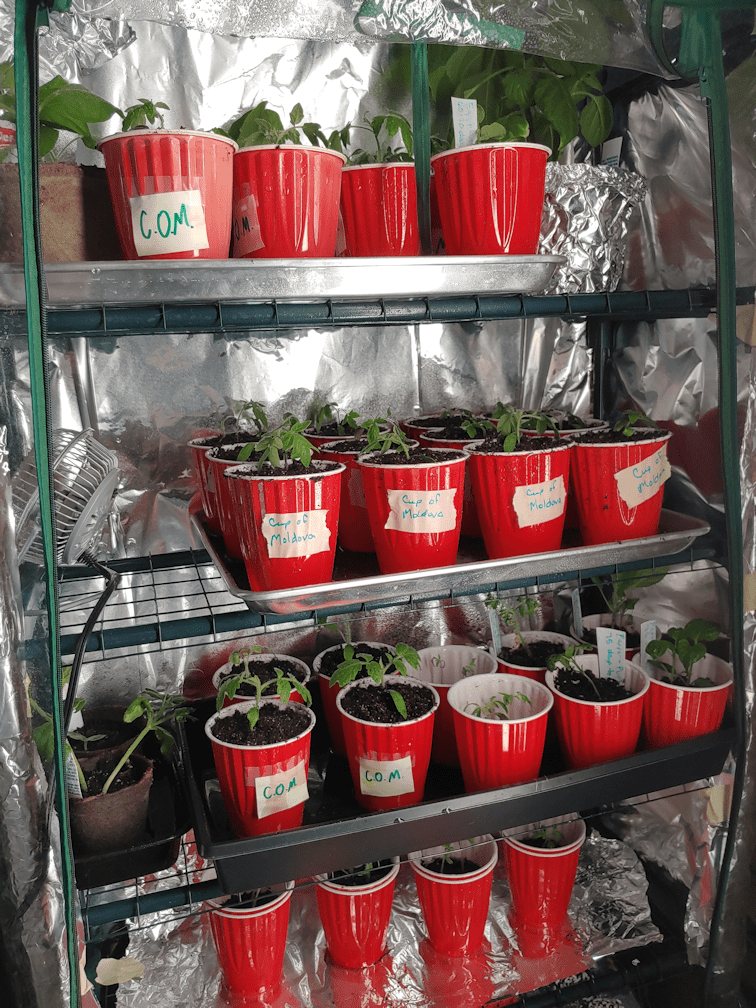
One of my daughters had bought a mini greenhouse for me the year before, so we brought that into the living room. We also bought a long, narrow, LED shop light to illuminate it better. That worked out well enough that we later bought a second one.
We set it up as close to the window as we could, on a chair to catch more light. The only way we could use the light, however, was to hang it from a plant hook in the ceiling above, so that it rested on the chair as well, oriented vertically.
The cats were absolutely determined to get into it!
They managed to squeeze in from under the chair, so we tried taping the plastic cover to the chair.
That wasn’t enough.
We added pieces of cardboard to block the spaces they were squeezing through.
It… mostly worked.
In the end, it was a combination of taping the bottom, the cardboard, and covering the back and sides of the frame with aluminum foil – which also helped reflect light onto the seedling better.
They still managed to get in.
I came out one morning and found cats had somehow squeezed through one of the zippers, pushing it open more, and rolled all over a couple of the trays.
It was such a disaster!
We did managed to save some of the seedlings, but not all. Thankfully, we had seeds left for some of them and were able to start over.
We were eventually able to keep the mini greenhouse sealed up well enough to keep the cats out, but it meant keeping the plastic cover on and closed up at a time when the seedlings didn’t need a cover. This meant no air circulation in there at all. Even so, there were times when a cat or two managed to get in, and try to eat some of the seedlings!
I was able to rig the little fan up inside the mini greenhouse, aimed at the walls in such a way that the air flow would be pushed upwards and around the whole space.
That little fan got one heck of a work out!
So we finally got that working, but there’s not a lot of space in between the shelves. Before long, some of the seedlings began to outgrow the mini greenhouse. They needed to be moved out, and the only place we could move them to was the sun room – but we had to wait until it was warm enough!
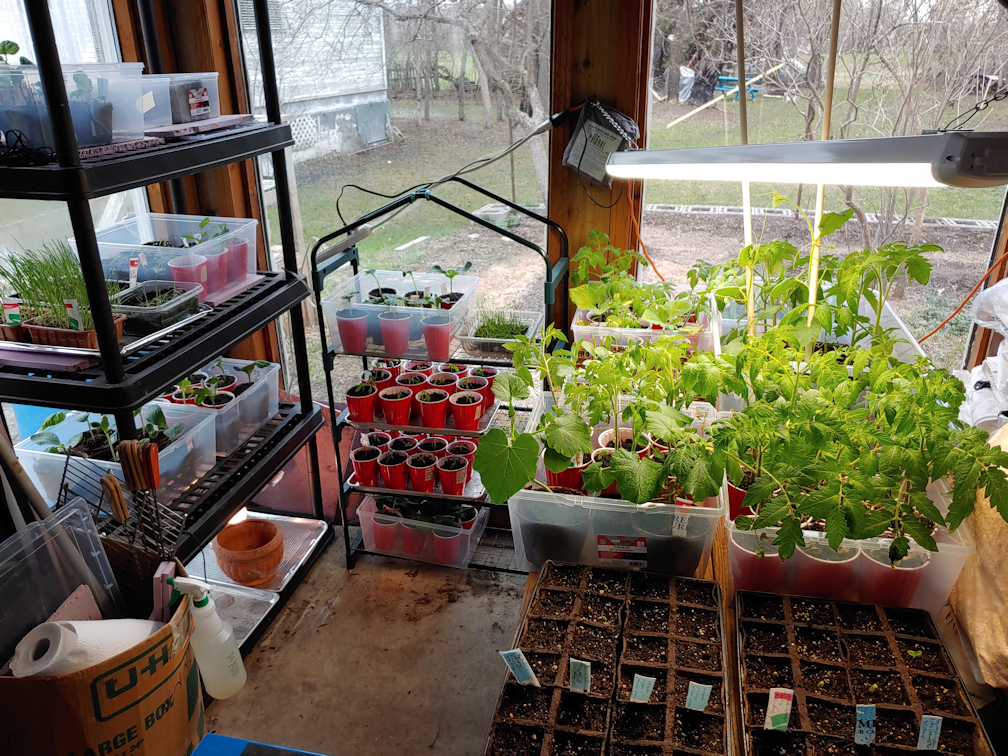
Eventually, we were able to move the largest seedlings onto shelves in the sun room, while other seedlings got rotated into the mini greenhouse, and newly sown trays were set up in the aquarium greenhouses. We had our seeds organized by when they needed to be started, with the earliest started 10 weeks before our average last frost date, then 8 weeks, 6 weeks and finally 4 weeks.
We still ran out of space.
In the end, we set up a surface to hold seedlings over the swing bench, and eventually we could move the mini greenhouse to the sun room – and finally take the cover off! The second shop light was hung above the plants over the swing bench, and we eventually hung the one from the living room on the inside of the shelf.
For a sun room, the sunlight doesn’t actually reach far into the room.
There were so many things that needed to be started indoors! In fact, most of what we were growing needed to be started indoors, with only a few things that needed to be direct sown.
That’s not really going to be changing, so we need to figure something better out. How do we provide the seed trays and seedlings with the light, air flow and space they need, while also protecting them from the cats?
Well, the girls and I have been talking about it, and the only real solution we have is to find a way to keep the cats out of the living room completely, and turn the living room into a plant room.
The question is, how?
There are floor to ceiling cabinets between the living room and dining room. On one set, the living room side is completely covered. On the other, there is a “window” at one shelf that allows access from both sides. It’s a favourite lounging place for David! Between the cabinets is an open space somewhat wider than a standard sized door for access between the two rooms.
The only way to prevent the cats from getting into the living room is to build a barrier in that space, with a door in it, plus another barrier to cover the “window” in one of the cabinets.
Barriers which need to be strong enough to withstand cats trying to get through, yet still be easily removeable.
One of my daughters has drawn up plans for a barrier with a doorway, while the “window” will just need a simple rectangular frame to fit the space. It’s basically going to be all wooden frames and hardware cloth.
Unfortunately, we’ll need to actually buy the lumber for this, and lumber is extremely expensive right now. There is nothing in the piles of salvaged lumber in the sheds and barn suitable for what we have in mind.
It’s something we’ll have to figure out soon. Some things, like onion seeds, could be started as early as January. February at the latest. Honestly, I just don’t see how we can get the materials and build the barriers that quickly. We could start off using the large aquarium, which might give us until March to get it done, but… I’m not very hopeful.
It would be a lot easier, if the cats weren’t so absolutely determined to destroy the seed trays!
Okay, it’s that time! I’ll be working on a serious of posts, going over how our 2022 garden went, what worked, what didn’t, and what didn’t even happen at all. This is help give us an idea of what we want to do in the future, what we don’t want to do in the future, and what changes need to be made.
*sigh*
I had such high hopes for our squash and gourds for 2022. We planted SO many varieties of squash! We especially worked towards growing winter squash, with a focus on varieties that stored well for the winter. This is part of our working towards being as self sufficient as possible, and to have a good supply of food during the winter months when we can expect to be unable to get out, either due to being snowed in, or vehicles freezing, or whatever, for at least two months. Something we’ve already had to deal with, somewhat.
We also planted a variety of pumpkins, including 3 hulless varieties for their seeds, and summer squash, plus had both new and old varieties of gourds.
Almost everything was a loss, and what wasn’t a loss was still nowhere near fully successful.
We’ll start with our “fun” plants: the gourds.
I am wanting to grow gourds to cure them, then use them for crafting or to make useful objects out of them. Three that we had grown before were:
Tennessee Dancing Gourd, which did very well in 2021, even in drought conditions.
Ozark Nest Egg, which was set back in growth for quite time time, but when they did start to grow, looked to be incredibly prolific and would have done amazing, if they had not been killed off by frost.
Luffa, which had not done well before, but I really want to grow them for their sponges.
These were grown from seeds left over from the previous year. They germinated well, though there were issues with the cats getting into the mini-greenhouse they were in and destroying many seedlings. I used the last of our seeds to try again, and we did manage to have a few survive.
New gourds included the canteen gourd, and apple gourd.
The Results:
I am really, really happy with how the Ozark Nest Egg and Tennessee Dancing Gourds did!
The Ozark Nest Egg gourds are absolutely beautiful! I just love the size and shape of them. The Dancing Gourds managed to produce a decent amount that were larger than those we collected at the end of the previous, drought stricken year.
As I write this, they are both in a bin, curing. The Dancing gourds have mostly turned a tan colour. The Ozark Nest Egg gourds were already almost white, so there’s not a lot of change in their colour.
I look forward to seeing what we can do with them, after they are fully cured!
Then there was the luffa…
They took such a very long time to even start blooming, and when they did, it was all male flowers for quite a long time. When the female flowers started showing up, there were no male flowers to pollinate them! So when we finally got both blooming at the same time, I made sure to hand pollinate them.
By then, however, it was just too late in the season. There was no chance for them to fully mature. When the frost finally hit, that was the end of them.
Conclusion:
I would definitely want to try all three again. Hopefully, I’ll have seeds from the Ozark Nest Egg we harvested, because I didn’t see them when I was ordering other things from the site I got them from originally. I may have just missed them.
As for the luffa, I think those will wait until we have a greenhouse or polytunnel before I try again. I really like them, and when the plants finally do start growing, they grow so incredibly fast!
Next, we have the canteen gourd and the apple gourd.
The canteen gourds ended up needing potting up a couple of times, and even then, by the time I could transplant them, they were getting way too big for their pots. I’d have transplanted them earlier, but had to wait until after our last average frost date (June 2). They were already showing flower buds when they were transplanted – which promptly died.
They never really did well after transplanting, staying long and gangly, and never filling out. They did bloom, but again, it was male flowers only. We did, eventually, get female flowers that I hand pollinated, but it was too late in the season.
The canteen gourds were planted at the tunnel trellis, which had been used the year before, but the apple gourds were grown in a completely new garden area. This squash patch had most of our winter squash and pumpkins. Each transplanted went into its own dug out hole that was filled with fresh garden soil before transplanting. Unfortunately, this area got heavily saturated during the flooding, and it was way too long before everything finally got well mulched.
Out of everything there, though, the apple gourds did the best.
It still took them a long time to get to the point of flowering and producing fruit – I would hand pollinated them, any time I saw new female flowers show up. The three surviving transplants began to produce quite a few gourds, but it was simply too late. Then, even with protection, they were pretty much killed off by our first frosts.
I know these grow in our climate zone. It was just a terrible growing year that set everything back so much.
Conclusion:
I’ve already picked up more canteen and apple gourd seeds. In fact, I’ve also picked up some drum gourds to try, too! Plus some Caveman’s Club. I am just determined to make it work! I want to make stuff with these, and there are other varieties of gourds I will eventually be trying to grow, for different purposes.
Then there was the summer squash.
*sigh*
We accidentally bought three, instead of one, variety pack of summer squash seeds, so we’ll have green zucchini, yellow zucchini, Magda and sunburst patty pan seeds for years to come. Summer squash was one of the first things we grew, in our very first gardening year, and even though we lost half of them to frost because they were transplanted too early, we still had so much summer squash, we were able to harvest them daily for a while.
They didn’t do as well during the drought of 2021, but we were still able to harvest enough summer squash to be able to do refrigerator pickles. Mostly, though, we enjoy eating them fresh and raw!
For 2022, we were accidentally sent a packet of G-Star patty pans, a green variety, as well. When the mistake was pointed out, we were sent the seeds we were supposed to get, and told to keep the ones we were sent by mistake. We were quite happy to try a new variety of patty pans!
The Result:
*sigh*
The Magda, yellow zucchini and sunburst patty pans were planted in a low raised bed together. Because we like them so much, we had twice as many sunburst as anything else. The green zucchini were planted into the new squash bed, right next to the low raised bed.
We planted as many of the G-star as we did the sunburst patty pans, but those got planted in another new bed, on the opposite side of the main garden area, along with corn, winter squash and hulless pumpkins.
All of these had been started indoors with an excellent germination rate.
None of the summer squash did well, though we did get more Magda squash than in previous years, when fewer plants survived. We quite like the Magda squash. Still, there were very few of them overall, and the plants did not thrive.
We got almost nothing from the green zucchini, and not much more from the yellow. Most disappointing of all was how few sunburst squash we got. Even with hand pollinating.
The G-star had a rough start, but once they got well mulched, they really perked up and grew very quickly. We were even able to harvest some, though the biggest, healthiest plant suddenly died, its stem completely cut through by an insect.
Conclusion:
Since we’ve had such success with summer squash in previous years, we know that 2022 was an exception for how bad our summer squash did. The question is, was it because of the flooding? Or where there other factors? I think lack of pollinators were part of the problem, but the plants also just didn’t bloom much at all.
We’ll be growing all these varieties again, and hopefully, 2023 will be a better growing year!
Now we go into what was one of the more disappointing things; our winter squash. I’m including the pumpkins with these, even though they actually did better.
Along with the three types of hulless pumpkins, which were transplanted well away from each other, we had a couple of free giant pumpkin seeds we grew in a hill we used for Crespo squash the year before, and some Baby Pam pumpkins from seeds left from the year before. Those had a zero germination rate the year before, but for 2022, we had a 100% germination rate!
In the new, big squash patch, we also had Teddy Squash, a tiny, short season variety we’d had seeds left over from the year before, Georgia Candy Roaster, and Winter Sweet. In the corn and squash patch, we had Boston Marrow, while Red Kuri was planted in a new bed by the chain link fence.
I feel like I’m forgetting another winter squash. Maybe I’ll remember later. Oh, right! We also tried Crespo Squash again. Those tried to do so well the year before, but kept getting eaten by deer and groundhogs!
The Results:
Again, it was almost a total loss. Especially for the winter squash.
While the big squash patch didn’t have standing water during the flooding, the ground did get quite saturated. We lost some of our transplants completely. The squash and corn patch, on the other hand, so SO much more flooding!
Still, if we’d been able to well mulch the big squash patch better, I think it would have helped. Also, the south side of the patch got more shade than the north side, due to the tall trees between the garden and the house, which certainly didn’t help!
The Georgia Candy Roaster and Winter Sweet just didn’t grow. It’s like they never recovered from transplanting. The Teddy did a bit better, and even started to form tiny squash, but it was way too late for them to mature. The Baby Pam did surprisingly well, and we did get a few little pumkins (they only grow 5-6 inches in diameter). We got a couple of Kakai hulless pumpkins, too. The Crespo squash never even bloomed.
Probably the only really successful thing was the giant pumpkins. We made no attempt to get actual giants, but they still grew really big. We had two plants, and got two pumpkins out of it.
In the corn and squash bed, which got so much more flooding, I’m amazed we got any Boston Marrow at all. They took a long time to recover from flooding, but they did eventually start blooming and producing fruit. We did pick a few, but they were under ripe, and even the ripest one was much smaller than they should have been.
We did get some Lady Godiva and Styrian hulless pumpkins, though nowhere near as many as we should have, nor where they as big as they should have been.
The only real success was the Red Kuri (Little Gem) squash, that grew in the south yard up the chain link fence. They were still smaller than they should have been, but we did get an okay harvest.
Conclusion:
Well, our reasons for growing so much squash haven’t changed, so we’ll definitely be trying to grow them all again. There’s nothing we could have done about the damage the flooding caused. When we try again, we will have to take extra care to make sure they are well mulched, as that made quite the difference, once we were finally able to do it. We’re going to be trying pretty much all the varieties again. My source for Baby Pam pumpkins and Teddy squash no longer carries, them, though. I don’t remember right now if we have any seeds left, but if we do, we will try them again, too.
Among the things we are slowly working on is building high raised beds in the main garden area. When we get to building them where the large squash patch was, the extra height will also help get away from the shade problem on the north side .
Now we reach one more disappointment.
A total and complete loss of our melons.
We had made two new large garden plots, using the Ruth Stout deep mulch method. The north half of both had potatoes planted in them, and the south half got melons.
The previous year, we’d grown two types of melons. In spite of the drought, they did very well, and we got a surprisingly good harvest. We loved having fresh melons, so for 2022, we planted even more. Some were seeds harvested from grocery store melons. We also tried Zucca melon (a giant variety) and a short season watermelon, for six varieties altogether.
The Results:
When some of the transplants died, we filled the gaps with Yakteen gourds (the ones with the red arrows pointing to them).
The watermelons died almost right away. Of the ones that didn’t die outright, they just didn’t grow. It wasn’t until the very end of the season that a couple of Zucca melons started to grow, and even bloom, but it was just way too late by then.
Conclusion:
After the success of the previous year, this was such a huge disappointment. We all really love melons, but they are quite expensive to buy, so growing them would be well worth the effort.
For 2023, we’ve bought more Halona and Pixie melon seeds, which we had successfully grown the year before (we had saved Halona seeds, but not Pixie), plus we are trying a new cantaloupe type variety. We will also be trying the Zucca melon again, plus we still have saved seeds from other varieties.
The flooding we got last year was exceptional, so I don’t think we’ll have that happen again, but we will still need to work on improving the soil and planting them in, at the very least, low raised beds. The Pixie and Halon were planted at the trellis tunnel the first time, and are excellent climbers. We don’t plan to use that tunnel trellis again, but will be building new, permanent trellis tunnels closer to the house, with low raised beds at their bases. That should make a big difference in growing conditions – so long as the weather is cooperative!
Okay, it’s that time! I’ll be working on a serious of posts, going over how our 2022 garden went, what worked, what didn’t, and what didn’t even happen at all. This is help give us an idea of what we want to do in the future, what we don’t want to do in the future, and what changes need to be made.
Here, we are looking at growing stuff that was new to us. When I was a kid, my mother did grow cucumbers here, but she never grew peppers or eggplants. Our own experience with growing peppers goes back to before our move, when the co-op we lived in built accessible garden beds, and we signed up for one of them. We tried growing a hot variety of pepper, and we were getting one that was developing really well – then it got stolen. I don’t know if I feel sorry for whomever took it and tried to eat it, thinking it was a bell pepper, not a hot pepper! We ended up potting it up and bringing it inside for the winter, and got many peppers from it, that we dehydrated.
I am not able to eat fresh tomatoes. They make me gag, and I’ve since learned this is a thing similar to how some people find cilantro tastes like soap. There’s something in fresh tomatoes that I react to, but not when they are processed.
Peppers is a bit different. It doesn’t matter if they’re fresh or processed. They make me gag if I can taste them. I’ve eaten things with peppers in them as an ingredient, without reacting to it, so it’s not an allergy, but if there is enough that they can be tasted, I can’t eat it. Oddly, I can eat jalapeno stuffed peppers just fine! As for fresh peppers, I love how they smell, and the crispness as I cut them up, but when I try to eat them, I just want to puke! However, my husband and one of my daughters both love peppers, so we gave it a try.
Eggplant is something that most of us like, but we rarely buy, so we decided to try growing them to see if we liked them enough to make it worthwhile to grow them every year. Peppers and eggplant are both heat loving plants, but as long as their growing season is short enough and they are started indoors, they can be grown in our zone 3. Our summers can get extreme heat as much as our winters get extreme cold!
I’ll start with the cucumbers, though.
We chose a variety that was supposed to be good for both fresh eating and for pickling. They were started indoors, and were transplanted at one of the A frame trellises.
The Result:
In a word, frustrating.
As with so many other things, the cucumbers did not reach their full potential. However, they did grow and bloom and produce. We would even have had enough to do a few jars of pickles, but we mostly ate them fresh.
For the amount of cucumbers we planted, we had enough for our own use.
The frustrating thing?
My sister had a very productive year for cucumbers, and she dumped bags of them with us.
We made up a dozen jars of pickles, but she gave us so many, they started to mold before we could use them all, and ended up composting a lot of them. With so many cucumbers given to us, it made it harder to use up our own cucumbers, too.
As for the pickles we made, we used a garlic pickle recipe. They’re good, but we’ll have to try different recipes, and different varieties of pickling cucumbers, to find what we like best.
The Conclusion:
Yes, we will be growing cucumbers again. Hopefully, we’ll have a better growing year, with bigger, stronger and more productive plants. We’ll be trying different varieties and, as we grow more herbs and continue to grow garlic, we’ll hopefully be making tastier pickles, in the future.
I’m also going to have to tell my sister that, if she has another bumper crop of cucumbers, to please not pass on any to us! We like cucumbers and pickles, but we don’t like them that much!
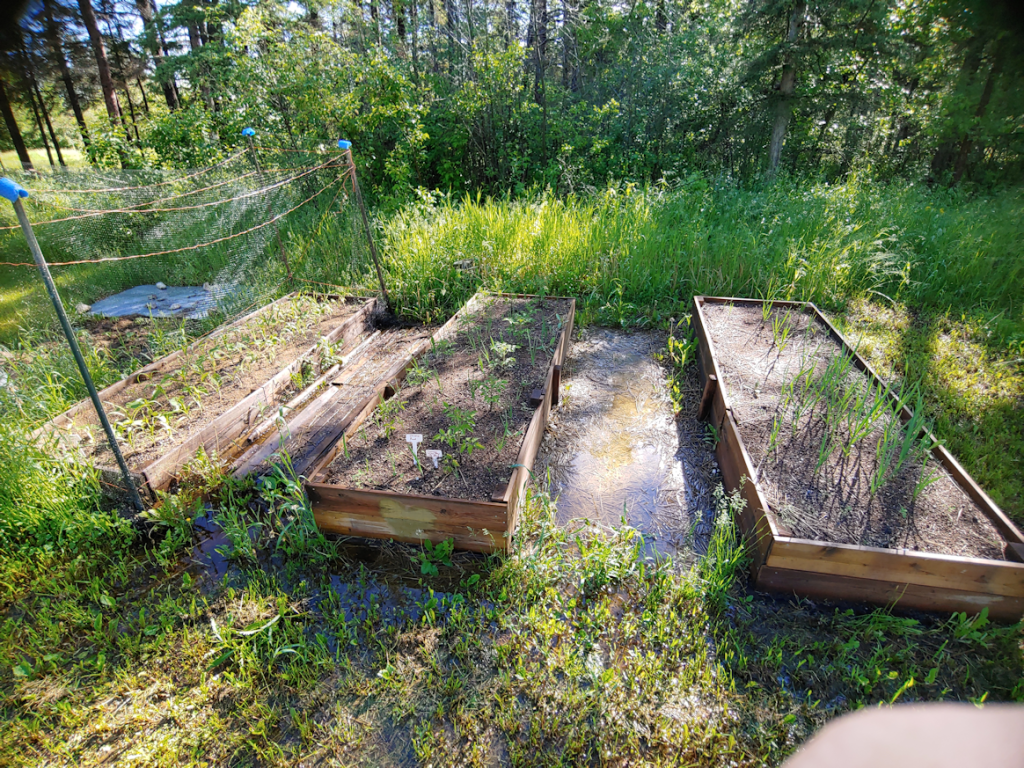
With the peppers, we got one variety of purple bell peppers (Purple Beauty) that were supposed to be so dark, they were nearly black when ripe. They were started indoors and germinated quite well. They were transplanted into one of the low raised beds, surrounded by spinach on one side, turnips on the other (both of which failed) and onions (which did well). We also had them under netting for most of the growing year, to protect them from critters.
The Result:
These were definitely a fail.
We did get tiny little peppers that ripened to the dark colour they were supposed to become, but the plants never thrived. I think they would have benefited from being mulched properly earlier, but we just didn’t have the material to do it until it was probably too late. How much of a difference the mulch would have made, I can’t actually say, but I would guess it would have at least improved things a bit.
We simply had a really bad growing year, even aside from the flooding. The low raised beds were enough to protect what was in them, for the most part, even when there was standing water in the paths, but it’s likely the flooding was still too much for the roots. The peppers were in the bed under the mosquito netting, on the left of the above photo. It wouldn’t have taken much for the roots to be hitting saturated soil and starting to rot.
What’s amazing about that standing water is, our top soil is only about 6-8 inches deep in this area. Under that is rocks and gravel. Which would normally mean, really good drainage. We had so much water this spring, however, there was nowhere for the water to drain!
Conclusion:
While the peppers may have been a fail, we’re going to try again. Hopefully, we’ll have better conditions in 2023.
My daughter had mentioned she thought we’d be trying more than one variety of pepper in 2022, so for 2023, we’re going to try several different varieties, including one hot variety. We’ll be looking at what we can do to improve soil conditions – perhaps using a higher raised bed, and making plastic domes to cover them, for extra heat. And, of course, mulching them very well, much earlier!
In the process, if we have a good growing year, we’ll figure out what varieties are enjoyed the most, and eventually work our way down to just one or two varieties to grow every year.
Assuming we’re able to grow them at all! We shall see.
Last of all, are the eggplants.
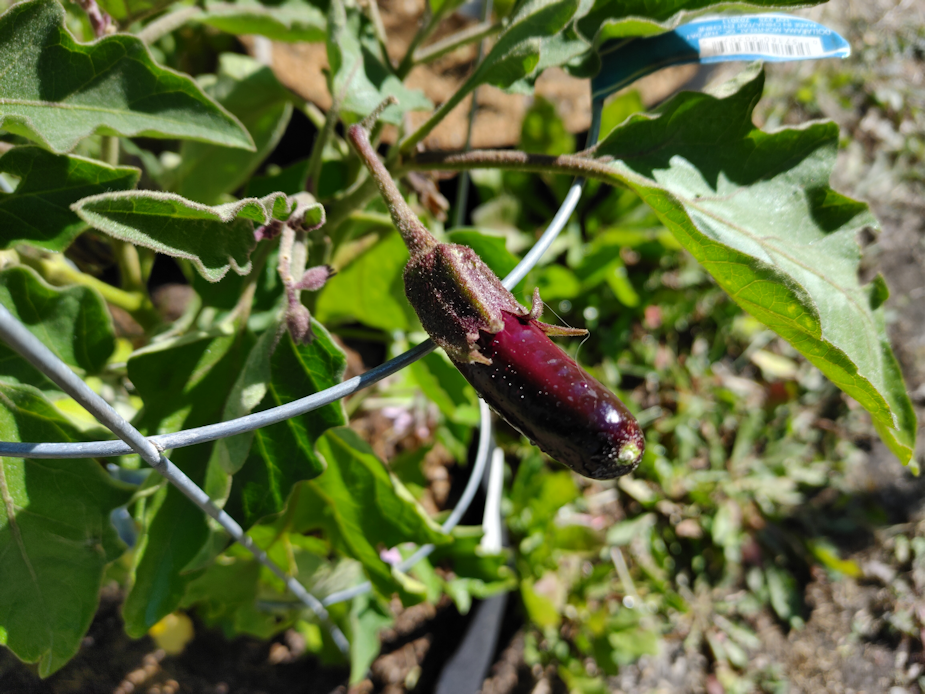
We chose the Little Finger variety, because I liked their shape and, from all I’d been able to find, they were described as quite delicious. I got them from a seed source that is even further north than we are, so we could be quite sure that they would grow here.
Well, not quite.
In the above photo with the flooded paths, the eggplants were transplanted into the middle bed, where the front half is planted with garlic. The eggplants were planted in the middle, with spinach surrounding them (which failed) and onions around the outer edge (which did okay). We had hoops to hold up mosquito netting to protect them but, like many other things, we were not able to mulch them properly until late in the season.
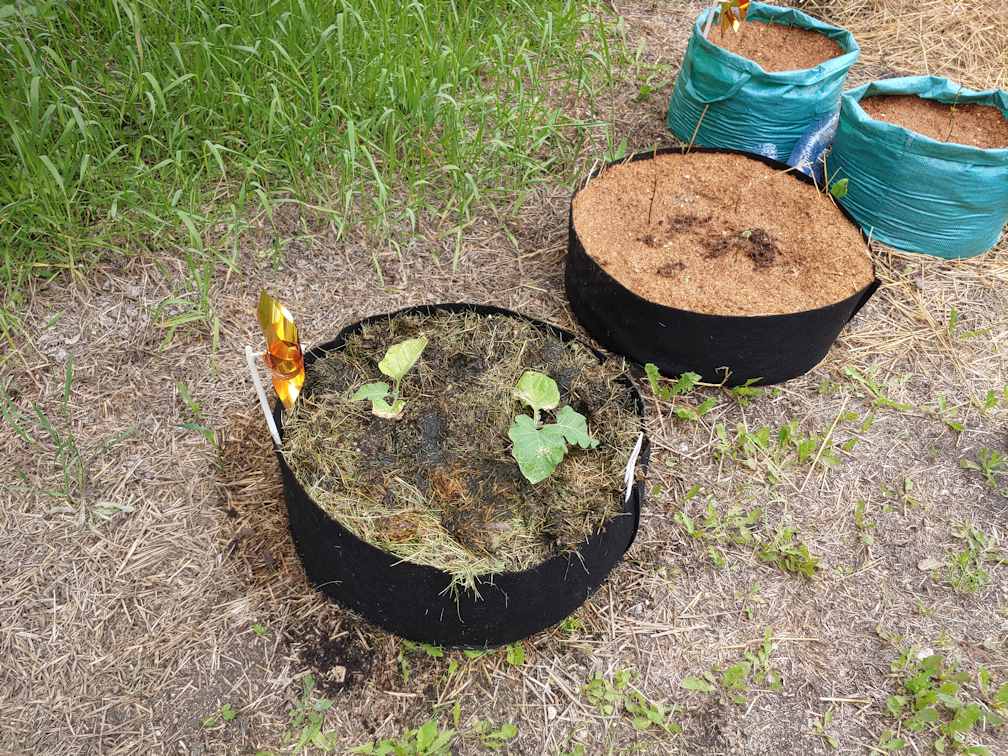
As we were doing the last of the transplants, we found a couple of eggplants that were missed, so those got planted into a dollar store “raised bed garden” that was made of black felt. This was set up quite a ways away from the low raised bed, which turned out to be slightly elevated, and not affected by the flooding.
The Result:
These were mostly a fail.
The eggplants in the low raised bed did not thrive at all. It wasn’t until very late in the season that one of them finally started to bloom, and develop a tiny little eggplant. Covering them did not seem to help them at all. The lack of a good mulching for so long probably didn’t help, either.
The ones in the black felt bed did better. I suspect the black fabric warmed up the soil more, and that they preferred that. They still took a long time before starting to bloom and develop fruit, however. One plant did noticeably better than the other.
That handful was our entire harvest.
We left them to grow as long as possible. We didn’t get frost until quite a lot later than average and, when we did, we covered them to protect them and squeeze out as much growing time as we could.
The few eggplants we did get, however, where quite tasty!
Conclusion:
We are definitely going to grow the Little Finger variety again, plus we will be trying some “regular” eggplant – the size and shape we would typically find in any grocery store.
With what we learned in 2022, I think that we will perhaps try growing them in pots or grow bags, or higher beds. If we can do black fabric grow bags, that would be even better. With two varieties to try, we’ll see which ones we like better, and see if we use them enough to keep growing them, year after year.
In the future, we hope to have some sort of greenhouse or polytunnel to help extend our growing season, and provide better growing conditions for heat loving plants, such as peppers and eggplants. Once we have a really good growing season for them, we’ll finally be able to determine if we actually like them enough to be worth growing annually, or if these are things we would continue to buy only once in a while at the grocery store.

















 The Re-Farmer