They have been transferred to baby jail and seem quite content. Decimous (or Decimus, as my daughter spells it) has been very quiet and attentive to her furry little worms.
My daughter has been staying in my room to supervise the family (the babies are so small, they could potentially squeeze through the openings of the cave) and keep an eye on how the other cats behave around them.
She fell asleep on my bed. I think she had a sleepless night last night, too!
Meanwhile, I headed outside and broke out the weed trimmer. I cleared around the pile of garden soil and then, since I had the trimmer out already, as much as I could reach around the burn barrel. I didn’t fell like adding another extension cord, so that area isn’t quite done, but close.
Then it was time to start hauling soil. I didn’t bother to sift it, though I did pause to pull out the biggest roots.
Where the sticks are, marks where we had squash growing last year. In each spot, we dug out the sod, then added fresh soil. Each squash got cardboard layers around them (we didn’t have enough to do the paths with cardboard, too), then mulched with straw, grass clippings, scythed hay – anything we could get our hands on. It took much of the summer to have enough material to mulch all the paths, too.
So now, each pot is getting more fresh garden soil and, now that we have so much of it, the rest of the area will be mulched with wood chips.
There are still two rows that I did not add soil to. They get a lot more shadow, so I won’t do those unless we really need the space. Instead, I will work on filling grow bags, next. Those will likely get peppers in them.
After I took this photo, I removed all the sticks marking the spots. Then I went around with the spade and flattened each hill and spread them a bit. Finally, I went around with the hose and used a higher pressure setting to drill water into the middle of each mound of soil.
I’ve left them to absorb the water while taking a break from the heat and the sun. Later today, I’ll go back out and start transplanting what winter squash we have that’s ready. We’ve got some melons to transplant, too, but they’re still pretty small, so they can wait. With what space I have left, if there is any, I want to sow summer squash.
We seem to have reached our high for the day – we’re at 25C/77F and pretty windy – and things are supposed to cool down slightly from now on. Tonight, we’re supposed to have a low of 12C/54F. That is going to feel glorious! My goal is to get as many of the transplants in that we can right now, so we can start dragging out those trees my brother cut down for me and begin working on the permanent trellis beds. If we can manage to get those done over the next while, we might still have time to direct sow things into them, as long as they have a short enough growing season.
This gardening year isn’t quite working out as planned, but it’s getting done, little by little!
Okay, so I managed to get a bit done in the garden this evening. Also, I had a wonderful surprise. Rolando Moon appeared! I haven’t seen her in at least a month, maybe two. At her age, we just never know if she’ll disappear and not return anymore.
I was also happy to see The Distinguished Guest wander into the north side of the property. Happy, that is, until I heard a cat fight and discovered he had attacked Pinky, and I had to chase him off. *sigh*
I had some squash that were getting too big for their pots that needed to go in, so I focused on the hill we grew pumpkins in last year.
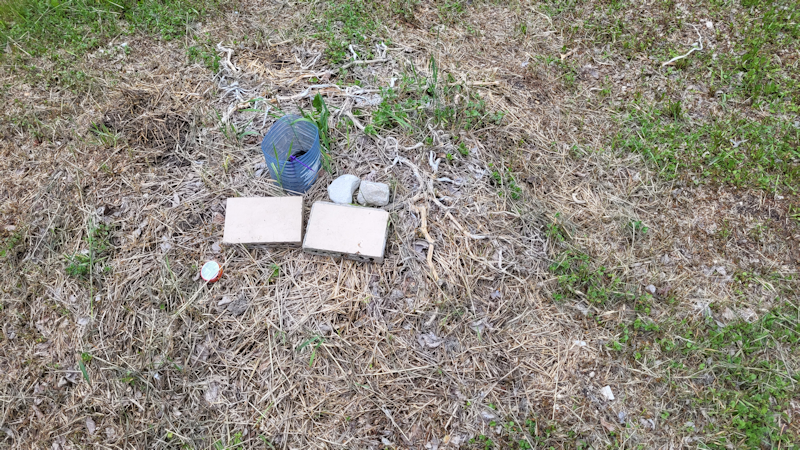
This is how it looked after taking a weed trimmer to it, after the mowing around it was done. Those bricks had been placed under the developing pumpkins to keep them off the ground. The round thing is an ant trap. There was two of them, but one disappeared when it got caught by the push mower, last year.
They didn’t work. The ant hill is still there.
Thankfully, the bug spray I used seems to do a good job of deterring ants, too. I dug up the bed with a garden fork and pulled out as many weeds and roots as I could. The ground was crawling with ants, but while I had them on my boots, that’s about as far as they went.
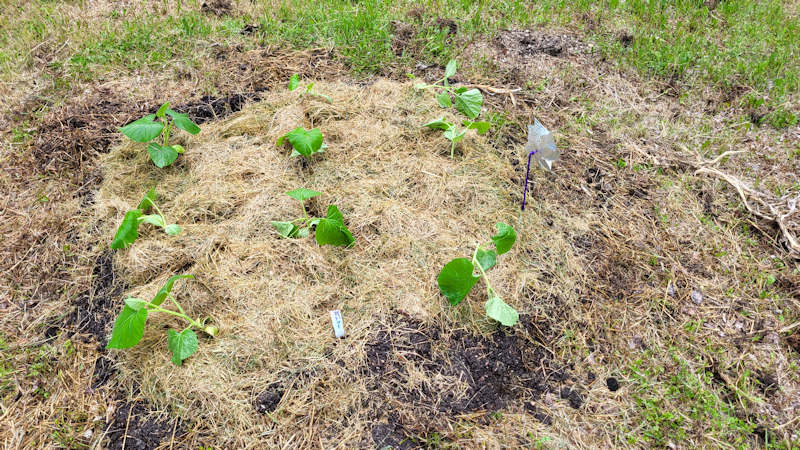
Before, this hill had only ever had two plants transplanted into it. After weeding it and working the last of a bag of sheep’s manure into the surface, I raked it out into a flattish square.
I fit 6 transplants in. The row of three on the far right are Zucca melon, from a second seed start. In the middle row, the two in the foreground are African Drum gourd, also from a second seed start. The other four were in an unlabeled pot. I restarted both the Zucca melon and Drum gourd at the same time, but one unlabeled pot got mixed up. I think they are also drum gourds, but I’m not sure. At this stage, the leaf and stem shapes look almost identical.
We’ll figure it out soon enough, if they survive.
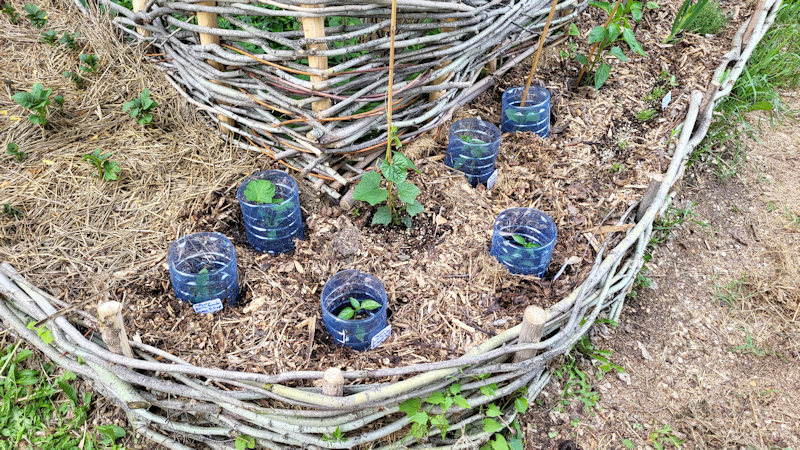
I then filled in the last of the space available in the wattle weave bed.
I had removed the protective plastic from the Sweet Chocolate peppers, and they now all have support stakes. I left the protection around the one Classic Eggplant, though it did get its own support stake, as did the luffa in the corner.
I transplanted one of each variety of pepper seedlings we had waiting. Between the luffa and the eggplant is Dragonfly. The three around the curve are the Cheyenne, Early Summer and Early Sunsation. I wanted to get at least one of each type transplanted, just in case we aren’t able to get things ready early enough to get the rest into the ground.
To the left of the luffa is the largest of the 3 mystery squash that germinated with some Roma tomatoes. I think they might be luffa, but I’m 100% not sure.
As I write this, it’s coming up on 8:30pm, and we’ve finally started to cool down a bit. What I got done wasn’t a lot, and certainly didn’t involve much physical exertion, but it still left me dripping with sweat. The next few days are supposed to be every so slightly cooler, and then things are supposed to heat up again. And physical exertion is going to be the main work, because we have to start hauling garden soil over to the squash patch, so we can start transplanting. We can’t even start that until I take the weed trimmer to the tall grass around the pile that couldn’t be mowed.
It’s going to be hot, sweaty and disgusting work, but we’re running out of time. It’s not just prepping spots for the transplants. This year, I was going to try direct sowing the summer squash, and those seeds should be in the ground already.
I suspect that by the time we finish building the permanent trellis beds, it’ll be too late to direct sow a lot of things. I might try, anyway. We could find ourselves with a long, mild fall again.
There’s only so much we can do, though. None of us area handling this heat well.
I didn’t get outside to do some work until past 8pm, when it finally started to feel cooler. Thankfully, the days are still getting longer, because it was just past 10pm when I was done, and pretty much full dark by the time I finished putting things away.
There wasn’t time to work on the big stuff, but there was some small spaces I could work on.
The first area I worked on were the 4 empty blocks in between the gourds and Zucca melon. I had some potting soil mix left, so after digging around in the blocks and pulling out any roots I could find, I added a bit of the potting soil to top up each block a bit. There were a total of 5 Little Finger eggplant seedlings, but two were still quite small, so I planted them together. We’ll see how they do and if one will need to be thinned out. I had plenty of new grass clippings to mulch around them, too. I collected a wagon load, and when the eggplants were mulched, I used the rest to finally give the asparagus bed a deep mulch. Until now, only the strawberries in between them were mulched. I was happy to see one new spear of asparagus, already at the fern state, had showed up. That makes 5 out of 6 crowns in this bed that survived last spring’s flooding… if barely!
Our spinach is just starting to get big enough to harvest a few leaves here and there, even though they were planted so long ago. As they will likely bolt quickly in this heat, my daughter went ahead and harvested the largest plants earlier today. In between the spinach, I started transplanting some Red of Florence onions. We grew these last year and really liked them. These are the first of this variety that have been transplanted, and they’re going to be shoved in every place we have room, as we go along planting other things.
Next, I worked my way across the retaining wall blocks, clearing and weeding. Every other block had mint transplanted into them, to contain them. It will be a battle to get the rest of the mint that’s growing in the old kitchen garden, but these were originally from my late grandmother, so I don’t want to get rid of all of them. They don’t seem to have handled last winter very well, and one block’s mint seems to have died (!!! who ever heard of mint dying on its own? 😄). A few other blocks got onions that survived the winter, that I found while prepping the area. Some stayed in the blocks they were found in, while others got transplanted, so that each block had 3 or 4 onions in it. In the end, I found a total of 6 blocks were free. Those got dug into to remove roots, topped up with the last of the potting soil, and then I transplanted some Spoon tomatoes into them. Each tomato got a bamboo stake they can be clipped to as they get bigger, then mulched with grass clippings. It’s not the area I wanted to grow these in, but at least we’ve got some in the ground. At this point, we could give away all the remaining transplants.
Not too bad for just a couple of almost cool hours before things got too dark to see!
I was able to head outside this evening and finish the transplanting I didn’t get to do this morning.
My daughter had mulched the tomatoes with shredded paper for me while I was out. I made a trench in the mulch and transplanted the Red Wethersfield onions. Almost the entire tray of onions made it into the bed. All the other beds are bordered with the yellow Talon onion. That leaves the Red of Florence onions to transplant, and there are a lot of those! We’ll squeeze them in where we can, where they can help protect other plants from insects and deer.
I hope.
So this bed is now done!
Now we have to get other beds prepared. I’m really hoping we get a good rain tonight, to help cool things down and reduce the humidity!
It’s barely 3:30pm right now, and I could easily call it a day and go to bed right now!
I tried to get out early to beat the heat, but by 7:30, it was already feeling hot and muggy. The humidity is very high, and the uncut grass is covered with dew. Which means that, when the outside cats come over for breakfast, they tend to be completely soaked!
Like this bedraggled beast.
Decimous is so matted and full of burrs! Today, however, for the very first time, I got to give him ear and neck skritches – and he let me! He even started purring. He wasn’t sure about the situation, but he did let me reach out to give skritches – not pets – a few times. His fur is so full of lumps, burrs and mats, I’m sure petting him would be somewhat painful.
I was even able to confirm something.
He is a she.
Yup. Decimous is female.
She doesn’t look pregnant, though. I’m trying to think of how we can catch her and bring her inside, so we can lavish her with love (and wet cat food) and socialize her enough to get those mats cut out of her fur!! The problem, of course, is we already have too many cats in the house. I’d have to bring her into my room and have her in baby jail for a while. That is Marlee’s favourite hangout, though, and Marlee typically isn’t too keen on other cats.
We’ll figure it out.
My priority for this morning was to get as many of the Roma VF tomatoes transplanted in the last available bed as I could.
I focused on getting the largest ones in, first. I didn’t want to do three rows, since it’s harder to reach the middle, but … well, it is what it is. I’m sure I planted them closer together htan they should be. I staggered the rows to use the space more efficiently, and was able to get 41 transplants in It took a couple of hours. I didn’t have time to transplant tomatoes around the perimeter of the bed, nor mulch it right away. My daughter shredded more of our collected fliers and other garden safe paper while I was doing this, and brought out a couple of bags. As I write this, I honestly don’t know if she was able to get back outside to lay the shredded paper around the tomatoes. After that, they’d just need to be dampened, because the tomatoes were deeply watered while being transplanted.
Speaking of which…
These are the mystery squash that showed up with two of the tomatoes. I’d reused seed starting soil from pots where things did not germinate at all, and somehow missed that there were still viable seeds as I pulled out the sticks and rocks I was finding in the mix. We’ll see if they survive. If they do, I’ll find somewhere to plant them, after we get more beds ready. Right now, aside from a couple of scattered spots, we have nowhere left to put any transplants – including the more than 20 Spoon tomatoes, none of which are out, and another 20 or so leftover Romas!
So much work to do!
Today is our average last frost date, but in some places, we’re breaking 30 year heat records. I took some garden tour videos yesterday that I’ll put together and upload later. Lots of heat warnings and warnings for thunderstorms, with possible hail, etc.
The question is, will any of that rain reach us?
Once the transplants were in, I headed out early to my mother’s, stopping to pick up some Chinese food, which was my breakfast. Previously, my mother has started to say not to get rice, because rice makes her cough. She said to get her just lemon chicken. Unfortunately, the timing was off, and I was at her place on the one day of the week they closed. Then she mentioned some of her neighbours would get just onion rings from the restaurant; they have a small North American menu along with Chinese food menu. After that, she started saying she wanted onions rings. So today, I picked up both lemon chicken and onion rings for her, and a combination platter for me.
When I arrived with the food, she was first taken aback that I came early, but I told her I’d been working in the garden, and hadn’t and breakfast. I came early so we could eat together. Then she chastised me for not calling her first, because she’d had a large breakfast (she later mentioned what she had, and it was not a large breakfast. Just not typical breakfast fare). I hadn’t planned to do this, though, so calling ahead was not an option. After I set out the food, setting hers aside on the table while I sat down with my breakfast, she started nibbling on the onion rings anyway, then suddenly demanded to know why I got the lemon chicken, too, instead of just the onion rings. I reminded her that she’d talked about wanting lemon chicken in the past, and she didn’t have to eat it all at once if she didn’t want to . She then started talking about how it’s a “temptation” for her, and if there’s food in the fridge, she eats it…
…
I’m pretty sure that’s what food in the fridge is meant for.
I think she was trying to say that she had little self control when it came to food, but had a hard time coming up with the words for it!
After I’d eaten, and she nibbled, I suggested we head out earlier. She didn’t seem to want to go out and procrastinated. It wasn’t until we were in the car and on the road that she mentioned that, next time, she would give me a list and let me do her errands for here. Her knees are increasingly giving her grief. There’s one errand I can’t do, though, and that is to go the bank for her.
So we got her errands done and her groceries put away. She wanted me to take a couple of trees home with me, along with her vegetable peelings and a plant she’s decided is blocking her window too much (it isn’t).
I did have a bit of a surprise while checking on her air conditioner, next to her plant table. For some reason, it was set to go off at 26C, which is just way too hot. I lowered that, and it turned on and starting cooling things down, but for some reason, I was also feeling heat.
Yes, her heat was also on!
I checked her thermostat.
It was set to about 26C.
So she was heating and cooling her apoartment at the same time.
I turned that right down for her!
I didn’t take any plants from her, because I didn’t want them baking in the car while I did my own errands after I finished with hers. I had to ask her where the trees came from. Basically, she’s got a little maple and an elm in the pot together, and it looked odd. Turns out she’d found them in the few feet of garden space where she has some garlic growing – pretty much the only “gardening” she does right now – so she decided they should go to the farm and stuck them in a pot.
*sigh*
She has also been gathering linden seeds and is trying to get them to grow. She’s got at least a dozen that I could see, scattered at the top of a pot of soil. Something else she has in pots and plans to send to the farm.
This from the person that was laughing at me when I showed her pictures of the garden, because I had some herbs in a pot.
Somehow, my mother has got it in her head that, because the trees around her building drop seeds, she MUST gather then, give them to me to grow, or start growing them herself, so the trees can go to the farm, because they are “free”.
I’m getting a better understanding of why we have so many problem trees right now.
Also, we have GOT to get rid of the Chinese elms. There are millions of seeds drifting everywhere, and every bit of bare soil where I’ve planted seeds or transplanted something is getting filled with them. They have very deep tap roots, even as tiny seedlings, and are so hard to get rid of! There are other elms here that don’t do this, and they’re just fine, but the few Chinese elms are just horrible to deal with!
A job for another time, though.
Anyhow.
Even though my mother basically abandoned the farm a decade ago, she still wants to control what happens here, including giving me trees to plant that are basically weeds out of her own garden space.
She brought up when we can bring her out to the farm to see things – she still has seen only photos of the new roof. I told her that, weather willing, my brother and his wife are hoping to come out this weekend with their lawn mowing equipment to do the lawns. Right now, she wouldn’t be able to get through the grass with her walker! After that, we’ll see.
Once done at my mother’s, one of my errands was to go to the egg lady’s place. While driving out there, I went through several sections of driving rain! It was so good to see! There were a few times I was sure the car was being hit with hail. It wasn’t raining at the egg lady’s homestead, though, and they sure could have used some! She just finished processing 40 chickens, and was dying in the heat!
My next errand was back at my mother’s town, and I drove into rain again. It was awesome! The temperatures dropped about 10 degrees almost instantly, from 31C/88F (“feels like” 34C/93F!), to 20C/68F. It was still coming down so hard when I was ready to come home, I sent a message to let the family know it might be slow driving. And it was.
For a little while.
Then I drove out of the rain, and the closer I got t home, the drier it got.
As of this writing, we still have had no real rain at all. There might have been a few drips here and there, but nothing more.
*sigh*
Looks like our climate bubble is back in action.
We’ll see how things turn out. If it stays dry and keeps cooling down with the wind, I might be able to get more weed trimming done. I need to focus around the garden beds, and where we need to build up the squash patch and where the permanent trellis beds will be built.
Meanwhile, my poor daughter has been busting her butt, cleaning the kitchen and trying to catch up on the dishes, in this heat!
I think I need to shut down my computer, though. It’s starting to act up in the heat. It’s a good thing I know how to touch type, because I’ve been typing entire paragraphs, without anything actually showing up on the screen for almost a minute.
So if there are a lot of typoes or strange sentences in this post, it’s because I’m typing blind right now!
With the weather we’ve been having, I have been feeling really anxious about getting the garden in “in time”, when we physically don’t have places prepared for everything yet. I feel like I’m falling behind, and everything is being planted late.
Then I remind myself.
Today is May 29. Normally, I wouldn’t be transplanting or doing a lot of direct sowing until after June 2.
Still, with the weather forecast being what it is, the more we get in the ground now, the more time we’re adding to our short growing season.
I headed out shortly after 7am this morning, to beat the heat, and didn’t come back in until almost 11. It was already feeling too hot by 8am, but I stuck it out as long as I could. My main focus was to finish planting in the beds the tomatoes were transplanted into, and get something into the high raised bed.
I’m still bordering everything with the yellow onions. I decided to plant bush beans in the high raised bed. That will make harvesting so much easier on the back!!
There wasn’t a lot of space left in the low raised beds, though that is partly because of the boards protecting the tomatoes. Once those are removed, it will open things up.
In the bed on the far left, with the Indigo Blue Chocolate tomatoes, I sowed all the Gold Ball turnips in one half, and Merlin beets in the other. These were densely planted in many short rows, more Square Foot Gardening style. When we planted the Gold Ball turnips last year, something ate them pretty much as soon as they germinated. I’m hoping surrounding them with onions will help keep away whatever ate them – I never saw any hint of what it was. I had intended to put a floating row cover over the turnips to protect them, but the space is too narrow for that.
In the bed with the Black Beauty tomatoes, I planted one long row of Uzbek Golden carrots. There was only space for the one row, which I then covered with boards. I will check under the boards daily and remove them as soon as I see carrots sprouting.
Both beds got a thick mulch of grass clippings along the outside, next to the onion transplants. Aside form helping keep the soil cool and moist, and slow down the weeds that come up from under the log boarders, the grass will also help prevent soil runoff while watering. I’ve basically used the last of our grass clippings at this point. We haven’t been keeping up with the mowing, unfortunately. Not only are the dandelions now all going to see, but in a lot of places, so is the grass!
With the high raised bed, I planted the yellow Custard beans – a new variety for us – on the left in the photo, and the green Lewis beans – a variety we’ve grown before – on the right. At each end, I stuck in a few more onion transplants. By this point, only the smallest yellow onion transplants are left, and I was planting them a bit closer to each other than usual, but I was still left with may 10 little transplants left. They’re so small, I probably shouldn’t bother transplanting them, but I’m sure I’ll find someplace to shove them into the ground!
(As an aside, while working on all this, I was happy for a breeze that kept away the mosquitoes. It wasn’t enough to keep away what turned out to be horseflies! Thankfully, they didn’t seem interested in bighting me today. Just in dive bombing my head.)
The large low raised bed you can see on the right is still completely empty. I’m considering using it for the Roma tomatoes, which are growing much faster than expected – one bin in particular is has plants so big, if it weren’t for the labels, I’d have thought they were Black Beauties or Indigo Blues that were started so many weeks earlier! Why that one bin of Romas is so much larger than the others that were started at the same time is an interesting question. I was originally wanting to plant peppers in that bed, but the Roma tomatoes need transplanting more urgently. I wont’ be able to fit all of them in there, but if I can at least get the biggest ones transplanted, that would be a good thing.
Before heading in, I made sure to water the corn bed, too. There are corn seedlings popping up now! I’m quite happy to see them. I was afraid that, with the heat and minimal rain, they might not make it. Checking the raised box beds in the East yard, I was happy to be able to see more carrot seedlings showing their true leaves, without having to look close and wonder, are those seed leaves carrots, or a weed? It’ll still be a while before the carrots are strong enough that we can safely weed around them. Right now, weeding mostly involves removing the biggest leaves from the weeds, and pulling and dandelion flower buds, and being careful not to disturb any carrot roots.
I was thinking of doing more transplanting later today but, at this point, I think the mowing is a more urgent priority. Not just because of how overrun both the inner and outer yards are getting, but because I need the grass clippings!
I also want to get in and around the garden beds and where the squash will be planted with the weed wacker.
When I came in, my weather app said it was 23C/73F. I think it felt quite a bit warmer than that! We’re supposed to reach a high of 26C/79F, with chance of a 43% chance of thunderstorm at about 4pm. I suspect I will have no problem getting out and doing the weed whacking when it’s cooler.
For now, though, it’s time to stay inside, stay cool, and hydrate!
It’s not even 11am as I start this, but I’ve already put in several hours in the garden, trying to beat the heat. Which wasn’t easy, since it was already feeling too hot when I was doing my rounds, first. The weather app was saying 18C/64F, but it felt hotter. It would be good to set up a thermometer in the garden area again.
My focus today is to get the Indigo Blue Chocolate done, and as many of the Black Beauty as I can fit, plus an edging of yellow onions. There are only 11 Indigo Blue and, at about a foot apart, they will easily fit in one row in the bed I chose for them. This bed is somewhat narrower, so it will be able to fit one more row, plus the onions around the edge.
The problem?
There are 26 Black Beauty transplants.
I also counted the Roma tomatoes as I set them out. There are 61, though the plant that broke in the wind yesterday is looking like it probably won’t make it.
Then there are the 30 Spoon tomatoes.
Right now, we have 2 more low raised beds, which are about 15ft long, for about 14ft of growing length. Then there is the high raised bed, which is 9′ x 4′ on the outside, so about 8′ x 3′ of growing space. Aside from a small section in the wattle weave bed in the old kitchen garden, and 4 blocks between the gourds at the chain link fence, that’s all we have left for prepared beds. The squash patch needs work and, of course, we need to get those trellis beds built.
Meanwhile, the lawn is getting out of control, we still need to cut down the dead spruce trees that will be used to make the trellis beds, as well as pre-cut and drag over the trees I cut down for the trellises.
As it is, I did as much as I could this morning, then had to head in to get out of the heat. We are at 24C/75F right now – yes, to me that’s way too hot already! – and we are supposed to reach 30C/86F this afternoon.
I got the Indigo Blue Chocolate tomatoes in, after setting up three of the salvaged T posts to hold their vertical supports, then transplanted some of the yellow onions along the outer edge. The tomatoes were starting to wilt already, so I added a grass clipping mulch around them and along the outer edge of the low raised bed on the one side, being careful not to cover the onions before giving them a final watering.
I was planning to plant the Black Beauty tomatoes on the other half, but I think I will put them in another bed, instead, and direct sow something else with them.
Unless I fill an entire bed with just Black Beauty tomatoes, I will have room for only about half of the transplants. And I don’t want to fill an entire bed with them. A dozen plants is more than enough for fresh eating. The Romas are the only variety that I’d be willing to dedicate an entire bed to, since those are being grown specifically for preserving.
Meanwhile, we’re still getting storm warnings for tomorrow evening. We’ll see if the system reaches us or not, but be ready to protect the garden beds, just in case.
For now, I will be staying out of the heat! Maybe get a nap in, since I will likely be working outside once it starts cooling down, and staying as long as daylight holds.
Yeah. That sounds like a good plan. I didn’t get much sleep last night!
We’ve got high winds today, with an expected high of 29C/84F. I wanted to get the transplants out, though.
With the wind direction, I was able to use the picnic table under the old market tent by the fire pit. They won’t get full sun, but with the expected heat, that’s quite all right. They will still get some wind, which is good for them, but not enough to send them flying across the yard.
The next while is expected to continue with high temperatures, with high winds and a possible thunderstorm tomorrow, though only one of my weather apps is predicting that. Overnight temperatures are also expected to be quite warm.
I decided today was a day to do some direct sowing, while also raking up some of the grass clippings to lay down some much needed mulch. If we’re going to be getting thunderstorms, I want the soil protected as much as possible. If we don’t get the thunderstorms, I want the soil well mulched to keep it moist, and from getting too hot!
I set up the extra phone to take time lapse video, so that will be put together for another post. With the peas, I planted the free Hedou Tiny bok choy from Bakers Creek and Jebousek lettuce I got for free from Heritage Harvest. As the peas grow up the chain link fence, they will shade and shelter the lettuce and bok choy. Then I prepped and planted the Tom Thumb popcorn.
I don’t know if I’ll have the energy to get back out there again today, but I’d really like to transplant the Black Beauty and Indigo Blue Chocolate tomatoes. They are getting quite large, and I’d rather transplant them than pot them up again. That and it would mean a fewer trays to take in and out every day! As it is, there were some Spoon tomatoes that didn’t make it, and removing the pots meant I could combine 3 trays into 2, with some judicious rearranging. When I transplant the bigger tomatoes, I want to transplant some of the onions in with them, too. The Black Beauty tomatoes are determinate, but the Indigo Blue Chocolate are indeterminate, so I need to consider the different types of support they will need. I also need to resist transplanting all of them, if I start running out of space. We had very good germination rates and few losses, and it’s the paste tomatoes that I want to have a lot of. I can always give away the extras! It’s the same for the remaining peppers. We have a 100% germination rate on all but one variety, and of that one variety, there’s only one peat pellet didn’t germinate – and I only planted one seed per pellet!
With the way things are looking, we may have to start doing outside work in the morning and late evening. The hottest part of the day tends to be around 3pm, but stays hot until about 6 or 7.
In my youth, I wasn’t bothered by the heat the way I am now. Makes it harder to get things done!
I had to go to the nearest Walmart to get cat kibble this morning, and took advantage of the trip to get a few more little things. It was insanely busy with people. We’re coming up on a long weekend which, for many people, is the traditional time to put in their gardens. It’s also when a lot of people open up their cottages for the summer, so it was busy everywhere! All the garden centres and greenhouses are open now.
For us, today is 2 weeks to our last frost date. That means it’s time to sow our Montana Morado corn!
Which, of course, is never as simple as just putting things in the ground!
I chose to plant these in the low raised bed we grew summer squash in, last year. As with just about everything else, the squash did very poorly last year. It was, however, the bed that needed the least amount of work done on it before I could sow.
Not by much, mind you.
After removing the grass mulch from last year, I had a whole lot of weeds to dig out. Mostly crab grass. That stuff is brutal!
The entire bed got worked over with a garden fork to loosen the soil. Then I had to go back over it to pull out as many weeds and roots as I could. Aside from using the fork to loosen the soil even more to get the roots and rhizomes out, it was very handy to support myself as I worked. I also used a board across the bed to step on, so I wasn’t stepping directly on the soil.
We really need to get more high raised beds built. This was very hard on the back. I suppose it would have been easier if I could kneel down to work, but my knees are shot, so I’m bending from the waist, for the most part.
While working towards the north end of the bed, I started finding more tree roots, from the nearby trees that my mother allowed to grow in what used to be garden space.
More reason to get those high raised beds done!
When the weeding was done, I went to get the seeds and a rake to level the bed. I brought a container to pour the seeds into and see how many there were. There was supposed to be at least 75 seeds.
I counted 94!
Once the bed was leveled, I took the board I had to support my foot while weeding, and used it to mark off three long rows. I wanted to stay well away from the edges. The crab grass is the worst along there, as the roots make their way under the log edging. Then I used the handle end of the rake to punch holes along the rows every 6 inches or so. Typically, it’s recommended to plant 2 or 3 seeds every 12 inches, but I’m doing dense block planting. I also hate wasting seed, so I planted one seed every 6 or so inches. This should be good for pollinating, and if some of the seeds don’t germinate, the resulting gaps won’t be too large.
I lost a seed while planting, though, so there’s “only” 93 in. 😄
Everything was well watered, of course. I always water before putting the seeds in, then again once they’re done.
Once planted, I put a thick layer of grass clippings all around the edges. The ends don’t have logs to hold the soil in, so hopefully the grass clippings will help keep it in place, too. Mostly, it’s to try and keep the weeds from creeping in from the edges. Once that was done, I put a very light mulch of grass clippings over the planted area. Basically, I just shook bunches of grass and let the wind blow it on. I wanted enough clippings to protect the soil, but still keep it light enough that the corn won’t have any problem pushing through.
Once the corn is up, I will might interplant some bush beans in between the rows. Maybe. I did that with the kulli corn we planted last year, and they got huge, but never reached the point of producing cobs. I now think that there was too much nitrogen in the soil in that bed. High nitrogen leads to lots of plant growth, but can result in lower yield. Or, in our case, none at all. With how densely these are planted, though, interplanting with something like beans might be too much.
Once that was done, I decided to take a chance and do some transplanting.
The Sweet Chocolate peppers that were started back in February have gotten nice and big. Normally, I wouldn’t dare transplant them before our last frost date, but I’ve been eyeballing the forecasts and decided to take the chance. It was either plant them now, or pot them up. The German Winter thyme that was started at the same time were also quite ready to be planted.
While I was transplanting, I got my daughter to cut the tops and bottoms off of some distilled water jugs for me. Since my husband needs to use distilled water for his CPAP humidifier, we have lots of those! Hopefully, they will help protect the peppers during any cool nights. In this bed, they will be easy to use row covers if we get frost warnings, too.
I had three pots with thyme to transplant – a fourth one was transplanted into a pot to stay in the house. I don’t think they’ll need any protective covers unless we get actual frost.
Eventually, I want to plant the chamomile in here, though it’ll be a while before those are big enough to do that. The spearmint and oregano we started from seed are not doing well. I might buy oregano transplants, which would also go into this bed. Spearmint is not something I usually see in stores as transplants, so we might skip those this year and try again next year. The second variety of thyme we planted at the same time as the chamomile doesn’t seem to be doing as well as the German Winter thyme has. We’ll see how they do over the next couple of weeks.
Once again, while working in this bed, I was quite impressed by how moist the soil was under the wood chips. The mulch is really doing its job!
Oh, there was one thing about transplanting the peppers that has made for a learning experience.
We started the seeds in bio-gradable pots that are designed so that they can be transplanted directly into the soil, pot and all, with no root disturbance. When the peppers needed to be potted up, they went into the larger Red Solo cups that way – except for a couple that were thinned by transplanting.
When taking the peppers out of the cups, the ones that were still in those bio-degradable pots… were still in the bio-degradable pots! They were actually rootbound inside a pot within a pot. So when I transplanted them, I removed the shells of pots they were in. The pots were very soft and easy to break off, but hardly any roots had tried to grow into them.
I still have some of these pots and seed start trays. I’ll use them but, in the future, I think we’ll skip buying those. A bio-degradable pot isn’t much use if the roots can’t get through them after being potted up!
So this is now done. The first corn is planted, and the first peppers and herbs are transplanted.
The corn is meant to be planted at this time. I just hope I didn’t jump the gun with those peppers!