One thing I like about this time of year. We were gone for more than 9 hours, and it was still light out when we got home and unloaded the truck!
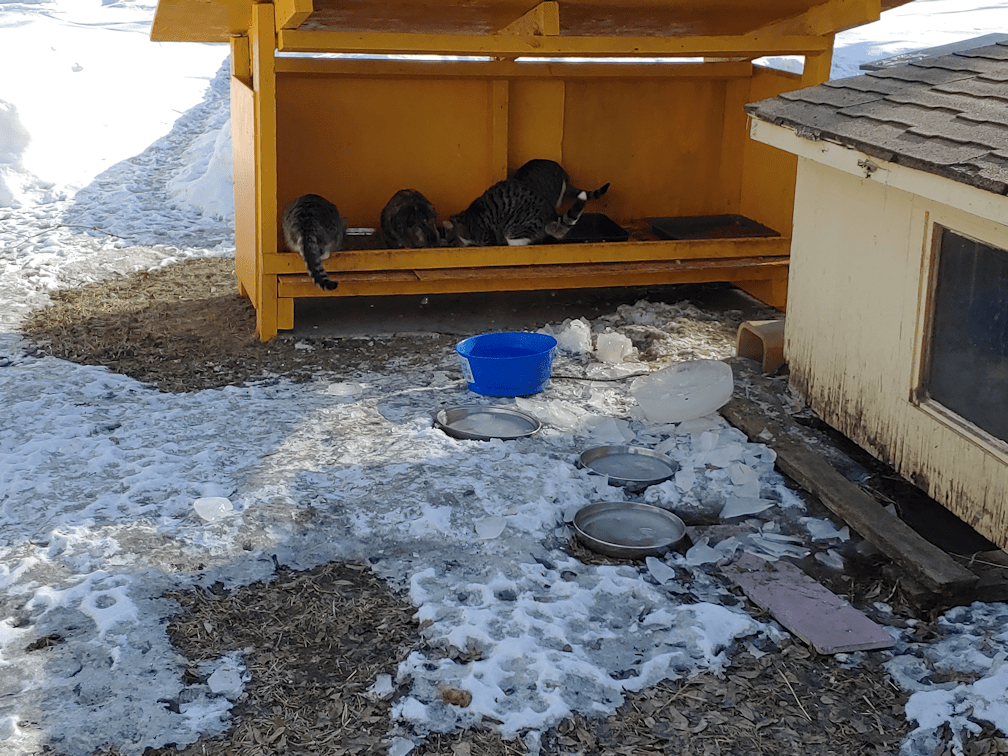
As always, my morning routine included getting food and warm water out for the outside cats. I am extra happy about how that went today!
I got to pet this gorgeous guy!
Normally, he runs away, even if I come closer while he is easing, but today I managed to skritch his shoulders and neck. Not only did he not run away, but he even leaned into my hand!
Once he was away from the food bowls, though, that was it. I couldn’t get near him anymore.
You may notice his fur is decorated in the above picture. He has hoar frost raining down on him from the rose bush above him. We had thick fog roll in last night, and it was still very much there this morning.
The trees were absolutely stunning.
The first item on the outings list today was to drop the truck off at the garage to get that differential leak fixed. My daughter and I headed out early, which was good, because we had to take it pretty slow in places. The closer we got to town – and the lake beyond it – the thicker the fog got. Still, we arrived over half an hour early for the drop off time. Which was okay, since I only needed to leave the key. While doing that, I let him know that, after moving the truck, I did see signs of fluid under it – it was definitely a very small leak, but still needs fixing! I also let him know that the check engine light had turned off on its own, and that the oil pressure gauge is where it should be, thanks to the last fix done.
From there, my daughter and I walked to the hospital. My sister had visited my mother in the transitional care unit (TCU), which is very close to where she lives, yesterday and let me know that some clothing items that had gone into the laundry were forgotten. While I asked about that, I also asked about the photo of our vandal. They had to contact someone that could pull my mother’s file to find out. While waiting for that, the person that checked housekeeping came back and there was no sign of anything that was my mother’s. Housekeeping may not have been done with it. We went to where we could meet the guy about the files. Sure enough, the photos were still in the file, in the large envelope my brother brought them in.
After explaining about the photos, and mentioning that we were going to be seeing my mother today, he gave me the envelope to take with us and deliver to the nursing station at the TCU. Then we went back to the nursing station about the clothing items. They would look into it some more, and got my contact information to call me later.
Since I had the photos, my daughter and I first walked back to the garage so we could leave it in the truck. It was still parked outside, so I put it in the basket of my mother’s walker, which was in the back of the truck cab. The wheelchair had to go into the box.
That dropped off, my daughter and I headed out to find somewhere we could have breakfast, and take our time about it.
Using the button to cross the highway wasn’t going to be an option! It’s only for an audible notification that the walk light was on, though.
There aren’t a lot of restaurants open that early in the day in this town, so our options were limited. The place we went to was at the other end of town (okay, that’s just 6 blocks or so. 😄). We were both quite famished by then! We both ended up ordering the largest breakfast platters they had. I’m glad we did, because that ended up having to last us until supper!
We took our time about it, but we were still waiting on a 2 hour job, so it wasn’t that long before we headed out.
[Edit: I forgot to mention. While we were having breakfast, the hospital called me about my mother’s missing clothing. They couldn’t find them, nor did they expect to find them. Most of the laundry goes to the city for washing. My mother’s items were not labelled with her name. The folks sorting through in the city wouldn’t know where they would have to go, and they would probably not even made it back to town!]
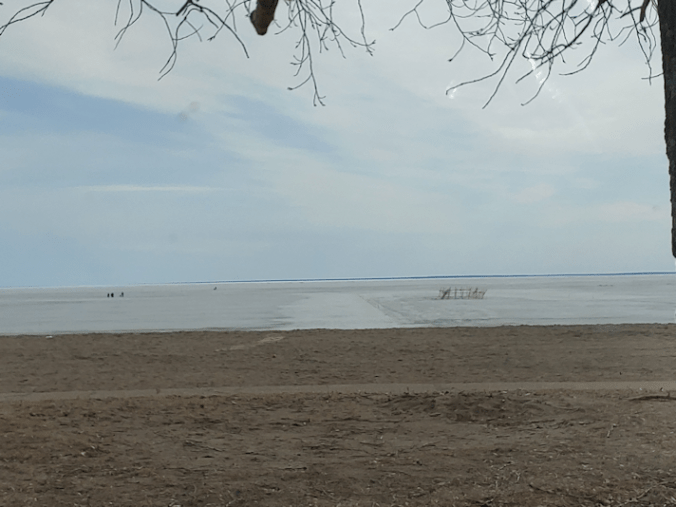
Since we were so close to the lake, we popped over to see how it looked.
Very white.
The fog was still pretty heavy. What you can just barely see in the photo is an ice fishing village, and an ice road leading to it.
From there, we stopped at a general store that my daughter wanted to go to. They are the only place that carries a particular brand of imported wool yarn. She’s bought some before and used them to knit herself a pair of socks. They turned out to be the best pair of socks she’s ever had, and actually keep her feet dry. She got herself enough yarn to knit herself two more pairs!
When we were done there, we crossed the street to check out the dollar store. There wasn’t anything we actually needed there, but I like to keep an eye out for some things.
We never finished going through the store before I got a text from the garage. The truck was done! Somewhat faster than I expected, but they must have been able to get it in almost right after we dropped off the envelope from the hospital. So we quickly picked up a couple of energy drinks for the road and made the walk back.
Unfortunately, by this time, my daughter and I were both limping pretty badly! My daughter hurt her leg getting her old computer chair down the stairs not long ago, and had been caning it for the past few days. She was feeling better today, but after the walking we’d already done, to and from the hospital, then across town, she was actually having a harder time than I was with my left hip giving out. What a sight we must have been!
Once we got to the garage and saw the truck parked in the lot, my daughter went straight to it to sit down while I went in to take care of the bill. $280 and change. *sigh* Still, better to get the leak fixed than push our luck with it!
From there, we were going to the nearer city, to see my mother. Normally, I would have popped over to another highway, rather than go straight from town, so as to avoid driving through several small lakeside towns. In the end, I decided the extra miles weren’t worth it, and we headed straight out.
I’m glad we did.
We made our way through the row of towns and had just reached an area of open highway when my daughter started feeling sick. Eating does that do her. Just, general eating. She’s never been able to pin down exactly what is making her ill. It did mean we had to find a gas station urgently! If we had been on the other highway, there would have been nothing available. On this route, there actually is a single gas station along the way. Thankfully, we made it.
We didn’t need to get any gas, but I did want to “pay” for our use of the bathroom, so I went looking for some snacks. The convenience store with this particular gas station is more like a smallish grocery store, and very well stocked! They even had a large display of baked goods from a bakery in the town north of us that is really well known. People from the city go out of their way to get their bread. I ended up getting a couple of Whoopie Pies for us (not that my daughter would be up to eating anything again for some time!). I had mine while waiting for my daughter to join me in the truck again. I’ve had Whoopie Pies before, and they’re usually rather dry and fairly hard. The cake portions were so incredibly soft and fresh, I had a hard time unwrapping it without crushing or tearing it! It was absolutely awesome.
From there, we continued on to visit my mother. I knew the TCU was in the “old hospital”, and I’ve driven past it many times.
I was wrong.
When we got to the area, the first problem was finding a way to get in. There were a number of buildings but, as we read the signage, going from one area to another, we couldn’t find anything. We did find that one of the buildings is a mental health hospital. My mother actually spent some time there, years before I was born. She still speaks highly of how pleasant her stay was, and how well they took care of her.
In the end, I found a plowed out space I could pull over and tried looking up the address for this unit. I found their web page – but there was no address! My brother did send me a phone number, though – not the same one that was on the web page! – so I tried that.
It took a bit to try and describe where we were to the person who answered before she could give us directions.
We had driven right past the place. I had no idea that that complex was the old hospital, not where I had always thought it was at!
Then we had to try and find the right door to go in.
I drove around in circled and back tracked before we finally decided to park near the entrance to what turned out to be an urgent care clinic. Only then did we pass the sign for the TCU.
It had been blocked by a truck. An 18 wheeler, unloading a semi size trailer box. Completely blocking the lane to where the TCU entrance was.
We got the wheelchair and walker out (with my daughter making sure to grab a cane for herself, too), but when we got to the urgent care clinic, I left my daughter with them to ask someone inside. She was able to give me directions on how to get to the unit through the building, rather than having to go outside and find away around the truck blocking the lane. So I got my daughter, the wheelchair and walker, and we made our way through what turned out to be “authorized personnel only” areas before finally reaching the elevator she told us to look for. It was one of those elevators with doors on each side, and we were going through the staff door to use it!
Finally, we got to the second floor and found signs leading us to the TCU.
The doors, however, are locked. Visitors are to push a button for someone to come and let us in.
Meanwhile, on the other side of the door, we could hear the voice of an elderly man yelling for someone to let him out. Before a staff member opened a different door next to the entry doors, we could hear him pushing and bashing at the door, trying to get out! When the staff member came (there were more people waiting with us to get in by then), and I told her who we were coming to see, she let us in through the staff door! As we made our way around, another staff member opened up a mobile barrier for us to go through. As we came around, we saw the guy we had heard through the door. He was still at the main doors, pushing a walker, and looking very furious about not being able to get out.
There’s a reason these places have lock codes to get in and out!
Once at the nursing station, I brought out the envelope with the photos. I explained to them that my mother doesn’t know that we’re giving these photos, because that would cause issues. Notes were taken as I explained about our vandal’s past abusive behavior towards my mother. They asked if there was a protection order, and I explained that the courts required my mother do that herself, and there’s no way she can physically do that, but her cognitive decline isn’t so far that my brother can do it on her behalf, as her PoA. They completely understood that frustration! I did mention that I’d had to get one against him myself. Then I had to explain why my sister’s picture was in there. They recognized her as having visited yesterday. I explained that, in general, she’s fine, but our vandal has been able to manipulate her into doing things in the past, that she is not understanding my mother’s cognitive issues and resulting self sabotage, and just goes along with things when she shouldn’t. My mother has been able to manipulate her as well.
I so hate having to include my sister as someone that needs to be kept an eye on while visiting my mother!
The likelihood of our vandal showing up is low, but they do have cancer care in the new hospital near by and, from the signs, they have cancer care in this building, too, so it’s possible he might be coming out for treatment and go visit my mother. We’re just assuming my sister is going to tell him where my mother is, and there’s no point in asking her not to tell him that. Not after she went ahead and did it anyhow, before, because my mother convinced her to. She simply doesn’t understand – or doesn’t want to believe – how potentially harmful to my mother that was.
*sigh*
That done, we found out which room my mother was in and headed over with the wheelchair and walker, while they printed out labels to put on them to show that these belonged to my mother.
It’s definitely a step down from where my mother was, in the hospital!
She went from a large, single person room, so a smaller room she shares with someone else. My mother’s bed is by the door, though, so we didn’t have to disturb the other person. She was quite happy to see us – and her own walker and wheelchair! The wheelchair she refused to even sit in, when I brought it over to her place, months ago. 😄
All in all, we had a good visit with her. She’s not really liking the TCU. Lots of noise, she says. Her room mate apparently was walking around all night, then sleeps through the day. Hopefully, my mother won’t be there for long, but every other person in this unit is waiting to be moved somewhere more permanent!
The staff there seem really nice, though, and were already telling me how sweet they found my mother to be. Nice to know she’s on good behaviour! She’ll have her moments, of course, but in a unit like this, that’s something they deal with – and worse – pretty regularly.
I did remind my mother that we are now the ones living the furthest from her, and we don’t go to this city very often, comparatively speaking, so we won’t be visiting as often. She mentioned that my sister lives nearby. I don’t know if that means she’ll visit more often, but we’ll see. Still, if the staff need anything from us, my brother is the first they would call, as PoA, I would be the second, as the one that’s been my mother’s advocate at her medical appointments for the past 7 years. If they can’t reach either of us, then they would call my sister. She asked about when my brother might visit, but he’s out of the country right now. He still manages to keep on top of everything, though!
[Edit: Something else I forgot to mention. I started to tell my mother about her missing clothing, and the hospital not being able to find them. She told me that someone actually delivered them to her, yesterday! It had to have happened after my sister was no longer there. When I was at the hospital this morning, they knew nothing about this!]
After our visit with her was done, we headed out – this time being able to go out the proper entrance and seeing where we can drive in to the right parking lot! The truck that was blocking the lane was gone, too, so that helped.
From there, we stopped at the Canadian Tire, then the Walmart, to do the shopping we would normally have done at the end of January, in the larger city. That will get its own separate post.
While we were at the Walmart, I started getting notifications from the garage security camera, and got to watch as Fed Ex delivered our chicken coop kit!
The shopping was really rough on both my daughter and I, as far as our pain levels went. The store is being renovated, and things we needed were moved to completely different areas we had to hunt for. When it came time to pay, we normally would have gone to the self check out, but they are now a 20 item limit, and we had well over 20 items. There were only two cash desks open.
Of course, we found ourselves at the one where a customer had some sort of issue, and the line just stopped while they waited for someone to come fix it. I ended up having to go over to the McDonalds across from the checkout, just so I could sit down!
The shopping done, we loaded the truck in bright sunshine and melting snow before heading home. We took the same route as before, because we wanted to stop to get gas at the same station we’d stopped at on the way out.
Driving right into a wall of fog!!!
It was heavy fog for most of the drive out, but by the time we reached town and our turn off to home, it was sunny again. Looking at the weather right now, we are still under a heavy fog advisory, with near zero visibility.
Once at home, we backed up to the house to unload the truck. Before moving it to the garage, though, I went to move the chicken coop boxes to the far end of the garage, well away from the door. We won’t be able to park the truck all the way in with them there, but it’s staying warm enough that that’s okay.
All the parts and pieces fit into two large boxes. You can see the design on the packages. The coop has nesting boxes, three at each end, with external doors that drop down for access. Above those doors are smaller doors that can be opened for ventilation, with more doors for ventilation in the front as well. The ramp to the nesting boxes is in the middle, and it has a full size door to access the interior.
I see on potential problem with the coop, though.
It has roosts under the nesting boxes, on either side of the ramp and door (not visible in the diagram). This means no clean up, since they’ll be pooping onto the ground below.
There are no roosts on the second level inside. Which means roosting chickens would be completely exposed to outside temperatures and wind, even though they are sheltered from above.
This is definitely not a coop made for Canadian weather!
One of the things we’re looking to build in the main garden area, though, is some sort of polytunnel type greenhouse. We could fit the entire coup inside for the winter, if necessary.
Until then, we might need to find ways to cover the wire mesh in the chicken run for the night or something like that. We’ll figure that out over the summer. We wouldn’t even be getting chicks until May.
After the boxes were moved, I went to park the truck, but there were cats, all over, under it. I went put kibble out, just to distract them away, but several kept going back under the truck. They were going on the tired, up into the undercarriage, and as soon as I got one out, another would replace it! I’ve never had so many cats so determined to get under the truck like that before!
The truck is still parked in the yard. Hopefully, when I do the morning feeding, they’ll be distracted enough that I can move it!
All in all, it made for quite a long day. Aside from my hips giving me grief, though, I’m feeling a lot better than I expected to. My poor daughter is toast, though. I won’t be surprised as all if she’s back to caning it all day, tomorrow. I’m thankful she was able to come along and help, though.
Next up, the stock up shopping post that should have been done two weeks ago!
The Re-Farmer








 The Re-Farmer