Our 2025 Garden analysis: transplants

In my last post, I talked about the winter sowing we did. A definite head start, with a short growing season like ours. Still, things needed to be started indoors, too.

We “lost” a lot of beds that would have been available for transplanting to winter sowing, which limited how much we could start indoors. We also had some re-arrangements in the house that meant I could no longer use the living room, and the aquarium greenhouses, to start seeds indoors.

I had to use our basement.

Not the old basement, which is actually pretty warm. The “new” basement, which has more space, but is pretty darn chilly!

Here are a series of videos I made of our seed starting sessions, beginning with the things that needed the most time.

For winter squash, we went with four types. Baked Potato, Mashed Potato, Sunshine and Arikara – all new varieties for us. The Arikara squash are a rare variety, so I particularly wanted to grow them for seed.

Next on the list where peppers.

This year, we went with a Sweetie Snack Mix with orange, red and yellow mini bell peppers for my family to snack on. We’re still in the “let’s find a variety we really like” stage, and trying new things.

Pre-germinating seeds has been another game changer for us. We’ve had years were we’ve planted and replanted things several times before getting germination. This way, only seeds that have already germinated get planted, for a much higher success rate.

This year, we also got a portable greenhouse, so we could start taking the transplants outdoors earlier – mostly because of space issues – and to make it easier to harden them off when the time came.

In the following video, it first shows the kitchen garden winter sown bed getting its own little greenhouse cover, and then the assembled portable greenhouse.

By the end of it, you could already see we were having issues, as the cover started to tear, even as we were putting it on!

The next seeds to pre-germinate were tomatoes.

This year, after going over our seeds with my daughters, we went with four varieties. The Black Beauty and Chocolate Cherry, we’ve grown successfully before, and the family enjoys them. New was the Sub Arctic Plenty. These are a super short season variety that we could technically start outdoors, since they are supposed to mature in less than two months, but they got started indoors, too. Last of all were the Spoon tomatoes. Those were mostly for me, as they’re the only tomato I can eat fresh without gagging (I’ve since learned this is a reaction to one of the chemicals in tomatoes, much like with people who find cilantro tastes likes soap). The seeds have gotten very expensive, so I want to grow these specifically for seed saving, too.

Something I somehow did not get pictures of were the melons I started. I started pre-germinating those at the same time I potted up the pre-germinated tomato seeds.

I used up some older seeds and started Kaho and Cream of Saskatchewan melon. I also started older Sarah’s Choice melon and new Green Flesh Honeydew seeds. Last of all, I started some older Zucca melon seeds as well.

The Zucca melon and the Kaho watermelons didn’t make it. None germinated. The others did, though, and I was able to pot them up.

Starting seeds indoors in the cold and dark basement was a real challenge. A challenge made more difficult, as one of my aquarium lights, which are grow lights, since they were for aquarium plants, too, needed replacement bulbs. They need a size that I simply could not find locally, so I had to order them online. I was able to get them from Veseys, which also had them at a very reasonable price.

Still, with heat mats, lights and even a heater, we were able to manage it.

It took a while for some of them, but the pre-germinated winter squash seeds all made it. In fact, most of the seeds did really well. It took quite a long time for the eggplant and peppers to germinate – those were direct sown rather than pre-germinated. The colder temperatures did seem to set them back a fair bit.

I was more than happy to be able to get them out of the basement and into the portable greenhouse as soon as possible!

We were still having cold nights, though. I had a thermometer in there for a while and, in the morning, it was just as cold in the greenhouse as outside. To try and combat this, I dug out an old, black garbage can – one of many we’ve been finding around the property! – and set it up to be a heat sink – covered to make sure no critters fell in! The idea being that water inside the black container would absorb heat during the day, then slowly release it during the night.

I can’t really say it worked that well. Partly because it turned out to have a leak and, after several days, it would need to be refilled.

During the day, it got insanely hot in the greenhouse and, other than tying the door flap open, there’s no way to release the heat.

Yeah, the heat was off the scale on the thermometer in there! It got so hot that, on many days, I had to move the trays and bins of transplants outside and into the shade, so they wouldn’t cook.

Like the chitted potatoes, but that will be covered in another analysis post.

In the picture with the transplants, you can see that I did buy some this year. I decided not to start any herbs indoors – I just didn’t have the space for them, and my results have been hit and miss over the years. In the picture, I got on each of lemon thyme, English thyme, oregano, Greek oregano, lemon balm and basil. Later on, I also picked up two transplants of sage.

Then there was the wind.

Even with the structure being secured at each corner, we had one wind storm that was bad enough to knock it half over!

The old garden hose was draped over the top of the greenhouse to reduce flapping in the wind, which was an issue well before this particular wind storm knocked it over. I later set the bags of manure strategically on shelves to add more weight and keep it from being blown over again.

Thankfully, most of the transplants survived.

Eventually, they were being taken outside of the greenhouse to harden off, not just to keep them from being cooked. They recovered very well.

The one thing that wasn’t doing well was the luffa. Of the four seeds, three pre-germinated but only two survived to be transplanted into pots to live in the greenhouse for the summer.

As you can see in the slide show above, one of those surviving luffa was super tiny.

The stove pellets are something I like to add as a gentle mulch. When wet, the pellets expand into sawdust and are less likely to squish or smother young seedlings. They also hold moisture quite well. I find they’re also good to mulch in hard to reach areas. I can reach under leaves or between plants and drop a handful of pellets where it would be more difficult to use grass clippings, leaves or straw.

In the end, I found myself with what were probably the best transplants yet. It was looking to be a great start for transplants this year! Aside from the sad luffa, they were all strong and healthy plants, by the time they were ready to go into the garden.

Once the ground was warm enough.

Which took a long time, this year.


Winter Squash

This first slideshow is of three types of winter squash that were planted in one bed. I set protective collars around them to help with the still-coldish nights, but also to protect them from rolling cats, slugs and other critters.

I later set up a soaker hose but, in the end, I found it easier to use the protective collars to water them. Protective collars went around all the transplants except the peppers and eggplant.

With the drought conditions we had this year, I found that the collars really helped. I could water into a collar until it was full, then move on to the next one. By the time I finished watering from one end of the bed to the other, the first collars were drained of their water, and I would do it again. Most of the summer, I would water a bed in this way three times, twice a day. By the third pass, the water would finally be draining slightly slower. It was more efficient to water this way, than to water empty, mulch covered soil around the plants.

The Arikara squash had three survivors, and they went into their own little bed in the East yard.

Last year, in this bed, I had finally successfully grown Crespo squash. The vines got so huge, they even spread into the cherry tree suckers nearby and started climbing them! The bed got amended as much as I could, and I had confident expectations that another variety of squash would do well here again.

The three squash were transplanted with a cover of mosquito netting to keep the cats out. The netting was a bit too small, though, and didn’t cover it very well. Still, it was enough to protect the bed until things were big enough. I didn’t want it covered for too long, so the squash could be pollinated by insects. Later on, I would direct sow corn among them.


Melons and Spoon Tomatoes

Last year, we had brought the logs to frame a low raised bed, but didn’t get a chance to finish it. I was able to do that this spring, and that’s the bed that got the melons and Spoon tomatoes.

First, the melons.

I found some metal posts at the dollar store and first used those to create a trellis for the melons. In past years, they turned out to be far to heavy for the plastic netting I’d used, so I figured something stronger was in order!

In planting the Spoon tomatoes, I put a pair of bamboo stakes in each protective collar. Later, I added cross pieces to make a trellis to secure the Spoon tomatoes to, as I knew they could get quite tall and leggy.

I also direct sowed beans beside the tomatoes, and will talk about those in another post.


More Tomatoes

The other three varieties of tomatoes all went into one of the East yard garden beds.

In the first picture, you can see just how much growth there was with the winter sown bed in the background. That greenery is almost all lettuce!

You can also see that the Chinese elm seeds have started to drop.

The attempt at solarizing didn’t work. It did warm up the soil, though, and the weeds were much easier to pull at that size.

In the end, I had 9 Sub Acrtic Plenty, 5 chocolate cherry and 4 Black Beauty tomatoes to transplant.

I added a large, plastic coated metal plant stake into each protective collar, then wove in bamboo stakes to great a strong trellis. I knew the chocolate cherry could get quite tall. When we grew Black Beauty before, they didn’t get as tall, but were so heavy with tomatoes, I had to add more structural support to their trellis, because they were pulling it over! I wanted to make sure these had a good, strong frame to hold their weight.


Sweetie Snack Mix peppers and Turkish Orange eggplant

Next, the peppers and eggplant went into the wattle weave bed in the old kitchen garden.

The Sweetie Snack Mix peppers all fit into the short side of the L shaped bed. The Turkish Orange eggplant were planted around the tiny fruited strawberry plants that were already starting to bloom!

In cleaning one of the beds, I found some sort of flower. I decided to transplant it in this bed, too. Later, I added a second, different, flower of some type I found. Once they bloom, maybe next year, we’ll know what they are!

The peppers and eggplant all got wire tomato cages for support. Those came in handy, later, for other reasons!


The Herb Bed

Finally, there were the herbs.

This tiny bed had been prepped in the fall, but was pretty over grown already. You can see the walking onions outside the bed are doing really well already, too!

The cats also like to sit on top of the mesh, so before anything else, I added supports to it, then added a bamboo stake that was given to us, weaving it through the top. It was meant to keep the top from sagging under the weight of cats, but has turned out to be a fantastic handle.

This little bed is the perfect size for a few herbs. It even had room for a couple more.

Spur of the moment, I got some discounted sage and tucked them in as well.

So, everything went in and was looking good, though things were getting pretty late by the end of it. We had plenty of hot days in May, but the nights were too cold for the transplants, and the soil didn’t get much chance to warm up. I recall we even got a frost well past our old average last frost date. The last of our garden didn’t get in until the end of June.

It did not bode well for how the summer would go.


How things grew

Drought.

Heat waves.

Smoke.

A triple whammy that affected everything. I’m amazed we got anything at all.

Winter Squash

The winter squash was hit particularly hard, and not just by weather and smoke.

Those strong, healthy winter squash in the main garden area started blooming very quickly, even while still small. Just male flowers, but that’s not unusual.

This, however, was a first.

All the winter squash in that bed were hit with these tiny insects. Thrips, I was told they are. They were really bad. In the end, they were dealt with using a spray bottle with dish detergent in it, after washing most of them off with a hose.

None of the winter squash did well. After the first flowers appeared, they just stagnated. It was ages before they started blooming again. Plants that should have gotten big enough to completely fill and cover their beds barely covered their protective collars.

It took even more time before any female flowers showed up, and I made sure to hand pollinate as many as I could find. Usually, I had to open up a spent male flower to be able to do it, though sometimes, not even that was to be had.

By then, it was so late in the season, we started having to worry about cold nights. Not quite frost, yet, but cold enough to set them back. I really wanted to give what few squash had finally started to develop, the best chance they could. Thankfully, we did have a long and mild fall, but not mild enough for the squash.

I found a way to cover the bed.

We added jugs full of water to act as heat since, too.

It seemed to work.

It wasn’t much, but what we had were surviving.

We got times when the days would be cold enough that I didn’t uncover them at all during the day.

After a pretty severe frost, I finally decided to open it up and see what survived.

None of the Sunshine squash made it, but we did have some Baked Potato and Mashed Potato squash to harvest, including one decently large Baked Potato squash. That one was pretty close to the size they are supposed to be. We had something to harvest to try out, at least.

Then there was the Arikara squash.

They, too, stalled and stagnated. The corn that was planted with them, however, did better than the corn in the larger bed, so we could rule out soil issues. The above photo was taken after I’d salvaged the trellis from the melons to make a fence to keep critters from eating the corn before we could.

As with the other winter squash, the Arikara squash seemed to do well, then stalled, then started to grow again, then stalled.

When it got late enough to harvest the corn and pull the stalks, they had started to grow again, so I left the fencing.

In the above picture, you can see frost damage on the leaves – and flowers! There were even female flowers developing!

It was too late by then, but they continued to surprise me by starting to show new leaves and buds even after the entire plants looked like they had been killed off by frost.


Melons and Spoon tomatoes

Then there were the melons and Spoon tomatoes.

I took these pictures of progress on covering the paths with wood chips, but you can see the melon and Spoon tomato bed in both images.

The melons just… didn’t. Some tried to bloom, but the vines seemed to die back a bit, possibly from transplant shock, and then that was it. They never got better, even if a few did try to bloom.

The melons were a total loss.

The Spoon tomatoes, however, were a surprise.

The first surprise is that they stayed short and bushy. Every time I’ve grown them in the past, they got quite tall for such a small plant, and needed support. That’s why I made the bamboo stake trellis for them that I did. The absolutely stagnated, like everything else.

And yet, they were incredibly productive! I couldn’t believe how many tiny tomatoes we got off of these! Granted, they are so small that it takes about 50 or more to equal one small slicer tomato, but it was enough.

Yes, I did collect some just for seeds.

We also lost a lot of tiny tomatoes into the bed while picking them. When the frosts were coming, my daughters pulled them all, then all three of us sat together, picking off only the reddest tomatoes to keep, and the rest went onto the compost heap. Of the next couple of weeks, even with the frosts, I saw all those tiny green tomatoes turning red!

Not only will we probably have self seeded Spoon tomatoes in that bed, but in the compost pile, too!


More tomatoes

Then there were the other tomatoes.

*sigh*

One of the things I had to do was put netting around the bed.

The cats kept going in and trying to use is as a litter box.

I also interplanted them with beans as nitrogen fixers and a living mulch. Plus, some self seeded carrots showed up.

As with so much else in the garden, they did not do well. Everything stagnated, and nothing grew to their full potential.

The Black Beauty tomatoes were already something that takes a long time to ripen, but when we grew them before, they got large and bushy and were loaded with tomatoes. This time, we had hardly any show up.

The Chocolate Cherry did better, but still nothing close to when we grew them before.

The Sub Arctic Plenty barely grew at all. They did produce a few tomatoes, though.

Very few. These are a bush type, but they should have gotten much bigger and bushier, and produce more.

Having said that, we did eventually get Chocolate Cherry and Sub Arctic Plenty tomatoes to harvest. Just a bit, here and there.

In the end, we had to harvest the last of everything before a frost hit, bringing them in to ripen indoors.

In the above first picture, there’s the last of the ripe Spoon tomatoes, along with the unripe tomatoes, that we brought in for our last real harvest. This included dry radish seed pods and Super Sugar Snap peas for seed saving.


Sweetie Snack Mix peppers and Turkish Orange eggplant

Then there were the peppers.

The plants actually did pretty well, though they didn’t get as large and bushy as they should have. One thing I did that I believe helped was prune the ornamental crab apple tree of branches overhanging that bed – discovering a whole bunch of hidden dead branches in the process. It took a very long time, but they did start producing, and we even harvested a couple of mostly ripe peppers off the plants.

When the cold nights and frosts threatened, the wire tomato cages allowed us to cover them with old bed sheets we repurposed for the garden.

The pepper plants handled the cold surprisingly well, though. As with the tomatoes, most of these got harvested while still green, and brought in to ripen indoors before the hard frosts hit.

The Turkish Orange eggplant also stagnated and took a long time to start producing fruit, so it was very late in the season before we started seeing orange among the green.

Some did fully ripen on the plants, though!

It was so late in the season, I was collecting carrot seeds, too!

As with the peppers, the last of them were harvested green and brought in to ripen indoors. The plants themselves were not at all cold hardy. Yet, they surprised me. Even after I cut their stems at soil level to more easily harvest the unripe eggplant, I later found that they were sending up new growth!

Over time, as they ripened, we were able to use the peppers and even had enough to dehydrate a small bag’s worth.

As for the eggplant, we tried them out and they were okay tasting. Not particularly tasty, compared to other varieties, but that could have been because of the difficult growing year. One of my daughters, however, found that after eating them, with the skins on, her lips went numb. She’s never had this reaction to eggplant before. There’s something in this variety that she’s allergic to!


The Herbs

This was absolutely a success!

In the first picture, you can see the herb bed in the background, still green and producing, after several frosts, while the other beds are being winter sown. Everything except the basil, which got killed off with the first light frost. It was fantastic being able to pop into the garden and harvest a few herbs, any time we needed.

We were still harvesting as needed until it finally was time to mulch the bed for the winter. Even then, I mulched around the plants first, and we kept using them, before fully mulching them before the snow hit. The thyme, oregano, lemon balm and sage are all herbs that, in milder climates, are perennials. With proper mulching, these might actually survive the winter.

For a time, it did seem that they were stagnating, too, but there was a different solution for that. They weren’t getting enough light. We’d pruned the ornamental crab apple tree at that corner before, but much of it was grown back. After cutting way a major branch, the herbs, and even the winter sown kitchen greens bed, suddenly were getting so much more light!

I’m glad I bought the transplants, though, rather than trying to start them myself indoors. I don’t think I would have had as much success, otherwise.

Now we have one last transplant to talk about.


The luffa.

*sigh*

As with everything else, they stagnated. One grew a fair bit more – enough to actually climb up the greenhouse structure, and even bloom.

The other one also, eventually, started to grow, but these were both failures. They’ve grown better for us, out in the open garden beds, than in the greenhouse!


Final Thoughts

Starting seeds in the basement: we have no choice on this one. In fact, we are currently working on making space and figuring out how to bring the aquarium greenhouses into the basement, so we have have better control over temperature and light. The problem is, the big tank and the shelf it’s on are quite large, and we aren’t sure how we can get it around the bottom of the stairs without breaking anything! Also, one of my heat mats died, so we’ll need to get another.

Pre-germination: no change there. We will continue to pre-germinate as many seeds as possible

The portable greenhouse: I really loved having this, but we have a major issue. By the end of the season, the winds basically tore it apart. Plus, we’ve had a couple of cats jump up onto the roof, adding more holes. The cover is completely toast. The frame it still good, though, so we will probably look into getting better quality greenhouse cover material and basically make a new cover for it. Currently, it’s covered with a large heavy duty tarp and being used as another winter shelter for the cats. With no door flap, because that is gone.

Winter Squash: we will always be growing winter squash of some kind. This year’s failure had to do with things out of our control. I’d like to try this year’s varieties again, but another time. We’ve got other varieties to try in 2026 already. I’m still looking to grow the rare Arikara squash for their seeds, too.

Melons: same as with the squash. Growing conditions just killed them off this year. We have new melon seeds and new varieties, so we will be growing melons again.

Tomatoes: My daughters have suggested not to grow Spoon tomatoes again. Too many tiny tomatoes to pick. 😁 We have new varieties to try, including another tiny variety 😄, so next year we will likely have another three or four varieties again. Just not a lot of each.

Peppers: my daughters suggested that we just grow the Sweet Chocolate peppers we grew a couple of years ago, as they were enjoyed. I did pick up a different variety noted for having thick walls, so we might be doing two varieties of pepper next year.

Eggplant: with a daughter that has a reaction when eating the Turkish Orange eggplant, we won’t be growing those again. I did, however, get a white variety to try next year.

Herbs: total win, here. We plant to have many more herbs in the old kitchen garden, and we do have seeds to start indoors, but buying transplants is always a good option, too. Plus, with this particular little bed, we might even have our first perennial herbs – if the heavy mulch helps them survive the winter!

Luffa: Yes, I will be trying luffa again! I am determined to grow sponges. We’ve come so close in the past!

What we could really use is a polytunnel or a more permanent greenhouse.

All in good time!

As for this year’s transplants, they started out strong once they got out of the basement. It just was such a difficult year. We had modest successes, at least, but nothing that would feed us for any length of time! As my SIL once said, of their own garden: if we relied on our garden to feed us, we’d starve! One of our goals, however, is to grow and store enough produce for 4 adults from harvest to harvest. We can’t afford years like this too many times!

We were not the only ones that has such a bad gardening year, of course. Lots of people on my gardening groups really struggled.

Hopefully, next year will be better.

We will, however, be learning a lot from this year, to help make that happen!

The Re-Farmer

Our 2025 Garden: tomato harvest and the status of things

After soooo much wonderful rain yesterday, I really wanted to see how things were going in the garden while doing my rounds.

When I got to the bed with the ripening Sub Arctic Plenty tomatoes, I decided to go ahead and harvest them. They’re a touch on the green side, but they will continue to ripen inside. I also grabbed the few bush beans that were available to gather.

I rather like the effect of the tomatoes reflected in the stainless steel bowl I put them in!

The next photo is of the one developing pumpkin that I hand pollinated; there’s another on that vine, but its flower has now opened yet. I’ve added support to the vine itself, to take some of the weight off the plastic trellis netting, but the pumpkin has already gotten heavier enough to start pulling down on it again. We will construct a sling for it soon. The vine can handle the weight. The temporary plastic trellis netting cannot.

The Hopi Black Dye sunflowers have had a lovely growth spurt and are getting quite tall. They should have seed heads by now, though, so it’s unlikely we will get anything to harvest. Even the Red Noodle beans have started to show signs of growth. Just barely. I don’t expect them to even start climbing the trellis before the growing season is done.

Of course, I checked on the new food forest transplants. Especially the Opal plum, with its fresh new growth.

And newly missing leaves.

I guess all that rain washed off the anti-deer spray I used on it, and the protective frame.

I went and got the piece of chicken wire I’d used to try and protect the Albion strawberries last year. It turned out to be just long enough to to around the frame. This, at least, the deer will not be able to get through!

The big crab apple tree that has the small but delicious apples is just reaching its peak period. Many of the apples are looking very red right now, though there are still plenty that aren’t ripe yet, among them. We could probably start harvesting some crab apples now, though they’re so small, it’s a lot more work to use them for any cooking. I grab a few on the way by to munch on as I do my morning rounds.

I was debating which project to work on today, but everything it still so wet, I might just stick to indoor projects and start some laundry. No hanging on the line, today, even though we’re not expecting rain. It’s still too humid. We’re also still under an air quality warning for smoke, though we are now on condition yellow instead of condition red.

We have had enough rain that even the grass has come out of dormancy and had started to grow again. We might even have lawn to mow, instead of having just a few patches growing. The overgrown area where the old garden used to be is going to need cleaning up soon. I’d left the alfalfa that was coming up to bloom for any pollinators we might have – there’s a lot less these days, than in the spring, probably because of all the smoke. Their bloom time is ending now, and the burdock is starting to get big, will start flowering soon, so we need to cut all that back before the burrs get too nasty. We might be able to start on that tomorrow. Depending on how things go today, I should be able to go in with the loppers and cut back the poplars saplings that are trying to take over.

I didn’t get a picture but the rain came down so yard yesterday that the almost white lengths of maple used in the wattle weave bed in progress are now grey with splattered soil from inside the bed! Which is saying something, since the soil is all pulled into the middle, to make room to work on the wattle weaving.

According to the forecast, today and tomorrow are going to reach a relatively cool high of 19C/66F, but the day after, we’re expected to scream up to a high of 28C/82F, with a possible small rainfall in the early evening. Then its supposed to drop down to more humane highs, hovering around 20C/68F, for the next while. No more rain, though. The monthly forecasts sees only one more rainfall between tomorrow and the end of the month. It also says we can expect the temperatures to climb up to 31C/88F on the last day of the month, and 33C/91F by Sept. 1st.

We’ll see what actually happens.

If we’re going to get any sort of harvest with the winter squash or pole beans, we need to have all of September to be warm. Especially the overnight temperatures, and that’s where things get dicey.

What this does show me is that, as we build our raised beds, we’ll have to think ahead to including ways we can cover them to protect them during cold nights, or even create mini greenhouses, with frames that can go over relatively tall plants. I couldn’t cover the radish bushes to protect them from the deer, for example, because none of the covers I have had room for them, except the box frame which is currently protecting the corn bed. We are working to keep the same dimensions on all the beds, so the covers can be interchangeable. The beds in the East yard are all 3’x9′, and that’s the size we’re working with. The log beds in the main garden area will all be 4′ wide on the outside which, with the thickness of the logs, means about 3′ of growing space inside. They will all be 18′ long, so two covers will fit on each bed. Once we have chickens, some of those covers will be mobile chicken coops, too, so we can let the chickens clean up and fertilize the beds after they’ve been harvested from.

Every year has been a different gardening year – especially weather wise! – and every year, we learn a bit more of what conditions we can expect, and can plan around in the future.

That is a process I expect will never quite end, and I’m okay with that!

The Re-Farmer

These are two different cats, plus some updates

A while back, I was seeing the one ‘iccus that was still around. Chaddicus? Thadiccus? I know it’s not Bradiccus, because he had a white tail tip and was… well… male… and I don’t think it’s Saddicus…). This cat was very pregnant, so when I heard a kitten squeaking that one day, I assumed it was … Thadiccus. I’ll settle on Thadiccus.

But then I started seeing the mama, and finding dead babies, and when she came to me for comfort and cuddles, I realized it was Junk Pile.

Except this morning, I saw both of them at the same time.

That’s Junk Pile on the right, sitting on the roof. She no longer lets me touch her, never mind carry her, but at least she doesn’t run off quite as much.

That’s Thaddicus in the kibble house.

Junk Pile has more white on her chest area, but if you can’t see that area, they look almost identical. We also don’t often see them both at the same time, and I hadn’t seen Junk Pile for days before the kitten sadness.

Thaddicus is not pregnant anymore.

Which means, there is a litter of kittens somewhere outside the yard. If they survived being born this early in the year.

*sigh*

Thaddicus tends not to relax when people are around, so the chances of her lying in a position where I might see if she’s nursing is very low.

Meanwhile, Rosencrantz is also getting pretty big. She tends to have her litters in the junk pile by the chain link fence. I was really hoping we’d be able to catch her and get her fixed before she got pregnant again.

At least last year’s kittens were mostly male, and the Cat Lady has been able to help us with the females that we’d been able to socialize. Still, we have three calicos and two torties that are quite feral, so we will potentially have quite a few litters again this year.

*sigh*

Well, we’ll see how many of the males disappear over the summer, and find their own territory somewhere else.

Meanwhile…

My attempt to find a new doctor has not been successful. I found a third clinic in the town we’ve been going to and called them this morning, but they are not accepting new patients. When I asked, the receptionist knew of only one doctor that was accepting new patients, and that was in the smaller city where the specialist I took my mother to see is located, and I know that would be more than my mother would be willing to put up with. My husband and I still have some options to explore, but unless we’re willing to go to the cities, there are no doctors available for my mother.

So, we’ll likely wait to see when new doctors transfer to our doctor’s clinic, to replace the three that are leaving.

In between all that, I’ve been cleaning up and cleaning out this blog, to reclaim media storage space. It has been unexpectedly frustrating.

I’ve been taking out my old Critter of the Day and Photo of the Day posts. I hadn’t realized just how many of them there were! I started doing these in 2018! Most of these had only a line or two of text, or none at all. All had at least one image, with some having two or three images. So far, I’ve deleted images from and trashed over 270 posts. The first frustration is that so far, this has only recovered a little over 1% of my 13 gigs of storage space. On the plus side, 1% storage space is enough for a lot of photos!

I was going to start with the oldest posts and work my way to the more recent, since it was a while before we figured out how much to reduce our file sizes and not use up memory too quickly, so a lot of those files are larger, even though we had already started to crop and resize fairly quickly. A number of them won’t be removed, since the images in them are stored on Flickr. Flickr limits the number of files you can upload, however, so I can’t use that anymore, without getting a Pro account. I don’t want more annual fees.

The biggest frustrations I’ve been having is with WordPress’ lack of media organization. Everything that’s uploaded is there by date of upload, but if you try to do a search for, say, all images uploaded in a specific year and month, the only thing that will come up are images where the year and month are part of the file name. The only way to see all the images for a month is to keep scrolling back in time. Which is fine for the most recent couple of years, but this is a very photo heavy blog, and after a while, WordPress starts really struggling. Then I start getting pop ups saying WordPress is not responding, asking me if I want to wait or cancel, as thumbnails of images stop loading for a while before suddenly whole groups of them will appear. Then I can scroll down a bit more, and the while thing starts over again.

Last night, I did that for hours, just to reach 2019, when suddenly there was a glitch and I had to reload – but the reload put me right back at the start.

There’s a reason I was trying to scroll back through all the images to get to 2018 (I never got past 2019). What I had started to do was do a search for all Critter of the Day posts. You’d think all the posts with Critter of the Day in the title would show up, but nope. Every post with the word “critter” or “day” would also show up. Still, it made it easier to go through the old posts, and I did even get some going back to 2018 that I tried to deal with. I would open each appropriate post in a new tab in edit mode, then open the image/s I wanted to get rid of in another tab. From there, I would cut and past the file name of the image into another tab I had for the media files and do a search for that specific file. Once it came up, I could delete the image, go back to trash the post, then move on to the next one.

The problem?

Sometimes, the searches just didn’t work.

Obviously, the image is somewhere in my media storage, but they don’t come up in the search. This was a particular problem with early images, when I was using only descriptive words for the file names. I’ve since changed to starting every image file with the numerical year, month and day. That way, if nothing else, I can do a search for the numerical part of the file name and a whole bunch of files will come up. I then find the exact one I’m after, delete that one, then trash the post it was in.

Except sometimes, even that didn’t work. There are some files that simply will not come up in the media search, even though I am copying and pasting the exact file name as it shows on the image. The search cannot have the .jpg or .png file extension, or it won’t come up. Some images had an _ added to them for some reason, and most of the time, if those were there, the image wouldn’t come up in a search (but today, I had a whole bunch work, anyway!).

So while I was able to clean out almost 300 images, there are some that I will have to find the hard way. By scrolling through years of images to get to the date the post was made.

After much wasted time and frustration yesterday, I tried again today, slowly scrolling through media files in between doing other things. I still barely made it to 2019.

So instead, I’ve been going through the post files, looking for the picture of the day titles, from more recent to older. These newer posts have images that are all coming up in a media search, so it’s been a lot more productive.

But I still have only freed up about 1% of storage space total.

This is going to be a long, slow, monotonous job.

Looking through all those old photos, though… Gosh, there are some really good photos! I had fun with them, too. Especially the silly deer faces – I had a whole daily series of photos just for silly deer faces! But, this is not a photography blog and, unlike other posts that are still getting hits years later, they are just taking up space. Aside for the first day or two after being uploaded, no one sees them.

Ah, well. This is all a learning process!

I’m done with that for today, though. There’s probably another two or three hundred more posts to go through before I’m done!

Time for a break from that!

The Re-Farmer

First scything

Well, I just got tired of it. We haven’t had a chance to do a restoration job on the scythe blade, but I really wanted to use it. While I was working on something else, my husband got a start on sharpening the blade for me.

The cutting edge has dings in it and likely needs to be peened, but I haven’t see any of the peening supplies I thought we must have somewhere. Not even the right type of hammer, which I was sure we had somewhere. So I made do with pausing to sharpen the blade frequently.

I started in the grass with a path on either side, forming a V. What you see in the middle of the photo is my first pass.

I then made a second pass on the other side of the path to the burn barrel. Since I was going in the opposite direction as before, the grass from both passes ended up on the path, forming a windrow.

I scythed part of the path to the garage, too, before stopping. This was something I could do while tending the last of a burn. We’ve got stuff too big to fit in the burn barrel, so I set up a fire ring next to it. When the burn was done, I waded through the tall grass to get to the barn, where I found a sheet of metal that felt heaving enough, it would take some pretty severe winds to blow off, to use as a cover. When the burn was done, so was the scything for the evening.

It is far from a neat and tidy job. With many pauses to sharpen the blade, most of the the time was spent trying to get that correct angle to cut the most efficiently. A scythe should have two handles on it. Ours just has one makeshift handle, but I was able to control it pretty well. As for how good of a job it did, it’s a toss up over whether the messy cuts are because I’m not quite using it right, or if it’s because it has a bag edge on the blade. It could well be both!

Still, it does the job. As we are able, I hope to get the outer yard between house and barn, and along the driveway (where there isn’t any standing water), slowly done with the scythe. Once that’s done, using the mower will finally be an option!

We’ll see if the weather will be co-operative!

The Re-Farmer

Spoon carving progress

Today, I got some really good progress on my practice carving, using the spoon blank that came with my carving kit.

Also, the basement is nice and cool. :-)

I was down to cutting the last few divots out of the morel mushroom on the end of the spoon, so that didn’t take long. I also tried to deepen the bowl of the spoon itself.

Working on the inside of the spoon is a challenge. The tip of the sloyd knife kept gouging areas I wasn’t working on. The direction the wood grain is also means that, in two spots opposite each other, the wood did not cut as well or as smoothly, leaving more gouges, no matter how carefully I tried to follow the instructions from the various videos I’d looked up for beginner carvers.

The rough shaping of the outside of the bowl and handle are… well… rough. LOL

Here is how it looked, after I finished with the carving tools. The next step, was to “cheat” and use my Dremel.

I have a Dremel engraver, which I tested out on the divots of the morel. That did not work at all, which is really what I expected. I figured it was worth a try, though.

Also, that thing is incredibly loud, and scare the crap out of the kittens and Beep Beep!!

The other Dremel I have is a basic low end rotating tool. (The engraver doesn’t rotate, so there is nothing interchangeable about them.) I used a drum sander to smooth out and shape the bowl and handle.

This also took off more of the excess wood to add more shaping.

For the details in the morel, I’m going to have to pick up a fine, abrasive tip. None of the tips that came with my kit are remotely close to being usable for this.

I decided on a swoopy handle, just for effect, but it has turned out to be a great thumb rest. It fits remarkably comfortably in the hand.

This is after sanding the spoon with three grades of sandpaper. Unfortunately, even the edges of the sandpaper tends to leave little gouges inside the spoon’s bowl.

I also had an unexpected issue to deal with, though not a surprising one. The humidity is so high in the basement, both the sandpaper and the wood itself was affected. The wood dust had a tendency to clump up. It wasn’t too much of a problem, but I think it affected how well the sandpaper was able to do the job. Some things actually work better with wet sandpaper. This is not one of them! :-D

This is now it looks after I stopped for the day. After I get a new Dremel tip to finish detailing the morel, I’ll continue to sand with finer grades of sandpaper, singe the morel to add colour, then finish with mineral oil. I did some searches on food grade oils for wood, and it basically came down to mineral oil. Other oils recommended are derived from nuts or seeds, and they go rancid over time. Beeswax is something else that can be used, but it can start cracking and flaking and, of course, you couldn’t use it with anything hot (among the things I hope to carve are cups and small bowls).

Once finished, I plan to offer it to my mother, since she requested I carve her a mushroom. Talking to her since then, it turns out she wants a Portebello (she didn’t know the English name for it), but I hope she’ll be happy with a morel for now. I know she likes morels, too. Most likely, she’ll reject it, but you never know. I might get her on one of her good days.

The Re-Farmer

ps: after finishing this, I checked the weather before heading outside. Turns out the temperatures are still going up, and we’re even hotter now, in the early evening, than before!

Recommended: Cordwood Construction

Welcome to my “Recommended” series of posts. These will be weekly – for now – posts about resources I have found over the past while that I found so excellent, I want to share them with you, my dear readers. :-) Whether or not I continue to post these, and how often they are posted, will depend on feedback. Please feel free to comment below, and if you have a favorite resource of your own, do share, and I will review them for possible future posts.

I hope you find these recommendations as useful and enjoyable as I have!

Since we decided to try our hand with some cordwood practice buildings, starting this summer with what will be an outdoor bathroom, I’ve been doing a fair bit of research. I’m learning that this building technique has had some modern changes to it that have greatly improved the final result.

One thing I found, as I did online searches, what that time and again, I kept finding myself back at one site. Cordwood Construction: The Essence of Cordwood Construction. There are many, many sites, blog posts, videos and books about the technique out there, but I’m not finding anything else more informative and practical. There is so much information at the site – even house plans! – one could easily spend many hours there. (I’m loving their post about cordwood flooring, too!) Their blog seems to be kept up quite often, too. They also have a Facebook group, bookstore and newsletter.

They do have a YouTube channel as well. There are not many of their own videos there, but if you check their playlist tab, you’ll find lots more videos.

The information they have is very hands on. I find myself wishing I could attend one of their workshops but, alas, they are too far away.

They also get right into the basic, essential details in a way that is so very helpful.

My previous experiences with cordwood (aka stackwood) construction are historical buildings, and this resource is where I first heard of using an inner layer of insulating material between outer layers of mortar. It’s also where I first encountered the notion of bottle bricks, outside of Pinterest images that led to nowhere useful.

They provide so much basic information that I really feel that someone like me, who has never built anything major before, can do it. I’ve already downloaded their shed plans ebook, and it is so very thorough! I plan to rely on it heavily, and I’m downright excited about building some practice buildings over the next couple of years. Who knows. A few years from now, we might be using the technique when it’s time to build a barrier free house for myself and my husband!

Obviously, this is a resource useful for someone who is – or hopes to be – in a position to construct their own cordwood building, but I think the technique itself is a sort of “lost art”. Given some of its many advantages, which include lower costs, being fire retardant, and more “eco-friendly”, I think this is a building method that deserves a resurgence. Resources like Cordwood Construction are a fantastic place to learn more about it, and be inspired. Of all the other sites I’ve looked at, this one is, hands down, the best of the lot!

I’m really looking forward to putting what I learn from this resource into practice, and definitely recommend this resource for anyone to check out, even if it’s just to learn more about this fascinating building method.

The Re-Farmer

Mead Baby 2.0: boosting fermentation

For those who have recently started to follow this blog (welcome!), here are the previous posts about our second attempt to make mead. All links should open in new tabs, so you won’t lose track of this page. :-)

Mead Baby, redux (includes links to our first attempt)
Mead Baby 2.0:
active fermentation
it’s a temperature thing
temperature success
overnight temperature status
second fermentation

Since then, we have been monitoring the Baby closely. While there has been virtually no visible activity in the air lock, when we looked at the liquid itself, we could see that it was clearing up, and there was a steady stream of tiny bubbles of carbonation moving upward. If the temperature dropped to 16C, we would turn on the warming pad, which would typically bring it up to about 18-19C.

Recently, its temperature would drop to 16C a lot faster, and we could no longer see the carbonation. It was looking a lot clearer, and we could see a fair bit of sedimentation at the bottom.

However, it was less than 2 weeks since we started the second fermentation. While I’ve read a mead can be ready in that time, most videos and websites I’ve been looking at showed active fermentation for about a month, and gave advice on how to reactivate fermentation if it stopped to early.

Since that was the problem we had with our first attempt, we debated. Is it done and time to bottle it? Should we rack it into another bottle to get it away from the sediment and leave it longer? Do we add something to boost the fermentation?

I’ve read various ways to boost fermentation in mead, including those that recommend adding a chemical that is used in wine making.

Or we could just add some raisins.

So that’s what we decided to do.

With a 1 gallon carboy – and it’s not full – not a lot of raisins would be needed.

We added three.

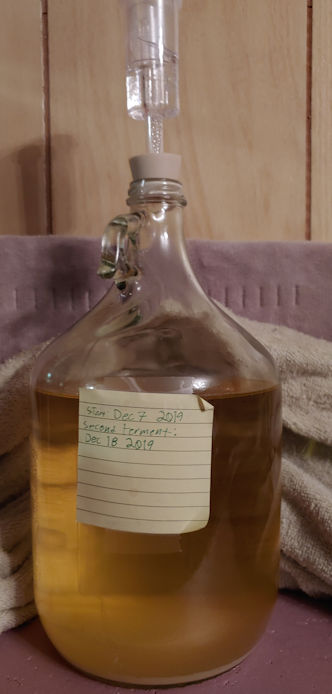
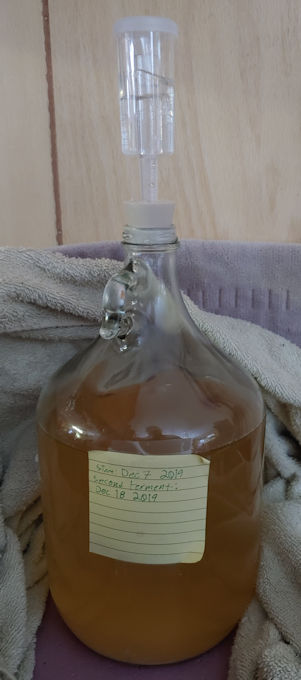
Here are photos, taken a day apart, showing before and after we added the raisins.

As you can see in the photo on the left, the mead had gotten quite clear, and there’s a pretty thick layer of sediment on the bottom. It’s hard to tell with the reflections, but in the second photo, you can actually see a couple of the raisins floating at the top. The mead is cloudier, but when we shine a light into it, we can once again see that steady stream of bubbles going up to the top.

We’ve been checking its temperature regularly and, aside from an initial warm up after adding the raisins, it’s been keeping its own temperature at 19C.

Right now, the plan is to leave it until we can no longer see those bubbles, rack it into another carboy to get it way from the sediment, then leave it for a while longer before bottling it.

A lot of the information about mead making I’m finding is conflicting, but one thing that all our sources agree on is, the longer the mead sits after bottling, the better it tastes. Most recommend at least a year.

I doubt we’ll wait that long, but with bottles at 750ml, even with having less than a gallon in the carboy (and I expect we’ll lose more after racking it again), we should still be able to get 3 – 4 full bottles out of it, so we can have one right away, then try the others at different ages.

So if we want to start a malomel (mead made with fruit) as we planned, we should pick up another air lock and two, so we can have multiple batches going at once.

You know, for someone who doesn’t actually like alcohol all that much, I find the process of making it quite enjoyable!

:-D

The Re-Farmer