Hearty Winter Potato Soup (not quite a recipe)

With all the heavy stuff going on around, I wanted to bring things back to what this blog is supposed to be about for a while. So here is a food post for you to enjoy!

There’s nothing quite like a hearty bowl of thicksome soup on a cold winter’s day! Most of our cooking falls half way between “this is how you make a thing” and, “let’s use whatever’s in the fridge or cupboards at right now and wing it.” So here is the approximate recipe for this soup. Quantities are pretty flexible. This is one of those soups that taste better the next day, so I made a huge pot of it this time.

Bacon, cut into small pieces – I used half a package of sliced bacon
Onions, 2 medium, finely diced
Garlic, several cloves, chopped fine. I like to use lots of garlic, but use however much you fancy
carrots, peeled and finely diced. Three largish carrots was what was used this time. Feel free to include other vegetables, like celery, broccoli, etc. For a large quantity of soup like this one, shoot for a total of 2 – 2 1/2 cups of finely chopped or diced vegetables.
(In this soup, I also added about half a cup of our frozen tiny tomatoes. It is not something we normally use in this soup, because tomatoes and I don’t get along. :-D )
potatoes, peeled and cut into 1/4 – 1/2 inch cubes. For this soup, I like to include different sizes of potato cubes, because I want the smaller cubes to overcook and basically dissolve into the soup, to make it thicker. For this batch, I used about 6 large-ish yellow potatoes.
egg noodles, or other pasta in shapes of a similar size
cooked chicken; we used canned chicken, drained, but this would be a good way to use any leftover roasted chicken or turkey.
cream, about 2 cups. We use whipping cream, because that’s pretty much the only cream we buy, but a lighter cream would work, too
shredded cheese – sharp cheddar is always good, but any strong flavoured, shred-able cheese will be wonderful
bay leaf
dry mustard powder, about half a teaspoon, or to taste. A prepared Dijon type mustard can be used, too.
herbs of choice, to taste (we almost always use a combination of ground thyme, sage, paprika and parsley. If we aren’t using fresh garlic, we’ll use garlic granules with the herbs)
salt and pepper to taste
chicken stock, water, or water with bouillon cubes/powder. I usually use bouillon cubes, and less than recommended for the amount of water used, because herbs, salt and pepper are also used. You can always add more seasoning, but you can’t take it out!
optional garnish: sour cream and shredded cheese
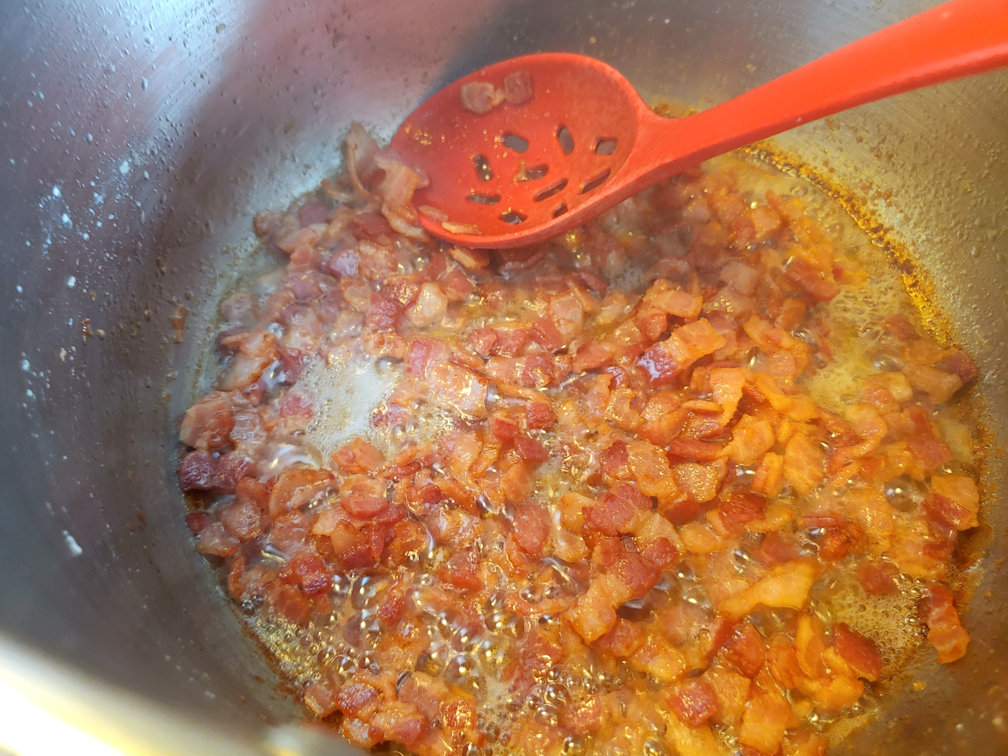
Start by cooking the bacon pieces in a large stock pot. If they seemed to be cooking unevenly, add a bit of water, which will help render out the fat more evenly, and deglaze the bottom so it doesn’t burn. Cook to desired doneness. I like it on the crispier side.
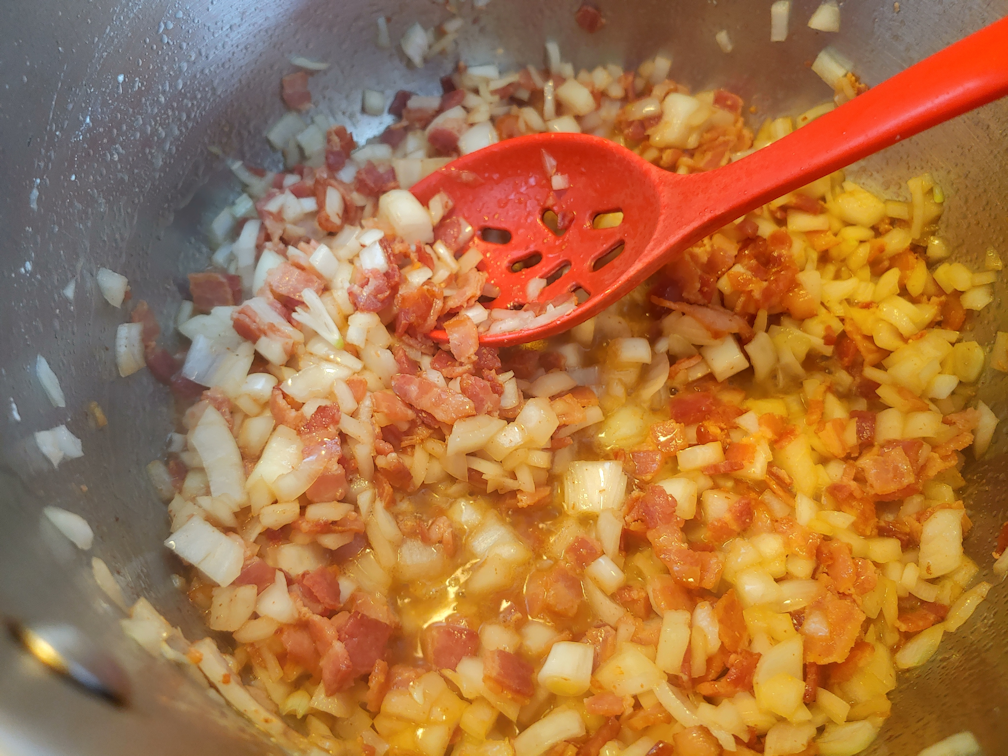
Next, add the chopped onions and cook until the onions are softening and starting to become translucent.
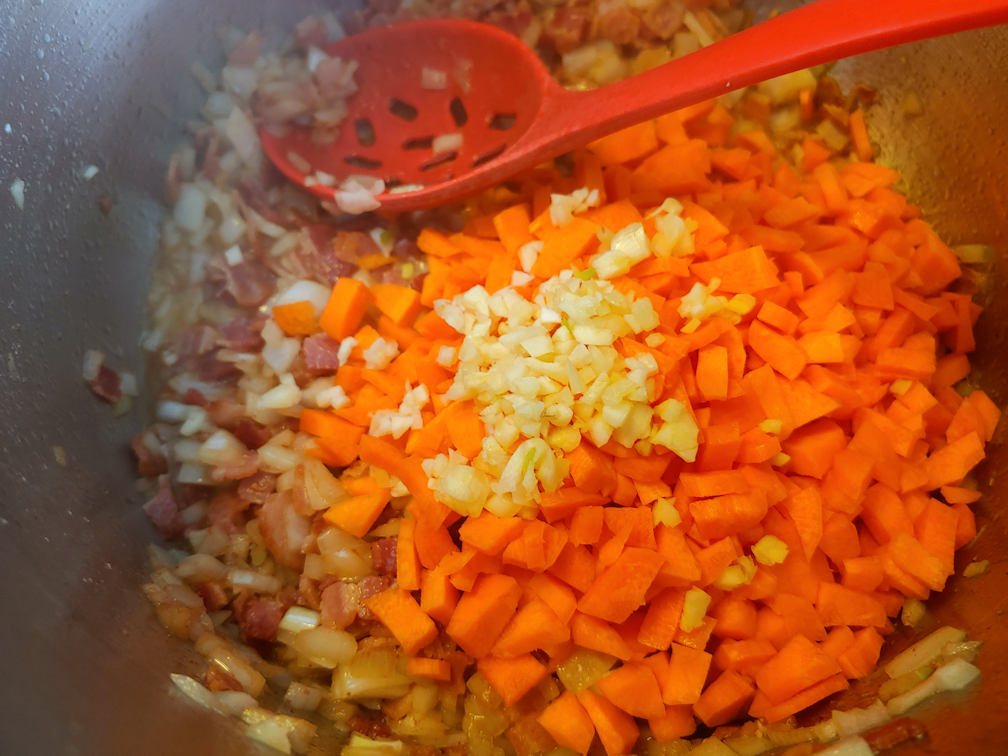
Add the carrots and garlic. Stir and cook until the carrots are about half done. If using other vegetables as well, add the longer cooking vegetables in first.
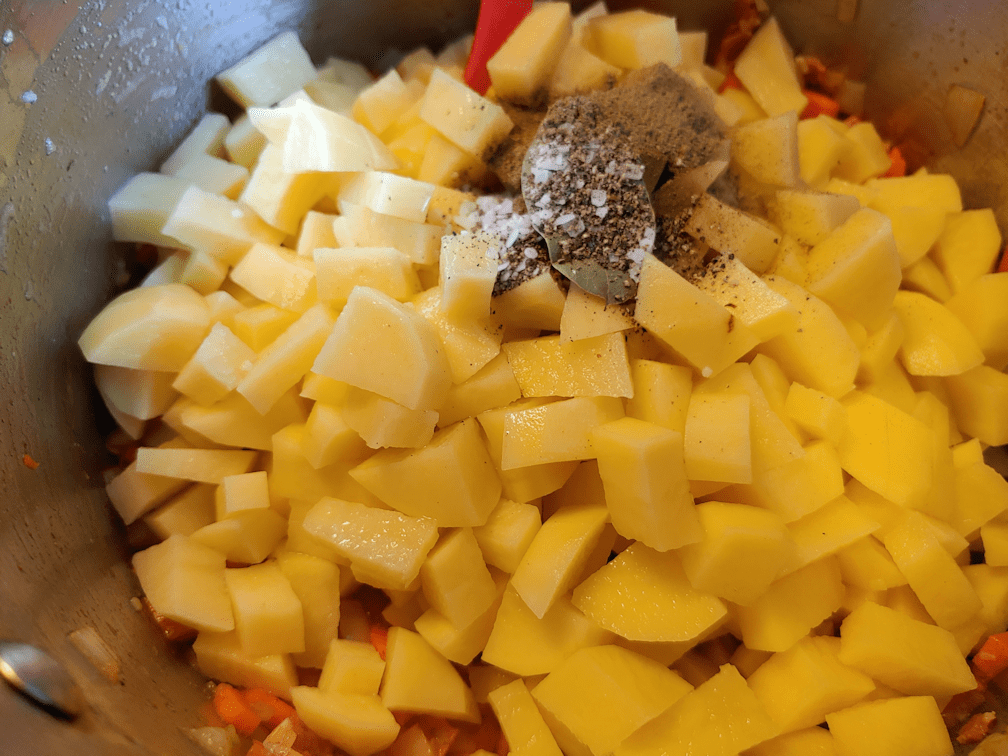
Next, add the potatoes, bay leaf, herbs, salt and pepper.

Add enough water or stock to cover everything. Since I was using bouillon cubes, I added them at this point, too. I like to chop them up a bit, so that they dissolve faster.

Stir well, then bring to a boil.

Once the liquid has been brought to a boil, reduce heat and simmer for the time needed to cook the potatoes, minus the time needed to cook the egg noodles or pasta. So if the size of potato cubes you cut need 20 minutes, and you’re using pasta that needs 8 minutes to cook, simmer for 12 minutes.

Because I wanted to deliberately overcook the potatoes, I simmered mine for 15 minutes.

Stir in the egg noodles. This was an entire small package of egg noodles. I don’t remember the weight on it.

Add more water as needed. To keep it from cooling down too much, boil some water in advance and use that while it’s still hot.

Stir in the canned or cooked chicken.

The tiny frozen tomatoes were added at this point, then the soup was brought to a boil again.

These are the super tiny Spoon tomatoes, and some cherry tomatoes, we grew last year. Their tiny size allowed them to be added at this stage, but if we were to use regular sized tomatoes, they would have been added with the carrots, much earlier on.

Bring to a boil, then simmer until the noodles are done. Remove the bay leaf.
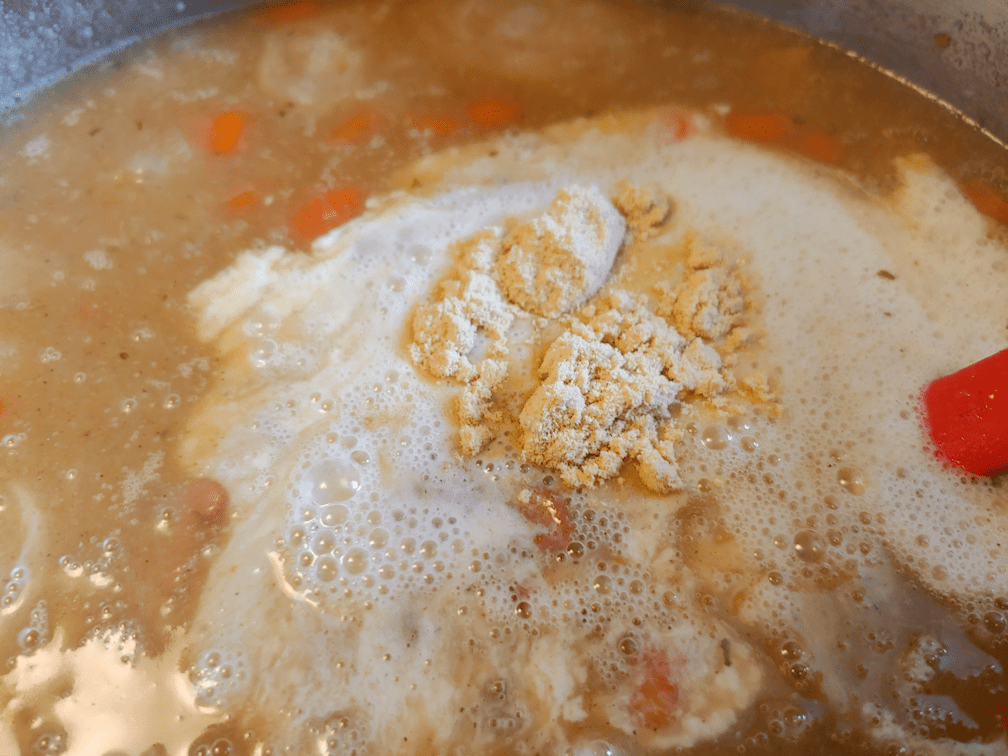
Stir in the cream and mustard powder. Bring the heat back up and simmer just long enough to heat the cream through, stirring continually. Turn off the heat.
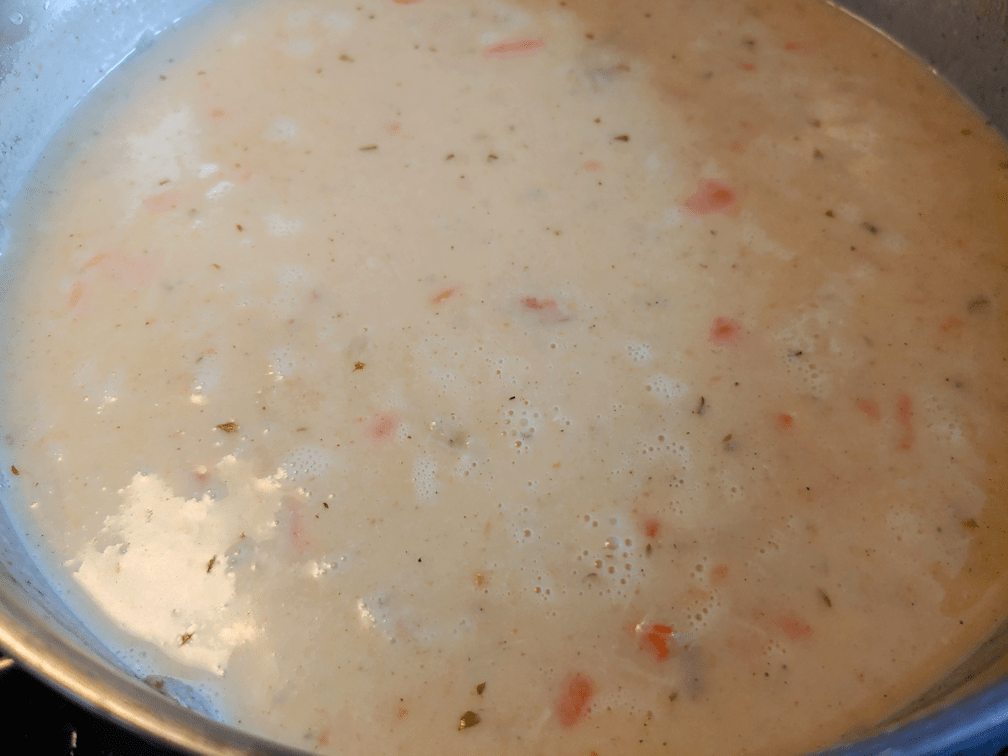
Taste and adjust seasonings.

This is the soup after the cream and mustard powder has been incorporated. You could skip the next step, if you like a thinner, chunkier soup.

Or, you can partially blend it. I have an immersion blender, which makes easy work of it, but if you have a countertop blender or food processor, use it to blend about half of the soup, then return the blended soup to the rest in the pot. Stir and, if necessary, reheat until it’s hot enough to melt cheese, then remove from heat.

Add in a good handful or two of shredded cheese and stir until thoroughly melted and incorporated.

Serve topped with a dollop of sour cream and a bit of shredded cheese, if desired.

This soup always goes over really well, even with my lactose intolerant family! It’s thick and hearty enough to be the main course, with maybe some buttered bread to go with it. If you like an even thicker soup, use more potatoes, and blend it more at the end.

Good stuff!

I think I’ll go for seconds, now…

The Re-Farmer

This year’s Christmas decorations

Every year, I used to make new decorations for our Christmas tree, and to share with family. We had a multi-year hiatus for a number of reasons, including moving here, but I’ve started the tradition up again.

Each year, I try to do something different, hopefully learn a new skill, and use materials at hand. This year, I started with…

… cans.

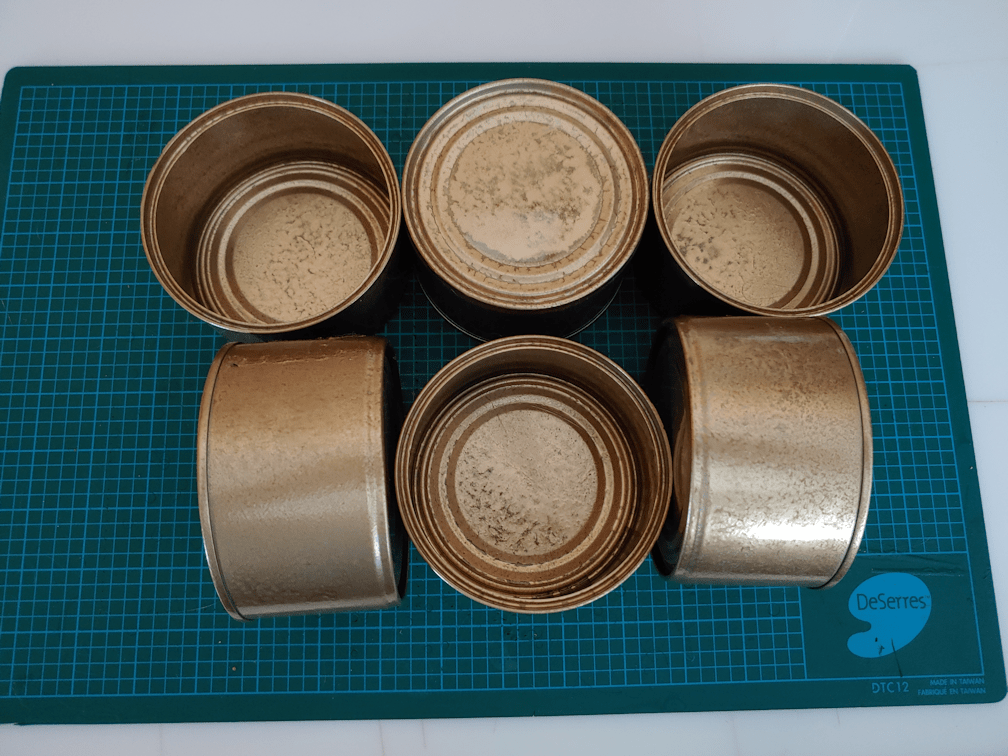
Specifically, the cans from Costco’s canned chicken. I liked their size.

My daughter was kind enough to spray paint them gold for me, which took several days and several layers. Paint doesn’t like to cure when it’s cold, and she ended up having to do it in the old basement – forgetting that the furnace is there. :-D The paint didn’t want to adhere to the metal very well, but once it set, it was good.

Those were turned into…

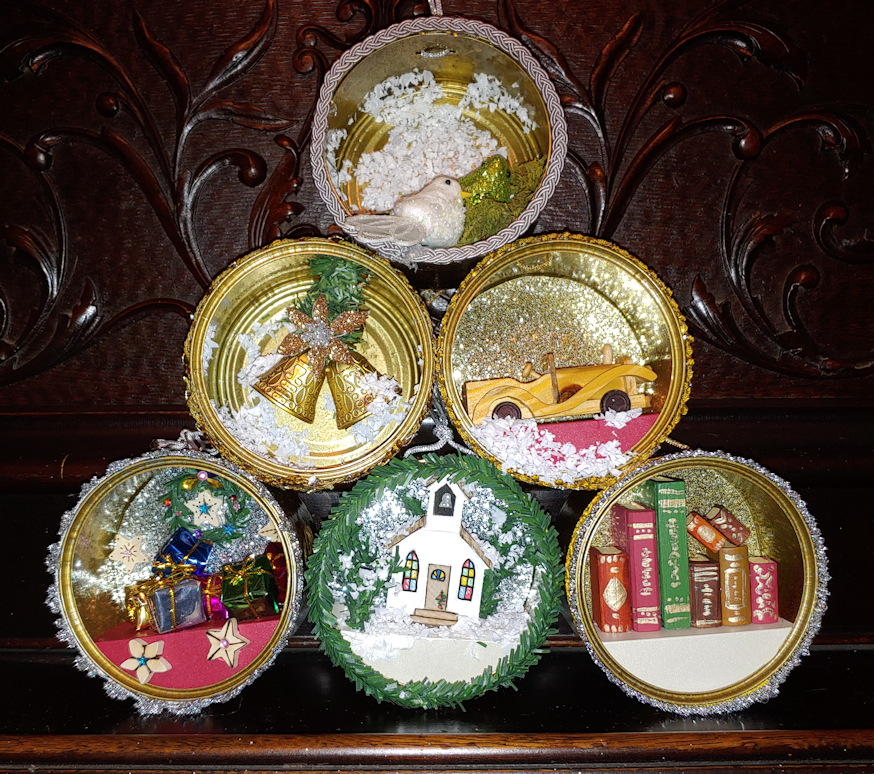
… these.

Most of the materials used were from a dollar store. I tried to find really tiny Christmas trees but ended up getting some floral wire made to look like sprigs. I cut and twisted some together to make little trees, two of which are behind the little church. The ribbon, birds, gifts, bells, glitter paper, wooden stars and fake snow were also from the dollar store. I already had metallic card stock that I used to create platforms, as well as the other wooden pieces. A family member gifted me with a storage box fill of little wooden pieces, years ago, and I finally got to use some!

I did some wood burning on the starts and the church. My daughter painted the church and the books. I just love how the books look!

You can see in the flash picture that she used metallic gold on the books. She also used some metallic paint for details on the church. When I tried to find things small enough for the wreath behind the gifts, she dug around and find some teeny, tiny “gem” shapes she had saved from somewhere. I ended up using several different types of adhesives I happened to have, to hold everything in place. As long as they did the job and dried clear, I wasn’t too fussy!

These are too large to hang on our little Christmas tree, but they will be perfect to add to the lights and garlands we have running across the dining room cabinets at the ceiling.

With having to wait for paint to cure and some adhesives to dry, this took a lot longer than I originally expected. The most difficult part was cutting holes into the metal, then threading cord through for the hangers. I couldn’t be sure where to place the holes until after the insides were done. The church steeple was particularly awkward! Craft tweezers came in very handy! The bells needed their own hole, and I had to figure out how to hang those, and ended up using a piece of the tree-sprig floral wire, then using an extra wide ribbon to edge it, to make sure the part that’s on top was well secured.

I’m quite happy with the finished result!

The Re-Farmer
Not a Recipe: loaded pierogi

Ah, what a day! As I sit here, I am watching the garage cam’s live feed, as blowing snow covers my daughter’s footprints, from when she closed the gate just a little while go. At least it’s still getting warmer!

FedEx never did show up with our Starlink system.

*sigh*

Hopefully, we’ll get a call or email tomorrow to tell us what happened.

We did, however finish making the pierogi!

Gosh, it’s been so long since I’ve made these, they are the ugliest pierogi, ever! :-D

We also have a huge amount of potato filling left over, even though I made a double recipe of dough. I keep forgetting just how little stuffing fits inside a pierog. We did make extra deliberately, though, and as I write this, the girls are using some of it to make supper.

No, we’re not having pierogi for supper today. Those are cooling off in containers for the fridge. I had thought I’d have enough for the freezer, but it turns out I would have needed to quadruple the dough, and I won’t be doing that. I was in enough pain by the end of it, with just the double batch!

Anyhow, this is how we make our loaded filling.

The potatoes are basically our usual mashed potatoes, except on the dry side. They can be completely plain, too, or maybe seasoned with just salt, but we to include butter, milk and sour cream, and whatever else we have on hand and strikes our fancy. My daughter added a dash of hot sauce to it this time; just a tiny bit, because she knows I have no tolerance for spicy foods.

While she worked on the potatoes, I cut bacon into very small pieces, then cooked them over medium low heat in a frying pan until crispy and the fat was rendered out. The bacon pieces then got removed with a slotted spoon onto paper towel to drain and cool down.

I then added a bunch of mushrooms, cut into little pieces, to the bacon grease and cooked those on medium heat until almost crispy. That can take a while, as they release quite a bit of moisture as they cook. I used white button mushrooms this time, but usually use crimini. Any fresh mushroom would work, I’m sure.

Once done, the mushrooms were removed with a slotted spoon onto paper towel to drain and cool, just like the bacon.

After that, I poured off some of the bacon grease, until there was only about 1 or 2 tablespoons left in the pan. To that, I added about the same amount of butter, then added onions, chopped fine. The onions can be cooked until translucent, but I decided to caramelize them this time. Near the end of their cooking time, I added a bunch of garlic I’d put through a garlic press.

All of that got mixed in with the mashed potatoes, then the entire pot was put into the old kitchen, which is at freezing temperatures these days, to cool down.

The filling didn’t need to be completely cold before I added the cheese, but I did want it cooled enough that it wouldn’t melt the cheese. Here, I’ve got some old cheddar and goat cheese. I’ve made these using Montery Jack, which worked out very well. Any sharp cheese can be used. A mild cheese would just disappear among the other flavours.

The dough was made using a basic recipe I found online. I like a dough that uses sour cream, but we didn’t have enough for a single recipe, never mind a double, so I used one that was just flour, salt and butter melted into boiled water. The fun part is kneading it. Pierogi dough has such a wonderful texture!

When it was time to start making the pierogi, I just made a mess of things! LOL The first ones I made were massive. I was shooting for three inches square, but I was probably closer to four.

Yes, I do squares folded into triangles, instead of cutting rounds. It’s faster that way, and there’s less dough left over that has to be rolled out again.

The next batch I did went the opposite way, and were far too small. Some of the squares were more rectangles and ended up being folded into smaller rectangles instead of triangles. :-D

My daughter started boiling the first couple of batches while I finished up the last ones. At the very end, when there was just enough dough to make three pierogi, I made three balls and rolled them out individually, so we got a few half-circle ones, along with the triangles and rectangles! LOL

After they were cooked and drained, we tossed them in olive oil, salt and pepper, then I split them up into take-out containers to finish cooling down.

I suppose I should have tasted one, but I was so focused on getting them ready to put away in the fridge, I didn’t think of it!

Let me remedy that.

Oh, my goodness! They turned out great!

The main reason I chop everything that goes into the potatoes so small is so that each pierog will have a bit of everything in it, and you can really taste each ingredient in there. Of course, with the onions and mushrooms fried in the bacon grease, the bacon flavour runs through it all, but without being too dominant.

The dough is nice and toothsome. I like a good, thick dough. Not too thick, of course, but I remember that even as a kid, eating my mother’s pierogi, my favourite part was the outer edge of dough. I would have liked a sour cream dough better, but the plain dough is still excellent. When we eat these later, they will be pan fried in butter, and that will make them even better!

Who cares if they are all weird sizes and shapes? They taste great!

The Re-Farmer

Recreating Mom’s soda cheese: the taste test

Part One
Part Two
Part Three

Well, here it is! The final product in trying to make my mother’s baking soda cheese.

Did it work?

Well… sort of.

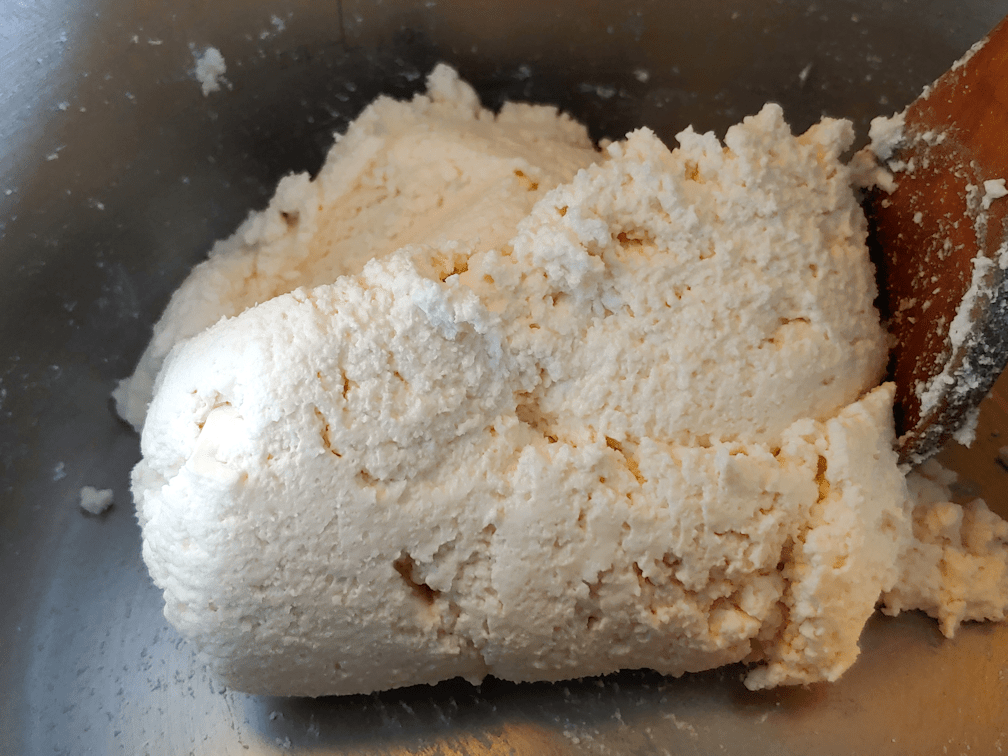
First of all, this is not at all like what I remember my mother’s cheese looked like. That was a semi-hard cheese that could be sliced. This… is not. It’s more like a cream cheese in texture, but it wants to crumble more than spread. It can, however, be spread.

As for the taste… I have a really hard time describing it. It’s a young cheese so, of course, the flavour is very mild. Which means it would lend itself very well to the addition of herbs and spices and other flavours. As it is now, with just salt, there is a sort of tanginess to it that I can’t put my finger on. It somehow manages to be both mild and bold tasting, at the same time!

Oh!! I just realized what it reminds me of. It’s very similar to a Boursin.

All four of us have had a taste, and we do have a consensus.

It’s very good. Delicious, even.

In fact, as I write this, I’m enjoying it on a slice of oatmeal bread, with a cup of Irish Breakfast tea.

What I should probably do is take some to my mother, so she can try it and tell me how it compares to what she made. After all, I only ever saw the finished product once, and that was many years ago. Based on my memory of it, I did not succeed in recreating it. However, the finished product is very good.

With the cost of milk these days, compared to a container of Boursin cheese at the grocery store, we’re not really saving any money by making it ourselves. If I were to compare to the cost of a block of plain cream cheese, we’d be losing money by making it ourselves.

Is it worth making again?

Absolutely. And we will, probably in larger quantities.

It may not be as I remember my mother’s soda cheese looked like (I can’t compare the taste too much, since hers had been flavoured with caraway seeds), but that’s just more reason to keep trying!

The Overview

Okay, so let’s look at why it might not have turned out like my mothers. What differences were there?

First up, quantity of milk. I’m now convinced that my original notes, which said “about 5 gallons” of milk was accurate. My parents still had a few cows at the time I visited and saw this cheese, and it was just the two of them, so they would have had a LOT of excess milk.

Second, she used raw, skim milk. My parents always ran the milk through the separator. While I’m sure they must have done it once in a while, I don’t remember my parents ever setting aside whole milk. Until it finally closed, my parents sold their cream to a local creamery for a bit of extra cash (though they sometimes took payment in butter!). Skim milk was for home use. Cream was for selling. I used the type of milk we usually buy; homo milk (3%). We never, ever buy skim, because we all find it incredibly disgusting. So what I made has a higher fat content than hers would have, plus our milk was pasteurized and homogenized. Hers would not have been.

Other differences include my hanging the cheese to drain, when my mother had just set it aside; my curds may have been drier than hers. She melted her curds in a frying pan before pouring it into a mold. Chances are, the frying pan she used was cast iron. If so, that too would have made a difference. She would have made hers in the summer, when the milk would have soured much more quickly. Even the natural yeasts in the air might have made a difference, and while my mother would have ensured everything was clean, she could not have sanitized things to the extent that home cheese makers can, now. The salt I used also would have been different. She would have used ordinary table salt, which would be iodized. I used non-iodized coarse salt that had been run through a coffee grinder to powder it.

There’s also the fact that she may not even remember some details, or had not thought to mention some because, to her, they were just so obvious she couldn’t imagine them not being done.

There are so many little things that could have made a difference, but until I actually take some to my mother to try, I don’t even know just how different ours is from hers! For all I know, I could be remembering her cheese completely wrong, or the cheese I remember is not the one she remembered and gave me her instructions for. We could have been talking about two different cheeses completely, and not known it.

I guess that’s just how it can be. I’ve had an interest in recreating ancient recipes for many, many years, and this sort of reminds me of that. When the ancient recipes were written down, they weren’t at all like modern recipes. Often, they were little more than a list of ingredients, with no or few quantities. The writer assumed the reader would already know the details. My mother just used what she had, in the quantities she had, done in the ways she knew.

I’m just fortunate I can still actually ask her for details, even if she can’t always remember them.

The Re-Farmer

Recreating Mom’s soda cheese; final steps

Part One
Part Two

After sitting overnight, tucked away in the oven, it was time to take out the cheese and do the final steps.

This is what it looks like this morning, after stirring.

It… looks like dry cottage cheese.

The next instructions were:

Add salt to taste, if desired. Add colour if desired. Add herbs/spices, if desired.

For this first attempt, I am only adding salt.

If you look closely, you can see the salt on the curds in front of the spoon. My mother would have just plain table salt, since that’s what she would have had. I stole some of the powdered salt my daughters use in the popcorn pot. It’s just coarse salt that has been run through a coffee grinder, so it can be added to the oil that popcorn is popped in, and actually stick to the popcorn as it pops. That got very thoroughly mixed in while I started the next step.

Put to frying pan on low heat, in batches, and heat. Mix while heating.

The more the curd got mixed, the more dough-like it got in consistency.

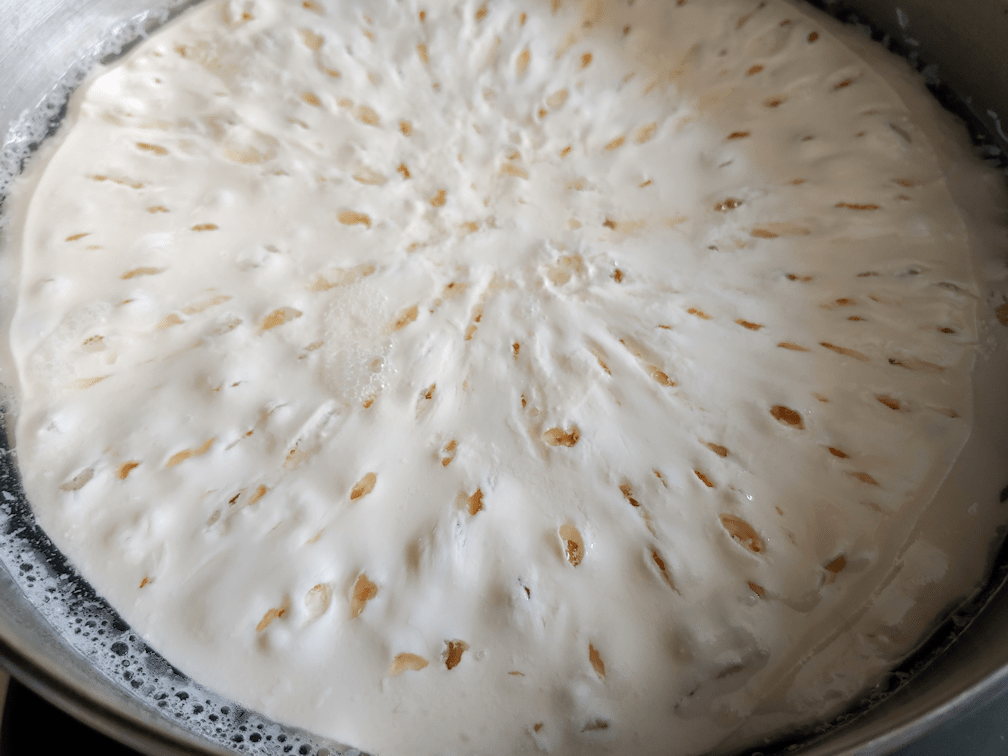
Then, it actually started to melt!

I know that’s what my mother said, but I still felt surprised by it!

I even had to change spoons. By this stage, the texture was a bit like cake batter.

When melted completely, pour into form.

I didn’t know how long it needed to be stirred, but my mom said to pour it, so I just kept going.

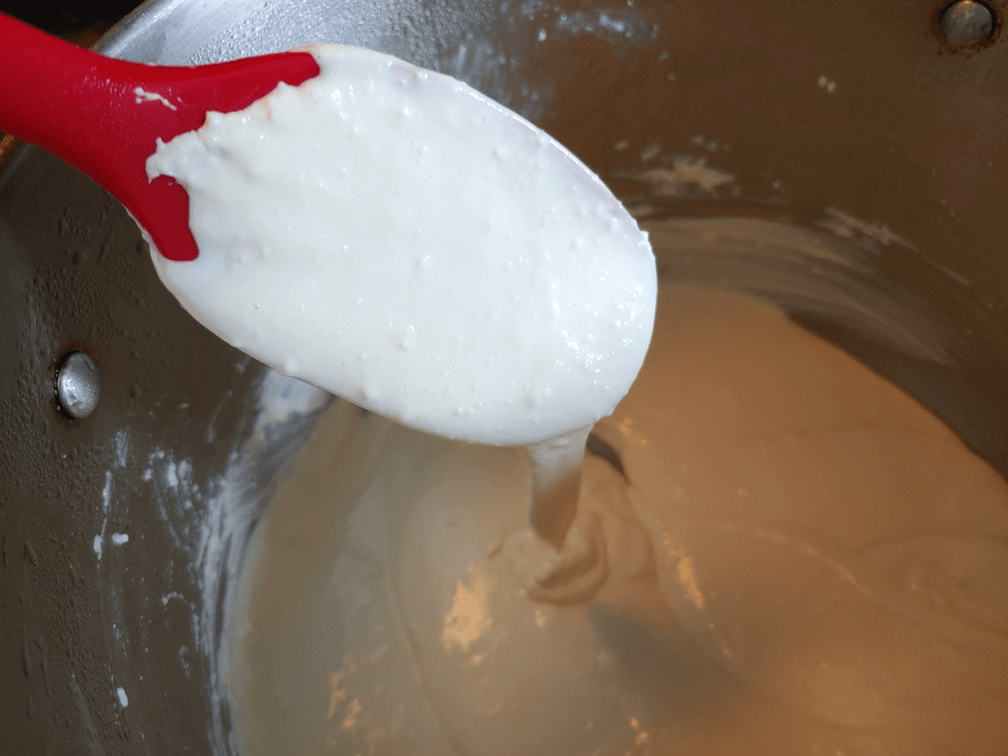
Just look at this! It really did get to a pour-able consistency, unlike any other cheese I’ve ever worked with! At this stage, it was like well stirred sour cream in consistency.

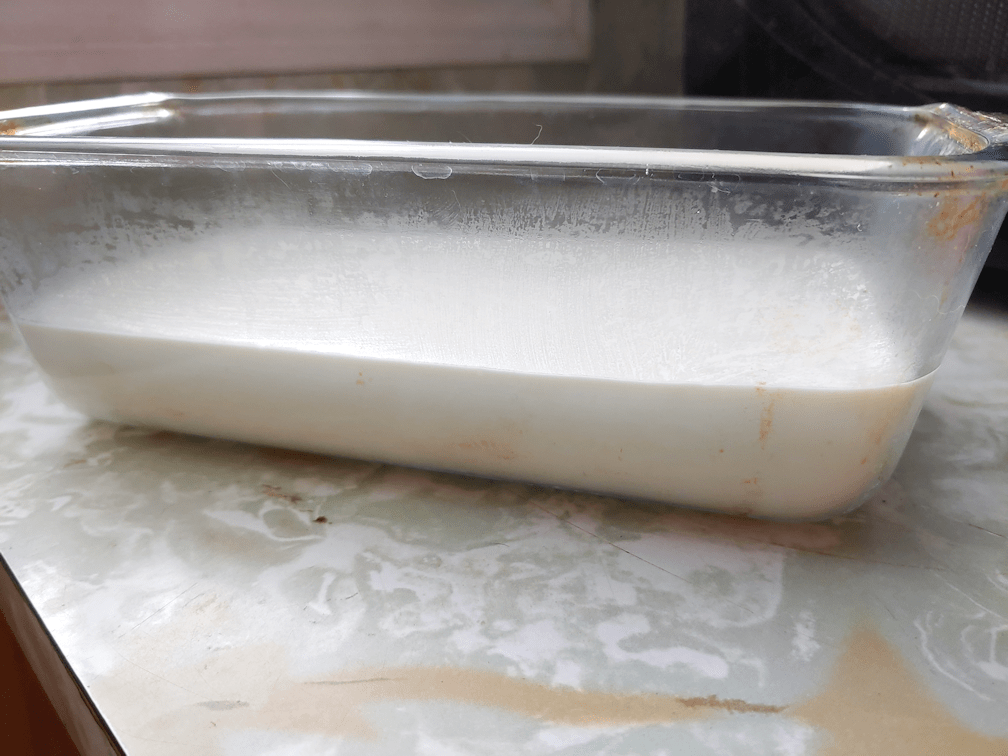
I then poured it into a loaf pan I’d scalded and had ready. This level if what 1 gallon of milk was reduced to.

Leave to rest until cool.
When cool, ready to slice.

This is the stage we are at now. I covered the loaf pan with a narrow wooden cutting board I have. I considered covering it with plastic wrap, but I wasn’t sure I wanted the condensation build up, and the board would keep the dust off while also allowing a bit of air.

I’m hoping that, as it cools, it shrinks a bit, so it’ll be easier to remove from the loaf pan.

I did taste it after pouring it into the mold (I admit it. I licked the spoon!). The salt definitely improves the otherwise bland flavour. There is another flavour in there that I just can’t identify or describe. I’m hoping after we do a taste test, later, someone in the household will be able to describe it!

I am really looking forward to trying this!

The Re-Farmer
Recreating Mom’s soda cheese; the next steps

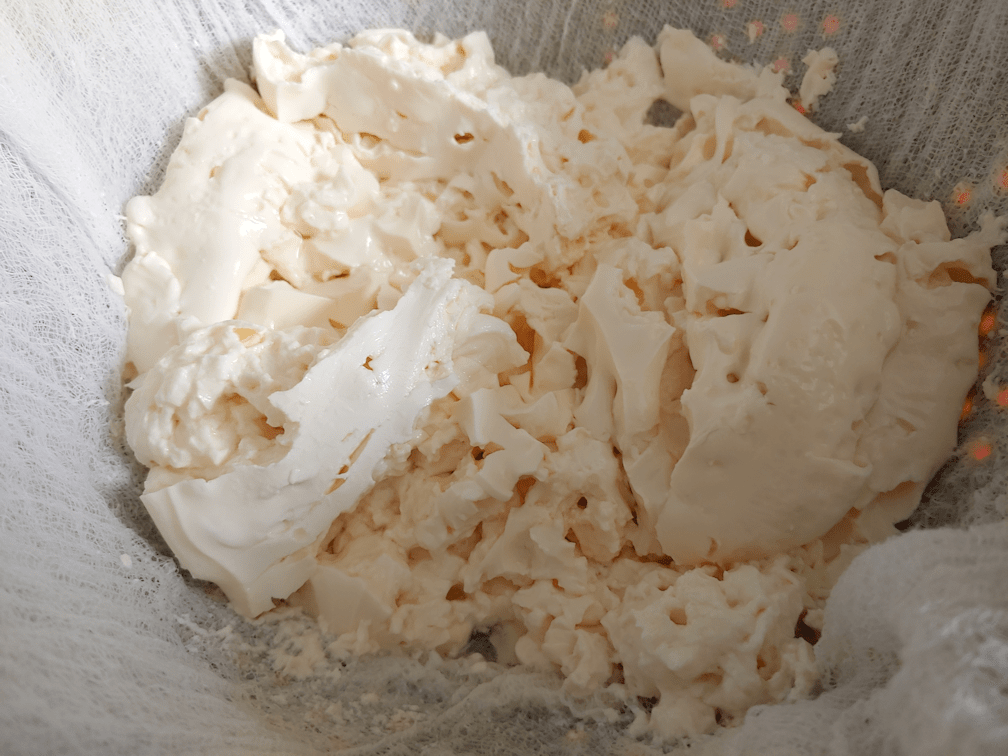
Okay, so the curds have been hanging for about 5 1/2 hours, and I’ve moved on to the next steps in trying to recreate my mom’s cheese.

Now, my Mom had said to just set it aside for a few hours, or overnight, so hanging it may have changed things a bit. I don’t know. But this is what it looks like after hanging for most of the day.

Also, it’s a good thing I covered the whole set up with another cheesecloth, because the cats REALLY wanted to get at this!

The next instructions are:

Put solids into large pot.
Add about 1 tsp baking soda and mix thoroughly.
Leave overnight.
Will rise like bread.

Hmmm.

Looking at how little there is in here, I’m starting to think that my original notes, saying about 5 gallons of milk, was accurate. There is not a lot in here, and when I saw my mother’s cheese, it filled an ice cream bucket, so there’s no way it was only 1 gallon.

Which means I’ve been using the quantities for vinegar and baking soda for 5 gallons, not 1 gallon. Yet, 1 tsp of vinegar to sour 5 gallons seems like way too little. Mind you, she would have been making this in the summer, and the milk probably would have soured quickly, with no vinegar at all. Knowing she was pretty loosey-goosey on the quantities to begin with, it’s really hard to know. Considering how long it took to sour using 1 tsp of vinegar to 1 gallon of milk, I suspect it’s actually the correct amount, and that I would have needed more, if I were using more milk.

This is after very thoroughly mixing in the baking soda. Yes, I used 1 tsp for this amount.

The curds feel like a cross between cream cheese and cottage cheese. I spent quite a bit of time mixing it, because I wanted that baking soda to be worked in as much as possible.

My mom said to leave it overnight, which means she would have just left it on a counter, but I have put the covered pot into a warm oven, because of how chilly that part of the house gets.

She commented that it will “rise like bread.” That makes sense, since we should be seeing a chemical reaction between the acidic milk soured with vinegar, and the alkaline baking soda. It’s something I’m used to when working with sourdough, but with cheese? I did get the sense that the curds were starting to feel “fluffier” by the time I finished stirring in the soda, but that could be just my imagination because I am expecting something like that.

I did taste the curds before and after adding the soda. As I mentioned before, it has very little flavour right now, but I did feel that the baking soda … softened… the flavour, if that makes sense.

After it has sat for the night, salt, colours and herbs and spices can be added. For this first attempt, I will be adding some salt, but that’s it. If we make it again, we’ll experiment with adding herbs and spices or whatever.

I am incredibly curious to see what it looks like by morning!

The Re-Farmer

Recreating Mom’s soda cheese

I am currently in the middle of an experiment.

Growing up here, as a subsistence farm, we had cows for milking and for beef. Even with 7 of us, we were milking enough cows to have excess milk. I remember my mother making cottage cheese (which I did NOT like), but that was the only type of cheese I saw her make until some years after I’d moved off the farm. I’d come out to visit, and saw some semi-hard cheese in an old ice cream bucket for a form. It was slightly harder than a cheddar, sort of tannish yellow in colour, with caraway seeds in it. It was quite tasty. I asked my mother about it, and she said she had made it.

A few years ago, I asked my mother about how she made this cheese I remembered. Unfortunately, she thought I was talking about cottage cheese, and the more I described it, the more perplexed she was.

After moving here, I was having a conversation with my mother about making and preserving food, when she mentioned a cheese she’d made. It was the one I remembered! I quickly took advantage of the moment, and got her to describe to me how she made it. I knew it had to be different, because my mother did not have access to rennet or any of the bacterial starters. She didn’t have a food thermometer, either.

Getting any sort of information like this from my mother has always been difficult. I remember the first time I tried to get a recipe for a soup she made. I remembered some of the ingredients, and asked her if she remembered how she made it. Instead of answering me, she started mocking me for not knowing how to cook and not knowing how to make soup. Never mind that I was already married and a child, by then, and had been feeding the family just fine.

I never did find out how she made that soup.

This time, I did manage to get the information down then, after I got off the phone with her, re-wrote it into more cohesive instructions, since the conversation bounced all over the place. When I was finally ready to try it, I was perplexed by some of the quantities, so I called her to clarify. Did she really start with 5 gallons of milk, or did I make a mistake writing it down?

Finding out was like pulling teeth! She kept avoiding answering the question, and kept saying, “you mean you’ve never made cheese before?” in total shock. Then giving me instructions on how to do different parts. I kept going back to the quantity, and asked her if she had used 5 gallons, only to be told how I should just use one gallon, because 5 gallons is such a lot… *facepalm* Then she talked about how she’d never made it using milk from a store, and how I could use lemon juice instead of vinegar, and on and on. It took a while, but I managed to explain that I have made cheese before, I did only want to use 1 gallon, and if the instructions I had was for 5 gallons, I’d have to know that, so I could adjust the other quantities.

What it came down to is, my mother never measured. She used whatever amount of milk she had, and went from there. I did know that. What I needed was some sort of approximation, because there is a heck of a big difference in quantities involved.

Finally, she told me she used about 1 gallon.

*sigh*

Once I had that clarified, I finally got a batch started. Here are the instructions I got from her, highlighted in blue, with my own commentary.

Milk – about a gallon
Add 1 tsp vinegar to make sour. May take all night.

This part actually ended up taking almost two days. The milk was supposed to rest at room temperature, but with how cold our house is – especially the kitchen – I put it in a warm oven.

When sour, put in pot/roaster into oven to warm (lowest heat) until forms curds and whey.

We finally reached that stage this morning.

This is how it looked.

I have no idea if this is how it’s supposed to look.

Drain through cheesecloth.

There is nothing about cutting the curds or anything like that, first. Just to drain it.

I did give it a taste at this point. It doesn’t have much flavour to speak of. The texture was a lot denser than I expected it to be, considering how it broke apart.

Set aside for a few hours or, preferable, overnight.

This is the stage we’re at now, though I’m cheating a bit. I dug out the stand I made to hang jelly bags or drain yogurt cheese, tied off the cheesecloth and hung it.

After taking this photo, I covered the whole stand and bowl with another cheesecloth, to keep out the dust and cat fur – and cats!

Since I got to this point so early in the day, I will likely continue after a few hours, rather than leaving it overnight, because…

Put solids into large pot.
Add about 1 tsp baking soda and mix thoroughly.
Leave overnight.
Will rise like bread.

… it will sit overnight again, after this stage.

As for the whey, I think it’s time to do some more bread baking! I love using whey as the liquid. It adds so much flavour!

The next instructions have me wondering.

Add salt to taste, if desired. Add colour if desired. Add herbs/spices, if desired.

This is all stuff that’s supposed to be added after the baking soda gets added, and after it rests overnight. Which seems odd to me, but that’s how she did it, so that’s how I’ll try it!

Put to frying pan on low heat, in batches, and heat. Mix while heating.
When melted completely, pour into form.

… melted?

It can melt at this stage?

I am really perplexed by this.

I’m not sure what I’ll use as a form just yet. It will depend on what I see when the time comes

Leave to rest until cool.
When cool, ready to slice.

If I hadn’t see my mother’s cheese, I would never guess that these instructions would get that result. As it is, I am still unsure of what I’ll actually get!

So this should be an interesting experiment. I hope it works, because it’s really easy to make, even if it does get spread out over several days.

The Re-Farmer

Ginger Bug, on the Rocks

Okay, I finally got a photo that didn’t totally suck!

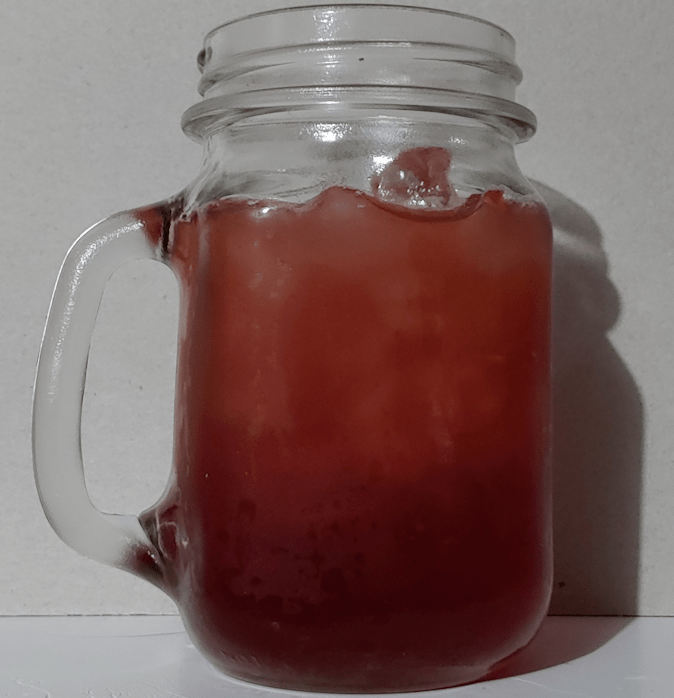
Here is our very first Ginger Bug pop.

Our very first attempt at making fermented pop, using a Ginger Bug.

We used a house brand, cranberry raspberry cocktail for the base, which also contained other types of juice in it. The predominant flavour was actually apple.

The juice and ginger bug mixture stayed at room temperature in a plastic bottle for a week. Every day, we would give the bottle a squeeze to see if it was getting harder, which would show that fermentation was happening and gases were starting to expand. Then one morning, I walked past and saw the bottle looking like it was about to tip over! The bottle was rock hard, and the indented base had been pushed outwards under the pressure, causing it start tipping!

I immediately put it in the fridge to stop the fermentation process, but not before I opened the bottle enough to relieve some of the pressure!

When we taste tested it the next day, there was quite a bit of pressure release when I opened the jug, but in pouring it out, there was surprisingly little fizz. It’s more like a barely noticeable effervescence, with a light tingle on the tongue.

Honestly, it really just tastes like juice. None of us noticed much of a ginger flavour in there, and the predominant flavour is still apple. I found it very sweet, so when I had another glass the next day, I watered it down, about 50/50. I found it to be nicer that way.

In researching how to make this, one of the things I’d read was that, after moving it to the fridge, it needed to be drunk within a few weeks, because it loses its fizz. So far, that has not been true! Every time I’ve taken the bottle out, it’s been rock hard again, and there’s no lessening on the sound of gas being released when it’s opened!

As for the glass in the photo, I admit, this is an adulterated drink. I poured it over quite a bit of ice, rather than watering it down.

I also added about an ounce of our hard crab apple cider!

My goodness, that does work rather well!

The ginger bug drink is very sweet, while the hard crab apple cider is a bit on the sour side, and the two balance each other out quite nicely.

I now have a new bottle of cranberry raspberry cocktail mixed with the ginger bug starter. That’s the last of the juice I got for this. I think next time, we’ll try making a fruit syrup out of what we’ve got in the freezer and see how that works out!

This is definitely something we’re enjoying.

The Re-Farmer

The sign is up!

Have I mentioned I have an awesome brother?

Absolutely the best!

He came over this morning, his truck loaded for bear, to install the sign I made to replace the one that was stolen. And, wow, did he ever go all out!

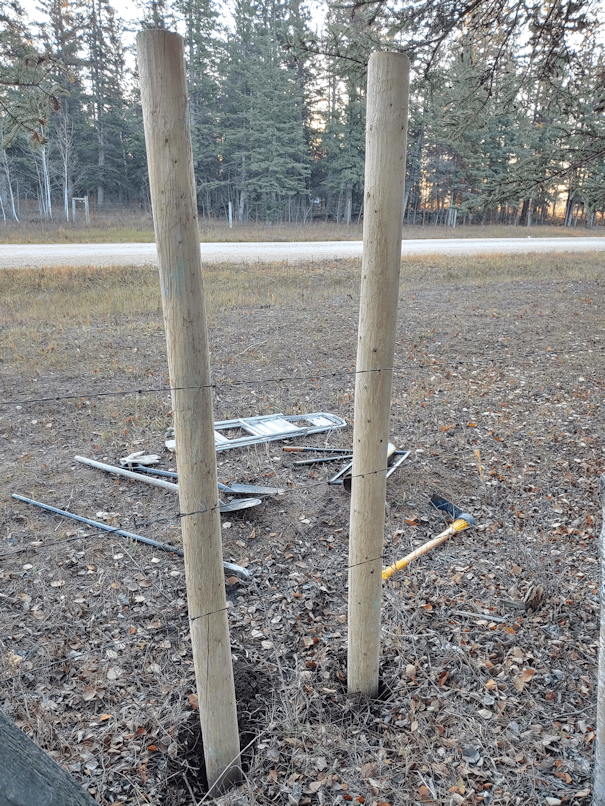
Once we decided where to put the sign, he used the little legs on the back of it to mark how far apart to set the posts, in the ground.

He started working from the outside of the fence, clearing away some brush growing at the fence line, using the soil auger bit on his drill to make post holes, then using the metal bar to widen the holes. He hit rocks, of course, but was able to either break right through them, or move them. He did have to cut away a section of spruce root, though.

While he worked on the outside of the fence, I worked on the inside.

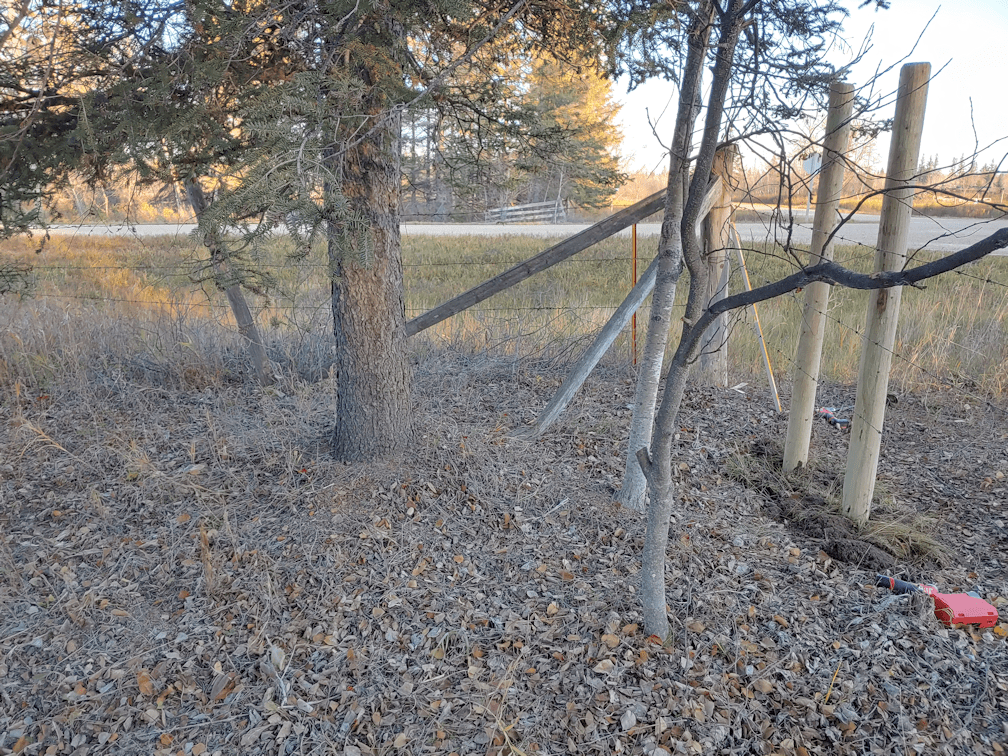
The area was pretty overgrown, and I worked on cleaning it up so we could access things. This also gave us a chance to take a good look at the corner post, which turned out to be quite solid. It’s just tilting. You can even see how one of the support boards has broken from the pressure!

He ended up setting the 8′ fence posts slightly more than 2′ deep. He brought his post pounder and a level, and had to do a bit of back and forth-ing between them, to get them level at the top.

While he worked on that, I continued clearing undergrowth.

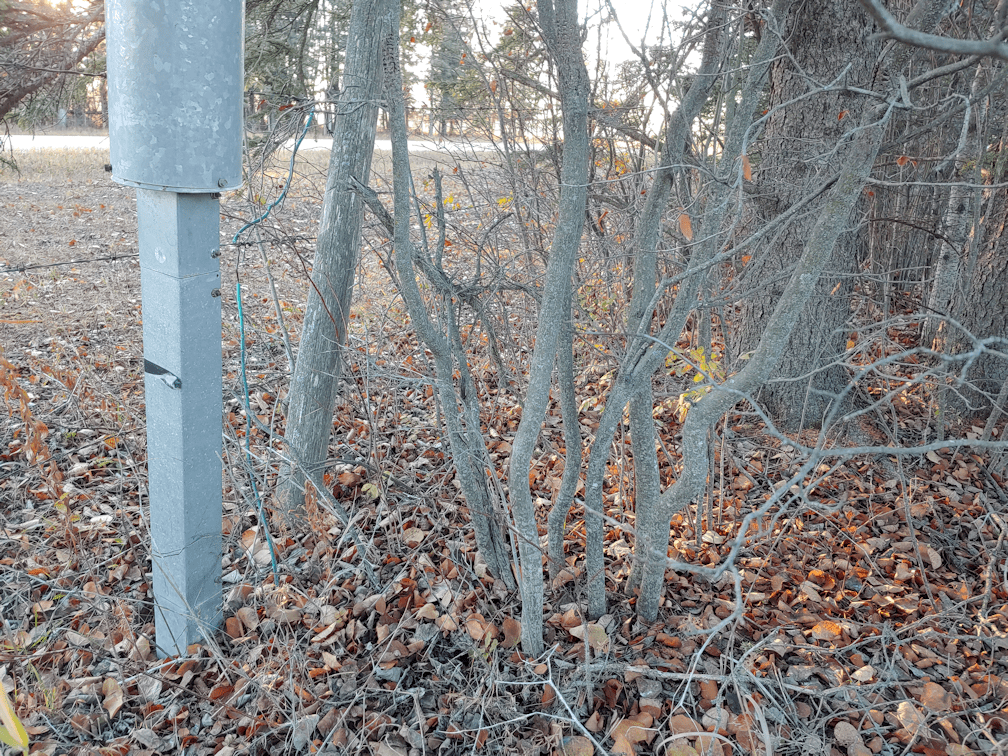
I continued clearing into this area, wanting to have access to the telephone company’s post. My brother confirmed that the green wire is a ground wire.

When planning for tree planting, we need to make sure not to plant over the buried phone wire. In our brother’s property across the road, there is an open alley through the trees. I had figured we just needed to line up with that and we’d be good. However, this post it not at all lined up with the alley.

My brother remembers when the phone lines were buried, and was able to tell me why. My father had asked them to move where they were laying the wire down in the quarter section across the road, so as not to take down the large, mature spruces they would have gone right through. They agreed. Once they crossed to the home quarter, they shifted back to being closer to the north property line. There is another one of these posts near our second gate, right at the north fence line, and my brother says the line was laid from this post to the other.

Which means it continues to shift diagonally, northward, along the way.

It also means the lone chokecherry tree that was allowed to grow in the open grass along the lilac hedge, it directly over the buried phone lines.

*sigh*

I am so thankful that my brother is able to tell me this stuff. He’s the only living person left who knows it! This will help us in working out where to plant trees and bushes.

Here is the corner, all cleared of underbrush. Even the trees that were left to grow got a bit of a necessary trim.

Gosh, it look so much better!

As for the posts, my brother took soil from the ditch to put around the posts. In the process, he cleared the ditch a bit, so that any water in there would not be as obstructed.

We then used his pounder to pack down the soil, with him doing the outside while I did the inside.

What an awesome tool!!! I want one!

I also want one of those steel bars (there was one here, but it got disappeared before we moved here) and a post pounder. :-)

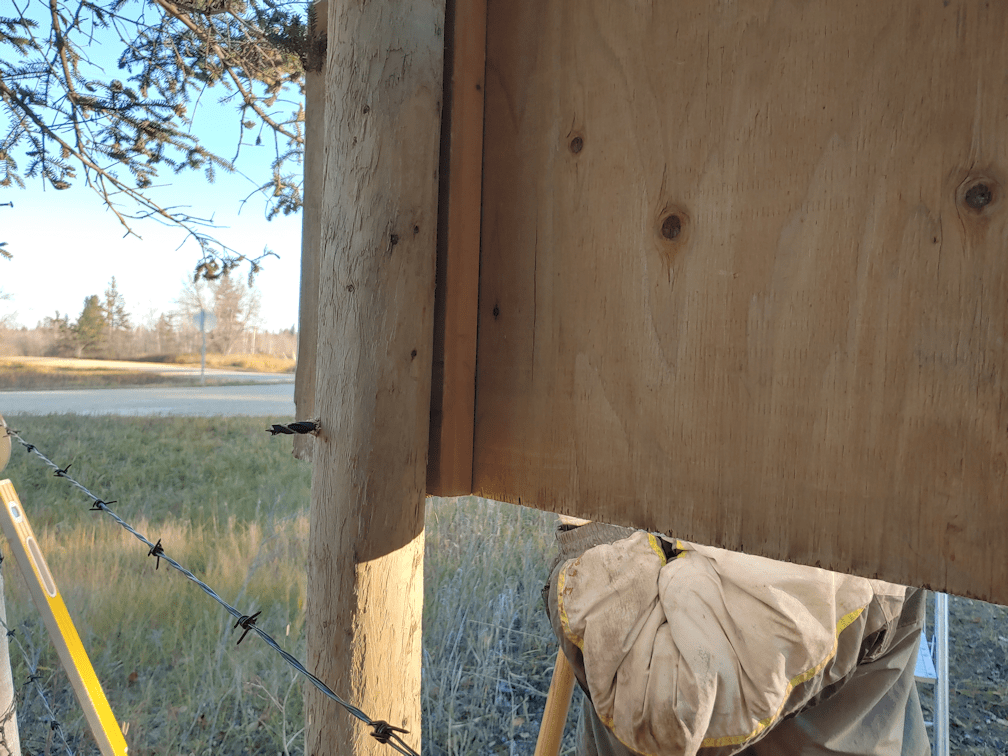
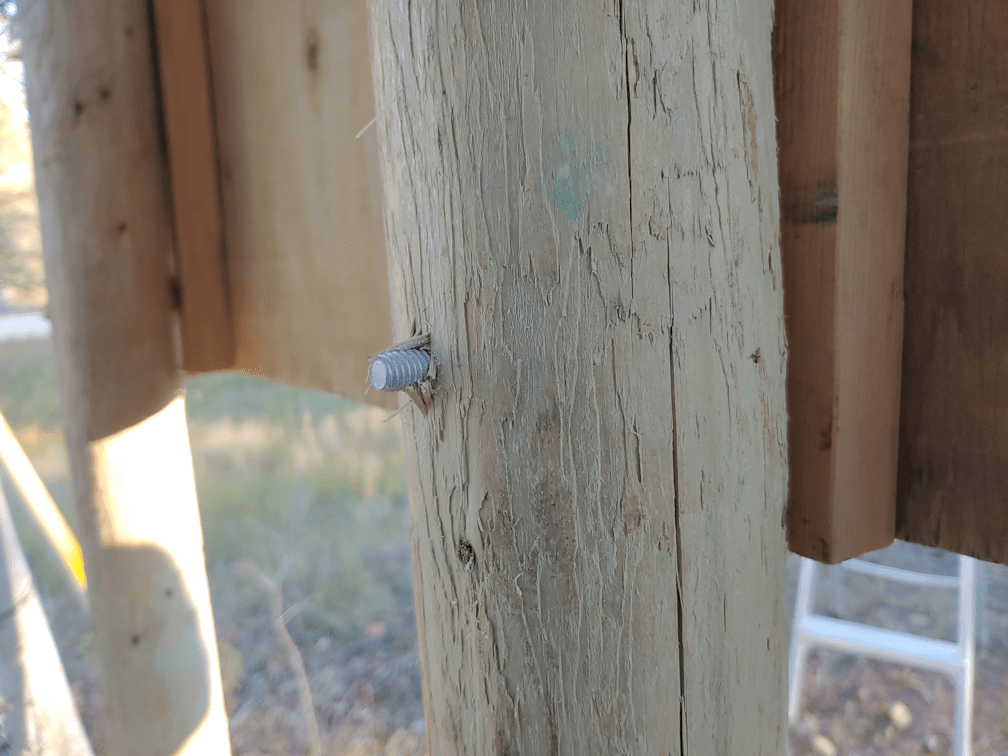
Then it was time to attach the sign. The legs were trimmed off, but the wood attached to the back was left. Between us, we worked out exactly where it would sit, so that the the remains of the legs on the back lined up with the roundest part of the post. While I held it in place from the inside, he marked the based and drilled a couple of screws at the line, to support the weight of the sign. Then he screwed the sign to the posts at the top, using deck screws, right where he would later add the carriage bolts. Once it was secure, and I didn’t need to hold it up anymore, he drilled pilot holes at the bottom, then enlarged them to the size needed for the bolts.

A perfect fit!

After helping put the washers and nuts on the bolts, I continued cleaning up the undergrowth while he finished attaching the sign.

This is the “after” by the telephone company’s post. I didn’t want to clear out all the small trees, as we do want what little privacy they can give us. Several dead branches from the pair of spruce trees got trimmed off, too.
It’s remarkable how big the pile gets, and how quickly!

Then, while I hauled the branch pile away, adding it to the one that’s out by the spruce grove, my brother added some final touches to the back of the sign.

A board was added for extra strength and stability.

We’re just assuming our vandal is going to try and do something to it, so he also added extra locking washers to the back of the carriage bolts, and other things. They cannot be taken off now!

He also attached the barbed wire to the post and…

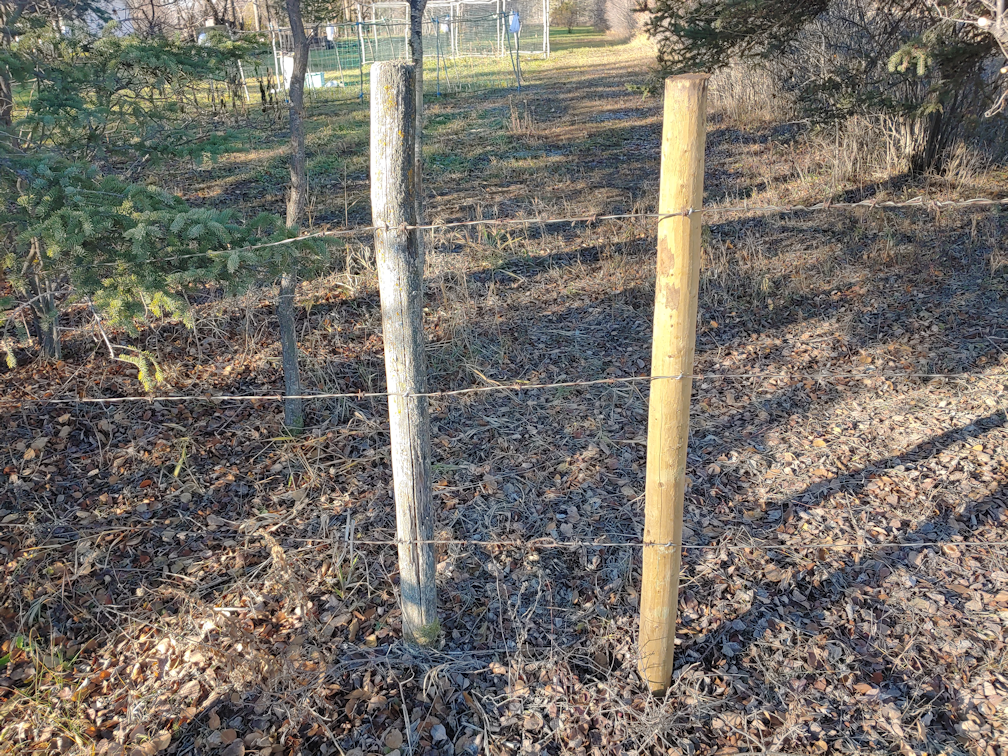
… in what seemed like the space of a heartbeat, installed a new fence post. The old one beside it is free floating; completely detached from the ground.

He even added a second one.

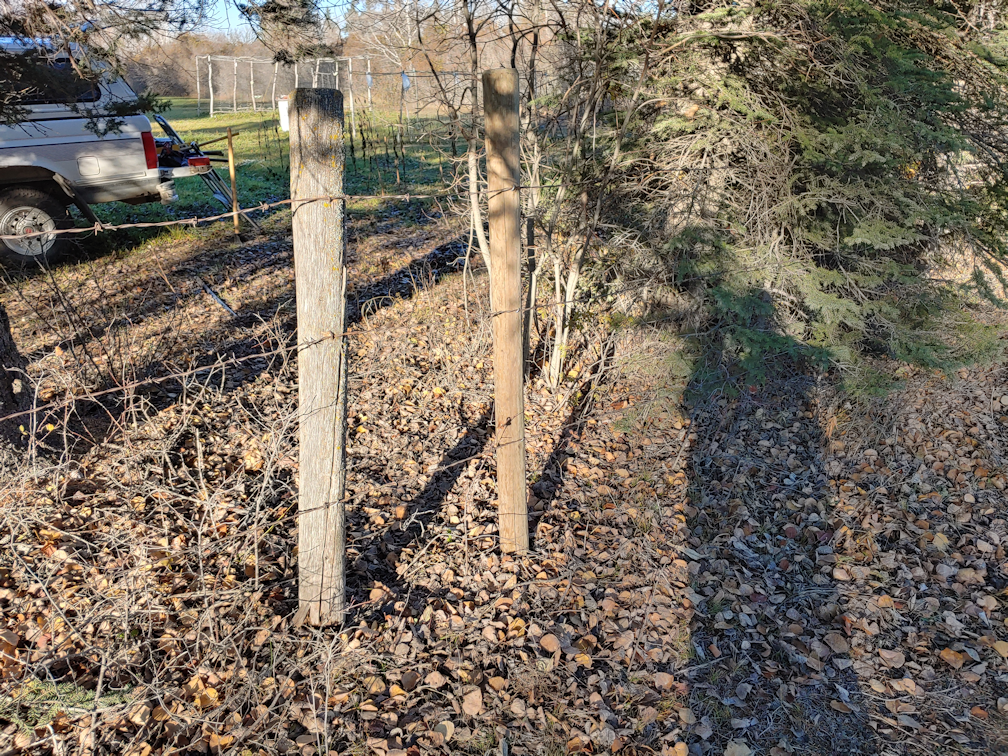
In this spot, the fence was so unsupported, my brother was able to lay the barbed wire on the ground, so it would be easy for us to cross the fence. After we were done and he was straightening things up, he installed another post. This time, I was able to provide the post, from the collection of fence posts I’ve been finding as we clean up. Just a couple of new posts, with the old posts keeping the barbed wire properly spaced, the fence is surprisingly more secured, and the wire was taught enough to actually make it difficult to slip between them as we crossed in and out!

Speaking of secure…

For some reason, there was an old post lying loose on the ground, not attached to anything. So we used that to add support to the corner post. My brother brought out a post maul – yet another of his many tools that he brought, just in case! – and was even able to straighten the corner post, just a little bit. Then he added some screws to the support post we added, as well as the one that was already there, to secure them even more. The last thing that was done, was installing the mounting hardware for the newer security camera. It took a while to find a good place for it. I wanted to make sure it covered the area in front of the sign, but also not face the main road. There is enough traffic around there that we’d ended up draining batteries like crazy, from the motion sensor being triggered so often. The mounting hardware also allowed me to adjust the camera even more, to make sure it was aimed exactly where I wanted. Of course, it also has to be set up so it can be reached easily, to switch the memory card and change the batteries.

If our vandal does decide to do something to the sign, we’ll have it on file. The camera isn’t exactly hidden, and may act as a deterrent, too. Unless our vandal is drunk again, at which point, he wouldn’t care if he was being recorded. I’m just hoping that if he does decide to do something to the sign, he’ll see the camera and stop.

Since the sign has our name an address on it, obviously I’m not going to post a picture of it here, but my brother is very happy with how it looks, and I’m very happy to have it up, so much sooner than I expected!

In all, it took us about 3 hours in total, to install the sign, a couple extra fence post, the trail cam, and clean up. Then my brother headed straight home, because he had so much to do at his place this afternoon, too!

Have I mentioned I have the best brother?

It deserves repeating.

Later on, when it’s dark out, I want to go back out and take a photo of the sign with flash, to see how the reflective paint shows up behind the lettering. I know my brother will want to see how it looks, too!

I am so happy this is done and – as a bonus – that corner got cleaned up. It looks so much better. We’re not cleaning up the rest of the fence line until we have planted the berry bushes we intend as a privacy screen.

It’s starting to look really nice out in that corner!

The Re-Farmer
First Ginger Bug Pop: Cran-Raspberry Cocktail
When it was time to feed the ginger bug, I decided it was time to start our first batch of fermented pop (aka: soda).

In looking for recipes and instructions on how to actually use the ginger bug, I found myself with some issues. One was the ratios of ginger bug to liquid, which tended to be for only a quart of liquid. Which seems a ridiculously small amount. Mind you, there’s four of us that will be drinking it, so that might have something to do with my perception. ;-) The most useful I found was to use 1/2 cup of ginger bug to 7 1/2 cups of sweet liquid. Pretty basic.

It was the fermentation container that seemed to be all over the place. Some sights said to ferment the ginger bug in a jar covered with cheese cloth or coffee filter. Others said to put it in a sealed jar and open it up every day, to release gasses. Some said to put it in a container with an airlock. All of these then said to bottle the finished beverage, usually recommending swing top bottles, but sometimes plastic bottles. Then there were those that said to pour the mixed liquid straight into swing top bottles for the fermentation period.

In the end, I decided to use one of my husband’s distilled water containers. We get distilled water for his CPAP humidifier, and I’ve started keeping the empty bottles to use in the garden.

We’re accumulating quite a few of them.

So this gives me a food safe container in a gallon size that has a sealable cap.

We started by measuring out 7 1/2 cups of the Cranberry Raspberry Cocktail I got for the purpose and pouring it into the jug, to judge if we would be doubling the recipe or not. We decided to go ahead and do another 7 1/2 cups, for 15 cups in total.

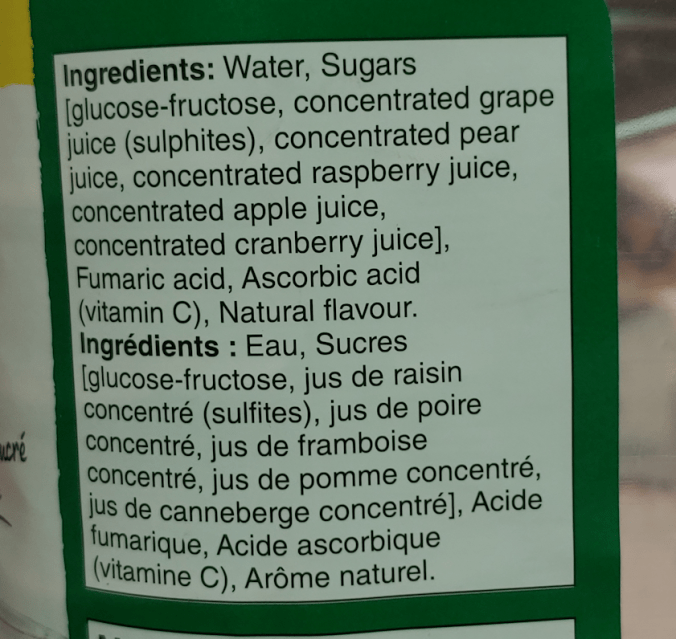
This is the ingredients list for the Cranberry Raspberry Cocktail. Which also has juices from grapes, pears and apples. The important part is that it has sugar in it, which means I did not have to add any sugar to feed the yeast during fermentation.

Pouring and straining the ginger bug out of the 750ml canning jar we are using would be messy, but we happen to have a ladle small enough to fit into the wide mouth jar, so we used that to ladle the liquid into a measuring cup through a strainer. Very few ginger pieces got caught in the process, so that worked out very well.

I found the amount in the juice bottle odd. 3.78L? A gallon is 4.5L, isn’t it?

Then I remembered; US gallons and Imperial gallons are not that same. LOL That is 1US gallon of juice. The distilled water bottle, however, gets referred to as a “gallon”, but is actually 4L.

Whatever. The end result is, a decent amount of headspace at the top of the water bottle, even after adding a cup of ginger bug liquid.

There was still some juice left behind, so the daughter that was assisting me, chugged it. It may be “cranberry raspberry” cocktail, but she tasted mostly apple!

No matter. It should still make an interesting carbonated drink!

We then replaced the cup of liquid removed from the ginger bug with our drinking water – the stuff we buy, rather than our well water – and fed it with some more ginger and sugar before putting it back in the cupboard, safe from the cats.

Then the fermentation bottle got labeled and dated. I figure we can wait a few days and, if the ginger bug is nice and bubbly after being used, we’ll start another batch.

For now, this bottle will stay out at room temperature. Every day, we’ll give it a squeeze. As long as it has give to it, it’ll stay out, but once it feels hard, that means it’s fermented enough and will be transferred to the fridge, so it doesn’t explode. From what I’ve read, this can take anywhere from 4 to 10 days. The house is fairly cool, so I predict it will be closer to 10 days.

Once in the fridge, it will need to be drunk within a few weeks, or it will lose its carbonation.

If it tastes any good, it’s unlikely to last that long. Not between four people!

I’m looking forward to seeing how this works! If it does work well, we will experiment with other liquids to ferment and keep track of which ones we like. :-)

The Re-Farmer