Our 2021 garden: soil protection

We are quite pleased with the new garden beds at the chain link fence. They are working out very much as we intended, and the chain link is providing support for the plants, just as planned.

There is just one real problem.

Erosion.

While scavenging for wood I could use to make raised bed boxes for where the garlic was harvested, I noticed some other old wood in the barn. Today, I decided to grab a few boards and use them to help keep the soil where it belongs.

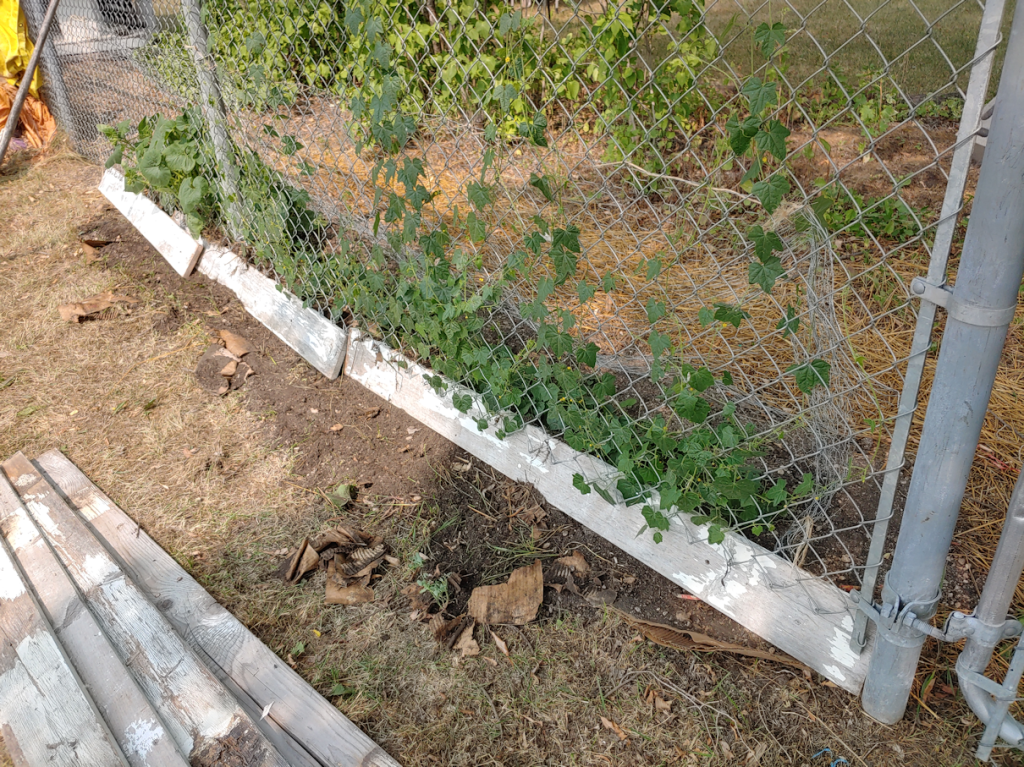
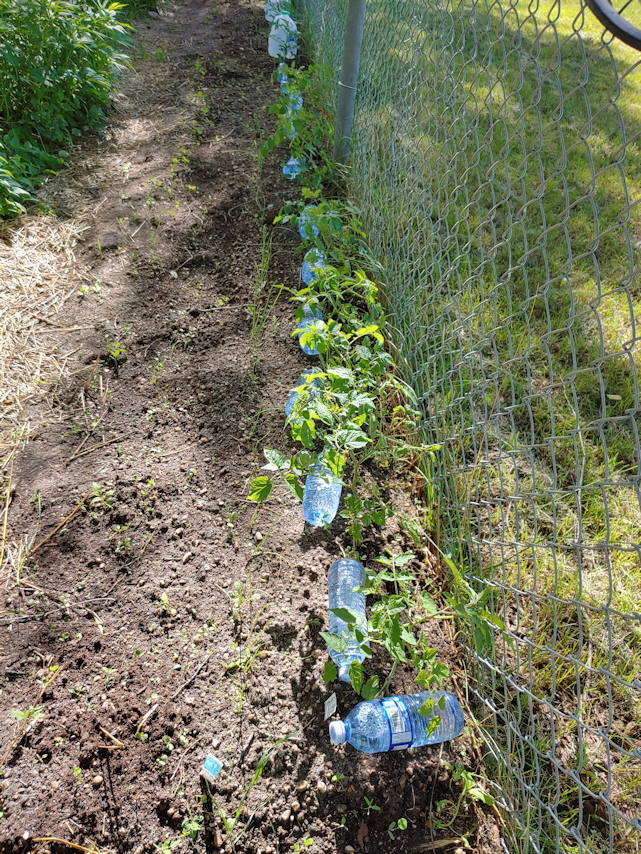
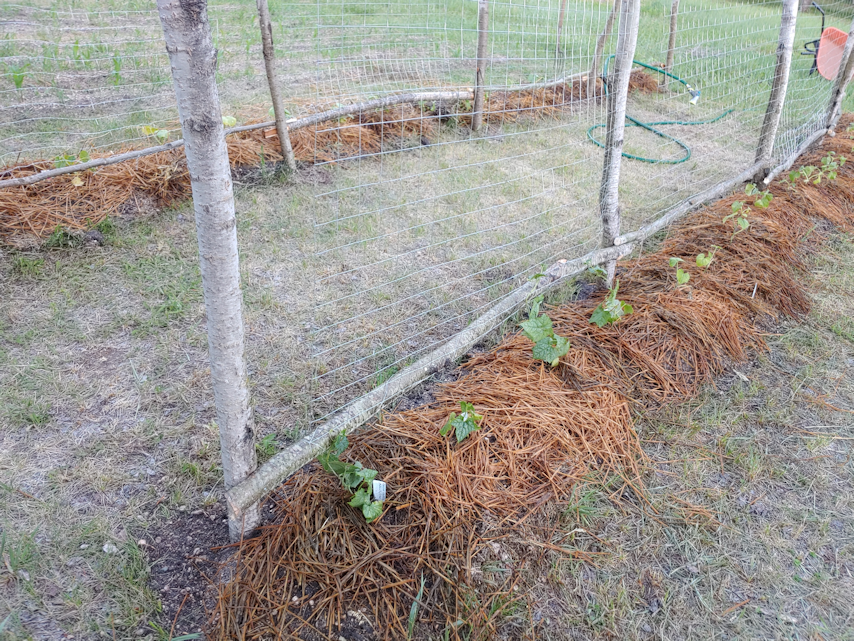
This is where the cucamelons and some gourds are planted. The ground slopes a bit here, so the bottom of the chain link fence has more of a gap under it. When we lay cardboard down first, we put flaps up against the chain link, but once the soil was added and things were being watered, the cardboard slid under the fence and the soil started to erode away.

It had been intended to place more of the chimney blocks along this section, to use them as planters like the ones we’re using as a retaining wall in the old kitchen garden. We still haven’t taken the last of those blocks out of the old basement (hauling those up the stairs and through the house is going to be difficult enough on its own, never mind no top of having to keep the cats out of that basement). We still intend to do it, though, and once they are in place, this will no longer be a problem. All that’s needed right now is to keep the soil from washing away under the fence, and taking the plants with it.

So for here, I just used a hoe to move enough soil to level things, then pushed boards under the bottom of the chain link from the outside. After that, I just tried to return some of the soil through the bottom of the fence, to hold the boards against the chain link. Otherwise, they would just lean inwards.

The boards were placed as far as the chicken wire critter barrier at the far end, making for a bit of overlap. It only needs to last until the end of the growing season, so as long as the boards keep the soil where it belongs, it’s doing its job.

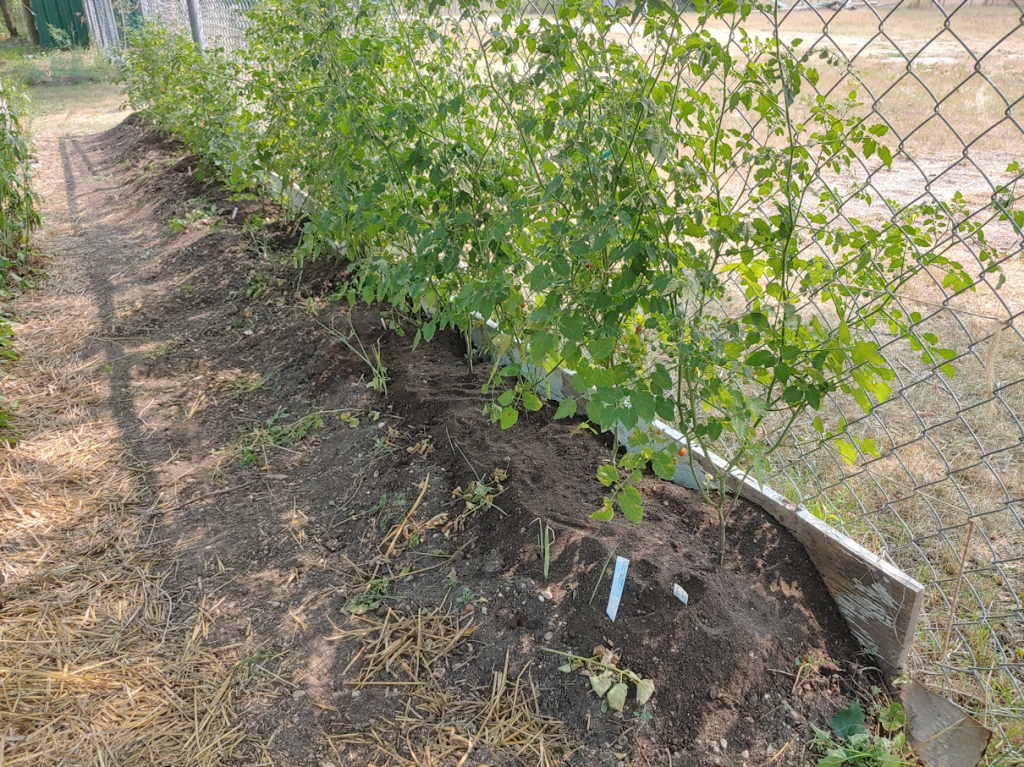
More boards where then slid between the tomato plants and the chain link fence, though I did need to go back to the barn for another board. Erosion was not as much of a problem, here. There is much less of a gap between the bottom of the fence and the ground, so the cardboard flaps are still holding the soil in place. However, I wanted to add more soil under the tomatoes, and I didn’t want to be losing that.

Once the boards were in place, I was able to add quite a bit of soil, without having to worry about it sliding through the fence.

In time, this bed will get some sort of frame as well. What it will be made of will depend on what materials we end up acquiring. I’m leaning towards brick, partly because we are looking to use paving stones or something similar on the paths along both new beds.

The boards are just a stop gap measure for this season. Like most of the other wood I’m finding in the sheds and barn, it was reclaimed from somewhere, and has various levels of damage. They’re solid enough to do the job for the rest of the season, though, and I’m glad to have it!

The Re-Farmer

Our 2022 garden: first raised bed box

With the garlic all harvested, we’ve got two empty beds that need to be readied for next year’s garden.

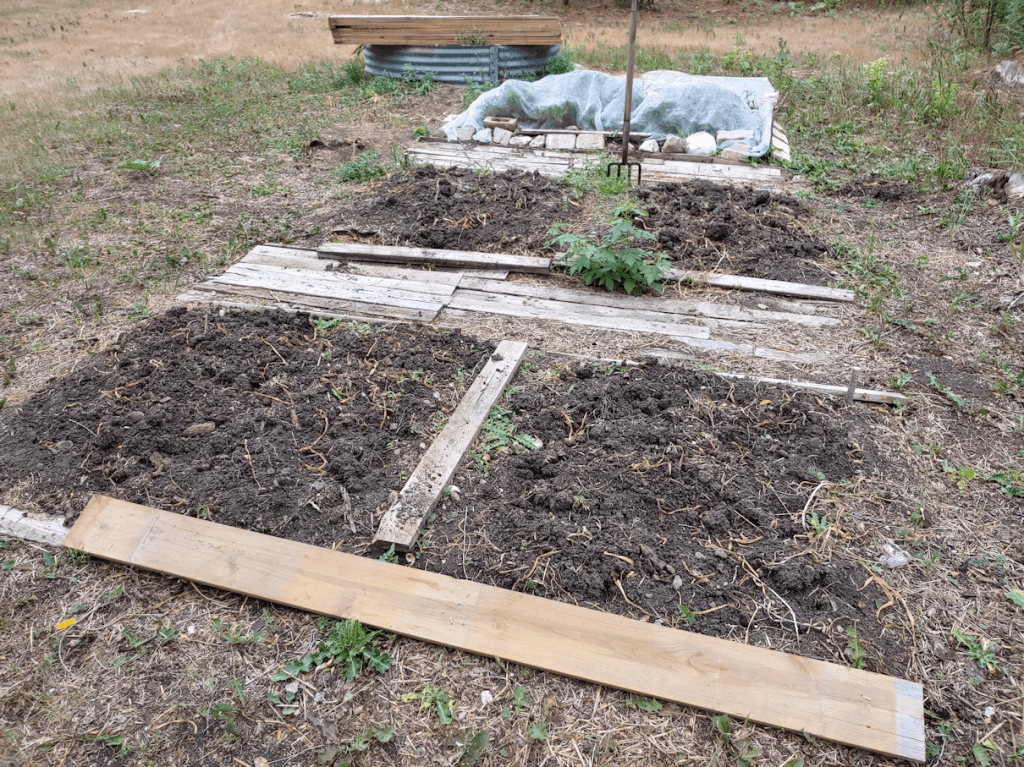
With these beds, we had dug into the soft soil we found under the wood pile, mounding soil into beds and making paths in between. This worked out quite well, but there were a couple of issues. One was, for such low raised beds, I found them too wide. They were about 4 feet wide, which would be fine for a high raised bed, but awkward to reach the middles on a low bed. That was partly solved by putting a board across the middle, which served to both mark where the different varieties of garlic were, and to give something to step on while trying to reach into the middle.

What can I say. I’m short.

The other issue was that the soil along the edges would end up in the paths, either from watering or from when the birds were digging around the garlic, early in the season.

The solution to both issues was to build a narrower box frame.

After scavenging in one of the sheds, I found some boards that would serve the purpose.

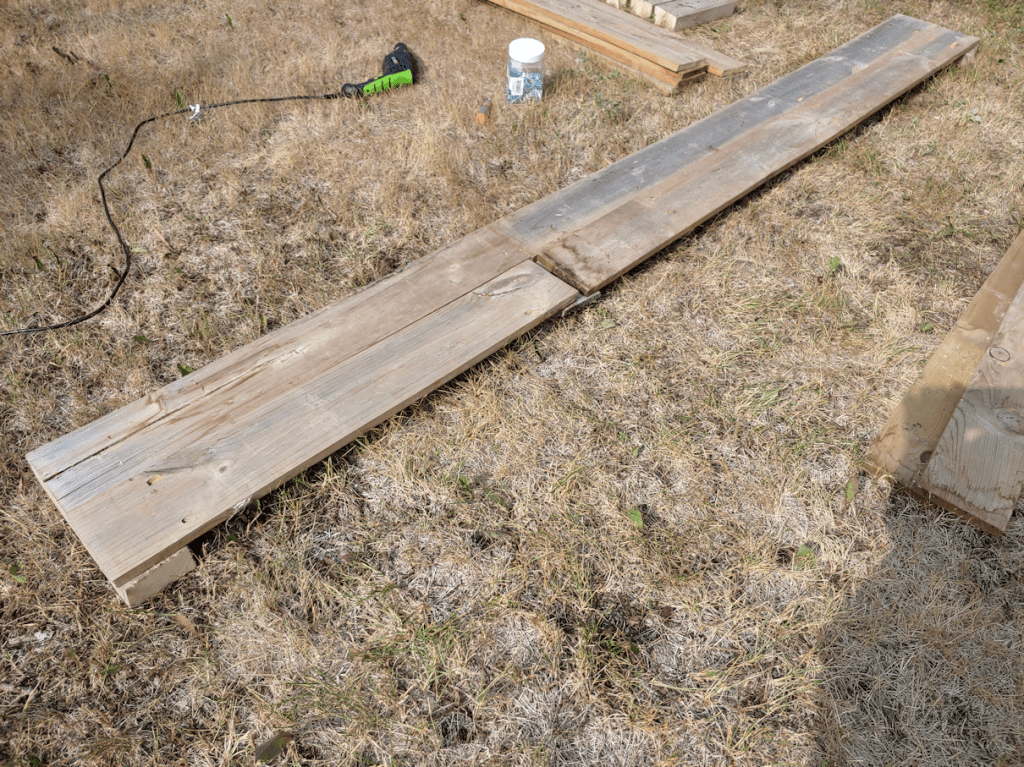
I dragged them all over to the beds. Here you can see one of them laid at the first bed I want to frame.

In total, I had 17 boards like the one in the foreground, plus 4 more that were the same length and thickness, about about an inch wider.

I decided to keep things simple.

I left four boards as is, then cut another four in half. The boards were all 6′ 1/2″ long and 5 1/4″ wide. Some of the half pieces would be used to increase the length, while the rest would be for the ends of the bed. I cut support pieces for the corners and to join the lengths together from some wood leftover from another project. Those were cut to match the width of two boards together.

The long sides were made by screwing the boards to the support pieces. The boards all have damage to them, ranging from old water damage and some rot, to splitting and cracking from being so very dry. Which is fine. They will do the job, and will last a few years, at least.

What wasn’t fine was flipping a board and almost catching my hand on these!!! They look like the screws were broken off on the other side, so there is no way to unscrew them from the wood. I have to think about the best way to get rid of these, using what tools we have, but for now, we’ll just have to watch out for them!

Once the side pieces were screwed together, making sure they matched in length, I brought over a couple of the wider boards to give a flatter, more even, surface to work on while putting on the end pieces.

Then I quickly tacked it together with just a single screw at each corner, to hold everything together while I worked.

Oddly, one piece was almost an inch longer than the others! Which is okay; the excess can be sawed off, later.

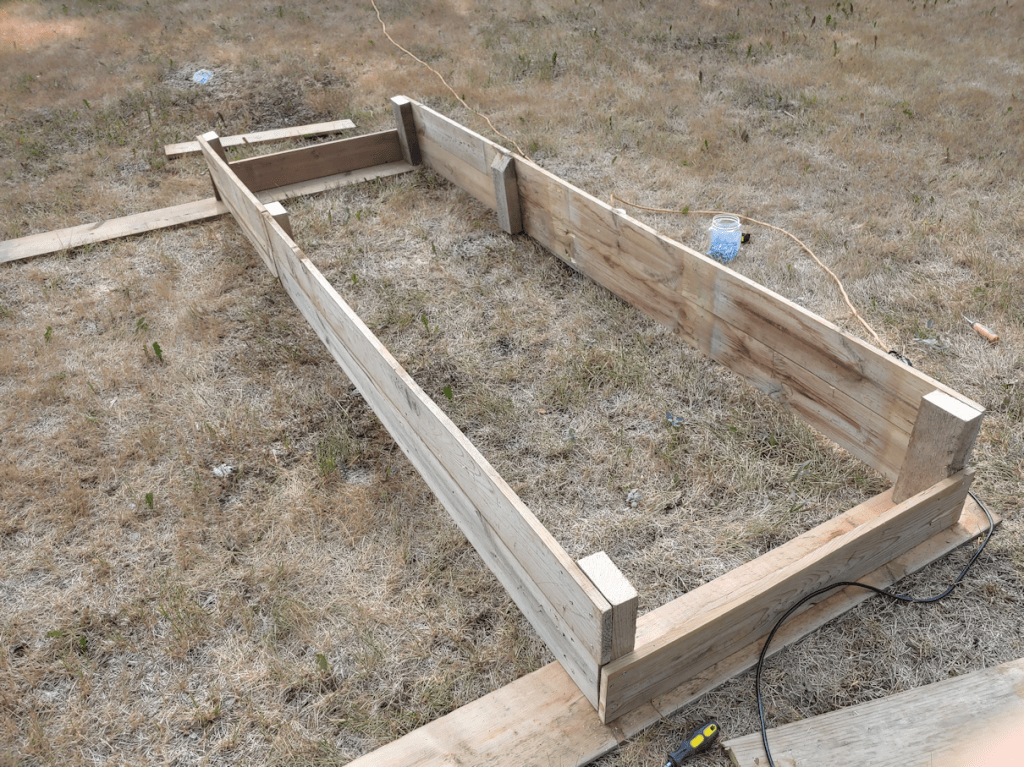
Here we have it! The finished box, next to the bed it will be placed at.

Here, you can see the difference in the dimensions quite clearly.

The box is about 9 feet long by 3 feet wide, and about 11 inches high.

In preparing these beds before planting the garlic, we dug out the soil and buried layers of straw and compost material at the bottom. Since the dimensions are being changed so much, I plan to dig out the beds again, then once the box frame is in position, will start filling it, hugelkulture style, by burying some of the branches we’ve been pruning for the past few years at the bottom, then layering the contents of our compost pile on top of that. Straw decomposes slowly, so I expect to find it when digging the bed out. If I do, I’ll be keeping it separate from the soil, so it can be layered back on again. As for the top layer of soil, I’ll take advantage of the situation to get rid of the weeds by their roots, then mix in some of the garden soil we purchased this year, before returning it to the bed. This soil tested healthier than anywhere else we took samples from, but it was still low in nitrogen, so adding the fresh soil will be a benefit. Once we have the materials again, the top will get layers of mulch to protect the soil.

I have enough wood to make a second box frame just like this one. I plan to build the second box before I start digging out soil. With the wider boards, there is enough to make a third frame for the bed that still has the beets in it, though it will be only one board high.

When this area is done, there will be three longer, narrower, framed beds with wider paths in between. This will make them much more accessible, even at their relatively low height.

Hopefully, I will be able to continue working on this tomorrow, but we’ll see how the day goes. I’ve got our rescheduled court date for the restraining order against our vandal in the morning. Hopefully, it’ll actually happen this time – and if the security guards try to tell me to leave and come back later, I will stay close this time.

The Re-Farmer

Row cover modification

While in the city for our monthly shop, I picked up four short, slightly flexible, lengths of PVC pipe. Today, I finally made use of them.

Since we covered various beds with the mosquito netting as floating row covers, they have not been eaten by critters. In the old kitchen garden, that means our carrots are actually recovering. The bed they are in is wider than the nearby beet beds, though, so they don’t have as much slack in the netting. What I’m still not sure is kohlrabi or not is getting pretty big, and the leaves are being bent over. Even the carrot tops were showing yellow, where they touched the fabric along the edges, where it’s weighed down with rocks and whatever else we could find.

I got the pipe to hold the netting up, but was stuck on what to use to hold the pipe in place that could handle the tension caused by curving the pipe. We’d done something like this with the hula hoops, but those are a lot thinner than the PVC pipe.

Normally, I would have used something strong and inflexible, like steel rods or rebar. I went looking around in the garage for something, without luck.

What I did find, though, was a bag full of cheap tent pegs.

That would be useful!

I also found one of the small flags we had at the fence line near the gate. The flags are getting quite torn up and need to be replaced, but I haven’t found the same time of flag this year. The doweling the flag is attached to fits perfectly in the pipe. All the flags still on the fence are torn up by the wind and needed to come down, as did the strings of Christmas lights we had running along the fence. The strings of lights need to be replaced. So I headed out to take down the lights and the flags, then used the wooden doweling from the flags as supports for the pipe.

Metal would have been preferred; I couple of them cracked while I was bending the lengths of pipe to fit over them. Still, they are holding! And the pipe is strong enough to stay in place.

The mosquito netting just barely fits across the bed, but those tent pegs I found were put to good use, taking the edges down. Wood and rocks that were used to weight down the edges before we put back, so help hold down any gaps between the beds.

I’m really happy with how this turned out. It a lot more solid than our first experiment with this. And now my carrots have room to grow!

The Re-Farmer

First tree stump bench made!

I had cleaned up the dead spruce tree I’d cut down, a few days go, but only now got to continue working in the area.

Because of how the tree had landed, I used the baby chainsaw to clear away all the non-weight bearing branches first, and was left with this giant insectoid shape! :-D After clearing away the last of the branches, I was going to break the trunk down further with the electric chain saw, but when that turned out to not be working properly, I just left the trunk to the side. We’ll have to take care of it later.

Today, I broke out the reciprocating saw and used it to finish trimming the top of the stump.

Happily, the wood in this stump is nice and solid.

The other trunk, from the tree we took down 3 summers ago? Not only did it have ant damage, but as I was trimming it with the reciprocating saw, it was vibrating at root level!

Well. That changed my plans.

At first, I figured I would just make a seat instead of a bench, but I really wanted a bench.

I used one of the boards that would be a horizontal support to mark off and cut the stump, using the reciprocating saw. At this point, I was still thinking of making a seat, but figured this stump was solid enough to support a bench. I cut the support pieces to a couple of inches shorter than the board that would be the seat, found the middles, then drilled pilot holes.

Despite using a level when positioning the support pieces, they still ended up uneven!

Though at least part of that is because one of the boards was warped.

Ah, well. I wasn’t going to start over! The only thing I did have to do was trim the top of the stump with a hand saw a bit, to make it even with the support pieces.

Then it was time to screw on the board for the seat.

You can see on the far right, that there was a substantial gap! I ended up making a wedge from a scrap piece of wood and jamming it in, then screwing the board in place, though the wedge and into the horizontal support.

As I was doing that, I could feel the bench wobbling a bit and decided the ends needed extra support. I didn’t want to put too much stress on the screws holding it to the stump, even though there are quite a few of them, and they are longer than needed. I had the pieces of wood I’d cut off the horizontal supports, so I trimmed those to size and added them at the ends to make legs. The main support is still the stump. The legs are just enough to give a little extra support, if there is too much weight at an end. The ground under them is soft, so if they were to be weight bearing, I would have wanted to add something solid under them, like a brick or some flat rocks

And there we have it! Our very first tree stump bench. :-D And I must say, it felt SO good to have someplace to sit down when I was done! It was the perfect height for me and my messed up knees, too. In fact, I used my knees to judge what height to trim the stump down to, and with the height added by the thickness of the seat board, it worked out just right.

Now it just needs a good scrubbing and a paint job to protect it from the elements. The board I found for the seat still has some paint on it, so it’s not too urgent.

I am quite pleased with how this turned out. We have so many dead trees in the spruce grove that need to be cut down, with some of them fairly close to each other. My thought was to cut them to leave stumps that could be used to make seats and tables, making sure that some of the seats are a bit higher, for my husband to be able to use comfortably. This bench is the first experiment to see if the idea is viable, and I’m happy to say that it is. Most of the greenery you can see behind the bench are a flower patch that we uncovered when cleaning up in this area, and have been leaving alone, as we mow or trim around it. Which means that, over time, we’ll be able to sit here in the shade, surrounded by lovely yellow flowers. :-)

Over time, we will have many seats like this, scattered all around the the inner yard, as we continue to clean up among the trees, and turn the inner yard into a lovely haven.

I feel a sense of peace, just thinking about it!

The Re-Farmer

Our 2021 garden: another attempt, and we have Pixies!

As we were reaching the hottest part of the day, I had concerns about the garden. Specifically, at the squash tunnel. The summer squash are well mulched and can stay cooler and moister longer, but the melons, winter squash and gourds are not as well set up, and they need more water than most other things.

I had an idea, so I headed out to the garden, only to get distracted as I walked past the concrete steps at the side of the house.

The woodchuck tried to get under the stairs again! I had checked it this morning, and it was not like this, so the attempt was made some time later.

It did not succeed.

I did see a woodchuck eating the sunflowers I scattered on the ground under the hanging bird feeder, and ended up leaving it be. I figure, it it’s eating bird seed, it’s not eating my garden. :-/

I put all the rocks back again, then jammed the boards you can just see in the photo, on top.

Anyhow.

On the way to the garden, I dragged the soaker hose over. In checking the plants at the squash tunnel, I found they were very wilted and drooping. I carefully set the soaker hose up as close to the stems as I could, making sure it went under any vines and leaves.

Which is why I finally was able to see this.

It’s a Pixie melon!! And so big, too! I’d been looking carefully to see if there were any melons forming, and never saw it until today.

I even found other ones starting to grow.

That is so awesome!!

The soaker hose is 50 ft long, so I was able to go around the entire outside of the squash tunnel, and even have about a foot and a half to spare that got looped back to the inside of the squash tunnel.

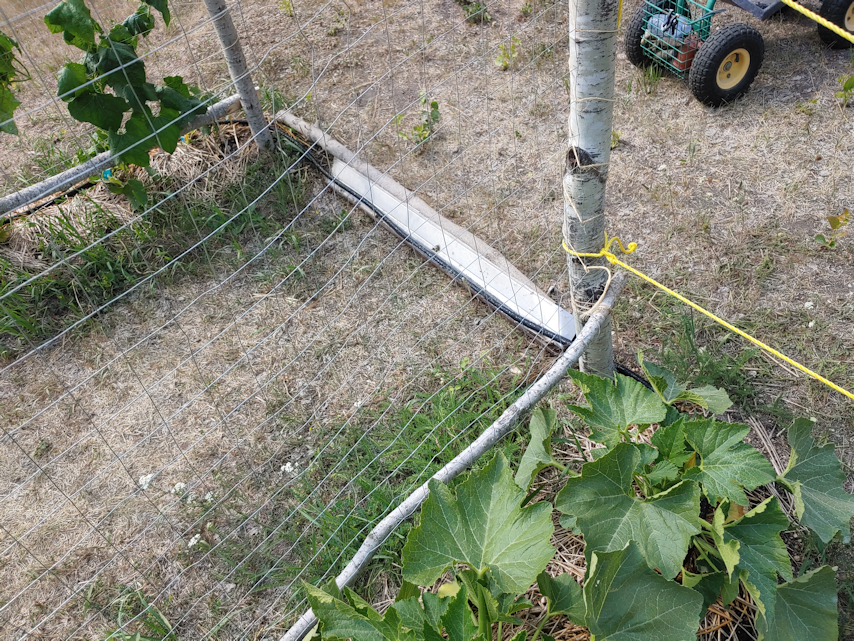
I didn’t want to be wasting water by watering the path, so I scavenged a piece of metal to put under it. It’s aluminum, the same as our eaves troughs, but it isn’t part of an eaves trough. I don’t know where it came from. We found it in the yard, by the back of the house, one day after some high winds. Wherever it came from, it didn’t blow off the house, which is the only place we have eaves troughs in that colour.

Well, it’s coming in handy, now. It’s got bends in it that I’m taking advantage of to use as a trough to divert water from the soaker hose to the ends of the squash tunnel. It doesn’t quite reach the ends of where we planted, but it’s close enough.

Before turning it on, I made a point of unscrewing sections of hose as I walked back to the tap, to drain off the scalding hot water that was inside it!

Since this hose releases so little water at a time, we can hook it up and leave the water running for an hour or more, before we switch the hose to the sprinkler to do the corn and sunflower beds for about and hour, timing it so that we can then do the evening watering when it has finally started to cool down.

The melons, gourds and winter squash are all heat loving plants, so having this set up to water them more deeply should help them quite a lot as they develop their fruit.

I am SO looking forward to tasting our very first melons!

The Re-Farmer

Our 2021 garden: defensive strategies

While going through the old kitchen garden this morning, I was seeing more of our beets, slowly being nibbled away. We’d added stinky soap, cat fur, hot chili flakes, and a motion sensor light. The only thing they seem to be doing is spreading out the damage, as the various things get avoided.

So today, we tried something else.

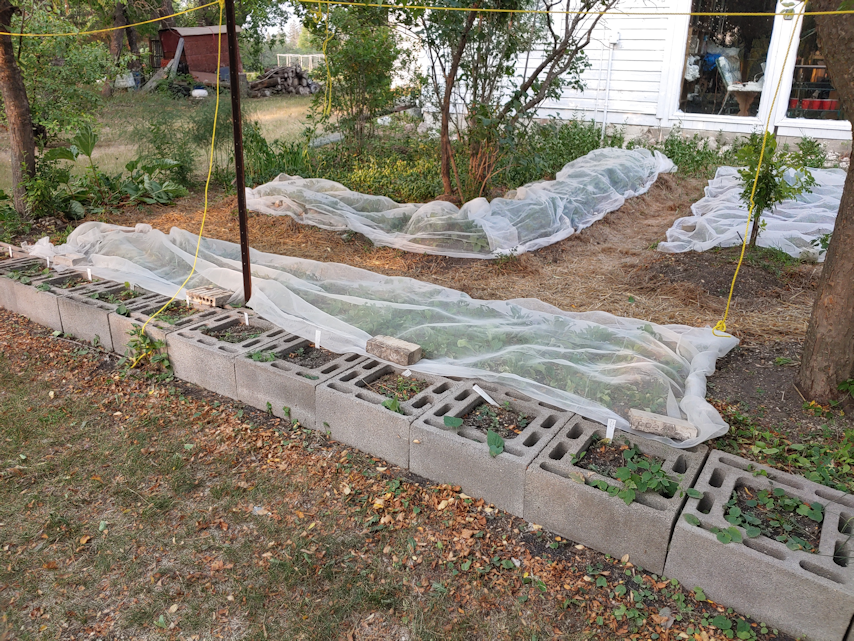
Since there’s no point keeping the mosquito netting wall up to keep the deer away from the lettuces that the groundhog decimated, it was taken down. The sheet was then torn in half, lengthwise, to be used as floating row covers.

One half was used to cover the L shaped beet bed. The other half was cut into two pieces, with one covering the beets by the retaining wall, and the other covering the carrot bed. The edges are weighted down with bricks and whatever rocks we could find that had some weight to them.

It won’t stop a determined critter, but it might be enough to convince it to not bother, and move on to easier pickings.

My only concern about that is, “easy pickings” would be the poppies and the couple of sunflowers growing next to them. They’re too tall to cover with anything, without damaging them, but not too tall for a critter to reach.

That done, we moved on to the cucamelons and gourds.

For this, we rigged a chicken wire “cage. The top is laced to the chain link fence with twine, above the cucamelons. Over the gourds, it’s just tacked in place at the end, so that a gap can be make for the plants to grow through. The ends were cut and folded in to close them off, and the bottoms are tacked down with tent pegs.

Again, this is not going to stop a determined critters. But it is better than nothing.

As I write this, it was past 9pm, and we are still at 30C/86F, with the humidex at 33C/91F. Tomorrow’s forecasted high is 34C/93F, with the humidex at 38C/100F. Hot, though not quite as hot as the previous heat wave. The girls have been diligent about the evening watering, though I think we’re going to have to keep it to just one watering a day, after something concerning happened last night.

The sweet corn and sunflower beds have been the most difficult to properly water, so we have started to use a sprinkler, turned on for about an hour before the rest of the watering is done. It reaches almost all of the corn and sunflower beds, leaving only a row and a bit at each end that need to be watered manually. Yesterday, as one daughter headed out to switch the hose from the sprinkler to the spray nozzle, my other daughter started to use the front hose to water the old kitchen garden.

This is something we have done before without issue, but this time, all pressure was lost. My younger daughter went into the basement to check the pump, and found it making that grinding noise we have managed to avoid for quite a while now, and the presser was down to zero. By the time she called me over to look, the pressure was back up to 30psi, which is where it should be, but the taps to outside were shut off, anyhow. After the pump shut itself off again, we turned the taps back on, and the girls continued watering, but with just using the back tap.

Now, when we first noticed the pump making that noise and we would lose all water pressure, it was quite a concern. There was a possibility that the foot valve was leaking. We had two plumbers look at the pump, and one even crawled into the well shaft, and my brother even bought a new pump to replace this one, which is about 20 years old. The problem is, the system is so old, neither plumber was willing to chance doing the work, because the risk of something breaking in the well and losing our water completely was too high. At the very least, we’d have to hire someone to find parts for a system that’s almost 50 years old and are in different sizes than modern wells, break the well cap to access the well and replace the parts, or dig a new well.

Digging a new well was the recommended course of action.

None of this is an option for us, so basically, we’re being really careful. The main thing is that problems would start when water was being used faster than the pump could refill the pressure tank. As long as we don’t do things like run the bath as full pressure, or use multiple sinks at once, etc., we can keep it from happening. We know we’re on borrowed time, though.

The hoses do not use a lot of water at once, and even with both taps being used, we never had issues with the pressure before. So why did it happen last night?

I can think of only one thing.

The water table is dropping.

I don’t remember this even happening before, but I can’t think of anything else. It’s not like someone decided to take a shower or something at the same time – and we’ve even the shower get used by someone not knowing the hose was in use, with no loss of pressure.

So for now, we’re going to stick to watering just once a day.

Hopefully, it will be enough.

This is when we could really use more mulch! In the future, when we build our permanent garden beds, a drip irrigation system is also very much in the plans.

The Re-Farmer

Our 2021 garden; made in the shade, and we have melons!

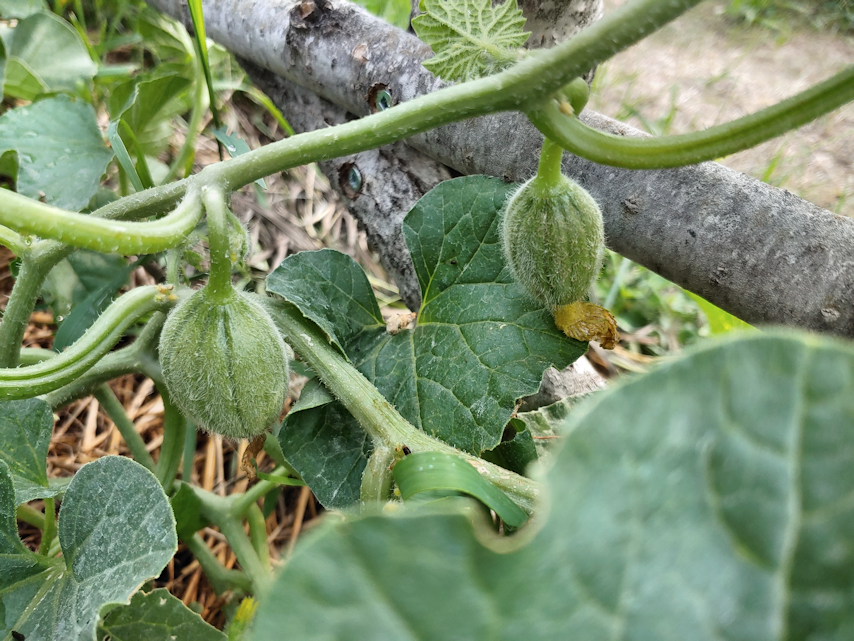
While doing the evening watering, the girls spotted a couple of little melons last night! I just had to go looking for them this morning.

Aren’t they adorable?

The bigger one is about 2 inches long. I wasn’t expecting them to be fuzzy. :-D

These are the Halona melons. Still nothing among the Pixies – at least not that we can see. Lots of flowers, though.

In thinking of how to protect our Crespo squash from being nibbled on, and our new sprouts from the upcoming heat, I scrounged in the old garden shed and dug up some old, bent up, decorative wire border fences.

Most of the sections went around the Crespo squash. Whatever has been eating them has not tried to go past the hoops, so I’m hoping the new border will further dissuade it.

The ground here is so rocky, I wasn’t able to push all the wire “legs” into the soil! Enough are in to keep it from falling over, though, so it should be fine.

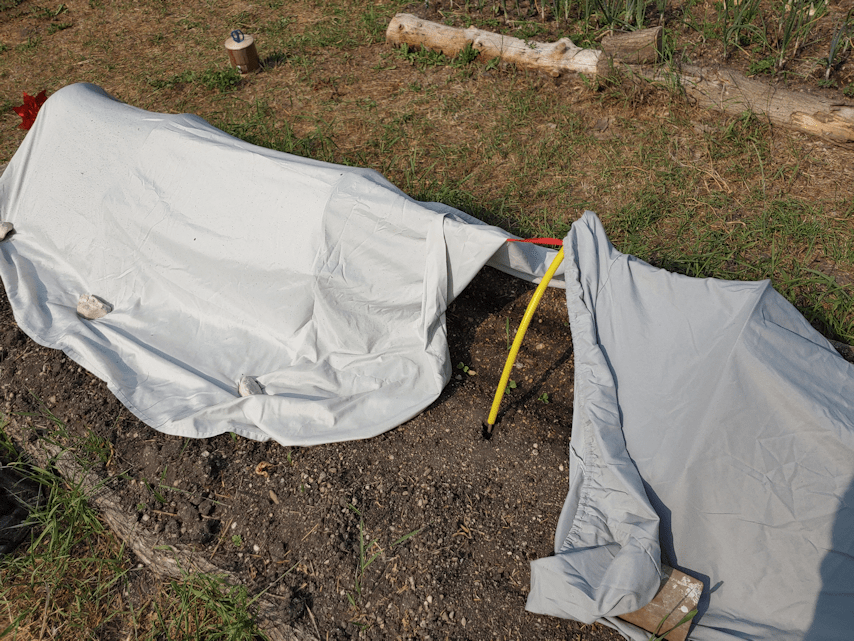
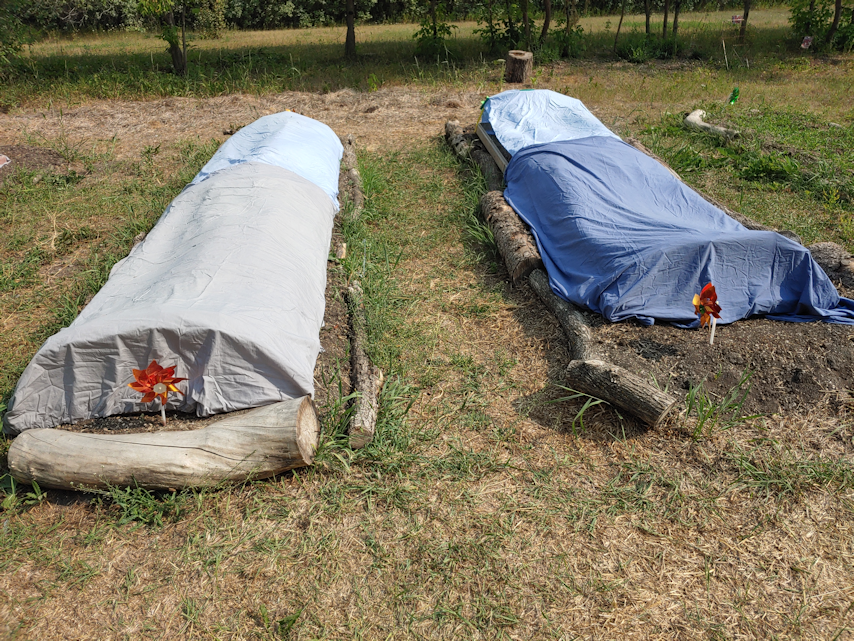
There were a few sections left, and they got used in the garden bed that doesn’t have a row cover on it. Then I used some bed sheets as shade covers. I neglected to take progress photos, though. :-/

There were 6 individual sections that got evenly spaced over the seedlings. The bundle of fencing had been tied with a fairly long ribbon, so I used that to join the tops of as many of the middle ones as I could. As I was laying the sheets down, though, there was nothing in the centre to support the ends. I had a short piece cut from a hula hoop left, so that’s now in the middle, on a couple of sticks in the ground to hold it up. It was too short to bend well, so there’s a kink in the hula hoop piece, but at long as it holds the sheet up, I don’t care! :-D

After that, rocks and bricks were used to pull the fabric taught and weigh it down.

For this bed, I could use some old Twin sheets. For the other two, I had some queen and kind sized sheets to use.

The one top sheet was easy enough, but the fitted sheets needed to have their elastics cut off, and one of them was cut in half and used to cover the ends of the rows. With these, the fabric could be secured by tucking it under the wooden frame. The sheet that was cut in half is barely wide enough on one frame, and a few inches too narrow on the other, but the ends are tucked, and in the middle of the row, the other sheets were laid on top to hold it in place.

So now our shade-loving seedlings have their shade, and protection from the heat of the day. We can uncover them when we start the evening watering, so they get some less direct light during a cooler time of the day. Then I can cover them again when I do my morning rounds.

We’re supposed to start hitting 30C/86F and higher, tomorrow, though the hourly forecast on one of my apps says we’re supposed to hit 32C/90F this afternoon. The record high for today is 33C/91F, set back in 2002. I think we were actually living in this province again in 2002, though I believe we moved back in the fall. The record low for today is 9C/48F, set in 1993.

Anyhow, we’re supposed to stay about 30C/86F for almost a week, and these sheets should help keep the seedlings a bit cooler. I’m considering whether it would be a good idea to moisten the sheets, too, but the extra weight of water might be too much for the frames to hold.

It should be interesting to see how these work out!

The Re-Farmer

Our 2021 garden: protecting the tomatoes

I’m glad I “wasted” some time on the computer last night, scrolling through Facebook. I came upon a question in one of the local gardening groups I’m on, asking advice on how to protect their transplants if there is a frost.

Frost???

So I checked the forecasts, and instead of the somewhat cooler overnight temperatures I’d seen earlier, it was forecasting a low of 4C/39F, with possible frost in lower areas.

Yes, on the night of June 20.

The problem is, we don’t have a lot available to protect our garden beds. Most wouldn’t need it, but I was concerned about the tomatoes in particular.

Since we buy cases of water to keep in the van, we had quite a few empties that I’d used to help keep the aquarium greenhouses warm. I gathered all I could find and started filling them with hot water. It wasn’t enough, so I started filling gallon jugs. It still wasn’t enough, so I went scrounging in the van’s recycling bag and found some vitamin water bottles to use.

The girls set them out, while I found and filled more.

I really appreciate that yard light on the power pole. We’d have had to juggle water bottles and flashlights, otherwise! :-D

I don’t know what temperature we actually hit last night, but this morning, the tomatoes seemed fine. From what I’ve read, we didn’t necessarily need to use hot water in the bottles for them to be able to protect nearby plants, but if I’d used cold water from the well, they would have been ice cold, and I doubt that would have helped at all. As it was, it took almost a full minute of letting the tap run just to get hot water to the kitchen sink. It’s the farthest away from the hot water tank, so there’s a fair amount of pipe to clear of chilled water, first. And chilled it was!

We should pick up pipe insulation at some point. If only for the pipes leading to the kitchen!

Anyhow.

While doing my rounds this morning, I made sure to check the squash, melons and gourds. So far, they look like they handled the chill all right, but we’ll see over the next couple of days. We’re supposed to get hot again, though today is supposed to reach a high of only 15C/59F, so there isn’t going to be a jump from one extreme to the other.

Another thing to keep in mind as we build our permanent garden beds. Being able to have and use different types of covers, to protect from critters or the weather, as needed.

I look forward to when we can set up a polytunnel or greenhouse, too.

All in good time. It’s only our second year gardening, and we’re learning lots that will be useful when it comes time to build permanent garden beds and structures.

Little by little, it’ll get done.

The Re-Farmer

Our 2021 garden: squash tunnel, day 4, and sacrificial spinach!

Today was set to be a scorcher, so when I did my morning rounds, I took the time to water all the garden beds before things got too hot, even though they got a thorough watering last night.

When I got to the spinach beds, I saw evidence of skulduggery!

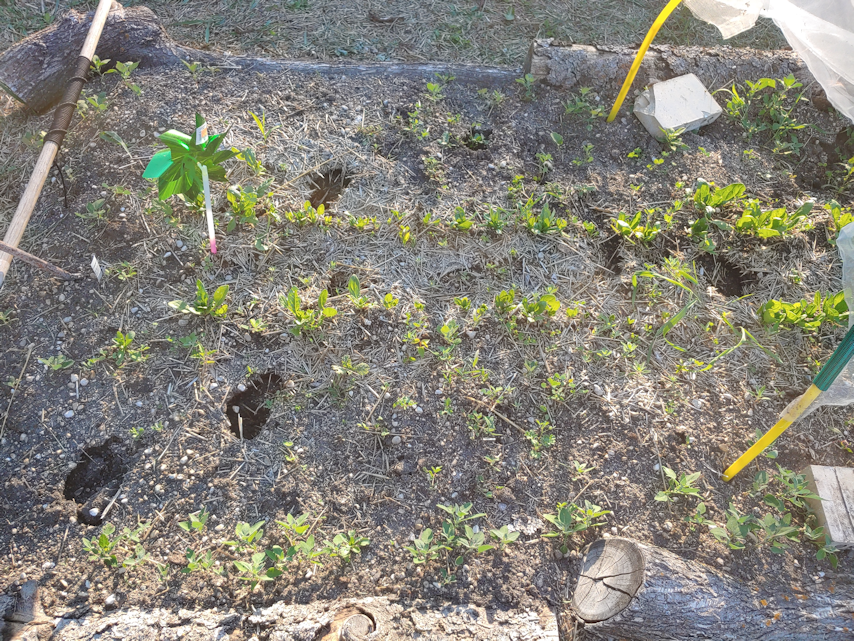
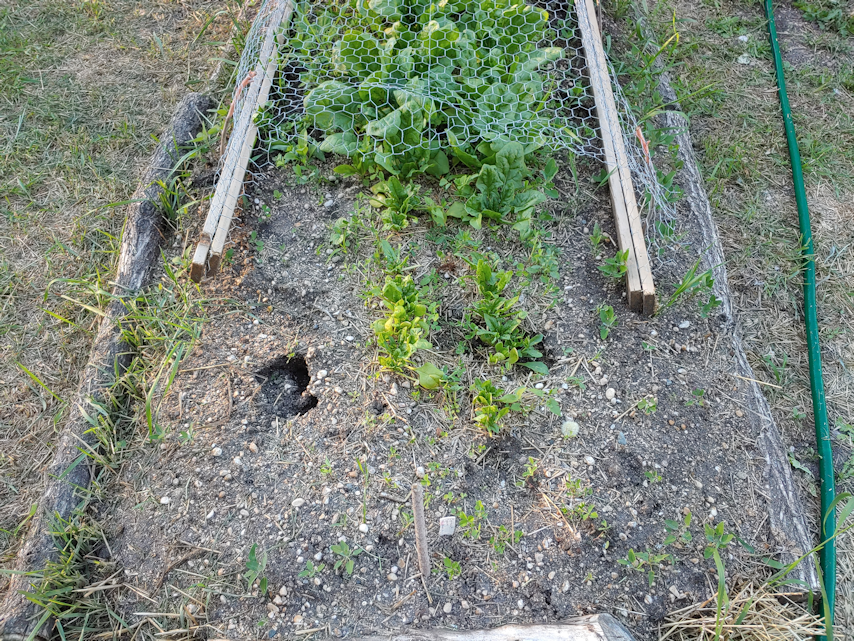
The sacrificial spinach, at the ends of a couple of rows, were duly sacrificed.

I moved that pinwheel over from one of the beds with the wire mesh covers, after the fact. Not that they seem to be accomplishing much, anymore!

No surprise, when I finally went inside and checked the trail cams, that a deer was captured, wandering through the corn beds, on the way out of the yard. Considering that the deer did not even pause to nibble on anything, I’d say the sacrificial spinach did its job! ;-)

Late this afternoon, when things were supposedly getting cooler again, the girls and I finished the squash tunnel.

Almost.

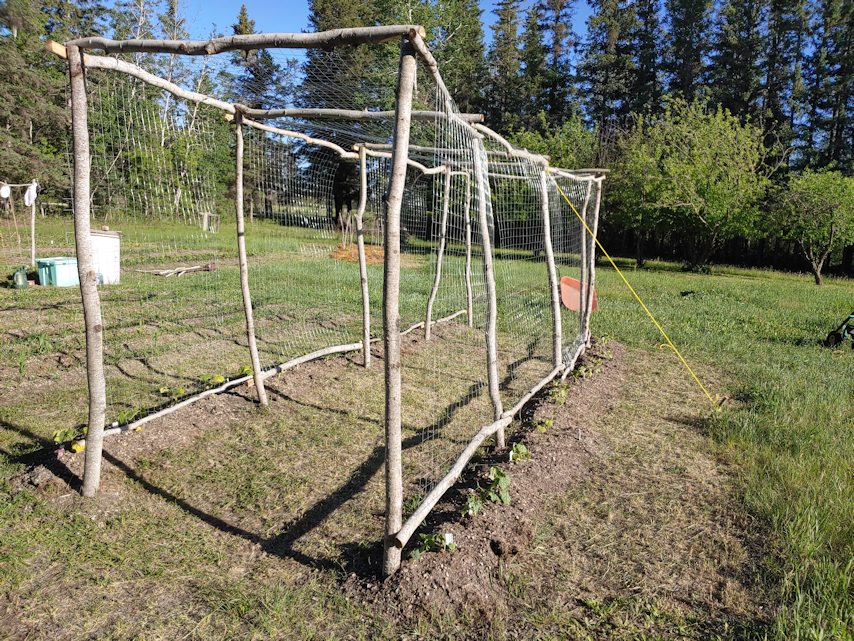
We got the cross pieces put in place, then brought over the wire mesh for the vines to climb.

The roll of wire mesh I got was 50 feet long, and that was enough to cover 3 of 4 sections. At only 4 feet wide, there are gaps at each post, but we can weave twine between the sections of wire mesh, if it’s necessary.

My original thought was to use U nails (also called staples) to attach the mesh, but we ended up only needing to attach it to the bottom cross pieces. With one, we used wire saved from a previous roll of wire mesh that had been wrapped around it to keep it from unrolling. In cutting the first length, the second length had one end with the wire ends sticking out, and we were able wrap the end around the cross piece, then just twist the wire ends around to hold it in place. Other sections were tied in place with twine.

We just need to buy another roll of this mesh, and we can finish the last section. The main thing is that the end where the luffa is growing, now has something for them to climb.

The girls also noted that one post seemed to need support, so they added the rope and peg to hold it in place.

It’s a good thing this is meant to be temporary! :-D

By the time we were done, we were totally baked and headed inside to cool down for a while. We were at “only” 25C/77F with a humidex of 28C/82F but we were also in full sun, and there was no breeze. At least we could pop into the shade of the nearby lilac hedge, every now and then.

While I was doing the evening watering, the girls brought over the last of the straw and mulched around the squash tunnel. You can see in the photo that some of the luffa was grown long enough to reach the mesh, already. Hopefully, they will soon be making their way up the side on their own.

This whole thing really is rather slipshod and wonky. I look forward to when we have our permanent raised garden beds, and can build something more solid, elsewhere. But this will do for a year, maybe even two, depending on how our plans to plant trees in this area progress. Well, Not where this tunnel is, I don’t think. There are telephone lines buried somewhere under here.

Anyhow.

I’m glad we finally got this done. At least as done as possible until we get more mesh for that last section. The forecast has changed again. Tomorrow, instead of thunderstorms, we’re expected to hit 31C/88F and maybe get some showers at some point. While I was doing the watering this evening, I used the water to make doing some hand weeding easier, and I could not believe how dry the soil was. I’d hate to think how dry it would have been if I’d decided it was damp enough this morning, and skipped the watering! The added mulch at these squash, gourds and melons will help keep their moisture better, at least. I look forward to having more mulch to add to the other beds as well.

Meanwhile, I hope we have some happy little squash, gourds and melons!

The Re-Farmer

Our 2021 garden: squash tunnel, day 3, and progress

We managed to get outside for a bit more progress on the garden. One of the things I did was go through where we planted sunflowers last year, and dig out any remaining stumps. I am really impressed with how much softer the soil is. Well. When I managed to not hit any rocks, at least. ;-) I think using this area for the summer squash will work out. We just have to fight back the grass and weeds. :-/
Not yet, though. The new corn block will be the priority for transplanting.

This area has been covered with black tarp for at least 2 months. Almost, but not quite, enough to kill off the grass and weeds.

This area is remarkably rough, though. I had the hardest time mowing on this side, without hitting rocks or lumps of dirt. Partly because of this, I will be going things differently. I will actually be turning the soil here. Nothing extreme. Mostly just loosening it with a garden fork, while pulling out the larger roots and rocks. Once it’s loosened up, I plan to go over it with a thatching rake (we only have 1 thatching rate, and a bunch of fan rakes, so that’s the tool I’ll use! :-D ). That should pull up more roots, but mostly I want to level it off enough that I’m not tripping over dirt clumps every time I walk through!
I had gotten a start on loosening the soil at one end, when one of my daughters was able to join me. Together, we got to work on the squash tunnel.

We were able to get all the side cross pieces in place at the tops. A job that was much more difficult than it looks!

I may have mentioned this before, but… we’re a bit on the short side.

Oy, did that make a difference!

My daughter held the cross pieces in place while I climbed the ladder to drill the pilot holes, then put in the screws. It was very awkward and painful for her – especially with her gimpy shoulder! – to try and hold the pieces steady until I had the screws in far enough that she could relax. Some of the uprights had shifted, too, so not only was she holding a cross piece in place, above her head, but sometimes holding an upright in place as well. The fact that everything was different sizes and shapes didn’t help, either. Doing this in 27C/81F heat, and winds high enough to blow over the step ladder, certainly didn’t make things any easier.

Also, we really need a power screwdriver. Driving in 3 inch screws manually, while someone else was struggling to hold the pieces together, was another thing that made the job more difficult than expected!

But we got it done!

It is still incredibly wonky, of course. Good thing it’s not intended to be permanent! We also didn’t use as many screws as I intended. For some joins, it was because the pieces were not of a size or shape to add more than one screw. With others, we just needed to get it in place and move on to the next, due to how painful or awkward it was for my daughter to support the cross pieces.

I now need to cut cross pieces for the bottoms. When I put those in, I will take the time to add extra screws were they are needed at the top. If necessary, I’ll add extra support pieces at the corners, but I think once we add the wire mesh for the vines to climb, that will help stabilize it a bit more, too. I’m actually not sure how we will get the mesh over the top.

Did I mention we’re short? LOL

At least it’ll be easier to put in the bottom cross pieces.

When we did as much as we could, I was ordered by my daughter to head indoors and out of the sun. Apparently, I was looking rather overheated!

So I am taking a bit of a break in the cool of the house. By the time I get outside again, more of the corn block I want to work on will be in shade, so that will help. I’m hoping to be able to get the corn transplants out by the end of tomorrow. We’ll see how it goes. I’ll be helping my mother with her grocery shopping earlier than usual, so that should work out.

Little by little, it’ll get done!

The Re-Farmer