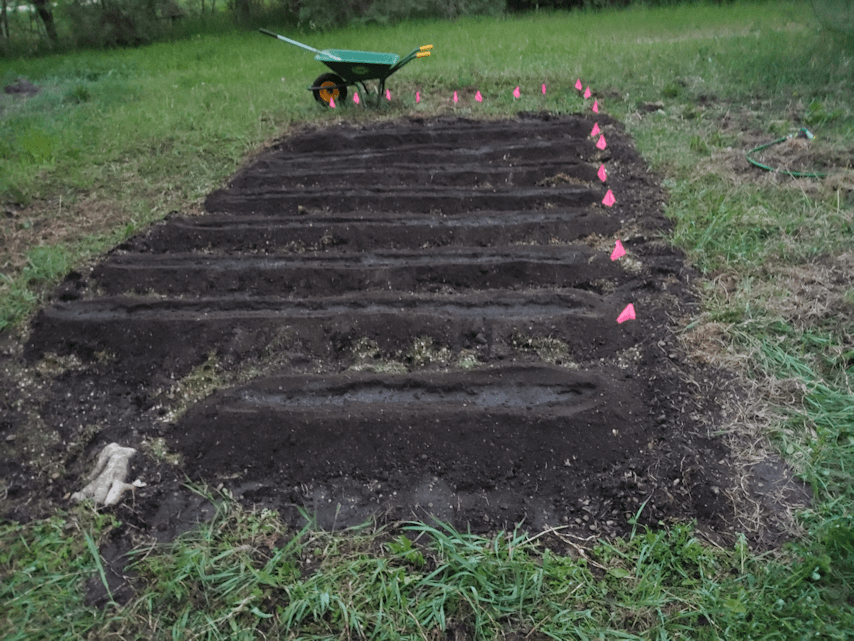
While going through the garden beds this morning, I was just blown away by how much is still growing – and still getting a chance to grow, if the forecasts for October stay true!
The last time I had so many photos to share, I put them together into a video, but it only ever got one view. Clearly that’s not something people are interested in. So today, I will instead make a series of short posts, instead, starting with our winter squash and melons.
This is the very first Red Kuri/Little Gem squash that matures. As you can see in the photo, the vine is completely died back – except for the few inches on either side of the stem!
The vine with the next biggest one still has some green leaves on it. There had been another small squash that started to develop, but it withered away and fell off.
The other one, however, is still getting bigger, and just starting to deepen in colour. The vine it’s on has a lot of cold damaged leaves, but is still mostly green and growing, so this one may actually get a chance to fully mature.
The vine the mutant is on is also still growing, with fresh new leaves showing up even as the older ones get killed off by colder overnight temperatures. We still have not had a frost, which is the only reason we still have hope for our garden!
We are back down to the two Teddy squash, one on each plant. The others that had started to form, withered and fell off, likely due to lack of pollination. I don’t know how much bigger this well get, as they are a very small variety to begin with.
If you notice the white on the squash and leaves, no, that is not powdery mildew, or any other sort of fungal disease. That’s road dust. Even with the lilac hedge nearby, dust from the nearby road still gets through and coats things. Even the summer squash, which is furthest away, has road dust on them. Another reason we want to complete the hedge with dense bushes, and also plant taller trees. They will serve as more than wind breaks and privacy screens, in this area!
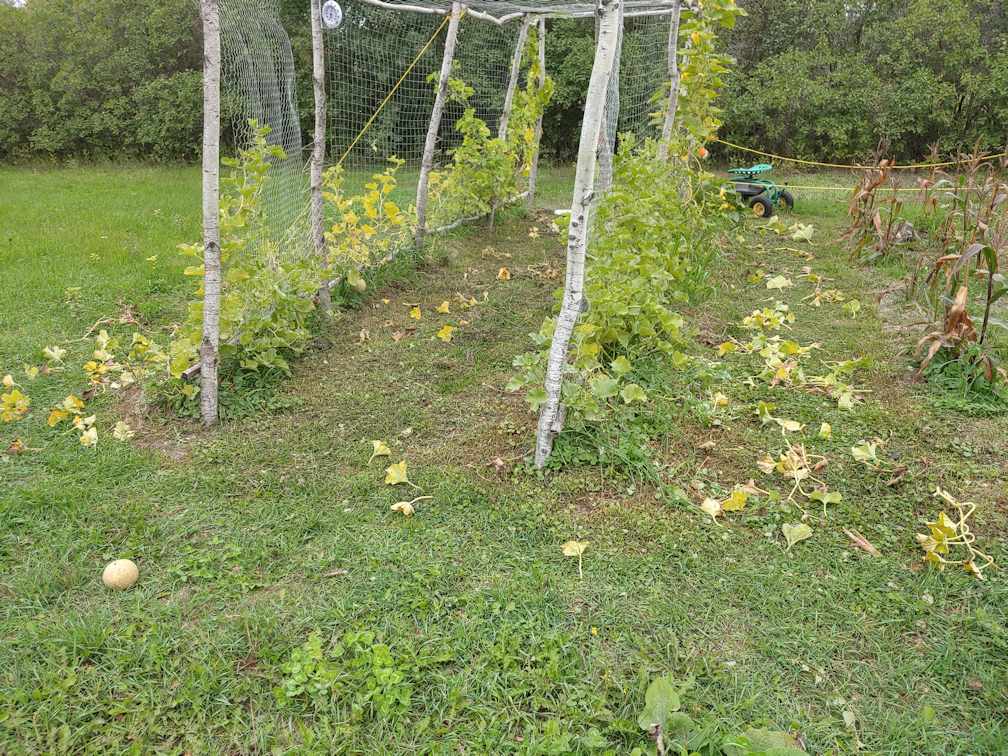
Here, you can see that the melon vines have all completely died back. All of them. And yet…
… the remaining melons are very firmly attached to their vines! Of course, they can’t grow any bigger, but I’m hoping as long as they stay out here, they will continue to ripen.
Under the conditions we’ve had, I’m really impressed with all of these. The melons managed to be quite prolific. The winter squash were not as prolific as they normally would have been, but we will at least have a few squash to try, and to see if we like them enough to want to grow these varieties again. We certainly would be willing to grow the Halona and Pixie melons again, though I think that we will try new varieties next year, to see what other varieties we enjoy eating.
While doing my rounds this morning, I found a strange thing at the gate.
The twine was caught around the lock and the caribiner, which usually hangs over one side of the gate, was hooked onto the chain link.
Right off the bat, I knew this was NOT our vandal. If it were, there would have been actual damage, like the locks being glued again, or something like that.
Needless to say, I was quite curious when I sat down to look at the trail cam files. I had a pretty good idea who did it.
I was right.
When my daughter’s package was delivered, the driver tried to shove it into the gate, then used the chain to try and hold it in place. The problem is, the gate moves in the wind. When the cameras were triggered again, less than 15 minutes later, I could see the package was already half-falling. My the time my daughter came over to get the package, about half an hour after it was dropped off, it was on the ground.
It’s a good thing it wasn’t fragile!!
Going through the trail cam files was interesting for another reason: several files caught huge flashes of lighting from last night’s storm! I even saw a deer and her little one, hurrying up the driveway, while the sky light them up repeatedly.
Yesterday blew past our expected high of the day, reaching at least 30C/86F, possibly 32C/90F. That was followed by a wicked thunderstorm that passed over us around 11pm. It was awesome! Of course, we lost internet well before that. It rained enough that I found our rain barrel by the sun room, which had only a few inches of water on the bottom, full to overflowing.
We *really* need an overflow hose on that thing.
The garden loved the rain, too!
I was seeing huge new blossoms on the summer squash. Even the Ozark Nest Egg and the luffa gourds had new flowers opening. So did the Tennessee Dancing gourds, but they never really stopped blooming, so that wasn’t a lot of change.
The Crespo squash is seeing more flowers opening, too, and some of the developing fruit is noticeably bigger! These two are the ones closest to the barriers than I can get clear photos of, but there are quite a few more getting bigger like this.
The sunflowers are loving the deep watering, too. And just look at this Hopi Black Dye seed head! It is getting so very dark!
I even had a baby harvest this morning.
The larger melon is a Pixie melon. There are still lots of those. The little one is a Halona melon. The remaining melons on those vines are not getting any bigger, as the vines are pretty much completely died back now. Most of the melons are all very securely attached to their vines, though. This little one was feeling a bit softer, so I had it with breakfast. :-)
I even was able to pick some peas! With our first green peas, I did find a pod or two, but between the drought and the critters, that was about it. This is the most I’ve picked at once, this year.
That longest pod is the size they would all be reaching, if growing conditions were better.
I suppose I really should have left them for another day, as these were a bit on the small size, but I couldn’t resist.
I had them with my breakfast, too. :-)
The melon wasn’t as sweet as larger ones we’d picked, but it was definitely ripe. The peas were also probably not as sweet as they would have been under better growing conditions. They were both still quite tasty, though!
Last night’s storm had blown the door to the outhouse closed. I opened it again and things were still a bit damp. It’s been a few hours now, so I am going to head out and see if I can start painting!
Today is likely to be the last hot day of the year. As I write this, we are currently at 26C/79F, with the humidex at 30C/86F. We are expected to reach 28C/83F with the humidex making it feel like 31C/88F. We are supposed to get a couple more days in the mid to low 20’s before the highs start dropping to the mid to high teens. So far, overnight temperatures are also still supposed to remain high enough that there are no frost warnings.
I headed out to do my rounds later than usual this morning, and we had already reached 22C/73F.
There has to be something wrong with the squash tunnel thermometer. It may have felt warmer than the 22C it was when I took this photo, but there is no way it was feeling like 42C/108F! Not even being in full sun, like it is, should result in that extreme of a difference. I suspect the dial is stuck. I haven’t been looking at it since the temperatures finally cooled down, so it may well have been sitting at this reading since our last heat wave.
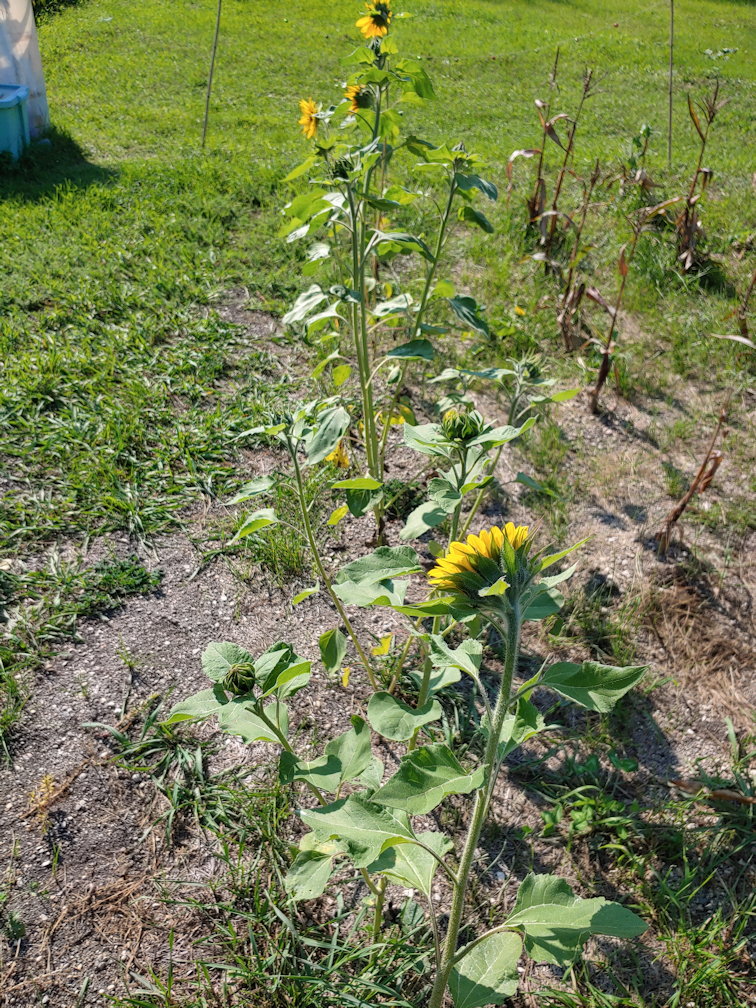
In checking the sunflowers, there was only one little pollinator that I saw! I think the heat waves we had over the summer killed off a lot of our pollinators. There just wasn’t enough food to sustain them. The mild temperatures we are having means more of our sunflowers are actually budding and opening their seed heads, but I don’t know that they’ll have a chance to be well pollinated.
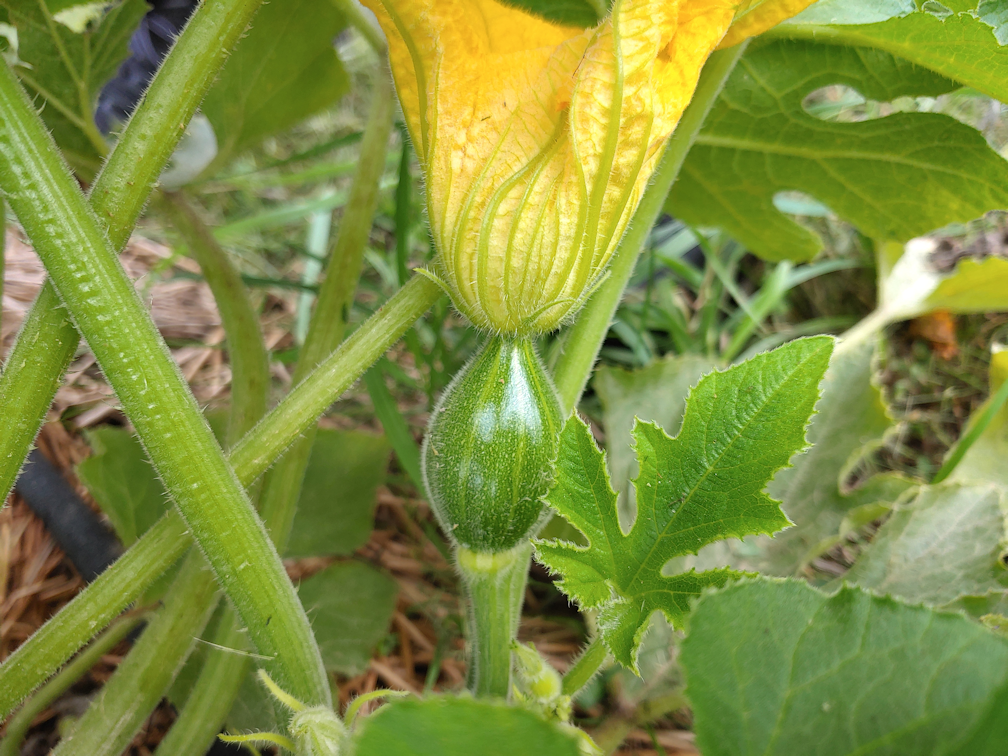
Some of the Mongolian Giants are finally taller than me. Hopefully, the opening sunflowers will lure any remaining pollinators to them. They may not have time to fully mature, even with our predicted mild temperatures, but they will at least provide some food for our surviving pollinators.
These are the Hopi Black Dye transplants that got chomped by a deer. They have all recovered surprisingly well, and are budding and blooming. They don’t need as long of a growing season as the Mongolian Giants, so it should be interesting to see if any of these get a chance to mature.
The green peas are enjoying the cooler temperatures we’ve been having, and I’m seeing more pods developing. This photo is of one of the pea plants growing among the Dorinny corn, the remains of which are being left to go to seed. The three blocks of sweet corn are still green, but they aren’t really growing. At this point, I don’t expect anything from them, really. They’re just there for the peas to have something to climb. Any pea pods we get is just gravy, as their main purpose is to fix nitrogen into the depleted soil in this area.
The winter squash and melons are the ones I am monitoring the most right now.
Remarkably, even as the plants are dying back, we are still getting fresh blooms, and the newer Red Kuri squash are getting noticeably bigger.
The mutant seems to have stopped getting bigger, and is now deepening in colour and developing a harder skin.
As this other, larger Red Kuri is still doing.
I did a nail test on the oldest of the developing Red Kuri, and you can see the mark left behind. Still not ready.
The Teddy squash are also still managing as well.
If we do end up getting frost before any of these larger squash can fully mature, we will still be able to harvest them and eat them. We just won’t be able to store them for long.
The melon vines are dying back faster than the winter squash vines, but their fruit are still hanging in there! I was able to pick this Pixie melon, only because the vine it was attached to had died back completely. I suspect it isn’t quite ripe.
My daughters discovered something about these little melons. After they are cut in half and the seeds scooped out, they make perfect ice cream bowls! I’m not big on ice cream, but I finally had some last night, in half of a Halona melon. It was quite excellent! :-D
I am glad we found these little, short season melons. They have been among the most enjoyed producers this year. I think we will try different short season varieties next year, but the Pixie and Halona are definitely varieties we would grow again. I’ve also saved seeds from some grocery store melons that I plan to try. They are larger varieties, but if we start them indoors early enough, and we don’t have another drought, we should be able to grow them. :-)
While doing my rounds this morning, I decided it was time to do some pruning and clean up around the squash and melons.
With the summer squash, I cut away a lot of the bottom leaves, and anything dead or dying. The zucchini didn’t really need it, but the sunburst squash needed quite a bit.
Noting for next year: while I am happy with training the summer squash to grow vertically, and will probably do it again next year, I now know to make extra certain the support poles are more secure. I thought they were, but as you can see in about the middle of the squash bed, one of them has fallen right over under the weight of the squash attached to it – and I’d already added a second support pole with it! The zucchini on the far right of the photo is also tippy.
We are in a strange sort of state right now, where the squash and melons are continuing to bloom and produce, recovering for the extreme heat and dryness over the summer, but also dying off as they reach the end of their growing season. A couple of Halona melon plants were completely died off and got taken out. The single melon on the ground ground had come loose from one of those.
The three biggest Red Kuri squash are coming along nicely. The mottled green one is quite noticeably bigger. With the colours and slightly different shape, I find myself wondering if it got cross pollinated with one of the nearby Teddy squash.
Speaking of which…
There’s a new one! Of the two plants, one of them now has four squash developing on it. :-)
After I finished pruning the squash and melons, I went through the other beds, doing a bit of cleanup, and found this.
We’ve somehow lost a sunflower!
It doesn’t even look like it was bitten – there is no sign of critter damage anywhere. It looks almost as if it were cut! It’s also in the middle of a row, in the middle of a sunflower block.
Very strange.
I took the seed head inside and put it in a very small bowl, shallow enough for the barely-there stem to reach the water. :-)
As I was finishing up in the garden, the grader went by on the road, and the driver stopped to talk to me. He let me know that he’d seen a black bear – a big male – on our quarter section, and he thought it was heading for the newly dug out gravel pit for water. He’d actually seen 7 bears, just today! The most he’d ever seen in one day – and it wasn’t even 11:00 yet, at the time I talked to him. He suggested we might want to pick up an air horn to carry with us, so if we see a bear, we can use the noise to scare it off.
One of our neighbours, about a mile away, has been posting photos of a bear that’s been raiding – and destroying – his bird feeders. I would not be expecting any to come to our feeding station, though. With both bird feeders broken, I’ve just been tossing a scoop of seeds directly on the ground, so there’s not a lot to tempt them. Especially since we have zero saskatoons and chokecherries this year, and almost no crab apples, thanks to that one cold night in May. Even the ornamental apples in the old kitchen garden, which would normally be full of tiny bunches of apples, and birds eating them, have nothing. No hawthorn berries, either. Between the drought and the wildfires, this loss of berries would be quite widespread, and the bears are starving at a time they should be building up their fat reserves for the winter.
I really appreciated the grader driver stopping to let me know. I have never seen a bear in our yard, but this is not a normal year, so we will have to keep our eyes open!
I just have to start with the exciting part. We actually got rain today!
Okay, so it was maybe only for about 20 minutes, but it was a nice, gentle, steady rain, and enough that after several hours, the ground is still damp. Not only that, but we’ve got a 90% chance of more rain overnight and into tomorrow morning.
Thank God!
Hopefully, by then, the smoke will finally clear out of the air, and some of that rain will hit the areas that have fires right now.
It is not going to make up for months of drought and heat, but it will certainly help. Even the completely dry, crispy grass has started to wake up and show green already.
It was lovely and cool when I did my rounds this morning, then a daughter and I went and checked all the garden beds just a little while ago.
I’m really glad we set up the chicken wire over the gourds and cucamelons. I found this critter damage this morning. It looks like something, likely a woodchuck, leaned on the wire and managed to nibble on a leaf through the gaps. Just one leaf here, and another on the other side of the chain link fence. Without the wire, we probably would have had a lot more damage.
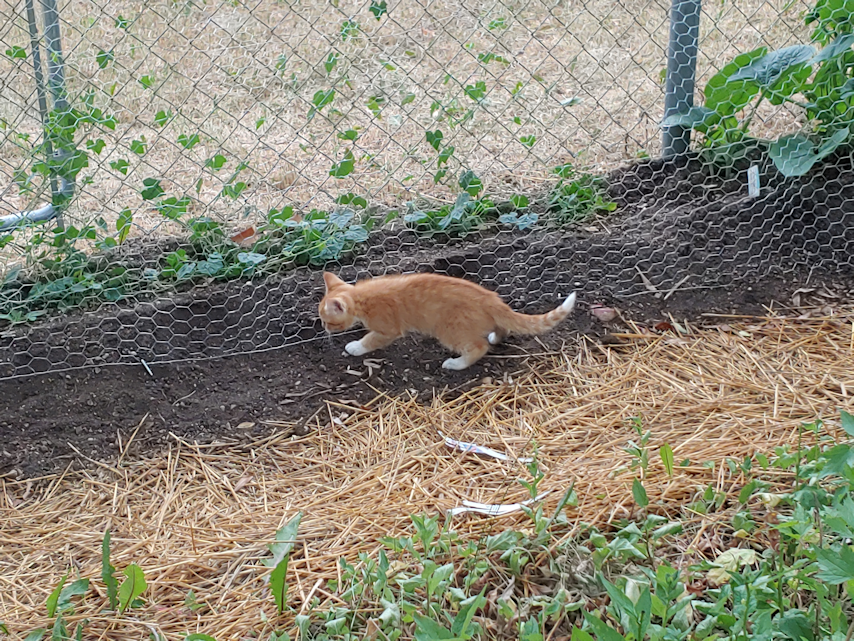
While I was checking on these, Nosencrantz was playing on the concrete block leaning on a tree nearby, so I paused to try and get her to come to my hand. I managed to boop Nosencrantz’s nose before she ran away. Toesencrantz, on the other hand, was far more interested in trying to get at a lump of dirt on the other side of the chicken wire! He could get his paws under the wire, but the tent pegs held and he couldn’t get the lump out. Not for lack of trying! So that confirmed for me that the kittens were doing the digging in the dirt. More reason to be glad for the wire! The dirt lump got broken up, so as to remove further temptation.
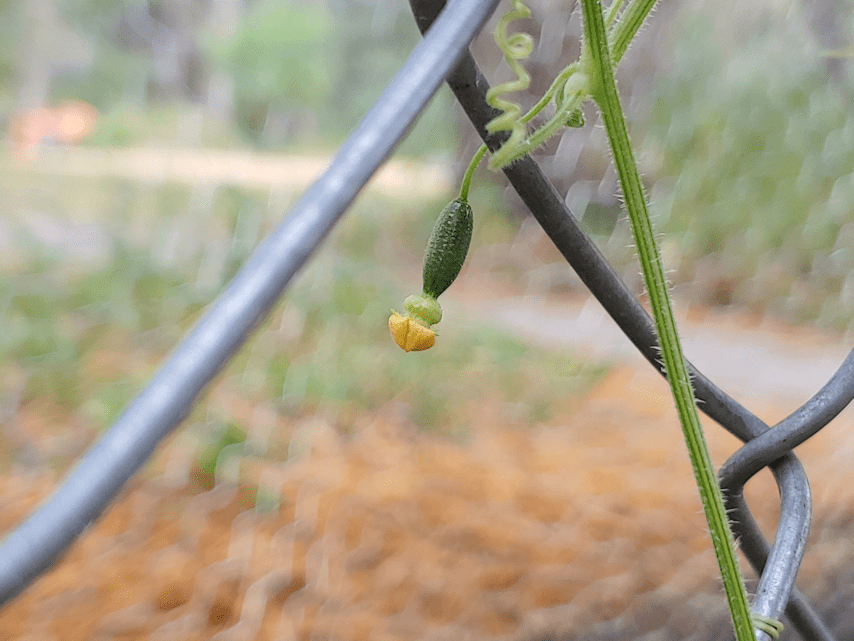
The cucamelon plants looks so tiny, but they are starting to develop fruit! The chain link fence gives an idea of just how tiny these are. I’m looking forward to seeing how they do in this location, which gets more sun than where we grew them last year. They produced quite well last year, for a plant that’s supposed to have full sun.
While checking things out with my daughter, I found new critter damage. When I checked the bed this morning, the damage wasn’t there. These are the Champion radish sprouts. Not all of them were eaten, and the purple kohlrabi sprouts next to them seem to have been untouched. Which would lead me to think it was grasshoppers, not a groundhog, except that after the rain, there were NO grasshoppers around. I didn’t see any in the morning, either, but I usually don’t, that early in the day. They tend to come out later.
Unfortunately, this bed has only the wire border fence pieces to hold up the shade cloth. We are out of the materials to make another wire mesh cover, so with the shade cloths not being used, this bed is unprotected, and there’s really nothing we can do about it right now. :-( On the plus side, it wasn’t a total loss, and I’m thinking the woodchucks, at least, are preferring the easy pickings under the bird feeder.
At the squash tunnel, we found this lovely friend, resting on a Halona melon flower. The melons, winter squash and gourds are doing quite well right now, though all the garden beds are due for another feeding. The baby melons are getting nice and big, and we keep finding more. I was really excited when my daughter spotted this, hidden under a leaf.
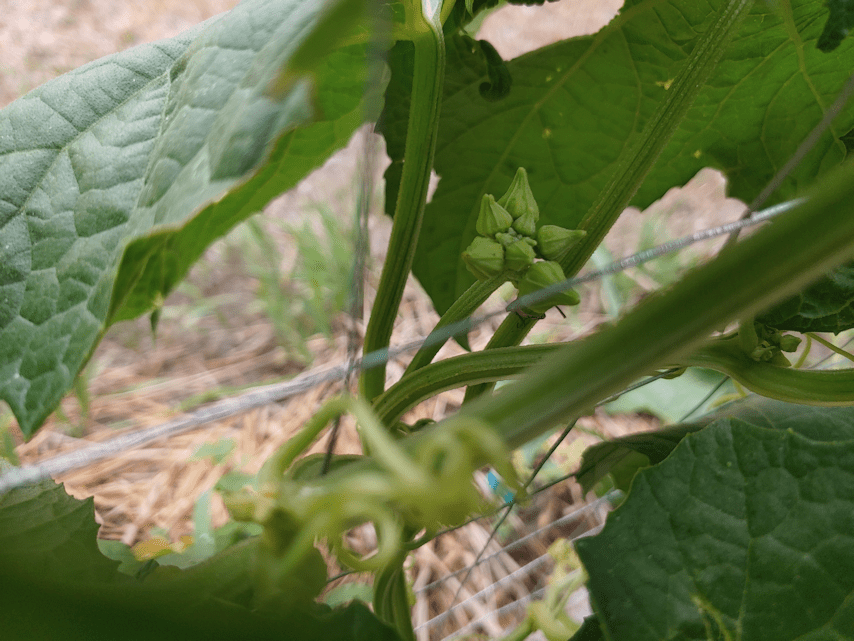
These are the first flower buds on the luffa! I was really starting to wonder about them. They started out well, then went through a rough patch, but since I started using the soaker hose, they are already looking more robust again.
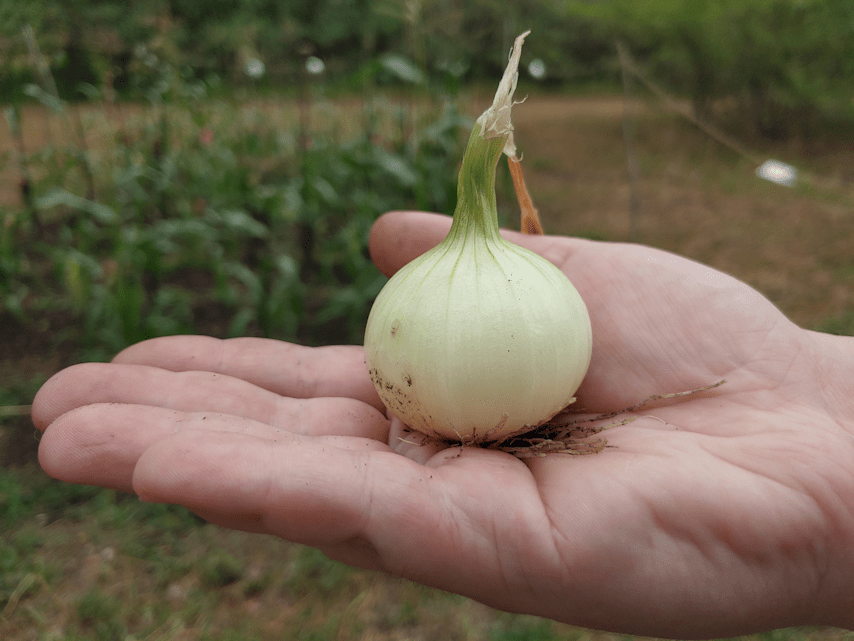
In checking the onion beds, my daughter spotted an onion that had lost its greens completely, so she picked it. It will need to be eaten very quickly. It is so adorable and round! This is from the onions we grew from seed. Though I’ve trimmed the greens of almost all the onions, we’re finding some of them with broken stems. Most likely, it’s from the cats rolling on them, as I’ve sometimes seen Creamsicle Baby doing.
We also found a green zucchini big enough to pick. I’ve checked all the plants, and while there should be at least one golden zucchini, I’m not finding any. Every plant is starting to produce fruit now, too, even if just tiny ones, and no golden zucchini. Odd. Perhaps the package was mislabeled and we got a different kind of green zucchini instead? There are differences in the leaves that suggest two different varieties, even if the fruit looks much the same.
Oh, in the background of the onion picture is the Montana Morado corn. We’re always checking them and the nearby Crespo squash for critter damage. There does seem to be some, but I am uncertain what to make of it. One corn plant, in the middle of the furthest row, lost its tassels and top leaves, but none of the others around it were damaged. It has a cob developing on the stalk, so I pollinated it by hand. Then I spotted another stalk, in the middle of the bed, that also lost its tassels. But what would have done that, while ignoring all the other plants around it? Very strange.
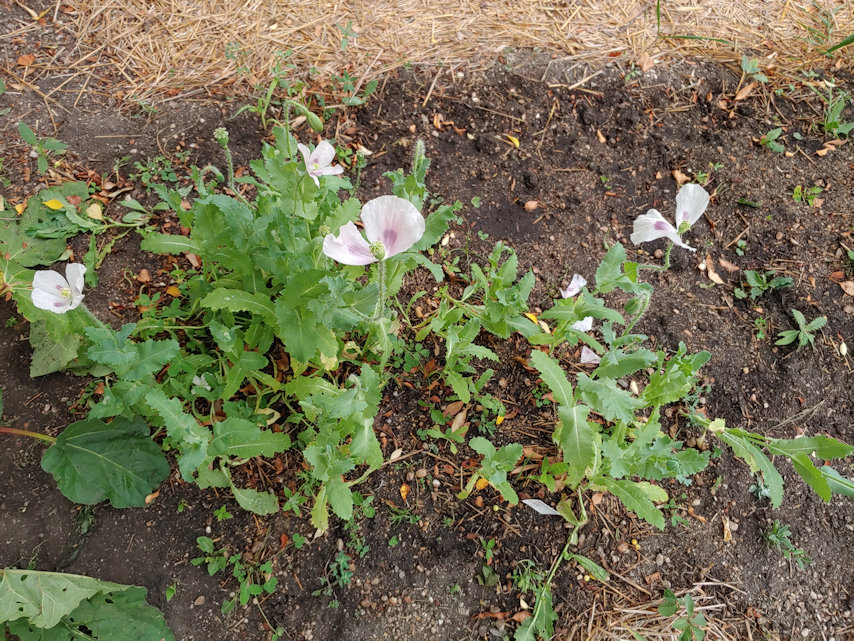
And finally, we have the poppies.
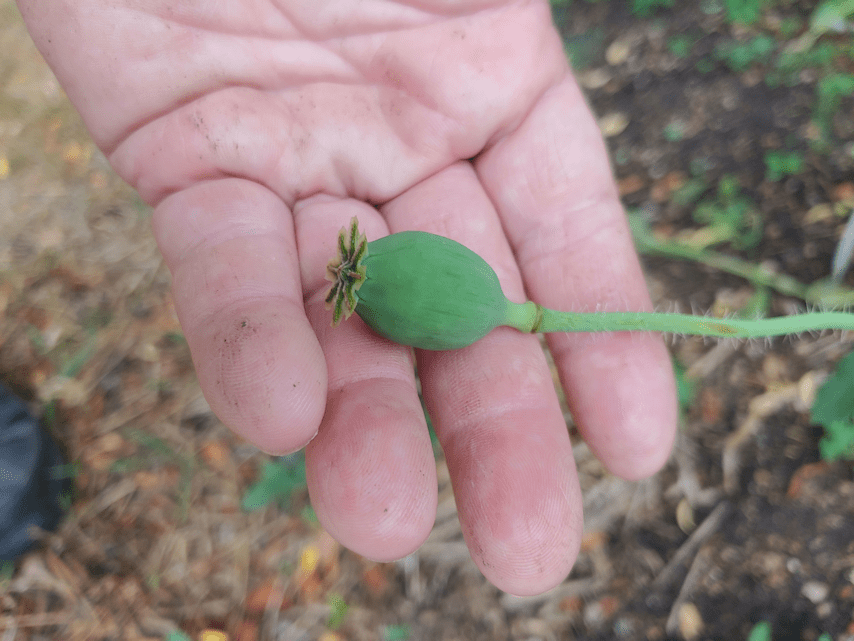
The Giant Rattle Breadseed poppies continue to bloom in the mornings, loosing their petals by the end of the day. Their pods are so tiny at that point, but in my hand, you can see the pod from the very first one that bloomed. It has gotten so much bigger!
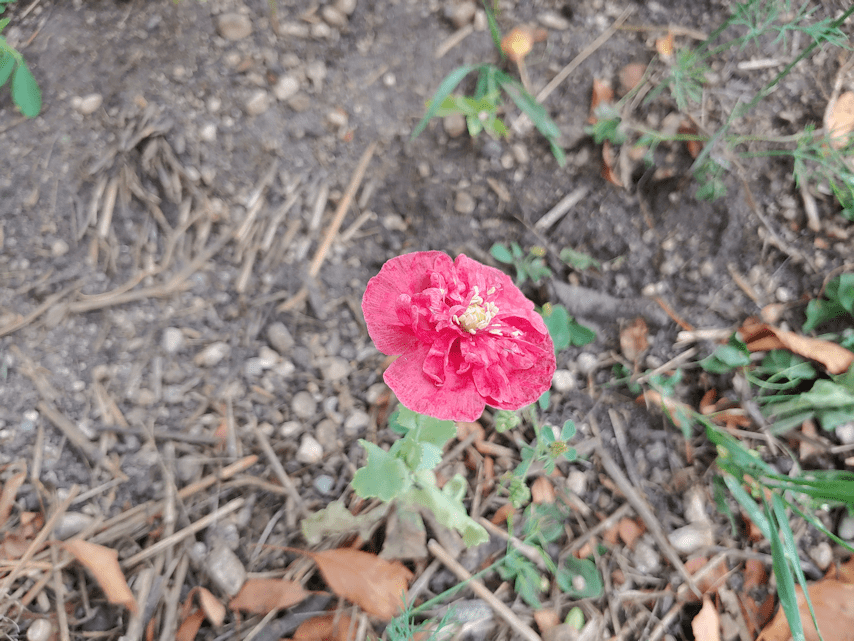
We also found a couple of these.
My mother had ornamental poppies in here, and even with the mulching and digging we did, some still survived. This photo is of the bigger of two that showed up in an unexpected place: where my daughter had dug a trench to plant her iris bulbs. Somehow, they survived, and now we have two tiny little ornamental poppies. :-D
In hopes that we will get rain tonight, we will not be doing our evening watering. If we don’t get rain, we will water everything in the morning, instead.
Now that we have Halona melons developing, it is so much more fun to check the garden in the mornings! Check this out.
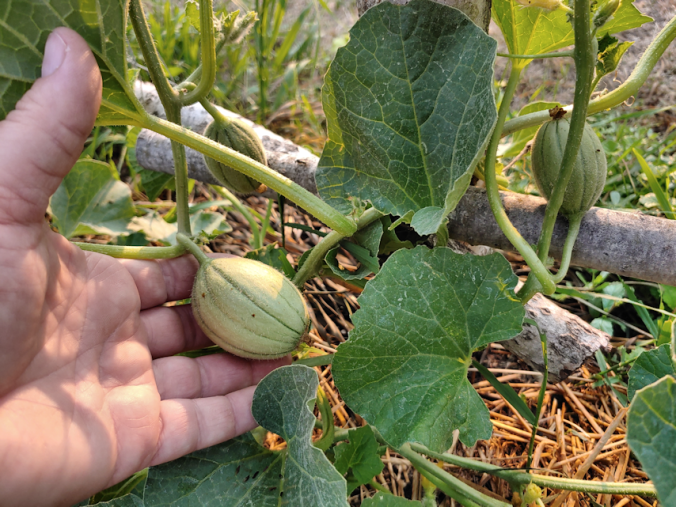
These melons are visibly bigger than they were when I looked at them yesterday evening. I checked them again this evening, and they are again, noticeably bigger! Not only that, but we are finding lots more new ones, plus some larger ones that we hadn’t seen earlier. None as big as the one I’m holding in the photo, though.
I’ve looked over the Pixie melons, and while there are lots of flowers, they all seem to be male flowers. Which is interesting, since the Pixies are 70-75 days to maturity, while the Halona are 75 days to maturity, so you’d think it would be the other way around.
This is a photo of our very first WINTER squash! *insert happy dance* They are starting to get quite big, and this type are quite enthusiastically climbing the squash tunnel. I forget which ones these are; the markers are hidden under leaves right now. :-D
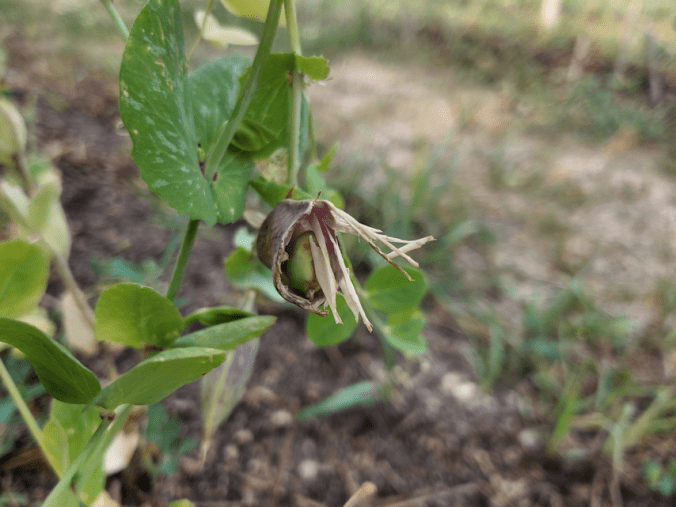
Well, if I needed clearer proof that something is eating our peas, this is it. Half the pod of this purple pea got et. There were still a few that were ready to pick. Maybe 5 or 6 pods. Just enough to include with my breakfast, as an edible garnish. :-D
This evening, I refilled the patched rain barrel and, while I was waiting, I checked over the peas more thoroughly. Enough are showing signs of nibbles that I moved the garden cam so I can hopefully see what critter is the cause. We’ve seen deer and raccoons going by, but they’re not eating anything, however the camera was not being triggered by anything in the pea beds. In fact, last night, nothing triggered it at all, until I walked past it this morning. I now have it up against the lilac hedge on the North side of the pea beds, and lowered on the flag stand, so I’m hoping it will work.
Two more poppies were blooming this morning!
They drop their leaves by the end of the afternoon, though. I was talking to my sister about them and mentioned that they were supposed to have pink petals, not white, and she said that it’s from the heat. If things were cooler, they would be the pink they’re supposed to be. Interesting. She also confirmed that it’s likely the heat that is causing our peas to struggle. I agree that this would be the major factor, though I’m sure a combination of factors are just making it harder for them to thrive.
And that’s before having critters eating them!
In other things, my plans changed with a phone call, and I headed out for most of the day, but that will be in my next post. :-)
While doing the evening watering, the girls spotted a couple of little melons last night! I just had to go looking for them this morning.
Aren’t they adorable?
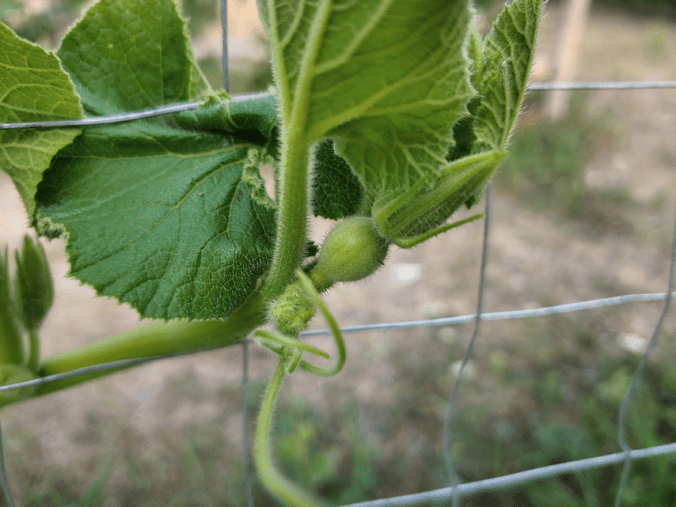
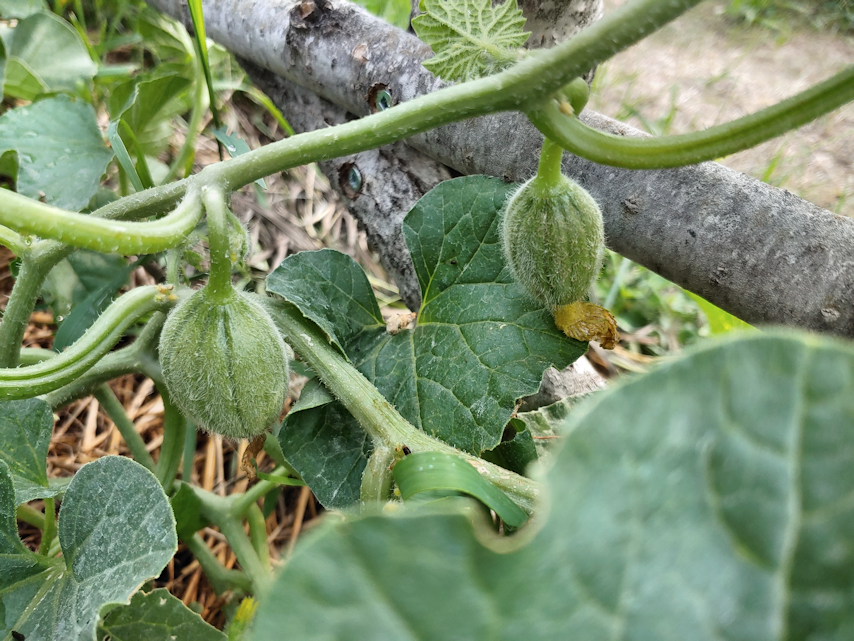
The bigger one is about 2 inches long. I wasn’t expecting them to be fuzzy. :-D
These are the Halona melons. Still nothing among the Pixies – at least not that we can see. Lots of flowers, though.
In thinking of how to protect our Crespo squash from being nibbled on, and our new sprouts from the upcoming heat, I scrounged in the old garden shed and dug up some old, bent up, decorative wire border fences.
Most of the sections went around the Crespo squash. Whatever has been eating them has not tried to go past the hoops, so I’m hoping the new border will further dissuade it.
The ground here is so rocky, I wasn’t able to push all the wire “legs” into the soil! Enough are in to keep it from falling over, though, so it should be fine.
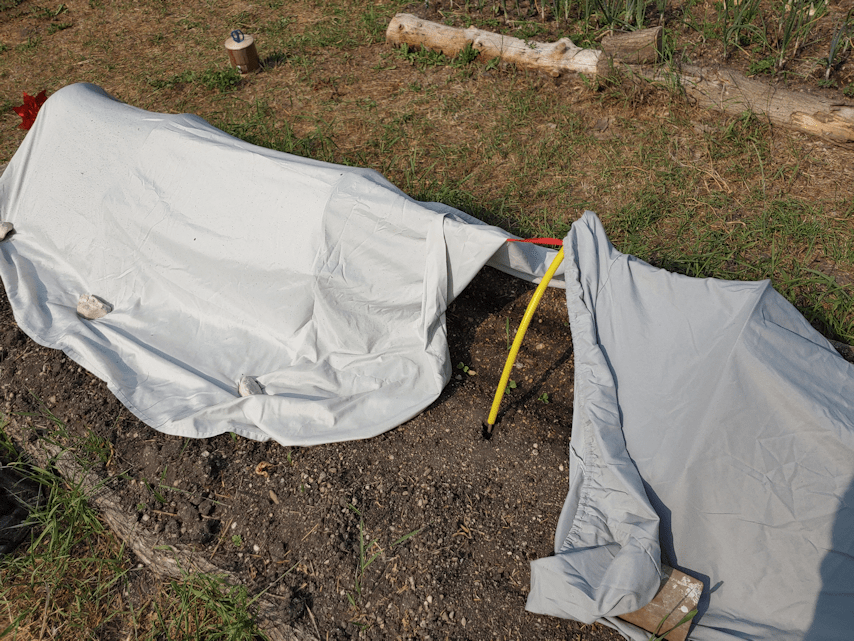
There were a few sections left, and they got used in the garden bed that doesn’t have a row cover on it. Then I used some bed sheets as shade covers. I neglected to take progress photos, though. :-/
There were 6 individual sections that got evenly spaced over the seedlings. The bundle of fencing had been tied with a fairly long ribbon, so I used that to join the tops of as many of the middle ones as I could. As I was laying the sheets down, though, there was nothing in the centre to support the ends. I had a short piece cut from a hula hoop left, so that’s now in the middle, on a couple of sticks in the ground to hold it up. It was too short to bend well, so there’s a kink in the hula hoop piece, but at long as it holds the sheet up, I don’t care! :-D
After that, rocks and bricks were used to pull the fabric taught and weigh it down.
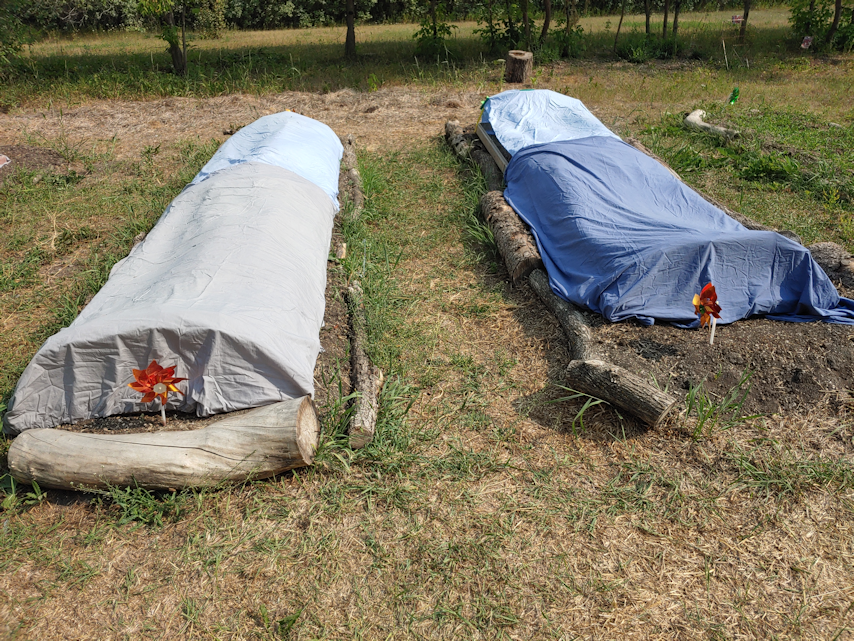
For this bed, I could use some old Twin sheets. For the other two, I had some queen and kind sized sheets to use.
The one top sheet was easy enough, but the fitted sheets needed to have their elastics cut off, and one of them was cut in half and used to cover the ends of the rows. With these, the fabric could be secured by tucking it under the wooden frame. The sheet that was cut in half is barely wide enough on one frame, and a few inches too narrow on the other, but the ends are tucked, and in the middle of the row, the other sheets were laid on top to hold it in place.
So now our shade-loving seedlings have their shade, and protection from the heat of the day. We can uncover them when we start the evening watering, so they get some less direct light during a cooler time of the day. Then I can cover them again when I do my morning rounds.
We’re supposed to start hitting 30C/86F and higher, tomorrow, though the hourly forecast on one of my apps says we’re supposed to hit 32C/90F this afternoon. The record high for today is 33C/91F, set back in 2002. I think we were actually living in this province again in 2002, though I believe we moved back in the fall. The record low for today is 9C/48F, set in 1993.
Anyhow, we’re supposed to stay about 30C/86F for almost a week, and these sheets should help keep the seedlings a bit cooler. I’m considering whether it would be a good idea to moisten the sheets, too, but the extra weight of water might be too much for the frames to hold.
It should be interesting to see how these work out!
Just a few pictures of the garden beds that I took while doing my morning rounds.
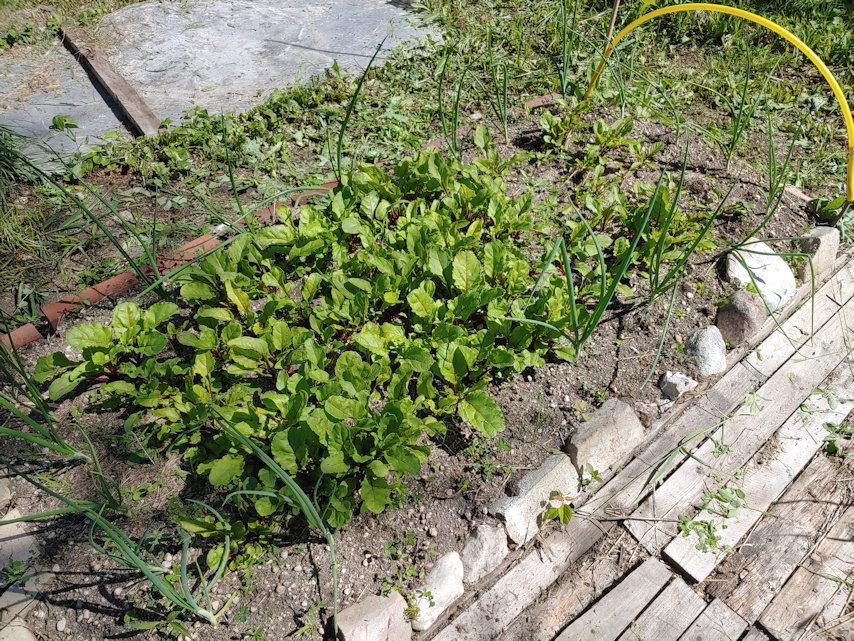
This is the newest bed in the area where the old wood pile used to be, and these beets were the first ones planted, so they are larger than the others. Well. Some of them are. We are curious about the one end there they are smaller, and not as many came up. There is no sign that deer have been eating them – the onions seem to be working! I recall that we had issues with birds digging in the garlic beds. I wonder if they were digging in here, too? I don’t know.
The onions are yellow onions we bought as sets locally, when it looked like the ones we started from seed might not make it.
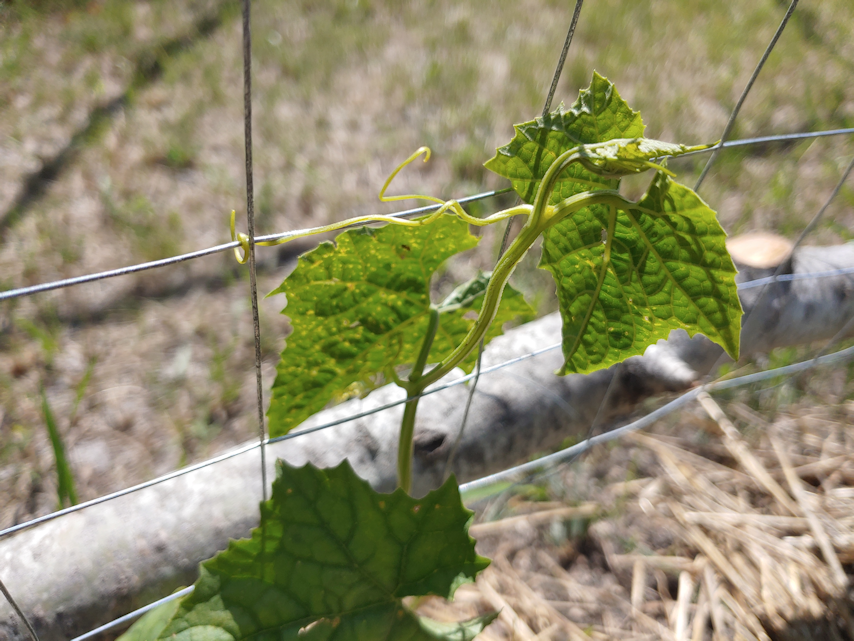
Luffa, actively climbing the mesh of the squash tunnel! So far, they are the only ones long enough to reach/climb the supports.
I was thrilled to see this, nearby.
Several Halona melons are starting to bloom! So awesome! Nothing on the Pixie melons or winter squash, yet.
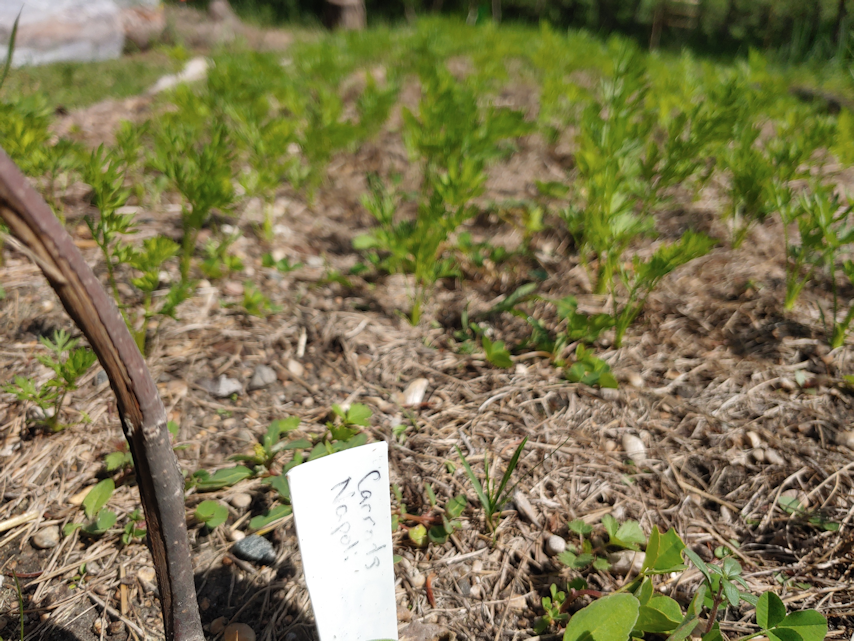
This bed has the two types of carrots – Kyoto Red and Napoli – that came in pelleted seeds. This allowed us to plant them further apart, so no thinning will be needed. That also meant that, even though they started coming up quite a while ago, their thin, feathery leaves were hard to capture in a photograph! :-D
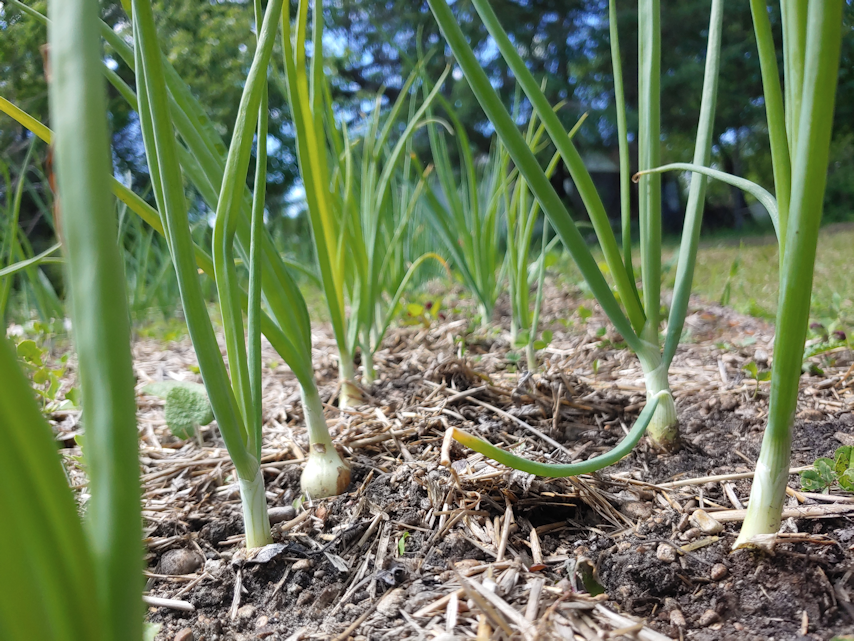
These are the Norstar onions we started from seed. Size wise, they are much the same as the ones started from sets, including the red onions that share this bed with them, however none of the others are starting to bulb as much as these ones are.
Looking ahead to next year, sets are definitely easier than starting from seed, and they don’t take up the space indoors that seeds do, but I think the ones started from see seem to be doing a bit better. We shall see when harvest time comes.
Speaking of harvest, the spinach is starting to bolt. The three varieties we have are all supposed to mature at different rates, but all three are ready for harvest, now! We’ll pull the biggest plants first, and leave the smaller ones a while longer, simply because there is so much. I dug out more window screens from the shed and washed them, so we can use them to dry spinach in the sun room. Doing it in the oven worked, but the trays are smaller, and we can only fit two in the oven at a time. We have four screens in total, and we’ll be able to fit a lot more leaves on them.
We finally have a decent amount of lettuces, though some blocks don’t seem to be doing as well as others. After the spinach is cleared out, we plan to do more lettuces in those beds. Just on one side, as we will be planting more spinach for a fall harvest, later on. The lettuce seed packets were in a Ziploc bag and spilled, so most of them are now mixed up, but that’s okay.
The greens to the left of the blocks, past the plastic, are 4 varieties of beets, that my daughters planted. Not visible is the larger L shaped bed, in which we planted all the remaining beet seeds, including from last year, all mixed up.
The potatoes are doing really well! If those bags weren’t twice the height they started off at, I would think they hadn’t been “hilled” at all!
I am really happy with how the garden is looking, though we do have some failures. None of the purple kale came up at all, and it looks like the purple kohlrabi is a total loss, too. There *might* be some white kohlrabi coming up in the old kitchen garden, but I’m honestly not sure if what I’m looking at are kohlrabi seedlings, or weeds. There’s only a couple of them.
The strawberry spinach seems to be a loss, too. We thought they had started to sprout, but now it looks like there’s nothing but weeds. If they did sprout, they didn’t survive. It looks much the same with the poppy seeds, except for one little patch. We’ll see how they survive! They’re still really small. Ah, well. Whether they make it or not, I plan to get more for next year. Possibly in another variety that I’ve found, too.
It’s only June, though. I’m quite looking forwards to seeing how things grow over the next couple of months!
Yes!!!!! We managed to finish transplanting tonight!
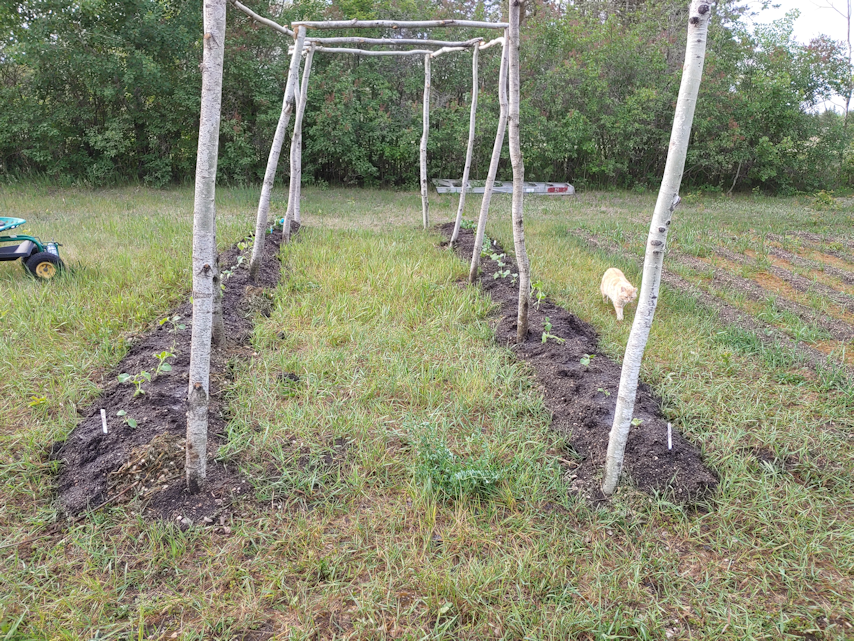
I thought we might have to move beyond the squash tunnel, but since these will be trained to climb, we were able to plant them closer together than we normally would, and they all fit. Also, I was sure we had the little pumpkins to transplant. I was wrong. None of them germinated. We didn’t plant many to begin with, but I’d hoped to have at least one!
At the far end of the squash tunnel, we have 4 luffa vines on one side, and 3 dancing gourd on the other. Next to them are the two varieties of winter squash, and the two varieties of melon.
There are a lot more melons than anything else (I REALLY love melon!), and that’s even with several cups that never germinated. There are some cups with summer squash in them that never germinated, either, which is why we have only 15 transplants. We all really love summer squash, so we would have enjoyed more, but it’s still a bit more than we had last year.
Now that the squash tunnel’s transplants are in, they, and the summer squash, will be getting a mulch of straw as soon as we are able to get back to it. Then I’ve got to get those bottom cross pieces in, so we can attach the mesh for them to climb.
That done, it was time to finish the new corn block. I’d put a fairly deep layer of grass clippings down, first, so I wanted to put a fairly deep layer of soil. Plus, the garden soil tested high in nitrogen, which corn uses a lot of, so I wanted to make sure it had at least that for the transplants to start in.
After the soil was in place, I made a trench in each row to plant into, then thoroughly watered the trench with water from the rain barrel.
Doing the actual transplanting was rather cringe worthy. I keep hearing from others that corn doesn’t handle being transplanted well, their roots don’t like to be disturbed, and so on. At the same time, I have heard from zone 3 gardeners that only start corn from transplants and never had an issue. Still, I really would have loved for the toilet paper tube plan to have worked. I don’t know of anyone who has tried to grow Montana Morado in Canada, never mind in our province, nor can I find anything online about it, so this is all completely experimental.
The biggest, healthiest looking corn plants tended to be the ones were all 4 seeds in the cups germinated. Except for when they were taken outside to be hardened off, the cups with their drainage holes were all in a bin that had water on the bottom, so they could take up water from below. Which means that there were strong roots at the bottom of the cups, and with anything more than 2 plants in a cup, that meant having to tear the roots apart to separate them.
I am really, really hoping they survived this.
They are, however, all in! I even managed to get some in the little half row I wasn’t sure if I’d be using. I went ahead and planted the little ones, too. Considering they tended to be a single plant per cup, they might actually end up doing better!
Also, the flash makes it look darker than it actually was. I did still have enough light to see what I was doing.
After they were transplanted, I gave them a gentle watering with the hose. It was amusing to see a flashlight coming through the increasing darkness. My daughters hadn’t realized I’d stayed out to finish transplanting the corn, and one of them came out to check on me. :-D Which was handy, because that meant I had help putting things away. The washing of the cups and trays, however, will wait until tomorrow!
The only thing left to do with the corn is put a mulch in the paths between the rows. More to keep the new soil in place while watering than anything else.
Now that this is done, the girls and I can head into the city tomorrow, and I won’t be angsting over getting the transplants in the whole time we’re out! :-D
I’m tired and in a world of hurt – and really, really appreciating having my husband’s bath chair to use in the shower! – but I am very happy. :-)