Here is the answer to yesterday’s guessing game…

It is a square bale lifter.
If you look at the bottom of the picture, you can see a piece of metal with a hole in it. That piece rotates, and was used to attach the lifter to the side of the hay rack. The ladder beside one of the tires could be used to get onto the rack (instead of just clambering up, like usual).
As the tractor pulled the hay rack along the row of square bales in the field, the “arms” in front would line up the bales with the opening. The long metal panel kept the bales in position as they were lifted up. Once at the top, the two curved pieces tipped the bale onto the platform, where it could be grabbed by whomever was riding the rack and stacking the bales.
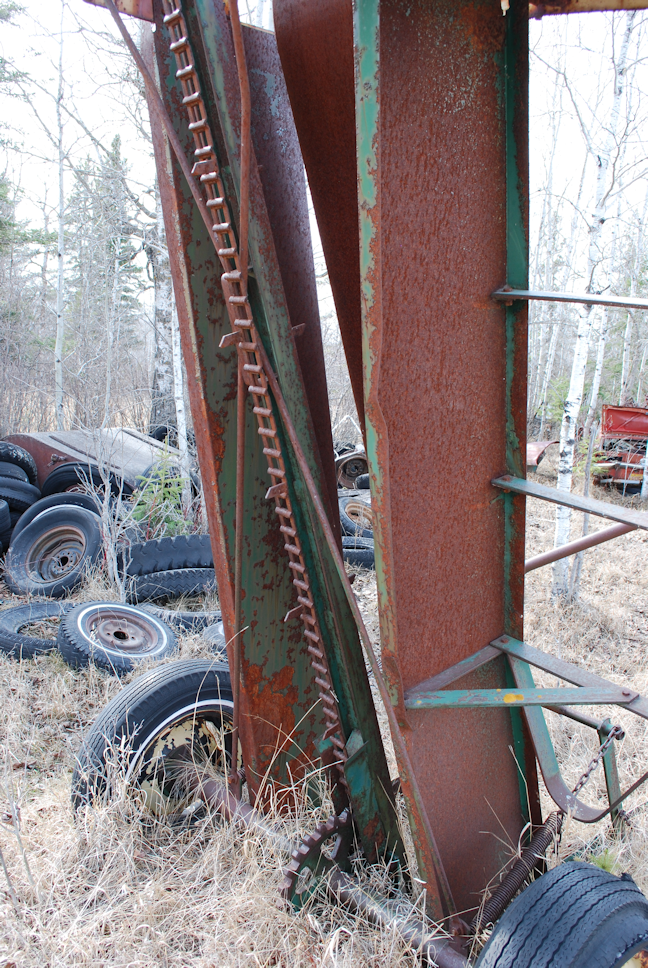
The chain was kept turning by the gear on the axle, and the alternating teeth on the chain are what grabbed onto the bales and carried them to the top.
As my older brothers grew up and started leaving the farm, I was finally allowed to help with the field work – which I much preferred to the housework; being female, that was the only work my mother believed I was good for, though even she ended up having to help with the hay as my brothers moved on. Of course, when we were still using binders to make stooks, then threshing them, all 7 of us were needed to do the work, regardless of gender.
For the first year I was allowed to do it on my own, it was my youngest brother (who passed away 10 years ago) that drove the tractor while I rode the rack and stacked the bales. The previous year, he and I worked together while my dad drove the tractor. My brother had worked out an interlocking stacking pattern to fit the dimensions of the hay rack that allowed us to load a remarkable number of bales on that thing! As the rack was pulled along, I would grab the bales as they landed on the platform of the bale lifter and stack them, beginning at the front of the rack for a few layers, then working my way along the opposite side, and finally the end. As I stacked, I would leave layers “stepped”, so that I could build the layers higher as we went along, leaving the space around the lifter open for as long as I could get away with, before starting to lay the bales under my feet.
Once the rack was full, we would leave the lifter in the field, then take the load to the barn. We started by filling the hay loft, which meant my brother would put a few bales on the front end loader, lift them up to the hay loft doors, where my mother and I would be waiting. Using hooks made out of metal bars bent at a right angle at one end, and bent into a circle at the other for a handle, my mother and I would pull the bales off the front in loader. Usually, one of us would quickly unload it, while the other dragged the bales away to the far end of the hay loft for stacking. It was dangerous, as the front end loader could only go so far forward before hitting the barn walls, leaving an inevitable gap we had to reach over to get the bales stacked further away. The loader was one my brother had built himself, out of metal pipes to form “teeth”, and creating a flat base to stack the bales on. Because it was just pipes, any loose hay or straw would just fall through rather than accumulate. Load after load, my brother would fill it from the hay rack, then get back into the tractor and raise the loader to us in the hay loft doorway to unload.
In his efforts to bring the load as close to us as possible, my brother kept hitting the barn on either side of the door with the outer parts of the loader. One time, he hit it so hard, it actually created a hole. Angry, my brother declared it was time for a break, and asked my mother and I go and make some tea. He would follow shortly after.
My mother and I were in the house, getting the kettle going and putting together something to eat with it, when we heard a noise start up. My mother looked out the kitchen window and suddenly bellowed in shock and anger, then went running out of the house.
My brother had taken a chain saw to the doorway to the hay loft.
There were words exchanged between them, but what was done was done. My brother had cut out about a foot and a half of the wall, on each side of the doorway, removing the pair of doors that closed up the hay loft in the process.
As angry as my mother was, there was no doubt, what he did made the job much easier. He was able to bring the loader right into the hay loft, and my mother and I no longer had to endanger ourselves to take any bales off. Things went much faster and smoother!
Then, when we were done for the day, he found some plywood and built two new doors for the opening.
When my brother left the farm, it was just my dad and I left to throw bales. He would drive the tractor, pulling the hay rack, and I would stack the bales from the lifter and stack them in the pattern my brother taught me. Then it was off to the barn for unloading. By then, my dad had acquired another lifter, using the same principle as the bale lifter on the hay rack. My dad would drop bales down to the bottom of the lifter at ground level, and a toothed chain would carry them up to the hayloft, where I would take them and stack them.
One time, as my dad and I were picking up a load from the field, we decided to see just how much we could fill the rack. Typically, I would build up 3 flat layers, then the next couple of layers would taper to a sort of pyramid shape before we would take the load to the barn. This time, I just kept building up flat layers.
I reached five, before I started to taper. It was so high that, instead of reaching up to the bale lifter’s platform to grab a bale, I was starting to reach down. Driving on the uneven field, as I got higher and higher, the tipping and dipping of the rack became more pronounced, until it was more of a swaying and swinging at the top. So much so, that I started to feel sea sick! I finally called my dad to stop, so we could unhook the bale lifter and take in the load, because I was ready to throw up! For the first and only time, ever, I road back on the tractor with my dad, rather than at the top of the load of bales. The rack itself could have handled more bales. My stomach, on the other hand, couldn’t!
We calculated it out, and each load averaged about 300 + bales, though that big one was probably in the 500 range. The bales themselves weighed probably about 60 pounds each, on average. The baler itself could be set from 55-75 pounds, if I remember correctly, but the switch wasn’t working, so sometimes the bales would get heavier and heavier, while other times, they would get looser and looser. A few times, the bales had become so loose, they would fall apart as I took them down from the lifter. Only once did I have to have issues because a bale was too heavy. I preferred them heavier, because they stacked better, and were safer to walk on as the layers got higher. Between the tipping and dipping of the ride, and the bales themselves, there was a very real danger of slipping between bales and breaking a leg. I did slip, many times, but thankfully, never injured myself.
I loved every minute of it. In all my years growing up on the farm, there was nothing I enjoyed more than those hours spent with my brother, and then my dad, throwing bales.
Seeing that old bale lifter brings back so many good memories, and feelings of happiness and contentment.
The Re-Farmer









 The Re-Farmer