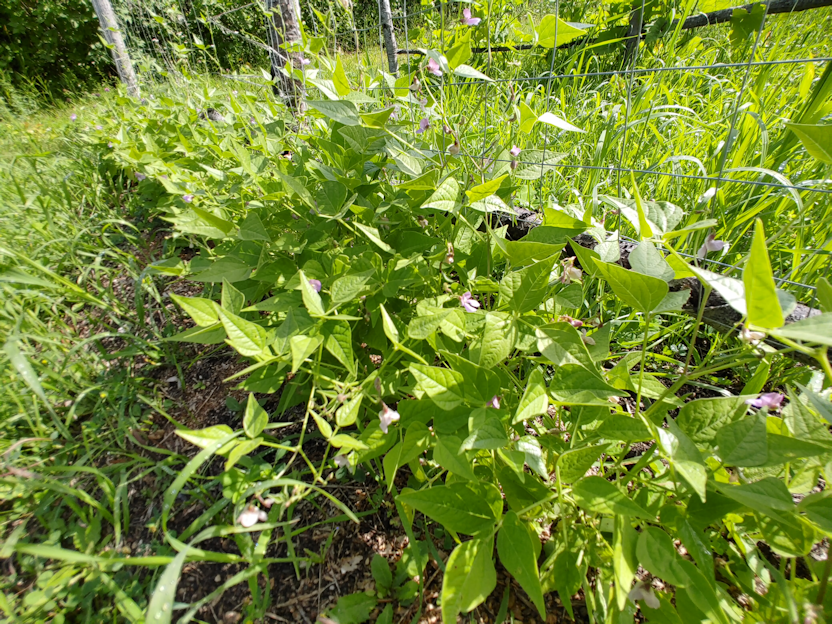
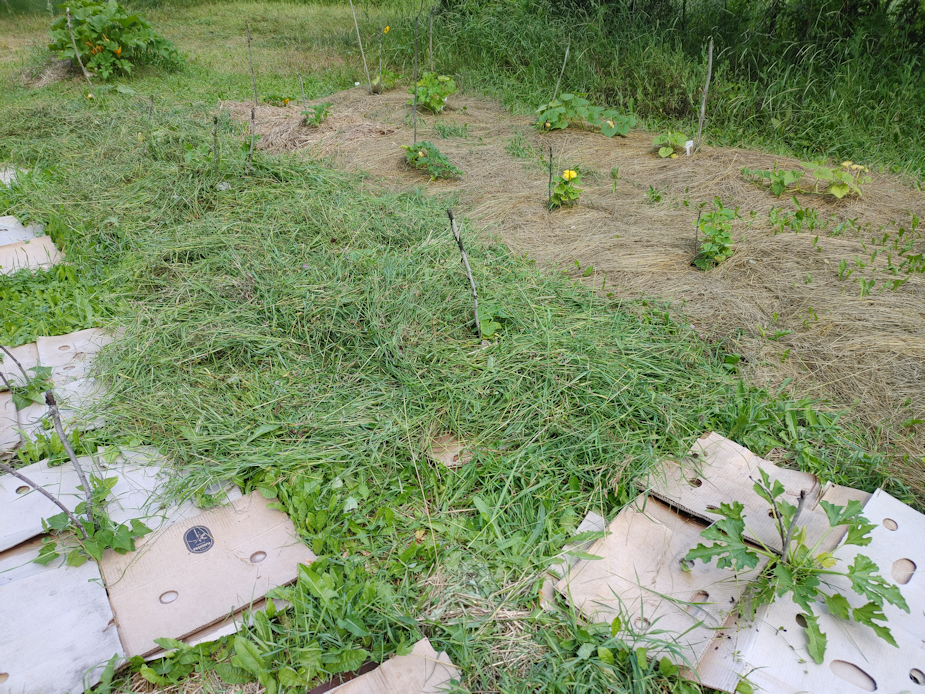
Makin hay, while the sun shines!

Or, in my case today, raking leaves and planting wildflowers!

This afternoon, we reached our expected a high of 8C/46F, with some lovely sunshine and NO high winds!

What a difference that makes.

We did get some rain this morning, but by the time I headed out after lunch, you couldn’t tell we’d had any.

My first job of the day was to rake up some leaves to mulch the wattle weave bed.

Not all of it. Just where the wild strawberries and herbs are growing.

This was the first time I used the pair of hand rakes my brother and his wife gave me. Now that they’ve sold their property, they are living in a townhouse, and have no need for gardening tools anymore. I don’t think these were ever used before!

They work really, really well! The only complaint I could have about them is the straps for the hands are on the small side. At least for broad simian hands like mine! 😄

Oh, gosh. I just realized what I caught a kitten doing in the other mulched bed in that first photo.

*sigh*

The next photo is the packaging for the hand rakes, though Instagram cut part of it off, even though I have it set to “original size” on the slideshow. The website says uncleweiner.com (not an affiliate link). A rather unfortunate name, but a good product!

Oh… gosh. They are located in Prince Albert. That’s… double unfortunate! 😂😂😂

In the last photo, you can see I had a helper when it came to mulching the Albion Everbearing strawberries in the main garden area. I put the chicken wire back over it to keep the leaves from being blown away but, as you can see, it doesn’t lie flat on the strawberry bed. Little Magda quite enjoyed going under there!

That done, I got another wagon load of leaves and started on the patch that’s been covered by the insulated tarp all summer.

After removing the old T posts and a board I’d put around the edges, to keep it from blowing away, I peeled off the tarp. That was unexpectedly difficult. All along the edges, Creeping Charlie had started growing on top of it. It turns out that some of them set their roots into, or even through, the tarp!

So the first thing I did was drag the tarp out to the front yard, where I have one hose still set up. The tarp was spread out to its full size. After hosing it down for a while, I went over it with a stiff bristle broom to get rid of the bigger debris, then used the hose to pressure wash it as best I could. It then got another scrubbing with the broom and a rinse.

For now, I’ve left it out where it is, to dry off as much as possible. Unfortunately, there are some holes in it. Some are tears from winds that happened a couple of years ago. Others were caused by weed roots pushing their way through and into the insulation layer! So parts of it now have water on the inside of the tarp. Not much I can do about that. I don’t have tarp tape, but I do have clear Gorilla tape, so I hope to at least patch up the bigger holes – if they are dry enough! Eventually, the other side will need to be cleaned, too.

That done as much as could be for now, it was back to the patch of soil it covered. In the second picture, you can see how it looked after the tarp was removed. Most of it does look dead but, along the edges, you can see white lines of roots extending into the what will be the growing area.

The soil needed to be loosened for the seeds, so I used the landscaping rake for that – and promptly found a roll of wire, buried in the soil! When we first moved here, this is where most of the chimney blocks and all the ceramic flues had been stacked, along with bricks and other odd things, and even garbage. We cleaned it up, but clearly missed this piece of wire!

The entire area got raked from the inside out, so as to pull the living roots out of the growing area, while also loosening the soil for the seeds.

As you can see in the next photo in the slideshow, the cats were very interested in what I was doing!

After the soil was loosened, I took the container of seeds shaken up in some seed starting mix, and scattered it evenly – I hope – over the area. Then I drew the back of the rake back and forth over the area to cover the seeds a bit.

While chasing away cats that figured this was a big new litter box, just for them!

Last of all, I scattered a wagon load of leaves over the entire area. This layer of leaf mulch is not as thick as on the garden beds. I was trying to more or less emulate how it would be, if leaves had fallen naturally on the ground. They will not be removed in the spring.
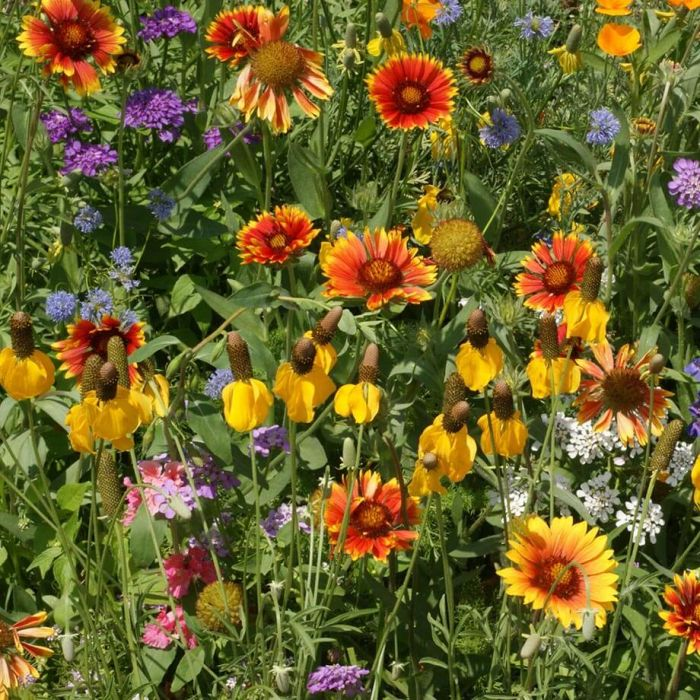

These seeds are a Western wildflower mix, so they should be able to handle the winter temperatures just fine. Any that succeed in germinating should have little problem growing through the light mulch.

The seed mix description doesn’t tell everything that’s in this mix. It just says “This mix includes Lupins, Poppy, Coreopsis, Flax, Blanket flowers and much more.” It should be interesting to see what comes up next year!

Image belongs to Veseys

One packet of seeds is supposed to be enough for 1000 sq ft. I used two packets. Technically, this means this area should be very densely sown. I’m not going to assume they’ll all germinate. We’ve tried to plant these plus an alternative lawn mix in areas nearby, and only some of them took – a year after they were sown! – and in only one area.

Still, if all goes well, enough of them will germinate that they will choke out any weeds that might otherwise spread into the area, and the wildflowers will spread their own seed further into the maple grove.

By the time that was done, it was starting to get close to sunset, to I moved on to things to go in the front yard. One of those was to clean up the flower bed the haskap bushes are planted in.

The first two photos in the above slide show are before and after shots. The dead flower stalks were clipped with loppers for a chop and drop. The old mulch I’d pulled off the garden bed at the fence was then raked on top along one side, and leaves along the other edges were raked up and added to the other sides. I don’t mind if the mulch reduces the number of flowers here. They get so tall, they cover the haskaps! Now, they are a mulch for the haskaps, and the lilac at one end.

I also snagged a couple of bricks and broken pieces of sidewalk blocks from the pile in the foreground. I keep thinking the catio is going to blow away, now that it’s wrapped in plastic for the winter. A corner of the plastic did tear off in yesterday’s winds, so that got tacked back into place, and there is now a weight on each corner of the roof.

I finally got around to laying out the hoses, to get the kinks and twists out. Once they moved, I was able to get to the old basement window to clean it up, then switch the summer window for the winter one. There was more to clean up than usual this year. The kittens have been using the area in front of it as a little box. 🫤 The window is now clear, though, and has a cover leaning over it. Eventually, we will pick up a window well and cover for around this window. The window wells are pretty affordable. The covers can sure get expensive, though!

That cleaned up and done, it was time to roll up and tie off the hoses. I ended up using a garbage can, laying it on its side over a hose, then rolling it with the hose around it. Doing it that way prevents the hose from twisting and kinking, though in these cooler temperatures, any kinks that were in the hoses when I laid them out were still pretty bent up when they were rolled up. Those are now ready to set aside for the winter.

Aside from finishing cleaning the insulated tarp, this is it for winterizing on the south side of the house. Tomorrow, I’ve got some things I want to get done in the main garden area. Our high is expected to be only 4C/39F tomorrow, but the day after is now expected to hit 9C/48F. I might wait for the warmer day before breaking out the chain saw to clean up the dead spruce tree that fell on the crab apple tree.

How much I get done tomorrow, though, may be up for debate. I felt really good while working outside, but once inside and sitting for a while, all my joints are stiffening up. Including my hands. I’m having a heck of a time typing right now. I forgot to take painkillers before I started this post.

Hopefully, I will finally get a good night’s sleep, and that will help. What I’d really love is have a hot soak in the tub, but it’s not worth the risk of injury, trying to get in and out. Sitting on the bath chair in the shower just isn’t the same, though!

Ah, well. It is what it is!

Whatever happens tomorrow, it felt great to be working outside, and I’m quite happy with the progress I was able to do while I had the chance!

The Re-Farmer

Our 2025 garden – I hope!

Yes!!!

It felt so good to get a really productive day outside. It’s been so long!

I did have to wait until the afternoon, when it warmed up to our expected high of 6C/43F. Even so, some of the areas I worked in that were shaded longer were still partially frozen.

The first thing I did was finish off the bed I was working on yesterday. That little section was shaded and still rather frozen, so it took longer than it normally would have. When I was done, I grabbed a nearby roll of plastic that was rolled up and waiting to be put away for the winter and laid it out on the bed, starting from the shaded south end. It wasn’t long enough to cover the entire bed, but all I really wanted was to get the end that got more shade to warm up a bit, once the sun was able to start hitting it.

Once that was done, I shifted to the old kitchen garden and cleared the rectangular be that had the Forme de Couer tomatoes this year. That bed was shaded by the house on one side so it, too, was partially frozen. After clearing it of weeds and mint rhizomes, I grabbed one of the plastic sheets that had protected the eggplants and peppers earlier, and laid it over the soil. This bed is shorter, so the plastic was plenty long enough.

I had decided to use the high raised bed, which is already prepared, and the open section of the garlic bed for winter sowing, so I didn’t need to clear another bed, yet. Leaving the plastic to warm the soil, I headed into the house and started going through my seeds.

I had already considered what I wanted to winter sow earlier, but I’m always flexible on stuff like that.

After going through my seeds, I decided on some ordered chaos.

I’m also going to need to clear one more bed.

Most of the seeds I will be sowing are older seeds, so I don’t expect a very high germination rate for some of them. I also decided to include some additions.

Here are the beds I was able to finish planting before it started getting too dark.

The first image of the slideshow above is in the old kitchen garden. With that theme in mind, I’ve got more “kitchen” greens. These include:

spinach – four different varieties
Swiss chard – two different varieties
Shallots – saved seed collected from a lone surviving shallot a couple of years ago
Kohlrabi – both purple and green
Hedou Tiny bok choi – we got these as free seeds a couple of years ago, but they were smothered by elm tree seeds after they sprouted. A couple of seedling survived and bolted, so I let them go to seed and saved them.

Lastly, I included some onion seeds collected this year. Hopefully including the onions and shallots will keep the deer and damaging insects away.

These and another group of smaller seeds were added to a repurposed herb/spice shaker container, along with some seed start mix and vermiculite I had left over from starting seeds indoors in the spring, and given a thorough shaking.

After emptying this container into the old kitchen garden bed, it was mulched with a thick, insulating layer of leaves that was topped with some grass clippings, as was done with the garlic already planted.

In the next image, you’ll see the bed I had started on last night. This one is now a summer squash bed. Years ago I had accidentally bought three collections of summer squash when I meant to get just one. We’ve been using the seeds for several years now, but they are starting to get old. The only new seeds were the White Scallop patty pan squash. The others are Sunburst (a yellow patty pan), Endeavor (green zucchini), Goldy (yellow zucchini) and Magda (mottled pale greens, similar to zucchini). I don’t expect much for a germination rate for the older seeds.

With these larger seeds, I scattered them from end to end on the bed, then pushed each one into the soil, spreading them out more evenly in the process, used a rake to gently cover them over, then mulched with leaves and grass clippings.

The next two photos – the remaining end of the garlic bed and the high raised bed – have root vegetables, plus protective onion seeds. These include:

– the last loose seeds of Uzbek Golden carrot (I still have the home made seed tape of those)
– pelleted Napoli carrot
beets – three red varieties left over from before, plus a white Albino variety given to me
Purple Prince turnip
radishes – three red varieties left over from before, plus a yellow variety given to me.

Plus, protective onion seeds were added as well.

I used the shaker over the small area next to the garlic, but I honestly couldn’t tell if any seeds got out. I mulched it anyhow, but when I got to doing the high raised bed, I took the shaker lid off and just scattered the mix. I could at least see the pelleted carrot seeds! This bed is shorter, and I ended up not finishing off the container. I’ll find somewhere else to sow the rest of the seeds.

After mulching the high raised bed, I moved the wire cover onto it for winter storage. The wire is open enough that it won’t prevent snow from covering the bed, and the snow is an important part of this winter sowing process.

This left me with two containers of seeds. I decided to plant the flower seeds. I wanted those in the main garden area and decided to use the space by the high raised bed where the pumpkins and drum gourds had been planted. It’s a small space and did not take long to clean up. That last space got:

Butterfly Flower: Orange shades (a milkweed) that I tried starting indoors this past spring, but never got to direct sowing the rest.
Forget Me Nots – given to me by a friend
Nasturtium; Dwarf Jewel Mix – I got those this year and never got around to planting them.

I look forward to (hopefully) have a busy patch of flowers for the pollinators in the main garden area next year! The Nasturtium should also act as a trap crop, luring in insects that might harm some of the other plants.

For flowers, I also have two packages of Western wildflowers mix. I have an area along the edge of the maple grove that has been covered with the insulated tarp, folded in half, since it was taken off the septic tank lid in the spring. I’m hoping that did the job of killing off any weeds under it. Once the tarp is removed, that is where I intend to plant the wildflower mix. It has 16 varieties of annuals and perennials native to Western Canada in it.

I am now left with one last container of seeds to plant, but I was losing light and need to prepare another bed for them. This container has:

Dalvay peas, including seeds I collected from the ones we planted this past year
King Tut purple peas; from collected seeds
Royal Burgundy bush beans
Hopi Black Dye sunflowers – just one of the two packages I had
Mongolian Giant sunflowers – I had only one packet of those
– a small number of Montana Morado corn. We’d grown them a couple of years ago and left them to go to seed, as we were going to test grinding them into flour, only to have the cats dump the entire bowl of collected seed. I managed to salvage a few seeds – less than a dozen.

I chose this combination so that the peas could climb the sunflowers, while the pole beans can shade the ground. This group of seeds did also get onion seeds added to it. Everything in here is prone to being eaten by deer, so I’m hoping the onions will be enough of a turn off for them.

After talking to my daughter about it, we figured the place to plant this is in the long, narrow bed along the chain link fence. It’s mostly clear already, as it had potatoes in it this past year. There’s just one self seeded tomato plant still needing to be cleaned up. Plus, the kittens have been using it as a litter box, so that needs to be cleaned out, too.

So that is my plan for tomorrow. To get that last group of seeds winter sown seeds in. Then, I’m hoping to get a bit more clean up before taking the garden tour video I’d originally intended to take in the middle of the month. This will be the last garden tour video of the year.

In the spring, once the snow is melted away, the mulch on all of these will need to be removed, to allow the soil to warm up and the seeds to germinate. If all goes to plan, this will give us a head start to our 2025 garden.

With most of these, I completely finished off the seeds I had left from previous years. I still have plenty of other things that can be started indoors, and others for direct sowing.

Next year’s garden will be very, very different from how this year’s garden turned out. Not having four 18′ beds dedicated to winter squash and melons is going to make quite the difference! We will be planting fewer tomatoes next year, too.

Even if this winter sowing experiment doesn’t turn out turn out, I could get away with not buying any new seed this winter.

I will still buy more seed, of course! Just probably not until a month or two from now. I’ve already got my eye on some rare heritage breeds that I’d like to grow, if only to help keep the varieties going.

Mostly, though, I’d like to finally get some new beds started, and get at least one permanent trellis built.

If the weather holds.

We shall see.

I’m just happy with the progress I got today!

The Re-Farmer

Our 2024 Garden: morning in the garden and NOOOOooooo!!!! *sniff*

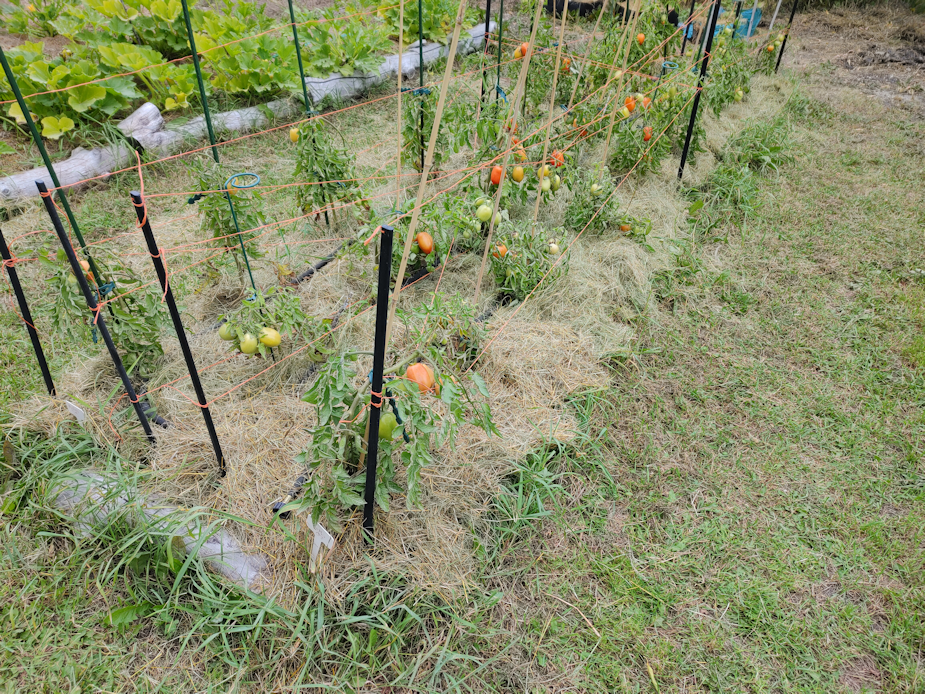
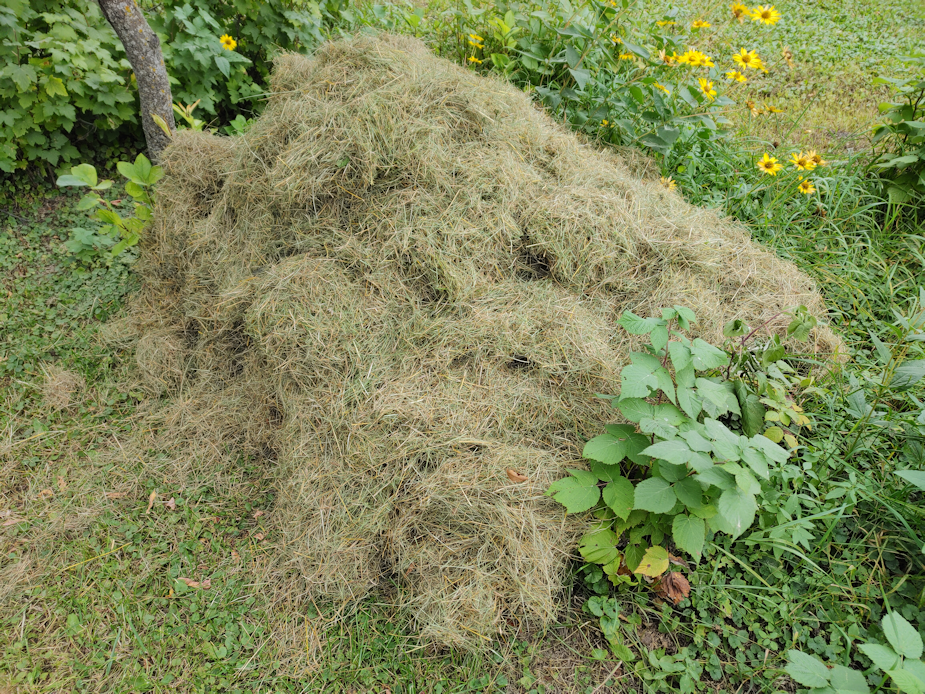
I headed out early this morning, while it was still relatively cool, to do the watering and make use of the grass clippings that had been collected and spread out on the black tarp.

I was getting near the end of watering in the main garden area, about to move on to the strawberry bed, when I realized…

I wasn’t seeing any strawberry plants.

At all.

Noooooooo!!

Yup. A deer got to them!

I have to admit, I was complacent. I’d seen a deer around the garden area a few times, but it never went to any of the beds and stayed in the tall grass. We’ve got spinners and flashy things and other distractions all over. It seemed they were making a difference…

Now, this.

Obviously, it’s late in the game, but I put a net around the bed so it won’t happen again. The plants will recover, and the runners are still there and rooting themselves. The main thing with the netting is to be able to lift it, as needed, to tend the bed. It’s held down with ground staples in the corners

*sigh*

The next time I can get to a Dollarama, I will see if I can pick up more of those green, plastic coated support posts. They are very handy!

The netting was put up last of all, though. Before that, as soon as the watering was done, I started filling the wheelbarrow with grass clippings and mulching things.

First I laid a pretty thick layer around the edges of the tomato and onion bed. Then I did the onion, shallot and summer squash bed. Setting handfuls of grass clippings between every onion took a while!

These two beds took up most of the grass clippings, but there was maybe half a wheelbarrow left, so I mulched around the onions going to seed, and around some melons at the end of the bed where the bush beans are trying to recover.

After that, I just had to get some photos of the huge vines we’ve got now!

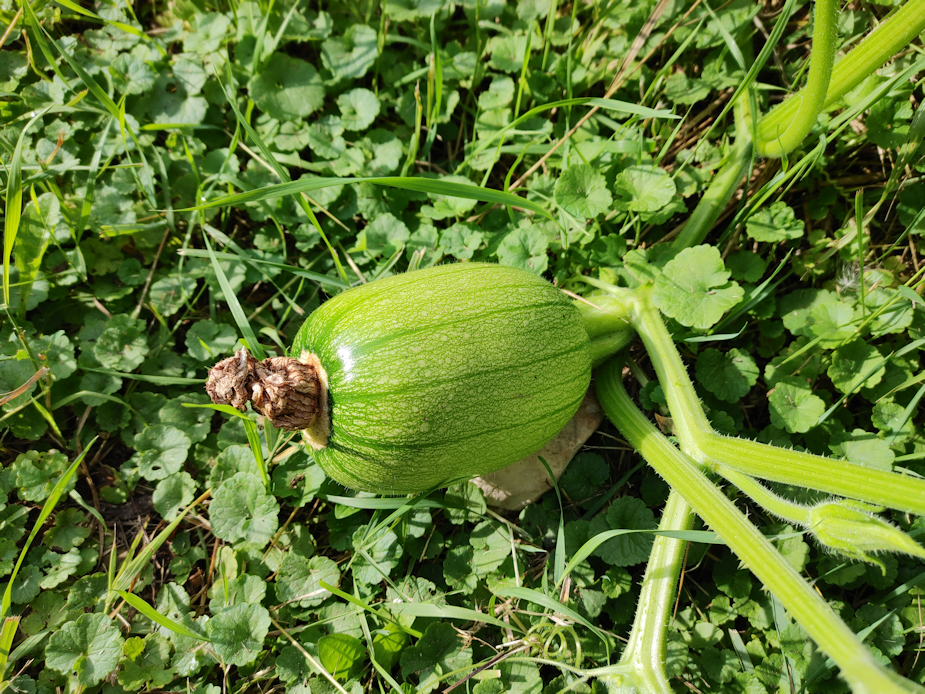
The pumpkins are blooming enthusiastically, and I even hand pollinated a couple more. There’s one pretty large pumpkin developing, plus a few smaller ones. I got a picture of just the largest one.

There are lots of drum gourd flowers, but no female flowers, yet.

The winter squash that are developing right now are getting so big, so fast! So far, the only one I can identify – I think – is what is likely a Turk’s Turban squash. It will probably be a while before we can identify the others – two of which I think are the same variety. I was able to hand pollinate a couple of winter squash, too.

I also got some photos of the Forme de Coure tomatoes.

I think having the sump pump hose draining at one end of the bed is making a difference. A lot of the water does end up flowing down one of the paths, but the bed itself is benefiting from being watered indirectly like this. The tomato plants are lush and bushy, and the tomatoes seem to be growing much faster than other varieties.

It was about 17C/63F when I headed out to water the garden beds, at about 6:30-7am. It’s now coming up on 11, and we are at 24C/75F with the humidex putting us at 27C/81F. We are expected to reach a high of 29C/84F, with highs of around 30C/86F starting tomorrow and staying at or near that range into August.

Which means I’ll be out watering the garden in the cool of the morning pretty regularly.

Most of the prairies are under heat warnings and/or air quality warnings. We’ve got an increase in wildfires up north, but really, we’re doing all right, all things considered. Alberta is being hit hard, and Jasper had to be evacuated and seems to have mostly burned down! Thank God, there don’t appear to be any injuries or loss of life. The most recent article I can find, as of this writing, is here. (link will open in a new tab)

And that is why having a “bug out bag” is a good idea! As well as having emergency supplies in your vehicle, if you have one.

So we will do what we can with our own heat, and be thankful that it’s all we have to deal with!

The Re-Farmer

Our 2024 Garden: grass clippings are gold!

I’m going to be feeling this tomorrow, but I got what I wanted to do, done – and then some!

I just finished mowing the area of the outer yard that I’d been able to mow previously. I had considered mowing until I finished a tank of gas at first. Since this area had already been done before, even with the constant stopping to empty the bag, that would have meant expanding the area I was able to get done last time. In the end, though, I just filled one last wagon load and stopped. I finished at about 3:30 or so, and we’re at 25C/77F, with the humidex at 28C/82F, and we’re not even at the hottest part of the day, yet.

I spread out only a couple of wagon loads on the black tarp I’ve got over the previous year’s squash patch. The rest, I used right away.

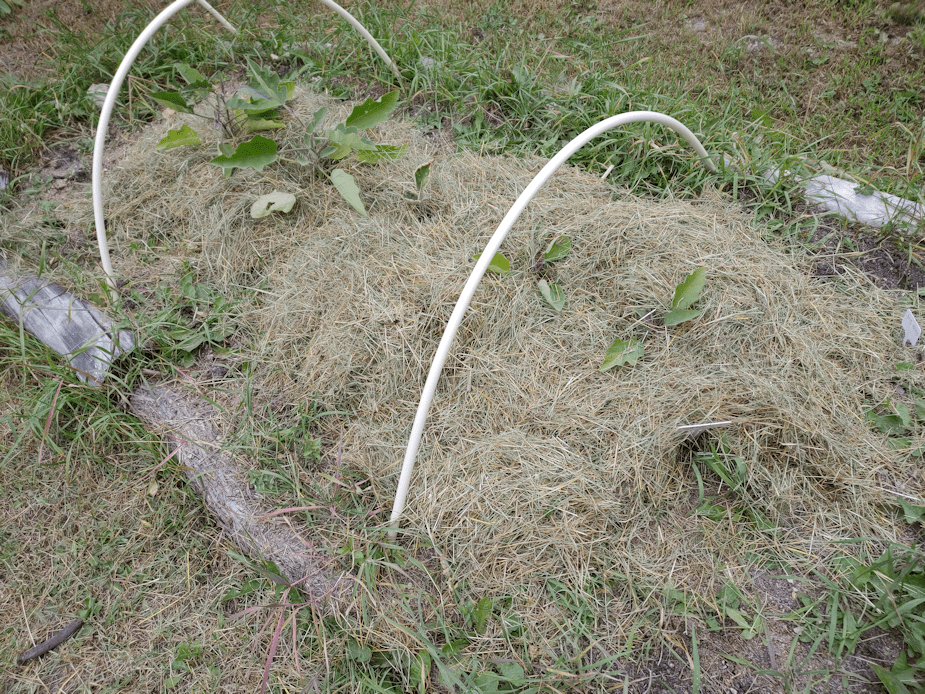
I did the eggplant and hot pepper bed first, because it was closer. These have not been doing well, and I’m hoping the extra layer of mulch, on top of the paper and cardboard mulch, will help. That took most of a wagon load, and what was left went into the compost ring next to the eggplant and peppers bed.

Next I did the bed that needed it the most: the bell peppers and onions in the high raised bed. They are pretty crowded in places, so it was a bit more difficult to keep the mulch away from the stems and bulbs, but I was still able to get a good layer down. There was just enough left in the wagon to mulch the surviving bush beans, which I didn’t bother taking a photo of.

The last wagon load was used to mulch the chocolate cherry tomatoes at the chain link fence. I also added some supports to the tomatoes that didn’t already have cages around them; I only got two cages, as these are dollar store cages and I wanted to test them out before getting more. The Goldy yellow zucchini by the gate got a bit more mulch, too.

There was just enough left in the wagon to lay a deep mulch down at other chain link fence bed, by the vehicle gate. This is where there are just two Purple Caribe potatoes growing, and where I’ve started kohlrabi. Since everything is so sparce at that end, there is a ridiculous amount of weeds. So the two potato plants are now mulched, as is each side of the tiny kohlrabi seedlings, and the empty space in between.

After putting everything away, I also rolled up the mosquito netting still attached to the chain link fence, and just left the rolls fastened at the top of the fence sections.

By then, the heat and humidity was really starting to get to me, and I was more than happy to finally get inside!

Tomorrow is supposed to be even hotter, so I want to make use of the clippings I’ve laid out on the black tarp to finish mulching around the San Marzano tomato and onion bed, and then lay more mulch down around the onions, shallots and summer squash. If there’s any left over, I’ll see if I can mulch the rest of the bed with the melons, bush beans and onions going to seed. That will be done early in the morning, before things start getting hot. Depending on how I find the soil, I might do another watering.

Grass clippings are gold!

The Re-Farmer

Our 2024 garden: winter mulching

It’s supposed to start snowing later, so it’s a bit of a now or never day to get those beds mulched before the ground freezes! I’m so glad my mother decided to have me come over to her place tomorrow instead of today.

If you scroll through the Instagram slide show above, you’ll first see the carrots that we are overwintering in the soil, harvesting them as we need to, rather than harvesting them all at once and having to process them for the winter. Quite a few people swear by this, and say the carrots taste so much better when stored this way. There was the remains of a pile of grass clippings next to that bed, so it was the fastest to get done. I used up pretty much the entire pile – I didn’t bother digging too far into the snow around the edges – and piled it right on top of the snow layer. The snow will also act as an insulator, as well as add needed moisture, come spring time. I put the cover back on, partly as a way to store it, but also to keep the grass clippings from being blown away. This is the only bed where that would be an issue.

Next is the old kitchen garden. All the garlic now has a thick layer of mulch, plus the chamomile, thyme and strawberries grown from seed are covered.

I also finally picked that last big luffa gourd. I’d forgotten about it! It’s now sitting in the living room to dry out.

I also remembered to put a deeper mulch on top of the saffron crocuses, plus a nice, thick “donut” of mulch around the Liberty apple tree. Both are zone 4 plants, so they need extra protection in our zone 3 temperatures. Some time ago, I added the tree protector. It’s wrapped around the stem and the bamboo stake together until it reached the bottom branches, and then got wrapped around the bamboo stake. As the sapling gets taller, the wrap can be adjusted accordingly. This area also has the fencing wire around it, so it should be safe from deer, but this will also protect from rabbits and other critters. Mind you, the yard cats do a great job of keeping the small critters under control, so we don’t have any rabbit or mouse problems, but there are other creatures that might try to eat a nice, juicy young sapling!

All of this pretty much finished off the huge pile of grass clippings that was next to the high raised bed! There’s just the dregs along the edges, buried under snow. Those are really full of crab grass rhizomes, anyhow. I was pulling quite a few of those out of even the deepest parts of the grass pile!

Last of all, we covered the asparagus and strawberry bed, and the sunchokes. We ended up not harvesting any. I decided to leave them to propagate, and we’ll have more plants to harvest from, next year. In theory. Instead, I decided to use the loppers to cut the stems and lay them down while my daughter raided the straw pile for more mulch.

The surprise was discovering half the sunchoke plants had lost their tops! Some time between when I did my morning rounds, and when we came over to tend to the bed, a deer had come around and eaten them!

The straw we used is what had been moved off the area the trellis beds are going on. It had been used for our Ruth Stout method of growing potatoes and melons that instead got flooded out, in our 2022 garden. So it’s had some time to break down, and the pile was quite damp! We used most of it to make a nice, deep mulch over the asparagus/strawberry, and sunchoke beds.

In the spring, these mulches will be removed (the carrot bed should be empty before then) to allow for the plants underneath to get sunlight and warmth and start growing. In the wattle weave bed, the chamomile should have reseeded itself by now. The thyme in there might actually survive the winter. It’s hard to say, as they are close to the wall of the bed, which means they’ll get cold from the side. Even with the mulch, they might freeze too much. This is why I made sure to plant the garlic well away from the walls of the raised beds they are in.

If all goes well, we’ll have a nice head start to our 2024 garden!

Oh!!! I just found out our lysine order is in already!

Time to go get the mail!

The Re-Farmer

Grass clippings are gold!

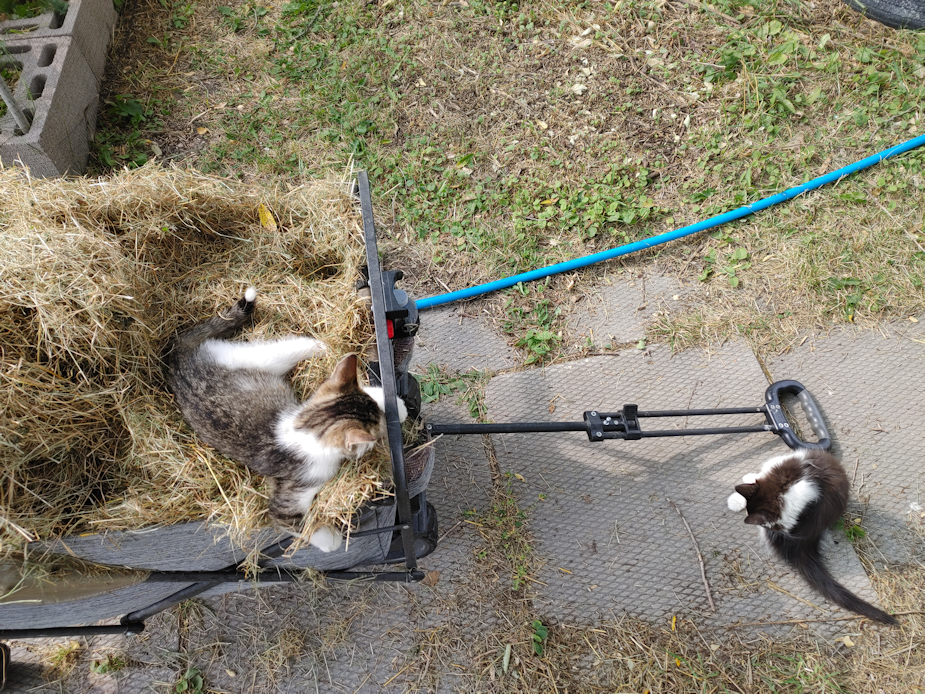
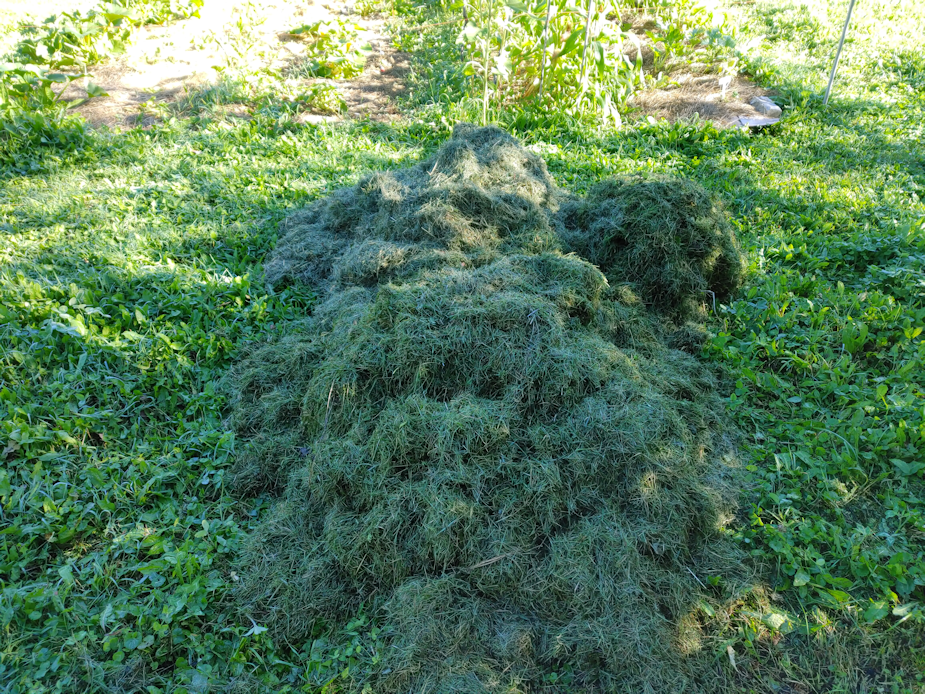
Since we did not get the expected rain today, I headed out with our yard wagon and started raking up the grass clippings from the outer yard. The never mowed areas where I’d been able to expand into had a deep layer of clippings to gather, before it started killing off the grass below.

The three most socialized kittens just loved what I was doing. Especially the one you can see inside the wagon!

I’d originally planned to just make a pile of clippings near the main garden area, but instead decided to actually do some mulching. It won’t make much of a difference for the plants, this late in the season, but it will help with amending the soil for next year.

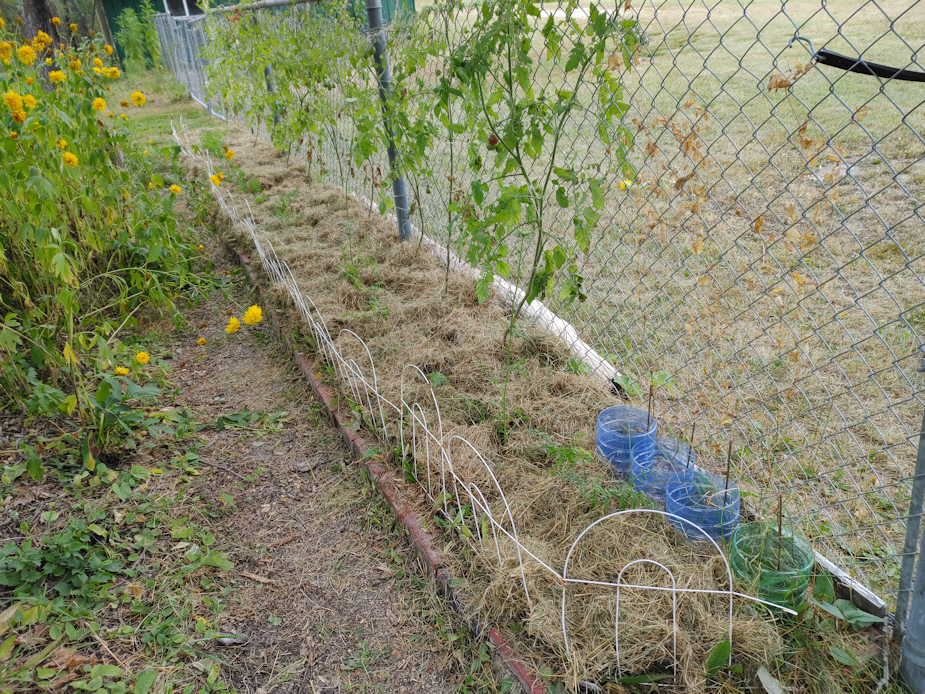
The Chocolate cherry tomatoes and carrots got done. There was just no weeding happening in this bed. Whatever the weeds were, they were pretty delicate. I found myself just tearing leaves instead of pulling up roots, and often accidentally catching carrot greens in the process, so I just gave up. You can see what few carrots made it in this bed, but there are so few onions that made it, the’re not visible in the photo.

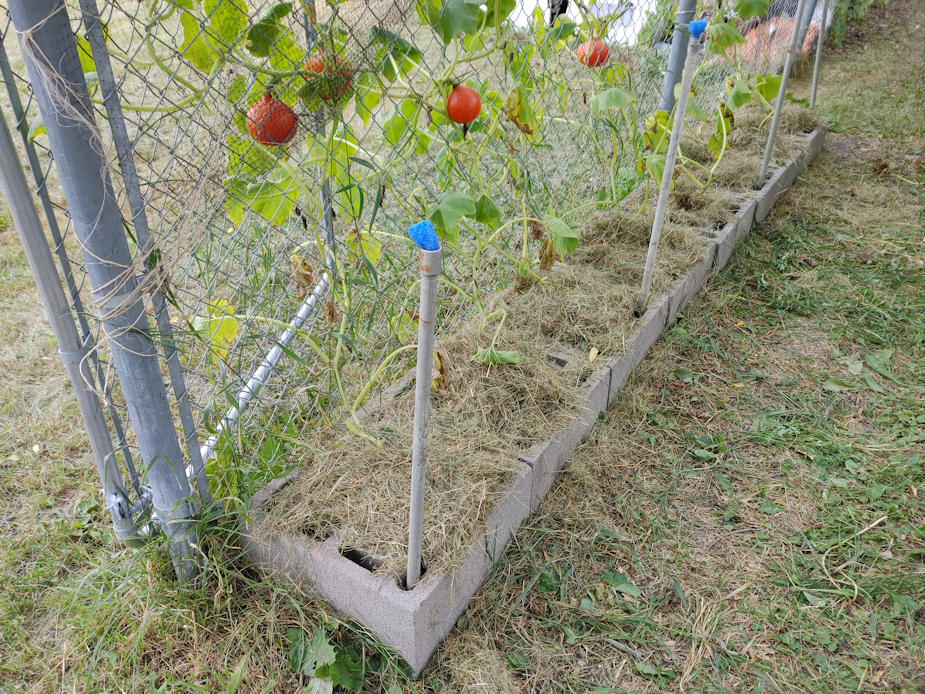
As expected, the layers in these blocks settled a fair bit. After lifting the protective netting, I was able to do some weeding, first, then mulched with clippings. I’ve left the netting up. When they were transplanted, there was a good chance the cats would roll on them or dig them up, but that’s not really a concern right now. We also no longer have ground hogs that might try to eat the squash. They’ve all disappeared for some time now.

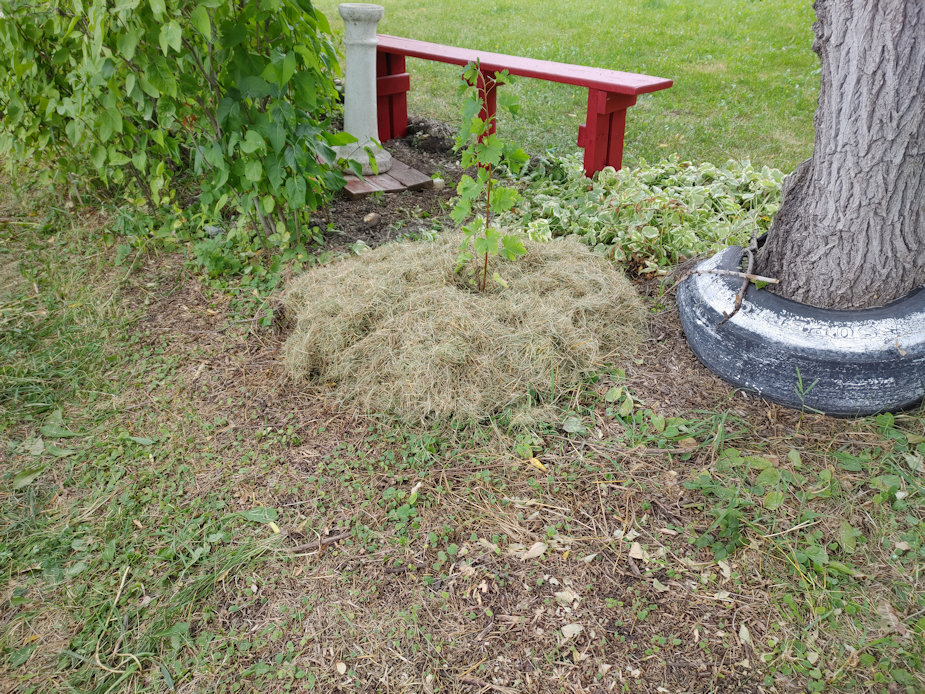
The current bush my mother gave me last year to transplant got a new layer of mulch around it as well.

In the main garden area, the tomato bed got done, making sure it went under the soaker hose. It would have been great if we could have done this much earlier in the season; the stove pellet sawdust mulch we added after transplanting them had broken down quite a bit, long ago. It was the same situation with these other beds…

With the onions harvested, there was just the Purple Beauty peppers, and two tomato plants, that got mulched. Plus the sunflowers. Because, why not?

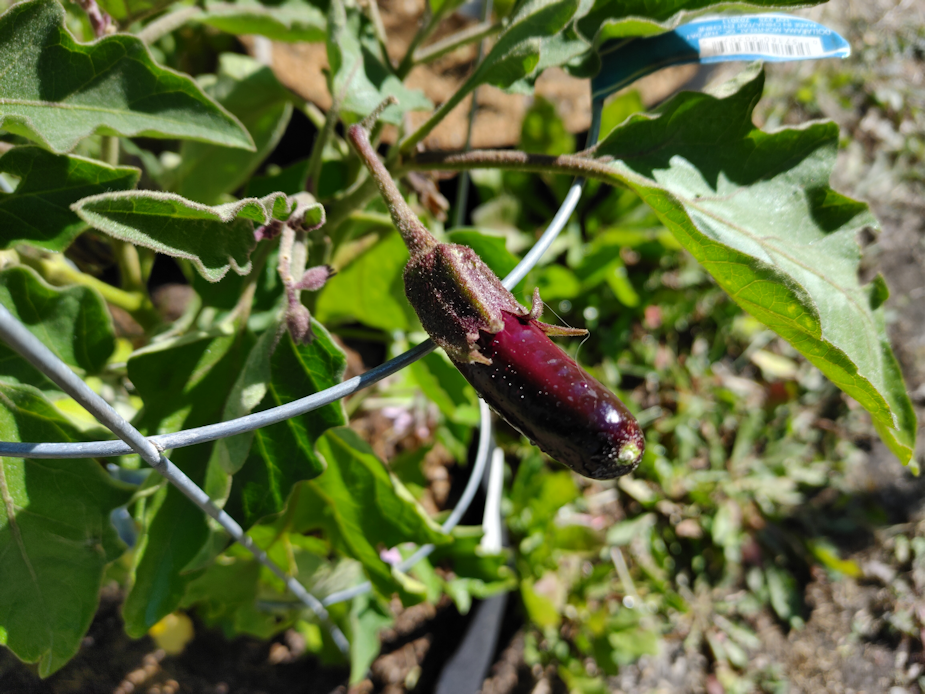
The Little Finger eggplant got done as well.

There is a single eggplant developing on one of the plants!

After all that, I was still left with a big pile of clippings. They will be quite handy as we prepare beds for next year, and for when we plant our hard neck garlic this fall.

As I write this, my daughters are outside, giving everything a good watering. The forecasts are still saying we’re supposed to be getting rain today, but they’re also saying we’re raining right now. Looking at the weather radar, there is an actual horseshoe shape of rain around us, but not over us! Still, there’s a large system of rain heading our way. Maybe, just maybe, we’ll actually get some rain. But if not, things are being watered, just in case. If we do get rain, the extra certainly won’t hurt.

Strange to thing that we need the rain – in areas, I can see the ground cracking from last of moisture – area all the flooding we had this spring!

The Re-Farmer

Our 2022 garden: little vegetables, deer damage, more mulching – and Leyendecker update

My daughters were finally able to finish raking up grass clippings from a couple days ago and bring them to the squash and corn patch for me. My older daughter still isn’t feeling very well, but she is much improved, at least, and can be more active again.

While they did that, I did my morning rounds and checked on things. My first find was a disappointment.

The deer chomped this highbush cranberry. Again! It had been recovering so well from the last time they beheaded it. The other cranberry was ignored. The silver buffalo berry and sea buckthorn are being left alone. I don’t know why they keep going after this one.

I wasn’t sure what to expect in the garden this morning. I was awakened by a crashing, early this morning, and discovered Nosencrantz had tried to get at the window again. I’ve actually had to put other screens in front of the window to protect it, because as much as I don’t mind them sitting on the window sill, I DO mind them clawing at the screen and making holes. When I had the window fan set up, they kept trying to jump on top of it and knocking it off, so they could claim the space. I took a couple of the old window screens I found in the shed and barn that we’ve been using for various things. They’re different sizes, so it took two of them to fully cover my window. They’ve got cord running across to hold them in place, but I still need to be able to slide them aside to reach the window. Which means that, if she’s determined enough. Nosencrantz can knock the screens off entirely.

Which is what woke me up.

As I was putting the screen back up, I heard the furnace shut off.

I hadn’t even noticed the furnace was on. Why did the furnace turn on???

Well, it turns out that, instead of the overnight low of 11C/52F that was forecast, the actual temperature at the time was 5C/41F. The girls had their windows open – it was finally bearable up there for them! – but with the way air circulated in this house, that resulted in a cold wind blowing down the stairs.

I have since turned the thermostat down further.

This is where looking at the long range forecast frustrates me. According to those, we weren’t supposed to have overnight lows like that until the end of September. Our average first frost date is Sept. 10, which is Friday. Over the next while, we’re supposed to go up to 28C/82F with a low of 15C/59F on Thursday, then drop to 16C/61F with a low of 4C/36F on Friday, then warm back up again.

Which would be okay, if that actually happened, but if our overnight low was less than half of what was forecast, how can I trust we won’t get frost temperatures?

Well, we can just hope.

The baby eggplant is getting bigger, but looked like it was about to break off its stem, so I dug out the last of the tomato cages I bought this spring and set it up.

Remarkably, there are tiny little peppers forming! They are supposed to turn purple when fully ripe, but I doubt there is enough growing season left for that.

Oh, I forgot to mention. My daughters taste tested the Chocolate Cherry tomatoes, and just loved them. They are very flavourful. The red tomatoes are very mild flavoured. The yellow pear have more flavour, but not compared to the other cherry and grape tomatoes we grew last year. So we won’t grow the yellow pear tomatoes again, but will be saving seed from the Chocolate Cherry. We got the seeds from Veseys, but they don’t seem to carry them anymore. From what I can find, though, they are an open pollinated, heirloom variety, so saving the seeds should give us the same variety. I did find some sites listing them as a hybrid, though, so perhaps there are more varieties with the same name. No matter. We will give it a try!

The girls got a nice big pile of grass clippings gathered for me. This is just from the south yards, which I cut a couple of days ago, so the clippings had time to dry in the sun a bit.

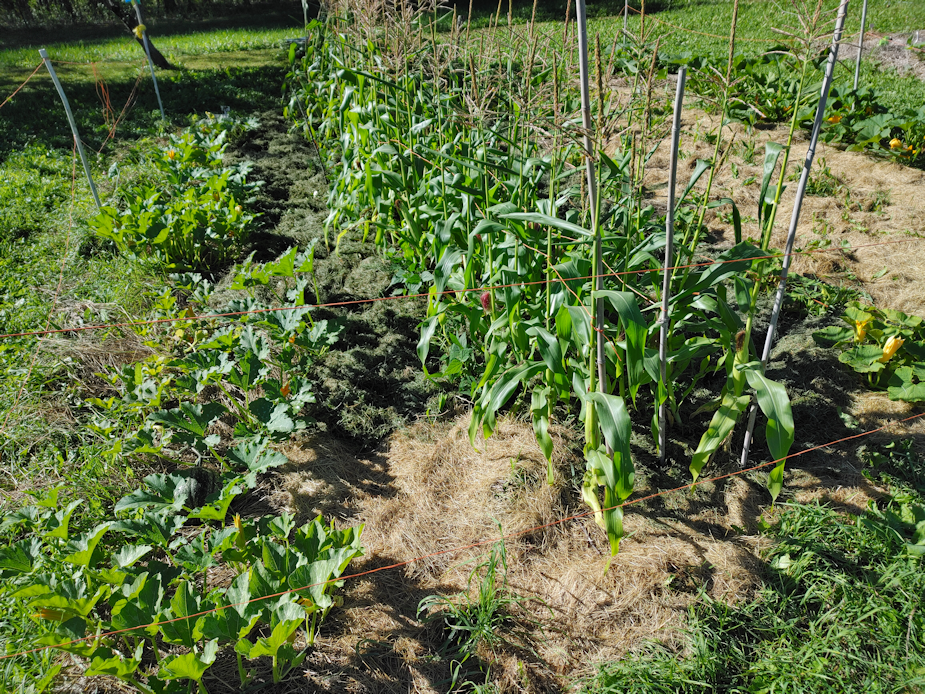
It was enough to finish mulching either side of the sweet corn, around the green bush beans, and most of the space between the corn. I did have to rake up more grass clippings from the north yard where I mowed yesterday to finish the job. The grass in the west yard is so sparse, there are no clippings worth raking up.

At this point, the amending that’s being done here is more for next year. We will be moving the trellises closer to the house next year, and these might be good places to put them. I don’t know when I’ll be able to start taking down trees to build more high raised beds – there are only 2 that are unobstructed and can be taking down at any time. Others need to wait until the garden beds in the east yard are done, and those ones need to be cleared before yet others can be cut down.

So even if things just don’t work out and we’re not able to build any high raised beds this fall, we can still use the new beds we made for the potatoes and melons, and in this corn and squash bed, to build tunnel trellises – I’d want to build two, I think – and more basic trellises with other materials we have available. I think these might even be permanent or semi-permanent locations for trellises, so we can make the extra effort to ensure they are not wonky and wobbly, like the ones we’re using for one last year right now. Which means the more mulching and other amending we do this year, the better it will be for next year.

I’ve also been looking at the grape vines. I want to transplant them to a better location, and would love to build an arbour style trellis for them. It would be nice to make an arched style arbor over the people gate in the chain link fence, but not with those big elms above. Those are not as high on the priority list, though, so we have time to figure out what we want and where.

I’ve been eye balling some of the wood the tree guys set aside for me when they chipped our branch piles. We might be able to use some of them to make smaller, slightly raised beds in the old kitchen garden. Or even just a low wall along one side, to keep people from accidentally stepping where my daughter has planted her irises and daffodils! 😁

I’m quite looking forward to figuring things out.

Meanwhile…

I just called the vet clinic again, which saved them from needing to call us later on. Leyendecker is eating, which is a good sign. They plan to take the catheter out this afternoon, and will monitor him overnight to make sure he’s peeing properly without it. We will get a call tomorrow. I asked about the bill, as my daughter will most likely transfer funds to me – my debit card has a higher purchase limit than hers does – and I wanted to give her an idea of how much. So far, we’re at about $700. With the medications he’ll be coming home with, and tonight’s overnight stay, she said the total might reach a thousand. Of course, he will need to come back for blood work to check if there is permanent damage to his kidneys. At least with that, we have the list on the form I signed, so I know that after taxes, that’ll be another $150 or so.

The main thing is, he is recovering, eating and drinking, and should soon be coming home!

The Re-Farmer

Our 2022 garden: mulching, growing and harvesting

I didn’t get a photo of the finished squash patch last night, so I got one this morning.

All the paths are now mulched, too. There’s no carboard under the paths, so I expect things to start growing through, but at least it will be more sparse.

The plants themselves are seeing new growth and lots of flowers. It’s a race against time and the weather to see if we’ll have anything to pick this year.

I love that you can see the giant pumpkin from so far away!

I swear, this thing is visibly bigger, every day.

Of the two other pumpkins spotted, this one is making it and growing fast. The other did not get pollinated, and withered away. I see no other female flowers, so we’re probably just have the two.

In checking the Red Kuri squash and Apple gourds, I found both male and female flowers blooing at the same time, so I went ahead and hand pollinated. The Red Kuri is doing well, but with the Apple gourds, all the female flowers so far have withered. This morning, I found a female flower on one plant, and a male on another, si I made sure to hand pollinate

Thankfully, tomatoes are self pollinating.

The are so many of them changing colour right now! I have to check myself, to make sure I don’t pick some of them too early.

The one big Sophie’s Choice tomato I recently picked was enough for the girls to make a tomato salad out of it. I’m glad they’re enjoying the variety.

I finally picked the one bigger golden zucchini this morning. There were not a lot of yellow beans to pick, but there were more of the pole beans, with many more little ones on the vines. There will be more peas for a while, too. There may not be a lot of quantity from each of them, but altogether, it’s pretty decent.

The only down side this morning are my pain levels. I over did it yesterday, while pruning the trees. I was so distracted by the heat, I missed my other “time to back off” warning signs. Frustrating.

Ah, well. That’s what pain killers are for. Today is going to be a hotter one, with possible thunderstorms, so it’s not going to be a day for significant manual labour, anyhow.

The Re-Farmer

Our 2022 garden: progress, and one last cardboard mulch

There wasn’t much of anything to harvest this morning. I picked a few shelling peas and just ate them right away. There was no point in bringing so few inside! At least with the first planting of peas. The second planting is looking like it will have a decent amount to pick fairly soon.

I really don’t know what to make of the beans at the tunnel. These are the Blue Grey Speckled Tepary shelling beans. They are so small and delicate looking. They are just barely tall enough to reach, but are managing to climb the mesh. I have no idea how big these would normally get, but for a shelling bean, I would have expected them to be at least as big as…

… the red noodle beans on the other side of the tunnel. These are much bigger plants, but there is still no sign of any vining happening. I’m not seeing any flowers, either. Given that it’s the start of August and our average first frost date is Sept. 10, I’m starting to wonder if we’ll get any of these at all. Even if we do get a super long, mild spring, like we did last year, I wonder if we’ll have any of these at all. At least the purple beans on the A frame trellis are blooming and producing tiny little pods, with vines extending well past the top of the trellis frame, while the green beans on the other side are climbing and blooming.

I have never grown pole beans before, but I really expected them to do better than this. This area did not get flooded out the way the bed with the green bush beans did.

Well, next year we’ll be moving the trellises closer to the house, and this area will be getting perennials planted in it. Parts of the area will need to be kept clear because of the phone line running under it, but not all of it. Hopefully, a new location for our legumes next year will be better.

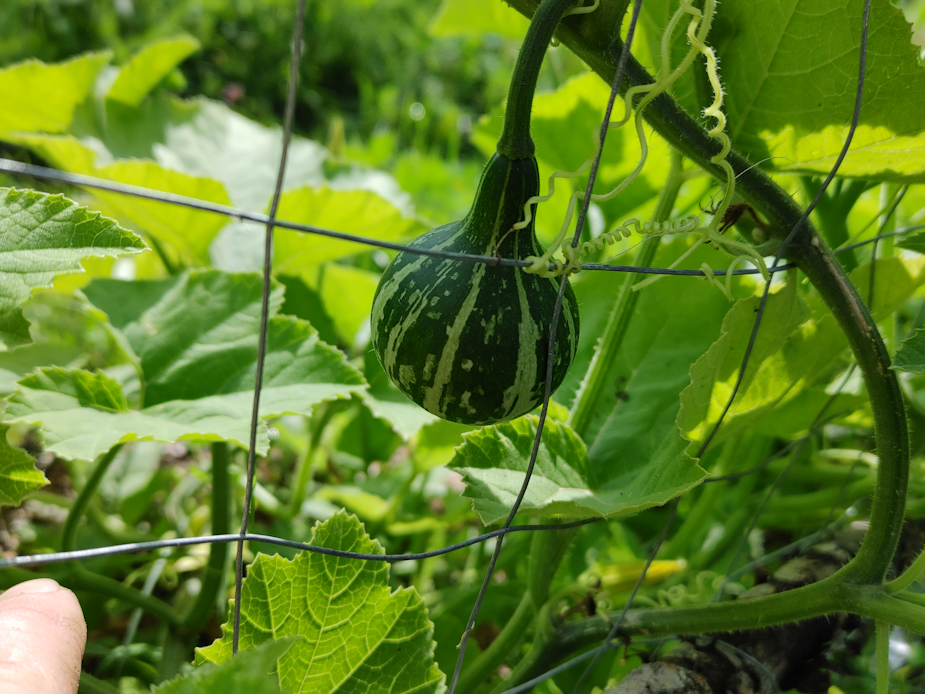
The dancing gourds are doing rather well, at least! The plants are much stronger and more vigorous this year than they were during last year’s drought. So far, there is just this one early gourd growing, though I am seeing quite a few female flowers developing. This one gourd is already bigger than the biggest we had last year. For perspective, the squares in the wire mesh are 2 inches.

In between the tunnel and the A frame trellises are some hulless pumpkins. They are the last patch without the cardboard mulch. I still had the cardboard sides from the wood chipper in the garage, so I decided to use it.

This is how it was looking. There’s an awful lot of creeping charlie making it’s way through the straw mulch around the pumpkins in the foreground. There are actually less weeds than it appears, though, just because of how they spread out.

The cardboard from the wood chipper box was very heavy duty, and had even more staples holding it together than the lawn mower box I used on the Boston Marrow. Cutting it so I could put it around the plants took some doing! Sliding the cardboard in place required quite a bit of care, too. The vines were gripping the straw and weeds quite strongly.

I placed some of the protective poles back, around the patch, and will be adding scythed hay mulch on top as I am able, but I find myself wondering if I should make a support frame for the vines to climb. I don’t know if that would actually help these or not. At the very least, I’ll be adding cord around it, to discourage deer from walking through.

There were quite a few female flowers on the vines, but I found only one male flower, so I used it to hand pollinate as many of the female flowers as were ready. While moving the vines onto the cardboard, one of them had already fallen off, because it had not been pollinated. Hopefully, the hand pollinating will help.

All three varieties of hulless pumpkin have at least some developing pumpkins. Some of summer squash is also finally picking up; the sunburst patty pans are starting to show female flowers again. The Madga squash seems to be doing the best, and we finally have yellow zucchini starting to develop. Not so much of the green zucchini, though.

At least we will have lots of the determinate tomatoes. Even the Cup of Moldova tomatoes are starting to show more of a blush in them.

If the weather holds and the frost stays away, we might still have something to harvest this fall.

The Re-Farmer
Not very far

The scything done near the main garden didn’t get me very far.

It was enough to mulch 5 out of 6 squash in a new row. That leaves one, plus three more rows of 6 to do.

And this is just focusing on around the plants themselves. The paths in between are not fully covered. As you can see between the rows previously done, grass and weeds will still get through, but at least those won’t be competing with the squash for nutrients as much.

While I was working in this, I was hearing the sound of cows that were a lot closer than usual. Usually, I hear them from the property across the road. Not this time! The renter has rotated his cows onto our quarter section! By the time I got out to take a look, they were back in the bushes by the gravel pit, so I couldn’t get any pictures.

We’ll have to keep an eye on the outer yard now. Especially at the “gate” in the fence by the barn. I noticed while I was scything there that one of the big gate posts is leaning way over. With all the water we got in that area this spring, anything already rotting at ground level would have been weakened considerably. The renter has an electric fence going around, but it does fail every now and then. The renter had been looking to replace the fences (responsibility for the fences is part of the rental agreement), but with this spring being such a disaster, I would not be surprised if they won’t be able to do it this year. They weren’t able to even plant anything in the field on this quarter, either. The other quarter they are renting is just hay and pasture, and much of that would have been under water this spring.

At least grazing and haying will be good this year!

The Re-Farmer