When I headed out this morning, there were a lot of areas to check during my morning rounds!
Things are actually pretty good.
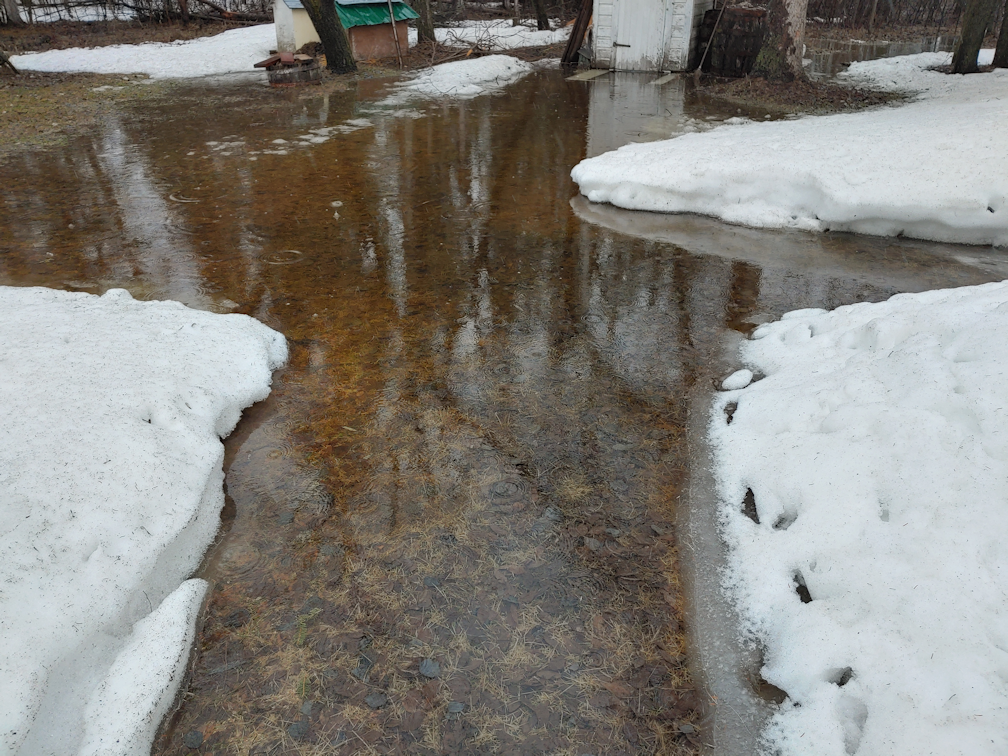
The storage house pretty much has a moat right now. It doesn’t go quite all the way around, but pretty close!
That’s a lot of water for the cats to get through. It looks like it goes all the way to the opening they use here, to get under the storage house. The only other way for them to get in and out is through a broken window at the back, which also has an old bench under it, so there is at least that access to one of their primary shelters.
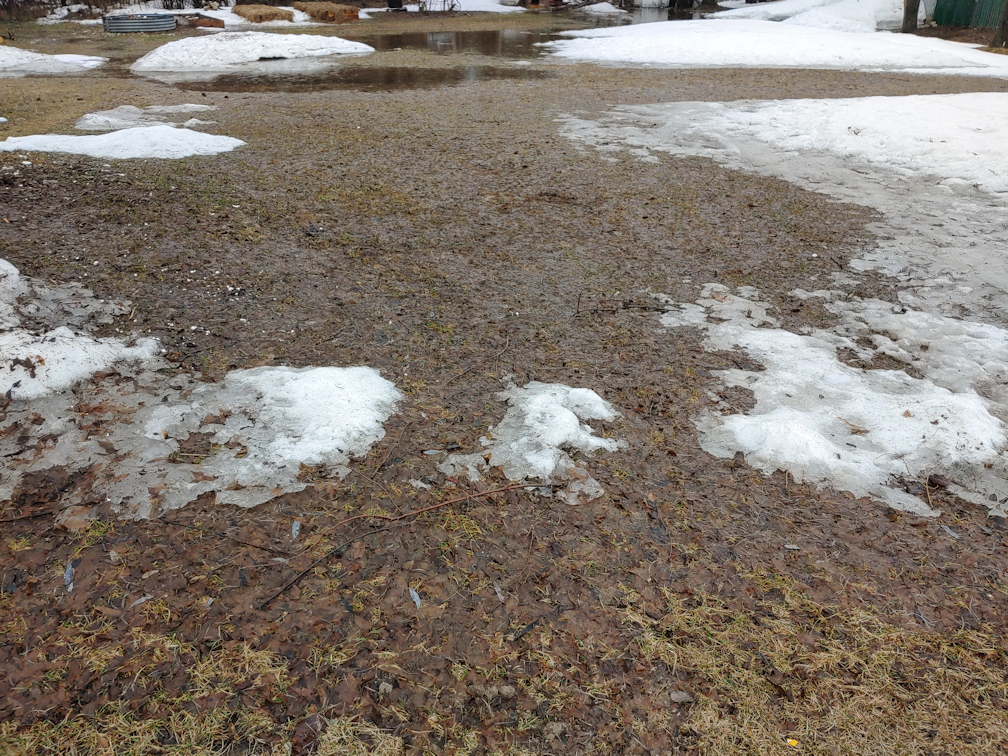
This is the area by the feeding station, where a lane had been made for the septic truck. There is a lot spot near where the pile of poplar wood is that always gets water when the snow melts, but this is the first time I’ve seen the water extend to far towards the gate in the chain link fence!
Before and after pictures of the area in front of the house that we would normally drive up to, when loading and unloading the van. Though the pictures were taken a week apart, there had been another snowfall, so there was actually more snow there, just a couple of days ago.
The water in front of the outhouse and behind the garage is the deepest, and most wide spread, I’ve ever seen it. I don’t know if any critters are using those two old dog houses near the outhouse, but I think that might be where Potato Beetle came from, to get so wet and have straw stuck to him. I’m not sure where the burs would have come from, though.
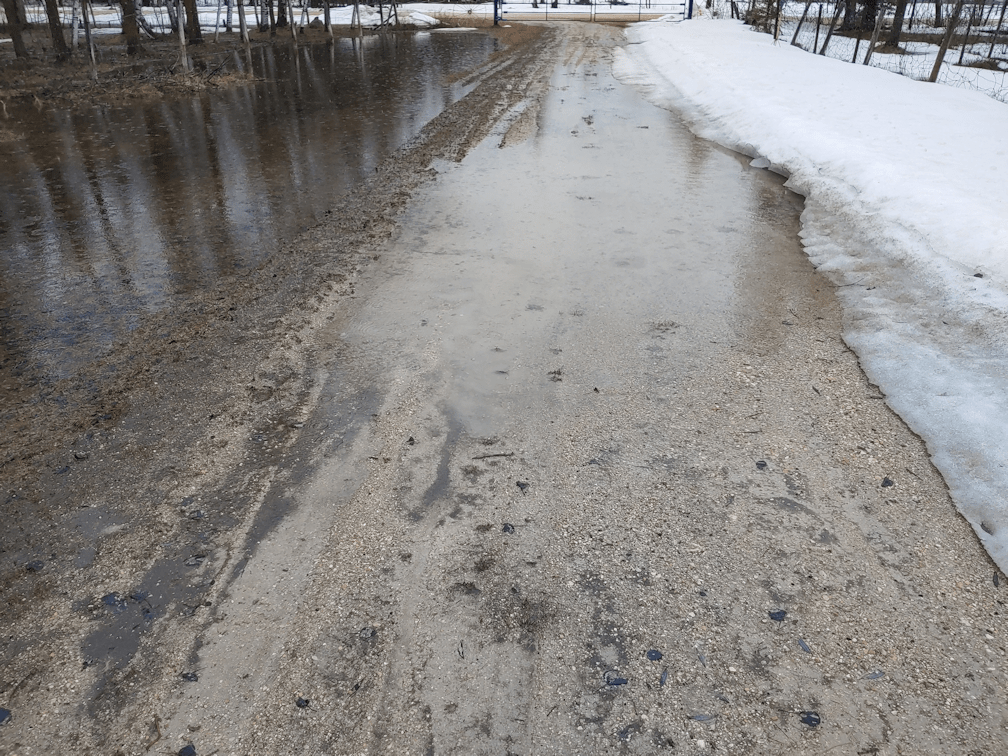
As deep as it is here, the usual lake that forms at the driveway to the garage isn’t particularly large. It looks like the water is actually being absorbed, since it doesn’t look like it’s draining anywhere.
The driveway itself isn’t draining very well. We can still drive through, but I wouldn’t want to unless we absolutely had to, as we’d be just causing more damage.
I took the route outside the fence to get to the sign cam, pausing to check the state of things as best I could. You can see where the rows of corn had been planted, and further back, where there had been a pile of pulled up plants from the garden that were meant to be buried in new plots. The deer had dug them up and eaten most of them, which is why that spot is melted away a bit faster.
Much of the garden area has about a foot of snow still on it, with a few bare patches exposed here and there.
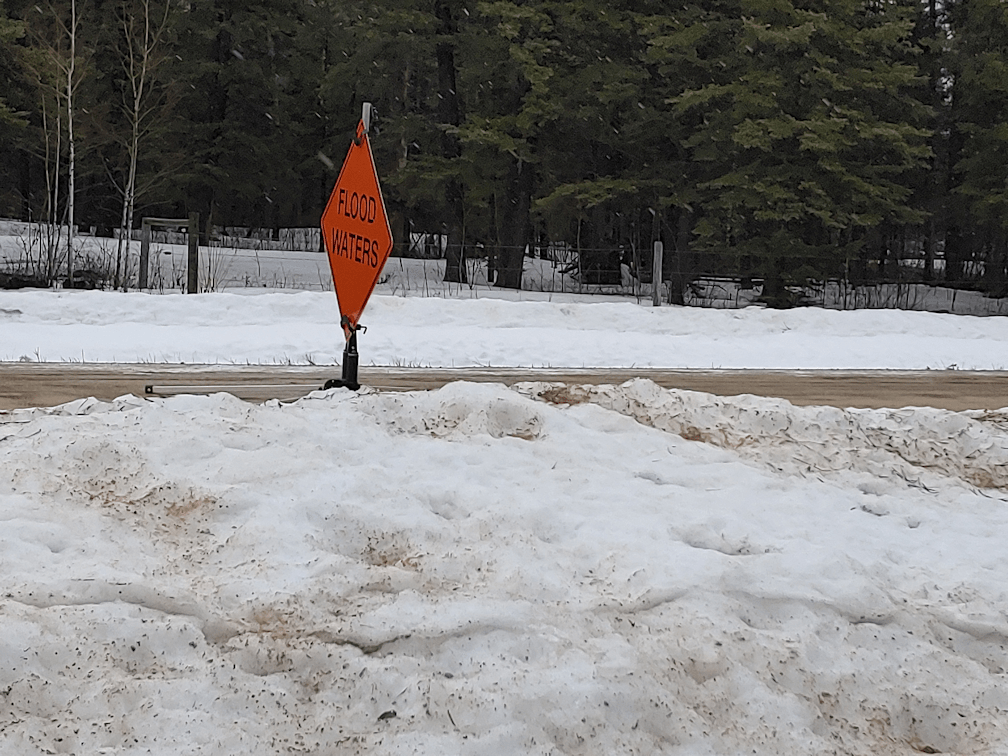
There was a new sign near the sign cam…
The road hasn’t been closed, but drivers are forewarned!
I decided to check the status of the road after this. I’ll share those photos in my next post. :-)
When my daughters went out later on, they checked things in directions I did not go. They were able to get to the shed that has all my parents’ stuff stored in it, and check out the field our septic ejector drains into. There’s water there, of course, but all looks well.
At this rate, we might even be able to get to the barn again, soon! :-D
While talking about the state of things with the girls, one of my daughters commented on what a good thing it was, that we were able to do the big shopping trip to the city when we did! We may not have gotten everything, but we’re easily good for a couple of weeks, and even then, the only thing we’d be running out of is the dry cat kibble.
All in all, we’re doing pretty good. Even the water seeping into the basement isn’t too bad.
After yesterday being such a crappy day, I’m happy to say that today was much improved!
This morning, I found several bright bits of sunshine in the garden.
Several of our summer squash blossoms are now fully open! There are just male flowers right now, so it’s still too early to expect baby squash, but it’s still very exciting to see!
The summer squash was not the only thing in bloom.
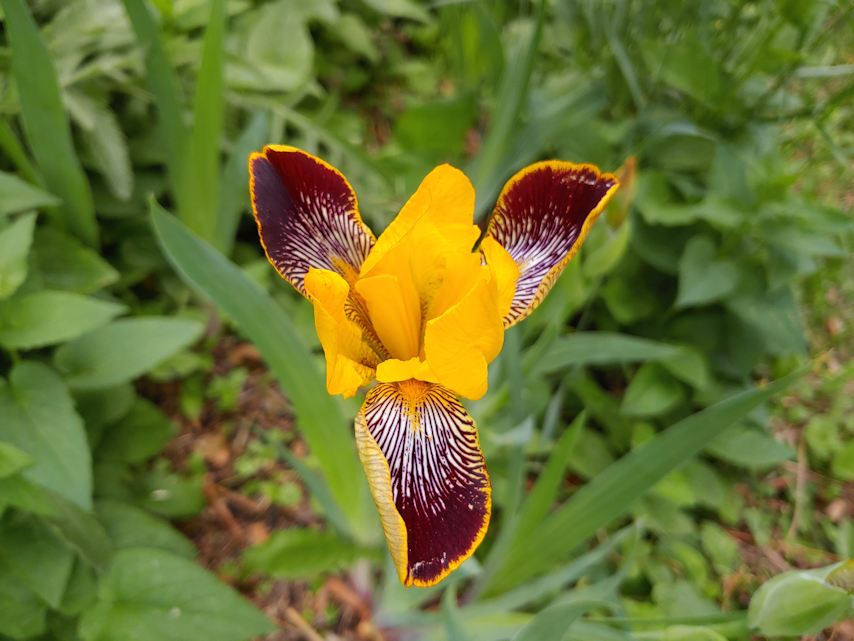
Some irises in the flower garden outside the living room window started blooming today. These have been here for as long as I can remember, coming back year after year, decade after decade. They may well have originally been planted here before I was even born.
We got the trip to the smaller city that I meant to do yesterday. One of our stops was to Canadian Tire, where I was finally able to find the air filter I needed for the push mower. After double checking exactly what I was looking for, I realized that the last couple of times we’d looked for a filter, this type wasn’t in stock at all, so I was happy to find one.
We also made a stop at the nearby Walmart. We ran out of kibble this morning, and had a few other things we needed to pick up. Thankfully, we were able to get everything on the list, and still stayed under budget – something we couldn’t have done if we’d had to buy in town.
One of the other things we needed to get was more gas for the lawnmowers, so pretty much as soon as we got home, I changed the air filter on the push mower, and was finally able to finish most of the mowing.
I had started to move along the driveway with the riding mower, a couple of days ago, but there was no way I could use the riding mower to do the area in front of the barn. This is the first time this area has been mowed this year, and it was tall enough to make hay! I’ll go back with a rake and the wagon to pick up clippings for mulch. There was no way I was going to use the bag. I’d have needed to stop to empty it so often, I would never have been able to finish it all in one evening. As it is, there is still another area that needs to be done, but it’s not used at much. At least now, we don’t have to wade through knee high grass to get to the barn and shed!
I also finally got to cut the main garden area, that is too rough to use the riding mower on. Frankly, found myself thinking I maybe should have used the weed trimmer over all of it, but at the highest setting, the push mower was able to do the job.
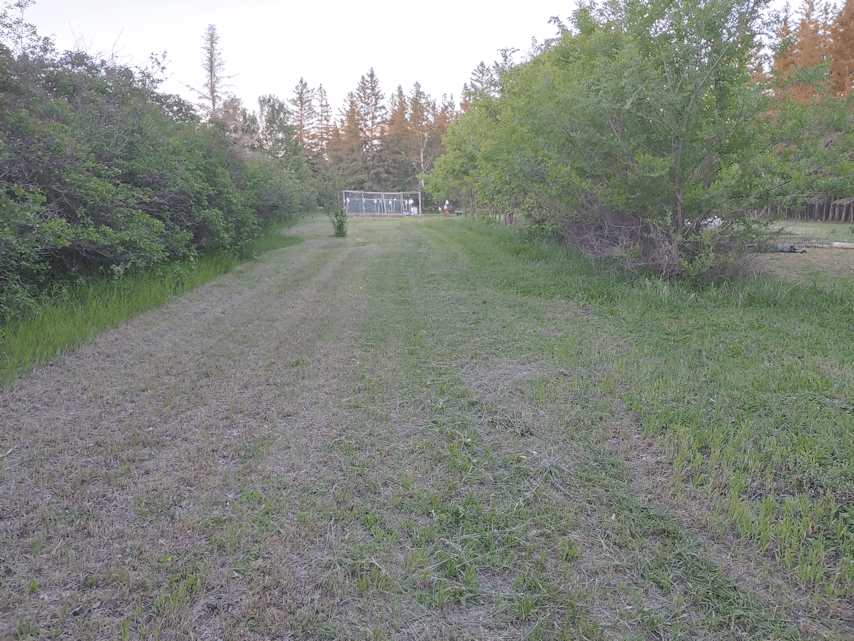
I had done most of this area with the riding mower; the strip along the right was done with the push mower; you can tell by the darker green, because I had the mower set so much higher. This strip had been plowed, so there are still furrows. If I wanted to get the rest, among those trees, I’d have to use the weed trimmer.
It’s just a guess, but I’m pretty sure where I was standing to take the photo is where the telephone lines are buried. A thing to keep in mind when we plant the trees we are planning on.
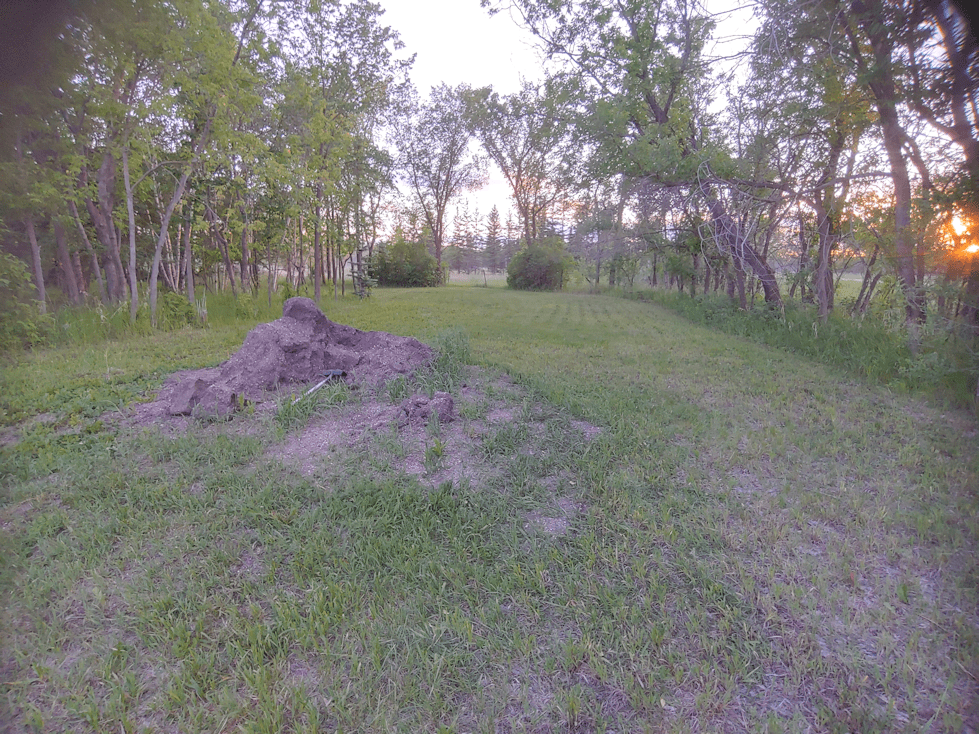
This photo was taken from the same spot, facing the other way.
Not much left of that pile of garden soil!
Part of this section was also plowed. You can see the gate in the back, where the tractor and plow would have entered. The plow was dropped starting along the trees on the right. Why there, I have no idea. There hasn’t been garden there since I was a babe. My parents did try gardening here, when they first moved the garden closer to the house (it used to be way out by the car graveyard, when my parents first moved out here). As I child, I remember when the area that has the trees right, now, was a cabbage patch. The area the dirt pile is on now was no longer being used by then. I remember asking my mother why they stopped using this section, and she told me it was too rocky.
Considering how many rocks are everywhere else, that’s saying a lot! :-D
Anyhow, I still wonder why the plowing was starting that far back, but then, my sister thinks the person who did it was drunk at the time, so who knows? The furrows mean it’s another area for the push mower, though the section to the right is flat enough for the riding mower.
I was even able to do some mowing among the trees, to open up some of the paths. The plants at the bottom of the dead spruce tree in the left foreground bloom beautifully, so I’m making sure to leave them be. I’ll have to do the rest of the area around the trees with the weed trimmer.
Mid term goal is to plant low growing ground covers that we can walk on in the paths, while in between the trees will be a combination of ground cover and flowers, with one exception. The morel mushroom spawn my husband got for me for Christmas will be “planted” under one of the elms in the maple grove. He also got giant puffball spawn for me, too, but they like to grow among grass, not under any particular type of tree. I still haven’t quite decided what area I want to inoculate with those, yet. Just somewhere we won’t be going over with the mower.
That is not the only thing I have to figure out where to put. We also have these.
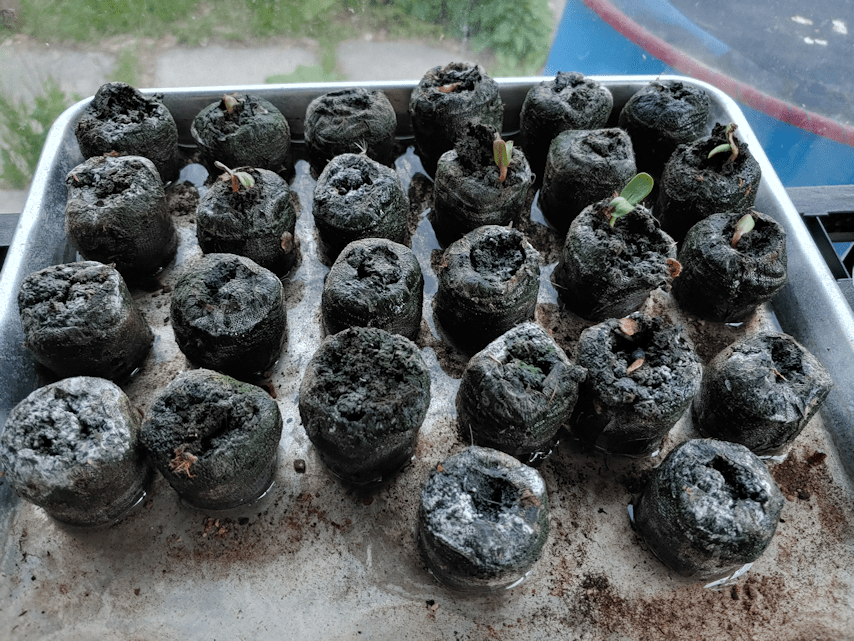
These are the Jiffy pellets we planted the Hopi Black Dye sunflowers in, some 2 months ago. The one that had sprouted got transplanted into the old kitchen garden. When a second one suddenly sprouted, almost a week later, I transplanted it a short distance away.
That made me curious enough to look at the rest of the pellets. I haven’t been watering the tray they were in, but when I lifted some of them up, I saw roots! No sprouts, just roots.
So I moved them all onto one of the baking sheets we got to hold the Solo cups we were using to start seeds, and added water.
Almost overnight, more started to sprout.
Currently, there are 7 new sprouts!
Why did it take these so long to sprout? Especially when the ones that were direct sown, in far less ideal conditions, sprouted so quickly??
And what will we do with them? At this point, I don’t think there’s enough growing season for them to fully mature, but now that they’re finally germinating, I don’t want to just toss them. Also, there’s no more room for sunflowers in the old kitchen garden, and the space they would have gone into in the garden got the Mongolian Giants transplanted into it, since these hadn’t sprouted at all at the time, and we thought they were a lost cause.
I think we will transplant them near the Dorinny corn. That wicked frost we had in late May didn’t seem to affect the corn sprouts at the time, but then they disappeared. They are supposed to be a Canadian frost-hardy hybrid, but that was an unusually cold night. While they looked unharmed the next morning, I guess it took a couple of days for the damage to become visible. However, the other corn seeds that hadn’t geminated yet came up soon after, so we will still have Dorinny corn, but it also means we have entire rows in the block with only one or two corn plants in them. I figure, we can make use of the empty space and transplant these sunflowers into them. Sure, they may not reach full maturity, but at least they’ll have a chance. Who knows. We might have a long and mild fall.
Then there are these.
These are the pink celery that should have been started indoors much earlier. They’ll eventually go into a container (or two?), so we can keep them outdoors for most of the growing season, then try using the sun room as a green house to extend their growing season though late fall.
Assuming they survive being transplanted. We’ll see.
All in all, it’s been a really good day. I finally got things done that kept getting delayed, I got to see the kittens, we had a fabulous supper of butter chicken one daughter made while I was mowing, and there’s panna cotta setting in the fridge, made by my other daughter. And tomorrow, we will be celebrating Father’s Day and my younger daughter’s birthday, early, with a pizza night. :-)
The wonderful rains we’ve had has meant everything has exploded in growth.
Including the grass and weeds.
Today, I decided to break out the weed trimmer and get around some areas before mowing.
In progress, I figured I would keep trimming some other areas. Just the rougher areas, I told myself. I’ll do the rest with the push mower, I told myself. I’ll just do the places the mower won’t fit, I added.
Of course, it’s all rough out there.
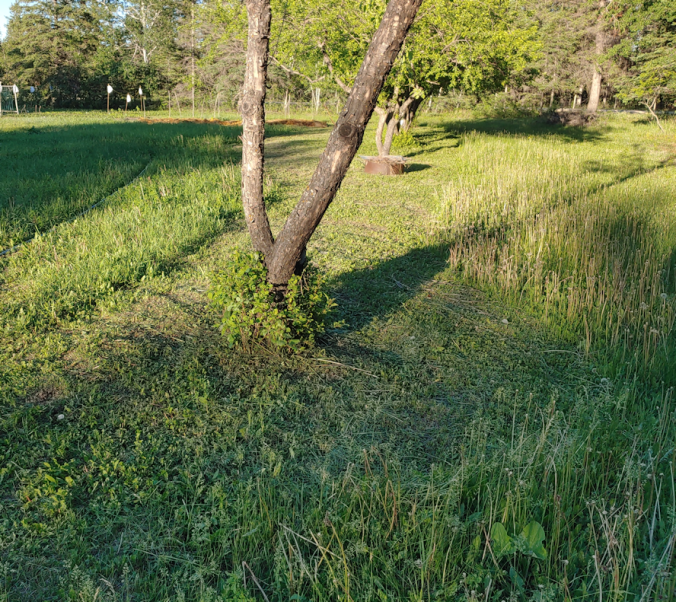
Before I started, I took a look at the crab apple tree by the old compost pile. This one was looking pretty diseased last year, but other trees were looking worse, so this is a bit unexpected.
Parts of it almost started to grow leaves. Then that wicket frost we got in late May hit, and it never recovered. Now it just looks dead.
Dang. That was one of the edible crab apples, too.
Note, however, the background of the photo, and how high the grass and weeds are. It’s high enough that getting the hose over to water the corn and squash is made more difficult than it should.
It was at the other crab apple trees that I started.
The tree in the foreground has just a few live branches left. It is one of several that we will eventually be cutting down.
As for the weed trimming, the ground is pretty flat on one side, so I just went far enough that I wouldn’t be getting my head caught in the branches when I mow. There is something about apple branches are just grab onto things! If I’m wearing a hat, I usually get it pulled right of. If not, I end up having to untangle twigs from my hair. :-D
On the other side, there’s the first ridge of plowed soil. Aside from making it hard to mow over, when the grass gets tall, it’s one of those places we’ve turned an ankle, more than once!
Once at the far end, I trimmed around the summer squash. It’s particularly rough around there, as that’s where the person who plowed it last, turned the tractor, going in circles instead of turning the soil in straight lines in the same direction.
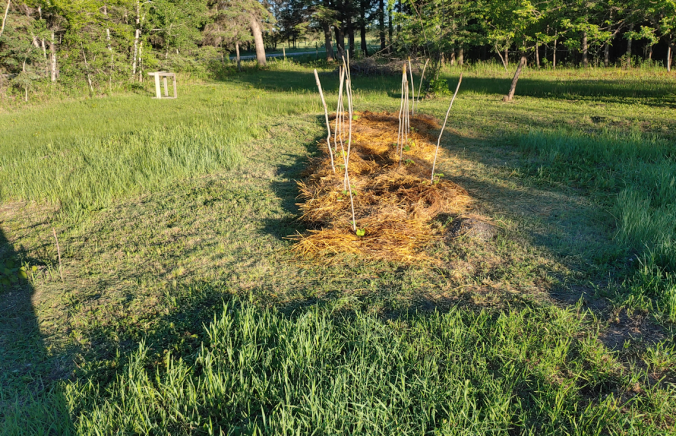
This photo was taken after my daughter had given the beds their evening water. The summer squash was looking pretty droopy while I was working around them, but they sure perked up fast after a good soak! :-)
Also, you can see where the garden cam is currently set up, on that saw horse sitting on its side. Last night, nothing at all triggered it. No deer visits to the garden! :-)
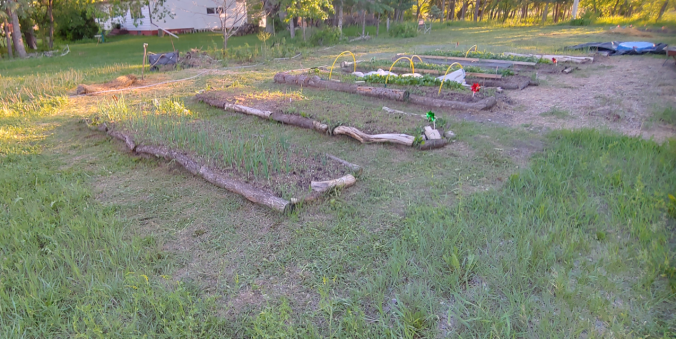
When I started working around the bean beds, I had to get one more length of extension cord to finish the job. Where the bean beds are is actually fairly level, but I didn’t want to run a lawn more in between them.
The extra length was enough for me to be able to reach all the sweet corn and sunflower beds – the pea trellises were prefect to drape the cord over, so it wouldn’t get dragged over plants. One of my daughters had already gone through the area to get rid of the tree saplings that are trying to overtake the area, so I was able to trim all the beds without having to work around little trees. This is not the most powerful of weed trimmers! ;-)
Then I just kept on going. I trimmed around all the main beds, and even in between the old raspberry plants under the dead crab apple tree and the chokecherry. My mother had transplanted some there before we moved out, and when we started reclaiming parts of the old garden area, we found more that we transplanted into there. Eventually, they will be moved to a location that isn’t under trees. ;-)
The last area was the biggest job.
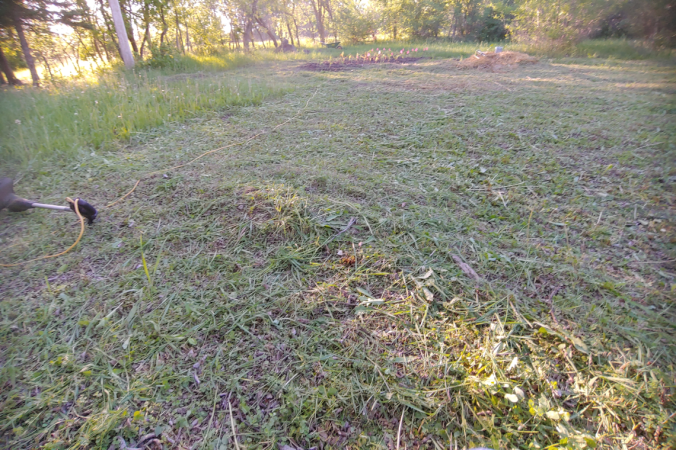
I had stopped for a break when I took this picture. Not only were the grass and weeds thickest and highest here, this is where the plow took the tightest turns, leaving the biggest ridges. One of which now has the Crespo squash growing in it.
All this, and we still need to mow in the areas that aren’t as rough! But at least it’s done, and we’ll have less chance of hitting something hidden in the grass, with the mower!
But that will wait. I was supposed to work on the squash tunnel today. Having the area around it trimmed will make that a bit easier to move around while it gets worked on, tomorrow. ;-)
That cheap little weed trimmer has done really well! It may be a pain, dragging the extension cord around, but it does the job. :-)
We had such a lovely day today, even with fairly high winds, that I couldn’t resist going outside and doing a bit of clean up. This time, I decided to work in the old garden area.
As we clean up around the property, there is one thing I find myself struggling with that I did not expect.
Trees.
In the decades I was away, my parents slowly reduced the size of their gardening, which made perfect sense. Unfortunately, at the same time, they planted trees. Poorly placed trees, many of which I am now having to cut down for various reasons, while trying to save as many as I can. At the same time, they also allowed self sown trees to grow where they really shouldn’t have. Some of them now need to be removed because they are causing damage. Others… well. Let me show you.
This is the before picture.
My mother had a row of raspberry bushes here. Elms and maples had self-sown among them. When my mother transplanted the raspberries (into an area that’s full shade!), she left the self-sown saplings. For a “wind break” she told me. The garden used to extend another 6 feet or so to the north. As they are now, the trees take up a space about 10-12 ft (3-3.6m) wide, and about 100 ft (30.5m) long.
That’s a lot of square feet of full sun garden space that can no longer be used.
Between these and the shade created by the trees they’d planted into the garden area on the south side, huge amounts of garden space have been taken out of production. Space that’s the closest to the house and water.
When I brought up taking them out and reclaiming the garden space, my mother was adamant that they not be touched. Apparently, if we take them out, we won’t have any wind break anymore or something, even though there are plenty of other trees and the lilac hedge to shelter us from Northern winds. :-/
Well, we’re not in a position to actively remove the trees quite yet, though the arborists recommended taking them out while they’re still small enough to be pulled out by the roots with a tractor. While trying to garden near these on one side, and tend the lawn on the other, I figured the least that should be done is to trim and clear them.
Yes, I know. This is probably the worst time of year to be trimming trees, but these are not trees we plan to save. They’ll do just fine, though. In fact, they’ll probably thrive. :-/
Starting at the end I took the photo at, I worked at it using both the baby chainsaw (aka: cordless pruner) and the long handled pruners. Loppers, I think they’re actually called. I used those quite a bit, because the branches and suckers were so dense, I couldn’t get in with the baby chainsaw to cut where I needed to. Which is fine. It reserved battery power for the pieces too large for the loppers. I got about 1 1/2 hours in before the battery died, then I continued for another half hour or so with the loppers.
Here is how it looks now.
That log that is now visible marks the corner of the mulched area we gardened in last year. I cleared until just past that log.
This is my branch pile.
I at first tried to trim the larger pieces and set them aside for potential use later, but that was taking up too much time, so I just added to the pile. When it’s time to deal with the pile, it will be easier to use hand pruners to trim any larger branches that might be usable for other things. The smallest pieces will go onto a chipping pile.
I did use pruning paint on the cut ends of the trees, though the maples were pouring so much sap, a lot of it was washed away! The elm sap isn’t running yet.
For all my mother’s admonitions to leave the trees alone, I found evidence that I was not the first to try cutting these away. In fact, some of what I found were growing out of stumps. Someone had tried cutting them down, and they grew back.
I also found this little group.
Three elms growing into each other! We couldn’t see this until I cleared things away. In fact, I couldn’t stand in the spots I was in to take the photos, either.
I worked on a maple just past this group of elms and found myself pulling out large strands of vines as well. The rest of the section has more of these vines. My mother had planted them (not here!) years ago, not realizing they were invasive. Now they’re spreading all over, and I’ve found at least a couple of trees that have been killed by them. So I stopped to continue another day, since more time will need to be spent pulling up these vines, which will need to be burned.
The irony of pulling up vines that are killing trees we plan to get eventually get rid of is not lost on me!
By the time I’m done with these, we should be able to walk through and around the trees without having to fight branches. I’ll even be able to mow past them without branches pulling off my hat!
Hopefully, their roots won’t make gardening near them too much of an issue. Eventually, we do plan to build some permanent, high raised beds in this area closer to the house, so it won’t be an issue for long. When we build the permanent garden beds to the south of the house, that will be where we will focus more on things that take longer to mature and get harvested in the fall, while areas closer to the house will be more kitchen garden type things that mature quickly, or have a continuous harvest.















 The Re-Farmer