Our 2025 Garden: a nice harvest, and breakfast!

This morning I collected our largest harvest yet, for this year!

I had some help, too.

When I prepared to transplant the melons, I set up a trellis for them using Dollarama steel fence posts and welded wire mesh salvaged from the old squash tunnel from years ago. When the Spoon tomatoes were planted in the other half of the bed, I use bamboo stakes to make them their own trellis.

Well, with the melons barely growing at all, they’re not going to need the trellis. So, with my daughter’s help, we pulled the posts, with the wire still on them, and moved them over to the corn and Arikara squash bed. It’s loosely set up for now, but the 4′ square bed will get a wire fence around it – the mesh is just long enough! – to hopefully keep the raccoons from getting into the corn, when the cobs are ready. I’ll probably have to put some sort of cover over it, too, or they’ll just climb up and over.

The corn bed has plastic netting around it. Hopefully, they will be dissuaded from the corn rather than tearing their way through.

After moving the melon trellis away, the Spoon tomatoes can now be reached from both sides, so my daughter helped me pick tomatoes on one side, while I did the other.

There were lots of Spoon tomatoes to pick!

I’m glad I remembered to bring a separate container for the Spoon tomatoes!

There was also a whole two Royal Burgundy beans to pick, from the three surviving plants. I did pick a small handful of yellow bush beans last night, though, so there was enough to actually use. While checking last night, I noticed some ripening Sub Arctic Plenty tomatoes and this morning, one was ready to grab.

After that, I dug up some potatoes, then winter sown carrots from the high raised bed.

In the next image in the slide show above, you can see a very wonky potato!

That was from roots.

These potatoes were picked from about the middle of the bed, so at least twenty feet away from the trees. My garden fork was digging up more roots than potatoes.

Those trees have got to go.

Then I remembered we have herbs and stuff, so I went to the old kitchen garden, where I gathers some lemon thyme, lemon balm and oregano. In the winter sown bed, I grabbed a few Swiss Chard leaves. I even grabbed some bulbils from the walking onions, since we don’t want them to spread any further.

Once inside, the longest time was spent getting all those little green bits of stem off all those Spoon tomatoes! I also set aside some of the ripest looking ones to collect seeds from, later. Their seeds are so tiny, I’ll have to consider how best to do that!

In the last photo – which looked much better and in focus on my phone, I swear! – it what I made with it. There’s still potatoes and Spoon tomatoes left, plus the one Sub Arctic Plenty tomato, but I used up all the carrots, julienned, a handful of bush beans cut small, the onion bulbils and a whole head of garlic. We still have fresh garlic left of the ones that were too far along for curing and winter storage. Then there was the chard and herbs.

When I went into town to get kibble yesterday, I also picked up some chicken legs and thighs that were on sale, which my older daughter prepared last night, so breakfast (brunch?) was the vegetables gathered this morning, plus oven roasted chicken legs.

It was very good!

The Re-Farmer

Our 2025 Garden: herbs are in

It’s hard to be having a heat wave like we are now, and have to think about last frost dates before planting things! Our average last frost date was June 2, but this year it’s listed as a range from May 28-31.

On the one hand, I’ve been eyeballing the long range forecasts. They tend to change often, sometimes multiple times in a day, but we are no longer having predictions of overnight temperatures below freezing. So far, nothing lower than 5C/41F in the overnight lows expected in early June.

On the other hand, I’ve been eyeballing the dandelions. If you’ve been following Maritime Gardening, you may have heard his way of using the stages of dandelions to judge when to plant things. When the greens emerge, the soil is warm enough to plant cold hardy seeds like peas and spinach. When the flowers are blooming, the soil is warm enough to plant things that need a bit more warmth, but can still handle a night of frost, like brassicas. When the dandelions go to seed, the soil is warm enough to plant everything else.

Our dandelions have been blooming for a while, and lots are starting to go to seed.

So I should be able to direct sow or transplant pretty much everything right now, but I still want to be able to cover things if we do get a frost.

Since I didn’t want to render myself immobile again, today I decided to work on the tiny raised bed garden and transplant the herbs I bought a few weeks back.

This bed got prepped in the fall, so there wasn’t much it needed – other than finally reinforcing the cover that cats keep lying on!

I took the cover over to the garage, along with some leftover pieces of hula hoop, which is what is already being used in the cover, to add to it. I got one installed, but when I tried to set up the other, it kept snapping on me. Thankfully, I had a piece of pipe of some kind my brother had passed on to me, along with lumber, shelving and numerous other small items he knew I would find uses for. It was perfect for the job, and I still have some left over. There was also a short bamboo garden stake that I wove through the chicken wire across the top. That will both support the wire (and the weight of cats) and make it easier to carry the cover.

Then it was time to ready the soil. It had a grass clipping mulch that was set aside, then I used my little hand cultivator to loosen the soil so I could better remove the rhizomes. Unfortunately, I was also finding tree roots; this time, from the nearby ornamental crab apple. I think there’s actually a large root running under the bed, but if there is, it’s deep enough it shouldn’t be a problem. It’s the little capillary roots that can become an issue!

After a few years of amending this bed, the soil was really nice and fluffy, already. I did amend it more with the rehydrated coconut coir, plus some manure. The soil was insanely dry, so I made sure to give it a very thorough watering once the amendments were mixed in.

I then set the pots in and moved them around until I figured out where the herbs would go. I’ve got English Thyme and Golden Yellow Thyme that are kitty corner from each other. The other corners have oregano and Greek oregano. In the middle, closer to the walking onions, is lemon balm, with the basil across from it. Once transplanted, they got another watering.

After they were transplanted, I carefully scattered the mulch around them, making sure it was under their leaves and stems.

Then it got another watering.

Last of all, the cover was set in place. No kitties will be rolling around on or digging these up!

The next area I plan to work on is the wattle weave bed. The tiny strawberries in there are blooming up a store right now, so I’m not going to transplant them until the fall. They don’t take up a lot of space. I think there is enough room to plant both the eggplants and peppers in this bed. We’ve grown both in there before, and they did surprisingly well, so that should work out.

We’re going into the city for our first stock up shopping trip tomorrow, though, so that won’t happen for a couple of days. The transplants are all looking really strong and healthy this year – even the ones that got dumped upside down when the wind knocked the greenhouse half over! If things work out, we should be able to get all the transplanting and direct sowing done over the next week or two. I’ll be quite happy when that is all finally done!

I have to keep telling myself. It’s still only May. With the weather we’ve been having, it feels like I’m behind on things, but I’m actually ahead!

Hopefully, this will be a good growing year.

The Re-Farmer

Our 2024 garden: herbs and peppers

Today, I did some seed organizing.

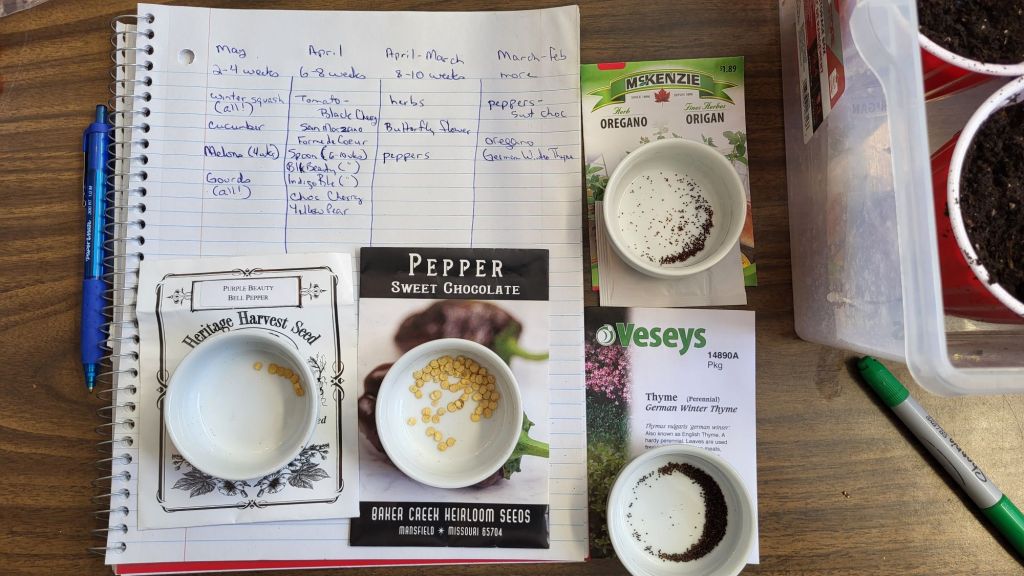
After marking out the weeks backwards from our June 2nd last frost date on our calendar, I then went through my bin of seeds and organized them by when they need to be started indoors. Then I picked out the ones I could get started now.

We won’t be starting everything that we have seeds for.

Starting from the 3-4 weeks list:

I still haven’t decided if we’re going to plant any gourds at all this year. There are several I really want to grow, but we just don’t have the space. With the winter squash, we have the new packet of mixed winter squash seeds to try, plus one type for pies my daughter asked for. With the mixed seeds pack, we will of course want to plant the entire package, and see what we’ve got! I would still like to try the Honeyboat Delicata squash again; the few we got didn’t get a chance to fully mature, but they were great in the pie my daughter made! We also really liked the Pink Banana and Georgia Candy Roaster. There are other varieties that didn’t do well that I want to try again, just so we can decide if we like them or not, but that will depend on how much space we have. The problem is, there are a LOT of things that need to be started in that 3-4 week time span. I’m still not sure if we’ll do cucumbers this year. I’d rather use the space for the melons and winter squash. We’ll be skipping the hulless seed pumpkins this year, but I really want to try the Crespo squash again. Last I saw, Baker Creek didn’t carry the seeds anymore, so I want to successfully grow at least one to collect seeds from!

As for the tomatoes in the 6-8 week list, we’ll not be planting all that we have seeds for. We’ll do the San Marzano paste tomatoes for preserving and the Black Cherry for fresh eating. The free seeds we got are tempting me greatly, and I always want to grow more Spoon tomatoes! They’re just fun. I want to start quite a lot of the San Marzano, but not as many of the cherry tomatoes. I don’t want a situation like last year, where we ran out of space and had to give away so many transplants!

From the 8-10 week list: the Butterfly Flower is a type of milkweed, so I definitely want to get those going. We have three varieties of “early” peppers that I waited to start last year. They have such a short growing season, technically we could direct sow them. It didn’t work out. They didn’t get to produce, though with most of them I now know that the grow bags they were planted in were invaded from below by roots from the nearby Chinese elm. So we’ll definitely need to keep that in mind, when deciding where to transplant them this year. I will be starting fewer seeds, shooting for at least 2 plants per variety in the garden, but between the 6 varieties I’ll be starting this year, we’ll still have plenty for our needs. Hopefully, my family will have peppers of each kind to try, so we can decide which varieties we like enough to keep growing, year after year.

You’ll notice there are no summer squash on my list. Those got moved to the direct sowing bin. I’m not going to have the space to start them indoors. As long as I can keep the slugs away from them, they should be okay to start outdoors.

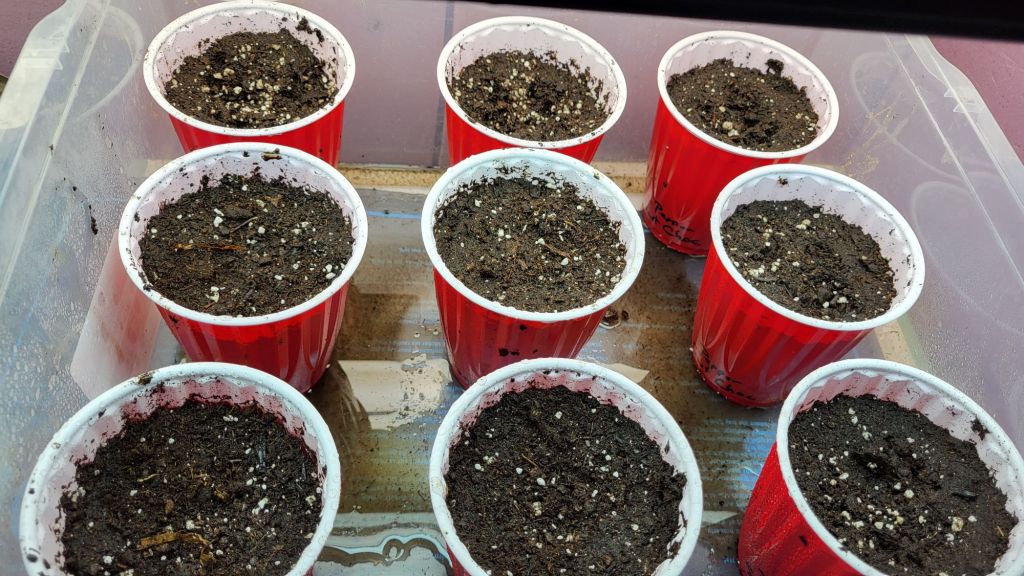
There were four things I could start today. Since I was after fewer plants per variety, I decided to go with the Red Solo cups to start them in, rather than the larger trays with smaller grow cells.

With the herbs, I’m just doing the oregano and German Winter Thyme again. The chamomile we planted last year should have self seeded, and we’ll see if the spearmint survived the winter in their pot. We ended up not using the lemongrass at all, so I’m not trying them again this year. We’ll plan out our herbs more, as time goes by. The herb seeds are so incredibly fine – especially the oregano! They got surface seeded over the pre-moistened seed starter mix, then covered with a light dusting of dry starter mix to just barely cover them, followed by a spritz to moisten the tops. Vermiculite would have been better, but I don’t have any. The herbs went into two cups each. With such tiny seeds, there’s no way to know how many I managed to sprinkle onto them. I still had seed left over, too, so if they don’t take, I can try again. The oregano really struggled last year, and I ended up with only one surviving seedling to transplant. That one plant did well, at least! They were started in the little Jiffy pellets last year, so I hope they do better in the larger cups and a different growing medium.

I decided to go ahead and plant the last of our Purple Beauty seeds, which are two year old seeds. The first time we planted them was a year of drought and heat waves, and they did very poorly. Last year, what was planted in that bed also struggled, so I think it’s more a problem with the soil in that bed. I split the last 7 seeds of Purple Beauty between two cups.

The Sweet Chocolate peppers were the one pepper that we were actually able to harvest mature peppers from last year, and they were also the only ones I started quite early. We saved seed from them, too, but there was still plenty in the packet, so I used those. There was enough to plant three seeds into each of three cups, with plenty of seed left over. I had intended to do just two cups, like the others, but the bin they’re in for bottom watering holds 9, and I just had to fill in that last space! Yeah, it’s a bit OCD, but I have an excuse. If there are gaps in the bins, the cups tend to fall over more easily when the bins get moved around.

So these are now in the big aquarium, on the warming mat.

The next seeds don’t need to be started until the second half of March, at the earliest.

Must… resist… starting too early!!!

😂

The Re-Farmer