It was a hot and sunny day, and so many trees and bushes are blooming right now.
The regular and double lilacs are just starting to open. The sour cherries are in full bloom. The Saskatoons and chokecherries are pretty much finished blooming, but the different crab apple trees are in various stages of exploding into flowers. There are also three other types of lilacs that are starting to bud, each blooming at a different time. It’s awesome!
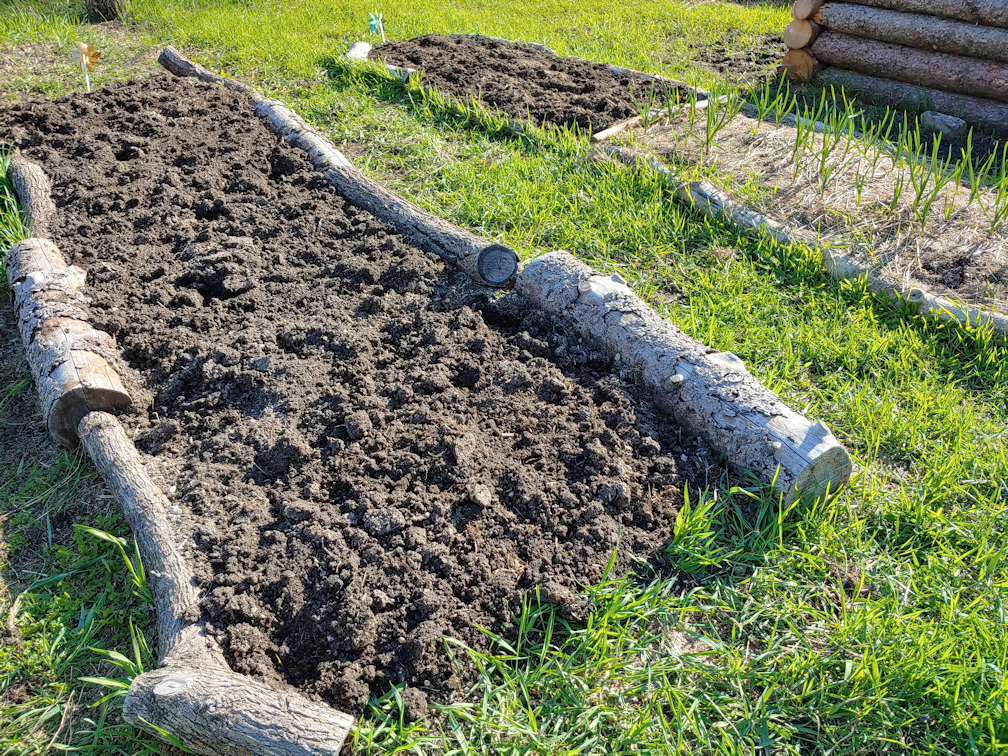
My first priority of the day was to prep the beds at the trellises and get them ready for planting.
What a big job that turned out to be.
It didn’t take long before I found myself pulling this bugger out. Normally, I wouldn’t have tried to take out something so big, but it was close enough to the surface that it would inhibit root growth. I’m sure I hit others bigger than this, judging by my inability to work the garden fork around them, but they were deep enough that I just left them. We may get one more year out of these trellises, but most likely, next year, we’ll be building trellises closer to the house.
This trellis was so full of roots – including tree roots! – that this one bed took me about 4 hours to do.
Thankfully, the other one didn’t take anywhere near as long!
After we’ve planted into them, each upright post is going to get it’s own pair of A frame netting supports for things to climb.
At this trellis, on the right hand side, my daughter planted all the cucumbers. On the left hand side, in the foreground, is at least two, possibly four, luffa gourds. I was using labels made out of sour cream containers, and Sharpie’s fade from those! So much for “permanent” markers!
The gourds took up only a quarter of the row. We ended up planting the last of our Lincoln Homesteader pod peas in the rest of that side.
This trellis got the remaining two varieties of pole beans. On the right are Carminat, a purple type of bean. On the left are Seychelles, a type of green bean that Veseys doesn’t seem to carry anymore.
There was some space left at the bean tunnel that got filled with 4 Tennessee Dancing Gourd and 2 luffa.
The girls, meanwhile, got the last low raised bed weeded and ready for planting.
This bed is now all summer squash. The front half has 8 Sunburst patty pan squash. The back half is split between Madga squash and Golden zucchini.
While one daughter transplanted all of those, my other daughter was digging.
We were going to make more beds, but we just don’t have the materials, so we’re winging it. My daughter dug a grid of 7×7 holes roughly 3 feet apart. Before I headed in, I used the jet setting on the hose to drill water into each hole, to help soften the soil. We’ll be transplanting winter squash, gourds and pumpkins into here, with added garden soil and straw mulch. We need to go over it with the weed trimmer to cut the grass and weeds back as much as possible, before the mulch is added.
Hopefully, we’ll be able to get this done tomorrow, but I won’t be much help with that until evening. My husband and I have our doctor’s appointments in the afternoon.
For summer squash, we do still have the green zucchini, plus the G-star patty pan squash.
I have no idea where we will be transplanting those. I also don’t know where we’ll be transplanting the ground cherries. There’s the corn to direct sow, too, if we’re not already too late for those. We have the space. What we don’t have is any sort of prepared beds left.
I’d really hoped to get everything in today, but everything just took so much time.
Yay! A day without rain! We finally got to get some serious work done outside!
I had a few goals for the day, but before I could even start on any of them, I had to get the weed trimmer out. The grass is getting out of control, but it’s still too wet to mow in most places. In the main garden area, the ground is so rough, it’s just easier to use the weed trimmer.
Easier on the lawn mower, that is. Not on me! Particularly since I was trying to trim as close to the ground as possible, as well as under the logs framing the beds. It’s pretty much all crab grass, with some dandelions thrown in for good measure, so it’s all going to come back, but at least it’ll take a bit longer, this way. :-/
Once that was done, I decided on where I would put the purchased grow bags we are testing out this year. I picked up a couple at Canadian Tire, mostly because they were on clearance. My original plan was to try growing some sweet potatoes in one of them, then have the remaining slips planted in the ground. The bed I was going to use for that now has the white strawberries in it, so I figured they could all go into the grow bags.
I decided to place them near the small potato bed, where they will get full sun, and be sheltered from the winds at least somewhat. I did put some straw in the bottom of the bags. The straw will act as a sort of sponge to hold moisture, but it also held the sides of the bags up, making it easier to add the soil.
The truck load of garden soil by the main garden is mostly used up, but so far it has been enough for what we need. The problem is that, after a year, it’s so full of roots, it’s actually hard to stab the spade into it!
We really need a soil sifter. I don’t have the materials to make one right now, so I rigged one up.
This steel mesh is what we use on the burn barrel as a spark catcher. I used it to sift soil last year. A couple of sticks to support it over the wheelbarrow, and it worked all right. Some roots still got through, but at least the big stuff was kept out.
It took a couple of loads to fill the bags. They’re not that large, but even with the straw on the bottom, they hold quite a bit of soil. I decided not to fill them to the top. I figure, once sweet potatoes start to form, they’re going to need some space. I’ve never grown them before, so we’ll find out!
Also, you can see that one of the handles has already torn off on one side!
These bags are probably too small for sweet potatoes, but this is a bit of an experiment, anyhow, so we’ll see.
For these, I decided to use the stove pellets as mulch. In the above photo, the one on the right had its first watering, and you can see they’re already starting to swell and soften.
After wetting them both down, I left the pellets to absorb the water and moved on to our other experiment.
I got a pair of these at The Dollar Tree to test out. The fabric they’re made of is a thick felt.
Hmmm… Did I mention I got these at The Dollar Tree?
You get what you pay for! The first one I opened, and it had a hole in it!
Some of the stitching looks like it simply came undone, but the opening was about a third of the circumference!
The other one was fine, though, so I gave the first one to my daughter. She’s been doing a lot of sewing, so she’s got all the supplies on hand and was able to stitch it up for me.
While she worked on that, I filled the second one. As with the others, I added straw to the bottom, using it to help hold up the sides. In between loads of soil to fill it, I watered the pellets in the first bags a couple more times, before smoothing out the sawdust, then repeated the process on the smaller fabric bed.
It looks so small compared to the other two!
The sweet potato slips I ordered was a 5 pack, and I decided to plant 2 in one of the green bags, then 3 in the black felt bed. I wanted to see if the black fabric, which would absorb more heat, would be better. We did get a short season, cooler climate variety, but they are still a heat loving plant.
Well, would you look at that!
We have extras!
After breaking up the bundle of slips (there was still ice in the packing medium!), the green bags got two each, while the shorter but wider black fabric bed got three.
Sweet potato slips, I’ve learned, are the only other plant that share a trait with tomatoes, in that you can bury them up to their leaves, and new roots will grow out of the buried stems.
I’m sure these bags will be too small, but with how sweet potato vines grow, I think I will let them spread onto the ground. Where the vines touch the ground, they can root themselves, and grow more sweet potatoes. So we might get some growing in multiple places. :-)
Once those were in, I got to work on one of the low raised beds that needed to be weeded (again) and prepped for planting.
It was actually a bit worse than the remaining bed that needs to be weeded. I got as many of the rhizomes and dandelion tap rooms out that I could. I know I didn’t get all of them, but at least I got most.
We’re running low on the canopy tent pieces I’m using for supports. This bed got only 6 of them. The other beds got 8. There are 4 left of these longer ones. After that, there are only some really short pieces. Short enough that I’m not sure where we can use them in the garden at all!
By the time I got this bed done, I really needed a break, so I popped inside for lunch … er… lupper? and a rest.
When I sat at my computer, one of the first things I saw was a flashing red alert on my task bar’s weather app icon.
It was a frost advisory.
*sigh*
Pretty much everything else we’ve got going right now is frost tolerant. These sweet potato slips, however… yes, they’re supposed to be a cool climate variety, but they just got planted!
I decided to play it safe.
We hang on to more of our water bottles, rather than putting them in recycling, and this is one reason why! They can be used as cloche over smaller plants.
Such a hot day, and we’re supposed to get frost. Ugh.
Okay… “hot” is relevant. It was only 16C/61F out there! It certainly felt hotter while working outside. I got a wicked sunburn on the back of my neck. My daughters chastised me for not wearing sunscreen, while one of them applied some aloe vera gel on the burn for me. :-D We do have sunscreen. Somewhere. I just forgot sunscreen existed, and didn’t even think that I might get sunburned!
Tonight, we’re supposed to dip to 2C/35F. Tomorrow’s high is expected to be much the same as today, while the overnight low is supposed to be 4C/39F. After that, our overnight lows are supposed to continue to slowly increase over the next couple of weeks.
Which means that we have one more night before we can start transplanting our warm weather crops. Even then, though, we will start with the ones that are most likely to handle colder overnight temperatures. There is still lots of work that needs to be done, including a repair on the squash tunnel – one of the screws holding a bottom cross piece snapped. Likely because of the winds we’ve been having.
There is still so much to do! The extended cold and the rains have really set things back.
Once everything is in, though, I expect we’ll have quite a good growing season. I look forward to not having to water all the garden beds, twice a day, almost every day, like we had to last year.
Between the weather and the critters, though, nothing is ever a sure thing!
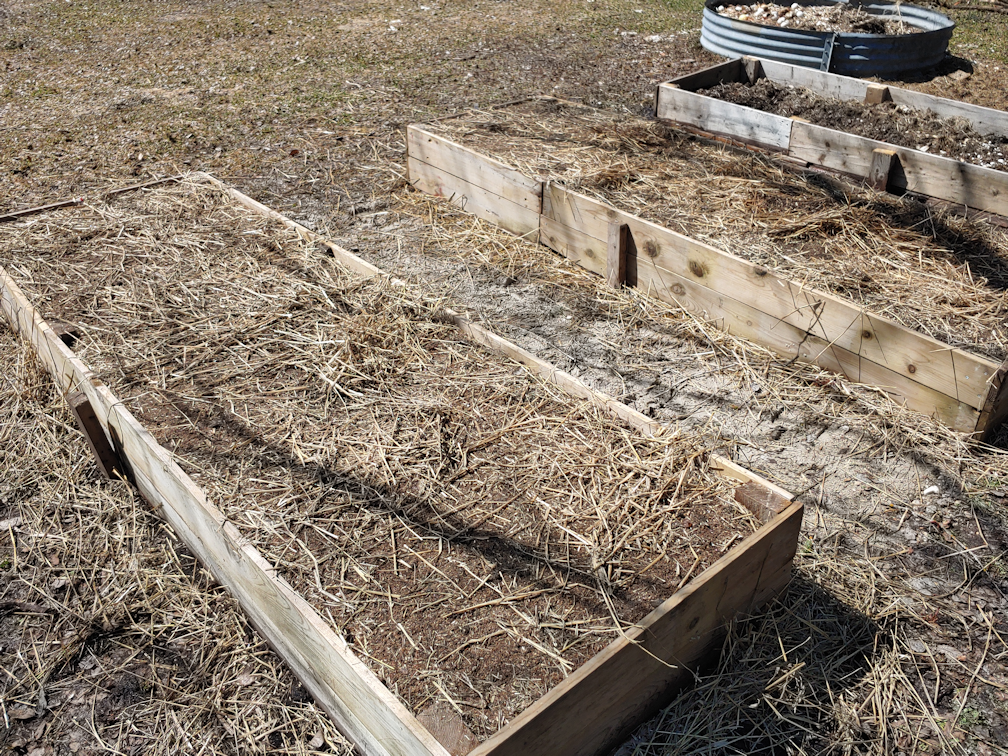
Last night, I was able to head outside again and work on a couple of the low raised beds. We’d done these in the fall, but they need more work again.
I managed to get a bed and a half done last night.
We definitely need to raise these beds higher. With the constant bending to pull the rhizomes and roots out, by the time I was done, I was feeling light headed and ill. :-(
The garlic hear is doing very well. The other two beds are doing very poorly. Because I planted them in a grid, I could use the few sprouted garlic to figure out where others should be, and gently dug down. I’ve found some cloves with their bit of leaf sprouted, but not at all green. I suspect we may have lost a lot of cloves to the cold, even though they were heavily mulched.
The remaining three beds need to be worked on, but we’ll have to do the pea trellises, first. Those should be planted already, and the purple peas the sprouted from seeds we saved need to be transplanted. They are frost hardy, so we don’t have to wait until past our last frost date, and they’re getting too big for their pots.
Today, however, I was expecting our potatoes to come in, so I really wanted to get that second bed deep mulched. I was very happy to be able to pick up some more cardboard from my new homesteading friend this morning – and get to visit her chickens, guinea hens and ducks! I was very inspired. We so need to get a coop built, so we can have chickens!!
They didn’t have as much carboard as list time, but I was also offered stacks of egg trays, so I went ahead and took those, too. The one downside of this program: it may keep a lot of food waste out of the landfills, but the farmers and homesteaders are left will all sorts of packaging, and not all of it can be reused. Even some of the cardboard has a wax coating on it, can can’t be used as mulch. Stuff is still going to end up in the landfills.
But not the cardboard I got today! :-)
This is the area that needed to be worked on. This had two layers of black tarp over it!
We are dry enough that I could break out the weed trimmer (and three extension cords!) and use that, first.
I trimmed right into the ground as much as I could, which tended to reveal plenty of surface rocks. I stopped frequently to pick the bigger ones. I’m not sure how much of a difference it will make, but better to remove them while the chance was there!
After this was done, I dug some hoses out of the garden shed and set up. It was very hot (we hit at least 22C/72F, which is higher than forecast) and windy, so I wanted to be able to wet down the cardboard as I worked, to make sure it wouldn’t blow away.
By this time, the post office was open again, so I headed out to pick up the potatoes, only to discover they weren’t in yet! I suppose I should have checked the tracking number first. Ah, well. I needed to get more milk at the store, anyhow! The tracking number now says they should arrive tomorrow by end of day, but the store is open only half a day tomorrow. Hopefully, it’ll be in, in the morning. We’ll see.
Once home, it was back to work!
This is when I ran out of cardboard, including what was left over from last time!
This is where I ran out of egg trays, including some of our own that we’d been saving. They’re laid in interlocking layers, so each row is at least two layers deep.
What to do next?? This is a large area to cover.
I scrounged around the house and found some boxes I could break down. Then I remembered we still had some moving boxes in the basement. We’d been saving them for something – I can’t even remember what, anymore – but the new basement now gets wet where a rain barrel had been allowed to overflow, before we moved here, and the boxes have been water damaged.
Which is just perfect for here.
I used up almost all of the old moving boxes! I think there’s three left, now.
I kept having to pause and use the hose, because they were drying so quickly in the sun. The egg trays, at least, hung on to their moisture a lot more.
Then it was time to start laying out the straw.
This took up a lot of that big straw bale!
Since I had the hose handy, I took the time to wet down the straw every now and then – and the cardboard, so it would still be wet as I laid the straw down. It took quite a while to get it done, but I think it worked out better that way. I hosed down the other bed as well, but it takes a lot to get straw really wet. We’re expecting showers and thundershowers, on and off over the next couple of weeks, but it won’t be enough to really get it soak, so we’ll be hosing it down daily. I plan to chit the potatoes, so we should have a few days to get it really good and wet.
The high raised bed, with its onion transplants and sown spinach, also got thoroughly watered.
While I was working on this, a daughter was back out digging holes for when the trees come in, until the heat became too much for such heavy manual labour. It was bad enough that she had to break out the loppers to cut roots she was hitting, not to mention all the rocks she had to clear out, too! Including both the bison berry and the highbush cranberry, she’s digging two rows of 16, three feet apart. Then there’s just the holes along the lilac hedge for the 5 sea buckthorn, and those will be ready for when the trees arrive. The shipping date for those is scheduled for May 30, with an expected arrival of June 2. Once they arrive, we need to get them in the ground as quickly as possible – and have a way to protect the saplings from being eaten by deer!
For now, we are ready for potatoes. Now that we finally have a break in the weather, the next few weeks are going to see a lot of garden activity! I’m eyeballing the long range forecast, on three different apps, and while they are all slightly different, none of them are suggesting we’ll be getting frost, and overnight lows are looking pretty good. I might have to chance it with some of our transplants. The kulli corn is outgrowing their toilet paper tube pots and need to be in the ground! I’m still not even sure where I’ll be planting them. They can grow up to 8 feet tall, so I’m thinking of putting them along the back of the main garden area, where we’d tried growing gourds our first year of gardening. They’ll be protected by trees from the north, while getting full sunlight all day. They would be planted in two or three long rows, closer together, rather than a block, but I think it will still work out.
This is going to be a very interesting gardening year!
Oh, what a lovely, lovely day! I was able to get things done that have been waiting for a day like today.
Before I get to that, though, take a look and who I found.
Possibly the same grog (groundhog) I saw this morning. It was at a space under the fence critters use to get through the chain link, but there’s water there right now. Because I was so close, it wanted to run through, but didn’t want to go through the water! It ended up running down the fence towards the junk pile, and I didn’t see it again until I was back in the house. The girls told me it was at the feeding station outside our living room window! I could tell it was the same one because it’s got burrs or something it its fur.
Then, as I sat down at my computer to upload photos, I saw two grogs running across the driveway towards the inner yard.
*sigh*
We’re going to have our work cut out for us!
Anyhow. Back to business!
The first thing I wanted to get done was lay out the salvaged black tarps (or whatever they are) in the main garden area.
Click on the images to see them larger.
In the background, you can see sticks coming out of the ground where a groundhog’s den used to be. It took shoving those sticks into the hole and burying them to finally get it out of there. They will be trimmed, later.
The black plastic should help warm up the soil, while also killing off the grass and weeds. We will be growing potatoes here, using the Ruth Stout deep mulching method, to start reclaiming this area.
When we’ve used these tarps before, we’d weigh the edges down with rocks, bricks, fence posts – whatever we could find. Since then, I found a big bag of cheap metal tent pegs, so I used some of those to pin the tarps down. The ground is thawed enough that I had no problem pushing them through – except for the rocks.
So. Many. Rocks.
I think only one tent peg actually made it through with minimal problems, and even then, I could feel it pushing past more rocks.
We have three types of potatoes on the way. Two at 5kg/11 pounds and one at 1kg/2.2 pounds. We will likely break the spaces covered by the tarps into 4 beds with paths, if only to make things easier to reach. We may plant the two 5kg types of potatoes here, and find somewhere else of the 1kg of potatoes. Maybe use one of the two grow bags I picked up on sale, for such a small amount.
The next area I wanted to work on was the chimney block bed along the chain link fence. The last 4 blocks had been brought over and were waiting to be placed.
At this point, all I wanted to do was level off the soil with a hoe, then line the blocks up along the fence. The ground slopes downward along this area, and the gap under the chain link increases along the way. When we built the bed here last year, we had to add boards along the fence to keep the soil from washing away when we watered things. It didn’t work as well as in the other bed (the one now bordered with bricks, in the background) because of all that space under the fence. Having these blocks will solve the erosion problem.
The blocks won’t be filled quite yet. I want to put some more organic material at the bottoms before returning the soil, and adding more, if needed. The ones we filled last year look like they could use some topping up, too.
Next, it was the garlic and asparagus beds.
I’ve been reading up and watching videos about growing asparagus – which is not yet showing – and it seems they do well with deep mulching (as well as being planted together with strawberries, which we might do). The garlic beds have mulch on them that I have decided to take off, and move to the asparagus.
First, the garlic beds.
Click on the images to see them in a larger size.
Pulling back the mulch, I can feel that the soil has thawed around the edges, but the closer to the middle, the more frozen it is. In the photo on the right, you can see some of the ice crystals exposed as the mulch was pulled back.
Also, this is oat straw, and quite a lot of seeds got caught up with the straw. I was seeing quite few sprouting grains, like the one in that second photo! (click to enlarge)
Both beds are now uncovered. The bed that’s in the back was more frozen than the one in the foreground. I couldn’t pull off some of the mulch because it was stuck in ice.
Now that there is no longer mulch insulating the ice, it should be melted by the end of the day. We’re at 18C/64F as I write this, so it won’t take long for the beds to thaw, and the garlic can start growing again.
As for the straw mulch…
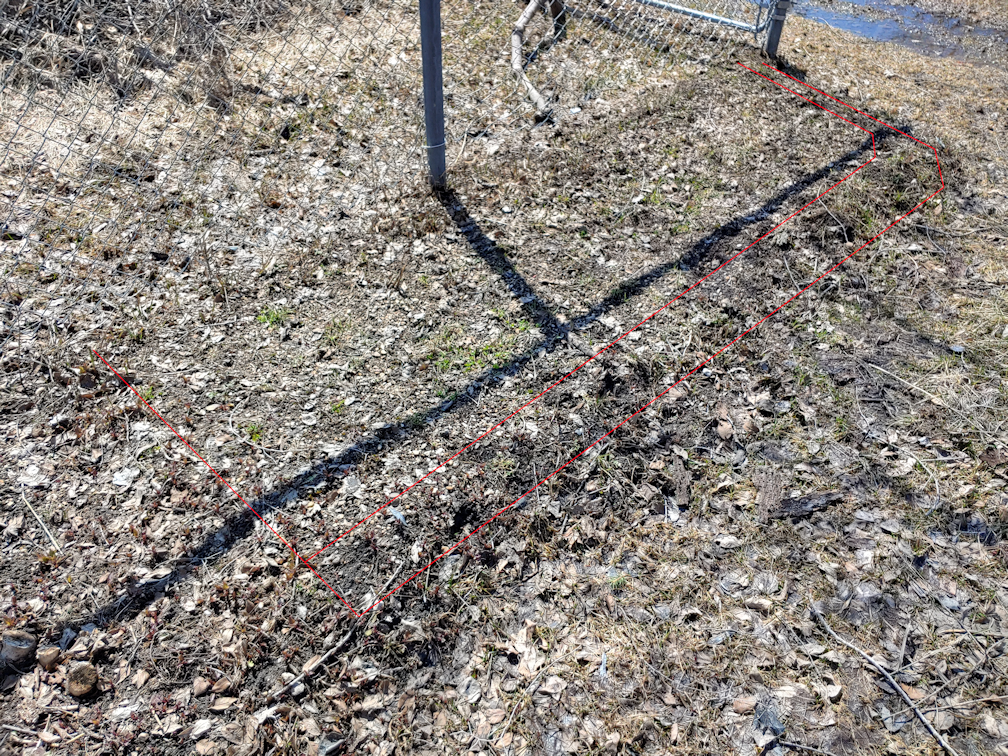
The red lines mark there the asparagus is, plus there is a narrow band around it, where we shoved in some tiny onions that were really too small for transplanting, but we didn’t want to just toss. They didn’t do well, which is not a surprise, but what is a surprise is that the bulbs survived the winter and are starting to grow! So when the mulch from both garlic beds was added over the asparagus, I made sure it was not really covering where the onions are.
Who knows. We might ended up being able to collect Norstar onion seeds this year!
The asparagus planted here is a purple variety, and this is its second year. Two years from now, we should be able to start harvesting them. We also plan to get green asparagus crowns, but we’ve got so many things to plant this year, it sort of went by the wayside. I’m still not sure where we’d want to plant them, since it would be permanent.
Maybe here?
When we first cleaned out there area, there was a tire planter that was a car tire cut in half around the circumference, the tire flipped inside out, and still attached to the rim, which raised it up a bit. I had dug it out and tipped the soil onto the ground, discovering it was covering the stumps of a maple – which promptly started to send up suckers! Then we discovered that the planter had been for a type of flower that spreads through rhizomes. Which means I inadvertently spread a weed.
When we built the bed here last spring, we used carboard to try and kill things off first, then layered straw and soil on top of the carboard, to make the new bed. We planted strawberry spinach. If any of them sprouted, we had no way to tell, and they didn’t last long. Instead, the bed was filled with all sorts of other things we didn’t want in it.
So today, I took my nice, new garden fork to it, broke it up and pulled out as many roots and rhizomes as I could find. I then scrounged in the garage and found a couple of pieces of panelling, which I placed on top of the space between the two beds, for something to stand on, and also to smother out more of those flowers!
The little stumps are something we’re going to need to get rid of, too.
I’m not sure what we’ll be planting here. Maybe some squash or gourds, which can be heavily mulched and has large leaves to further shade and kill off anything we don’t want to be growing here.
That was it for outside garden prep. I also adjusted some things in the sun room.
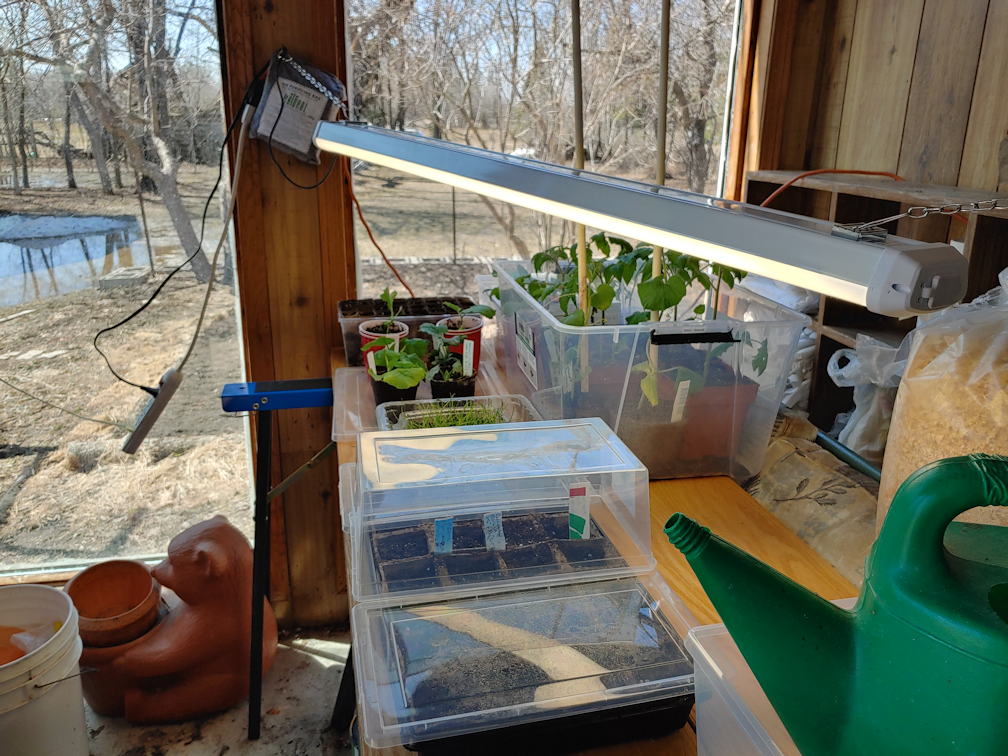
The bright LED shop light that had been used on the inside of the plant shelf got rigged to light the new growing platform over the swing bench. This may be a “sun” room, but it’s not a greenhouse, and this far back from the window doesn’t get much direct sunlight at all.
Also, I’m happy to say that it looks like the two little peppers I thinned out of the other pots have perked up and may actually survive!
Once these were all taken care of, I started to dismantle the broken canopy tent frame. I could only do part of it, because I only brought a Phillip’s screwdriver with me, and the rest of them need a hex tip. Which I have, but I’ll continue it another time.
I still can’t get that one leg out of the soil. I can move it around, and the ground is thawed out for at least a couple of feed, but I just can’t pull it out. We’ll have to dig it out! The amount of force from that falling piece of tree must have been amazing to push that leg, with the flat plate on the bottom, through frozen ground must have been something else! So glad it didn’t land on the BBQ, or it would have been destroyed!
While working on the frame, I noticed the window in the back of the storage house had its cover knocked off, so I went over to put it back. Before I did, though, I could see it was wet under there, so I put my phone on flash, stuck it through the window and took some blind shots.
Oh, dear.
With how the water had formed a moat around the storage house, not coming up to the house itself, I thought it might have been pretty dry. Talk about wrong! It’s a lake under there! The kitties have lost their largest shelter.
This is also the brightest I’ve ever seen it under there. I’m not usually there and taking pictures, this time of day!
Well, no surprise that the entire storage house has been slowly sinking if it gets like this during wet years!
In the 14 day forecast, there are a couple of days where we are expecting light showers, but beyond that, we’ve got all warm and sunny, or mostly sunny, days for a while. That is going to be a huge help in giving the soil a chance to absorb more water, and the high water levels to drop or drain away. That means more chances to prepare garden beds for planting!