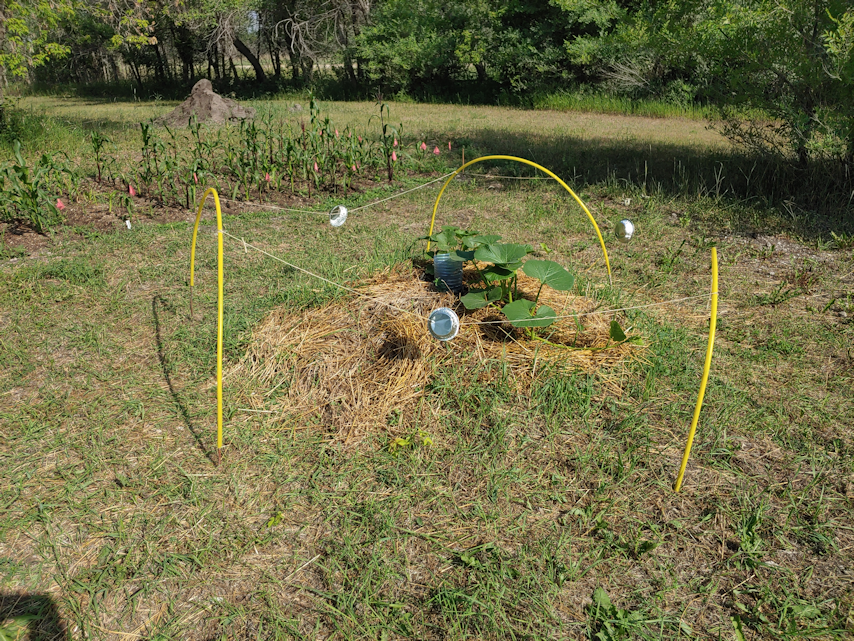
Our 2025 Garden: where the sprouts are!

It was a very calm morning, with almost no wind, so this was a good time to water the plastic covered winter sown beds.

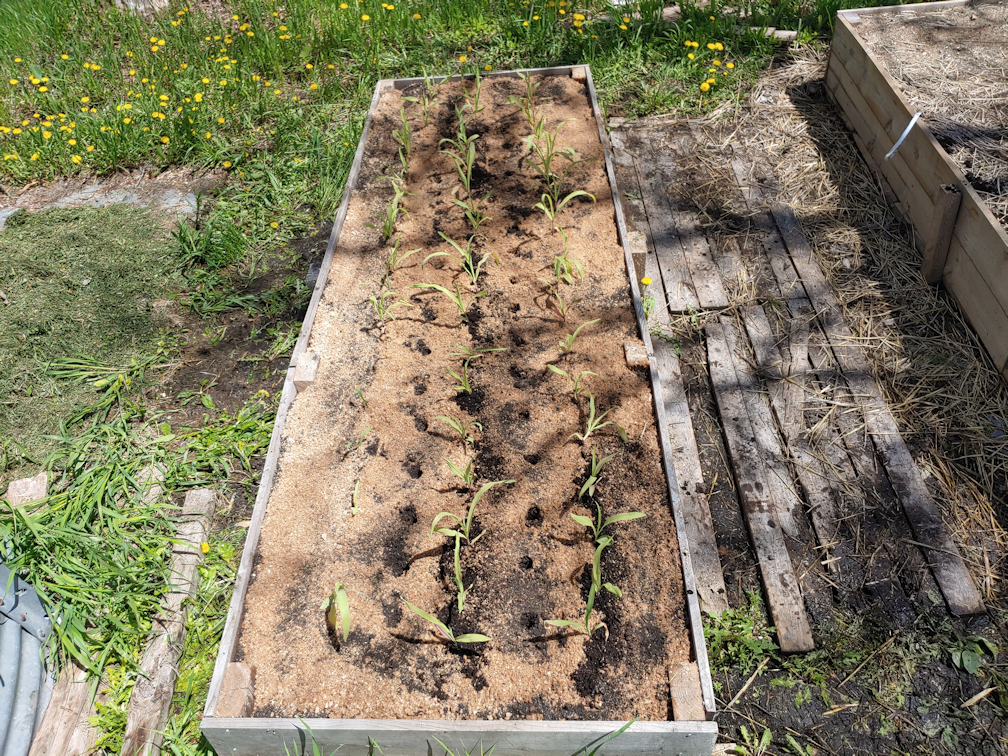
The first image is under the cover of the low raised bed in the East yard. This one has a root vegetable mix of seeds, plus 1 type of lettuce and onion seeds. There are a lot of sprouts in there! I’m guessing mostly radish and beets. I’m not seeing signs of carrots or onions sprouting, but it’s really hard to tell at this point.

This bed was getting the most difficult to tend to with the high winds, so when I took the cover off to water it, I spent a lot of time securing the plastic after the cover was put back on. The plastic on all the beds is meant to be there only until the plants establish themselves and don’t need as much warmth or protection. It will likely be replaced with netting later in the season. So securing the plastic involves a lot of rolling and carefully tucking under the frame. With this one, that also meant completely redoing how it was weighted down on top. Hopefully, it will hold. We’re expecting high winds again, in a few days.

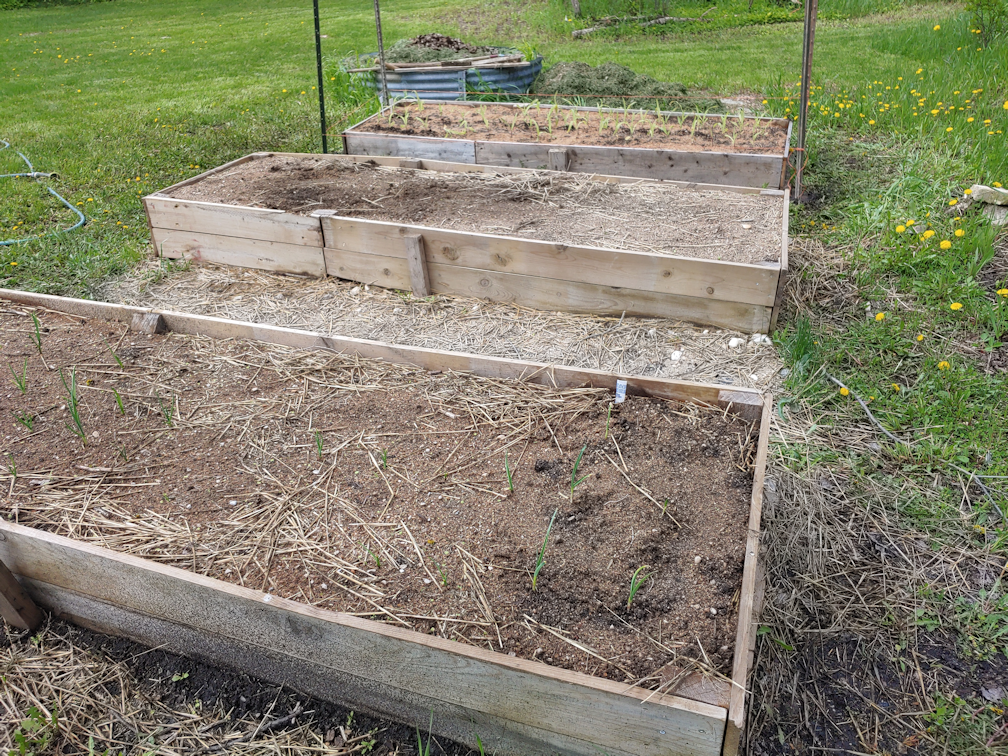
There wasn’t much to see in the high raised bed or the ground level bed with mixed flowers in it. There are sprouts, but not very many. The main thing is, they are no longer being dried out by the wind, nor dug into by the cats!

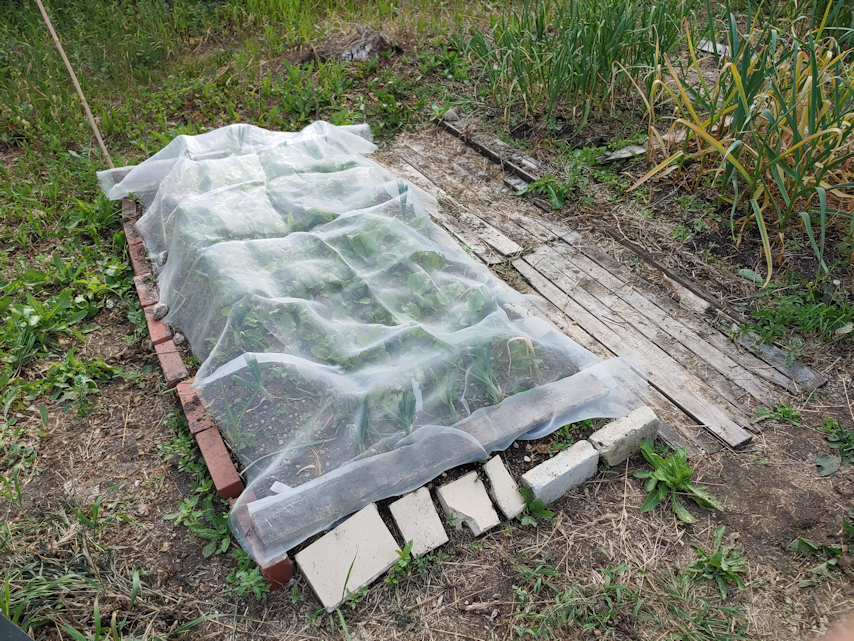
The next picture is of the old kitchen bed. There is quite a bit of spinach coming up in there, and I can even see tiny onion sprouts. The cluster of larger leaves visible came up very early and I thought it had to be a missed onion from last year, but now I can see that these are most definitely garlic. We had garlic planted in here, two years ago! I did try to pull things that were most obviously weeds – crab grass and dandelions – but only if I could do so without disturbing any seedlings, so there wasn’t a lot I could pull.

The other winter sown beds got watered as well. I think the summer squash bed, and the end of the garlic bed, are lost causes. The only things coming up in the summer squash bed is clearly not summer squash, and the few feet of the garlic bed shows nothing at all. I don’t think they made it!

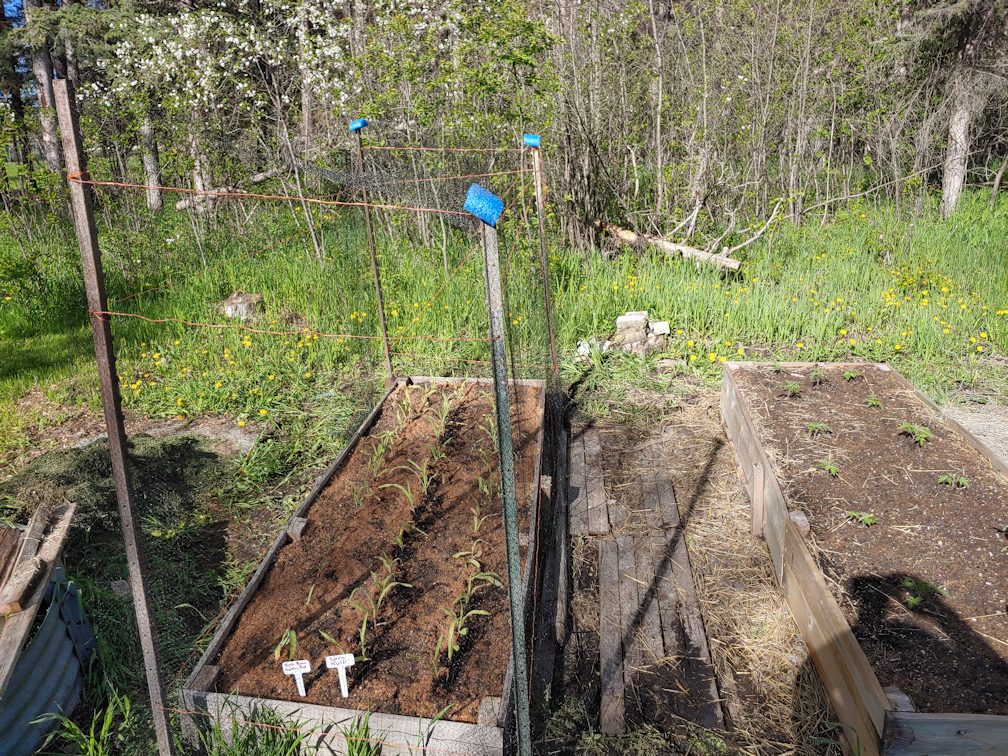
There are more sprouts coming up in the mesh covered bed at the chain link fence, though still just the one pea shoot. This is the bed that has Dalvay shelling peas, a few King Tut purple, Royal Burgundy bush beans, Hopi Black Dye and Mongolian Giant sunflowers, a few black Montano Morado corn seeds, plus onion seeds. So there should be more pea seeds showing, as peas prefer to germinate in cooler soil. That suggests to me, most of the peas did not survive the winter. As for the sprouts I am seeing, about all I can say right now is that none of them are corn.

Unfortunately, while covering the bed with netting will protect it from the Chinese Elm seeds that are forming right now, the net only partially protects from the cats. There are a few smaller cats that are absolutely determined to get under the netting. Then, when I go to get them out, instead of leaving through the open space next to them that they got in on (the netting slides on the wire hoops), they run down the length of the bed, bashing themselves against the netting every now and then, in a panic. Or, like this morning, they simply climb on top of the netting and play on it! This set up wasn’t designed to actually hold that kind of weight, so quite a few of the wire hoops are now bent out of shape. It is really frustrating.

This bed is still made with temporary materials. Along the path side and ends is loose bricks. The chain link fence there are old boards to keep the soil from spilling through. When we finally have the materials to make it more permanent, we will need to keep protection in mind. It’s not enough to just cover it with netting to keep the elm seeds from smothering the bed, stop the cats from using it as a litter box, or keep the deer from eating whatever is grown there. We need the cover set up to be able to hold the weight of cats – we just can’t keep them from going right on top of any of the covers!

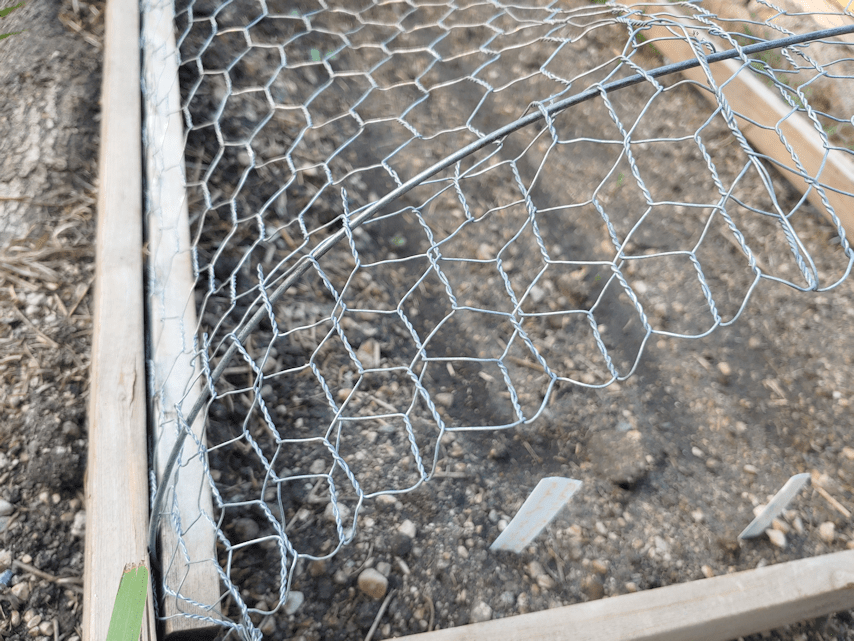
The cover that we have over the old kitchen garden bed is the one that was made using fence wire. When it was done, I swore I never wanted to work with that again! It’s so thick, I had to double up the frame on the sides to secure it in between, then double up the ends, just to keep it from falling apart. However, while it was on the high raised bed, I found it worked out really well, in that I could reach through the wire to tend to the bed, without having to remove it. The openings are not all the same size, though. It’s meant to be installed with the narrower openings at ground level to keep small critters out, while the larger openings at the top are all that’s needed to keep mid sized critters out. Which means there are spaces where I cannot fit my hands through, but I can still reach around from other openings.

The wire is also strong enough that no support hoops were needed. Not only can it hold itself up, but when the plastic was placed over it and the cats started jumping on it, it held their weight, too!

The cover that’s on the winter sown bed in the East yard is almost there. The hoops are strong enough to hold weight; especially now that I’ve secured them permanently, and they no longer slide through the pieces of metal strapping I used to hold them in place. I originally thought it would be useful to be able to remove the hoops at some point, but that potential convenience caused more problems than solved any. They do, however, still bend inwards, slightly. Particularly the ones at the ends.

The hoops are supporting a plastic mesh that is stiffer than netting, but more flexible and easier to work with than hardware cloth. As you can see in that first photo, it’s wide enough that it creates more shade, so this is a cover that would be idea to use for things like lettuces, which like more shade. The plastic mesh does sag when the cats jump on it. My plan is to add horizontal supports in between the hoops. These would keep the hoops at the ends from being pulled inwards, plus keep the plastic mesh from sagging downwards. I am hoping it will only need horizontal supports across the very top, but it might need more halfway up each side, too.

Once the plastic sheet is no longer needed, I will have to put something across the open ends, to keep the cats out. I have some black plastic mesh that should work out well, once I figure out how to secure it!

I don’t want to be spending too much time or effort on these covers, though. These were my first experimental raised bed covers. Now that I know how these have been working out, I plan to build new ones using better and stronger materials, taking into account what we have found works, or doesn’t work, with these ones. These ones still have a few years in them, though, and we will keep building more raised beds, so we will need more covers as time goes by.

Meanwhile, as I was watering the bed at the chain link fence, I took a good look at the haskap bushes.

*sigh*

I have one “Mr. Haskap” and two “Mrs. Haskap” bushes – cross pollinating varieties. With haskap, you need two varieties for cross pollination. The “Mrs. Haskap” is the Borealis variety. I can’t remember what the “Mr. Haskap” is, but that one still has its label, so I can check later.

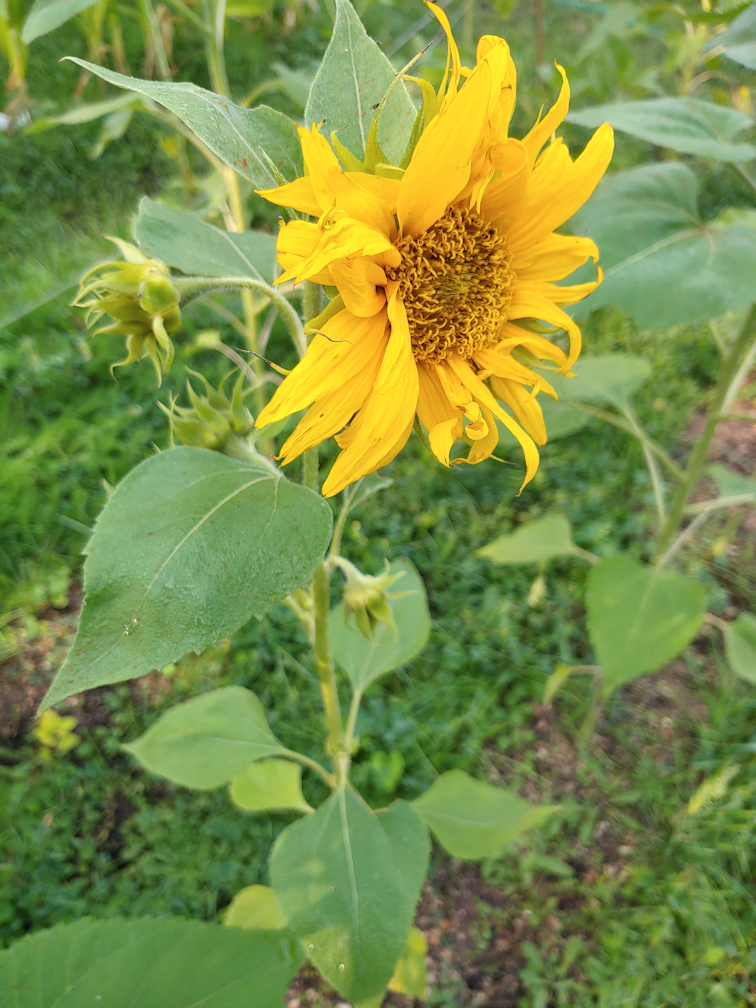
Here is now they looked this morning.

The first image is the “male” haskap. It’s leafing out beautifully and, in the second picture, you can see it even has flower buds forming!

The next two photos are the “female” haskaps.

The larger one was bought at the same time as the Mr. Haskap and, at one point, I was sure that one had died. It has barely any leaves opening on it. The smaller one is still really small, even though it’s only one year behind the other two. At least it has more leaves, but still, they are way behind their pollinator variety! This is why, after all these years, we’ve never had more than a small handful of berries. They simply aren’t blooming at the same time long enough for proper pollination.

The varieties I have coming later in the month are Aurora (the pollinator) and Boreal Blizzard. These will be planted out in the food forest area, near where the apple and gooseberry just got planted. The Opal plum should be shipped at the same time as the haskap, and it will be planted in that area, too.

Hopefully, this will work out better than what we’ve got now, and we’ll finally have berries to eat! Two bushes should be enough to meet our needs; they are supposed to be quite productive. We’ve got three, and have barely had enough to taste.

At least we know we like them!

So that is how things were in the garden this morning. With today being a calm day, I hope to get back out there soon, and get some work done!

The Re-Farmer

Our 2024 Garden: protection mode

It was really windy out there this morning – too windy to take the transplants outside for hardening off. All the pots would get blown over!

That wind also means the Chinese Elm seeds are being blown off, even though they are still green. They tend to drop en masse after they’ve dried out and turned brown.

When I saw how many seeds were on the bed along the chain link fence, though, I had to do something about it. Thankfully, I dug out several rolls of netting from the garden shed, before we returned Broccoli’s kittens to her nest, so I didn’t have to disturb her and her babies to get anything!

Last year, we used decorative wire garden fencing we found over the years, in sections and in different places! Some of it was so damaged, it had to be tossed, but there’s enough left to set up along the length of this bed, just inside the bricks. That would hold the netting up from the soil.

I was happy to find the first of three rolls of mosquito netting I grabbed was long enough to cover the entire bed, with some to spare. It would have been such a pain to have to cobble together two shorter lengths!

Once it was unrolled to the length of the bed, I used garden staples to fix one edge to the ground, outside the brick border.

Syndol “helped”.

At the end by the car gate, right at the start, I fixed the top corner of the netting to the chain link fence with a ground staple. Then, after the bottom edge was fixed all the way across, I went back along the outside of the fence and used more ground staples to fasten the netting to the top of the chain links.

Syndol “helped”.

At the people gate end, I wrapped the excess around the post as well. Now that I think about it, that means we can’t close the gate right now, but that should be okay. The netting needs to stay just long enough to protect the beds until after the seeds have dropped. We only ever close the gates when the renter’s cows get into the outer yard, when the electric fence fails for some reason, and the cows aren’t rotated onto this quarter, yet.

We’ll have to add netting over the chimney block planters, too. The raised beds in the west yard need to be protected, too. One already has netting around it, but it’s a wider mesh. Hopefully, it’ll still stop the seeds from covering the bed. The other two beds could get the other covers on them, since they don’t have any trellis posts and netting inside them. Two of the covers have plastic on them. They got removed, so the rain would water the potatoes in one bed, and saturate the soil in the empty bed. I’m considering removing the plastic and covering them with netting, which would let the rain in. The forecasts have changed. We were supposed to get more rain tomorrow, then off and on throughout the week, but now it’s saying we won’t get rain again until Friday (today is Sunday).

That means we might actually be able to mow the lawn! Right now, we have standing water in the low spot behind the garage, as well as in the vehicle gate. Hopefully, it’ll be absorbed over the next couple of days. We need to do a dump run, which means backing the truck up to the house. The lawn is so wet, driving on it right now would actually damage it.

My goal for today day is to get a second bed in the main garden area weeded and shifted over to its new, permanent location – or at least get started on it! It’s really windy out there, and it’s supposed to get quite hot, while the next few days are supposed to be cooler. We’ll see how far we can get before the heat becomes a problem. I don’t mind waiting for cooler days to work on it. I can get more done, faster, on a cooler day.

Looking at the long range forecasts, the overnight temperatures we are now expecting are well away from the “danger of frost” zone. At least for the last week of May. We might even be able to get some things transplanted early, in the beds that are currently ready. We can protect the transplants with the plastic rings we make from my husband’s distilled water bottles. We did that last year, and it worked out really well. Especially for the chocolate peppers and that one surviving Classic eggplant. We need to focus on getting the transplants in, then do the direct sowing in whatever space we have left.

Oh! That reminds me…

Last night, as I was getting ready to start pre-germinating those pumpkin seeds I picked up, I took out the two containers of Zucca and Pixie melon seeds that were still in the aquarium greenhouse. I was expecting to toss them into the compost. Much to my surprise, two of the three Pixie melon seeds left in there had roots. Even more of a surprise, so did one of the two remaining Zucca melon seeds! So I potted those up and they are now on the warming mat. The pumpkin seeds are now set up with them, in a container between damp paper towels to pre-germinate. I also moved out pots with one Pixie and one Zucca melon that had broken the soil surface. For now, they’re in the mini greenhouse frame at the window, but they will join the other transplants in the sunroom later today. I just need to have someone open and close the door we made for the living room, so no cats sneak in. Fenrir is the worst for that. I swear, that cat can teleport. She’ll be in a completely different part of the house, but as soon as she hears that door open, suddenly she’s through the door and dashing under the couch! She does the same thing when we open the door to the old kitchen. So if any of us needs to get into either room while carrying something, we need a second person to open and close the doors for us, and chase the cats away.

While we do have quite a few transplants going, we started way less than we did last year. I went kinda crazy with starting seeds last year. Many never germinated, which was probably a good thing; we had way more transplants than we had space for, since we ended up with about half the growing space than we had, the previous year. This year, I’m hoping to avoid both problems; pre-germinated seeds for the first one, and starting less for the second. Hopefully, we’ll be able to get back to expanding the garden every year again. Once we get everything in the current beds planted, we should be able to start building more beds for next year.

We haven’t even tried uncovering what’s left of the pile of purchased garden soil yet. I think we’ll have enough for this year, but we’ll need to consider getting another dump truck load for next year.

The ultimate goal is to be able to grow enough food to feed ourselves with fresh produce, and preserve enough of certain things to last from harvest to harvest. As we also intend to get small livestock, growing their food is part of the plan, too. Chickens will be relatively easy to provide for, but if we’re going to get the sheep my daughter wants for their fleece, and the milk goats I want, we’ll need to plan accordingly. Some things, of course, we will have to buy. Especially for winter feed. As we progress with the garden beds, we intend to expand into the outer yard as well. Over time, we’ll have the beds closest to the house to be for things like kitchen herbs and greens, the beds further away for things that would need to be harvested every couple of days, like summer squash, peas and green beans, then the beds furthers from the house for things that get harvested at the end of the season, like winter squash, root vegetables and tubers or dry beans. Even further out, we’ll start to plant crops specifically to supplement animal feed.

It’ll take a few years, but the plan is there, even if it does have to get changed up or delayed by circumstances fairly regularly.

Little by little, it’ll get done!

The Re-Farmer
Our 2023 garden: this means war!

As I expected, the predicted thunderstorms went right past us BUT, we did get a wonderful downpour!

While it was raining, my daughter came to ask me to go outside with her; she was hearing bad sounding cat noises and, fearing a cat might be trapped somewhere, she wanted to have an extra pair of hands with her.

Well, it wasn’t a trapped cat. It was Shop Towel beating up The Distinguished Guest. I had to literally kick them apart, he had such a death grip on TDG.

In the process, I got completely soaked. When I got back inside, I decided to change straight into my pajamas. I considered skipping my evening rounds, but when the rain stopped and it was clear it was done for the day, I headed out in my pajamas.

I am so glad I did.

I discovered, we have a war going on in the squash patch!

I’ve been seeing some slug damage already, but the rain must have brought them out. The first couple of hills with summer squash seedlings, I found some munching away and started picking them off.

Then I saw what was in the mulch around it.

The little red dots that you see mark the slugs in just one small area – and it isn’t even one of the worst hills! Every single hill had them; even the ones that were resown and hadn’t germinated yet. I checked every plant, making sure to look under each leaf, and some of them were covered with slugs on the underside! While I took slugs off the plants themselves, there was just too many of them. Most of them were incredibly tiny, as if they’d hatched very recently, but there were plenty of big ones, too.

I went in to do some research on how to get rid of them. There is the well known beer trap, which does work. However, my daughters are the beer drinkers, and they don’t drink the cheap stuff. I’d have to buy beer, and the beer traps would need to be refilled every day. It could be done, but not the best option, and not something we could do right away.

Slugs apparently hate coffee grounds, so sprinkling coffee grounds around the plants to protect them would work. Especially if ground eggshells were also included. The girls have been drinking cold brewed coffee in this heat, but the grounds go straight into the compost bucket. So they will start keeping the grounds for me, spreading them on a tray to dry in the oven. It would take quite a lot of grounds for the size of our squash patch, so it would take quite a while to have enough to sprinkle around every plant. With so many slugs, they’d probably eat all our squash plants well before then.

Then I found out that slugs love cornmeal, but it kills them. It was recommended to make slug traps by putting a couple tablespoons of cornmeal into jars, then putting the jars out, laying on their sides, in the evening. By morning, they should be filled with dead slugs.

We buy cornmeal in large bags, but haven’t been baking cornbread lately, because of the heat, so we have quite a lot of it handy.

My younger daughter and I gathered up small jars that we’ve been hanging onto, put cornmeal in them, then took them out to the garden. I wasn’t going to use any of our good canning jars, so we only had eight jars.

We have 30 mounds in the squash patch.

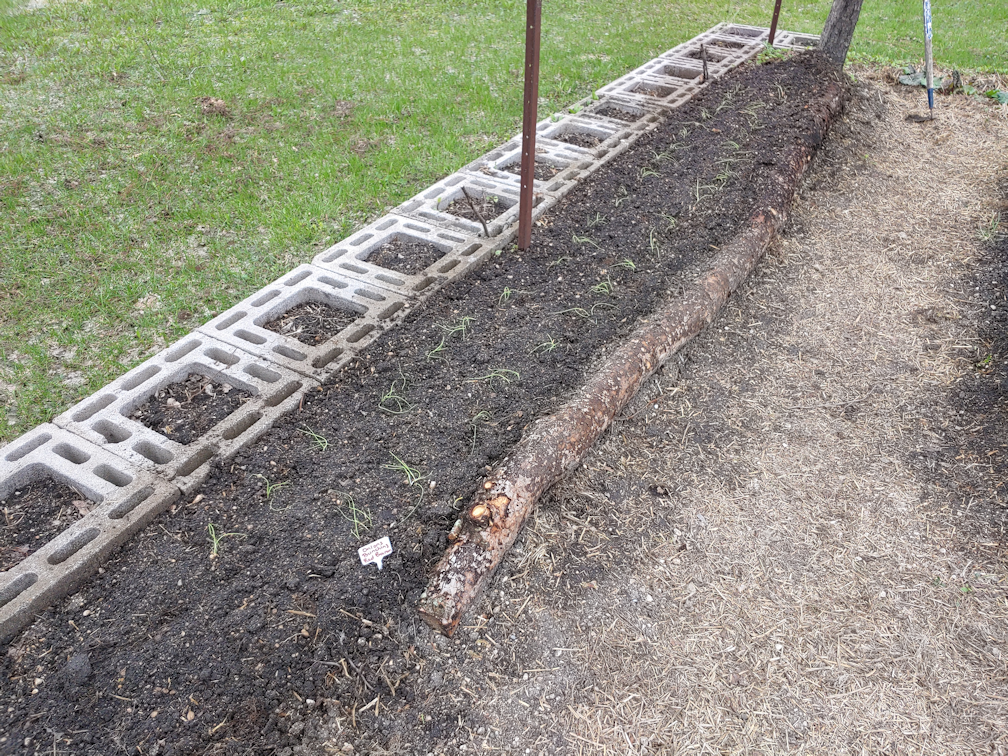
I scattered the jars around, putting some on the mounds with more visible slugs. You can just see part of one of them in the above picture. Still, it just didn’t seem like it would be enough.

So I took an empty sour cream container – the 500ml size – and used an awl to punch largish holes in the lid, then filled the container with cornmeal.

In this picture, you can see that one of the seedlings is mostly eaten. There had been no damage on that seedling, this morning.

You can also see cornmeal sprinkled all around on the mulch. I used the sour cream container as a shaker and spread cornmeal liberally around every single hill. I really don’t care if the slugs get trapped in the jars or not. I just want them dead.

I really hope this works. With how many slugs I saw – and knowing many more would be hidden in the mulch or the grass – it’s entirely possible most of the squash plants would be eaten by morning.

I have never seen so many slugs in my life. Not even when living in Victoria, BC, where the banana slugs would be out like crazy after a rainfall. It is absolutely insane!

While doing this, I saw only one frog in the squash patch. We see more of them among the other beds, but the squash patch is too exposed for their comfort. The next step in the battle is to set up frog houses all around the squash patch. The challenge will be the heat, as there won’t be a lot of shade in the squash patch until the plants get bigger – and for them to do that, they need to survive the slugs! I could simply lay out some boards in places. I’ve got a stack of them that were used to protect the tomatoes from wind, when they were first transplanted. We’ve got broken ceramic pots that would work, if we also cover them with mulch to keep them shaded from the sun.

We’ve got a lot of frogs this year. I will happily enlist them to gobble up as many slugs as their round little bellies can handle!

This is war, and I’m willing to break out the big guns, if I have to!

The Re-Farmer
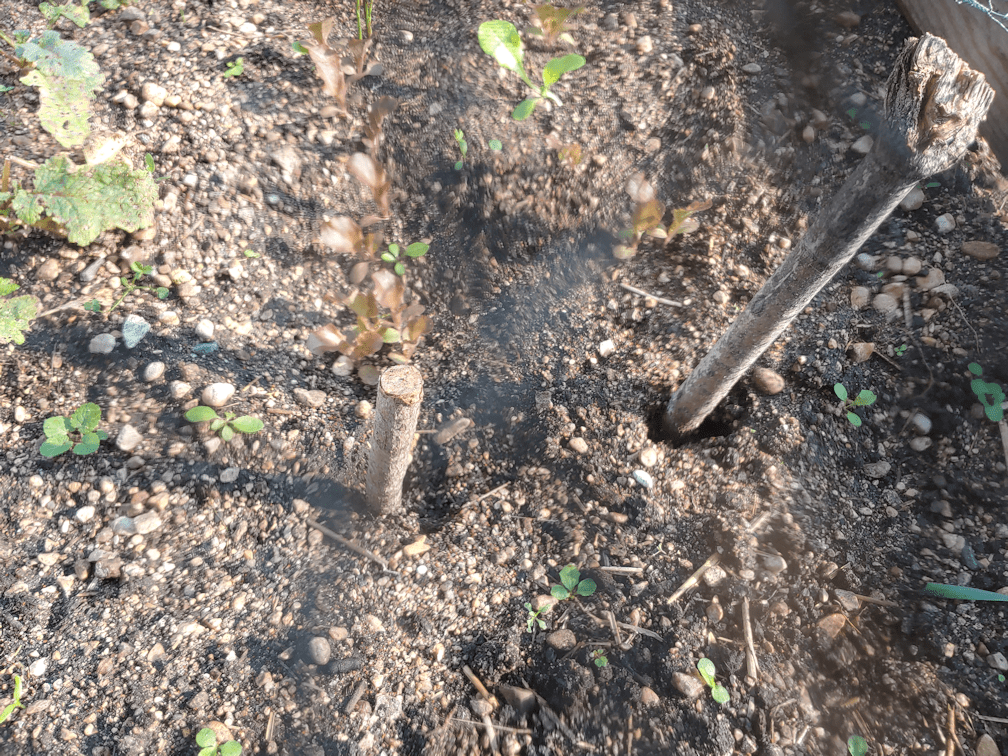
Our 2022 garden: kulli corn, yellow beans and garlic

Yes! Finally! Major transplanting was started today. :-)

The first thing I needed to finish was topping up the low raised bed they were going into.

Since the snow melted away, we’ve been adding our kitchen compost in the trench, which already had some straw in it, and I even tossed in the soil from various pots we had, from house plants that died, to seed starts from last year that didn’t germinate. The last layer before adding the soil was some fresh grass clippings.

This is the first time this pile of garden soil has been uncovered since last year.

So. Many. Thistles!

And those roots go all the way though the pile.

Which meant I had to bring the makeshift soil sifter into service, so get as many of the roots as possible out. It was long and tedious, but at least it was made a bit easier by scavenging a couple of scrap boards out of a pile to support the steel mesh, rather than the found branches I was using before. Sifting the soil had to be a gentle process, because there were SO many worms.

I kept the worms for the new bed. :-D

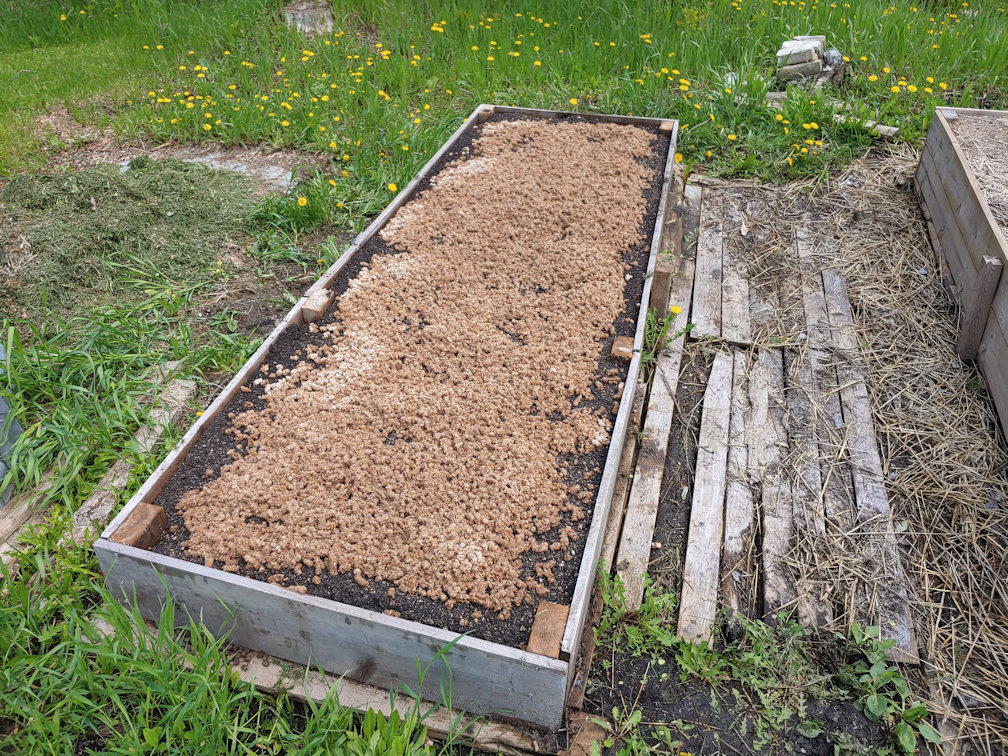
After the soil was added, stove pellets were scattered across the top and hydrated so act as a thin mulch. It won’t stop any weeds, but it will help keep the soil surface from compacting. After several soakings, the sawdust was spread evenly with the back of a fan rake.

It took a couple of hours, but I could finally transplant the kulli corn!

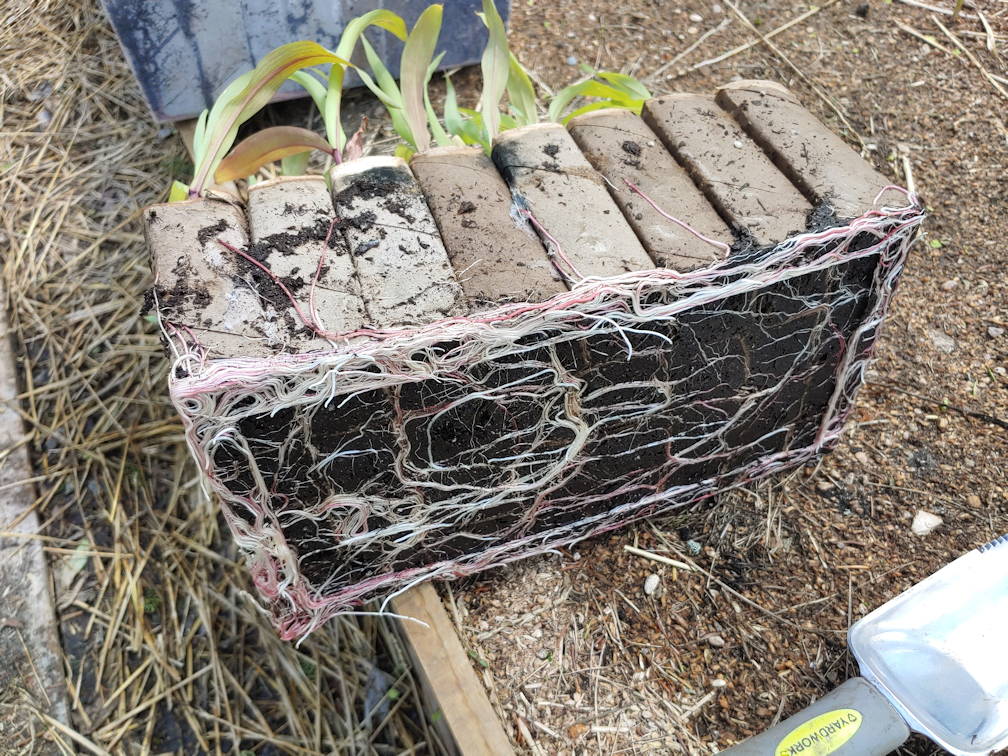
They had a major root system going! It made it difficult to get them out of the bins, then pull apart the tubes. The toilet paper really wanted to come apart!

With the larger bin, it was even more difficult to get them out, and the whole thing ended up falling out and apart. I think only one corn plant actually got broken, though. We’ll see if it makes it.

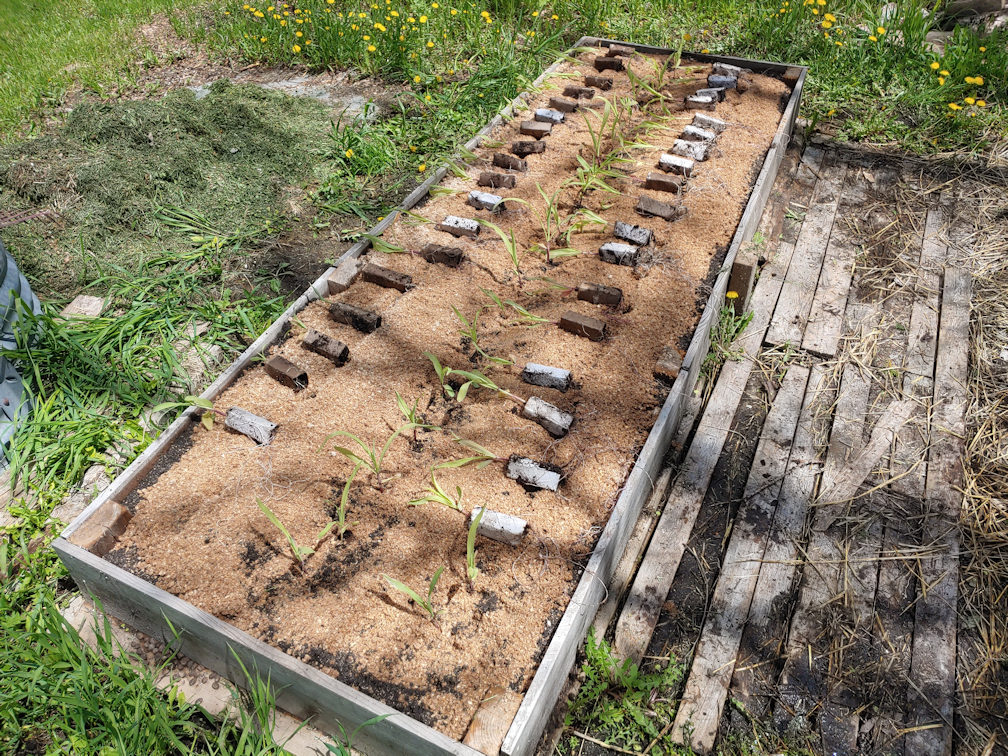
I counted the seedlings, then marked three rows of 20 evenly spaced spots for the corn. The actual total was 58, including some smaller ones that may or may not make it. We ordered 100 seeds, and there were extras, so we’re looking at roughly 50% germination rate. Which I don’t mind. We would have had trouble finding space for more. They are quite closely planted, as it is. Which should be good for improving pollination.

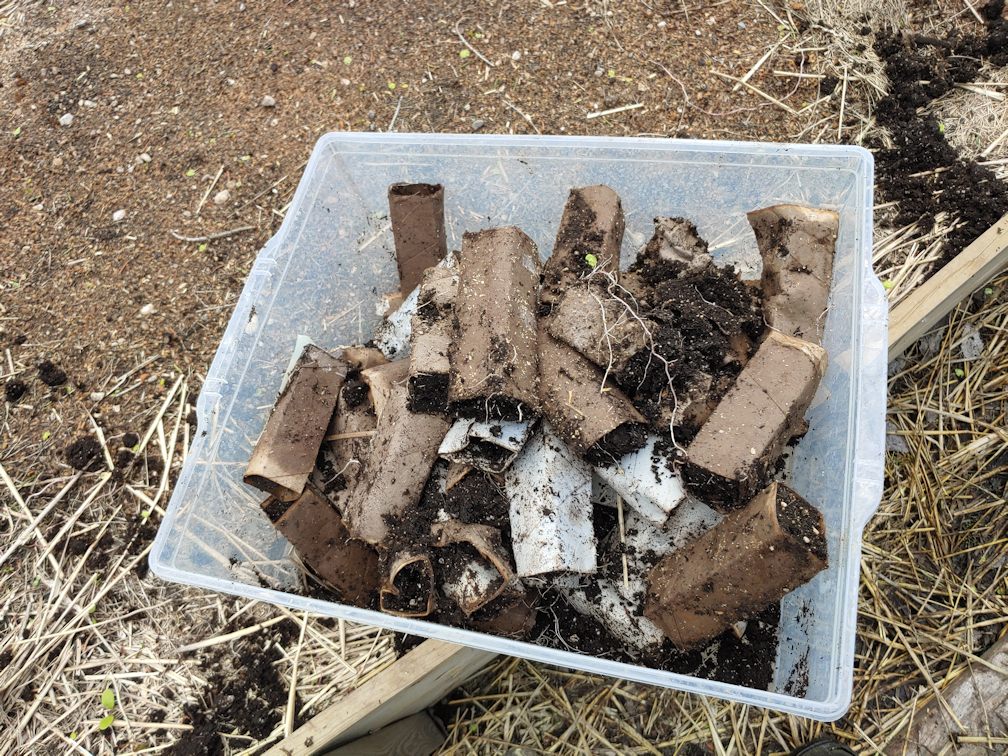
Of the remaining rolls, I broke apart the cardboard and rifled through it. No sign of the remaining seeds that did not germinate. The carboard went into the compost pile, while the remaining soil was used to top dress any seedlings that looked like they could use it.

I had also grabbed a bag of bush beans from last year, picking the one that looked like it had fewer seeds. That was the yellow “Golden Rod” variety. We still have some green bush beans left, too.

I counted the bean seeds and there was 38 – which was perfect! I could plant two rows of 19 beans, in between the corn.

As they are “old” seeds, I don’t expect 100% germination. This bed is very densely planted, but they should be complimentary.

The corn, however, needed to be protected. The question was, how?

I made a trip to the barn and dug out the T posts I spotted in one corner, a while back. There turned out to be 6 of them, all different lengths. :-/

I had to dig holes to be able to set them, using a garden trowel, since a spade would have been just too big. Within inches, I was hitting water, then rocks and gravel. After placing the posts and trying to push the soil back against them, there was literally water, shooting out from the ground, as I stomped on the soil!

We have no post pounder, so I found a heavy hammer to try and drive them deeper. Especially the longest one, but I think that one ended up hitting a rock. Being the short person that I am, for the taller once, I had to stand on the corners of the bed to reach. Even with a board across the corner to stand on, I was wobbling all over the place! LOL

Once they were in, I strung some twine around to further support the net, once it was added. That was a job that had to wait for when the girls were available.

In the two garlic beds, the nearer one had only 6 remaining garlic coming up – and one of those was barely there. I could find no sign of the few others that had emerged, as well.

I decided to transplant those 6 garlic into the other bed. That one has a lot more garlic trying to grow, but there was still plenty of space at one end to transplant the remaining 6 of the other variety.

The left a bed available for planting into, which we did end up doing.

The main challenge was, how do we cover the bed with netting, yet still be able to access the plants, easily, for weeding and eventual harvesting of yellow beans.

Piece of pool noodles were added to the tops of the posts, so they wouldn’t tear apart the net. When the one on the tallest post fell off, I left it. If it tears, it’ll only go down to the twine, and will actually line up better with the rest.

When I brought the T posts out of the barn, I also grabbed a stack of narrow pipes. I have no idea what they were for, or why they were stored there, but I figured the might make good supports. The short ends of the net are wrapped around those pipes and zip tied into place. For the long sides, we zip tied narrow fence posts we found… somewhere, to weigh down the netting. Any gaps were further secured with ground staples. If we want to tend the bed, we can remove the ground staples and lift the poles to get under the netting.

Hopefully, that will work out.

The corn can potentially grow to 8 ft tall, which is higher than the netting, but if they do get that tall, we’ll deal with it, then.

That was my big job for today, but it wasn’t the only one we got accomplished! I’ll write about that, in my next post. :-)

The Re-Farmer

Our 2022 garden: beets, lettuce and bunching onions. Also, cats!

Today has turned out to be a warmer day than predicted, and beautifully sunny. When heading out to do my morning rounds, I had a whole crowd of hungry kitties, waiting by the sun room door for me!

They were running around so much, I didn’t even try to count them. While putting food in the kibble house, TDG not only let me pet him, but let me pull the big ole wood tick in the tip of his ear! In fact, he didn’t even seem to notice I did it.

Which reminds me; while topping up the cat food last night, I got to touch Rosencrantz a bit and finally got a closer look at one of her ears. I thought she might have lost the tip to frost bite over the winter, but the tip is still there! It’s just badly torn. Not a new injury. Not much we can do about it, unfortunately.

The transplants got set outside for hardening off. They were supposed to be out for 5 hours, but we ended up bringing them in a bit early. The winds really picked up, and some of the pots were being blown around.

Wind or no wind, I was determined to get the old kitchen garden finally planted!

This is now our beet bed. We bought two types of beets this year, Cylindra and Bresko, plus we had some Merlin left over from last year. The support posts handily divided the bed into three sections, so that makes it easy to keep track of where one type starts and another one ends.

After the bed was seeded and watered, I broke open the roll of netting. This is the stuff my daughter picked out that I thought could be used for deer fencing. It’s a much finer net than I expected! The black just disappears, too, but in the photo, you can see where the excess is bunched up along the sides. I’m really glad I found that big bag of cheap tent pegs in the garage. We used quite a few of them to pin down the edges of the netting. The short ends are held in place at one end by a stick rolled up in the excess, while at the other end, the excess went under a board I was using to mark the end of the bed.

Next was the L shaped bed. Lettuce went into there. I thought I had 4 types of lettuce left over from last year, but it turned out one of the envelopes was empty. That actually worked out, for the amount of seeds in the remaining packets.

The hard part was covering the odd shaped bed. One of my daughters came out and we sized up a piece of netting for the longer part of the L shape and cut it. The netting is 14′ wide, so we stretched it out on the grass and cut it in half.

The short side of the L, up to the label you can see near the bottom of the photo, is one type of lettuce, which is about as much as the other two together! There were still a few seeds left over, including some that had spilled in the baggie the seed packets were in, so those got scattered in the odd little bit of space next to the rose bush. They didn’t get covered with netting; the space is too small to bother.

The long side of the L shape was pretty easy to cover, but the short side curves around the lilac and gets wider at the end. While I used pieces from the canopy tent frame as supports at one end, there weren’t enough of that length for the whole bed, so I dug out some metal support rods I got last year. They’re not very strong and some had pieces broken off, making them shorter. Those matched the tent frame pieces more easily, but other were full length. I could push most if them deep enough to match heights, but with a couple, I kept hitting rocks that were big enough, I couldn’t seem to get around it. That one stake that has a spider web of cords from it is the highest of them all, and there was no way I could adjust it to avoid the rock I was hitting, and still have it where I needed it. (The bottoms of water bottles are there to keep the netting from falling down the stakes) That extra height in particular made pegging the netting down more of a challenge. In the end, we just had to push some of the stakes inwards to create some slack. We managed it, though.

That left one more bed to plant in.

For this bed, I transplanted the Red Baron bunching onions, in little groups of 3 or 4 seedlings. These are not going to get covered, since nothing eats the onions. Hopefully, the cats will leave the bed alone!

While working on this, I checked out the small bed we planted the poppy seeds saved from last year. I think they are starting to come up, but there are so many things coming up with them, it’s hard to tell! For all the roots I dug out of these beds, we’re still going to have a lot of weeds to fight off.

Now, the only thing left in the old kitchen garden are the retaining wall blocks. I’d transplanted mint into alternating blocks, but they’re not showing yet. I don’t know if they’re going to show up later, or if they got killed by the winter cold. It takes a lot to kill mint, but they did just get transplanted. I’ll leave those for now, but still plan to plant things in the remaining blocks. I just haven’t decided what, yet, since we will likely not be covering those. Plus, this area gets shaded by the ornamental apple trees a lot. With the T posts there, we could put up trellis netting and plant climbers, but anything like that would be deer or groundhog buffet, so we would have to find a way to cover them. It was very difficult to cover the retaining wall blocks last year. We’d planted lettuce in it last year, which we were able to protect from the deer, but didn’t count on the groundhogs getting at them.

We’ll figure it out. We can tuck something into the blocks, later one. For now, I’m just glad to finally get this garden basically done!

Oh, before I forget, just a quite update on my mother. I called her up this morning, and she’s still in a lot of pain. She’s quite surprised by it, it seems. She’s also disappointed. She thought that the doctor would be able to fix her. I tried to explain, they can’t fix everything, but she started taking about how, with all the modern technology we have, there must be something. I had to go back to using my husband as an example, since he’s been dealing with debilitating back pain for a very long time now. Even if they technically could do surgery for one thing, the risk was too high for little benefit, and it would have to be done again in 2 years anyhow – and that wasn’t even for the main source of his pain, for which there is nothing that can be done other than painkillers and, for some of it, physio. He hasn’t been able to do physio since we moved here. Some things just can’t be fixed. I don’t think my mother realised just how fortunate she is to have reached 90 and not had to deal with something like this before.

Ah, well. It is what it is. We just deal with the hand we’re dealt with!

The Re-Farmer
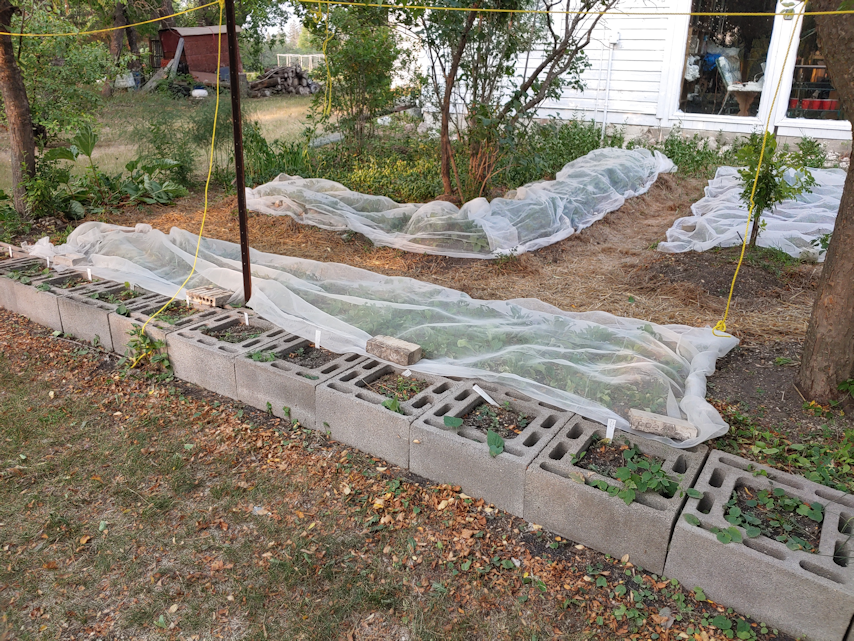
Our 2021 garden: morning in the garden

While checking on the sunflowers this morning, I found one of the Mongolian Giant seed heads finally starting to open.

I had actually expected this one to open up first. Look how dark the middle is!

Hard to believe this is the same type of sunflower as this…

They look completely different!

One of the smaller seed heads sprouting out the side is starting to open, too.

With our fall planting, only a few of the rainbow chard has survived the grasshoppers and the heat. Enough that, when they are large enough, we can find out if we actually like chard! :-D

The lettuces protected by the window screen covered frame are coming up quite nicely! It’ll still be a while before they are large enough to start picking baby greens for salads, but being under the adapted cover, they should be protected from both groundhogs and insects, so I expect to actually have some this time. Unlike our first planting in the spring, that got eaten before we’d had more than a handful ourselves! Even the weather is supposed to be cooler and potentially rainier, over the next while, so we won’t have to use the shade clothes, either.

As rough of a gardening year it has been, we’re still getting some produce, and I’m happy with that!

The Re-Farmer

Our 2021 garden: defensive strategies

While going through the old kitchen garden this morning, I was seeing more of our beets, slowly being nibbled away. We’d added stinky soap, cat fur, hot chili flakes, and a motion sensor light. The only thing they seem to be doing is spreading out the damage, as the various things get avoided.

So today, we tried something else.

Since there’s no point keeping the mosquito netting wall up to keep the deer away from the lettuces that the groundhog decimated, it was taken down. The sheet was then torn in half, lengthwise, to be used as floating row covers.

One half was used to cover the L shaped beet bed. The other half was cut into two pieces, with one covering the beets by the retaining wall, and the other covering the carrot bed. The edges are weighted down with bricks and whatever rocks we could find that had some weight to them.

It won’t stop a determined critter, but it might be enough to convince it to not bother, and move on to easier pickings.

My only concern about that is, “easy pickings” would be the poppies and the couple of sunflowers growing next to them. They’re too tall to cover with anything, without damaging them, but not too tall for a critter to reach.

That done, we moved on to the cucamelons and gourds.

For this, we rigged a chicken wire “cage. The top is laced to the chain link fence with twine, above the cucamelons. Over the gourds, it’s just tacked in place at the end, so that a gap can be make for the plants to grow through. The ends were cut and folded in to close them off, and the bottoms are tacked down with tent pegs.

Again, this is not going to stop a determined critters. But it is better than nothing.

As I write this, it was past 9pm, and we are still at 30C/86F, with the humidex at 33C/91F. Tomorrow’s forecasted high is 34C/93F, with the humidex at 38C/100F. Hot, though not quite as hot as the previous heat wave. The girls have been diligent about the evening watering, though I think we’re going to have to keep it to just one watering a day, after something concerning happened last night.

The sweet corn and sunflower beds have been the most difficult to properly water, so we have started to use a sprinkler, turned on for about an hour before the rest of the watering is done. It reaches almost all of the corn and sunflower beds, leaving only a row and a bit at each end that need to be watered manually. Yesterday, as one daughter headed out to switch the hose from the sprinkler to the spray nozzle, my other daughter started to use the front hose to water the old kitchen garden.

This is something we have done before without issue, but this time, all pressure was lost. My younger daughter went into the basement to check the pump, and found it making that grinding noise we have managed to avoid for quite a while now, and the presser was down to zero. By the time she called me over to look, the pressure was back up to 30psi, which is where it should be, but the taps to outside were shut off, anyhow. After the pump shut itself off again, we turned the taps back on, and the girls continued watering, but with just using the back tap.

Now, when we first noticed the pump making that noise and we would lose all water pressure, it was quite a concern. There was a possibility that the foot valve was leaking. We had two plumbers look at the pump, and one even crawled into the well shaft, and my brother even bought a new pump to replace this one, which is about 20 years old. The problem is, the system is so old, neither plumber was willing to chance doing the work, because the risk of something breaking in the well and losing our water completely was too high. At the very least, we’d have to hire someone to find parts for a system that’s almost 50 years old and are in different sizes than modern wells, break the well cap to access the well and replace the parts, or dig a new well.

Digging a new well was the recommended course of action.

None of this is an option for us, so basically, we’re being really careful. The main thing is that problems would start when water was being used faster than the pump could refill the pressure tank. As long as we don’t do things like run the bath as full pressure, or use multiple sinks at once, etc., we can keep it from happening. We know we’re on borrowed time, though.

The hoses do not use a lot of water at once, and even with both taps being used, we never had issues with the pressure before. So why did it happen last night?

I can think of only one thing.

The water table is dropping.

I don’t remember this even happening before, but I can’t think of anything else. It’s not like someone decided to take a shower or something at the same time – and we’ve even the shower get used by someone not knowing the hose was in use, with no loss of pressure.

So for now, we’re going to stick to watering just once a day.

Hopefully, it will be enough.

This is when we could really use more mulch! In the future, when we build our permanent garden beds, a drip irrigation system is also very much in the plans.

The Re-Farmer

Our 2021 garden; made in the shade, and we have melons!

While doing the evening watering, the girls spotted a couple of little melons last night! I just had to go looking for them this morning.

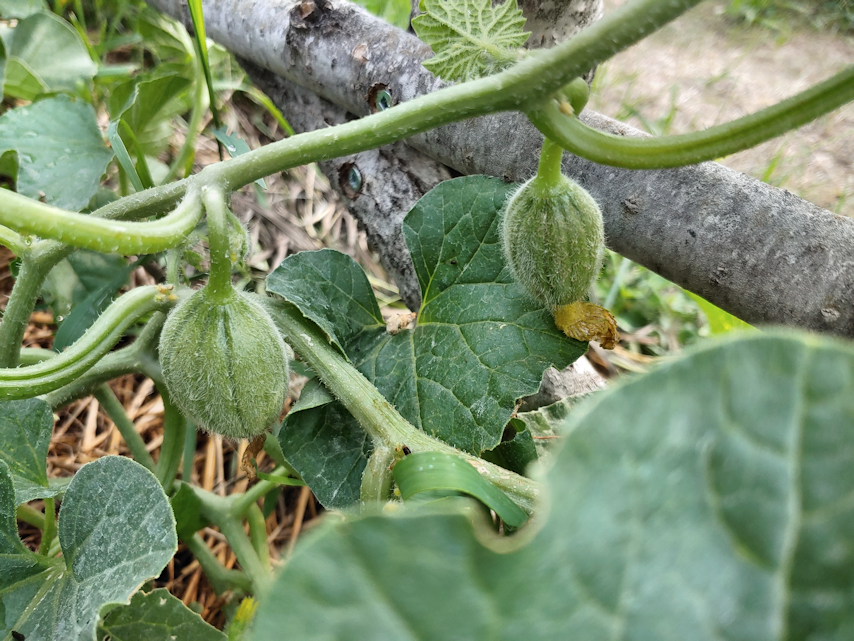
Aren’t they adorable?

The bigger one is about 2 inches long. I wasn’t expecting them to be fuzzy. :-D

These are the Halona melons. Still nothing among the Pixies – at least not that we can see. Lots of flowers, though.

In thinking of how to protect our Crespo squash from being nibbled on, and our new sprouts from the upcoming heat, I scrounged in the old garden shed and dug up some old, bent up, decorative wire border fences.

Most of the sections went around the Crespo squash. Whatever has been eating them has not tried to go past the hoops, so I’m hoping the new border will further dissuade it.

The ground here is so rocky, I wasn’t able to push all the wire “legs” into the soil! Enough are in to keep it from falling over, though, so it should be fine.

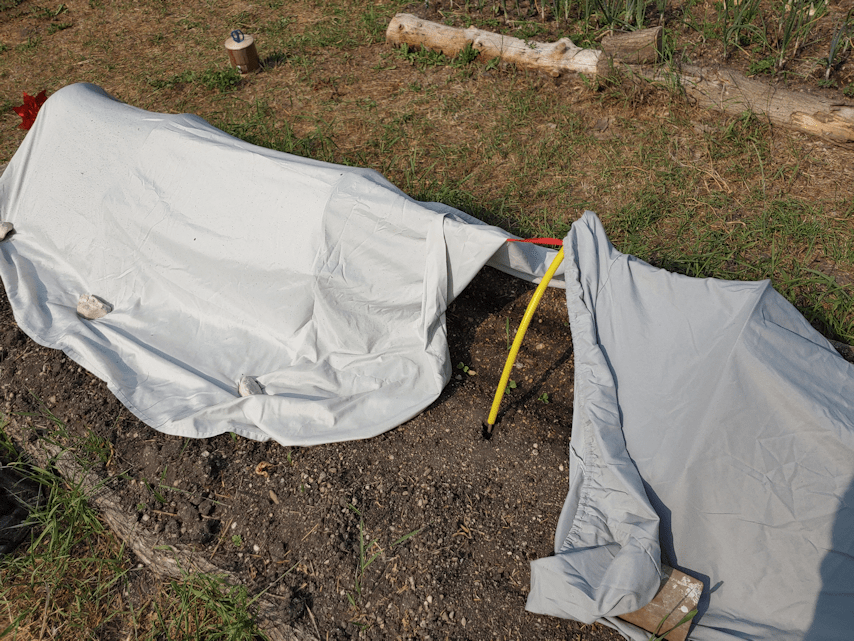
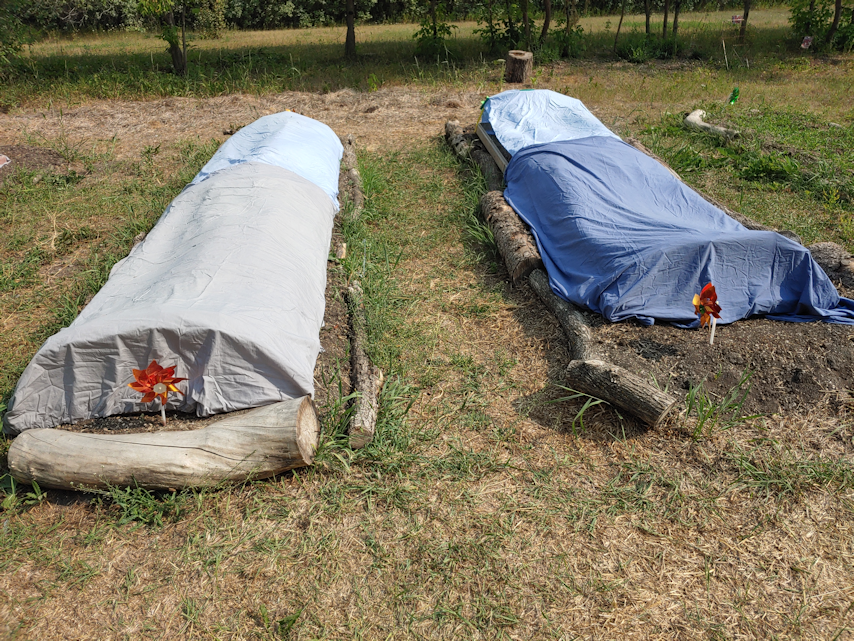
There were a few sections left, and they got used in the garden bed that doesn’t have a row cover on it. Then I used some bed sheets as shade covers. I neglected to take progress photos, though. :-/

There were 6 individual sections that got evenly spaced over the seedlings. The bundle of fencing had been tied with a fairly long ribbon, so I used that to join the tops of as many of the middle ones as I could. As I was laying the sheets down, though, there was nothing in the centre to support the ends. I had a short piece cut from a hula hoop left, so that’s now in the middle, on a couple of sticks in the ground to hold it up. It was too short to bend well, so there’s a kink in the hula hoop piece, but at long as it holds the sheet up, I don’t care! :-D

After that, rocks and bricks were used to pull the fabric taught and weigh it down.

For this bed, I could use some old Twin sheets. For the other two, I had some queen and kind sized sheets to use.

The one top sheet was easy enough, but the fitted sheets needed to have their elastics cut off, and one of them was cut in half and used to cover the ends of the rows. With these, the fabric could be secured by tucking it under the wooden frame. The sheet that was cut in half is barely wide enough on one frame, and a few inches too narrow on the other, but the ends are tucked, and in the middle of the row, the other sheets were laid on top to hold it in place.

So now our shade-loving seedlings have their shade, and protection from the heat of the day. We can uncover them when we start the evening watering, so they get some less direct light during a cooler time of the day. Then I can cover them again when I do my morning rounds.

We’re supposed to start hitting 30C/86F and higher, tomorrow, though the hourly forecast on one of my apps says we’re supposed to hit 32C/90F this afternoon. The record high for today is 33C/91F, set back in 2002. I think we were actually living in this province again in 2002, though I believe we moved back in the fall. The record low for today is 9C/48F, set in 1993.

Anyhow, we’re supposed to stay about 30C/86F for almost a week, and these sheets should help keep the seedlings a bit cooler. I’m considering whether it would be a good idea to moisten the sheets, too, but the extra weight of water might be too much for the frames to hold.

It should be interesting to see how these work out!

The Re-Farmer
Second row cover, a determined little bugger, and happy times!

Today, I was able to find a piece of wood of the right size to put end caps on the second chicken wire row cover. When I headed out to start working on it this evening, I discovered…

… that little woodchuck is a determined little bugger!

Over the next while, I made sure to make lots of noise as I went past the stairs to make sure that, if the woodchuck were in there, it would run off.

My daughters told me earlier that they’d seen the littlest woodchuck in the birth bath, drinking water. At least it was just the little one. The big one would have knocked the bird bath right off its pedestal!

One of the things I was thinking of while adding the end pieces to the row cover, was how to support the chicken wire. I no longer had any hula hoop pieces, like I used in the last one. I thought I might be able to use some old hose pieces, so I went to the pile of junk and odd bits and pieces by the old garden shed. I had left a damaged hose there, and used pieces of it to hold the mosquito netting onto the hula hoops when we had that rigged up as a cover over one of the spinach beds. When I looked at the hose, though, it was so floppy from the heat, that I could see it would never be able to hold up the wire mesh.

However…

… among the miscellaneous bits and pieces, I noticed some wire that looked pliable enough to bend into a curve, yet stiff enough to hold up the chicken wire. I was able to cut three lengths that I could weave through the chicken wire, and was able to push the ends in between the boards the chicken wire was held by. It did the job really well!

With the heatwave returning, I am thinking to sacrifice some old sheets to use as shade cloths, draped over these frames. The problem is, there is still one more newly planted bed, and I am out of the materials needed to made another row cover like these. We are going to have to figure something out! We finally have the radishes, kohlrabi and kale sprouting, along with the chard. I’d like for them to actually survive!

After this was done, I banged around the concrete steps for a while and, once sure that there was no critter under there, brought over some bigger rocks and broken pieces of bricks to fill the hole in again. Hopefully, these are big enough and heavy enough that it won’t be able to dig through again.

I was just about to head back inside while the girls were getting ready to do the evening watering, when I had a very happy surprise.

My husband actually felt well enough to walk around outside! He got a tour of most of the garden beds, and even felt well enough to walk to squash tunnel. He didn’t use his walker – it may be a heavy duty walker, but even it can’t handled the rough ground out there – and he didn’t even use a cane! Granted, it was slow going, and walking over those old plow furrows took extra care, but he did it! Gosh, I can’t remember the last time he felt well enough to go outside, without needing to go to a medical appointment or something. I’m so happy! :-)

The Re-Farmer

Our 2021 garden: protective measures

I got a couple of photos of what we did yesterday, to try and protect parts of our garden.

There is plenty of slack in the cover for things to grow, and if it ever reaches a point where it needs more, we can unroll the netting wrapped around the scrap wood weighing it down on the ends. It won’t stop small critters like skunks or the woodchuck, but they don’t tend to go here, anyhow. Deer are the ones that seem to find beet green delicious. :-D
While walking towards the Crespo squash mound, those tart tins were flashing away, and there was hardly any breeze at all, so that was good to see.

As for the woodchuck, I’m now 99% sure it has a new den under the garden shed. The only reason it’s not 100% is because we have no way to see under there to confirm.

A couple of times today already, the brazen bugger parked his adorable furry butt under the bird feeder and was eating sunflower seeds. Which, I guess, is better than him being in the garden and eating our vegetables! Still, I went out to chase him away, startling a skunk away from the cat kibble. :-/

On a more positive note, I saw Junk Pile’s kittens again. It does seem like there are 4 of them in total, but they ran off as soon as they saw me. The only one I did not see was the little grey and white one. The tuxedo dashed under the storage house, while two mostly grey kittens ran past the fire pit and out the yard near the old threshing machine.

Those little guys are FAST!

Most of the kittens are getting braver, and wandering around the yard more. Butterscotch’s kittens were seen around the old compost pile. No surprise that they went in that direction, as Butterscotch frequents the old farmyard across the road. Rosencrantz’ kittens have been playing in the white lilacs and climbing the willow tree.

It would be good if we can convince them to stay close to the protection of the house and inner yard!

The Re-Farmer