Our 2022 garden: beets, lettuce and bunching onions. Also, cats!

Today has turned out to be a warmer day than predicted, and beautifully sunny. When heading out to do my morning rounds, I had a whole crowd of hungry kitties, waiting by the sun room door for me!
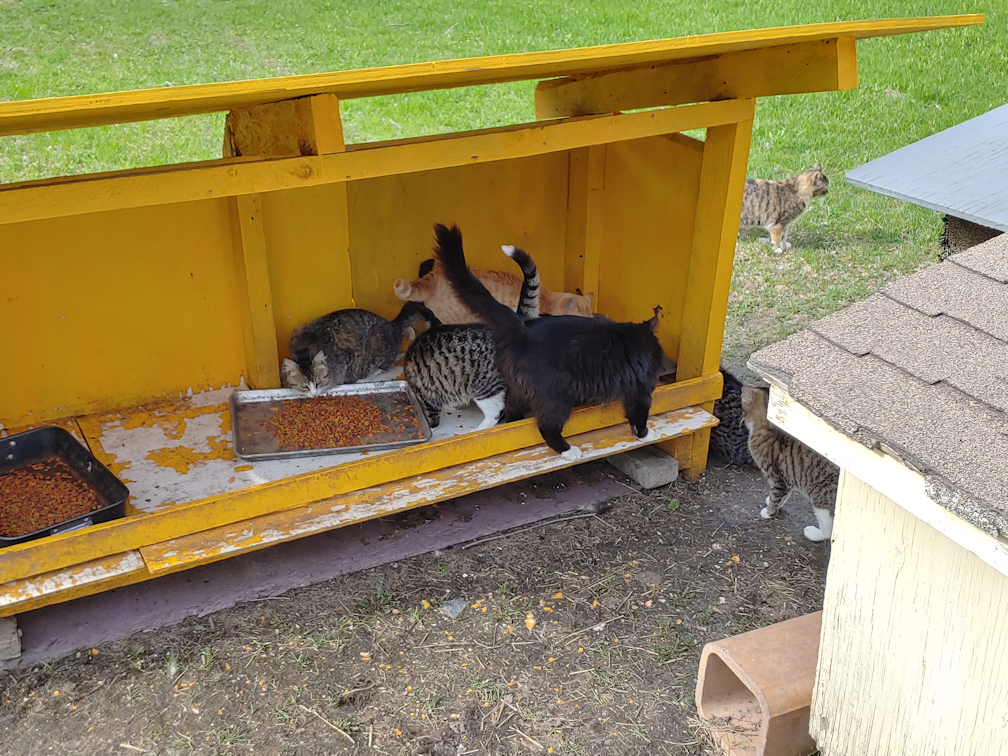
They were running around so much, I didn’t even try to count them. While putting food in the kibble house, TDG not only let me pet him, but let me pull the big ole wood tick in the tip of his ear! In fact, he didn’t even seem to notice I did it.

Which reminds me; while topping up the cat food last night, I got to touch Rosencrantz a bit and finally got a closer look at one of her ears. I thought she might have lost the tip to frost bite over the winter, but the tip is still there! It’s just badly torn. Not a new injury. Not much we can do about it, unfortunately.

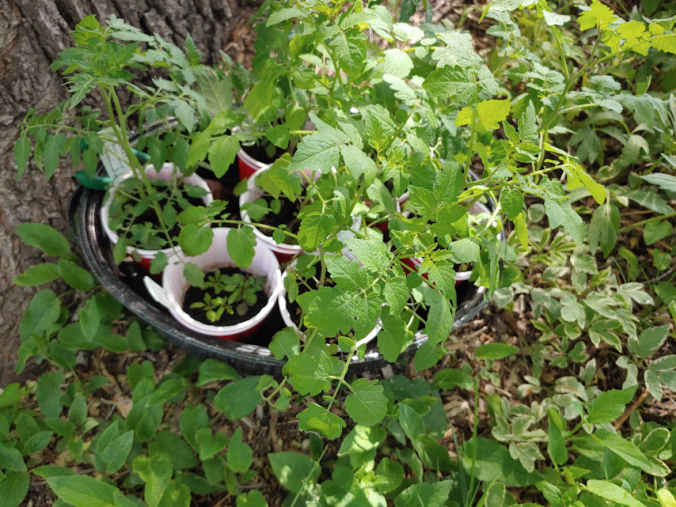
The transplants got set outside for hardening off. They were supposed to be out for 5 hours, but we ended up bringing them in a bit early. The winds really picked up, and some of the pots were being blown around.

Wind or no wind, I was determined to get the old kitchen garden finally planted!

This is now our beet bed. We bought two types of beets this year, Cylindra and Bresko, plus we had some Merlin left over from last year. The support posts handily divided the bed into three sections, so that makes it easy to keep track of where one type starts and another one ends.

After the bed was seeded and watered, I broke open the roll of netting. This is the stuff my daughter picked out that I thought could be used for deer fencing. It’s a much finer net than I expected! The black just disappears, too, but in the photo, you can see where the excess is bunched up along the sides. I’m really glad I found that big bag of cheap tent pegs in the garage. We used quite a few of them to pin down the edges of the netting. The short ends are held in place at one end by a stick rolled up in the excess, while at the other end, the excess went under a board I was using to mark the end of the bed.

Next was the L shaped bed. Lettuce went into there. I thought I had 4 types of lettuce left over from last year, but it turned out one of the envelopes was empty. That actually worked out, for the amount of seeds in the remaining packets.

The hard part was covering the odd shaped bed. One of my daughters came out and we sized up a piece of netting for the longer part of the L shape and cut it. The netting is 14′ wide, so we stretched it out on the grass and cut it in half.

The short side of the L, up to the label you can see near the bottom of the photo, is one type of lettuce, which is about as much as the other two together! There were still a few seeds left over, including some that had spilled in the baggie the seed packets were in, so those got scattered in the odd little bit of space next to the rose bush. They didn’t get covered with netting; the space is too small to bother.

The long side of the L shape was pretty easy to cover, but the short side curves around the lilac and gets wider at the end. While I used pieces from the canopy tent frame as supports at one end, there weren’t enough of that length for the whole bed, so I dug out some metal support rods I got last year. They’re not very strong and some had pieces broken off, making them shorter. Those matched the tent frame pieces more easily, but other were full length. I could push most if them deep enough to match heights, but with a couple, I kept hitting rocks that were big enough, I couldn’t seem to get around it. That one stake that has a spider web of cords from it is the highest of them all, and there was no way I could adjust it to avoid the rock I was hitting, and still have it where I needed it. (The bottoms of water bottles are there to keep the netting from falling down the stakes) That extra height in particular made pegging the netting down more of a challenge. In the end, we just had to push some of the stakes inwards to create some slack. We managed it, though.

That left one more bed to plant in.
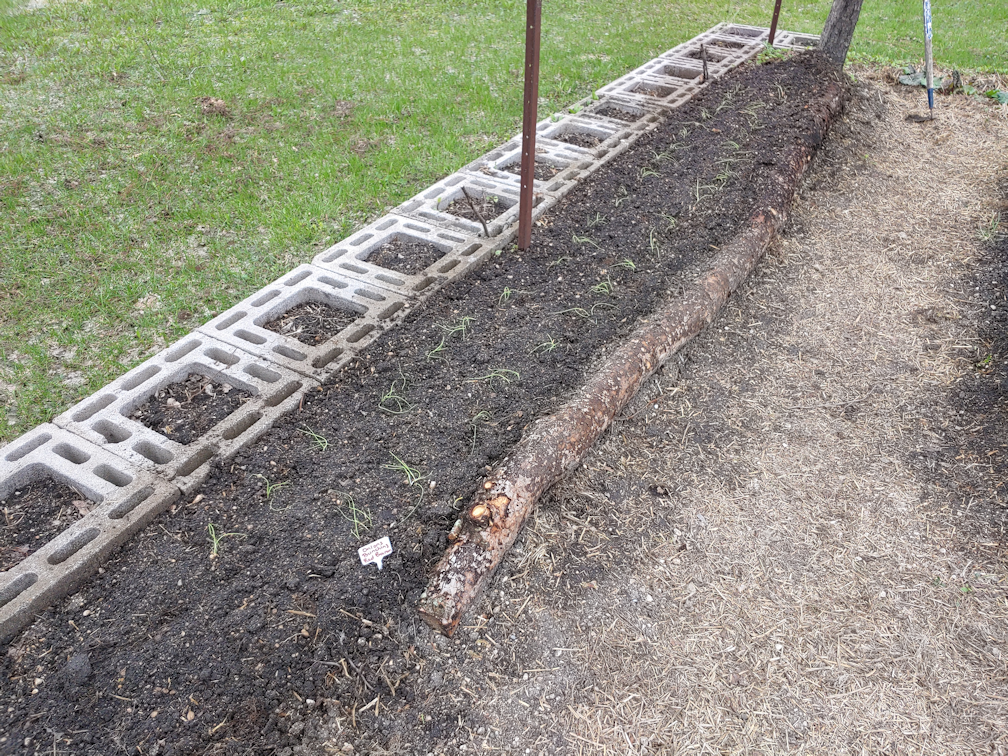
For this bed, I transplanted the Red Baron bunching onions, in little groups of 3 or 4 seedlings. These are not going to get covered, since nothing eats the onions. Hopefully, the cats will leave the bed alone!

While working on this, I checked out the small bed we planted the poppy seeds saved from last year. I think they are starting to come up, but there are so many things coming up with them, it’s hard to tell! For all the roots I dug out of these beds, we’re still going to have a lot of weeds to fight off.

Now, the only thing left in the old kitchen garden are the retaining wall blocks. I’d transplanted mint into alternating blocks, but they’re not showing yet. I don’t know if they’re going to show up later, or if they got killed by the winter cold. It takes a lot to kill mint, but they did just get transplanted. I’ll leave those for now, but still plan to plant things in the remaining blocks. I just haven’t decided what, yet, since we will likely not be covering those. Plus, this area gets shaded by the ornamental apple trees a lot. With the T posts there, we could put up trellis netting and plant climbers, but anything like that would be deer or groundhog buffet, so we would have to find a way to cover them. It was very difficult to cover the retaining wall blocks last year. We’d planted lettuce in it last year, which we were able to protect from the deer, but didn’t count on the groundhogs getting at them.

We’ll figure it out. We can tuck something into the blocks, later one. For now, I’m just glad to finally get this garden basically done!

Oh, before I forget, just a quite update on my mother. I called her up this morning, and she’s still in a lot of pain. She’s quite surprised by it, it seems. She’s also disappointed. She thought that the doctor would be able to fix her. I tried to explain, they can’t fix everything, but she started taking about how, with all the modern technology we have, there must be something. I had to go back to using my husband as an example, since he’s been dealing with debilitating back pain for a very long time now. Even if they technically could do surgery for one thing, the risk was too high for little benefit, and it would have to be done again in 2 years anyhow – and that wasn’t even for the main source of his pain, for which there is nothing that can be done other than painkillers and, for some of it, physio. He hasn’t been able to do physio since we moved here. Some things just can’t be fixed. I don’t think my mother realised just how fortunate she is to have reached 90 and not had to deal with something like this before.

Ah, well. It is what it is. We just deal with the hand we’re dealt with!

The Re-Farmer

Our 2022 garden: starting seeds and potting up

With our average last frost date of June 2, today works out to be 8 weeks for seed starts. In addition to starting new seeds, our replanted Cup of Moldova seedlings were ready to be thinned and potted up.

We also needed to make space.

While the sun room’s daytime temperature neared 20C/68F, while the outside temperature reached a high of 4C/39F, the overnight temperatures dropped to just above freezing.

We decided to take the chance, and move the onions and shallots to the sun room. I’m not very encouraged by how they seem to be doing, and I figure we’re going to need to buy sets later on, anyhow. More on that, later.

We also had to pot up the Wonderberry. The only one that survived from the first planting is large enough that it can only fit into the top of the mini-greenhouse, where the frame comes to a peak. The second planting had two that were getting pretty big, so they got separated and repotted, too. There was also a whole lot of removing of pots where the seedlings did not survive, and re-arranging the big aquarium greenhouse so that the new seed starts could go on over the heat mat.

Eventually, we were able to start the new seeds!

There were only two things that needed to be started, as the others on the list were for 8-10 weeks, and we’d already started them at 10 weeks.

One was Aunt Molly’s Ground Cherry. The seeds are so small and few, they came in a separate envelope in the packet. Still, my daughter divided them up, and planted 6 pots with them.

While she worked on those, I started on the Red Baron bunching onions.

They have such pretty seeds!

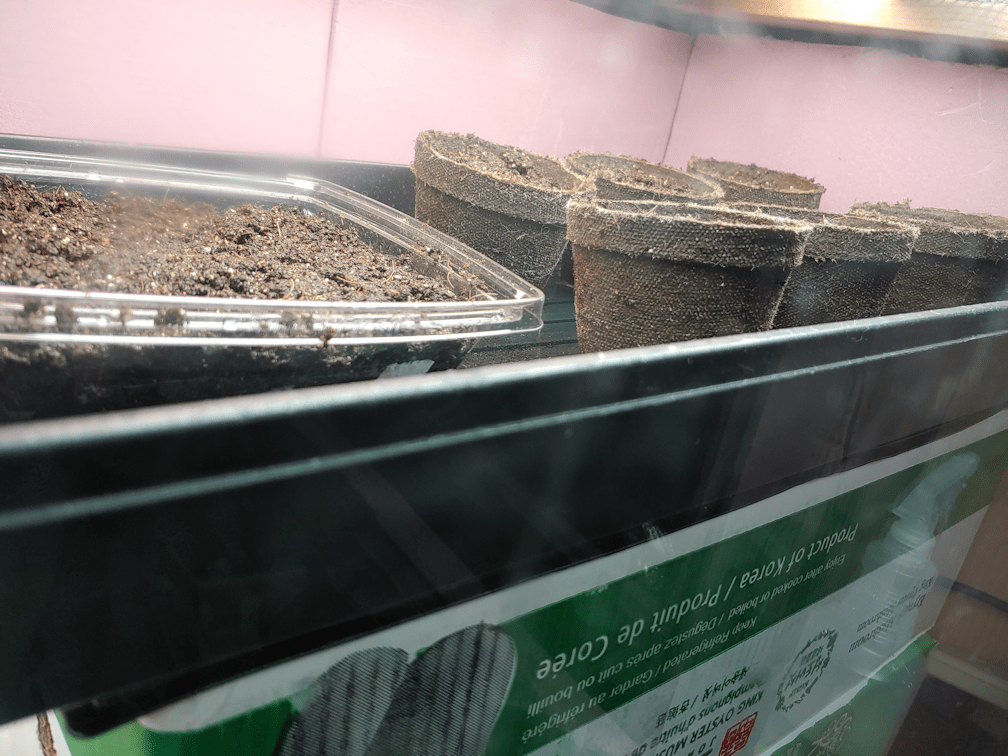
These were densely planted in a repurposed grocery store salad container.

These are now on the heat mat.

The pots that had been on the heat mat got shifted over, but are still in the big aquarium.

Here we have our squash and gourds, and the second planting of eggplants and purple peppers. There are a few survivors of the first planting, but the way things are going, I figure extras will always be a good idea!

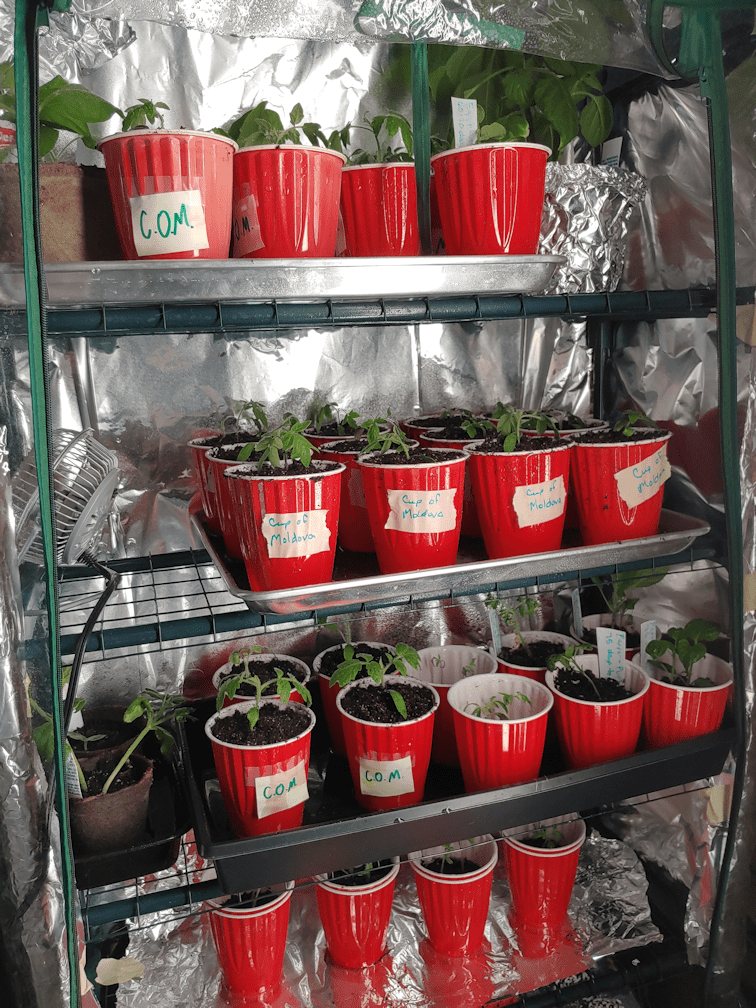
This tray had the second planting of the Cup of Moldova paste tomatoes, planted in Red Solo cups. A couple of them had only one seedling in them. For the rest, I gently removed all but one from each cup. The cups were only half full of seed starting soil, so my daughter potted them up by simply adding more to fill the cup. While she worked on that, I filled more cups and transplanted the tomatoes that had been removed, burying the stems until they were much like the others. I ended up doing a dozen cups, on top of what my daughter filled.

Hopefully, most of these will survive to be transplanted!

We were able to fit them all into the mini-greenhouse, though a bit more re-arranging needed to be done. The Sophie’s Choice tomatoes are much smaller, and not ready to be thinned or potted up, yet.

The largest Wonderberry is now in one of those Jiffy pots that can be buried directly into the ground, as are the two smaller Wonderberry. The smaller ones are in the tray, where they can be watered from below, but the big one was on its own. To allow for watering and not making a mess, my daughter wrapped the pot with aluminum foil.

Since we have to keep the mini-greenhouse enclosed, I have the mini fan set up to blow are up one side, so it can circulate under the cover without blowing directly onto any plants. A salvaged window screen gets set across the bottom, then the flap is brought down, its bottom tucked under the screen, and the zippers pulled down as far as the screen, so hold it in place. It’s the best we can do to keep it from getting too hot in there and to allow fresh air in. For seedlings this big, the cover would be removed completely, but certain cats would simply destroy everything.

It will be good when all the plants can finally go into the sun room! These are, however, much more fragile than the onions.

I had a couple of spare oven liner trays that I picked up for inside the small aquarium greenhouse. We’re not using that right now, as anything that goes into it seems to struggle. That’s where these onions had started out. They should be quite a bit bigger, and there should be more of them.

That one tray that looks the sparsest is the shallots. The soil even looks dug into. I suspect one of the cats actually managed to reach through a gap in the cover flap over the screen we put in front of the mini-greenhouse.

Concerned for the overnight temperature drop, I remembered a small light that we’ve used in the sun room before. It has an incandescent, full spectrum bulb in it.

It also gets quite warm, and we’ve made use of that heat for everything from keeping plants warm, to keeping recovering cats warm!

So that got set up on the empty shelf under the onions. The shelves all have scrap pieces of rigid insulation on them. Most of the inside of the shelf is covered by the reflector we made using a larger piece of rigid insulation. So the space should hold warmth a fair bit. The light fixture would help, plus even the LED shop light does warm up, just a bit. Between all that, I’m hoping the shelf itself will hold a pocket of warm compared to the rest of the room.

We’ll see what difference it makes.

So this is where we are at, 8 weeks before last frost. We have a few more seeds to start at the 6 week mark, but it’s the 4 week mark that is going to be a doozy. The fast majority of our seeds, both in variety and in quantity, are supposed to be started by 4 weeks. This includes the winter and summer squash, pumpkins, remaining gourds, melons, watermelons, and the last of the tomato varieties. We don’t plan to start many of the tomatoes, but we do intend to plant quite a lot of the various squash and melons.

Finding the space for everything is going to be quite the challenge. It’ll be May by then, though, which means the overnight temperatures in the sun room should be warm enough that we could even start some seeds in there, and not just in the large aquarium greenhouse. Some of what we’ve started will be ready for hardening off, too.

Looking at the long range forecast, we’re going to have a rather chilly Easter weekend, and things aren’t going to warm up very much after, either. I’ve been looking at the 30 year averages, though, and these temperatures are pretty much bang on for the average.

It just feels like winter keeps dragging on.

And on and on and on.

The Re-Farmer

Our 2021 garden: transplanting tomatoes and onions

After we got the sunflowers transplanted, the girls and I decided we would transplant the tomatoes today, too.

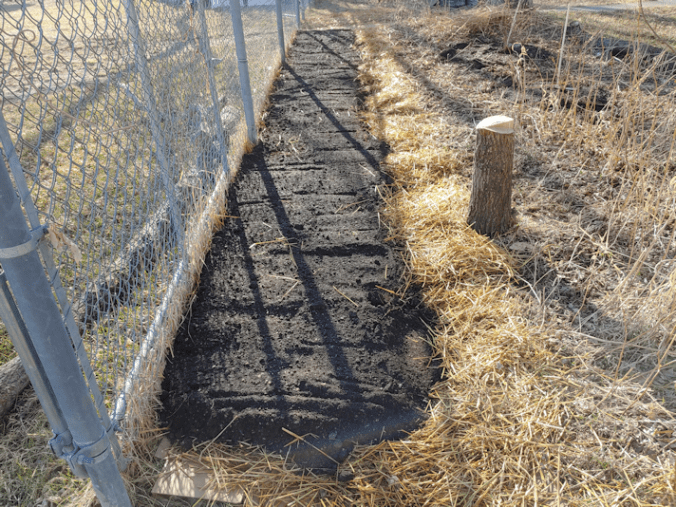
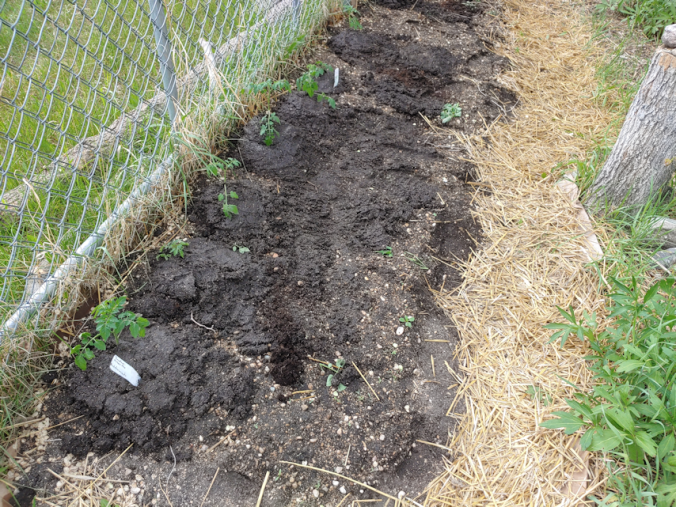
This is the area we prepared for the tomatoes, back in April, so that we can use the chain link fence to support them. You can read what we did to prepare it here. Though we have been wetting it down fairly regularly, there just hasn’t been enough moisture for the straw and cardboard to do much breaking down, and the soil layer was relatively thin.

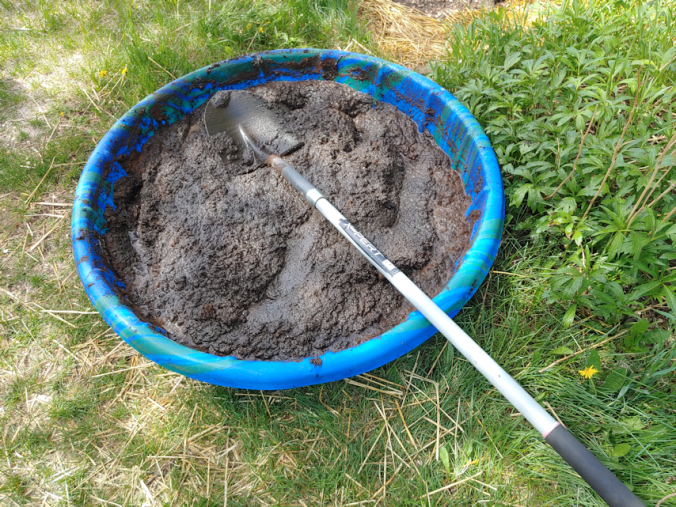
Since the new garden soil is alkaline, and tomatoes like slightly acidic soil, we decided to make use of the last of our bale of peat. Before heading in for lunch and out of the heat, we took the time to mix the peat with garden soil and soak it down.

Basically, we made peat soup. :-D

The seedlings were brought over to wait in the shade, then we headed inside to let the soil and peat mixture absorb more water.

Do you see that cup with the itty bitty tomato plants in it? That is a cup with Mosaic Mix seeds in it. It took forever for one seed to germinate, so when the plants got moved to the sun room, we decided to keep it. Then, just about a week ago, the other seeds planted in the cup germinated! They’re really too tiny to transplant, but the girls wanted to, anyway. We’ll see how they do!

When we got back to it, the transplants were separated and laid out, after getting their bottom leaves and branches trimmed off. We did dig small holes for each one, but there wasn’t a lot of depth before we hit straw. Each transplant got some of the peat mixture built up around it, up to the lowest remaining leaves, so that the buried stems will grow roots and the plants will be stronger.

Then we added more garden soil in between each plant, to build up the soil depth in the bed, and to make sure the peat mixture won’t wash away when we water them.

The first things we started from seed were onions, but we lost all of our Red Baron bunching onions, due to cats. When we started using the Solo cups as pots, I decided to broadcast sow the last of the seeds we had in a couple of cups and see what happened. With one of them, nothing happened, but with another, they did actually sprout. They’ve been hardening off along with everything else, and onions are supposed to be good companion plants for tomatoes, repelling insects, so we decided to go ahead and transplant the onions, too.

Some of them are REALLY tiny, but the girls went ahead and planted them anyhow. They’ll either make it or not.

The onions got planted in where we added more soil, but you’ll notice a gap in the middle. The tomatoes in the foreground are the tiny Spoon tomatoes, while the ones at the far end are the Mosaic Mix tomatoes. In the middle are the super tiny, sprouted really late, Mosaic Mix tomato plants. They’re so small, no extra soil was added around them; they would have been buried completely! We’ll see if they survive or not.

As always, we thoroughly watered the soil before putting in the transplants, so when we did our evening watering, they only got a misting, to help settle the soil.

We did hit 29C/84F today. As I write this, it’s just past midnight, and we’re still at 20C/68F. Our expected overnight low is 17C/63F. Instead of having to watch out for a last frost hitting our transplants, we have to watch out for excessive heat! We’ll be doing a lot of careful watering over the next while.

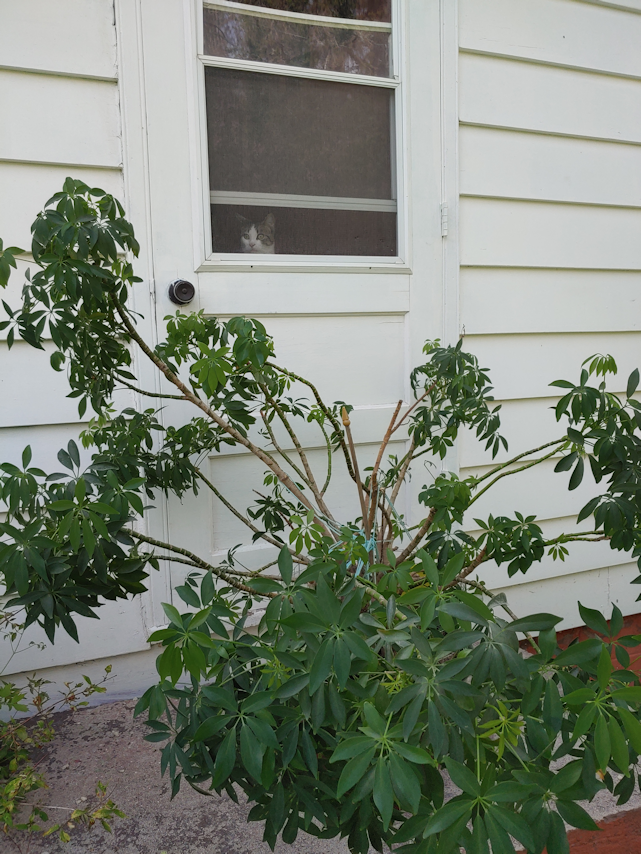
One thing the girls and I did finally remember to do; we put our poor, bedraggled umbrella tree outside. It took three of us. One to carry the pot, one to open and close the doors, and one to keep the cats away! :-D

Tissue was watching me through the door!

Yes, the plant is on the stairs in front of a door. In this spot, it will get full sunlight in the morning, while it’s still relatively cool, but be shaded during the hottest parts of the day. We don’t use this door, so it can stay there. Right now, during the day, we open the inner door and set up a little step ladder, so that cats can sit on it and look out the window. The window is open just enough to allow a breeze through the house to help keep it cool. The outer door has a tendency to unlatch on its own, so to make sure the cats don’t accidentally end up outside, we have it secured with some cord. It has become a favorite place for the cats to see and watch all the birds outside! :-)

So the tomatoes are now transplanted. Between them and the sunflowers, I had a lot fewer plants to bring back into the sun room for the night! :-) The rest cannot be transplanted until we finish the squash tunnel for the climbers, and build beds for them, but they are all hardened off and ready for transplanting. So we need to get those done as quick as we can! Friday and Saturday as supposed to be scorchers, too. Ah, well. Better the heat for transplanting, than frost!

Little by little, it’ll get done.

The Re-Farmer