Our 2026 Garden: new seed starting set up

Well, I got one package at the mail.

I’m glad I didn’t decide to just wait until the post office reopened in the afternoon. I forgot today is Wednesday. The store the post office is in closes at noon, every Wednesday, for inventory.

I was expecting the chicken coop to come in several large boxes, but there was only one small box. Only one package slip in my mail box. No coop. There was no “attempted delivery” this morning at all.

Hmmm.

Something to look up when I got home, and after I checked out my new stuff.

This is what I got.

Two new heat mats, two 4 light clamp lamps and one 5 light tripod pedestal lamp, with full spectrum lighting.

This gave me a chance to do a few things all at once.

Right now, my work table is covered with a gain self-healing cutting mat my darling husband got for me some time ago. Unfortunately, the heat mats make it warp. So I cut some pieces of half inch rigid insulation to size, to go under the heat mats.

The heat mat with the germinated plants in it got a piece of carboard between the mat and the tray as a buffer. Normally, I would stop using a heat mat as soon as the seeds germinated, but it’s so chilly in the basement, that’s not really an option. Especially since I will no longer use a light fixture that puts off a small amount of heat. The buffer will keep the seed starting mix warm, but not too warm.

The large celled tray now has a new heat mat under it. I’ve filled the last empty cells with seeds that were set to pre-germinate, even though they were not germinated yet. Then, just in case, I added a couple of fresh seeds into each cell. I did actually see a single Caspar eggplant starting to break through the surface, but nothing in any of the other cells. It’s entirely possible the seed starting mix, not being on a heat mate, but getting some heat from above, was too cold.

I also added new luffa seeds to the three Red Solo cups where nothing has shown yet, including the one where I couldn’t find the pre-germinated seed at all.

The new lights have a controller with several settings. There are five brightness settings – I put them at the highest. They can also adjust from red, blue or white light, or all three. I have it on all three. It can also be set to shut itself off after 6, 12 or 16 hours. I set it to 12 hours. Each lamp also came with an adapter, so they can be plugged in as usual, or can have USB. I have a power bar hanging above that has a couple of USB slots in it, so I decided to use that.

The only problem is that these are clamp lamps, and cannot stand on their own. Which means I had to move the tray set up to the front of the table for the lights to reach. Only at the front of the able is the surface narrow enough for the clamps. This worktable has a sheet of plywood on top of a narrower table top. The ends are too thick for the clamps.

With a full tray of cells, plus a second tray that’s only partially full, I set things up so that the full tray has five lights over it, and the other has only three.

I’ve still left the shop light above on. That light is manual, so I’ll need to shut it off and on, but that’s okay.

I am looking to pick up more seed starting mix when we are out and about tomorrow then, either on Friday or the weekend, I’ll start more seeds. Specifically, I’ll be starting herbs.

The tall light fixture will be set up in the living room. The onions in their seed snail rolls are getting plenty of light, with the shop light lowered to their level, but the other plants around them could really use better light! That room gets the morning light, and that’s it. It’s pretty dim, the rest of the day. We don’t have a lot of plants anymore, after repotting and donating most of them to the large animal rescue that took Poirot’s orphan kittens last summer. That, at least, will make it easier to give them proper lighting with this new lamp.

The lights themselves were very reasonably priced. The smaller lamps were under $25 each. It was actually cheaper for me to buy as a quantity of two separately, than to buy a single 2pk, which is weird. The larger lamp was under $40, regular price, and I got that one on a 10% off sale.

That done, I went looking to see what happened with that coop delivery.

Now, when placing the order, I was really surprised that would be delivered by Canada Post. When checking the tracking for the two packages I was expecting, they were the same. They even went through the same delivery depots at the same time, though the lights were ordered several days before the coop was.

Any time an order arrived, the trackers say “delivery attempted”. Of course, no delivery is attempted at all. The packages are just left at the post office for us to pick up with the regular mail.

Today, however, the coop’s tracking now said “undeliverable” and “location unknown”.

It also said, Fed Ex.

*sigh*

If I’d known is was going to be Fed Ex, I would have used our physical address. They have actually found us and delivered to us before.

I tried using the “contact shipper” link on Amazon, which took me to a page with a list of delivery companies.

None of them, Fed Ex.

So I went to their website and eventually found a customer service number to call.

After going through the robot sentinel, I actually got to talk to a real human being! Not only that, but he was awesome!

I gave him our physical address, including both the name and the numerical designation for our road. He put me on hold to work on it, then had to come back to ask more confirming questions. I told him, our address doesn’t exist on Google maps. He did, however, find a road with the numerical designation – but under the name of our municipality, not our little hamlet. So I had to explain that that section of road ends at a crossroad, then restarts a short distance off before continuing for several miles. It’s those several miles that are the empty void in the map, and we are in the void. In the end, he was able to take directions and instructions on how to get to us, and how to find our driveway – with the warning that if they miss our driveway, they’re not going to find the next one to turn around in for another mile. I also told him about the sign we have, with our physical address on it, and arrows pointing the way, at the turn off. Because we’ve had this problem before!

We had a lot of laughs while working this out.

I asked if they would be delivering tomorrow, and he said it was very likely. So I told him, I’ll be out for most of the day, though there will be someone home. I let him know we would leave the gate open, and the garage, and the package can be delivered into the garage. I don’t know how many boxes this is going to go into, but it’s warm enough that I don’t mind not parking the truck all the way into the garage, so make room for the boxes.

We will need to figure out where to assemble the coop. It needs to be relatively close to the house, on level ground, and in an area that doesn’t get flooded out in spring melt. Wherever we decide to set it up, we’ll probably have to level the ground. We really don’t have level ground anywhere!

On the plus side, this is a relatively small coop. It would be easy to move, if we ever need to. It could even get set up in the main garden area, where we can let the chickens help prepare the soil for us, where more raised beds are going to be built. The coops is just under 4′ wide, and just over 6′ long. The raised beds we will be building in the main garden area will all be 4′ x 18′. It could be set up where a new bed is planned and either moved 6′ every few weeks, or an extended run could be built to cover the 18′. I’ve got enough chicken wire for that. I’d just need to find the materials to frame it out. The coop design I got has the eggs boxes and roosts above and an open run below, with wire mesh walls. It would be easy to make a door to access an extended run. The only hitch is that access to the nesting boxes are at the ends, so a run on the end would make it harder to reach.

Hmmm… Things to think about.

We’ll have snow on the ground for quite a while yet, though, so there’s plenty of time to figure it out.

The Re-Farmer

Our 2026 Garden: West Coast Seeds order

Yes, I ordered more seeds. 😄

There is a method to my madness, though!

First up, this is my first order from West Coast Seeds, a Canadian seed source that comes highly recommended. I used the Gardening in Canada affiliate link, so Ashley gets a cut. I gain so much from her videos, it’s my little bit to support her.

The other reason I wanted to order from here is because of my current seed starts. When I turned the light on over the trays in the basement, I decided to check on my luffa. Of the four pre-germinated seed, only one has emerged and it still just as seed leaved.

Yes, I dug around to check the others.

With the first one, I started off gently moving the seed starting mix aside, but there was nothing. In the end, I was digging around aggressively, and there was no sign of a seed. Which means it rotted away. The remaining two seeds, I did find when I initially, very gently, most the seed starting mix aside, stopping as soon as I touched a seed. There is no side of growth, though.

It may be that, even on the heat mat, the basement – and, therefore, the seed starting mix – it just too cold.

These seeds were ones I got from MI Gardener and have a days to maturity of 120. Thanks to Gardening in Canada, I learned that West Coast Seeds has a variety of luffa that needs only 55 days to maturity! I could actually direct sow those and get luffa!

Of course, I can’t just order a single pack of seeds, so I went looking.

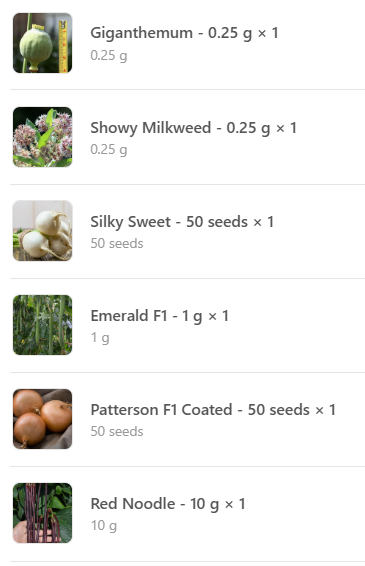
This is what I ended up getting.

From the top (all links will open in a new tab):

Giganthemum: This is something that Ashley from Gardening in Canada had in her recent seed haul video. Yes, I already have bread seed poppies. This variety, however, is supposed to get seed heads as large as a baseball! It has edible seeds, which is the main reason for ordering them. I have a space selected to grow bread seed poppies as a perennial, where I will allow them to re-seed themselves. What I will probably do is find another such location, in another part of the yard, and grow both varieties.

Showy Milkweed: this is the main variety of milkweed for Monarch butterfly conservation efforts. I’ve got an orange variety of milkweed that I have not been successful with. Hopefully, we’ll be able to get this variety established as part of our efforts to attract more pollinators.

Silky Sweet turnip: I already have some white turnips winter sown. I chose this variety because it just sounded like it would be really tasty. It matures in only 35 days and is a cool weather crop, so this can be succession sown throughout the spring, and again in the late summer/fall, if we want.

Emerald F1: This is the luffa gourd that matures in only 55 days! It’s listed as a dual purpose gourd, as the immature gourds can be eaten, but I think that’s true of all luffa varieties. We might try eating some, but that I want are those sponges!

Patterson F1 onion: Okay, yes, I have my own saved onion seed, plus red bunching onions and red bulb onions started. My saved seed is a mix of red and yellow bulb onions. I chose these because I wanted to be sure of yellow onions, and they are described as being exceptional storage onions. Unless I start them as soon as they arrive, though, these will be for next year.

Red Noodle bean: I couldn’t help it. I just really, really want to successfully grow the red noodle bean at least once! When I tried to grow them last year, I had an amazing germination rate, the seedlings exploded into growth, got to about 6-8 inches tall, and then stopped. They never got any bigger, and I don’t know why. I can make guesses, considering the horrible growing conditions we had last year, but they are still just guesses. I have quite a variety of bean seeds, both bush beans and pole beans, as well as varieties for drying, so we will have lots of choices, once the soil warms up enough for direct sowing.

There we have it. My first West Coast Seeds order.

Oh, my goodness! I just checked my Amazon tracking. My chicken coop and my lights and seed mats have arrived!

If I leave right now, I can get there before the post office closes for 2 1/2 hours over lunch.

The Re-Farmer

Morning kitties, updates, and yes, I got more seeds

First, the cuteness!

The outside cats are certainly running around a lot more, now that things are warming up! It’s going to get quiet pleasant for the rest of February, according to the long range forecast, though the local weather group I follow is monitoring a weather system that might push a Colorado Low into our area.

I never got a call from the hospital yesterday, so I called them before going to bed. I’m glad I did, because my mother called me this morning!

She is still in the hospital, all packed and ready for her transfer. She told me she asked the staff about when she was leaving, and that they told her they didn’t know how she would be transported. Which is strange, since they told me from the start that they are arranging her transport.

The doctor at the hospital was never able to connect with the doctor and the temporary care unit, and that’s why she didn’t get transported yesterday. I explained that to her, and assured her that the hospital would be arranging the transportation. Likely with a HandiVan, rather than an ambulance. My mother didn’t even know where she was going, other than it would be in the smaller, nearer city. I told her, she would be in the old hospital, now converted to temporary long term care, but that we still didn’t know where in the building she would be. She was satisfied with that. She sounded like she was really looking forward to the transfer!

Late this morning, I headed out to the feed store in the town my mother no longer has an apartment in. 😄 We’re heading into the middle of February already (how did that happen so quickly???), and we still had kibble, so I only got three 40 pound bags. I also ordered some lysine, which should be in on Monday. Or Tuesday. Monday is a statutory holiday (it has different names in different provinces) and I think they will be closed.

Since I ordered that chicken coop – which got shipped yesterday already! – I stopped to ask some questions about chickens. The two people that were there at the time got quite enthused in answering them! I’ll need to set up a brooder (I already have the heat lamp, currently being used in the sun room for the cats). They gave me a booklet from the hatchery they get their chicks from that has all the information needed. I know we still have feeders and whatnot in the old log building my parents used as a chicken coop when I was a kid, but I’m not about to go digging those out. They’ve been there for probably 30 or more years by now. I honestly can’t remember when my parents stopped keeping chickens.

I asked them which breed they would recommend for someone just starting out and looking for layers. They both very enthusiastically recommended Browns. They were really impressed with the number and size of the eggs this breed lays, plus they are known to be quiet, friendly and clean.

The chicken coop that’s on its way is big enough for only 10 chickens, which is a bit of a problem. The hatchery’s minimum order is 24 chicks. There is, however, someone else that’s looking for only a few chicks, so they took my name down alongside theirs. If they can find one more person, they can split a shipment, and the shipping costs, after the chicks arrive. It costs a bit more for sexed chicks, but with only 10, I don’t want to have any roosters in there. By the time everything is added together, it should cost me about $75 for 10 chicks. Meanwhile, I can slowly start picking up the other supplies I will need, like feeders and waterers. I can get pine shavings locally.

Over time, as we build bigger coops, we’ll look at getting meat birds, too. If we’re looking to fill the freezer for a year, we’d be looking at at least 100 meat hens, so that would require a much bigger coop! Or multiple smaller ones. It’s a shame the building my parents used can’t be used. We might still be able to fix it up at some point – it’s still in good enough shape for that, at least – but that is very much a long term project.

Once I was done there, I topped up the gas tank ($1.279/L *sigh*), then went to the grocery store. I was mostly looking to get more rye bread, but found a few more things, of course – including some tri-tip beef that was on sale. Beef has become something where local prices tend to be better than Costco prices. At least when the sales are on. Still high, but at least affordable enough to grab the odd package now and then.

I also got sucked in, as soon as I walked in the door.

There was a seed display. The first I’ve seen this year!

Of course, I had to look, and yes, I did get seeds.

The first are some double marigolds. These are something I want to scatter plant all over the various garden beds, wherever there is space. They can be started indoors 4-6 weeks before last frost, so around the middle of April or beginning of May. Marigolds are easy to collect seed from, so I should hopefully be able to collect some for next year.

I also got some yellow zucchini, because I just can’t have too many summer squash! These can be started 3-4 weeks before last frost, so in the beginning of May.

Both can actually be direct sown, too, so I might try a bit of both. It depends on how much room I find myself with.

I seriously had to resist buying more!

So we are set for the next while. I don’t need to head out anywhere again until it’s time to take the truck in to get the differential leak fixed – a 2 hour job. I had intended to visit my mother while the work was being done, but she shouldn’t be there anymore. Depending on when they can start working on the truck, once it’s done, I will likely to head to the city my mother will be in, to hit a Walmart and a Canadian Tire, both of which are quite close to the old hospital building she is being transferred to.

I’m actually surprised I haven’t gotten a call from the hospital yet. That means she hasn’t been transferred yet. I would have hoped the doctors had connected by now!

Ah, well. We shall see. The main thing is, she is safe and care for, either way.

Now… time to start pouring through that hatchery booklet I picked up today!

The Re-Farmer

Addendum: Oh! I just hit publish when a message from my brother came in. The hospital just called him. My mother is transferred, safe and sound!

Our 2026 Garden: eggplant and peppers

A couple of days ago, on checking the seeds I’ve set to pre-germinate, it looked like some were just starting to show radicals. Nothing ready, but it seemed they soon would be.

So I grabbed one of my deep celled trays and prepared it in advance. These trays have 21 cells, and I’m looking to have 1 row of each of the seeds I have pre-germinating right now. The seed starting mix in the cells are all pre-moistened, ready and waiting.

When I tried pre-germinating seeds last year, I let them sit for probably too long. Their roots started to go into the damp paper towels and had to be very carefully pulled free. From what I’ve been seeing online, they really should be potted as soon as the radicals appear.

So that’s what I’ve already done with the luffa.

Yesterday, that first seed I saw that looked like it was starting to show its radical – a Caspar Eggplant – had started to germinate. Just the one. So I planted it into a prepared cell, then topped it with vermiculite, partly so I could easily tell which cell has a seed planted in it.

Today, I found another eggplant, plus some Sweet Chocolate peppers.

I would prefer to have these on another heat mat, but I only have one. The light fixture above them, however, does put off some heat. With smaller seeds closer to the surface like these, it will actually be enough to affect them.

I did have to raise the light fixture another inch to fit the large celled tray under it, but that should be okay. I’ll keep transferring seeds over as they germinate. With these larger cells, I should be able to avoid potting them up for some time, if at all.

As long as the pre-germinated seeds survive the transfer, I should have 7 plants each by using this tray. If I’d been using the Red Solo cups, I can fit 9 cups in each of the bins I have to hold them, so that’s what I would have been shooting for as a total. Seven should be enough, and I am not expecting 100% germination rates, nor 100% transfer survival rates.

We shall see!

The Re-Farmer

Our 2026 Garden: starting peppers, celery and luffa

Normally, today would be my day to go into the city for our first stock up trip for February. With the truck having issues and an appointment to get it checked tomorrow morning, today was a home day, instead.

Which turned out to be a good thing.

I didn’t think I’d pushed myself yesterday, but the pain started hitting last night, and this morning I could barely walk. I managed to feed and water the outside cats, grab a quick breakfast, pain killered up and went back to bed for a couple of hours.

Thankfully, that seemed to help a lot.

Which meant I was up to setting things up in the basement to start more seeds.

That included testing out the heat mats. I’d bought a new one last year, because the old one stopped working, but I tested it again anyhow. For a while, I thought I’d need to buy another heat mat, but the new one did eventually warm up quite nicely. The basement is always between 13-16C/55-61F, though it does feel warmer after we removed the cat barrier in the “window” between the two basements, now that we don’t allow the cats down there anymore. I set up just one of the lights, choosing the one that actually warms up a bit when it’s on.

Then it was time to get the set of seeds to start this early. I decided against starting thyme. I’ll see if the varieties we planted last year survived the winter under their thick mulch and blanket of insulating snow. If they didn’t, I will buy transplants, instead.

I also decided against trying the Sweetie Snack Mix peppers again, and will start more of the other two varieties, instead.

This is what I started today.

There’s the luffa, of course. I probably could have started those at the same time as the onions. There are sprouts in all four onion seed rolls now.

Then there’s the Caspar eggplant, a new variety I’m trying this year. The Golden Boy celery is the first time I’ll be trying to grow celery. The Sweet Chocolate peppers are a variety the girls suggested. They grew well when we had them before. When it comes to flavour, they really don’t find much difference between any of the varieties we’ve tried. The California Wonder Bell pepper is a new variety for us that I chose specifically because they are described as being thick walled.

I decided to pre-germinate the peppers, eggplant and luffa, as the seeds are larger and will be easier to move and plant, once the radicals appear. I could also use a damp wooden chopstick to pick up the pepper and eggplant seeds.

With the peppers, I was thinking a total of 9 plants. When it came to pre-germinating the seeds, though, I ended up going for 9 seeds each – though the California Wonder got an extra when one of the seeds I grabbed looked like it was damaged. We’ll see how many actually germinate.

I also started just 9 seeds of the eggplant. I’m hoping to get 4-6 transplants out of those.

I was seriously tempted to pre-germinate more than 4 luffa. Even with pre-germinating, they do struggle to survive. We’ll see how many germinate – and how many survive until transplant time. Last year, I started with four, three pregerminated, one didn’t survive being planted, and of the remaining two, only one really grew much at all.

When it came to dampening the paper towels for this, I made sure to use warm water, too.

As for the celery, the seeds are so tiny, I decided not to pre-germinate them. Instead, I repurposed a clamshell from strawberries. The holes on the bottom are fairly large, so I set a paper towel on the bottom to keep the medium from washing out the bottom. Normally, I pre-moisten the starting mix in a large bowl I have for that purpose, but for such a small amount, I filled the container with dry mix, then used the warm water to thoroughly soak it, first, making sure there were no dry spots. Then I pressed it down to get rid of any excess water, and ensure there were not air gaps.

I have a little seed dispenser that I used to scatter the seed lightly over the surface. With seeds that small, the hard part is keeping them from being too densely sown. Also because they are so small, I didn’t top them with more seed starting mix. Instead, I added a layer of vermiculite. That got a thorough spray with warm water.

All of these fit into a seed starting drain tray and are now set on the heat mat, under the light. The light has “legs” that fit on the ends of the aquarium we originally got it for, so it only needed a couple of the fire bricks I’ve been using as supports. The other light we have rested directly on the aquarium frame, so if we need to bring that one out, it’ll need twice as many bricks to get the same height. The handy thing is, as things grow taller, we can just add more bricks to raise the lights by an inch per brick.

For the peppers and eggplant, I’ve got some deep cell trays I can plant them into. The less potting up, the better.

In the beginning of February, I will be starting tomatoes. I will probably pre-germinate, then use the Red Solo cups for those. I’m still torn between starting three, or all four, of the new varieties I got.

Oh, who am I kidding. I’ll be starting all four.

It would also be the time to start herbs, such as tarragon and savory.

Hopefully, this will work out. Aside from the luffa, these varieties have a relatively short days to maturity on them. It’s not just frost free days we need to think about though, but soil temperature. Last year, we had such warm days in May, but the overnight temperatures were so low, we still couldn’t transplant our seedlings until well into June.

Hopefully, this year will be a much better growing year, without the drought, heat waves and smoke!

The Re-Farmer

Our 2026 Garden: starting onions

Today, I finally got around to starting our onion seeds.

Usually, I start onions by densely sowing them in trays. Onion roots can handle quite a bit of abuse. When it’s time to transplant, I just pull them apart as I go. The problem with that, is, the roots do get pretty tangled together, and there have been times when I’ve even had to use water to wash away the growing medium in order to get individual seedlings out.

This time, I wanted to try something different.

I’ve been seeing the “seed snail” method that got me curious. Basically, seed starting mix it laid out on a strip of something – plastic, cardboard, paper towel, etc. – and rolled up. Seeds are planted at depth at the top, covered with more seed starting mix, and it’s done. When it’s time to transplant, the roll is undone and there is less root disturbance when accessing the plants. If the plants need to be “potted up”, it can be unrolled, more starting mix added, then rolled back up again.

In looking it up more, I see people using this method for pretty much everything, including things with very large seeds that grow pretty big. I’m not so sure the method lives up to the hype for larger things in particular, but something like onions? It seems perfect.

The thing that I was most curious about was, the material used to make the roll. One article I read, which was not positive towards the method, used paper towel. I can’t imagine using something that practically dissolves in water, over time! Others described using heavy paper or cardboard. I don’t really have anything like that, in the size and shape needed. I’ve also found that using paper products tends to wick moisture out of the growing medium, away from the plants, and need more watering. Even with the biodegradable pots, I’ve found the pots themselves need to be kept wet, or they start drawing moisture away from the plants.

One thing mentioned as working well was the thin foam sheets used to wrap breakables for packing.

Did I still have some?

I quick look in a storage bin in the root cellar, and I found I had plenty!

So that’s what I used.

Before I started on that, though, I prepped the last of my seed starting mix from last year. It had quite a lot of pieces of wood and such, which would be more of a problem with a seed snail. I wanted to sift it, but didn’t have a sifter. In the end, I used a metal colander with finer holes all over, and sifted it into a giant mixing bowl.

I got quite a bit of larger material out. I also had some concern that I might not have enough sifted started mix for the project.

I had four seed options. There were our own saved seed, which is a mix of red and yellow bulb onions. Then there were the seeds I got from MI Gardener. Red Long of Tropea, which are very much like the Tropeana Longa onions we’ve successfully grown before. Red Wethersfield, which we tried but did NOT successfully grow before, and Red Beard Bunching onion.

I was at first thinking to do the bunching onions later, but they are 110 days to maturity, while the other two are 100 days to maturity, so I prepped four strips. I taped shorter pieced together for the length, then folded and cut them in half lengthwise. That resulted in two strips of about 31 inches, and two of about 29 inches long, and about 6″ wide.

That sifted seed starting mix was absolutely beautiful to work with! So soft and fluffy!

Each strip got a layer of starting mix about a quarter inch thick, laid out right to the edge of one end and the bottom. The top had about an inch empty, and the other end had about 8″ empty. I had my work surface covered with a repurposed clear garbage bag, which actually made it easier to roll them up. I could lift the plastic up against the base of the snail, to keep starter mix from falling out.

I prepped masking tape ahead of time. Four were labelled. After rolling up the snails, I used a black piece of tape to hold it together near the bottom, before tucking it into a bin. After they were all rolled, I sowed the seeds and added the labelled strips of tape to hold it together near the tops.

In the first picture here, the seeds are sown, more seed starting mix was set on top and every so gently tamped down to get rid of any air gaps. In the next picture, they’ve been topped with vermiculate.

Once topped with vermiculate, they got a very thorough watering with a spray bottle, then more water was added to the bottom of the bin they’re in, so they can be watered through capillary action, too. Last of all, the bin’s lid was laid on top to act as a moisture dome.

This was all done in our basement dungeon. I don’t have any of the grow lights, the heat mat, trays, etc. ready. I won’t need them for quite some time yet. So these went upstairs to the cat free zone (aka: the living room). It’s not particularly warm there, but warm enough. Plus, the window gets full sun only for a few hours in the morning, so we have supplementary light above.

It should be interesting to see how this method works out.

In the past, when densely sowing seeds in trays, I would usually finish off the package. This time, there are seeds left in all three packets – plus there is lots of our saved seed. So there is the possibility of trying again, if this doesn’t work, as long as they get started early enough.

Anyhow. The main thing for now is, the onion seeds are started!

First seeds started indoors, for our 2026 garden.

Yay!!

The Re-Farmer

Our 2026 Garden: beets, bok choi, dwarf peas – and Judgement!

I definitely want to start with the good news, before getting into the gardening stuff.

As I was putting things away in the sun room, I saw a cat in the cat cage jump out and meow a greeting. Nothing unusual about that, except that this cat had something around its neck that was flapping.

Which is when I realized, it was Judgement!

I haven’t seen Judgement in months!

We had put collars on the cats that got fixed, to make them faster to identify, but I also made sure they were reflective collars, so they would be less likely to get hit by a car or something. Most of the cats lost their collars long ago. Judgement had lost one or two already, but he still had a ratty yellow collar still on him.

I took it off and threw it away!

Now I’m hoping to see Syndol back, too! It’s not unusual for cats to disappear for the summer, then come back for the winters, but sometimes they don’t come back at all. So this was a nice surprise for the day.

My priority for today was to finish what I started in the old kitchen garden. The rectangular bed in particular needed a bit more work. I was able to pull more weeds and roots I could no longer see when I stopped last night. I also found the gap under one log was quite a bit larger than the hole the cats had made, so I found more sticks to push in front of it. The gap extended all the way to the corner, though, so I used the scrap board I’d been using when hammering stakes into the ground to lay across the opening on the inside, then added a few more sticks to hold it in place.

Then I could use the rake to level all the soil again.

The section of the wattle weave bed I’d prepped yesterday needed some clean up again. I kept having to chase cats out of the garden beds because they kept wanting to use the nice, soft, fluffy soil as a litter box!

After levelling the soil in the rectangular bed, I marked out four rows with stakes and twine. This required repeated removal of kittens. In the second picture, you can see what I planted and transplanted. In the row north of centre, I planted the mixed beets, so they wouldn’t overshadow the Hedou Tiny bok choi I sowed on in the row south of centre. The bok choi can get quite tall, after it has bolted and gone to seed, but for harvesting, they should only be about 2 or 3 inches tall. I do plan to leave one or two to go to seed to collect at the end of the season.

In the outside rows, I transplanted a whole bunch of the onions I’d been finding. On one side, I transplanted the ones that were clearly bulb onions. On the other, I transplanted the ones that look like they might be white bunching onions, except I’ve never tried to grow white bunching onions before.

In the next picture, you can see where I planted one packet of dwarf peas. I got two packets, but this is a very short row, so I only needed the one. The peas went in the back of the bed (north side). I’d already transplanted some onions at the end and at the front near the corner before. Today, I took the two garlic bulbs I’d found, broke up the cloves, and planted them in line with the onions. They filled the entire remaining front space.

Once everything was in, it all got mulched with leaves. Then I mulched around the herbs in the tiny bed as well. I didn’t cover them, as we’re still using them as needed. Before the hard freeze hits, I’ll cover them completely with a leaf mulch, and we’ll see how they survive the winter!

I also moved the raised bed cover over the rectangular bed for the winter.

I didn’t take final pictures, though, as I decided to take garden tour video, instead. I’ll be going through them and putting together a garden tour video. If I’m satisfied with what I took. Otherwise, I might take new recordings tomorrow, before I head into the city for the Costco shop. We’ll see.

At this point, the only bed I was considering winter sowing into is the small bed off to the side where the Albion Everbearing strawberries had been last year. It still needs to be cleaned up, and I plan to sow bread seed poppies there. That can wait until spring, though, if necessary.

As it stands now, other than mulching the transplanted strawberries and little things like that, the garden can be done for the year. The winter sowing is in, and anything left can wait until spring if I can’t get to it in the next while. We’re getting a bit of rain right now, and the next couple of days are supposed to be dry and cooler, but Sunday and Monday are supposed to get warm again, with plenty of sun, so there’s still the possibility of getting ahead of things for next year.

So, to recap, we have winter sown for next year:

Purple savoy cabbage
White and Purple Vienna Kohlrabi
Daikon Radish
White Egg turnip
Rainbow Mix carrots
Spring Blush peas
American spinach
Yellow Swiss Chard
Garlic
Hedou Tiny bok choi
Assorted Mix beets
Tom Thumb Dwarf peas

Then transplanted miscellaneous onions and garlic that were found during bed prep. Plus seed onions.

Last year, I scattered seed mixes and they did surprisingly well. This year, I’m hoping the more orderly plantings will survive the winter and give us a nice head start in the garden next year!

Not too shabby, I think!

The Re-Farmer

Our 2026 garden: winter sowing kohlrabi and cabbage, and prepping the next bed

I got back from the city early enough, and it was still warm enough, to get some progress done in the garden.

My first priority was to winter sow in the east yard low raised beds. Two of these beds were already prepped, but not covered in any way, so they did require some clean up. The cats have been using them as litter boxes!

Some of their “presents” were astonishingly huge.

Ew.

My original plan had been to do the kohlrabi and cabbage on the outside of the beds, then have peas down the middle of one, while leaving a gap in the middle of the other to plant pole beans in the spring.

I forgot. The kohlrabi and cabbage will need to be covered in netting to keep them from being decimated by flea beetles and cabbage moths. Having something growing on a trellis in the middle is probably not a good idea!

In the first picture below, the beds are cleaned up, leveled and rows marked out.

In the second picture, you can see the planted rows of purple and white kohlrabi. If I had gone ahead with the plan to grow pole beans down the middle, these rows would have been further apart. I decided to stick with just the two rows and moved them closer to the middle. These raised beds are more prone to freezing than the beds in the main garden area, simply because the boards are so much thinner than the logs used in the longer beds. We’ve lost almost entire beds of garlic over the winter due to excessive cold, even with a mulch. I’m hoping that, with sowing them closer to the middle, deep mulching them with leaves, plus the predicted milder winter we’re expected to have, they will survive. The plant spacing for these, according to the package, is 4-6 inches, so I tried to scatter the seeds with my little hand seeder fairly lightly. If they survive and germinate, they will still need to be thinned later on, but not by too much. Hopefully, if I have the space, the will be thinned by transplanting.

In the next picture, I have the Purple Savoy cabbage. This is the first time we’ve tried to grow cabbage. I originally planned to have two rows on the outside, then peas in the middle, but decided to do three rows of cabbage. As they need about a foot per cabbage for spacing, I tried to scatter two or three seeds every foot or so, though a few spots accidentally got quite a bit more! You can sort of see a grid in the soil, from where the seeds were covered and the soil gently pressed down, while the rest of the rows I made with a hoe remain untouched.

Grommet REALLY wanted to “help” me with the sowing!

I had made sure to rake up plenty of leaves into the wagon and the wheelbarrow before I started, and was able to give the beds a good mulching for the winter. Then I transferred one of the raised bed covers for the winter. There is another one on the third bed I could move over, but I decided against it. That cover’s wire mesh does not have hoops to support it. Cats would knock that flat and out of shape in a heartbeat. So it’s up on top of the box frame one the other bed, which I’ve found surprisingly useful. I plan to make more 3′ x 9′ covers like this over time, but we need to buy more lumber for it, first.

That done, it was time to shift over to the old kitchen garden.

The cats have been having a field day in the cleaned up wattle weave bed, so that got a clean up, first. My plan is to winter sow dwarf peas in the back of the south facing section of the wattle weave bed, and transplant any onions, etc that I found in the rectangular bed in the front.

That… might not quite work out! At least, not so much for the onions part.

The first thing was to harvest the remaining Swiss Chard. It wasn’t until I uploaded the pictures onto Instagram that I realized I forgot them outside! They should be okay overnight.

In the second picture, you can see an area on the south side of the bed, where the cats dug into the dirt. I suspect there was a mouse or something that got their attention for them to dig it out that much. There had been grass clippings chinked in the gap between the logs, but that disappeared. It’s been filled repeatedly, and the cats keep pulling it out. So one of the things I needed to do was find a way to block that gap in a cat proof way.

Once the chard and remaining kohlrabi roots were cleared out, it was time to loosen the soil, pull the weeds and set aside any little onions I found.

I found so many, I started just tossing them with the weeds after a while!

What I really wanted to find out is what was going on with what looked like a cluster of garlic coming up, and another cluster of what I thought were onions but, as they got larger, the leaves started to look like some sort of ornamental allium, instead.

In the next picture, you can see that there were two entire bulbs of garlic that somehow got missed! I planted garlic in here a couple of years ago. This year, two garlic bulbs grew among the seed mix in this bed. They grew into nice sized bulbs that got harvested.

Now I find two full bulbs of garlic that somehow got missed over two growing seasons! I will probably separate the cloves and transplant them.

Next to the garlic is the cluster of alliums growing near by that did turn out to be onions. Several of them were growing together like bunching onions, rather than bulb onions, but I’ve never grown bunching onions. They are large enough that I will probably transplant them, too.

In the next photo, you can see most of the other onions I found while cleaning the bed. There were so many tiny ones! One red onion was quite large. I will transplant the larger ones, but I don’t know if I’ll bother with the teeny ones.

While working across the bed, I was finding a surprising number of roots. Some were definitely from the rose bush at the end of the bed, but it’s possible others were from the ornamental crap apples and the double lilac. It definitely made the job take longer. As I worked my way up the bed, I took advantage of having lots of old stakes handy from the bed along the retaining wall, before the wattle weaving was added on top of the retaining wall blocks. Some of the largest, strongest ones were used to stabilize the top side logs, as their supports were getting old and starting to break.

To block the gap, I used some flat pieces of scrap wood that were in the corner, then a whole bunch of old stakes, on the inside of the wall. Once the bed is done and ready for planting, these will be mostly buried and hidden from view.

As you can tell by the last picture, and the flash needed for the pictures of the onion and garlic, I had to stop before it was all finished. It was simply getting too dark. I was working by the light of the shop lights at the sun room window by then, and those were on only because their motion sensors were being triggered.

I don’t have anywhere to be at tomorrow, so I’ll be able to finish the job then, and do more winter sowing. I should also be able to clean out that little bed off by itself in the main garden area, where I’ve decided to plant bread seed poppies. Since I didn’t winter sow a variety of peas I’d meant to plant between the cabbage, I’m considering finding somewhere else to winter sow them. Once the dwarf peas are planted, that’s two varieties of peas that are winter sown, so leaving the third variety I was planning to winter sow for the spring would be fine, too. I also have our own saved sugar snap pea seeds that can be sown in the spring.

The rectangular bed that’s being cleared now will have beets and tiny bok choi winter sown in it, probably interplanted with some of those onions and/or garlic I’ve been finding! I was thinking of planting something down the middle, but I can’t for the life of me remember what that was right now. I’ve got diagrams drawn out, but those are in the basement, along with my seed inventory.

So that’s the garden and winter sowing status, for now. We should have a nice head start into next year’s garden, if this works out.

I will also be making what will probably be my last garden tour video of the year. Last year, I ended up doing my October video using video recorded on November 1, because the video I’d taken on October 31 was done too late in the day, and everything was too dark. So I want to make sure to get it done earlier, and earlier in the day.

Thankfully, it looks like the weather will hold for a while yet, and I should be able to get other things done before the snow flies. We’ll see how that works out!

Little by little, it’s getting done!

The Re-Farmer

Our 2025 Garden: yes, there’s still things growing, and seed sorting

Today turned out to be too damp to work on more garden beds outside. Another day lost when there are very few days left to get the beds ready for winter sowing. Hopefully, I’ll get more progress done over the next couple of days. After that, we’re supposed to have another day of rain, and then it’s actually supposed to slowly warm up a fair bit, so I should still have time to get beds ready and winter sowing done.

While I’m focusing on the main garden beds right now – they are the largest and most difficult, thanks to the tree roots I’m battling – we do actually still have things growing! The greens mix I sowed in the old kitchen garden still has a few things that have done quite well with the frosts we’ve had.

The most visible are the Swiss Chard. We’ve just been harvesting leaves from the larger plants as we want some, and they soon fill out with more.

The first photo in the slide show above show the two largest of them – the ones we’ve harvested from the most! There are other, smaller ones in the bed. These had germinated in areas where the kohlrabi was growing, so they got shaded out. Interestingly, I harvested a few kohl rabi but cutting the stems at the bases, rather than pulling the whole plant, and the stumps are growing new leaves!

All of the winter sown seed mixes had onions seeds, which didn’t make it, for the most part. This bed has a few poking up, including a few clusters of greens. As those greens have gotten bigger, however, their leaves turned out to be flat! They look like garlic! Now, we did have a couple of garlic show up in this bed. In a previous year, we planted garlic in it, and it seems a couple of cloves that hadn’t germinated then, survived to germinate this year. The thing is, this bed was completely reworked to make the soil as fluffy as possible before the winter sown seed mix was added. I never saw garlic cloves. Looking at the clusters, if those are garlic, they look like they are growing out of a whole bulb of cloves, not individual ones!

I’ll be digging them up as I clean the bed and, if they are indeed garlic, they will be replanted and mulched for the winter.

One of the garden related things I did today was start going through the seeds I’d collected and set out to dry in the cat free zone, aka: the living room. Today, I started jarring some of them up.

In the first photo, I’ve got some of them in spice jars that were gifted to us. There are the mixed Jewel nasturtiums, radish seeds from whatever plants had pods ready (we had 4 or 5 different types of radish in the root vegetable seed mix), Super sugar snap peas, and the Hedou Tiny bok choy. I had to look up the name for those. I keep wanting to call them Hinou instead of Hedou, and I don’t know why!

In the next picture, I’ve separated carrot seeds out from their clusters. Same with the onion seeds, after that. The last picture is the Jebousek lettuce seeds I’d collected by trimming off the stalks. They are now separated out from their stalks and will be left to dry out some more. Some of them are still surprisingly green.

I’ve also started planning on where I want to do the winter sowing, and choosing what will go where. There are a number of things I need to consider. Some faster growing/maturing things will be planted closer to the house, while stuff that will take much longer before they can be harvested will be further from the house. Some will need extra protection from deer and/or insect damage. Others will be interplanted with things that will be sown or transplanted in the spring. I’m even considering things like which things will get harvested the most often, for the high raised bed.

Which means none of what I’ll be winter sowing. That bed is going to get bush beans again. Must easier on the back to harvest from there! I had bush beans in there a few years ago, and it was SO much easier to find and pick the beans.

I picked up so many seeds, taking advantage of MI Gardener’s sales on their already low priced (even taking into account the dollar difference) seeds, that we have lots of extras, and that doesn’t even take into account the seeds I already have in stock. We can pick and choose what we want to try growing this year. I’ll be going through them with my daughter’s, too, to see what interests them.

In other things…

We’ve heard from the company that’s replacing our door and frame. Today was out, because of rain, and the installers don’t do Saturdays, so Monday is the earliest it will be installed. Monday, however, has a 70% chance of rain, so it will likely be done on Tuesday. I have my eye appointment on Tuesday, and my daughter will have to drive me home, but it’s not until the afternoon, so that’s not an issue.

I’ve also been in touch with the woman who is taking 6 yard cats tomorrow, with a time and place to meet arranged. She says she has a kibble donation for us, too, which is greatly appreciated! The three littles are so small, they can go into the same carrier together. Being together will probably help keep them calmer, too. Four carriers in the truck will be much easier to arrange than six! Especially since I want to refill a couple of water jugs while I’m in town.

This evening, before the light was gone, I got my mother’s angel statue set up by the trail cam, facing the gate. I hope I’ve secured it to the block it’s on well enough. It’s rather top heavy. Ideally, it would be secured to a post hidden behind it. Maybe with something pretty, or at least a neutral colour to match the neutral colour of the statue, around her waist so it looks like it’s supposed to be there. When I’m able to, I’ll drag out some larger rocks to set around the bottom to hide the block it’s on for now. Eventually, the rocks will form the walls of a slightly raised flower bed around the base of the angel.

I’m even thinking of moving my mother’s Mary statue to be part of the display. It’s currently mostly hidden by the mock orange beside the laundry platform. Unlike the angel, though, this statue is concrete. It weighs anywhere from 80-100 pounds. No chance of that one blowing away in the wind!

This will be a longer term work in progress. It’s going to involve a lot of digging and the hauling of a lot of heavy rocks! For now, the main priority is to make sure the angel doesn’t get blown over. Especially now that we know how easily it breaks!

I haven’t told my brother that I’ve set it up, yet. I am pretty sure he’ll be coming out this weekend again. He still has plenty to do with his own stuff, but our motion sensor light over the door has stopped working. We thought it just needed a new bulb and tested it by turning it on manually, but it still didn’t work. I think he intends to replace it completely, since he asked me to send him pictures of it in daylight, after I sent him a video of the light occasionally flashing like a strobe light.

In the end, even though I didn’t get stuff done outside because it was so wet, I did manage to have a productive garden related day!

I’m really chafing about not getting those beds ready faster, though! 😄😄

The Re-Farmer

Our 2025 Garden: cold damage

I found myself staying up late very last night, which meant I was up to see what the weather was doing. So I was not at all surprised by what I found in the garden this morning.

The first picture in the above slideshow is the Arikara squash, which only recently had its first female flowers start to bloom. I’d wanted to grow these specifically to save seed, as it’s a rare variety.

Not going to happen this year.

Thankfully, I do have a few seeds left and can try again, next year.

The next two pictures are of some of the pumpkin plants. It’s a bit hard to tell in the photos, but the leaves are that darker colour they get from cold damage. In one of the pictures, you can see the leaves starting to droop, too. We do have the one pumpkin in its sling on the trellis. It does not appear to be frost damaged, but it might take a day or two before we can see for sure.

The next picture is of the summer squash, still under their covers. They actually seem okay, even though they aren’t completely covered. I did not try to check on the winter squash, under their plastic. They should be fine, and I don’t plan to uncover that bed at all today.

I didn’t uncover anything this morning. It was still too cold at the time. It’s not going to get much warmer, though, and now it is supposed to rain all day. From what I could see, the peppers held out fine under their sheet. So far, the eggplants do, too, but they tend to start dropping later on. It’s the plants at each end, that are the most exposed, and take the brunt of the cold. I’m hoping the jugs of hot water we set beside them helped, but it’ll be a while before we can tell, one way or the other.

Last night, I worked on getting the radish seeds out of their pods, which ended up taking a VERY long time. I stayed up a while longer to monitor the oven, so my daughters could go to bed. Which is why I was up to check the weather apps and get the screen captures in the next two images.

So much for a low of 4 or 5C/39 or 41F. We were expecting it to be colder, to be honest. We did end up hitting 0C/32F. There were no frost warnings.

I’m actually thinking of turning the furnace back up for today! I do have one of the heat lamps in the sun room turned on – the one with the 250F bulb, not the 150F lamp. It hangs above the space in front of the new cat cave, and the sun room littles have definitely figure out that this is a good spot to hang out! 😄

Our daytime highs are supposed to increase quite a bit, about half way through next week, and stay high for about 2 weeks. That will be the time to empty out and clean up the sun room for the winter, and do things like bring the isolation shelter back near the house, put the heat lamp back in and get it set up, so we just need to plug it in to the outdoor outlet there, as needed.

I am not looking forward to winter. My daughters love the colder weather. I can tolerate cold a lot more as I get older – it’s heat I’m having a harder time with now! – but I don’t like the season. Too many things that need protecting from the cold – including the house itself – and too many things that can go wrong that, in the summer, would be just an annoying but, in the winter, can be dangerous, or even deadly.

Having one of these sure would be nice.

One can dream!

The Re-Farmer