I’ve ordered seeds for next year’s garden already.
There’s a reason for that, though. For starters, we can already see how things went with direct sowing in the fall, and how they’re doing now. So while these are for our 2026 garden, some will be planted this year, before the ground freezes.
Another reason is, MI Gardener has refused to raise their prices making them more affordable, even when taking the dollar difference into account.
As low as their prices already were, they also have a 20% off sale, and free shipping to boot.
I took advantage of that.
Well. Just for the seeds. Everything in their site is on sale for a week, but ordering things bulkier than seeds over the border is not something I plan to do.
When I did the winter sowing, I made seed mixes using up a lot of our seeds that were starting to get old. All our radish seeds, spinach, a summer squash seed mix I’d accidentally bought extras of a few years ago, beets, Swiss Chard, etc. were all finished off when I made our seed mixes for the winter sowing.
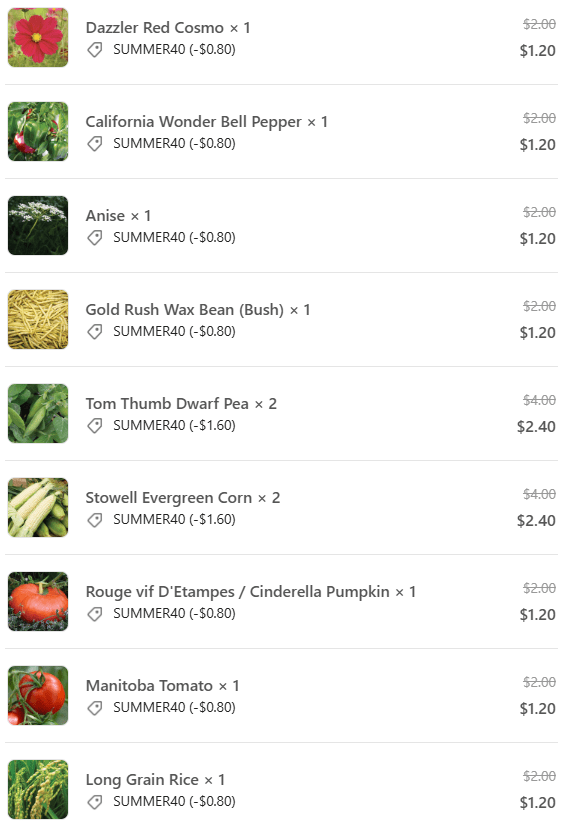
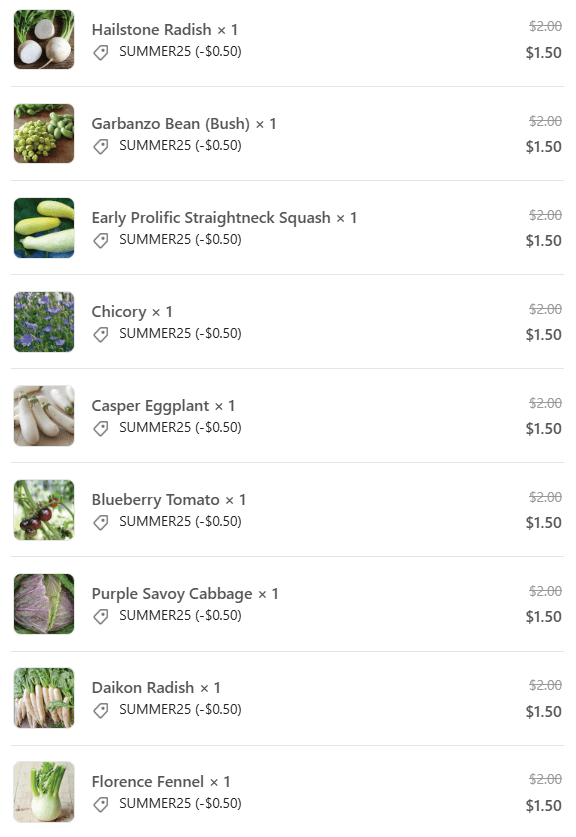
Here is what I ordered today. I ended up taking three screen caps of the entire order, to get all the little thumbnail images.
Borage: this is an herb I’ve been meaning to get for a long time. Many uses, and a great pollinator attractor.
Kandy Korn Sweet Corn: I have the super short season Yukon Chief for next year already. Having a longer season variety means we can have a longer season for corn, and no overlap on pollination times, so we can still save seeds.
Fordhook Giant and Rainbow Swiss Chard: the same types that I finished off in my winter sowing seed mixes, these will be planted in the fall.
Giant Nobel and American Spinach: while I am looking to save seed from what we have now (we didn’t eat much spinach this year; they bolted too quickly), these are new varieties that I hope will do well. They will be planted in the fall.
White Egg Turnip: all our turnip seeds were used up, so I will be trying this interesting looking variety for our fall planting.
White Icicle Radish: these will be sown in the fall, but not for their pods, though I will probably allow at least one go to seed. My younger daughter likes the daikon radish, which was sold out. This is a smaller relative, and I think she will enjoy these. I recall seeing a variety of radish sold specifically for their large seed pods that I’ll keep an eye out for as well.
Spring Blush Pea: a new variety to plant in the fall, along with other peas we still have.
Bi-Colour Pear Gourd: my “for fun” item.
Purple Vienne Kohlrabi: I used up the last of our old kohlrabi seeds to plant in the fall, and most of the ones that are growing now are the purple ones. Definitely doing to plant more in the fall!
Red Beard Bunching onion: I’ve tried a red variety of bunching onion twice before, and they didn’t succeed. I want to try again with this variety. For bulb onions, we will have our own seed.
Assorted Beet Mix: I planted the last of our beet seeds in the fall, and have the most robust beets growing right now. I decided to go with a mix this time. I like variety!
Green Scallop Benning’s Squash: we’ve got white scallop squash, but they don’t seem to like germinating here. We have more seeds for next year, but I want to try a green variety, too.
Gill’s Golden Pippin Squash: a new and versatile variety to try. I have lots of different types of winter squash seeds, still, both large and small. I like variety!
Tri-colour Green Bean mix: we have a number of different beans left, but the first bush beans we ever grew were a tri-colour mix, and they were the most successful we’d ever grown.
Rainbow Mix Carrot: to plant in the fall. We still have a couple of varieties of carrot seeds left, so we could also start some in the spring, as space opens up, too.
White Vienna Kohlrabi: of our old seeds, it looks like only a couple of the white kohlrabi germinated. These will be planted in the fall. I think they will fair better, not in a mix.
Yellow Scallop Squash: because I like variety, and I really like patty pan squash!
While I will probably pick up other seeds for next year between now and spring, between this order and what I still have in my seed bin, we don’t actually need anything else, besides things like potatoes. It may still be July but, with fall planting in mind, plus working on getting more beds either reworked or made new, I hope to have a larger garden next year, and get a head start on it, this year. After all, almost half of our growing season is already gone!
The beans with the tomatoes are doing really well. At first, it seems that one of the seeds had not germinated, but it did eventually show up. That makes for a 100% germination rate of these old seeds.
Too bad a cat dug one of them up. *sigh*
In the foreground of the first photo, you can even see some of the self-seeded carrots coming up!
In the next image, you can see the second planting of beans coming up in between the corn. Of the first planting, there ended up being a total of three, maybe four, that came up, and only one of them came up strong and healthy. Considering these are the same seeds in the same bed, it’s hard to know why the first sowing failed so badly.
The last image is of the Arikara squash bed – and the corn in there is so much bigger than the ones in the other bed!
I really like using the stove pellets to mulch around seedlings. The pellets land around the small plants, rather than on top of them. Then, after being watered, the pellets expand and fall apart, with the sawdust creating a nice, fairly thing, but really light, mulch. So far, it seems to be working out with anything I’ve used them around. It helps that the 40 pound bags are so cheap, and a little goes a surprisingly long way!
Once my rounds were done, my older daughter came out to help me remove the netting around the trellis bed. We had an unfortunate surprise while pulling it out, though. I’ve seen frogs – even large ones – squeeze through the rather fine mesh but, unfortunately, a garter snake didn’t make it. My daughter found it stuck around and under the corner of the bed. It hadn’t been dead for long, but long enough that a big beetle was chewing on its head. We had to cut a section of the netting off, because we couldn’t get it loose from the netting.
As my daughter said, it’ll be good when we no longer need to use netting! At least not this netting. It’s always a concern that a kitten or a bird will get caught in it. I never thought a garter snake would get caught!
We were being eaten alive by mosquitoes while we got the net down, stretched it out, folded it in half length wise, then started rolling it up on a bamboo stake for storage. They were after my daughter a lot more than me for some reason, so once the netting was rolled up enough, I sent her inside while I finished. It’s now tied off and in the garden shed. I made sure it was resting higher up in the shed so, hopefully, no critters will get into it.
That done, I brought out some of the trellis netting we’ve used in previous years. This netting has 4′ square spaces, making it easy to reach through to weed or harvest.
I started off by weaving a bamboo stake through one edge of the netting, where there is a pair of lines about a half inch apart, instead of 4 inches. I tied one end to the vertical post at the corner, then stretched out the netting flat before tying it to the next post. Then I added the next bamboo stake, weaving it into the netting and joining it to the first stake, before tying it off to the next couple of vertical supports, then did it again.
The netting ended on the third stake, so I added another piece of it to a fourth stake before joining the stakes and matching the netting up. That left a lot of excess netting at the end, but I just bunched that up and secured it while trying off the stake to the vertical.
I had woven in a plastic coated metal stake at each end of the bed to keep the netting straight. After the horizontal stakes were in place, I pushed the netting down so any excess was at ground level. I then took the garden stakes there were already in place to hold the protective netting that was there before, and used them in the trellis netting. Each one got woven vertically through the netting, then I used them to tighten things up a bit before pushing them into the ground. Where the two nets overlapped happened to be where there was already a longer bamboo stake, so I used that to join the sections together at the same time. Once all the stakes were woven through and pushed in the ground, I used ground staples to secure the netting to the soil, catching in the excess, to make it all fairly stretched out and tight.
I recall from using the netting before that the weight of plants climbing it can cause issues, so I added another level of horizontal bamboo stakes along the middle. These got tied to the vertical garden stakes, rather than the posts for the permanent trellis. This way, the netting is at a slight angle for the beans to climb.
This bed hasn’t been weeding since the protective netting was placed all around it. A lot of the self seeded onions I transplanted into rows were no longer visible.
I started weeding along the trellis side. I probably should have done it before the trellis net was added, but the mesh is open enough to reach through easily. The problem was more my hat constantly getting tangled in it!
As I was working my way along the beans, I spotted a little volunteer tomato plant! I remember finding volunteer tomatoes in this bed last year, too. I’m not sure where the seeds came from!
When I found one, I left it, thinking it would be fine were it was. Then I found another.
And another.
So I thought I would come back later and transplant them once I weeded and could see a space for them.
Then I found another.
And another.
And several others!
As I was working my way down the onion side of the bed and kept finding more even tiny tomato plants, I started pulling them up with the weeds, then transplanting them wherever I had enough space between the onions or the pumpkins. Then, when I finished weeding the bed, I went around the beans side to dig up the ones I’d left there and transplanted them.
By the time I was done, I counted 14 volunteer tomatoes.
Or 15.
I actually counted 13, first, after all the weeding and transplanting was done. Then noticed one I’d missed, so I counted again and got 15. Then I counted again, as I was scattering stove pellets around the bed and counted 14. I counted again and kept getting 14, so I either keep missing one, or I double counted one before.
Of course, it’s also possible I missed some volunteers when I went back to find and transplant them. If so, they’ll be easier to see, soon enough!
The last photo was taken after I’d scattered the stove pellets, but I forgot to take one after it was watered and the pellets were all expanded and breaking up.
This bed now has Red Noodle beans and Hopi Black Dye sunflowers along one side. On the other is onions from last year, going to seed, plus a whole bunch of tiny self seeded onions that I transplanted after clearing and preparing this bed for the beans and sunflowers. Then there is the pumpkins, and now the volunteer tomatoes.
This bed is going to look really interesting, once everything has reached maturity!
Today, I remembered to take some pictures of the radish seed pods that I’ve been snacking on.
The first three pictures are all from the same plant. What a difference! Some pods have just one pea-sized seed “bubble”. Others are longer, looking like they have a couple of seeds developing in them. Then there was a branch that has seed pods of all shapes and sizes!
The last pictures is of a different variety of radish in the winter sown East yard garden bed, with distinctive red lines on them. The seed mix had four different varieties of radishes in it, and I don’t know which is which, though I’m guessing the yellow variety is the one plant I’m seeing with yellow flowers.
I’m really happy with how the winter sowing experiment worked. The last time I tried it, I did the mild jug version, and it failed completely. Now I know that sowing directly into the beds, then heavily mulching, is the way to go for a lot of things. There are a few things I will now plan ahead to winter sow, but not as a mix. Beets, carrots, turnips, kohlrabi, spinach, and radishes for their pods. Also, that one variety of lettuce I planted was insanely prolific, and good at self seeding! I’ll have to be careful when collecting seeds this fall! Oh, the tiny bok choy worked, as did the chard – when they’re not being overwhelmed by other plants! There are also tiny onions all over, but they’re so far behind, I don’t expect we’ll be getting any bulb unions this year. Which is okay. We have the ones that are going to seed, so we can start onions indoors, using our own seeds, in January or February. The turnips also worked out much better than any other time we’ve tried them, so I think we will run through the varieties again to see which ones we like best.
I get the feeling we’ll be doing a lot of direct sowing in the fall from now on! Just in a more organized way. Peas are something else that are supposed to be good for winter sowing – we just have to make sure the bed they’re planted in doesn’t get destroyed by cats, to find out!
Obviously, tomato seeds survive the winter just fine. What variety they are, I have no idea, but if we’re going to winter sow tomatoes deliberately, they’ll have to be a very short season variety, if we’re going to get anything from them. If the Sub Arctic Plenty tomatoes turn out to be a variety the family likes, they would be an ideal candidate. Their growing season is so short, we could actually direst sow in the fall, then again in the late spring, to extend the harvest, if we wanted to.
We just need to be sure we actually enjoy eating them, first.
It’s taking us years to get things worked out, with a couple of major set backs along the way, but those set backs have actually helped us in our decision making for the future. Like now knowing that parts of our garden area are prone to flooding during wet years! Having beds raised even just a few inches has saved come of our plantings already.
I do look forward to when we can make the low raised bed higher, though. Working on the bed this morning, while much improved from working at ground level, was still pretty painful! Plus, the lower the bed, the shorter the reach. Even though these beds are 4′ wide on the outside, it was still hard for me to reach the middle of the bed. With the high raised bed, I can reach clear across, if I wanted to, without difficulty.
All in all, I’m pretty happy with the morning’s work.
My next garden project will be finally working on the old kitchen garden bed that will get wattle woven walls, but I’m going to have to put another job higher on the priority list. When going through the trail cam files this morning, the gate cam had over 100 files – and this camera is set to just take single still shots. Most of those were from the poplars coming up on the other side of the fence, blowing in the wind. Which is not really a step back, since some of them, at least, are of a size that could probably be used in the wattle weaving!
Lots to do, and the weather is finally cool enough to get to it. I’m loving every minute of it!
I’d planted three groups of three seeds of Black Zucchini and White Scallop squash. The zucchini almost all came up – one spot had only two come up – but the white scallop squash saw only two germinate, in one spot.
That left me with two empty spots – and those were being filled with tiny elm seedlings taking over!
So the first thing I had to do, after taking the protecting netting off, was move the mulch aside and get in with the hand cultivator to weed as much as possible.
That took a while.
I really, really hate those elm seeds.
With the white scallop squash, I simply moved the smaller plant into the empty spot beside it. I did the same with the zucchini that had only two plants growing. Then I very carefully removed the extras from the other two spots that had all three zucchini seeds germinate.
I turned out to be wrong. I must have dropped a seed or something, because one of them had four!
I found spaces for them in other beds. Two went into gaps between the three types of winter squash, which are still recovering from getting hit with that one cold night. One went into the end of the bed with the Spoon tomatoes in it. Those all got protective plastic collars. The last one went into an open space in the high raised bed, left from harvesting some radishes and turnips.
Thanks to my SIL using their big zero turn mower on the outer yard, I had a whole lot of grass clippings available. I needed more mulch around the original summer squash bed, plus the one in the high raised bed got a grass clipping mulch, with a final watering to soak the mulch.
Hopefully, the transplants will survive alright. Squash don’t like their roots disturbed, but there was no way I could take them out without using a lot of water and washing the roots off completely. Those ridiculous elm seedlings were wrapping their tap roots around everything!
While our garden is officially in, things will still be planted! We’ll be doing some succession sowing later in the month, but today, it was damage control.
The first bed I worked on was the corn and beans bed. There are now a whole three beans that have germinated, in between the corn, out of all the seeds planted in two rows! The ones planted on the same day, in between the tomatoes in the next bed over, are stating to get bigger, but not in the bed with the corn. I want beans in with the corn as much for their nitrogen fixing properties as for the beans themselves, so I decided to replant.
I still had seeds for the yellow Custard bush beans that were planted here, so that’s what got planted again.
I didn’t have to remove the protective netting, thankfully, and could just make use of the box frame to hold it for me while I first weeded the bed as best I could. There are just so many of those elms seeds sprouting! Many were still too small to try and pull, though.
If you click through to the next photo in the slideshow above, you’ll see my little froggy friend!
It’s hard to tell in the first couple of photos of the garden bed, but if you can make out some pink dots in the photo, those are the inoculated beans. I just spaced them out in the rows the first beans were planted, then went around and simply pushed them into the ground just enough to bury them. Hopefully, these ones will take! I didn’t pre-water the rows, as the soil was still wet from last night’s rain, nor did I water after, since I could hear the incoming thunderstorm.
Once those were planted and the protective netting back in place, it was off to the main garden area.
I had planted Royal Burgundy bush beans near the Spoon tomatoes. An entire packet’s worth. Only three germinated, and one of them got chomped. It seems to be growing back, though.
The one that got chomped is visible sort of between the first two tomato collars.
I could not find more bush bean seeds of any kind while out and about yesterday, so I went with something else, which you can see in the next image above. Fordhook Giant Swiss Chard. Their seeds are of a decent size, so after loosening the soil in around the few bean plants that made it, I was able to space them out fairly well while planting them. Swissh Chard is related to the beet family, and the Fordhook Giant apparently also produces an edible root. We’ve grown it before, a few years ago, but they never got to that stage. We’ll see how it goes this year. We did include Swiss Chard in one of the seed mixes that were sown in the fall. Some have come up, but they were basically too crowded out with other things to get very big. Only now, as we’ve thinned things out over time, are they starting to catch up in size.
By the time I finished sowing the Swiss Chard, it was raining, so I made my way indoors. I had picked up some yellow zucchini seeds, too, so when I head out again later, I’m hoping to get a few of those planted, too.
Maybe.
We are currently under a severe thunderstorm watch, but then my weather app says we’re raining right now, and it’s bright and sunny out there. We’re also at 27C/81F right now, but the humidex has us at 31C/88F. I’ve heard forecasts saying to expect the humidex to make it feel like 38C/100F in places. We’re supposed to keep getting hotter until about 6pm, and then it will very slowly start to cool down after 7pm. Tomorrow is expected to be slightly cooler, so it’s no big deal if things get postponed until then!
I am very thankful for what rain we do manage to get!
I just got back from giving the garden beds a watering for the evening. Tomorrow is not supposed to be as hot as today, but we haven’t gotten any of the rain that hit other parts of the province, some of which got serious thunderstorm warnings!
When I got to the trellis bed, I was rather blown away by how much bigger the noodle bean sprouts were, even compared to this morning.
In the first image, you can see four of the five collars around pumpkin seeds – and they are all sprouting! Nothing in the fifth one, yet, but these were the very last seeds I planted, and they’re already up! I remember last year, being amazed by how fast these free pumpkin seeds grew, too.
I have also confirmed, and you can see in the next photo: we have sunflowers! Not a lot, but the Hopi Black Dye sunflowers are starting to sprout. I wasn’t sure if these seeds were still viable or not, so anything we get of those is bonus!
While watering the new asparagus and strawberry bed, I got another pleasant surprise. I am pretty sure I planted the bare roots and crowns too late; I had not expected it to take so long, or I would have stored them properly. And yet, I found a single Jersey Giant asparagus, sprouting along the stake I place to mark where the crowns were planted. It’s so adorable!
I spent a fair bit of time working on the snap pea bed, carefully using the hose to pull weeds without also pulling the peas and tiny carrots out. As I worked my way from one end to the other, I was startled to find a bean sprout. Several of them. I had completely forgotten that I’d planted the last few bean seeds in the gaps between pea plants in one row! Gosh, the red noodle beans germinated fast!
Meanwhile, the Royal Burgundy bush beans I’d plant much earlier, beside the spoon tomatoes, have finally shown signs of life. All of two beans have sprouted. Hopefully, this means more will show up.
I didn’t bother trying to get a photo, but I also saw more corn seedlings showing up in the corn and yellow bush bean bed. Still very few, while the leftover seeds that got planted with the Arikara squash have more sprouting, and the earlier ones are getting quite big!
The Black zucchini has been doing really well. I planted three seeds in three spots, and 8 out of 9 seeds are now sprouted! With so many sprouting, I will probably have several to thin by transplanting, later. Even where the White Scallop square are planted, one seedling has appeared. Last year, those ones took three tries and a much longer time before any germinated, so that makes me very happy.
So far so good! I have to keep reminding myself that I finished planting everything such a short time ago. It just feels so late in the season. Probably because we had that heat wave in May.
On a completely unrelated note…
We seem to be missing three kittens.
Caramel’s tabby, Li’l Rig, and her tortie, Wormy, are nowhere to be seen. Yesterday, I spotted Caramel “luring” Li’l Rig into the maple grove on the north side of the inner yard. I strongly suspect she has taken them across the road. I was really hoping that, after I brought Li’l Rig back to the sun room yesterday evening, she wouldn’t try again. Caramel has been hanging around the house, which seems very strange for her to do, if she took her babies onto the property across the road.
Their brother, Havarti, is the biggest of the litter, is still very much around. He is so active and independent, I doubt he’d follow his mother anywhere right now. The other two are much smaller and were both recovering from oogey eyes. I can’t find them to check if their eyes still need washing.
The third missing kitten is Zipper. He was the sickest and the last on the road to recovery. He did seem much improved but, to be honest, in looking for him, I was looking for a body. No sign of him, anywhere. I do hope he’s okay. I can’t imagine he would have followed Caramel across the road.
I’m probably going to go outside one more time and do a walkabout. Maybe I’ll find him then.
Last year, I picked up the free pumpkinfest seeds early enough to start them indoors. I picked them up just a few days ago, so there’s no time for that, this year!
While we have been getting a few rainfalls, off and on, and don’t expect more rain until tomorrow morning, our province is actually getting special weather alerts for possible funnel clouds. I got messages from my brother, saying they had rain pretty much all day, with occasional massive downpours. It’s been knocking his internet out often enough that he ended up linking to his phone to access the internet, so he could work.
From home.
On a Sunday.
Because my brother just never seems to stop working. Ever.
He’s always been like this, even as a kid. How he hasn’t burnt out, long ago, I have no idea!
While I had completely forgotten about the pumpkin seeds when I was working on the bed earlier, it was probably a good thing, in the end, given that I started to get rained on before I finished what I did remember to plant!
The row with the transplanted onions had enough empty space for four seeds, and the last one was planted in the remaining space of the sunflower row. I used the plastic collars to mark where the seeds would go, then planted one in each collar. They may not all germinate. Last year they have out 3 seeds per packet. I pre-germinated them, and they all sprouted within a day, so I do know they give out very healthy seeds.
I had some stove pellets left in the bag I’ve been using in other garden beds, and I finished it off here, including adding a few into the collars as well. Then everything got watered, even though it just rained. The collars got partially filled with water a couple of times, to make sure the pumpkin seeds got thoroughly soaked. The watering was also to get the stove pellets to absorb moisture and start breaking up into sawdust. They will do as a light mulch for now. Later in the season, after things are fairly big, more mulch will be added.
I don’t expect to use the mulch that I pulled off this morning. In the photo, you can see it raked onto the taller grass. That is where this bed’s twin is going to be built. Once things are dry enough to drag out the weed trimmer, I’ll clean out that area, trimming it as close to the soil as possible, then lay cardboard down on it, in preparation for building the next bed. The mulch I’ve set aside will eventually get buried in the new bed.
So I think I can NOW say the garden is officially in! 😄😂 There’s still lots of work to do, of course, but what needed to be planted is now in the ground.
I managed to get it done, just as the rain started to hit!
I think I can now officially say, our garden is in! Sure there are some things, such as fall spinach, that can be planted, but for all our expected spring planting, it is done.
Yay!
I waffled between planting along the chain link fence in the south hard, or in the trellis bed in the main garden area. In the end, I decided to go for where I knew there would be the most sunlight.
The first image above is how the bed looked, after the mulch was pulled off. Last year, we grew melons along one side, onions for seed on the other. The onions were replanted in the fall, with just one half of the bed being prepped, then covered with leaves for mulch. The other half had melons mulched with cardboard, bark and grass clippings and, in the fall, I just pulled the melon plants and left the rest in place to protect the soil.
That made cleaning the bed up much easier!
This bed does have an issue, though. You can see that – sort of – in the next two images.
To make these beds, we’re using logs as straight and even as we can find. Which is surprising difficult. Especially when looking to use 18′ logs. With this bed, on the trellis side, one of the logs was quite bent. We put that one on the bottom, with the bend going into the bed, while the top log is straight. That’s what the remaining three vertical trellis support posts are going to be secured to.
What that means, though, is that there is an entire log, just inside the top frame of the bed, in the middle. The bend is extreme enough that there’s an actual gap formed between the two logs. Over time, it won’t matter as much, as we are aiming to eventually make the beds all 4 logs high. Until then, though, the gap is getting stuffed with skinny pieces of wood, bits of bark and even grass clippings and dried leaves.
Once the mulch was removed, I went over the bed with the garden fork first, to loosen the soil and make it easier to pull the weeds. As I went along, I started to find other things besides weeds, though – and I was not at all surprised. The onions that had gone to see had dropped some of their seed before they could be harvested.
Once I got to where the onions had seeded themselves, I worked a lot more carefully, and gathered every one that I could find.
Along the way, I also found a couple of plants I recognized as the flower I allowed to grow at one end of the bed, last year. I removed those as well.
It wasn’t part of the plan, but since I had them, every since baby onion I found got transplanted. The flowers got transplanted at the opposite end of where we grew them last year.
While preparing to transplant the onions, I also carefully pulled some of the onions that were growing against each other, broke them apart, then replanted them separately.
One half of the bed had fewer onions survive than the other, so that was the first area I started transplanting onions the tiny onions. I still had enough left over that I made a second row for the rest. They filled a little over half the bed’s length before I ran out, so there’s still room to plant something else, if I wanted to.
After that, I planted the two flowers (possibly a wild salsify) I’d found, then marked off two more rows in the soil in the other side of the bed. Those were for the Hopi Black Dye sunflowers and the Red Noodle beans.
There were not enough sunflower seeds to fill the row. I spaced them about 6 inches apart, which is close for sunflowers. I don’t expect a 100% germination rate, though. In fact, I wouldn’t be surprised if none germinated. These are older seeds.
The red noodle beans, on the other hand, are fresh seed. These got planted nearer the edge of the bed, where they will be able to climb the trellis that will be built on that side of the bed. After filling the row from end to end, I had only 6 bean seeds left. So I stuck them into some of the gaps among the sugar snap peas, since they have a trellis already prepared. The planted rows then got marked off at the ends with plant stakes, so that if I decide to plant something else there, I know where the open spaces are.
Oh! I completely forgot! I was going to plant the pumpkins in this bed!
I can still do that. For those, I plan to set up plastic collars to mark where the seeds are.
In fact, I see the rain has passed and the sun is out. I’ll go do that right now!
So the winter sown flower bed was a total failure. If any seeds did survive the winter, I saw no sign of them. While the bed did get covered with plastic, eventually, once that mulch was removed in the spring, it became a favourite spot for the cats to roll around on!
And did in, of course. 🫤
I decided it should be safe to direct sow more flowers into this bed.
The Dwarf Jewel mixed nasturtium is one of the flowers that had been planted here in the fall. I recently picked up the Cosmos, as I know for sure they grow here; my mother grew them here, and even after we moved back, I remember seeing a few of them show up in places were they’d self seeded. The Aster are seeds that were included in a memorial card for an old friend that passed away suddenly, last year.
The plastic cover on the bed had torn at one end, where the end of a bamboo stake was. That tear was all the wind needed to rip the whole thing in half. So that was the first thing to get removed. Then the hoops and the bamboo stake pieces holding them in place were pulled out and set aside.
The bed itself was full of weed seedlings, plus the dandelions, crab grass and creeping Charlie around the edges. There was even some burdock coming up, next to the high raised bed. It took a lot of loosening with the garden fork before I could start pulling the weeds and trying to get as many of the roots out as possible. Unfortunately, I was also finding elm tree roots in there, too.
Once weeded, I went over it with the rake to pull the soil more towards the middle, making it narrower than before. Partly because fewer seeds were going to be planted here, and partly to make it easier to cover and protect. After everything was levelled, it got a thorough watering, before the smaller seeds were scattered about. The nasturtium seeds are large enough that I planted those, individually.
While cleaning up the bed, I did find at least one nasturtium seed that had been planted in the fall; they were the only seeds large enough that they could be seen. Which means that it is possible that some of the seeds planted in the fall might have survived and could still germinate. Unlikely, but possible! 😁
Then it was time to set the hoops back in place, over the broken pieces of bamboo stakes holding them in place. With the hoops still attached to the bamboo stakes across the top, it didn’t talk long to get them back in place.
While gathering my supplies for this, I had grabbed a folded up piece of mosquito netting I thought might be good to set over the hoops, but it turned out to be too short for this bed. So I went and got the rolled up netting that had been over the garlic, before they got too tall. That turned out be just the right length! I weighted down one edge at the based of the high raised bed, then unrolled the netting. This netting catches on everything, so that was not as easy as it should have been! Once the netting was pulled snug, there was just enough slack to roll back around the stick it had been stored on. I then used the bricks, rocks and pieces of wood that had been used to hold the plastic over the hoops to secure the side, rolling the weights up in the excess netting. I was able to get the netting nice and snug over the hoops.
Hopefully, this will be enough to protect the area until the seeds germinate and get big enough that they won’t need the hoops and netting anymore. The nasturtium are edible, but they can also act as a trip crop, to keep insects away from other edible greens.
Once I gather the materials, I’ll build frame to fit over this area and attach these hoops to support whatever wire mesh I have to put over it, making sure to close up the ends, too. That will be much handier than setting hoops over sticks in the ground! I’ll be making several such covers, little by little, all with the same frame dimensions, so they can be interchangeable. The prototypes I’ve made so far have been incredibly handy!
One more job done. Time for another hydration break, then one more bed to work on!
I’m looking forward to taking some pain killers and going to bed early, though! 😄
But first, the cuteness! While feeding the cats this evening, I got to see the grublings while their mama was outside. They are getting way more active!
While getting the container out of the cat house for Caramel and her babies, I saw a surprise through the window.
Three kittens, snuggling together in the cat bed.
The sun room kitten has found her siblings!
She didn’t say, and was soon back in the sun room for feeding time, but I’m glad that she found and was immediately accepted by them.
Also, Kale and Sir Robin are 1) insanely fast and 2) determined to go into the old kitchen. As soon as the door is open, they come bounding for the doorway. It’s actually really quite dangerous for them, because they’re doing this while I’m carrying the kibble bowl with one arm, opening the outer old kitchen door (the one with the screen window, with no screen) with the other, and trying to get through fast enough to close the inner door (the solid one) and keep the cats out. They keep getting under my feet while I’m juggling all this. I’ve already accidentally closed a door on a tail because Sir Robin basically teleported from across the sun room.
Kale and Sir Robin want people, and they want inside!
So that’s what feeding time is like these days. 😁
One of the things I wanted to do today was get our push mower to the small engine shop in town. Last summer, it got harder and harder to start until finally, after stopping to refill the gas tank, I just couldn’t start it anymore. It’s possible this is related to the fact I was unable to change the air filter all summer, because there were none to be had. I finally found one this past winter and made sure to bring it with me. While I was at the counter, this was one of the things I mentioned. The woman filling out the paperwork was very glad that I brought the filter. It seems I was not the only one to have problems finding these, last year!
Along with basic servicing (oil change, blade sharpening, etc.) they will check the self propelling mechanism, which is broken, but not in any visible way, and look for anything that could be causing the starting problem. This time of year, she told me they probably won’t have a chance to look at it until next week, which is pretty much what I’m expecting. The nice surprise was when I gave my name and contact information, and she recognized me. We haven’t met in person until now, but “know” each other on local Facebook groups. When our truck suddenly lost oil pressure and started giving the “shut engine off now” warning, her husband was the person who stopped and helped us out. I made sure to tell her to thank him again for us, briefly mentioning some of the problems we found from this happening.
That done, it was a run to the grocery store to refill our 5 gallon water jugs and pick up a few things before heading home.
By the time I was able to head outside and work in the garden it was, unfortunately, reaching the hottest part of the day. Which, thankfully, was only 17C/63F. Still hot in the sun, though. Tomorrow is supposed to be 22C/72F with high winds again, then 27C/81F on Mother’s Day, then 32C/90F on Monday! Or 32C/90F on Sunday and 34C/93F on Monday, depending on which app I look at! So now was the time to get this done.
The first thing to do was finished getting all the weeds out of the second half of the bed. By now, the soil had baked hard and had to be broke up with a garden fork again, so I could get as much of the tap roots and rhizomes out as possible. I am so thankful for that rolling seat! It’s not comfortable to sit on while reaching down that far, but still much easier on the body than bending at the waste. My doctor may want me doing squats, but my knees are too unstable to bend that far for that long!
In the first photo of the slideshow above, the bed is cleared and leveled, and the centre marked out. I wanted to set trellis support posts down the middle, along the twine you can barely see in the image. The posts I used were old T posts we found while cleaning up around the property. They’re not in good shape and several of them are way too tall for this, but they’ll do. With the first one (set at the end at the bottom of the photo), I hit something in the soil below, and it just would not go any deeper. I tried using my chisel tip digging bar. That wasn’t getting very far, either, and I ended up having to use a spade to loosen whatever it was I was hitting, before I could set the post. Thankfully, I didn’t have to do with any of the others. You can see all 5 posts in the second image of the above slide show.
At that point, I had to stop, get out of the sun and take a break. Before heading back out, I prepared my seeds.
My original though had been to do a row of peas down the centre, then plant potatoes on either side. I changed my mind and decided to do two rows of snap peas; the Sugar snap peas and the Super Sugar snap peas. I prepped markers and set the seeds to soak while I continued.
I decided to use wire mesh for the trellis instead of the plastic trellis netting that I used last year. I found that too saggy. I went to the old squash tunnel that should have been taken down a couple of years ago, and grabbed the 1″ square wire mesh from one section of it. That leaves one more section of 1″ mesh, plus another with hex chicken wire. It’s turned out to be a rather handy way to store the wire on there. 😄
I wasn’t sure if it would be long enough, so I laid it out on the grass to check, and was very happy that it wasn’t too short! Then I realized I’d set all the “teeth” of the T posts facing the other way, and had to drag it around to the other side of the bed. 😄
In the old garden shed I had a bungle of garden twist ties and brought those out to fasten the wire to the posts. The next while was spent first getting it up, then adjusting one way or the other, to get the wire snug between the posts, without pulling them one way or the other. There was enough excess wire to actually wrap around the posts at each end, and fasten it to itself. The other posts got twist ties at the top and bottom to secure it in place.
One thing about using this wire for the trellis. When the wind blows through it, it can get pretty loud!
Hopefully, we won’t need to secure the posts with tie downs. It will depend on how much trouble the wind becomes, once there’s peas actually growing up the trellis and acting like a sail.
I took a picture of the trellis after the wire was up, but you can’t really see the wire at all!
That done, I used a garden stake to draw a trench for seeds on each side of the posts, then used the jet setting to deep water the trench only. This would also break up and clumps, plus the water would naturally level the soil a bit.
Then it was time to set out the pre-soaked seeds evenly down the trenches. There were more of the Super Sugar snap peas, but this bed is long enough that they got pretty normal spacing, while the other wise got more space between each seed. Hopefully, we’ll have a high germination rate, and there won’t be any gaps!
After pushing the seeds into the ground, the trenches got another watering, this time with a flat spray; gentler than the jet setting, but still enough pressure to settle the soil over the seeds.
While I was working on this, of course there were cats going across the freshly loosened soil – and trying to use it as a litter box! So after the seeds were planted, I took the boards that were used to weigh down the solarizing plastic and set them along the sides of the bed. Hopefully, that will be sufficient, and they won’t go under the wire in the middle and start digging there. Later, mulch will be added.
I will plant something under where the boards are, later. I haven’t decided what, yet. The potatoes I’d planned on will get their own bed, I think. If they get planted at all. I may have to buy new seed potatoes. When I prepped the potatoes for chitting, they seemed to be find, but have just… stopped. No sprouts, no leaf buds, no growth. Some of the potatoes have even started to shrivel up and dry out, instead. They were sprouting in their bag when I bought them, and then just… didn’t.
I suspect our basement set up has something to do with it. I hoped they would start growing once in the warmth of the portable greenhouse, but nope. No change at all. I could – and probably will – still plant them, but I think getting more potatoes is in order. It’s not like we can have too many potatoes! It’s just a matter of space.
For now, I’m thinking and early bed time and an early start tomorrow, before the heat hits, which is supposed to be in the early evening. I’d like to get some more walnut seeds in, but I also need to start digging a trench for the asparagus crowns and bare root strawberries I picked up awhile ago. Then there’s the trellis bed that needs to have the rest of its vertical supports attached, the log frame of another bed assembled, then the bed cleared of weeds… and then… and then… and then… Lots of work to do before we can do more direct sowing and transplanting!
For all the heat we’re supposed to get within the next few days, in the long range forecasts, the temperatures are supposed to drop quite a bit, again, with overnight temperatures barely above freezing.
What we really need is rain. It’s wildfire season, and there are quite a few going right now. The closest ones to the north of us are mostly now listed as under control, but the further north you go, the bigger they are, and they are all listed as out of control. Rain and no wind. That’s what we need!
From the 10 day forecasts, we might get some next week, but just for a couple of days.
We shall see.
For now, I’m happy to have gotten that bed done, and some direct sowing accomplished! Peas really could have gone into the ground quite a while ago, but this should be okay – as long as the heat doesn’t kill them! It sure feels good to be digging in the dirt again.
Even if my body is now saying very nasty things to me right now. 😄
We got 4 of the 5 Cream of Saskatchewan watermelon seeds potted up, as well as a couple of Honeydew. There were still 2 Honeydew seeds, and the Kaho melon seeds, that were not germinated, so we ended up combining them into one tray. I’d gotten rid of the one Cream of Saskatchewan watermelon seed that didn’t germinate, as it seemed like it was not viable, but the remaining Honeydew seeds look like they might still germinate. I’m not sure about the Kaho seeds, though. They may simply be too old.
With the pre-germinated seeds potted up, there wasn’t room in the tray for the container with the remaining seeds, plus the container with the Zucca melon seeds, so they got stacked. The large Zucca melon seeds would need longer to germinated, but it does seem like it’s taking too long. I’m not sure we’ll get any at all this year. We shall see.
My daughter and I then went through some of my herb seeds to figure out what else we could be starting inside. In the end, I decided that I will buy transplants, instead, for the ones we want. I also seem to be missing some seed packets! I’ve no idea what happened to them.
We also talked about some of the flower seeds. I’d picked up some Baby’s Breath for my daughters, as my older daughter in particular really likes them. They looked them up and, apparently, they are considered invasive in our area. Which I find strange, since we already have some in a small flower garden where my mother had planted them, ages ago. They barely survive and are certainly not spreading! It’s part of the reason I got more seeds.
Once we were done, my daughter ended up staying in the basement for a while longer to use the exercise bike, so we could keep the heater on for longer. Later, we both headed outside to feed the cats, then go through the garden beds. I wanted to make sure she was on top of the plans I had, in case they had to take over for me for some reason.
She was very happy to see that her tulips are coming up, and we even spotted a few grape hyacinths emerging. No sign of the snow crocuses, though. We pulled back the black tarp to check out where I was thinking of planting the asparagus and strawberries, and it does look like the weeds and crab grass have been killed off well enough to use the space. The only issue will be the roots from the nearby elm trees, and I’m really hoping we can finally cut those down this year. In trying to clean the area up, I found stumps that showed others have tried to clear them away in the past, and they grew back, so I’ll have to take that into account when we finally get those taken down. It still blows me away, how much their roots have been getting into the garden beds and choking things out.
We checked on the beds that I want to cover with the netting, and had to refill more holes dug by the cats. Very frustrating, that we couldn’t cover them because of the wind.
Speaking of the wind, in the next photo of the slide show above, you can see an area in our spruce grove I was finally able to get to. I tell that we lost a few trees over the winter, and saw some that look like they came down within the past day or two. Cleaning up in there is going to be a huge job!
We checked on the netting I put over the bed at the chain link fence yesterday. Much to my surprise, one of the supports at an overlapping section had been completely pulled up and almost took a few others with it! It seems like the extra netting with the drawstring that would normally be the end of the row cover got caught somehow. Hopefully, that won’t happen again, and there was no damage.
The portable greenhouse was getting some wind damage, though.
In the last photo in the slideshow above, you can see the tear along the zipper. It has gotten bigger – big enough that cats could easily fit through, if they wanted. I’m not sure how to reattach it to the zipper. I did add some clear duct tape above the tear, in hopes it will prevent it from tearing more. We also found a tear in one corner where the tie downs are attached. The loop of fabric the cord was tied to actually tore loose from the plastic. The loop is part of a tie that is fastened to the frame itself on the inside, so it can’t go very far. The clear duct tape came in handy to cover the hole and, hopefully, prevent it from getting worse. I know the covers on these little greenhouses don’t last long, but we don’t even have any plants in it yet! High winds were why I’d hoped to set it up in a corner closer to the house, but the ground is just too uneven there.
I’ve been looking at 6mm greenhouse plastic online. What I’d really like to do is get a roll of it, but that’s well out of budget right now.
I keep looking at various notifications on my weather apps, telling me things like, light rain coming soon, or, rain will end soon. The problem is, we’ve had NO rain at all. According to the weather radar, we’ve got a system right on top of us, and we’re supposed to get rain for the next couple of hours, yet I’m not seeing a drop of rain out my window. At this rate, I’m going to have to hook up the hoses and start watering the winter sown beds! I might even have to fill the rain barrel I’ve set up with the hose, to have warmer water for the garden beds, because we sure aren’t getting any rain to fill it! Nor are we expecting any, for weeks.
Tomorrow is supposed to be a cooler day than today, though with the wind, today felt downright chilly. I’m really hoping the wind dies down, so we can get those nets set up. Given my pain levels today, it’s probably good I’ve got an enforced day of rest.
My husband, sweetheart that he is, ordered some Tai Fu lotion (not an affiliate link), that came in today. We’ve used this stuff, in balm form, in the past and it helped, but we were a lot less broken back then. I’m looking forward to trying it when I go to bed tonight. I hope it helps. Lord knows, the prescription stuff I tried a few years ago didn’t do much, and I’m hurting a lot more these days, then at that time. Between the lotion, and today’s enforced rest, I’m hoping to be able to get some work done tomorrow!