Our 2023 garden: transplanting first tomatoes

Well… starting to!

It’s not even 11am as I start this, but I’ve already put in several hours in the garden, trying to beat the heat. Which wasn’t easy, since it was already feeling too hot when I was doing my rounds, first. The weather app was saying 18C/64F, but it felt hotter. It would be good to set up a thermometer in the garden area again.

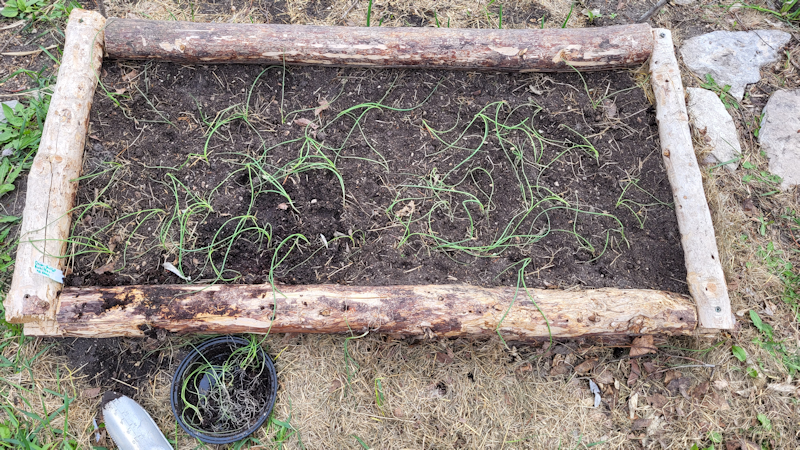
My focus today is to get the Indigo Blue Chocolate done, and as many of the Black Beauty as I can fit, plus an edging of yellow onions. There are only 11 Indigo Blue and, at about a foot apart, they will easily fit in one row in the bed I chose for them. This bed is somewhat narrower, so it will be able to fit one more row, plus the onions around the edge.

The problem?

There are 26 Black Beauty transplants.

I also counted the Roma tomatoes as I set them out. There are 61, though the plant that broke in the wind yesterday is looking like it probably won’t make it.

Then there are the 30 Spoon tomatoes.

Right now, we have 2 more low raised beds, which are about 15ft long, for about 14ft of growing length. Then there is the high raised bed, which is 9′ x 4′ on the outside, so about 8′ x 3′ of growing space. Aside from a small section in the wattle weave bed in the old kitchen garden, and 4 blocks between the gourds at the chain link fence, that’s all we have left for prepared beds. The squash patch needs work and, of course, we need to get those trellis beds built.

Meanwhile, the lawn is getting out of control, we still need to cut down the dead spruce trees that will be used to make the trellis beds, as well as pre-cut and drag over the trees I cut down for the trellises.

As it is, I did as much as I could this morning, then had to head in to get out of the heat. We are at 24C/75F right now – yes, to me that’s way too hot already! – and we are supposed to reach 30C/86F this afternoon.

I got the Indigo Blue Chocolate tomatoes in, after setting up three of the salvaged T posts to hold their vertical supports, then transplanted some of the yellow onions along the outer edge. The tomatoes were starting to wilt already, so I added a grass clipping mulch around them and along the outer edge of the low raised bed on the one side, being careful not to cover the onions before giving them a final watering.

I was planning to plant the Black Beauty tomatoes on the other half, but I think I will put them in another bed, instead, and direct sow something else with them.

Unless I fill an entire bed with just Black Beauty tomatoes, I will have room for only about half of the transplants. And I don’t want to fill an entire bed with them. A dozen plants is more than enough for fresh eating. The Romas are the only variety that I’d be willing to dedicate an entire bed to, since those are being grown specifically for preserving.

Meanwhile, we’re still getting storm warnings for tomorrow evening. We’ll see if the system reaches us or not, but be ready to protect the garden beds, just in case.

For now, I will be staying out of the heat! Maybe get a nap in, since I will likely be working outside once it starts cooling down, and staying as long as daylight holds.

Yeah. That sounds like a good plan. I didn’t get much sleep last night!

The Re-Farmer

Our 2023 garden: Red Thumb potatoes are in

Gooby tried to help.

He was not a very good helper!

The Red Thumb fingerling potatoes had to get into the ground, so they went into the beds that were ready.

I have no doubt I was crowding them a bit too much, but these are fingerling potatoes, so I hope that will make a difference. I still couldn’t fit them all in the bed along the retaining wall. The last of them went into the short end of the L shaped bed, where you can see the straw mulch. I was able to add straw mulch to the rectangular bed with the Irish Cobbler potatoes in it, too.

The extra height added to the bed along the retaining wall came in handy. I did work in some of the composted sheep’s manure first. The bed was already starting to compact! The height of the soil is almost as high as the retaining wall (it is settling a bit, still). The logs are high enough to hold the straw mulch in place.

Unfortunately, the cats seem to think that straw is there, just for them! Especially Gooby.

It started raining by the time I was ready to add the straw, but I gave all the straw a thorough watering, anyhow. They’ll get more deep watering, even with the rain. I’ve noticed that, if the straw doesn’t get saturated first, the top will get wet, but the bottom stays dry, so the moisture never quite gets to the ground. I want to get these beds soaked down through all the layers. Once that’s done, the beds will hold the moisture for quite a long time before they will need watering again.

The whole point of our wanting to use grow bags this year was because we have such a problem with slugs. I’m hoping that, by planting these in raised beds, it will be less of a problem. I suppose we could leave out some beer traps for the slugs, but I have no doubt the cats would be getting into them! I’d rather encourage garter snakes or toads and frogs.

Meanwhile, we’re also seeing peas starting to break ground. Just barely visible! We’ve got carrots sprouting, too, but they are very small and it doesn’t look like we have a high germination rate. They really should have had the plastic right on the ground until they germinated, instead of on hoops, but the hoops were as much to keep the cats off as to keep the moisture in. Hopefully, the heat inside didn’t kill off too many seeds. We do still have 2 other varieties of carrots to sow, so we should be able to make up for any losses.

We’re getting air quality warnings right now. There is a cold front moving in, so the temperatures will drop quite a bit, tomorrow (though not low enough for frost), and with it will come smoke from the many fires in Alberta. Rain is desperately needed, though with so many of the fires being started by people, more than rain is going to be needed to get these under control!

Along with rain today, we’ve also got a fair bit of wind. Nothing exceptional, but too much to take the transplants out. We have no way to protect them from the wind on the various surfaces we use to lay them out. So they remain in the sunroom, which isn’t much warmer than outside right now, with the fan and the lights, for today.

I’m glad I got the potatoes in right away. Rainy, grey weather like this always makes me incredibly sleepy. If I’d delayed it, I probably would not have been able to get it done. As it is, I think I’m going to have to lie down for a bit. I can barely keep my eyes open, as I write this!

So… all three varieties of potatoes are planted. Which means I can finally turn my attention to taking down the trees we’ll be needing to build the trellis tunnel. That should have been done, long ago!

The Re-Farmer

Our 2023 Garden: Purple Peruvian Potatoes planted

Well, we got one out of two done!

I thought we would have more than enough old feed bags to use for both types of potatoes we have left to plant, but I was wrong! The Purple Peruvian fingerling potatoes alone, took 14 of the 19 bags we had!

I made a quick little video with the photos I took. It’s less than a minute and a half long. 😁

The first time we grew potatoes in feed bags, we were intending to do the tower thing, expecting to add more material to the bags several times throughout the summer. Then we found out that potatoes come in both determinate and indeterminate types – and we had determinates. They aren’t the right kind for growing in towers, so there was no benefit to adding more material. The plants got huge, though, and the bags couldn’t support them. With that in mind, this time I made sure to add quite a lot of straw to the tops of the bags. It should help support the plant stems, and hopefully the bags as well.

So now we have to figure out how and where to plant the Red Thumb fingerling potatoes.

I wonder if there are too many to plant in that bed along the old kitchen garden retaining wall I just finished reworking?

The Re-Farmer

Our 2023 Garden: transplanting shallots

We’re in that time when we can start transplanting things that can handle frost which, for us, is the onions and shallots. I started hardening them off earlier than the other transplants. It’s going to be very hard to resist transplanting more before our last frost date! Not only are we having a very warm May (today was supposed to reach a high of 18C/65F, but as I write this, at almost 6:30pm, we’re still at 20C/68F), but the long range forecast is showing warmer overnight temperatures well above frost risk. The problem is, long range forecasts are notoriously unreliable!

So, we continue to take it slow and continue to harden off the transplants. There is still lots to do to make room to plant not only all the transplants, but all the direct sowing we have planned, too.

This tiny little bed in the old kitchen garden is where the shallots are going, because we have the fewest of those. This is a new variety of shallots, and the first to actually really survive to the transplant stage.

Keeping the cats out of the living room made a bit difference!

I planted fairly densely, but there were still a few plants left. After taking this picture, the bed got a thorough watering. We will have to add a mulch as soon as the transplants are strong enough.

The last little transplants went into one end of the wattle weave bed. It has a thick layer of wood chips on the top that I had to move aside to reach the soil. Protected by the wood chips, the soil was nice and damp!

So those are now in.

I foresee only one problem.

The cats have gotten used to using the garden beds for napping and playing!

I’m hoping to avoid having to cover the beds, but we might not have a choice. For now, they have no interest in the wet ground.

In other things, I went through our collection of feed bags, and had more than I thought. We’ve got 11 bird seed bags (20kg size) and 8 deer feed bags (18kg size). More than enough for the remaining potatoes. The only difference between the bags, besides the label, is that the bird seed bags are longer.

I’m still not sure where to set them up. The best place I can think of is at the far side of the main garden area, but I really don’t want to be hauling garden soil that far, if I can avoid it! Ah, well.

I can use the exercise.

The Re-Farmer

Our 2023 garden: Irish Cobbler potatoes planted

The girls and I are still trying to figure out the best place to set up grow bags for the potatoes, where they would get full sun, but also be closer to the house for watering. We don’t have a lot of the old feed bags left to use as grow bags, so we decided to use one of the Old Kitchen Garden beds that was recently fixed up.

The bed still needed topping up, so I started by adding some of the sheep manure I recently purchased. I didn’t add a lot, as this bed was filled with purchased garden soil, and it should still be pretty rich in nutrients. What’s missing is organic matter. This is a blend of compost and composted manure, so that will help a bit. This got worked in with a rake.

Also… do you see that bit of green poking out of the wattle weave bed?

It’s a stray onion!

I have no idea where that onion came from. This bed had never had onions planted in it.

I’m not going to complain, though!

Next, it was time to raid the garden soil pile and do some soil sifting.

Three wheelbarrow loads of the garden soil was brought over. The weeds are already starting to grow under the cover on that pile!

Some of the Irish Cobbler seed potatoes were very small, so to fit them all in the bed, I put some of the smaller ones together. Then they got buried as deep as I could, so they don’t need to be hilled.

As this area slopes away from the house, the far end of the bed is somewhat deeper than the end closer to the house, to level it off. Still, with this bed being newly rebuilt, and the layers of organic matter below, the top layer of soil still isn’t very deep.

Once the potatoes were planted, I scattered some stove pellets over the top, then began watering. Once the pellets had expanded into sawdust, I used a rake to spread it out evenly. This is not at all for the potatoes, but to protect the soil and help reduce soil compaction. Over time, we will continue to add grass clippings and wood chips as mulch. The potatoes will easily be able to grow through a mulch. With this bed being higher now, and not using straw for a mulch, hopefully, that will reduce the slug problems!

After spreading out the sawdust, I gave it a deep watering, and plan to water it again a couple more times, today. I want the water to go through all those bottom layers that were added, which will speed up their anaerobic breakdown, while also acting as a sponge to retain moisture. Once those bottom layers are good and moist, this bed should not need much watering at all.

Now comes the hard part.

Keeping the cats from digging in the bed!

The Re-Farmer

Our 2023 Garden: peas are in!

Our peas are finally in! They could have been planted as soon as the ground could be worked, which was a couple of weeks ago.

This row is about 20 feet long. We could succession sow peas elsewhere, but I think that this might actually be enough. Assuming a high germination rate, of course.

I really like fresh peas, though, so if we have the space to grow more elsewhere – together with some corn, perhaps – they certainly won’t go to waste!

The Re-Farmer
Our 2023 garden: potatoes chitting, and progress video

Okay, it took WAY longer than it should have, but I finally finished a video I was working on. I ended up leaving my computer on all night to upload it. I don’t know that I’m happy with it, but it shows what I want it to show, and that’s the main thing.

First, though…

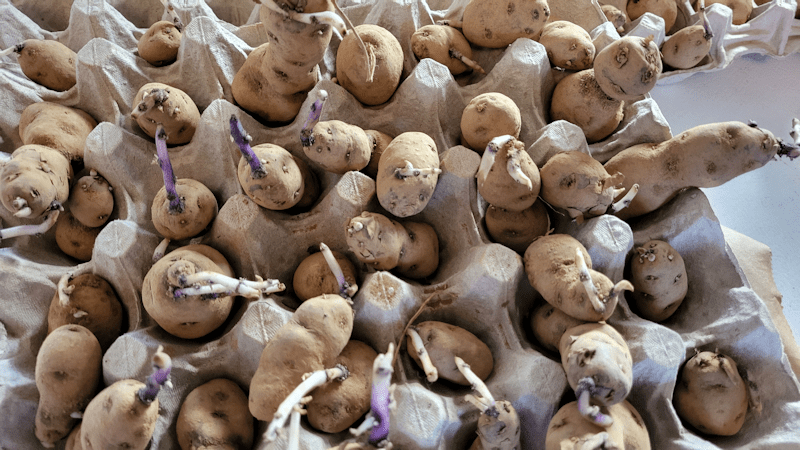
I took the potatoes that came in yesterday and laid them out on egg trays to chit for a bit longer. They all already have shoots, so we’ll need to get them into the feed bag-grow bags we’ll be using this year, soon.

These are the Purple Peruvian fingerling potatoes.

They don’t look very purple!

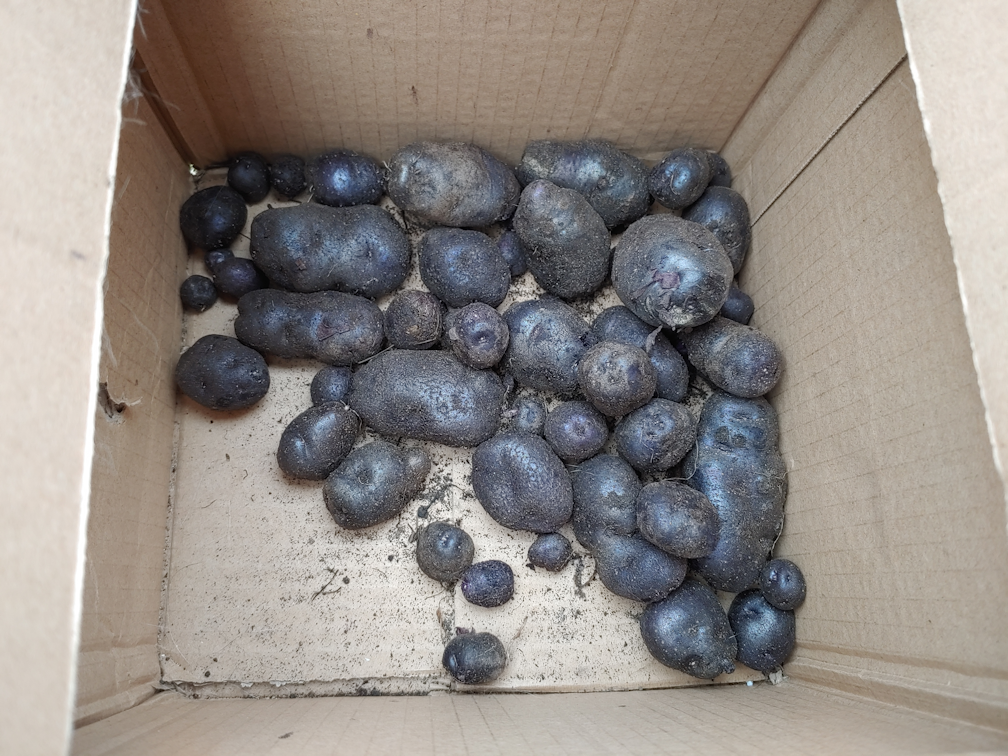
None look like they need to be cut into smaller pieces, so I won’t see how purple they are on the inside, but when these come fresh out of the ground, they are so dark a purple, they’re almost black. Right now, there’s just purple in the new growth.

It’s the same thing with the Red Thumb fingerlings. If it weren’t for the red cast to the shoots, you wouldn’t be able to tell them apart from these ones. At least the Irish Cobbler ones look more distinctive, just because they’re not a fingerling variety!

For now, they’re all laid out in the trays and set up in the sun room.

While going my rounds this morning, I checked the planted beds. I can’t see that any poppies are coming up, but there may be seedling coming up in the areas planted with the alternative lawn mix. There are most definitely spinach seedlings coming up, though! As for the carrots… I may have goofed. There are lots of things coming up in there. Mostly dandelions. So much for weeding out as many roots as we could! But I can’t see anything that looks like carrots coming up. The problem may be their cover. Once planted, it’s really important that carrot seeds never dry out. That’s why I put the hoops and covered them with plastic. The thing is, it likely got too hot for them under there. Perfect conditions for any weeds, but not for carrot seeds.

I uncovered the bed yesterday, to allow the bed to be rained on. We’ll watch closely over the next while and if they don’t germinate, I’ll replant the bed. We used the entire packet of a new variety of seeds in there, but I have two other varieties waiting to be planted.

Speaking of which, we have pretty much decided not to transplant those teeny little mulberry saplings. At least not outside, this year. What we’ll most likely do is put them up into larger pots and wait until they are larger and more likely to survive being outside.

We’ve also decided to plant that apple tree in the more sheltered spot in the West yard. We’ll have to clear away some dead and dying trees, first, so it might still be a day or two.

The bed along the chain link fence is also ready for a proper weeding now, and we can finally plant our peas.

Lots of work to be done!

But first, here is the video showing the transformation of the Old Kitchen garden, and then I have to go pick up some parcels in the mail!

Please feel free to watch the video on YouTube, like, subscribe, leave a comment, etc.. Any feedback, here or on YouTube (I’ll later upload it to Rumble, too) would be greatly appreciated.

Enjoy!

(Also, I need to learn how to make a thumbnail image to properly fit! 😂😂)

The Re-Farmer

Our 2023 garden and food forest: order is in!

This morning I headed into town to refill our big water jugs and pick up a few things at the grocery store. By the time I headed back, our post office was open. I’d checked the tracking last night and knew our Veseys order would be in today, but when I got there, she still hadn’t had a chance to finish processing all the parcels that came in. She found them for me, though – among several other boxes from Veseys that I could see! They are a popular company, with good reason.

For the potatoes, we got a total of 4 pounds each of Red Thumb fingerling and Purple Peruvian fingerling. We really liked the Purple Peruvian when we grew them a couple of years ago, and I’m hoping we’ll have enough to save seed potatoes for next year.

There is also a 3 pound back of Irish Cobbler.

Two of the above images are from the Veseys website. The Purple Peruvian are some of our own harvest.

I can see that the potatoes have already started to sprout. We’ll need to lay those out for air circulation as much as for chitting. I’ll have to go through the old feed bags we have and see how many are left, since we’ve stopped buying deer feed and bird seed. We have too many slugs and not enough garter snakes or toads, to try growing them in the ground again.

Then there was the box with our trees.

Would you look at those mulberry trees!!

I knew they would be small, but I didn’t think they would be THAT small! Normally, there would have been a single, larger, 2 yr old sapling, but they had a shortage of that size. Instead, they sent out two 1 yr old saplings for the same price.

The above pictures are from Veseys. Hopefully, in a few years, we’ll have apples and berries to harvest!

Right now, I’ve got them out of their plastic bags and set up in the living room, safe from the cats. I find myself seriously considering leaving them to grow indoors for a year but… well… I don’t know that their chances for survival would be any better indoors than out! We will have to make sure to put a cloche over them when they are planted, to protect them. The funny thing is going to be transplanting these tiny little things with their fully grown size in mind. They can grow 15-20 ft high. This variety is supposed to be hardy to our zone, but winter protection is still something we’ll want to ensure. At least for the first couple of winters.

The apple tree is quite a bit larger! It started raining as I got home, so it might be a little while before we plant it, so I opened the plastic bag and set it up next to the mulberries. I didn’t take it out, since it’s packed in sawdust.

The planting instructions for the mulberry state:

Unless you have heavy clay soil, there isn’t much to do in terms of soil preparation. You can add amendments such as compost or peat moss to the soil and/or a layer of mulch over the root area after planting will help retain moisture, especially during the first year. While it may be tempting to add fertilizer or manure to your freshly dug hole before planting your new tree, PLEASE resist! Fertilizer or manure in close contact with the root system could chemically burn the roots and potentially kill the tree.

Mulberry trees can grow quite large, up to 15-20 feet tall. Avoid planting near walkways and driveways as the fruit will drop and create stains. Mulberries are self-fertile and require full sunlight. 

https://www.veseys.com/ca/trader-everbearing-mulberry-37817.html

Where we will be planting them, the soil is very rocky and hard packed, and a whole lot of sun, so we’ll be giving them some garden soil to grow in, and plenty of wood chip mulch around them.

It’ll be different for the apple tree. The planting instructions are:

Plant apple trees 5-6 meters (15-18 feet) apart in the spring in a full sun location with good air circulation and drainage. For best results, two varieties should be planted to ensure successful pollination and fruit production.  Dig a hole large enough to accommodate all of the roots without bending (approx. 18 inches). Place the tree in the hole with the graft union about three inches above the soil surface. You should be able to see the soil mark on the trunk where the tree has been taken out of the ground, it should be planted no deeper than this. Mix compost with the soil to fill back in the hole once the tree is set in place, and lightly firm to ensure good soil root contact. Water surrounding the tree to ensure good root establishment. Water every two to three days if your season is dry.

https://www.veseys.com/ca/liberty-apple-tree-37810.html

It will be planted closer to the crab apple trees for cross pollination, but far enough away to hopefully protect it from the fungal disease that is killing them off. This variety is also a zone 4 tree, which means it will need shelter for the winter.

Hhhmm… I’m rethinking where to plant the apple tree. There are some dead and dying trees in the west yard that need to be cleared out. Better shelter, full sun, and close enough to the ornamental apple trees in the old kitchen garden for cross pollination.

We’ll figure it out. That’s now our job for the day!

The Re-Farmer
Our 2023 garden: last seed starts!

First, something pretty!

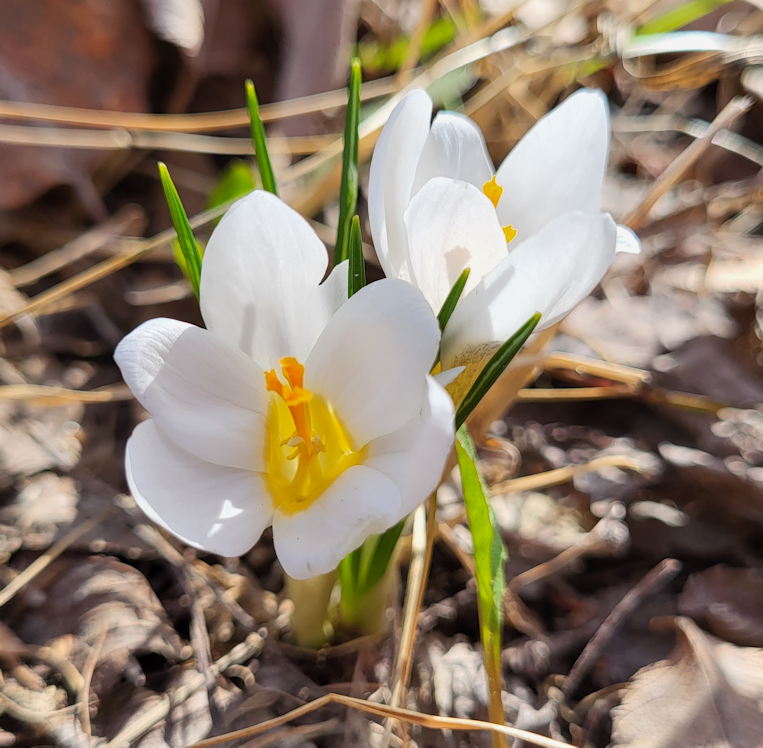
There are quite a few crocus buds popping up, and we’re also seeing lots of grape hyacinth greens emerging! Too early for the flower stalks to start forming, but the leaves come up in distinct little clusters that are easy to identify, compared to the grass and weeds that are in the same area. I’m looking forward to when the crocuses and hyacinths spread enough to start choking out the weeds and grass where they’ve been planted!

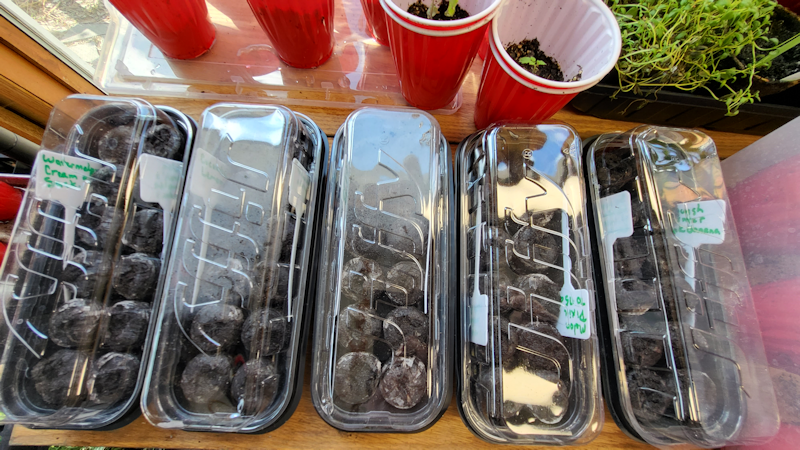
Last night, I started hydrating the seed trays with the Jiffy pellets, then headed into town this morning to pick up some more seed starting mix for the other tray.

There wasn’t any.

I tried a few places and found lots of potting mix, but no seed starting mix. I wasn’t willing to drive to another town, so I ended up getting more of the small trays with Jiffy Pellets in them. I did pick up a few bags of manure, though. Two of composted cow’s manure with peat, and two more of composted sheep’s manure with compost. These will be good for top dressing some of the beds, and for the trees we’ll be transplanting when they come in next week.

When I got home, I first had to start new trays hydrating, then I could work on the ones that were ready.

I had 5 trays, each with 12 pellets in them. I decided to do two different seeds in each tray, for a total of 20 new seed starts. Hopefully, we’ll have a nice, high germination rate, since each pellet got only one seed each.

These are what I chose for the first batch.

For melons, I’ve got the Sarah’s Choice, a new variety, Halona and Pixie, which we’ve successfully grown two years ago, and Cream of Saskatchewan watermelon, also new. Our attempt to grow melons last year was a complete failure, due to flooding. There are the two types of cucumber; Lemon, which we got as a freebie, and Eureka, a dual purpose variety for both fresh eating and canning. Then there are the winter squash: Pink Banana, North Georgia Candy Roaster, Honeyboat Delicata and Little Gem (Red Kuri). We tried the Candy Roaster last year, but they got drowned out. This will be our third year growing the Red Kuri squash, which survived last year because we planted them in a completely different location. I thought I’d ordered a new packet of those, but couldn’t find it. I ended up finishing off the few seeds in this older packet, then used seeds we’d saved ourselves from the first year we grew them.

I rearranged things a bit in the sun room to make room for these on the makeshift table. Later on, I’ll move the mini-greenhouse frame to the sun room to have more space for the trays.

As for the second batch, it will have:

The three varieties of hulless pumpkins, Kakai, Lady Godiva and Styrian, that we also grew last year. We’ve been slowly going through the ones we harvested last year – yes, we still have some! – but I lost track of two varieties that looked alike, so I haven’t been able to keep track of which seeds we like best. There is more winter squash: Red Warty Thing is new, while Boston Marrow and Winter Sweet were among those that got drowned out last year, though the Boston Marrow did start to recover somewhat. I’ve got more gourds, too. We started the Canteen gourd too early last year, and they were starting to bloom before we could transplant them, so they are being started later this year. Hopefully, they will actually get a chance to produce fruit this year. The Yakteen gourd transplants got killed off along with the melons, during our terrible, no-good growing year last year, and I hope to be able to actually try some this year. The Ozark Nest Egg and Apple gourds seemed to do well last year. We still have some Ozark Nest Egg gourds curing. The Apple gourds actually recovered rather well from the terrible conditions the squash were all hit with last year, and were producing quite a lot of gourds, but it was too late in the season by then. We were hit by frost before they could fully mature. I’m hoping we’ll have a better year this year.

I was tempted, but decided against growing the Tennessee Dancing gourd again this year. They are fun and do well, but we just have too many things going – and that’s not even considering what needs to be direct sown!

The new trays are being hydrated now. I’ve got another 5 going, though I have a spare available to hydrate, just in case. Hopefully, I’ll be able to plant into them tonight, and things can be moved into the sun room right away.

Once the last seeds are started, it’s back to working outside! I’ve still got the one last bed to work on in the old kitchen garden, then we need to build at least one trellis tunnel, with the raised beds that will be part of it, and prepare existing beds for planting, as well as grow bags for the potatoes, and containers for things like the lemongrass, some of the peppers and probably the eggplant as well.

Lots to do, and just a few weeks left to do them!

I’m so happy being able to get outside and get work done again!

The Re-Farmer

Our 2023 garden: Royalty Raspberries are in!

It has just reached noon as I begin writing this and apparently we’re at only 14C/57F out there. That can’t possibly be right, because it felt so much hotter while we worked outside!

Today, we made our newest addition to what will be our food forest area.

I picked up our Royalty raspberries from Veseys at the post office this morning. They’re even showing leaves already! Getting these in the ground became our top priority.

This is where I decided to start planting raspberries (we will be adding more, as we are able). You can see the remains of the row where we’ve been planting peas for the past two years.

Because there is a phone line buried nearby, we are keeping an area open that’s large enough to drive through on the north side, where I am standing to take this picture.. With that in mind, these first raspberries were lined up with the cranberries that mark the ends of the berry bush rows we planted last year. That sawhorse on the left is over one of the cranberries.

Of course, I was hitting a lot of rocks while I dug the holes! One of them had more roots than rocks. After this, I watered the holes a bit, then went and got some of the soil in the garden we sifted free of weeds and roots last fall. This is soil we’ve been working on and amending for a couple of years now. It’s been covered by black tarp since then, so I knew it was still clear.

My daughter, meanwhile, brought over the raspberry transplants – and a lopper to cut those roots out!

The canes were planted into new, root-free, soil, then given a bit of a watering. Each of them got a tomato cage to protect from the deer.

Last of all, a deep mulch of wood chips was placed around them, then a final watering. The sod that was removed got broken up and spread out, while the rocks from the holes, plus rocks that had been left at the ends of other rows we’d grown in last year, were collected. Thse all got dumped into the new groundhog hole we found next to the house when the snow melted. It still doesn’t look like it’s being used, nor does the original one beside the dining room door steps, just a few feet away. For now, we’re just going to block off the one. The other one is behind a mock orange bush, so I’ll want to fill that one with soil, first, if it keeps looking unused.

My daughter is quite happy with the raspberries. The ones we planted before, that I got her for her birthday, were eaten by deer and hit with drought in their first year, and never really recovered. It’s too early to tell for sure, but I don’t know if they survived this past winter. If they did, we’ll probably transplant them near these ones, in the fall. As we add more, the rows will extend to the south, with more rows added to the west, were we’d been planting beans and peas.

This is why we’ve been planting vegetables so far from the house for the past couple of years. To give the food trees we’ll be planting here a better chance of survival!

Oh, and while I was digging holes, my darling daughter fixed the sun room outer door that wouldn’t close. It turned out to be the latch plate was coming loose. The door does still stick at the top, but it at least closes now. It seems the wood is rotting, and that’s why it came loose. The main thing is that we can use the outer door for now, and leave the inner door open, for air circulation. When my daughter came out through the sun room, she noticed the windows were starting to steam up!

She’s so handy! 😊💛

The Re-Farmer.