Recommended: Maritime Gardening

Welcome to my “Recommended” series of posts. These will be weekly – for now – posts about resources I have found over the past while that I found so excellent, I want to share them with you, my dear readers. 🙂 Whether or not I continue to post these, and how often they are posted, will depend on feedback. Please feel free to comment below, and if you have a favorite resource of your own, do share, and I will review them for possible future posts.

I hope you find these recommendations as useful and enjoyable as I have!

You’d think that, having grown up on this farm and with my family being subsistence farmers, I would already know how to garden here. And I guess I do, really. The thing is, I want to do things differently than my parents did. Some simple things, like trellising, which my parents never did. One of my jobs as a kid was to flip the rows of pea plants, so the sun could get at the other side. We also want to grow new things I have no experience in, use no-till methods my parents never used, and eventually have raised beds.

So basically, I’m learning how to garden, all over again.

Part of this learning curve is figuring out how to grow what we want in our climate zone, which is a zone 3. It takes extra measures to produce food in our short growing season. We can’t even take advantage of any urban heat island effects.

With that in mind, I have been looking up resources for cold climate gardening. In my searches, I have found many sites and YouTube channels dedicated to cold climate gardening. How wonderful, I would think, as I eagerly began to explore them.

Right up until I discovered that these “cold climate” gardeners were in…

Zone 5.

Really?

Just about everything I look at that I’m interested in growing is rated to zone 5. How is zone 5 considered a cold climate?

Okay, okay. I realize that these sites are almost all based in the US, and northern states are rightfully considered cold climates compared to the southern states. But I’m in frikkin’ central Canada. To us, zone 5 is almost tropical. :-D

All joking aside, it did make my searches frustrating. It turns out there just aren’t a lot of active Canadian gardening resources out there.

So I was pretty excited to find Maritime Gardening.

Maritime Gardening is run by Greg Auton, in Nova Scotia. It’s basically one person and 2,500 square feet of back yard garden! He’s been making these videos since 2016.

The only down side?

It’s still a zone 5 climate region… but it’s far closer to our situation than anything else I’ve found! There are lots of videos on how to lengthen the outdoor growing season, like getting the soil to thaw out faster, or dealing with high winds.

There are also a lot of videos on specific crops, such as garlic, onions, potatoes, and strawberries, and techniques, such as no-till gardening, using cold frames, different types of mulches, and so on.

There are videos on planning out your garden spaces, dealing with weeds and insect problems, saving seeds, harvesting and preserving.

There are even cooking videos, fermentation videos, videos on how to make tool handles, and so much more.

There is just SO much to learn from here! I highly recommend this channel as a resource.

Especially if you’re a frozen Canadian. :-D

The Re-Farmer

Thinking Ahead

As we are settling in to our new home and going over the immediate property to see what needs to be done, we’ve been having discussions about what we want to do over the next few years.

Gardening isn’t likely to happen this year, unless my daughters do some planting.  At least not any deliberate gardening on our part.  Come spring, we’ll see what my mother has planted that will come up.

I’m really hoping the asparagus is still there.  And the rhubarb and horseradish.

We’ve talked about making raised bed gardens for accessibility, and what sort of vegetables we’d plant.  We’ll have to see what the status is of the raspberry bushes, how the apples do this year, and any other fruit trees that might still be productive around the yard.

We’ve also talked about getting chickens, and how many we would need to provide an adequate amount of eggs.  There’s the possibility of getting goats, though more about getting angora goats for their fibre.  A couple of goats for their milk would not be a bad idea.  I’m the only person in the family that isn’t lactose intolerant, and goat milk is something they can drink.  It’s just too flippin’ expensive to buy.  They love milk, so they put up with the discomfort of drinking it.  It would be nice for that not to be a thing.  Plus, I’d like to try making cheeses.  The friend I ran into at the clinic with my husband raises goats for meat, plus milk for their own use.  She told me that you can raise 10 goats on the resources of one cow, plus they give birth in twins and triplets, so they are a good return on investment for food production.  I’ve never actually eaten goat, though, so I don’t know if I’d like it.

Looking just at the size of our yard, I’m realizing that we could do most, if not all, of what we want to do, just in our fenced yard/garden area, and not even need to beyond the yard itself, once we’ve taken care of the overgrowth.

Along with those ideas, I’ve also started looking at other options.  Specifically, I was looking into fruit and nut trees.

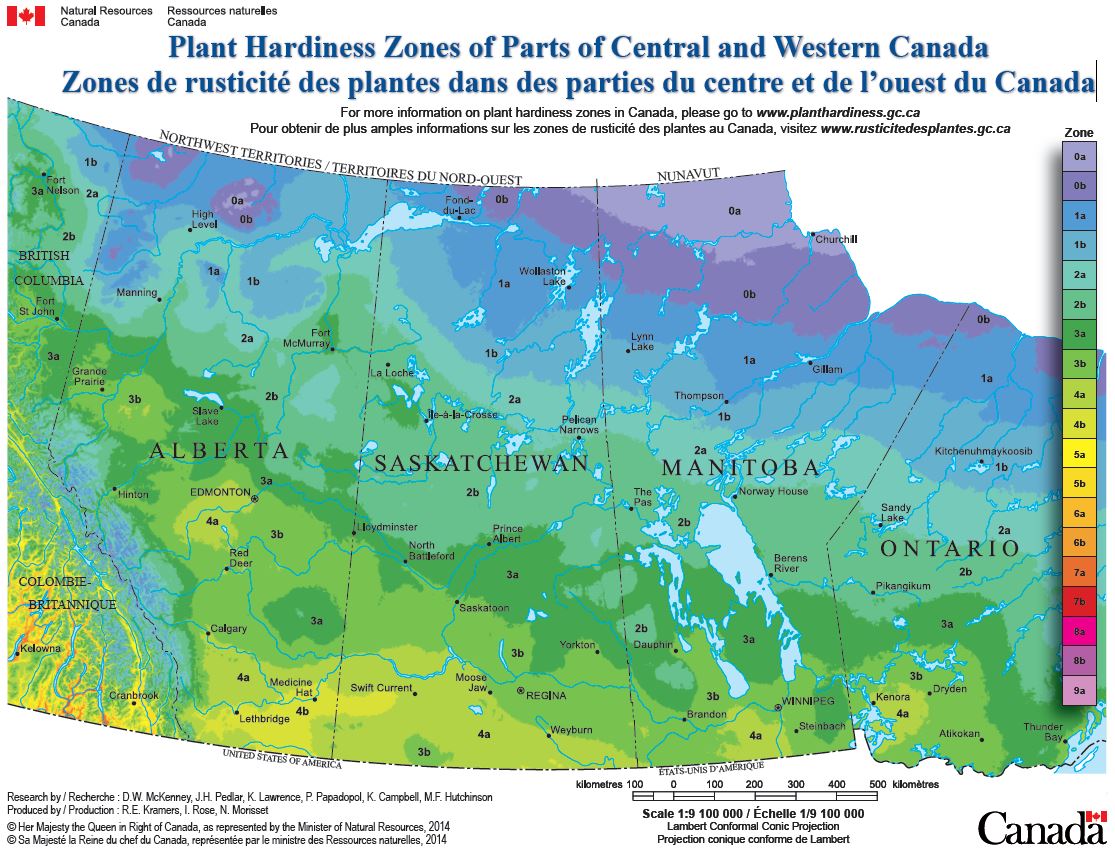
It’s surprising, how many food trees will actually grow in our planting zone.  Here is a map from the federal government.

Canada.zones

We fall solidly into the 3a zone, so any fruit or nut trees we plant have to be quite hardy, and able to withstand some pretty chill temperatures.

extreme.lows.map

Unlike a vegetable garden, any trees or shrubs we plant have to be able to survive lows into the -40C range in the winter and survive, even if we do work out micro-climates to facilitate their growth and production.  It’d be nice to actually have some of that global warming that’s supposed to be happening.

Here is a wish list I’ve started.

______________________________________________________________________________

Kiwi.  Yes, kiwi!  Turns out they can handle zone 3 quite well.  We would need at least 3 plants, including 1 male pollinator.

Seedless grapes.  Yes, grapes grow on the prairies, and there are native varieties, but I am interested in red and green seedless hybrids.

Saskatoon.  These actually grow wild in the bush, though I no longer remember where.  It would be nice to have some in the yard.  The fruit looks similar to blueberries, but they are related to apples.

Raspberry varieties; I’d like to have three varieties that mature at different times, so we have raspberries available for a much longer season.

Cherry.  We may have some cherry trees in the yard already, but I don’t know that they are a hardy enough variety to provide much fruit.  There are varieties of cherries that can handle our zone 3 quite well.  Later in the year, I want to check out an area where I remember we had pin cherries.  These are very tiny and tart; more seed than berry, but I remember eating them by the handful, anyhow, and my father made wine with them.  It would be cool if they’re still around, too.

Haskap.  This is a hybrid I’ve been learning about that looks a bit like a long, somewhat misshapen blueberry.  They can be used the same as blueberries, too.

Sunberry.  This is another berry that can be used just like blueberries, though they look quite different.

Plums.  We might have plum trees, still.  They were little, hard bright red plums, not the soft purple or red ones you buy at the grocery store.  We didn’t really eat them, but like the pin cherries, my dad would make wine with them.  I think my mom might have made jam with them, but I never liked jam, so I don’t remember.

Pine nuts (Korean pine).  Yes!  They can grow here!  Pine nuts are so expensive, it would be awesome to have our own trees.

Buartnut.  This is a hybrid walnut.  They are also fast growing shade trees that get huge, so we’d have to be careful where we plant them.  Black walnut is a native Canadian variety, but after reading up a bit, I think I’d rather try the hybrid.

Butternut.  This is another Canadian native that I’d like to try.

Beaked hazel nut.  This variety, I remember picking with my mother once, as a child.  I don’t know how she found the bush, because I remember having to go deep into the bushes to get to it, well away from any cow paths – and loosing my sandal in some muck we had to cross in the process!  I think this would be a good thing to plant along the edge of our spruce grove or along a fence line.

Gooseberries.  Mostly for sentimental reasons.  I have such fond, delicious memories of the one we had when I was a child.

______________________________________________________________________________

So that’s my list so far.  Some of these require a lot more work than others – the grape vines, for example, need to be trained and pruned over several years.

What we actually end up doing over the years, who knows.  I’d be excited even if we manage just a few of them.

If you’ve got any sort of experience or knowledge about some of these – or suggestions to make – I’d be thrilled to hear it!

The Re-Farmer