Our 2024 Garden: harvesting scapes, first pumpkin, and a bit of nip!

We’ve got a hot day coming, so I wanted to give the garden beds a solid watering, to help them cope with the coming heat. It was already 22C/72F at the time. I can’t remember what the humidex was.

While doing my morning rounds, though, I got a bit of a harvest.

There were quite a lot of scapes to harvest! There’s a few left to harvest over the next few days, but at this point, the bulk of them are harvested. We just need to figure out what we want to do with them all!

There were a few sugar snap peas large enough to pick. The little strawberries are the ones grown from seed last year, and the larger ones from the bare root plants we planted this spring. There is one plant among the asparagus that has berries, but the other three have been eaten, in spite of the barriers I put up to discourage the deer. *sigh*

I have spotted our first female pumpkin flower. The camera on my phone just did NOT want to focus on it, though. After I got the picture, I found a male flower and hand pollinated it. I later found a new female flower among the winter squash and was able to hand pollinate that one, too.

After a quick breakfast, my older daughter and I headed outside – my younger daughter is out of commission and walking with a cane again. 😢 We finally got around to removing the insulation around the base of the newer part of the house. This uncovered two windows – a third was already uncovered. These two windows don’t have screens on them, so I’m hoping to build some new screens for them. This way, we can have the windows open and allow more air circulation in the basement and hopefully help it dry out.

The insulation was taken to the barn for storage. My daughter took the smaller pieces in the wagon, fighting her way through the tall grass. With both of us, though, it took only two trips to get it all stored away.

Since I was going to be watering the garden anyway, I had decided to use the hose attachment and water soluble fertilizer. We have the 30-10-10 Acidifying fertilizer we’d found when cleaning out the old kitchen. Everything in the box was well sealed in plastic bags, so even though the box got wet at some point, the fertilizer is fine. With our alkaline soil, I decided it was worth trying. The peas and beans, of course, won’t get any benefit from the high nitrogen content, but anything that makes our soil at least closer to neutral will be a help.

I had a bit of trouble getting back into the sun room to get what I needed, though.

It was blocked.

Adam was nursing Button, in front of the door!

I was NOT about to interrupt Button getting some nip. Especially when he wasn’t having to fight the bigger kittens for it.

So I took advantage of the time to clear things on the patio blocks in front of the south facing basement window. The swing bench is there. The seat cushions have needed replacing for years, but I keep forgetting to get the measurements for cushions. Being out in the elements, moisture and debris gets caught in the fold between the back and the seat portions, so I undid the Velcro holding them in place and flipped the folds backwards for them to dry.

We stuck an old wooden bench against the wall that my daughter helped me move away after the insulation pieces were taken out. I ended up taking it off the patio blocks completely. All sorts of buckets and other things were stored under the bench, some of which got garbaged, some hosed off and set to dry in the sun. After that, it was old leaves, twigs, and other nature debris that needed to be scraped off the patio blocks and swept away. The window and the basement wall, of course, had to be swept clear of debris that got between the wall and the insulation pieces.

By the time I finished clearing that, Adam and Button were done, and I could fill the hose attachment and get to watering. The box of fertilizer has one large bag in it, with four smaller bags. One had been opened, but hardly anything had been used. Each one of the smaller bags was premeasured to put into the hose attachment. Handy! Of course, I used the one that was open already, even though it was missing a small amount, and set it up on the hose at the main garden area.

All the beds got a watering then, after the first watering had time to be absorbed by the soil, a second watering. Hopefully, it will be sufficient to protect the plants from the heat, even though a lot of these are heat loving plants.

I don’t know if the last Zucca melon will survive. When I did my evening rounds and checked on it, it was just covered in slugs, eaten to the point the stem with the newest growth on it broke off while I was removing the slugs! It still got a fertilizer watering, though.

That done, I switched to the front yard hose and did the East yard garden beds, and the beds along the chain link fence. There’s a section where we planted the Purple Caribe potatoes that never came up. I’m thinking of direct sowing something for a fall crop. I’m told we can actually still plant kohlrabi now, so I might do that. There is a single self seeded Jebousek lettuce that showed up in the gap, and I’m leaving it to go to seed, as it would be acclimating to our local conditions quite nicely by now. That, and the seed it came from survived the entire bed being reworked!

By the time the south and east beds were watered, the water in the attachment was looking pretty clear, so for the old kitchen garden, I switched gears. I used watering cans and water from the rain barrel, opening another bag of fertilizer and adding measured amounts into the cans after filling them. As I was watering, I spotted some Forme de Couer tomatoes developing!

I just realized; I forgot to water the green zucchini in the pot. The Magda and White Scallop pots still have nothing in then, and I’ve figured out part of the problem. I’ve got stakes to keep the cats out, but the kittens still fit! I’ve been finding kittens curled up in between the stakes, right over where the seeds were planted.

*sigh*

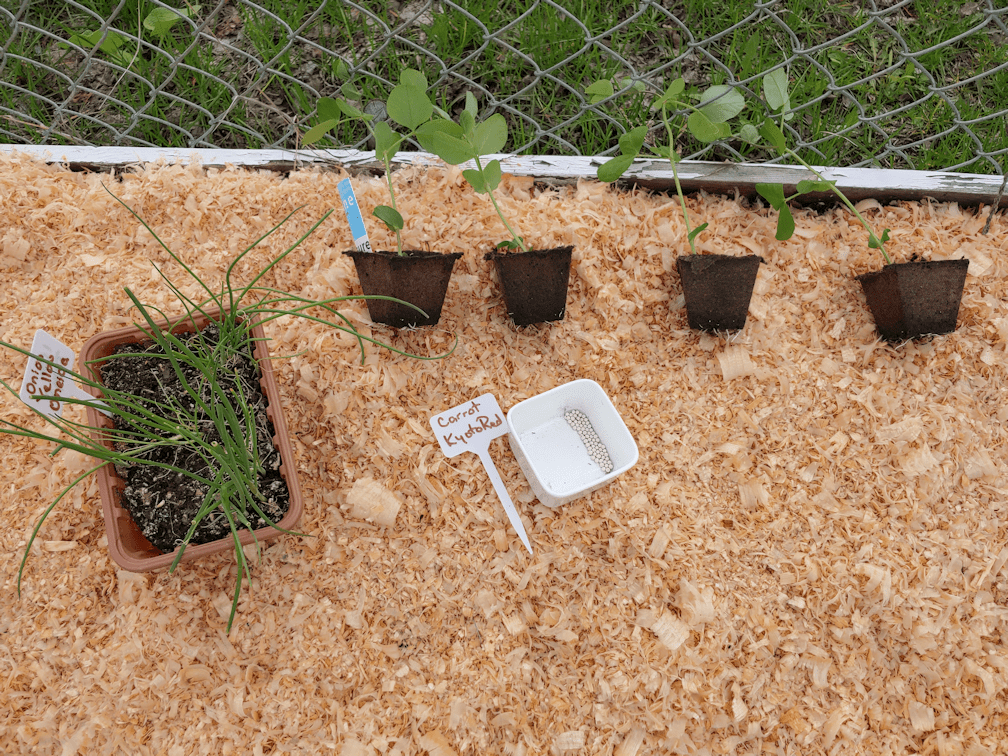
Oh, that reminds me. We now have all four G-Star seeds I planted, in the bed with the onions and shallots, germinated and starting to show their true leaves. Still nothing with the Magda and White Scallop I planted at the same time. I was really hoping to get those. We quite enjoyed the few Madga squash we’ve been able to grow over the years, and the White Scallop patty pans are a new variety we were really looking forward to trying. The G-Star, however, seem to thrive here, so we should at least get some of those!

After everything was watered, I took the time to put away some plastic for the garden. I’d laid the pieces out on the grass, weighted down to keep them from blowing away, to dry. Instead, it rained, and ended up with puddled. After a while, they were starting to kill the grass, so I finally gave up on that idea. Yesterday evening, I hung them up on the clothes line, instead. They’re pretty long, even with the biggest piece folded in half, so there was a risk the cats would start playing with the ends and tearing them up.

The wind was starting to pick up, and the plastic was starting to get twisted on the line, so I took them down. The biggest piece got folded smaller, before being rolled up into a bundle. The other pieces were long and thin – mostly clear garbage bags with the sides cut, and used to solarize a garden bed. Those got rolled up around a stick.

By the time I got inside and checked the temperature, we were – and still are – at 28C/82F, with the humidex at 31C/88F. The high for today is expected to reach 30C/86F.

I can’t complain. In the city we lived in before moving here, they hit 36C/97F with the humidex at 40C/104F, yesterday. Mind you, we’re expected to reach a humidex of 40C/104F today ourselves, even with a lower expected high. Most of the prairies, now extending into southwestern Ontario, are under extreme heat warnings. Tomorrow is supposed to be much of the same.

Looking at the extended forecast, we’re not supposed to get any more rain until the beginning of August, and temperatures are expected to remain high. Given the heat and humidity levels, though, I wouldn’t be surprised if we get sudden thunderstorms in there.

Well, all those squash and melons, peppers and eggplants, are going to love the heat! They might get a chance to really get growing.

Hmm. This is interesting. I just checked a completely different weather app, and it says we have a 100% chance of rain on Saturday, Sunday and Monday.

Every app seems to have a different forecast!

We shall see.

Until then, we’re going to hunker down inside the house. It’s not supposed to cool off out there until 7pm, and even our overnight temperature is supposed to be a low of 21C/70F!

Gotta love the prairies. We get as hot in the summer as we do cold in the winter!

The Re-Farmer

Our 2024 Garden: a little harvest, and odd blooms

That whole “get outside early, before it gets hot” thing is just not working. After finishing my morning rounds, it was already 25C/77F, with the humidex putting it at 31C/88F! As I write this, it’s actually cooled down a tiny bit, but it’s going to go right back up again this afternoon.

One of the garden beds that has me a bit perplexed is the eggplant and hot pepper bed. I have not tried to replace the plastic around the box frame, that got shredded by the wind, so they’ve been exposed to the wind and temperatures like everything else beside them. That bed does get a bit more sun than the other two beside it. The peppers and eggplants, though, just don’t seem to be growing. This seems like more than transplant shock. They’re just stagnating, and I don’t know why.

Which makes what progress I am seeing in them a bit surprising.

As small as they are, I am seeing flowers opening up among both the Classic eggplant, and the Little Finger eggplant. There are flowers on the Cheyenne hot peppers, too, but I would almost expect that. These peppers were started the earliest. They should be big and bushy and have fruit developing by now, so having a few flowers appear is late for those. For the eggplant, though, would have expected flowers to appear after they’d gotten much better. Especially considering how large the fruit is supposed to get at maturity. The normal fruit size, even for the Little Finger variety, is bigger than the plants are now!

Aside from that mystery, I found a couple of ripe strawberries among the older plants in the asparagus bed. Yesterday evening, I’d picked a few from the bare root strawberries that were planted this spring, and the tiny strawberries grown from seed in the old kitchen garden. The strawberries in the asparagus bed are having the hardest time of it, because the deer keep eating the leaves, so anything out of there is bonus.

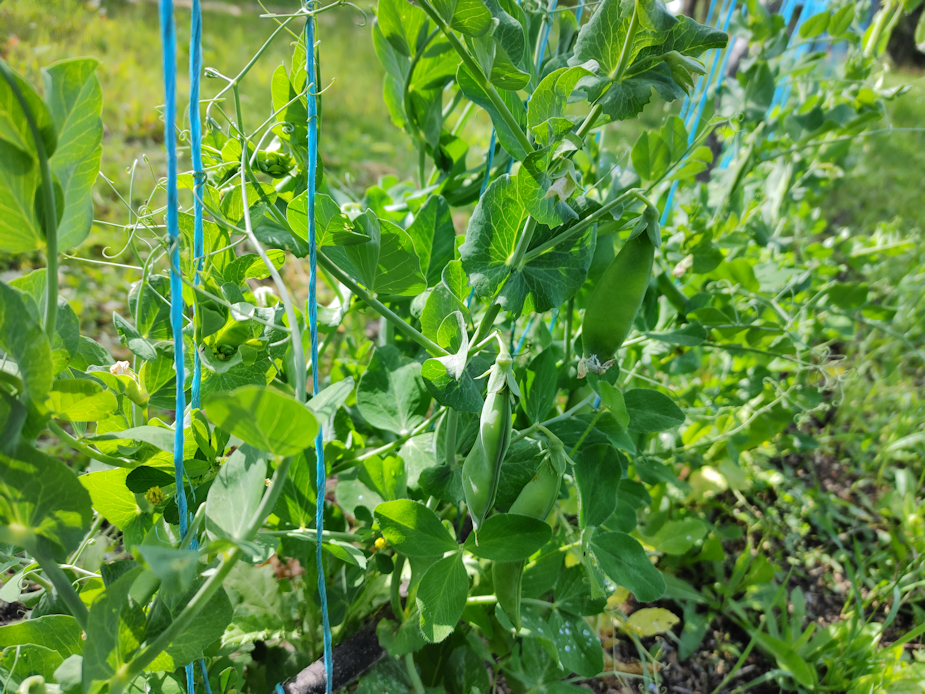
There are sugar snap pea pods developing, and I’d picked a couple last night. This morning, there was just one, ready to pick. I’m only picking these because, the more they are harvested from, the more they will produce.

The real bonus this morning was the garlic scapes!

Almost all of the scapes were ready to be harvested. Of the ones remaining, they should be ready to harvest in the next day or two. So we’ll probably have one last harvest, and then be done for scapes for the year.

We need to plant more garlic. 😄

The mint that keeps trying to take over the bed is managing to get into the raised rectangular bed with garlic, tomatoes, onions and shallots in it. Since I was weeding them out, anyhow, I picked enough for a day’s use.

It’s not much of a harvest, and this year, it doesn’t look like we’ll get much that can be harvested through the summer. The bush beans have been decimated by slugs, so I don’t expect anything from them anymore. They mature fast enough that I could replant, but there’s no point, unless we can get rid of the slugs.

I should pick up some cheap beer for slug traps. Even the last Zucca melon is getting decimated, and it’s of a size they normally wouldn’t be able to damage that much. There is evidence of slug damage on some of the melons and winter squash, and at least a couple of melons have simply disappeared, but they seem to really like the Zucca melon – enough to get up into that kiddie pool raised bed it’s planted in!

The shelling peas are of a size that they need to be trained up into the trellis netting. There are very few pole beans, but they are getting tall enough that trellis netting needs to be added on that side of the bed, too.

The hot pepper growth has been stagnant, but so have the bell peppers in the high raised bed. They’re not getting any bigger, though they certainly look healthy, small as they are, and some of them are starting to bloom, too!

Most of the tomato varieties are also showing blooms. The only ones that aren’t are the last San Marzano transplants. Considering how much later they were planted, that’s not a surprise. The ones planted in the old kitchen garden almost all have flowers and are getting tall enough we’re going to have to start clipping them to their bamboo stake supports.

Along with all that, we need to get the weed trimmer and lawn mowers out before the grass gets too tall again. We still have standing water in places, and the ground is still saturated in others, but we should still be able to get at least some of the mowing done. That will give us grass clippings we can add to some of the garden beds as mulch, too.

Also on the list it so finish assembling the log frame on the one low raised bed. I was able to accumulate more cardboard that I plan to put under the logs, first. So they’ll need to be rolled away, the ground under where they will go needed to be levelled off more, the carboard laid down as a weed barrier, then the logs rolled back and permanently attached to each other. I just plan to cut notches in the shorter end pieces to fit them over the ends of the side pieces, to set them snug against each other. I still have some broken pieces plant supports I got a few years ago. They were hollow metal tubes coated in plastic, and with so many rocks in our soil, they broke very easily. I’ve used some of them, already, on the current trellis bed. I used an auger bit on my drill to make a hole through the logs at the short ends, then drove the broken lengths of supports in, to hold them together. I plan to do the same thing when assembling the new frame. It needs to be done very soon, as the winter squash is starting to grow into the paths, and will soon be too big to move out of the way without damaging them.

Meanwhile, the temperature and humidex is already starting to get hotter again. Our humidity levels are supposed to reach over 90% at times. I’m amazed we have an only 25% chance of rain this evening. I would have expected thunderstorm warnings. We do have a small system with storms in it passing us to the north, but not anywhere near where we are.

Well, summer is summer, and I’d better get used to the heat, if I’m going to get anything done.

The mosquitoes, on the other hand, are something I will never get used to!! Mosquitoes, horseflies, deer flies… they’re all just brutal this year!

The Re-Farmer

Firsts!

I had some nice surprised while doing my rounds this morning!

The sugar snap peas are starting to bud and bloom. I’m a bit surprised, because the plants are not very big, but there it is!

I also spotted the first summer squash show up; a green zucchini. I was planning to sow more after I finished with the low raised beds in the main garden area. We shall see if any others germinated over the next while. I may not need to re-sow all of them, after all.

The mock orange at the laundry platform now has a few flowers blooming. There are so many buds, it’s going to be a mass of white flowers soon, but for now, it’s just a few scattered around. It’s a shame this was planted where it was. It’s gotten big enough that it gets in the way when we want to use the clothes line. That and the platform needs maintenance and a paint job. We need to transplant it, and I want to find a nice sunny location that will really showcase it, because it’s so gorgeous once it starts blooming.

I like that there always seems to be something starting to bloom, right around when other things are finishing their blooming season.

The Re-Farmer

Last one!

The store in our little hamlet has a very small display of seeds every year, and at first I thought I was out of luck. They had two varieties of pod peas, and that was it.

Then I noticed one of the displays of flower seeds had several types of seeds mixed together. So I took another look at the peas.

Hiding in the back of one of the shelling peas display was a single package of snap peas!

I could feel there weren’t a lot of seeds in the packet. I’d have bought two, if there were two to be had! There turned out to be 24 seeds in the packet. Just enough for one row down the middle of the bed they will be planted in. The snap peas we bought before had more seeds in the packet, but the packet also cost more.

Then I got some nasturtiums. I suspect the ones included with the seeds I scattered along the side of the driveway aren’t going to make it, since the area ended up filling with water soon after. There’s still some standing water around there, which could be a good thing, or a bad thing, for the scattered seeds. I really can’t guess right now! Maybe something from the different varieties I scattered will grow, but just in case, I figured I’d get these. These will be direct sown, after our last frost date, probably in the main garden area somewhere, to attract pollinators and act as a trap crop. Plus, if they actually grow, the flowers are edible, and the flower buds can be used to make “poor man’s capers”.

We shall see how it turns out!

The Re-Farmer

Analysing our 2022 garden: peas and beans

Okay, it’s that time! I’ll be working on a serious of posts, going over how our 2022 garden went, what worked, what didn’t, and what didn’t even happen at all. This is help give us an idea of what we want to do in the future, what we don’t want to do in the future, and what changes need to be made.

It was a mixed bag when it came to growing legumes in 2022!

As with so many other areas in the gardens, we did have flooding around the pea and bean trellises, but that area is a bit more elevated, so it wasn’t much of an issue, compared to other garden areas.

The previous year, we’d grown three types of bush beans, and they did very well, in spite of drought conditions and heat waves. We were very happy with them.

For 2022, though, we decided to try growing pole beans, and shelling beans.

The previous year, we had little success with peas. For 2022, we decided to try an edible pod pea, as well as shelling beans. Plus, we had a whole four saved seeds from the King Tut Purple Peas we tried growing the year before.

Let’s start with the peas.

We used the same trellis we’d grown peas at, the year before, amending the soil a bit more. The trellises were all meant to be temporary, but we did get one more year out of them.

Don’t those peas look nice and healthy?

That was about the best they got.

The Results:

The sugar snap peas germinated, then almost disappeared. I think we got a whole two pea pods out of them. There weren’t a lot of those, however, and were planted in half of one side of the trellis. The shelling peas too up the rest of the trellis, which means some were planted across from the snap peas. Those pea plants also did not do well, which tells me that the soil on that end of the trellis was most likely the problem.

A couple of weeks later, we planted more of the shelling peas at an A frame trellis, shared with gourds and cucumbers. Those plants actually seemed to do better.

In general, though, the peas did not thrive. Even the healthiest, strongest plants only got to about half the size they should have. I did have shelling peas to harvest, but never more than a handful. Usually, it was just a few that I could eat right away.

Then there were the purple peas.

The Results:

As with the other peas the year before, the King Tut Purple Peas did not do well, but they kept trying to grow and bloom for a surprisingly long time. I decided to try starting the four seeds we’d managed to keep indoors. All four germinated and were looking quite healthy. They were transplanted in a south bed with the chain link fence to climb. Shortly after transplanting, I cut the top and bottom off some gallon water jugs and put them around the peas for extra protection from the wind until they could grow big enough to start vining into the fence.

They… grew. Like the other peas, they did not reach their potential at all. They grew tall and thin, without a lot of foliage. There were a few purple blooms and pea pods developed, but they were green instead of purple, except for one. I never tried harvesting them at all, but just left them to go to seed. There wasn’t a lot to collect at the end of the season, and I’m not even sure I want to try growing them again. They weren’t the tastiest of peas, but that could be because they just didn’t grow well.

The Conclusion:

While the peas did not do well, we will still be growing them again. For 2023, I’ve already ordered the variety of shelling peas we’d tried in 2020. The pea and bean trellises have been dismantled, and they will be grown in a completely different area, as we build up our permanent garden beds. Hopefully, that will make the difference. I really love fresh peas, and would love to have enough to freeze. I would love to have edible pod peas, too, but I’m not sure if we will try them again in 2023. I think it will depend on how far we get with the permanent gardening locations.


Then there were the beans.

While we bought pole beans, we also had green and yellow bush beans left over from the year before.

We planted a green and a purple variety at an A frame trellis. The shelling beans and the red noodle beans were planted at what had been a squash tunnel, the year before. The yellow beans were planted with the kulli corn to act as a nitrogen fixer, as well as to help shade out weeds.

The green beans from the year before were planted with our sweet corn as well, but that bed got flooded out. While most of the corn survived, not a single green bean germinated. We bought another variety of green bush bean and planted those, and they did grow.

The Results:

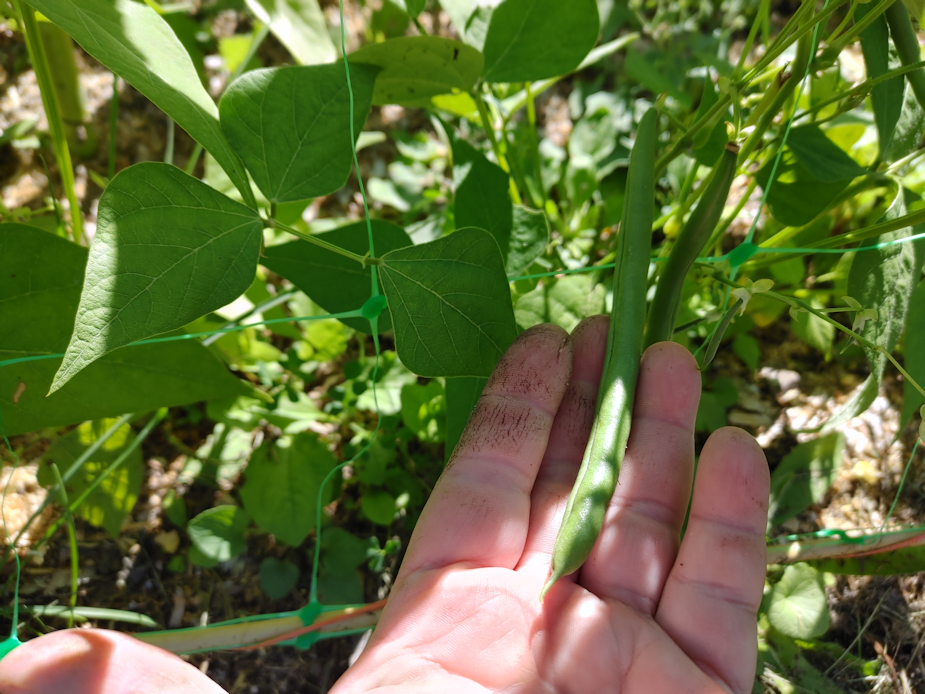
The purple Carminat and the green Seychelles pole beans did great, considering what a horrible growing year it was.! Both varieties were quite productive. I wasn’t picking beans every day, as I was with the bush beans the previous year, but I was at least picking some every couple of days. The purple beans seemed to do the best – even when a deer went by and nibbled on them all along the row!

The yellow bush beans planted with the kulli corn did quite well, too. The only downside was that we had a net around the bed to protect the corn from deer and racoons, which made harvesting the beans very inconvenient.

The green bush beans we planted with the sweet corn didn’t grow as large as they should have; it was a new bed and it had lots of issues, so I’m not surprised by that. Everything did a lot better when we were finally able to finish mulching it all. The bean plants were so small, however, that it was hard to harvest them with the mulch. They were there more for the corn than for us, so I decided to just leave them and hopefully have seeds, but I think they were planted just too late for the season, and none of the pods dried out.

Then there were the shelling beans and Red Noodle beans at the tunnel trellis.

The shelling beans (Blue Grey Speckled Tepary) were very small plants, just barely getting tall enough to start climbing the trellis, yet they produces so many pods! Still, there wasn’t much of a harvest of these very small beans. That photo is the entire harvest! I saved 100 seeds (we’d planted 50) to grow in 2023, and we ate the rest. It was the first time we’d tasted these beans, and they were barely enough for one meal! Still, we found them tasty, and I look forward to trying them again. I hope a better growing year will improve things.

As for the Red Noodle beans…

These are supposed to be a vining type bean, but it wasn’t until near the end of the season that they actually got large enough to start climbing the trellis. It took even longer before I finally saw blooms. We were starting to harvest and pull up the garden for the end of the year, when I found a single, solitary, baby red noodle bean pod, which you can see in the above photo.

I had been looking forward to trying these beans, and would like to try growing them again, just to find out if we like them! Not in 2023, though.

Conclusion:

Beans are such a staple crop, and we enjoy having a variety of types, we are definitely growing beans again in 2023. Along with the seeds we saved for shelling beans, my mother gave me a jar of white beans that are descendants of beans she used to grow here. She gave seeds to my sister to grow in her own garden, which she did for quite a few years. She’s not growing shelling beans anymore, though, so she gave her saved seeds to my mother, who passed them on to me. What a circle!

On top of that, we have ordered seeds for green, yellow, purple and red varieties of beans, including one that is supposed to be good as both a fresh bean and a shelling beans.

While we’ve had our failures this year, beans are one of the few crops that have produced really well for us, even in adverse growing conditions, making them a reliable food to grow.

The Re-Farmer

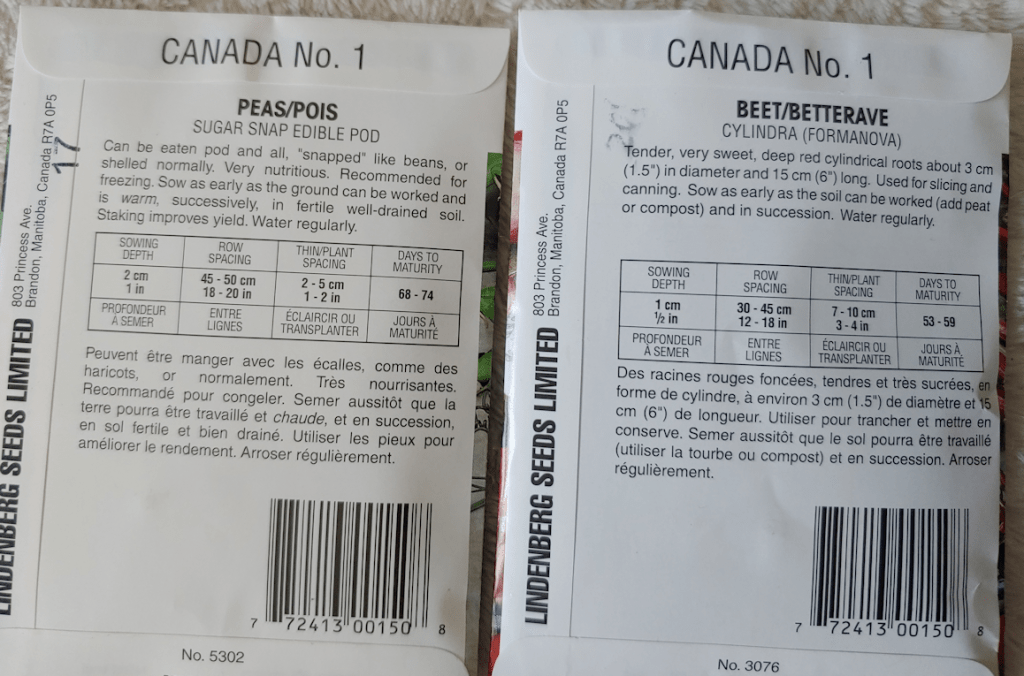
Our 2022 garden: Lindenburg seeds – snap peas and cylindra beets

I couldn’t resist.

This afternoon, I went to the post office, where I was able to get a money order made out and mail it off, along with an improved printout photo of myself, to the RCMP for my PAL application. Hopefully, that means I’ll have my PAL certificate soon.

Since I was there, I took the opportunity to pick up a few things and…

I couldn’t help it.

I got sucked in.

There was a new seeds display.

We don’t need more seeds.

I got some, anyhow.

The peas we have now are shelling peas. Which would have been enough, but I do like snap peas, so I went ahead and got some. We also have a variety of beets already, but I decided to try the cylindra variety, too. The elongated shape is apparently much easier for getting consistently sized pieces for canning.

At least they aren’t something that need to be started indoors!

I think this is the first time I’ve picked up seeds from Lindenberg. Unlike a lot of other seed companies, they don’t have all their products viewable at their website, but had a downloadable catalog you can scroll through, instead.

Oh, dear.

I might just have to spend a bit of time ogling their selections now.

The Re-Farmer