Garden stuff, seeing a friend, and lysine is finally in… but it’s not the same!

I tried going to bed early last night, which actually worked for a change, so I was able to get out and in the garden early. We were getting warnings for a possible thunderstorm (which never happened), so as soon as my morning rounds were done, I wanted to work on my tomatoes.

The first of the Instagram slideshow photos is as far as I got with the San Marzano tomatoes in the main garden area.

I was even able to pick a few tomatoes, first. They were so tightly packed in with the vines, a couple were weirdly misshapen, having had to grow around stems and even one of the bamboo supports.

With this bed, though, only the main stems were supported by the stakes. These weren’t pruned, so they all have suckers on them. The three southernmost plants (in the foreground) had suckers spread out and lying on the ground like a thick, green spider’s web! You can see a bit, how I added support to those vines.

For most of them, I couldn’t reach the stake in the middle, so I loosely tied jute twine to the stem I wanted to support, under a leaf stem, or the nub of one, if it was one that was broken off. I did prune some of the bottom leaves away, awhile back, as they were crushing the onions planted around them. The twine was then wrapped around the stem, with extra wraps near the base so it wouldn’t pull upwards. I didn’t skimp on the wraps all the way up, and made sure that any branches with clusters of tomatoes on them had wraps above and below. Once near the top, the whole thing was gently lifted, and the top tied to the support.

With so many of these branches splayed out around the main stem, I alternated sides as I worked, to more evenly distribute the weight. I also moved the metal posts that were marking the corners of the bed, as I was shifting it over. Those were brought closer in and pushed deep into the soil, so they – hopefully! – wouldn’t be pulled over. I then anchored the stake at the end of the row onto them.

As I worked on the next two tomato plants, I also straightened stakes that were being pulled down by the weight of the main vine, and secured them to the previous stake. With one plant, I could access the stake as I worked, so the jute twine was anchored to the stake at the bottom, rather than the base of the stem I was working on. A couple of vines were even anchored to the stake about half way up, as they were being wrapped. Not too close against the stake, though, but with space for air flow.

The three at the south end got done, but it took so long, I had to move on. The others don’t look like they will need individual wrapping like this. I’ll see, when I get back to them.

The second photo in the slideshow above is of the Black Cherry vines in the Old Kitchen Garden. They are getting so big and heavy, the lilac they are climbing is bending from the weight! These are already tied off and supported as much as can be, though.

Note for future reference. Find a way to incorporate stakes into the wattle weave to support things like this! The lilac can handle supporting the luffa vines just fine, but these tomatoes are just too big and heavy, and those branches are not near the main stems of the lilac.

It was the bed with the Forme de Couer tomatoes that needed help. I had to post this photo separately on Instagram, because it’s oriented differently. It was the bamboo stakes that had to be helped.

Each plant has a pair of stakes to support it. The pair in the bottom right corner of the photo were so heavy, the stakes were twisted around and starting to lean into the bath between this bed, and the wattle weave bed with the Black Cherry tomatoes. You can even see a bit, just above where the jute twine is tied, that one of them had started to split and bend. If there hadn’t already been some twine holding the pairs of stakes together, there’s no doubt the whole thing would have broken and fallen into the path.

That one got attention first. I was able to carefully pull the stakes upright again, then anchored them to the opposite corner of the raised bed. More twine was added to the pairs of stakes along one side, anchoring them to each other, then to the corners of the raised bed at the other end, before being tied off on the last pair of stakes on the opposite side. The other stakes on that side had already had support added to them and did not need more.

Once that was done, it was time to clean up and head into town. My friend from out of province had time to meet for lunch, one more time before she had to go home.

I left early so that I could stop at the dollar store, first. With one of the yard cats going in for a neuter next week, we have to start deciding which one we’ll be trying to catch. The friendliest ones have already done, but one of those is really hard to tell apart from others, now that the wound on his front leg is completely healed, without even a scar visible through is fur.

What I’ve decided to do is to try and put break-away collars on the four that have already been neutered, then another to add onto whichever cat we manage to catch and bring in next.

The store had only one style with breakaway snaps on them, so that’s what I got. They all have bells, which will need to be removed. These are outdoor cats, and they earn their keep by keeping the rodent population down. Having a bell would defeat the purpose, plus make them easier targets for coyotes.

After that, I hung around and enjoyed the day until my friend and I met up and went for lunch in the fish ‘n chips place that reopened not long ago. They’d been closed for many months, repairing and renovating after a fire (when I first saw the boarded up building, I actually thought they’d been vandalized). It’s the same owners using their same recipes, and their food was every bit as delicious as before. We quite enjoyed our lunch – and the portions were generous enough that both of us got take out containers to bring the leftover home!

My friend still had some time left before she had to go, so we got to walk on the beach for a while – a nice quite beach, now that the summertime crowds are done, and it’s the middle of the week! Then she had to head back. She’s leaving very early in the morning, and has a long drive ahead of her, so she had lots to do to get ready. Including a grocery shopping trip for her mother.

That sure sounds familiar! 😁

While I was in town, I got a message from my husband, letting me know the feed store had called, and the lysine they’d ordered for me was in. So, after we said our goodbyes, I headed to my mother’s town to pick it up, along with more kibble for the outside cats.

Speaking of which…

This morning, I tried to do a head count of just kittens. That’s a bit of a challenge, as some of the adult cats are pretty small, and the older kittens are almost as big as they are!

I counted twenty.

I think.

In the photo above, with the kittens, you can see the bright white granular type lysine on the bottom of the kibble tray. That is why I was wanting to have a finer powder, like I had been able to get before, but is no longer available.

If you look at the second picture of the slide show above, you’ll see the lysine I got today. I opened one of the tubs right in the store, as soon as I paid for it.

This bulk lysine is sold for horses, so I guess they don’t bother bleaching it white, like for human consumption! It’s still granular, though. Lysine is lysine, though, so it is otherwise the same.

I think what I’ll just have to do is use that Magic Bullet set we were gifted with, and just process the granules into a fine powder. This will coat the kibble better, and the cats are more likely to actually get a dose of the stuff. Thankfully, aside from eye baby, there don’t seem to be any sick cats out there right now. Just a little bit of crusty bits visible in the corners of some of their eyes, but nothing major. None need to have their eyes washed. Even eye baby’s messed up eye isn’t leaking much. It’s just really… gross.

No, I will not inflict you with a photo!

Anyhow.

Along with the lysine (I got two 1 pound tubs, which cost just under $20 each), I got the bag of kibble I’d paid for last time, but they turned out to have only two bags in stock, not three. Then I got one more on top of that.

Once done at the feed store, I headed home.

I don’t know what’s been going on with me lately, but during the drive home, a wave of tired just hit me. I don’t mean physically tired, or even mentally tired. I mean sleepy tired!

I did get a good night’s sleep! Honest!

Once I was at home, I unloaded everything but the 40 pound bags of kibble in the box of the truck, then went for a nap. When I woke up after a couple of hours, I was feeling even more groggy than when I lay down in the first place!

So I just did my evening rounds, but let my daughter that was going to help me, know that I wasn’t up to finishing with those last San Marzano tomatoes. They will be fine for another day.

Meanwhile, the writing of this paused just had a pause to it, as I dosed and fed eye baby, while my daughter held him, wrapped up like a purrito – and there was much purring happening!

Gosh, I wish all cats took their meds as well as this little guy!

I gave his face a bit of a wash around the eye, and just laid a warm, damp cloth over the eye itself, before giving him some saline drops. I wish I knew what I was looking at with that eye. All I can say for sure is, it’s getting better – as in, it’s not sticking out as much, and not leaking like it had been, when we first started treating him. He even seemed to enjoy the cleaning.

That is now done for the night, and that’s as much as I have energy for. I’m done for the day. My younger daughter and I have plans to watch Columbo together tonight.

I’m hoping I don’t fall asleep in my chair!

The Re-Farmer

Our 2024 Garden: morning in the garden and NOOOOooooo!!!! *sniff*

I headed out early this morning, while it was still relatively cool, to do the watering and make use of the grass clippings that had been collected and spread out on the black tarp.

I was getting near the end of watering in the main garden area, about to move on to the strawberry bed, when I realized…

I wasn’t seeing any strawberry plants.

At all.

Noooooooo!!

Yup. A deer got to them!

I have to admit, I was complacent. I’d seen a deer around the garden area a few times, but it never went to any of the beds and stayed in the tall grass. We’ve got spinners and flashy things and other distractions all over. It seemed they were making a difference…

Now, this.

Obviously, it’s late in the game, but I put a net around the bed so it won’t happen again. The plants will recover, and the runners are still there and rooting themselves. The main thing with the netting is to be able to lift it, as needed, to tend the bed. It’s held down with ground staples in the corners

*sigh*

The next time I can get to a Dollarama, I will see if I can pick up more of those green, plastic coated support posts. They are very handy!

The netting was put up last of all, though. Before that, as soon as the watering was done, I started filling the wheelbarrow with grass clippings and mulching things.

First I laid a pretty thick layer around the edges of the tomato and onion bed. Then I did the onion, shallot and summer squash bed. Setting handfuls of grass clippings between every onion took a while!

These two beds took up most of the grass clippings, but there was maybe half a wheelbarrow left, so I mulched around the onions going to seed, and around some melons at the end of the bed where the bush beans are trying to recover.

After that, I just had to get some photos of the huge vines we’ve got now!

The pumpkins are blooming enthusiastically, and I even hand pollinated a couple more. There’s one pretty large pumpkin developing, plus a few smaller ones. I got a picture of just the largest one.

There are lots of drum gourd flowers, but no female flowers, yet.

The winter squash that are developing right now are getting so big, so fast! So far, the only one I can identify – I think – is what is likely a Turk’s Turban squash. It will probably be a while before we can identify the others – two of which I think are the same variety. I was able to hand pollinate a couple of winter squash, too.

I also got some photos of the Forme de Coure tomatoes.

I think having the sump pump hose draining at one end of the bed is making a difference. A lot of the water does end up flowing down one of the paths, but the bed itself is benefiting from being watered indirectly like this. The tomato plants are lush and bushy, and the tomatoes seem to be growing much faster than other varieties.

It was about 17C/63F when I headed out to water the garden beds, at about 6:30-7am. It’s now coming up on 11, and we are at 24C/75F with the humidex putting us at 27C/81F. We are expected to reach a high of 29C/84F, with highs of around 30C/86F starting tomorrow and staying at or near that range into August.

Which means I’ll be out watering the garden in the cool of the morning pretty regularly.

Most of the prairies are under heat warnings and/or air quality warnings. We’ve got an increase in wildfires up north, but really, we’re doing all right, all things considered. Alberta is being hit hard, and Jasper had to be evacuated and seems to have mostly burned down! Thank God, there don’t appear to be any injuries or loss of life. The most recent article I can find, as of this writing, is here. (link will open in a new tab)

And that is why having a “bug out bag” is a good idea! As well as having emergency supplies in your vehicle, if you have one.

So we will do what we can with our own heat, and be thankful that it’s all we have to deal with!

The Re-Farmer

Our 2024 Garden: potting progress

Well, I ended up doing a bit more than I expected to, yesterday evening!

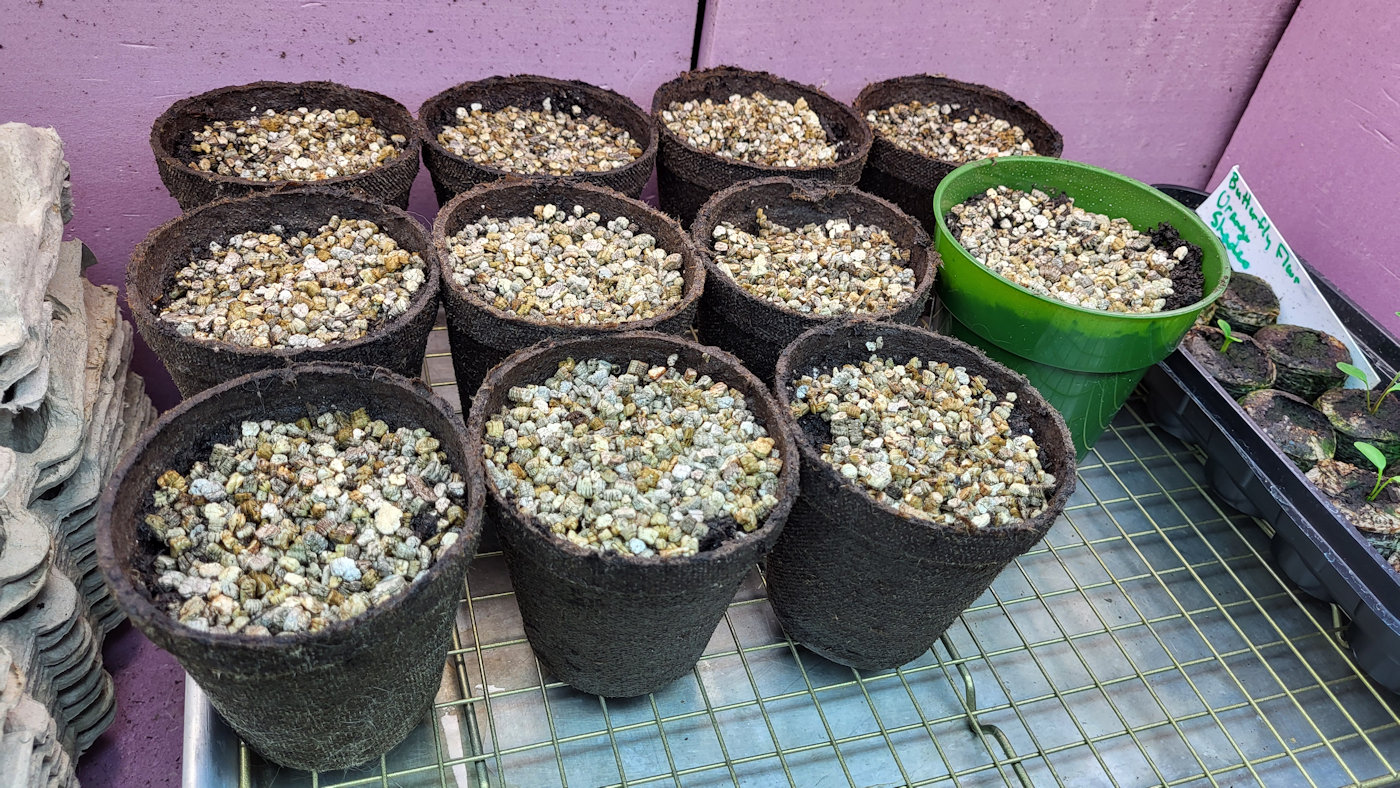
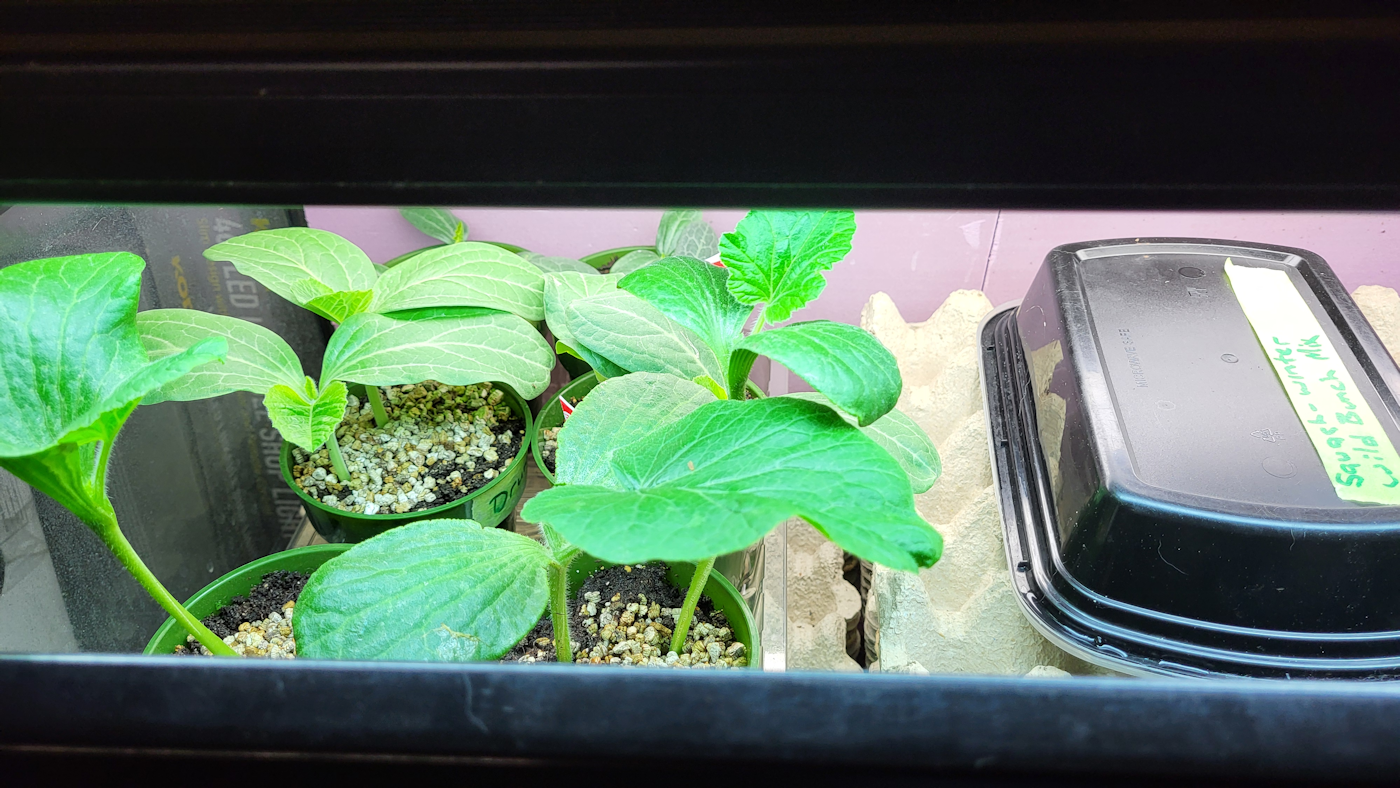
The first thing I did as plant a few more pre-germinated Wild Bunch winter squash seeds. To make space, I changed out what the pots were sitting in.

They are now in a baking pan, over a cooling rack, to allow air to circulate under them. This is a recommendation from Gardening in Canada, as a way to keep the pots from getting moldy or starting to fall apart. The problem, though, is they can’t be bottom watered while on this, which means they’ll be watered mostly by misting.

I would love it if Costco got another shipment of these baking pans. They are basic, 9×13 pans and were very affordable. I didn’t realize just how good the price was, until they were gone and I tried finding more, elsewhere, only to find they cost 4 or 5 times more! Even the restaurant section of the wholesale store I checked out was ridiculously expensive.

Also, that’s the last of my 3″ biodegradable pots from last year. The new ones I got are 4″ pots, which is what the green plastic one is.

Speaking of “biodegradable” pots. The last thing I potted was the coffee tree I got for my daughters. I repurposed a pot that we’d planted thyme in, last year. The thyme had been started in one of these biodegradable pots and the whole thing was potted up. Unfortunately, the indoor thyme got forgotten about and died. It was set aside until tonight, when I finally went to remove the dead thyme – and pulled out a pot! It was completely whole; only brittle from being so dry. No degradation occurred while the plant was still alive, at all. That is not how these pots are supposed to be! When it comes time to plant these outdoors, I will most likely break the pot up so that at least the roots won’t be constrained. If I can remove them completely without damaging the roots, I will!

But I digress…

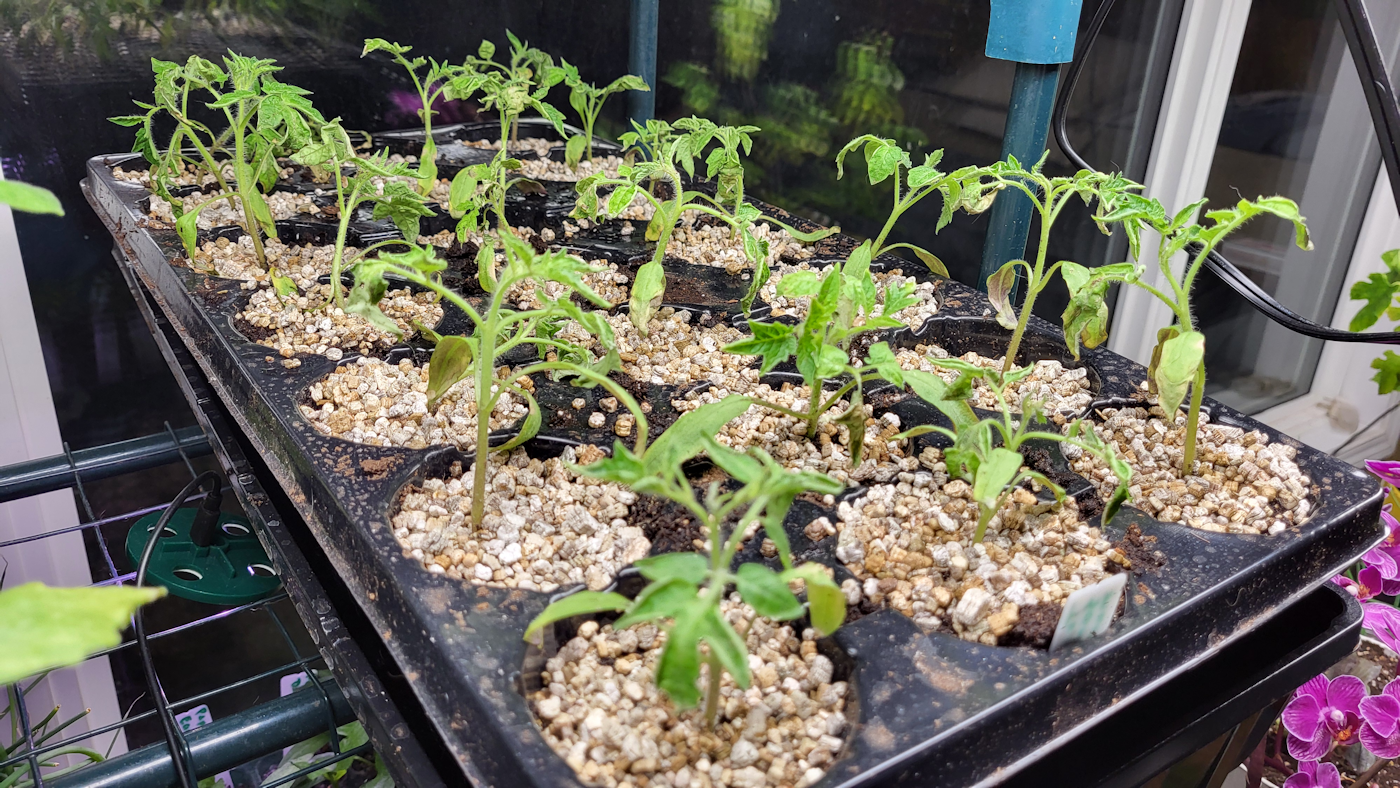
After potting the pre-germinated seeds and rearranging the aquarium greenhouse to fit them, it was time to work on the San Marzano tomatoes. I decided they needed to be done, even though they are still recovering from their accident, as they were just getting too crowded. I used another deep cell tray to transplant into, but instead of filling it with seed starting mix, I use a Pro Mix potting soil I picked up today. As usual, I premoistened the soil, first.

Good grief, there were a lot of sticks in it!

I can’t even say it’s a brand problem. My second bag of Miracle Grow seed starting mix was full of sticks, too. The first bag of Miracle Grow had them as well, though not as bad. The first bag of seed starting mix I got – Jiffy, I think, but I can’t remember for sure – was probably the best of the lot, with only a few sticks in it, but it was also a much smaller bag.

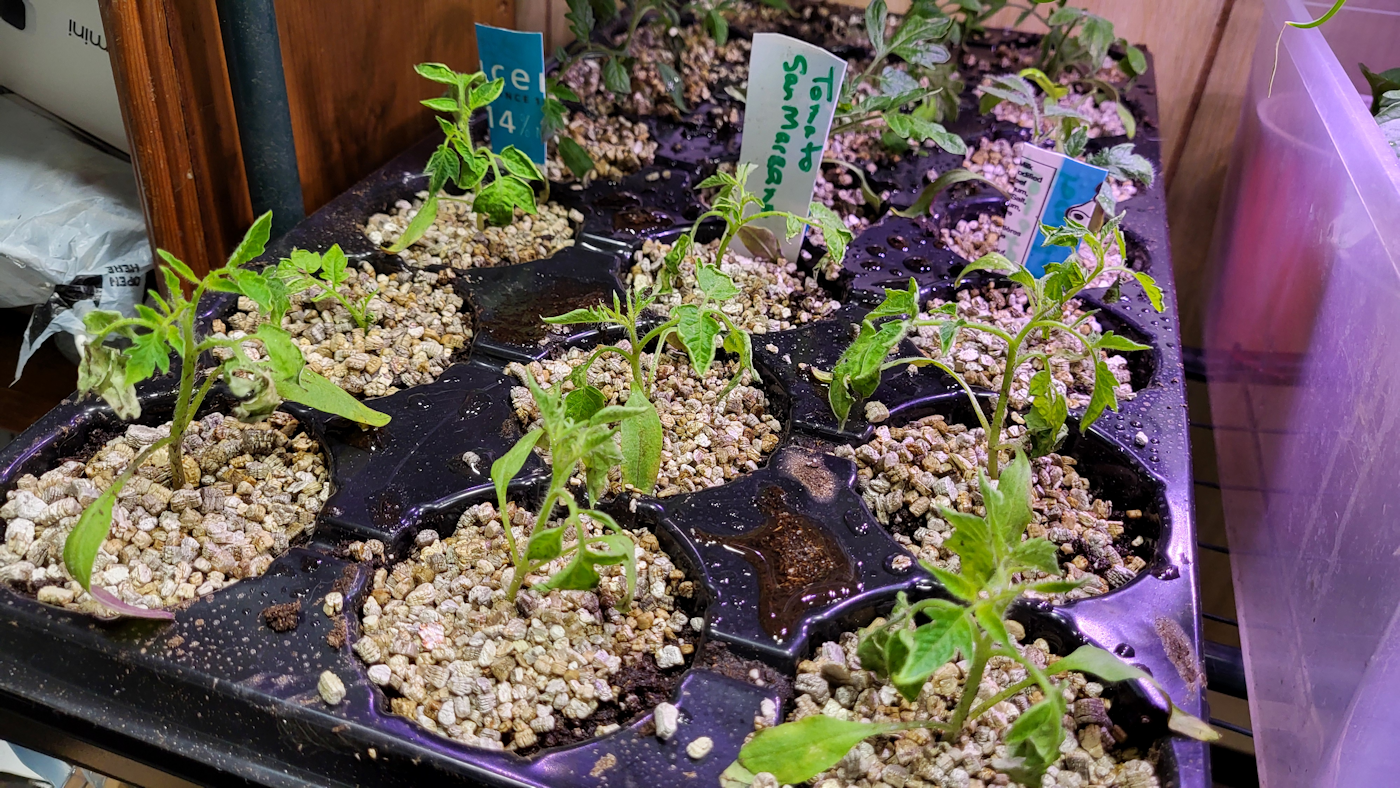
Once the new tray was full of potting soil, I went through the San Marzano seedlings. A couple were pretty much dead, so I just pulled them. After removing and potting up the “spares”, I top dressed the ones left behind with vermiculate, then set it back at the window.

They are definitely still in rough shape. I hope that, now that they have more room, a bit of fresh soil and the vermiculite, they will recover faster.

As for the spares I transplanted out, there were only 9 strong enough to transplant to the new tray, plus one that got transplanted into a cell in the original tray that lost its seedlings to the fall.

I’m honestly not sure these will all survive. 😞 We shall see!

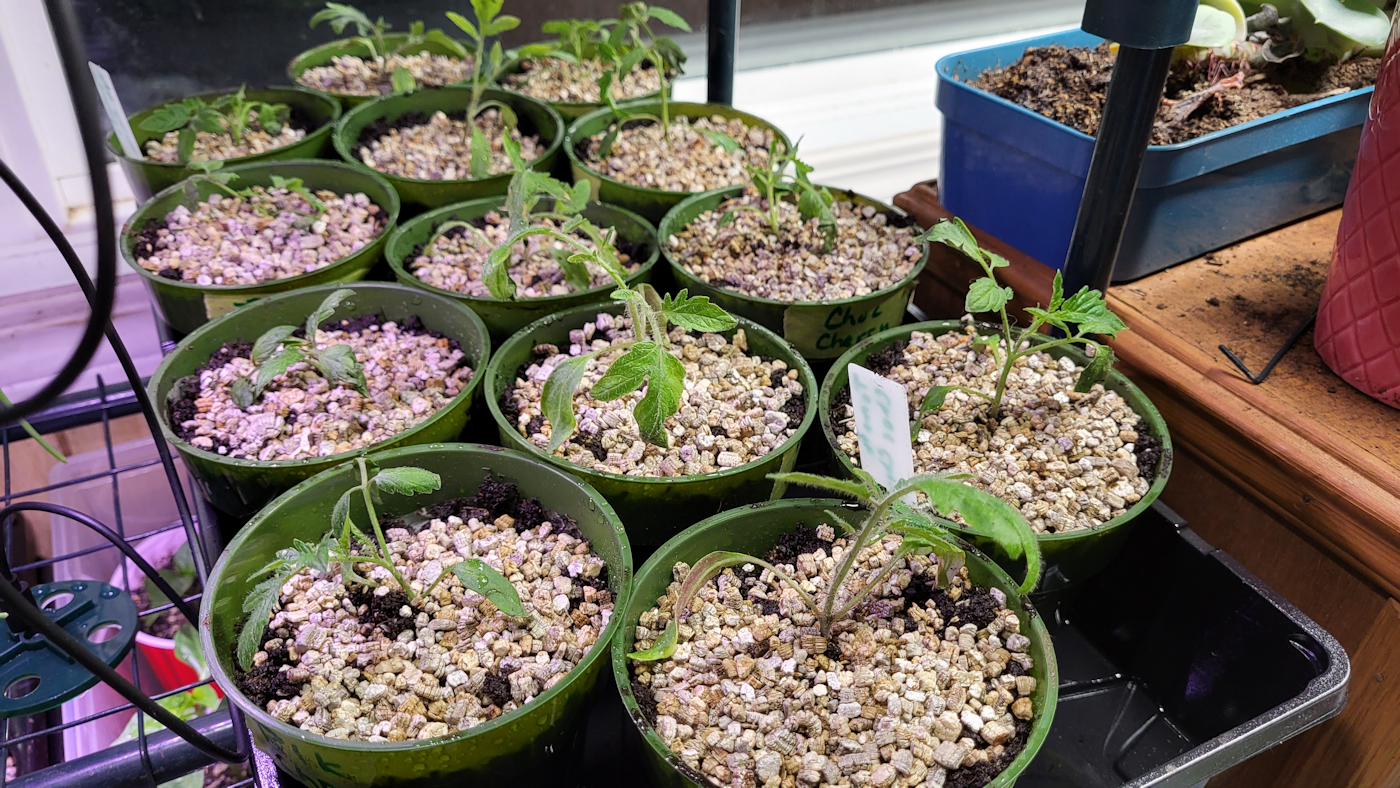
That left 12 cells available. I had the small tray with 12 cells planted with three different types of tomatoes in them, so I decided to thin those by transplanting. With the Chocolate Cherry and the Black Cherry, there were 4 “spares” to transplant out, but with the Forme de Coeur, a couple of cells had 3 seeds sprouting when I thought I’d planted only two, giving me 6 “spares” to plant out.

Once I started working on them, though, I realized I would have to plant all of them out of the little tray, so once these were done, I planted the remainder into 4″ plastic pots.

The outside rows of 4 pots are the Black Cherry and Chocolate Cherry. I didn’t have room for all the Forme de Coeur, though…

… so the last one went into the bin with the peppers and thyme.

Hopefully, I didn’t want too long to transplant these from those little trays! This one’s looking particularly rough. 😞

I hadn’t planned to be filling an extra fourteen 4″ pots, so these ones were filled with a mix of seed starting mix and potting soil.

The other small tray with the peppers in it will need to be potted up, too. I’ll probably use Red Solo cups for those, since I only have 4 or 5 of the green pots left, and the new biodegradable ones I got, I’m saving for the winter squash. For the peppers in the small tray, I don’t think I’ll thin them by transplanting, though. Instead, I’ll just keep the 4 strongest seedlings of each variety.

Speaking of room, I need to make a decision on these guys.

These are getting large enough they’ll need to be moved out of the aquarium greenhouse. The question is, do I try to thin by transplanting, or do I just thin them?

Who am I kidding. I can’t bring myself to just yank and kill off so many strong, healthy seedlings! However, transplanting them means 7 more pots, on top of the 6 already here. I can fit them in the mini greenhouse frame at the window, if I can move out the onions and shallots.

Hmmm… onions are a cool weather crop. I could start hardening them off and transplant them outside.

Speaking of planting things outside, the last thing I did for the evening was set the snap pea seeds between wet paper towels for the night. Tomorrow, they go into the ground!

I love having cool weather crops that can be planted so early – earlier than usual, this year. I’m hoping the long range forecasts are at least close to accurate! Even if things end up cooler, this is stuff that should survive anything but an unseasonal deep freeze. Hopefully, we’ll soon be seeing our garlic coming up, as well as the snow crocuses.

Spring may finally have arrived!

The Re-Farmer

Analyzing our 2023 garden: four kinds of tomatoes

Last year, we grew tomatoes that were processed into tomato paste, rather than sauce. Cooking them down to a paste took many hours, and we filled a case of 125ml jars that got used up nice and fast! So this was something we were quite interested in doing again.

The variety of paste tomatoes we grew – Sophie’s Choice – was chosen partly because it was a rare variety. Yes, we saved seeds. The flavour was a bit on the bland side, so we wanted to try something different this year. So for paste tomatoes, we chose Roma VF.

We also wanted to have tomatoes that were good for fresh eating. I’m the only one in the family that can’t do fresh tomatoes. For these, we went a completely different direction and chose black tomatoes. Indigo Blue Chocolates for an indeterminate variety, and Black Beauty for a determinate variety.

Then, because they did so well a couple of years ago, I went ahead and got more Spoon tomato seeds. We did have a few seeds left, but when I saw the price per packet, and the number of seeds in them, drop to reasonable levels again, I ordered some.

Since then, I’ve started to see people and seed companies talking about Spoon tomatoes, so these miniscule tomatoes seemed to have found a following! These are also the only tomatoes that I can eat fresh, without gagging.

With wanting to have plenty of tomatoes to process into pastes and sauces, the original plan was to grow quite a lot of them. The first seeds we started indoors were the Indigo Blue Chocolate and Black Beauty, in March.

The black beauty sure started sprouting fast!

Towards the end of March, we had space in a tray and planted the Spoon tomatoes.

By this time, we had built the cat barrier, which allowed us to set trays on shelves, at least temporarily, and not have to worry about them getting destroyed.

We had a very high germination rate, which meant that when it was time to pot them up, we needed a lot of space!

With the red solo cups, they were first potted up with the soil only half way up. Once they grew big enough to need “potting up” again, we simply added more toil to the top of the cups, burying the stems so they could form more roots.

With our new indoor set up, we were able to start quite a lot of things indoors, but none thrived as well as the tomatoes! Not only did we have a very high germination rate, but we had almost no losses as they were potted up!

Eventually, when things were warm enough, the seedlings were transferred to the sun room, and then hardened off outside, before transplanting into the garden.

We soon found ourselves with a problem.

We were not able to get enough garden beds ready, before all those seedlings needed to be transplanted! The tomatoes got much bigger, faster, than we were ready for.

In the end, we got them into three of our long, low raised beds in the main garden area. One bed was filled with the Roma VF, with only a border of onions around them. We wanted to make sure to have the most of those, for processing later.

With the other two, they were each planted in a single row in the beds they were in, filling the beds half way, length wise, so that the other half could be used for the root vegetables we would plant later and, of course, room for the onions planted as a border around them.

That left the Spoon tomatoes, and at that point, I really didn’t know where to put them. In the end, I stuck a few of them into the retaining wall blocks in the Old Kitchen garden.

There wasn’t a lot of free space for them, but we got a half dozen in. Later on, a last Jiffy Pellet that had Spoon tomatoes in it finally germinated, so I stuck it at the end of the retaining wall, with a tomato plant that had broken in the wind.

That still left us with large numbers of tomato seedlings of all varieties – and nowhere to plant them!

I did find someone we could give a bunch of them to, but there were far more than they needed. In the end, I got permission to leave them outside the general store and post office for our little hamlet, with signs saying what they were, and recommending that seeds be saved. We had lots of peppers to give away, too!

I’m happy to say, they were all taken. I hope they grew well for people!

With the tomato beds, we were able to wind a soaker hose and sprinkler hoses throughout the beds so that they could be watered from below, which did free up quite a bit of time! I could just hook up the hose and go do something else, for most of the beds.

As for how ours did, I’ll talk about each variety.

The first that we were able to start harvesting from were the Roma VF. While they did start out rather well, they did get hit with tomato blight, and we ended up harvesting all the tomatoes, then pulling the plants for burning, rather than composting.

If you go through the Instagram slideshow of photos, you’ll see we were also able to harvest some Indigo Blue and Black Beauty tomatoes, too.

Both varieties of black tomatoes took a long time to ripen. Because of their colour, it was really hard to tell when they were ready to pick! Both were supposed to get a red blush on their bottoms, but ultimately, we had to go by the squeeze test to see if they were ready.

Indigo Blue Chocolate tomatoes

The Indigo Blue started to ripen first. These are a smaller tomato which, unfortunately, did have a tendency to split rather quickly, once they ripened. They have a nice, smooth shape to them, and their colours are lovely.

The Black Beauties, on the other hand, took a lot longer to ripen. They got so huge, so fast, and then… nothing. We kept checking them and they were rock hard for the longest time. They also had a tendency to split, more than the Indigo Blues did. Then, when we could finally pick some, their uneven shapes made them harder to work with. As for the flavour, my family was unimpressed. They did not live up to their descriptions on the website.

Then there were the Spoon tomatoes!

Where they were planted was not an ideal spot at all. It’s shaded by one of the ornamental apple trees, on the south corner. While they did grow quite tall on their bamboo stake supports, they did not get as lush and healthy as they did the first time we grew them, against the chain link fence. They were transplanted a bit late, too, so they took longer to ripen than before. As a result, we didn’t get a lot of them, relatively speaking, but there were certainly enough to snack on while we were out and about in the yard.

At the end of the season, when we got hit by our first frost, we harvested all the tomatoes left (except the Spoon tomatoes; we left them alone), bringing in the ripest ones, then spreading the greenest ones out on screens under the market tent to ripen.

Here, you can see the last of the Black Beauty and Indigo Blue Chocolate tomatoes set out in the sun, before they got transferred to screens.

We were able to process a sink full of Roma VF tomatoes into sauce for the freezer.

Those are already gone!

We had too many other things going on, though, and ended up freezing a lot of the tomatoes whole, to either cook as they are, process into more sauce, or into tomato paste. These can wait until slower, winter days.

The frustrating thing was all the left over, slowly ripening tomatoes. We just didn’t have the space to store them and keep them handy. Last year, we had a bin full in the dining room that the family snacked out of regularly, We weren’t able to do that this year. The end result was that many tomatoes started going bad before they could be eaten. Ultimately, way too many of them ended up in the compost heap, simply because they were forgotten.

Surprise tomatoes!

The last two years, we grew tomatoes in a bed along the chain link fence. This year, we grew other tings in there, but several self seeded tomatoes showed up, too!

I decided to transplant them into the empty bed the Irish Cobbler potatoes had been in.

It was September 8 when I transplanted them, and our average first frost date is September 10, so there was no way they’d have time to mature, but I figured I’d give them a chance! They did actually start to bloom. Even when the first mild frosts did, they were protected by the plastic rings I’d put around them and survived.

Final Thoughts on Tomatoes

As far as starting the seeds goes, they did amazingly well! I’m still blown away by the almost 100% germination rate. The transplants did really well, and I’m glad we were able to give the last ones away. Once they were in the ground, they all did mostly good, but I think our growing conditions and soil issues prevented them from doing as well as they should have.

Roma VF

As these ended up being harvested early due to tomato blight, I don’t know that they reached their full flavour potential. The family enjoyed them, but didn’t find the flavour exceptional. The tomato sauce we made was good but, again, the tomato flavour was nothing to write home about. We will try a different variety of paste tomato, next year.

Black Beauty

These are a pretty tomato, for sure, but they took so much longer to ripen, and had a real problem with splitting easily. My family was unimpressed with the flavour, and didn’t like working with the lumpy, bumpy shapes. I’m glad we tried them, but we will not be growing them again.

Indigo Blue Chocolate

These went over much better. They’re a smaller tomato, but still adequate for slicing and using in sandwiches. My husband likes to just eat the tomatoes with some salt, and quite enjoyed these that way. They were nicely productive, too. We will be growing these again.

Spoon

For all the set backs these had, they did surprisingly well. They’re also just a really fun tomato. I look forward to growing them again, just for the fun of them. Plus, they are the only ones I can actually eat, and it’s fun to have these tiny little tomatoes to snack on while working in the garden. Plus, being a rarer variety, I like the idea of keeping them going.

The challenge is going to be having enough space to grow the amount of tomatoes we would need for our long term goals. At some point, we want to be able to can and freeze sauces and pastes sufficient to last a year – basically, from harvest to harvest. For that, we’ll need to grow more tomatoes, which means we need to have more space to grow them in.

Which means we need to get our butts in gear to have enough raised beds for everything we want to grow. Even the low raised beds we have now, which have been amended for several years, will need to be made at least a little higher, with more amending.

All in good time. Little by little, it’ll get done!

The Re-Farmer

Our 2023 garden: still alive! (sort of)

My morning rounds still includes checking the garden beds, and there are still a few surprises!

The Tom Thumb popcorn could probably be harvested now, but I’m going to leave the stalks for as long as I can before we do that. Just to make sure the kernels get all the time possible to fully mature and dry out on the stalks. So far, the critters seem completely uninterested in both corn beds!

Today was not as hot as yesterday, but still quite warm, hitting 21C/68F while I was working outside. Which is good for the remaining beds that will not be harvested for some time, like the Red of Florence onions next to the popcorn, which still have a lot of growing to do.

A real surprise this morning was seeing a bright yellow flower in the squash patch! The yellow patty pan squash plant is still alive, in spite of all the frost damage, and one of the female flowers actually bloomed this morning. There are several more female flower buds, too, but there are no male flowers to pollinate, so nothing will come of it. The green patty pans have squash that were big enough to survive the frost, and they are getting bigger, too. Even on the green zucchini, we found one little zucchini that had gotten bigger and could be harvested!

Later in the day, I finally cleared the tiny raised bed in the old kitchen garden, which required snipping off the dried poppy pods that had grown through the wire cover. These self seeded poppies have openings in their tops, so when I put them upside down in the container, the seeds just poured out. It really shows how these self seed so readily. The Hungarian Blue poppy pods do not have these openings, so are less likely to self seed.

Another surprise is seeing flowers on one of the volunteer tomatoes that got transplanted! They’re still so tiny, but they seem to really like where they were transplanted to.

I was going to plant garlic in the bed by the chain link fence, after it was reworked, but the garlic came in yesterday. The Jebousek lettuce is blooming now and I want to save the seeds, so the garlic had to go somewhere else.

Which is what my next post will be about!

I’m just loving that we’re past the middle of September, and there’s still gardening happening!

The Re-Farmer

Our 2023 garden: frosty harvest

I’m just going to post this photo for now; I took some video and will upload that later.

Until then, this is what I was able to harvest today.

We did get another frost last night. I was out doing my rounds early enough to see some frost still on the ground. Once again, there was no frost warning and, according to the official past 24 hours record, we never dipped below 6C/43F, while I know I saw 4C/39F on my app when I checked before heading out this morning.

I should get one of those high/low thermometers that have needles to mark the highest and lowest temperatures on the dial.

So for now, all the stuff affected by the frost has been harvested that could be harvested. I left the melons, because they look like enough of the vines survived for ripening to continue. We’re supposed to warm up over the next while, so that will give more time for things like the melons, peppers, Spoon tomatoes and the one eggplant to ripen. The other things, like the carrots and onions, can handle frost so they’ll be fine for quite a while longer.

Our gardening season is not done yet!

The Re-Farmer

Our 2023 – and 2024! garden: planting and transplanting

This morning, before I intended to continue working on the trellis bed, I wanted to transplant those volunteer tomatoes into the old kitchen garden.

Yes, it’s September, and our average first frost date is the day after tomorrow, but if the frost holds off long enough, they just might have a chance!

It was also a good time to amend the bed the Irish Cobbler potatoes were in. After removing the remaining mulch and loosening the soil (and finding a few tiny potatoes that got missed!), I worked in a bag of cow manure. I also noticed a couple of spaces in the walls where the grass clippings used as chinking was gone, so I found some scrap pieces of wood to put over the gaps on the inside.

Once the bed was prepared, I went and dug up the volunteer tomatoes. I don’t even water that bed anymore, so the soil was very dry. None of it stuck to the roots at all! I laid them out gently on one of the baking sheets we use to transfer seedlings in and out while hardening them off. Those are so handy! We need more of them, but Costco no longer carries them. They are SO much more expensive, elsewhere!

Anyhow.

I had seen one volunteer tomato had died; all it’s leaves just shriveled up for some reason. I left that one, but I still ended up digging out 9 tomato plants! All but one of them are where we’d had Spoon tomatoes planted, 2 years ago. I kept track of the one that came up where cherry and grape tomatoes were planted last year, and the year before.

I’d already given the bed a fairly decent watering, but once I knew how many transplants I had, I dug a hole for each of them, then gave each hole a deep watering. As for the transplants themselves, I trimmed off the lowest leaves and buried the bare stems all the way to the first set of leaves.

I happened to have exactly the right number of plastic rings that had been used to protect the peppers, etc. in the wattle weave bed, so those got put around each tomato plant. These will not only protect them from overnight chills, but from rambunctious kittens, too!

At this point, my alarm went off, reminding me that the post office was open again after lunch. I have a subscription on lysine for the outside cats, and it was in. When I got there, however, I had a pleasant surprise.

My saffron crocus bulbs were in! When I checked the tracking, it was telling me the package would arrive on Monday, so this was a pleasant surprise.

It also changed my plans for after I finished with the tomatoes.

Since we had to pull up all the Roma tomatoes, I had a lot of bamboo stakes available. I pushed in a pair of them inside each plastic ring. These will keep the wind from blowing them away – and the cats from knocking them about – and if the weather holds long enough for them to survive, they will be supports for the tomato plants, too.

I also had the soaker hose that had been used on the Roma tomato bed. It’s pretty long, though, so I was able to run it back and forth and around every plastic ring, using tent pegs to hold it in place on the curves.

Last of all, the mulch got returned.

It’s ridiculously late to be transplanting tomatoes in our area, but I wanted to give them a chance!

That done, I could move on to the saffron crocuses, which needed to be planted right away.

These are actually a zone 4 plant, and we’re zone 3, so they went into the same protected area we have our zone 4 apple tree, and where the girls planted tulips. This area has a mishmash of wire surrounding it, to protect them from the deer.

There are 20 bulbs in the package, and the need to be planted 4 to 8 inches deep, and 3 inches apart. I was originally intending to plant them in a 4 x 5 bulb block, in an area I was pretty sure there were no tulips growing, but after poking around with a garden fork, that went out the window pretty fast. The area is so full of large roots!

I ended up being able to start a longer trench, so I went with 2 rows of 10 bulbs, instead.

The instructions specifically said to NOT amend the soil with manure of fertilizer, to water them when planted, but to not water them again unless it was drought conditions.

In clearing out the soil, so many weed roots were removed that there was hardly any soil left. I would have to get soil from the remains of the truck load of garden soil in the outer yard we bought a couple of years ago.

After removing the top 4 inches of weed roots and dirt, I loosened the bottom with a cultivator tool, then gave the trench a very deep watering. Then I loosened the soil some more, tried to level it off a bit, and watered it some more!

After that, I went and sifted some garden soil into the wheel barrow to fill the trench, before getting the bulbs.

I did not expect them to be so…

…hairy.

The bulbs got laid out in two rows, 3 inches apart, then buried. I ended up needing to get a second small load of soil to cover them well. They got about 6 inches of soil, maybe a bit more, on top. It will, however settle over time. Compaction is another concern. I wanted to give them a final watering, but not with out a mulch, first!

Thankfully, we still have lots of grass clippings handy for mulch!

Once a thick layer was in place, I gave it another deep watering. I wanted that new soil, which was quite dry, to be moistened. The mulch is great for keeping the soil below moist, but if the clippings are very dry, they actually prevent moisture from getting through. The top will get wet, but the bottom – and the soil below – says dry. Kinda like how thatch works. So I made sure the mulch itself was very wet, all the way through, so that the water could moisten the soil, too.

Given the temperatures we can hit over the winter, these will need more protection before the ground freezes, as well the apple tree. It’s already sheltered and protected from the north and, now that the dead and dying trees are cut away, it gets full sunlight and warmth. Still, extra protection will be good! When the leaves fall, we can use that to mulch the entire area. In the spring, though, the mulch of the crocuses will need to be pushed aside, leaving only a light layer to protect the soil. The alternative would have been to plant them in pots and bring them in every winter, and frankly, I have no interest in doing that. It’s hard enough to protect our house plants from the cats! They’d just love some big pots of soil to dig in. 😄

Once the mulch was in place, I spread out the soil that had been removed as evenly as I could, and that was it.

We now have tomatoes transplanted that, if they survive, will be for this year, and bulbs planted for next year! These crocuses boom in the fall, so it will be quite some time before we know we will have any saffron to harvest.

I’m pretty excited to find out.

From the Vesey’s website:

Bulbs typically triple their flower output year over year. A package of 20 bulbs should produce enough saffron in the first season for the average family to enjoy sparingly.

Triple their output every year? That would be amazing!

But first, they have to survive our winters!

The Re-Farmer
Making tomato sauce

Well, it took several hours longer than expected, but the tomato sauce got done!

I filled my large colander with the ripest of the Roma VF we have laying on a screen in the cat free zone, as well as the ripest Indigo Blue Chocolate and Black Beauties, filling the colander to almost overflowing.

After going through a number of recipes, I decided to not blanch them first. The Roma got topped, halved and seeded first, then went into my larger stock pot. I considered doing the other tomatoes separately, but didn’t want to mess with more pots and just mixed them all together.

When we processed tomatoes last year, we blanched and cooked them, before running them through a sieve, so any seeds were no longer viable by the time they went into the compost heap. This time, I seeded them first. I expect we’ll be having some volunteers in the compost pile, next year! 😄

For the seasoning, I kept things simple. I harvested some fresh yellow onions, picking ones the cats rolled on and broke the stems, since those were not going to be getting any bigger. They were a decent size, though, and I only used three of the bunch I picked. The rest got braided and are now hanging in the cat free zone (the living room) with the garlic to cure.

I grabbed a garlic bulb that turned out to have two huge cloves, as well as a bunch of fresh thyme from the pot in the living room. Along with that, I added some freshly ground salt; my husband picked up new salt and pepper grinders to replace our old and breaking ones, and got a container of Himalayan pink salt chunks for the salt grinder, too. I also added a bit of sugar and lemon juice.

Once the tomatoes had stewed long enough that the skins could be easily removed, I sautéed the onions and whole garlic cloves in some ghee until the onions were translucent. I was going to strain the tomatoes through a fine colander I have, but I couldn’t find it, so it went through a large sieve, instead. This sieve has a quite fine mesh on it. I don’t know how much difference it would have made if I’d used the colander, since there really wasn’t a lot of pulp in there, but the end result was more like tomato juice than tomato sauce!

Which is why it ended up taking much longer than expected to cook it down to a more sauce like consistency.

All those tomatoes had filled my larger stock pot. By the time I strained out the skins, it barely filled half of my smaller stock pot. I cooked it down until it seemed thick enough, then poured the sauce into sterilized 750ml canning jars. I was able to fill two, plus maybe a third of the last jar. That one got a twist off lid. In the photo, the whitish chunks are the broken up pieces of garlic cloves. Mmmmm….

They are now sitting out to cool over night, and then they’re going into the fridge. There isn’t enough there to bother actually canning the sauce.

I think with the next batch, though, I might take the time to make tomato paste again – this time on the hot plate on the dining table, to free up the kitchen, like we did last year. I don’t expect to be making as much as we did last year, and we only got a dozen 125ml jars of paste at the time. They went over so very well, though, they didn’t last long. That’s why my original intention had been to grow so many paste tomatoes this year, and it just didn’t happen. Hopefully, we’ll be more prepared, next year!

Altogether, this took about 5 or 6 hours to finish. If we’d been working with more tomatoes, I would have broken out our giant stock pot – the one that’s big enough to brine a turkey, with room to spare – to cook down the tomatoes. That’s what I used to make the paste last year.

We still have plenty of tomatoes resting on the screen in the living room and, of course, lots more on the vines, so we will be doing this again, probably a couple more times.

I did get a bit of a nap in before I started, but I am still so very tired. I’ll expect I’ll be sleeping on the couch again tonight, too. The family did keep checking on my room, and my husband even had Snarly Marlee in the living room to give her a break from the kittens for a while, and there were no new messes. Hopefully, things will stay that way, but my mattress is still damp from the previous ones.

I so look forward to getting cats and kittens adopted out!

Speaking of which, still no sign of The Phantom. The Cat Lady and I have been discussing alternatives if she doesn’t show up, and tomorrow she plans to drop off a trap for us.

Still no interest in the kittens she shared photos of.

Since they are friendlier and easier to catch, she’s going to see about booking us to get a bunch of males fixed, next.

As much as I’d like to get the outside cats fixed and adopted out, we really need to adopt out more inside cats. Some of them are inside only because they were going to get taken and adopted out, and it just didn’t end up happening.

Ah, well. We’ll figure it out.

The Re-Farmer

Morning harvest, and kitty status

First, the good stuff.

This was this morning’s harvest.

Just tomatoes, almost all Romas, and a few patty pan squash, but it was still quite a haul.

The other good stuff is that the kitten I brought in yesterday did just fine, overnight. It was running around and playing with the other kittens when I came into my room this morning.

Which leads me to the not so good stuff.

I had to sleep on the couch last night.

I thought we had been doing well, but in the space of just a few minutes, my nice, clear, dry bed suddenly had a massive puddle in the middle. Not only was it large enough that I couldn’t even sleep on another part of the bed, even though it’s a king size, but it was in a spot that didn’t have any puppy pads under the sheets to protect the mattress.

The girls helped me juggle kittens and strip the bed, but as I soaked up as much as I could with more puppy pads, they were the ones that suggested I sleep on the couch. After getting it as dry as we could, we took off the mattress protector, too, and got everything in the laundry. We laid out more puppy pads, absorbent side down, then carefully covered them with a blanket to keep them in place. Then I left the room with the window fan going on maximum.

I did not get much sleep last night, though I have to admit, it was rather nice sleeping in the cat free zone. I was awakened early by cat arguments. Having had just a couple of hours of sleep, I got up long enough to feed all the cats, inside and out, before going back to bed on the couch.

While doing the feeding in my room, the bed was clear and nothing was destroyed, so I was very encouraged. So I went back to the couch and managed to get almost a couple more hours of sleep.

When I came back to my room, I found a “gift” on my bed. On the blanket, next to the towel I laid out under the kibble bowls while dividing up the wet cat food.

At least it was easy to clean up, but really??? There are so many litter boxes, but noooooo. Gotta use my bed!

Then I sat on the side of the bed to take my supplements, only to discover a wet spot with my butt. The colour and fuzziness of the blanket had hidden it. At least that was on top of a puppy pad!

I am getting so very frustrated.

I did get a chance to chat with the Cat Lady a bit, letting her know that the kitten did well inside. As long as the kitten is about 3 pounds, they will spay her, and I think she’s pretty close to that. With her being inside and getting regular wet and dry cat food, I don’t think it will be an issue by the time of the appointment.

No sign of Phantom this morning, though. We’re already discussing options, if she doesn’t show up in time. I’ll simply grab one of the friendly males. I wouldn’t be able to grab any of the other females. They’re not socialized enough.

Oh, just heard from the Cat Lady again. She says she will drop a trap off for us, tomorrow. If we can snag any of the moms with older kittens that would be good. Still, it would be ideal of Phantom comes back and we grab her.

In other cat related things…

This is the kitten we thought was female that turned out to be male.

What is it all the friendly ones are male? It was the same thing last year. The females are almost universally standoffish, while the males have been more easily socialized and love attention.

Then there are those that are just plain feral. Not semi-feral. Just feral. Like this one.

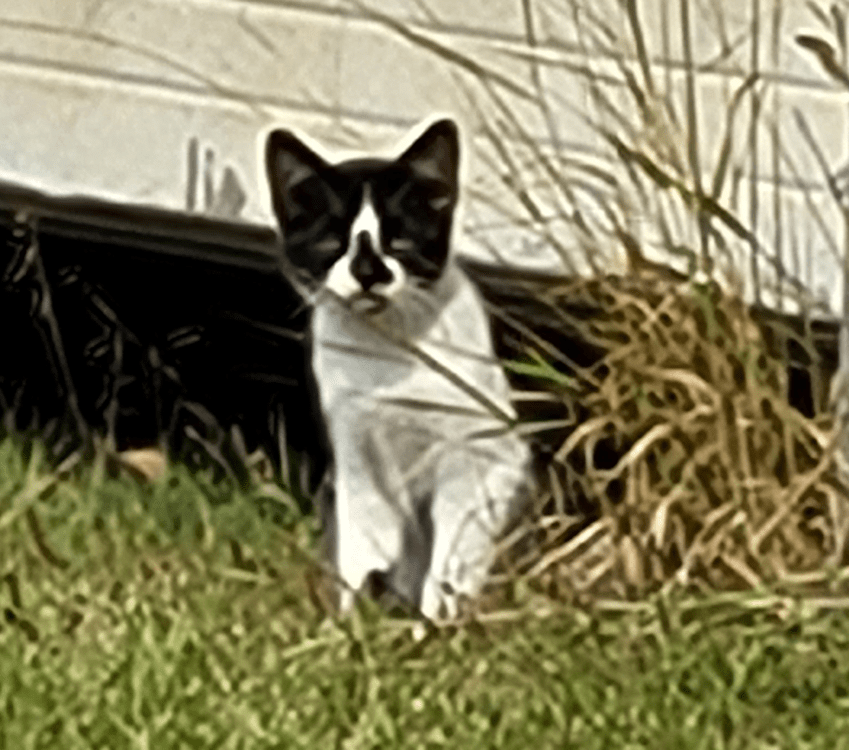
I spotted this one when I finally got out to do my morning rounds. Brussel’s kittens seem to have moved into the garage, more or less. This is the shier one, and the first time I’ve been able to get a good look at him/her. I had to move slow and zoom right in to get a picture, so it’s not a good image at all. What unique face markings!

I’ve seen its orange and white sibling closer to the house. I think I even saw it in the kibble house. This one, however, stays around the garage, and that’s it. I didn’t top up the food in the bowl I set up in the garage this morning, though. Hopefully, this one will get hungry enough to brave coming to the house. I also saw Octomom’s littles. Not all of them, but they seem to have taken up residence – at least for part of the day – under the cat house.

While doing my rounds this morning, I was pleased to find just one fallen branch. We had more rain and high winds last night, but it seems that weird climate bubble we have over us has protected us. The winds did knock quite a few crab apples off the trees, though. This morning, on one of my local gardening groups, several people mentioned their gardens were completely destroyed. One posted a photo of her crab apple tree, its apples knocked to the ground and lying next to hail almost as big as the apples! So far that I’ve seen, she was the only one that also reported damage to her home. Just a broken window, thankfully.

Today should be quite a bit more pleasant. I plan to be doing stuff indoors, though. Specifically, making tomato sauce. Lack of sleep is catching up to me, though, and I’m dropping off as I type this. I think I will try napping again. I think I can squeeze into the dry corner of my bed around the kittens. I’m afraid that if I try napping on the couch again, I’ll come back to more puddles or piles!

The tomato sauce can wait a couple of hours. I’m all out of energy drinks, and feel like I’m about to drop right on my keyboard!

The Re-Farmer

Our 2023 garden: potting up tomatoes is DONE!

Finally!!!

I was able to pick up more potting soil after helping my mother with errands yesterday, which means that today I got to finish potting up our tomato seedlings.

I actually was able to “pot up” the Black Beauty and Indigo Blue Chocolate tomatoes by topping the cups up with soil, first. Then I potted up the last 18 Roma VF tomatoes, which used up my last two plastic bins. I had to move things around, and move the onions right out, to fit everything. The taller seedlings hat to go either to the top of the mini greenhouse frame, or to the shelf, where the onions were. The rest are still short enough to fit in the mini greenhouse frame, though I’ve run out of space in there.

Next was the Spoon tomatoes.

I planted two seeds per pellet, and I made sure to do the ones that had pairs of seedlings first – though one of them had three! For each one, I removed the outer covering on the Jiffy pellets, then separated the seedlings. They’re still quite small, so the cups got filled only about half way.

I noticed the outer covering on the Jiffy Pellets is different this year. It’s more paper like. I remember it being more net-like, before. Those didn’t really break down, and I would find them in the garden while cleaning up at the end of the year. I’m guessing that has sometime to do with the change. With one pair of seedlings, a tomato had actually grown through the outer covering. As I was trying to gently remove it, I ended up breaking the tomato stem clean through! It’s a tomato, though, so I went ahead and planted the tomato top, anyhow. Changes are pretty good it’ll send out new roots and survive.

These are all 35 Spoon tomatoes (I’d mistakenly counted 36, before). I was able to fit 19 onto an oven liner tray, which will allow for bottom watering. The tray the Roma tomatoes had been in, which now had only the spearmint and oregano in it, could fit another dozen. That left only 4 that needed to be double cupped. I’ve run out of both trays and bins.

Those done, I did some more rearranging and removed off the watering can and extra cups, which allowed me to bring the onions back closer to the light. With all those, plus the bin with the Zucca melon and African Drum gourds in it, this surface is now completely full. I don’t even have my work space anymore! The light isn’t as good during the day on here but, early in the morning, it does actually get direct sunlight for a few hours.

The peppers in the large aquarium greenhouse still have new seeds germinating, so I won’t be potting those up for a while. Not that I have the space for it anymore!

I will need to monitor the overnight temperatures in the sun room over the next while. We’re supposed to warm up, but the overnight temperatures are still dipping below freezing. If the sun room can manage to stay at 6C/43F or warmer during the night, I should be able to at least move the onions over. They are about the only thing we’ve started indoors that can handle cooler temperatures. I’d love to be able to move the biggest plants out, which is mostly the gourds and Zucca melon, but they are the most cold sensitive plants we’ve got right now. Daytime temperatures in the sun room have been reaching as high as 20C/68F, which would be great as long as it didn’t drop too far. The times I’ve checked it through the bathroom window at night, I’ve seen the thermometer at around 10C/50F, which would be acceptable, I think. Plus, we’d be closing the doors overnight to keep the yard cats out of the plants, which means it would stay warmer overnight, too.

The cats are not going to be happy, losing their favourite bed on the swing bench, and private dining areas! I’ll be happy to not have skunks and racoons going in there anymore!

All in good time, though. It’s still only April, and a lot of these can’t get transplanted until the middle of June!

The Re-Farmer