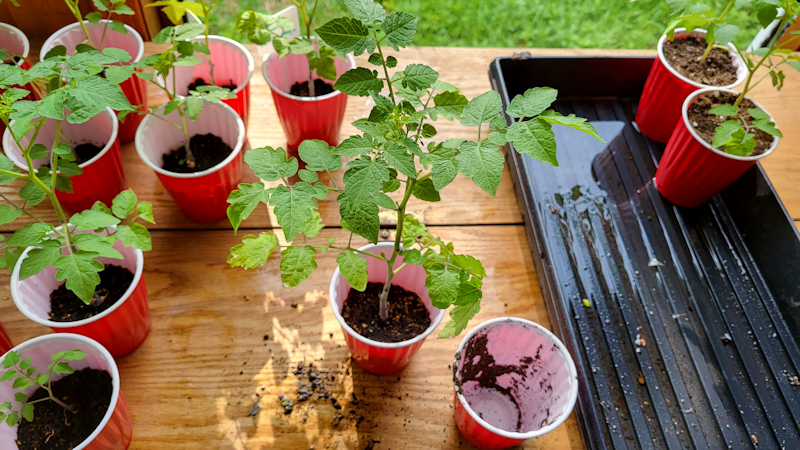
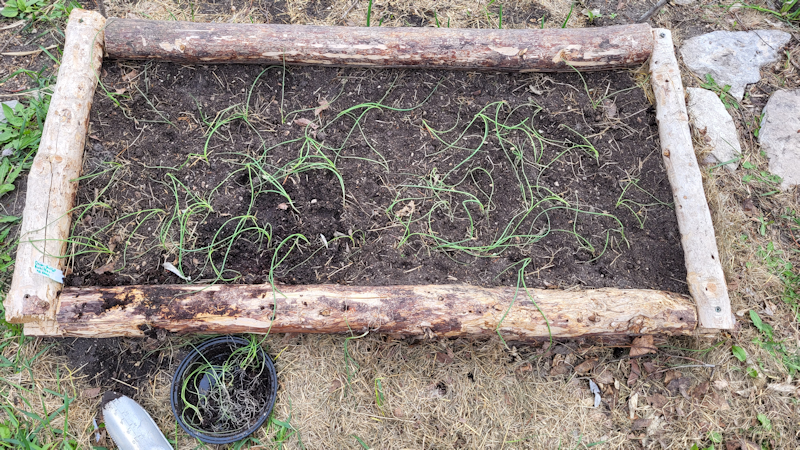
I was able to head outside this evening and finish the transplanting I didn’t get to do this morning.
My daughter had mulched the tomatoes with shredded paper for me while I was out. I made a trench in the mulch and transplanted the Red Wethersfield onions. Almost the entire tray of onions made it into the bed. All the other beds are bordered with the yellow Talon onion. That leaves the Red of Florence onions to transplant, and there are a lot of those! We’ll squeeze them in where we can, where they can help protect other plants from insects and deer.
I hope.
So this bed is now done!
Now we have to get other beds prepared. I’m really hoping we get a good rain tonight, to help cool things down and reduce the humidity!
It’s barely 3:30pm right now, and I could easily call it a day and go to bed right now!
I tried to get out early to beat the heat, but by 7:30, it was already feeling hot and muggy. The humidity is very high, and the uncut grass is covered with dew. Which means that, when the outside cats come over for breakfast, they tend to be completely soaked!
Like this bedraggled beast.
Decimous is so matted and full of burrs! Today, however, for the very first time, I got to give him ear and neck skritches – and he let me! He even started purring. He wasn’t sure about the situation, but he did let me reach out to give skritches – not pets – a few times. His fur is so full of lumps, burrs and mats, I’m sure petting him would be somewhat painful.
I was even able to confirm something.
He is a she.
Yup. Decimous is female.
She doesn’t look pregnant, though. I’m trying to think of how we can catch her and bring her inside, so we can lavish her with love (and wet cat food) and socialize her enough to get those mats cut out of her fur!! The problem, of course, is we already have too many cats in the house. I’d have to bring her into my room and have her in baby jail for a while. That is Marlee’s favourite hangout, though, and Marlee typically isn’t too keen on other cats.
We’ll figure it out.
My priority for this morning was to get as many of the Roma VF tomatoes transplanted in the last available bed as I could.
I focused on getting the largest ones in, first. I didn’t want to do three rows, since it’s harder to reach the middle, but … well, it is what it is. I’m sure I planted them closer together htan they should be. I staggered the rows to use the space more efficiently, and was able to get 41 transplants in It took a couple of hours. I didn’t have time to transplant tomatoes around the perimeter of the bed, nor mulch it right away. My daughter shredded more of our collected fliers and other garden safe paper while I was doing this, and brought out a couple of bags. As I write this, I honestly don’t know if she was able to get back outside to lay the shredded paper around the tomatoes. After that, they’d just need to be dampened, because the tomatoes were deeply watered while being transplanted.
Speaking of which…
These are the mystery squash that showed up with two of the tomatoes. I’d reused seed starting soil from pots where things did not germinate at all, and somehow missed that there were still viable seeds as I pulled out the sticks and rocks I was finding in the mix. We’ll see if they survive. If they do, I’ll find somewhere to plant them, after we get more beds ready. Right now, aside from a couple of scattered spots, we have nowhere left to put any transplants – including the more than 20 Spoon tomatoes, none of which are out, and another 20 or so leftover Romas!
So much work to do!
Today is our average last frost date, but in some places, we’re breaking 30 year heat records. I took some garden tour videos yesterday that I’ll put together and upload later. Lots of heat warnings and warnings for thunderstorms, with possible hail, etc.
The question is, will any of that rain reach us?
Once the transplants were in, I headed out early to my mother’s, stopping to pick up some Chinese food, which was my breakfast. Previously, my mother has started to say not to get rice, because rice makes her cough. She said to get her just lemon chicken. Unfortunately, the timing was off, and I was at her place on the one day of the week they closed. Then she mentioned some of her neighbours would get just onion rings from the restaurant; they have a small North American menu along with Chinese food menu. After that, she started saying she wanted onions rings. So today, I picked up both lemon chicken and onion rings for her, and a combination platter for me.
When I arrived with the food, she was first taken aback that I came early, but I told her I’d been working in the garden, and hadn’t and breakfast. I came early so we could eat together. Then she chastised me for not calling her first, because she’d had a large breakfast (she later mentioned what she had, and it was not a large breakfast. Just not typical breakfast fare). I hadn’t planned to do this, though, so calling ahead was not an option. After I set out the food, setting hers aside on the table while I sat down with my breakfast, she started nibbling on the onion rings anyway, then suddenly demanded to know why I got the lemon chicken, too, instead of just the onion rings. I reminded her that she’d talked about wanting lemon chicken in the past, and she didn’t have to eat it all at once if she didn’t want to . She then started talking about how it’s a “temptation” for her, and if there’s food in the fridge, she eats it…
…
I’m pretty sure that’s what food in the fridge is meant for.
I think she was trying to say that she had little self control when it came to food, but had a hard time coming up with the words for it!
After I’d eaten, and she nibbled, I suggested we head out earlier. She didn’t seem to want to go out and procrastinated. It wasn’t until we were in the car and on the road that she mentioned that, next time, she would give me a list and let me do her errands for here. Her knees are increasingly giving her grief. There’s one errand I can’t do, though, and that is to go the bank for her.
So we got her errands done and her groceries put away. She wanted me to take a couple of trees home with me, along with her vegetable peelings and a plant she’s decided is blocking her window too much (it isn’t).
I did have a bit of a surprise while checking on her air conditioner, next to her plant table. For some reason, it was set to go off at 26C, which is just way too hot. I lowered that, and it turned on and starting cooling things down, but for some reason, I was also feeling heat.
Yes, her heat was also on!
I checked her thermostat.
It was set to about 26C.
So she was heating and cooling her apoartment at the same time.
I turned that right down for her!
I didn’t take any plants from her, because I didn’t want them baking in the car while I did my own errands after I finished with hers. I had to ask her where the trees came from. Basically, she’s got a little maple and an elm in the pot together, and it looked odd. Turns out she’d found them in the few feet of garden space where she has some garlic growing – pretty much the only “gardening” she does right now – so she decided they should go to the farm and stuck them in a pot.
*sigh*
She has also been gathering linden seeds and is trying to get them to grow. She’s got at least a dozen that I could see, scattered at the top of a pot of soil. Something else she has in pots and plans to send to the farm.
This from the person that was laughing at me when I showed her pictures of the garden, because I had some herbs in a pot.
Somehow, my mother has got it in her head that, because the trees around her building drop seeds, she MUST gather then, give them to me to grow, or start growing them herself, so the trees can go to the farm, because they are “free”.
I’m getting a better understanding of why we have so many problem trees right now.
Also, we have GOT to get rid of the Chinese elms. There are millions of seeds drifting everywhere, and every bit of bare soil where I’ve planted seeds or transplanted something is getting filled with them. They have very deep tap roots, even as tiny seedlings, and are so hard to get rid of! There are other elms here that don’t do this, and they’re just fine, but the few Chinese elms are just horrible to deal with!
A job for another time, though.
Anyhow.
Even though my mother basically abandoned the farm a decade ago, she still wants to control what happens here, including giving me trees to plant that are basically weeds out of her own garden space.
She brought up when we can bring her out to the farm to see things – she still has seen only photos of the new roof. I told her that, weather willing, my brother and his wife are hoping to come out this weekend with their lawn mowing equipment to do the lawns. Right now, she wouldn’t be able to get through the grass with her walker! After that, we’ll see.
Once done at my mother’s, one of my errands was to go to the egg lady’s place. While driving out there, I went through several sections of driving rain! It was so good to see! There were a few times I was sure the car was being hit with hail. It wasn’t raining at the egg lady’s homestead, though, and they sure could have used some! She just finished processing 40 chickens, and was dying in the heat!
My next errand was back at my mother’s town, and I drove into rain again. It was awesome! The temperatures dropped about 10 degrees almost instantly, from 31C/88F (“feels like” 34C/93F!), to 20C/68F. It was still coming down so hard when I was ready to come home, I sent a message to let the family know it might be slow driving. And it was.
For a little while.
Then I drove out of the rain, and the closer I got t home, the drier it got.
As of this writing, we still have had no real rain at all. There might have been a few drips here and there, but nothing more.
*sigh*
Looks like our climate bubble is back in action.
We’ll see how things turn out. If it stays dry and keeps cooling down with the wind, I might be able to get more weed trimming done. I need to focus around the garden beds, and where we need to build up the squash patch and where the permanent trellis beds will be built.
Meanwhile, my poor daughter has been busting her butt, cleaning the kitchen and trying to catch up on the dishes, in this heat!
I think I need to shut down my computer, though. It’s starting to act up in the heat. It’s a good thing I know how to touch type, because I’ve been typing entire paragraphs, without anything actually showing up on the screen for almost a minute.
So if there are a lot of typoes or strange sentences in this post, it’s because I’m typing blind right now!
With the weather we’ve been having, I have been feeling really anxious about getting the garden in “in time”, when we physically don’t have places prepared for everything yet. I feel like I’m falling behind, and everything is being planted late.
Then I remind myself.
Today is May 29. Normally, I wouldn’t be transplanting or doing a lot of direct sowing until after June 2.
Still, with the weather forecast being what it is, the more we get in the ground now, the more time we’re adding to our short growing season.
I headed out shortly after 7am this morning, to beat the heat, and didn’t come back in until almost 11. It was already feeling too hot by 8am, but I stuck it out as long as I could. My main focus was to finish planting in the beds the tomatoes were transplanted into, and get something into the high raised bed.
I’m still bordering everything with the yellow onions. I decided to plant bush beans in the high raised bed. That will make harvesting so much easier on the back!!
There wasn’t a lot of space left in the low raised beds, though that is partly because of the boards protecting the tomatoes. Once those are removed, it will open things up.
In the bed on the far left, with the Indigo Blue Chocolate tomatoes, I sowed all the Gold Ball turnips in one half, and Merlin beets in the other. These were densely planted in many short rows, more Square Foot Gardening style. When we planted the Gold Ball turnips last year, something ate them pretty much as soon as they germinated. I’m hoping surrounding them with onions will help keep away whatever ate them – I never saw any hint of what it was. I had intended to put a floating row cover over the turnips to protect them, but the space is too narrow for that.
In the bed with the Black Beauty tomatoes, I planted one long row of Uzbek Golden carrots. There was only space for the one row, which I then covered with boards. I will check under the boards daily and remove them as soon as I see carrots sprouting.
Both beds got a thick mulch of grass clippings along the outside, next to the onion transplants. Aside form helping keep the soil cool and moist, and slow down the weeds that come up from under the log boarders, the grass will also help prevent soil runoff while watering. I’ve basically used the last of our grass clippings at this point. We haven’t been keeping up with the mowing, unfortunately. Not only are the dandelions now all going to see, but in a lot of places, so is the grass!
With the high raised bed, I planted the yellow Custard beans – a new variety for us – on the left in the photo, and the green Lewis beans – a variety we’ve grown before – on the right. At each end, I stuck in a few more onion transplants. By this point, only the smallest yellow onion transplants are left, and I was planting them a bit closer to each other than usual, but I was still left with may 10 little transplants left. They’re so small, I probably shouldn’t bother transplanting them, but I’m sure I’ll find someplace to shove them into the ground!
(As an aside, while working on all this, I was happy for a breeze that kept away the mosquitoes. It wasn’t enough to keep away what turned out to be horseflies! Thankfully, they didn’t seem interested in bighting me today. Just in dive bombing my head.)
The large low raised bed you can see on the right is still completely empty. I’m considering using it for the Roma tomatoes, which are growing much faster than expected – one bin in particular is has plants so big, if it weren’t for the labels, I’d have thought they were Black Beauties or Indigo Blues that were started so many weeks earlier! Why that one bin of Romas is so much larger than the others that were started at the same time is an interesting question. I was originally wanting to plant peppers in that bed, but the Roma tomatoes need transplanting more urgently. I wont’ be able to fit all of them in there, but if I can at least get the biggest ones transplanted, that would be a good thing.
Before heading in, I made sure to water the corn bed, too. There are corn seedlings popping up now! I’m quite happy to see them. I was afraid that, with the heat and minimal rain, they might not make it. Checking the raised box beds in the East yard, I was happy to be able to see more carrot seedlings showing their true leaves, without having to look close and wonder, are those seed leaves carrots, or a weed? It’ll still be a while before the carrots are strong enough that we can safely weed around them. Right now, weeding mostly involves removing the biggest leaves from the weeds, and pulling and dandelion flower buds, and being careful not to disturb any carrot roots.
I was thinking of doing more transplanting later today but, at this point, I think the mowing is a more urgent priority. Not just because of how overrun both the inner and outer yards are getting, but because I need the grass clippings!
I also want to get in and around the garden beds and where the squash will be planted with the weed wacker.
When I came in, my weather app said it was 23C/73F. I think it felt quite a bit warmer than that! We’re supposed to reach a high of 26C/79F, with chance of a 43% chance of thunderstorm at about 4pm. I suspect I will have no problem getting out and doing the weed whacking when it’s cooler.
For now, though, it’s time to stay inside, stay cool, and hydrate!
It’s not even 11am as I start this, but I’ve already put in several hours in the garden, trying to beat the heat. Which wasn’t easy, since it was already feeling too hot when I was doing my rounds, first. The weather app was saying 18C/64F, but it felt hotter. It would be good to set up a thermometer in the garden area again.
My focus today is to get the Indigo Blue Chocolate done, and as many of the Black Beauty as I can fit, plus an edging of yellow onions. There are only 11 Indigo Blue and, at about a foot apart, they will easily fit in one row in the bed I chose for them. This bed is somewhat narrower, so it will be able to fit one more row, plus the onions around the edge.
The problem?
There are 26 Black Beauty transplants.
I also counted the Roma tomatoes as I set them out. There are 61, though the plant that broke in the wind yesterday is looking like it probably won’t make it.
Then there are the 30 Spoon tomatoes.
Right now, we have 2 more low raised beds, which are about 15ft long, for about 14ft of growing length. Then there is the high raised bed, which is 9′ x 4′ on the outside, so about 8′ x 3′ of growing space. Aside from a small section in the wattle weave bed in the old kitchen garden, and 4 blocks between the gourds at the chain link fence, that’s all we have left for prepared beds. The squash patch needs work and, of course, we need to get those trellis beds built.
Meanwhile, the lawn is getting out of control, we still need to cut down the dead spruce trees that will be used to make the trellis beds, as well as pre-cut and drag over the trees I cut down for the trellises.
As it is, I did as much as I could this morning, then had to head in to get out of the heat. We are at 24C/75F right now – yes, to me that’s way too hot already! – and we are supposed to reach 30C/86F this afternoon.
I got the Indigo Blue Chocolate tomatoes in, after setting up three of the salvaged T posts to hold their vertical supports, then transplanted some of the yellow onions along the outer edge. The tomatoes were starting to wilt already, so I added a grass clipping mulch around them and along the outer edge of the low raised bed on the one side, being careful not to cover the onions before giving them a final watering.
I was planning to plant the Black Beauty tomatoes on the other half, but I think I will put them in another bed, instead, and direct sow something else with them.
Unless I fill an entire bed with just Black Beauty tomatoes, I will have room for only about half of the transplants. And I don’t want to fill an entire bed with them. A dozen plants is more than enough for fresh eating. The Romas are the only variety that I’d be willing to dedicate an entire bed to, since those are being grown specifically for preserving.
Meanwhile, we’re still getting storm warnings for tomorrow evening. We’ll see if the system reaches us or not, but be ready to protect the garden beds, just in case.
For now, I will be staying out of the heat! Maybe get a nap in, since I will likely be working outside once it starts cooling down, and staying as long as daylight holds.
Yeah. That sounds like a good plan. I didn’t get much sleep last night!
I headed outside when things started to cool down and gave the garden beds another watering. I also snagged the trays of Spoon tomatoes and “potted them up”.
Which was just taking off the lower leaves and adding more soil to the cups. These were all so tiny when they were transplanted from the Jiffy pellets, the cups were barely half full of soil. Even now, a couple of them are so small, the cups still couldn’t be filled to the top. A few of the largest ones, however, actually seem to be showing the beginnings of blossoms!
We’ve got 30 of these, plus the Romas, and I still don’t know where they will be planted. It all depends on how much progress there is on the new trellis beds that still need to be built!
Next, I transplanted the lemongrass.
I treated the pot a bit like filling a raised bed; on the bottom, I put a layer of grass clippings, which got a good soak, then potting soil. The potting soil was really dry, so it took quite a bit more soaking to get it moist.
For the lemongrass, I decided to break them up and plant them individually, instead of in groups. That meant breaking up the biodegradable pots. These had been started in smaller, square, biodegradable cells of the same material, so when I potted them up, I just put the whole starter cell into the bigger pot.
For biodegradable pots, they sure don’t break up easy. They were still pretty rootbound in the original cells! So I pulled those pieces out, too. Considering how much handling the roots got, I really hope they survive!
Once transplanted and watered, I very carefully mulched with grass clippings. This pot is set up on the concrete landing of the stairs in front of the main doors. A good, warm microclimate for an herb that needs much warmer temperatures than what we usually grow here. It’s going to get pretty baked, though, so the clippings will help moderate the temperatures as well as protect the soil and transplants. Once the clippings were in place, I was going to give it one last watering.
The handle broke off the sprayer.
*sigh*
I bought is at part of a 2pc set, so I did have another nozzle I could use. I just don’t like it very much. It’s the kind where the spray is adjusted by turning the tip of the spray head. It doesn’t spray very well. Ah, well. Something else for the list of broken things to replace!
Then I finally!!! finished the cover over the shallots bed.
The ends are now closed off, so no cats can walk through and use the shallots as a bed!
As I was finishing this off, I could hear thunder that seemed to be coming closer, so my daughters and I quickly got the rest of the transplants inside. According to them, we did have smatterings of rain today, while I was in the city, and even had a very brief downpour last night! I never heard a thing. There sure wasn’t any sign of it when I watered the garden beds this morning.
Whatever system I was hearing this evening, it passed us by. A good rainfall really would have been nice! It got so very muggy out there!
Tomorrow is supposed to be another hot one, with no expectation of rain at all, so I plan to get an early start. The largest tomatoes need to be transplanted, but I want to put in the supports for the indeterminate Indigo Blue Chocolates first. The Black Beauties can be staked individually.
Which means an early bed time for me, and hopefully a good sleep!
I really hope I didn’t screw up by transplanting these so early. They all need really long growing seasons, though. It was either transplant them, or pot them up, and I really didn’t think they’d benefit from being potted up.
So here it is: today’s transplanting of Zucca melon, African Drum gourd, Caveman’s Club gourd and Crespo squash.
I actually thought I had two Zucca melons to transplant, but when I looked at the label, I saw that the smaller one was a drum gourd. It’s a good thing I labeled them or I would have been in for one heck of a surprise at the end of the growing season.
Assuming these survive getting transplanted. Also, assuming they don’t get eaten by something along the way!
The Re-Farmer
June update: I discovered the file got corrupted somehow, and re-uploaded it. Let me know if you see problems with it! Thanks.
Much of today has been a total waste. I got almost no sleep last night, and it was basically all because of the cats! First, there was the constant stream of cats wanting in and out. I swear, even the cats that are outside the door have a sense of when I’m finally lying down and comfortable in bed, because that’s when they start scratching at the door again! As the ladies have been able to tolerate more of the other cats, that means more scratching at the door to be let in or out.
All that, because we’ve got two cats that always go after Nosencrantz, forcing me to keep the door closed to keep them out!
The other cause of interruption was Nosencrantz.
I have one small window I can open – a window with a deep sill the cats like to sit on. The screens on all the new windows are high quality, but the cats have still managed to damage all of them. With mine, I tried to have most of it blocked off with a window fan, a salvaged metal mesh window screen and a hunk of Styrofoam insulation, to protect the screen, but even when the fan was put away for the winter and the window kept closed, the screen would get clawed at. I finally removed it completely – then had to hide it behind the metal mesh screen – because Nozencratnz still wanted claw at it!
We ended up getting what is supposed to be cat proof window screen, and have replaced the screens on several windows, mine included.
Yes. It’s supposed to be cat proof. However, I don’t think even cat proof window screen can withstand a cat sitting up on its hind end and going at it with both front paws! Even if the screen managed to survive the attack without getting holes, chances are it would get yanked right out of the frame, eventually.
That’s what I was trying to stop all night. Nosencrantz is fixated on clawing on that screen! I even jammed the salvaged screen in front of it. It’s narrower than the window, and Nosencrantz would just reach around the metal mesh screen, to claw at the window’s screen! There aren’t even any bugs or blown in fluff that she’s after. She’s just after the screen!
So that was another thing that had me getting up repeatedly. Oh, and also the sound of cats using the carpet as a scratching post, instead of the scratching post… 😕
I’ve now stolen my husband’s box fan, which fills the window almost completely. I just had to stick some cardboard between the wall and a shelf to cover a gap on one side. Hopefully, at least that problem is solved.
The whole thing left me feeling awful by morning. A sleep repeatedly interrupted is far worse than simply being up all night. It’s not even feeling physically sleepy that’s the problem, though I was so physically tired, I felt ill. It’s the affect on mental acuity that really knocks me out.
The girls took care of feeding the outside cats and taking the transplants out so I could sleep in, but I still found myself constantly awakened and having to open and close my door. I finally gave up and tried to leave it open, cat fight or no, only to have the breeze from my open window slam it shut, over and over!
Yeah. I was pretty miserable this morning, and finally gave up.
The afternoon, at least, was better after indulging in my last energy drink. 🙄 I finally went outside to see how much work I could manage to get done.
Which turned out to be far more than I expected.
I took a significant risk today.
I did some transplanting of squash and gourds!
Normally, these would not go in until about the middle of June, but some of them were getting quite large. I didn’t want to keep potting them up, and they were getting so big that taking them in and out of the sun room to harden off was damaging them.
I took photos of the progress and will put together a small video later, but here is a preview.
Four of the transplants were climbers, so I cleaned up the blocks and transplanted them here. Because they all can potentially get quite large, I put them in every other block. In the foreground is the Zucca melon. I put it there so it has room to expand away from the others.
I thought the next one was also a Zucca melon, but when I took out the label, it said African Drum gourd. We have extra, much smaller, seedlings of both. The next two are the Caveman’s Club gourds.
All of them are long enough that I was able to get their tendrils wrapped around the chain link fence and start training them up it or, with the Zucca melon, away down the side. These all are supposed to have fairly large fruit, though with the Caveman’s Club, they are more about length than girth. If any of these reach the point of developing fruit, we’ll figure out how best to support them.
The next thing that had to go in were the Crespo squash.
Then went into the bed we had a hulless pumpkin variety in last year, near the old squash/bean tunnel. This will likely be the last year we use this spot for gardening, and hopefully we’ll be able to plant something for our food forest here, next year. We shall see.
The Crespo squash plants can get really huge, which is part of the reason they went in this far away bed. The old rain barrel I filled yesterday is nearby – but it was only about a quarter full when I got to it today! I couldn’t see if it developed a new crack, or if the seal on one of the old ones gave out.
We really need more rain barrles.
I’m quite glad I found that one last hose in the old garden shed, so I could give this area a thorough watering. I’ll have to keep that up for at least a few days to make sure it’s damp through the new mulch, all the way down through the layers we put here, least year.
I’m reeeeaaallllyyy hoping I didn’t jump the gun by transplanting these so early. There is no sign of frost in the long range forecasts. In fact, June is looking like it’s going to be quite hot, and rainy. If, however, we do find ourselves with a frost warning, I think we’d be able to add covers to protect things fairly well.
After I was done and putting things away, I fed the outside cats for the evening (and chased away a couple of skunks eating their kibble!). Judgement is still limping, and the foot seems to be bothering him more. He still won’t let me look at it, so I tried seeing if I could sneak a look through my phone’s camera.
It didn’t really work, but I did get this video!
I did not get a response to my email to the vet, asking about being able to bring him in as we are able to catch him, without an appointment. I’ll have to remember to phone them, tomorrow.
So I did get at least something useful done today. If the weather holds, this early planting will make a big positive difference for things like the drum gourds and Zucca melon.
I’m not sure what I will plant in the empty blocks. Ideally, it would be some other climber, but since I expect the fence to eventually get completely engulfed by what just got planted, perhaps it would be better to choose a shade loving plant, instead. We’ll see.
I’m just happy to have gotten at least a bit of productivity in today!
I had to go to the nearest Walmart to get cat kibble this morning, and took advantage of the trip to get a few more little things. It was insanely busy with people. We’re coming up on a long weekend which, for many people, is the traditional time to put in their gardens. It’s also when a lot of people open up their cottages for the summer, so it was busy everywhere! All the garden centres and greenhouses are open now.
For us, today is 2 weeks to our last frost date. That means it’s time to sow our Montana Morado corn!
Which, of course, is never as simple as just putting things in the ground!
I chose to plant these in the low raised bed we grew summer squash in, last year. As with just about everything else, the squash did very poorly last year. It was, however, the bed that needed the least amount of work done on it before I could sow.
Not by much, mind you.
After removing the grass mulch from last year, I had a whole lot of weeds to dig out. Mostly crab grass. That stuff is brutal!
The entire bed got worked over with a garden fork to loosen the soil. Then I had to go back over it to pull out as many weeds and roots as I could. Aside from using the fork to loosen the soil even more to get the roots and rhizomes out, it was very handy to support myself as I worked. I also used a board across the bed to step on, so I wasn’t stepping directly on the soil.
We really need to get more high raised beds built. This was very hard on the back. I suppose it would have been easier if I could kneel down to work, but my knees are shot, so I’m bending from the waist, for the most part.
While working towards the north end of the bed, I started finding more tree roots, from the nearby trees that my mother allowed to grow in what used to be garden space.
More reason to get those high raised beds done!
When the weeding was done, I went to get the seeds and a rake to level the bed. I brought a container to pour the seeds into and see how many there were. There was supposed to be at least 75 seeds.
I counted 94!
Once the bed was leveled, I took the board I had to support my foot while weeding, and used it to mark off three long rows. I wanted to stay well away from the edges. The crab grass is the worst along there, as the roots make their way under the log edging. Then I used the handle end of the rake to punch holes along the rows every 6 inches or so. Typically, it’s recommended to plant 2 or 3 seeds every 12 inches, but I’m doing dense block planting. I also hate wasting seed, so I planted one seed every 6 or so inches. This should be good for pollinating, and if some of the seeds don’t germinate, the resulting gaps won’t be too large.
I lost a seed while planting, though, so there’s “only” 93 in. 😄
Everything was well watered, of course. I always water before putting the seeds in, then again once they’re done.
Once planted, I put a thick layer of grass clippings all around the edges. The ends don’t have logs to hold the soil in, so hopefully the grass clippings will help keep it in place, too. Mostly, it’s to try and keep the weeds from creeping in from the edges. Once that was done, I put a very light mulch of grass clippings over the planted area. Basically, I just shook bunches of grass and let the wind blow it on. I wanted enough clippings to protect the soil, but still keep it light enough that the corn won’t have any problem pushing through.
Once the corn is up, I will might interplant some bush beans in between the rows. Maybe. I did that with the kulli corn we planted last year, and they got huge, but never reached the point of producing cobs. I now think that there was too much nitrogen in the soil in that bed. High nitrogen leads to lots of plant growth, but can result in lower yield. Or, in our case, none at all. With how densely these are planted, though, interplanting with something like beans might be too much.
Once that was done, I decided to take a chance and do some transplanting.
The Sweet Chocolate peppers that were started back in February have gotten nice and big. Normally, I wouldn’t dare transplant them before our last frost date, but I’ve been eyeballing the forecasts and decided to take the chance. It was either plant them now, or pot them up. The German Winter thyme that was started at the same time were also quite ready to be planted.
While I was transplanting, I got my daughter to cut the tops and bottoms off of some distilled water jugs for me. Since my husband needs to use distilled water for his CPAP humidifier, we have lots of those! Hopefully, they will help protect the peppers during any cool nights. In this bed, they will be easy to use row covers if we get frost warnings, too.
I had three pots with thyme to transplant – a fourth one was transplanted into a pot to stay in the house. I don’t think they’ll need any protective covers unless we get actual frost.
Eventually, I want to plant the chamomile in here, though it’ll be a while before those are big enough to do that. The spearmint and oregano we started from seed are not doing well. I might buy oregano transplants, which would also go into this bed. Spearmint is not something I usually see in stores as transplants, so we might skip those this year and try again next year. The second variety of thyme we planted at the same time as the chamomile doesn’t seem to be doing as well as the German Winter thyme has. We’ll see how they do over the next couple of weeks.
Once again, while working in this bed, I was quite impressed by how moist the soil was under the wood chips. The mulch is really doing its job!
Oh, there was one thing about transplanting the peppers that has made for a learning experience.
We started the seeds in bio-gradable pots that are designed so that they can be transplanted directly into the soil, pot and all, with no root disturbance. When the peppers needed to be potted up, they went into the larger Red Solo cups that way – except for a couple that were thinned by transplanting.
When taking the peppers out of the cups, the ones that were still in those bio-degradable pots… were still in the bio-degradable pots! They were actually rootbound inside a pot within a pot. So when I transplanted them, I removed the shells of pots they were in. The pots were very soft and easy to break off, but hardly any roots had tried to grow into them.
I still have some of these pots and seed start trays. I’ll use them but, in the future, I think we’ll skip buying those. A bio-degradable pot isn’t much use if the roots can’t get through them after being potted up!
So this is now done. The first corn is planted, and the first peppers and herbs are transplanted.
The corn is meant to be planted at this time. I just hope I didn’t jump the gun with those peppers!
We’re in that time when we can start transplanting things that can handle frost which, for us, is the onions and shallots. I started hardening them off earlier than the other transplants. It’s going to be very hard to resist transplanting more before our last frost date! Not only are we having a very warm May (today was supposed to reach a high of 18C/65F, but as I write this, at almost 6:30pm, we’re still at 20C/68F), but the long range forecast is showing warmer overnight temperatures well above frost risk. The problem is, long range forecasts are notoriously unreliable!
So, we continue to take it slow and continue to harden off the transplants. There is still lots to do to make room to plant not only all the transplants, but all the direct sowing we have planned, too.
This tiny little bed in the old kitchen garden is where the shallots are going, because we have the fewest of those. This is a new variety of shallots, and the first to actually really survive to the transplant stage.
Keeping the cats out of the living room made a bit difference!
I planted fairly densely, but there were still a few plants left. After taking this picture, the bed got a thorough watering. We will have to add a mulch as soon as the transplants are strong enough.
The last little transplants went into one end of the wattle weave bed. It has a thick layer of wood chips on the top that I had to move aside to reach the soil. Protected by the wood chips, the soil was nice and damp!
So those are now in.
I foresee only one problem.
The cats have gotten used to using the garden beds for napping and playing!
I’m hoping to avoid having to cover the beds, but we might not have a choice. For now, they have no interest in the wet ground.
In other things, I went through our collection of feed bags, and had more than I thought. We’ve got 11 bird seed bags (20kg size) and 8 deer feed bags (18kg size). More than enough for the remaining potatoes. The only difference between the bags, besides the label, is that the bird seed bags are longer.
I’m still not sure where to set them up. The best place I can think of is at the far side of the main garden area, but I really don’t want to be hauling garden soil that far, if I can avoid it! Ah, well.
I put together a video of the work I did yesterday. No audio, so I wanted to add music to it today.
I spent so much time trying to find public domain music that fit the mood I wanted. Then my daughter came in and helped me pick music that was already in the software I’m using, in a matter of minutes.
She’s now interested in making videos. I have no doubt she would do a better job than me! So at some point, you might start seeing better quality videos getting posted.
For now, this is what I got done yesterday.
We settled on this location for the new Liberty apple tree for several reasons. The main one is, it is a zone 4 tree, which means it will need more protection in the winter. Where I was thinking of planting it originally is far more exposed, and will remain so until the silver buffalo berry reaches maturity.
Here, it will get full sun, but also be sheltered from the north by the lilacs. It also needs another variety of apple tree for pollination. While I took down the one crab apple tree, there are the ornamental crab apples in the old kitchen garden, plus another crab apple tree, though we’ll see how well that one does. It will likely be taken down, eventually.
The little plum trees were also removed; we’ll see how the larger ones do this year. These are not edible plums, though my father did use them for wine making sometimes. They have almost no flesh around their pits.
If all goes well, we’ll start having apples to harvest in a few years. The new apple tree can reach a mature height of 18-20, so if we do plant any other fruit trees here, we will need to keep that in mind. If we do end up taking out the one crab apple, and possibly the remaining inedible plums, I figure we have room for one more fruit tree here.
My parents planted so many things in this little area over the years; I remember there being mountain ash (there are none left at all now), a pear tree, other crab apple trees, plus I thinned out caragana and lilac. Oh, and there’s the big linden tree at one end, now. It’s one of the few things that is doing well! I’m sure there were other things that came and went in the 30 or so years I’ve been away.
Now that I’ve cleared as much as I have, the lilacs will hopefully grow better. When I first cleared the area of dead stuff back in 2018, I found most of the lilacs had stretched to very unusual heights. They had leaves pretty much only at the top, as they struggled to get sunlight. They are recovering, but still a lot lankier than lilacs normally would be.
The main thing, though, is that the new apple tree and the tulips have that barrier around them. It’s small enough that I hope no deer will consider it worth trying to jump it. Over time, we will add things to the wire to blow, flash and make noise in the wind.
One thing I noticed only after watching the time lapse video I took.
I had a LOT of cats running around while I worked!