Quick Pickling Radish Seed Pods

Yes! Finally!

Years ago, I read in a homesteady/pioneer living type book (I no longer remember where; it wasn’t in the book I thought it was in) that growing radishes for their roots only is a pretty recent thing. Our pioneers more often grew them for their seed pods, and that they were often pickled.

I am not a fan of radishes, though my family is okay with them. I was curious to find out if I would like the seed pods, instead, and wanted to know what they were like, pickled.

The past few years, I’ve tried to grow radishes with very little success. They either didn’t germinate, germinated but got eaten by something, or when they finally did grow, they didn’t grow well. The one time a radish bolted and went to seed, it was too late in the season for any pods to develop.

This year, I put the last of my old radish seeds, plus some from a seed pack I was given, into my root vegetable seed mix that was direct sown in the fall. I can’t remember exactly, right now, but there was at least four, possibly five, varieties in the mix.

For the first time, we got radishes! Including yellow ones. Some of them immediately bolted – with the heat we had, that is no surprise – which I was quite happy with.

They do grow into a rather large and pretty plant! The seed pods that have been developing have ranged from a little, round pea sized ball to long and slender pods. Some all green, some with red stripes. The branches of the plants tend to be somewhat fragile, though.

I’ve been snacking on radish pods while doing my rounds or tending the garden for a while now. I definitely like them better than radish roots. I find they have a mild radish taste, and just a hint of a kick to them. They have a nice, satisfying crunch.

Since I never found where I’d read about pickling the pods, and the recipe I think was there as well, a friend was a sweetheart and sent me this link. Interestingly, the beginning of the post describes the pods as being more intensely flavoured than the roots. I wonder if the variety makes the difference, because I find it to be the complete opposite! It does say “winter radishes” tend to be milder than spring or summer ones, but I can’t tell if they mean varieties, or sowing time. If it’s sowing time, then that would explain why I find ours to be milder, not more intense, in flavour.

Last night, my older daughter was able to mixed up a double batch of the brine from the website, so that it would be fully cooled down by morning.

The recipe calls for both rice vinegar and white wine vinegar. I’m not sure if we had any white wine vinegar left, and keep forgetting to ask my daughter, but if we were out, she would have used basic white pickling vinegar (5% acidity).

This morning, I picked a whole bunch of the larger pods, shooting for about 4 cups worth, in total.

I collected from the bed in the East yard garden first, which is most of what you can see in the colander in the first photo above. The pods there were all long and slender. The big plant in the high raised bed was mostly the round “pea” looking ones, but there were a few longer ones. Plus, there are a couple of other plants in there.

After collecting the radish seed pods, I also gathered some sugar snap and super sugar snap peas as well. I’ve tried and compared both varieties. I find the flavour is pretty much the same, but the sugar snaps tend to be a touch for fibrous. Stripping the top of pod, where the flower is, and removing the string gets rid of that.

Once inside, they all got a good wash and I left the radish pods to soak while I separated out the peas and put them in the fridge for later.

When it was time to set everything up, I lifted the seed pods into a measuring cup, and it seemed to be just a bit under the 4 cup mark. I was using two 500ml jars for this, so I thought I might be a bit short. In the end, I found I had some left over! They aren’t easy to pack into the jars. I didn’t want to crush them.

Since this is just a quick pickle, I filled the jars with the brine to the top, and used screw on caps instead of lids and rings.

I found myself with some extra brine, too.

I ended up making a third jar with the pea pods jammed into the bottom, then the last of the radish seed pods on top, then emptied most of the leftover brine into it. I didn’t bother taking a picture, though. All three jars are now in the fridge, and we will taste them tomorrow.

One thing I can say from the start about the difference between growing radishes for their roots, or their seed pods. Growing them for their pods would be more efficient. You can grow lots of radishes for their bulbs, and each one is one bulb, and it’s done. They’re all used up. When growing for their pods, one radish plant can provide a surprising amount of edible pods. So just a few radish plants would give you enough pods for both fresh eating and for preserving.

As long as the deer don’t eat them first!

If all goes to plan, I’ll be writing about how they turned out, by tomorrow evening!

The Re-Farmer

Trying something new

With all the problems we’ve been having with our plumbing and septic system, we’re doing everything we can to find ways to not just fix them, but to prevent them from happening again.

Once of those things is the use of enzymes, both for the septic tank and for the drain pipes.

The drain pipes are one of our biggest problems. There’s a section that needs to be cleared. We have the commercial drain auger, but access to the pipe is almost directly over the sump pump reservoir and hard to get at, between the mess of pipes around it, and a wall. We will get that done, eventually, but I will be doing it with the help of my brother, when he is available. The alternative is a $300 minimum visit from a plumber so he can use his commercial drain auger, instead… 🫤

Until then, we are doing everything we can to get the drains clear using bacteria and enzyme products. Since I had to go to the town north of us to pick up kibble at the feed store anyhow, I went to the hardware store there that carries a produce we’ve been using quite a bit.

After looking over their display, though, I decided to try something different.

One of them is specifically for the septic tank, so we won’t use that until after we get the tank emptied for the winter, which is a call I need to make today.

Looking at the instructions for the other one, I decided it was worth trying. It is to be used in stages, starting from the pipes closest to the septic tank. Which would be the accept pipe in the floor, right next to the pump. That’s where I’ve already been having to shove a hose through on a regular basis, to clear what feels like two bottlenecks between the opening and the tank.

The next closest would be the bathroom. Tub, toilet and sink are all really close to each other, so any one of them can be used to apply the product.

After that, it’s the drain for the laundry, and finally, the kitchen sink.

We really need to get things cleared up. We’re still draining our washing machine through a pipe running out the storm door window and into the lawn. When a large amount of water drains out of the kitchen sink, like draining a sink full of wash water, we can hear the water gurgling and backing up to the drain pipe for the laundry, with is just a few feet away. The pipe from the kitchen to the corner of the basement has already been cleared by a plumber. It’s the rest of the pipe, from the corner of the basement to where it goes through to the septic tank, that hasn’t been done yet, and that’s the one that needs to be worked on the most until we can get it augered.

We also have to consider the pipe from septic pump to the ejector, out by the barn.

Which still needs to be repaired.

Another call I need to make today!

While at the hardware store, I asked about a septic pump. With all the problems we’ve been having, and with how often it’s been running dry, it’s going to wear out. It already sounds wrong, but at least it’s working. I’ve been searching online to find out where we can buy one, and I’m even saving my Canadian Tire dollars towards the cost of one – but have had no luck. Any searches bring up septic pumps that are designed to be installed in the tank itself. Ours is in the basement.

It turns out, they are marketed as utility pumps, though when he was looking through his computer, he ended up having to search under sump pumps, which is something else entirely. The hardware store does carry them, but none were in stock that I could see. He was able to give me a printout, though.

As for the price, it turned out to be pretty much what I was expecting. $500

A quick search at Canadian Tire, though, and it seems they don’t carry the type of pump I need. The closest they have is a transfer pump for irrigation. It’s designed to pump water from a pond, creek or lake into an irrigation system. My sister has one of those her husband set up to water their garden from the creek their home is next to. I suppose, technically, it would do the job, but that’s not what it’s designed for.

So… we’ll have to come up with $500 over the next while, so we can pick up a “spare” before the current pump wears out!

Until then, we will be going everything we can to keep the system maintained as best we can, starting with using these new-to-us products.

Here’s hoping they do the job as promised!

The Re-Farmer

Tree seeds and using the toilet tube pots

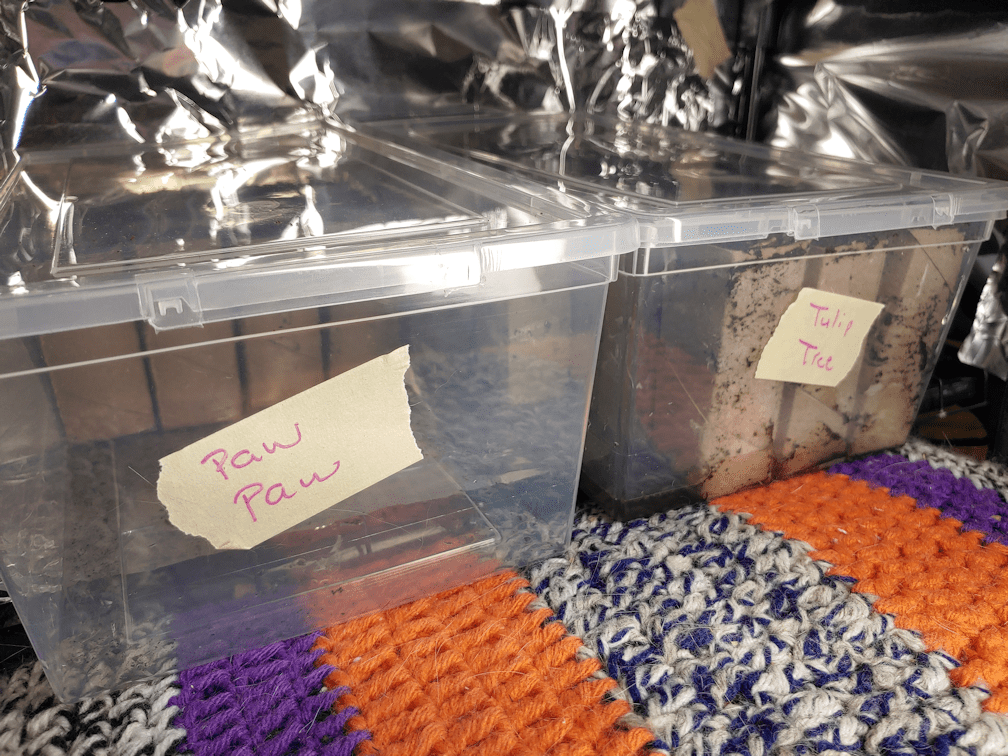
When finishing the toilet tube seed pots we made yesterday, we had to put the lids on the bins, to keep the cats out, so it took quite a while for them to dry.

They still weren’t totally dry, but I figured it was good enough! After all, we’re just going to be bottom watering these, anyhow, so they’re going to get soaked, soon.

I started with the tubes intended for the paw paw seeds. After filling them 3/4s of the way with pre-moistened seed starting soil, I started carefully finding the paw paw seeds in their baggies, while my daughter continued to fill the tubes intended for the tulip tree seeds.

After placing a seed into a pot, soil from the baggie was used to top up the pots. In the above photo, the two on the left have seeds in them.

None of the paw paw seeds showed signs of roots, though they did look more… filled out, shall we say. More rounded. Which is to be expected, considering they’ve been in damp soil all this time.

Once filled, they tucked into the bin a bit more tightly than while empty, which is what I want. It’ll keep them from falling over, and keep the toilet rolls from unraveling when they get wet.

After putting the filled pots back in the bin, they got watered, and any that showed the soil settling quite a bit, got topped up with more soil. Then water was added to the bottom of the bin.

The tulip tree seeds also did not show any signs of roots. In fact, they still looked almost exactly like they did when we first got them, except a bit darker from being in damp soil.

They got watered from above, topped up with more soil as needed, then water added to the bottom of the bin, as well.

They then got lidded and labelled, ready to go into the mini-greenhouse.

The lids will be left on, loosely, to help keep the moisture levels even.

A bit of re-arranging of the other seedlings and trays, and I was able to put these on the two bottom shelves where, even if the cats manage to get in, they will be safe.

Now there’s another reason to use these bins for seed starting. Cat protection!

The instructions they came with said that these take a very long time to germinate, and that the roots will be growing long before the leaves start to show. So we will just keep these moist and otherwise leave them alone. Not having them in the baggies anymore means we won’t get to see those roots, but I think it will be better for them to be in these little pots instead of the baggies. Less chance of the roots getting damaged, I think. It will also be much easier to move them around in these bins, than in the tray that was holding the baggies. Those black trays may fit the shelves in the mini-greenhouse just right, but they are awfully wimpy things, and hard to move around. A couple of them have already started to crack on their edges, from bending in the middle when picked up.

So this is now done. The tree seeds are in little pots and, perhaps in a month or two, we might see sprouts emerge. I have no idea what to expect from these, and am just hoping for the best!

The Re-Farmer

New “toys” and things to repair

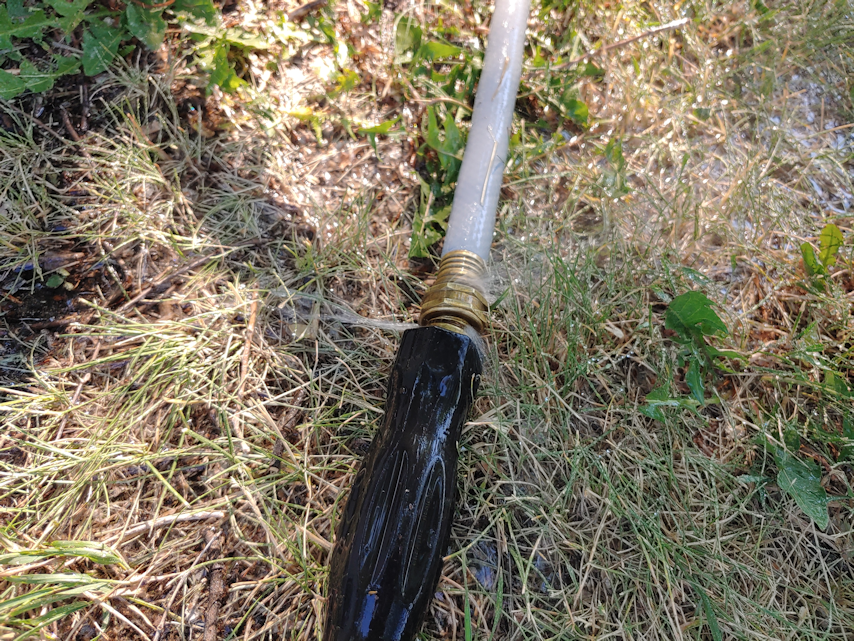
Yesterday, a couple of our hoses sprang a leak. I still used them this morning, to do the morning watering. I took advantage of the leak whenever I could, and placed it where it would at least water something!

The water is spraying out of both hose ends. Where the hose is attached to the tap is also leaking, though nothing as bad as this, so today I headed to the nearer city to pick up what I needed to repair them. I was happy to see a flexible tap attachment that will prevent the hose connector from breaking at the tap, too.

After the watering was done, I took the canister of Critter Ridder and started spreading the granules. I did the old kitchen garden, and just barely had enough left to do the beet bed near the garlic. I figured I would need at least two more to be able to rest.

That turned out to not be an option.

They didn’t have the granules in stock; just the spray. I was going to try the spray when I noticed this.

This should be enough to spray around our beds, including the ones I should have planted in by now, and have some left over for later applications. I hope it works!

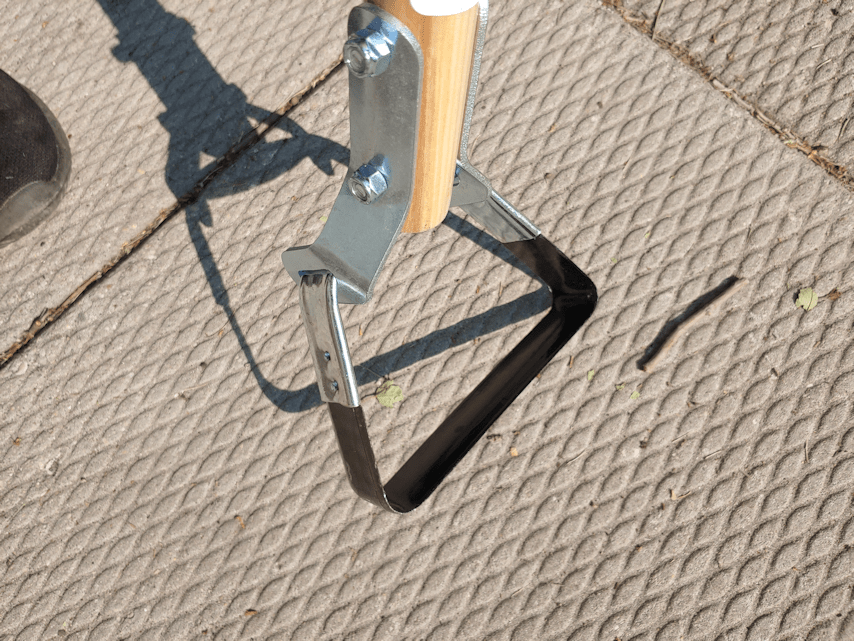
Since I was in the store anyhow, I went looking at the garden tools sections, and was very excited to find one of these.

It’s an “action hoe”. My brother has one and just loves it. They are very hard to find, however, because they sell out so quickly! So I grabbed one, even though it was a stretch on the budget. It will be a huge help, and there are spots I will finally be able to reach and weed properly!

The girls are going to be starting the evening watering, soon, though it will still be in the 30C/86F range. If we wait any longer, it’ll be too dark. Plus, the overnight temperatures will be staying high tonight. We aren’t supposed to drop to 25C/77F until 7am tomorrow, and by then, I’ll be heading out to do the morning watering! I’m hoping to get the hoses repaired before then, but even if I only get a chance to do one or two, it’ll be better than nothing, and the hoses are still useable at least.

Tomorrow is supposed to be our hottest day of the heat wave, with a forecasted high of 36C/97F and a humidex of 39C/102F. After that, we will quickly drop back to average temperatures for July. They are no longer predicting thundershowers for tomorrow, unfortunately. Now it’s just a 40% chance of precipitation, which for our area, probably means none at all. I wold have been happy for a good thunderstorm! We could really use the rain! Still, it means I can apply the animal repellent and not have it washed off right away, I guess.

The Re-Farmer

Cucamelons: first taste!

After looking up and confirming when to start harvesting cucamelons, I went ahead and picked the largest ones.

The fruit doesn’t grow larger than 1 or 2 inches, and we read that if they are left too long, they get really seedy. Which makes sense.

Aren’t they adorable?

There was just enough for 2 each, so the girls and I tried them last night, while I left the last two in the little bowl on the table for my husband to try in the morning.

One of them disappeared.

Either we’re going to step on a cucamelon at some point, or a cat ate it. :-D

So… how did they taste?

Like cucumber, really. :-D The skin to flesh ratio is higher, so you do have more of that slightly bitter flavour of the skin, but just enough to make them distinct. They have a nice crunch, too.

From what we read, picking the fruit makes them more productive, and they will produce for a long time. I look forward to having more of them to gather, soon!

I think these are definitely keepers for future gardening. Apparently, in colder climates with shorter growing seasons like ours, you can even dig up the roots in the fall for spring transplanting, and have earlier production.

Might be worth a try.

The Re-Farmer

They arrived!

My new “toys” came in today – I wasn’t expecting them until next week!

I got myself a beginners wood carving set. :-) With all the interesting woods we’ve been pruning and clearing away, there are all sorts of things I’d rather be doing with them, rather than burning them or having them chipped.

I have no plans to carve figurines or anything like that; that’s just not my thing. But to carve small, useful things, like spoons, spreaders, tiny bowls and the like is right up my alley!

This kit includes safety gloves, three carving knives, including a curved knife for cutting bowls, a leather strop and polishing compound to use on it, and sand paper in a range of grits. Plus, a spoon blank to practice on!

I actually plan to use a piece of scrap wood to practice cuts on, before I start on the spoon blank.

Of course, I’ve been looking up how to use these, and noticed I would need a couple other things. One was a breastplate, so I can safely brace the wood against my chest as I work. My darling husband has already filled that need. He had some heavy leather scraps and glued a couple of pieces together to make an even thicker piece, and cut a couple of holes in the top corners. All I need now is some sturdy cord to put through the holes so I can hang it around my neck. So I now have a very strong, purple breastplate to use! The other thing is something I will need for when I want to carve bowls, and that’s a particular type of chisel to cut away waste wood. The curved blade in the kit is sufficient to carve spoon bowls, and while I will likely be keeping things small – at least for the first while – I will still want to go bigger than a spoon! Plus, I think I have some pieces that might make great cups, and for that, I definitely will want something more appropriate to chisel away the waste wood.

I am really looking forward to testing these out!

The Re-Farmer